That’s More Like It: Multiple Exemplars Facilitate Word Learning
Katherine E. Twomey1, Samantha L. Ranson2 & Jessica S. Horst2*
1University of Liverpool, 2University of Sussex
*Address correspondence to Jessica S. Horst, School of Psychology, Pevensey 1 Building, Falmer, Brighton, East Sussex, BN1 9QH, United Kingdom, email: [email protected].
Acknowledgements
Abstract
That’s More Like It: Multiple Exemplars Facilitate Word Learning
Learning the names for object categories is fundamental to children's ability to make sense of their world and to communicate about it effectively. Perhaps it is not surprising, then, that children’s early vocabularies are dominated by names for object categories (Samuelson & Smith, 1999; Waxman, 2003). Previous research has demonstrated a close relationship between vocabulary acquisition and categorization (e.g., Gopnik & Meltzoff, 1992; Nazzi & Gopnik, 2001; Smith, Jones, Landau, Gershkoff-Stowe & Samuelson, 2002; Thom & Sandhofer, 2009). For example, toddlers with larger productive vocabularies are better able to categorize objects at the basic level (Singer-Freeman & Bauer, 1997) and are better able to appreciate commonalities among category members at the superordinate level (Waxman & Markow, 1995). Although several studies have demonstrated that knowing more words facilitates categorization, it remains unclear whether experience with object categories in turn facilitates word learning.
Learning Names for Object Categories
word retention: having a memory representation of a name-object association that is strong enough to be robust against reasonable delays and changes in context. Indeed, processing demands might prevent young children from learning the correct name-object association after only a single exposure (Mather & Plunkett, 2009).
Retention depends on slow mapping, which occurs gradually over an extended period of time (Capone & McGregor, 2005; Horst & Samuelson, 2008; Munro, Baker, McGregor, Docking & Arculi, 2012). During this phase, repeated encounters with a name and an object allow the child to strengthen the name-object association such that it can be recalled after a delay. For example, the penguin-PENGUIN association will be strengthened each time the child hears the word penguin and plays with her toy PENGUIN in a new situation. Across such situations children learn about the statistical regularity with which names and their referents co-occur
(cross-situational word learning; Smith & Yu, 2008). Clearly, then, repeated exposures are critical for word learning.
As well as learning names for individual items during cross-situational word learning, children also learn names for object categories. Categories are collections of items which share common features, but are still discriminable from each other (Mandler, Fivush, & Reznick, 1987; Quinn, 1986; Rosch, 1975; Younger & Cohen 1985). In the PENGUIN category, for instance, the majority of members share the common features of black-and-white coloring, two legs and the ability to swim, but the individual members are discriminable based on their individual features such as height, wing-span and other species-specific features such as breast coloring.
plastic penguin bath toy in the evening. Whether repeated, cross-situational exposures to the same exemplars or to multiple, different exemplars better facilitates word learning remains unknown.
Encountering Multiple Exemplars
Providing children with the opportunity to compare across multiple exemplars facilitates
categorization (e.g., Kovack-Lesh & Oakes, 2007; Oakes & Ribar, 2005). For example, 6-month-old infants are able to form categories when allowed to compare pairs of different cats, but fail to form categories when presented with pairs of identical cats (Oakes & Ribar, 2005).Further research demonstrates that young children are able to compare between exemplars across trials, that is, across situations (Kovack-Lesh & Oakes, 2007). This is especially important because it demonstrates that cross-situational learning may also occur when forming categories. For example, Kovack-Lesh and Oakes (2007) demonstrated that 10-month-old infants are able to form categories when they are given the opportunity to compare exemplars during the transition between trials. In contrast, infants are unable to form categories with the same items presented in the same sequence if they are not given that opportunity to compare exemplars between trials. That is, simply providing a brief opportunity to compare exemplars allows infants to infants form a category they otherwise do not form. Presenting multiple exemplars also facilitates
phonological acquisition (e.g., Rost & McMurray, 2009). Across several domains, we see that comparison between exemplars helps children to detect both the commonalities and differences between category members, thus inducing categorization.
Importantly, exposure to multiple exemplars facilitates word generalization: extending the name for one exemplar to another object from the same category. For example, when two exemplars are given the same name, children extend this common name to new objects that share perceptual features with the named exemplars (e.g., texture; Graham, Namy, Gentner & Meagher, 2010) or to new objects from the same taxonomic category (Liu, Golinkoff & Sak, 2001; Gentner & Namy 1999). When toddlers are taught color-word vocabularies that include more exemplars (six) they are also better able to generalize novel color names to new instances than toddlers trained on vocabularies that include fewer exemplars (four or two, Thom & Sandhofer, 2009). In addition, when toddlers are trained on multiple, perceptually variable exemplars they experience a significant acceleration in vocabulary growth and are better able to generalize novel names to novel exemplars, in contrast to children who encountered perceptually similar exemplars (Perry, Samuelson, Malloy, & Schiffer, 2010).
However, such studies have focused on how categorization influences word generalization—which is only one part of the word learning puzzle. Full word learning
ultimately requires retention (Horst, McMurray & Samuelson, 2006). To build a vocabulary, children must learn the meanings of words well enough to recall them after a delay or after a change in context (Horst & Samuelson, 2008). Just as it is important to be able to generalize penguin to a never-before-seen PENGUIN, it is also important to be able to remember which
The Current Study
The current study tests the effect of encountering multiple exemplars on children’s gradual, longer-term word learning. Whereas previous studies have focused on how encountering
multiple exemplars affects children’s generalization of novel names, the current study focuses on how encountering multiple exemplars facilitates word retention. Across two experiments, we explored how experience with multiple exemplars during fast mapping facilitates children’s ability to learn and retain names for novel object categories. Experiment 1 explores whether encountering multiple, variable exemplars facilitates word retention and Experiment 2 explores the extent to which variability among exemplars impacts word retention.
We gave children multiple fast mapping trials for each word to better understand how providing children with multiple exemplars across trials facilitates cross-situational word learning. In Experiment 1, children either encountered the same exemplar across trials or
encountered multiple, variable exemplars across trials. If providing children with the opportunity to compare between category exemplars across trials facilitates word learning, then children who fast-mapped multiple exemplars should demonstrate better retention. In Experiment 2, children either encountered multiple, low variability exemplars across trials or encountered multiple, high variability exemplars across trials. If variability among category exemplars influences word learning, then children’s ability to retain novel names should be different between groups.
Experiment 1 Method
Participants. Twenty-four typically developing, monolingual, English-speaking children
aged 2;6 (13 girls, M = 2;6 SD = 43.19 days; range = 2;4 – 2;8) with a mean productive
of colorblindness participated. We tested children in this age range because they tend to enjoy selecting objects in this paradigm and can complete several 3-alternative forced-choice trials without becoming overly tired. Half of the children were randomly assigned to the single exemplars condition, and the other half were randomly assigned to the multiple exemplars condition. Children’s ages and productive vocabularies did not differ between conditions (both ps >.13). Data from two additional children were excluded from analyses due to fussiness and
experimenter error. Parents were reimbursed for travel expenses and children received a small gift for participating.
Stimuli. Eighteen known objects, chosen because they are highly familiar to 2-year-old
children, served as familiar objects: six animals (bird, chicken, elephant, fish, giraffe, lion), six vehicles (boat, bus, car, motorcycle, plane, train), and six household objects (block, chair, comb, cup, toy mobile phone, spoon).
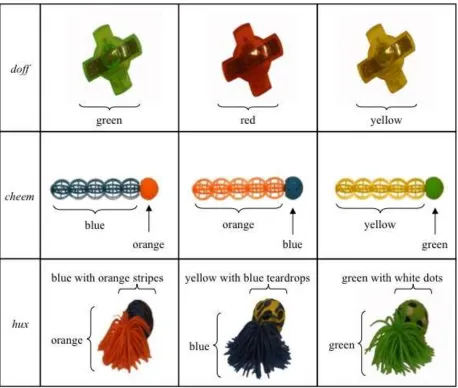
Nine novel objects from three categories, chosen because they are not easily named by 2-year-old children, served as the target objects. Consistent with other studies (e.g., Vlach et al., 2008), the objects in these categories varied in color, but shared the same shape (see Figure 1). The doff category consisted of slightly transparent, plus-sign shaped tops in green, red and yellow. The cheem category consisted of plastic rods with small balls on one end in blue/orange, orange/blue and yellow/green. The hux category consisted of rubber balloons with elastic strings hanging down in blue/orange, green/white and yellow/blue. The balloons kept their shape
because they had foam balls inside. All objects were similar in size (5cm x 8cm x 10cm). Stimuli were presented on a white tray divided into three even sections. A digital kitchen timer was used to time some parts of the experiment (see below).
parent color photographs of the known and novel objects to ensure they were known and novel to the child, respectively (which they were for all children). If the child knew a different name for an object (e.g., “kitty” v. “cat”) the experimenter used that name.
During the experiment, children were seated in a booster seat at a white table across from the experimenter. Parents sat next to their children and completed a vocabulary checklist (Klee & Harrison, 2001) and were instructed to only encourage children during the warm-up trials, if necessary (for similar instructions see Zosh, Brinster & Halberda, 2013).
Warm-up trials. Each session began with three warm-up trials to introduce children to the
task. On each trial, children were presented with three randomly selected known objects. First, the experimenter set the tray of objects on the table and silently counted for three seconds to give the child an opportunity to look at the objects (see Horst, Scott, & Pollard, 2010). Then, the experimenter asked the child to select an object by naming it twice (e.g., “Can you find the block? Can you get the block?”) before sliding the tray forward. Children were praised heavily for correct responses and corrected if necessary. Between trials the experimenter replaced the tray on her lap and arranged the objects for the next trial out of the child’s view. The same objects were presented on each warm-up trial, but object positions (left, middle, right) were pseudo-randomized across trials, to ensure children practised choosing an item at each possible location. Thus, children were asked for a different object in a different position on each trial and the order of locations varied across children. Warm-up stimuli were later used as known objects during the referent selection trials (see Horst & Samuelson, 2008).
Referent Selection Task. Referent selection trials immediately followed the warm-up
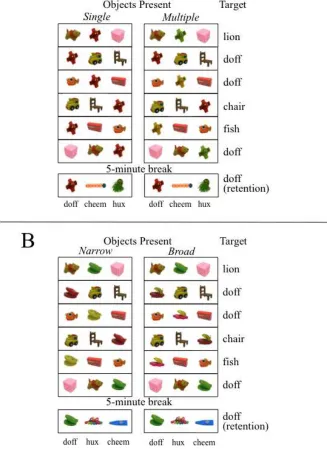
Panel A depicts an example procedure for one of the categories encountered by children during the referent selection task. Each child was presented with nine sets and saw each set once on a known name trial and once on a novel name trial for a total of 18 referent selection trials. Known name referent selection trials were included as a control to ensure that children were mapping the names to the targets and not simply mapping novelty to novelty (see also Horst, Samuelson, Kucker & McMurray, 2011; Mather & Plunkett, 2012). Each set included two familiar objects (e.g., boat and cup) and one novel object (e.g., top). Different familiar objects were used in each set to provide cross-situational learning opportunities across trials. Children in the multiple exemplars condition saw a different novel exemplar in each set. For example, a child might see the green top with the block and lion, the red top with the chair and train and the yellow top with the bus and fish (see Figure 2, Panel A). Children in the single exemplars condition saw the same exemplar in each set. For example, a child might see the green top with the block and lion, and again the chair and train and once more with the bus and fish. Thus, the only difference between conditions was whether children saw one or three exemplars from each category.
Referent selection trials were presented in three blocks. For example, one child
completed all trials with the top category, then all trials with the rod category and finally all trials with the balloon category. Block order was counterbalanced across participants using a Latin Square design. The order of known and novel trials was pseudo-randomized in each block such that the same set (e.g., green top, lion, block) was never presented on two consecutive trials and no more than two trials of either type (i.e., known or novel) were presented sequentially. Object position (left, middle, right) was randomly determined on each trial.
was included to ensure that children’s retention was based on long-term memory representations for the novel name-object associations formed during the referent selection phase rather than short-term maintenance (for a similar argument see, Horst & Samuelson, 2008). Previous research suggests delays are necessary to ensure full word learning has occurred (Bloom, 2000) and are more akin to how children learn to use new words in the real world than test trials that immediately follow the initial referent selection trial.
Retention task. The retention task was the same in both conditions and provided our
critical test of cross-situational word learning. On these trials all of the objects were equally novel; therefore, these trials could not be solved by employing process of elimination to exclude known objects. Instead, correctly choosing the target object required having learned the name-object associations across referent selection trials. Importantly, because additional supportive cues (e.g., ostensive naming, Horst & Samuelson, 2008) were not provided, children could only solve these trials if they had engaged in cross-situational learning across referent selection trials.
To re-engage children in the task, a new warm-up trial with three different known objects was presented. This was immediately followed by three retention trials, during which children saw three novel exemplars: one from each novel category (top, rod, balloon). Importantly, each of the novel objects presented on the retention trials had been previously seen during the referent selection trials and served as both a target and a distractor. This ensured that the test alternatives were equally novel, as object novelty can bias children’s behavior in word learning experiments (Axelsson & Horst, in press; Horst et al., 2011). The same exemplars were presented on each trial for a given child. In the multiple exemplars condition, which previously-seen exemplars (i.e., which top, which rod, which balloon) were presented was counterbalanced across
encountered earlier. Object positions were randomized across trials and children were asked for a different novel object in a different position on each trial.
Coding. As in previous studies only the words that a child correctly fast-mapped at least once during the referent selection trials were included in the analyses of the child’s retention (e.g., Gray & Brinkley, 2011; Kucker & Samuelson, 2012). Children’s responses were coded offline from DVD. A second coder blind to the experimental hypotheses coded 20% of the sessions of both experiments for reliability. Inter-coder agreement was high, M = 97.94%, SD = 3.31% (range = 92.31% – 100.00%).
Results and Discussion
selection trials.
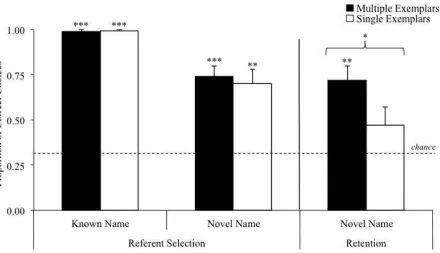
Our main question in this experiment was whether encountering multiple exemplars or the same exemplars repeatedly during referent selection influenced retention. As can be seen in the right panel of Figure 3, only children in the multiple exemplars condition (M = 0.72, SD = 0.27) retained more names than expected by chance (.33), t(11) = 5.00, p < .001, d = 1.46. Children in the single exemplars condition (M = 0.47, SD = 0.32) failed to retain more words than expected by chance, t(11) = 1.47, ns, d = .441. An unpaired t-test confirmed that children who encountered multiple exemplars retained more words than children who encountered the same exemplars repeatedly, t(22) = 2.06, p ≤ .05, 2 = .16. Taken together, then, these data clearly demonstrate that encountering multiple exemplars during referent selection facilitates word retention.
In this experiment, children in the multiple exemplars condition encountered categories of novel objects, while those in the single exemplars condition encountered the same objects repeatedly. Children who were taught names for categories learned more words than those who were taught names for single objects. Put another way, children who encountered variable exemplars learned more words than children who encountered identical exemplars. However, within each category, exemplars varied only in color, meaning that children encountered only restricted variability. Thus, while Experiment 1 demonstrates that encountering multiple,
variable exemplars influences word retention, it does not inform our understanding of the extent to which within-category variability influences retention.
(e.g., Perry et al., 2010). For example, in a seminal study, Quinn and colleagues (1993)
demonstrated that infants familiarized with a category with low within-category varibaility (cats) formed a narrow category which excluded out-of-category items (i.e., cats but not dogs), while infants familiarized with a category with high within-category variability (dogs) formed a broad category that included members of both categories (i.e., dogs and cats). Later, when within-category variabilty of the variable within-category was reduced, infants formed a narrow within-category (i.e., dogs but not cats), demonstrating that it was the the extent of the within-category variability that led to the original effect. Within-category variability also influences word generalization. When toddlers are taught names for categories with high within-category variability they develop more sophisticated word generalization biases than those taught names for categories with low within-category variability (Perry et al., 2010). However, precisely how within-within-category variability influences word retention remains unknown.
Therefore, to better understand how encountering multiple, variable exemplars affects word retention, we manipulated within-category variability in Experiment 2. Specifically, we presented all children with multiple exemplars during the initial referent selection task. However, half of the children were presented with narrow categories (i.e., low within-category variability) and the other half of the children were presented with broad categories (i.e., high within-category variability).
Experiment 2 Method
Participants. Twenty-four typically developing, monolingual, English speaking children
history of colorblindness participated. Half of the children were randomly assigned to the narrow exemplars condition and the other half were randomly assigned to the broad exemplars
condition. Children’s ages and productive vocabularies did not differ between conditions (both ps > .48). Data from four additional children were excluded from analyses due to fussiness (2)
and parental interference (2). Parents were reimbursed for travel expenses and children received a small gift for participating.
Stimuli. Eighteen known objects, chosen because they are highly familiar to 2-year-old children, served as familiar objects: seven animals (cow, chicken, elephant, fish, giraffe, lion, turtle), six vehicles (boat, bus, car, motorcycle, plane, train), and five household objects (block, cup, fork, phone, spoon).
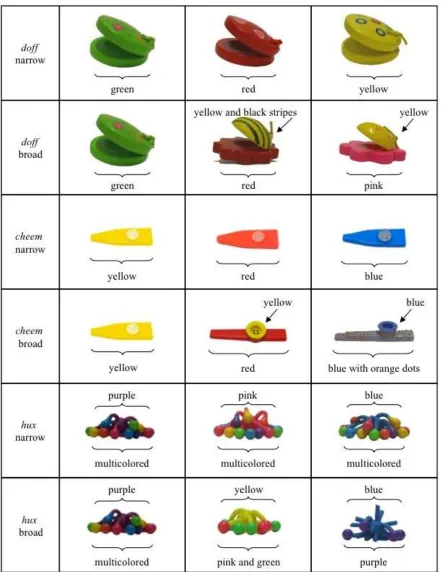
Fifteen novel objects from three categories, chosen because they are not easily named by 2-year-old children, served as the target objects (see Figure 4). Between conditions these novel objects either varied along one dimension (color in the narrow condition) or multiple dimensions (e.g., color, size and texture in the broad condition). That is, the novel objects used in the narrow condition had low within-category variability and those used in the broad condition had higher within-category variability2.
caps on the ends (the caps were purple, blue, yellow, pink and green).
Children in the broad exemplars condition also encountered nine of the novel objects (see Figure 4). For these children, the doff category consisted of wooden castanets including one with a green base with a green top and flowers, one with a red pointy base with a yellow top with black stripes and one with a pink scalloped base with a yellow top with pink dots. The cheem category consisted of plastic kazoos that were small and yellow, large and red and large and blue with orange dots. The hux category consisted of rubber pom-poms in purple, blue and yellow with multicolored, plastic caps on the ends. The blue pom-pom had the same number of ends as the purple pom-pom but only half of the ends had caps (all purple). The yellow pom-pom had fewer ends than the others but all the ends had caps (green and pink).
Importantly, one exemplar from each category was seen by children in both conditions: the green castanet (doff), the yellow kazoo (cheem) and the purple pom-pom (hux). The only difference between conditions was the within-category variability of the novel categories. For children in the narrow exemplars condition, the categories only varied in color, however, for children in the broad exemplars condition the categories varied in color, texture, size and slightly in overall shape (due to the castanet base, kazoo length and number of caps, respectively). All objects were similar in size (3cm x 7cm x 10cm).
Procedure and design. All aspects of the experiment were identical to Experiment 1
except different stimuli were used so that within-category variability could be controlled. Results and Discussion
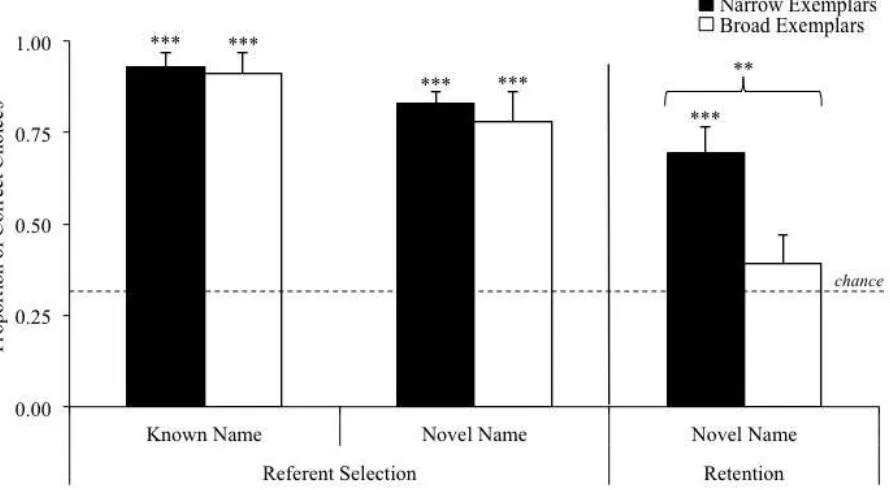
task. On known name referent selection trials, children’s proportion of target choices were greater than would be expected by chance (.33) for both children in the narrow exemplars condition (M = 0.91, SD = 0.19), t(11) = 10.56, p < .0001, d = 3.05, and children in the broad exemplars condition (M = 0.93, SD = 0.12), t(11) = 17.51, p < .0001, d = 5.05. There was no difference between conditions, t(22) = 0.28, ns. On novel name referent selection trials, children’s proportion of target choices was also greater than expected by chance (.33) for both children in the narrow exemplars condition (M = 0.78, SD = 0.26), t(11) = 5.99, p < .0001, d = 1.73 and children in the broad exemplars condition (M = 0.83, SD = 0.11), t(11) = 15.67, p < .0001, d = 4.52. Again, there was no difference between conditions, t(22) = 0.63, ns. Thus, whether children encountered narrow or broad categories during referent selection did not influence children’s performance on either known or novel name referent selection trials.
Our main question in this experiment was whether encountering narrow or broad
categories during referent selection influenced children’s ability to retain and extend novel name-object mappings. As can be seen in the right panel of Figure 5, only children in the narrow exemplars condition (M = 0.69, SD = 0.27) retained more names than expected by chance (.33), t(11) = 4.73, p < .001, d = 1.38. In contrast, children in the broad exemplars condition (M = 0.39,
General Discussion
Across two experiments, we explored how encountering multiple exemplars during fast mapping facilitates children’s retention of new words. In Experiment 1, we presented 2-year-old children with multiple referent selection trials with the same object category. Children either encountered the same exemplar repeatedly or multiple exemplars across trials. Overall, all children did very well on the initial referent selection task. However, only children who
encountered multiple exemplars demonstrated that cross-situational learning had occurred across referent selection trials by retaining the previously fast-mapped novel names after a delay. Further, these children demonstrated significantly better retention than children who only encountered the same exemplar repeatedly. In Experiment 2, all children were presented with multiple exemplars, however, children either encountered narrow (low within-category variability) or broad (high within-category variability) categories. Again, all children did very well on the referent selection task, but only children who encountered narrow exemplars retained the previously fast-mapped novel names after a delay.
Overall, these data demonstrate that experience with multiple exemplars facilitates cross-situational word learning by improving retention of fast-mapped names for object categories. Other studies that have explored the relationship between vocabulary and categorization have typically tested children over a long time scale, such as several weeks (Ellis & Oakes, 2006; Perry et al., 2010). However, the current study reveals that exposing children to an object
finding to demonstrate that toddlers can compare between exemplars presented on different trials in a fast mapping task.
The Current Study in Context
Previous research that has investigated how multiple exemplars influence children’s word learning has done so by presenting multiple exemplars at test. Typical test trials include another exemplar from the same category, a completely novel foil and two known objects (e.g., Mervis & Bertrand, 1994; Golinkoff et al., 1992). However, any delay is minimal (e.g., 1-2 trials later), thus we cannot be sure that we are testing children’s long-term memory (i.e., retention) for the name-object associations rather than their working memory. Other studies have included a delay and these test trials include the same previously-encountered exemplar, another exemplar from the same category and a novel foil (e.g., Jaswal & Markman, 2003; Waxman & Booth, 2000). However, as in the method noted above, the relative novelty of the test alternatives is not controlled (e.g., Vlach, Sandhofer & Kornell, 2008), which can lead to children responding simply based on an endogenous bias to novelty (Horst et al., 2011).
The current study is the first to present multiple exemplars during referent selection to provide an opportunity to compare across exemplars during fast mapping in order to test the effect of comparison on word retention. Note: other studies that have tested children’s retention for name-object associations learned via fast mapping have only included one exemplar for each category (e.g., Horst & Samuelson, 2008; Kucker & Samuelson, 2011). In addition, in the current study, the relative novelty of the test alternatives was controlled as each had previously served as a target and each had been encountered the same number of times. Although previous research has tested the strength of children’s newly formed name-object category associations by
the role of comparison in cross-situational word learning by manipulating the strength of
children’s name-object category associations formed across encounters with multiple exemplars (but see Ankowski, Vlach & Sandhofer, 2012 on word generalization).
How Comparison Facilitates Retention
The current study also adds to a growing body of literature demonstrating that applying a common name to multiple objects invites children to compare across items, drawing their attention to shared commonalities (Casasola et al., 2009; Gentner & Namy, 1999; Namy & Gentner, 2002; Plunkett, et al., 2008). While repeated encounters with a novel name likely strengthened stored name-object associations for all children, only encountering multiple object exemplars led to name-object associations strong enough to withstand a short delay.
have demonstrated better novel name retention when children’s attention is directed toward critical information and away from irrelevant information (e.g., Horst & Samuelson, 2008; Axelsson et al., 2012).
Children in the single exemplars condition did not learn the novel names at rates greater than expected by chance. Again, this is consistent with findings from the infant categorization literature that when children are not provided with the opportunity to compare between multiple exemplars they fail to form a category (Oakes & Ribar, 2006; Kovack-Lesh & Oakes, 2007). Because single exemplars do not help direct children’s attention to one particular feature,
children may be attempting to encode too much information (shape, color, size, weight, material, texture), leaving fewer attentional resources for committing the name-object associations into long-term memory. Consequently, each feature may be encoded too weakly to facilitate retention after so few fast mapping trials. In contrast, multiple exemplars help children extract what is common among category members (e.g., balls are round, cups are cup-shaped, huxes are round with strings; see Smith et al., 2002), which may free up attentional resources to aid
encoding.
The Effect of Variability
learn names for broad categories such as insects, construction vehicles and other superordinate categories, in both the real world and experimental environments (Pauen, 2002; Younger & Fearing, 2000). It is possible that children simply need more exposures to learn names for such highly variable categories because of the greater attentional demands of processing such stimuli.
Previous research, however, has demonstrated an advantage for encountering highly variable exemplars (e.g., Perry et al., 2010). Importantly, this advantage for high within-category variability promoted word generalization. Here we find that low within-category variability promotes word retention (for a demonstration of these effects in neural network models see Twomey & Horst, 2011; Twomey, Morse & Horst, 2013).
Future research is needed to better understand how children learn to retain names for broad categories (e.g., insects, construction vehicles) and how they learn to generalize names for narrow categories (e.g., pencils, scissors). In the context of evidence suggesting that
categorization is at least initially perceptually-based (Quinn et al., 1993), future research should examine children’s fine-grained encoding of both narrow and broad categories and factors that might facilitate both generalization and retention such as the number of encounters, the number of exemplars and time spent exploring the individual objects.
Conclusions
References
Ankowski, A. A., Vlach, H. A., & Sandhofer, C. M. (2012). Comparison versus contrast: Task specifics affect category acquisition. Infant and Child Development 22(1).
Axelsson, E. L., & Horst, J. S. (in press). Testing a word is not a test of word learning. Acta Psychologica.
Bloom, P. (2000). How children learn the meanings of words. Cambridge, MA: The MIT Press. Capone, N. C., & McGregor, K. K. (2005). The effect of semantic representation on toddlers’
word retrieval. Journal of Speech, Language, and Hearing Research, 48(6), 1468-1480. Carey, S. (1978). The child as word learner. In M. Halle, J. Bresnan & A. Miller (Eds.),
Linguistic Theory and Psychological Reality (pp. 264-293). Cambridge, MA: MIT Press. Casasola, M., Bhagwat, J., & Burke, A. S. (2009). Learning to form a spatial category of tight-fit
relations: How experience with a label can give a boost. Developmental Psychology, 45(3), 711-723.
Ellis, A. E., & Oakes, L. M. (2006). Infants flexibly use different dimensions to categorize objects. Developmental Psychology, 42(6), 1000-1011.
French, R. M., Mareschal, D., Mermillod, M. & Quinn, P.C. (2004). The role of bottom-up processing in perceptual categorization by 3- to 4-month-old infants: Simulations and data. Journal of Experimental Psychology: General, 133(3), 382-397.
Gentner, D. (2003). Why we're so smart. In D. Gentner & S. Goldin-Meadow (Eds.), Language in mind: Advances in the study of language and thought. (pp. 195-235). Cambridge, MA: MIT Press.
Gentner, D., & Namy, L. L. (1999). Comparison in the development of categories. Cognitive Development, 14, 487-513.
Golinkoff, R. M., Hirsh-Pasek, K. Bailey, L. M. & Wenger, N. R. (1992). Young children and adults use lexical principles to learn new nouns. Developmental Psychology (28)1, 99-108.
Gopnik, A., & Meltzoff, A. (1992). Categorization and naming: Basic-level sorting in eighteen-month-olds and its relation to language. Child Development, 63(5), 1091–1103.
Graham, S. A., Namy, L. L., Gentner, D., & Meagher, K. (2010). The role of comparison in preschoolers’ novel object categorization. Journal of Experimental Child Psychology, 107(3), 280–290. doi:10.1016/j.jecp.2010.04.017
Gray, S. & Brinkley, S. (2011). Fast mapping and word learning by preschoolers with specific language impairment in a supported learning context: Effect of encoding cues,
phonotactic probability, and object familiarity. Journal of Speech, Language and Hearing Research, 54, 870-884.
Horst, J. S. (2013). Context and repetition in word learning. Frontiers in Developmental Psychology, 4(149), 1-11. doi:10.3389/fpsyg.2013.00149
Horst, J. S., Parsons, K. L., & Bryan, N. M. (2011). Get the story straight: contextual repetition promotes word learning from storybooks. Frontiers in Psychology, 2.
doi: 10.3389/fpsyg.2011.00017
Horst, J. S., & Samuelson, L. K. (2008). Fast mapping but poor retention by 24-month-old infants. Infancy, 13(2), 128-157.
Horst, J. S., Samuelson, L. K., Kucker, S. C., & McMurray, B. (2011). What’s new? Children prefer novelty in referent selection. Cognition, 118(2), 234–244.
referent selection. Developmental Science, 13(5), 706-713.
Jaswal, V. K. & Markman, E. M. (2003). The relative strengths of indirect and direct word learning. Developmental Psychology, 29(4), 745-760.
Kemler Nelson, D. G., O'Neil, K. A., & Asher, Y. M. (2008). A mutually facilitative relationship between learning names and learning concepts in preschool children: The case of
artifacts. Journal of Cogntiion and Development, 9(2), 171-193.
Klee, T., & Harrison, C. (2001). CDI words and sentences: Validity and preliminary norms for British English. Paper presented at the Child Language Seminar, University of
Hertfordshire.
Kovack-Lesh, K. A., & Oakes, L. M. (2007). Hold your horses: How exposure to different items influences infant categorization. Journal of Experimental Child Psychology, 98(2), 69-93. doi: 10.1016/jjecp.2007.05.001
Kovack-Lesh, K. A., Horst, J. S., & Oakes, L. M. (2008). The cat is out of the bag: Previous experience and online comparison jointly influence infant categorization. Infancy 13(4), 285-307.
Kucker, S. C., & Samuelson, L. K. (2011). The first slow step: Differential effects of object and word-form familiarization on retention of fast-mapped Words. Infancy 17(3), 295-323. Liu, J., Golinkoff, R. M., & Sak, K. (2001). One cow does not an animal make: Young children
can extend novel words at the superordinate level. Child Development, 72(6), 1674-1694. Mandler, J. M., Fivush, R., & Reznick, J. S. (1987). The Development of Contextual Categories.
Cognitive Development, 2(4), 339–354.
Mareschal, D., & Quinn, P. C. (2001). Categorization in infancy. Trends in Cognitive Sciences, 5(10), 443–450.
Mather, E., & Plunkett, K. (2009). Learing words over time: The role of stimulus repetion in mutual exclusivity. Infancy, 14(1), 60-76.
Mather, E., & Plunkett, K. (2012). The role of novelty in early word learning. Cognitive Science, 36, 1157-1177.
McGregor, K. K., Newman, R. M., Reilly, R. M., & Capone, N. C. (2002). Semantic
representation and naming in children with specific language impairment. Journal of Speech Language and Hearing Research, 45(5), 998–1015. doi: 10.1044/1092-4388(2002/081)
McMurray, B., Horst, J. S., & Samuelson, L. K. (2012). Word learning emerges from the interaction of online referent selection and slow associative learning. Psychological Review, 119(4), 831.
Mervis, C. B. & Bertrand, J. (1994). Acquisition of the Novel Name-Nameless Category (N3C) principle. Child Development, 65(6), 1646-1662.
Munro, N., Baker, E., McGregor, K., Docking, K., & Arculi, J. (2012). Why word learning is not fast. Frontiers in Psychology, 3.
Murphy, G. L. (2002). The Big Book of Concepts. MIT Press. Cambridge, MA.
Namy, L. L., & Gentner, D. (2002). Making a silk purse out of two sow's ears: Young children's use of comparison in category learning. Journal of Experimental Psychology: General, 131(1), 5-15.
Nazzi, T., & Gopnik, A. (2001). Linguistic and cognitive abilities in infancy: when does language become a tool for categorization? Cognition, 80(3), B11–B20.
Psychology: Learning, Memory, and Cognition, 10(1), 104.
Oakes, L. M., Coppage, D. J., & Dingel, A. (1997). By land or by sea: The role of perceptual similarity in infants’ categorization of animals. Developmental Psychology, 33(3), 396– 407.
Oakes, L. M., & Ribar, R. J. (2005). A comparison of infants’ categorization in paired and successive presentation familiarization tasks. Infancy, 7(1), 85–98.
Pauen, S. (2002). The global-to-basic level shift in infants’ categorical thinking: First evidence from a longitudinal study. International Journal of Behavioral Development, 26(6), 492– 499. doi: 10.1080/01650250143000445
Perry, L. K., Samuelson, L. K., Malloy, L. M., & Schiffer, R. N. (2010). Learn locally, think globally: Exemplar variability supports higher-order generalization and word learning. Psychological Science, 21(12), 1894-1902.
Plunkett, K., Hu, J. F., & Cohen, L. B. (2008). Labels can override perceptual categories in early infancy. Cognition, 106(2), 665-681. doi: 10.1016/j.cognition.2007.04.003
Quinn, P. C. (1986). The categorical representation of visual pattern information by young infants. Cognition, 27. 145-179.
Quinn, P. C., Eimas, P. D., & Rosenkrantz, S. L. (1993). Evidence for representations of perceptually similar natural categories by 3-month-old and 4-month-old Infants. Perception, 22(4), 463-475.
Quinn, P. C., & Eimas, P. D. (1998). Evidence for a global categorical representation of humans by young infants. Journal of Experimental Child Psychology, 69(3), 151–174.
Ribar, R. J., Oakes, L. M., & Spalding, T. L. (2004). Infants can rapidly form new categorical representations. Psychonomic Bulletin & Review, 11(3), 536-541.
Riches, N. G., Tomasello, M., & Conti-Ramsden, G. (2005). Verb learning in children with SLI: Frequency and spacing effects. Journal of Speech, Language, and Hearing Research, 48(6), 1397.
Rosch, E. (1975). Cognitive representations of semantic categories. Journal of Experimental Psychology-General, 104(3), 192-233.
Rost, G. C., & McMurray, B. (2009). Speaker variability augments phonological processing in early word learning. Developmental Science, 12(2), 339–349.
Samuelson, L. K., & Smith, L. B. (1999). Early noun vocabularies: Do ontology, category structure and syntax correspond? Cognition Vol 73(1) Nov 1999, 1-33.
Singer-Freeman, K. E., & Bauer, P. J. (1997). Sorting out language and level: Examining the relation between productive vocabulary and category differentiation. First Language, 17(51, part3), 241–270.
Smith, L. B., Jones, S. S., Landau, B., Gershkoff-Stowe, L., & Samuelson, L. (2002). Object name learning provides on-the-job training for attention. Psychological Science, 13(1), 13–19.
Smith, L. B., & Yu, C. (2008). Infants rapidly learn word-referent mappings via cross-situational statistics. Cognition, 106, 1558-1568.
Thom, E. E., & Sandhofer, C. M. (2009). More is more: The relationship between vocabulary size and word extension. Journal of Experimental Child Psychology, 104(4), 466-473. doi: 10.1016/j.jecp.2009.07.004
York, UK.
Twomey, K. E., Horst, J. S., & Morse, A. F. (2013). An embodied model of young children’s categorization and word learning. In L. J. Gogate & G. Hollich (Eds.), Theoretical and Computational Models of Word Learning: Trends in Psychology and Artificial
Intelligence (pp. 172–196). Hershey, PA: Information Science Reference. Retrieved from doi:10.4018/978-1-4666-2973-8.ch008
Vlach, H., Sandhofer, C. M., & Kornell, N. (2008). The spacing effect in children's memory and category induction. Cognition, 109(1), 163-167.
Waxman, S. R. (2003). Links between object categorization and naming: Origins and emergence in human infants. In D. H. Rakison & L. M. Oakes (Eds.), Early category and concept development: Making sense of the blooming, buzzing confusion. (pp. 213-241). New York: Oxford University Press.
Waxman, S. R. & Booth, A. E. (2000). Principles that are invoked in the acquisition of words, but not facts. Cognition, 77(2), B33-B43.
Waxman S. R., & Markow Dana, B. (1995). Words as invitations to form categories: Evidence from 12-to 13-month-old infants. Cognitive psychology, 29(3), 257–302.
Younger, B. A., & Cohen, L. B. (1983). Infant perception of correlations among attributes. Child Development, 54(4), 858-867.
Younger, B. A., & Fearing, D. D. (2000). A global-to-basic trend in early categorization: Evidence from a dual-category habituation task. Infancy, 1(1), 47–58.
doi:10.1207/s15327078in0101_05
Footnotes:
1 The same pattern was observed when non-parametric Wilcoxon-Signed Rank tests were used: Multiple exemplars, V = 55, p < .01; single exemplars, V = 63, ns.
2 To confirm that the broad stimuli were more perceptually variable than the narrow stimuli, 18 adults from the university community provided similarity ratings using an 11-point Likert scale (1 = very similar, 11 = not similar at all), thus larger scores indicated exemplars were more perceptually variable. Adults were tested individually and compared the exemplar that was the same between conditions (e.g., the green castanet) to each of the other exemplars from that set (e.g., the red, yellow, flower-base and striped castanets). Ratings confirmed that the broad stimuli (M = 7.30, SD = 1.61) were more perceptually variable than the narrow stimuli (M = 2.54, SD = 0.81), t(17) = 14.02, p < .001, two-tailed.
Figure 2. Examples of what children saw across trials in a single referent selection block in
Figure 3. Children’s proportion of correct choices in Experiment 1. Dotted line represents chance
Figure 5. Children’s proportion of correct choices in Experiment 2. Dotted line represents chance