EXPLORING PARTICIPATORY DESIGN FOR SNS-BASED
AEH SYSTEMS
Lei Shi, Dana Al Qudah and Alexandra I. Cristea University of Warwick - Coventry, CV4 7AL. UK
ABSTRACT
The rapidly emerging and growing social networking sites (SNS) offer an opportunity to improve adaptive e-learning experience by introducing a social dimension, connecting users within the system. Making connections and providing communication tools can engage students in creating effective learning environment and enriching learning experiences. Researchers have been working on introducing SNS features into adaptive educational hypermedia systems. The next stage research is centered on how to enhance SNS facilities of AEH systems, in order to engage students’ participation in collaborative learning and generating and enriching learning materials. Students are the core participants in the adaptive e-learning process, so it is essential for the system designers to consider students’ opinions. This paper aims at exploring how to apply participatory design methodology in the early stage of the SNS-based AEH system design process.
KEYWORDS
Adaptive Educational Hypermedia System; E-Learning; Social Networking; Participatory Design; Requirement Analysis.
1.
INTRODUCTION
Adaptive Educational Hypermedia (AEH) is the first and most popular research area of adaptive hypermedia systems, which combines the ideas from adaptive hypermedia and intelligent tutoring systems, with the aim of producing applications in which the content is adapted to each learner’s needs, such as knowledge level, learning goal, preferences, stereotypes, cognitive and learning styles (Brusilovsky, 2004). One of the key issues in AEH system is how to engage students in continuous interaction with the system.
The rapidly emerging and growing social networking tools offers an opportunity to improve the adaptive e-learning experience by introducing a social dimension, connecting users within the system. The benefits of making connections and providing communication tools provide inquiry-based collaboration (McLoughlin, 2007). Besides, students can also be more motivated to contribute to creating effective learning environment and enriching learning experiences with the collaboration and feedback from their peers (Dabbagh, 2011).
Researchers have been recently working on introducing social networking features into AEH systems. For instance, the LAOS framework for adaptive learning (Cristea, 2003) has been extended to SLAOS by adding a social layer, based on which a system called MOT 2.0 (Ghali, 2009) was developed. MOT 2.0 introduced some social facilities, such as the ability to hold a discussion via chat tool, to rate, tag learning items, and get recommendations of advanced learners to contact (Cristea, 2011). The KS II system provides structured access to open corpus web resources, by providing map-based social navigation support according to the users’ prior behaviors as well as the group activities that they participated in (Brusilovsky, 2006).
The next stage of this research line is centered on how to enhance social networking facilities, in order to engage students’ participation in collaborative learning and generating and/or enriching learning materials.
This paper aims at exploring how to apply the participatory design methodology for SNS-based AEH system design at an early stage, and extract an ordered list of application requirements.
The remainder of the paper is organized as follows. Section 2 describes what the participatory design is and why We!Design was chosen in our research. Section 3 presents how We!Design was applied in the experiment. Section 4 and Section 5 present the discussion and conclusion respectively.
2.
METHODOLOGY
According to (March, 2005), “New and unexpected interactions with the immaterial have expanded the design territory to include people as designers.” Rather than the traditional view that end-users are not necessary to participate in the design process before the requirement gathering phase, PD requires that designers and end-users to equally work together to set design goals and plan prototypes. PD provides 1) an opportunity for end-users to participate in the design process, so the probability of a usable design is increased; 2) a chance for application designers to work with the end-users, so they can have a better understanding of end-users’ needs; and 3) a tool that helps identify the issues and solutions. Especially, the PD approach has been successfully used in the design of web-based learning systems (Rashidah, 2011).
Early PD mainly introduced the potential end-users’ participation into the design process of ICT systems, while the recent one broadens cross-domains and uses a vast set of approaches in both research communities and commercial context (Sanders, 2010). Research on students as co-designers of learning systems appeals to researchers increasingly. Könings et al. asserts that “participatory design can be adapted for use in education as a promising approach to better account for students’ perspectives in the instructional design process in different school subjects” (Könings, 2010). Seale claims that participatory methods have “the potential to both empower students and increase the possibility that teachers will respond to student voices” (Seale, 2009). Many PD approaches introduce students as co-designers in the design process, and bring together design techniques of needs assessment, evaluation, brainstorming, prototyping and consensus building, etc.
Triantafyllakos et al. have proposed the We!Design as a new participatory design methodology which involves students in the design process of e-learning system (Triantafyllakos, 2008). It brings some merits compared to other PD methodologies: 1) conducts cooperation between students and designers in a short period of time; 2) supports a content-independent learning process, including note-taking and assessment, and 3) exploits the potential of highly computer-literate students who are driven to collaborate in order to produce a description of needs, task sequences and user interface prototypes (Triantafyllakos, 2008). For these reasons, we have opted to use the We!Design methodology in our research for requirements analysis.
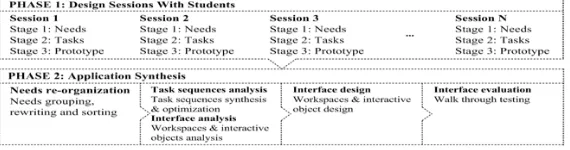
The We!Design methodology includes 2 phases (see Figure 1). In phase 1, several parallel design sessions are conducted with small groups of students. Each session contains three stages, including needs collecting,
[image:2.595.164.449.526.601.2]tasks sequencing and prototype designing. Design sessions take place under the supervision of coordinators, aiming to propose a low-tech prototype and a requirements list. In the 2nd phase, the system designers analyze the requirements and synthesize them into a single application, with an ordered requirements list. In the following section, these phases are instantiated with the actual data from the performed experiment.
Figure 1. The We!Design Methodology (Triantafyllakos, 2008)
3.
EXPERIMENT
systems, including LearnFit (Essaid, 2010), AHA! (De Bra, 2003) and MOT 2.0 (Ghali, 2009). Then, the coordinator introduced the concept of SNS to the students. All the students were familiar with SNS, such as Facebook, Google+ and YouTube, etc. The students were also familiar with UML and UML-based design.
Thereafter the students could take upon themselves the main roles of discussing and presenting, while the coordinators were in charge of time controlling and summarizing. The seminar focused on the features of the AEH systems and SNS, and aimed to acquaint the students with both domains, and encourage them to think deeply about these two kinds of system, so they could integrate both to design new SNS-based AEH systems.
3.1 Phase 1: Design Session with Students
In phase 1, two parallel design sessions were conducted with the participation of 2 coordinators and 6 4th year undergraduate students from ‘Politehnica’ University of Bucharest, Romania, studying a course of ‘Semantic Web’. Each design session was comprised of 2 students and 2 coordinators, and lasted for about 150 minutes. The students sat around a table with paper and pens to write down ideas and draw the prototype user interface. The coordinators guided the students and facilitated their collaboration throughout the session, and provided support without interfering decision making. Besides the common duties, one coordinator was a domain expert in AEH systems and in charge of preventing the students’ proposals from diverging too far from the main system design goals; the other coordinator was a human computer interaction expert whose responsibility was to preserve the usability of the designed system (Triantafyllakos, 2008). The whole design process was recorded by a video camera to keep all the details, so the coordinators could focus on conducting the experiment and noting the occurred problems for further research. Before the three design stages, the coordinators explained the experiment objectives and the design goals to the students.
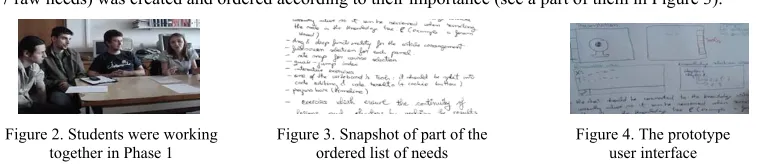
Stage 1, needs collecting, was to ask students to extract a set of needs for using a SNS-based AEH system, according to their previous e-learning experience. The students contributed to the needs collecting by brainstorming and discussing. The cooperative working process of the students is shown (partly) in Figure 2. Everyone had opportunities to present her/his ideas, while others might provide suggestions and comments. The list of needs was continually elaborated and evaluated. By the end of this stage, a sorted list of the needs (97 raw needs) was created and ordered according to their importance (see a part of them in Figure 3).
[image:3.595.113.493.404.487.2]
Figure 2. Students were working together in Phase 1
Figure 3. Snapshot of part of the ordered list of needs
Figure 4. The prototype user interface
Stage 2, tasks sequencing, adopted personas and scenarios as a lightweight method to capture the system requirements. Personas contain the end-users’ background information and specific situation related to using the system (Cooper, 2007). 4 personas were created to outline the real characteristics of end-users. Take one for example: Alex is a sophomore student, studying a course of ‘Java Programming Language’. He has learned PHP, and achieved higher scores than most of the other students. He prefers to analyze examples, and then design his own program to check whether he’s learnt to use. He likes to share and discuss with other students. Scenarios create a story with settings, personas and a sequence of actions and events (Carroll, 2000). One of the designed scenarios was: when Alex is debugging his program by using the programming tool provided by the system, he receives a message from his friend asking for help. He preserves his work, and asks what this friend exactly needs. In this stage, personas and scenarios were used to describe the interaction between the personas and the potential application to fulfill the proposed needs, and enable rapid communication about usage possibilities that might satisfy the needs proposed in stage 1.
3.2 Phase 2: Application Synthesis
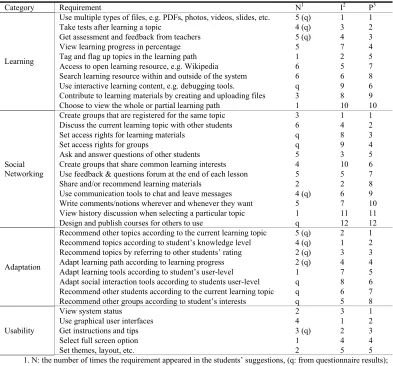
In phase 2, all the application requirements proposed in phase 1 were analyzed by the principal designers, in order to synthesize a single application (Triantafyllakos, 2008). The designers also grouped the requirements into 28 final ones, removing duplicates and estimating the importance according to the number of times the requirements appeared in the students’ suggestions, in one form or another. Then, these requirements were categorized into 4 categories, which represented the main areas for which features could be built in a system, according to the designer, as follows: 1) Learning: here went, for example, requirements such as using of multiple types of files, including photos, videos, slides, etc.; multiple files was considered of high importance by students; other requirements of lesser importance were, for example, taking tests after learning a topic; getting assessment and feedback from teachers; etc. 2) Social Networking: this category included important requirements such as creating groups that are registered for the same topic; and, in decreasing order of priority, discussing the topic with other students; etc. 3) Adaptation: this category involved requirements such as recommending other topics according to the current learning topic; recommending topics according to student’s knowledge level and other students’ rating; etc. 4) Usability: this category listed requirements such as visibility of the system status; instructions and tips; graphical user interfaces; etc.
3.3 Questionnaire
To elicit more information about the application design, the students who participated in the design sessions were all invited to answer a questionnaire with 28 questions. The questionnaire asked the students to evaluate the e-learning systems that they had used, and to elicit their extra expectation for features of new SNS-based AEH systems. As the students already went through the introductory material and design sessions, their answers were more informed, and were to help the designer understand the priorities of the previously extracted requirements. Due to the limited space, only selected results are shown in this section.
Attitudes about known e-learning systems: the reasons why the students said they used e-learning systems are shown in Figure 5. The most important reason is to ‘Save Time & Effort’. Similarly, in the open-ended questions part of the questionnaire, the students also considered ‘Availability 24/7, everything is organized in one place’ as some of the features of e-learning systems that they liked the most. So one of the requirements would be to keep things as simple as possible, and not increase extra learning burden.
Wikipedia is the largest general reference on the Internet, offering more than 22 million articles as of March 2012 (List of Wikipedias, 2012). The questionnaire result also indicated that all the students have experience of collecting learning resource from Wikipedia (see Figure 6). YouTube is the second popular social networking website for the students to collect learning resources, according to the questionnaire results, while the third one is LinkedIn. In the experiment, students also mentioned the requirements of access to and search for open learning resources from outside of the system. Therefore the method of access to Wikipedia and searching for learning materials should have a high priority to be developed.
[image:4.595.111.496.509.577.2]
Figure 5. The reasons for using e-learning systems Figure 6. SNS websites for collecting learning resources
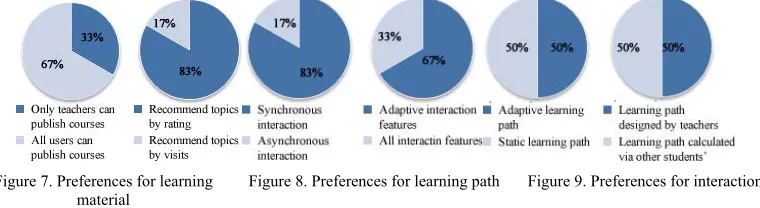
have all social interaction tools when they begin to use the system; while the other 67% of the students think it is better that they can obtain more social interaction tools when they move up to a higher user-level.
Figure 7. Preferences for learning material
Figure 8. Preferences for learning path Figure 9. Preferences for interaction
[image:5.595.143.462.312.457.2]Importance of system’s features: the students were asked to rate the importance of selected features of the system on a 1-5 scale with 1 = not at all important and 5 = very important. Table 1 shows the mean value and the standard deviation of the result. The most important feature is ‘Exchange of knowledge and approaches’ with the maximum mean value (4.83) and the minimum standard deviation (0.408).
Table 1. Importance of system’s features
Feature Scale of importance
Mean (1-5) Standard deviation Exchange of Knowledge and approaches 4.83 0.408
Feedback of learning process and results 4.67 0.516
Recommendation of learning path 4.67 0.516
Trust of group members 4.50 0.548
Share learning materials and experience 4.50 0.548
Revision exercises 4.33 0.516
Trust of user-generated learning contents 4.33 0.816 Recommendation of related topics 4.00 0.894 Collaborative learning and group activities 4.00 0.894
Interactions and tips 4.00 0.632
Interactive learning content 4.00 1.265
Multimedia delivery 3.67 0.816
Recommendation of groups and other students 3.67 0.816
Suggestions on designing a new e-learning system: the open-ended questions asked the students their suggestions on designing a new SNS-based AEH system. This allowed the students to provide unrestrained wide-range responses which might reveal unoriginally anticipated findings in the questionnaire (Reja, 2003). Some of the suggestions are listed below:
Exercise tools are essential, especially for practice courses such as programming language courses. It would be better to learn by using the knowledge rather than just reading some chapters.
Students should also be able to create their own learning paths in the courses that they were interested in, while other students could provide suggestions or use these learning paths for their own study.
The recommendation of learning materials for a particular student should be based on her/his performance during learning mixed with testing.
The system should provide an interface to access online libraries for reference while students are learning related topics, and make is possible for the students to save these references inside the system.
The user interface should be as simple as possible; the system operation should be easy to use, so it cannot disturb students while they are learning, but it can provide some help and tips when needed.
The system should introduce some learning methods for students to improve their learning efficiency.
3.4 Requirement List
and from the separate information on the number of times a (version of the) requirement appeared during the design sessions. The result of the ordered requirement list for SNS-based AEH systems is shown in Table 2.
Table 2. Ordered requirements list for SNS-based E-Learning systems
Category Requirement N1 I2 P3
Learning
Use multiple types of files, e.g. PDFs, photos, videos, slides, etc. 5 (q) 1 1
Take tests after learning a topic 4 (q) 3 2
Get assessment and feedback from teachers 5 (q) 4 3
View learning progress in percentage 5 7 4
Tag and flag up topics in the learning path 1 2 5
Access to open learning resource, e.g. Wikipedia 6 5 7 Search learning resource within and outside of the system 6 6 8 Use interactive learning content, e.g. debugging tools. q 9 6 Contribute to learning materials by creating and uploading files 3 8 9 Choose to view the whole or partial learning path 1 10 10
Social Networking
Create groups that are registered for the same topic 3 1 1 Discuss the current learning topic with other students 6 4 2
Set access rights for learning materials q 8 3
Set access rights for groups q 9 4
Ask and answer questions of other students 5 3 5
Create groups that share common learning interests 4 10 6 Use feedback & questions forum at the end of each lesson 5 5 7
Share and/or recommend learning materials 2 2 8
Use communication tools to chat and leave messages 4 (q) 6 9 Write comments/notions wherever and whenever they want 5 7 10 View history discussion when selecting a particular topic 1 11 11 Design and publish courses for others to use q 12 12
Adaptation
Recommend other topics according to the current learning topic 5 (q) 2 1 Recommend topics according to student’s knowledge level 4 (q) 1 2 Recommend topics by referring to other students’ rating 2 (q) 3 3 Adapt learning path according to learning progress 2 (q) 4 4 Adapt learning tools according to student’s user-level 1 7 5 Adapt social interaction tools according to students user-level q 8 6 Recommend other students according to the current learning topic q 6 7 Recommend other groups according to student’s interests q 5 8
Usability
View system status 2 3 1
Use graphical user interfaces 4 1 2
Get instructions and tips 3 (q) 2 3
Select full screen option 1 4 4
Set themes, layout, etc. 2 5 5
1. N: the number of times the requirement appeared in the students’ suggestions, (q: from questionnaire results); 2. I: the average importance of the requirement proposed by the students from the two design sessions; 3. P: the final resulting priority of the requirement, according to the principal designers.
4.
DISCUSSION
This pilot study is meant to mimic a large co-designer experiment in a small format, to gather issues and initial preferences for the future studies. This reflects the idea of the We!Design as a PD methodology applied to the SNS-based AEH system design process, and creates a practical sketch of this methodology, essential to simulate how design methodology would work and what results would be proposed. A larger study will have to be done after this initial design proposal in the future, to further validate our choices.
the main focus of the design’ (Cooper, 2007). To be primary, a persona is ‘someone who must be satisfied but who cannot be satisfied with an interface designed for any other persona. An interface always exists for a primary persona.’ (Cooper, 1999) With regard to scenarios, storyboards or customer journeys were used to test the validity of design and assumptions. The students had to design an appropriate level of detail, because of the short period of time. In the prototyping stage, some solutions were found to be flawed to some extent. In such a case, students might be unwilling to fix flaws or they might need extra time. The coordinators should encourage them to get the solution as well as control the time, because even if the work was incomplete, designers could still be inspired by the highlighted issues.
In phase 2, the designers arranged the requirements proposed by the students, the descriptions of content-based requirement. It is always possible for the designers to misunderstand the original meaning intended by the students. Hence it is necessary to show the reorganized requirements to the students, and ask them to check whether the requirement list is consistent with their original ideas. Still, even though the students confirmed the requirement list, it would be still possible that the designer deviates from their intended design. The end-users participating in the experiment were computer science undergraduate students, so their software engineering knowledge helped them to be more easily involved in the design process, but this also may have limited their ability to create a domain-independent e-learning system. For instance, they mentioned the importance of tools for practice courses such as programming language courses, but they did not consider multimedia delivery as highly important, when for instance, for art and social science subjects, the quality of multimedia transmission and presentation might be very important.
The questionnaire result indicates that the students’ favorite equipment to access e-learning system is the notebook. While Canalys recently released the worldwide shipment estimation of equipment for Internet access (Alto, 2011), which indicates mobile terminals, especially smartphones and pads, have a much greater potential. This means that cross-platform compatibility, including adaptive layout and adaptive screen orientation (landscape or portrait), is urgent to be considered.
Facebook is the biggest social networking website in the world and has 901 million monthly active users, and 526 million daily active users on average in March 2012 (Facebook Newsroom, 2012), but most people use Facebook for entertainment rather than learning, which is why the questionnaire result shows that only 16.7% of the students chose that they have ever collected learning resource from Facebook.
Another interesting result is that half of the students chose ‘Compulsory to Use’ as a reason. This may be because the systems are hard to use, or the students are not confident to use such systems. Therefore it is necessary to evaluate and analyze existing e-learning systems, in order to find out how to improve them or how to design a better new system. The opinions of the systems’ end-user, the students, are very important, and many aspects (e.g., system usability, accuracy of recommendation) of the systems need to be taken into consideration, so the evaluation should be conducted by using a multi-dimensional approach (Ozkan, 2009).
5.
CONCLUSION
In this paper, we have applied a participatory design methodology, We!Design, in the early stage of the SNS-based AEH system design process. The experiment was conducted in the Computer Department, ‘Politehnica’ University of Bucharest, Romania. 6 4th year undergraduate students studying the course of ‘semantic web’ were involved. Phase 1 was comprised of two parallel design sessions, each of which lasted for about 2.5 hours. The students went through the stages of needs collecting, task sequencing and prototype designing, based on a brief introduction to AEH and SNS and their knowledge background and e-learning experience. By the end of this phase, a low-tech prototype and a requirement list were proposed. In phase 2, the principal designers synthesized all the proposed requirements into a single application, and categorized and refined them into an ordered list. Then, all the students participating in the design sessions were asked to answer a questionnaire containing the questions about their attitudes on existing e-learning systems that they used, and their expectation for the features of new SNS-based AEH systems. Finally, the designer merged the results from phase 2 and the questionnaire into a requirement list, ordered by their priority to be developed.
statements describing what services the system is expected to provide. Besides, these requirements create a common vision between the students and the system designers, to make sure the system that will be developed are what the students really want. The next step is to generate the requirements specification (intermediate-detail) and then the application specification (high-detail) (Sommerville, 1995).
REFERENCES
Alto, P. Smart phones overtake client PCs in 2011, http://www.canalys.com/newsroom/smart-phones-overtake-client-pcs-2011. (viewed 3 Feb. 2012).
Brusilovsky, P., 2004. Adaptive Educational Hypermedia: From generation to generation (Invited talk). Proceedings of Hellenic Conference on Information and Communication Technologies in Education, Athens, Greece, pp.19-33. Brusilovsky, P. et al, 2006. Layered Evaluation of Adaptive Search. In: R. W. White, G. Muresan and G. Marchionini
(eds.) Proceedings of Workshop on Evaluating Exploratory Search Systems at SIGIR 2006, Seattle, USA, pp. 11-13. Carroll, J.M., 2000. Five reasons for scenario-based design, Interacting with Computers, Vol. 13, No. 1, pp. 43-60. Cooper, A. and Saffo, P., 1999. The inmates are running the Asylum. Macmillan Publishing Co., Inc. Indianapolis, USA. Cooper, A. et al, 2007. About Face 3: The Essentials of Interaction Design. John Wiley & Sons, Inc. New York, USA. Cristea, A. and De Mooij, A., 2003. LAOS: Layered WWW AHS Authoring Model and their corresponding Algebraic
Operators, In Proceedings of International World Wide Web Conference. Budapest, Hungary, pp. 301-310.
Cristea, A. I. and Ghali, F., 2011. Towards Adaptation in E-Learning 2.0, The New Review of Hypermedia and Multimedia, Vol. 17, No. 2, pp. 199-238.
Dabbagh, N. et al, 2011. Personal Learning Environments, social media, and self-regulated learning: A natural formula for connecting formal and informal learning. The Internet and Higher Education, Vol. 15, No. 1, pp. 3-8.
De Bra, P. et al, 2003. AHA! The Adaptive Hypermedia Architecture. In Proceedings of the ACM Hypertext Conference, Nottingham, UK, pp. 81-84.
Essaid El Bachari, 2010. Design of an Adaptive E-Learning Model Based on Learner's Personality, Ubiquitous Computing and Communication Journal, Vol. 5, No. 3, pp 1-8.
Facebook Newsroom, http://newsroom.fb.com/content/default.aspx?NewsAreaId=22. (viewed 24 April 2012).
Ghali, F. and Cristea, A., 2009. Social Reference Model for Adaptive Web Learning. In Proceedings of International Conference on Web-based Learning, Aachen, Germany, pp. 162-171.
Könings, K. D. et al, 2010. An approach to participatory instructional design in secondary education: an exploratory study. Educational Research, Vol. 52, No. 1, pp. 45–59.
List of Wikipedias, 2012. http://meta.wikimedia.org/wiki/List_of_Wikipedias. (viewed 28 March 2012).
March, W. et al, 2005. Designing technology for community appropriation. In Proceedings of Conference on Human Factors in Computing Systems, Extended Abstracts, Oregon, USA, pp. 2126-2127.
McLoughlin, C. and Lee, M. J. W., 2007. Social software and participatory learning: Pedagogical choices with technology affordances in the Web 2.0 era. In Proceedings Ascilite Conference, Singapore, pp. 664-675.
Muller, MJ. and Druin, A., 2003. Participatory design: the third space in HCI. In Handbook of HCI. Edited by Muller MJ. Mahway, NJ: Erlbaum, pp. 1-31.
Ozkan, S. and Koseler, R., 2009. Multi-dimensional students’ evaluation of e-learning systems in the higher education context: An empirical investigation. Computers & Education, Vol. 53, No. 4, pp. 285-1296.
Rashidah, R. et al, 2011. A. End-Users’ involvement in the development of web-based learning resources for English Literature. 3L: Language, Linguistics and Literature, The Southeast Asian Journal of English Language Studies, Vol. 17 (special issue), pp. 5-18.
Reja, U. et al, 2003. Open-ended vs. close-ended questions in Web questionnaires. In Anuška Ferligoj and Andrej Mrvar (Editors), Developments in Applied Statistics, pp. 159-177.
Roda, C., 2004. Participatory system design as a tool for learning, In Proceedings of International Conference of Cognition and Exploratory Learning in Digital Age, Lisbon, Portugal, pp. 366-372.
Sanders, E. B-N. et al, 2010. A Framework for organizing the tools and techniques of participatory design, In Proceedings of Participatory Design Conference, Sydney, Australia, pp. 195-198.
Seale J., 2009. Doing student voice work in higher education: an exploration of the value of participatory methods. British Educational Research Journal, Vol. 36, No. 6, pp. 995-1015.
Sommerville I., 1995. Software Engineering, 5th ed, Addison Wesley Longman Publishing Co., Redwood City, USA. Triantafyllakos, G. N. et al., 2008. We!Design: A student-centered participatory methodology for the design of