Security
Chang-Tsun Li
University of Warwick, UK
Hershey • New York
Managing Editor: Jamie Snavely Assistant Managing Editor: Carole Coulson Copy Editor: Holly Powell Typesetter: Carole Coulson Cover Design: Lisa Tosheff
Printed at: Yurchak Printing Inc.
Published in the United States of America by
Information Science Reference (an imprint of IGI Global) 701 E. Chocolate Avenue, Suite 200
Hershey PA 17033 Tel: 717-533-8845 Fax: 717-533-8661 E-mail: [email protected] Web site: http://www.igi-global.com
and in the United Kingdom by
Information Science Reference (an imprint of IGI Global) 3 Henrietta Street
Covent Garden London WC2E 8LU Tel: 44 20 7240 0856 Fax: 44 20 7379 0609
Web site: http://www.eurospanbookstore.com
Copyright © 2009 by IGI Global. All rights reserved. No part of this publication may be reproduced, stored or distributed in any form or by any means, electronic or mechanical, including photocopying, without written permission from the publisher.
3URGXFWRUFRPSDQ\QDPHVXVHGLQWKLVVHWDUHIRULGHQWL¿FDWLRQSXUSRVHVRQO\,QFOXVLRQRIWKHQDPHVRIWKHSURGXFWVRUFRPSDQLHVGRHV
not indicate a claim of ownership by IGI Global of the trademark or registered trademark.
Library of Congress Cataloging-in-Publication Data
Multimedia forensics and security / Chang-Tsun Li, editor.
p. cm.
Includes bibliographical references and index.
6XPPDU\7KLVERRNSURYLGHVDQLQGHSWKWUHDWPHQWRIDGYDQFHPHQWVLQWKHHPHUJLQJ¿HOGRIPXOWLPHGLDIRUHQVLFVDQGVHFXULW\E\ WDFNOLQJFKDOOHQJLQJLVVXHVVXFKDVGLJLWDOZDWHUPDUNLQJIRUFRS\ULJKWSURWHFWLRQGLJLWDO¿QJHUSULQWLQJIRUWUDQVDFWLRQWUDFNLQJDQGGLJLWDO FDPHUDVRXUFHLGHQWL¿FDWLRQ3URYLGHGE\SXEOLVKHU
ISBN 978-1-59904-869-7 (hardcover) -- ISBN 978-1-59904-870-3 (ebook)
1. Multimedia systems--Security measures. 2. Data encryption (Computer science) 3. Data protection. I. Li, Chang-Tsun.
QA76.575.M83187 2008
005.8--dc22
2008008467
British Cataloguing in Publication Data
A Cataloguing in Publication record for this book is available from the British Library.
All work contributed to this book set is original material. The views expressed in this book are those of the authors, but not necessarily of the publisher.
Andrew Ker
Oxford University, UK Alain Trémeau
Université Jean Monnet - Bat. E, FRANCE
Natasa Terzija
University of Manchester, UK Chang-Tsun Li
Univeristy of Warwick, UK Yinyin Yuan
Univeristy of Warwick, UK Yue Li
Univeristy of Warwick, UK Andreas Uhl
Salzburg University, Salzburg, Austria Zhu Yan
Peiking University, China Fouad Khelif
Queen’s University Belfast, UK Martin Steinebach
Media Security in IT, Germany Patrick.Wolf
Media Security in IT, Germany Maciej Li´skiewicz
)HGHUDO2I¿FHIRU,QIRUPDWLRQ6HFXULW\%6,
Germany Ulrich Wölfel
)HGHUDO2I¿FHIRU,QIRUPDWLRQ6HFXULW\%6,
Germany
Florent Autrusseau
l’Université de Nantes, FRANCE Maria Calagna
Universita’ La Sapienza, Italy Hongxia Jin
IBM Almaden Research Center, USA Hae Yong Kim
Universidade de São Paulo, Brazil Sergio Pamboukian
Universidade Presbiteriana Mackenzie, Brazil Shiguo Liang
France Telecom R&D Beijing Angela Wong
University of Adelaide, Australia Matthew Sorell
University of Adelaide, Australia Roberto Caldelli
University of Florence, Italy Alessandro Piva
University of Florence, Italy Abdellatif ZAIDI
UCL, Belgium Yonggang Fu
Jimei University, China Xingming Sun
Hunan University, China Yongjian Hu
Foreword ... xiii
Preface ... xiv
Chapter I
Authentication Watermarkings for Binary Images ... 1
Hae Yong Kim, Universidade de São Paolo, Brazil
Sergio Vincente Denser Pamboukian, Universidade Presbiteriana Mackenzie, Brazil Paulo Sérgio Licciardi Messeder Barreto, Universidade de São Paolo, Brazil
Chapter II
Secure Multimedia Content Distribution Based on Watermarking Technology ... 24
Shiguo Lian, France Telecom Research & Development–Beijing, P.R. China
Chapter III
Digital Watermarking in the Transform Domain with Emphasis on SVD ... 46
Maria Calagna, Dipartimento di Informatica, Universita’ di Roma La Sapienza, Italy
Chapter IV
Digital Video Watermarking and the Collusion Attack ... 67
Roberto Caldelli, University of Florence, Italy Alessandro Piva, University of Florence, Italy
Chapter V
A Survey of Current Watermarking Synchronization Techniques ... 84
Nataša Terzija, The University of Manchester, UK
Chapter VI
On the Necessity of Finding Content Before Watermark Retrieval: Active Search
(&,74XHHQ¶V8QLYHUVLW\%HOIDVW8.
Fatih Kurugollu, The Institute of Electronics Communications and Information Technology
(&,74XHHQ¶V8QLYHUVLW\%HOIDVW8.
Ahmed Bouridane, The Institute of Electronics Communications and Information Technology
(&,74XHHQ¶V8QLYHUVLW\%HOIDVW8.
Chapter VIII
On Noise, Steganography, and the Active Warden ... 139
Christopher B. Smith, Southwest Research Institute, USA Sos S. Agaian, The University of Texas at San Antonio, USA
Chapter IX
Visibility Control and Quality Assessment of Watermarking and Data Hiding Algorithms... 163
Patrick Le Callet, Polytech’Nantes, University of Nantes, IRCCyN Lab, France Florent Autrusseau, Polytech’Nantes, University of Nantes, IRCCyN Lab, France Patrizio Campisi, Università degli Studi Roma TRE, Italy
Chapter X
Computational Aspects of Digital Steganography ... 193 0DFLHM/LĞNLHZLF],QVWLWXWHRI7KHRUHWLFDO&RPSXWHU6FLHQFH8QLYHUVLW\RI/EHFN*HUPDQ\ 8OULFK:|OIHO)HGHUDO2I¿FH,QIRUPDWLRQ6HFXULW\%6,*HUPDQ\
Chapter XI
On Steganalysis and Clean Image Estimation ... 212
Christopher B. Smith, Southwest Research Institute, USA Sos S. Agaian, The University of Texas at San Antonio, USA
Chapter XII
Steganalysis: Trends and Challenges ... 245 +D¿]0DOLN8QLYHUVLW\RI0LFKLJDQ±'HDUERUQ86$
Rajarathnam Chandramouli, Stevens Institute of Technology, USA K. P. Subbalakshmi, Stevens Institute of Technology, USA
Chapter XIII
Benchmarking Steganalysis ... 266
Andrew D. Ker, Oxford University Computing Laboratory, UK
Chapter XIV
'LJLWDO&DPHUD6RXUFH,GHQWL¿FDWLRQ7KURXJK-3(*4XDQWLVDWLRQ ... 291
Chapter XVI
(I¿FLHQW7UDQVSDUHQW-3(*(QFU\SWLRQ ... 336
Dominik Engel, University of Salzburg, Austria
7KRPDV6WW]8QLYHUVLW\RI6DO]EXUJ$XVWULD
Andreas Uhl, University of Salzburg, Austria
Compilation of References ... 360
About the Contributors ... 387
Foreword ... xiii
Preface ... xiv
Chapter I
Authentication Watermarkings for Binary Images ... 1
Hae Yong Kim, Universidade de São Paolo, Brazil
Sergio Vincente Denser Pamboukian, Universidade Presbiteriana Mackenzie, Brazil Paulo Sérgio Licciardi Messeder Barreto, Universidade de São Paolo, Brazil
Data hiding (DH) is a technique used to embed a sequence of bits in a cover image with small visual deterioration and the means to extract it afterwards. Authentication watermarking (AW) techniques use DHs to insert a particular data into an image, in order to detect later any accidental or malicious alterations in the image, as well as to certify that the image came from the right source. In recent years, some AWs for binary images have been proposed in the literature. The authentication of binary images is necessary in practice, because most scanned and computer-generated document images are binary. This publication describes techniques and theories involved in binary image AW: We describe DH tech-niques for binary images and analyze which of them are adequate to be used in AWs; analyze the most adequate secret and public-key cryptographic ciphers for the AWs; describe how to spatially localize the alteration in the image (besides detecting it) without compromising the security; present AWs for -%,*FRPSUHVVHGELQDU\LPDJHVSUHVHQWDUHYHUVLEOH$:IRUELQDU\LPDJHVDQG¿QDOO\SUHVHQWRXU conclusions and future research.
Chapter II
Secure Multimedia Content Distribution Based on Watermarking Technology ... 24
Shiguo Lian, France Telecom Research & Development–Beijing, P.R. China
Firstly, some related works, including multimedia encryption and digital watermarking, are introduced. Then, the existing watermarking-based distribution schemes are reviewed and analyzed. Furthermore, the novel scheme is proposed and evaluated. Finally, some open issues are presented.
Chapter III
Digital Watermarking in the Transform Domain with Emphasis on SVD ... 46
Maria Calagna, Dipartimento di Informatica, Universita’ di Roma La Sapienza, Italy
The chapter illustrates watermarking based on the transform domain. It argues that transform-based wa-termarking is robust to possible attacks and imperceptible with respect to the quality of the multimedia ¿OHZHZRXOGOLNHWRSURWHFW$PRQJWKRVHWUDQVIRUPVFRPPRQO\XVHGLQFRPPXQLFDWLRQVZHHPSKDVL]H the use of singular value decomposition (SVD) for digital watermarking; the main advantage of this FKRLFHLVÀH[LELOLW\RIDSSOLFDWLRQ,QIDFW69'PD\EHDSSOLHGLQVHYHUDO¿HOGVZKHUHGDWDDUHRUJDQL]HG as matrices, including multimedia and communications.We present a robust SVD-based watermarking scheme for images. According to the detection steps, the watermark can be determined univocally, while
RWKHUUHODWHGZRUNVSUHVHQWÀDZVLQZDWHUPDUNGHWHFWLRQ$FDVHVWXG\RIRXUDSSURDFKUHIHUVWRWKH
protection of geographical and spatial data in case of the raster representation model of maps.
Chapter IV
Digital Video Watermarking and the Collusion Attack ... 67
Roberto Caldelli, University of Florence, Italy Alessandro Piva, University of Florence, Italy
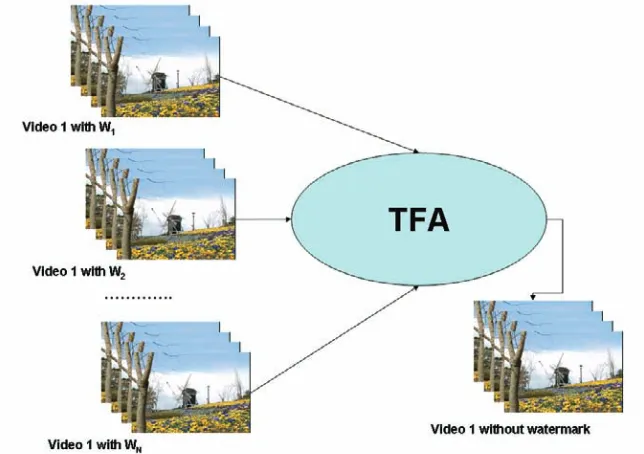
This chapter is devoted to the analysis of the collusion attack applied to current digital video watermarking algorithms. In particular, we analyze which are the effects of collusion attacks, with particular attention to the temporal frame averaging (TFA), applied to two basic watermarking systems like spread spectrum (SS) and spread transform dither modulation (STDM). The chapter describes the main drawbacks and advantages in using these two watermarking schemes and, above all, the fundamental issues to be taken into account to grant a certain level of robustness when a collusion attack is carried out by an attacker.
Chapter V
A Survey of Current Watermarking Synchronization Techniques ... 84
Nataša Terzija, The University of Manchester, UK
Chapter VI
On the Necessity of Finding Content Before Watermark Retrieval: Active Search
Strategies for Localising Watermarked Media on the Internet ... 106 0DUWLQ6WHLQHEDFK)UDXQKRIHU,QVWLWXWHIRU6HFXUH,QIRUPDWLRQ7HFKQRORJ\6,7*HUPDQ\ 3DWULFN:ROI)UDXQKRIHU,QVWLWXWHIRU6HFXUH,QIRUPDWLRQ7HFKQRORJ\6,7*HUPDQ\
Digital watermarking promises to be a mechanism for copyright protection without being a technology for copy prevention. This sometimes makes it hard to convince content owners to use digital watermark-ing for protectwatermark-ing their content. It is only passive technology addwatermark-ing information into the content to be protected. Therefore some active mechanism is required that completes the protection. This needs to be a search mechanism that localizes potentially watermarked media on the Internet. Only then the passive LQIRUPDWLRQHPEHGGHGLQWKHFRQWHQWFDQKHOSWR¿JKWLOOHJDOFRSLHVWe discuss strategies and approaches for retrieving watermarks from the Internet with the help of a media search framework. While various Internet domains like HTML pages (the Web), eBay, or FTP are discussed, the focus of this work is on content shared within peer-to-peer networks.
Chapter VII
Statistical Watermark Detection in the Transform Domain for Digital Images ... 120 )RXDG.KHOL¿7KH,QVWLWXWHRI(OHFWURQLFV&RPPXQLFDWLRQVDQG,QIRUPDWLRQ7HFKQRORJ\
(&,74XHHQ¶V8QLYHUVLW\%HOIDVW8.
Fatih Kurugollu, The Institute of Electronics Communications and Information Technology
(&,74XHHQ¶V8QLYHUVLW\%HOIDVW8.
Ahmed Bouridane, The Institute of Electronics Communications and Information Technology
(&,74XHHQ¶V8QLYHUVLW\%HOIDVW8.
The problem of multiplicative watermark detection in digital images can be viewed as a binary decision where the observation is the possibly watermarked samples that can be thought of as a noisy environment in which a desirable signal, called watermark, may exist. In this chapter, we investigate the optimum watermark detection from the viewpoint of decision theory. Different transform domains are consid-ered with generalized noise models. We study the effect of the watermark strength on both the detector performance and the imperceptibility of the host image. Also, the robustness issue is addressed while considering a number of commonly used attacks.
Chapter VIII
On Noise, Steganography, and the Active Warden ... 139
Christopher B. Smith, Southwest Research Institute, USA Sos S. Agaian, The University of Texas at San Antonio, USA
with a discussion of the future of steganography.
Chapter IX
Visibility Control and Quality Assessment of Watermarking and Data Hiding Algorithms... 163
Patrick Le Callet, Polytech’Nantes, University of Nantes, IRCCyN Lab, France Florent Autrusseau, Polytech’Nantes, University of Nantes, IRCCyN Lab, France Patrizio Campisi, Università degli Studi Roma TRE, Italy
In watermarking and data hiding context, it may be very useful to have methods checking the invisibil-ity of the inserted data, or at least, checking the objective qualinvisibil-ity after the mark embedding or after an attack on the watermarked media. Many works exist in the literature dealing with quality assessment, mainly focused on compression application. Nevertheless, visual quality assessment should include special requirements that depend on the application context. This chapter presents an extended review RIERWKVXEMHFWLYHDQGREMHFWLYHTXDOLW\DVVHVVPHQWRILPDJHVDQGYLGHRLQWKH¿HOGRIZDWHUPDUNLQJ and data hiding applications.
Chapter X
Computational Aspects of Digital Steganography ... 193 0DFLHM/LĞNLHZLF],QVWLWXWHRI7KHRUHWLFDO&RPSXWHU6FLHQFH8QLYHUVLW\RI/EHFN*HUPDQ\ 8OULFK:|OIHO)HGHUDO2I¿FH,QIRUPDWLRQ6HFXULW\%6,*HUPDQ\
This chapter provides an overview, based on current research, on theoretical aspects of digital steganog-UDSK\²DUHODWLYHO\QHZ¿HOGRIFRPSXWHUVFLHQFHWKDWGHDOVZLWKKLGLQJVHFUHWGDWDLQXQVXVSLFLRXV cover media. We focus on formal analysis of security of steganographic systems from a computational complexity point of view and provide models of secure systems that make realistic assumptions of limited computational resources of involved parties. This allows us to look at steganographic secrecy based on reasonable complexity assumptions similar to the ones commonly accepted in modern cryptography. ,QWKLVFKDSWHUZHH[SDQGWKHDQDO\VHVRIVWHJRV\VWHPVEH\RQGVHFXULW\DVSHFWVWKDWSUDFWLWLRQHUV¿QG GLI¿FXOWWRLPSOHPHQWLIQRWLPSRVVLEOHWRUHDOL]HWRWKHTXHVWLRQwhyVXFKV\VWHPVDUHVRGLI¿FXOWWR implement and what makes these systems different from practically used ones.
Chapter XI
On Steganalysis and Clean Image Estimation ... 212
Christopher B. Smith, Southwest Research Institute, USA Sos S. Agaian, The University of Texas at San Antonio, USA
with a discussion of the future of passive warden steganalysis.
Chapter XII
Steganalysis: Trends and Challenges ... 245 +D¿]0DOLN8QLYHUVLW\RI0LFKLJDQ±'HDUERUQ86$
Rajarathnam Chandramouli, Stevens Institute of Technology, USA K. P. Subbalakshmi, Stevens Institute of Technology, USA
In this chapter we provide a detailed overview of the state of the art in steganalysis. Performance of some steganalysis techniques are compared based on critical parameters such as the hidden message detection probability, accuracy of the estimated hidden message length and secret key, and so forth. We also provide an overview of some shareware/freeware steganographic tools. Some open problems in steganalysis are described.
Chapter XIII
Benchmarking Steganalysis ... 266
Andrew D. Ker, Oxford University Computing Laboratory, UK
This chapter discusses how to evaluate the effectiveness of steganalysis techniques. In the steganalysis literature, numerous different methods are used to measure detection accuracy, with different authors XVLQJLQFRPSDWLEOHEHQFKPDUNV7KXVLWLVGLI¿FXOWWRPDNHDIDLUFRPSDULVRQRIFRPSHWLQJVWHJDQDO\VLV methods. This chapter argues that some of the choices for steganalysis benchmarks are demonstrably poor, either in statistical foundation or by over-valuing irrelevant areas of the performance envelope. Good choices of benchmark are highlighted, and simple statistical techniques demonstrated for evaluating the VLJQL¿FDQFHRIREVHUYHGSHUIRUPDQFHGLIIHUHQFHV,WLVKRSHGWKDWWKLVFKDSWHUZLOOPDNHSUDFWLWLRQHUV and steganalysis researchers better able to evaluate the quality of steganography detection methods.
Chapter XIV
'LJLWDO&DPHUD6RXUFH,GHQWL¿FDWLRQ7KURXJK-3(*4XDQWLVDWLRQ ... 291
Matthew J. Sorell, University of Adelaide, Australia
This chapter discusses the cryptographic traitor tracing technology that is used to defend against pi-racy in multimedia content distribution. It talks about different potential pirate attacks in a multimedia content distribution system. It discusses how traitor tracing technologies can be used to defend against those attacks by identifying the attackers involved in the piracy. While traitor tracing has been a long standing cryptographic problem that has attracted extensive research, the main purpose of this chapter is to show how to overcome many practical concerns in order to bring a theoretical solution to practice. 0DQ\RIWKHVHSUDFWLFDOFRQFHUQVKDYHEHHQRYHUORRNHGLQDFDGHPLFUHVHDUFK7KHDXWKRUEULQJV¿UVWKDQG experience on bringing this technology to practice in the context of new industry standard on content SURWHFWLRQIRUQH[WJHQHUDWLRQKLJKGH¿QLWLRQ'9'V7KHDXWKRUDOVRKRSHVWRVKHGQHZLQVLJKWVRQ future research directions in this space.
Chapter XVI
(I¿FLHQW7UDQVSDUHQW-3(*(QFU\SWLRQ ... 336
Dominik Engel, University of Salzburg, Austria
7KRPDV6WW]8QLYHUVLW\RI6DO]EXUJ$XVWULD
Andreas Uhl, University of Salzburg, Austria
In this chapter we investigate two different techniques for transparent/perceptual encryption of JPEG2000 ¿OHVRUELWVWUHDPVLQWKHFRQWH[WRIGLJLWDOULJKWPDQDJHPHQW'50VFKHPHV7KHVHPHWKRGVDUHHI -¿FLHQWLQWKHVHQVHRIPLQLPL]LQJWKHFRPSXWDWLRQDOFRVWVRIHQFU\SWLRQ$FODVVLFDOELWVWUHDPEDVHG approach employing format-compliant encryption of packet body data is compared to a compression-integrated technique, which uses the concept of secret transform domains, in our case a wavelet packet transform.
Compilation of References ... 360
About the Contributors ... 387
Foreword
The advances and convergence of information and communication technology (ICT) and multimedia techniques have brought about unprecedented possibilities and opportunities. The upside is that we EHQH¿WIURPWKHFRQYHQLHQFHWKDWWKHVHWHFKQRORJLHVKDYHWRRIIHU,QIRUPDWLRQFDQEHH[FKDQJHGLQ various forms of media through far-reaching networks, while multimedia processing techniques facili-WDWHHI¿FLHQWIXVLRQRIPHGLDZLWKVWXQQLQJHIIHFWVZKLFKKDYHDOUHDG\PDGHDSURIRXQGLPSDFWRQWKH ways we communicate, learn, and entertain. However, the downside is that these technologies could also be exploited for malicious purposes such as copyright piracy and document forgery, to name a few. To prevent abuses of the usage of ICT and multimedia techniques, the study of multimedia forensics and security has emerged in recent years as a new interdisciplinary area encompassing aspects of digital cryptography, digital watermarking, data hiding, steganography, and steganalysis. Moreover, multimedia forensic techniques have also opened up a new horizon for helping companies, government, and law enforcement agencies in combating crime and fraudulent activities.
The past decade has seen an exciting development of techniques revolving around the issues of mul-timedia forensics and security. Although a number of quality books have been published in the literature, WKHIDVWDGYDQFLQJWHFKQRORJ\LQWKLV¿HOGHQWDLOVDFRQVWDQWUHQHZDORIV\VWHPDWLFDQGFRPSUHKHQVLYH accounts of the latest researches and developments. Aiming at serving this purpose, this book contains a collection of informative and stimulating chapters written by knowledgeable experts and covers a wide spectrum of the state-of-the-art techniques for tackling the issues of multimedia forensics and security. Each chapter is a self-contained treatment on one aspect of the broad subject, allowing the readers to follow any order of their liking. The chapters are selected to suit readers of different levels with various interests, making this book an invaluable reference for beginners as well as experts alike.
Professor Anthony TS Ho
Professor and Chair of Multimedia Security, Director of Postgraduate Research
Department of Computing,
Faculty of Engineering and Physical Sciences, University of Surrey,
Preface
In the last two decades, the development of information and communication technology (ICT) and multimedia processing techniques has revolutionized the ways we create, exchange, and manipulate information. Most people, if not all, with access to computers and the Internet, can not only share infor-PDWLRQLQVWDQWO\DWLQVLJQL¿FDQWFRVWEXWDOVRFUHDWLYHO\SURGXFHWKHLURZQPHGLDRIYDULRXVIRUPVVXFK as text, audio, speech, music, image, and video. This wave of ICT revolution has undoubtedly brought about enormous opportunities for the world economy and exciting possibilities for every sector of the modern societies. Educators are now equipped with e-tools to deliver their knowledge and expertise to the remote corners of the world with Internet access. Harnessing these ICT resources, e-governments
can now provide various aspects of e-services to the people. Willingly or reluctantly, directly or indi-rectly, we are all now immersed in some way in the cyberspace full of e-opportunities and e-possibilities
and permeated with data and information. However, this type of close and strong interweaving poses concerns and threats. When exploited with malign intentions, the same tools provide means for doing harms at a colossal scale. These concerns create anxiety and uncertainty about the reality of the media we deal with.
,QUHVSRQVHWRWKHVHLVVXHVWKHODVWGHFDGHKDVVHHQWKHHPHUJHQFHRIWKHQHZLQWHUGLVFLSOLQDU\¿HOG of multimedia forensics and security, which aims at pooling expertise in various areas, such as signal processing, information theory, cryptography, and so forth to combat the abuses of ICT and multimedia techniques. In particular, digital watermarking schemes have been proposed to meet copyright protec-WLRQQHHGVIRUH[DPSOHRZQHUVKLSLGHQWL¿FDWLRQFRS\FRQWUROWUDQVDFWLRQWUDFNLQJDQGWRGHDOZLWK FRQWHQWDXWKHQWLFDWLRQDQGLQWHJULW\YHUL¿FDWLRQ&KDOOHQJHGE\LWVFRPSHWLQJVWHJDQDO\WLFDOWHFKQLTXHV steganographic methods have been developed and are being constantly improved for data hiding and embedding applications. Multimedia forensic techniques have also been studied and derived for provid-ing evidences to aid with resolvprovid-ing civil and criminal court cases. Added to the excitement of the races EHWZHHQQHZPHDVXUHVDQGFRXQWHUPHDVXUHVLQWKLVQHZDUHDLVWKHGLI¿FXOWLHVLQVWULNLQJDEDODQFH EHWZHHQFRQÀLFWLQJUHTXLUHPHQWV)RUH[DPSOHLQWKHFRQWH[WRIGLJLWDOZDWHUPDUNLQJKLJKUREXVWQHVV is usually gained at the expense of high distortion, while, in the context of steganography, low distortion is, most of the times, achieved at the cost of low payload.
and IT/multimedia practitioners, who are interested or involved in the study, research, use, design, and development of techniques related to multimedia forensics and security.
7KLVERRNFRQVLVWVRIWKUHHPDLQFRPSRQHQWV7KH¿UVWFRPSRQHQWFRPSULVHGRI&KDSWHUV,WR9,, aims at dissemilating the idea of digital watermarking and its applications to multimedia security in general and copyright protection in particular. The second component, which covers Chapters VIII to XIII, is concerned with the two competing arts of steganography and steganalysis. The third component, comprising Chapters XIV to XVI, deals with methods that harness the techniques of data hiding and cryptography for the applications of multimedia forensics.
Chapter I, Authentication Watermarkings for Binary Images, presented by Hae Yong Kim, Sergio Pamboukian, and Paulo Barreto, is concerned with a class of data hiding techniques and the analysis of which of them are suitable for authenticating binary images. Ways of detecting and localising tamper, aiming at revealing the attacker’s possible intention, are described. A new irreversible scheme for au-thenticating JBIG2-compressed binary images and a new reversible algorithm for auau-thenticating general binary images are presented.
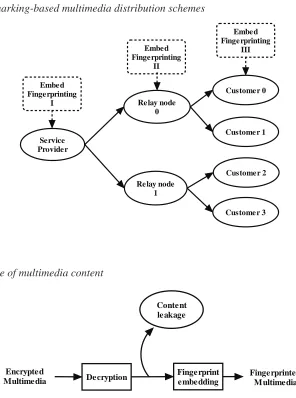
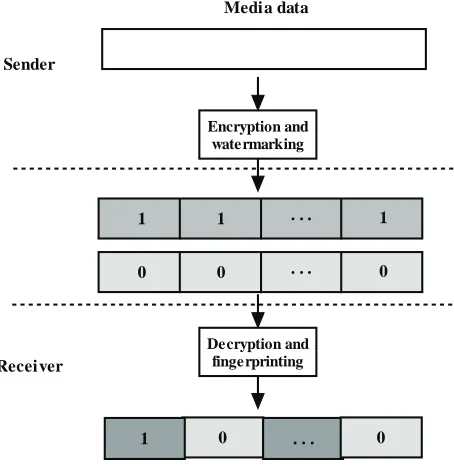
In Chapter II, Secure Multimedia Content Distribution Based on Watermarking Technology, Shiguo /LDQGH¿QHVWKHSHUIRUPDQFHUHTXLUHPHQWVRIZDWHUPDUNLQJEDVHGPXOWLPHGLDGLVWULEXWLRQVFKHPHVIRU multimedia communication applications and reviewed a number of related schemes, with their char-DFWHULVWLFVDQGOLPLWDWLRQVGLVFXVVHG$QHZVFKHPHFRPELQLQJ¿QJHUSULQWLQJDQGHQFU\SWLRQZKLFK UHDOLVHVERWKFRQ¿GHQWLDOLW\SURWHFWLRQDQGFRS\ULJKWSURWHFWLRQLVWKHQSUHVHQWHGWRDGGUHVVWKHLVVXHV such as traitor tracing, robustness, and imperceptibility, surrounding multimedia distribution and to meet WKHGH¿QHGUHTXLUHPHQWV
In Chapter III, Digital Watermarking in the Transform Domain with Emphasis on SVD, Maria Ca-ODJQD¿UVWLQWURGXFHVWKHPDLQPDWKHPDWLFDOWRROVVXFKDVGLVFUHWHFRVLQHWUDQVIRUP'&7GLVFUHWH wavelet transform (DWT), and singular value decomposition (SVD) and their applications in digital watermarking and then places emphasis on presenting and comparing related work on SVD watermark-LQJ7RRYHUFRPHWKHÀDZVIRXQGLQWKHZDWHUPDUNH[WUDFWLRQFRPSRQHQWRIVRPHGLVFXVVHG69'EDVHG schemes, Calagna proposes a new SVD-based scheme for watermarking geographical and spatial images exchanged among a group of GIS users.
In Chapter IV, Digital Video Watermarking and the Collusion Attack, Roberto Caldelli and Ales-sandro Piva present a taxonomy of video watermarking techniques according to data formats and signal processing tools employed for implementation. The idea and types of collusion attacks are then analysed. In particular, the effects of applying temporal frame averaging (TFA) to the watermarking systems im-plemented with spread spectrum (SS) and spread transform dither modulation (STDM) are studied in JUHDWGHWDLOV7KLVFKDSWHULGHQWL¿HVWKHPDLQDGYDQWDJHVDQGOLPLWDWLRQVRIWKH66DQG67'0EDVHG schemes in the face of TFA collusion attack.
In Chapter VI, On the Necessity of Finding Content before Watermark Retrieval—Active Search Strategies for Localizing Watermarked Media on the Internet, Martin Steinebach and Patrick Wolf state that embedding digital watermark for copyright protection is only a passive protection and, to complete WKHSURWHFWLRQDQDFWLYHPHFKDQLVPFDSDEOHRI¿QGLQJSRWHQWLDOO\ZDWHUPDUNHGPHGLDWKDWKDYHEHHQ GLVWULEXWHGLVQHHGHGEHIRUHWKHZDWHUPDUNH[WUDFWLRQFDQDFWXDOO\EHFDUULHGRXWWRKHOS¿JKWLOOHJDO copies. This chapter discusses important issues regarding the search for watermarked content on the Internet and introduces strategies and approaches for retrieving watermarks from the Internet with the help of a media search framework.
In Chapter VII, Statistical Watermark Detection in the Transform Domain for Digital Images, Fouad .KHOL¿)DWLK.XUXJROOXDQG$KPHG%RXULGDQHYLHZWKHSUREOHPRIPXOWLSOLFDWLYHZDWHUPDUNGHWHFWLRQ in digital images as a binary decision where the observation is the possibly watermarked samples that can be thought of as a noisy environment in which a desirable watermark may exist. They investigate optimum watermark detection from the viewpoint of decision theory. Different transform domains are considered with generalized noise models and the effects of the watermark strength on both the detector performance and the imperceptibility of the host image are studied.
Chapter VIII, On Noise, Steganography, and the Active Warden, marks the beginning of the second component of this book. In the face of the fact that many data hiding techniques give rise to changes to the cover media that appear to be noise, Christopher Smith and Sos Agaian state in this chapter that VWHJDQRJUDSK\FDQEHGH¿QHGLQWHUPVRIDGGLQJVRPHW\SHRIDUWL¿FLDOQRLVHDQGUHYLHZDVHULHVRI state-of-the-art, noise-like steganographic schemes. The authors also present information for the reader to understand how noise is unintentionally and intentionally exploited in information hiding and show how passive and active steganalysis can be applied to attack steganographic schemes. Results of using advanced clean image estimation techniques for steganalysis under the active warden scenario are also presented.
$PRQJWKHPDQ\FRQÀLFWLQJUHTXLUHPHQWVRIGLJLWDOZDWHUPDUNLQJDQGGDWDKLGLQJYLVLELOLW\RUHP -EHGGLQJGLVWRUWLRQLQÀLFWHGRQWKHKRVWPHGLDE\WKHPDUNLQJSURFHVVLVRIVLJQL¿FDQWFRQFHUQ&KDSWHU IX, Visibility Control and Quality Assessment of Watermarking and Data Hiding Algorithms, contributed by Patrick Le Callet and Florent Autrusseau, deals with both the subjective and objective quality as-sessment of images and video in the context of digital watermarking and data hiding applications. The GH¿FLHQFLHVRIVRPHTXDOLW\PHWULFVIRUGDWDKLGLQJSXUSRVHDUHKLJKOLJKWHG6XEMHFWLYHH[SHULPHQWDO protocols are conducted. A quality benchmark aiming at identifying the objective metrics among many that best predicts subjective scores is presented.
In Chapter X, Computational Aspects of Digital Steganography0DFLHM/LĞNLHZLF]DQG8OULFK:|OIHO focus on the formal analysis of the security of steganographic schemes from a computational complexity point of view and provide models of secure schemes that make realistic assumptions of limited compu-tational resources of involved parties. This allows the reader to look at steganographic secrecy based on reasonable complexity assumptions similar to the ones commonly accepted in modern cryptography. 7KHDXWKRUVH[SDQGWKHDQDO\VHVRIVWHJRV\VWHPVEH\RQGVHFXULW\DVSHFWVWKDWSUDFWLWLRQHUV¿QGGLI -¿FXOWWRLPSOHPHQWWRWKHWUDFWDELOLW\DVSHFWVWKDWLVWKHTXHVWLRQwhyVXFKVFKHPHVDUHVRGLI¿FXOWWR implement and what makes these systems different from practically used ones. These questions concern the maximum achievable security for different steganography scenarios and the limitations in terms of WLPHHI¿FLHQF\DVVRFLDWHGZLWKVWHJRV\VWHPVWKDWDFKLHYHWKHKLJKHVWOHYHOVRIVHFXULW\
art of steganalysis in terms of detecting and/or removing a particular type of noise and review a series of steganalysis techniques, including blind steganalysis and targeted steganalysis methods, which either implicitly or explicitly use a clean image model to begin the detection of hidden data. From these ideas of clean image estimation, the steganalysis problems faced by the passive warden are formulated as a WKUHHVWDJHSURFHVVRIHVWLPDWLRQIHDWXUHH[WUDFWLRQDQGFODVVL¿FDWLRQWKH()&IRUPXODWLRQ
Chapter XII, Steganalysis: Trends and ChallengesE\+D¿]0DOLN5&KDQGUDPRXOLDQG.36XE -balakshmi provide a detailed overview of the state-of-the-art techniques in steganalysis. The perfor-mance of existing steganalysis techniques are compared based on critical parameters such as the hidden message detection probability; the accuracy of the hidden message length and secret key estimates; and the message recovery rate. They also provide an overview of some existing shareware/freeware steganographic tools and highlight the pros and cons of existing steganalysis techniques. The growing gap between recent developments in the steganographic research and the state-of-the-art of steganalysis are also discussed.
Chapter XIII, Benchmarking Steganalysis, by Andrew Ker, discusses how to evaluate the effective-ness of steganalysis techniques. In the steganalysis literature, numerous different methods are used to PHDVXUHGHWHFWLRQDFFXUDF\ZLWKGLIIHUHQWDXWKRUVXVLQJLQFRPSDWLEOHEHQFKPDUNV7KXVLWLVGLI¿FXOWWR make a fair comparison of competing steganalysis methods. This chapter argues that some of the choices for steganalysis benchmarks are demonstrably poor, either in statistical foundation or by over-valuing irrelevant areas of the performance envelope. Good choices of benchmarks are highlighted, and simple VWDWLVWLFDOWHFKQLTXHVGHPRQVWUDWHGIRUHYDOXDWLQJWKHVLJQL¿FDQFHRIREVHUYHGSHUIRUPDQFHGLIIHUHQFHV It is hoped that this chapter will make practitioners and steganalysis researchers better able to evaluate the quality of steganography detection methods.
In the light of the fact that digital photographs are becoming a more common form of evidence used in criminal investigation and civil court of laws, Chapter XIV'LJLWDO&DPHUD6RXUFH,GHQWL¿FDWLRQ
Through JPEG QuantisationSUHVHQWHGE\0DWWKHZ6RUHOOLVFRQFHUQHGZLWKWKHLGHQWL¿FDWLRQRIWKH
make, the model series, and the particular source camera of a particular digital photograph. Character-LVWLFVRIWKHFDPHUD¶V-3(*FRGHUDUHH[SORLWHGWRGHPRQVWUDWHWKHSRVVLELOLW\RIVXFKLGHQWL¿FDWLRQDQG WKHOLNHOLKRRGRIGHWHFWLQJVXI¿FLHQWUHVLGXDOFKDUDFWHULVWLFVRIWKHRULJLQDOFRGLQJHYHQZKHQDQLPDJH has subsequently been recompressed, allowing the investigator to narrow down the possible camera PRGHOVRILQWHUHVWLQVRPHFDVHV7KUHHVHWVRIWHFKQLTXHVFODVVL¿HGDFFRUGLQJWRWKHHPSOR\HGGDWD QDPHO\PHWDGDWDEXOOHWVFUDWFKHV¿QJHUSULQWLQJDQGPDQXIDFWXUHUVSHFL¿FLQIRUPDWLRQIRUFDPHUD LGHQWL¿FDWLRQDUHGLVFXVVHG
Chapter XV, Traitor Tracing for Multimedia Forensics, authored by Hongxia Jin, reviews potential pirate attacks on multimedia content distribution systems and discusses how traitor tracing techniques can be used to defend against those attacks by tracing the attackers and colluders involved in the piracy. This chapter is also concerned with business scenarios that involve one-way digital content distribution and a large set of receiving users. It shows how to address many overlooked practical concerns and brings ¿UVWKDQGH[SHULHQFHRQEULQJLQJWKLVWHFKQRORJ\WRSUDFWLFHLQWKHFRQWH[WRIQHZLQGXVWU\VWDQGDUGRQ FRQWHQWSURWHFWLRQIRUQH[WJHQHUDWLRQKLJKGH¿QLWLRQ'9'V
RIGLJLWDOULJKWPDQDJHPHQW'50VFKHPHV7KHVHPHWKRGVDUHHI¿FLHQWLQWHUPVRIWKHFRPSXWDWLRQDO costs of encryption. A classical bitstream-based approach employing format-compliant encryption of packet body data is compared against a compression-integrated technique, which uses the concept of wavelet packet transform.
Acknowledgment
Chapter I
Authentication Watermarkings
for Binary Images
Hae Yong Kim
Universidade de São Paulo, Brazil
Sergio Vicente Denser Pamboukian Universidade Presbiteriana Mackenzie, Brazil
Paulo Sérgio Licciardi Messeder Barreto Universidade de São Paulo, Brazil
ABSTRACT
INTRODUCTION
This publication describes techniques and theories involved in binary image AW. The authentication of binary images is necessary in practice because most of scanned and computer-generated docu-ment images are binary. These docudocu-ments must be protected against fraudulent alterations and impersonations.
%LQDU\LPDJHVFDQEHFODVVL¿HGDVHLWKHUKDOI -tone or non-half-tone. Half-tone images are binary representations of grayscale images. Halftoning techniques (Knuth, 1987; Roetling & Loce, 1994; Ulichney, 1987) simulate shades of gray by scat-tering proper amounts of black and white pixels. On the other hand, non-halftone binary images may be composed of characters, drawings, sche-matics, diagrams, cartoons, equations, and so forth. In many cases, a watermarking algorithm developed for halftone images cannot be applied to non-halftone images and vice versa.
DH or steganography is a technique used to embed a sequence of bits in a cover image with small visual deterioration and the means to ex-tract it afterwards. Most DH techniques in the literature are designed for grayscale and color images and they cannot be directly applied to binary images. Many of continuous-tone DHs PRGLI\ WKH OHDVW VLJQL¿FDQW ELWV :RQJ modify the quantization index (Chen & Wornell, 2001), or modify spectral components of data in a spread-spectrum-like fashion (Cox, Kilian, Leighton, & Shamoon, 1997; Marvel, Boncelet, & Retter, 1999). Many of the continuous-tone DHs makes use of transforms like DCT and wavelet. Unfortunately, none of the previous concepts OHDVWVLJQL¿FDQWELWVTXDQWL]DWLRQLQGLFHVDQG spectral components) are applicable to binary images. Binary images can be viewed as special cases of grayscale images and consequently can be transformed using DCT or wavelet, resulting in continuous-tone images in transform-domain. However, modifying a transform-domain image to insert the hidden data and inverse transforming
it, usually will not yield a binary image. Hence, transforms like DCT and wavelet cannot be used to hide data in binary images. As consequence of the previous reasoning, special DH techniques must EHGHVLJQHGVSHFL¿FDOO\IRUELQDU\LPDJHV
A watermark is a signal added to the original cover image that can be extracted later to make an assertion about the image. Digital watermark-LQJWHFKQLTXHVFDQEHURXJKO\FODVVL¿HGDVHLWKHU
robust watermarks, or authentication watermarks. Robust watermarks are designed to be hard to remove and to resist common image-manipula-tion procedures. They are useful for copyright and ownership assertion purposes.
AWs use DH techniques to insert the authenti-cation data into an image, in order to detect later any accidental or malicious alterations in the image, as well as to certify that the image came from the right source. AWs can be further clas-VL¿HGLQWZRFDWHJRULHVIUDJLOHDQGVHPLIUDJLOH watermarks.
2000). In a cryptography-based AW, the message authentication code (MAC) or the digital signa-ture (DS) of the whole image is computed and inserted into the image itself. However, inserting the MAC/DS alters the image and consequently alters its MAC/DS, invalidating the watermark. This problem can be solved by dividing the cover image Z in two regions Z1 and Z2, computing the MAC/DS of Z2, and inserting it into Z1. For ex-ample, for uncompressed or lossless-compressed gray-scale and color images, usually the least VLJQL¿FDQWELWV/6%VDUHFOHDUHGWKH0$&'6 of the LSB-cleared image is computed and then the code is inserted into the LSBs (Wong, 1998). For JPEG-compressed images, the 8u8 blocks are divided in two groups Z1 and Z2, MAC/DS of Z2 is computed and each bit of the code is inserted in an 8u8 block of Z1by, for example, IRUFLQJWKHVXPRIWKH'&7FRHI¿FLHQWWREHRGG or even (Marvel, Hartwig, & Boncelet, 2000). In this publication, we describe similar fragile AW techniques for binary images and the associated security issues.
Semi-fragile watermarks, like fragile ones, are designed to check the image integrity and authenticity. However, semi-fragile watermarks try to distinguish harmless alterations (such as lossy compression, brightness/contrast adjusting, etc.) from malicious image forgeries (intended to remove, substitute, or insert objects in the scene). The demarcation line between benign and malicious attacks is tenuous and application-dependent. Consequently, usually semi-fragile AWs are not as secure as cryptography-based fragile AWs.
We are not aware of any semi-fragile AW for binary images. In the literature, there are many semi-fragile watermarks for continuous-tone images (Eggers & Girod, 2001; Fridrich, 1999; Kundur & Hatzinakos, 1998; Lan, Mansour, & 7HZ¿N/LQ &KDQJ/LQ &KDQJ 2001; Lin, Podilchuk, & Delp, 2000; Marvel et al., 2000; Yu, Lu, & Liao, 2001). Ekici, Sankur, and Akcay (2004) enumerate eight “permissible”
alterations that a semi-fragile watermarking must withstand:
1. JPEG compression 2. Histogram equalization 3. Sharpening
/RZSDVV¿OWHULQJ 0HGLDQ¿OWHULQJ
6. Additive Gaussian noise 7. Salt-and-pepper noise 8. Random bit error
However, to our knowledge, there are no similar techniques for binary images. This is explicable considering that most of the benign attacks (1, 2, 3, 4, and 6) cannot be applied to binary images. The remaining attacks (5, 7, and 8) can be applied to binary images but they are not so important in practice to deserve designing special semi-fragile watermarkings. Instead, there are practical interests in designing semi-fragile AWs for binary images that resist:
a. Lossy JBIG2 compression
b. Geometric attacks, that is, rotation, scaling, translation, and cropping
c. Print-scan and photocopy
Let us consider the possibilities of developing these semi-fragile AWs:
discuss a DH technique named DHTCJ that embed bits in JBIG2-compressed images (both lossy or lossless). This technique is not semi-fragile, and consequently the hidden bits will be lost if the watermarked image is re-compressed to different compression levels. The hidden bits can be extracted from the bitmap image obtained by uncompress-ing JBIG2 image.
b. There are many watermarking techniques for continuous-tone images that can resist geometric distortions. For example, Kutter (1998) replicates the same watermark several times at horizontally and vertically shifted locations. The multiple embedding of the watermark results in additional autocorrela-WLRQSHDNV%\DQDO\]LQJWKHFRQ¿JXUDWLRQ RIWKHH[WUDFWHGSHDNVWKHDI¿QHGLVWRUWLRQ applied to the image can be determined and inverted. Pereira and Pun (2000) and Pereira, Ruanaidh, Deguillaume, Csurka, Pun (2000), and Lin et al. (2001) present watermarking resistant to geometric distor-tions based on the logpolar or log-log maps. The technique presented by Kutter (1998) can be applied to halftone binary images. For example, Chun and Ha (2004) insert spatially replicated registration dots to detect WKHDI¿QHGLVWRUWLRQLQZDWHUPDUNHGKDOIWRQH images. It seems that the logpolar transform cannot be directly applied to halftone im-ages, because discrete halftone dots cannot withstand continuous logpolar transform. There are only a few DH techniques for non-halftone binary images that resist geometric distortions. They can be based on inserting and detecting some synchronization marks (Wu & Liu, 2004) or using document bound-aries. Kim and Mayer (2007) present a geometric distortion-resistant DH technique for printed non-halftone binary images based on tiny, hardly visible synchroniza-tion dots. However, a watermarking or DH
technique that resists geometric attacks is not automatically a semi-fragile AW resistant to geometric distortions. In our opinion, a robust hashing must be somehow integrated to geometric distortion-resistant watermark-ing to yield geometric distortion-resistant semi-fragile AW. Robust hashing h(A), also called perceptual image hashing or media KDVKLQJLVDYDOXHWKDWLGHQWL¿HVWKHLPDJH
A (Schneider & Chang, 1996). Moreover, given two images A and B, the distance D
between the hashing must be somehow pro-portional to the perceptual visual difference of the images A and B. Lu and Hsu (2005) present a robust hashing for continuous-tone image that withstand geometric-distortion. In short, to our knowledge, there is still no geometric distortion-resistant semi-fragile AW for binary images.
This publication discusses only fragile AWs for binary images in digital form, because as we considered previously, semi-fragile AWs are seemingly still in development.
A possible application of AW for binary im-ages is in Internet fax transmission, that is, for legal authentication of documents routed outside the phone network. Let us suppose that Alice wants to send an authenticated binary document to Bob. She watermarks the binary image using her private key and sends it to Bob through an unreliable channel. Bob receives the watermarked document and, using Alice’s public key, can verify that Alice signed the document and that it was not PRGL¿HGDIWHUZDWHUPDUNLQJLW%REVHQGVDFRS\ of the document to Carol, and she also can verify the authenticity and integrity of the document by the same means.
Friedman (1993) introduced the concept of “trustworthy digital camera.” In the proposed camera, the image is authenticated as it emerges from the camera. To accomplish this, the camera SURGXFHVWZRRXWSXW¿OHVIRUHDFKFDSWXUHGLPDJH the captured image and an encrypted DS produced by applying the camera’s unique private key em-bedded within the camera’s secure microproces-sor. Using watermarking, the DS can be embedded into the image. This scheme can be applied to scanners that scan binary documents using the AW techniques presented in this chapter.
The rest of this chapter is organized as fol-lows. In the second section, we describe some DH techniques for binary images. In the third section, we analyze which DH techniques are adequate to be used in binary image AWs. In the fourth section, we analyze the state of the art in cryptography, describing how to get short MACs and DSs without compromising the security. In WKH ¿IWK VHFWLRQ ZH GHVFULEH KRZ WR VSDWLDOO\ localize the alterations in the watermarked stego-image. In the sixth section, we present an AW for JBIG2-compressed binary images. The creation of secure AWs for compressed binary images is
an important practical problem, because uncom-pressed binary images use to be very large and can be compressed with high compression rates. In the seventh section, we present a reversible DH for binary images and show how to use it as an AW. Reversible DH allows recovering the original cover image exactly (besides allowing to insert a sequence of bits in the image with small visual deterioration and to recover it later). Finally, in WKH¿QDOWZRVHFWLRQVZHSUHVHQWRXUFRQFOXVLRQV and future research.
DATA HIDING TECHNIQUES FOR
BINARY IMAGES
Many papers in the literature describe methods for inserting a sequence of bits in binary and halftone images. They can be divided into three basic classes:
1. Component-wise: Change the character-istics of some pixel groups, for example, the thickness of strokes, the position or the area of characters and words, and so forth (Brassil et al., 1999; Maxemchuk & Low, 1997). Unfortunately, the success of this approach depends highly on the type of the cover image.
2. Pixel-wise: Change the values of individual pixels. Those pixels can be chosen randomly (Fu & Au, 2000) or according to some visual impact measure (Kim, 2005; Mei, Wong, & Memon, 2001).
,QWKLVVHFWLRQZHSUHVHQWEULHÀ\VRPHRIWKH aforementioned DH techniques that will be used to obtain AWs:
Data Hiding by Self-Toggling (DHST,
Pixel-Wise)
DHST is probably the simplest DH technique IRUELQDU\LPDJHV)X $X.LP $¿I 2004). In DHST, a pseudo-random number gen-erator with a known seed generates a sequence
v of pseudo-random non-repeating data-bearing locations within the image. Then one bit is em-bedded in each data-bearing location by forcing it to be either black or white. To extract the data, the same sequence v is generated and the values of the data-bearing pixels of v are extracted. This technique is adequate primarily for dispersed-dot halftone images. Otherwise, images watermarked by this technique will present salt-and-pepper noise.
Data Hiding by Template Ranking
(DHTR, Block-Wise)
In DHTR (Kim & De Queiroz, 2004; Wu & Liu, 2004), the cover image is divided into blocks (say, 8u8). One bit is inserted in each block by forcing the block to have even or odd number of black pixels. If the block already has the desired parity, it is left untouched. Otherwise, toggle the pixel in the block with the lowest visual impact. Figure 1 depicts one of many possible tables with 3u3 patterns in increasing visual impact order of their central pixels. As different blocks may have different quantities of low visibility pixels, it is suggested to VKXIÀH the image before embedding GDWD 7KLV VKXIÀLQJ PXVW XVH D GDWD VWUXFWXUH WKDW DOORZV DFFHVVLQJ ERWK WKH VKXIÀHG LPDJH (to distribute evenly low visible pixels among WKHEORFNVDQGWKHRULJLQDOXQVKXIÀHGLPDJHWR allow computing the visual impact of a pixel by
Figure 1. A 3×3 template ranking in increasing visual impact order with symmetrical central pixels. +DWFKHGSL[HOVPDWFKHLWKHUEODFNRUZKLWHSL[HOVQRWHWKDWDOOSDWWHUQVKDYHKDWFKHGFHQWUDOSL[HOV The score of a given pattern is that of the matching template with the lowest impact. Mirrors, rotations and reverses of each pattern have the same score.
Figure 2. Distribution of candidate pixels to bear data, using 3×3 neighborhoods to evaluate visual impact scores
H[DPLQLQJLWVXQVKXIÀHGQHLJKERUKRRG,PDJHV watermarked by DHTR usually present high visual TXDOLW\EHFDXVHLWÀLSVSUHIHUHQWLDOO\WKHSL[HOV with low visual impact.
Data Hiding by Template Ranking
with Symmetrical Central Pixels
(DHTC, Pixel-Wise)
DHTC is another pixel-based DH technique (Kim, 2005). Here, the sequence v of data-bearing loca-tions is chosen according to some visual impact score, instead of randomly selected as in DHST. The pixels with low visual impact are selected SUHIHUHQWLDOO\WREHDUWKHGDWD+RZHYHUÀLSSLQJ data-bearing pixels may modify the visual scores of the neighboring pixels, and consequently make it impossible to reconstruct v in the data extrac-tion. This problem is solved by: (1) using visual impact scores that do not depend on the value of its central pixel (Figure 1); (2) choosing data-bear-ing pixels such that their neighborhoods (used to compute the visual scores) do not contain another data-bearing pixel (Figure 2b). In the original paper, the author stated that the data-bearing pixels’ neighborhoods should not overlap (Figure 2a); however, we noticed that it is enough that the neighborhoods of data-bearing pixels do not FRQWDLQ DQRWKHU GDWDEHDULQJ SL[HO ¿JXUH E increasing the data embedding capacity. DHTC insertion algorithm is:
1. Let be given a cover image Z and n bits of data to be inserted into Z. Construct the sequence v of candidate pixels to bear data, as explained above.
2. Sort v in increasing order using the visual scores as the primary-key and non-repeating pseudo-random numbers as the second-ary-key. The secondary-key prevents from embedding the data mostly in the upper part of the image.
3. Embed nELWVRIGDWDÀLSSLQJLIQHFHVVDU\ the n ¿UVW SL[HOV RIv. Those n pixels are called data-bearing pixels.
Mei et al. (2001) present another technique based on similar ideas. The images watermarked E\'+7&KDYHKLJKYLVXDOTXDOLW\EHFDXVHLWÀLSV preferentially the pixels with low visual impact.
Chang, Tseng, and Lin’s Data Hiding
(DHCTL, Block-Wise)
Tseng et al. (2002) present a block-wise DH WHFKQLTXHWKDWPRGL¿HVDWPRVWWZRSL[HOVLQD block with m pixels to insert
¬
log2(m1)¼
bits. Chang et al. (2005) improved this technique to insert the same number of bits by modifying one bit at most. We will explain Chang et al.’s ideas through an example, instead of giving general formulas. Let us suppose that the cover binary image is divided into blocks with 2u4 pixels. In this case, each block can hide 3 bits. The pixels of a block receive serial numbers ranging from 001 to 111, as in Figure 3a (some numbers, as 001 in the example, may be repeated). Figure 3b represents the cover block to be watermarked. This block is currently hiding the number 011 101 111 = 001 (exclusive-or of the serial numbers of the pixels with value 1). Let us suppose that the number 101 is to be hidden in this block. To modify the hidden001
111
110
101
100
011
010
001
(a) Binary “serial numbers.”
0
1
0
1
0
1
0
0
(b) Cover block to watermark.
0
1
0
1
1
1
0
0
(c) Block with hidden 101.
QXPEHUIURPWRZHKDYHWRÀLSWKHSL[HO with the serial number 001 101 = 100. Figure 3c depicts the resulting block. A stego-image marked by this technique will present salt-and-pepper noise, because no visual impact was taken into DFFRXQWWRFKRRVHWKHÀLSSLQJSL[HOV
AUTHENTICATION WATERMARKING
FOR BINARY IMAGES
Cryptography-based AWs can be subdivided in three groups:
1. Keyless: Keyless AW is useful for detecting unintentional alterations in images. It is a sort of check-sum. Cryptographic one-way hashing functions can be used to obtain the integrity index to be inserted in the cover image to certify its integrity.
2. Secret key: In a secret-key AW, there must exist a secret key known only by the image generator (say Alice) and the image receiver (say Bob). Alice computes the MAC of the image to be protected using the secret key and inserts it into the image itself. Then, the marked stego-image is transmitted to Bob through an unreliable channel. Bob uses the secret key to verify that the image ZDVQRWPRGL¿HGDIWHUEHLQJZDWHUPDUNHG by Alice.
3. Public key: In a public-key AW, claims of im-age integrity and authenticity can be settled without disclosing any private information. Alice, the image generator, computes the DS of the image using her private key and inserts it into the image. Only Alice can compute the correct DS, because only she knows her private key. Then, the stego-image is transmitted through an unreliable channel. Anyone that receives the stego-image can verify its authenticity (i.e., whether the image really came from Alice) and integrity (i.e., ZKHWKHUWKHLPDJHZDVQRWPRGL¿HGDIWHU
being marked by Alice) using the Alice’s public key.
An AW scheme (of any of the previous three groups) can either answer only a Boolean response (whether the image contains a valid watermark or not) or insert/extract a logo image (a valid logo will be extracted only if the stego-image is authentic). Introductory books on cryptography, such as Schneier (1996), explain in more detail, concepts like one-way hashing, MAC and DS.
A DH technique can be transformed into an AW computing MAC/DS of the whole image and inserting it into the image itself. However, inserting the MAC/DS alters the image and consequently alters its MAC/DS, invalidating the watermark. This problem can be solved by dividing the cover image Z in two regions Z1 and
Z2, computing the MAC/DS of Z2, and inserting it into Z1. Let us examine how this idea can be applied to the four DH techniques described in the previous section.
Authentication Watermarking by
Self-Toggling (AWST)
AWST is obtained applying the previous idea to DHST. In this case, region Z1 where the MAC/DS will be inserted corresponds to the pixels that be-long to the sequence v of data-bearing locations. We describe below the secret-key version of this algorithm that inserts and extracts a logo binary image. The other versions can be derived straight-forwardly. Figure 4 illustrates this process.
1. Let Z be a cover binary image to be wa-termarked and let L be a binary logo. The number of pixels of L must be equal to the length of the chosen one-way hashing func-tion H.
3. Let Z2 be the pixels of Z that do not belong to
v, that is, Z2mZ \ v. Compute the integrity index H = H(Z2), exclusive-or H with L, and encrypt the result with the secret key, generating the MAC S.
4. Insert S ÀLSSLQJ LI QHFHVVDU\ WKH SL[HOV of the sequence v, generating the protected stego-image Z’.
The AWST extraction algorithm is:
1. Let Zc be an AWST-marked image. Generate again the sequence of data-bearing pixels
v.
2. Let
Z
2c
m
Z
c
\
v
. Compute the integrity indexH
H
(
Z
2c
)
.3. Extract the hidden data from Zc scanning the pixels in v and decrypt it using the secret key, obtaining the decrypted data D. 4. Exclusive-or H with D, obtaining the check
image C.
5. If C is equal to the inserted logo image L, WKH ZDWHUPDUN LV YHUL¿HG 2WKHUZLVH WKH stego-image Zc KDV EHHQ PRGL¿HG RU D wrong key has been used).
We suggest using AWCTL (see the Authenti-cation watermarking derived from Chang, Tseng DQG/LQ¶VGDWDKLGLQJ$:&7/ section) instead of AWST, because the former has more data hiding capacity than the latter and an equivalent visual quality.
Authentication Watermarking by
Template Ranking (AWTR) and Parity
Atacks
AWTR can be directly derived from the cor-responding DH technique by dividing the cover image Z in two regions Z1 and Z2; computing the MAC/DS of Z2; and inserting it into Z1. However, some caution must be taken in transforming a DH scheme into an AW, because although the region
Z2 is well protected (with the security assured
by the cryptography theory), the region Z1 is not. For example, let us take the DH scheme that inserts one bit per connected component, forcing it to have even or odd number of black pixels. A connected component can be forced to have the desired parity by toggling one of its boundary pixels. This scheme can be transformed into an AW using the previously described idea. Yet, a malicious hacker can arbitrarily alter the region Z1, without being noticed by the AW scheme, as long as the parities of all connected components remain unaltered. For example, a character a in Z1 region can be changed into an e (or any other character that contains only one connected component) as long as its parity remains unchanged. We refer to this as a parity attack. In AWTR, the blocks of Z1FDQEHPRGL¿HGZLWKRXWEHLQJGHWHFWHGE\ the watermark, as long as their parities remain unchanged. To avoid parity attacks, we suggest using AWTC (see the AW by template ranking ZLWKV\PPHWULFDOFHQWUDOSL[HOV$:7& section) instead of AWTR.
AW by Template Ranking with
Symmetrical Central Pixels (AWTC)
Surprisingly, the simple AWST cannot be assaulted by parity attacks. This happens because, in AWST, the number of pixels in Z1 region is exactly equal to the length of the adopted MAC/DS. All image pixels (except the n pixels that will bear the n bits of the MAC/DS) are taken into account to compute the AS. Consequently, any alteration of Z2 region can be detected because it changes the integrity index of the stego-image, and any alteration of Z1
region can also be detected because it changes the stored MAC/DS. The probability of not detecting an alteration is only 2-n (where n is the length of MAC/DS), which can be neglected.
)LJXUH/RJRLPDJH/EZDVLQVHUWHGLQWRFRYHULPDJH=DXVLQJ$:67)LJXUHFGHSLFWVWKH ZDWHUPDUNHGVWHJRLPDJH7KHFRUUHFWFKHFNLPDJH&GZDVH[WUDFWHGIURPWKHVWHJRLPDJH:KHQ WKHVWHJRLPDJHZDVPRGL¿HGHDFRPSOHWHO\UDQGRPFKHFNLPDJHZDVH[WUDFWHGI
(a) Part of 512 512 cover halftone image Z.
(c) Part of watermarked stego image Z’. 1024 bits were embedded.
(e) Part of the modified image X’.
×
(b) Logo image L(32 32 pixels).
(d) Check image Cextracted from Z’.
an AW with AWTR’s visual quality and AWST’s security? Fortunately, AWTC (derived directly from DHTC) has high visual quality and is im-mune to parity attacks. Figure 5 illustrates this technique. A page of a magazine was scanned at 300 dpi (Figure 5a) and watermarked by AWTC with 10240-bits long MAC (much longer than the usual), resulting in Figure 5b. Note in Figure 5c that only low-visibility pixels located at borders RIFKDUDFWHUVZHUHÀLSSHG
Authentication Watermarking
Derived from Chang, Tseng and Lin’s
Data Hiding (AWCTL)
6RPHWLPHVZHPD\QRWEHLQWHUHVWHGLQÀLSSLQJ only low-visibility pixels, for example, to water-marking a dispersed-dot halftone image. In this case, it is possible to use AWST. However, a better technique can be obtained converting DHCTL into an AW. The advantage of AWCTL over AWST is that the MAC/DS can be embedded into the FRYHULPDJHÀLSSLQJDVPDOOHUQXPEHURISL[HOV For example, using blocks with 255 pixels, 1024-ELWVORQJ0$&'6FDQEHHPEHGGHGÀLSSLQJDW most 128 pixels in AWCTL (instead of 1024 bits as in AWST).
AWCTL can be assaulted by parity attack only if
log
2(
m
1
)
is not an integer (m is the numberof pixels of a block). Consider Figure 3a, where two pixels have received the same serial number ,IWKHVHWZRSL[HOVDUHÀLSSHGWRJHWKHUWKH data hidden in the block will not change. If a KDFNHUÀLSVWRJHWKHUDQ\WZRSL[HOVLQDEORFN with the same serial number, this alteration will not be detected by the watermarking scheme. However, if
log
2(
m
1
)
is an integer, there is no set of pixels with the same serial number, and thus this attack becomes impossible.PUBLIC- AND SECRET-KEY
CRYPTOGRAPHY FOR
AUTHENTICATION WATERMARKING
The very nature of any watermark requires mini-mizing the amount of data embedded in the cover image (to avoid deteriorating the quality of the resulting image) and maximizing the processing speed (due to the naturally high number of sig-natures one must generate and verify in realistic images, especially when spatial localization of alterations is involved). In cryptographic terms, the signatures inserted in a cover image must be as compact as possible, and its processing must EHDVHI¿FLHQWDVIHDVLEOH
)LJXUH$SDJHRIDPDJD]LQHVFDQQHGDWGSLDQGZDWHUPDUNHGE\$:7&XVLQJDQXQXVXDOO\ORQJ MAC
To address these requirements, watermarking schemes usually adopt either public-key DSs like Schnorr (1991), BLS (Boneh, Lynn, & Shacham, 2002), and ZSNS (Zhang, Safavi-Naini, & Susilo, 2004) (the latter two based on the concept of bilin-ear pairings), or secret-key message authentication codes like CMAC (NIST, 2005) and Galois-Carter-Wegman (McGrew & Viega, 2005) (adopted in existing standards and/or worth of note due to their high performance). Schemes based on the former cryptographic primitives have unique properties OLNHSXEOLFYHUL¿DELOLW\ZKHUHE\GHWHFWLQJDQGRU verifying a watermark does not imply revealing private information), while schemes based on the latter are usually much faster (as much as two orders of magnitude).
:HQRZEULHÀ\UHYLHZWKH%/6DQG&0$& algorithms, which seem most suitable for water-mark-based image authentication.
BLS Signatures
The signature algorithm we now describe makes use of notions from algebraic geometry; the inter-ested reader can refer to Cohen et al. (2005) for a thorough exposition of the concepts involved. BLS signatures adopt as public parameters: an elliptic curve EGH¿QHGRYHUD¿QLWH¿HOG*)q) and the VDPHFXUYHRYHUDQH[WHQVLRQ¿HOG*)qk); two points PE(GF(q)) and QE(GF(qk)) of prime order r; a cryptographically secure hash function
H: Io¢P² where I is the set of all valid images (or image blocks); and a bilinear pairing e: ¢P²u ¢Q² o GF(qk) satisfying the relations e(P, Q) z 1 and e(xP, Q) = e(P, xQ) for any integer x. For VHFXULW\DQGHI¿FLHQF\UHDVRQVW\SLFDOO\ORJ2r
| 160 bits for k = 6; suitable parameters match-ing these constraints can be constructed usmatch-ing the MNT technique (Miyaji, Nakabayashi, & Takano, 2001).
The entity (called the signer) wishing to cre-ate a BLS-based wcre-atermark establishes a key pair (s, V), where the secret key s is an integer
randomly selected in range 1 to r-1, and the public key is the curve point V = sQ. To sign an image block bI, the signer computes B = H(b) and S
= sB; the signature is the point S. To verify the received signature of a received image block b, any interested party (called the YHUL¿HU) computes
B = H(b) and checks that e(S, Q) = e(B, V). This protocol works because, if the received block and signature are authentic, then e(S, Q) = e(sB, Q) = e(B, sQ) = e(B, V). The signature size is only log2r, hence typically 160 bits; by comparison, a typical RSA signature for the same security level is 1024-bits long.
CMAC Message Authentication Code
The CMAC message authentication code is de-¿QHGIRUDQXQGHUO\LQJEORFNFLSKHUE accepting a k-bit secret key to encrypt n-bit data blocks. Typically the cipher is either 3DES (k = 168 bits and n = 64 bits) or AES (k = 128, 192 or 256 bits and n = 128 bits). We write EK(b) for the encryp-tion of a data block b under the key K with cipher
E. CMAC authentication tags have an arbitrary size t between n/2 and n bits, with recommended values t = 64 for 3DES and t = 96 for AES. Both the VLJQHUDQGWKHYHUL¿HUPXVWNQRZWKHNH\K. The image to be signed is assumed to be partitioned into blocks b1, …, bm according to some conven-tional ordering, with all blocks except possibly the last one being n bits in length; for convenience, ZHGH¿QHDGXPP\EORFNb0 consisting of binary zeroes. Let L = EK(0n) be the encryption of a string of n binary zeroes under the key K, viewed as a polynomial L(xLQWKH¿QLWH¿HOG*)n). Let 2L and 4L respectively stand for the polynomials
xL(x) and x2L(xLQWKHVDPH¿QLWH¿HOG1RWLFH
that, on the assumption that K is not a weak key for the cipher E, neither of L, 2L, or 4L consists exclusively of binary zeroes.
To generate a CMAC authentication tag, the signer computes ci = EK(bi XOR ci–1) for i = 1, …,
pad(bm) = bm XOR 2L if the length |bm| of bm is exactly n, or else pad(bm) = (bm || 1 || 0*) XOR 4L
if |bm| is strictly smaller than n, where XOR stands for bitwise exclusive-or, || stands for bit string concatenation, and 0* denotes a (possible empty) string of binary zeroes long enough to complete an n-bit string (thus in this context the length of 0* is n – |bm| – 1). The CMAC tag is the value of cm truncated to the t leftmost bits. To verify a &0$&WDJWKHYHUL¿HUUHSHDWVWKLVFRPSXWDWLRQ for the received image and compares the result with the received tag.
SPATIALLY LOCALIZING THE
ALTERATIONS
Watermarks that are capable of not only detecting, but also spatially localizing alterations in stego-images with a previously established resolution are called topological. Wong (1998) has proposed a topological scheme that consists of dividing the cover continuous-tone image in blocks, comput-ing MAC/DS of each block, and insertcomput-ing the UHVXOW0$&'6LQWRWKHOHDVWVLJQL¿FDQWELWVRI the block. Similar ideas can be applied to binary images as well.
However, Wong’s (1998) and other topological schemes succumb to a number of attacks, rang-ing from simple copy-and-paste attacks (whereby individually signed image blocks taken from legitimate images are undetectably copied onto equally sized blocks of other images or different positions in the same images) to the subtler trans-plantation attacks and advanced birthday attacks. Only a few proposed watermarking techniques can effectively counter these shortcomings, by in-troducing either non-deterministic or unbounded context to the generated signatures.
:H¿UVWH[DPLQHWKHSULQFLSOHVRIWKHDIRUH -mentioned attacks, and then we show how to construct topological watermarking schemes that are able to resist them.
Transplantation Attacks
Assume that an authentication scheme adds local-ity context to the signed data, in the sense that the signature of an image region Y depends also on the contents and coordinates of another region
X; denote this relation between the regions by X
o Y. Also, write X ~Y if regions X and Y share the same contents (pixel values). Suppose that an opponent obtains two sets S and T of signed regions satisfying the relations:
ASoUSoBSoCS, AToVToBToCT,
where AS ~ AT, BS~ BT, and CS ~ CT, but USzVT. If each region carries along its own authentication tag, the pair of regions (US, BS) is undetectably interchangeable with the pair (VT, BT), regardless of the signature algorithm being used.
Advanced Birthday Attacks
Let f be a subjective function whose range con-sists of 2n distinct values, and suppose that a sequence (f1, f2, . . . , fk) of values output by f is uniformly distributed at random in the range of
f. The probability that two equal values occur in this sequence gets larger than ½ as soon as the sequence length becomes O(2n/2). This purely
stochastic phenomenon does not depend on the details of f, and is known as the birthday paradox
(Stinson, 2002).
Assume that the signatures are n bits long, and suppose that a valid message contains three regions satisfying the relations:
L
o
M
o
R
.
A naïve approach to forge a block M’ in place of M would be to collect O(2n/2) valid signatures