A FRONT-END SYSTEM TO SUPPORT CLOUD-BASED MANUFACTURING OF CUSTOMIZED PRODUCTS
Arthur L.K Yip Ananda P. Jagadeesan
Jonathan R. Corney
Yi Qin Ursula Rauschecker
Department of Design Manufacturing & Engi-neering Management
Fraunhofer IPA
Dept. Ultraclean and Micromanufacturing University of Strathclyde Nobelstr. 12
75 Montrose Street Stuttgart, 70569, GERMANY Glasgow, G1 1XJ, UK
ABSTRACT
In today’s global market, customized products are amongst an important means to address diverse cus-tomer demand and in achieving a unique competitive advantage. Key enablers of this approach are exist-ing product configuration and supportexist-ing IT-based manufacturexist-ing systems. As a proposed advancement, it considered that the development of a front-end system with a next level of integration to a cloud-based manufacturing infrastructure is able to better support the specification and on-demand manufacture of customized products. In this paper, a new paradigm of Manufacturing-as-a-Service (MaaS) environment is introduced and highlights the current research challenges in the configuration of customizable products. Furthermore, the latest development of the front-end system is reported with a view towards further work in the research.
KEYWORDS
Product customization, configurator, cloud manufacturing 1 INTRODUCTION
For many manufacturing enterprises, providing customized products has emerged as an important manu-facturing strategy within a global and competitive environment (Da Silveria et al. 2001). It is considered that the key to achieving a successful customized product strategy must address multiple aspects from product design and configuration support to production and supply chain activities (Steger-Jensen and Svensson 2004, Blecker and Friedrich 2007). In this approach, the role of information technologies (IT) and supporting systems have become key enablers in supporting a customization environment. Whilst the ability to offer customized goods have been demonstrated in today’s market (e.g. Dell Computers), in-creasingly complex engineered, customizable products present new technical challenges for both the cus-tomers who specify them and the multiple vendors who manufacture and supply them. The underlying re-quirement is on a flexible IT infrastructure that can dynamically configure and coordinate the supply chain in agile response from diverse and evolving customer requirements. In this context of customized production, supporting IT systems must effectively manage the specification, manufacture and supply chain phases involved in the delivery of sophisticated and highly-customizable products.
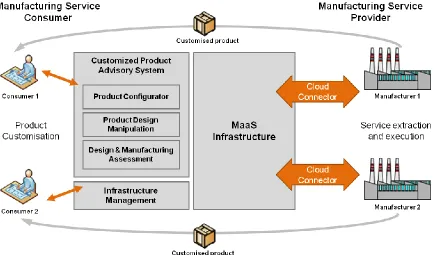
integration of manufacturing networks based on the dynamic interconnection of multiple factories. In doing so, it is envisaged that the small series production of complex customizable products can be imple-mented by small-medium enterprises (SMEs) and offer value to customers. This is in reference to the ini-tial application context of developing highly customizable organic photovoltaic (PV) and lighting (organ-ic light emitting diodes (OLED)) solutions.
Supporting the objectives of the MaaS environment is the development of a front-end system, which will enable the specification of complex customizable products from manufacturing services provided by physically distributed production sites. The focus of this paper considers the research challenges at the front-end perspective in configuring customizable products and reports on the latest development of the proposed front-end system.
2 STATE-OF-THE-ART-REVIEW
Whilst many other technical and organizational factors are critical in supporting the customization of products, this review focuses on the field of product configuration and its current research issues. On the specification of customized products, development of product configuration systems has enabled compa-nies to achieve a quick response to individual customer requirements (Salvador and Forza, 2004). Due to this, much research activity has been dedicated in the technical area of product modeling and methods to describe product information necessary for the configuration task. This has involved various approaches by different authors over the years to define a generic product model and the representation of configura-tion knowledge (Jiao et al 2000; Zhang et al 2005; Felfernig et al 2007; Haug 2010). The related tasks of acquiring and maintaining configuration data models are core knowledge management issues, which arise from the dynamic nature of customizable products. For instance, an adaptable product configuration sys-tem was developed by Chen and Wang (2009) based on an artificial neural network (ANN) approach to address these issues.
In a wider context, other research efforts have been to address the issues of product configuration with production and supply chain integration. The distributed configuration of products and services, based on multiple suppliers, was investigated in a previous study by Ardissono et al (2003). Steger-Jensen and Svensson (2004) proposed the integration of product configuration with an advanced planning and scheduling (APS) system to better support order promise and fulfillment within customized manufactur-ing. Furthermore, a recent study by Zhang et al (2010) presented an integrated prototype system to enable process plan generation and production execution from the configuration of a basic industrial product. A key limitation of the system concerned the lack of support for both complex products and new customized product designs.
With recent developments in information and communication technologies, these present promising new approaches to address customized products requirements within production and the supply chain. For example, the application of service-oriented architecture (SOA) was discussed by Dietrich et al (2007) and implemented for product customization in the shoe industry. The research demonstrated the feasibili-ty of a SOA-based approach to support the dynamic configuration and coordination for a distributed supply chain network within a customization environment.
3 RESEARCH CHALLENGES
The definition of product specifications for customized production presents several technical challenges to be resolved across multiple tiers of the manufacturing supply chain. From a specification view, the ma-jority of existing product configurators implement a unidirectional approach, in which the degree of cus-tomization freedom is limited to the design solution space defined by the manufacturer. Therefore, custo-mized products can only be specified by the customer according to matching manufacturing capabilities. A consequence is that new design specifications or requests cannot be supported in this existing approach.
solution space is generally defined as a product model, this equates to the issue of modeling and maintain-ing dynamic product data in a product customization environment. This task becomes even more complex in a manufacturing network, when multiple distributed manufacturers are involved in the development of a customizable product.
Furthermore, there are technical challenges in providing a seamless integration from product configu-ration to the dynamic reconfiguconfigu-ration of the manufacturing supply chain to support downstream custo-mized production. Overall, it is proposed that these issues can be addressed by enabling a bidirectional exchange between the definition of product specifications that can be configured and available manufac-turing capabilities. The requirement is on the efficient definition of product specifications at the front-end with effective manufacturing supply chain integration and management of product information in the cus-tomization environment.
4 PROPOSED FRONT-END SYSTEM
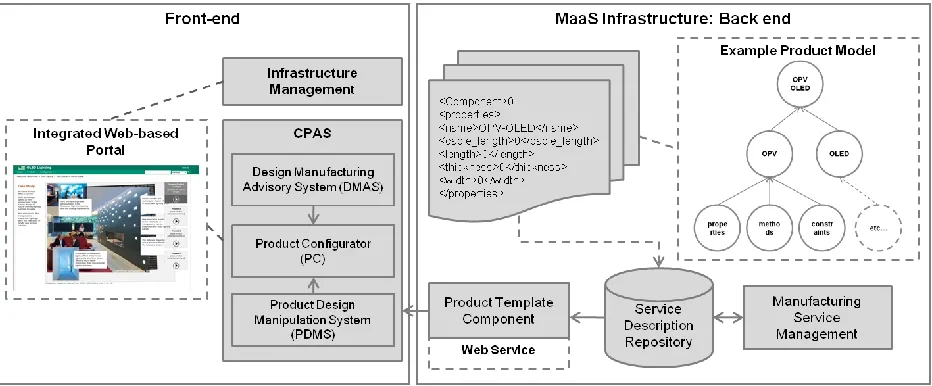
[image:3.612.94.528.354.609.2]In towards a more flexible manufacturing network based on the MaaS paradigm, a front-end system is proposed to better support the specification and manufacture of customized products. The proposed con-ceptual architecture of the front-end system components and its interface with the MaaS infrastructure is illustrated Figure 1. At the front-end layer, this consists of a Customized Product Advisory System (CPAS) with the provision of user interfaces for Infrastructure Management and supporting back-end manufacturing components. Furthermore, the front-end components are deployed as part of an integrated web-based portal to support collaborative development.
Figure 1: Conceptual architecture of Front-end system and MaaS Infrastructure
Product Configurator (PC): provides the overall functionality to configure and specify custo-mizable products offered within the manufacturing cloud, according to the requirements of the consumer.
Product Design Manipulation System (PDMS): provides the capability for product visualization
and provides support for new customized product design,
Design and Manufacturing Advisory System (DMAS): provides the capability for preliminary
design and manufacturing assessment of new product design specifications.
The planned front-end CPAS is an integrated system which combines the functionalities of the three highlighted subsystems with a common graphical user interface and access to required data repositories within the MaaS infrastructure. In the envisaged application scenario, a product designer can browse available lighting products and configure to their specific needs using the PC. If the desired product can-not be currently configured due to limited degrees of customization freedom, the PDMS is intended to support the definition of new custom product design. This can then be initially assessed for design and manufacturability by the DMAS based on real-time integration from the MaaS infrastructure. Lastly, the product specification output of the front-end CPAS can be submitted to the corresponding manufactur-ers/suppliers to receive further feedback on the desired customized product.
For the second use-case, the user interfaces for the MaaS infrastructure management and other back-end manufacturing components are intback-ended to enable the dynamic configuration of virtual production networks. This will be used by manufacturers to define the specific manufacturing services (e.g. offer an assembly service by the lighting product manufacturer) required to produce a customized product or sub-components required within a virtual value chain.
5 FRONT-END APPROACH AND WORK IN PROGRESS
The front-end system integration to the MaaS environment is established on the proposed core concept of a Manufacturing Service Description Language (MSDL), which provides the means of communication between the cloud-based components. The underlying MSDL provides a formal semantic description of both production and product-related information to enable the specification and manufacture of the cus-tomized products.
For the CPAS front-end, the configuration of customized products is based on the product-related as-pect of the MSDL. This corresponds to a product data model that can be interpreted by the product confi-gurator in the form of a product template document, which contains the relevant information (product attributes, constraints etc) to enable product configuration. The working principle is that a product tem-plate is configured to user requirements and is then processed in the MaaS environment to execute the manufacture of the customized product.
In this proposed approach, the front-end product model is defined as an integrated aspect of the manu-facturing service descriptions. As the manumanu-facturing service descriptions are updated by manufacturers to reflect new production capabilities or resources, the relevant changes can be easily propagated through the MaaS environment towards the product configurator and therefore can offer new product customiza-tion freedom to the customer. In other words, the integracustomiza-tion allows a two-way exchange between the de-sign solution space and the available manufacturing capability to produce a customized product. As a re-sult, one of the goals is to reduce some of the issues involved in developing and maintaining product models used for product configuration and to provide further integration to the manufacturing supply chain.
Figure 2: Front-end CPAS and Back-end system interaction
The basic structure of manufacturing service descriptions and corresponding front-end product model was implemented with a graph-based database as an initial approach, which provides a graph tree representa-tion composed of nodes and edges. For the front-end product model, a basic product graphic tree was created to model all the relevant product data (attributes, values, constraints, rules, methods etc) for the configuration of example OPV/OLED product. A Product Template Component is to be executed as a web service to extract the configuration-oriented data model from manufacturing the service descriptions and define it as a Product Template. At present, extensible markup language (XML) technology is being investigated as a means to represent the data model and for the exchange of product information between the back-end and front-end CPAS.
In concurrent to the modeling and development work, a technology evaluation and selection has been completed regarding the integrated web portal at the front-end, based on important criteria including the runtime environment and user interface. Furthermore, an investigation has been initiated in evaluating concepts and technologies for product configuration and other specified CPAS subsystems.
6 CONCLUSION AND OUTLOOK
This paper has provided an overview of a proposed front-end system that aims to support the specification and manufacture of customized products based on the development of a new flexible cloud-based produc-tion IT infrastructure. The work presented here reports the initial approach and development of the front-end CPAS to address the some of the challenges involved from a product configuration perspective. A key advancement is the front-end system integration with production-IT and supply chain management. This is to enable a bidirectional exchange between customized product specification and the actual manu-facturing capabilities distributed within the MaaS infrastructure, which would support the evolution of ex-isting manufacturing system significantly.
ACKNOWLEDGMENTS
The ongoing work described in this paper was executed within the ManuCloud project, which is funded by the European Commission grant agreement FP7-260-142.
AUTHOR BIOGRAPHY
Arthur L.K Yip is a research assistant at the Department of Design, Manufacturing and Engineering Man-agement (DMEM), University of Strathclyde. ([email protected])
Ananda P. Jagadeesan is a research fellow at Department of Design, Manufacturing and Engineering Management (DMEM), University of Strathclyde. ([email protected])
Jonathan R. Corney is a professor and head of Department of Design Manufacture and Engineering Man-agement (DMEM) at the University of Strathclyde. ([email protected])
Yi Qin is a professor at the Department of Design, Manufacturing and Engineering Management (DMEM), University of Strathclyde. ([email protected])
Ursula Rauschecker is a project manager and researcher at the Fraunhofer Institute for Manufacturing En-gineering and Automation. ([email protected])
REFERENCES
Ardissono, L., Felfernig, A., Friedrich, G., Jannach, D., Petrone, G., Schäfer, R. and Zanker, M. 2003. A Framework for the development of personalized, distributed web-based configuration systems. AI Magazine 24(3):93–108
Blecker, T. and Friedrich, G. 2007. Guest Editorial: Mass Customization Manufacturing Systems. IEEE Transactions on Engineering Management 54(1):4–11
Chen, Z. and Wang, L. 2009. Adaptable product configuration system based on neural network. Journal of Production Research 47(18):5037–5066
Da Silveria, G., Borenstein, D. and Fogliatto, F.S. 2001. Mass customization: Literature review and re-search directions. International Journal Production Economics 72:1–13
Dietrich, A. J., Kirn, S., Sugumaran, V. 2007. A Service-Oriented Architecture for Mass Customization - A Shoe Industry Case Study. IEEE Transactions on Engineering Management 54(1):190–204 Felfernig, A. 2007. Standardized configuration knowledge representations as technological foundation for
mass customization. IEEE Transactions on Engineering Management 54(1):41–56
Haug, A. 2010. Managing diagrammatic models with different perspectives on product information. Journal of Intelligent Manufacturing 21:811–822
Jiao, J., Tseng, M., Ma, Q. and Zou, Y. 2000. Generic Bill-of-Materials-and-Operations for High-Variety Production Management. Concurrent Engineering 8(4):297–321
Meier, M., Seidelmann, J. and Mezgár, I. 2010. ManuCloud: The Next-Generation Manufacturing as a Service Environment. ERCIM News 83:33–34
Salvador, F. and Forza, C. 2004. Configuring products to address the customization-responsiveness squeeze: A survey of management issues and opportunities. International Journal of Production Economics 91(3):273–291
Steger-Jensen, K. and Svensson, C. 2004. Issues of Mass Customisation and Supporting IT-solutions. Computers in Industry. 54:83–103