Int. J. Electrochem. Sci., 13 (2018) 7663 – 7674, doi: 10.20964/2018.08.66
International Journal of
ELECTROCHEMICAL
SCIENCE
www.electrochemsci.org
Preparation of Mesoporous Carbon with different Pore Wall
structure via a temperature-programmed route for Lithium
Sulfur Battery
Jing Wang, Yechun Lan, Lei Yan, Yufan Li, Zhiqiang Shi*
Tianjin Key Laboratory of Advanced Fibers and Energy Storage, College of Materials Science and Engineering, Tianjin Polytechnic University, 399 Binshui West Road, Tianjin 300387, P. R. China *
E-mail: [email protected] (Z. Shi).
Received: 7 April 2018 / Accepted: 4 June 2018 / Published: 5 July 2018
Due to the high specific surface area and large pore volume, mesoporous carbon materials are appealing for research interests to promote the performance of Lithium sulfur battery (Li/S). Herein, a mesoporous carbon (MC-1000) material, with high specific surface area (1432 m2 g-1) and large pore volume (2.894 cm3 g-1), is prepared via situ template method (using MgO as template), followed by pyrolysis at 1000 ℃ in nitrogen atmosphere. Temperature-programmed route is used to regulate the pore wall of MC-1000, and the modified MC-1000, MC-1300 and MC-1600 with similar specific surface area and pore volume are chosen for investigating the effect of micro-structure of MC on the performance of Li/S battery. HR-TEM images show graphited structure gradually formed with the regulated progress, and the increasing of pyrolyzation temperature may also improve the conductivity of MC and MC/S composites. With an appropriate sulfur loading, MC-1300 and MC-1600 both present superior discharge capacity. Notably, MC-1300 and MC-1600 display high capacity of 1524 mAh g-1 and 1415 mAh g-1, respectively, which is close to the theoretical specific capacity of sulfur.
Keywords: mesoporous carbon, pore wall, shuttle effect, lithium sulfur, large pore volume
1. INTRODUCTION
safety issues. Main problems focus on the low electric conductivity of sulfur and the large volume expansion of discharge products from S to Li2S2/Li2S. Especially, the “shuttle effect” attributed to polysulfide dissolution in the electrolyte could cause gradual loss of activity sulfur [5-7]. To overcome these issues, a variety of efforts have been attempted, for instance, constructing the nanostructure of sulfur-carbon composite, using innovation electrolyte with additives such as LiNO3 and modifying the surface of separator by coating.
Traditionally, micro/mesoporous carbon [8,9], carbon nanotubes [10-13], graphene or its composites [14,15] are usually used as the cathode materials followed by sulfur loading. Porous carbon (PC), with high surface area and large pore volume has shown superiority of transporting ion. Moreover, its open-framework structure not only provides the reaction space but also avoids the adverse effects of electrolyte convection on the dissolution and loss of polysulfide. The sulfur loading is well known to have a great influence on the electrochemical performance of the sulfur/carbon composites (C/S). However, C/S should also leave a certain gap to prevent the volume expansion of active sulfur during Li+ insertion and promote the electrochemical reaction of the lithium sulfur battery [16]. For further retarding the polysulfide dissolution, reports about chemical interaction between polar nano-materials and polysulfides were becoming hotspots, such as metal oxide [17-20], MXenes [21] and conductivity polymers [22-25]. However, low utilization of sulfur was realized because of the poor electrical conductivity of metal oxides. Among the functionalized carbon materials, carbon materials doped with heteroatoms, such as N-doped graphene [26] and mesoporous carbon [27], B-doped reduced graphene oxide [28] are also investigated to retard the shuttle effect. These modified materials allow achieving better electrochemical performance than pristine carbon materials. However, the mentioned above processes are usually complicated and high cost, which leads to a lack of competitiveness of Li–S batteries.
To summary, the low electrochemical capacity of whole electrode in the charge-discharge process can be attributed to two reasons: (1) polysulfide ions are easily dissolved in the electrolyte; (2) the electrical conductivity of the carbon material is poor. Therefore, ideal carbon materials should satisfy with large free space for buffering volumetic expansion and connected conductive network. It is well known that, the conductivity of carbon materials always increases as the carbonization temperature increased because of the higher degree of graphitization. Carbon materials with high conductivity can effectively enhance the kinetic process, thus allow achieving high activity. In order to confirm this idea, in this work, we regulate the pore wall microstructures of the template mesoporous carbon materials (MC), and then use it as the conductive carrier to prepare the sulfur-carbon composites via the melt diffusion method. The electrochemical properties of the sulfur carbon composites are preliminarily investigated.
2. MATERIALS AND METHODS
2.1. Preparation of mesoporous carbon (MC-X)
precursor of mesoporous carbon (MC) and provided nano-MgO templates. MC-1000 pyrolyzed at 1000 oC was obtained according to a similar procedure in our previous report [16]. Then, MC-1000 was heated to 1300, 1600, 2000, and 2800 oC for 1 h in nitrogen atmosphere, respectively. The MC materials will be described as MC-X, where „X‟ represents the heat treatment temperature.
2.2 Preparation of mesoporous carbon/ sulfur (MC-X/S) composites
The mesoporous carbon /sulfur (MC/S) composites were prepared by melt diffusion method. MC-X was mixed with the high-purity sulfur (99.99%, Aladdin, AR) with weight ratio of 1:2, then ground into uniformity by ball-milling at 230 rpm. Finally, the MC/S composites were obtained after heating for 5 h at 150 oC in the muffle furnace and 3 h at 300 oC.
2.3. Materials characterization
Field-emission scanning electron microscopy (FE-SEM, Hitachi S-4800) and high-resolution transmission electron microscopy (HR-TEM, Tecnai G2 F20) were taken to observe the morphology and structure of MC-X and MC/S. SEM with energy-dispersive X-ray (EDX) spectroscopy was carried out via the FEI Nova Nano-SEM 450 at 10 kV. The N2 adsorption-desorption isotherms were measured on Autosorb-iQ adsorption analyzer at 77K. The specific surface area, pore size distribution (PSD) and total pore volumes can be calculated by BET method and BJH model.
2.4 Electrochemical Measurement
Active material (MC/S), conductive agent (carbon black) and binder (PTFE) with a weight ratio of 80:10:10 was mixed as slurry in NMP. By using a common doctor-blade coating method, the electrodes were obtained after drying for 12 h. And then CR2430 coin type cells were assembled as the way we had reported [16]. Land CT-2001A (Wuhan, China) used for GCD tests were performed at the voltage ranging from 1 V to 3 V. Cyclic voltammetry (CV) curves (CHI604D, China) were acquired at a scan rates of 0.1 mV/s.
3. RESULTS AND DISCUSSION
3.1. Characterizations of the MC-X and MC/S.
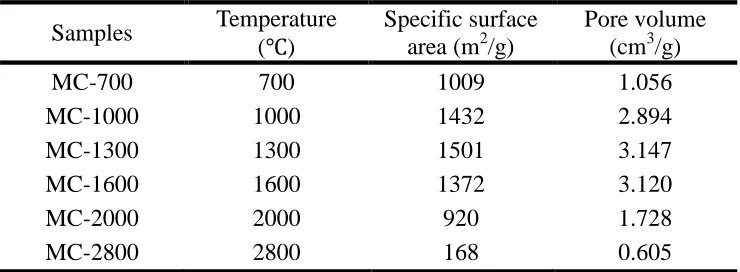
1300 ℃, the specific surface area increases, then it decreases. When the temperature was 2800 ℃, the specific surface area of MC-2800 sharply decreased to 168 m2g-1. Meanwhile, the pore volume of MC-X presented the same trend with the specific surface area and the max pore volume was 3.147 cm3g-1, which calculated by BET method (Table 1).
Scheme 1. Schematic diagram illustrating the preparation process of MC-X/S composite electrodes.
[image:4.596.99.502.360.500.2]Figure 1. The specific surface area and pore volume of MC-X at different heating treatment temperature.
Table 1. The specific surface area and pore volume of MC-Xs treated at different temperature.
Samples Temperature (℃)
Specific surface area (m2/g)
Pore volume (cm3/g)
MC-700 700 1009 1.056
MC-1000 1000 1432 2.894
MC-1300 1300 1501 3.147
MC-1600 1600 1372 3.120
MC-2000 2000 920 1.728
MC-2800 2800 168 0.605
[image:4.596.114.484.576.712.2]
micro-crystal structure gradually formed caused the pore wall structure changed dramatically. In order to study of the direct relation in between the micro-wall structure and the corresponding properties of MC-X, we chosen the same carbon source precursor, similar specific surface area and pore volume mesoporous carbon materials (1000, 1300 and 1600 ℃) as the carbon matrix for MC/S composites.
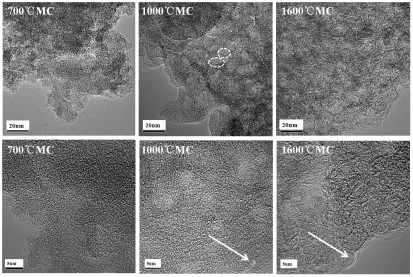
Figure 2. The HR-TEM images of MC-Xs.
The effect of temperature regulation on the microcrystalline structure of MC-X can be clearly observed by high rate transmission (HR-TEM). As shown in Figure 2, MC-1000 displays larger cluttered layers of 1~2 nm than that of MC-700, although the crystallites were still in a relatively short form (as shown in fig. 2b arrows). After modified at 1600 ℃, the crystallites continued growth, and the six angle net structures layers gradually change into the graphited structure with regular orientation. The well alignment of graphited crystallites structure may enable the MC-X to have good electronic conductivity and further increase the activity of MC/S composites.
[image:5.596.93.506.156.433.2]
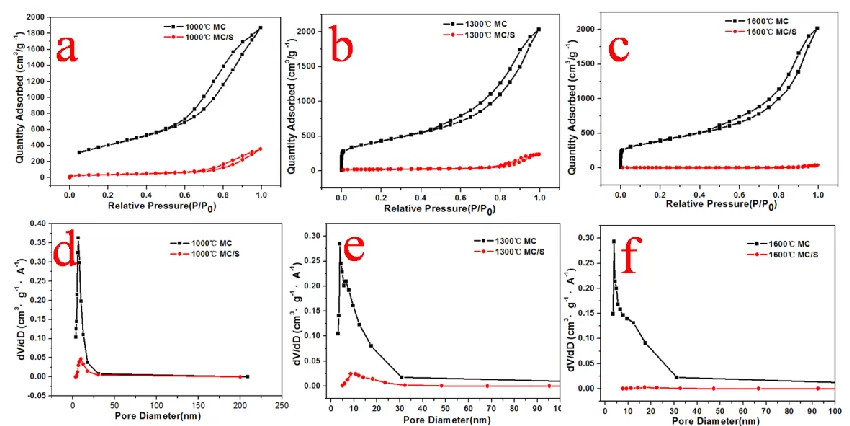
results indicate the elemental sulfur is successfully embedded in the mesopores of MC materials.
[image:6.596.85.510.90.303.2]Figure 3. Nitrogen adsorption/desorption isotherms of MC-X before and after sulfur loading: a)1000℃,(b)1300℃,(c)1600℃; Pore size distribution curves of the MC-X before and after sulfur loading d)1000℃,(e)1300℃,(f)1600℃
Table 2. The specific surface area and pore volume of MC-Xs before and after sulfur loading.
Samples
Before sulfur loading After sulfur loading Specific
surface area m2/g
pore volume cm3/g
Specific surface area
m2/g
pore volume cm3/g
MC-1000 1432 2.894 133 0.353
MC-1300 1501 3.147 75 0.370
MC-1600 1372 3.120 8 0.060
Figure 4. TGA curves of MC-X/S composites :a)1000℃MC/S, b)1300℃MC/S and c) 1600℃MC/S.
[image:6.596.61.538.426.684.2][image:7.596.104.495.139.381.2]
of sulfur was 66.7 %. When the temperature is 300~350℃, the weight loss is the fastest which corresponding to the sulfur loss. In accordance with the weight loss of sulfur, the actual sulfur loading was 63, 67 and 76 %, which were almost consistent with the theoretical value.
Figure 5. The SEM images of MC-Xs and MC-X/S.
[image:7.596.105.493.422.734.2]
Figure 5 shows the SEM images of MC-X (1000, 1300, 1600) before and after sulfur loading. The upside is the raw material images and the below was the images of MC/S composites. It could be seen that the size of the MC-X particles changes slightly before and after sulfur loading indicating that the sulfur has successfully entered into the nanopores of MC-X and no deposition on the surface of MC-X. To investigate the distribution of sulfur in the MC/S, the SEM-EDX spectra of MC/S with different micro wall structure were taken. From figure 6, the carbon and sulfur mapping of MC-X/S clearly illustrated that sulfur nanoparticles were indeed homogeneously dispersed in the MC-X matrix within the mesopore [16]. The high loading and good dispersibility of sulfur may allow to better electrochemical characteristic of Li/S battery.
[image:8.596.118.481.278.566.2]3.2. Electrochemical performance
Figure 7. CV curves of the MC-1000/S at scan rate of 0.1 mV s−1
life of the electrode.
[image:9.596.166.426.105.305.2]
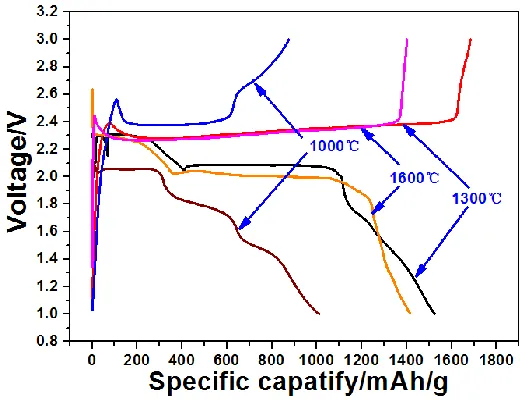
Figure 8. First charge/discharge curves of the MC-X/S composite cathodes at a current density of 200 mA g-1
Table 3. Comparison of the MC-X cathode in this work with reported results .
Cathode materials Discharge capacity (mAh/g)
Sulfur
loading (%) Ref. Sulfur/graphene/carbona
nanotubes composites a 1468 57 12
Graphene@microporous carbon a 1320 60 9
Flexible nanostructure paper a 1234 56 14
3D graphene/sulfur a 1077 90 15
PVP/ GA a 1192 63 25
MC-1300 b 1524 67 (this
work) Note: Working Conditions: a) 0.1 C; b) 200 mAh/g
[image:9.596.91.505.406.564.2]
MC-1000/S, the first charge discharge capacity of MC-1300/S and MC-1600/S was much higher which may attribute to the relatively higher conductivity of MC-X by high temperature modification. In addition, the resulting capacity of MC-X/S samples is clearly higher than the most of previously reported materials which are listed in Table 3. The high temperature modification may yield to high conductivity, which is conducive to the activity and utilization of elemental sulfur.
At the current density of 200 mAh g-1, cycling performance of the MC-X/S with different micro-wall structure was shown in Figure 9. It can be seen that the initial discharge capacity of the batteries of MC-1300/S and MC-1600/S is higher than that of MC-1000/S, but the deceleration rate of MC-1300/S is slower than that of other batteries. Especially, MC-1300/S had shown the highest discharge capacity of 1524 mAh g-1 which was closed to the theoretical specific capacity (1675 mAh g -1
), and its corresponding specific surface area and pore volume was also the highest. Compared to micro structure, the sulfur loading percent seemed to have a minimal impact on the electrochemical performance. Nazar's group confirmed that 75% was the critical value of sulfur loading, specific capacity had little change when sulfur loading in excess of 75% but increased linearly with the sulfur loading within 75% [37]. Therefore, although the sulfur loading of MC-1600/S was higher than that of MC-1300/S, the performance of MC-1300/S was much better. The results demonstrated that pore structure played an important role in the inhibition of the dissolution of intermediate products. Moreover, the high conductivity of the carbon matrix improves the activity of the sulfur electrode, which is conducive to the electrochemical reaction of the whole electrode.
4. CONCLUSIONS
In this work, template method is used to prepare mesoporous carbon materials (MC), and the pore wall microstructures are regulated via a temperature-programmed route. Then, MC materials with similar surface area and large pore volume are selected for further research. The influence of MC matrix microstructure on the electrochemical behavior of elemental sulfur is studied. The main results are as follows: for one part, MC with high specific surface, large pore volume and open phase channel structure provides a sufficient reaction place for the active substances, which has a great influence on the inhibition of disulfide dissolution and loss; for another part, the regulation of the microwall structure of MC increases the degree of graphitization of the MC-X, promoting the electronic conductivity of MC. Therefore, MC-1300 and MC-1600 present the high capacity of 1524 mAhg-1 and 1415 mAhg-1, respectively, which is close to the theoretical specific capacity. The as shown microstructures regulated progress of MC can be used in any field where mesoporous structures are adopted.
ACKNOWLEDGEMENTS
References
1. P.G. Bruce, S.A. Freunberger, L.J. Hardwick and J.M. Tarascon, Nat. Mater., 11 (2012) 19. 2. A. Manthiram, Y. Fu, S.H. Chung, C. Zu and Y.S. Su, Chem. Rev., 114 (2014) , 11751–11787. 3. A. Manthiram, S.H. Chung, C. Zu, Adv. Mater., 27 (2015) 1980.
4. J.M. Tarascon, M. Armand, Nature, 414 (2001) 359.
5. L.F. Nazar, M. Cuisinier and Q. Pang, M R S Buletin, 39 (2014) 436.
6. S. Chen, X. Huang, B. Sun, J. Zhang, H. Liu and G. Wang, J. Mater. Chem. A., 2 (2014), 16199. 7. Y. Yang, G. Zheng and Y. Cui, Chem. Soc. Rev., 42 (2013), 3018.
8. N. Jayaprakash, J. Shen, S.S. Moganty, A. Corona and L.A. Archer, Angew. Chem. Int. Ed., 123 (2011), 6026.
9. N.W. Li, Y.X. Yin and Y.G. Guo, RSC Adv., 6 (2016) 617.
10. M.D. Walle, Z. Zhang, X. You, M. Zhang, J.M. Chabu, Y. Li and Y.N. Liu, RSC Adv., 6 (2016) 78994.
11. Y.L. Ding, P. Kopold, K. Hahn, P.A. van Aken, J. Maier and Y. Yu, Adv. Funct. Mater., 26 (2016) 1112.
12. G. Yuan, G. Wang, H. Wang and J. Bai, J. Nanoparticle Res., 17 (2015) 36. 13. J. Guo, Y. Xu and C. Wang, Nano Lett., 11 (2011) 4288.
14. J. Cao, C. Chen, Q. Zhao, N. Zhang, Q. Lu, X. Wang, Z. Niu and J. Chen, Adv. Mater., 28 (2016) 9629
15. B. Papandrea, X. Xu, Y. Xu, C.Y. Chen, Z. Lin, G. Wang, Y. Luo, M. Liu, Y. Huang, L. Mai, Nano Res., 9 (2016) 240.
16. J. Wang, Y.H. Wu, Z.Q. Shi, C.C. Wu, Electrochim. Acta, 144 (2014) 307. 17. . J. Zhang, Y. Shi, Y. Ding, W. Zhang, G. Yu, Nano Lett., 16 (2016) 7276.
18. J.Y. Hwang, H.M. Kim, S.K. Lee, J.H. Lee, A. Abouimrane, M.A. Khaleel, I. Belharouak, A. Manthiram, Y.K. Sun, Adv. Energy Mater., 6 (2016) 12886.
19. X. Wang, G. Li, J. Li, Y. Zhang, A. Wook, A. Yu, Z. Chen, Energy Environ. Sci., 9 (2016) 2533. 20. Y. Tao, Y. Wei, Y. Liu, J. Wang, W. Qiao, L. Ling, D. Long, Energy Environ. Sci. 2016, 9, 3230. 21. X. Liang, Y. Rangom, C.Y. Kwok, Q. Pang, L.F. Nazar, Adv. Mater., 29 (2017) 1603040.
22. L.F. Xiao, Y.L. Cao, J. Xiao, B. Schwenzer, M.H. Engelhard, L.V. Saraf, Z.M. Nie, G.J. Exarhos, J. Liu, Adv. Mater., 24 (2012) 1176.
23. Y. Yang, G.H. Yu, J.J. Cha, H. Wu, M. Vosgueritchian, Y. Yao, Z.N. Bao, Y. Cui, ACS Nano., 5 (2011) 9187.
24. Y.F. Dong, S.H. Liu, Z.Y. Wang, Y. Liu, Z.B. Zhao, J.S. Qiu, Nanoscale, 7 (2015) 7569. 25. B.Y. Li, Q. Xiao, Y.Z. Luo, RSC Adv., 7 (2017) 54453.
26. J. He, K Zhou, Y. Chen, C. Xu. J Lin and W Zhang, Mater. Today Energy, 1-2 (2016) 11. 27. Y.J. Hao, Z.Q. Shi, J. Wang and Q. Xu, RSC Adv., 5 (2015) 31629.
28. Y. Tian, C.L. Deng, Z.H. Sun, Y. Zhao, T.Z. Tan, F.X. Yin, X. Wang, Int. J. Electrochem. Sci., 13 (2018) 3441.
29. S. Du, L. Wang, X. Fu, M. Chen, C. Wang, Bioresour. Technol., 139 (2013) 406-409.
30. K. Xi, S. Cao, X.Y. Peng, C. Ducati, R.V. Kumar, A.K. Cheetham, Chem. Commun., 49 (2013) 2192.
31. G.Y. Xu, B. Ding, L.F. Shen, P. Nie, J.P. Han, X.G. Zhang, J. Mater. Chem. A., 1 (2013) 4490. 32. H. Yamin, A. Gorenshtein, J. Penciner, Y. Sternberg, E. Peled, J. Electrochem. Soc., 135 (1988)
1045.
33. H.Wang, Y. Yang, Y. Liang, J.T. Robinson, Y. Li, A. Jackson, Y. Cui, H. Dai, Nano Lett., 11 (2011) 2644.
34. Y.J. Choi, Y.D. Chung, C.Y. Baek, K.W Kim, H.J. Ahn, J. Power Sources, 184 (2008) 548. 35. C. Lai, X.P. Gao, B. Zhang, T.Y. Yan, Z.J. Zhou, Phys. Chem.C, 113 (2009) 4712.
37. J. Schuster, G. He, B. Mandlmeier, T. Yim, K.T. Lee, T. Bein, L.F. Nazar, Angew. Chem. Int. Ed., 50 (2011) 5904.