Int. J. Electrochem. Sci., 13 (2018) 10821 – 10828, doi: 10.20964/2018.11.62
International Journal of
ELECTROCHEMICAL
SCIENCE
www.electrochemsci.org
Short Communication
Low Melting Point Glass Powder (glass) used as an Additive to
Zr
0.88Y
0.08Eu
0.04O
2-α(ZYE) Electrolyte for Intermediate
Temperature SOFCs
Ruijuan Shi1, Wei Chen2, Wenli Hu2, Junlong Liu1,*, Huiquan Li1,*, Hongtao Wang1,*, Liangquan Sheng1
1
School of Chemical and Material Engineering, Fuyang Normal College, Fuyang 236037, China 2
Fuyang Preschool Education College, Fuyang 236015, China *
E-mail: [email protected], [email protected], [email protected]
Received: 31 July 2018 / Accepted: 5 September 2018 / Published: 1 October 2018
In this study, Eu3+ and Y3+ double doped ZrO2, that is Zr0.88Y0.08Eu0.04O2-α (ZYE) electrolyte was synthesized by the chemical precipitation method. The low melting point glass powder (glass) was used as an additive to ZYE electrolyte for intermediate temperature SOFC after heated at 700 °C for 2 h. The phase composition and microstructure of the Zr0.88Y0.08Eu0.04O2-α-low melting point glass powder (ZYE-glass) composite electrolyte were observed by XRD and SEM. The effects of gas atmosphere, operating temperature, time and the partial pressure of oxygen on the ionic conductivity of the ZYE-glass composite electrolyte were also studied at 400–800 °C.
Keywords: Additive; Composite; Fuel cell; Thermogravimetric analysis (TGA)
1. INTRODUCTION
As has been found in many studies, double metal ion doped zirconia can effectively reduce the sintering temperature [13–15]. It has also been evidenced that double metal ion doped zirconia can significantly reduce the operating temperature and improve its conductivity. Gong et al. found that CaO/Y2O3-stabilized ZrO2 exhibited higher ionic conductivity than ZrO2-CaO and ZrO2-Y2O3 at high temperature, which is mainly ascribed to the increase in the concentration of the oxygen vacancies [13]. It has been reported that doping Al2O3 to YSZ could enhance the mechanical properties, decrease the sintering temperature of YSZ, and the highest output value was achieved for a single cell based on 1 wt.% Al2O3-doped YSZ electrolyte [14]. YSZ-SDC (samarium doped ceria) composite was found to be responsible for the enhanced electrical conductivity in the temperature range 400-700 °C [15]. All this suggests that doping ZrO2 with two different elements can improve conductivity. Metallic cation Eu3+ is similar to Y3+ in ionic radius and electronegativity. Therefore, we tried to fabricate a new dense composite electrolyte by using Eu3+ and Y3+ double doped ZrO2 together with low melting point glass powder additive.
In this paper, a new ZYE-glass composite electrolyte was prepared. The structure, morphology, ionic conductivity and electrochemical properties at intermediate temperature (400–800 °C) of the composite electrolyte were examined by various methods. The effects of different gas atmospheres, operating temperature, time and the partial pressure of oxygen on the ionic conductivity were also studied.
2. EXPERIMENTAL
Eu3+ and Y3+ double doped ZrO2, that is Zr0.88Y0.08Eu0.04O2-α (ZYE), electrolyte was prepared via the chemical precipitation method. To synthesize ZYE electrolyte, stoichiometric amounts of Y2O3 and Eu2O3 were dissolved in nitric acid and then added to the Zr(NO3)4·5H2O solution under stirring. All the reagents used were of analytical-grade. The NH4OH was added drop-wise to the mixed solution under continuous stirring until the pH reached 9. The precipitate was washed and dried. Subsequently, the resulting precursor was heated at 700 °C for 6 h to get the ZYE electrolyte. The ZYE electrolyte was mixed with low melting point glass powder (glass) at a weight ratio of ZYE electrolyte to glass of four to one. The composition of the low melting point glass powder is Na2O-CaO-SiO2-ZnO (Taizhou Xinhai Special Materials Factory, 300 mesh, m.p. is 550 °C). After heating at 700 °C for 2 h, the Zr0.88Y0.08Eu0.04O2-α-low melting point glass powder (ZYE-glass) composite electrolyte was obtained.
The effect of different gas atmospheres, operating temperature, time and the partial pressure of oxygen on the electrical conductivities was investigated using an electrochemical analyzer (CHI660E, Shanghai, China) in a three-electrode system over the frequency range of 0.1 Hz to 1 MHz at 400–800 °C. And the ac amplitude was 20 mV. The sample powders were pressed into pellets and then ground into thin slices with a thickness of 1.0–1.2 mm. A 20% palladium-80% silver paste with silver wires were attached onto both sides of the pellets as electrodes, the areas of both electrodes were about 0.5 cm2. A H2/O2 fuel cell using the ZYE-glass composite electrolyte as electrolyte was fabricated. The fuel cell was tested using the linear scanning of current and voltage method in the CHI660E electrochemical analyzer.
3. RESULTS AND DISCUSSION
0 200 400 600 800 1000
20 40 60 80 100
-10 -5 0 5 10
Heat
Flo
w (W
/g
)
Temperature / oC
Wei
gh
t(%)
[image:3.596.169.450.267.476.2]Weight(%) Heat Flow (W/g)
Figure 1. TGA-DSC curves of the precursor of ZYE electrolyte in nitrogen atmosphere up to 1000°C at 15 °C·min-1.
20 30 40 50 60 70
ZYE-glass 700 oC
ZYE
t-Zr
0.9Y0.1O1.95 82-1241
m-ZrO 2 83-0942
2/ o
Inte
nsit
y/a
.u.
[image:3.596.182.413.547.728.2][image:4.596.103.493.240.380.2]
The thermogravimetry analysis and differential scanning calorimetry (TGA-DSC) were conducted to determine the suitable calcination temperature required for ZYE electrolyte. Fig. 1 shows the TGA-DSC curves of the precursor. As can be seen from Fig. 1, there was a weight loss of 15 % from room temperature up to 80 °C with a sharp endothermic peak which can be ascribed to the loss of the adsorbed water and ammonium salt in the precursor [16]. The DSC curve has two exothermic peaks between 100 °C and 300 °C accompanied by 40 % weight loss which can be assigned to the decomposition of the nitrate [17]. Almost no weight loss was observed when the temperature was above 680 °C, therefore, the optimal calcination temperature for ZYE electrolyte was chosen as 700 °C [18–19].
Figure 3. Surface (a) and cross-sectional (b) SEM images of the ZYE-glass composite electrolyte.
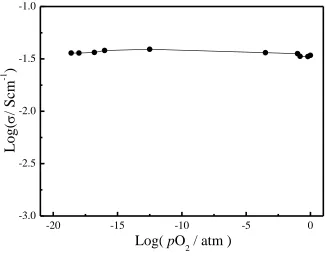
Figure 4. The conductivities of the ZYE-glass composite electrolyte as a function of the oxygen partial pressure (pO2) range from 10-20 to 1 atm at 800 °C.
-20 -15 -10 -5 0 -3.0
-2.5 -2.0 -1.5 -1.0
Log( pO
2
/ atm )
Log(
/ Scm
[image:4.596.111.438.438.694.2]
Fig. 2 shows the XRD diffraction patterns of the ZYE electrolyte and ZYE-glass composite electrolyte together with the standard data of t-Zr0.9Y0.1O1.95 (JCPDS 82-1241) and m-ZrO2 (JCPDS 83-0942). It is clear that both samples calcined at 700 °C possessed a mixture of t-Zr0.9Y0.1O1.95 and m-ZrO2 phases, where the tetragonal phase was the main constituent. And there were no characterized diffraction peaks relating to the low melting point glass powder phase, which means that the low melting point glass powder exists as an amorphous phase. All the results indicate that the low melting point glass powder which did not react with ZYE electrolyte mainly existed in the grain boundary in an amorphous form [20].
The microstructure of the ZYE-glass composite electrolyte was detected by SEM and the result is displayed in Fig. 3. Obviously, no visible pores or cracks were observed on the surface of the ZYE-glass composite electrolyte, which implies that the ZYE-ZYE-glass composite electrolyte was fairly dense. However, it can be seen from Fig. 3(b) that some small scattered pores were found in the cross-sectional of the ZYE-glass composite electrolyte. It was also found that the pores were closed through the seal test and thus can not affect the electrochemical test.
Fig.4 shows the conductivities of the ZYE-glass composite electrolyte as a function of the partial pressure of oxygen. The conductivities of the ZYE-glass composite electrolyte were performed in the oxygen partial pressure (pO2) range from 10-20 to 1 atm at 800 °C. It can be seen that the conductivities hardly changed with the partial pressure of oxygen in the whole pO2 region, which demonstrates that the ZYE-glass composite electrolyte is a pure ionic conductor at 800 °C [21]. At 800°C, the molten low melting point glass powder may allow ionic charge carriers to move quickly and freely through it which is beneficial for the long-range transferability of ions.
0.9 1.2 1.5
-2 -1 0 1 2
wet O
2
wet air
1000 T-1 / K-1
Lo
g(
T/
Sc
m
[image:5.596.197.400.448.679.2]-1 K)
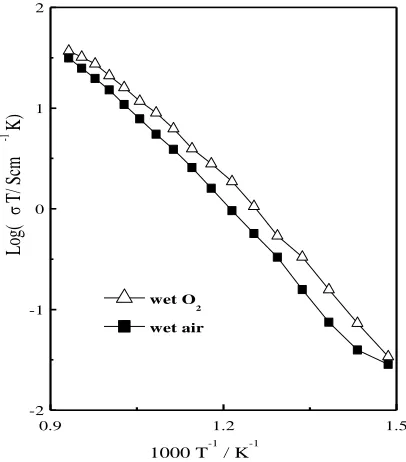
The temperature dependence of the conductivities of the ZYE-glass composite electrolyte was measured in wet O2 and wet air from 400 to 800 °C. As shown in Fig. 5, the log (T) ~ 1000 T-1 plots of the ZYE-glass composite electrolyte exhibited a linear relationship and the conductivities were increased with increased temperature. The conductivities in a wet air atmosphere were slightly lower than that in wet O2. The maximum conductivities of 3.4×10⁻² S·cm-1 and 2.9×10⁻² S·cm-1 were achieved in wet O2 and wet air at 800 °C, respectively.
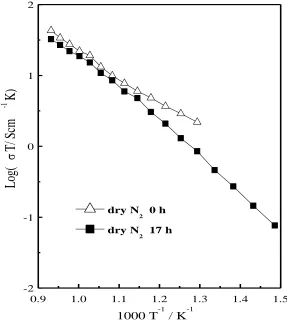
The stability of the ZYE-glass composite electrolyte was investigated by measuring the conductivities after a 17h run in a dry N2 atmosphere. As shown in Fig. 6, the ZYE-glass composite electrolyte exhibited high and stable conductivity during the long run in a higher temperature range which was above the melting point of the low melting point glass powder (550 °C). This may be due to the ionic charge carriers being able to move quickly in the molten low melting point glass powder. However, the conductivity decreased slightly in the low temperature range. The glass is solid at 400– 550 °C which hinders the mobility of ionic charge carriers, resulting in the decrease of electrical conductivity. It is suggested that the ZYE-glass composite electrolyte is stable enough for practical use in the high temperature range of 600-800 °C.
0.9 1.0 1.1 1.2 1.3 1.4 1.5
-2 -1 0 1 2
dry N
2 0 h
dry N
2 17 h
1000 T-1 / K-1
Lo
g(
T/
S
cm
-1
K)
Figure 6. The log (T) ~ 1000 T-1 plots of the ZYE-glass composite electrolyte in dry N2 at the beginning of the experiment and after 17 h.
[image:6.596.159.446.348.669.2]
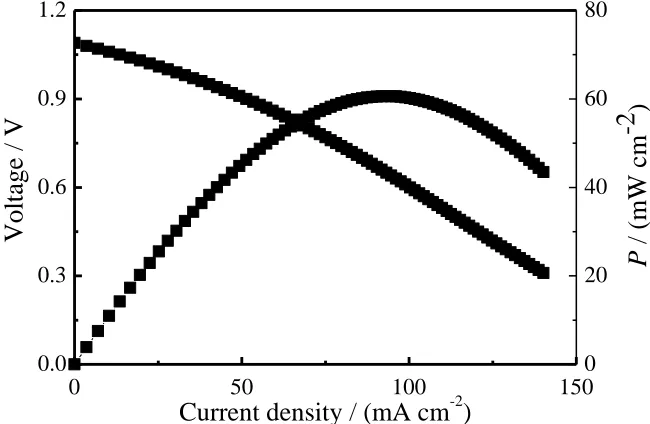
voltage was 1.09 V which indicates that the ZYE-glass composite electrolyte is tight, and the maximum power output density is 60.6 mW·cm-2 at 800°C. Moon et al. found that a fuel cell with a YSZ thin film as the electrolyte showed a maximum power output density of 230 mW·cm-2 at 750 °C [22]. Lee et al. discovered that a YSZ membrane fuel cell using microemulsion-mediated and a conventionally ball-milled NiO-YSZ anode exhibited a maximum power output density of 362 mW·cm-2 and 160 mW·cm-2 at 850 °C, respectively [23]. The result is not so high as those reported on thin film fuel cells, which may be mainly ascribed to the electrolyte layer thickness (1.1 mm).
0.0 0.3 0.6 0.9 1.2
P
/
(
m
W cm
-2
)
V
ol
tage /
V
Current density / (mA cm-2)
0 50 100 150
0 20 40 60 80
Figure 7. I-V and I-P curves of the H2/O2 fuel cell of the ZYE-glass composite electrolyte using the linear scanning of current and voltage method within the CHI660E electrochemical analyzer at 800 °C.
4. CONCLUSIONS
In this study, a new ZYE-glass composite electrolyte was prepared. The result of XRD indicates that the tetragonal is the main phase and low melting point glass mainly exists in the grain boundary in an amorphous form. The log ~ log (pO2) plot illustrates that the ZYE-glass composite electrolyte is a pure ionic conductor at 800 °C. The highest conductivities are observed to be 3.4×10⁻² S·cm-1 and 2.9×10⁻² S·cm-1 in wet O2 and wet air at 800 °C, respectively. The maximum power density of the ZYE-glass composite electrolyte (thickness = 1.1 mm) is 60.6 mW·cm-2 at 800 °C.
ACKNOWLEDGEMENTS
[image:7.596.149.474.213.425.2]
government and Fuyang Normal College (No. XDHX2016019, XDHXTD201704, XDHX201739, XDHX2016002), Excellent Youth Foundation of Fuyang Normal College (rcxm201805) and Foundation of Anhui Provincial Key Laboratory for Degradation and Monitoring of Pollution of the Environment (2019HJJC01ZD).
References
1. G. L. Liu, W. Liu Q. Kou and S. J. Xiao, Int. J. Electrochem. Sci., 13 (2018) 2641. 2. R. Shi, J. Liu, H. Wang, F. Wu, and H. Miao, Ceram. Int., 43 (2017) 16931.
3. T. Hibino, K. Kobayashi, P. Lv, M. Nagao, S. Teranishi, and T. Mori, J. Electrochem. Soc., 164 (2017) F557.
4. Y. N. Chen, T. Tian, Z. H. Wan, F. Wu, J. T. Tan and M. Pan, Int. J. Electrochem. Sci., 13 (2018) 3827.
5. S. Lee, and X. Guan, MRS Communications, 7 (2017) 199.
6. J. Luo, A.H. Jensen, N.R. Brooks, J. Sniekers, M. Knipper, D. Aili, Q. Li, B. Vanroy, M. Wübbenhorst, F. Yan, L.V. Meervelt, Z. Shao, J. Fang, Z.-H. Luo, D.E.D. Vos, K. Binnemans, and J. Fransaer, Energy Environ. Sci., 8 (2015) 1276.
7. A. Dankeaw, G. Poungchan, M. Panapoy, and B. Ksapabutr, Sensor. Actuat. B: Chem., 242 (2017) 202.
8. X.Y. Liu, Z.H. Xu, and G.Y. Liang, Mater. Lett., 191 (2017) 108.
9. N. Mamana, A. Díaz-Parralejo, A.L. Ortiz, F. Sánchez-Bajo, and R. Caruso, Ceram. Int., 40 (2014) 6421.
10.F.R. Bueta, J.F. Imperial, and R.B. Cervera, Ceram. Int., 43 (2017) 16174.
11.A. Elmouwahidi, E. Bailón-García, A.F. Pérez-Cadenas, F.J. Maldonado-Hódar, J. Castelo-Quibén, and F. Carrasco-Marín, Electrochim. Acta., 259 (2018) 803.
12.O. Bohnke, V. Gunes, K.V. Kravchyk, A.G. Belous, O.Z. Yanchevskii, and O.I. V'Yunov, Solid State Ions., 262 (2014) 517.
13.J. Gong, Y. Li, Z. Tang, and Z. Zhang, Mater. Lett., 46 (2000) 115. 14.L. Lei, Y. Bai, and J. Liu, J. Power Sources, 248 (2014) 1312. 15.Raghvendra, and P. Singh, Ceram. Int., 43 (2017) 11692.
16.A. Matsuda, S. Oh, V.H. Nguyen, Y. Daiko, G. Kawamura, and H. Muto, Electrochim. Acta, 56 (2011) 9364.
17.M.T. Soo, N. Prastomo, A. Matsuda, G. Kawamura, H. Muto, A.F.M. Noor, Z. Lockman, and K.Y. Cheong, Appl. Surf. Sci., 258 (2012) 5250.
18.M.I.G. Miranda, C.I.D. Bica, S.M.B. Nachtigall, N. Rehman, and S.M.L. Rosa, Thermochim. Acta, 565 (2013) 65.
19.S. Huang, and J.J. Sheng, Fuel, 210 (2017) 98.
20.M. Keane, and P. Singh, Ceram. Int., 40 (2014) 7261.
21.J. Liu, R. Du, R. Shi, and H. Wang, Ceram. Int., 44 (2018) 5179.
22.H. Moon, S.D. Kim S.D, S.H. Hyun, and H.S. Kim, Int. J. Hydrogen Energ., 33 (2008) 2826. 23.M.K. Rath, Y.M. Jung, J.H. Park, D. W. Joh, and K.T. Lee, J. Alloy Compd., 723 (2017) 681.