The detection of smaller changes in
visual working memory arrays
Laura Jenkins
University of Strathclyde United Kingdom
Correspondence: [email protected]
Copyright. 2017. Psychreg Journal of Psychology ISSN: 2515-138X
The Shared Resource Account of visual working memory defines working memory capacity in terms of a memory resource shared equally between the items in a memory array. This enables an unlimited amount of small details to be remembered within visual working memory, naming this type of memory as qualitative visual working memory. Previous research has suggested that people can store multiple items within qualitative memory, including the storage of precise details, such as the size of a shape or the exact hue (colour) of an object. One question remains from this research, as to how small these changes in visual working memory can be and how the precise nature of visual working memory can be measured when visual elements such as colour are not used. The aim of the current research, therefore, was to produce an updated qualitative visual working memory task, in the hope of reducing working memory errors and to investigate the degree to which people can accurately remember the small, qualitative features, such as the size of a shape in memory. Researchers implemented a qualitative change detection task which asked participants to identify whether a shape size had changed, with size changes ranging from 5% to 25% in size change. Results demonstrated that people could detect size changes of all types, however ceiling effect were presented for the 25% size changes. This has enabled researchers to question whether 25% is really a small change in visual memory or whether this is more of a categorical, quantitative change. Results of the current study were discussed in terms of the Shared Resource Account to qualitative visual working memory and suggestions of future task use were discussed.
BACKGROUND
The Shared Resource Model (Bays, Catalao, & Husain, 2009) contrasts the more quantitative based Discrete Slot Model (Luck & Vogel, 1997) by focusing upon the resolution of the representations within working memory as well as the number of items that could be stored. The model defines working memory capacity in terms of the precision of the stored representations and proposes that there is no upper limit to the amount of items that can be stored. This is because a memory resource is shared equally between all ‘to-be’ remembered items (Bays & Husain, 2008). The Shared Resource Model has been investigated using small changes in visual arrays including features such as size, location, and orientation as these aspects can be measured with very fine precision.
Awh Barton and Vogel (2007) investigated qualitative change detection tasks from a different perspective. Researchers here suggested that it is not just recall precision alone which can decline with small changes in stimuli, but also errors known as comparison errors can increase causing the decline in working memory capacity. In their experiment, Awh et al. (2007) asked participants to view shaded cubes, random polygons, Chinese characters and coloured squares, all of which were seen to have a different levels of complexity. Performance was assessed when participants had to detect changes between both similar and non-similar stimuli. Similar stimuli consisted of changes that occurred within the same type of stimuli, for example a Chinese character changed to another Chinese character. Non-similar changes were changes that were detected between the types of stimuli, for example if a square changed to a Chinese character. High sample-test similarity, in particular between the same category items, was seen to cause comparison errors in memory as participants would make error judgements when trying to retrieve the highlighted item from memory. For the creation of the current change detection task, the possibility of comparison errors with multiple array sizes needs to be considered.
Another way of assessing the qualitative aspects of working memory is to look at the detection of precise details of the representation presented. Zhang and Luck (2008) used a colour wheel paradigm which enabled participants to point to the exact colour they recalled. A wheel meant that precision was measured by the difference between the encoding colour and the colour that was recalled by the participant. Results demonstrated that the precision of working memory declined from set size 3 to set size 6 suggesting that at set size 6, all items are stored but with a smaller amount of the resource. Zhang and Luck (2008) incorporated both the Shared Resource model and the Discrete Slot Model as an explanation for results, suggesting that memory capacity consisted of a small set of discrete fixed-resolution representations, where each slot is allocated the same amount of resource.
In a different visual working memory context, Scolari, Vogel and Awh (2008) used a change detection task to assess both qualitative and quantitative changes in stimuli, in relation to perceptual expertise. Researchers, here used images of upright faces, inverted faces and shaded cubes which were divided into two categories – a within condition (same category) and a between condition (different categories). These enabled researchers to look at the difference of both small within category changes and large between category changes. Results suggested that perceptual expertise and prior knowledge of the stimuli enhances the resolution of working memory but not the number of items stored, again suggesting a dynamically distributed resource. Scolari et al. (2008) suggested that because the K-Capacity scores for the within category conditions were lower than the between categories, this could suggest comparison errors between the stored and retrieved stimuli, for example, the comparison errors as previously suggested by Awh et al. (2007).
labelled the Size Just Noticeable Differences task was used to assess the smaller changes in visual arrays. For this task, participants are shown an encoding square which then disappears for a specified maintenance interval. At retrieval, another square is presented and participants have to decide if this square is bigger, smaller or whether there has been no change compared to the first square previously shown at encoding. As this task assesses qualitative changes, the difference in changes can range from 5% to 25% in size.
Thompson et al. (2006) used the size JND task within a clinical context to show that the task can be used to assess visual working memory. They investigated the memory resources, associated with the size JND, using participants with euthymic bipolar disorder. It was concluded that the size JND was a good measure of pure visual working memory, due to the high correlations with the Visual Patterns Test and concurrent lack of correlation with executive measures of working memory. This suggested that the size JND task potentially uses visual memory resources only and therefore this could be used to assess visual working memory where high resolution representation was required (see also Dean, Dewhurst, & Whittaker, 2008; Dent, 2010; and McConnell & Quinn, 2004).
Bae and Flombaum (2013) also assessed visual working memory efficacy in maintaining high fidelity representations. They used a simple change detection paradigm (similar to Luck and Vogel, 1997), but as well as assessing colour changes, they assessed size changes of circles and triangles. The qualitative size change detection tasks allowed researchers to manipulate the stimuli to show small changes, such as a 10% increase or decrease in shape area. From this investigation, it was found that even changing the array size from 1 to 2 items could decrease performance in working memory, therefore any larger array sizes may not be useful to use. For the current thesis, only array sizes 1 and 2 will be used as they demonstrate the most appropriate complexity and task demands. The decrease in performance from array size 1 to array size 2 suggests that the Shared Resource Model (Bays et al., 2009) to be an alternative view to discrete slot accounts. The Discrete Slot Model (Luck & Vogel, 1997) would suggest no array size differences between array size 1 and 2, indicating that the current results cannot be explained by this approach. The Shared Resource Model is a more appropriate explanation as this approach suggests decreases in performance even at lower array sizes due to the decrease in the amount of resource allocated to each item (meaning a less precise representation is stored).
Bae and Flombaum (2013) used a set size of 2 which contained two objects having either the same of different integral features (i.e., features that can be manipulated independently but are not perceived independently). By assessing the contribution of integral features they could assess performance when correspondence errors occurred. Unlike with the comparison errors of Awh et al. (2007), correspondence errors refer to the similarity of two items in an encoding array. The comparison errors from Awh et al. (2007) refer to the similarity between the encoding and retrieval stimuli. As it was discovered that shapes with similar integral features caused more correspondence errors, different shapes were used (e.g., one circle and one triangle) to eliminate any possibility of correspondence errors in the retrieval phase when completing qualitative working memory tasks.
Bae and Flombaum (2013) concluded that a shared resource model was the most appropriate model to discuss qualitative changes in the stimuli. If a slot model had been accountable then all items in both size 1 and size 2 array would have been remembered with nearly 100% accuracy as working memory capacity is seen as approximately 3 to 4 items (Luck and Vogel, 1997). As this was not the case, and memory performance of the 1 and 2 items was different, shared resource accounts can be used to explain the storage of the fine grained details.
close to 75–80% and thus avoiding floor and ceiling effects. The paradigms from Thompson et al. (2006), Hamilton (2013) and also Bae and Flombaum (2013) will be combined. The size of the shapes will be assessed using a similar task to that of Bae and Flombaum (2013); however, the size changes will be taken from Hamilton (2013) and Thompson et al. (2006). Participants will be shown an encoding array of 1 or 2 shapes and will have to decide if a retrieval single shape is either bigger or smaller than its equivalent shape in the memory array. Two different maintenance intervals will be used. Within the current research study 1 will use a 900 millisecond maintenance interval. Study 2, however, will use an extended 4000 millisecond maintenance interval to look at any effect of the extended maintenance interval as this interval.
In each array size of 2, different shapes (circles, squares, and triangles) will be used to reduce correspondence errors as suggested by Awh et al. (2007) and also by Bae and Flombaum (2013). As size can be measured to the nearest percentage change, this will be used to assess the ability to represent and maintain in short term memory small continuous or qualitative changes. Researchers also would like to discover if any differences are present between the original 900ms maintenance interval of Bae and Flombaum (2013) and a longer maintenance interval of 4000ms.
Due to the results of previous research, it is predicted that:
1.) There will be a difference in performance associated with the array size, 1 shape versus 2 shape stimuli in the memory array, with array size 2 having a low accuracy.
2.) In addition it is predicted that performance will show decline in the longer maintenance study (2), for the 4000ms interval in comparison to the shorter 900ms interval of study 1.
METHOD
The methods for study 1 and 2 were the same except study 1 used a 900ms maintenance interval and study 2 used a 4000ms maintenance interval within the change detection protocol.
Design
In both study 1 and 2, a 2 x 5 repeated measures design was used as all participants took part in all experimental conditions. Factor 1 was array size consisting of two levels – array size 1 and array size 2. Factor 2 was percentage change consisting of 5 levels – 25%, 20%, 15%, 10%, and 5% change.
Participants
A total of 14 participants (7 males and 7 females, with a mean age of 30 and a standard deviation of 6.77) took part in study 1. A total of 10 participants took part in study 2 (7 females and 3 males, with a mean age of 27 and a standard deviation of 5.23). Participants were from the North East of England and had no condition of colour blindness or photosensitive epilepsy.
Materials
Participants had to score at least 70% correct on the perceptual task to progress onto the computer-based tasks so that floor effects were avoided. No statistical analyses were conducted on these paper tasks as scoring was only used to exclude people who did not score above the 70% needed for the computerised task.
Qualitative size change detection tasks. There were three qualitative change detection components presented to participants which assessed size changes in visual arrays. The practice task (first task) consisted of only 12 trials and scores were not used during any analysis procedure as this was purely for participants practice purposes. The second task (experimental task) included trials for array size 1. These were presented in 3 blocks, with each block containing 24 trials of squares, circles or triangles. For each block there were 2 trials containing 25% changes, 2 trials containing 20% changes, 4 trials containing 15% changes, 8 trials containing 10% changes and 8 trials containing 5% changes.
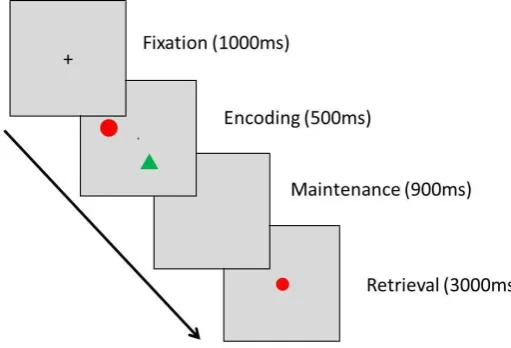
[image:5.595.158.414.383.557.2]The third task (experimental task) included trials for array size 2. These were presented in 3 blocks in this task with each block containing 24 trials of squares, circles, or triangles. For each block there were 2 trials containing 25% changes, 2 trials containing 20% changes, 4 trials containing 15% changes, 8 trials containing 10% changes, and 8 trials containing 5% changes. Researchers decided not to counterbalance the administration of array sizes 1 and 2 due to the task difficulty. It was required that participants understood the task and therefore array size 1 was given to the participant before the more challenging array size 2. Please see Figure 1 for an example of this task. The total score for each experimental task could be 72.
Figure 1. An example of one trial containing the shape stimuli.
Trials for Study 1. Each trial consisted of the presentation of an encoding array of either 1 or 2 shapes, presented for 500 milliseconds on a computer screen. For both array size 1 and 2, the location of the encoding shapes was randomly allocated to one of eight possible locations around a circular location. A maintenance array was then presented for 900 milliseconds and this contained one central cross. A single central probe retrieval array was presented for 3,000 milliseconds or until the participant pressed the appropriate response key on the keyboard. Participants had to press ‘p’ if the shape was bigger and ‘q’ if the shape was smaller than the corresponding one in the encoding or memory array.
Procedure for both Study 1 and 2. The procedure for study 1 and study 2 were identical except for the increase in a maintenance interval during study 2b.
The current investigation was ethically approved by the University Health and Life Sciences Ethics Committee. The total testing session lasted 30 minutes per participant. Information sheet and consent forms were given to participants before the investigation began. The size change detection task was fully explained to participants before the testing phase began.
Before any computer testing began, participants were given the perceptual, paper-based size detection task containing images of squares that varied in size. Participants had to identify whether these pairs of squares were the same size or different. This was then checked by the researcher to ensure the instructions of the task were fully understood. Any participant who did not complete this perceptual task to the criterion level did not take part in the computer task.
Participants were then asked to work through three computer task themselves, pressing the appropriate keys on the keyboard when prompted. When the practice task and first array task was finished, the researcher opened the next programme ready for completion by participants. The aim of each task was to identify if the centrally located probe stimulus was larger or smaller than its equivalent shape in the memory array.
When testing was completed, participants were notified on screen and were asked to wait for further instructions from the researcher. At this point testing had finished and participants were fully debriefed, including a reminder of the right to withdraw and how to contact the researcher if needed.
Scoring of each qualitative change detection task. As each experimental testing block contained 24 trials of different size changes, 1 point was given for a correct score and a score of 0 was given for an incorrect score. Performance levels were calculated for each percentage change to standardise the scoring. This allowed a comparison between the different percentage changes to take place as each percentage change had a different amount of trials. A total score of 72 could be given for each experimental task of array size 1 and array size 2.
RESULTS
A simple analysis was first conducted using the data. Any data which was seen at chance level (below 50% performance) was not used during the analysis stage.
Performance levels were calculated for each percentage change (overall) so that comparisons could be made between the 5% changes and the 25% change. Please see Table 1 for the means of each percentage change which also indicate ceiling effects for percentage changes of 25% and 20%.
Where post hoc analyses were needed for a main effect given from an ANOVA, the Bonferroni function within the ANOVA SPSS analysis was used which automatically adjusts the alpha level accordingly. When following-up an interaction effect, this Bonferroni function was not used and instead, paired samples t-tests were conducted with the appropriately adjusted p values for each correction (for example, alpha/number of hypotheses tested).
A 2 (array size) x 5 (percentage change) repeated measures ANOVA was applied to the data, demonstrating a significant main effect of array size, F (1,13 ) = 22.410, p < .001, partial η² = .633. A significant main effect of percentage change, F(4,10)= 29.712, p <. 001, partial η² = .922
No interaction was found between percentage change and array size, F(4,10) = .391, p = .810, partial η² = .135
Table 1
Performance Levels of Percentage Change for Array Size 1 and Array Size 2 in Study 1 (900 Millisecond Maintenance Interval)
Array Size 1 Array Size 2 Total
M SD M SD M SD
25% 97.60 6.17 92.71 10.99 95.14 7.23
20% 95.14 10.39 90.29 12.85 92.71 10.46
15% 89.86 13.61 80.79 8.37 85.32 6.90
10% 88.36 9.30 82.36 10.75 85.35 9.36
5% 82.71 11.60 74.07 12.43 78.39 10.81
Total 90.72 7.62 84.04 6.84
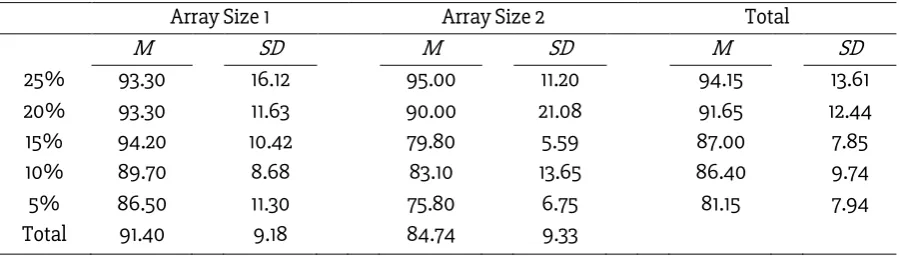
Study 2 (4000ms maintenance interval). A simple analysis was first conducted using the data. Any data which was seen at chance level (below 50% performance) was not used during the analysis stage. Performance levels were calculated for each percentage change (overall) so that comparisons could be made between the 5% changes and the 25% change. Please see Table 2 for the means of each
percentage change.
Table 2
Performance Levels of Percentage Change for Array Size 1 and Array Size 2 in Study 2 (4,000 Millisecond Maintenance Interval)
Array Size 1 Array Size 2 Total
M SD M SD M SD
25% 93.30 16.12 95.00 11.20 94.15 13.61
20% 93.30 11.63 90.00 21.08 91.65 12.44
15% 94.20 10.42 79.80 5.59 87.00 7.85
10% 89.70 8.68 83.10 13.65 86.40 9.74
5% 86.50 11.30 75.80 6.75 81.15 7.94
Total 91.40 9.18 84.74 9.33
A 2 (array size) x 5 (percentage change) repeated measures ANOVA was applied to the data, demonstrating a significant main effect of array size, F(1,9) = 19.348, p = .002, partial η² =.683. Array size 2 (M = 84.7, SD = 9.33) was less accurately performed than array size 1 (M = 91.4, SD = 9.18). No main effect of percentage change, F(4,6) = 3.845, p = .070, partial η² = .719. An interaction between array size and percentage change was found, F(4,6) = 21.240, p = .001, partial η² = .934
[image:7.595.74.524.464.592.2]A 2 (percentage change: 25%, 20%) x 2 (array size: 1 and 2) was conducted to look at any effects of the larger changes. Results revealed no effects of array size, F(1,9) = .056, p = .818, partial η² = .006 and no effects of percentage change, F(1,9) = .446, p =. 521, partial η² = .047. No interaction of array size and percentage change was present, F(1,9) = .367, p = .560, partial η² = .039
A 3 (percentage change: 15%, 10%, 5%) x 2 (array size: 1 and 2) was conducted to look at any effects of the smaller changes. Results revealed a significant main effect of array size, F(1,9) = 51.036, p < .001, partial η² = .850. Array size 1 had a larger mean of 91.40 (SD = 9.18) compared to array size 2 with a mean of 84.74 (SD = 9.33). A significant main effect of percentage change, F(2,8) = 4.746, p = .044, partial η² = .543. Bonferroni post hoc analyses revealed that the 10% size change had a higher mean of 86.40 (SD = 9.74) compared to the 5% size change with a mean of 81.15 (SD = 7.94, p = .010).
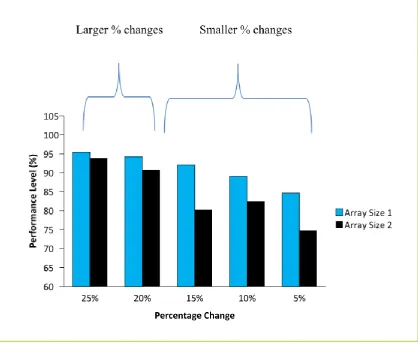
[image:8.595.99.496.294.603.2]The interaction between array size and percentage change has been shown to come from the differences in array size and percentage change with regards to the smaller array sizes whereas no differences are present with the larger array sizes. Please see Figure 2 for a representation of this interaction.
Figure 2. The interaction between percentage change and array size in study 2b
Main effects
Results demonstrated a significant main effect of array size, F(1,22)=35.449, p<.001, partial η²=.617. Array size 1 had a significantly larger mean of 91.06 compared to the mean of array size 2 of 84.40.
A main effect of percentage change was also found, F(4,19) = 22.475, p < .001, partial η² = .826. Bonferroni post hoc analyses demonstrated that the 25% change, with a mean performance of 94.64 (SD = 11.40) was significantly larger than the mean performance of the 5% change mean of 79.68 (SD = 6.73, p < .001). The 20% change, with a mean performance of 92.48 (SD = 10.88) was also significantly larger than the mean performance of the 5% change (p < .001). The 25% change was shown to have significantly larger than the mean performance of the 10% change of 85.72 (SD = 12.03, p = .001). The 20% change was significantly larger than the 10% change (p = .014). The 25% change was significantly larger than the 15% change of 86.13 (SD =1 2.44, p = .004). No main effect of maintenance interval was found F(1,22) = .045, p = .883, partial η² = .002
Interactions
A significant interaction between array size and percentage change was found, F(4,19) = 3.811, p = .019, partial η² = .445. Paired samples t-tests were conducted to look at any differences between the percentage change performance levels of each array size.
Results suggested that there were significant differences between the 15% changes of each array size t(23) = 3.985, p = .001, the 10% changes of each array size, t(23) = 3.495, p = .002 and also the 5% changes of each array size t(23) = 4.756, p = <. 001. However, there were no significant differences between the 25% changes of each array size, t(23) = 1.141, p = .226, and also the 20% changes of each array size, t(23) = 1.005, p = .325.
Figure 3. The interaction between array size and percentage change in the comparison of Study 1 and 2.
DISCUSSION
This current investigation aimed to identify the extent to which array size and maintenance interval impacted upon change detection performance within a qualitative visual working memory protocol. In addition, it aimed to establish the parameters for the sizes of changes which would enable performance to be uninfluenced by floor or ceiling effects in two studies, using a 900 and a 4,000 millisecond maintenance interval during a qualitative change detection task.
Initially, a 900 millisecond maintenance interval was used to follow the same procedure as Bae and Flombaum (2013), however, this was then extended to a 4,000 millisecond maintenance interval to utilise the change detection in a longer context with regards to future studies.
Similar to Bae and Flombaum (2013), when a 900 millisecond maintenance interval was used, the current investigation found a significant difference between the percentage changes. This suggested that in both Bae and Flombaum (2013) and in the current study, participants could detect very small changes (qualitative changes) in shape stimuli. However, one point to note is that Bae and Flombaum (2013) only had a small increase/decrease of 10% and they did not use stimuli that had very small 5% size changes. This is where the current study expands on those findings of Bae and Flombaum (2013) and presents further data to support the detection of small qualitative changes in visual arrays.
with a time limit that reduced working memory performance, in particular with regards to array size 2. As Bae and Flombaum (2013) did not use a long 4,000 millisecond maintenance interval, it is difficult to compare the current findings to Bae and Flombaum (2013) based on the maintenance interval only. It could be suggested that the interaction between array size and percentage change size reflects the fundamental distinction between quantitative – categorical (large) change detection representation and qualitative – high resolution representation within visual short term memory. When the change size is larger, approaching a categorical level or large change in size, the impact of array size is reduced. However, when high resolution representation is required in the context of small size changes, then array is more influential. It should be noted that in these results, even when the stimuli were designed to minimise comparison errors, performance still declined when array size increased from 1 to 2 items.
Thompson et al. (2006) did use small percentage changes, narrowing these changes to a 6% increase or decrease in the area of a shape. In their 2006 investigation, researchers used a 4,000 millisecond maintenance interval to show that the size JND task could work and assess an individual’s visual memory. Although similar size changes, and a similar maintenance interval was used, the procedure of the current investigation was slightly different to that of Thompson et al. (2006). Thompson et al. (2006) only presented participants with one square for the encoding arrays and did not make use of any other shape. The current investigation used both array size 1 and array size 2, but also presented participants with a variety of three different shapes.
It could be suggested that the inclusion of two different shapes with a 4,000 millisecond maintenance interval made the current task more difficult than that of Thompson et al. (2006); 2 shapes would mean that less memory resource is shared between each shape (item). Thompson et al. (2006) only had 1 shape meaning that the full memory resource was allocated to this one item. Looking from a Bays et al. (2009) perspective, the current task could be seen as more difficult due to the decreased precision in memory with the resource being divided between two items. To fully compare the differences between the current investigation and that of Thompson et al. (2006), a separate study would need to be conducted looking only at squares with array size 1.
Due to the possible reduction of comparison errors in set size 1 (perspectives proposed by Bae & Flombaum, 2013), task performance across the 900 millisecond and 4,000 millisecond maintenance interval may have been similar simply because participants found the task to be too easy. From looking at the averages, participants did not score remarkably less than 74% across set size 1 in both maintenance intervals. With regards to the current study, to increase task difficulty, it may be advisable to have a larger proportion of array size 2 within the change detection procedure if the task is found to not be demanding upon memory. This would make the change detection task more demanding than simply just using array size 1.
The decrease in performance from set size 1 to set size 2 does provide support for the Shared Resource Model (Bays et al., 2009). As there was a decrease in performance, it suggests that although all items are stored in memory with a given array is presented, more resource was allocated to the single item in set size 1 compared to the two individual items in set size 2. Contrasting models of working memory capacity (Luck & Vogel, 1997; Luck & Vogel, 2013) would suggest that both set size 1 and set size 2 are stored with similar accuracy. These types of slot models would suggest that both set size 1 and set size 2 would not completely fill the 3–4 working memory slots, enabling high accuracy on both set sizes. As this was not the case, the slot model accounts cannot be used to account for the results of the current investigation of this qualitative change detection protocol.
shapes, such as triangles, circles and squares, to look at shape size changes and memory errors in visual arrays. It could be questioned as to whether a similar pattern of results would be found with just using squares as Phillips and Hamilton (2001) did.
One direction for future research could be to make the current change detection paradigm similar to that of Phillips and Hamilton (2001). In this research, only squares were used to assess the size changes in visual arrays, in particular the presentation of one single central square, concluding that small changes could be detected. This would eliminate the use of 2 shapes/squares, meaning that participants would only need for focus upon the one item presented.
Although the current change detection task was created to stop potential memory errors such as correspondence errors, the task unintentionally caused participants to need to use binding abilities instead (Wheeler & Treisman, 2002), making the task more difficult than intended. As both colour and shape were used in the qualitative change detection tasks, and participants were unaware as to which shape would be presented at retrieval, the binding of the shapes and colours had to be conducted in memory. If participants were informed that the colours of the shapes would not change during the current task, this could have caused less errors within memory as the size of the shapes only would have been focused on.
Brown and Brockmole (2010) looked at feature binding in an ageing population, suggesting that binding errors in memory can occur especially when the attentional load is increased. If this task was contrasted with a quantitative change detection task, using elements of an interference procedure, differences in primary task performance could occur. When giving participants a task such as the current qualitative change detection task (which includes binding) plus an attentionally demanding task such as a visuospatial interference task (Vergauwe, Barrouillet, & Camos, 2009), this could cause unintentional errors within memory. Compared to the non-binding quantitative change detection task, the qualitative change detection task could produce more errors within memory simply based on the fact that the disruption of the blinding abilities has occurred. In future, it may be useful to use single coloured shapes (e.g., black), so that the participant does not need to use the binding abilities associated with colour and shape and, therefore, the possibility of such errors can be reduced.
IMPLICATIONS
After completing study 1 using a 900 millisecond maintenance interval, it was found that participant could detect size changes as small as a 5% increase or decrease in the size of a shape. It was thought that the qualitative change detection task sizes of 25%, and to a less extent, 20%, in study 1 may be seen as not cognitively challenging enough; therefore, in future research, the 25% changes should be
eliminated from the qualitative change detection tasks to increase task difficulty. As previous research has used a larger and more extended maintenance interval (Brown & Wesley, 2013; Thompson et al., 2006), it was decided to increase the maintenance interval in the current task so that study 2b was created. It was found that there was no difference between the percentage changes during the 4,000 millisecond and 900 millisecond conditions.
Ideally, the study aimed to achieve a 75–80% performance level. Clearly, the 25% change performance level was too high in both maintenance conditions and had to be taken out. It is proposed that if the 25% change had been used in further investigation, participants would more likely be using categorical comparison processes during the probe phases.
900 millisecond and 4,000 millisecond data demonstrated significant differences in the performance levels of the 25% and 5% changes in shape size.
Results have led researchers to disregard the 25% changes for future studies, due to the ceiling effects presented with this percentage change. The use of the 4,000 millisecond maintenance interval will continue within the dual task procedures of study 4 as this interval produced the most appropriate performance levels (75–80%) which demonstrated that the task was not too easy for participants.
This now provides scope for further research on qualitative change detection protocols and the implementation of different size changes and maintenance intervals within the tasks. Researchers need to ensure that the task is purely qualitative and also need to ensure that the maintenance interval is sufficient to allow the smaller changes to be detected.
References
Awh, E., Barton, B., & Vogel, E. K. (2007). Visual working memory represents a fixed number of items regardless of complexity. Psychological Science, 18(7), 622–628. https://doi.org/10.1111/j.1467-9280.2007.01949.x
Bae, G. Y., & Flombaum, J. I. (2013). Two items remembered as precisely as one: How integral features can improve visual working memory. Psychological Science, 24(10), 2038–2047.
https://doi.org/10.1177/0956797613484938
Bays, P. M., Catalao, R. F., & Husain, M. (2009). The precision of visual working memory is set by allocation of a shared resource. Journal of Vision, 9(10), 7–7. https://doi.org/10.1167/9.10.7
Bays, P. M., & Husain, M. (2008). Dynamic shifts of limited working memory resources in human vision. Science, 321(5890), 851–854. https://doi.org/10.1126/science.1158023
Brown, L. A., & Brockmole, J. R. (2010). The role of attention in binding visual features in working
memory: Evidence from cognitive ageing. Quarterly Journal of Experimental Psychology, 63(10), 2067–2079. https://doi.org/10.1080/17470211003721675
Brown, L.A., & Wesley, R.A. (2013). Visual working memory is enhanced by mixed strategy use and semantic coding. Journal of Cognitive Psychology, 25(3), 328–338.
https://doi.org/10.1080/20445911.2013.773004
Dean, G.M., Dewhurst, S.A., & Whittaker, A. (2008). Dynamic Visual Noise interferes with storage in visual working memory. Experimental Psychology,55(4), 283–28. https://doi.org/10.1027/1618-3169.55.4.283
Dent, K. (2010). Dynamic Visual Noise affects visual short-term memory for surface color, but not spatial location. Experimental Psychology,57(1), 17–26. https://doi.org/10.1027/1618-3169/a000003
Hamilton, C.J. (2013) The Development of Visuo spatial working memory in children. In,
Working Memory: Developmental Differences, Component Processes andImprovement
Mechanisms. H. St Clair-Thompson (Ed.), New York, NOVA.
Luck, S. J., & Vogel, E. K. (1997). The capacity of visual working memory for features and conjunctions. Nature, 390(6657), 279–281. https://doi.org/10.1038/36846
Luck, S.J., & Vogel, E.K. (2013). Visual working memory capacity: From psychophysics to neurobiology to individual differences. Trends in Cognitive Sciences, 17(8), 391–400.
https://doi.org/10.1016/j.tics.2013.06.006
McConnell, J., & Quinn, J.G. (2004). Interference in visual working memory. The Quarterly
Journal of Experimental Psychology, 53A(1), 53–67. https://doi.org/10.1080/713755873
Phillips, L.H. & Hamilton, C. (2001). The working memory model in adult ageing research. In J. Andrade (Ed.). Working Memory in Perspective. Psychology Press:
Hove. https://doi.org/10.4324/9780203194157_chapter_5
Scolari, M., Vogel, E. K., & Awh, E. (2008). Perceptual expertise enhances the resolution but not the number of representations in working memory. Psychonomic Bulletin & Review, 15(1), 215–222.
https://doi.org/10.3758/pbr.15.1.215
Thompson, J. M., Hamilton, C. J., Gray, J. M., Quinn, J. G., Mackin, P., Ferrier, I. N., & Young, A. H. (2006). Empirical indices of spatial and executive processes in visuo-spatial working memory. Cognitive Processing, 7(1), 164–164. https://doi.org/10.1007/s10339-006-0122-2
Vergauwe, E., Barrouillet, P., & Camos, V. (2009). Visual and spatial working memory are not that dissociated after all: A time-based resource-sharing account. Journal of Experimental
Psychology: Learning, Memory and Cognition,35(4), 1012–1028.
https://doi.org/10.1037/a0015859
Wheeler, M.E., & Treisman, A.M. (2002). Binding in short-term visual memory. Journal of
Experimental Psychology: General,131(1), 48–64. https://doi.org/10.1037//0096-3445.131.1.48