www.parliament.uk/commons-library | intranet.parliament.uk/commons-library | [email protected] | @commonslibrary
BRIEFING PAPER
Number 7257, 9 June 2017
Sure Start (England)
By
Foster
Alex Bate & David
Contents:
1. Sure Start under Labour 2. Sure Start under the Coalition 3. Sure Start under the 2015
Contents
Summary 3
1. Sure Start under Labour 4
1.1 Launch of the Sure Start policy 4
1.2 The piloting and expansion of Sure Start Local Programmes (1999-2003) 5
1.3 Evolution of Sure Start Children’s Centres (2003-2010) 6
1.4 Sure Start legislation (2009-2010) 9
1.5 Comment 10
Comment on changes since 2003 10
2010 Select Committee report 12
London School of Economics – Naomi Eisenstadt 13
2. Sure Start under the Coalition 14
2.1 Coalition Agreement 14
2.2 Health visitors 14
2.3 Pilots of payment by results 15
2.4 New statutory guidance for Sure Start centres 16
Introduction of a ‘core purpose’ of Sure Start centres 17
2.5 Full day care and qualified teachers 18
2.6 Funding 18
2.7 Number of Sure Start centres 19
2.8 Comment 20
2013 Education Select Committee report 20
LSE and Centre for Analysis of Social Exclusion working paper 21
3. Sure Start under the 2015 Conservative Government 22
3.1 Funding 22
3.2 Number of Sure Start centres 23
3.3 Extended free childcare entitlement 24
3.4 Sure Start consultation 25
4. Impact of Sure Start 26
4.1 National Evaluation of Sure Start (2002-2012) 26
4.2 Audit Commission report (2010) 29
4.3 Evaluation of Children’s Centres in England (2012-2016) 29
5. The future of Sure Start 34
Contributing authors Paul Bolton (table, section 3.1)
Cover page image copyright: Preschool Colors by Barnaby Wasson. Licensed under
Summary
This briefing paper details the introduction, implementation and development of the Sure Start policy of early intervention for pre-school children and their parents.
Launched in 1998, Sure Start was driven by local partnerships of voluntary groups, parents and local authorities in the most deprived areas. Apart from five core areas including outreach services, play and healthcare, local programmes offered services based on locally-defined needs.
This briefing sets out the development of the policy from local programmes to local authority administered children’s centres, as part of which Sure Start was changed to a universal service for all families, and the creation of a statutory basis for children’s centres in 2009.
The 2010 Coalition Government also implemented a number of changes to the Sure Start programme, including the introduction of a core purpose for children’s centres and new statutory guidance.
A number of empirical studies on the impact of Sure Start have been carried out since 2002, and details of many of these are provided, along with information on funding for and numbers of children’s centres.
1.
Sure Start under Labour
Box 1: Sure Start under Labour – 1997-2010
• Sure Start introduced in 1998 as a multi-departmental programme of early intervention for under-fours.
• Delivered initially through local programmes, directed by a range of stakeholders within the most deprived areas.
• Ten year childcare strategy in 2004 changed focus to delivery of services through children’s centres.
• Children’s centres had an increased focus on childcare and early years education, with services provided to the under-fives.
• Target for 3,500 children’s centres – one per community in England – by 2010.
• Children’s centres given a statutory basis in 2009.
1.1
Launch of the Sure Start policy
Labour’s 1997 general election manifesto set out a commitment to “invite selected local authorities to pilot early excellence centres combining education and care for the under-fives.”1
Following the return of a Labour Government, a network of 25 pilot early excellence centres was announced in a 1997 White Paper, Excellence in Schools, to share best practice throughout an early years sector argued to be patchy in its provision across different local authorities.
Prior to the 1998 Comprehensive Spending Review (CSR), the then Minister for Public Health, Tessa Jowell, reported to the Cabinet Committee overseeing the CSR on effective approaches to early
interventions. Whilst acknowledging there was no fixed criteria for good early intervention, it stated that effective programmes should be:
• Two generational – involve parents as well as children;
• Non-stigmatising – avoid labelling ‘problem families’;
• Multifaceted – target a number of factors, not just, for example, education or health or ‘parenting’;
• Persistent – last long enough to make a real difference;
• Locally driven – based on consultation and involvement of parents and local communities;
• Culturally appropriate and sensitive to the needs of children and parents.2
The CSR was published in July 1998 and established a cross-departmental budget, the Children’s Fund, for a new Sure Start programme of early intervention.
1 Labour, New Labour: because Britain deserves better, April 1997
It was intended that this would lead to the establishment of 250 local Sure Start programmes by the end of the Parliament, located within the 20% most deprived areas in England. These local programmes would:
• Arrange a visit from an outreach worker to every new mother within 3 months of giving birth;
• Provide a range of easily accessible services, including childcare, primary health care, early education, and play and support, “ideally within pram pushing distance”3
£452 million of funding was allocated by the CSR for Sure Start in England between 1999 and 2002.
1.2
The piloting and expansion of Sure Start
Local Programmes (1999-2003)
In January 1999, the first 60 Sure Start ‘trailblazer’ districts were announced, based on high levels of local deprivation and existing good practice in early years provision.
These districts covered a local authority area but included voluntary bodies, health services and the local authority itself within that area. The trailblazer districts would each identify one catchment area appropriate for a Sure Start Local Programme (SSLP).4
The local bodies within a district would set up a board, including parents, to determine local priorities and which services their SSLP would offer. Local programmes were intended to be locally defined based on specific local requirements, and measured by the Government only on outcome. However, all SSLPs were required to offer 5 core services:
• Outreach services and home visiting;
• Support for families and parents;
• Good quality play, learning and child care;
• Primary and community healthcare and advice about child health and development;
• Support for those with special needs.5
The area-based provision was an innovative approach to early intervention. As Belsky and Melhuish (2007) argued:
SSLPs were intended to break the intergenerational transmission of poverty, school failure and social exclusion by enhancing the life chances for children less than four years of age growing up in disadvantaged neighbourhoods. More importantly, they were intended to do so in a manner rather different from almost any other intervention undertaken in the western world.6
3 HM Treasury, Modern public services for Britain: investing in reform –
Comprehensive Spending Review: new public spending plans 1999-2002, July 1998 4 HC Deb 20 January 1999 cc501-502W
5 Norman Glass, Sure Start: the development of an early intervention programme for young children in the United Kingdom, Children and Society vol 13 issue 4, 1999 6 Jay Belsky & Edward Melhuish, The National Evaluation of Sure Start: Does
The 2000 Spending Review saw a large expansion in the Sure Start programme. £948 million was committed from 2002 to 2004 to double the number of proposed SSLPs to over 500. The intention was that this would cover a third of the poorest children under four (compared to 18% of the poorest children covered by the proposed 250 SSLPs). Early years services were also to be rationalised by merging SSLPs with early excellence centres.
The Spending Review set out some ambitious Public Service Agreement (PSA) targets:
• Reduce the proportion of children aged 0-3 in the 500 Sure Start areas who are re-registered within the space of 12 months on the child protection register by 20 per cent by 2004.
• Achieve by 2004 in the 500 Sure Start areas, a 10 per cent reduction in mothers who smoke in pregnancy.
• Achieve by 2004, for children aged 0-3 in the 500 Sure Start areas, a reduction of five percentage points in the number of children with speech and language problems requiring specialist intervention by the age of four.
• Reduce the number of 0-3 year old children in Sure Start areas living in households where no-one is working by 2004.7
By November 2003, there were 521 SSLPs in operation.8 In addition to
these, a further 46 mini SSLPs in rural areas and areas with pockets of deprivation were also set up.9
1.3
Evolution of Sure Start Children’s Centres
(2003-2010)
The 2002 Spending Review marked a change in emphasis in the delivery of Sure Start. Services would now aim to be provided in a ‘one-stop’ Sure Start Children’s Centre (SSCC), with greater local authority oversight through integration into existing children’s services:
6.5 The Government’s vision for children is one in which every parent can access affordable, good quality provision. This Spending Review provides resources to create at least 250,000 childcare places including those provided directly within children’s centres to advance the Government’s lone parent employment and child poverty objectives, through targeted assistance to providers in areas of market failure.
6.6 There will also be support for the creation and operation of children’s centres in disadvantaged areas. Building, where possible, on existing Sure Start facilities, and other provision, by March 2006, an additional 300,000 children will have access to health, education and other services.
7 HM Treasury, Prudent for a purpose: building opportunity and security for all – 2000
Spending Review: new public spending plans 2001-2004, July 2000 8 HC Deb 10 November 2003 c68W
9 Department for Education and Skills, Working together – A Sure Start guide to the
6.7 In addition to joining up existing services, it is also the
intention to simplify funding arrangements, streamline targets and support local and national government to focus on delivering this vision, by giving local authorities an enhanced role in supporting delivery, and by bringing the responsibility for childcare, early years education and Sure Start together in a single inter-departmental unit.10
The first 32 SSCCs were announced in June 2003,11 and a programme
of expansion was set out in the 2004 multi-departmental childcare strategy, Choice for parents: the best start for children. This set a target of 2,500 SSCCs in place by 2008, and 3,500 in place by 2010. The 3,500 target represented one centre for every community in England, signalling a move from targeted intervention in areas of the most deprivation to a universal delivery model.
The target of creating 3,500 centres by 2010 required a large increase in Sure Start funding, both overall, and in the proportion of capital spending required to build new centres:
Source: Department for Education12
In 2006, the Department for Children, Schools and Families brought in Together for Families – a partnership between Serco and the charity 4Children – to facilitate the rollout of universal SSCCs. A Serco press release stated that the 3,500 target was achieved on 22 March 2010.13
In response to a parliamentary question, the then Minister for Children and Families, Sarah Teather, confirmed that as of 31 July 2010, 3,633 SSCCs were open in England, providing services to 2.9 million children under five.14
This shift in approach for delivery of Sure Start early intervention from local programmes to local authority-led children’s centres, came in the
10 HM Treasury, Opportunity and security for all: investing in an enterprising, fairer
Britain - 2002 Spending Review: new public spending plans 2003-2006, July 2002 11 HC Deb 23 March 2004 c680W
12 HC Deb 31 March 2011 c500W, figures do not include £315 million of funding allocated to SSLPs 1999-03.
13 Serco press release, ‘Serco partnership supports delivery of 3500 Sure Start Children’s Centres’, 22 March 2010
14 HC Deb 4 October 2010 c1280W
0% 5% 10% 15% 20% 25% 30% 35%
0 250 500 750 1,000 1,250 1,500 1,750 2,000
£ m
illio
ns
Sure Start funding allocated to local authorities
context of the Every Child Matters (ECM) report. The report followed Lord Laming’s inquiry into the death of eight-year-old Victoria Climbié in 2000 at the hands of her carers, which was critical of interaction
between, and accountability throughout, different organisations involved in child protection.
In response to the inquiry, ECM set out the following proposals:
• Improving information sharing between agencies, ensuring all local authorities have a list of children in their area, a list of the services they have had contact with, and the contact details of relevant professionals
• Establishing a common assessment framework. The Government will move towards a common assessment framework across services for all children. The aim is for core information to follow the child between services to reduce duplication
• Identifying lead professionals to take the lead on each case where children are known to more than one specialist agency
• Integrating professionals through multi-disciplinary teams responsible for identifying children at risk, and working with the child and family to ensure services are tailored to their needs
• Co-locating services in and around schools, Sure Start Children’s Centres, and primary care settings
• Ensuring effective child protection procedures are in place across all organisations.15
The proposals in ECM fed into the Children Act 2004, which created new duties for local authorities to plan for the provision of children’s services and co-ordinate services with relevant partners, as well to introduce a Director of Children’s Services position. These changes signalled a much greater involvement and oversight of Sure Start by local authorities.
SSCCs also saw a greater focus on the provision of childcare. The Choice for parents childcare strategy set out plans for a statutory duty for local authorities to ensure local childcare needs are met. SSCCs were to offer ten hours of childcare per day and become advice hubs for parents of children under five on local availability. This was also a significant development in terms of the expansion of Sure Start’s remit from the under-fours to the under-fives.
Concerns were however raised that Sure Start was not effectively targeting or reaching out to the most disadvantaged families. The first reported results from the National Evaluation of Sure Start (NESS – see section 3.1) in 2005 showed that the most disadvantaged families may actually have been adversely affected by living in SSLP areas, whilst somewhat less disadvantaged children benefitted.16
15 HM Treasury, Every Child Matters, September 2003, p51
The Government looked to tackle the problem of outreach in its 2007 publication, The Children’s Plan. This committed to:
• Provide additional funding to support outreach activities with the most disadvantaged families;
• Ensure that there are a minimum of two outreach workers in SSCCs in the most disadvantaged areas;
• Engage fathers and offer them support in strengthening their parenting skills.17
1.4
Sure Start legislation (2009-2010)
Prior to 2009, the introduction of children’s centres and moves towards having a SSCC in every community in England had happened without any statutory backing. Rather the policy had been implemented through funding agreements between central Government and SSLPs, then later local authorities.
Although the Childcare Act 2006 introduced a duty for local authorities to provide early childhood services in their area, and outreach to parents to inform them of these services, there was no compulsion to deliver services through children’s centres.
In his presentation of the Apprenticeships, Skills, Children and Learning Bill, the then Children, Schools and Families Secretary, Ed Balls, set out the Government’s ambition to legislate on Sure Start:
A decade ago, there were no children’s centres. There are now almost 3,000 Sure Start children’s centres around the country. The next stage of our reforms is to ensure that every family can access the support of such centres. That is why the Bill will enshrine in law our 2020 goal of ensuring that there is a children’s centre in every community in the coming years. That is the way to ensure that the benefits of Sure Start, which millions of children and families around the country are receiving, are received by all children and families in perpetuity.18
The introduction of a statutory basis for Sure Start was supported by the Conservative opposition,19 and the basis was included in the
Apprenticeships, Skills, Children and Learning Act 2009.
Sections 198-200 of the Act amended the Childcare Act 2006 to introduce the following requirements for local authorities:
• Local authorities must “so far as is reasonably practicable, include arrangements for sufficient provision of children's centres to meet local need”;
• Children’s centres must have an advisory board which includes parents or prospective parents from the area;
• Local authorities must carry out appropriate consultation when proposing to close or open a children’s centre.
17 Department for Children, Schools and Families, The Children’s Plan: building brighter
futures, Cm7280, December 2007
The Act also defined children’s centres in law as ‘Sure Start Children’s Centres’. Significantly, it also gave local authorities the option to provide early childhood services in settings other than a children’s centre,
provided that a children’s centre environment had been fully considered.
Section 199 of the 2009 Act also brought in requirements for Ofsted to carry out inspections of SSCCs. The Children’s Centres (Inspections Regulations) 2010, SI 2010/1173, which came into force on 30 April 2010, required these inspections to take place at least every five years.
1.5
Comment
Comment on changes since 2003
Greater local authority oversight
The move towards greater local authority oversight was questioned by the Education and Skills Select Committee. Its 2005 report on Every Child Matters raised concerns that directing funding through children’s services departments in local authorities, rather than SSLPs, could significantly reduce parental input:
37. In the future, funding for Sure Start Children’s Centres will be channelled through children’s services authorities—who may then involve parents in the operation of centres. Some have interpreted this as representing an implied diminution in the role of parents, and have questioned how this sits with the policy commitment to make sure parents and carers are centrally involved in service design and delivery.
38. The Minister told us that this was categorically not the case and that the intention was to:
“ensure, both through guidance that we give local authorities and the way in which we inspect and manage the performance of local authorities, that that essential ethos of Sure Start, which is the involvement of parents in all aspects of the delivery of services for children and families in the earliest years, is maintained.”
39. These were welcome words, but it remains to be seen whether the effects of a substantial reorganisation of Sure Start will be as intended—and whether parents will continue to have the kinds of roles that they have held until now. We are concerned that significant changes are being made to the Sure Start programme when evidence about the
effectiveness of the current system is only just beginning to emerge. This relates back to our wider point about the inherent difficulties of pursuing transformative and rapid change while at the same time maintaining a commitment
to evidence-based policy.20
In addition, the Committee expressed concerns about the possible impact of changes on voluntary sector involvement:
163. It is vital that the contribution of the voluntary and community sector is not overlooked or diminished. This is a complex sector, including big national charities on the one hand
and very small community-based organisations on the other. This can lead to difficulties in engaging the sector with strategic planning and commissioning processes. There is also concern within the sector about local mainstreaming of the Children’s Fund and Sure Start local programmes, both areas in which voluntary and community bodies have played a large part. We will be following closely the effect of the Every Child Matters changes on the voluntary and community sector and hope that the large and valuable contribution it makes
will be recognised and sustained.21
Yet whether or not parental influence was diluted by the move to SSCCs, local steering did still remain. A 2010 report by the Children, Schools and Families Committee noted a wide range of services offered, leading to concerns that centres were trying to do too much and their focus was too diffuse. Examples of services outlined in the report included:
‘Baby Bounce and Rhyme’ sessions, speech and language therapy appointments, baby massage, fathers’ groups, housing advice, Citizens’ Advice Bureaux, money management workshops, sexual health clinics, holiday and after-school clubs for older children, home birth support groups, breastfeeding support groups, ‘Stay and Play’ sessions, book and toy libraries, community cafés, sales of cost-price home safety equipment, relationship counselling, befriending services, family learning, parenting skills courses, childminder drop-ins, healthy eating classes, smoking cessation groups, basic skills courses including ESOL and IT, domestic violence support groups, advocacy services, dental hygiene clinics, multiple birth support groups.22
This is of course a collation of services offered across different centres, rather than an indication of what was on offer at any particular SSCC.
Rollout of a universal early years services
The move to a universal service brought about significant cost increases. However, a 2010 report by the Children, Schools and Families Select Committee set out some of the problems that had faced the previous, targeted intervention model:
40. Despite concerns about resources being spread too thinly or a loss of focus, there was widespread agreement that the narrow basis of the predecessor programmes was, in policy terms, unsustainable. Jan Casson, Sure Start Locality Manager for Northumberland County Council, told us:
It was very difficult as a Sure Start Local Programme manager. It was a bit of a postcode lottery, and morally it was quite hard to define the boundary of your Sure Start area when you knew that maybe 400 families just beyond the boundary were equally in need of the services.
A programme targeted only at the most disadvantaged areas also risks carrying a stigma for families. Rural areas in particular rarely benefited from the early phases of Sure Start programmes, despite the fact that low population densities can mask a considerable degree of poverty and other problems exacerbated by isolation. The Commission for Rural Communities reported that
21 Ibid. para 163
at least 400,000 children in rural communities in England live in households affected by poverty, and 1 million children in rural areas live in low income households.23
One of Sure Start’s original developers in the Treasury, Norman Glass, argued that the expansion to 3,500 centres left local Sure Start programmes stretched thinly, and this led to its “capture by the employability agenda.” He felt that the resulting focus on provision of childcare moved Sure Start away from its original child development agenda. In becoming a place for parents to leave children while they went to work, he argued the changes were creating “a sort of New Deal for Toddlers.”24
A 2006 National Audit Office report highlighted that centre staff and managers also saw sustainability and funding, and risk of change in agenda, as their main operational concerns.25
Outreach to the most disadvantaged families
Even with the measures set out in The Children’s Plan, Kitty Stewart of the London School of Economics argued that the issue was never fully resolved during Labour’s time in Government:
Early evaluation data pointed to worse outcomes for some of the most disadvantaged groups in Sure Start areas than for similar groups in comparison areas, discussed below, and NAO (2006) also highlighted concerns that centres were not effectively targeting those most in need. Later evaluations found no
difference in the Sure Start effect for more and less disadvantaged groups, suggesting that outreach improved with time, while the 2008 DCSF survey of parents found no evidence that sub-groups were being excluded or failing to access the centres. In a report on 20 children’s centres conducted at the same time as the parents’ survey, (Ofsted, 2009) concluded that engagement continues to be a challenge and that “despite a clear commitment to reach out to the most disadvantaged and vulnerable families, no centres felt they were fully successful in doing so.”26
2010 Select Committee report
A 2010 Children, Schools and Families Select Committee report took qualitative evidence on the impact of Sure Start from those within the sector, and highlighted positive feedback from both parents and stakeholders:
Although few view Children’s Centres as the finished article, Emma Knights, Joint Chief Executive of the Daycare Trust, summed up the general feeling when she said “it has been not just a step in the right direction but thousands of steps.” Jan Casson of Northumberland County Council told us:
I was running a home visiting scheme before Sure Start came along, and I was running it on very little money. Every day we were seeing children whose home situations
23 Children, Schools and Families Committee, Sure Start Children’s Centres, HC 130-1, 15 March 2010, para 40
24 ‘Surely some mistake?’, The Guardian, 5 January 2005
25 National Audit Office, Sure Start Children’s Centres, 19 December 2006, HC 104 2006-07, p10
26 LSE/ CASE, Labour’s record on the under-fives: policy spending and outcomes
weren’t bad enough to come to the attention of social services, but those children were living in situations that in the 20th century, as it was then, we should have been ashamed of. I can’t even think what it would be like to go back to pre-Sure Start times. The number of children we saw on a daily basis whom we were letting down doesn’t even bear thinking about.
Martin Narey, Chief Executive of Barnardo’s, told us about his first experience of Sure Start after starting to work in the voluntary sector:
When I first saw the Centres, I was most struck by speaking to parents—mums inevitably— who had had older children and contrasted for me their experience of bringing up children pre-Sure Start and post-Sure Start. I saw the change in ambition and aspiration for the children, a belief that the children could do much better and the sense of children being supported. I was hugely taken with that and I probably visited 50 or 60 Children’s Centres since then. I have continued to be impressed.
[…]
It is common for parents to describe the impact of their contact with Children’s Centres as “life-changing.”27
London School of Economics – Naomi Eisenstadt
Naomi Eisenstadt, writing for the London School of Economics’ British Politics & Policy blog in 2011, argued that despite empirical studies showing a lack of consistent evidence of improved outcomes, Sure Start has been a clear success in political terms:
The substantial success of the Sure Start scheme has been that the argument about the role government should play between birth and school is now won. We never did a randomised control trial to prove that children benefited from school. We no longer need to deliver more evidence that the pre-school years are vital to children’s development, and that provision of services for young children and families is critically important. The debate on what those services should be, delivered by whom, aimed at parents or children, and at what age group care should start will run and run. However, the acceptance that there should be provision for such services, and that government has a role in regulating and at least partly funding this, is now firmly in place.28
27 Children, Schools and Families Committee, Sure Start Children’s Centres, HC 130-1, 15 March 2010, para 80-2
28 LSE blog, ‘Despite initial mistakes, the success of the Sure Start programme has been
2.
Sure Start under the Coalition
Box 2: Sure Start under the Coalition – 2010-2015
• Commitment to recruit an additional 4,200 health visitors by 2015
• Pilots of payments by results for providers but not taken forward
• New statutory guidance, which introduced a ‘core purpose’ for Sure Start centres, published April 2013
• Removal of requirement for centres in most disadvantaged areas to provide full day care and employ staff with qualified teacher status.
• Removal of ring-fence on Sure Start funding
2.1
Coalition Agreement
The Coalition Agreement, published shortly after the 2010 general election, outlined the Coalition Government’s plans for Sure Start. These included increasing its focus on the neediest families, investigating a system of payment by results, and paying for additional health visitors:
We will take Sure Start back to its original purpose of early intervention, increase its focus on the neediest families, and better involve organisations with a track record of supporting families. We will investigate ways of ensuring that providers are paid in part by the results they achieve.
We will refocus funding from Sure Start peripatetic outreach services, and from the Department of Health budget, to pay for 4,200 extra Sure Start health visitors.29
2.2
Health visitors
In 2011, the Department of Health published a Health Visitor
Implementation Plan, which outlined the Government’s plans to deliver 4,200 new health visitors by 2015.30 The plan outlined the relationship
between health visitors and Sure Start children’s centres: Sure Start Children’s Centres are accessible to all families with young children, and have an important role in identifying and supporting families in greatest need. Local authorities have statutory duties under the Childcare Act 2006 to secure sufficient provision of children’s centres to meet local need, as far as is reasonably practicable. Every children’s centre should have access to a named health visitor. Health visitors have unique, professional expertise to:
• deliver universal child and family health services through children’s centres (the Healthy Child Programme)
• lead health improvement through children’s centres, on subjects such as healthy eating, accident prevention and emotional wellbeing
• help families stay in touch with wider sources of support through children’s centres, including from the community and other parents
29 HM Government, The Coalition: our programme for government, May 2010, p19 30 LSE and Centre for Analysis of Social Exclusion, The Coalition’s Record on the Under
• be leaders of child health locally, including fostering partnerships between GPs, midwives and children’s centres. Many health visitors already work closely with their local children’s centre, using it as a base; work with their local children’s centre leader and are members of the management team; share
information appropriately; review local cases; and share skills and experience.31
The plan estimated that, allowing for retirements and other loss of workforce, an additional 6,000 health visitors would have to be trained over the period to 2015 to achieve the 4,200 figure.32
This target was narrowly missed, although the additional 3,800 full-time equivalent (FTE) health visitors represented an increase of around 49% measured against a May 2010 baseline.33
2.3
Pilots of payment by results
In July 2011, the Department for Education announced that it would trial payment by results in relation to Sure Start Children’s Centres in nine local authority areas. It was announced in September 2011 that a further 17 local authority areas were to be included in the pilots. The Department for Education provided further information about the pilots in written evidence to the Education Committee:
The Payment by results (PbR) trials are exploring the potential to incentivise local authorities to focus on delivering the Core Purpose of children’s centres. Twenty seven local authorities are taking part in the trials. Trial areas are testing both a national PbR scheme between the Department for Education and local
authorities, and local PbR schemes between local authorities and individual children’s centres. It is too early to take a view on the effectiveness of national or local PbR schemes or PbR measures. Performance data and reward payments will be processed in May 2013.34
On 5 March 2012, the Department for Education announced that the payment by results trials would use six measures:
Increasing the school readiness of young children by:
• Narrowing the gap in attainment through the Early Years Foundation Stage Profile.
• Increasing take up of the two year old free entitlement.
• Increasing take up of early education amongst disadvantaged three year olds.
Improving health and child development by:
31 Department of Health, Health Visitor Implementation Plan 2011–15, February 2011, p9
32 Department of Health, Health Visitor Implementation Plan 2011–15, February 2011, p14
33 The Government’s commitment is to increase the number of FTE health visitors by 4,200 against a May 2010 baseline of 8,092. In April 2015 there were 11,929 FTE health visitors (see PQ 21379 [on Health Visitors], 11 January 2016). Data on health visitors is no longer published on a comparable basis to these figures.
• Increasing the prevalence of Breastfeeding at 6-8 weeks. Improving parenting skills and support provided to families in need of children's centre services by:
• Increasing the proportion of families in greatest need completing evidence based parenting programmes.
• Increasing the proportion of families with children under 5 years who are identified as being "in greatest need” and have "sustained contact” with children's centres in the local authority area.35
Local measures were also to be developed by local authorities running the trials. The press notice went on to state that the trials would be “evaluated to inform a decision about potential national rollout and the most suitable measures for a national payment by results scheme.”36
In evidence to the Education Committee on 15 October 2013, the then Parliamentary Under-Secretary of State for Education and Childcare, Elizabeth Truss, stated that she did not think payment by results worked for children’s centres and that it would not be pursued “for the time being.”37 This decision was supported by the Education Committee in
its December 2013 report on Sure Start Centres (see section 2.7 below).38
2.4
New statutory guidance for Sure Start
centres
In April 2013, the Department for Education published new statutory guidance for children’s centres. The guidance stated that it:
• clarifies what local authorities and statutory partners must do because it is required by legislation, and what local authorities and partners should do when fulfilling their statutory responsibilities;
• focuses on outcomes for children (the core purpose of children’s centres);
• clarifies the duty to secure sufficient children’s centres accessible to all families with young children, and targeted evidence-based interventions for those families in greatest need of support; and
• promotes the greater involvement of organisations in the running of children’s centres with a track record of supporting families.39
35 ‘Coalition government to reward local authorities for improving children's lives’, Department for Education press release, 5 March 2012
36 Ibid
37 Education Committee, Foundation Years: Sure Start children's centres, 8 January 2014, HC 364-II 2013-14, Ev149
38 Education Committee, Foundation Years: Sure Start children’s centres, 17 December 2013, HC 364-I, p27
Introduction of a ‘core purpose’ of Sure Start
centres
Department for Education guidance published in April 2013 introduced a ‘core purpose’ for Sure Start children’s centres:
The core purpose of children’s centres is to improve outcomes for young children and their families and reduce inequalities between families in greatest need and their peers in:
1. child development and school readiness; 2. parenting aspirations and parenting skills; and 3. child and family health and life chances.40
In a 2013 report, the Education Committee contended that the ‘core purpose’ was too vague and should be reviewed:
We consider that it is too vague and broadly worded and should be reviewed to focus on achievable outcomes for children and families and to recognise the difference between centres. This should include reaching clarity on who centres are for—children or parents—and what their priority should be.41
In its response to the Committee’s report, published in March 2014, the Coalition Government disagreed that the core purpose was in need of review:
The core purpose document was published in April 2013
following a period of extensive consultation with local authorities, children’s centre managers and other interested parties. It was always intended to offer a high level and aspirational statement of intent, which gives local authorities and individual centres the flexibility to configure services in accordance with local circumstances.
While the government understands the Committee’s concerns, the government believes that focus should now be on developing services within the broad framework the core purpose document provides, and seeking to maximise the impact of the roughly £1.3 billion investment that local authorities are making in children’s centres. While it will obviously continue to monitor local
application of the core purpose document, the government does not agree that there is a need for a formal review so soon after its adoption.42
In response to a parliamentary question on 30 June 2014, Elizabeth Truss stated that she was happy to look at the core purpose in light of a move by Ofsted to a local authority inspection regime for children’s centres:
Bill Esterson: To ask the Secretary of State for Education with reference to the guidance published by his Department on 25 March 2014, on Sure Start centres: local authority duties, what assessment he has made of the adequacy of the core purpose of Sure Start children’s centres.
40 Ibid, p7
41 Education Committee, Foundation Years: Sure Start children’s centres, 17 December 2013, HC 364-I, p3
42 Education Committee, Foundation Years: Sure Start children's centres: Government
Elizabeth Truss: Sure Start children’s centres statutory guidance was published in April 2013; the web page containing it was last reviewed on 25 March 2014.
The statutory guidance states the core purpose of Sure Start children’s centres is to improve outcomes for young children and their families, with a particular focus on those in greatest need. The Department extensively consulted on draft statutory
guidance, including the core purpose, in 2012. The response was positive, with 85% of respondees (local authorities, children’s centre managers, voluntary sector bodies and others) finding the document clear on statutory duties.
As I said to the Education Committee on 18 June, Ofsted is going to be moving to a local-authority-based inspection regime for children’s centres and I am very happy to look at the core purpose, particularly in the light of what Ofsted put out as their inspection regime, if there is a lack of clarity.43
2.5
Full day care and qualified teachers
In November 2010, the Government announced that it would remove the requirement for children’s centres in the most disadvantaged areas to provide full day care. It also announced the removal of the
requirement for staff in centres in the most disadvantaged areas to have both qualified teacher status and early years professional status.44
In its December 2013 report, the Education Committee recommended that the requirement for a qualified teacher to be linked to each centre should be re-instated.45
In evidence to the Education Committee in June 2014, Elizabeth Truss outlined the position of the Government:
If there is childcare provision…it can be better integrated with the school at the local level. I am not saying there should be a
national prescription for that. In any case, we do not prescribe the levels of qualifications for teachers in many schools and that is not a Government policy. What we look at are the outcomes for children, rather than saying we are going to specify the inputs. The point is that the children’s centre itself is not primarily an early education and childcare facility; it is an early‑help facility.46
2.6
Funding
In April 2011, the Government removed the ring-fence from Sure Start funding and introduced the Early Intervention Grant (EIG).47 The EIG
was subsequently merged into the Business Rates Retention Scheme. A working paper produced by the London School of Economics (LSE) and
43 HC Deb 30 June 2014 c350W
44 ‘Free childcare for disadvantaged 2-year-olds to be guaranteed in law’, Department for Education press release, 16 November 2010 & Education Committee, Foundation Years: Sure Start children’s centres, 17 December 2013, HC 364-I, p15
45 Education Committee, Foundation Years: Sure Start children’s centres, 17 December 2013, HC 364-I, p16
46 Education Committee, Oral evidence: Foundation Years: Sure Start children’s
centres: Government response, HC 144, 18 June 2014, Q9
the Centre for Analysis of Social Exclusion explained this change to the funding arrangement for children’s centres:
The EIG replaced a number of centrally directed grants supporting services for children, young people and families (including e.g. support for youth crime, mental health and teenage pregnancy). In effect this meant that early childhood services such as children’s centres were competing for funding with services for older children in a way they had not done before. From May 2013-14 the Early Intervention Grant itself was folded into a broader funding stream, the Business Rates Retention System.48
Concerns were raised during the course of the 2010 Parliament about the impact the funding changes were having on Sure Start centres.49
However, in response to a parliamentary question on 31 March 2011, the then Minister for Children and Families stated that there was “enough money to retain a network of Sure Start children’s centres” through the EIG:
Sure Start children's centres are at the heart of the Government's vision for supporting families with young children and intervening early to prevent problems from becoming crises. Through the Early Intervention Grant, the Government have ensured there is enough money to retain a network of Sure Start children's centres, accessible to all but identifying and supporting families in greatest need. The Government have made it clear that it is for local authorities to determine the most effective use of the grant. Local authorities will have greater flexibility, but they remain under statutory duties under the Childcare Act 2006 to consult before opening, closing or significantly changing children's centres and to secure sufficient children's centres provision to meet local need, so far as is reasonably practicable.50
In its December 2013 report, the Education Select Committee concluded that the Government was right to remove the ring-fencing from funding for children’s centres because of the different ways in which the centres are used by local authorities. However, it recommended that there should be more transparency on spending by local authorities so that it is clear how much has been spent on different services.51
2.7
Number of Sure Start centres
There was considerable debate over the number of Sure Start centres that closed over the course of the 2010 Parliament; some stated that over 600 centres closed, whilst the Government stated that the number of centres that closed outright was far fewer than this because of restructuring and mergers.52
48 LSE and Centre for Analysis of Social Exclusion, The Coalition’s Record on the Under
Fives: Policy, Spending and Outcomes 2010-2015, p15 49 For example, see HC Deb 17 October 2011 c611-612.
50 HC Deb 31 March 2011 c501W. See also, HC Deb 17 October 2011 c611-2
51 Education Committee, Foundation Years: Sure Start children’s centres, 17 December 2013, HC 364-I, p39
52 LSE and Centre for Analysis of Social Exclusion, The Coalition’s Record on the Under
In April 2010, there were 3,632 Sure Start centres in England.53 As of 30
June 2015, there were 2,677 main centres and 705 further sites that remained open providing children’s services.54
In her evidence to the Education Select Committee on 18 June 2014, the then Minister for Education and Childcare, Elizabeth Truss, stated that it was not true that the network of Sure Start centres was diminishing greatly:
What we are seeing in terms of the network is a pretty steady state. We have 3,550 children’s centres and additional sites. Since 2010, only 76 centres have closed and six new centres have opened, because what local authorities are doing is they are getting efficiency through back office reform. They are operating centres as much more of a network. They are integrating them with local health services. What we know is that more and more parents and children are actually using the centres. Tales of the network diminishing greatly are simply not true; they are not borne out by the evidence.55
On the closing of Sure Start centres, the Education Select Committee’s December 2013 report stated:
Closing centres is not popular but we accept that the current pattern of provision may not be the best model to meet the needs of different areas. Change in the network may make centres as a whole more effective. We therefore welcome the innovative approach being taken to adopting different models of provision. New patterns of provision will require fresh responses from centre workers and their partners. Local authorities should be prepared to help with this, whether with training or other practical assistance.
An existing centre should be closed only where there has been proper consultation with the public and where the local authority has made a strong case for a better way of achieving outcomes. Alternatives to closure, including expansion and co-location of services, should be considered as options in the consultation. Outstanding children’s centres should be encouraged by their local authorities to become public service mutuals or to devise other methods to continue their work.56
2.8
Comment
2013 Education Select Committee report
In December 2013, the Education Committee published a report, Foundation Years: Sure Start children’s centres. As well as commenting on the changes made by the Coalition Government, as noted in the relevant sections above, the report made a number of observations regarding Sure Start centres at this time. These included:
53 Department for Education, Numbers of Sure Start children's centres: April 2010, 17 June 2010
54 Directgov, ‘Sure Start Centres’, last accessed 7 June 2017
55 Education Committee, Oral evidence: Foundation Years: Sure Start children’s
centres: Government response, HC 144, 18 June 2014, Q83
• Many local authorities were redesigning their centres so that they operated in clusters.57
• An increasing number of centres were targeting services, partly because of reductions in funding and partly because of the new core purpose.58
• In some cases, centres had reduced their services rather than closed.59
The report’s recommendations included:
• Local authorities should do more to seek out the most vulnerable children and to raise awareness of children’s centres.60
• The Department for Education should “restore the national collection of data on the reach of individual centres in order that good and poor practice alike can be identified.”61
• It is not necessary or practical for all centres to run their own education with care but that it is essential that all centres build links with early education/childcare providers.62
LSE and Centre for Analysis of Social Exclusion
working paper
In January 2015, the LSE and Centre for Analysis of Social Exclusion published a working paper on the Coalition’s record on the under-fives. Concerning Sure Start it stated that:
• There was considerable variation by local authority in closures of Sure Start centres, with the number decreasing by 50% or more in 20 local authorities between 2010 and 2013.
• Some centres, though not the majority, introduced charges for some services that were previously free.
• There was evidence of staff in children’s centres working longer hours and of more use being made of volunteers.
• In keeping with the new Government guidance, services were
targeted more closely at families with the greatest apparent needs.
• There was also evidence of considerable resilience. A survey for the charity 4Children found that three-quarters of centres in 2012 and two-thirds in 2013 expected to maintain, or even expand, the services they provided.63
57 Ibid, p41 58 Ibid, p12 59 Ibid, p41 60 Ibid, p3 61 Ibid, p31 62 Ibid, p16
63 LSE and Centre for Analysis of Social Exclusion, The Coalition’s Record on the Under
3.
Sure Start under the 2015
Conservative Government
Box 3: Sure Start under the Conservative Government - 2015-2017
• No substantial changes to service design during 2015-17 Parliament
• Main debates related to funding and numbers of Sure Start centres
• Announced consultation on the future of Sure Start is yet to be published
3.1
Funding
The Conservative Government did not make any significant operational or legislative changes to Sure Start during the 2015-2017 Parliament. Arguably the most significant changes related to funding.
As set out in section 2.6, changes were made to the Early Intervention Grant (EIG) under the Coalition Government, which included merging it with the Business Rates Retention Scheme and moving early education funding for two-year-olds from EIG to the Dedicated Schools Grant. Following these changes, the identified value of the EIG within the Business Rates Retention Scheme was £1.58 billion for 2015/16.64 More
information on the EIG changes can be found in the Commons Library briefing paper, Early Intervention.
The value of the remaining EIG within the local government finance settlement was subsequently reduced to £1.32 billion in 2016/17 and £1.21 billion in 2017/18. Indicative totals for the following years show further reductions which reduce the total to £1.03 billion in 2019/20.65
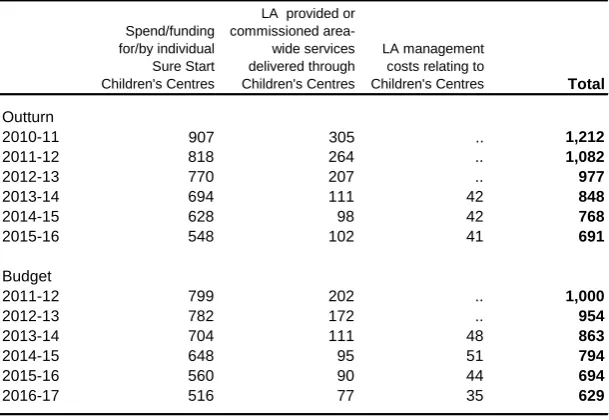
As the ring-fence on EIG spending was removed under the Coalition Government, there is no way to assess changes to central Government support specifically for Sure Start children’s centres. The table on the next page looks at changes in what local authorities spent or planned to spend since 2010.
Outturn spending in 2015/16 was 43% lower than 2010/11 in cash terms; 47% less in real terms.66 Budgets for 2016/17 showed a further
planned reduction in spending.
64 Department for Communities and Local Government (DCLG), Breakdown of
settlement funding assessment 2015-16, February 2015
65 DCLG, Core spending power: final local government finance settlement 2017 to
3.2
Number of Sure Start centres
Continuing the trend seen under the Coalition Government, the overall number of Sure Start children’s centres reduced over the 2015-2017 Parliament, alongside further restructuring and mergers of some centres.
[image:23.595.86.391.117.327.2]As of 30 June 2015, there were 2,677 main centres and 705 further sites that remained open providing children’s services.67 According to
figures from EduBase, as of June 2017 the number of main centres had reduced to 2,443, whilst the number of former designated children’s centres that now offer access to early childhood services had increased to 731. This is an overall reduction in sites of 208 since 2015.68
In response to concerns about reducing numbers, in July 2015 the then Childcare Minister Sam Gyimah highlighted the increased number of parents that were using Sure Start services:
Dr Roberta Blackman-Woods (City of Durham) (Lab):: In 2010 the Prime Minister said that he backed Sure Start centres, but since then more than 800 have closed, including a number in my constituency. Why are the Government not giving local authorities the necessary resources, so that they can go on helping Sure Start centres to deliver the excellent early-years and childcare provision that we know they can deliver?
Mr Gyimah: I agree that Sure Start centres provide some excellent support for young families. Where we disagree is that the hon. Lady wants to go on counting buildings and we want to focus on outcomes. I hope Opposition Members will join me in welcoming the fact that more than 1 million families are benefiting from Sure Start centres.69
67 Directgov, ‘Sure Start Centres’, last accessed 7 June 2017
68 DfE, Edubase – Data downloads: All open children’s centres, accessed 7 June 2017 69 HC Deb 20 July 2015, c1201
Local authority gross spending on Sure Start Children's Centres in England
£ million cash
Spend/funding for/by individual Sure Start Children's Centres
LA provided or commissioned area-wide services delivered through Children's Centres
LA management costs relating to
Children's Centres Total
Outturn
2010-11 907 305 .. 1,212
2011-12 818 264 .. 1,082
2012-13 770 207 .. 977
2013-14 694 111 42 848
2014-15 628 98 42 768
2015-16 548 102 41 691
Budget
2011-12 799 202 .. 1,000
2012-13 782 172 .. 954
2013-14 704 111 48 863
2014-15 648 95 51 794
2015-16 560 90 44 694
2016-17 516 77 35 629
Organisations such as the Pre-school Learning Alliance raised concerns about the closures of centres, as well as about a reduction in services at those remaining open:
It is very worrying to see that such a significant number of children's centres across the country are continuing to close. Children's centres are a vital source of advice and practical support for families – especially those more disadvantaged families – and so for so many to be disappearing at a time when there is so much government rhetoric on 'closing the gap' and improving children's life chances seems completely contradictory. Worse still, a growing number of those children's centres that remain open are unable to offer much more than a skeleton service due to lack of adequate funding, meaning that even more vulnerable families are finding it difficult to access the support they need.
This is clearly not a sustainable situation and so we urge the government to set out its – now long overdue – strategy for securing the future of children's centres as a matter of priority.70
3.3
Extended free childcare entitlement
One of the most significant legislative changes targeted at the under-fives by the 2015 Government was the increase in childcare for three and four-year-olds from 15 to 30 hours per week, for eligible working parents.This was brought in under the Childcare Act 2016 and will be fully rolled out by September 2017. More information can be found in the Commons Library briefing paper, Children: Introduction of 30 hours of free childcare (England).
Although a very limited proportion of Sure Start centres currently provide day care services, in July 2015 the then Childcare Minister Sam Gyimah argued that Sure Start could play a role in implementing the 30 hours policy:
Dr Roberta Blackman-Woods (City of Durham) (Lab): What plans the Government have to use Sure Start centres for the extension of free childcare to 30 hours a week.
The Parliamentary Under-Secretary of State for Education (Mr Sam Gyimah): Children’s centres play a valuable role in our communities. It is right for local authorities to decide on the nature of provision on the basis of local need. If there is a viable nursery in a children’s centre, of course we will strongly
encourage it to help to deliver our manifesto commitment to assist families with the cost of childcare.
[…]
Only 3% of Sure Start centres currently offer day care, but we want to ensure that when centres are viable, they can deliver.71
70 ‘Alliance concerned as Sure Start centre closures surge’, Pre-school Learning Alliance press release, December 2016
3.4
Sure Start consultation
In July 2015, the then Childcare Minister Sam Gyimah announced in Nursery World that there would be a consultation on the future of Sure Start children’s centres. The aim was to determine whether the
Government was “maximising the impact of children’s centres and whether they are helping families most in need.”72
More detail on the consultation was provided in a December 2015 letter from then Health Minister Lord Prior of Brampton to Lord Rea:
The consultation will offer parents, carers, local authorities and key stakeholders the opportunity to influence and drive what we expect from children’s centre services and where we see them having the greatest impact.
The consultation will not just be about the children’s centre buildings but focus on what they provide as part of the integrated services for children and families locally, what outcomes they should achieve and what accountability framework is needed to best demonstrate impact.73
In March 2016, it was announced that the consultation would be launched in the summer as part of the then Prime Minister David Cameron’s Life Chances Strategy. However, the planned publication of the strategy was dropped in December 2016, under new Prime Minister Theresa May, in favour of a broader social justice green paper.
In January 2017, the Department for Education (DfE) confirmed to Children & Young People Now that the consultation was likely to launch in early 2017, independent of the green paper.74 No publication date
has yet been announced.
72 ‘Exclusive: Gyimah launches children’s centre consultation’, Nursery World, 13 July 2015
73 Department of Health, Letter to Lord Rea re Sure Start Centres, 10 December 2015, DEP2015-0966
4.
Impact of Sure Start
Sure Start was introduced to drive improvements across a range of health and development measures for children, as well as on various health and home life impacts for parents.
Assessing the impact of early intervention policies such as Sure Start can be lengthy and complicated, as it involves analysis of outcomes over a number of years from the early years into later childhood.
The Labour and Coalition Governments each commissioned a multi-year, longitudinal study - the National Evaluation of Sure Start (NESS) and Evaluation of Children’s Centres in England (ECCE)
respectively - to determine what impact Sure Start had had against its policy objectives. The results of these studies, and of a 2010 quantitative study by the Audit Commission, are explored below.
4.1
National Evaluation of Sure Start
(2002-2012)
The 1998 Comprehensive Spending Review stated that it would, in relation to Sure Start, “draw on the evidence of what works.” The Government therefore set up the National Evaluation of Sure Start
(NESS), co-ordinated by Birkbeck, University of London, which reported every year from 2002-2012.
In assessing the impact of Sure Start Local Programmes (SSLPs) on child and family functioning over time, the NESS followed up over 5,000 seven-year-olds and their families in 150 SSLP areas who were initially studied when the children were nine months, three years old and five years old.
The NESS study measured the impact of Sure Start across the SSLP area, not just on those families that used the services.
A comparison group of non-SSLP children and their families, was also used to compare with the NESS sample. The comparison group was selected from the entire Millennium Cohort Study (MCS) cohort. Their selection was based upon identifying and selecting children living in areas with similar characteristics to SSLP areas, but which did not offer SSLP services.
The first major report, published in 2005, looked at children aged nine months and 36 months. It noted “extremely few overall main effects of SSLPs, whether positive or negative.” The main effects observed in SSLP areas were:
• Parents of nine-month-old children reported less household chaos.
• Parents of 36-month-old children used less negative parenting.
In addition, as noted in section 1.3, whilst relatively less disadvantaged families benefitted from being in an SSLP area, the most disadvantaged families may actually have been adversely affected.75
When the nine-month-old children were followed up at age three, the discrepancy of outcomes between most and relatively less
disadvantaged families had gone. NESS were unclear whether this was the result of changed outcomes between the two reports, or a change in methodology.
The follow-up report at age three noted that the main benefits associated with living in a SSLP area were:
• Parents of three-year-old children showed less negative parenting while providing their children with a better home learning environment.
• Three-year-old children in SSLP areas had better social development with higher levels of positive social behaviour and independence/self-regulation than children in similar areas not having a SSLP.
• The SSLP effects for positive social behaviour appeared to be a consequence of the SSLP benefits upon parenting.
• Three-year-old children in SSLP areas had higher immunisation rates and fewer accidental injuries than children in similar areas not having a SSLP - although it is possible that instead of reflecting positive effects of SSLPs these health-related benefits could have been a result of differences in when measurements were taken of children living in SSLP areas and those living elsewhere.
• Families living in SSLP areas used more child- and family-related services than those living elsewhere.76
When followed up at age five the main impacts identified for children were that:
• Children growing up in SSLP areas had lower BMIs than children in non-SSLP areas. This was due to their being less likely to be overweight with no difference for obesity.
• Children growing up in SSLP areas had better physical health than children in non-SSLP areas.
In addition, mothers in SSLP areas reported:
• Providing a more stimulating home learning environment for their children.
• Providing a less chaotic home environment for their children.
75 NESS, Early impacts of Sure Start Local Programmes on children and families, November 2005
76 NESS, The impact of Sure Start Local Programmes on three year olds and their
• Experiencing greater life satisfaction.
• Engaging in less harsh discipline.
• Experiencing more depressive symptoms.
• Being less likely to visit their child’s school for parent/teacher meetings or other arranged visits. Although the overall incidence was low generally. 77
More recently, when followed up at age seven, significant effects of SSLPs emerged for four out of 15 outcomes, two of which applied across the board and two of which applied to certain groups within the SSLP areas (parents of boys, lone parents and workless households). For the whole population, mothers in SSLP areas relative to their counterparts in non SSLP areas reported:
• Engaging in less harsh discipline;
• Providing a more stimulating home learning environment;
Additionally for certain groups within the SSLP areas mothers reported:
• Providing a less chaotic home environment for boys (not significant for girls);
• Better life satisfaction (lone parent and workless households only).
Additional evidence of positive SSLP effects emerged for three of eight repeatedly-measured outcomes when the focus of evaluation was on change in parent and child functioning between 3 and 7 years (9 months and 7 years for workless household status). Mothers in SSLP areas relative to those residing in comparison areas:
• Showed a greater improvement in the home learning environment;
• Reported a greater decrease in harsh discipline;
• Greater improvement in life satisfaction (lone parent and workless households only)
No consistent SSLP effects for child development emerged at 7 years. The report’s authors believe that this is likely to be due to high levels of participation in the 3 and 4 Year Old Free Entitlement to pre-school education across England, which has resulted in most of the MCS children also benefitting from early years learning opportunities.
Additionally, by age 7 children were in their third year of primary school and so had 3 years of primary school in common as well, which may partly account for the similarity in outcomes across the study groups.78
77 NESS, The impact of Sure Start Local Programmes on five year olds and their families, November 2010
78 NESS, The impact of Sure Start Local Programmes on seven year olds and their
4.2
Audit Commission report (2010)
An additional quantitative study, Giving children a healthy start, a 2010 report by the Audit Commission, was critical of the limited impact Sure Start had on improving health outcomes:
Between 1998/99 and 2010/11 we estimate that £10.9 billion (including £7.2 billion for Sure Start, which had dedicated funding for health improvements in the early phase of roll-out) will have been invested in programmes aimed in whole, or in part, at improving the health of the under-fives, but this has not produced widespread improvements in health outcomes. Some health indicators have indeed worsened – for example, obesity and dental health – and the health inequalities gap between rich and poor has barely changed.79
4.3
Evaluation of Children’s Centres in
England (2012-2016)
Under the Coalition Government, the DfE commissioned NatCen Social Research, the University of Oxford and Frontier Economics to carry out a substantial research project into Sure Start. Evaluation of Children’s Centres in England (ECCE) produced 11 publications between 2012 and 2016, across five research ‘strands’:
1 Survey of children’s centre leaders
2 Survey of families using children’s centres in the most disadvantaged areas
3 Children’s centre service delivery and reach
4 Effects of children’s centres on child and family outcomes 5 Value for money analysis
Survey of children’s centre leaders
Strand one surveyed a number of children’s centre leaders in 2011 and 2013, to identify changes they had observed between the two dates. The major changes the report found included:
• An increased ‘clustering’ of centres – the number of leaders managing four or more centres rose from 17% to 28%.
• A decrease in other organisations running centres – in 2011 local authorities managed 63% of centres, by 2013 this was 72%.
• An increase in part-time staffing – the proportion of part-time staff and volunteers, compared to full-time, rose from 61% to 66%.
• Fewer centres offering full-time early learning and childcare services (77% in 2011 and 51% in 2013) and an increase in part-day sessions of less than four hours (34% in 2011 and 62% in 2013).
• A large increase in the number of centres with over 501 users, rising from 24% in 2011 to 47% in 2013. The report proposed this could be due to the merging of different centres.
• Of those surveyed in 2013, 42% said that reductions in funding had affected the services provided in their centre, and 52% said that staffing had been affected.80
Survey of families using children’s centres in the
most disadvantaged areas
Families using children’s centres in the 128 most deprived areas were surveyed at three different points in their child’s life (age 9-18 months, age two, and age three) to see how Sure Start centres were being used. ECCE carried out 5,717 intervi