Temporal Binding by Short-Term Synaptic
Plasticity
Ernst Odolphi
[email protected]
March 30, 2010
Abstract
This thesis introduces a novel way of performing temporal binding in a network of biologically plausible spiking neurons. The neurons in the
net-work are connected through synapses with short-term synaptic plasticity. By synchronously activating multiple patterns, the network stabilizes into
a state where these multiple patterns quickly oscillate between an active
and inactive state.
Using this method a simple Hopfield-like auto-associative network is
Acknowledgment
I would like to thank everybody who helped my in the writing of this the-sis. Specifically Reinhard Blutner for his supervision, Michiel van
Contents
1 Introduction 5
2 Neural Networks 8
2.1 Classical Neural Networks . . . 9
2.2 Spiking Neural Networks . . . 10
2.3 The Spike Response Model . . . 10
2.3.1 The Model . . . 11
2.3.2 Example . . . 13
2.3.3 Activity in the Spike Response Model . . . 15
3 Auto-associative Networks 16 3.1 Associative Neural Networks . . . 16
3.2 Storing Patterns . . . 17
3.3 Distributed Representation . . . 18
4 Binding Problem 21 4.1 Temporal Binding . . . 22
4.2 Synchronous temporal binding . . . 24
4.2.1 Shruti . . . 24
4.2.2 Neural Oscillators . . . 26
4.2.3 Disadvantages of synchronous binding methods . . . 26
4.3 Slow Temporal Binding . . . 27
5 Temporal Binding by Short-Term Synaptic Plasticity 30 5.1 Pattern Retrieval . . . 30
5.2 Pattern separation . . . 31
5.2.1 Short-Term Synaptic Plasticity . . . 33
5.3 Switching Patterns . . . 36
5.4 Measuring Binding . . . 38
6 Simulations and Results 40 6.1 Simulations . . . 40
6.1.1 Retrieving one pattern . . . 40
6.1.2 Retrieving two patterns . . . 40
6.1.3 More patterns . . . 42
6.2 Results . . . 43
6.2.1 One pattern . . . 43
7 Future Work and Conclusion 49
7.1 Future Work . . . 49
7.1.1 More Realistic Domain . . . 49
7.1.2 Whole/Parts Modeling . . . 49
1
Introduction
Distributed representations in neural networks have a very strong appeal. They are easy to implement and fault tolerant. They generalize, have
a large capacity and are very expressive. There has been quite a lot of research in the relations between logic and these networks.
There are however also some big problems limiting the use and ex-pressive power of neural networks with distributed representations. One
of the biggest problems is the binding problem. It is difficult to represent
more then one object in such a network, since there is no information about which unit belongs to which object.
Several solutions to this problem have been proposed. One solutions that has been given a lot of attention is called “temporal binding”. In
this method of binding, introduced in [von der Malsburg, 1981], the exact timing of the spikes of the neuron is used to indicate which neuron belongs
to which object.
Most research on temporal binding focuses on using exact synchrony
of spikes to signal binding. In these models neurons firing in synchrony are said to “belong” to the same pattern. This way the network activity
quickly oscillates between active patterns. Since the duration of a spike
is between 2 and 10 milliseconds, the network switches patterns approxi-mately every 5 to 20 milliseconds.
[Knoblauch and Palm, 2002] introduces a model that implements tem-poral binding on a much slower time-scale. Instead of neurons firing in
synchrony, neurons are active in short “bursts”. Neurons belonging to the same pattern are active during the same bursts. This means the network
switches patterns on a much slower scale, somewhere between every 50 to 200 milliseconds.
This thesis will introduce a model that implements a variant of this binding method. The resulting binding behavior is similar to that of the
model implemented by [Knoblauch and Palm, 2002]. The model in this
thesis consists of a simple auto-associative network of spiking neurons, universally connected through synapses with short-term plasticity. In
bi-ological neurons the transmission of a spike changes the strength of a synapse. [Kistler and van Hemmen, 1999] introduce a model that
imple-ments this characteristic of synapses and show that short-term synaptic plasticity impacts network behavior, but does not impact the capacity
of auto-associative networks with these synapses. This thesis shows that the short-term synaptic plasticity modeled in [Kistler and van Hemmen,
of [Knoblauch and Palm, 2002].
Whereas in the model of [Knoblauch and Palm, 2002] the binding
behavior is implemented using a complex network consisting of multiple layers, in the proposed method the binding behavior simply emerges from
a straight-forward associative network of spiking neurons which are
con-nected through synapses with short-term plasticity. The binding method does not require any machinery added to the associative network, making
it much simpler than other proposed solutions.
Section 2 gives a general introduction to neural networks. It introduces
central concepts in artificial neural networks, like neurons, synapses and activity.
In biological neural networks, activation is spread through the network by short spikes. Since the exact timing of these spike did not seem to play
an important role in the workings of neural networks, classical artificial neural networks do not model these spikes. Instead the average frequency
of these spikes is modeled.
Since the binding method developed in this thesis uses the exact timing of spikes to perform binding, section 2 introduces a variant of artificial
neural network that does model the spiking nature of neural activity. This section introduces a mathematical model of spiking neurons. Though
more complex than classical neural networks, it remains fairly simple, which allows the paper to focus on the binding method.
Section 3 introduces auto-associative networks. These networks are capable of storing patterns and retrieving the stored patterns by activating
parts of the stored patterns. Patterns are stored by changing the strength
of the synapses connecting the neurons.
This section also shows how information can be encoded in patterns in
an elegant way in neural networks. Nodes in the network represent prop-erties of objects. Objects are represented by a pattern of these propprop-erties,
i.e. the properties that that object has. These patterns can be stored in auto-associative networks and have some very attractive properties.
A problem however with these so-called distributed representations is that only one pattern can be active at the same time. When two patterns
are activated we need a way to keep track of which properties belong to which object. This problem, generally called the binding problem, is
introduced in section 4. Without a solution it seems impossible to model
complex things like relations in distributed representations.
This section also introduces a solution to the binding problem proposed
two models, that use synchrony in spikes to model binding and keep track of which active node belongs to which active pattern. Some problems
with these models are discussed. The section also introduces the model of [Knoblauch and Palm, 2002], where neurons are bound to patterns on
a slower time-scale.
Section 5 introduces a novel way to perform temporal binding in an auto-associative network on a slow time scale similar to that of [Knoblauch
and Palm, 2002]. The binding emerges in a standard auto-associative net-work of spiking neurons with short-term synaptic plasticity from [Kistler
and van Hemmen, 1999]. Short-term plasticity, the fact that synapses fatigue when transmitting spike and thus become less and less effective,
controls the activity in the network, resulting in a temporal binding be-havior but with much less added complexity.
A computer model of the binding method developed in section 5 is used to perform simulations in section 6. A simple network of spiking
neurons is used to retrieve one, two and three patterns simultaneously.
The simulations show that the method can indeed be used to perform binding in a simple network of spiking neurons and short-term plasticity.
Section 7 introduces some aspect of the binding method that might be interesting to the develop in future work, and gives a conclusion to the
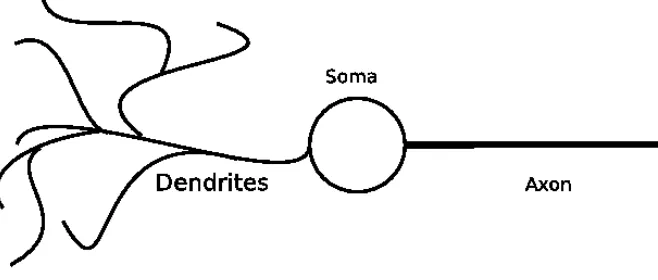
Figure 1: A schematic representation of a biological neuron
2
Neural Networks
Over a hundred years of biological research have given us a lot of insight
in the structure of our brain. This research showed that neurons are the primary processing units in our brain. The brain consists of a huge
number of these neurons connected to each other in a complex network. The estimated number of neurons is about 1012. A typical neuron is
connected to approximately 104other neurons [Maass and Bishop, 1999].
A typical neuron consists of three main parts, see figure 1. The den-drites of a neuron consist of a tree that collects pulses from pre-synaptic neurons, i.e. the neurons which connect to the current neuron. The body of a neuron is called the soma. The incoming pulses collected by the dendrites cause a potential change in the soma. If this potential crosses a threshold, the soma emits a pulse. This pulse is propagated to the
post-synaptic neurons, i.e. the neurons to which the current neuron is connected, by theaxon.
The duration of a pulse is typically 1-2 ms. It is generally assumed that the exact shape and duration of a spike carries no information. Only
the time of a pulse and the number of pulses emitted matter.
The place where the axon of one neuron meets the dendrite of another neuron is called the synapse (hence the term pre- and post-synaptic).
When a pulse of the pre-synaptic neuron reaches this point, a highly complex chain of chemical reactions causes a changes in the potential of
the post-synaptic neuron. The size of the change is determined by the strength of the synapse. The changes can either be positive (the synapse
2.1
Classical Neural Networks
Classical artificial neural networks give a simple mathematical model of
neural networks as described in the previous section. Essentially a network consists of a set of nodes representing the neurons, and a matrix of weights
representing the synapses connecting the neurons.
Each node has an activation value associated with it. This activation
value represents the firing rate of the neuron. The higher the firing rate, the higher the activation of the node.
The reaction depends on the type and strength of the synapse connect-ing neuron iandj. This is modeled by the activation levela of neuron
k depends on the activation level of the pre-synaptic neurons and the
strength of the synapses connecting the pre-synaptic neurons.
The strength of the synapse is models bywij (the weight of the
con-nection from neuron j to neuron i). If wij is positive, the synapse is excitatory. If a neuroni receives input from an excitatory neuron, the
activation level of neuroniwill increase. Ifwijis negative, the synapse is inhibitory. If neuronireceives a spike from an inhibitory neuron the
acti-vation level of the neuron will decrease. The value ofwijdetermines the strength of the synapse. The stronger the synapse the more the activation
level of the neuron will increase or decrease.
The sum of the activation levelaj of the pre-synaptic neuronsj6=k multiplied by the synaptic strengthwjkof the synapses connecting neuron
kandjis usually called the input of the neuron. So the input,skof neuron
kat timet+ 1 is:
sk(t+ 1) =X j6=k
aj(t)wjk (1)
The way the activation level of a neuron depends on it’s input is called
the activation function. Several activation functions are used in artificial neural networks. The simplest activation function is the binary activation
function. Units that have a binary activation function have an activation level of 1 if the input exceeds a certain thresholdT and 0 if the input is
below the thresholdT.
ak(t+ 1) = 1 ifsk(t+ 1)> T,0 otherwise (2)
Another popular activation function is the sigmodial activation
func-tion:
ak(t+ 1) = 1
2.2
Spiking Neural Networks
Classical neural networks as described in section 2.1 give a simple
math-ematical model of networks of neurons. These models allow for empirical and theoretical research. Because mathematically these models are
rel-atively simple, it is possible to make rigorous proofs, such as the one mentioned in 3.1.
One of the simplifications that often proves too strong is the fact that the exact firing times of the neurons are not modeled. In biological neural
networks, the activity is spread through the network by neurons that fire small spikes. In classical neural networks it is assumed that the exact
timing of the spikes carries no meaning.
So to simplify the model, activity in the network is modeled by the ac-tivation level of a neuron, which can roughly be interpreted as the number
of times a neuron fires a spike within a certain time period. Instead of car-rying spikes through the network, the synapses are modeled to transport
these activation levels.
This greatly simplifies the model, however it often proves too much
of a simplification. The binding method developed in this thesis uses the exact timing of spikes to bind neurons to a pattern. So classical models
of artificial neural networks can not be used to implement the binding method.
2.3
The Spike Response Model
In this section I will introduce a precise mathematical model of a network of neurons called the Spike Response Model [Maass and Bishop, 1999].
This model abstracts from the exact biological details of the neurons. In this way the model can be fairly simple. However it is powerful enough
to explain various phenomena of biological neural networks.
The method of binding developed in this thesis uses the exact
tim-ing of spikes to perform bindtim-ing. To implement the bindtim-ing method we thus needs to implement a model of spiking neural networks. The spike
response model is relatively simple to implement while staying relatively
close to biological neurons. The spike response model is also the model chosen in [Kistler and van Hemmen, 1999] to implement short-term
2.3.1 The Model
The state of a neuroniat timetis modeled by the action potentialµi(t)
of that neuron. Whether or not a neuron fires a pulse to its post-synaptic neurons is controlled by this action potential. If the action potential of
neuroni crosses the neuron’s firing thresholdθi the neuron will emit a pulse along it’s axon. So the setFiof firing timesti(the times a neurons
emits a pulse) is defined by the exact times the action potential of the neuron crosses the firing threshold of a neuron:
Fi={tkµi(t) =θi} (4)
There are two processes that contribute to the value of the action
potentialµi of neuron i. First, there is the reaction of a neuron to it’s own pulse, it’s so-called refractoriness, this is modeled by a functionηi(t).
And second, the reaction of a neuron i to pulses of a pre-synaptic neuronj, is modeled byij(t). The potential at timetis determined by
all reactions to it’s own spikes and by all reactions to the spikes of the neuron’s pre-synaptic neurons. I.e.:
ui(t) = X tf∈Fi
ηi(t−tf) +
X
j∈Γi
X
tg∈Fj
ij(t−tg) (5)
where Γi is the set of pre-synaptic neurons of i. The first term of
the right side of equation 5 represents the response ofito it’s own firing,
the second term corresponds toi’s response to firing of it’s pre-synaptic neurons.
After a neuron emits a pulse it cannot emit any pulses for a short while. This phenomena is called absolute refractoriness. After that the
potential µi is lowered to a value below the resting potential µresti , i.e. the value to which the potential of the neuron converges if it receives no
pulses. The lowering of the potential has the effect that it is more difficult for the neuron to fire after emitting a pulse. This phenomena is called
relative refractoriness.
So the reaction of a neuronito it’s own pulse at timescan be modeled by:
ηi(∆t) =
−µrefracexp[−(∆t)/τ] if ∆t≥∆abs −∞ if 0≤(∆t)<∆abs
0 if (∆t)<0
(6)
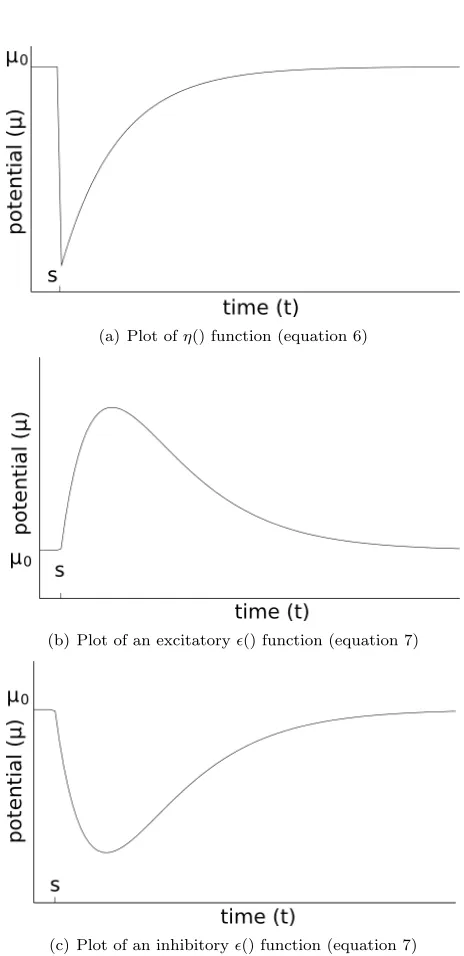
(a) Plot ofη() function (equation 6)
(b) Plot of an excitatory() function (equation 7)
[image:12.612.189.421.103.581.2](c) Plot of an inhibitory() function (equation 7)
determining the length of the relative refractory period, and µrefrac a
constant determining the amount the potential is lowered due to a spike.
Figure 2 shows a graph explaining equation 6.
For simplicity I will assume the sameηfor every neuron. [Maass and
Bishop, 1999] uses equation 6 in most parts of the book. It is however
possible to choose a different equation and for example model different types of biological neurons.
If neuron ireceives a pulse from a pre-synaptic neuron j ∈ Γi, this pulse will cause a reaction of the potentialµi of neuroni. The weight of
the synapses determines the direction and magnitude of the reaction. As in the models of classical artificial neural networks in the previous section,
this is modeled bywij.
When a pulse arrives at the neuron, the potential changes rapidly.
After reaching the full potential change the potential will gradually recover to the resting potential. [Maass and Bishop, 1999] models this as:
ij(∆t) =
(
wij[exp[−((∆t)τ−∆ax
m )]−exp[−(
∆t−∆ax
τs )]] if (∆t)≥∆ ax
0 otherwise
(7) Whereτs andτmare time constants that determine how fast the
po-tential recovers, and where ∆axmodels the axonal delay (i.e. the time it takes for a pulse to reach the post-synaptic neuron).
Again for simplicity I assume the same for every pair of neurons.
Throughout the simulations equation 7 is used to model a neurons reaction to it’s own pulses.
The equations in this section make up the basic structure of spike response model. They completely abstract away from the biological
pro-cesses involved. The model just gives a basic structure of how neurons react to pulses. However it is possible to choose more involved equations
forηandand create a models that more precisely models the chemical processes. For our purpose, a simple model suffices, since the model does
not crucially depend on any of the low-level chemical processes.
2.3.2 Example
Consider the figures 3(b) and 3(c). The figure shows a part of a network
of neurons (figure 3(a). Neuron 1 is connected to neurons in the network
that fire randomly. Neuron 2 is connected to Neuron 1 by an excitatory synapse.
(a) Part of a network of neurons.
(b) Potential of Neuron 1.
[image:14.612.191.424.120.588.2](c) Potential of Neuron 2.
At timet= 0 the potential is equal to the resting potentialµrest. Neuron 1 receives excitatory input from other neurons in the network. Every
pulse that is emitted by the pre-synaptic neurons of Neuron 1 causes a change in the potential of the neuron, as modeled by equation 7. At time
t = t1 the potential of of neuron 1 crosses the threshold. This means
that at t1 Neuron 1 fires a pulse as modeled by equation 4. The firing causes a negative contribution to be added to the potential of the neuron
as modeled by equation 6.
Neuron 2 is connected to Neuron 1 through an excitatory synapse.
When the spike reaches the synapse connecting the neurons att1+ ∆axon a positive contribution of () is added to the potential of Neuron 2 as
modeled by equation 7 (figure 3(c)). At times t2 and t3 the potential crosses the threshold again, resulting again in a raising of the potential of
Neuron 2.
2.3.3 Activity in the Spike Response Model
The spike response model introduced above gives a simplified model of
biological neurons. This subsection shows how the spikes emitted by spike
response neurons can be interpreted to resemble the activity of classical neurons (see section 2.1).
The activity of neuron neuroniat timet,ai(t), can be interpreted as the firing rate of the neuron a timet. This is defined as the total number
of pulses a neuron emits over the time intervals[Maass and Bishop, 1999]:
ai(t) =|{tf ∈F|(t−s)< tf < t}| (8)
Using this definition we can describe the state of a network at timetby a vectora(t) ={a1(t), . . . , an(t)}, just like we can represent the activity of a classical network by it’s activity vector.
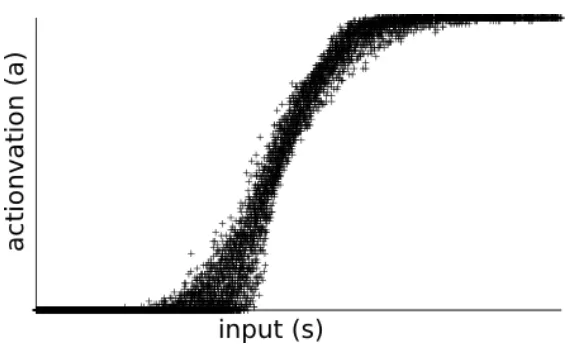
[Gerstner, 1999] shows that the activation function of a spike response
neuron with absolute refractoriness can be modeled by a sigmoidial func-tion. Figure 4 shows a plot of a simulation performed using the model
described above. The input of a neuron is plotted against the average fir-ing rate of the neuron. The plot clearly shows that the activation function
Figure 4: Result of a simulation of a spike response neurons. The figure plots the received input of a neuron against the firing rate of the neuron.
3
Auto-associative Networks
Networks of neurons generally perform a computation by activating neu-rons and letting the activation spread through the network. The activity of
some neurons is raised, and through the excitatory synapses, post-synaptic neurons are activated. They perform a mapping of one set of activation
vectorsx1, x2, . . . , xnto another set of activation vectorsy1, y2, . . . , yn. Two types of mappings can by distinguished. In the first type, the
activation values of one set of neurons are mapped to the activation values of another set of neurons. Such network are called hetero-associative. The
network can also perform a mapping of the activation values of a set of neurons to the activation values of the same set of neurons. These second
type of networks are called auto-associative.
Attractor neural networks are a special type of auto-associative net-works. They consist of universally connected neurons, i.e. every neuron is
synaptically linked to all other neurons in the network. By changing the weights of the synapses, patterns can be stored in the network. If a partial
pattern is activated, the activation spreads through the network activating the rest of the pattern, essentially implementing a type of memory.
3.1
Associative Neural Networks
[Hopfield, 1982] showed that a certain class of neural networks will always
consist of elements described by equations 1 and 2, which are updated asynchronously. This means that at every time t the activation value
of only one (randomly selected) neuron is updated. The elements are connected by symmetrical weights, i.e. the weight connecting neuron i
to neuron j must be the same as the weight connecting neuron j to i,
or more formally: ∀i, j: wij =wji. Hopfield showed that if a group of neurons in such a network is activated the network will always converge
to a stable state.
3.2
Storing Patterns
If the neurons in a network are connected through symmetrical synapses, the network will converge to a stable state after activating certain neurons.
What states are stable depends on the weights of the synapses in the network. By changing these weights it is possible to change the attractor
states in the network.
[Hebb, 1949] introduced a method of changing the strength of a synapse based on the activity of the pre- and post-synaptic neurons of the synapse.
The process of changing the weight of a synapse according to the activity of the neurons it connects is called synaptic plasticity.
Hebb’s idea was that simultaneous activity of two neurons can be in-terpreted as a way of “belonging together” of the two neurons. “Neurons
that fire together wire together”. By increasing the strength of the con-nection between two neurons if they are active together, this information
can be stored in the network. If the connection between the neurons is
strong enough and one of the two neurons is active, the other neuron will be activated because of the strong positive connection between them. The
network has “learned” that the neurons belong together.
This general idea of long-term synaptic plasticity can be used to store
patterns in a network. Patterns are stored by presenting an activation pat-tern to the network, and then adjusting the weights according to Hebb’s
idea about long-term synaptic plasticity. If two neurons belong to the same pattern their connection is strengthened.
The stronger positive connections between two neurons belonging to the same pattern will mean that activation of one of the neurons will
heighten the potential of the other neuron. Looking at the complete
More formally Hebb’s idea can be expressed as
∆wij=γ∗(xixj) (9)
wherexiis the activation of neuroniandγ is usually called the learning rate.
Note that when the activation of the neurons in the presented patterns is positive the weights in the network continue to grow. Often when storing
binary patterns,{−1,1}are used as activation values. This has the effect that besides positive connections, also negative connections are created.
When one of the neurons is active and the other is not, the connection
between the two neurons is weakened instead of strengthened.
3.3
Distributed Representation
In classical computers information is retrieved from memory by finding the exact address of the stored item. If an item has to be retrieved the
exact location of the item in memory has to be computed, which is not necessarily trivial.
The previous subsections showed how a simple network of neurons can be used to implement a content addressable memory. Using a simple rule,
patterns can be stored, and later retrieved by activating a part of that
pattern. There are various ways to store information in such patterns, for this thesis however I will focus on the two most obvious and different
techniques: local representation and distributed representation.
Classical cognitive theory tends to adhere to local representations.
Objects are represented in one place in the system, i.e. a memory address, a node in the network or, from a classical analogy for human memory, a
drawer in a big closet. If information about an object is to be retrieved, first the location of the object is retrieved, from which the information
about the object can then be retrieved.
The auto-associative networks from the previous subsection suggests
a different but elegant way to store objects. Instead of letting the nodes
in a network represent objects, they represent features of that object. An object is represented by an activation vector. Active nodes in the
vec-tor represent features that belong to the object, inactive nodes represent features that do not belong to the object.
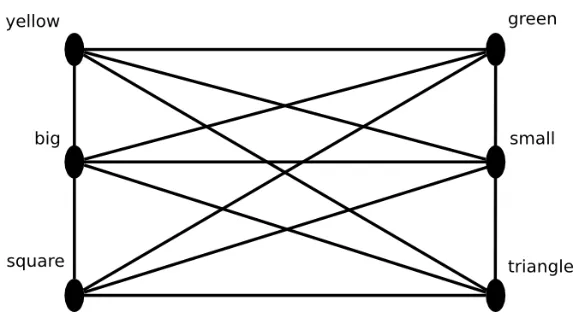
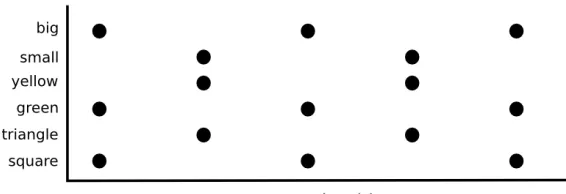
Consider figure 5, it shows a network of 6 nodes. The 2 nodes on the top represent color, the central nodes represent size, and the bottom nodes
Figure 5: Example of a network using a distributed representation
The example above uses binary units (see 2.1). Using analog units would give us an even more expressive network, “where smallish” and
“yellowish” objects can be represented.
Representations similar to the representation in figure 5 are called
distributed representations (see [Rumelhart and McClelland, 1987] for a good overview). The classical types of representation where objects are
represented in one place are called local representations.
Distributed representations have some advantages over local
represen-tations. For one, using local representationsnobjects can be represented
usingnnodes. Using a binary distributed representation 2nobjects can be represented using n nodes, since every different pattern represents a
different object. So a network that uses a distributed representation can represent exponentially more objects than a local representation can.
Using a local representation, representing new objects requires special mechanisms, since new nodes need to be assigned for the new objects.
There are methods for this, however if implemented in a neural network, there has to be some machinery and bookkeeping to do this. In a
dis-tributed representation, new object do not need to be assigned to a node, the object can just be activated by activating the corresponding pattern.
Distributed representations are fault tolerant. If a feature of an object
is misrepresented, the network will usually repair that, because of the feedback from the network. In a local representation this is much more
difficult.
Distributed representations are much more robust then local
4
Binding Problem
The previous section shows how a simple network of neuron-like elements can implement a content-addressable memory, and how these networks
suggest a simple but extremely powerful way to represent objects in a network. Although distributed representations have many nice features,
they also have some severe shortcomings.
One of the biggest problems with distributed representations (see
sec-tion 3.3) in classical neural networks, was pointed out by Frank
Rosen-blatt [RosenRosen-blatt, 1962] using the example from figure 5. The figure shows how configurations of a square and a triangle can by represented using a
distributed representation. A small green triangle is represented by the features (small, green, triangle), a big yellow square is represented by the
features (big, yellow, square).
The problem arises when we want to represent a small green
trian-gleand a big yellow square. This will be represented by (small,green,
triangle, big, yellow, square). A small yellow square and a big green
triangle is represented by (small,green, triangle,big,yellow,square). It is impossible to tell both representations apart, because there is no way
to tell which feature belongs to which object.
In general this problem always arises when more than one object is to be represented using a distributed representation. There has to be a way
to bind features to objects if more than one object has to be represented. This problem is known as the binding problem [von der Malsburg, 1981].
The problem does not only occur if visual information has to be rep-resented in a distributed way, it also occurs if information from different
modalities (i.e. visual and auditive) has to integrated into one object. The next sections introduces a solution to the binding problem as
pro-posed in [von der Malsburg, 1981]. This method uses the exact timing of spikes in a network of neurons to perform binding. Three implementations
of this method are discussed in the following couple of sections. Section 5
develops a novel way to perform temporal binding, where temporal bind-ing emerges from the use of short-term synaptic plasticity. The proposed
method is both more biologically plausible and less complex, in the sense that it can be implemented in a simple network of fully connected spike
re-sponse neuron, without the need for complex neuronal units or a complex network structure.
Various other solutions have been proposed to solve the binding prob-lem. [Smolensky, 1990] proposes a mathematical solution called tensor
of both objects and variables, and represents the binding using the tensor product of the two.
Another proposed solution is that the problem is solved hierarchically. The world is represented in successively more complex representations.
Nodes in the layers of higher complexity represent more and more specific
things, making it possible to distinguish objects from each other. Recently temporal solutions of binding have received a lot of attention
(see for example the special issue of Neuron on binding: [Shadlen and Movshon, 1999], [Roskies, 1999]) for example), and various solutions have
been proposed. The general idea of using spike times for binding seems very elegant and simple. However most of the proposed models that
per-form binding this way tend to be complex, or have various other problems that limit the elegance and representational power of these models (see
section 4.2.3). This thesis develops a model of temporal binding which uses short-term synaptic plasticity to implement slow temporal binding.
4.1
Temporal Binding
This thesis focuses on temporal binding, as introduced in [von der Mals-burg, 1981]. There it is noted that the exact timing of spikes which is
usually considered without meaning in classical neural network could be used to implement binding.
[von der Malsburg, 1981] proposes to use the exact timing of the spikes for binding, hence the name temporal binding. A visual illustration of this
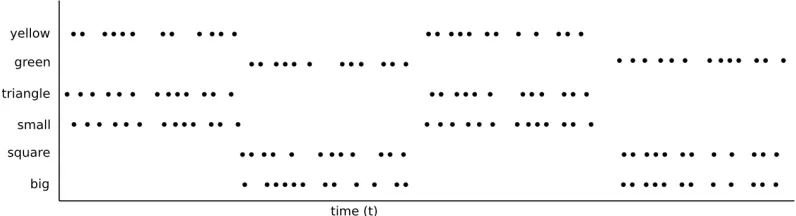
idea, makes it clear how this works. Consider figure 6, which shows firing
times for the neurons from figure 5. Note that the firing rate, and thus the activation level of all the neurons is equal. When looking only at the firing
rate we have a similar pattern as before, all neurons are active, making it impossible to tell if this represents “a large green triangle and a small
yellow square” or “a large yellow triangle and a small green square”. When looking at the exact firing times however it is possible to see
what is represented. The spikes for “large”, “green” and “square” are always synchronous, as are the spikes for “small”, “yellow” and “triangle”.
The exact timing of the spikes make it possible to bind patterns of neurons to objects, making it possible to represent more than one object at the
same time.
[von der Malsburg, 1981] notes that this synchronicity is almost cer-tainly unconscious. People are not capable of consciously perceiving
Figure 6: Binding through synchronous firing. Network activity of a network representing a small yellow triangle and a big green square. Each dot repre-sents a particular neuron firing a pulse. The fact that the neurons representing the features “small”, “yellow” “and triangle” fire in synchrony indicates that they are features of the same object. This synchrony “binds” the neurons to-gether. Note that the same holds for the neurons representing “big”, “green” and “square”.
somewhere between 200ms and 500 ms, so the synchrony of the neurons
would not be something that is consciously perceived.
The duration of the psychological moment is much longer than the du-ration of a single spike, making it possible to implement temporal binding
using other methods than exact synchrony. Short burst of activity as depicted in figure 7 are also possible, for example.
Section 4.3 shows a model that implements this type of binding. This thesis develops a novel way of implementing this slow temporal binding
using short-term synaptic plasticity (See section 5).
One of the things to notice is that although more than one pattern can
be distinguished using this method, the number of different patterns re-mains small. The more different patterns are active the closer the timings
of the spike come together. Since the timings of the spikes of the neurons
are inherently noisy, the upper limit is probably rather low.
Various researchers ([von der Malsburg, 1981], [Shastri and
Ajjana-gadd, 1993] for example) have argued that this is possibly in accordance with studies from cognitive psychology. People are not capable of focusing
on more than a handful of objects at the same time, and most people can not keep more than about 6 words in active memory. This would mean
that this low and hard barrier on simultaneous representation does not have to be a problem.
Figure 7: Binding through bursts of activation. Network activity of a network representing a small yellow triangle and a big green square. Neurons are not bound by synchrony of the spikes. Instead, the neurons belonging to one pattern are simultaneously active in short burst. Since the length of the bursts is still much lower than the psychological moment, the changes in activation will still be unconscious.
(or scenes) consisting of more than one object. In fact most methods of
temporal binding do not offer a way to store scenes of objects (except for the method in section 4.2.1).
4.2
Synchronous temporal binding
There has been a lot of research into the possible implementation of
tem-poral binding in spiking neural networks using synchronous pulses. This section will introduce two of the more prominent models. After this, some
disadvantages of these models are discussed.
4.2.1 Shruti
Lokendra Shastri [Shastri and Ajjanagadd, 1993], implements “a
connec-tionist model of knowledge representation and reflexive reasoning”
in-spired by the ideas on temporal binding from [von der Malsburg, 1981]. In this work a network of simple processing units is constructed, that can,
in a distributed manner, perform reasoning tasks. Binding is achieved by explicitly synchronizing firing times of nodes in the network.
[Blutner and Doherty, 1997] shows that associative networks imple-ment a form of non-monotonic logic. Without binding however, the
ex-pressive power of these models is severely limited. To represent a state-ment like “John loves Mary” in a distributed fashion there has to be a
[Shastri and Ajjanagadd, 1993] represents relations such as “John loves Mary”, by synchronous firing of the nodes john and lover, and
syn-chronous firing of the nodes mary and beloved, and thus binding the nodes forjohnandloverto the same object, and simultaneously binding
the nodes formaryandbelovedto another object.
To achieve this Shastri et al. introducep-btu nodes andτ-and nodes. Both these types of nodes are simple neuron-like processing units that fire
pulses to connected nodes. They however have some special properties that makes it possible to control the synchronization of the firing times of
nodes.
p-btu nodes behave as follows:
• If a nodeAis connected to nodeB, the activity of nodeB synchro-nizes with the activity of nodeA.
• The periodic activity of nodeAleads to synchronous periodic activ-ity in nodeB within one period.
• A threshold,n, associated with a node indicates that the node will fire only if it receivesnor more synchronous inputs.
In this way p-btu nodes can form chains of synchronous firing. In
[Shastri and Ajjanagadd, 1993] this is used to encode rules. The nodes are used to implement the synchronization between roles (arguments of a
predicate) and fillers (objects that fill these predicate arguments) and of arguments of the antecedent predicates to the arguments of the consequent
predicates. In this way it is possible to implement simple first-order like rules, in a distributed way.
τ-nodes behave as follows:
• A τ-and node becomes active if it receives an uninterrupted pulse train, i.e. it receives pulses such that the gap between pulses is less that a pulse width.
• So aτ-and node receiving periodic pulses with periodπ produce a periodic pulse with periodπ.
• A threshold,n, associated with aτ-and node indicates that the node will only fire if it receives more thannpulses within the length of a pulse.
τ-and nodes make it possible to encode facts. This is done by creating
[Shastri and Ajjanagadd, 1993] shows how a network of these two types of nodes can perform various reasoning and query-answering task
by encoding facts and rules in a network of these nodes and activating the network in a way that represents a question.
4.2.2 Neural Oscillators
[Ursino et al., 2006] constructs a network of biologically plausible spiking neurons that perform binding using synchronous firing.
A network of neural oscillators is constructed. An oscillator is formed
by coupling an inhibitory neuron with an excitatory neuron. Activating the excitatory neuron will result in periodic firing of the excitatory neuron
due to the feedback of the inhibitory neuron. These neural oscillators are called Wilson-Cowan oscillators.
An associative network is constructed by connecting the excitatory neurons in the oscillator. Patterns can be stored in this network by basic
Hebbian learning. When two oscillators are connected, a positive connec-tion (i.e. excitatory synapses) favors synchronizaconnec-tion, whereas a negative
connection (i.e. inhibitory synapses) favors de-synchronization.
An inhibitory layer is used to make sure that only approximately one pattern can be active. This, together with the
synchronization/de-synchronization behavior of the oscillators, achieves a segregation of the input.
Shortly after the activation of more than one pattern, the pulses of the neurons belonging to the same pattern synchronize, whereas pulses of
neurons belonging to different patterns desynchronize, effectively binding neurons to the pattern.
4.2.3 Disadvantages of synchronous binding methods
The nodes in the model of [Shastri and Ajjanagadd, 1993] are “Neuron like”, in the sense that they are simple processing nodes connected to
each other in a network. It is however hard to see how these nodes will be constructed from more biologically realistic neural units. Biological units
are noisy and imprecise and do not seem to have mechanisms for explicit
synchronization.
This makes it difficult to see how the model of [Shastri and Ajjanagadd,
1993] could be implemented in a biological system.
The units in the model of [Ursino et al., 2006] are much closer to
form an oscillator. These constructions might be found but do not seem to be ubiquitous enough to facilitate binding on a large scale.
Besides these problems with biological realization of these models, models that use exact synchrony, are argued to be biologically
implau-sible in general. [Shadlen and Movshon, 1999] argues that analysis of
biological brain activity shows that there is not enough correlation be-tween firing times of neurons for temporal synchrony of neurons to play a
role in binding.
A very compelling feature of distributed representations is that the
activation level (i.e. the firing rate) of a neuron signals the strength of the feature in the represented object. I.e. the more active the neuron
encoding the feature “red” is, the redder the represented object is. This rate coding makes distributed representations highly expressive.
In most model of synchronous temporal binding it is not possible for active neurons to have a different firing rate. Either neurons are active
and continuously fire in synchrony or they are not active at all. This
makes rate coding effectively impossible.
Another problem with synchronous temporal binding related to this
is that the refractoring period of neurons make it impossible for a neu-ron to fire immediately after firing. This plays an essential role in the
synchronization in the model of [Ursino et al., 2006] and other models. However this also makes it impossible for a neuron to reliably be active
in more than one pattern. A neuron can only be active in one pattern, making it much more complex to represent two different but similar
ob-jects. It is not clear how to activate more than one overlapping pattern
at the same time.
4.3
Slow Temporal Binding
[Knoblauch and Palm, 2002] implements temporal binding, but on a dif-ferent time-scale. The network in the model consist of two areas. A
peripheral area P, which models the visual cortex and a more central areaCwhich acts as an associative memory, receiving input from areaP.
AreaP models the visual cortex receiving an image as input. Neigh-boring neurons in this section are inhibitorily connected, whereas neurons
further apart are excitatorily connected. This has the effect that area
separates distinct visual object from the input. Neurons representing the same pattern will fire synchronously, effectively binding neurons in this
area to visual pattern.
Figure 8: Topology of the network that implements the segmentation and re-trieval. Adapted from [Knoblauch and Palm, 2002]
Different visual shapes are separated into different patterns. Fire time synchrony is used to indicate which neuron belong to which pattern in
the segmentation.
AreaP serves as input for area C. This area is connected through
Hebbian learning, i.e. it is an associative memory. The patterns that are stored represent visual patterns presented to areaP. When a partial
pattern is activated in area C, the retrieval process of the associative
network will retrieve the full pattern.
If two overlapping patterns are activated in areaP, these visual
pat-terns are separated through the synaptic connections in this area. The activation in areaP is spread to areaC starting a retrieval process for
the full pattern that are stored in this area.
The neurons in areaCare not bound through synchronous firing
how-ever. The associative areaCis connected to two other areas that together govern the binding process (see figure 8).
AreaCs, the separation area, is activated through areaC, and gives inhibitory input to area C. It inhibits all neurons not belonging to the
current pattern. This has the effect that only one pattern can be active
at the same time. When more than one pattern is active, a process of competition makes sure only one pattern remains active.
the other patterns in the network, areaCt inhibits areaCunspecifically. It also works on a much slower scale. After a period of activity in areaC,
areaCtterminates the activity.
The interaction of the three areasC, Cs, andCt has the effect that
only one pattern is active at the same time in areaC, and that a pattern
remains only active for a short period.
The resulting network behavior in area C (the associative area) is
similar to that of figure 7. One of the retrieved patterns is active for a short period untilCt terminates that pattern’s activity, another pattern
takes over and is again active until areaCt terminates it’s activity again. This way the network continually switches between patterns, with each
pattern active for a short amount of time. So the network binds neurons to patterns using time, but on a much slower scale.
The periods of activity are much smaller than the psychological mo-ment, making the switches between pattern unconscious. [von der
Mals-burg, 1981] already indicates that this type of temporal binding would
also be a valid form of temporal binding.
Note that crossover of neurons between patterns is much more unlikely
in this model than in models of synchronous binding. It is also no problem for neurons to be active in more than one pattern at the same time.
The next section introduces a novel method of implementing this slow temporal binding. Instead of having a series of layers that implement the
pattern switching, the model in the next section the binding emerges in a simple auto-associative network with short-term synaptic plasticity as
5
Temporal Binding by Short-Term
Synap-tic PlasSynap-ticity
Section 3 showed how networks of neurons can be used to implement an
associative memory.
This section aims to implement an auto-associative network that can
retrieve more than one pattern at the same time. Section 4 showed how having more than one pattern active in the network poses a problem,
be-cause it becomes unclear which neurons belong to which pattern. The
same problem arises when patterns are activated. If patterns of fifty neu-rons are stored in a network of hundred neuneu-rons, and two non-overlapping
patterns are to be activated, this has the effect that all the neurons in the network are activated. There has to be a way to bind activated neurons
to their pattern
Section 4.1 showed a method of binding neurons to a pattern by using
time as an extra dimension. Neurons that fire in phase belong to the same pattern, whereas neurons that fire in a different phase belong to a
different pattern, see also figure 6. Section 4.3 showed a method that uses
a slow version of temporal binding, where neurons belonging to the same pattern fire in simultaneous bursts.
This section introduces a novel method of binding that uses short-term plasticity to achieve temporal binding on a time-scale similar to
[Knoblauch and Palm, 2002]. An associative network of spike response neurons is constructed from which multiple patterns can be retrieved
si-multaneously. The resulting network behavior is similar to the behavior of the network developed by [Knoblauch and Palm, 2002], however the
network consists of one simple layer of neurons that are trained using standard Hebbian learning. This model implements slow temporal
bind-ing in a simple Hopfield-like network of spike response neurons. The model
does not suffer from the general problems models of synchronous binding suffer from (as explained in section 4.2.3). The network topology of the
model is much simpler than the model proposed by [Knoblauch and Palm, 2002].
5.1
Pattern Retrieval
Section 3 showed how a network of neurons can be used to store and
retrieve patterns. Patterns are retrieved from the network by activating part of the pattern. In a network of classical neurons these neurons are
[Sommer, 2001] implements such an auto-associative network using a network of spike response neurons. Retrieving a pattern in such a network
is a little bit more complicated, since neurons can be activated in various ways.
One way is to simulate pulses from neurons outside the network, i.e.
activating neurons is done by sending pulses to the neuron, similar to pulses it receives from neurons inside the network. The exact timing of
these pulses can be used to group the activated neurons together in a similar way to the binding solution of [von der Malsburg, 1981].
[Maass and Bishop, 1999] notes that pulses arriving close together have a bigger effect on a neuron’s potential then spikes arriving far apart.
Figure 9 shows the effect on the potential of two pulses arriving close together (a) and two pulse arriving further apart (b). The maximum of
the potential of the neuron is much higher in figure 9 (a) than in figure 9 (b)).
The fact that pulses close together have a bigger effect on the potential
of a neuron can be used to bind activated neurons to a pattern. If the neurons of one pattern are activated by pulses that arrive simultaneously
to all activated neuron belonging to that specific pattern, the potential of these neurons will cross the threshold at an almost equal time. Because
the activated neurons belonging to one pattern fire close together they have a much bigger effect on the potential of their post-synaptic neurons.
Neurons belonging to different patterns will not cross their threshold si-multaneously and thus have a much smaller effect on the potential of their
post-synaptic neurons.
5.2
Pattern separation
As mentioned in section 3.2 the Hebb rule (equation 9), can be used to
store patterns in a network of universally connected neurons. Using this rule, patterns can be stored by (locally) changing the synaptic strength
between neurons.
For simplicity we only look at binary patterns in this thesis. When
presenting the pattern to the network as values in{0,1}, the result will be that with each stored pattern, the strength of the synapses will increase.
When part of a pattern is activated, the excitatory connections will
activate the remainder of the pattern, thus retrieving the full pattern. When two partial patterns are activated, the excitatory connections
usu-ally activate the superposition of both patterns.
be-(a) Plot of the potential of a spike response neuron receiving two pulses close together
[image:32.612.190.422.222.423.2](b) Plot of the potential of the same spike response neuron re-ceiving two pulses further apart
Figure 9: Plots of the potential of two neurons. Neuron 1 receives two pulse (s1,
sides positive connections, negative connections will be created between neurons from different patterns. When a partial pattern is activated in
the network the excitatory connections still retrieve the full pattern. When two partial patterns are simultaneously presented to the
net-work, the negative connections between the two patterns will make sure
the network stabilizes to a state where only one pattern is active. This form of competition is used in the proposed binding method to make sure
there is only one pattern active at any moment in time.
Note that this active pattern need not be a completion of one of the
two partial patterns. There might be more than two partial patterns in the superposition of both activated partial patterns.
However, as described in the previous section, by synchronously ac-tivating neurons belonging to the same partial pattern, one of the two
activated partial patterns has a much better chance at becoming the re-trieved pattern than any of the possible spurious patterns in the
superpo-sition of the two partial patterns, since, as the previous section explained,
the effect of simultaneous pulses is much bigger than non-simultaneous pulses.
The combination of the inhibitory connections created when storing patterns and the synchronous activation of patterns makes sure that only
one of the activated patterns can be retrieved at any moment in time.
5.2.1 Short-Term Synaptic Plasticity
Section 3 described how the strengths of synapses can be changed to store
patterns in a network of neurons. This type of synaptic plasticity was described in [Hebb, 1949]. It takes places on a long timescale, from seconds
to even hours. For modeling retrieval from the network, the synaptic strengths are actually assumed to be constant.
[Kistler and van Hemmen, 1999] describes an extension of the spike
response model where a different type of plasticity can be modeled. This type of plasticity takes places on a much shorter time-scale, approximately
on the time-scale of normal network activity. This type of synaptic plas-ticity is called short-term synaptic plasplas-ticity.
Besides the differences in time-scales, there is also a difference in what influences the synaptic strength. In long-term plasticity, the synaptic
strength is influenced by both the pre-synaptic, and post-synaptic neu-ron’s activity. If both neuron are simultaneously active the synapse is
With short-term plasticity the strength of the synapses is only influ-enced by the activity of the pre-synaptic neuron. The general idea is that
transmitting a spike from the pre-synaptic neuron to the post-synaptic neuron takes up some kind of “resource” ([Kistler and van Hemmen, 1999],
section 2), i.e. by transferring the spike across the synapses, chemicals and
energy is used. The use of these resources results in a temporary change of synaptic strength. Either the synapse is weakened, which is called
short-term depression, or the synapse is strengthened which is called short-short-term facilitation. After a spike is transmitted, the resources are recollected, and
the synaptic strength goes back to it’s original value.
[Kistler and van Hemmen, 1999] models both short-term depression
and short-term facilitation. Here I will focus on short-term depression, as only this is relevant for this thesis.
In the spike response model the potential of a neuron is modeled by equation 7. In this equationwijmodels the synaptic strength. [Kistler and
van Hemmen, 1999] proposes to replace the constantswijwith functions
wij(t):
wij(t) =w0ijZij(t) (10)
Where Z(t) can be interpreted as the amount of resource available
at the synapse at timet. Each transmitted spike lowers this amount of resources with a certain amount r. After the spike is transmitted the
resource is recollected. So the amount of resourceRij taken by a trans-mitted spike since the moment of the spike can be modelled as:
Rij(∆t) =
(
rexp[−(∆t)/τ] if (∆t)≥0
0 otherwise (11)
A subsequent spike lowers the amount of resources again withr until the resource is fully depleted. This yields the following equation for the
amount of resourcesZijat timet.
Zij(t) =max({0,1− X
tf∈Fi
Rij(t−tf)}) (12)
whereFi
Figure 10 shows the effect of short-term synaptic plasticity on the strength of a synapse. After the synapse has carried a spike, it’s strength is
decreased. Another spike decreases the strength of the synapse even more.
After the spikes are transmitted, the strength of the synapse recovers to it’s original value.
plas-Figure 10: Plot of the synaptic strength of a synapse carrying a pulse
ticity on associative memory. They conclude that
. . . associative memory networks with synaptic depression are
capable of carrying out their functions, although with a lower capacity ([Bibitchkov et al., 2002], 334)
and
The problem of lower storage capacity for networks with
de-pression can be relieved if one requires just a certain time win-dow for a stable activity in a pattern instead of sustained
ac-tivity ([Bibitchkov et al., 2002], 334).
If an associative memory is created with short-term depressing synapses,
the network retrieves the same patterns as a network with static synapses.
When a pattern is retrieved however, the patterns become more and more susceptible to noise, and the patterns become unstable, retrieving spurious
patterns.
When the network performs slow temporal binding, the long term
stability is not very interesting. Patterns are meant to stay stable for a short while.
[Bibitchkov et al., 2002] shows that associative networks with short-term depressing synapses exhibit a novel behavior where the network
quickly switches from one pattern to another, due to noise. The synapses connected to the active neurons in the pattern become weaker and weaker
due to their reducing resources. The decreasing strength of the active
[image:35.612.162.449.120.290.2]reaction of neurons to the noise increases.
This behavior of pattern switching will be used in the next section to
implement binding in an associative network that can retrieve more than one pattern at the same time.
5.3
Switching Patterns
Using the techniques described in the previous two subsections, it is pos-sible to implement an auto-associative network of spike response neurons,
that can retrieve more than one pattern simultaneously.
Patterns are stored using Hebbian learning (see equation 9). The
inhibitory synapse makes sure only one pattern can be active at any mo-ment in time as explained in section 5.2. Patterns are activated using the
method described in section 5.1.
The neurons are connected by short-term depressing synapses. When
one pattern is active in the network the strength of the post-synaptic
synapses of the neurons belonging to the pattern is decreased. [Bibitchkov et al., 2002] shows that the network will tend to switch to another pattern
if the strength of the synapses gets low enough. In [Bibitchkov et al., 2002] this switch was induced through noise, and the network would switch to
an random pattern. If more than one pattern is activated, the network will however switch to one of the suppressed patterns.
If a pattern has been active for a while, the post-synaptic synapses of the neurons belonging to the active pattern will be very weak due to
con-tinuous short-term depression. The strength of the post-synaptic synapses
of the neurons belonging to one of the suppressed patterns will be high, as they will be fully recovered because they have been suppressed for a while.
So the active pattern hardly suppresses the other patterns any more due to the weakened inhibitory synapses. The suppressed neurons will strongly
excite neurons in their pattern and strongly suppress neurons in the other patterns. A new competition is started between the suppressed patterns.
One pattern will win and suppress the other patterns, until the synapses are weakened again and a following competition is started.
Figure 11 shows a network where two patterns are activated in an auto-associative network. At first, the red pattern is active, and suppresses the
green pattern. The strength of the active synapses decreases, lowering the
suppression of the green pattern. The synapses of the green pattern are fully recovered, so once the suppression of the green pattern is sufficiently
Using the techniques from the previous section it is possible to im-plement a network that retrieves more than one pattern and binding the
neurons to a pattern using temporal binding as suggested by [von der Malsburg, 1981], however not on the scale of single spike, but on the scale
of a couple of spikes.
Note that it is actually possible to changes the time-scale on which the binding is performed by manipulating the strength of the short-term
plasticity.
5.4
Measuring Binding
Section 5.3 shows how to implement an auto-associative network that can retrieve more than one pattern at the same time. Neurons are bound to
patterns by short periods of activity using short-term-plasticity.
This section shows a method to measure to which patterns a neuron
belongs. Intuitively, neurons that are active in a period belong to the same
pattern. A neuron that is continuously active belongs to all patterns, and a neuron that is not active at all belongs to no pattern. Figure 11 clearly
shows two groups of neurons that are bound using temporal binding. Some neurons are active in the first 120 milliseconds, some neurons are active
in the second 120 milliseconds and so forth.
However if we want to do experiments or simulations we need a formal
definition of when a neuron is bound to a pattern. In other words, we need a definition of when neurons are active together, and when neurons
are not active together.
Activity of a neuron is measured by it’s firing rate (see equation 8). An active neuron has a high firing rate, whereas a inactive neuron has a
low firing rate.
One way to measure the relation of the firing rate of two neurons is
by measuring the the covariance of the firing rate of the neurons. The covariance of the firing rate of two neurons is expressed by equation 13
covr1(t)r2(t)=E(r1(t)r2(t))−E(r1(t))E(r2(t)) (13) Covariance measures the relatedness of the two firing rates. If both
firing rates are high and low at the same times, the covariance is high. If the firing rate of one neuron is high when the firing rate of the other is
low the covariance is low.
If neurons are bound using the technique described in the previous sections, the firing rate of a neuron will go up and down as the pattern
same pattern, they will go up and down around the same times. The covariance of their firing rates will thus be high. If neurons do not belong
to the same pattern the opposite will be true, and the covariance will be low.
One problem with measuring binding this way is that it fails if a neuron
belongs to two active patterns. The neuron will then be active in more than one period. It’s firing rate will not match with the firing rate of any
of the other neurons, however intuitively it should belong to two patterns A high covariance indicates that neurons belong to thesamepattern, however a low covariance does not indicate that the neurons belong to adifferent pattern. So covariance cannot be a decisive measure for slow temporal binding.
Intuitively, neuronnbelongs to the same patterns as neuronmif the
firing rate ofnis high when the firing rate of neuronmhigh. Conversely neuronmbelongs to the same patterns as neuronnif the firing rate ofmis
high when the firing rate ofnis high. If during a period the firing rate ofn
is high, but the firing rate ofmis low, this does not indicate anything with regard to binding, since neuronnmight be active in multiple patterns.
Sorn(t) 0 andrm(t)0 can be taken as an indication that the neurons belong together. We can thus define therelatedness B ofn and
mas
B(n, m) =X t
rn(t)rm(t) (14)
where rn(t) is the firing rate of neuron n at time t. Neuron n and m
6
Simulations and Results
6.1
Simulations
I implemented the model of temporal binding developed in the previous section in C++ (see http://github.com/eodolphi/Spiking to download the
code). This section shows some experimental results from running this implementation. The implementation creates a network of 100 spike
re-sponse neurons (See section 2.3), withτm = 4, τs = 2;τr = 2,∆abs = 2 and a threshold of 0.2.
These neurons are universally connected through synapses with short-term plasticity (See section 5.2.1).
Patterns are stored using the Hebbian learning rule from equation 9. 20 patterns of 10 neurons are stored in the network of 100 neurons.
Pat-terns are retrieved by simultaneously activating 5 neurons from a pattern
using the method described in section 5.1.
This network setup is used in the next three sections to retrieve one,
two and three simultaneous patterns.
6.1.1 Retrieving one pattern
Figure 12 shows the activation of the neurons in the network, when 5
neurons of one of the patterns are activated by simultaneous pulses. The other neurons belonging to the pattern are immediately retrieved. When
the synapses become fatigued, the strength of the synapses becomes lower and the retrieved neurons become inactive again.
This confirms the result of [Bibitchkov et al., 2002]. Note that in this case the activity just dies out. In other case spurious patterns might be
retrieved.
6.1.2 Retrieving two patterns
Figure 13 shows what happens if two patterns are retrieved
simultane-ously. The inhibiting connections between the two patterns ensure that
only one pattern can be active at the same time. The depressed synapses however make the active pattern unstable after a certain period of activity.
At this time the other pattern will take over and become active. The instability encountered in the previous section with one pattern, causes
the other pattern to become active.
When the synapses of the neurons in the second pattern become
Figure 12: Results of a simulation with one active pattern, r=.01, τr = 100.
Repeated from figure 11.
Figure 13: Results of a simulation with two active patterns,r=.02, τr= 50.
[image:41.612.182.444.420.617.2]Figure 14: Results of a simulation with two active patterns, r=.04,τr= 50.
Figure 14 shows the behavior of a network with a higherr(see equation 11), i.e. the carrying of a spike causes a bigger reaction in the synaptic
strength. So it takes less time for the synaptic strength of the active pattern to be lowered enough for the suppressed pattern to take over.
This has the effect that the periods of activity become shorter.
When the period of activation becomes too low, the patterns do not stabilize any more.
6.1.3 More patterns
When the number of active patterns is increased further, the retrieval becomes gradually worse. Figure 15 show how the network behaves when
three patterns are simultaneously activated. Note that the three patterns are again active in distinct periods. However around 550 ms two neurons
from the red pattern are active during the activity of the green pattern. The moment an active pattern fatigues, the two other patterns
Figure 15: Results of a simulation with three active patterns
6.2
Results
The previous section showed some simulations of a spike response network that retreives one, two and three pattern simultaneously. The plots of the
network activity show that the network binds neurons to their pattern by slow temporal binding.
This section analyzes the retrieval performance of the network when retrieving one, two, and three patterns.
6.2.1 One pattern
[Bibitchkov et al., 2002] shows that the capacity of an auto-associative network is not affected by short-term synaptic plasticity. However, the
stability of the retrieved pattern is affected. When a partial pattern is activated, the activation will spread and activate the full pattern just as in normal auto-associative networks.
The synapses connecting the neurons in the pattern quickly weaken because of the short-term plasticity, which makes the retrieved pattern
unstable. With the synapses connecting the stored pattern weakened, noise and the now relatively strong other synapses will have the effect

![Figure 8: Topology of the network that implements the segmentation and re-trieval. Adapted from [Knoblauch and Palm, 2002]](https://thumb-us.123doks.com/thumbv2/123dok_us/8385591.321809/28.612.136.530.119.308/figure-topology-network-implements-segmentation-trieval-adapted-knoblauch.webp)