Collective Rationality in Graph Aggregation
Ulle Endriss
1and
Umberto Grandi
2Abstract. Suppose a number of agents each provide us with a di-rected graph over a common set of vertices. Graph aggregation is the problem of computing a single “collective” graph that best rep-resents the information inherent in this profile of individual graphs. We consider this aggregation problem from the point of view of so-cial choice theory and ask what properties shared by the individual graphs will transfer to the graph computed by a given aggregation procedure. Our main result is a general impossibility theorem that applies to a wide range of graph properties.
1
INTRODUCTION
Suppose a group of agents each supply us with a particular piece of information and we want to aggregate this information into a col-lective view to obtain a good overall representation of the individ-ual views provided. This may be interpreted as a problem of social choice. In classical social choice theory (SCT) the objects of aggre-gation have been preference orders on a set of alternatives [2, 21]. More recently, the same methodology has also been applied to other types of information, notably beliefs [16], judgments [17], ontolo-gies [20], taxonomic models used for classification [3], and rankings provided by Internet search engines [10].
Here we consider the problem ofgraph aggregation, i.e., the prob-lem of devising methods to aggregate the information inherent in a profile of individual (directed) graphs, one for each agent, into a sin-gle collective graph. Given that a preference order is a special kind of directed graph, graph aggregation may be viewed as a direct generali-sation of classical preference aggregation. This is a useful generalisa-tion, because also several other problem domains in which aggrega-tion is relevant are naturally modelled as graphs. For instance, some authors have studied the aggregation of the graphs underlying ab-stract argumentation frameworks [6, 9, 22]. Others have considered the aggregation of incomplete transitive relations to account for the bounded rationality of agents expressing preferences [19]. Special instances of the graph aggregation problem have also been studied in work on the aggregation of judgments regarding causal relations be-tween variables [5] and the design of voting agendas for multi-issue elections based on individually reported preferential dependencies between issues [1]. Finally, graph aggregation is also at the core of recent work on the aggregation of different logics [23]. However, a general account of the graph aggregation problemas suchhas so far been missing. Our goal here is to bridge this gap.
While graph aggregation is more general than preference aggrega-tion, it is (in some sense) less general than judgment aggregation [17] or binary aggregation [8, 12]: just like classical preference aggrega-tion, graph aggregation can—in principle—be embedded into these
1Institute for Logic, Language and Computation, University of Amsterdam,
email: [email protected]
2Dept. of Mathematics, University of Padova, email: [email protected]
frameworks. For a given problem domain, it is important to find the right level of abstraction, and graphs appear to be a particularly use-ful level of abstraction for a wide range of problems.
The question we ask in this paper is what properties shared by the individual graphs will transfer to the collective graph returned by a given aggregator. For example, if we aggregate individual graphs by computing theirunion(i.e., if we include an edge fromxtoyin our collective graph if at least one of the individual graphs includes that edge), then it is not difficult to verify that the property ofreflexivity will transfer while that oftransitivitywill not. Thus, if all individual graphs are reflexive, then so is their union, while there are transitive graphs the union of which is not transitive. We say that the union rule iscollectively rationalw.r.t. reflexivity, but not w.r.t. transitivity.
Collective rationality is an important concept in SCT. In prefer-ence aggregation an aggregator is called collectively rational if it en-sures transitivity and completeness of the preference structure pro-duced [2]. In judgment aggregation it refers to aggregators that en-sure logically consistent outcomes [17]. Work in binary aggregation has generalised beyond these domain-specific uses of the term and considered collective rationality w.r.t. arbitrary properties [12].
Besides introducing a formal framework for graph aggregation, our main contribution in this paper is to prove a very general impos-sibility theorem. Arrow’s classical result for preference aggregation states that no aggregator meeting certain basic axiomatic require-ments can possibly be collectively rational w.r.t. both transitivity and completeness [2]. We show that the same kind of result applies to a wide range of other properties of graphs. Rather than proving our re-sult for a specific combination of graph properties, we introduce three meta-properties and show that collectively rational aggregation is im-possible for any combination of properties that are instances of these meta-properties. For instance, both transitivity and the so-called Eu-clidean properties are instances of the meta-property of “implicative-ness”, as they all stipulate that the inclusion of one type of edge is impliedby the inclusion of certain other edges.
The remainder of the paper is organised as follows. The formal framework of graph aggregation is defined in Section 2. Section 3 is devoted to our general impossibility theorem. Finally, Section 4 concludes and suggests possible directions for future work.3
2
GRAPH AGGREGATION
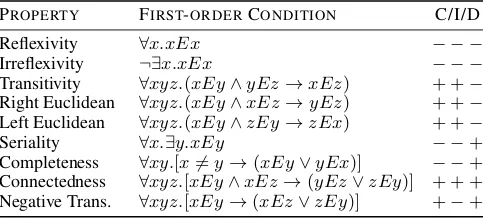
Fix a finite set ofverticesV. A (directed)graphG=hV, Eibased onV is defined by a set ofedgesE ⊆ V×V. We writexEyfor (x, y) ∈ E. AsV is fixed,Gis in fact fully determined byE. We therefore refer to sets of edgesE⊆V×V simply as graphs. Table 1 lists some well-knownpropertiesof graphs.4
3An early version of this work has been presented at COMSOC-2012 [11]. 4The rightmost column of Table 1 specifies which properties arecontagious,
PROPERTY FIRST-ORDERCONDITION C/I/D
Reflexivity ∀x.xEx − − −
Irreflexivity ¬∃x.xEx − − −
Transitivity ∀xyz.(xEy∧yEz→xEz) + +−
Right Euclidean ∀xyz.(xEy∧xEz→yEz) + +−
Left Euclidean ∀xyz.(xEy∧zEy→zEx) + +−
Seriality ∀x.∃y.xEy − −+
[image:2.595.43.286.71.180.2]Completeness ∀xy.[x6=y→(xEy∨yEx)] − −+ Connectedness ∀xyz.[xEy∧xEz→(yEz∨zEy)] + + + Negative Trans. ∀xyz.[xEy→(xEz∨zEy)] +−+
Table 1. Common properties of directed graphs.
For example, aweak order is a directed graph that is reflexive, transitive, and complete.
LetN be a finite set of (two or more)individuals. Each individ-uali ∈ N specifies a graphEi ⊆ V×V, giving rise to aprofile
E = (E1, . . . , En).NeE :={i ∈ N | e ∈ Ei}denotes the set of individuals accepting edgeeunder profileE. Anaggregatoris a functionF : (2V×V)n →2V×V, mapping any such profile into a single collective graphE. An example is themajority rule, accepting a given edge if and only if more than half of the individuals accept it.
Example 1(Preferences). An example for a graph aggregation prob-lem is preference aggregation as classically studied in SCT [2]. In this context, vertices are interpreted as alternatives and the graphs considered are weak orders on these alternatives. Our aggregators then reduce to so-called social welfare functions.
Example 2 (Knowledge). If we think of V as a set of possible worlds, then a graph onV that is reflexive and transitive (and pos-sibly also symmetric) can be used to model an agent’s knowledge: (x, y)being an edge means that, ifxis the true current world, then our agent will considerya possible world [14]. If we aggregate the graphs of several agents by taking their intersection, then the re-sulting collective graph represents the distributed knowledge of the group. If, on the other hand, we aggregate by taking the transitive closure of the union of the individual graphs, then we obtain a model of the group’s common knowledge.
Recall that we have assumed that every individual specifies a graph onthe sameset of verticesV. For both of our examples above this is a natural assumption to make, but in general we might also be interested in aggregating graphs defined on different sets of vertices. Observe that in this case our framework is still applicable, as we may think ofV as the union of all the individual sets of vertices (with each individual only providing edges involving “their” vertices).
2.1
Axioms: Properties of graph aggregators
Adopting theaxiomatic methodfamiliar from SCT [21], we can char-acterise certain classes of aggregators in terms ofaxioms, i.e., intu-itively appealing properties. The first such axiom is an independence condition that requires that the decision of whether or not a given edgeeshould be part of the collective graph should only depend on which of the individual graphs includee. This corresponds to well-known axioms in preference and judgment aggregation [2, 17].Definition 1. F is independent of irrelevant edges (IIE) ifNE
e =
NeE0impliese∈F(E)⇔e∈F(E0).
That is, if exactly the same individuals accepteunder profilesEand
E0, theneshould be part of either both or none of the corresponding
collective graphs. The definition above applies toalledgese∈V×V andallpairs of profilesE,E0∈(2V×V)n. We shall leave this kind of universal quantification implicit also in later definitions.
The fundamental economic principle ofunanimityrequires that an edge should be accepted by the group if all individuals in it accept it.
Definition 2. F isunanimousifF(E)⊇E1∩ · · · ∩En.
A requirement that, in some sense, is dual to unanimity is to ask that the collective graph should only include edges that are part of at least one of the individual graphs. In the context of ontology aggregation this axiom has been calledgroundedness[20].
Definition 3. F isgroundedifF(E)⊆E1∪ · · · ∪En.
The remaining two axioms are standard desiderata and closely mod-elled on their counterparts in the field of judgment aggregation [17].
Definition 4. FisanonymousifF(E) =F(Eπ(1), . . . , Eπ(n))for
any permutationπ:N → N.
Definition 5. FisneutralifNeE=NeE0 impliese∈F(E)⇔e0∈F(E).
Anonymity and neutrality are basic symmetry requirements w.r.t. individuals and edges, respectively. An extreme form of violating anonymity is to use an aggregator that isdictatorialin the sense that a single individual can determine the shape of the collective graph.
Definition 6. Fisdictatorialif there exists an individuali?∈ N(the dictator) such thate∈F(E)⇔e∈Ei?for every edgee∈V×V.
An aggregatorFthat is not a dictatorship for any of the individuals is callednondictatorial. Sometimes we are only interested in the prop-erties of an aggregator as far as thenonreflexiveedgese = (x, y) withx 6= y are concerned. Specifically, we callF NR-neutral if NE
(x,y) =N
E
(x0,y0)implies(x, y) ∈F(E)⇔(x0, y0)∈F(E)for
allx 6= yandx0 6= y0; and we callF NR-nondictatorialif there exists noi?∈ N
such that(x, y)∈F(E)⇔(x, y)∈Ei?for all
x6=y. That is, NR-neutrality is slightly weaker than neutrality and NR-nondictatoriality is slightly stronger than nondictatoriality.
2.2
Collective rationality
In this paper, we want to analyse to what extent aggregators can en-sure that a given property that is satisfied by each of the individual graphs is preserved during aggregation.
Definition 7. Fis collectively rational (CR) w.r.t. graph propertyP ifF(E)satisfiesPwhenever all of the individual graphs inEdo.
Example 3(Collective rationality). Suppose three individuals each provide us with a graph over the same set of four vertices:
•
• •
•
O
O • •
•
•
D
D • • •
v
v
•
6
6
If we apply the majority rule, then we obtain a graph where the only edges are those connecting the upper three vertices with themselves. That is, the majority rule is not CR w.r.t. seriality, as each individual graph is serial, but the collective graph is not.
For some graph properties, collective rationality is easy to achieve, as the following simple possibility results demonstrate.
Proof. If every individual graph includes all edges of the form (x, x), then unanimity ensures the same for the collective graph.
Proposition 2. Any grounded aggregator is CR w.r.t. irreflexivity.
Proof. If no individual graph includes the edge(x, x), then ground-edness ensures the same for the collective graph.
3
A GENERAL IMPOSSIBILITY THEOREM
Animpossibility resultstates that it is not possible to devise an aggre-gator that satisfies certain axioms and that is also CR w.r.t. a certain combination of properties of the structures being aggregated (which in our case are graphs). In this section, we will prove a powerful im-possibility result for graph aggregation.
3.1
Arrow’s Theorem
The prime example of an impossibility result is Arrow’s Theorem for preference aggregation [2]. It states that there exists no nondictato-rial, Paretian, and independent aggregator mapping profiles of weak orders over three or more alternatives to collective weak orders. We can reformulate this result in our framework for graph aggregation:
For |V| > 3, there exists no nondictatorial, unanimous, grounded, and IIE aggregator that is CR w.r.t. reflexivity, tran-sitivity, and completeness.
Note that we have translated Arrow’s (weak) Pareto condition (if ev-ery individual ranksxstrictly abovey, then so should the collective) to a combination of unanimity and groundedness. In fact, in the con-text of the other requirements, Pareto efficiencyimpliesboth of these properties (so our version is at least as strong as Arrow’s Theorem). In the sequel, we will sometimes refer to aggregators that are unani-mous, grounded, and IIE asArrovian aggregators.
3.2
Winning coalitions
As is well understood in SCT, impossibility theorems in preference aggregation heavily feed on the notion of independence (in our case IIE). Observe that an aggregatorFsatisfies IIE if and only if for each edgee∈V×V there exists a set ofwinning coalitionsWe ⊆2N such thate∈F(E)⇔NE
e ∈ We. That is,Facceptseif and only
if exactly the individuals in one of the winning coalitions foredo. Imposing additional axioms onFcorresponds to restrictions on the associated family of winning coalitions{We}e∈V×V:
• IfF is unanimous, thenN ∈ Wefor any edgee.
• IfF is grounded, then∅ 6∈ Wefor any edgee.
• IfFis (NR-)neutral, thenWe =We0 for any two (nonreflexive)
edgeseande0.
Recall that neutrality does not feature in Arrow’s Theorem. As we shall see soon, the reason is that the same restriction on winning coalitions is already enforced by collective rationality w.r.t. transitiv-ity. This is an interesting link between a specific collective rationality requirement and a specific axiom. In the literature, this fact is often called theContagion Lemma[21], although the connection to neu-trality is not usually made explicit. The same kind of result can also be obtained for other graph properties with a similar structure. Let us now develop a definition for a class of graph properties that will allow us to derive neutrality.
3.3
Contagious properties
It will be useful to think of a graph propertyP, such as transitivity or reflexivity, as a subset of2V×V(the set of all graphs over the set of verticesV). For two disjoint sets of edgesS+ andS−and a graph propertyP, letP[S+, S−] ={E∈P |S+⊆EandS−∩E=∅}
denote the set of graphs inP that include all of the edges inS+
and none of those inS−. We start with a technical definition.
Definition 8. Letx, y, z, w ∈ V. A graph propertyP ⊆2V×Vis xy/zw-contagiousif there exist two disjoint setsS+, S−⊆
V×V such that(i)for every graph E ∈ P[S+, S−]it is the case that (x, y)∈Eimplies(z, w)∈Eand(ii)there exist graphsE0, E1∈
P[S+, S−]with(z, w)6∈E0and(x, y)∈E1.
Part(i)of Definition 8 says that, if you accept edge(x, y), then you must also accept edge(z, w)—at least if the side condition of you also accepting all the edges inS+
but none of those inS−is met. That is, the property of contagiousness may be paraphrased as the formula[V
S+∧ ¬W
S−]→[xEy→zEw]. Part(ii)is a richness condition that says that you have the option of accepting neither or both of(x, y)and (z, w). It requires the existence of a graphE0
where neither(x, y)nor(z, w)are accepted, and the existence of a graphE1where both(x, y)and(z, w)are accepted.
Contagiousness w.r.t. two given edges will be useful for our pur-poses if those two edges stand in a specific relationship to each other.
Definition 9. A graph propertyP⊆2V×Viscontagiousif it satisfies at least one of the three conditions below:
(i) Pisxy/yz-contagious for all triples of verticesx, y, z∈V. (ii) Pisxy/zx-contagious for all triples of verticesx, y, z∈V. (iii) Pisxy/xz-contagious andxy/zy-contagious for allx, y, z∈V.
That is, Definition 9 covers pairs of edges where(i)the second edge is a successor of the first edge, where(ii)the second edge is a pre-decessor of the first edge, and where(iii)the two edges share either a starting point or an end point. This covers all cases of two edges meeting in one point. As will become clear in the proof of Lemma 4, case(iii)differs from the other two, as only one of these two types of connections would not be sufficient to “traverse” the full graph.
Fact 3. For|V|>3, transitivity, the two Euclidean properties, nega-tive transitivity, and connectedness are contagious graph properties.
Proof. Let us first consider the property of being right Euclidean. It satisfies condition(i)of Definition 9. To prove this, we will show that the right-Euclidean property isxy/yz-contagious for all triples x, y, z∈V. LetS+ ={(x, z)}andS−=∅, i.e.,P[S+, S−]is the set of all graphs containing(x, z). Condition(i)of Definition 8 is met: any graph inP[S+, S−]contains(x, z); therefore, by the right-Euclidean property(y, z)needs to be accepted whenever(x, y)is. Condition(ii)is also satisfied. LetE0be the graph only containing
the single edge(x, z), and letE1be the graph containing exactly the
three edges(x, y),(y, z), and(x, z). Both graphs are right-Euclidean and, since they include(x, z), they also belong toP[S+, S−].
An alternative way to see that the right-Euclidean property is con-tagious is to observe that it is equivalent to the formula[xEz] →
[xEy→ yEz], with all variables universally quantified. Similarly, the left-Euclidean property, which can be rewritten as [zEy] →
Negative transitivity, finally, can be rewritten as either[¬(zEy)]→
[xEy →xEz]or[¬(xEz)] →[xEy →zEy]and thus also sat-isfies condition(iii). For all these cases, the richness conditions are easily verified to hold as well.
We are now ready to prove a powerful lemma showing that any Ar-rovian aggregator that is CR w.r.t. a contagious graph property must be neutral (at least as far as nonreflexive edges are concerned).
Lemma 4. For|V|>3, any unanimous, grounded, and IIE aggre-gator that is CR w.r.t. a contagious graph property is NR-neutral.
Proof. We will first establish a generic result for collective rational-ity w.r.t.xy/zw-contagiousness. Letx, y, z, w∈V. Take any graph propertyPthat isxy/zw-contagious and take any aggregatorFthat is unanimous, grounded, IIE, and CR w.r.t.P. Let{We}e∈V×V be the family of winning coalitions associated withF. We want to show thatW(x,y) ⊆ W(z,w). So letC ∈ W(x,y). LetS+, S− ⊆V×V
andE0, E1 ∈P[S+, S−]be defined as in Definition 8. Consider a
profileE in which the individuals inC propose graphE1 and all
others proposeE0. That is, all individuals accept the edges inS+,
none accept any of those inS−, exactly the individuals inCaccept edge (x, y), and exactly those inC also accept(z, w). Now con-sider the collective graphF(E). By unanimity S+ ⊆ F(E), by
groundednessS−∩F(E) = ∅, and finally (x, y) ∈ F(E)due toCbeing a winning coalition for(x, y). By collective rationality, F(E) ∈ P and thus alsoF(E) ∈ P[S+, S−]. But then, due to xy/zw-contagiousness ofF(E), we get(z, w)∈F(E). As it was exactly the individuals inCwho accepted(z, w), coalitionCmust be winning for(z, w), i.e.,C∈ W(z,w), and we are done.
We are now ready to prove the lemma. Take any graph property P that is contagious and take any aggregatorF that is unanimous, grounded, IIE, and CR w.r.t.P. Let{We}e∈V×V be the family of winning coalitions associated withF. We need to show that there exists a uniqueW ⊆2N such thatW=Wefor every nonreflexive edgee. By unanimity, the setsWeare not empty. Consider any three verticesx, y, z ∈ V and any coalitionC ∈ W(x,y). We will show
thatCis also winning for both(y, z)and(y, x). If we can show this for anyx, y, z, then we are done, as we can then repeat the same method several times until all nonreflexive edges are covered.
For each of the three possible ways in whichPcan be contagious (see Definition 9), we will use different instances of our generic re-sult forxy/zw-contagiousness above. First, if P is contagious by virtue of condition(i), then we can usexy/yz-contagiousness to get C ∈ W(y,z) and its instancexy/yx-contagiousness (withz :=x)
to obtain also C ∈ W(y,x). Second, if P is contagious due to
condition(ii), we usexy/yx-contagiousness to getC ∈ W(y,x),
and then yx/zy-contagiousness to getC ∈ W(z,y) and
zy/yz-contagiousness to getC∈ W(y,z).
Third, suppose P is contagious by virtue of condition (iii). We first use xy/zy-contagiousness to obtain C ∈ W(z,y) and
then zy/zx-contagiousness to get C ∈ W(z,x). From the latter,
via zx/yx-contagiousness we get C ∈ W(y,x). Finally,
yx/yz-contagiousness then entailsC ∈ W(y,z). Hence, we obtain the
re-quired transfer from one edge(x, y)to both its successor(y, z)and its inverse(y, x)in all three cases, and our proof is complete.
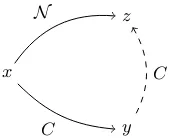
Figure 1 provides an illustration of a specific instance of the main argument in the proof of Lemma 4 when the right-Euclidean prop-erty is considered, which isxy/yz-contagious by Fact 3. We have S+ ={(x, z)}andS− =∅.E1is the graph that accepts all three
edges(x, y),(y, z)and(x, z), andE0acceps only edge(x, z).
Con-sider profileE, in which the individuals inC choose E1 and all
x
z
y
N
C
[image:4.595.385.471.71.140.2]C
Figure 1. CR w.r.t. the right-Euclidean property implies neutrality.
others chooseE0. That is, the individuals inC accept (x, y) and
(y, z), while(x, z)is accepted by all individuals inN. By unanimity, (x, z)must be accepted, and due toC ∈ W(x,y)also(x, y)should
be accepted. We can now conclude, sinceF is CR w.r.t. the right-Euclidean property, that(y, z)should also be accepted, and hence thatC ∈ W(y,z). It is then sufficient to consider all triples to obtain
neutrality over all (nonreflexive) edges.
3.4
Implicative and disjunctive properties
Our next goal is to prove a modular result that derives an impossi-bility from a combination of two types of graph properties. We first introduce these new meta-properties.
Definition 10. A graph propertyP ⊆ 2V×V
isimplicativeif there exist two disjoint setsS+, S− ⊆ V ×V and three distinct edges e1, e2, e3 ∈ V ×V \(S+ ∪S−) such that(i) for every graph
E ∈ P[S+, S−]it is the case thate1, e2 ∈ E implies e3 ∈ E
and (ii) there exist graphs E0, E1, E2, E3 ∈ P[S+, S−] with
E0∩{e1, e2, e3}=∅,E1∩{e1, e2, e3}={e1},E2∩{e1, e2, e3}=
{e2}, and{e1, e2, e3} ⊆E3.
Part (i) expresses that all graphs with property P (that also in-clude all edges inS+ and none fromS−) must satisfy the formula e1∧e2 → e3. Part(ii)is a richness condition saying that
accept-ing/rejecting any combination ofe1 ande2 is possible and thate3
need not be accepted unless bothe1 ande2 are. Observe that
Def-inition 10 has an existential form, i.e., we simply need to find two subsetsS+ and S− for the precondition, and three edges e1, e2
and e3 that satisfy the two requirements(i) and (ii). This
meta-condition for graph properties may be paraphrased as the formula [V
S+∧ ¬W
S−]→[e1∧e2→e3].
Fact 5. For|V|>3, transitivity, the two Euclidean properties, and connectedness are implicative graph properties.
Proof (sketch). LetV = {v1, v2, v3, . . .}. To see that transitivity
satisfies Definition 10, chooseS+ =S−
=∅,e1 = (v1, v2),e2 =
(v2, v3), ande3= (v1, v3). Transitivity implies that if bothe1ande2
are accepted, then alsoe3should be accepted. All remaining
accep-tance/rejection patterns ofe1,e2, ande3are possible, in accordance
with condition(ii). The proofs for the Euclidean properties are sim-ilar. Rewriting connectedness as[¬yEz]→[xEy∧xEz →zEy] shows that it is implicative as well.
Note that implicativeness is a very weak requirement: even transitiv-ity restricted to a single triple of edges is sufficient to satisfy it.
Definition 11. A graph propertyP ⊆2V×V
isdisjunctiveif there exist two disjoint sets S+, S− ⊆ V ×V and two distinct edges e1, e2 ∈ V ×V \ (S+ ∪ S−) such that (i) for every graph
E ∈ P[S+, S−]we havee1 ∈ Eore2 ∈ E and(ii)there exist
two graphsE1, E2 ∈ P[S+, S−]withE1∩ {e1, e2} ={e1}and
Part(i)ensures that all graphs with propertyP (that meet the pre-condition of including all edges inS+and none fromS−) satisfy the formulae1∨e2. Part(ii)is a richness condition ensuring that there
are at least two graphs that each include only one ofe1ande2.
Ob-serve that Definition 11 also has an existential form, and that it may be paraphrased as the formula[V
S+∧ ¬W
S−]→[e1∨e2].
Fact 6. For|V| > 3, completeness, connectedness, seriality, and negative transitivity are disjunctive graph properties.
Proof. LetV = {v1, . . . , vm}. For completeness, chooseS+ =
S−=∅,e1= (v1, v2), ande2= (v2, v1)to see that the conditions
are satisfied. For connectedness, chooseS+ ={(v1, v2),(v1, v3)},
S− = ∅, e1 = (v2, v3), and e2 = (v3, v2). For seriality,
chooseS+ =∅,S− ={(v1, v1),(v1, v2), . . . ,(v1, vm−2)},e1 =
(v1, vm−1), and e2 = (v1, vm). For negative transitivity, choose
S+=∅,S−={(v1, v3)},e1= (v1, v2), ande2= (v3, v2).
Table 1 summarises which of our standard graph properties are con-tagious, implicative, and disjunctive, respectively.
3.5
Impossibility of graph aggregation
We now prove a first version of our main impossibility result, initially under the additional assumption of neutrality. We do this by proving that the set of winning coalitions corresponding to any aggregator that meets certain conditions is anultrafilter[7].
Definition 12. AnultrafilterWon a setNis a collection of subsets ofN satisfying the following three conditions:
(i) ∅ 6∈ W
(ii) C1, C2∈ WimpliesC1∩C2∈ W(closure under intersection)
(iii) CorN \Cis inWfor anyC⊆ N(maximality)
In SCT, the ultrafilter method has first been used by Kirman and Son-dermann [15] to prove Arrow’s Theorem, and it has also found ap-plications in judgment aggregation [13]. The following result applies to graph properties that are both implicative and disjunctive, e.g., the property of being both transitive and complete.
Proposition 7. For|V| > 3, there exists no NR-nondictatorial, unanimous, grounded, NR-neutral, and IIE aggregator that is CR w.r.t. any graph property that is both implicative and disjunctive.
Proof. Take any graph propertyPthat is implicative and disjunctive, and any aggregatorF that is unanimous, grounded, NR-neutral, IIE, and CR w.r.t.P. Due to IIE and NR-neutrality, there exists a set of winning coalitionsW ⊆2N withe∈F(E)⇔NeE ∈ Wfor any nonreflexive edgee. We shall prove that the set of winning coalitions
Wis an ultrafilter. Condition(i)holds, asFis grounded.
For condition(ii) we will make use of the assumption that P is implicative. Let S+, S− ⊆ V ×V;e1, e2, e3 ∈ V×V; and
E0, E1, E2, E3 ∈ P[S+, S−]be defined as in Definition 10. Now
take any two winning coalitionsC1, C2 ∈ W. Consider a profile of
graphsEmeeting P in which exactly the individuals inC1∩C2
proposeE3, those inC1 \C2 proposeE1, those inC2\C1
pro-poseE2, and all others proposeE0. Thus, exactly the individuals in
C1 accept e1, exactly those inC2 accept e2, and exactly those in
C1∩C2 accepte3. Furthermore, all individuals acceptS+ and all
of them rejectS−. Hence, due to unanimity, all edges inS+must be
part of the collective graphF(E), while due to groundedness, none of the edges inS−can be part ofF(E). AsFis CR w.r.t.P, we get F(E)∈P[S+, S−
]. Now, sinceC1andC2are winning coalitions,
x y
z C1
C2
C1∩C2
x
y
[image:5.595.333.524.72.139.2]N \C C
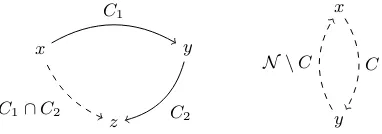
Figure 2. The set of winning coalitions is an ultrafilter.
e1ande2must be part ofF(E). AsPis implicative, this means that
e3∈F(E). Hence,C1∩C2∈ W.
For condition(iii)we will make use of the assumption thatPis disjunctive. LetS+, S−
⊆ V×V;e1, e2 ∈ V×V; andE1, E2 ∈
P[S+, S−]be defined as in Definition 11. Now take any winning coalitionC ∈ W. Consider a profileEmeetingPin which exactly the individuals inCproposeE1and exactly those inN \Cpropose
E2. Recall thatS+⊆E1andS+ ⊆E2, i.e., all individuals accept
S+. Thus, due to unanimity, all of the edges inS+must be part of the collective graphF(E). Analogously, due to groundedness, none of the edges inS−can be part ofF(E). Thus, asF is CR w.r.t.P we getF(E)∈P[S+, S−]. AsPis disjunctive, this means that one of e1ande2has to be part ofF(E). Hence,C∈ Wor(N \C)∈ W.
Recall thatN is required to be finite. An ultrafilterWon a setN
is calledprincipalif it is of the formW ={C ∈ 2N | i? ∈ C} for some fixedi?∈ N. In our setting, principality ofWcorresponds toFbeing dictatorial (with dictatori?) on nonreflexive edges. Now, it is a well-known fact that every ultrafilter on a finite set must be principal [7], which shows thatFcannot be NR-nondictatorial.
Figure 2 provides an illustration of a specific instance of the main argument in the proof of Proposition 7. To show that the set of win-ning coalitions is an ultrafilter we need to prove that conditions(ii) and(iii)of Definition 12 hold—condition(i)is implied by ground-edness. For condition(ii), i.e., closure under intersection, we can use transitivity, which is an implicative property by Fact 5. Let e1 = (x, y),e2 = (y, z), ande3 = (x, z). Consider the profile
de-picted in the left part of Figure 2, in which exactly the individuals in C1accept(x, y), exactly those inC2accepte2, and exactly those in
C1∩C2accept(x, z). As bothC1andC2are winning coalitions, we
obtain that both(x, y)and(y, z)need to be collectively accepted. We can now conclude, sinceFis CR w.r.t. transitivity, tha the edge(x, z) should also be accepted, and hence alsoC1∩C2 ∈ W. To show that
Wis maximal, i.e., that condition(iii)holds, we can use complete-ness, which is a disjunctive property by Fact 6. Lete1 = (x, y)and
e2 = (y, x), and consider the profile in the right part of Figure 2, in
which exactly the individuals inCaccept the edge(x, y)and exactly those inN \Caccept(y, x). AsFis CR w.r.t. completeness, one of the two edges needs to be accepted, showing that eitherC ∈ Wor
N \C∈ W.
We are now ready to state and prove our main result:
Theorem 8. For|V|>3, there exists no NR-nondictatorial, unani-mous, grounded, and IIE aggregator that is CR w.r.t. any graph prop-erty that is contagious, implicative, and disjunctive.
Proof. Immediate from Proposition 7, after an initial application of Lemma 4 to obtain NR-neutrality.
3.6
Applications
Theorem 8 applies to many different classes of graphs. Let us briefly discuss some examples.
Arrow’s Theorem, as stated in Section 3.1, is an immediate con-sequence of Theorem 8: First, recall that transitivity is both conta-gious and implicative, and completeness is disjunctive. Second, the additional requirement of being CR w.r.t. reflexivity does not affect the logical strength of the theorem, as we know from Proposition 1 thateveryunanimous aggregator is CR w.r.t. reflexivity. Finally, re-quiring NR-nondictatoriality rather than just nondictatoriality is not a restriction, as the two properties coincide when all input graphs are reflexive. Observe that by the same kind of argument, and us-ing Proposition 2, we also immediately obtain a variant of Arrow’s Theorem for strict (i.e., irreflexive) linear orders.
By exchanging transitivity and completeness for other graph prop-erties that together cover contagiousness, implicativeness, and dis-junctiveness (see Table 1), we can generate any number of varia-tions of Arrow’s Theorem (e.g., there exists no NR-nondictatorial Arrovian aggregator that is CR w.r.t. the right Euclidean property and seriality). One property, connectedness, stands out for having all three meta-properties. Thus, there exists no NR-nondictatorial Arro-vian aggregator that is CR w.r.t. connectedness.
Theorem 8 also implies a recent result by Pini et al. [19], a vari-ant of Arrow’s Theorem for preorders, i.e., for preferences that need not be complete. Besides transitivity, they require the collective pref-erence order to have one element that is weakly preferred (or dis-preferred) to all other elements. This is a clear example for a (very minimalist) disjunctive property, i.e., Theorem 8 applies directly.
In work on belief merging, Maynard-Zhang and Lehman [18] sug-gest an approach to circumvent Arrow’s Theorem by (a) replacing completeness by negative transitivity (which they callmodularity) and (b) weakening the independence axiom. In the discussion of their result, they stress the significance of both of these changes. However, our analysis clearly shows that replacing completeness by negative transitivity alone has no effect on Arrow’s impossibility, as negative transitivity is also a disjunctive property. Hence, the crucial source for the possibility result of Maynard-Zhang and Lehman must be their modification of the independence axiom.
4
CONCLUSION
We have argued that graph aggregation is an important problem with several potential applications and we have introduced a simple for-mal framework to study this problem. We have then proved a general impossibility theorem that generalises Arrow’s Theorem for prefer-ence aggregation to the case of graph aggregation and that can be in-stantiated for many different combinations of properties of graphs— rather than just transitivity and completeness (the properties featur-ing in Arrow’s Theorem). In dofeatur-ing so, we have refined the ultrafilter method, clearly relating how certain features of graph properties cor-respond to, first, the neutrality axiom and, second, the two ultrafilter properties of closure under intersection and maximality.
In the long run, we believe that such fundamental results have the potential to contribute to the solution of practical problems arising in some of the application domains mentioned in the introduction, e.g., argumentation studies, as well as others, e.g., social networks or multiagent systems. But, as we have been able to demonstrate, al-ready now our results can be applied to better understand phenomena in certain areas, including in particular recent work in AI.
An interesting direction for future work that we have begun to
explore is to study collective rationality w.r.t. graph properties ex-pressed in terms of formulas of modal logic [4]. The semantics of modal logic suggests two novel notions of collective rationality. While the standard notion of collective rationality corresponds to the frame-validityof formulas being preserved under aggregation, we may also consider the cases of preservation oftruth in a modelor truth at a specificworldin a model.
REFERENCES
[1] S. Airiau, U. Endriss, U. Grandi, D. Porello, and J. Uckelman, ‘Aggre-gating dependency graphs into voting agendas in multi-issue elections’, inProc. 22nd Internat. Joint Conference on Artificial Intelligence (IJ-CAI), (2011).
[2] K. J. Arrow,Social Choice and Individual Values, John Wiley and Sons, 2nd edn., 1963. First edition published in 1951.
[3] J.-P. Barth´elemy, B. Leclerc, and B. Monjardet, ‘On the use of ordered sets in problems of comparison and consensus of classifications’, Jour-nal of Classification,3(2), 187–224, (1986).
[4] P. Blackburn, M. de Rijke, and Y. Venema,Modal Logic, Cambridge University Press, 2001.
[5] R. Bradley, F. Dietrich, and C. List, ‘Aggregating causal judgments’, Working paper, London School of Economics, (2011).
[6] S. Coste-Marquis, C. Devred, S. Konieczny, M.-C. Lagasquie-Schiex, and P. Marquis, ‘On the merging of Dung’s argumentation systems’,
Artificial Intelligence,171(10–15), 730–753, (2007).
[7] B. A. Davey and H. A. Priestley,Introduction to Lattices and Order, Cambridge University Press, 2nd edn., 2002.
[8] E. Dokow and R. Holzman, ‘Aggregation of binary evaluations’, Jour-nal of Economic Theory,145(2), 495–511, (2010).
[9] P. E. Dunne, P. Marquis, and M. Wooldridge, ‘Argument aggregation: Basic axioms and complexity results’, inProc. 4th Internat. Conference on Computational Models of Argument (COMMA). IOS Press, (2012). [10] C. Dwork, R. Kumar, M. Naor, and D. Sivakumar, ‘Rank aggregation
methods for the Web’, inProc. 10th Internat. World Wide Web Confer-ence (WWW), (2001).
[11] U. Endriss and U. Grandi, ‘Graph aggregation’, inProc. 4th Internat. Workshop on Computational Social Choice (COMSOC). AGH Univer-sity of Science and Technology, Krak´ow, (2012).
[12] U. Grandi and U. Endriss, ‘Lifting integrity constraints in binary aggre-gation’,Artificial Intelligence,199–200, 45–66, (2013).
[13] F. Herzberg and D. Eckert, ‘The model-theoretic approach to aggrega-tion: Impossibility results for finite and infinite electorates’, Mathemat-ical Social Sciences,64(1), 41–47, (2012).
[14] J. Hintikka,Knowledge and Belief: An Introduction to the Logic of the Two Notions, Cornell University Press, 1962.
[15] A. Kirman and D. Sondermann, ‘Arrow’s theorem, many agents, and in-visible dictators’,Journal of Economic Theory,5(2), 267–277, (1972). [16] S. Konieczny and R. Pino P´erez, ‘Merging information under con-straints: A logical framework’,Journal of Logic and Computation,12, 773–808, (2002).
[17] C. List and C. Puppe, ‘Judgment aggregation: A survey’, inHandbook of Rational and Social Choice, Oxford University Press, (2009). [18] P. Maynard-Zhang and D. J. Lehmann, ‘Representing and aggregating
conflicting beliefs’,JAIR,19, 155–203, (2003).
[19] M. S. Pini, F. Rossi, K. B. Venable, and T. Walsh, ‘Aggregating partially ordered preferences’,Journal of Logic and Computation,19(3), 475– 502, (2009).
[20] D. Porello and U. Endriss, ‘Ontology merging as social choice: Judg-ment aggregation under the open world assumption’,Journal of Logic and Computation, (2012). In press.
[21] A. K. Sen, ‘Social choice theory’, inHandbook of Mathematical Eco-nomics, volume 3, North-Holland, (1986).
[22] F. A. Tohm´e, G. A. Bodanza, and G. R. Simari, ‘Aggregation of attack relations: A social-choice theoretical analysis of defeasibility criteria’, inProc. 5th Internat. Symposium on Foundations of Information and Knowledge Systems (FoIKS), Springer-Verlag, (2008).
[23] X. Wen and H. Liu, ‘Logic aggregation’, inProc. 4th Internat. Work-shop on Logic, Rationality, and Interaction. Springer-Verlag, (2013).