This is a repository copy of In the Right Place at the Right Time!: The Influence of Knowledge Governance Tools on Knowledge Transfer and Utilization in MNEs.
White Rose Research Online URL for this paper: http://eprints.whiterose.ac.uk/88993/
Version: Accepted Version
Article:
Andersson, U, Buckley, PJ and Dellestrand, H (2015) In the Right Place at the Right Time!: The Influence of Knowledge Governance Tools on Knowledge Transfer and Utilization in MNEs. Global Strategy Journal, 5 (1). 27 - 47. ISSN 2042-5791
https://doi.org/10.1002/gsj.1088
[email protected] https://eprints.whiterose.ac.uk/
Reuse
Unless indicated otherwise, fulltext items are protected by copyright with all rights reserved. The copyright exception in section 29 of the Copyright, Designs and Patents Act 1988 allows the making of a single copy solely for the purpose of non-commercial research or private study within the limits of fair dealing. The publisher or other rights-holder may allow further reproduction and re-use of this version - refer to the White Rose Research Online record for this item. Where records identify the publisher as the copyright holder, users can verify any specific terms of use on the publisher’s website.
Takedown
If you consider content in White Rose Research Online to be in breach of UK law, please notify us by
IN THE RIGHT PLACE AT THE RIGHT TIME!: THE INFLUENCE OF KNOWLEDGE GOVERNANCE TOOLS ON KNOWLEDGE TRANSFER AND UTILIZATION IN MNES
ULF ANDERSSON12, PETER J. BUCKLEY34, and HENRIK DELLESTRAND5*
1
School of Business, Society and Engineering, Mälardalen University, Västerås, Sweden 2
Department of Strategy and Logistics, BI Norwegian Business School, Oslo, Norway 3
Centre for International Business, Leeds University Business School, University of Leeds, Leeds, U.K.
4
University of International Business and Economics, Beijing, China 5
Department of Business Studies, Uppsala University, Uppsala, Sweden
Keywords: headquarter-subsidiary roles and relations; knowledge governance; knowledge management; multinational enterprise; relationships
*Correspondence to: Henrik Dellestrand, Department of Business Studies, Uppsala University, Box 513, SE-751 20, Uppsala, Sweden. E-mail: [email protected]
This article examines the utilization of knowledge transferred between sending and receiving subsidiaries within multinational enterprises. A model was developed and tested on 169 specific knowledge transfer projects. The model explains the utilization of knowledge subject to transfer in terms of hierarchical governance tool efficacy and lateral relationships within the multinational enterprise. The results show that headquarters’ involvement during knowledge development does not have any significant impact on subsequent knowledge utilization in the receiving units and, in fact, hierarchical governance forms have a negative impact on knowledge utilization. However, lateral relationships are positive stimuli to
INTRODUCTION
In this article, we analyze knowledge transfer effectiveness between sending and receiving
subsidiaries within multinational enterprises (MNEs) in terms of utilization of transferred
knowledge at the receiving unit. Viewing and measuring knowledge transfer as a discrete
event, rather than an aggregate of knowledge in- and outflows enables teasing out the
knowledge transfer effectiveness in terms of use and adoption at the receiver.1 This is an
important contribution of our study, as only knowledge that has been adopted and is used can
have a genuine impact on capability development. The conceptual framework of this article
builds on the knowledge-based view and integrates both hierarchical governance tools and
lateral relationships for understanding knowledge transfer effectiveness. The
knowledge-based view highlights integrating isolated knowledge (Almeida, Song, and Grant, 2002; Foss
and Pedersen, 2004; Song, Almeida, and Wu, 2003). We contribute to the knowledge-based
view by making manifest hierarchical and lateral factors facilitating, or impeding, firms’ de
facto knowledge integration. Put differently, the knowledge-based view is extended by
explaining antecedents to the use and adoption of geographically dispersed knowledge by
focusing on effective knowledge transfer.
Given knowledge’s prominence as a fundamental competitive resource, a key firm
activity is knowledge governance, that is, the development and leverage of knowledge
throughout the firm (Argote and Ingram, 2000; Foss, 2007). Managers at different firm levels
orchestrate knowledge processes with varying degrees of difficulty: for example, the more
geographically dispersed the firm is, and the more dissimilar the activities of its subsidiaries
are, the greater the obstacle to knowledge transfer (Agrawal, Kapur, and McHale, 2008;
Tallman and Phene, 2007). The MNE, which can be viewed as a bundle of resources that are
geographically dispersed (Bartlett and Ghoshal, 1989; Penrose 1959), therefore constitutes a
particularly important laboratory in which to study knowledge governance (Foss, 2006).
Geographically dispersed knowledge and associated sources may benefit the MNE due to
location heterogeneity, but, at the same time, it may be difficult to integrate (Foss and
Pedersen, 2004). However, a core idea of the knowledge-based view is that MNEs can
transfer this knowledge efficiently (Kogut and Zander, 1993), but at the same time it may be
1 Effectiveness reflects the utilization of knowledge that has been transferred to a receiving unit. As the adoption
difficult for the recipient to utilize the transferred knowledge effectively (Barney, 1991). This
conundrum is rarely discussed within the knowledge-based view; by focusing on the use and
adoption of transferred knowledge, we address this gap in the literature.
The struggle between internal consistency and local adaptation is apt to be more
pronounced in MNEs as compared to domestic firms, thus complicating the knowledge
transfer process. MNE managers at both the subsidiary and the headquarters level can employ
different governance mechanisms to influence knowledge transfer processes (Foss, Husted,
and Michailova, 2010)—hence, the need to understand the various tools at the managers’
disposal. We focus on specific knowledge transfer projects with particular reference to the
role of headquarters in the process—the relationship between subsidiaries and specific
managerial actions taken to ensure effective knowledge transfer (Foss and Pedersen, 2004;
Grant, 1996; Kogut and Zander, 1992, 1993; Martin and Salomon, 2003; Szulanski and
Jensen, 2006).
Firms are not only important and efficient governance structures, but are also a locus for
learning (Ghoshal and Moran, 1996; Madhok 1996, 1997; Tallman and Chacar, 2011; Teece,
1990) and cultivate routines as coordinative devices (Nelson and Winter, 1982; Williamson,
1999). Previous research has primarily focused on characteristics of the knowledge
transferred or subsidiaries’ absorptive capacity, that is, cognitive aspects (Mahnke and
Pedersen, 2004), whereas hierarchical intervention has attracted less attention, especially at
the subsidiary level. Relational governance, defined as, 'a social institution that governs and
guides exchange partners on the basis of cooperative norms and collaborative activities'
(Poppo, Zhou, and Zenger, 2008: 1197) seems to be a promising perspective in analyzing the
utilization of transferred knowledge, i.e., transfer effectiveness, as it encompasses hierarchical
governance tools and lateral relationships.
This article also addresses the important question, discussed by Foss and Pedersen
(2004), of how MNE managers at both the subsidiary and headquarters level can orchestrate
knowledge transfer activities in the MNE network and how this affects knowledge transfer
effectiveness. The link between organizational processes and knowledge transfer is still
under-researched (Foss, 2006). This article connects actions taken by headquarters with more
micro-features associated with subsidiaries engaged in knowledge transfer, that is, the social
structures of inter-subsidiary relationships (Szulanski, Cappetta, and Jensen, 2004) that can
help explain knowledge transfer effectiveness. While extant research has looked at knowledge
transfer in MNEs from different viewpoints, most has looked at 'flows of knowledge' as an
effect of the knowledge transfer effort at the recipient unit. The focus on flows of knowledge
obscures the success of individual transfer projects in terms of adoption and use in the
receiving units. It also makes the influence of different knowledge governance tools on
knowledge transfer effectiveness ambiguous. In the present study, we address this important
gap in the existing knowledge transfer literature.
The findings are based on a questionnaire administered through structured face-to-face
interviews with subsidiary managers involved in 169 specific intra-MNE knowledge transfer
projects. The knowledge transaction was used as the unit of analysis (Foss, 2007). The
specificity of the data from these 169 transfer projects adds to the quality of the findings,
since research has found that MNEs apply different control strategies depending on the
context in which the subsidiaries operate (Nohria and Ghoshal, 1994). By looking at specific
transfer projects, a fine-grained understanding of both hierarchical and lateral relationships is
attained, thereby contributing to an increased understanding of knowledge governance and the
knowledge-based view. This is directly related to Grant’s (1996) conceptualization of the firm
as a knowledge integrator.
The remainder of the article is organized as follows: the theoretical background is
outlined in the next section. This is followed by a section outlining five hypotheses that
address how hierarchical governance tools and lateral relationships affect the utilization of
transferred knowledge. Subsequently, the data and methods are presented, followed by the
results of the study. The results are then discussed with limitations pointed out and
suggestions made for future research.
THEORETICAL BACKGROUND
Transfer of knowledge
Knowledge management is at the forefront of MNE research (cf. Agrawal et al., 2008; Grant,
1996; Gupta and Govindarajan, 2000; Kogut and Zander, 1992, 1993; Szulanski, 1996;
Tallman and Phene, 2007). The MNE is conceptualized as a superior vehicle for knowledge
development and transfer because it is a social community (Kogut and Zander, 1993) rather
than a market transactor of knowledge. Teece (1986) conceptualized innovations as bearers of
knowledge. Thus, in this article, knowledge is captured by analyzing different innovations
that embody knowledge. The transfer of knowledge is an attempt to close gaps between what
is known and what is currently being used throughout the organization (Cool, Dierickx, and
Szulanski, 1997; Pfeffer and Salancik, 1978; Pfeffer and Sutton, 2000; Repenning, 2002).
knowledge transfer activity needs to be managed and coordinated, that is, governed. In
essence, this suggests a framework where both the formal power of headquarters and the
informal social relationships formed by subsidiaries—where much of the actual network
influence may reside (Forsgren, Holm, and Johanson, 2005)—are taken into account.
The rationale behind knowledge transfer in MNEs arises because it is costly to develop
new knowledge and the organization has an interest in making use of existing knowledge
elsewhere in the MNE, although transfer also has a cost (Teece, 1977). This is in accordance
with Penrose’s (1959) assertion that the competence of a firm is connected to its ability to
leverage its resources. By transferring knowledge, the performance observed at one location
in the organization can potentially be enhanced in another location, either by generating new
knowledge or by economizing on existing knowledge (Schulz, 2001; Szulanski et al., 2004).
This implies that there is both cost and gain from knowledge transfer. The cost-benefit
balance is dependent on the transfer process performance; more specifically, echoing Teece
(1977) and Penrose (1959), the transferred knowledge has to be utilized at the recipient. If
transferred knowledge is not used, it seems inept to engage in transfer at all, since costs are
incurred but no effect is achieved in terms of upgrading the competencies and competitive
advantage in the receiving unit. Making sure that what is developed in one location is
transferred to another is core for knowledge governance and the knowledge-based view, and
usage may lead to an improved competitive position for the receiving unit.
Knowledge transfer performance
Extant research has by and large focused on knowledge transfer measured as an outflow from
a sender or inflow to a receiver (Gupta and Govindarajan, 2000; Haas and Hansen, 2005;
Norderhaven and Harzing, 2009; Schulz, 2001). However, this literature offers limited
insights as to whether the knowledge transferred is being implemented and used at the
receiving subsidiary. There have been some voices arguing that this might not be the case
(Argote and Ingram, 2000; Kostova, 1999), for example, knowledge being ceremonially
adopted (Kostova and Roth, 2002). Hence, our knowledge is limited regarding whether or not
knowledge really is adopted by the receiving subsidiary. In this respect, our understanding of
knowledge transfer effectiveness is underdeveloped.
Studying knowledge transfer performance requires investigating individual transfer
projects. We capture individual project performance variance and elucidate the associated
underlying reasons in an approach similar to Szulanski (1996) and Kostova and Roth (2002),
projects. In this article, knowledge transfer effectiveness is defined as a distinct measure
related to the receiving subsidiary’s knowledge implementation and usage (Ciabuschi,
Dellestrand, and Kappen, 2011a; Kostova, 1999; Leonard-Barton and Sinha, 1993). As
proposed by Foss (2007), we use the specific knowledge transaction as the unit of analysis in
this study.
Organizational processes at different levels can affect MNE knowledge transfer
performance in general. Though efficiency and effectiveness are inter-related, this article
focuses on effectiveness rather than efficiency, that is, the transfer cost (Daft, 1992).
Knowledge that is used by the recipient is key, since it is only then that the transferred
knowledge has implications for the functioning of the recipient subsidiary. The following two
sections elaborate on hierarchical governance and lateral relationships by focusing on the
discrete event of individual knowledge transfer projects. Both are distinct organizational
governance dimensions and do not exclude the other—rather they are complementary forces
influencing the degree of the receiving unit’s transferred knowledge utilization.2 The variables
included in this analysis are associated with key concepts in the discussion of hierarchy and
lateral relationships and illuminate the emerging knowledge governance approach (Foss,
2007; Grandori, 2001). Our approach is also consistent with the horizontal and vertical
dimensions of the knowledge-based view (Grant, 1996).
HYPOTHESIS DEVELOPMENT
Hierarchical governance and knowledge transfer
Ghoshal and Bartlett (1990) and Birkinshaw (2001) argued that headquarters is potentially
very influential in managing knowledge flows between MNE units. Headquarters can be
thought of as a knowledge webmaster (Tallman and Koza, 2010), occupying a special
position within the MNE network as the unit with formal authoritative power. Headquarters
has a holistic role that entails a strategic responsibility to identify needs and solutions in the
organization, i.e., top management has an important role in identifying, creating, and sharing
knowledge (Markides, 2002; Markides and Williamson, 1994), which relates to the transfer
process in filling gaps where knowledge resides at other organization locations. For
headquarters, this involves participating in subsidiary-level activities, as well as using formal
monitoring and evaluation criteria. The level of hierarchical involvement in subsidiary
2
activities is not equal for all organizations and, even within one organization, the degree to
which governance mechanisms are employed can vary (Nohria and Ghoshal, 1994); that is,
there is a unique configuration of the headquarters-subsidiary control problem in every
relationship.
Headquarters’ role during innovation development
Headquarters’ involvement can affect how knowledge—and the subsidiary developing the
knowledge—is perceived within the organization. If headquarters pays attention to specific
innovation projects (Williamson, 1992), a corollary is that the subsidiaries related to this
project gain visibility, receive legitimacy (Ambos, Andersson, and Birkinshaw, 2010), and are
perceived to be important players (Andersson, Forsgren, and Holm, 2007). This is also true
for the specific knowledge developed, i.e., not only is the subsidiary developing the
knowledge perceived as important, but so is the specific knowledge per se. Consequently,
innovations subject to transfer that have received headquarters’ attention through its direct
involvement during the development stage are, by definition, allocated resources and
prioritized by headquarters (Ciabuschi, Dellestrand, and Martín Martín, 2011b). By involving
itself in the innovation’s development, for instance by specifying requests, the outcome of the
development process is affected and the developed innovation is more suitable for other MNE
subsidiaries. Headquarters’ involvement in development also encompasses adding specific
competencies and knowledge as well as actively participating in the development process
(Ciabuschi et al., 2011b). By doing so, headquarters steers knowledge development toward
internal consistency with the result that it is easier for a receiving subsidiary to adopt and
integrate the knowledge transferred to it (Schulz, 2001; Yang, Mudambi, and Meyer, 2008).
For headquarters, involvement in development indicates a commitment that is likely to be
reflected in the subsequent transfer and signals that the innovation should be utilized at a
recipient once transferred. Also, if headquarters has influenced the outcome of the
development process via its involvement by, for instance, specifying requests, this will
increase the perceived relevance of the knowledge subject to transfer (Yang et al., 2008) and,
as a corollary, positively influence the adoption and use of the transferred knowledge.
Consequently, the following hypothesis is proposed:
Hypothesis 1 (H1): Greater headquarters involvement in the development of an innovation will positively affect the utilization of the transferred knowledge.
One of headquarters’ objectives in upgrading subsidiary capabilities is to make sure that
knowledge is transferred between them (Dellestrand and Kappen, 2012). If knowledge is not
transferred within the MNE, opportunities may be lost and the organization may lose an
advantage. The role of headquarters in MNEs has been conceptualized as avoiding the
negative (losses), as well as taking on an entrepreneurial role (value creation) (Foss, 1997).
Headquarters can be thought of as an MNE network orchestrator (Dhanaraj and Parkhe,
2006), where it identifies critical knowledge and points out transfer opportunities to
subsidiaries. This resonates with headquarters taking action and becoming a visible hand
within the MNE by issuing commands without directly controlling the transfer process
(Tallman and Koza, 2010). Such hierarchical governance can create ill feelings among the
subsidiaries and instigate ceremonial adoption of knowledge (Ghoshal and Moran, 1996;
Kostova and Roth, 2002). The parties engaged in the transfer process may feel forced into a
costly and time-consuming activity and, consequently, perceive little value in it, which
negatively influence the process of adoption and integration at the receiving unit.
Moreover, the knowledge that headquarters possesses regarding the subsidiaries’ local
business network is often shallow (Forsgren et al., 2005). If headquarters actively involves
itself in knowledge transfer and governs this process by formal demands and evaluation
systems, it can be perceived as ignorant because of its lack of relationship-specific
knowledge. This can create a negative disposition toward adopting and using the knowledge
at the subsidiary level (Forsgren, 2008). Hence, the effects of headquarters governance
mechanisms may be detrimental and social activities at the subsidiary level become important
for knowledge transfer (Kostova and Roth, 2003). This negative side of headquarters’
governance could be mitigated by the fact that it possesses formal power to exert influence
over subsidiaries, and direct transactional involvement of headquarters can mean additional
resources for the subsidiary. However, even if headquarters provides a knowledge-directing
function within the MNE, it may be biased toward cost efficiency and not effectiveness of the
transfer processes. This is because cost efficiency is a dimension more easily measured and
monitored at a distance (Kostova and Roth, 2002). A focus on efficiency can be detrimental
for utilization of the transferred knowledge since adoption takes more time and understanding
than simply transferring knowledge in a cost-efficient manner (Ciabuschi et al., 2011a). In
line with this reasoning, the following is suggested:
Subsidiary control mechanisms in knowledge transfer
One way to govern the transfer process is by using expatriates from the sending subsidiary to
the receiving subsidiary, which can facilitate lateral relationship building (Minbaeva, 2008).
The use of expatriates can further facilitate knowledge flows between the technology-sending
subsidiary and other MNE units (Gupta and Govindarajan, 2000) and is one way of governing
knowledge transfer processes laterally (Edström and Galbraith, 1977). Expatriates from the
sending subsidiary collaborate with colleagues at the receiving subsidiary, and this will
facilitate the creation of communities of practice and the establishment of social ties that
facilitate learning (Tallman and Chacar, 2011). Consequently, expatriates can facilitate the
process of integrating new knowledge at the receiving subsidiary and help overcome
problems during the transfer phase (Tsang, 1999). Using expatriates specifically for a
knowledge transfer project is costly and can be seen as an investment by the organization, but
should have a positive impact on the understanding and adoption of the knowledge subject to
transfer. Put differently, the communities of practice established by individuals (e.g.,
expatriates) also have implications for establishing networks of practices between subsidiaries
(Tallman and Chacar, 2011). This is likely to positively influence knowledge transfer.
Furthermore, expatriates can understand the value added of the transferred knowledge,
have direct experience in handling the knowledge, and help explain complicated tacit
knowledge dimensions when it is used at the receiving unit (Björkman, Barner-Rasmussen,
and Li, 2004; Moran 2005). Hence, the following hypothesis can be formulated:
Hypothesis 3 (H3): Greater use of expatriates from the sending subsidiary to the receiving subsidiary during the transfer will positively affect the utilization of transferred knowledge.
Subsidiary networks and knowledge transfer
In the intraorganizational MNE network, indistinct formal boundaries exist between
subsidiaries (Ghoshal and Bartlett, 1990), and subsidiaries develop (more informal)
collaborations and cooperate with each other (Andersson et al., 2007; Forsgren et al., 2005).
Previous (voluntarily) developed relationships between subsidiaries have, due to prior
exchange and collaboration, enhanced the social capital between them (Tsai, 2000). Social
capital provides cohesiveness and makes the firm strive toward a common goal (Adler and
Kwon, 2002). Value is generated by building social capital due to the facilitation of the
exchange process of resources and through providing access to extended network
implies that social capital entails both personal connections and network structures at the unit
level that often transcend organizational boundaries (Granovetter, 1985; Moran, 2005;
Mäkelä, Andersson, and Seppäle, 2012) and help govern knowledge transfer.
In established relationships, where the actors have previously cooperated, the perceived
risk of engaging in a new project is decreased since knowledge pertaining to the functioning
of the relationship has already been built, behavior has been experienced, and trust has been
developed (Inkpen and Tsang, 2005; Uzzi, 1997). Further, processes and routines are in place
for future interaction, which will facilitate collaboration and cooperation (Kostova and Roth,
2003) and thereby knowledge transfer, connecting to what constitutes 'relational governance'
(Poppo et al., 2008). Through social ties, a common identity is created (Håkansson and
Snehota, 1995) and since many knowledge transfer processes are complicated to explain
during the transfer phase, this will take time and is more likely to be effective in a relationship
where a closeness between the individuals partaking in the transfer exists (Moran, 2005).
Expressed differently, social ties between a sender and a receiver will facilitate the utilization
of the knowledge transferred. Moreover, in a relationship where the actors know each other,
the search process for relevant knowledge is facilitated. Consequently, the knowledge
transferred in such a relationship will entail more relevant knowledge for the receiver; and the
sender will be more understanding of the needs of the receiver. This will affect the utilization
of transferred knowledge positively (Szulanski et al., 2004; Yang et al., 2008). This line of
reasoning implies that social capital can be built by repeated interaction (Buckley and Casson,
1988); if the transfer partners are experienced, their capabilities for conducting such processes
are enhanced (Cyert and March, 1963; Eisenhardt and Martin, 2000; Zollo and Winter, 2002)
and routines are established for transferring and incorporating knowledge. Therefore, the
following hypothesis is postulated:
Hypothesis 4 (H4): An established relationship between the sending and receiving subsidiaries will positively affect the utilization of transferred knowledge.
From the logic about relationships, it follows that relationship building between the sending
and the receiving units enhances social capital, where social capital is understood as, 'the
relational resources attainable by individual actors through networks of social relationships'
(Tsai, 2000: 927). More specifically, relationship building within MNEs corresponds to
knowledge management tools such as temporary training, forming task forces, and
face-to-face meetings. However, it is important to keep in mind that this study focuses on actions
This relates to utilization and effectiveness because the opportunity to explain complex issues
and reduce errors during the transfer process increases. As such, building relationships will
facilitate the learning and the understanding of the knowledge transferred (Lane and Lubatkin,
1998; Tallman and Phene, 2007). In other words, the actors have a common basic
understanding of the knowledge subject to transfer, which facilitates adoption and use of the
transferred knowledge (Kogut and Zander, 1992, 1993). Social interaction will also increase
the knowledge transparency, which further facilitates integration and adoption of knowledge
(Tallman and Phene, 2007). Consequently the following hypothesis is proposed:
Hypothesis 5 (H5): Relationship building between the sending and receiving subsidiary will positively affect the utilization of transferred knowledge.
DATA AND METHODS
The data used in this research was collected from 2002 to 2005 and covers 169 intra-MNE
innovation transfer projects in great detail. Innovations in subsidiaries were identified through
snowball sampling, which is appropriate when the population is difficult to define and no
comprehensive listing exists (Hair et al., 2006). The data can be traced back to 72 innovation
development projects hosted by 63 subsidiaries belonging to 23 different MNEs
headquartered in the U.S. and Europe. The sending subsidiaries span 14 countries and the
receivers 31 countries.3 Different industries are represented in the sample, for example,
manufacturing, telecommunications, transportation, and the steel industry. The innovation
selection criterion was based on the novelty and specific value to the organization. This
follows the 2005 OECD definition of innovations, that is, 'the implementation of a new or
significantly improved product (good or service), or process, a new marketing method, or a
new organizational method in business practices, workplace organization or external relations'
(OECD, 2005: 47). This selection was done by the innovating/developing subsidiary.
Moreover, the innovations had to have the potential of being transferred and they also had to
have been completed one to 10 years prior to the interview. Sampling innovations that have
transfer potential means that the dataset contains some innovations that have not been subject
to transfer. These innovations are excluded in the present analysis.
One potential sample bias is that it only contains successful innovations, in terms of
having been developed. However, given the question at hand, this bias is almost intrinsic
since the transfer of unsuccessful innovations is highly unlikely and would not add anything
3 More specifically, the senders are located in: Sweden, Taiwan, Italy, France, the U.K., the U.S., Germany,
to the MNE’s competitive advantage. 'Successful' in this sense does not imply subsequent
market success.
The data was collected through face-to-face interviews on site at the subsidiaries where
the respondent answered a structured questionnaire—an approach similar to surveys, but with
the advantage of being able to target the respondent in person and knowing exactly who
answers the questionnaire. The respondents had been involved in the innovation development
and were usually R&D managers, project managers, or subsidiary CEOs. In relation to the
transfer projects, even if the data was collected at the sending subsidiary, the innovations had
been transferred to more than one receiver (on average, the innovations in our sample were
transferred to 2.35 receivers). This allows respondents to compare, for instance, transfer
effectiveness across projects. The questionnaire had been pretested in two pilot interviews,
and minor changes were made in order to eliminate ambiguous questions and phrasings as
well as to exclude erroneous indicators. By having access to managers with detailed
knowledge of the specific innovations, a deeper understanding could be gained (Denrell,
Arvidsson, and Zander, 2004), and we could discuss the questions with the respondents. This
approach allows targeting the appropriate respondent and detecting inconsistencies in the
answers during the interview, hence increasing reliability and face validity of the data.
Measures
The advice of Boyd, Gove, and Hitt (2005) was followed and single-measure indicators were
avoided. Multiple indicators were used in both the dependent and independent variables. This
approach minimizes measurement error, is parsimonious, and offers a multifaceted
representation of the underlying construct (Hair et al., 2006). Additionally, as recommended
by Cox (1980), seven-point Likert-type scales were used to obtain the data on innovation
transfer in MNEs. Besides the subjective estimations by the respondents, distance measures
using secondary data, patenting, and size were included as control variables. The constructs
were identified in an iterative process, where coefficient alphas as well as theoretical issues
were considered (Churchill, 1979; Nunnally, 1978). The constructs were theoretically valid
and empirically verified. Subsequently, factor analysis was used in order to confirm the
constructs’ discriminant validity.
Dependent variable
The dependent variable—knowledge transfer effectiveness—reflects the adoption and use of
the transferred knowledge within the receiving unit. The responses focused on circumstances
recommendations and discussions in the literature (Kostova and Roth, 2002; Leonard-Barton
and Sinha, 1993; Repenning, 2002; Szulanski 1996). Compared to earlier studies
concentrating on the extent of knowledge flows between firm subsidiaries, our method of
depicting transfer performance is the degree of transfer effectiveness in terms of investigating
the actual adoption and use of the innovation at the receiving subsidiary (Ciabuschi et al.,
2011a). This reflects key ideas in the knowledge-based view (Grant, 1996) and reflects
utilization of transferred knowledge.
Transfer performance effectiveness is measured as a four-item construct where the
respondents were asked to indicate on a scale from 1 (totally disagree) to 7 (totally agree)
whether: (1) the performance of the innovation transfer was very satisfactory; (2) the
counterpart adopted the innovation very quickly; and (3) the innovation has been very easy to
adopt by this counterpart. One final item was included in this construct and was measured on
a similar scale from 1 (not at all) to 7 (very high): (4) to what extent the innovation transfer
has been completed. The internal construct reliability was good, with a coefficient alpha of
0.817, exceeding the recommended level of 0.7 (Nunnally, 1978). These four items were
summed and averaged to form the dependent variable in the statistical analysis. The
dependent variable is distinct from other variables in the analysis, as Table 1 shows.4
Independent variables
The first dimension of headquarters’ subsidiary-level influence is whether or not they have
been involved in the innovation development of the innovation subject to transfer and build
on and extend the attention-based view (Bouquet, Morrison, and Birkinshaw, 2009; Ocasio,
1997). Headquarters’ involvement in innovation development is captured in a four-item
construct where the respondents were asked to indicate, on a scale from 1 (totally disagree) to
7 (totally agree) whether: (1) the MNE HQ has participated closely in developing this
innovation; (2) the MNE HQ has brought competence of use for the development of this
innovation; (3) the MNE HQ has been important through specifying requests; and (4) the
MNE HQ has taken important initiatives for developing the innovation. The four indicators
4 Since the research project and data collection effort aimed at capturing both MNE subsidiary development and
transfer activities, the primary data collection target was the developing/sending subsidiary. We worked under the assumption that respondents involved in development and transfer of the specific projects will have a good knowledge of associated structures and processes, and the face-to-face data collection increased data quality. Subsequent to the initial data collection, we collected data from 23 receivers. We have matched data
were summed and averaged in order to form the construct used in the regression analysis.
Internal construct reliability was high, with a coefficient alpha of 0.908.
The use of formal hierarchical governance tools and sanctions by headquarters is
captured by four items and is similar to measures employed by Gates and Egelhoff (1986) and
Tsai (2002). The respondents were asked to indicate, on a scale from 1 (totally disagree) to 7
(totally agree), to what extent: (1) the MNE HQ has formally instructed you to share this
innovation with the counterpart; and (2) the transfer of the innovation has occurred without
any sanctions by HQ with the counterpart (reversed).Moreover, the respondents were asked
to indicate on a scale from 1 (not at all) to 7 (very much) whether the transfer of the
innovation was driven by: (1) requirement from HQ; and (2) HQ evaluation system. These
four items were summed and averaged to form the construct. The coefficient alpha of this
construct is 0.632, which is below the recommendation as set by Nunnally (1978). Since this
construct employs relatively few indicators, it is not uncommon to find that alpha tests, given
that they generally are conservative, return a lower coefficient than the recommended level.
Reliability increases the more items a scale contains (Nunnally, 1978). With the same average
inter-item correlation and the inclusion of additional variables, the alpha value will increase
(Carmines and Zeller, 1979). When a low alpha is found, it is appropriate to check the mean
inter-item correlation (MIC). The optimal range for the MIC is 0.2 to 0.4 (Briggs and Cheek,
1986). The MIC for this construct was 0.295, thus meeting the stipulated criterion. This, plus
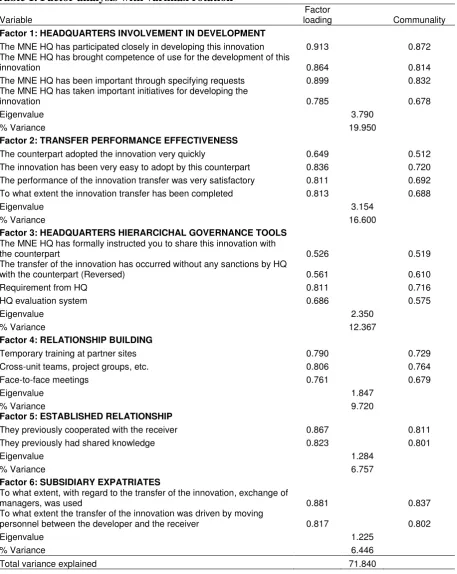
the construct being identified as distinct from others in a principal component factor analysis
(see Table 1), where both the factor loadings and communalities extracted for the items were
adequate, indicate the appropriateness of using this construct.
The use of subsidiary expatriates is reflected in a two-item construct and builds on
Gupta and Govindarajan’s (2000) measure and Galbraith’s (1973) integrative mechanisms.
The respondents were asked to indicate, on a scale ranging from 1 (not at all) to 7 (very high):
to what extent, with regard to the transfer of the innovation, exchange of managers was used.
The respondents were also asked to indicate, on a scale from 1 (not at all) to 7 (very much): to
what extent the transfer of the innovation was driven by moving personnel between the
developer and the receiver. The indicators were added and averaged to form the scale. A
coefficient alpha of 0.743 indicates good internal construct reliability.
Established relationships, that is, dyadic transfer experience in the sender-receiver
relationship, is a two-item construct where the respondents indicated to what extent, (besides
the focal innovation discussed during the data collection) on a scale from 1 (not at all) to 7
had shared knowledge. The indicators were summed and averaged in order to form the
construct, which had a coefficient alpha of 0.738. This construct builds on literature
highlighting experience’s role in knowledge transfer (Ingram and Baum, 1997).
Finally, relationship building between the sending and receiving subsidiaries during the
innovation transfer was captured using a three-item construct drawing on Ghoshal and
Bartlett’s (1988) framework concerning socialization mechanisms, as well as on the indicators
used by Persson (2006). The respondents were asked to indicate on a scale from 1 (not at all)
to 7 (very high) the level of use of: (1) temporary training at partner sites; (2) cross-unit
teams, project groups, etc.; and (3) face-to-face meetings. The indicators were summed and
averaged. The construct has adequate internal reliability, with a coefficient alpha of 0.732.
Control variables
In order to more fully specify the model, a number of control variables were introduced. Age
was included since older subsidiaries are more established in their business networks and
have a tendency to be more autonomous (Forsgren, 1990); they can also exhibit a higher
innovative capability (Cohen and Levinthal, 1990; Foss and Pedersen, 2002). To control for
age, the logarithm of the number of years the subsidiary had been operating on the market
was included in the regression equation.
Size, measured as the natural logarithm of the number of developing subsidiary
employees, is used as a proxy for many subsidiary-related characteristics. Research has shown
that large subsidiaries have greater intrafirm bargaining power (Mudambi and Navarra, 2004),
and size can also affect knowledge transfer even if the knowledge has a low relevance (Yang
et al., 2008). Research has also used size as one indicator for valuable knowledge stock,
which can be of greater overall value for the MNE (Gupta and Govindarajan, 2000).
Basic research is captured with the help of a dummy variable. If the subsidiary
conducted research considered to be core, the variable was coded '1;' if the subsidiary did not
conduct any basic research, the observation was coded '0.' Knowledge developed by a
subsidiary performing core activities is likely to be more easily adopted, building on
absorptive capacity logic. In order to control whether knowledge-sharing activities are
stimulated in the MNE, this was included as a single-item variable. The respondents were
asked to indicate, on a scale of 1 to 7, how important knowledge sharing was in the
performance evaluation made of them. This has been shown to have a positive impact on
knowledge transfer flows in previous studies (Björkman et al., 2004). To control for the target
the innovation transfer partners. This is a two-item construct capturing how similar the sender
and receiver are regarding technological and organizational features. The respondents were
asked to indicate, with regard to the receiver, on a scale of 1 (totally disagree) to 4 (neither) to
7 (totally agree) whether: (1) technical difference makes the transfer problematic; and (2)
organizational difference makes the transfer problematic.5 The indicators were summed and
averaged to form the construct. Internal reliability was good, with a coefficient alpha of 0.738.
A dummy variable indicating whether the innovation subject to transfer was patented or not
was included in the model. The potential ease with which the knowledge might be transferred
connects to codification, which can be proxied by patenting (Tallman and Chacar, 2011).
Additionally, distances and differences between countries in which subsidiaries are located
may influence knowledge transfer. Therefore, we controlled for distances in a number of
dimensions. The geographic distance between the locations was calculated for each transfer
project. The number of kilometers was calculated using MapCrow. This measure was
transformed into the natural log of the distance measure and is consistent with the approach of
other studies using geographic distance (e.g., Hansen and Lovås, 2004). Cultural distance was
controlled for by using Kogut and Singh’s 1988 index, expressed as:
4
CDj=
∑
{(Iij– IiN)2/Vi}/4 , i=1where CD is the cultural distance between the subsidiary host countries, Iij is the score of the receiving subsidiary’s country on the ith dimension, and IiN is the score of the sending subsidiary’s country in this dimension. Vi represents the score variance in the specific
dimension. Institutional distance was measured building on the approach of Gaur et al. (2007)
and Xu, Pan, and Beamish (2004). The institutional dimensions found in the Executive
Opinion Survey of the Global Competitiveness Report (2005) were explored, and a factor
analysis was conducted (principal component with varimax rotation and Kaiser
normalization). The institutional environment is captured by a seven-item construct that
loaded on a single factor having a coefficient alpha of 0.961. This data was matched to our
data calculating the institutional distance between the host countries of the sending and
receiving subsidiaries. The relative economic differences were captured by estimating
differences in GDP per capita between the host countries of the subsidiaries (Tsang and Yip,
5 These items were reverse coded in order to capture the similarities between the subsidiaries involved in the
2007). Data was obtained through the Total Economy Database (2006). Following Tsang and
Yip (2007), we created a measure for relatively more developed countries in relation to the
other part of the dyad. This measure can be expressed as:
ln(GDPsender)-ln(GDPreciever) if GDPsender≥ GDPreciever and = 0 if GDPsender < GDPreceiver
Common method bias and multicollinearity
The use of perceptual measurements can be problematic because of social desirability and
self-assessment bias. This is mitigated by the face-to-face interviews. In order to check for
common method bias augmenting the relationships, Harman’s one-factor test was used
(Podsakoff and Organ, 1986). All relevant indicators were included in a principal component
factor analysis (principal component with varimax rotation and Kaiser normalization, see
Table 1). The 0.638 KMO value exceeded the recommended 0.6 level (Tabachnick and Fidell,
2001). The Bartlett’s test of sphericity was at a 0.001 significance level, indicating sufficient
correlations between the indicators (Hair et al., 2006) and factor analysis procedure
appropriateness. The factor analysis indicated data validity and reported good properties. If
high common method variance is a problem, only one factor will emerge with an eigenvalue
exceeding 1 or, alternatively, one of the factors extracted will account for a majority of the
variance. In the principal component analysis, six factors were extracted with eigenvalues
above 1. The seventh factor returned with an eigenvalue of 0.837, thus being far from meeting
the latent root criterion and, consequently, not included in the analysis.
None of the factors explain a majority of the variance, ranging from 6.446 percent to
19.950 percent. The cumulative variance explained by the seven factors was 71.840 percent.
In the rotated factor solution, a cutoff value of 0.32 was used, and only two cross-loadings
appeared above this level. Factor loadings below 0.32 can be considered poor since the
overlapping variance then is below 10 percent; and a factor loading of 0.45 represents 20
percent of the overlapping variance and can be considered fair (Comrey and Lee, 1992). The
first cross-loading occurred for the item of headquarters’ instruction to share the innovation
with the counterpart on the construct of headquarters’ participation during the development
with a value of 0.436. The second cross-loading relates to the respondents reporting whether
the innovation transfer occurred without any sanctions from headquarters (reversed), with a
value of 0.324 on the construct of headquarters’ participation during the development.
tool construct. These two cross-loadings do not factor when interpreting the data, even though
the presence of common method bias cannot entirely be ruled out.
Following Lindell and Whitney (2001), we introduced a marker variable to further test
for common method variance,. This technique has been argued to be an effective tool for
accounting for common method variance (Malhotra, Kim, and Patil, 2006). The marker
variable should be measured by the same questionnaire as for the other variables. However,
the marker variable should be theoretically unrelated to the relevant perceptual variables.
From the questionnaire, the respondents’ answer to the following question was used: rate the
level of usage of logistics data during the development of the innovation (on a scale ranging
from 1 (not at all) to 7 (very high)). This question was selected since there did not seem to be
any theoretical reason why it should be related to the variables in the conceptual model.
Additionally, this variable was measured in the same way as the other perceptual measures.
We controlled for any effect of the marker variable on the partial correlations of the
perceptual variables. All significant correlations remained the same, and the marker variable
did not significantly correlate with any of the perceptual measures. Thus, this additional test
for common method variance ensures that it is not likely to affect the estimation outcomes.
---
Insert Table I here
---
To investigate whether there is a correlation between two or more predictor variables
augmenting the estimated R2 of the model, the variance inflation factor (VIF) was calculated.
Different acceptable VIF value sizes have been proposed, and there does not seem to be a
consensus of what cutoff value to use, although 5 has been suggested as a reasonable number
(Studenmund, 1992). No VIF values in any of the models exceeded 5. In Model 2, the highest
calculated VIF value was 1.963, with a mean of 1.450. Consequently, multicollinearity does
not seem to threaten the model estimates, and this should not distort the regression model
results.
RESULTS
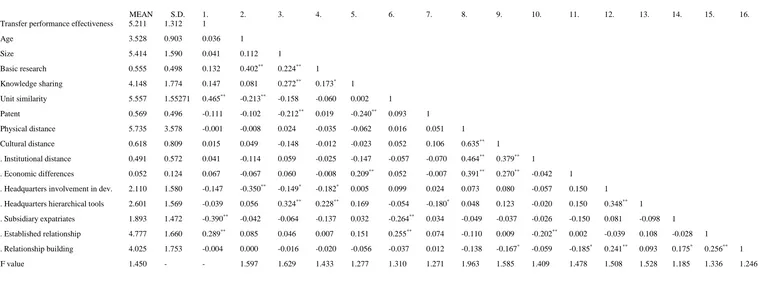
The mean values, standard deviations, and correlation matrix for all the variables are
presented in Table 2. The highest correlation is 0.635 (p < 0.01) between physical and cultural
The article examines how different organizational mechanisms affect knowledge
transfer effectiveness. In order to estimate the models, ordinary least squares regressions were
used. In the second specification, all independent variables were entered. In Table 3, the
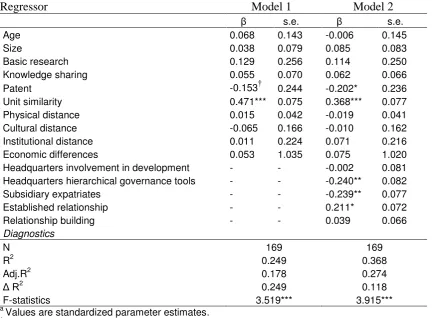
standardized parameter estimates of all models are reported. The first model returned
significant with an F-value of 3.519 (p < 0.01), and the control variables explained 24.9
percent of the variance. Model 2 is significant with an F-value of 3.915 (p < 0.01) and an R2
-value of 0.368. Hence, both models are significant and the explanatory -value increases
between model specifications (see diagnostics in Table 3). In order to control for potential
industry effects, we ran a post hoc analysis including industry dummies. This analysis
suggests that industry differences are not influencing estimate outcomes.
This supports the chosen model specifications and no VIF values are abnormally large
in any of the models, indicating that multicollinearity does not augment the R2 value or the
model’s predictive capability. We employed the Ramsey reset test to investigate whether
nonlinear alterations of the independent variables would yield a higher adjusted R2. The
outcome suggested that the models are better without introducing power alterations.
Additionally, we plotted the residuals to see if nonconstant variance was present across
different independent variable values. No heteroskedasticity problem was detected.
The findings indicate a very small influence of headquarters' involvement during the
development of the innovation, and the relationship is insignificant. Hence, no support is
found for Hypothesis 1. Hypothesis 2, which relates to whether the transfer was driven by
headquarters' hierarchical governance tools, showed a significant (p < 0.01) negative
relationship to transfer performance effectiveness in Model 2. Thus, Hypothesis 2 is
supported. Contrary to what was postulated in Hypothesis 3, using subsidiary expatriates
indicates a significant (p < 0.01) negative relationship to transfer performance in Model 2.
Hence, Hypothesis 3 is not supported.6 Established relationships are positively (p < 0.05)
related to knowledge transfer effectiveness, thus lending support to Hypothesis 4. Finally,
relationship building has a small positive effect on transfer effectiveness. However, this
relationship is not significant and Hypothesis 5 is consequently not supported.
6 The result pertaining to subsidiary expatriates is especially notable and opposed to our expectations. In order to
further understand this result from an empirical point of view, we ran additional models as post hoc tests with the subsidiary expatriates variable interacting with the patenting variable, as well as with the established relationship variable. This is based on the reasoning that since expatriates may be more useful for transferring tacit
---
Insert Tables II and III here
---
DISCUSSION
This article set out to fill the research gap on the influence of formal hierarchical governance
tools and lateral relationships on transferred knowledge utilization, that is, transfer
effectiveness. A major contribution of this study is the focus on effectiveness in specific
transfer projects related to hierarchy and relationships within the MNE. This allows for a
better understanding of hierarchical and lateral tools for effective knowledge governance. The
knowledge governance approach (Foss, 2007) holds that an organizational action to influence
knowledge transfer should start with formal mechanisms since these are readily available to
managers. However, informal mechanisms also affect the transfer. The idea is that the formal
mechanisms influence behavior, thus enabling satisfactory transfer performance. Building on
this approach, our article deals with two formal tools employed by headquarters, one formal
control tool employed in the sending-receiving relationship, and two lateral relationship
characteristics of a more informal nature that may govern the knowledge transfer process. The
results suggest that, in general, hierarchical and formal governance tools are not positively
related to transfer effectiveness, but that lateral relationships affect transfer effectiveness
positively. This enables us to advance the understanding of headquarters' role and function in
knowledge transfer projects and the benefits of using lateral relationship building. This
informs us about the role of headquarters and subsidiaries within the knowledge-based view
and how this relates to knowledge governance. Moran and Ghoshal (1999: 395) highlighted
the importance of facilitating, 'the continual reallocation of resources to more productive
uses.' This study emphasize effective knowledge governance for realizing the value of
knowledge exchange between units and, thereby, contributes to the knowledge-based view by
analyzing antecedents to effective use of transferred knowledge.
Hierarchy in the MNE
In line with our expectations, a significant negative effect on knowledge utilization is found
when headquarters drives the transfer process through formal tools. This may be due to actors
feeling forced into action without any real motivation, and it might be irrelevant knowledge
that is being transferred to the receiver, i.e., the motivational disposition of the subsidiaries
between subsidiaries that is initiated and required by headquarters is going to be less
effective.
Even though headquarters may have both value creation and cost control in mind, its
focus is more likely to be on efficiency rather than effectiveness because it is easier to
measure and follow-up, thus offering one explanation of the negative result vis-à-vis
effectiveness (Daft, 1992; Kostova and Roth, 2002). Another explanation may be that
headquarters involves itself in problematic transfers. For managers, this points out that
classical, easily available control tools may not always be appropriate in ensuring that
knowledge is adopted, integrated, and used at the receiving subsidiary. Thus, our results
indicate that the role of headquarters as a knowledge webmaster tasked with assembling the
global company and enabling self-renewal is indeed challenging (Tallman and Koza, 2010).
Command and control seems to be an ineffective headquarters strategy with respect to
knowledge transfer effectiveness.
A surprising finding is the insignificant effect of headquarters’ involvement during the
knowledge development on the subsequent utilization of the knowledge when transferred to
another unit. The involvement of headquarters can be perceived as a distinctly different
governance tool compared to monitoring and control with a different rationale and
performance effect. In some cases, headquarters needs to be involved and to support
promising subsidiary developments (Rugman and Verbeke, 2001). Even though involvement
does not have a direct effect on transfer performance effectiveness, the indirect effects of
headquarters involvement may be great. For example, the foundations for organizational
influence can potentially be traced back to headquarters’ involvement in subsidiary-level
activities. Also, the perception of the subsidiary as an important player in the MNE network is
increased as a result of headquarters involvement (Ciabuschi et al., 2011b). Our model does
not consider this political power balance and evolution within the MNE, but it at least
indicates that no significant detrimental effect of involvement during development can be
found with respect to transfer effectiveness. Thus, with respect to headquarters' tools for
effective knowledge governance, our findings indicate that there may be a difference between
formal policy and support for innovative activities within subsidiaries compared to direct
transactional governance. In some cases, headquarters interference in subsidiary operations is
likely to create, rather than solve, knowledge transfer problems (Tallman and Chacar, 2011;
Tallman and Koza, 2010).
A surprising finding relates to the negative effect of expatriates for the utilization of
transferred knowledge. In fact, correlating the individual items making up the expatriate
construct with transfer effectiveness shows significant and negative correlations for both
items. As discussed by Björkman et al. (2004), the expatriate role needs to be further
researched. In their study, they found no effect of expatriates on knowledge outflow. One
reason behind the current negative transfer effect may be that it is easier to evaluate financial
performance and cost, that is, efficiency, than the extent to which knowledge is used and
integrated, that is, effectiveness. Hence, expatriates are more likely to have a focus similar to
that of headquarters rather than a subsidiary focus on implementing and using the knowledge
in order to improve the operations in the long run at the recipient (Björkman et al., 2004).
Moreover, as suggested by Tallman and Chacar (2011), knowledge transfer mechanisms
should be considered at the level of communities and networks of practice, implying that
social ties facilitate learning. However, the conditions for a positive outcome of such social
ties are that individuals have, for instance, similar training and objectives, as well as shared
professional norms. In our setting, this may translate into considering whether the 'right' or
'wrong' expatriates are used for the specific knowledge utilization setting.
As argued by Tallman and Chacar (2011), it is easy to disrupt social ties; if that is the
case, a problematic situation for knowledge utilization may emerge. Our results indicate that
expatriate managers do not always facilitate transfer effectiveness, as they often lack
sufficient understanding about how the transferred knowledge should be implemented and
used at the receiving unit. Instead, path dependencies, in terms of established relationships
and unit similarity, lead to transfer effectiveness. This highlights the importance of
organizational and personal relationships that are established over time (Buckley and Carter,
1999, 2004). Parachuting 'strangers' into a social process does not appear to be successful.
Our post hoc test does not, however, indicate a significant positive moderation effect between
expatriates and established relationships. For research on expatriates, it seems important to
consider what an appropriate expatriate in a particular setting is in order to create
communities and networks of practices that facilitate conditions for learning (Tallman and
Chacar, 2011).
Another explanation of this notable finding might be the receiving subsidiary’s
increasing (perceived) dependence on the sending unit when expatriates are used. In their
seminal study of organizational practice transfers, Kostova and Roth (2002) found a negative
relation between subunits’ perceived headquarters dependence and practice implementation.
the receiving subsidiary’s dependence on this unit and, therefore, make the adaption and
utilization of the transferred knowledge more arduous than otherwise. As the utilization and
adoption of transferred knowledge normally entail some modification and adaptation to work
smoothly in a new setting, the increased dependence, implying subordination and control
from the expatriates, might circumscribe the needed flexibility for utilizing and adopting the
knowledge fully and, thereby, produce the negative relation between expatriates and transfer
effectiveness (Kostova and Roth, 2002).
Finally, it may be that subsidiaries make use of expatriates only in transfer processes
they believe will be very difficult to carry out. Thus, it may be that the additional cost of using
expatriates in a transfer process for adopting and utilizing the transferred knowledge is
incurred only in cases that are expected to be difficult. It is then natural to receive a negative
result on performance, but we can only speculate that the negative result would have been
even stronger if expatriates had not been used. This remains open for future research.
Subsidiary lateral relationships
Turning to lateral relationships, the results indicate that the utilization of transferred
knowledge is achieved in situations where the transfer occurs in established relationships. It is
important to cooperate with partners that the actors already know and trust and with whom
they have working experience. Our results indicate that this facilitates knowledge adoption
and use. Highlighting the importance of already-established relationships compared to
building relationships contributes to understanding how knowledge can be governed
effectively. This supplements reasoning highlighting the importance of long-standing
relationships and the accumulation of specific exchange process experiences (Mayer and
Argyres, 2004; Zollo, Reuer, and Singh, 2002). Hence, it becomes a matter of selecting the
transfer counterparts carefully if success is to be achieved, not to transfer the knowledge to
just anyone.
Selecting the transfer counterparts carefully makes better use of available resources and
will help the subsidiaries govern their knowledge transfer processes. Looking at transfer
performance effectiveness allows for a deeper understanding that is not gained by viewing
successful transfer simply as the extent of flows between units. By cooperating with known
counterparts, the subsidiary builds specific dyadic knowledge transfer experience and
knowledge. The relationship partners learn how to organize and conduct knowledge transfer
takes place (Nelson and Winter, 1982). This capability is connected to specific relationships
and lends support to the idea of the MNE as a social community (Kogut and Zander, 1992,
1993). These findings connect well with the relational governance approach discussed by
Poppo et al. (2008), where exchange is governed by cooperative norms and collaborative
activities. Organizational economics also acknowledges informal social relationships as
governance tools, often in the form of trust (Williamson, 1994; Woolthius, Hillebrand, and
Nooteboom, 2005). Hierarchical governance can sometimes be substituted by or
complemented with relational arrangements (Woolthius et al., 2005); in the current
framework, this translates as subsidiaries’ governing knowledge. Thus, relational governance
can be an effective process aimed at increasing subsidiary-level capabilities, i.e., knowledge
transfer effectiveness.
The disappointing nonsignificant result for relationship building may have occurred
because the variables that make up this construct (temporary training, cross-units teams, and
face-to-face meetings) can all be seen as precursors of long-standing relationships and may
pay off only in the future. These may be considered investments in strengthening and
establishing relationships that pay off in future knowledge transfer effectiveness as our result
for ‘established relationships’ show. This has to remain an important conjecture requiring
careful longitudinal investigation.
Limitations and directions for future research
One major limitation of the study is that the data originates only from the sending subsidiary.
In order to estimate transfer performance in a more holistic way, dyadic data needs to be
collected. However, since the sending subsidiary is actively involved during the transfer, it is
reasonable to assume that the targeted respondents gave an accurate estimation of both
headquarters’ role, the dyadic relationship, and how well the knowledge was implemented
and adopted at the receiving subsidiary.7 Moreover, the respondent had usually been involved
in multiple transfer projects (encompassing the same innovation), which allowed for
cross-project comparison. Some of the measurements consist of subjective estimations made by the
respondents, which can be problematic because of social desirability and self-assessment
biases. However, this is mediated by the fact that our data is collected from key informants
through face-to-face interviews.
In terms of future research, the interplay between efficiency and effectiveness needs to
be better understood, as does the indirect effects of headquarters’ involvement in
7
level activities. The role of expatriates and incentive systems and their potential contribution
to transfer performance needs to be further investigated since prior studies found mixed
results (Björkman et al., 2004; Gupta and Govindarajan, 2000). This study is cross-sectional,
and longitudinal research is required to test the dynamic proposition that relationship building
leads to future knowledge transfer effectiveness through establishing strong relationships.
CONCLUDING REMARKS
The contribution of this article is twofold; first, a more in-depth knowledge transfer
performance measure (effectiveness in terms of adoption and use) is employed compared to
previous studies that have focused more on aggregated knowledge flows (Agrawal et al.,
2008; Gupta and Govindarajan, 2000; Haas and Hansen, 2005; Schulz 2001). We have
analyzed the performance variation in individual knowledge transfer projects and shed light
on the reasons for this variation. Second, we show the importance of considering both
hierarchical governance tools and lateral relationships, as they influence knowledge utilization
simultaneously and in different ways. This directly contributes to an enhanced understanding
of knowledge governance and the knowledge-based view.
The results indicate that headquarters’ involvement during knowledge development
does not have any impact on subsequent transfer effectiveness, whereas more formal
hierarchical governance forms have a negative impact. We suggest that relational
characteristics are preferable for building subsidiary capabilities in knowledge transfers.
Similarly, the use of expatriates may be disruptive to an essentially social process.
Consequently, this article augments the understanding of knowledge governance and
integration in large international organizations.
ACKNOWLEDGEMENTS
This article was developed when Dellestrand was a visiting researcher at CIBUL, Leeds
University Business School. The authors would like to thank the World Universities Network