Optimization of planning as a means of
improving
efficiency
of
development
management of resource potential of rail
transport enterprises
Olena Chupyr1, Liudmyla Kalinichenko2, Olena Sychova1, and Yevgeniy Burlaka3,*
1 Department of Management and Public administration, Kharkiv National University of Civil
Engineering and Architecture, 61002 Kharkiv, Ukraine
2 Department of Economy, Kharkiv National University of Civil Engineering and Architecture, 61002
Kharkiv, Ukraine
3 Department of Finances and Credit, Kharkiv National University of Civil Engineering and
Architecture, 61002 Kharkiv, Ukraine
Abstract. This scientific paper presents a methodological approach to optimizing the planning process based on the analysis of existing scientific recommendations on this issue with the development of the resource potential of rail transport enterprises. The proposed method allows more accurately diagnosing of bottlenecks in the management of the resource potential of enterprises in the railway industry, which, in turn, allows us to choose more adequate measures for the development of resource potential.
1 Topicality
Railway industry of each country has a developed resource potential which is composed of various resources interacting between each other and are in permanent interaction. For this particular reason, resource potential development management of railway industry enterprises becomes one of the most important tasks which is set by the enterprises top management with respect to the industry strategic management. Planning process is the most important management element which allows determining lines of enterprise development, minimizing effect of accidental environmental factors and human factor, while ensuring minimizing of costs and irrational use of resources. The need to apply mathematical approaches to planning optimization is caused by the uncertainty with respect to choosing the best option for an enterprise development, since different options may be characterized by several different criteria that differ in their importance, each of them having their own advantages. The use of mathematical optimization methods will allow us to choose the best option for the enterprise development lines.
2 Analysis of the latest studies and publications
Resource potential development management issue was studied by the following domestic and foreign scientists as A.Ya. Bersutskiy [1], D.V. Volovyk [2], S.M. Isa [3], М. Kassab [4], O.V. Ulyanchenko [5], Т. Khegazi [4], О.І. Shamanska [6].
Comparative characteristic of the above authors’ models is provided in table 1.
Table 1. Comparative characteristic of the optimization models for resource potential management existing in the scientific literature.
Author Model description
A.Ya. Bersutskiy [1]
Determination of a balanced set of resources ensuring the implementation of a generated operational production program while taking into account the priority vector values. The advantage of the model – it allows to plan the production program of an enterprise and forecast a possible resources shortage in the process of its implementation. The model's weak point is the lack of a procedure for the priority actions selection aimed at resource potential development.
D.V. Volovyk [2]
The method of multicriteria optimization in managing the resource potential development of agrarian enterprises. The advantage of the model is comprehensiveness of all resources types, considering external and internal factors, that affect resource potential management efficiency. Its weak point is the absence of an enterprise resource potential development assessment which could be used as output data for optimization.
S.М. Isa [3] Holistic linear optimization model for resources leveling (single resource, continuous activity) in construction which guarantees optimal leveling. Its advantages is that the model target function minimizes absolute deviations between needs for resources and an even resources level, between consecutive needs for resources, or between requirements for resources and the desired uneven resources levels.
T. Khegazi, M. Kassab [4]
The method of combined simulation and genetic algorithms is employed for resources optimization in construction. The model determines the least cost-demanding and the most productive resources quantities which ensure the highest benefit/expenses ratio in specific construction operations.
О.V. Ulyanchenko [5]
Multi-criteria function optimization by the established limitations system. The advantage of this model is that it covers all types of resources and takes into account maximal number of internal context factors and environmental factors that produce their effect. Its weak point is the absence of mechanism for planning initial changes for development of the enterprise resource potential.
О.I. Shamanska [6]
The method of regressive analysis is employed with respect to resource potential of the industrial enterprises. Its criterion is profit maximizing depending on the resource potential composition. The model advantage is the possibility for an enterprise profit forecasting. The weak point is the absence of the procedure for selection of initial actions aimed at resource potential development.
Thus, the above scientists were engaged in solving resource potential optimization problems using different mathematical methods, such as regressive analysis, multi-criteria optimization, genetic algorithms and other. However, the issues of managerial procedure development remained unresolved; using this procedure a comprehensive approach to optimization of resource potential development planning would be carried out, as well as a more precise diagnosticating of the 'bottle necks' in the enterprise resource potential management.
3 Purpose of the article
The purpose of the article is to develop a comprehensive procedural approach to optimization of resource potential development planning to enhance a quality of resource potential development management of railway transport enterprises.
4 Presentation of the main material
very important to have means in order to formalize DM advantages, or at least to approximate its advantages [7].
The theory of multi-criteria optimization serves as a basis for development of methods to support decisions taking in the case, when the solution choice is performed in accordance with several criteria, however, it does not substitute the methods for solution choice. This refers to methods of multi-criteria optimization as well, and to methods of selection from a few alternatives number. Generally, the multi-criteria task is viewed as a task of simultaneous optimization of several target functions on the set multiplicity of permissible plans [8]:
= ( ) → , = 1, ,
∈ , (1)
where p – the number of target functions, which are subject to optimization; – individual k-function from criterial set (k=(1, ));
X – multiplicity of permissible plans, whose individual element is designated as x.
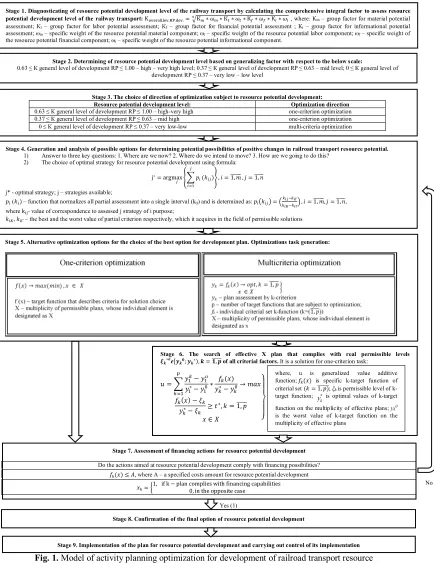
Planning is a process which includes determining of purposes or the organization's tasks, establishing a general strategy to achieve these aims and development of multilateral hierarchical structure of plans for unifying and coordination of the entire enterprise activity [9]. Need for optimization of planning resource potential development management is caused by the fact that during the planning process a choice of managerial decision is effected, which should be based on objective assessment of resource potential development condition, be the most effective under given conditions and to maximally comply with determined aims and tasks of the enterprise. Thus, a need for procedural approach emerges; and this approach should be a reliable tool in the enterprise top management hands and would allow resolving planning tasks on the enterprise resource potential development management in a comprehensive manner. In this context, the authors propose the following planning optimization procedure which is composed from several consecutive stages (Fig. 1).
At the first stage, diagnosticating of resource potential development level is carried out for railway transport enterprise using the author's procedure to assess resource potential development level [10]. Diagnosticating is carried out by determining of integral factor with application of hierarchies analysis procedure to determine specific weight of each resource potential component and of interpretation of integral factor values based on Harrington verbal-numerical scale.
At the second stage depending on the obtained value of resulting factor, a level of resource potential is studied using the universal Harrington verbal-numerical scale. This scale helps to establish correlation between physical (numerical) and psychophysical parameters (high/low, good/bad, big/small).
At the third stage, the direction of optimization subject to resource potential development is chosen: one-criterion optimization or multi-criteria optimization. For the mid, high and very high levels (0.37 ≤ K general level of development RP ≤ 1.00) one-criterion optimization direction is chosen, since for such obtained level no substantial measures are required for enhancing resource potential development level. For the low, and very low levels (0 ≤ K general level of development RP ≤ 0.37) – the direction of multi-criterial optimization, since these both levels require significant intrusions in the process of resource potential development management.
At the fourth stage, formation of possible development plans options occurs. It is expedient to carry out this process using answers to such key questions:
1. Where are we now? Condition and possibilities of the organization are assessed at the
moment.
2. Where do we intend to move? Organization's intentions and circumstances of its
Fig. 1. Model of activity planning optimization for development of railroad transport resource potential in the industry enterprises
Yes (1)
Stage 1. Diagnosticating of resource potential development level of the railway transport by calculating the comprehensive integral factor to assess resource potential development level of the railway transport: K . . . .= К ∗ ∗ К ∗ ∗ К ∗ ∗ К ∗ , where: Кm – group factor for material potential
assessment; Кt – group factor for labor potential assessment; Кf – group factor for financial potential assessment ; Кі – group factor for informational potential assessment; ωm – specific weight of the resource potential material component; ωt – specific weight of the resource potential labor component; ωf – specific weight of
the resource potential financial component; ωі – specific weight of the resource potential informational component.
Stage 2. Determining of resource potential development level based on generalizing factor with respect to the below scale:
0.63 ≤ К general level of development RP ≤ 1.00 – high – very high level; 0.37 ≤ К general level of development RP ≤ 0.63 – mid level; 0 ≤ К general level of development RP ≤ 0.37 – very low – low level
Stage 3. The choice of direction of optimization subject to resource potential development:
Resource potential development level: Optimization direction
0.63 ≤ К general level of development RP ≤ 1.00 – high-very high one-criterion optimization 0.37 ≤ К general level of development RP ≤ 0.63 – mid high one-criterion optimization 0 ≤ К general level of development RP ≤ 0.37 – very low-low multi-criteria optimization
Stage 4. Generation and analysis of possible options for determining potential possibilities of positive changes in railroad transport resource potential. 1) Answer to three key questions: 1. Where are we now? 2. Where do we intend to move? 3. How are we going to do this?
2) The choice of optimal strategy for resource potential development using formula:
j∗= argmax ( ) , = 1, , = 1,
j* - optimal strategy; j – strategies available;
( ) – function that normalizes all partial assessment into a single interval (kij) and is determined as: = Г
Г , = 1, , = 1, ,
where k- value of correspondence to assessed j strategy of i purpose;
, Г – the best and the worst value of partial criterion respectively, which it acquires in the field of permissible solutions
Stage 5. Alternative optimization options for the choice of the best option for development plan. Optimizations task generation:
Stage 6. The search of effective X plan that complies with real permissible levels ∗ [ ; ∗), = , of all criterial factors. It is a solution for one-criterion task:
= ∗− − ∗
( )
∗− →
( ) −
∗− ≥ ∗, = 1,
∈ ⎭
⎪ ⎬ ⎪ ⎫
Stage 7. Assessment of financing actions for resource potential development
Do the actions aimed at resource potential development comply with financing possibilities?
( ) ≤ , where А – a specified costs amount for resource potential development
= 1, if k − plan complies with financing capabilities 0, in the opposite case No (0)
Stage 8. Confirmation of the final option of resource potential development
Stage 9. Implementation of the plan for resource potential development and carrying out control of its implementation
where, u is generalized value additive function; ( ) is specific k-target function of criterial set ( = 1, ); k is permissible level of k-target function; *
k
y is optimal values of k-target function on the multiplicity of effective plans; yk0
3. How are we going to do this? Possible ways, methods, means that are chosen to achieve the set goals, are determined.
Further, the choice of optimal strategy for the top priority changes is carried out using the group-based system of partial factors system (material, labor, financial, informational) for development of the enterprise resource potential using formula [10]:
j∗= argmax ∑ ( ) , = 1, , = 1, , (2)
where j* – optimal strategy; j – strategies available;
( ) – function that normalizes all partial assessment into a single interval (kij) and is
determined as: = Г
Г , = 1, , = 1, ,
where k – value of correspondence to j-strategy of-i purpose assessed
, Г – the best and the worst value of partial criterion respectively, which it acquires
in the field of permissible solutions.
At the fifth stage, alternative options for optimization are determined to ensure the choice of the best option for development plan and one-criterion and multi-criteria optimization is carried out subject to the choice made at the third stage of procedural approach.
One-criterion task is generated in the following way:
( ) → max(min), ∈ , (3)
where ( ) – target function which describes the solution choice criterion;
X – multiplicity of permissible plans, whose individual element is designated as x. The multi-criteria task is viewed as a task of simultaneous optimization of several target functions on the set multiplicity of permissible plans:
= ( ) → , = 1,
∈ (4)
where p – the number of target functions, which are subject to optimization;
fk – individual k-function of the criterial choice ( );
X – multiplicity of permissible plans, whose individual element is designated as x [7]. Permissible plans are compared via correlation of their assessments, in which case, an arbitrary admissible plan assessment of multicriteria task is vectorial one:
у = (у1,..., ур). (5)
A person who takes managerial decisions determines such permissible levels , which
he/she thinks to be satisfactory.
At the sixth stage, the search of such effective X plan that complies with real permissible levels of all criterial factors takes place. It is a solution to one-criterion task [7]:
= ∑ ∗ ∗
( )
∗ →
( )
∗ ≥ ∗, = 1,
∈ ⎭⎪
⎬ ⎪ ⎫
(6)
A conclusion is made which is the result of the stage performance as to reality or unreality of initial permissible levels (value t*) and real permissible levels k*0[yk0;yk*),
= 1, , and an assessment y2=f(x2
)
with recommendation as to approval of x plan as asolution of the multicriteria task [7].
The reality of the determined criterial factors levels is effected using the solution to one-criterion task:
⟶ ,
( )
∗ ≥
є .
, = 1, (7)
Case ∗≥ 0 testifies in favor of the permissible levles reality, while case ∗˂0 – as to their unreality.
At the seventh stage an assessment of possibility for financing actions for resource potential development is carried out. If the target expenditures function is less or equal to A (А is costs amount specified allocated for resource potential development), the plan is chosen and approved at the eighth stage. In case the amount exceeds the planned one, return to stage 4 is performed and the choice of a new strategy of resource potential development is effected due to insufficient financing.
At the eighth stage the final approval of the plan chosen at a previous stage, is carried out.
At the ninth stage implementation of resource potential development plan is carried out and control of its implementation is effected.
5 Conclusions
Thus, the presented model allows implementing comprehensive approach to optimization of resource potential development planning of railway industry enterprises. These procedural recommendations are more precise compared with other existing procedural recommendations for resource potential optimization, since they provide for diagnosticating “bottlenecks” in the enterprise resource potential and choose more adequate actions from the enterprise resource potential development proceeding from its financial capabilities. Implementation of proposed procedural recommendations as to optimization of resource potential development planning would encourage raising efficiency of resource potential development management of railway transport enterprises.
References
1. A. Ya. Bersutskyi, Models of decision-making on development management of
resource potential of enterprise, Donetsk, 16, 29-33 (2010)
2. D.V. Volovyk, Ukr. scien., Ternopil’, 19, 1, 11-16 (2014)
3. Said M. Easa, Resource Leveling in Construction by Optimization. Journ Constr.
Engin Manag. 115, 2 (1989)
4. T. Hegazy, M. Kassab, Journ. Constr. Engin. Manag., 129, 6, (2003)
5. O.V. Ulyanchenko, Management of resource potential in the agrarian sector
Kharkiv, 302-322 (2007)
6. O.I. Shamanska, Effect. econ., Dnipropetrovsk, 9 (2011)
7. V.R. Kihel, Methods and models of decision making in a market economy, Kyiv,
Economic Institute of Management, (2003)
8. S.P. Robbins, M. Coulter, Management. Moscow, Williams Publishing House,
(2007)
9. A.V. Lotov, I.I. Pospelova, Multi-criteria decision making tasks. MAKS Press,
Moscow, (2008)
10. L.L. Kalinichenko, O.M. Chupyr, N.V. Yanchenko, V.M. Bredikhin,