International Journal of Innovative Technology and Exploring Engineering (IJITEE) ISSN: 2278-3075, Volume-8 Issue-7, May, 2019
Execution Proportions of Multi Server Queuing
Modelwith Pentagonal Fuzzy Number: DSW
Algorithm Approach
K. Usha Prameela, Pavan Kumar
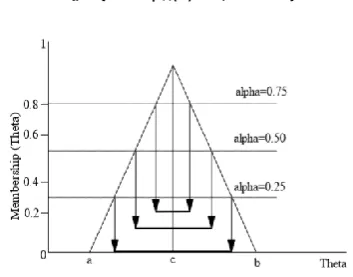
Abstract: - This paper displays a multi-server queuing miniature in fuzzy condition. We accept the inter-arrival(entry) time and service(overhauled) time as pentagon fuzzy numbers, and the arithmetic of interval numbers is enforced. In this proposed model, the idea of the α-cut through DSW calculation is connected to decide the execution proportions.The effectiveness of the proposed model is outlined by fathoming a numerical precedent by thinking about hypothetical information.
Keywords: Queuing Model, Pentagon Fuzzy Numbers, DSW Algorithm, α-cut, execution proportions.
I. INTRODUCTION
A queue contains at least one lines or at least one administration offices under a lot of tenets. The parameters entry rate (λ) and administration rate (µ) are required to pursue appropriation in queuing hypothesis. In lining models for the most part, the information, landing rate and administration rate are uncertainly known, and this vulnerability is settled by utilizing fuzzy idea. This hypothesis gives significant and amazing portrayal of vulnerability. In this way, lining models have more applications by applying fuzzy nature. Fuzzy lining miniature was introduced by R. J. Lie and E.S. Lee [9]in1989and developed by J.J. Buckley [3] in 1990. R. S. Negi and E.S. Lee in 1992, and Chen [2005-2006] advanced (FM/FM/1): (∞/FCFS) and (FM/FM/k): (∞/FCFS) where FM indicates Fuzzified exponential time dependent on queuing hypothesis. Srinivasan[7] in2014 proposed a fuzzy queuing model utilizing DSW calculation. S. Thamotharn[4]in 2015 exhibited an investigation on multi server fuzzy queuing model in triangular and trapezoidal fuzzy numbers utilizing α cuts. S. Shanmugasundaram &Venkatesh [6] in 2015 anticipatedfuzzy multi server queuing model through DSW calculation. K.U Madhuri &V. Ashok in 2017 have dissected fuzzy lines utilizing Zadeh’s [2]augmentation rule.P. Selvam et. al. [12]in 2017 submitted a ranking of pentagonal fuzzy numbers applying incentre of centroids.Kao et al constructed the membership functions of the system characteristics for fuzzy queues utilizing parametric linear programming. Fuzzy set hypothesis is an augmentation of traditional set hypothesis. The crisp numbers are not adequate to manage vulnerability So, the fuzzy numbers, for example, triangular, trapezoidal, are utilized to manage vulnerability. Triangular and trapezoidal fuzzy numbers are regularly utilized in supplications.
Revised Manuscript Received on May 07, 2019.
K Usha Prameela received M.Sc. degree from Andhra University Waltair, M.Phil. from Periyar University Salem, pursuing Ph.D. From KL UniversityVaddeswara m (AP). India.
PAVAN KUMAR , Assistant Professor of Mathematics at the KoneruLakshmaiah Education Foundation (K L University), Vaddeswaram (AP), India.
They are not reasonable for executions where vulnerabilities emerge in multiple focuses. In such cases, pentagonal fuzzy numbers i.e., five points can be utilized to take care of the issues. This paper depicts multi server lining model and FCFS discipline utilizing pentagonal fuzzy numbers under α cut portrayal through DSW calculation to manage unsure parameters. Here, Fuzzy set can be divided into permeate unmistakable focuses through α cut strategy. To characterize membership function of the execution proportions in multi-server fuzzy lining model, DSW calculation is utilized.In segment II, some essential ideas and definitions are presented. In segment III, the suspicionsand inscriptions areportrayed. In segment IV, the proposed queuing model is given. In segment V, the resolution perspective to the present model is reported. In segment VI, numerical example is solved. In segment VII, results and discussions areconferred. Insegment VIII, the model is concluded.
II. II.ESSENTIAL IDEAS & DEFINITIONS
Fuzzy Set [2]:A Fuzzy set can be characterized as: Ã= {<x, µÃ(x)>:xϵX}
and X be a non-void set,µÃ(x)ϵ [0,1] is the membership of xϵX in Ã
Fuzzy Number [3]: A fuzzy set à characterized on theset of real numbers R is said to be fuzzy number if it has the accompanying qualities such as à is normal, convex and the support of it is closed and bounded.
α-cut [2]: An α- cut of a fuzzy set is a crisp set Ãαthat contains all the elements of theuniversal set X that have a participation grade in à greater than or equal to determined estimation of α. Therefore
[image:1.595.338.515.572.710.2]Ãα = {x∈X: µÃ(x) ≥α, 0≤α≤1}
Pentagon Fuzzy Number [9]
A fuzzy number à = ] where is said to be a pentagon fuzzy number if its membership function is given by
µP (A, S) (x)=
[image:2.595.45.281.64.364.2]
Figure 2: Geometrical Portrayal of Pentagon Fuzzy Number
Arithmetic operations on Pentagonal Fuzzy Number (PFN) [11]
For Aa1, a2, a3, a4, a5 and Bb1, b2, b3, b4, b5, we have
Addition:
A B a1 b1, a2 b2, a3 b3, a4 b4, a5 b5.
Subtraction:
A B a1 b5, a2 b4, a3 b3, a4 b2, a5 b1
Multiplication:
AB a1*b1, a2*b2, a3*b3, a4* b4, a5* b5.
Inverse:The inverse of a PFN is characterized when all its components are non-zero.ForAa1, a2, a3, a4, a5we have
If one of the components of a PFN ends up zero, at that point we cannot find its inverse.
Development of PFN.
The pentagonal fuzzy number is spoken to by the five parameters a1, a2, a3, a4 and a5 where a1 and a2signify the smallest conceivable qualities, a3 the most encouraging worth and a4, a5the biggest conceivable esteem.The pentagonal fuzzy number can be created by utilizing the accompanying equation.
A =a -2, a -1, a, a +1, a +2for each of a 3,4,5,6,7
APPRAISAL OF INTERVALS [9]
The two interval numbers designated by ordered pairs of real numbers with lower and upper limits be
G= [ ], ; and H= ],
The math property is signified generally with the symbol *,
Where + ] = [a1+b1, a2+b2]
- ]= [a1-b2, a2-b1]
[ ]*[ ]= [min (a1 b1, a1 b2, a2 b1,a2 b2), max (a1 b1, a1
b2, a2 b1,a2 b2)]
[ ] [ ]= [ ] *[1/b2, 1/b1] provided that 0 does
not belong to [ ]
α [ ]= [α ] for α>0 and [α ] for α<0 III. SUSPICIONS AND INSCRIPTIONS [3] 3.1 Suspicions
(i) Queuing Model with multiple server and unlimited capacity.
(ii) Inter arrival time taken Poisson dispersion and overhauled time taken Exponential circulation. (iii)Arrival(entry) rate, service(overhauled) rate are
pentagon fuzzy numbers.
3.2 Inscriptions
λ Average number of clients arriving per unit of time. µ= Average number of clients being overhauled per unit of time.
LS=The average number of clients in the system.
Lq =The Average number of clientsholding up in the queue(line).
WS =Average holding up time of a client in the system. Wq = Average holding up time of a client in the line. X = set of the inter arrival time. Y = set of the service time. A = inter arrival time, S = service times
IV.
PROPOSED QUEUING MODEL & IMPLEMENTATION [1]we propose an unlimited limit populationhaving two or more service facilities in parallel and the service is provided identically with, first started things out served (FCFS) regulation queuing model, indicated as (FM/FM/C) :(/FCFS), where the inter entry time and the overhauled time ensue Poisson and Exponential dispersions with fuzzy parameters λ and µ.
The execution proportions of the multi-server model are given beneath
Expected number of clients in the system
L
s=
P
0+
(1)Expected number of clients holding up in the queue
Lq =
P
0(2)Average time a client spends in the framework
Ws =
P
0+
(3)Average holding up time of a customer in the line
Wq =
P
0(4)Where,
P0=
International Journal of Innovative Technology and Exploring Engineering (IJITEE) ISSN: 2278-3075, Volume-8 Issue-7, May, 2019
V.
RESOLUTION PERSPECTIVE [5]DSW (Dong, Shah and Wong) is a rough technique utilizes intervals at various α – cut dimensions in characterizing execution proportions. It avoids variation from the output membership function because of use of the segregation reaching on the fuzzy variable area. Any persistent participation capacity can be spoken to by ceaseless scope of α-cut in term from α= 0 to α = 1.Let µÃ(a), and µš(s)be
membership functions of the inter entry time and the overhauled time,separately. The inter landing time and administration times are fuzzy sets, depicted as:
= {(a, µÃ(a)) /a∈ X)}; = {(s, µš(s))/s ∈Y)}
The α cuts of inter entry time, overhauled time are represented as
(α) = {a ∈ X / µÃ(a)≥ α}; (α) ={s ∈ Y / µš(s) ≥ α}
Utilizing these α cuts we characterize themembership function as follows:
µP (A, S) (x)=
The DSW calculation comprises the accompanying advances
Stage 1. Stipulate α cut esteem where 0 ≤ α ≤1.
Stage 2. Discover the intervals in the input membership functions that compare to this α.
Stage3. Utilizing standard binary interval operations, process the interval for the outputmembership function for the chosen α cut dimension.
Stage4. Iterate stages 1-3 for various estimations of α to finish α cut portrayal of the arrangement.
VI. ANALOGY OF INTERVAL VALUED MODEL [6]
[image:3.595.319.501.63.318.2]Consider a FM/FM/C queue where both the entry rate and administration rate as pentagonal fuzzy numbers communicated by λ = [11 12 13 14 15] and µ = [21 22 23 24 25]. The interval of certainty at probability level α as [11+2α,2α] and [21+2α, 25-2α]. where x= [11+2α, 15-2α] & y= [21+2α, 25-15-2α].
Pentagon fuzzy number with graphicalportrayal
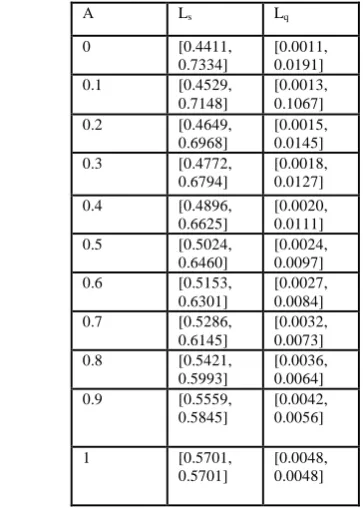
By taking α values from 0, 0.1, . . . 1 the accompanying outcomes are acquired as appeared in Table1 and Table 2.
Table 1: Ls and Lqfor different values of cuts
Α Ls Lq
0 [0.4411, 0.7334]
[0.0011, 0.0191] 0.1 [0.4529,
0.7148]
[0.0013, 0.1067] 0.2 [0.4649,
0.6968]
[0.0015, 0.0145] 0.3 [0.4772,
0.6794]
[0.0018, 0.0127] 0.4 [0.4896,
0.6625]
[0.0020, 0.0111] 0.5 [0.5024,
0.6460]
[0.0024, 0.0097] 0.6 [0.5153,
0.6301]
[0.0027, 0.0084] 0.7 [0.5286,
0.6145]
[0.0032, 0.0073] 0.8 [0.5421,
0.5993]
[0.0036, 0.0064] 0.9 [0.5559,
0.5845]
[0.0042, 0.0056] 1 [0.5701,
0.5701]
[0.0048, 0.0048]
Table 2: Ws and Wq for different values of cuts
Α Ws Wq
0 [0.0401, 0.0488]
[0.0001, 0.0012] 0.1 [0.0404,
0.0482]
[0.0001, 0.0011] 0.2 [0.0407,
0.0477]
[0.0001, 0.0009] 0.3 [0.0411,
0.0471]
[0.0001, 0.0008] 0.4 [0.0415,
0.0466]
[0.0001, 0.0007] 0.5 [0.0418,
0.0461]
[0.0002, 0.0006] 0.6 [0.0422,
0.0456]
[0.0002, 0.0006] 0.7 [0.0426,
0.0451]
[0.0002, 0.0005] 0.8 [0.0430,
0.0447]
[0.0002, 0.0004] 0.9 [0.0434,
0.0442]
[0.0003, 0.0004] 1 [0.0438,
0.0438]
Lq
Ls
Wq
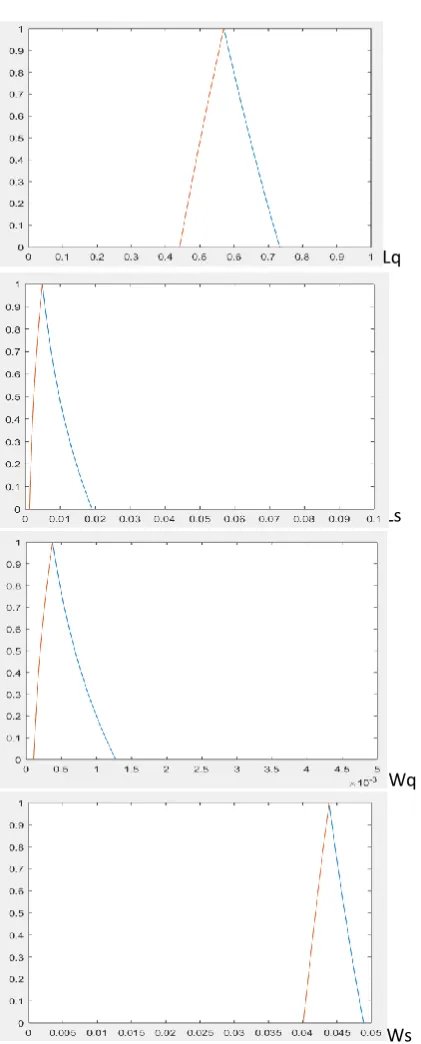
[image:4.595.50.261.53.576.2]Ws Figure 3: Plotting of Various Performance Measures
versus α-cut Values
VII.
RESULTS AND DISCUSSIONSUtilizing MATLAB, we achieve α cuts of entry rate, administration rate and fuzzy anticipated number of occupations in queue just as system at eleven patent dimensions: 0, 0.1, 0.2, 0.3, 0.4, 0.5, 0.6, 0.7, 0.8, 0.9, 1. Crisp intervals for fuzzy anticipated number of employments in line and framework at various probability α levels are exhibited in Table-1, 2 and 3. The execution proportions for example anticipated number of clients in the system (Ls), anticipated length of the line (Lq), the average holding up time of a client in the system (Ws) and the average holding up time of a client in the queue (Wq) likewise inferred in Tables 1-2.
unsustainable to fall outside the scope of 0.0011 and 0. 0191 and for the system Ls, falls at 0.5701 and its value is difficult to fall outside the scope of0.4411 and0.7334. so also, foraverage holding up time in system Ws, the most likely esteem is 0.0438 and it is unsustainableto fall outside the scope 0.0401 and 0.0488 and for theline Wq, the most likely esteem is0.0003 and it is unsustainable to fall outside the range 0.0001 and0.0012
These above outcomes are extremely valuable for
characterizing a lining framework and for decision process.
VIII. CONCLUSION
In this paper, the idea of pentagon fuzzy number has been examined with interval math operations to FM/FM/Cfor example multi serverlining model. The executionproportions of FM/FM/C miniature with pentagon fuzzy number aregiven with the help of numerical precedent by utilising α cut tasks. The inter entry time and administration times are fuzzy nature. The execution of this framework is likewise fuzzy nature.
ACKNOWLEDGEMENT
The authors would like to thank the mysterious commentators for their profitable remarks and proposals to improve the nature of thispaper.
REFERENCES
1. Chen. S.P, (2006), A Mathematics Programming Approach to the Machine Interference Problem with Fuzzy Parameters, Applied Mathematics and Computation 174, pp. 374-387.
2. L.A. Zadeh, (1965), Fuzzy Sets, Information and Control, 8, pp. 338-353.
3. Buckley, (1990), Elementary Queuing Theory based on Possibility Theory, Fuzzy Sets and Systems 37, pp. 43-52.
4. S. Thamotharan (2016), A Study on Multi Server Fuzzy Queuing Model in Triangular and Trapezoidal Fuzzy Numbers using α Cuts, International Journal of Science and Research, 5(1), pp. 226-230. 5. Negi.D.S. and Lee.E. S (1992) Analysis and Simulation of Fuzzy
Queue, Fuzzy Sets and Systems, 46, pp. 321-330.
6. S. Shanmugasundaram and BB. Venkatesh,(2015), Fuzzy Multi Server Queuing Model through DSW algorithm, International Journal of Latest Trends in Engineering and Technology, 5(3), pp.452-457. 7. Srinivasan (2014), Fuzz\y Queuing Model using DSW algorithm,
International Journal of Advanced research in Mathematics and Application. 1(1), pp.57-62.
8. Chen.S. P, (2005), Parametric Nonlinear Programming Approach to Fuzzy Queues with Bulk, Service, European Journal of Operations Research 163, pp. 434-444.
9. Li.R.J and Lee.E.S.(1989) “Analysis of Fuzzy Queues”, Computers and Mathematics with Applications 17(7), pp. 1143-1147.
10. K.T Atanassov. (1986), Intuitionistic fuzzy sets, Fuzzy sets system, 20, pp. 87-96.
11. T. Pathinathan and K. Ponnivalavan, (2014), Pentagonal fuzzy numbers, International Journal of Computing Algorithm, 3, pp.1003-1005.
International Journal of Innovative Technology and Exploring Engineering (IJITEE) ISSN: 2278-3075, Volume-8 Issue-7, May, 2019
K Usha Prameela received M.Sc. degree fromAndhra University Waltair, M.Phil. from Periyar
University Salem, pursuing Ph.D. From KL UniversityVaddeswara m (AP). Her research interest is
In Applied Mathematics, Statistics, Fuzzy Optimization, Probability, Statistical Modeling.