Abstract: The color image retrieval is a dynamic research area for more than a few decades as to access the images from the outsized image database. The color feature extraction and representation is the vital task in color image retrieval. Among the various color feature representation methods, the retrieval performance of Local Binary Pattern meant for color images (LBPC) is more as it combines color and texture features. LBPC utilizes the definition of hyper_plane to threshold the color pixel as either ‘0’ or ‘1’. The definition of hyper_plane is derived using different normal vectors. This work considers this factor and design LBPC based image retrieval system with three hyper_plane normal vectors; Local average Normal, Center Normal, Mean Normal. Experimental results show that the LBPC with Local average Normal vector hyper_plane and LBPC with Mean Normal vector hyper_plane are yielding the same retrieval efficiency. The performance of Center Normal vector hyper_planed LBPC is low as compared to other two. This work proposed that the LBPC can be extracted using either Local average Normal vector hyper_plane or Mean Normal vector hyper_plane for the efficient retrieval of color images.
Index Terms: Content_Based Image Retrieval, LBP, color image, Hyper_plane normal vector, Precision, Recall, MAP,Wang Database.
I. INTRODUCTION
Content_Based Image Retrieval (CBIR) participates a momentousrole to recognize pattern in various fields as the enormous growth of images in those.CBIR system facilitates the user to gain access toand retrieves the images from the databases. The image database for CBIR may contain medical images, natural images, face images, finger print images and many more. CBIR depends on two sub processes for its application. They are visual content (feature) Extraction and similarity matching (indexing). Visual content extraction is very important process among the two. Many CBIR algorithms are being developed on the basis how the visual features are digged out from the image. Visual feature extraction is drawing out the low level features such as texture, color, and shape from the image. These visual features are used to symbolize the image content[1].
Revised Manuscript Received on June 05, 2019
C.CallinsChristiyana, Professor, Computer Science and Engineering, Sethu Institute of Technology.
M.Mathinakani, Assistant Professor (S.G), Computer Science and Engineering, Sethu Institute of Technology.
M.Poomani@Punitha, Asst. Professor (S.G),Computer Science and Engineering, Sethu Institute of Technology.
K.Priyadharsini, Asst. Professor (S.G), Computer Science and Engineering, Sethu Institute of Technology.
With the various visual features mentioned for the image, color is the most eminence visual feature to represent the image content thereby widely used in many of the image retrieval systems. It does not with respect to image orientation and size [2]. The color feature can be represented by many methods. Some of them are color histogram, color moment invariants [3,4], color sets [5], color correlogram [6] ,color coherence vector [7], and many more.
Texture is the significant feature to characterizethe matterof the image since it concerns the region homogeneity to represent the visual features. It prospects the visual pattern in the way of how they are spatially defined. It integratesthe high point semantics for image retrieval purpose [8]. The textures from the image are drawn by statistical and structural approaches. The structural texture extraction methods consider an image texture as a set of primaltexels in some regularrepeated patterns. The structural method of texture representation is appropriate to analyze the artificial textures. The statistical approach represents the image textureas a quantitative degreeof the arrangement of intensities in a region. The notable statistical texture representation methods are Tamurafeatures [9], Grey Level Co-occurrence Matrix [10] , Laws texture energy measures [11] , wavelet transform [12] , Wold features [13] , Local Binary Pattern(LBP) [14] and many more.
The shape feature helps the human being to identify the objects through their shape, in thatway shape feature contains semantic information. To represent the image object by its shape, the image should be partitioned into regions with theapplication of the segmentation process. The effectiveness of the shaperepresentation depends on the effectiveness of the segmentation procedure unconditionally. The shape representation method ought tobe invariant to geometric conversionfor exampletranslation, scaling and rotation. There are two methods of shape feature representation. Region and boundary based are the instance of shape
interpretation[15]. The most victoriousshape
interpretationsare Fourierdescriptor and moment invariants. But the limitation of shape feature is that it cannot be directly extracted from the image. The shape extraction by means of the above-said representations requires the segmentation of the interested objects from the image. In most of the content_basedimage retrieval system, the shape feature cannot be employed as the primary one as its competence depends on the segmentation process. The shape feature can be used as the auxiliary
feature.
In addition to the different representation of visual
Color Textured Feature based Image retrieval
using Local Binary Pattern with Hyper plane
Thresholding
features, the features are extracted by globally or locally [10]. The global approach considers the whole image and extracts the visual features. It leaves the local characteristics and spatial relationship between pixels of the image. These problems are rectified by local feature extraction methods since the local approach concerns about the local regions of the image.
Both color and texture feature extraction jointly derives the effective features thereby improving the accuracy of the retrieval systems. There are many feature extraction procedures separately represent texture and color features. But it is necessary to find the feature extraction technique which combines both texture and color features. One such feature is LBP. LBP extracts the image content locally. It is simple, fast and gives high discrimination as compared to many local texture features. It is also invariant to illumination changes. LBP has been proved as a successful feature in face recognition applications [16,17], texture classification[18] and image retrieval[19] applications. The color_texture feature of color images extracted with the help of LBP operator by considering each channel of the color images as a grayscale image. There are many number of LBP-based image retrieval algorithms are being developed for color images. Multispectral LBP (MSLBP) was developed by Mäenpää et al. [20] for color_texture depiction. The MSLBP utilizesall the three planes of a color image and six counterpartcolor plane pairs to confine spatial associationbetween the two channels for the computation of LBP. Even though this method is effective, it results a very high length feature vector. Later, Mäenpää and Pietikäinen [21] have the trials on color_texture and witnessed that three pairs of color channels are adequate for deriving the cross associationfeatures among the three color planes instead of considering the six pairs as in [20]. Choi et al. [22] brought LBP histograms in each plane ofYCbCrcolor space and employed Principal Component Analysis to lower the lengthof the feature vector. They concluded that their method worked well in recognizing face images than the LBP operator on gray face imagesderived from color images. Lee et al. [23] presented local_ color_ vector_ binary_ patterns (LCVBPs) to recognize face images. The LCVBP operator contains two patterns: color_angularand color_norm patterns. Color_ angular pattern acquires distinctive features of two color planes and gives spatial associationof local color_texture. Lee et al. suggested that LCVBP operator outperformed as associated to the LBP of individual color planes. Zhu et al. [24] suggested orthogonal_combination of local_ binary_ patterns (RGB_OC_LBP) for color images as a local pattern to reduce the dimension of LBP feature vector. Theyconcluded that RGB_ OC_LBP operator performs better than the color SIFT operator in object recognition, image harmonizing, and scene classification applications. Recently,
Lan et al. [25]
offeredquaternion_local_ranking_binary_pattern (QLRBP), for color images. The QLRBP unites the color information offered by multispectral channels in color images. QLRBP operator is drawn using quaternionic_representation (QR) in color images. The QLRBP controls all color planes in the quaternionic domain directly and give color_texture information without treating the color planes separately. The completed_ Local_similarity_Pattern (CLSP) have suggested
by Li et al. [26]. The co-occurrence of color quantization information and the textural information of color image pixel is used to epitomize the color images in CLSP. In an aim to make use of the impedecolor plane information, Dubey et al. [27] have presented two suites of patterns, Multichannel_adder and Multichannal_decoder based LBPs (MDLBPs). They concluded that the Multichannal_decoder based descriptor gives superiorretrieval concert than the former.
Though the above-said color image LBP operators outperformed in various applications, the length of the feature vector is more. Chandan Singh et al. [28] have given local binary pattern for color images (LBPC), which brings color_texture patterns for a color image akin to the way LBP operator gets texture for gray scale images. They treated a color pixel as a vector with 3-pieces (as 3 color planes) and form a hyper-plane. The hyper-plane is acted as a margin to brinkand separate color pixels into two classes. A color pixel in a 3 ×3 neighborhood is named a value 0 if it lies below the plane, otherwise named as 1. This feature vector length of LBPC is equal to feature vector length of LBP in grayscale images though the spatial relationship among color pixels is utilized. The LBPC is related with the modern LBP descriptors for color images and has been proven as the best descriptor.
The hyper-plane for color channels can be defined in many ways. The plane is built by defining the normal vector and reference vector. The reference vector is derived from the pixels for which the LBPC is computed. There are several ways of defining normal vectors. They are Global Natural normal, Global average normal, Local average normal, Center normal, and Mean normal. Local average normal has been used to define a normal vector in hyper-plane of LBPC[28]. But the performance of LBPC can be varied with respect to how normal vector for the hyper-plane is derived. When compared to the different definitions of the normal vector of the hyper-plane, the Local average normal, Center normal, and Mean normal considers the local neighborhood pixels. The local approach is always efficient when compared to global approach. This article is developed based on how LBPC is performed on color image retrieval with different hyper-plane definitions based on local normal vectors. The paper is systematized as follows.The color feature based image retrieval systems based on different feature representation are given in section II. Section III portrays the methodology adopted in this work to model the image retrieval system. The results and discussions of the system under study is experimented in section IV. Inference of the experiments is given in section V.
II. RELATED WORK
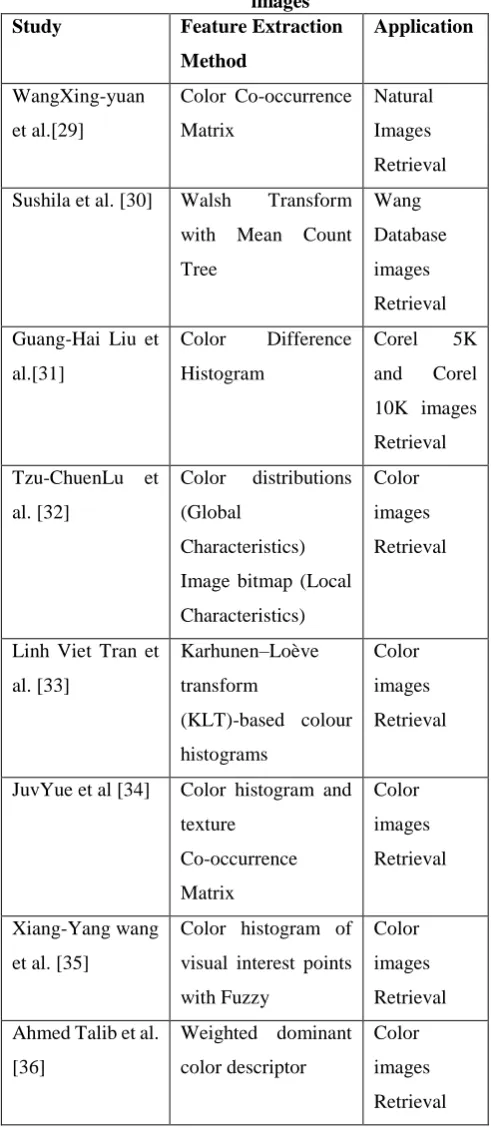
Table 1. Feature Extraction Procedure for color images
Study Feature Extraction
Method
Application
WangXing-yuan
et al.[29]
Color Co-occurrence
Matrix
Natural
Images
Retrieval
Sushila et al. [30] Walsh Transform
with Mean Count
Tree
Wang
Database
images
Retrieval
Guang-Hai Liu et
al.[31]
Color Difference
Histogram
Corel 5K
and Corel
10K images
Retrieval
Tzu-ChuenLu et
al. [32]
Color distributions
(Global
Characteristics)
Image bitmap (Local
Characteristics)
Color
images
Retrieval
Linh Viet Tran et
al. [33]
Karhunen–Loève
transform
(KLT)-based colour
histograms
Color
images
Retrieval
JuvYue et al [34] Color histogram and
texture
Co-occurrence
Matrix
Color
images
Retrieval
Xiang-Yang wang
et al. [35]
Color histogram of
visual interest points
with Fuzzy
Color
images
Retrieval
Ahmed Talib et al.
[36]
Weighted dominant
color descriptor
Color
images
Retrieval
III. MATERIALS AND METHODS A. LBPC pattern Computation
This section illustrates how the LBPC thresholds the color pixels using hyper-plane is defined with respect to Local Average Normal, Center Normal and Mean Normal. The LBPC for color images threshold the color pixels using hyper_plane in 3 dimensions since there are 3 color planes R,G and B for RGB images. With the intention ofderiving the LBP feature, the image is partitioned into overlapping neighborhoods by treating every pixel as a center pixel. The
[image:3.595.332.526.156.221.2]size of the neighborhood is (2r+1) X (2r+1), where ‘r’ is the reach of the neighborhood. Normally, ‘r’ takes the value 3,5,7 and in increased odd number. In every neighborhood, the LBP thresholds the surrounding pixels with respect to the pixel present in the center of 3X3. The 3X3 neighborhood is considered for local pattern computation in most of the works. The 3X3 neighborhood is considered in this work and pictured in Figure 1.
Figure 1. 3X3 Neighborhood of an image In Figure 1, ‘Ic’ and ‘Ip’ represent the center pixel and surrounding neighbors of a center pixel in 3X3 neighborhood. A color pixel has three components in red(r), green(g) and blue(b) channels correspondingly. A hyper_planeto derive a LBPC value is built by defining normal vector to the plane and the reference point. The normal vector ‘n’ has three components (n1,n2,n3) since the hyper-plane is defined for 3 dimensions. Assume that (rc,gc,bc) is the center pixel (Ic) and the (rp,gp,bp) are the each neighboring pixels(Ip) in a neighborhood then the threshold function is defined in Equation (1).
T(Ip)n1(rp rc) n2(gp gc) n3(bp bc) (1) The LBPC value of center pixel (Ic) in a color image is labeled as follows
m 1
i
i 0
LBPC(Ic) f (Ip) 2
(2) In Equation (2), ‘m’ represents the number of surrounding pixels in the neighborhood. The term f(Ip) for a surrounding pixels in a neighborhood is defined in Equation (3).
1,ifT(Ip) 0 f (Ip)
0,ifT(Ip) 0
(3)
This article concentrates how normal vector components (n1,n2,n3) are derived with the help of local average normal, center normal and mean normal. To stem out n1,n2 and n3 values from 3X3 neighborhood of three color channels , the pixels in three color channels are figured in Figure 2.
[image:3.595.310.550.607.836.2]In Figure2, ‘rc’ represents the center pixel of 3X3 neighborhood in red channel and ‘rp1’ to rp8’ represent the 8 surrounding neighbors of ‘rc’. The ‘gc’ represents the center pixel of 3X3 neighborhood in green channel and ‘gp1’ to gp8’ represent the 8 surrounding neighbors of ‘gc’. The ‘bc’
represents the center pixel of 3X3 neighborhood in blue channel and ‘bp1’ to bp8’ represent the 8 surrounding
neighbors of ‘bc’. A.1 Local Average Normal Vector
The normal vector n=(n1,n2,n3) is defined based on the average pixel intensities in a 3X3 neighborhood. Equation (4) gives how ‘n’ is defined based local average procedure.
1 1 1
2 2 2 2 2 2 2 2 2 1 1 1 1 1 1 1 1 1
R G B
n , ,
R G B R G B R G B
(4)
The terms R1, G1 and B1 in Equation (4) are defined in Equations (5), (6) and (7).
8
i i 1 1
rp rc
R
9
(5) 8
i i 1 1
gp gc G
9
(6) 8
i i 1 1
bp bc B
9
(7)
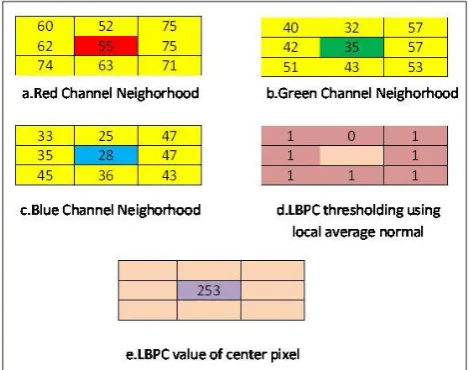
[image:4.595.49.285.543.728.2]The terms used in Equations (5), (6) and (7) can be taken from Figure 2. The sample LBPC computation based on local average normal vector is given in Figure 3.
Figure 3. LBPC Computation using Local Average Normal
A.2 Center Normal Vector
The normal vector n=(n1,n2,n3) is derived using only the center pixel characteristics. The center pixels rc,gc, and bc from red, green and blue planes used to find the value of ‘n’. The description of normal vector ‘n’ using center normal is given in Equation 8.
2 2 2 2 2 2 2 2 2
rc gc bc
n , ,
rc gc bc rc gc bc rc gc bc
(8)
A.3 Mean Normal
The maximum and minimum values of surrounding neighbors in each channel neighborhood is used to compute the normal vector n=(n1,n2,n3). The normal vector is drawn using the Equation 9.
x x x
2 2 2 2 2 2 2 2 2
x x x x x x x x x
R G B
n , ,
R G B R G B R G B
(9)
The term Rx in equation 9 is the mean of minimum and maximum values of surrounding neighbors in 3x3 red channel neighborhood. The terms Gx and Bx in Equation 9 are defined correspondingly for green and blue channel neighborhoods.
A.4 LBPC feature vector Formation
The LBPC label of color image with three values in r,g,bplanes is calculated as per the procedure given in section A. The histogram of the LBPC values of an image is called as LBPC feature vector of an image that represents the image for further processing.
B. Similarity Measurement
Similarity matching is the next to process of CBIR system after the feature vector formation of the images in database. The similarity assessment in CBIR can be done with the aid of distance measures. There are different distance gauges such as Euclidean distance, Chi-square distance, Manhattan distance, Canberra distance, d1 distance and many more. Among the various distance measures, d1 has been successfully employed for local patterns [37]. The d1 distance between two vectors ‘A’ and ‘B’ of length ‘n’ is calculated as in Equation 10.
n
i 1
A[i] B[i] d1(A, B)
1 A[i] B[i]
(10) C.Proposed CBIR system with LBPC Feature Descriptor
Figure 4. CBIR system using LBPC Features and d1 distance similarity
IV. EXPERIMENTALANDRESULTS
[image:5.595.313.560.214.345.2]The image retrieval system with LBPC feature vector is experimented on the Wang Database in this work. The objective of this experimentation is to find which hyper-plane definition is suitable for LBPC feature for image Retrieval purpose. The Wang Database consists of 1000 number of colorimages that are equally partitioned into 10 classes of 100 images in each class. Wang database consists of the images in the classes of African people, beach, building, bus, dinosaur, elephant, flower, food, horse, and mountain. The modelimage in each categoryis given in Figure 5.
Figure 5. Sample image in each class of Wang Database Each one database image is selected as a query image for image retrieval experiments and the outcomes are received. The effectiveness of the image retrieval system is measured with Precision and Recall measures. The Precision and Recall of each query image ‘q’ are defined in the Equations (11) and (12) respectively.
Number _ of _ Re levant _ images _ Re trieved P(q)
Total _ number _ of _ images _ Re trieved
(11)
Number _ of _ Re levant _ images _ Re trieved R(q)
Total _ number _ of _ Re levant _ images _ in _ Database
(12)
P(q) and R(q) in Equations (11) and (12) are representing Precision and Recall value of query image ‘q’ respectively. Average Precision AP(q) and Average Recall AR(q) values of query image ‘q’ with respect to Top ‘i’ images retrieved are calculated using the Equations (13) and (14).
N i 1
1 Number _ of _ Re levant _ images _ Re trieved AP(q)
N Top _'i '_ images _ Re trieved
(13)N
i 1
1 Number _ of _ Re levant _ images _ Re trieved AR(q)
N Total _ number _ of _ Re levant _ images _ in _ Database
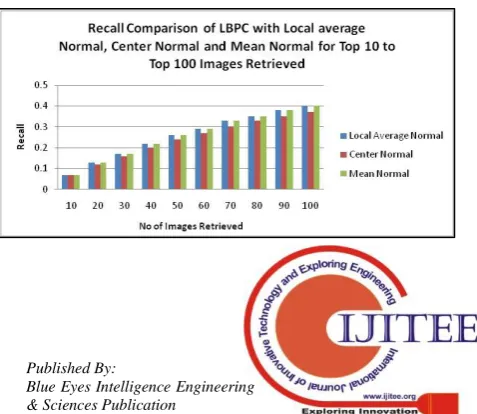
(14) [image:5.595.62.287.412.495.2] [image:5.595.311.569.436.583.2]Experiments are carried out in three image retrieval systems such as LBPC with local average normal, LBPC with center normal and LBPC with mean normal. The precision and recall values of each image in the Wang database is calculated separately for three image retrieval system. Precision values are computed for Top 1 to Top10 images retrieved in the interval of 1, and for Top 10 to Top100 images retrieved in the interval of 10. Recall values of the query images are worked out for Top 10 to Top100 images retrieved in the interval of 10. The Precision comparison of Top1 to Top10 images retrieved in the interval 1 is given in Figure 6.
Figure 6. Precision Comparison of Top 1 to Top 10 Images Retrieved
The Precision comparison of Top10 to Top100 images retrieved in the interval 10 is given in Figure 7.
Figure 7. Precision Comparison of Top 10 to Top 100 Images Retrieved
[image:5.595.308.547.625.832.2]Figure 8. Recall Comparison of Top 10 to Top 100 Images Retrieved
It is perceived from the graphical representations of Precision and Recall analysis, the LBPC with Local average Normal Vector and Mean Normal vector are equally good. The performance of image retrieval system of LBPC with Center Normal is not up to the level of the other two. Though the graphical representation depicts that Local Average Normal vector and Mean Normal vector based LBPC are performed equally, it is better to have a single value measure to substantiate the statement. The Mean Average Precision (MAP) is such a measure with the values ranged from 0 to 1. The retrieval system with maximum MAP is the system with maximum retrieval efficiency. The MAP value is the mean average precision of all queries in the Database. The computation of MAP is given in Equation (15).
Q
q 1 1
MAP AP(q)
Q
(15) The term ‘Q’ in Equation (15) is the total number of query images in the database. This work uses the parameter N=10 to calculate AP(q). The MAP values of LBPC based image retrieval system with Local Average Normal, Center Normal and Mean Normal is presented in Table 2.
Table 2. MAP comparison of LBPC with Different Hyper_plane Definition
Retrieval Method MAP
LBPC with Local Average Normal Vector
0.78
LBPC with Center Normal Vector 0.77
LBPC with Mean Normal Vector 0.78
The MAP measure also validates that mean normal vector based hyper_plane definition can be used in place of local average normal vector based hyper_plane while deriving LBPC feature.
V. CONCLUSION
LBPC has been proved as the effective feature to represent the color images for the retrieval purpose. The LBPC is differentiated from other up_to_datelocal patterns in the manner of binary encoding. The LBPC thresholds the pixels into binary values based on their position on the hyper_plane. The hyper_plane definition can be varied with respect to how normal vector is derived. This work experimented the performance of LBPC feature vector in Wang database with three normal vectors; Local average Normal, Center Normal and Mean Normal. The precision and recall analysis, MAP values symbolize that the Local average Normal vector and Mean Normal vector in LBPC produced the equally competent, and they are superior to the Mean Normal vector. This work suggested that the hyper_plane of LBPC feature vector can be defined either by Local average Normal vector or Mean Normal vector. It is recommended to augment the LBPC with other efficient features to improve the retrieval efficiency.
REFERENCES
1. Pfund,T&Marchand-Maillet, S. ‘Dynamic multimedia annotation tool’, in SPIE Proceedings 4672, Internet Imaging III, 2001.
2. Rui,Y, Huang, TS & Chang, S-F, ‘Image Retrieval: Current Techniques, Promising Directions, and Open Issues’, Journal of Visual Communication and Image Representation, vol.10, 1999,pp.39-62. 3. Stricker, M &Dimai, A, ‘Color indexing with weak spatial constraints’,
in Proceedings of SPIE Storage Retrieval Still Image Video Databases IV, vol. 2670, 1996, pp. 29-40.
4. Stricker, M &Orengo, M, ‘Similarity of color images’, in Proceedings of SPIE Storage Retrieval Still Image Video Databases IV, vol. 2420, 1995, pp. 381-392.
5. Smith, JR & Chang, S-F, ‘Tools and techniques for color image retrieval’, Proceedings of SPIE, vol. 2670, 1996, pp. 2-7.
6. Huang, J, Kumar, SR, Mitra, M, Zhu, W &Zabih, R, ‘Image indexing using color correlograms’, in Proceedings of IEEE Conference Computer Vision Pattern Recognition, 1997, pp. 762–768.
7. Pass, G &Zabih, R, ‘Histogram refinement for content based image retrieval’, in Proceedings of IEEE Workshop Applications Computer Vision, 1996, pp. 96–102.
8. Liu, Y, Zhang, D, Lu, G & Ma, WY, ‘A Survey of Content Based Image Retrieval with High Level Semantics’, Pattern Recognition, vol. 40, 2007, pp. 262-282.
9. Tamura, H, Mori, S &Yamawaki, T, ‘Texture features corresponding to visual perception’, IEEE Transactions On Systems, Man and Cybernetics, vol.8, no.6, 1978, pp. 460-473.
10. Haralick, RM, Shanmugam, K &Dinstein, I, ‘Texture features for image classification’, IEEE Transactions on Systems, Man and Cybernetics, vol.3, no.6, 1973, pp.610-621.
11. Laws, KI,‘Rapid texture identification’, in Proceedings of SPIE. vol.238, 1980, pp. 376-380.
12. Ma, WY &Manjunath, BS, ‘A comparison of wavelet transform features for texture image annotation’, in Proceedings of IEEE International Conference on Image Processing, vol.2, 1995, pp. 256-259.
13. Liu, F & Picard, RW, ‘Periodicity, directionality, and randomness: Wold features for image modeling and retrieval’, IEEE Transactions on Pattern Analysis and Machine Learning, vol.18, no.7, 1996, pp.722-733. 14. Ojala, T, Pietik¨ainen, M &M¨aenpaa, T, ‘Multiresolution gray-scale
and rotation invariant texture classification with local binary pattern’, IEEE Transactions on Pattern Analysis and Machine Intelligence, vol.24, no.7, 2002, pp.971-987.
15. Rui, Y, She, AC & Huang, TS, ‘Modified fourier descriptors for shape representation- a practical approach’, in Proceedings of First International Workshop on Image Databases and Multi Media Search,1996.
16. T. Ahonen , A. Hadid , M. Pietikäinen , Face recognition with local binary pat- terns, in: Proceedings of the European Conference on Computer Vision (ECCV), 2004, pp. 469–481 .
17. T. Ahonen , A. Hadid , M. Pietikäinen , Face description with local binary pat- terns: application to face recognition, IEEE Trans. Pattern Anal. Mach. Intell. 28 ,12, 2006, 2037–2041 .
18. T. Mäenpää, T. Ojala , M. Pietikäinen , M. Soriano ,Robust texture classification by subsets of local binary patterns, in: Proceedings of the International Con- ference on Pattern Recognition (ICPR), 2000, pp. 3947–3950.
19. V. Takala , T. Ahonen , M. Pietikäinen , Block-based methods for image retrieval using local binary patterns, in: Proceedings of Scandinavian Conference on Image Analysis, 2005, pp. 882–891 .
20. T. Mäenpää, M. Pietikäinen , J. Viertola , Separating color and pattern information for color texture discrimination, in: Proceedings of 16th International Conference on Pattern Recognition, vol. 1, 2002, pp. 668–671.
21. T. Mäenpää, M. Pietikäinen , Classification with color and texture: jointly or separately? Pattern Recognition, 37,8, 2004,pp.1629–1640. 22. J.Y. Choi, K.N.Plataniotis , Y.M. Ro ,Using local binary pattern features
for face recognition, in: Proceedings of 17th IEEE International Conference on Image Processing (ICIF 2010) Sept. 26–29, Hong Kong, 2010, pp.4541–4544.
23. S.H. Lee , J.Y. Choi , Y.M. Ro , K.N. Plataniotis , Local color vector binary patterns from multichannel face images for face recognition, IEEE Transactions on Image Processing, 21,4,2012,pp.2347–2353. 24. C. Zhu , C.-H. Bichot, L. Chen, Image region description using
orthogonal combination of local binary patterns enhanced with color information, Pattern Recognition, 46, 2013,pp.1949–1963.
Processing, 25,2, 2015,pp.566–579.
26. J. Li , N. Sang , C. Gao , Completed local similarity pattern for color image recognition, Neurocomputing 182,2016,pp.111–117.
27. S.R. Dubey , S.K. Singh , R.K. Singh , Multichannel decoded local binary patterns for content-based image retrieval, IEEE Transactions on Image Processing, 25,9,2016,pp.4018–4032.
28. Chandan Singh, EktaWalia, KanwalPreet Kaur, Color Texture Description with Novel Local Binary Patterns for Effective Image Retrieval, Pattern Recognition, 75,2018,pp.50-68.
29. WangXing-yuan ,ChenZhi-feng, YunJiao-jiao, An effective method for color image retrieval based on texture, Computer Standards & Interfaces 34,2012,pp.31–35.
30. SushilaAghav-Palwe, Dhirendra Mishra, Color Image Retrieval using Compacted Feature Vector using Mean-Count Tree, Procedia Computer Science, 132,2018,pp.1739-1746.
31. Guang-Hai Liu, Jing-Yu Yang, Content-Based Image Retrieval using Color Difference Histogram, Pattern Recognition, 46 ,2013, pp.188-198. 32. Tzu-ChuenLu, Chin-chenChang, Color image Retrieval Technique based on color features and bitmap, Information Processing &Mangement, 43,2,2007,pp.461-472.
33. Linh Viet Tran, ReinerLenz, Compact Colour descriptors for colour-based image retrieval, Signal Processing, 85,2,2005,pp. 233-246. 34. JuvYue, ZhenboLi, LuLiu, ZetianFu,Content-based image retrieval using color and texture fused futures, Mathematical and Computer Modelling, 54, 3-4,2011, pp.1121-1127.
35. Xiang-Yang wang, Hong-Ying Yang, Yong-wei li, Fang-yuyang,Robust color image retrieval using visual interest point feature of significant bit-plane, Digital Signal Processing 23,4,2013,pp.1136-1153. 36. Ahmed Talib, MassudiMahmuddin, HusnizaHusni, LoayE.George, A
Weighted Dominant Color descriptor for content-based image retrieval, Journal of Visual Communication and Image Representation, 24,3,2013, pp. 345-360.
37. Manish Verma, Balasubramanian Raman, Local tri-directional patterns: A new texture feature descriptor for image retrieval, Digital signal Processing 51,2016,pp.62-72.
AUTHORSPROFILE
Dr.C.CallinsChristiyana, Professor, Department of Computer Science and Engineering, Sethu Institute of Technology completed U.G and P.G degree in ManonmaniumSundaranar University, Tirunelveli and completed her Ph.D in Anna University Chennai. She is doing her research in Content Based Image retrieval. She has published more than 20 papers in Journals and Conferences. She has membership in ISTE and CSI.
M.Mathinakani, Assistant professor (S.G),Department of Computer Science and Engineering, Sethu Institute of Technology completed U.G in ManomaniumSundaranar University, Tirunelveli and P.G in Anna University. She is doing her research in Image Processing and has published 5 papers in various journals and Conferences.
M.Poomani@Punitha, Assistant Professor (S.G), Department of Computer Science and Engineering, Sethu Institute of Technology completed U.G and P.G degree in Anna University, Chennai. She is doing her research in Object based Image Classification. She has published more than 5 papers in Journals and Conferences. She has membership in ISTE and CSI.