Abstract—Solid waste management is a challenging and major problem of surroundings in the whole globe. Hence there is a need to evolve an effective system which can resolve this issue or at least decrease it to the minimum level. Nowadays, government across the world is planning to construct smart cities or attempt to transform the cities into smart cities. The solid waste collection is an essential point for surroundings and its effect on society must be regarded seriously in infrastructure of smart cities. IoT (internet of things) techniques can manage such services efficiently in smart cities. In this study solid management system based on Internet of Things is proposed which permits the municipal corporations to supervise the dustbin status over web server remotely and maintain the cities clean by optimizing time and cost needed for it. As soon as the dustbin has been filled its maximum level the department of waste management passes an alert message through GSM module so the department can send the waste collector vehicle to respective place to gather the garbage. The study helps in recognizing the smart garbage management systems that can be used to make the city clean and hygienic.
Keywords: IoT, Solid Waste Management, Microcontroller, GSM module, Arduino Software, RF Transmitter
I. INTRODUCTION
Due to drastic increase in economic and population growth in the nation there is huge development in the generation of the solid waste. Solid waste management is a main problem of surroundings in the whole globe. SWM is a huge problem not only in urban cities of India but in most of the nations in the globe. There is a requirement to evolve an effective system which will resolve this issue or decrease it to some level. It will support them to maintain their surroundings green and clean in an effective way. Today each government across the world is scheduling to construct smart cities or attempt to change the cities into smart cities. A smart city is a city which is constructed on smart integration of activities and endowments of independent, aware and self-decisive citizens. The solid waste collection in a smart city is an essential part for surroundings and its effect on society must be regarded seriously. By offering a whole internet of things based system the process of collecting, tracking and handling the solid waste can be monitored and automated easily and effectively(Chaudhari and Bhole, 2018; Ramesh et al, 2018; Sharma and Singh, 2018). Pokalekar et al (2018) has stated that internet of things can be described as a physical object networking with the use of embedded software and electronic sensors that
Revised Manuscript Received on August 05, 2019.
Ms.S.Loganayagi, Assistant Professor, Department of Computer Science, Valliammal College for Women, Chennai, Tamilnadu, India.
Dr.C.jeyabharathi, Assistant Professor, PG Department of Computer Science, AruliguPalaniandavar arts College for Women, Palani, Dindigul, Tamilnadu, India.
permits the devices to receive and send information from each other. The internet of things carries out collection of data, sensing, storing data and processing by linking physical devices to internet.
Surapaneni et al (2018) has stated that the municipal corporations are wholly liable for proper management of waste in their respective cities in the context of India. But most of the authorities are not satisfying their duty to offer effective ways of handling the waste generation at source, transporting, collecting and waste disposal. Because of this ineffective waste collection, the collected waste is always integrated with excreta of animals and humans in the drains and liable for roads flooding during rains, breeding of insects and lastly resulting in spreading various diseases. Dilip et al (2018) internet of things SWM system is a creative way which will support to maintain the cities clean. This system supervises the bins of garbage and informs about the garbage collected in dustbin through a web page. For this the system utilizes ultrasonic sensors placed on the top of dustbin to sense the level of garbage and comparing it with depth of garbage bins continuously (Nithish et al, 2019). This system makes use of LCD screen, ARM microcontroller, RF transmitter and GSM module for sending the information. The LCD display is utilized to show the garbage collected level in dustbins in percentage form. Sherly et al (2018) has stated that the solid waste management system is produced every day and by 2025 it would increase rapidly and hence effective method and decisions must be taken in order to handle the waste. Kumar et al (2016) have led a method of handling waste in a well-mannered way. The internet of things based alert system is used to produce the alarm signal to municipal officers. Arduino UNO is interlinked with ultrasonic sensor to evaluate the garbage level of dustbin (Anwar et al, 2018). RFID is used to identity and verify dustbin. Android application is connected with web server for interaction from municipal officer to nearby truck vehicle to collect the garbage (Pawar et al, 2018). Several solutions have been used for waste management to make it efficient and smarter. Every waste bin is attached with ultrasonic sensor which predicts the level of waste of dustbin (Sharma et al, 2018). According to Ali et al (2018) the ultrasonic measures estimate the waste level by sending a sound wave at a particular frequency and listens the sound wave that is bounced (Rao et al, 2018). Moisture sensor predicts the waste content that is disposed into dustbin and segregates the waste stored relying on waste moisture content (Jadhao et al, 2018)
Development of an Iot System for Efficient
Classification and Management of
Solid Waste in Indian Cities- A Research
Pardini et al (2019) has mentioned that the coordinated arrangement of RFID, GPS and GPRS makes the dustbin customer information and identification accumulation structure effective. The GPRS and GPS are usually implemented in the electronic/computerized guide, the vehicle administration and monitoring system and the navigation of security. RFID has applications in the environment field (Poornakumar et al, 2018). According to Harika et al (2018) motion detection sensor can be placed exterior of dustbin for automatic opening and closing of lid on dustbin. The sensor predicts if any individual is there near to dustbin for disposing any waste and the lid is opened for throwing the waste. Akshatha et al (2016) has stated that the smart waste management system offers the best way to support public people to handle the city clean by using the developed application to locate various dustbin places in various places of the region. The application also offers various dustbin status if they are empty, completely full or semi full. This saves the time and supports people to throw out the waste only in dustbin and not elsewhere in the city. The waste management system aims to offer effective way to keep the environment clean (Deka and Goswami, 2018).Thus, it can be inferred that the technologies used in the proposed system are better enough to assure perfect and practical solution for the process of solid garbage management and monitoring for green environment.
II. LITERATURE REVIEW
A. Meaning and Definition of Internet of Things (IoT)
According to Patel and Patel (2016) Internet of things is defined as a network type to link anything with internet based on stipulated protocols through equipment’s of information sensing to organize communication and information exchange to accomplish smart positioning,
recognition, administration, tracing and
monitoring.Levallois(2017) defined internet of things as an interlink of physical devices also known as smart devices and connected devices, construction and other items involved with software, electronics, actuators, network connectivity and sensors which develop these objects to exchange and collect data.
Arkko et al (2015) denotes internet of things as a trend where huge set of embedded tools use services of communication provided by the protocols of internet. Most of these devices always referred smart objects which are not operated by humans directly but occur as components in vehicles or buildings or are distributed in the surroundings. Thaler et al (2015) defined internet of things as a worldwide infrastructure for information society developing advanced services by interlinking virtual and physical things based on evolving and existing interoperable ICT. Through the use of recognition, data processing, communication and capture capabilities the internet of things makes complete use of things to provide services to entire types of applications whilst assuring the privacy and security needs are satisfied. The internet of things can be understood as a vision with societal and technological suggestions.
According to GSM Association (2014) internet of things defines the use of intelligently linked systems and devices to leverage data collected by actuators and embedded
sensors in machines and other physical devices. Internet of things is anticipated to spread rapidly in the upcoming years and this convergence will release new service dimension that develops customer’s life quality and enterprises productivity. IEEE (2014) defines internet of things as an items network each involved with sensors which are linked to internet.
Chebudie et al (2014) has mentioned that internet of things envisions a complex and self-designing network that interlinks things to internet through the use of standard protocols of communication. The interlinked things have virtual or physical representation in digital world, capability of actuation/sensing, and a feature of programmability and are identifiable distinctly. The representation comprises information involving the things status, identity, place or any other social, business and privately related data. The things provide services without or with intervention of humans through the use of distinct recognition, data communication capture and capability of actuation. The service is used through the use of intelligent interfaces and is made feasible anytime, anywhere and for anything considering security.
Hung (2017) has defined the IoT as dedicated physical objects network that comprises embedded technique to sense and interact or communicate with their external environment and internal states. The link of processes, personnel and assets enhance the seizure of events and information from which a firm can learn usage and behaviour react with preventive measures or transform or augment processes of business. The internet of things is a basic capability for the making of digital business. In the report of EY (2016) the internet of things explains the link of devices to internet using embedded sensors and software to interact, exchange and gather information with one another. The globe is wide open with internet of things providing an endless number of opportunities widely and links at work, at play and at home. Madakam et al (2015) defined IoT as a comprehensive and open network of intelligent events that have the capability to organize automatically, share data, resources and information, acting and reacting in face of circumstances and alterations in the surroundings.
B. Applications of IoT in waste management
waste. These two types of algorithms are used for predictive examination of waste collection on day to day basis so as to assure efficient and effective sorting and collection of disposed household materials of waste.
Suryawanshi et al (2018) proposed a smart alert system for clearance of garbage by providing an alert signal to municipal web server for immediate dustbin cleaning with appropriate verification based on the garbage filling level. An Android application is linked and developed to web server to inform the alerts from microcontroller to urban office and to carry out remote supervision of the process of cleaning performed by workers thereby decreasing the manual monitoring process and verification (Roopesh et al, 2018; Shirke et al, 2019). Zavare et al (2017) proposed a system for the collection and identification of garbage bin waste. In this system the containers of garbage transfer the signals to proper authority representing that it is around 80 to 90 percent full and needs to be cleared. A notification or a signal is sent through a mobile communication network to a web application used by the garbage collecting vehicle and the authorities of waste management once the garbage bin is full. By using the GSM (Global Systems for Mobile Communication) technique a unique id is allotted to each bin and it will pass its location coordinates to the vehicle (Monika et al, 2016). Similarly, Kumar et al (2017) proposed internet of things based smart waste clean management system which verifies the level of waste over dustbins using sensor systems. Once it is predicted immediately this system is changed to concern authorized through GPRS/GSM. This system used microcontroller as an interface between the GPRS/GSM and sensor system. To integrate and monitor an android application is evolved for the desired data which is associated to different waste level in various places.
Chaware et al (2017) proposed an integrated system of wireless fidelity modem, GSM, internet of things and ultrasonic sensor for economic and effective collection of garbage. The developed system offers developed database for collection time of garbage and amount of waste in every place. By implementing this system, the researchers will avoid garbage overflow from container in residential places which is loaded manually or with the use of loaders in traditional trucks. Kalpana and Jayachitra(2017) proposed a system of intelligent bin management which records all the details about dustbins and their server location. In this system the users are liable for supervising the garbage level in the bin as well as passing such data to sever. The details are used by proper authorities at the end of receiving through internet and instant response can be started to dispose the garbage bin. The bin can be emptied only when a user passes the bin status to server through a mobile application.
Devi and Chandan (2017) implemented a system of smart garbage management using PIR sensor, ultrasonic sensor, GSM, microcontroller, wireless fidelity module and GPS. This system ensures the trash bins cleaning when the level of garbage meet its maximum a message is sent to authority. This decreases the total number of garbage collection vehicle trips and hence decreases the whole expenditure related with collection of garbage. It mainly helps to keep the society clean. Rajavizhi et al (2018) implemented smart
garbage managements system using microcontroller, wireless fidelity module and ultrasonic sensor. This system ensures dustbin cleaning when the level of garbage meets its maximum. Therefore, the smart garbage management system makes the collection of garbage much effective. Navghane et al (2016) implemented internet of things based smart garbage and waste collection bins using microcontroller, wireless fidelity module and IR sensor. This system ensures the dustbin cleaning when the level of garbage meets its maximum. If the dustbin is not cleaned in a particular amount of time then the record is passed to higher authority who can take proper measures against the concerned contractor. On the whole it supports to keep the cleanliness in society. The smart garbage management system makes the system of garbage management much effective.
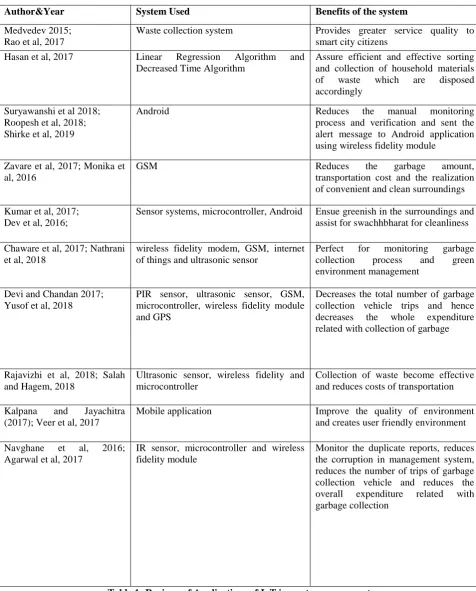
Author&Year System Used Benefits of the system Medvedev 2015;
Rao et al, 2017
Waste collection system Provides greater service quality to smart city citizens
Hasan et al, 2017 Linear Regression Algorithm and
Decreased Time Algorithm
Assure efficient and effective sorting and collection of household materials of waste which are disposed accordingly
Suryawanshi et al 2018; Roopesh et al, 2018; Shirke et al, 2019
Android Reduces the manual monitoring
process and verification and sent the alert message to Android application using wireless fidelity module
Zavare et al, 2017; Monika et al, 2016
GSM Reduces the garbage amount,
transportation cost and the realization of convenient and clean surroundings
Kumar et al, 2017; Dev et al, 2016;
Sensor systems, microcontroller, Android Ensue greenish in the surroundings and assist for swachhbharat for cleanliness
Chaware et al, 2017; Nathrani et al, 2018
wireless fidelity modem, GSM, internet of things and ultrasonic sensor
Perfect for monitoring garbage collection process and green environment management
Devi and Chandan 2017; Yusof et al, 2018
PIR sensor, ultrasonic sensor, GSM, microcontroller, wireless fidelity module and GPS
Decreases the total number of garbage collection vehicle trips and hence decreases the whole expenditure related with collection of garbage
Rajavizhi et al, 2018; Salah and Hagem, 2018
Ultrasonic sensor, wireless fidelity and microcontroller
Collection of waste become effective and reduces costs of transportation
Kalpana and Jayachitra (2017); Veer et al, 2017
Mobile application Improve the quality of environment
and creates user friendly environment
Navghane et al, 2016; Agarwal et al, 2017
IR sensor, microcontroller and wireless fidelity module
[image:4.595.58.535.57.649.2]Monitor the duplicate reports, reduces the corruption in management system, reduces the number of trips of garbage collection vehicle and reduces the overall expenditure related with garbage collection
C. Development of IoT system for solid waste management in Indian cities
The research of Mary et al (2017) presents an internet of things based garbage monitoring system to manage the environment safe and clean. This system is very creative system which will be used to keep cities clean. This system supervises the bins of garbage and notifies about the garbage collected level in garbage bins through web page. Also it notifies the toxic gas formation status inside the bin as well as bin weight. The system uses ultrasonic sensor placed over bins to predict the level of garbage and compare it with the depth of garbage bin level (Balekai et al, 2018).
The study of Nirde (2017) have proposed wireless SWM for smart cities which permits municipal corporations to supervise dustbins status remotely over web server and maintain cities clean by optimizing time and cost needed for it. As soon as the dustbin has met its maximum limit the department of waste management gets alert message through SMS through GSM module placed at dustbin so that the department can send waste collector to respective places to gather garbage. The main aim of the study is to develop the internet of things practicality based solid waste management and collection system for smart city (Mahajan et al, 2017).
Vaisali et al (2017) provides internet of things-based solutions for managing the problems like accumulation of information, administration and security viewed by door innovation much superior to present powerful framework of waste administration. By providing a complete internet of things-based structure the way toward assembling, dealing and following with powerful waste can be watched and motorized sufficiently. By impacting the use of sensors this research collects information from junk collectors and send them to database server SigFox technique. The data from different junk collectors are collected by secured passage and sent to server or cloud over internet using the protocol stack of Sigfox. The major benefit of the proposed structure is the Sigfox innovation use for information exchanging/correspondence which develops huge isolation transmission of information, much security than past forms alongside reduced power use when compared and Bluetooth, wireless fidelity, LoRA and Zigbee (Bharadwaj et al, 2016). Nair and Valarmathie (2018) study designed an internet of things based waste management framework to make their city clean and neat. In this study the appropriate level of precision and electronic mail caution-based structure provides a rapid opportunity of approved waste. To resolve this structure the following are used namely IR sensors, ARM processor and RF module. This study is using smart phones, digital display devices and smart watches to make the city look clean (Mallick et al, 2017).
Dewangan (2018) has stated in their study with the emergence in cities urbanization and developing population there has been a main concern for developing hygiene, quality and improving health of surroundings. One of the essential barriers is solid waste management from its initiation to removal. Waste accumulation causes health risks, pollution of environment and in turn spoils the region. Different initiatives have been considered with the purpose of enhancing sustainable surroundings using smart solutions. To eliminate and remove the solid garbage, internet of
things-based techniques has been developing as an advantageous method. This study reviews a survey on different internet of things enabled techniques adopted as a smart solution for SWM to evolve a smart city.
Deshmukh et al (2018) concentrated on implementation of internet of things based embedded system which combines Arduino, IR sensors, Bluetooth and UNO module for solid waste bin and system of track monitoring with their performance estimated in real time surroundings. The android applications based on web were evolved to interface with web server to inform municipality regarding the process of cleaning carried out by workers. This system offers a database comprising data of the status of bin, waste amount in bin, time of the waste collection are transmitted to mage and monitor the strategies of waste collection efficiently.
Harish et al (2018) study designed an 8bit x-mega2560 controller with U-Box GPS and an MCU wireless fidelity node with MQTT protocol is utilized for solid waste management system design in metro. This study designed a system to offer the filled level of garbage bin status and also offers the data like humidity, temperature, with longitude and latitude of the position of bin using U-Blox GPS to pass the data to cc2500 wireless unit control centre is utilized as an extra characteristic for spreading the messages for numerous users issued by authorized user for whole automation with exchange of information will be provided using MQTT protocol.
Kesthara et al (2018) present a creative way which revolutionizes the system of trash management which is a step towards clean India. Using the embedded technique to continue supervising the dustbin to verify whether the dustbin is full or not. The sensors senses the waste amount in containers if it meets the maximum capacity and sends immediate messages to trash management which deploys them to gather garbage in no time. The main aim of this study is to isolate the waste in various dustbins and send the data to respective places once the dustbins is filled with waste materials. By using this product at various places instead of driving blindly in static routes the collection schedule can be optimized (Balakrishnan et al, 2016).
Paulchamy et al (2018) discusses one of the most challenging problems which municipal waste collection within smart city. To optimize the logistic method of collection of waste genetic algorithm is used in this study. The presented solution offers estimation of effective truck routes of garbage. As a result, this study offers a simulation set and all algorithms are implemented within the framework of integrated simulation which is evolved as an open source solution with respect to future changes.
predict the level of garbage, AVR instruction set microcontroller Tmega16 for handling the working of complete system, GSM to pass messages to higher authority and GPRS for updating the dustbin status on designed sites.
The main aim of the proposed system is to handle the cleanliness level in the city and form a surrounding which is good for living.
Author & Year Techniques used Findings of the research
Mary et al,
2017;Balekai et al, 2018
Garbage monitoring system on IoT gecko web development and Arduino board platform
Provides authorized users with proper update of the garbage bin location and thus reduces the requirement of overflowing garbage bins and intermittent manual checks
Nirde, 2017;Mahajan et al, 2017
Wireless SWM Develops the practicality of internet of things based solid waste management and collection system for smart city
Nair and Valarmathie 2018;
Mallick et al, 2017
Precision level and Electronic Mail caution-based structure
Maintain the surge of dustbin and make the earth clean and immaculate, reduce the wastage of cost, time and importance of human being and the drivers acquire the data successfully on to the technique of cleaning and perform their job in a fraction of seconds
Vaisali, 2017; Bharadwaj et al, 2016
Deshmukh et al 2018;Mungara et al, 2018
IR sensors, UNO, Arduino and Bluetooth module
Supervise the status of waste collection in real time surroundings and estimate the yardman performance thereby decreasing the manual process of verification and monitoring
Dewangan, 2018; Vu and Kaddoum, 2018
Ultrasonic sensors, Force sensors, IR sensors, Graph theory classification and regression technique, GSM
Internet of things is used as an efficient method for solid waste management in public areas
Harish et al, 2018; Abeesh et al, 2018
Automatic sensing system Develops the smart waste management and reduced exposure in pollution
Kesthara et al, 2018; Saminathan et al, 2019
Automatic Segregation system Gathers waste segregation automatically, saves the time, optimize the resources and clean the environment.
Paulchamy et al, 2018;Fujdiak et al, 2016
Genetic Algorithm Used as an optimization approach for municipal solid waste collection
Rupa et al, 2018; Saranya et al, 2018
Smart garbage management system based on IoT
[image:7.595.322.535.451.644.2]Improves the environment quality and satisfies the SWACH BHARAT ABHIYAN goal which is an initiative of government for cleanliness of environment
Table 2: Reviews of Development of IoT system for solid waste management in Indian cities Source: Author
III. PROPOSED SYSTEM
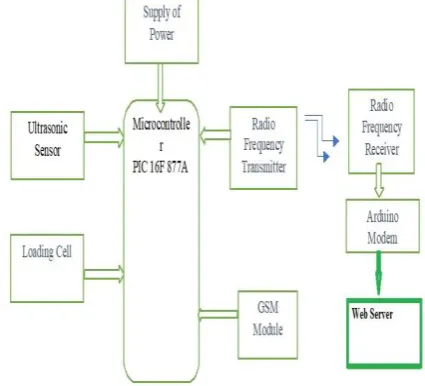
The things that are related with internet and these devices can be verified occasionally from web are regularly known as Internet of Things. In this proposed system the dustbins are organized at various places. The smart clean dustbin is associated with web to get the status which is on-going. Two ultrasonic sensors are settled at greater place of dustbin to avoid inaccurate measurement level and are interlinked with PIC microcontroller. The weight sensor is placed at dustbin base and is interlinked additionally with controller to identify over junk weight filled in dustbin. Both sensors pass the signals to controller and the radio frequency transmitter encodes the data emerging from PIC microcontroller and passes it to Arduino unit which performs as receiver, it passes the data to radio frequency collector which is related with the shield of Arduino Ethernet. Arduino Ethernet gathers the data acquired by collector and transfer on online page through the shield of Ethernet. The below figure shows the proposed system diagram:
Figure 1: Proposed System Diagram Source: Author
filling continuously and if the dustbin is filled to its maximum level then an indication exists on LCD display. Similarly, the encoded signal will be transferred by radio frequency transmitter. The GSM module plays an essential part in the garbage monitoring system because it can send the messages to the needed authorities as per the application. The radio frequency receiver acquires the data with the shield of Ethernet. The dustbin status is shown on web page using connections through the shield of Ethernet.
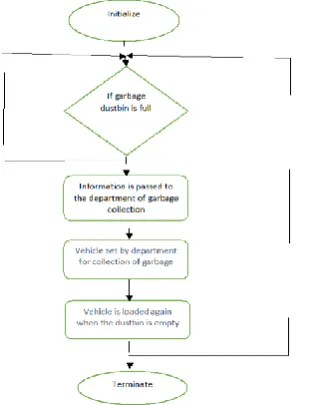
[image:8.595.106.261.266.469.2]The proposed system flowchart is depicted below:From the above chart it can be understood that the web page monitoring will support the department of garbage collection to track for the accurate place and garbage amount. Then the vehicles of garbage can unload the garbage from a specific place. The GSM module function is used to pass the message to the department of garbage collection.
Figure 2: Flowchart of the Proposed System Source: Author
IV. DISCUSSION& RESULTS
A solid waste management system has been implemented using a set of ultrasonic sensors. A dustbin is taken with the values of weight, capacity and cross section. On one side, the ultrasonic sensors have been placed at the top of the dustbin whereas on the other side a load cell is applied. A web page is developed on internet which permits for remote monitoring of the real time status of dustbin. A hypertext mark-up language code was written to design the GUI. The web page offers the data considering the place of dustbin, its name and contact details of coordinator and its status in that respective area. The real time status of dustbin is shown on web page and if the dustbin is full then an SMS is sent through GSM module to the coordinator.
V. CONCLUSION
This study develops the internet of things practicality based on the management and collection of solid waste for smart city. The automatic sensing system is designed using load cell and ultrasonic sensor to provide an automatic and efficient status of dustbin monitoring system. There is a
better scope for growth in algorithm which synthesizes the operating condition of bins, its status, and perception of load status and time threshold. The proposed system ensures the dustbin cleaning when the level of garbage meets its maximum. The proposed system also helps in reducing the total number of garbage collection vehicle trips and hence decreases the whole economy related with the collection of garbage. It mainly handles cleanliness in the environment and society. Thus it can be concluded that a solid waste management system performs in a smart way using internet of things.
VI. REFERENCES
1. Abeesh a, prakash a p, mohan p, poornima and dhanya m (2018), iot based waste management, monitoring & tracking – smart bin, international journal of innovative research in electrical, electronics, instrumentation and control engineering, volume 1, special issue 2, pp 224-230.
2. Agarwal p, sharma s, gupta l and manideep b (2017), smart electronic garbage management system based iot, international journal of soft computing and engineering, volume 7, issue 1, pp 93-95.
3. Akshatha g, sneha k and prasad b g (2016), monitoring and smart planning of urban solid waste management based on iot, international journal of engineering research and technology, volume 4, issue 29, pp 1-4.
4. Ali n, awais m, muzammul m and zafara (2018), intelligent system for garbage collection: iot technology with ultrasonic sensor and arduino mega, international journal of computer science and network security, volume 18, no. 9, pp 102-107.
5. Anwar, m. A. (2018). Iot based garbage monitoring using arduino (doctoral dissertation, west bengal university of technology).
6. Arkko, j., mcpherson, d., tschofenig, h., &thaler, d. (2015). Architectural considerations in smart object
networking, available at
https://tools.ietf.org/html/rfc7452, accessed on 8th august 2019.
7. Balekai r, raghudathesh g p, handigolkar l, harshavardhana h v, manjunath d, manoj m m and pujar y (2018), smart garbage monitoring system using iotgecko, international journal of pure and applied mathematics, volume 120, no. 6, pp 787-797.
8. Bharadwaj, a. S., rego, r., &chowdhury, a. (2016), iot based solid waste management system: a conceptual approach with an architectural solution as a smart city application. In 2016 ieee annual india conference (indicon) (pp. 1-6).
9. Chaudhari s s and bhole v (2018), solid waste collection as a service using iot-solution for smart cities, available at
https://www.researchgate.net/publication/329061124_sol
id_waste_collection_as_a_service_using_iot-solution_for_smart_cities, accessed on 13th august 2019. 10. Chaware p d s m, dighe s, joshi a, bajare n and korke r
11. Chebudie a b, minerva r and rotondi d (2014), towards a definition of the internet of things (iot), available at
https://www.researchgate.net/publication/317588072_to
wards_a_definition_of_the_internet_of_things_iot,
accessed on 8th august 2019.
12. Deka, k., &goswami, k. (2018). Iot-based monitoring and smart planning of urban solid waste management.
In advances in communication, devices and
networking (pp. 895-905). Springer, singapore.
13. Deshmukh d, karme a, nagmote b, joshi m, dekate n and mishra p (2018), iot based garbage monitoring using location tracking system, ijariie, volume 4, issue 2, pp 215-220.
14. Dev a, jasrotia m, nadaf m and shah r (2016), iot based smart garbage detection system, international research journal of engineering and technology, volume 3, issue 12, pp 153-155.
15. Devi l p and chandan b r (2017), iot based waste management system for smart city, iaetsd journal for advanced research in applied sciences, volume 4, issue 7, pp 322-327.
16. Dewangan, s (2018), iot-enabled intelligent solid waste management system for smart city: a survey, international journal of advanced in management, technology and engineering sciences, volume 8, issue 3, pp 221-223.
17. Dilip k p, dnyandeo j m, changdev j p and lavhate s s (2018), iot based solid waste management for the smart city, international journal of advance research, ideas and innovations in technology, volume 4, issue 2, pp 2032-2036.
18. Ey (2014), internet of things: human machine interactions that unlock possibilities, ey report.
19. Fujdiak r, masek p, mlynek p and misuree j (2016),,”using genetic algorithm for advanced municipal waste collection in smart city”, ieee 10th international symposium on communication systems, networks and digital signal processing
20. Gsma (2014), understanding the internet of things, available at
https://www.gsma.com/iot/wp-content/uploads/2014/08/cl_iot_wp_07_14.pdf, accessed
on 8th august 2019.
21. Harika k, muneerunnisa, rajasekhar v, rao p v and sreelakshmi l j n (2018), iot based smart garbage monitoring and alert system using arduinouno, international journal of innovative research in computer and communication engineering, volume 6, issue 2, pp 22. Harish s v, arjun y k, vinay m n, mujamil m j and praveen
(2018), iot based solid waste management system, international research journal of engineering and technology, volume 5, issue 5, pp 3569-3575.
23. Hasan, b. M., yeazdani, a. M. M., istiaque, l. M., &chowdhury, r. M. K. (2017). Smart waste management system using iot (doctoral dissertation, brac university). 24. Hung m (2017), leading the iot: gartner insights on how
to lead in a connected world, gartner research.
25. Ieee (2014), “special report: the internet of things.”
Available at
http://theinstitute.ieee.org/static/special-report-the-internet-of-things, accessed on 8th august 2019.
26. Jadhao p a, sakhare s d, bhaldane k g, narkhede a p and girnale v s (2018), smart garbage monitoring and collection system using internet of things, international journal of advance engineering and research development.
27. Joshi, r., &ahmed, s. (2016). Status and challenges of municipal solid waste management in india: a review. Cogent environmental science, 2(1), 1139434. 28. Kalpana, m., &jayachitra, j. (2017).Intelligent bin
management system for smart city using mobile
application. Asian journal of applied science and technology (ajast), 1(5), pp 172-175.
29. Kesthara v, khan n, praveen s p, mahesha c and murali n (2018), sensor based smart dustbin for waste segregation and status alert, international journal of latest technology in engineering, management and applied sciences, volume 7, issue 4, pp 171-173.
30. Kumar, n. S., vuayalakshmi, b., prarthana, r. J., &shankar, a. (2016), iot based smart garbage alert system using arduinouno. In 2016 ieee region 10 conference (tencon) (pp. 1028-1034).
31. Kumar, s. V., kumaran, t. S., kumar, a. K., &mathapati, m. (2017).smart garbage monitoring and clearance system using internet of things.in 2017 ieee international conference on smart technologies and management for computing, communication, controls, energy and materials (icstm) (pp. 184-189).
32. Levallois c (2017), definition of iot and connected
objects, available at
https://seinecle.github.io/iot4entrepreneurs/generated-pdf/definitions.pdf, accessed on 8th august 2019. 33. Madakam, s., ramaswamy, r.And tripathi, s. (2015)
internet of things (iot): a literature review.Journal of computer and communications, 3, pp 164-173.
34. Mahajan, s. A., kokane, a., shewale, a., shinde, m., &ingale, s. (2017). Smart waste management system using iot. International journal of advanced engineering research and science, 4(4).
35. Mallick t, datta d and alam i (2017), internet of things (iot) based waste management system, 4th national
conference on natural science and technology,
bangladesh.
36. Mary k a, monica p, apsurrunisa a, sreekanth c, pavan g and kumar (2017), iot based garbage monitoring system, international journal of scientific and engineering research, volume 8, issue 4, pp 1478- 1489.
37. Medvedev, a., fedchenkov, p., zaslavsky, a., anagnostopoulos, t., &khoruzhnikov, s. (2015).waste management as an iot-enabled service in smart cities. In internet of things, smart spaces, and next generation networks and systems, springer, cham, pp. 104-115. 38. Monika k a, rao n, prapulla s b and shobha g (2016),
smart dustbin-an efficient garbage monitoring system, international journal of engineering science and computing, volume 6, issue 6, pp 7113-7115.
39. Mungara j, shobha, keerthana m, kanakambika r g and kokila s (2018), survey on smart garbage monitoring system using internet of things (iot), international journal of innovative research in computer and communication engineering, volume 6, issue 3, pp 2143-2147.
40. Nair a r and valarmathie p (2018), iot based waste management system for smart cities, international journal of advance research, ideas and innovations in technology, volume 3, issue 3, pp 1276-1280.
41. Nathrani n, belani m, agrawal a, pathak s, tawarawala y and kasturiwala s (2018), waste monitoring system using internet of things, international research journal of engineering and technology, volume 5, issue 4, pp 2931-2934.
42. Navghane, s. S., killedar, m. S., &rohokale, v. M. (2016). Iot based smart garbage and waste collection bin. International journal of advanced research in
electronics and communication engineering
(ijarece), 5(5), pp 1576-1578.
44. Nithish y, varma d s, koundinya l p and babu b s (2019), smart garbage monitoring system using ultra sonic sensor and node mcu, international journal of innovative technology and exploring engineering, volume 8, issue 7, pp 1802-1805.
45. Patel, k. K., &patel, s. M. (2016). Internet of things-iot: definition, characteristics, architecture, enabling technologies, application & future challenges. International journal of engineering science and computing, 6(5).
46. Paulchamy b, alwar e b t, anbarasu k, hemalatha r, lavanya r and manasa k m (2018), iot based waste management in smart city, asian journal of applied science and technology, volume 2, issue 2, pp 387-394. 47. Pawar v e, bhatkar m, jadhav o and mhatrea (2018),
smart garbage monitoring system using iot, international journal of engineering science and computing, volume 8, issue no. 4, pp 17202-17204.
48. Pokalekar k, salunkhe a, kachare p and yadav n c (2018), iot based garbage monitoring system, international research journal of engineering and technology, volume 5, issue 3, pp 3060-3062.
49. Poornakumar, d., sowmiya, p., sriranjani, r. S., srividhya, r., &vikram, s (2018), smart garbage monitoring system using iot, international journal for trends in engineering and technology, volume 27, issue 1, pp 38-41.
50. Rajavizhi n, hamsaveni p, kavya p and priyadarshini k (2018), iot based waste management in smart city, international research journal of engineering and technology, volume 5, issue 2, pp 1984-1986.
51. Ramesh, m., subbaiah, n. H., punyashree, b. S., &sowjanya, m. N. (2018). Solid waste management using iot.
52. Rao a, bute c, shinde t, choubey s, kasture a and gaile v (2018), a study of ultrasonic sensors in garbage monitoring, international journal of scientific development and research, volume 3, issue 5, pp 300-302.
53. Rao v m, ram m s s and giriprasad m n (2017), a review- on iot based garbage monitoring and collection system, international journal of advanced in management, technology and engineering sciences, volume 7, issue 12, pp 358-370.
54. Roopesh r, kumar k b r, patil s b, manjula s, deepak g and kumar h n (2018), an iot based approach for efficient collection and disposal of e-waste, international journal of engineering and techniques, volume 4, issue 3, pp 379-382.
55. Rupa, kumari r, bhagchandani n and mathura (2018), smart garbage management system using internet of things (iot) for urban areas, iosr journal of engineering, volume 8, issue 5, pp 78-84.
56. Salah, n., &hagem, r. M (2018), smart recycle bin system based on wi-fi and iot. International journal of computer applications, 975, pp 8887.
57. Saminathan t, musipatla a, varma p m., khan p s and kumar g m (2019), iot based automated waste segregator for efficient recycling, international journal of innovative technology and exploring engineering, volume 8, issue 6s, pp 164-166.
58. Saranya l, rajeshwari p, priyadharshini m, kumar p s s and pradeep g (2018), garbage management system for smart city using iot, international journal of pure and applied mathematics, volume 118, no. 20, pp 597-601. 59. Sharma n, mishra n and gupta p (2018), iot based
garbage monitoring system”international journal of advance research, ideas and innovations in technology volume 4, issue 2.
60. Sharma s and singh s (2018), smart dustbin management system, international journal of engineering sciences and research technology, volume 7, issue 5, pp 169-175.
61. Sherly i, priya j, dharaneswari and priya m (2018), solid waste management and electricity generation using iot, international journal of innovative research in computer and communication engineering, pp 1250-1253. 62. Shirke s i, ithape s, lungase s and mohare m (2019),
automation of smart waste management using iot, international research journal of engineering and technology, volume 6, issue 6, pp 414-418.
63. Surapaneni, p., maguluri, l. P., &symala, m. (2018). Solid waste management in smart cities using iot. International journal of pure and applied mathematics, 118(7), 635-640.
64. Suryawanshi, s., bhuse, r., gite, m., &hande, d. (2018), waste management system based on iot. Waste management, 5(03), pp 1-3.
65. Thaler, d., tschofenig, h., &barnes, m. (2015). Architectural considerations in smart object networking. Tech. No. Rfc, 7452.
66. Vaisali g, bhargavi k s, kumar s and satyanarayana s (2017), smart solid waste management system by iot, international journal of mechanical engineering and technology, volume 8, issue 12, pp 841-846.
67. Veer m, kumar a, kumar k and kumar n (2017), waste management via iot enabled app for smart cities, international journal of innovative research in technology, volume 3, issue 12, pp 217-219.
68. Vu, d. D., &kaddoum, g. (2017), a waste city management system for smart cities applications. In 2017 advances in wireless and optical communications (rtuwo), pp. 225-229.
69. Yusof n m, zulkifli m f, yusof n y a m and azman n a a b (2018), smart waste bin with real-time monitoring system, international journal of engineering and technology, volume 7, pp 725-729.
70. Zavare, s., parashare, r., patil, s., rathod, p., &babanne, v. (2017). Smart city waste management system using gsm. Int. J. Comput. Sci. Trends technol, 5(3), pp 74-78.
VII. AUTHORS PROFILE S.Loganayagi, received the Master of Computer Applications(M.C.A) from Anna University, Chennai, TN, India in 2009. Currently pursuing Ph.D(part time) in Mother Teresa University, Kodaikanal, TN, India. She is working as an Assistant Professor, Department of Computer Science, Valliammal College for Women, Chennai, TN, India. Her research interests includes IOT and data mining.