This is a repository copy of
Stance detection with bidirectional conditional encoding
.
White Rose Research Online URL for this paper:
http://eprints.whiterose.ac.uk/101395/
Version: Published Version
Proceedings Paper:
Augenstein, I., Rocktäschel, T., Vlachos, A. et al. (1 more author) (2016) Stance detection
with bidirectional conditional encoding. In: Su, J., Duh, K. and Carreras, X., (eds.)
Proceedings of the 2016 Conference on Empirical Methods in Natural Language
Processing. 2016 Conference on Empirical Methods in Natural Language Processing,
01-05 Nov 2016, Austin, Texas, USA. ACL , pp. 876-885.
10.18653/v1/D16-1084
© 2016 Association for Computational Linguistics. This article is available under the terms
of the Creative Commons Attribution Licence (http://creativecommons.org/licenses/by/4.0),
which permits unrestricted use, distribution, and reproduction in any medium, provided the
original work is properly cited.
[email protected] https://eprints.whiterose.ac.uk/ Reuse
This article is distributed under the terms of the Creative Commons Attribution (CC BY) licence. This licence allows you to distribute, remix, tweak, and build upon the work, even commercially, as long as you credit the authors for the original work. More information and the full terms of the licence here:
https://creativecommons.org/licenses/
Takedown
If you consider content in White Rose Research Online to be in breach of UK law, please notify us by
Proceedings of the 2016 Conference on Empirical Methods in Natural Language Processing, pages 876–885, Austin, Texas, November 1-5, 2016. c2016 Association for Computational Linguistics
Stance Detection with Bidirectional Conditional Encoding
Isabelle Augenstein and Tim Rockt¨aschel Department of Computer Science
University College London
[email protected], [email protected]
Andreas Vlachos and Kalina Bontcheva Department of Computer Science
University of Sheffield
{a.vlachos, k.bontcheva}@sheffield.ac.uk
Abstract
Stance detection is the task of classifying the attitude Previous work has assumed that ei-ther the target is mentioned in the text or that training data for every target is given. This pa-per considers the more challenging version of this task, where targets are not always men-tioned and no training data is available for the test targets. We experiment with condi-tional LSTM encoding, which builds a rep-resentation of the tweet that is dependent on the target, and demonstrate that it outperforms encoding the tweet and the target indepen-dently. Performance is improved further when the conditional model is augmented with bidi-rectional encoding. We evaluate our approach on the SemEval 2016 Task 6 Twitter Stance Detection corpus achieving performance sec-ond best only to a system trained on semi-automatically labelled tweets for the test tar-get. When such weak supervision is added, our approach achieves state–of-the-art results.
1 Introduction
The goal of stance detection is to classify the attitude expressed in a text towards a given target, as “pos-itive”, ”negative”, or ”neutral”. Such information can be useful for a variety of tasks, e.g. Mendoza et al. (2010) showed that tweets stating actual facts were affirmed by 90% of the tweets related to them, while tweets conveying false information were pre-dominantly questioned or denied. In this paper we focus on a novel stance detection task, namely tweet stance detection towards previously unseen targets (mostly entities such as politicians or issues of
pub-lic interest), as defined in the SemEval Stance De-tection for Twitter task (Mohammad et al., 2016). This task is rather difficult, firstly due to not having training data for the targets in the test set, and sec-ondly, due to the targets not always being mentioned in the tweet. For example, the tweet “@realDon-aldTrump is the only honest voice of the @GOP” expresses a positive stance towards the target Don-ald Trump. However, when stance is annotated with respect toHillary Clintonas the implicit target, this tweet expresses a negative stance, since supporting candidates from one party implies negative stance towards candidates from other parties.
Thus the challenge is twofold. First, we need to learn a model that interprets the tweet stance towards a target that might not be mentioned in the tweet it-self. Second, we need to learn such a model without labelled training data for the target with respect to which we are predicting the stance. In the example above, we need to learn a model forHillary Clinton by only using training data for other targets. While this renders the task more challenging, it is a more realistic scenario, as it is unlikely that labelled train-ing data for each target of interest will be available.
To address these challenges we develop a neu-ral network architecture based on conditional encod-ing (Rockt¨aschel et al., 2016). A long-short term memory (LSTM) network (Hochreiter and Schmid-huber, 1997) is used to encode the target, followed by a second LSTM that encodes the tweet using the encoding of the target as its initial state. We show that this approach achieves better F1 than an SVM baseline, or an independent LSTM encoding of the tweet and the target. Results improve
ther (0.4901 F1) with a bidirectional version of our model, which takes into account the context on ei-ther side of the word being encoded. In the context of the shared task, this would have been the second best result, except for an approach which uses auto-matically labelled tweets for the test targets (F1 of 0.5628). Lastly, when our bidirectional conditional encoding model is trained on such data, it achieves state-of-the-art performance (0.5803 F1).
2 Task Setup
The SemEval 2016 Stance Detection for Twitter shared task (Mohammad et al., 2016) consists of two subtasks, Task A and Task B. In Task A the goal is to detect the stance of tweets towards tar-gets given labelled training data for all test tartar-gets (Climate Change is a Real Concern,Feminist Move-ment,Atheism,Legalization of AbortionandHillary Clinton). In Task B, which is the focus of this paper, the goal is to detect stance with respect to an un-seen target,Donald Trump, for which labeled train-ing/development data is not provided.
Systems need to classify the stance of each tweet as “positive” (FAVOR), “negative” (AGAINST) or “neutral” (NONE) towards the target. The official metric reported for the shared task is F1 macro-averaged over the classes FAVOR and AGAINST. Although the F1 of NONE is not considered, sys-tems still need to predict it to avoid precision errors for the other two classes.
Even though participants were not allowed to manually label data for the test targetDonald Trump, they were allowed to label data automatically. The two best-performing systems submitted to Task B, pkudblab (Wei et al., 2016) and LitisMind (Zarrella and Marsh, 2016) made use of this, thus changing the task to weakly supervised seen target stance de-tection, instead of an unseen target task. Although the goal of this paper is to present stance detec-tion methods for targets for which no training data is available, we show that they can also be used successfully in a weakly supervised framework and outperform the state-of-the-art on the SemEval 2016 Stance Detection for Twitter dataset.
3 Methods
A common stance detection approach is to treat it as a sentence-level classification task similar to sen-timent analysis (Pang and Lee, 2008; Socher et al., 2013). However, such an approach cannot capture the stance of a tweet with respect to a particular tar-get, unless training data is available for each of the test targets. In such cases, we could learn that a tweet mentioningDonald Trumpin a positive man-ner expresses a negative stance towardsHillary Clin-ton. Despite this limitation, we use two such base-lines, one implemented with a Support Vector Ma-chine (SVM) classifier and one with an LSTM net-work, in order to assess whether we are successful in incorporating the target in stance prediction.
A naive approach to incorporate the target in stance prediction would be to generate features con-catenating the target with words from the tweet. Ig-noring the issue that such features would be rather sparse, a classifier could learn that some words have target-dependent stance weights, but it still assumes that training data is available for each target.
In order to learn how to combine the stance target with the tweet in a way that generalises to unseen targets, we focus on learning distributed represen-tations and ways to combine them. The following sections develop progressively the proposed bidirec-tional condibidirec-tional LSTM encoding model, starting from independently encoding the tweet and the tar-get using LSTMs.
3.1 Independent Encoding
Our initial attempt to learn distributed representa-tions for the tweets and the targets is to encode the target and tweet independently ask-dimensional dense vectors using two LSTMs (Hochreiter and Schmidhuber, 1997).
H=
xt ht−1
it=σ(WiH+bi)
ft=σ(WfH+bf) ot=σ(WoH+bo)
ct=ft⊙ct−1+it⊙tanh(WcH+bc)
ht=ot⊙tanh(ct)
x1 c→ 1 c← 1 h→ 1 h← 1 x2 c→ 2 c← 2 h→ 2 h← 2 x3 c→ 3 c← 3 h→ 3 h← 3 x4 c→ 4 c← 4 h→ 4 h← 4 x5 c→ 5 c← 5 h→ 5 h← 5 x6 c→ 6 c← 6 h→ 6 h← 6 x7 c→ 7 c← 7 h→ 7 h← 7 x8 c→ 8 c← 8 h→ 8 h← 8 x9 c→ 9 c← 9 h→ 9 h← 9
Legalization of Abortion A foetus has rights too !
[image:4.612.137.494.52.242.2]Target Tweet
Figure 1:Bidirectional encoding of tweet conditioned on bidirectional encoding of target ([c→
3 c
←
1 ]). The stance is predicted using the last forward and reversed output representations ([h→
9 h
←
4 ]).
Here,xtis an input vector at time stept,ctdenotes
the LSTM memory,ht∈Rkis an output vector and
the remaining weight matrices and biases are train-able parameters. We concatenate the two output vec-tor representations and classify the stance using the softmax over a non-linear projection
softmax(tanh(Wtahtarget+Wtwhtweet+b))
into the space of the three classes for stance detec-tion whereWta,Wtw ∈ R3×k
are trainable weight matrices andb ∈ R3 is a trainable class bias. This
model learns target-independent distributed repre-sentations for the tweets and relies on the non-linear projection layer to incorporate the target in the stance prediction.
3.2 Conditional Encoding
In order to learn target-dependent tweet representa-tions, we use conditional encoding as previously ap-plied to the task of recognising textual entailment (Rockt¨aschel et al., 2016). We use one LSTM to en-code the target as a fixed-length vector. Then, we encode the tweet with another LSTM, whose state is initialised with the representation of the target. Finally, we use the last output vector of the tweet LSTM to predict the stance of the target-tweet pair.
Formally, let (x1, . . . ,xT) be a sequence of
tar-get word vectors,(xT+1, . . . ,xN)be a sequence of
tweet word vectors and [h0 c0] be a start state of
zeros. The two LSTMs map input vectors and a pre-vious state to a next state as follows:
[h1 c1] =LSTMtarget(x1,h0,c0)
. . .
[hT cT] =LSTMtarget(xT,hT−1,cT−1) [hT+1 cT+1] =LSTMtweet(xT+1,h0,cT)
. . .
[hN cN] =LSTMtweet(xN,hN−1,cN−1)
Finally, the stance of the tweet w.r.t. the target is classified using a non-linear projection
c=tanh(WhN)
where W ∈ R3×k
is a trainable weight matrix. This effectively allows the second LSTM to read the tweet in a target-specific manner, which is crucial since the stance of the tweet depends on the target (recall the Donald Trump example above).
3.3 Bidirectional Conditional Encoding
Bidirectional LSTMs (Graves and Schmidhuber, 2005) have been shown to learn improved represen-tations of sequences by encoding a sequence from left to right and from right to left. Therefore, we adapt the conditional encoding model from Sec-tion 3.2 to use bidirecSec-tional LSTMs, which repre-sent the target and the tweet using two vectors for each of them, one obtained by reading the target
and then the tweet left-to-right (as in the conditional LSTM encoding) and one obtained by reading them right-to-left. To achieve this, we initialise the state of the bidirectional LSTM that reads the tweet by the last state of the forward and reversed encoding of the target (see Figure 1). The bidirectional encod-ing allows the model to construct target-dependent representations of the tweet such that when a word is considered, both its left- and the right-hand side context are taken into account.
3.4 Unsupervised Pretraining
In order to counter-balance the relatively small amount of training data available (5,628 instances in total), we employ unsupervised pre-training by initialising the word embeddings used in the LSTMs with an appropriately trained word2vec model (Mikolov et al., 2013). Note that these em-beddings are used only for initialisation, as we allow them to be optimised further during training.
In more detail, we train a word2vec model on a corpus of 395,212 unlabelled tweets, collected with the Twitter Keyword Search API1 between Novem-ber 2015 and January 2016, plus all the tweets con-tained in the official SemEval 2016 Stance Detec-tion datasets (Mohammad et al., 2016). The unla-belled tweets are collected so that they contain the targets considered in the shared task, using up to two keywords per target, namely “hillary”, “clin-ton”, “trump”, “climate”, “femini”, “aborti”. Note that Twitter does not allow for regular expression search, so this is a free text search disregarding pos-sible word boundaries. We combine this large unla-belled corpus with the official training data and train a skip-gram word2vec model (dimensionality 100, 5 min words, context window of 5).
Tweets and targets are tokenised with the Twitter-adapted tokeniser twokenize2. Subsequently, all to-kens are lowercased, URLs are removed, and stop-word tokens are filtered (i.e. punctuation characters, Twitter-specific stopwords (“rt”, “#semst”, “via”).
As it will be shown in our experiments, unsuper-vised pre-training is quite helpful, since it is difficult to learn representations for all the words using only the relatively small training datasets available.
1https://dev.twitter.com/rest/public/
search
2https://github.com/leondz/twokenize
Corpus Favor Against None All
TaskA Tr+Dv 1462 2684 1482 5628 TaskA Tr+Dv HC 224 722 332 1278
TaskB Unlab - - - 278,013
TaskB Auto-lab* 4681 5095 4026 13,802 TaskB Test 148 299 260 707 Crawled Unlab* - - - 395,212
Table 1: Data sizes of available corpora. TaskA Tr+Dv HC
is the part ofTaskA Tr+Dvwith tweets for the target Hillary Clinton only, which we use for development. TaskB Auto-lab is an automatically labelled version of TaskB Unlab. Crawled Unlab is an unlabelled tweet corpus collected by us.
Finally, to ensure that the proposed neural net-work architectures contribute to the performance, we also use the word vectors from word2vec to de-velop a Bag-of-Word-Vectors baseline (BOWV), in which the tweet and target representations are fed into a logistic regression classifier with L2 regular-ization (Pedregosa et al., 2011).
4 Experiments
Experiments are performed on the SemEval 2016 Task 6 corpus for Stance Detection on Twitter (Mo-hammad et al., 2016). We report experiments for two different experimental setups: one is theunseen targetsetup (Section 5), which is the main focus of this paper, i.e. detecting the stance of tweets towards previously unseen targets. We show that conditional encoding, by reading the tweets in a target-specific way, generalises to unseen targets better than base-lines which ignore the target. Next, we compare our approach to previous work in a weakly super-vised framework (Section 6) and show that our ap-proach outperforms the state-of-the-art on the Se-mEval 2016 Stance Detection Subtask B corpus.
Table 1 lists the various corpora used in the ex-periments and their sizes. TaskA Tr+Dv is the official SemEval 2016 Twitter Stance Detection TaskA training and development corpus, which contain instances for the targets Legalization of Abortion, Atheism, Feminist Movement, Climate Change is a Real Concern and Hillary Clinton. TaskA Tr+Dv HC is the part of the corpus which contains only the Hillary Clinton tweets, which we use for development purposes. TaskB Test is the TaskB test corpus on which we report re-sults containing Donald Trump testing instances.
TaskB Unlab is an unlabelled corpus containing Donald Trump tweets supplied by the task organ-isers, and TaskB Auto-lab*is an automatically la-belled version of a small portion of the corpus for the weakly supervised stance detection experiments reported in Section 6. Finally,Crawled Unlab*is a corpus we collected for unsupervised pre-training (see Section 3.4).
For all experiments, the official task evalua-tion script is used. Predictions are post pro-cessed so that if the target is contained in a tweet, the highest-scoring non-neutral stance is chosen. This was motivated by the observation that in the training data most target-containing tweets express a stance, with only 16% of them being neutral. The code used in our experi-ments is available fromhttps://github.com/
sheffieldnlp/stance-conditional.
4.1 Methods
We compare the following baseline methods:
• SVM trained with word and character tweet n-grams features (SVM-ngrams-comb) Mo-hammad et al. (2016)
• a majority class baseline (Majority baseline), reported in (Mohammad et al., 2016)
• bag of word vectors (BoWV) (see Section 3.4)
• independent encoding of tweet and the target with two LSTMs (Concat) (see Section 3.1)
• encoding of the tweet only with an LSTM (TweetOnly) (see Section 3.1)
to three versions of conditional encoding:
• target conditioned on tweet (TarCondTweet)
• tweet conditioned on target (TweetCondTar)
• a bidirectional encoding model (BiCond)
5 Unseen Target Stance Detection
As explained earlier, the challenge is to learn a model without any manually labelled training data for the test target, but only using the data from the Task A targets. In order to avoid using any la-belled data forDonald Trump, while still having a (labelled) development set to tune and evaluate our models, we used the tweets labelled forHillary Clin-tonas a development set and the tweets for the re-maining four targets as training. We refer to this as
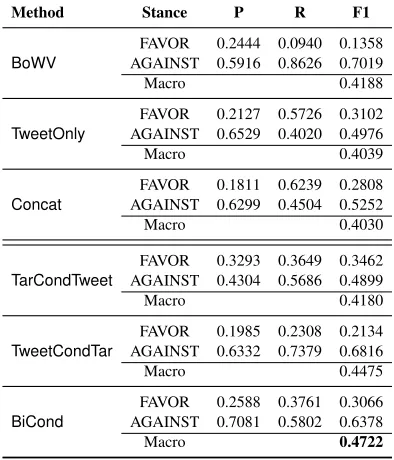
Method Stance P R F1
BoWV
FAVOR 0.2444 0.0940 0.1358 AGAINST 0.5916 0.8626 0.7019
Macro 0.4188
TweetOnly
FAVOR 0.2127 0.5726 0.3102 AGAINST 0.6529 0.4020 0.4976
Macro 0.4039
Concat
FAVOR 0.1811 0.6239 0.2808 AGAINST 0.6299 0.4504 0.5252
Macro 0.4030
TarCondTweet
FAVOR 0.3293 0.3649 0.3462 AGAINST 0.4304 0.5686 0.4899
Macro 0.4180
TweetCondTar
FAVOR 0.1985 0.2308 0.2134 AGAINST 0.6332 0.7379 0.6816
Macro 0.4475
BiCond
FAVOR 0.2588 0.3761 0.3066 AGAINST 0.7081 0.5802 0.6378
[image:6.612.328.525.60.290.2]Macro 0.4722
Table 2: Results for theunseen targetstance detection devel-opment setup.
thedevelopment setup, and all models are tuned us-ing this setup. The labelled Donald Trumptweets were only used in reporting our final results.
For the final results we train on all the data from the development setup and evaluate on the official Task B test set, i.e. theDonald Trumptweets. We refer to this as ourtest setup.
Based on a small grid search using the develop-ment setup, the following settings for LSTM-based models were chosen: input layer size 100 (equal to the word embedding dimension), hidden layer size of 60, training for max 50 epochs with initial learn-ing rate 1e-3 uslearn-ing ADAM (Klearn-ingma and Ba, 2014) for optimisation, dropout 0.1. Models were trained using cross-entropy loss. The use of one, relatively small hidden layer and dropout help to avoid over-fitting.
5.1 Results and Discussion
Results for the unseen target setting show how well conditional encoding is suited for learning target-dependent representations of tweets, and crucially, how well such representations generalise to unseen targets. The best performing method on both de-velopment (Table 2) and test setups (Table 3) is Bi-Cond, which achieves an F1 of 0.4722 and 0.4901 respectively. Notably, Concat, which learns an
Method Stance P R F1
BoWV
FAVOR 0.3158 0.0405 0.0719 AGAINST 0.4316 0.8963 0.5826
Macro 0.3272
TweetOnly
FAVOR 0.2767 0.3851 0.3220 AGAINST 0.4225 0.5284 0.4695
Macro 0.3958
Concat
FAVOR 0.3145 0.5270 0.3939 AGAINST 0.4452 0.4348 0.4399
Macro 0.4169
TarCondTweet
FAVOR 0.2322 0.4188 0.2988 AGAINST 0.6712 0.6234 0.6464
Macro 0.4726
TweetCondTar
FAVOR 0.3710 0.5541 0.4444 AGAINST 0.4633 0.5485 0.5023
Macro 0.4734
BiCond
FAVOR 0.3033 0.5470 0.3902 AGAINST 0.6788 0.5216 0.5899
[image:7.612.319.535.58.287.2]Macro 0.4901
Table 3: Results for the unseen targetstance detection test setup.
EmbIni NumMatr Stance P R F1
Random Sing
FAVOR 0.1982 0.3846 0.2616 AGAINST 0.6263 0.5929 0.6092
Macro 0.4354
Sep
FAVOR 0.2278 0.5043 0.3138 AGAINST 0.6706 0.4300 0.5240
Macro 0.4189
PreFixed Sing
FAVOR 0.6000 0.0513 0.0945 AGAINST 0.5761 0.9440 0.7155
Macro 0.4050
Sep
FAVOR 0.1429 0.0342 0.0552 AGAINST 0.5707 0.9033 0.6995
Macro 0.3773
PreCont Sing
FAVOR 0.2588 0.3761 0.3066 AGAINST 0.7081 0.5802 0.6378
Macro 0.4722
Sep
FAVOR 0.2243 0.4103 0.2900 AGAINST 0.6185 0.5445 0.5792
Macro 0.4346
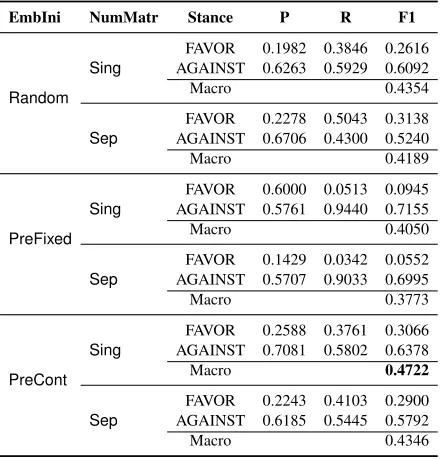
Table 4:Results for theunseen targetstance detection develop-ment setup usingBiCond, with single vs separate embeddings matrices for tweet and target and different initialisations
dependent encoding of the target and the tweets, does not achieve big F1 improvements over Twee-tOnly, which learns a representation of the tweets only. This shows that it is not sufficient to just take the target into account, but is is important to learn target-dependent encodings for the tweets. Models
Method inTwe Stance P R F1
Concat
Yes
FAVOR 0.3153 0.6214 0.4183 AGAINST 0.7438 0.4630 0.5707
Macro 0.4945
No
FAVOR 0.0450 0.6429 0.0841 AGAINST 0.4793 0.4265 0.4514
Macro 0.2677
TweetCondTar Yes
FAVOR 0.3529 0.2330 0.2807 AGAINST 0.7254 0.8327 0.7754
Macro 0.5280
No
FAVOR 0.0441 0.2143 0.0732 AGAINST 0.4663 0.5588 0.5084
Macro 0.2908
BiCond
Yes
FAVOR 0.3585 0.3689 0.3636 AGAINST 0.7393 0.7393 0.7393
Macro 0.5515
No
FAVOR 0.0938 0.4286 0.1538 AGAINST 0.5846 0.2794 0.3781
[image:7.612.88.284.62.290.2]Macro 0.2660
Table 5: Results for theunseen targetstance detection devel-opment setup for tweets containing the target vs tweets not con-taining the target.
that learn to condition the encoding of tweets on tar-gets outperform all baselines on the test set.
It is further worth noting that the Bag-of-Word-Vectors baseline achieves results comparable with TweetOnly,Concatand one of the conditional en-coding models,TarCondTweet, on the dev set, even though it achieves significantly lower performance on the test set. This indicates that the pre-trained word embeddings on their own are already very use-ful for stance detection. This is consistent with find-ings of other works showing the usefulness of such a Bag-of-Word-Vectors baseline for the related tasks of recognising textual entailment Bowman et al. (2015) and sentiment analysis Eisner et al. (2016).
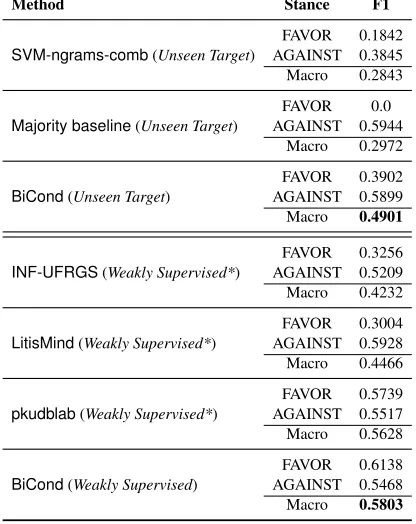
Our best result in the test setup withBiCondis the second highest reported result on the Twitter Stance Detection corpus, however the first, third and fourth best approaches achieved their results by automati-cally labellingDonald Trumptraining data.BiCond for the unseen target setting outperforms the third and fourth best approaches by a large margin (5 and 7 points in Macro F1, respectively), as can be seen in Table 7. Results for weakly supervised stance de-tection are discussed in Section 6.
[image:7.612.76.296.333.563.2]Pre-Training Table 4 shows the effect of unsu-pervised pre-training of word embeddings with a word2vec skip-gram model, and furthermore, the re-sults of sharing of these representations between the tweets and targets, on the development set. The first set of results is with a uniformlyRandom embed-ding initialisation in[−0.1,0.1]. PreFixeduses the pre-trained skip-gram word embeddings, whereas PreContinitialises the word embeddings with ones from SkipGram and continues training them dur-ing LSTM traindur-ing. Our results show that, in the absence of a large labelled training dataset, pre-training of word embeddings is more helpful than random initialisation of embeddings. SingvsSep shows the difference between using shared vs two separate embeddings matrices for looking up the word embeddings. Singmeans the word represen-tations for tweet and target vocabularies are shared, whereasSepmeans they are different. Using shared embeddings performs better, which we hypothesise is because the tweets contain some mentions of tar-gets that are tested.
Target in Tweet vs Not in Tweet Table 5 shows results on the development set for BiCond, com-pared to the best unidirectional encoding model, TweetCondTar and the baseline model Concat, split by tweets that contain the target and those that do not. All three models perform well when the target is mentioned in the tweet, but less so when the targets are not mentioned explicitly. In the case where the target is mentioned in the tweet, bicon-ditional encoding outperforms unidirectional encod-ing and unidirectional encodencod-ing outperforms Con-cat. This shows that conditional encoding is able to learn useful dependencies between the tweets and the targets.
6 Weakly Supervised Stance Detection
The previous section showed the usefulness of con-ditional encoding for unseen target stance detec-tion and compared results against internal baselines. The goal of experiments reported in this section is to compare against participants in the SemEval 2016 Stance Detection Task B. While we consider an unseen target setup, most submissions, includ-ing the three highest rankinclud-ing ones for Task B, pkud-blab (Wei et al., 2016), LitisMind (Zarrella and
Method Stance P R F1
BoWV
FAVOR 0.5156 0.6689 0.5824 AGAINST 0.6266 0.3311 0.4333
Macro 0.5078
TweetOnly
FAVOR 0.5284 0.6284 0.5741 AGAINST 0.5774 0.4615 0.5130
Macro 0.5435
Concat
FAVOR 0.5506 0.5878 0.5686 AGAINST 0.5794 0.4883 0.5299
Macro 0.5493
TarCondTweet
FAVOR 0.5636 0.6284 0.5942 AGAINST 0.5947 0.4515 0.5133
Macro 0.5538
TweetCondTar
FAVOR 0.5868 0.6622 0.6222 AGAINST 0.5915 0.4649 0.5206
Macro 0.5714
BiCond
FAVOR 0.6268 0.6014 0.6138 AGAINST 0.6057 0.4983 0.5468
Macro 0.5803
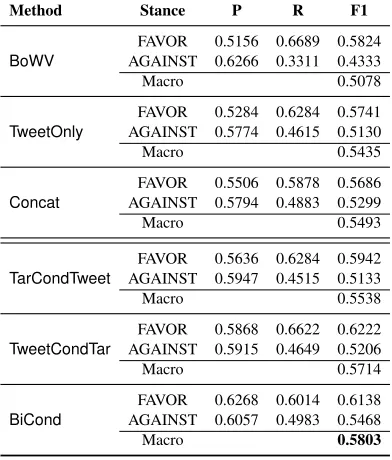
Table 6: Stance Detection test results for weakly super-vised setup, trained on automatically labelled pos+neg+neutral Trump data, and reported on the official test set.
Marsh, 2016) and INF-UFRGS (Dias and Becker, 2016) considered a different experimental setup. They automatically annotated training data for the test targetDonald Trump, thus converting the task into weakly supervised seen target stance detection. The pkudblab system uses a deep convolutional neu-ral network that learns to make 2-way predictions on automatically labelled positive and negative training data for Donald Trump. The neutral class is pre-dicted according to rules which are applied at test time.
Since the best performing systems which partic-ipated in the shared task consider a weakly super-vised setup, we further compare our proposed ap-proach to the state-of-the-art using such a weakly supervised setup. Note that, even though pkudblab, LitisMind and INF-UFRGS also use regular expres-sions to label training data automatically, the result-ing datasets were not available to us. Therefore, we had to develop our own automatic labelling method and dataset, which are publicly available from our code repository.
Weakly Supervised Test Setup For this setup, the unlabelled Donald Trump corpus TaskB Unlab is annotated automatically. For this purpose we
[image:8.612.329.525.61.291.2]ated a small set of regular expressions3, based on inspection of the TaskB Unlab corpus, expressing positive and negative stance towards the target. The regular expressions for the positive stance were:
• make( ?)america( ?)great( ?)again
• trump( ?)(for|4)( ?)president
• votetrump
• trumpisright
• the truth
• #trumprules
The keyphrases for negative stance were:
#dumptrump, #notrump, #trumpwatch, racist, idiot, fired
A tweet is labelled as positive if one of the posi-tive expressions is detected, else negaposi-tive if a nega-tive expressions is detected. If neither are detected, the tweet is annotated as neutral randomly with 2% chance. The resulting corpus size per stance is shown in Table 1. The same hyperparameters for the LSTM-based models are used as for theunseen targetsetup described in the previous section.
6.1 Results and Discussion
Table 6 lists our results in the weakly supervised set-ting. Table 7 shows all our results, including those using the unseen target setup, compared against the state-of-the-art on the stance detection corpus. Ta-ble 7 further lists baselines reported by Moham-mad et al. (2016), namely a majority class base-line (Majority baseline), and a method using 1 to 3-gram bag-of-word and character n-gram features (SVM-ngrams-comb), which are extracted from the tweets and used to train a 3-way SVM classifier. Bag-of-word baselines (BoWV, SVM-ngrams-comb) achieve results comparable to the majority baseline (F1 of 0.2972), which shows how diffi-cult the task is. The baselines which only extract features from the tweets, SVM-ngrams-comband TweetOnlyperform worse than the baselines which also learn representations for the targets (BoWV, Concat). By training conditional encoding models on automatically labelled stance detection data we achieve state-of-the-art results. The best result (F1 of 0.5803) is achieved with the bi-directional condi-tional encoding model (BiCond). This shows that
3Note that “|” indiates “or”, ( ?) indicates optional space
Method Stance F1
SVM-ngrams-comb(Unseen Target)
FAVOR 0.1842 AGAINST 0.3845 Macro 0.2843
Majority baseline(Unseen Target)
FAVOR 0.0 AGAINST 0.5944
Macro 0.2972
BiCond(Unseen Target)
FAVOR 0.3902 AGAINST 0.5899 Macro 0.4901
INF-UFRGS(Weakly Supervised*)
FAVOR 0.3256 AGAINST 0.5209 Macro 0.4232
LitisMind(Weakly Supervised*)
FAVOR 0.3004 AGAINST 0.5928 Macro 0.4466
pkudblab(Weakly Supervised*)
FAVOR 0.5739 AGAINST 0.5517 Macro 0.5628
BiCond(Weakly Supervised)
[image:9.612.323.531.64.326.2]FAVOR 0.6138 AGAINST 0.5468 Macro 0.5803
Table 7: Stance Detection test results, compared against the state of the art. SVM-ngrams-combandMajority baseline
are reported in Mohammad et al. (2016), pkudblab in Wei et al. (2016), LitisMind in Zarrella and Marsh (2016), INF-UFRGS in Dias and Becker (2016)
such models are suitable for unseen, as well as seen target stance detection.
7 Related Work
Stance Detection: Previous work mostly considered target-specific stance prediction in debates (Hasan and Ng, 2013; Walker et al., 2012) or student essays (Faulkner, 2014). The task considered in this paper is more challenging than stance detec-tion in debates because, in addidetec-tion to irregular lan-guage, the Mohammad et al. (2016) dataset is of-fered without any context, e.g., conversational struc-ture or tweet metadata. The targets are also not always mentioned in the tweets, which is an addi-tional challenge (Augenstein et al., 2016) and dis-tinguishes this task from target-dependent (Vo and Zhang, 2015; Zhang et al., 2016; Alghunaim et al., 2015) and open-domain target-dependent sen-timent analysis (Mitchell et al., 2013; Zhang et al., 2015). Related work on rumour stance detec-tion either requires training data from the same
mour (Qazvinian et al., 2011), i.e., target, or is rule-based (Liu et al., 2015) and thus potentially hard to generalise. Finally, the target-dependent stance de-tection task tackled in this paper is different from that of Ferreira and Vlachos (2016), which while re-lated concerned with the stance of a statement in nat-ural language towards another statement.
Conditional Encoding: Conditional encoding has been applied to the related task of recognising textual entailment (Rockt¨aschel et al., 2016), using a dataset of half a million training examples (Bowman et al., 2015) and numerous different hypotheses. Our experiments here show that conditional encoding is also successful on a relatively small training set and when applied to an unseen testing target. Moreover, we augment conditional encoding with bidirectional encoding and demonstrate the added benefit of supervised pre-training of word embeddings on un-labelled domain data.
8 Conclusions and Future Work
This paper showed that conditional LSTM encod-ing is a successful approach to stance detection for unseen targets. Our unseen target bidirectional con-ditional encoding approach achieves the second best results reported to date on the SemEval 2016 Twitter Stance Detection corpus. In the weakly supervised seen target scenario, as considered by prior work, our approach achieves the best results to date on the SemEval Task B dataset. We further show that in the absence of large labelled corpora, unsupervised pre-training can be used to learn target representations for stance detection and improves results on the Se-mEval corpus. Future work will investigate further the challenge of stance detection for tweets which do not contain explicit mentions of the target.
Acknowledgments
This work was partially supported by the European Union under grant agreement No. 611233 PHEME4
and by Microsoft Research through its PhD Scholar-ship Programme.
4http://www.pheme.eu
References
Abdulaziz Alghunaim, Mitra Mohtarami, Scott Cyphers, and Jim Glass. 2015. A Vector Space Approach for Aspect Based Sentiment Analysis. InProceedings of the 1st Workshop on Vector Space Modeling for Nat-ural Language Processing, pages 116–122, Denver, Colorado, June. Association for Computational Lin-guistics.
Isabelle Augenstein, Andreas Vlachos, and Kalina Bontcheva. 2016. USFD: Any-Target Stance Detec-tion on Twitter with Autoencoders. InProceedings of the International Workshop on Semantic Evaluation, SemEval ’16, San Diego, California.
Samuel R. Bowman, Gabor Angeli, Christopher Potts, and Christopher D. Manning. 2015. A large annotated corpus for learning natural language inference. In Pro-ceedings of the 2015 Conference on Empirical Meth-ods in Natural Language Processing, pages 632–642, Lisbon, Portugal, September. Association for Compu-tational Linguistics.
Marcelo Dias and Karin Becker. 2016. INF-UFRGS-OPINION-MINING at SemEval-2016 Task 6: Auto-matic Generation of a Training Corpus for Unsuper-vised Identification of Stance in Tweets. In Proceed-ings of the International Workshop on Semantic Eval-uation, SemEval ’16, San Diego, California, June. Ben Eisner, Tim Rockt¨aschel, Isabelle Augenstein,
Matko Boˇsnjak, and Sebastian Riedel. 2016. emoji2vec: Learning Emoji Representations from their Description. InProceedings of the International Workshop on Natural Language Processing for Social Media, SocialNLP ’16, Austin, Texas.
Adam Faulkner. 2014. Automated Classification of Stance in Student Essays: An Approach Using Stance Target Information and the Wikipedia Link-Based Measure. In William Eberle and Chutima Boonthum-Denecke, editors,FLAIRS Conference. AAAI Press. William Ferreira and Andreas Vlachos. 2016.
Emer-gent: a novel data-set for stance classification. In Pro-ceedings of the 2016 Conference of the North Ameri-can Chapter of the Association for Computational Lin-guistics: Human Language Technologies, pages 1163– 1168, San Diego, California, June. Association for Computational Linguistics.
Alex Graves and J¨urgen Schmidhuber. 2005. Framewise phoneme classification with bidirectional LSTM and other neural network architectures. Neural Networks, 18(5):602–610.
Kazi Saidul Hasan and Vincent Ng. 2013. Stance Clas-sification of Ideological Debates: Data, Models, Fea-tures, and Constraints. InIJCNLP, pages 1348–1356. Asian Federation of Natural Language Processing / ACL.
Sepp Hochreiter and J¨urgen Schmidhuber. 1997. Long short-term memory. Neural computation, 9(8):1735– 1780.
Diederik P. Kingma and Jimmy Ba. 2014. Adam: A Method for Stochastic Optimization. CoRR, abs/1412.6980.
Xiaomo Liu, Armineh Nourbakhsh, Quanzhi Li, Rui Fang, and Sameena Shah. 2015. Real-time Ru-mor Debunking on Twitter. In Proceedings of the 24th ACM International on Conference on Informa-tion and Knowledge Management, CIKM ’15, pages 1867–1870, New York, NY, USA. ACM.
Marcelo Mendoza, Barbara Poblete, and Carlos Castillo. 2010. Twitter Under Crisis: Can We Trust What We RT? In Proceedings of the First Workshop on Social Media Analytics (SOMA’2010), pages 71–79, New York, NY, USA. ACM.
Tomas Mikolov, Kai Chen, Greg Corrado, and Jeffrey Dean. 2013. Efficient estimation of word representa-tions in vector space. arXiv preprint arXiv:1301.3781. Margaret Mitchell, Jacqui Aguilar, Theresa Wilson, and Benjamin Van Durme. 2013. Open Domain Targeted Sentiment. InProceedings of the 2013 Conference on Empirical Methods in Natural Language Processing, pages 1643–1654, Seattle, Washington, USA, October. Association for Computational Linguistics.
Saif M. Mohammad, Svetlana Kiritchenko, Parinaz Sobhani, Xiaodan Zhu, and Colin Cherry. 2016. SemEval-2016 Task 6: Detecting stance in tweets. In Proceedings of the International Workshop on Seman-tic Evaluation, SemEval ’16, San Diego, California, June.
Bo Pang and Lillian Lee. 2008. Opinion mining and sentiment analysis. Foundations and trends in infor-mation retrieval, 2(1-2):1–135.
F. Pedregosa, G. Varoquaux, A. Gramfort, V. Michel, B. Thirion, O. Grisel, M. Blondel, P. Prettenhofer, R. Weiss, V. Dubourg, J. Vanderplas, A. Passos, D. Cournapeau, M. Brucher, M. Perrot, and E. Duches-nay. 2011. Scikit-learn: Machine Learning in Python. Journal of Machine Learning Research, 12:2825– 2830.
Vahed Qazvinian, Emily Rosengren, Dragomir R. Radev, and Qiaozhu Mei. 2011. Rumor Has It: Identify-ing Misinformation in Microblogs. InProceedings of the Conference on Empirical Methods in Natural Lan-guage Processing, EMNLP ’11, pages 1589–1599.
Tim Rockt¨aschel, Edward Grefenstette, Karl Moritz Her-mann, Tom´aˇs Koˇcisk`y, and Phil Blunsom. 2016. Rea-soning about Entailment with Neural Attention. In In-ternational Conference on Learning Representations (ICLR).
Richard Socher, Alex Perelygin, Jean Wu, Jason Chuang, Christopher D. Manning, Andrew Ng, and Christo-pher Potts. 2013. Recursive Deep Models for Se-mantic Compositionality Over a Sentiment Treebank. In Proceedings of the 2013 Conference on Empiri-cal Methods in Natural Language Processing, pages 1631–1642, Seattle, Washington, USA, October. As-sociation for Computational Linguistics.
Duy-Tin Vo and Yue Zhang. 2015. Target-Dependent Twitter Sentiment Classification with Rich Automatic Features. In Qiang Yang and Michael Wooldridge, ed-itors,IJCAI, pages 1347–1353. AAAI Press.
Marilyn Walker, Pranav Anand, Rob Abbott, and Ricky Grant. 2012. Stance Classification using Dialogic Properties of Persuasion. InProceedings of the 2012 Conference of the North American Chapter of the As-sociation for Computational Linguistics: Human Lan-guage Technologies, pages 592–596.
Wan Wei, Xiao Zhang, Xuqin Liu, Wei Chen, and Tengjiao Wang. 2016. pkudblab at SemEval-2016 Task 6: A Specific Convolutional Neural Network Sys-tem for Effective Stance Detection. InProceedings of the International Workshop on Semantic Evaluation, SemEval ’16, San Diego, California, June.
Guido Zarrella and Amy Marsh. 2016. MITRE at SemEval-2016 Task 6: Transfer Learning for Stance Detection. InProceedings of the International Work-shop on Semantic Evaluation, SemEval ’16, San Diego, California, June.
Meishan Zhang, Yue Zhang, and Duy Tin Vo. 2015. Neural Networks for Open Domain Targeted Senti-ment. In Proceedings of the 2015 Conference on Empirical Methods in Natural Language Processing, pages 612–621, Lisbon, Portugal, September. Associ-ation for ComputAssoci-ational Linguistics.
Meishan Zhang, Yue Zhang, and Duy-Tin Vo. 2016. Gated Neural Networks for Targeted Sentiment Anal-ysis. In Proceedings of the Thirtieth AAAI Con-ference on Artificial Intelligence, Phoenix, Arizona, USA, February. Association for the Advancement of Artificial Intelligence.
![Figure 1: Bidirectional encoding of tweet conditioned on bidirectional encoding of target ([c→3 c←1 ])](https://thumb-us.123doks.com/thumbv2/123dok_us/7808807.171632/4.612.137.494.52.242/figure-bidirectional-encoding-tweet-conditioned-bidirectional-encoding-target.webp)