Int. J. Electrochem. Sci., 8 (2013) 2734 - 2745
International Journal of
ELECTROCHEMICAL
SCIENCE
www.electrochemsci.org
Quantitative Determination of Gadolinium Ion by a Gd
3+-Liquid
Membrane Sensor Based on
1-(4-Nitrophenyl)-3-(4-phenylazophenyl)triazene as a Sensing Material
Mehri Vahdani1, Hassan Ali Zamani2,*, Samira Karimian1
1
Department of Applied Chemistry, Quchan Branch, Islamic Azad University, Quchan, Iran
2
Department of Applied Chemistry, Mashhad Branch, Islamic Azad University, Mashhad, Iran
*
E-mail: [email protected]
Received: 18 August 2012 / Accepted: 25 September 2012 / Published: 1 February 2013
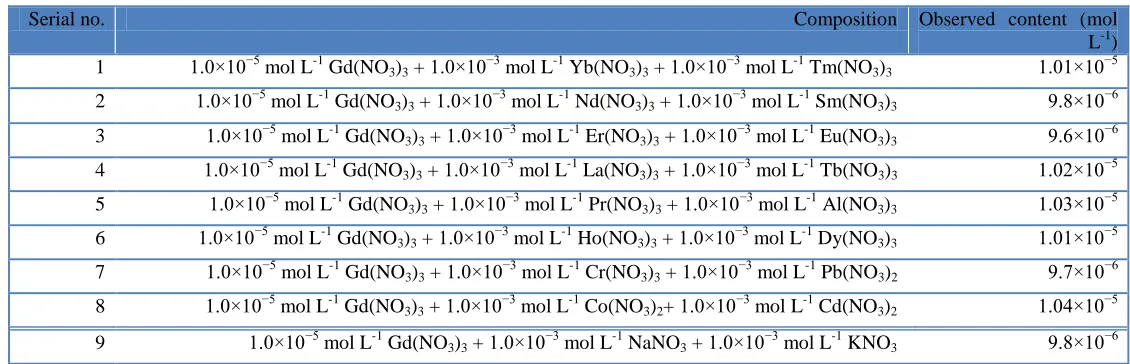
In this work, a new gadolinium(III) PVC-membrane potentiometric sensor for the Gd3+ ion based on 1-(4-Nitrophenyl)-3-(4-phenylazophenyl)triazene (PPAT) has been prepared. The sensor shows a Nernstian slope of 19.90.2 mVdecade-1 in a wide concentration range of 1.0×10⁻⁶ to 1.0×10⁻² mol L-1 with a detection limit of 4.7×10⁻⁷ mol L-1. It has a very short response time of about 10 s. The proposed electrode revealed high selectivity for Gd3+ ions over a number of cations including alkali, alkaline earth, transition and heavy metal ions and could be used in a pH range of 2.6–8.7. The fabricated Gd3+ electrode was successfully used as an indicator electrode in potentiometric determination of Gd(III) ions with standard solution of EDTA and the monitoring of Gd(III) ions in mixtures of different metal ions with quantitative results.
Keywords: Ion selective electrode, Sensor, Potentiometry, PVC membrane
1. INTRODUCTION
During the last decade, there has been a renewed resurgence in developing potentiometric membrane electrodes as devices for rapid, accurate, low cost and nondestructive analysis of different samples with small volume samples [1-3]. The utility of ion selective electrodes (ISE) is being increasingly appreciated by analytical chemists, in view of the rapid, world-wide growth of industry and technology, because they represent rapid, accurate, and low cost procedures for trace metal analysis. In general, a liquid membrane sensor is a device comprised of a nonpolar solvent supported by a highly porous polymeric layer [4].
environment in many different places, mainly by petrol-producing industries. Gadolinium will gradually accumulate in soils and water soils and this will eventually lead to increasing concentrations in humans, animals and soil particles. Gadolinium salts irritate skin and eyes and are suspected to be tumorigens [5]. Other lanthanide oxides and gadolinium oxide are widely used in preparation of polishing compounds, carbon arcs, gasoline-cracking catalysts optical glasses, and glass fibers [6]. Some reports on measurements of gadolinium are spectroscopic methods such as atomic emission spectroscopy, high-resolutionˆI3-spectroscopy, phosphorescence opto-sensing, inductively coupled plasma-mass spectrometry (ICP-MS), laser-based multi step resonance ionization, quenching of gadolinium fluorescence, and electron spin resonance. But almost all of these are expensive and time consuming. In this report we are going to introduce a new simple and nonexpensive method that is based on an electrochemical sensor with a sensitive and selective component 1-(4-Nitrophenyl)-3-(4-phenylazophenyl)triazene. A literature survey indicates that there are only a limited number of reports regarding gadolinium determination by ion selective electrodes [7-11].
Recently, several studies concerning the selective and sensitive ion-selective electrodes have been reported for some metal ions by our research team and other researchers [12-45]. In this work, the use of 1-(4-Nitrophenyl)-3-(4-phenylazophenyl)triazene (PPAT) as an excellent ionophore is introduced for the preparation of a highly Gd(III) ion-selective electrode (Fig. 1). This sensor has relatively high selectivity and a low detection limit relative to the other sensors that have been developed for determination of one of the lanthanides, even in presence of other lanthanides.
N N N
N H N O2N
Figure 1. The Chemical structure of PPAT.
2. EXPERIMENTAL
2.1. Chemicals and reagents
The Merck and the Aldrich Chemical Co. were the providers of the following reagent. grades: benzyl acetate (BA), nitrobenzene (NB), dibutyl phthalate (DBP), acetophenone (AP), oleic acid (OA), ionophore 1-(4-Nitrophenyl)-3-(4-phenylazophenyl)triazene, high relative molecular weight PVC, sodium tetraphenyl borate (NaTPB) and tetrahydrofurane (THF). Chloride and nitrate salts of the cations used (from Merck and Aldrich) were of the highest purity available and used without any further purification except for vacuum drying over P2O5. During the experiments, doubly distilled
2.2. ISE membrane preparation
The general procedure to prepare the PVC membrane was to thoroughly mix 30 wt.% of powdered PVC, 60 wt.% of nitrobenzene and 4 wt.% of the additive NaTPB in 3mL of THF. To this mixture 6 wt.% 1-(4-Nitrophenyl)-3-(4-phenylazophenyl)triazene (PPAT) was added and the solution was mixed well. The resulting mixture was transferred into a glass dish of 2 cm diameter. The solvent was evaporated slowly until an oily concentrated mixture was obtained. A Pyrex tube (5 mm i.d.) was dipped into the mixture for about 5 s, so that a non-transparent membrane (about 0.3 mm in thickness) is formed. The tube was, then, removed from the mixture, kept at room temperature for about 24 h and filled with an internal filling solution (1.0 ×10⁻³
mol L-1 GdCl3). Finally, the electrode was conditioned
by soaking in a 1.0 × 10⁻³ mol L-1 GdCl3 solution for 24 h [46-61]. As an internal reference electrode, a
silver/silver chloride electrode was used.
2.3. The EMF measurements
All emf measurements were carried out with the following assembly:
Ag–AgCl| 1.010-3 mol L-1 GdCl3 | PVC membrane: test solution| Hg–Hg2Cl2, KCl (satd).
A Corning ion analyser 250 pH/mV meter was used for the potential measurements at 25.0 °C. The activities were calculated according to the Debye–Huckel procedure [62].
3. RESULTS AND DISCISSION
3.1. Response of the Gd3+ sensor
-150 -100 -50 0 50 100 150 200
0 1
2 3
4 5
6 7
E(mV)
pMn+
Gd
La
Ho
Sm
Yb
Cd
Co
Al
Ba
Fe
Zn
Hg
K
[image:3.596.136.463.492.735.2]Pb
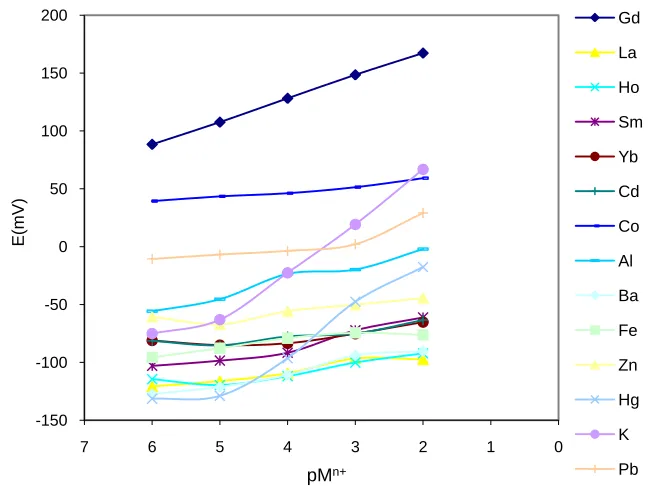
At first, for checking the stability as well as the selectivity of PPAT as a sensing ionophore, it was tested for the preparation of a variety of ions: mono, di, and trivalent metal ion-selective sensors. Their potential responses were measured and the resulting data are summarized in Figure 2. It can be observed that the response slopes of the other ion-selective electrodes are much lower than the values expected from the Nernstian equation, covering only a limited concentration range. Among the tested cations, only the Gd3+ ion illustrated a strong response (with a slope of 19.90.2 mV decade-1) to the PPAT-based membrane sensors in comparison with the other tested cations. This observation can be attributed to the selective behavior of the PVC membrane system against Gd3+ in comparison with the tested metal ions, including other lanthanide ions.
[image:4.596.46.554.312.661.2]3.2. Evaluation of the membrane composition effect on the potential response of the Gd(III) sensor
Table 1. Optimization of the membrane ingredients.
Sensor No.
Composition of the membrane (wt, %) Slope / mVdecade-1
Dynamic Linear range / molL-1
PVC Plasticizer PPAT Additive 1
2 3
30 30 30
NB, 66 AP, 66 BA, 66
2 2 2
NaTPB,2;OA,0 NaTPB,2;OA0 NaTPB,2;OA,0
13.3 ± 0.3 6.5 ± 0.4 7.7 ± 0.2
1.0 ×10⁻⁶
-1.0 ×10⁻² 1.0 ×10⁻⁵
-1.0 ×10⁻² 1.0 ×10⁻⁵
-1.0 ×10⁻² 4 30 DBP, 66 2 NaTPB,2;OA,0 6.0 ± 0.3 1.0 ×10⁻⁵-1.0 ×10⁻² 5 30 NB, 60 1 NaTPB,9;OA,0 13.5 ± 0.4 1.0 ×10⁻⁴-1.0 ×10⁻² 6 30 NB, 60 2 NaTPB,8;OA,0 13.5 ± 0.2 1.0 ×10⁻⁴-1.0 ×10⁻² 7 30 NB, 60 3 NaTPB,7;OA,0 12.8 ± 0.5 1.0 ×10⁻⁶-1.0 ×10⁻² 8 30 NB, 60 4 NaTPB,6;OA,0 10.3 ± 0.2 1.0 ×10⁻⁶-1.0 ×10⁻² 9 30 NB, 60 5 NaTPB,5;OA,0 15.4 ± 0.5 1.0 ×10⁻⁶-1.0 ×10⁻² 10 30 NB, 60 6 NaTPB,4;OA,0 19.9 ± 0.2 1.0 ×10⁻⁶-1.0 ×10⁻² 11 30 NB, 60 7 NaTPB,3;OA,0 17.0 ± 0.4 1.0 ×10⁻⁶-1.0 ×10⁻³ 12 30 NB, 60 8 NaTPB,2;OA,0 12.6 ± 0.3 1.0 ×10⁻⁶-1.0 ×10⁻² 13 30 NB, 60 9 NaTPB,1;OA,0 9.4 ± 0.2 1.0 ×10⁻⁵-1.0 ×10⁻² 14 30 DBP, 60 6 NaTPB,4;OA,0 16.2 ± 0.4 1.0 ×10⁻⁶-1.0 ×10⁻² 15 30 BA, 60 6 NaTPB,4;OA,0 15.9 ± 0.3 1.0 ×10⁻⁶-1.0 ×10⁻² 16 30 AP, 60 6 NaTPB,4;OA,0 15.8 ± 0.6 1.0 ×10⁻⁶-1.0 ×10⁻² 17 30 NB, 62 6 NaTPB,2;OA,0 23.5 ± 0.2 1.0 ×10⁻⁶-1.0 ×10⁻² 18 30 NB, 61 6 NaTPB,3;OA,0 22.3 ± 0.4 1.0 ×10⁻⁶-1.0 ×10⁻² 19 30 NB, 55 6 NaTPB,4;OA,5 17.3 ± 0.3 1.0 ×10⁻⁶-1.0 ×10⁻² 20 30 NB, 50 6 NaTPB,4;OA,10 18.7 ± 0.2 1.0 ×10⁻⁶-1.0 ×10⁻² 21 30 NB, 45 6 NaTPB,4;OA,15 16.3 ± 0.6 1.0 ×10⁻⁶-1.0 ×10⁻²
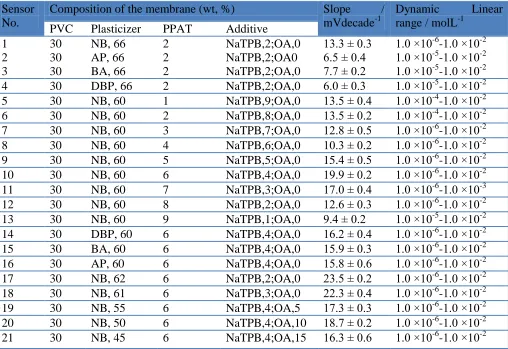
ratios of different constituents. According to Table 1, PPAT amount increase up to 6% in the membrane (membrane no. 10) resulting in Nernstian slope. A maximum slope of 19.9±0.2 mVdecade-1 of gadolinium concentration was observed for membrane no.10 with 6% of PPAT. Because the nature of plasticizer influences the dielectric constant of the membrane phase, the mobility of the ionophore molecules, and the state of ligand, it was expected to play a key role in determining the selectivity, working concentration range, and response time of the membrane electrode. As shown from Table 1, except NB, among three other plasticizers used (AP, BA and DBP), the resulting membranes revealed no stable potential response. This is due to the high polarity of NB that facilitates the extraction of gadolinium ions with high charge density from aqueous solution to the organic membrane phase.
The presence of ionic additives with large lipophilic anions in the composition of cationic-selective membrane electrodes not only diminishes the ohmic resistance and enhances the potential behavior and selectivity, but also in poor extraction capacities, increases the sensitivity of the membrane electrodes [75–81]. Table 1 reveals that the slope of the Gd(III) membrane sensor, NaTPB is a suitable additive. Clearly from Table 1, the NaTPB addition of 4% will increase the sensitivity of the electrode response considerably, so that the membrane electrode demonstrates a near Nernstian behavior (membrane no. 10).
All in all the best response behavior of 19.9±0.2 mVdecade−1, in a wide concentration range of 1.0×10⁻⁶–1.0×10⁻² mol L-1 was found to be achievable for a composition of 30 mg of PVC, 6 mg of the ionophore, 60 mg of NB as the plasticizer and 4 mg of NaTPB (No. 10).
3.3. The calibration curve
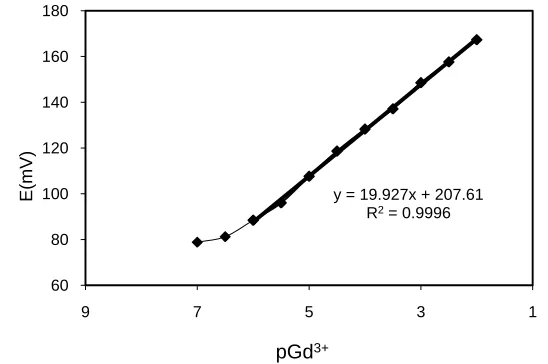
The critical response characteristics of the Gd3+ sensor were assessed according to IUPAC recommendations [82]. The potential response of the membrane at varying concentration of Gd3+ ions (Fig. 3) indicates a rectilinear range from 1.0×10⁻⁶ to 1.0×10⁻² mol L-1. The slope of the calibration curve was 19.9±0.2 mVdecade-1
of Gd3+ concentration. The limit of detection, as determined from the intersection of the two extrapolated segments of the calibration graph, was 4.7×10⁻⁷ mol L-1.
y = 19.927x + 207.61 R2= 0.9996
60 80 100 120 140 160 180
1 3
5 7
9
E(mV)
[image:5.596.162.436.560.742.2]pGd3+
3.4. The pH effect
The pH dependence on the response of the Gd(III) membrane electrode in test solution (1.0×10⁻³ mol L-1 of Gd(III)) was studied in a pH range 1.0-11.0, and the results are illustrated in Figure 4. The pH of the solutions was adjusted by either HNO3 or NaOH solutions [83-86]. As seen,
the potential was found to stay fairly constant in the pH range 2.6–8.7. Beyond the range, a relatively drastic drift was observed. The observed drift at higher pH values could be due to the formation of insoluble Gd(OH)3 in the solution. In acidic solutions having pH values less than the minimum of this
range, the ionophore used could be protonated to some extent, resulting in improper functioning of the membrane electrode to the Gd(III) ion concentration at pH values less than 2.6.
100 120 140 160 180 200 220
0 1 2 3 4 5 6 7 8 9 10 11 12
E(mV
)
[image:6.596.148.449.259.419.2]pH 0.001 M Gd3+
Figure 4. pH effect of the test solution (1.0×10⁻³ mol L-1 of Gd3+) on the potential response of the Gd3+ ion-selective electrode.
3.5. Dynamic response time
80 100 120 140 160 180 200 220 240
0 20 40 60 80 100 120 140
E(mV)
t(s)
A
B
C
D
E
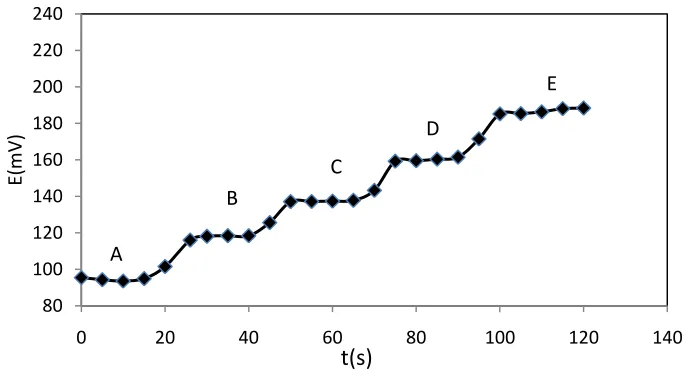
Figure 5. Dynamic response time of the gadolinium electrode for step changes in the Gd3+ concentration: A) 1.0×10⁻⁶
[image:6.596.123.467.519.704.2]
For analytical applications, dynamic response time is an important factor for any ion-selective electrode. In this study, the practical response time was recorded by changing the Gd3+ concentration in solution in a concentration range of 1.0×10⁻⁶ to 1.0×10⁻² mol L-1. The results are shown in Figure 5. As can be seen, in the whole concentration range the electrode reached its equilibrium response in a very short time (~10 s). This is most probably due to the fast exchange kinetics of the complexation– decomplexation of Gd3+ ions with the ionophore at the test solution–membrane interface.
3.6. The selectivity of the Gd(III) sensor
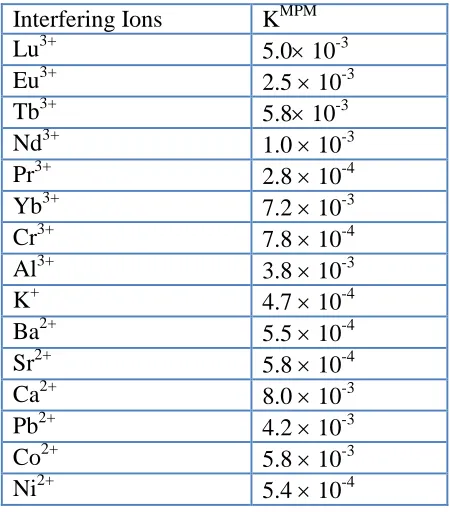
The influence of interfering ions on the response behavior of ion-selective membrane electrodes is usually described in terms of selectivity coefficients, KPotA,B. In this work, matched potential method (MPM) was used for calculation of selectivity coefficient [87, 88]. According to the MPM, a specified activity (concentration) of primary ions (A) is added to a reference solution and the potential is measured. In a separate experiment, interfering ions (B) are successively added to an identical reference solution, until the measured potential matches the one obtained before by adding primary ions. The selectivity coefficient, KPotA,B is determined as KPotA,B=aA/aB. The resulting values are
[image:7.596.186.411.451.707.2]listed in Table 2. As can be seen from Table 2, for the all mono and bivalent metal ions and trivalent lanthanide ions tested, the selectivity coefficients are in the order 8.010-3 or smaller, indicating they would not radically disturb the function of the developed Gd3+ membrane sensor.
Table 2. Selectivity coefficients of the developed Gd3+ electrode based on MPM method .
Interfering Ions KMPM
Lu3+ 5.0 10-3
Eu3+ 2.5 10-3
Tb3+ 5.8 10-3
Nd3+ 1.0 10-3
Pr3+ 2.8 10-4
Yb3+ 7.2 10-3
Cr3+ 7.8 10-4
Al3+ 3.8 10-3
K+ 4.7 10-4
Ba2+ 5.5 10-4
Sr2+ 5.8 10-4
Ca2+ 8.0 10-3
Pb2+ 4.2 10-3
Co2+ 5.8 10-3
Ni2+ 5.4 10-4
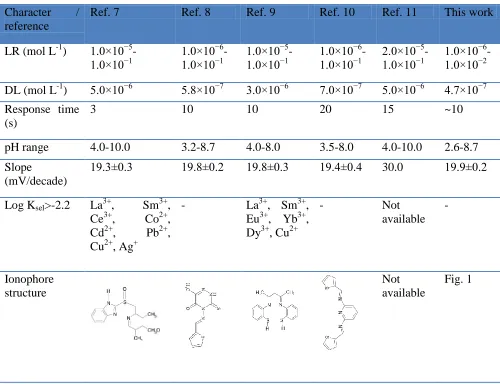
[image:8.596.48.548.176.560.2]
previously reported Gd3+ electrodes [7-11]. It is instantly clear that the concentration range, the response time, the detection limit of the recommended electrode and the selectivity coefficients are superior to those stated by other researchers.
Table 3. Comparison table of the characterization of reported Gd(III) potentiometric electrodes. Character /
reference
Ref. 7 Ref. 8 Ref. 9 Ref. 10 Ref. 11 This work
LR (mol L-1) 1.0×10⁻⁵
-1.0×10⁻¹ 1.0×10
−6
-1.0×10⁻¹ 1.0×10
−5
-1.0×10⁻¹ 1.0×10
−6
-1.0×10⁻¹ 2.0×10
−5
-1.0×10⁻¹ 1.0×10
−6
-1.0×10⁻² DL (mol L-1) 5.0×10⁻⁶ 5.8×10⁻⁷ 3.0×10⁻⁶ 7.0×10⁻⁷ 5.0×10⁻⁶ 4.7×10⁻⁷ Response time
(s)
3 10 10 20 15 ~10
pH range 4.0-10.0 3.2-8.7 4.0-8.0 3.5-8.0 4.0-10.0 2.6-8.7 Slope
(mV/decade)
19.3±0.3 19.8±0.2 19.8±0.3 19.4±0.4 30.0 19.9±0.2
Log Ksel>-2.2 La3+, Sm3+,
Ce3+, Co2+, Cd2+, Pb2+, Cu2+, Ag+
- La3+, Sm3+, Eu3+, Yb3+, Dy3+, Cu2+
- Not
available -
Ionophore structure
Not available
Fig. 1
3.7. Analytical application
The proposed Gd3+-PVC membrane sensor was successfully applied as an indicator electrode in titration of Gd3+ (1.0×10⁻⁴ mol L-1) with a standard EDTA solution (1.0×10⁻² mol L-1) and the resulting titration curve is shown in Figure 6. As can be seen, the amount of Gd3+ ions in solution can be determined with the sensor.
80 90 100 110 120 130 140
0 0.1 0.2 0.3 0.4 0.5 0.6
E(mV)
[image:9.596.162.431.76.258.2]VEDTA, mL
Figure 6. Potential titration curve of 25.0 mL from a 1.0×10⁻⁴ mol L-1 Gd3+ solution with 1.0×10⁻² mol L-1 of EDTA (pH=10).
Table 4. Determination of Gd3+ ions in mixtures of different ions.
Observed content (mol L-1) Composition
Serial no.
1.01×10⁻⁵
1.0×10⁻⁵ mol L-1 Gd(NO
3)3 + 1.0×10⁻³ mol L-1 Yb(NO3)3 + 1.0×10⁻³ mol L-1 Tm(NO3)3
1
9.8×10⁻⁶
1.0×10⁻⁵
mol L-1 Gd(NO3)3 + 1.0×10⁻³ mol L-1 Nd(NO3)3 + 1.0×10⁻³ mol L-1 Sm(NO3)3
2
9.6×10⁻⁶ 1.0×10⁻⁵ mol L-1 Gd(NO3)3 + 1.0×10
−3
mol L-1 Er(NO3)3 + 1.0×10 −3
mol L-1 Eu(NO3)3
3
1.02×10⁻⁵
1.0×10⁻⁵ mol L-1 Gd(NO
3)3 + 1.0×10⁻³ mol L-1 La(NO3)3 + 1.0×10⁻³ mol L-1 Tb(NO3)3
4
1.03×10⁻⁵
1.0×10⁻⁵ mol L-1 Gd(NO
3)3 + 1.0×10⁻³ mol L-1 Pr(NO3)3 + 1.0×10⁻³ mol L-1 Al(NO3)3
5
1.01×10⁻⁵
1.0×10⁻⁵ mol L-1 Gd(NO
3)3 + 1.0×10⁻³ mol L-1 Ho(NO3)3 + 1.0×10⁻³ mol L-1 Dy(NO3)3
6
9.7×10⁻⁶ 1.0×10⁻⁵ mol L-1 Gd(NO3)3 + 1.0×10
−3
mol L-1 Cr(NO3)3 + 1.0×10 −3
mol L-1 Pb(NO3)2
7
1.04×10⁻⁵
1.0×10⁻⁵ mol L-1 Gd(NO
3)3 + 1.0×10⁻³ mol L-1 Co(NO3)2+ 1.0×10⁻³ mol L-1 Cd(NO3)2
8
9.8×10⁻⁶ 1.0×10⁻⁵ mol L-1 Gd(NO3)3 + 1.0×10
−3
mol L-1 NaNO3 + 1.0×10 −3
mol L-1 KNO3
9
ACKNOWLEDGEMENT
The authors acknowledge the kind financial support provided by the Research Council of Mashhad Branch and Quchan Branch Islamic Azad University.
References
1. U. Oesch, D. Amman, and W. Simon, Clin. Chem. 32 (1986) 1448. 2. M.A. Arnold, and M.E. Meyerhoff, Anal. Chem. 56 (1984) 20R.
3. M.L. Davies, C.J. Hamilton, S.M. Murphy, and B. Tighe, J. Biomaterials. 13 (1992) 971. 4. M.R. Ganjali, P. Norouzi, F. Faridbod, M. Rezapour, and M.R. Pourjavid, J. Iran. Chem. Soc. 4
(2007) 1.
[image:9.596.14.579.346.528.2]
7. M.R. Ganjali, M. Tahami, M. Shamsipur, T. Poursaberi, S. Haghgoo, and M. Hosseini, Electroanalysis 12 (2003) 1038.
8. H.A. Zamani, G. Rajabzadeh, M.R. Ganjali, and P. Norouzi, Anal. Chim. Acta 598 (2007) 51. 9. M.R. Ganjali, M. Emami, M. Rezapour, M. Shamsipur, B. Maddah, M. Salavati-Niasari, M.
Hosseini, and Z. Talebpoui, Anal. Chim. Acta 495 (2003) 51.
10.M.R. Ganjali, M. Rezapour, P. Norouzi, and M. Salavati-Niasari, Electroanalysis 17 (2005) 2032. 11.H.K. Sharma, and N. Sharma, E-J. Chem. 6 (2009) 1139.
12.H.A. Zamani M. Zaferoni, and S. Meghdadi, E-J. Chem. 9 (2012) 1941. 13.V.K. Gupta, R.N. Goyal, and R.A. Sharma, Anal. Chim. Acta 647 (2009) 66.
14.P. Norouzi, M.R. Ganjali, A. Ahmadalinezhad, and M. Adib, J. Braz. Chem. Soc. 17 (2006) 1309. 15.H. A. Zamani, M. R. Abedi, and M. R. Ganjali, J. Chil. Chem. Soc. 45 (2009) 186.
16.M.R. Ganjali, A. Ahmadalinezhad, P. Norouzi, and M. Adib, J. Appl. Electrochem. 36 (2006) 931. 17.H. A. Zamani, Chinese Chem. Lett. 22 (2011) 346.
18.S. Chandra, and D.R. Singh, Mater. Sci. Eng. A 502 (2009) 107.
19.H.A. Zamani, A. Imani, A. Arvinfar, F. Rahimi, M.R. Ganjali, F. Faridbod, and S. Meghdadi, Mater. Sci. Eng. C 31 (2011) 588.
20.H.A. Zamani, M. Rohani, A. Zangeneh-Asadabadi, M.S. Zabihi, M.R. Ganjali, and M. Salavati-Niasari, Mater. Sci. Eng. C 30 (2010) 917.
21.H. A. Zamani, G. Rajabzadeh, M. Masrornia, A. Dejbord, and M. R. Ganjali, Desalination 249 (2009) 560.
22.H. A. Zamani, M. R. Ganjali, F. Faridbod, and M. Salavati-Niasari, Mater. Sci. Eng. C 32 (2012) 564.
23.V. K. Gupta, A. K. Jain, S. Agarwal, and G. Maheshwari, Talanta 71 (2007) 1964.
24.H. A. Zamani, M. Masrournia, S. Sahebnasagh, and M. R. Ganjali, Anal. Lett. 42 (2009) 555. 25.H. A. Zamani, M. Masrournia, M. Rostame-Faroge, M. R. Ganjali, and H. Behmadi, Sensor Lett. 6
(2008) 759.
26.H. A. Zamani, G. Rajabzadeh, and M. R. Ganjali, Sensor Lett. 7 (2009) 114.
27.H. A. Zamani, M. Mohammadhossieni, M. Nekoei, and M. R. Ganjali, Sensor Lett. 8 (2010) 303. 28.M. R. Abedi, and H. A. Zamani, Anal. Lett. 41 (2008) 2251.
29.H. A. Zamani, M. Rohani, M. Mohammadhosseini, M. R. Ganjali, F. Faridbod, and S. Meghdadi, Sensor Lett. 9 (2011) 1745.
30.H. A. Zamani, M. T. Hamed-Mosavian, E. Hamidfar, M. R. Ganjali, and P. Norouzi, Mater. Sci. Eng. C 28 (2008) 1551.
31.H. A. Zamani, E-J. Chem. 9 (2012) 83.
32.H. A. Zamani, M. R. Ganjali, P. Norouzi, A. Tadjarodi, and E. Shahsavani, Mater. Sci. Eng. C 28 (2008) 1489.
33.M. Mohammadhossieni, H. A. Zamani, and M. Nekoei ,Anal. Lett. 42 (2009) 298.
34.V. K. Gupta, R. N. Goyal, M. K. Pal, and R. A. Sharma, Anal. Chim. Acta 653 (2009) 161. 35.M. Nekoei, H. A. Zamani, and M. Mohammadhossieni, Anal. Lett. 42 (2009) 284.
36. F. Faridbod, H.A. Zamani, M. Hosseini, M. Pirali-Hamedani, M.R. Ganjali, and P. Norouzi, Int. J. Electrochem. Sci. 6 (2011) 3694.
37.P. Norouzi, M.R. Ganjali, F. Faridbod, S.J. Shahtaheri, and H. A. Zamani, Int. J. Electrochem. Sci. 7 (2012) 2633.
38.M.R. Ganjali, M. Hosseini, M. Pirali-Hamedani, and H.A. Zamani, Int. J. Electrochem. Sci. 6 (2011)2808.
39.H. A. Zamani, S. Langroodi, and S. Meghdadi, E-J. Chem. 8 (2011) S237. 40.M.R. Abedi, and H. A. Zamani, Chinese Chem. Lett. 22 (2011) 977. 41.H. A. Zamani, Chinese Chem. Lett. 22 (2011) 201.
43.H. A. Zamani, M. R. Ganjali, and F. Faridbod, J. Serb. Chem. Soc. 76 (2011) 1295. 44.H. A. Zamani, G. Rajabzadeh, and M. R. Ganjali, Bull. Chem. Soc. Jpn 80 (2007) 172. 45.H.A. Zamani, M.R. Ganjali, P. Norouzi, and M.Adib, Sensor Lett. 5 (2007) 522. 46.H. A. Zamani, Anal. Lett. 41 (2008) 1850.
47.H. A. Zamani, M. T. Hamed-Mosavian, E. Aminzadeh, M. R. Ganjali, M. Ghaemy, H. Behmadi, and F. Faridbod, Desalination 250 (2010) 56.
48.S. Chandra, and D. R. Singh, Mater. Sci. Eng. A 5029 (2009) 107.
49.H. A. Zamani, M. Mohammadhossieni, Saeed Haji-Mohammadrezazadeh, F. Faridbod, M. R. Ganjali, S. Meghdadi, and A. Davoodnia, Mater. Sci. Eng. C 32 (2012) 712.
50.H. A. Zamani, Fatemeh Naghavi-Reyabbi, M. Mohammadhossieni, Babak Feizyzadeh, M. R. Abedi, F. Faridbod, and M. R. Ganjali, Sensor Lett. 10 (2012) 112.
51.S. K. Mittal, S. K. A. Kumar, and H. K. Sharma, Talanta 62 (2004) 801.
52.H. A. Zamani, A. Imani, A. Arvinfar, F. Rahimi, M. R. Ganjali, F. Faridbod, and S. Meghdadi, Mater. Sci. Eng. C 31 (2011) 588.
53.H. A. Zamani, R. Kamjoo, M. Mohammadhossieni, M. Zaferoni, Z. Rafati, M. R. Ganjali, F. Faridbod, and S. Meghdadi, Mater. Sci. Eng. C 32 (2012) 447.
54.M. R. Ganjali, H. Khoshsafar, A. Shirzadmehr, M. Javanbakht, and F. Faridbod, Int. J. Electrochem. Sci. 4 (2009) 435.
55.A. K. Singh, R. P. Singh, and P. Saxena, Sens. Actuators B 114 (2006) 578.
56.H. A. Zamani, M. Masrournia, H. Mohamadzadeh, M. R. Ganjali, M. Rahimizadeh, and P. Ziaei, Mater. Sci. Engin. C 29 (2009) 976.
57.H. A. Zamani, M. Nekoei, M. Mohammadhosseini, M. R. Ganjali, Mater. Sci. Eng. C 30 (2010) 480.
58.H. A. Zamani, B. Feizyzadeh, F. Faridbod, and M. R. Ganjali, Sensor Lett. 9 (2011) 1767.
59.H. A. Zamani, B. Feizyzadeh, F. Faridbod, and M. R. Ganjali, Mater. Sci. Eng. C 31 (2011) 1379. 60.H. A. Zamani, M. S. Zabihi, M. Rohani, A. Zangeneh-Asadabadi, M. R. Ganjali, F. Faridbod, and
S. Meghdadi, Mater. Sci. Eng. C 31 (2011) 409.
61.M. R. Ganjali, N. Motakef-Kazemi, P. Norouzi, and S. Khoee, Int. J. Electrochem. Sci. 4 (2009) 906.
62.S. Kamata, A. Bhale, Y. Fukunaga, and A. Murata, Anal. Chem. 60 (1998) 2464. 63.T. Rostazin, E. Bakker, K. Suzuki, and W. Simon, Anal. Chim. Acta 280 (1993) 197. 64.H.A. Zamani, Chinese Chem. Lett. 22 (2011) 701.
65.H. A. Zamani, M. R. Ganjali, H. Behmadi, and M. A. Behnajady, Mater. Sci. Eng. C 29 (2009) 1535.
66.H. A. Zamani, and H. Behmadi, E-J. Chem. 9 (2012) 308.
67.V. K. Gupta, A. K. Jain, S. Agarwal, and G. Maheshwari, Talanta 71 (2007) 1964. 68.H.A. Zamani, M.R. Ganjali, and M. Adib, J. Braz. Chem. Soc. 18 (2007) 215. 69.E. Naddaf, and H. A. Zamani, Anal. Lett. 42 (2009) 2838.
70.H. A. Zamani, J. Abedini-Torghabeh, and M. R. Ganjali, Bull. Korean Chem. Soc. 27 (2006) 835. 71.H. A. Zamani, M. R. Ganjali, P. Norouzi, and S. Meghdadi, Anal. Lett. 41 (2008) 902.
72. H. A. Zamani, E-J. Chem. 8 (2011) S97.
73.M. R. Ganjali, H. Ganjali, B. Larijani, and P. Norouzi, Int. J. Electrochem. Sci. 4 (2009) 914. 74.V. K. Gupta, R. N. Goyal, and R. A. Sharma, Int. J. Electrochem. Sci. 4 (2009) 156.
75.E. Ammann, E. Pretsch, W. Simon, E. Lindner, A. Bezegh, and E. Pungor, Anal. Chim. Acta 171 (1985) 119.
76.E. Bakker, P. Buhlmann, and E. Pretsch, Electroanalysis 11 (1999) 915.
77.M. R. Ganjali, R. Nemati, F. Faridbod, P. Norouzi, and F. Darviche, Int. J. Electrochem. Sci. 3 (2008) 1288.
79.M. R. Ganjali, M. Tavakoli, F. Faridbod, S. Riahi, P. Norouzi and M. Salavati-Niassari, Int. J. Electrochem. Sci. 3 (2008) 1169.
80.H. A. Zamani, G. Rajabzadeh, A. Firouz, and M. R. Ganjali, J. Anal. Chem. 62 (2007) 1080. 81.E. Bakker, P. Bühlmann, and E. Pretsch, Chem. Rev. 97 (1997) 3083.
82.IUPAC Analytical Chemistry Division, Commission on Analytical Nomenclature.
Recommendations for nomenclature for ion selective electrodes, Pure Appl. Chem. 48 (1976) 127. 83.H. A. Zamani, Z. Rafati, and S. Meghdadi, E-J. Chem. 8 (2011) S203.
84.M.R. Abedi, and H. A. Zamani, E-J. Chem. 8 (2011) S467.
85.M.R. Ganjali, H. Ganjali, M. Hosseini, and P. Norouzi, Int. J. Electrochem. Sci. 5 (2010) 967. 86.M.R. Ganjali, S.O. Ranaei-Siadat, H. Rashedi, M. Rezapour, and P. Norouzi, Int. J. Electrochem.
Sci. 6 (2011) 3684.
87.Y. Umezawa, K. Umezawa, and H. Sato, Pure Appl. Chem. 67 (1995) 507.
88.S. Matysik, F. M. Matysik, J. Mattusch, and W. D. Einicke, Electroanalysis 10 (1998) 57.