S T U D Y P R O T O C O L
Open Access
Protocol for a longitudinal mixed methods
realist evaluation of holistic needs
assessment and care planning for people
affected by cancer
Lucy Johnston
*and Karen Campbell
Abstract
Background:In 2012, approximately 14 million new cases of cancer were diagnosed. As a result of advances in treatment, screening and prevention programmes the number of people surviving cancer globally is also increasing. The growing understanding of the diversity and scale of the need for support, compounded by the increasing prevalence of cancer survivors has fuelled the development and evaluation of a range of services and models to meet them. A key intervention is the holistic needs assessment and care planning, however there is little homogeneity in its actual delivery to cancer survivors. To fill this evidence gap there is a need to understand any effect implementation variables have on patient experiences, measurable outcomes and resource use. We are exploring this through a realist evaluation of holistic needs assessment and care planning.
Methods:This longitudinal, mixed method realist evaluation has been approached in 4 phases. Phases 1 and 2 have been completed (2014–2017) and a summary of this work is presented. We then provide a detailed protocol for Phases 3 and 4 (2017 onwards). Phase 1: Establishment of programme theory for HNA and care planning; Phase 2: Exploration and documentation of local programme theories; Phase 3: Theory testing and refinement and Phase 4 - Theory validation and dissemination.
Phase 3 draws on a range of data derived from 6 study sites. Methods include analysis of patient characteristics and concerns identified, qualitative interviews /fieldwork with local project staff, national stakeholders, professionals using the needs assessment tool and patients, a three-year longitudinal online survey of wider programme stakeholders and a review and synthesis of local project evaluations and patient care plans.
Discussion:This intervention is a key component globally of cancer survivorship care. The results of this realist evaluation can be used to optimise the delivery and development of HNA and care planning for people affected by cancer. To our knowledge this is the first study of this type. By utilising the discipline of Realistic Evaluation this mixed methods study will elicit findings with greater potential for generalisability and transferability within Scotland, the UK and beyond.
Keywords:Holistic, Needs assessment, Care planning, Realist evaluation, Cancer, Oncology
* Correspondence:[email protected]
School of Health and Social Care, Edinburgh Napier University, Sighthill Campus, Sighthill Court, Edinburgh EH11 4BN, Scotland, UK
Background
Worldwide, cancer is one of the leading causes of both mortality and morbidity [1]. In 2012, approximately 14 million new cases of cancer were diagnosed and this is anticipated to increase by around 70% in the next
20 years [2]. As a result of advances in treatment,
screening and prevention programmes the number of people surviving cancer globally is also increasing [3–5].. Across the United Kingdom the numbers who are living with a cancer is forecast to increase from 2 million to 4 million by 2030 [6].
It has been reported that around a third of people who survive cancer have unmet needs following treatment [7] and that these needs are wide ranging, including physical, social and psychological [8, 9]. Left unmet, poorer health and wellbeing outcomes will reduce quality of life and in-crease demands on health and social care services [10,11]. This growing understanding of the diversity and scale of the need for support, compounded by the increasing prevalence of cancer survivors has fuelled the develop-ment and evaluation of a range of services and models to meet them [12–16]. Naturally these services and models differ in content and delivery across the world, however predominant and omnipresent is the identifica-tion and assessment of the holistic needs [15, 17, 18] of patients moving into the survivorship pathway [19] sig-nalled by the end of their active treatment for cancer.
Many piloted approaches to holistic needs assessment (HNA) have their roots in the UK work of the National Cancer Survivorship Initiative [14]. This was a partner-ship between the Department of Health (England and Wales) and a major UK charity, Macmillan Cancer Sup-port. In January 2010 a “National Cancer Survivorship
Vision,” was published which promoted HNA as a key
intervention to support people living with and beyond cancer. The process of an HNA and care plan is defined as; “a process of gathering and discussing information with the patient and/or carer/supporter in order to de-velop an understanding of what the person living with and beyond cancer knows, understands and needs. This holistic assessment is focused on the whole person, their entire well-being is discussed –physical, emotional, spir-itual, mental, social, and environmental.The process cul-minates when the assessment results are used to inform a care plan[20].”
Despite growing provision and promotion of HNA and publication of guidance and implementation guides [20], there is little homogeneity in its actual delivery to cancer survivors. Holistic needs assessment of people affected by cancer are undertaken in different health and social care settings, by different professions, for a range of rea-sons and at a variety of points on the patient’s journey. In addition there is limited evidence on the effect these
variables may have on patient experiences and
outcomes, resource use and sustained and informed
‘good practice’[21,22].
There is therefore a need to understand any effect im-plementation variables have on patient experiences, out-comes and resource use. This can be done by subjecting the interventions to the question“what works, for whom,
in what circumstances and why” [23]. This is the key question posed by realist evaluators. This paper de-scribes our longitudinal, mixed methods realist evalu-ation of HNA and care planning. This realist evaluevalu-ation has been approached in 4 phases. Phases 1 and 2 have
been completed (2014–2017) and a summary of this
work is presented. We then provide a detailed protocol for Phases 3 and 4 (2017 onwards).
Phase 1: Establishment of programme theory for HNA and care planning.
Phase 2: Exploration and documentation of local programme theories.
Phase 3: Theory testing and refinement. Phase 4 - Theory validation and dissemination.
Study site
This realist evaluation (RE) is located within a 5 year na-tional programme of Transforming Care After Treat-ment in Scotland (TCAT) [24,25].
TCAT is a five year programme funded by Macmillan Cancer Support. TCAT is a partnership between the Scottish Government, Macmillan Cancer Support, NHS Scotland, local authorities and third sector organisations and was designed to provide evidence to inform strategic direction and drive for new, integrated follow up /after care models relevant to the wider reform of public ser-vices including:
developing new models of care to address unmet needs and wider service challenges
maximising the sustainability and roll out of evidenced based practice
enhancing service integration and coordination and health and social care partnership working in relation to services for people affected by cancer providing cost effective solutions and a more
appropriate use of resources than current practice
TCAT has been ‘operationalised’ via the commission-ing and fundcommission-ing of 25 local projects, tasked with the de-velopment, testing and evaluation of new models of service delivery and practice for people who have com-pleted active cancer treatment (2014–2018).
Aim and research questions
people affected by cancer. This will be achieved by a realist evaluation designed to answer the following questions:
What is known about the impact of HNA and care planning on patient outcomes?
In what ways does the process of assessment have an effect on the impact/outcomes of HNA and care planning?
What is the role of the assessor in HNA and care planning and how can it be optimised to enhance impact and outcomes?
What effect do different delivery and
implementation variables (such as setting and timing of assessment) have on the impact and outcomes of HNA and care planning?
Design/Methods
Meeting the aims through realist evaluation
RE was founded on the need to better understand, iden-tify and evaluate why complex interventions succeed or fail in order to inform spread and replicability of effect-ive interventions [23]. RE is well placed to provide much needed transferable findings that are of practical use for practitioners and decision makers. In addition RE identi-fies strategies and operational approaches that can im-prove programmes by differentiating interventions that are effectively and ineffectively implemented.
This approach is therefore of particular value when evaluating an intervention that has been implemented in different ways, by different people with different target recipients at different times in an illness trajectory. RE provides a way of explaining how the outcomes of im-plementation are achieved, and therefore can be repli-cated in other areas with more chance of success.
In order to improve understanding of the conditions for effective implementation of HNA and care planning a realist approach proposes that: the outcomes (results, changes, improvements) of an intervention are contingent
upon the interaction between mechanisms (that is the
provision of interventionresourcesand ideas and how the implementer and recipient react to these through reason-ing) and thecontext(the environmental backdrop) [23].
This explanatory way of evaluating causation is presented by Pawson and Tilley as a formula or CMO Configuration.
ContextþMechanism¼Outcome
By utilising this exploratory and explanatory formula, the results of RE are set out by realist evaluators as Mid-dle Range Theories, which can then be used to form the basis of the refined programme theories.
The use of RE therefore shines a much needed light on the fact that for most interventions in health and so-cial care, success is dependent upon implementation
policy and practice. By investigating the effects of imple-mentation, this theory driven evaluation aims to
illumin-ate and explain the critical components of the
intervention and illuminate what makes it successful from a provider and patient perspective.
Data sources
This is a mixed methods study that utilises nationally specified data derived from local TCAT projects, qualita-tive interviews with local projects, assessors, patients and national stakeholders, a three-year longitudinal on-line survey of stakeholders and a review and synthesis of local project evaluations.
Locally derived data
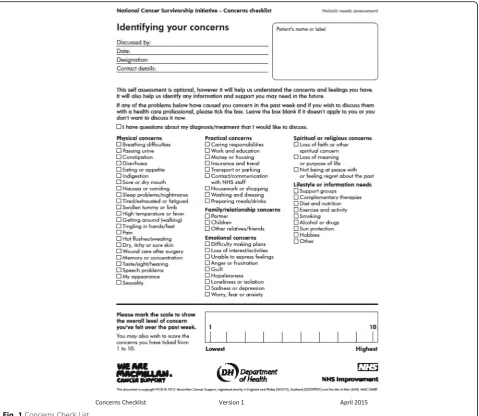
Collation and analysis of nationally specified data from the project sites on the assessment process and characteristics of those who were assessed (Table1) Collation and analysis of concerns reported on the
Concerns Checklist. (Fig.1)
Semi structured interviews with patients who had been assessed
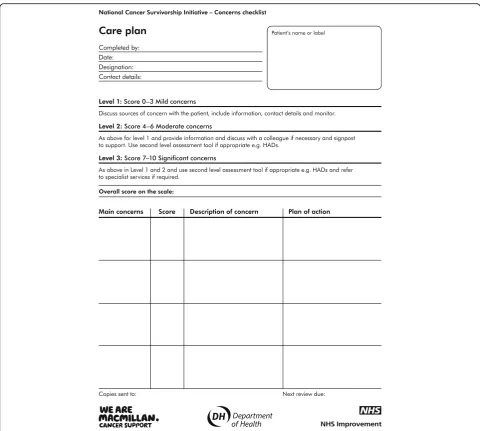
A content review of generated care plans (Fig.2) Focus group discussions and individual semi
structured interviews with the assessors
Focus group discussions with local projects (pre and post implementation)
Content review and synthesis of local evaluation reports from each local project.
An analysis of patient feedback gathered locally by the projects. Edinburgh Napier University provided local TCAT projects with the management of the distribution, return and analysis of an independent patient feedback survey. A free text section allows patients to report what they most valued about the HNA process and to make suggestions from their own experience as to how to enhance its impact. In addition the questionnaire gathers quantitative data on:
knowledge, ability and confidence in how to manage their condition themselves
[image:3.595.309.536.600.732.2]self-management
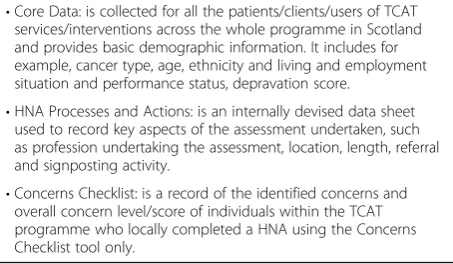
Table 1Data gathered for each completed HNA
•Core Data: is collected for all the patients/clients/users of TCAT services/interventions across the whole programme in Scotland and provides basic demographic information. It includes for example, cancer type, age, ethnicity and living and employment situation and performance status, depravation score.
•HNA Processes and Actions: is an internally devised data sheet used to record key aspects of the assessment undertaken, such as profession undertaking the assessment, location, length, referral and signposting activity.
patient experience, including feeling better supported
Reduced dependency on the system and increased empowerment
Reduced isolation and increased social/support network
Self reported health and well being
Nationally derived data included
Three year longitudinal online survey of wider stakeholders which are members of TCATs’regional and local project implementation steering or operational groups.
Annual interviews with what we have termed as Core Stakeholders which are representatives of the
programme’s national and regional governance structures.
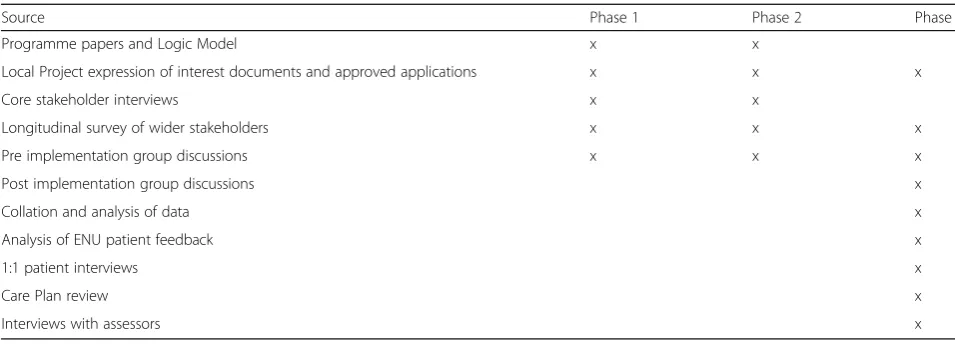
How each source will contribute to the first 3 Phases is set out in Table2.
The evaluation team embedded an appreciative ap-proach into fieldwork tools such as interview and group discussion topic lists and online survey ques-tions. This was done as Appreciative Inquiry [26] fo-cuses on identifying what is working well and eliciting from those involved understand why they think it is. The use of this complementary evaluation approach is deemed a ‘good fit’ for realist evaluations as it helps ensure focus on the optimal conditions (contexts and mechanisms) for the implementation of HNA and care planning.
[image:4.595.60.540.87.503.2]Within a Realist Evaluation the number, or sample size, determined for interviews and focus group discus-sions is predicated on their ability to maximise variabil-ity in context and implementation variables and also to iteratively focus attention on key contexts and mecha-nisms relevant to the developing theories. As such trad-itional sample size calculations are not pre-determined. We will therefore recruit participants (assessors and pa-tients) from each study site to ensure both comprehen-sive coverage and that as many as possible casual explanations can be explored in our analysis.
Phase 1: National programme theory
Phase 1 included: interviews with the TCAT programme’s core stakeholders (n= 11); review of relevant national and
local project documents and disseminated Logic Model(s), the first of 3 planned annual online surveys of the pro-gramme’s wider stakeholders and focus group discussions with the operational/steering group members of local pro-jects (n= 14).
Phase 1 resulted in the more detailed documentation of the national programme theory for HNA and care planning, than that provided by the programme’s logic model. This is given in Table3.
Phase 2: Local programme theories
Across local TCAT projects that tested directly HNA and care planning (n= 19) we identified variation in the profession of the assessor, the actual assessment tool used, the recipients of assessment, setting, timing, the
[image:5.595.57.538.85.516.2]actions of the assessor post assessment, the number and type of concerns identified and a wide range of impact and outcome measures.
The scale of variation in implementation of HNA and care planning with people affected by cancer within the TCAT Programme required the recording of local pro-ject theories. For this phase we identified and set out exactly how the national programme theory was being implemented by each local project. We did this by de-tailing the key differentiating delivery variables. At this stage, due to the large number of study sites, we consid-ered them at a fairly‘high level of conception’and deter-mined them to be the HNA tool used, profession of assessor, location and timing of the assessment.
Eight different HNA tools were identified. The pre-dominant one was the Concerns Checklist used by 14 local projects. Across the projects using this tool we identified twelve different local approaches and models of HNA and care planning being tested within the over-all TCAT programme in Scotland.
It became evident during this Phase that the time and resources available for this RE would not allow us to
gather all the data from all the local projects nor con-duct all other planned workstrands in each of the loca-tions. Given the scale and range of emerging local programme theories an early decision as to the scope of the theory testing and validation work (Phase 3) had to be made.
For inclusion in Phase 3 we have selected six study sites. The selection/inclusion criteria includes:
The use of the Concerns Checklist
Data will be available within the timeframes of the data collection period (2017/2018)
Each selected study site had to provide opportunities to explore variations in the 3‘surface level’
implementation variables - role of assessor, timing of assessor and most vitally different implementation approaches–including within secondary care, community setting and primary care.
Were able to provide data from at least 4 of the 6 defined methods given in Table2.
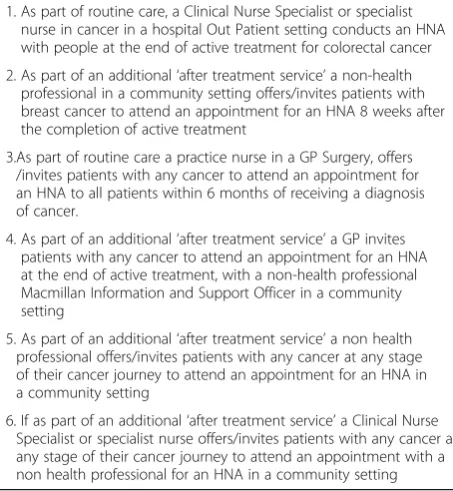
Possible local programme theories for the evaluation across selected sites are given in Table4.
From these 6 local programme theories there are three as it were‘surface level’implementation variables. These are location, the profession of the assessor and timing of the assessment within the cancer trajectory. Phase 3 and 4 have been designed to ensure‘ontological depth’of the evaluation. That is to identify and explore the effect not only of these‘pre defined’variables but also to look be-neath the surface and identify what else may provide an explanation for outcomes and impact.
Phase 3: Theory testing and refinement
[image:6.595.56.534.97.269.2]As the data from the work strands specified above in Table2 becomes available it will be continuously and it-eratively analysed.
Table 3TCAT Logic Model for HNA and Care Planning
IF you use a structured assessment tool (concerns checklist) to identify a patients concerns AND use this information /results of the assessment to inform a care plan THEN the experiences and outcomes will improve in these areas:
○Increased knowledge, ability and confidence in how to manage their condition by themselves
○Increased self management
○Improved patient experience, including feeling better supported across the pathway with improved coordination of their care
○Reduced dependency on the system and increased empowerment
○Reduced isolation and increased social/support network
○Improved health and well being
○Increased patient empowerment to be full partners in their care
Table 2Methods and Sources: Phases 1 to 3
Source Phase 1 Phase 2 Phase 3
Programme papers and Logic Model x x
Local Project expression of interest documents and approved applications x x x
Core stakeholder interviews x x
Longitudinal survey of wider stakeholders x x x
Pre implementation group discussions x x x
Post implementation group discussions x
Collation and analysis of data x
Analysis of ENU patient feedback x
1:1 patient interviews x
Care Plan review x
[image:6.595.58.288.562.731.2]Analysis approach
We propose to utilise a broad Framework Method [27, 28] for the analysis of all data. This will enhance our ability to construct an analytical framework within which context, mechanism and outcomes can be more readily identified and documented.
All quantitative data that is received from the study sites will be reviewed for accuracy and omissions. Rea-sonable effort will be made to ensure complete data sets are transferred. The transfer of this anonymous data is covered by approval from the Public Scrutiny and Bene-fits Panel. All statistical data will be analysed using Excel and SPSS.
Researchers will listen to the audio recordings as part of the analysis process. In addition all audio recordings of interviews and focus group discussions will be tran-scribed in full by a reputable company.
Every transcript and all the free text responses to the online survey and local project patient questionnaires, will be uploaded into the software, QSR NVIVO. Initially this data will be analysed thematically [29]. Emerging themes and codes will be discussed and verified by members of the team for consistency of definition and interpretation.
Subsequent to this the agreed codes will be categorised as either a mechanism, context or outcome and trans-ferred to a tailored made matrix using Excel. We would like to acknowledge the work of Melanie Puntan [30]. We have used their approach as a prototype from which to develop our analysis recording. We consider this to provide the basis of a transparent and systematic way in
which all researchers (and at a later stage stakeholders) can contribute effectively and accurately during Phase 4. In addition the resulting matrix to be created in Excel, will provide an effective way for considering in context all forms of data, the results of data triangulation and team analysis meetings.
Our RE approach to analysis
Realist Evaluation has been described as less of an evalu-ation method and more of“a way of thinking” [31]. We value this conceptualisation of RE being an approach to the exploration and explanation of findings generated from various methods of evaluation and quantitative and data analysis.
With this as a guiding philosophy, our exploratory and explanatory work will progress to the identification and extraction of all outcomes. We will review them for oc-currence, patterns and identify any unachieved or unex-pected outcomes.
In addition our work to date has led us to include space to also extract what we have termed as “partially
evidenced” outcomes. This is important in this RE as
what is being aimed for can differ across sites and what can be ‘evidenced’ and to what extent, via local evalu-ation work will also vary. A lack of robust evidence does not however undermine the effect the context and mechanisms under scrutiny may have had on what was aimed for.
We anticipate categorising outcomes as relating to pa-tient, practitioner, the service/organisation and wider cultural shifts or changes. Using the process for theory validation suggested by Byng [32] we will then, for each outcome create dyads of linked mechanisms and out-comes. Finally ‘contexts’ will be reviewed and added to the matrix to develop tested CMO configurations. Ana-lysis of these will focus on developing MRTs for consid-eration during Phase 4.
Although our analysis starts with the identification of outcomes, we plan to utilise the work of Jackson and Kolla [33] for the analysis of the assessor interviews. Their work provides an approach to identifying linked CMO configura-tions in the primary data generated directly from practi-tioner descriptions of what they did and why.
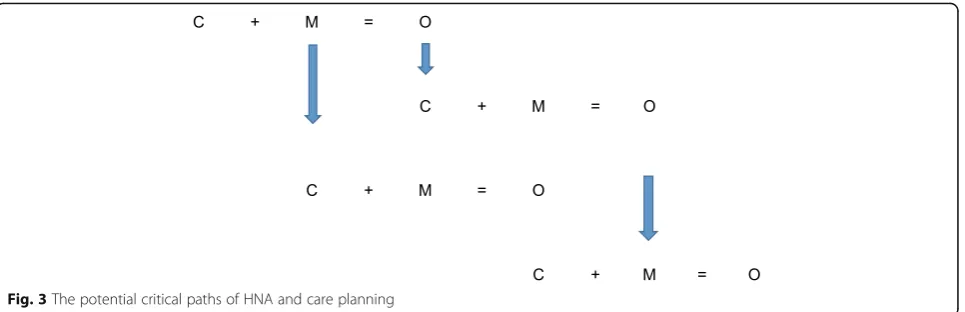
Of importance will be ensuring we shed light on and enhance understanding of the distal/intermediate out-comes vital to the pursuit of high level patient outout-comes such as improved quality of life. This deliberate focus on the potential for CMO configurations to be sequential, where for example an ‘outcome’is a new more facilitat-ing environment for the intervention will help illustrate the “critical path” for the implementation of HNA and Care Planning. This is illustrated in Fig.3.
[image:7.595.61.288.100.346.2]The outcomes of HNA and care planning are not one di-mensional, one off nor linear. As such it will be important
Table 4Local programme theories of HNA and care planning
1. As part of routine care, a Clinical Nurse Specialist or specialist nurse in cancer in a hospital Out Patient setting conducts an HNA with people at the end of active treatment for colorectal cancer
2. As part of an additional‘after treatment service’a non-health professional in a community setting offers/invites patients with breast cancer to attend an appointment for an HNA 8 weeks after the completion of active treatment
3.As part of routine care a practice nurse in a GP Surgery, offers /invites patients with any cancer to attend an appointment for an HNA to all patients within 6 months of receiving a diagnosis of cancer.
4. As part of an additional‘after treatment service’a GP invites patients with any cancer to attend an appointment for an HNA at the end of active treatment, with a non-health professional Macmillan Information and Support Officer in a community setting
5. As part of an additional‘after treatment service’a non health professional offers/invites patients with any cancer at any stage of their cancer journey to attend an appointment for an HNA in a community setting
to ensure the distance travelled towards high level out-comes is understood in order to optimise the conditions for longer term, sustainable success.
Phase 4: Theory validation and dissemination
The theory validation phase will include 2 workshops with core programme stakeholders and leading HNA practitioners in Scotland. At these workshops we will share the analysis results and proposed MRTs.
Participants will be asked to consider and compare the CMO configurations across the study sites to offer ex-planations and insight into whether HNA and care plan-ning works more or less well in different sites, how, why and who for.
Our resulting MRTs will be discussed in detail and re-ceived comments will be audio recorded. We will facili-tate the discussion to maximise interrogation of our interpretation of the data and preliminary conclusions.
Finally a refined programme theory for HNA and care planning will be documented. We will also set out in any implications for relevant policy and practice. This will include descriptions of both positive and disabling context and mechanisms. We will utilise the reporting standards for realist evaluations published in 2016 [34].
Discussion
This study evaluates HNA and care planning. This inter-vention is a key component globally of cancer survivor-ship care. The results of this realist evaluation can be used to optimise the delivery and development of HNA and care planning for people affected by cancer. To our knowledge this is the first study of this type. By utilising the discipline of Realistic Evaluation this mixed methods study will elicit findings with greater potential for gener-alisability and transferability within Scotland, the UK and beyond.
Such knowledge can be used to optimise delivery to maximise benefit for patients and service efficiency and effectiveness.
The variety of approaches across TCAT provides a rich study setting within which to evaluate HNA and Care plan-ning using Realist Evaluation. However the selection of this setting raises the potential for a number of limitations. Firstly there is a possibility that the evidence may be too diffuse from which solid recommendations can be based. Related to this is a concern that the local projects may be unable to provide valid and robust evidence from their local evaluations. To overcome this we have augmented our work with a systematic literature review of the outcomes and implementation of HNA and care planning.
Abbreviations
HNA:Holistic needs assessment; RE: Realist evaluation; TCAT: Transforming Care After Treatment Programme
Acknowledgements
We would like to express our thanks to the local projects for contributing to the study.
Funding
Edinburgh Napier University received funding from Macmillan Cancer Support to conduct this evaluation.
Availability of data and materials
The datasets used and/or analysed during the current study are available from the corresponding author on reasonable request.
Authors’contributions
LJ co-conceived the study design, wrote the manuscript and will carry out data collection and analysis. KC (Principal Investigator) oversees all aspects of the study, co-conceived the study design and will carry out data analysis. Both authors have read and approved the manuscript.
Ethics approval and consent to participate
The study protocol was reviewed and approved Edinburgh Napier University Ethics Committee in 2015 and again in 2017, prior to commencing Phase 3 fieldwork. Informed written consent will be obtained from all participants.
Consent for publication
Not applicable
Competing interests
[image:8.595.59.542.87.243.2]Publisher’s Note
Springer Nature remains neutral with regard to jurisdictional claims in published maps and institutional affiliations.
Received: 10 April 2018 Accepted: 9 July 2018
References
1. Ferlay J, Soerjomataram I, Ervik M, Dikshit R, Eser S, Mathers C, Rebelo M, Parkin DM, Forman D, Bray F. Cancer incidence and mortality worldwide: sources, methods and major patterns in GLOBOCAN 2012. Int J Cancer. 2015;136(5):E359–86.
2. World Health Organisations, Cancer Factsheet, February 2018.HTTP://WWW. WHO.INT/MEDIACENTRE/FACTSHEETS/FS297/EN/[Accessed March 2018]. 3. Miller KD, Siegel RL, Lin CC, Mariotto AB, Kramer JL, Rowland JH, Stein KD,
Alteri R, Jemal A. Cancer treatment and survivorship statistics, 2016. CA Cancer J Clin. 2016;66(4):271–89.https://doi.org/10.3322/caac.21349. 4. Canada Cancer Statistics 2008.
https://www.cancer.ca/en/cancer- information/cancer-101/canadian-cancer-statistics-publication/past-editions-canadian-cancer-statistics/~/media/5AA997B41D064E818E7E160321B74B07. ashx[Accessed March 2018].
5. Parry C, Kent EE, Mariotto AB, Alfano CM, Rowland JH. Cancer survivors: a booming population. Cancer Epidemiology Biomarkers Prev. 2011;20:1996– 2005.
6. Macmcillan Cancer Support, December 2017. Cancer Statistics Factsheet https://www.macmillan.org.uk/_images/cancer-statistics-factsheet_tcm9-260514.pdf. Accessed Mar 2018.
7. ArmesJ CM, Colbourne L, Morgan H, Murrells L, Oakley C, Palmer N, Ream E, Young A, Richardson A. Patients’supportive care needs beyond the end of treatment: a prospective, longitudinal survey. J Clin Oncol. et al, 2009;27(36): 6172–9.
8. Glaser AW, Fraser LK, Corner J, Feltblower R, Morris EJA, Hartwell G, Richards M. Patient-reported outcomes of cancer survivors in England 1-5 years after diagnosis: a cross-sectional survey. BMJ Open. 2013;3:e002317.
9. Foster C, Wright D, Hill H, Hopkinson J, Roffe L. Psychosocial implications of living 5 years or more following a cancer diagnosis: a systematic review of the research evidence. Eur. J. Cancer Care. 2009;18:223–47.
10. Khan N, Watson E, Rose P. Primary care consultation behaviours of long-term, adult survivors of cancer in the UK. Br J Gen Pract. 2011;61(584):197–9. 11. Harrison JD, Young JM, Price MA, Butow PN, Solomon MJ. What are the
unmet supportive care needs of people with cancer? A systematic review. Support Care Cancer. 2009;17(8):1117–28.
12. Carey M, Lambert S, Smits R, Paul C, Samson-Fisher R, Clinton-McHarg T. The unfulfilled promise: a systematic review of interventions to reduce the unmet supportive care needs of cancer patients. Support Care Cancer. 2012; 20:207. https://doi.org/10.1007/s00520-011-1327
13. Macmillan Cancer Support, Routes from Diagnosis: the most detailed map of cancer survivorship yet. 2013.http://www.macmillan.org.uk/Documents/ AboutUs/Research/Researchandevaluationreports/Routes-from-diagnosis-report.pdf[Accessed March 2018].
14. The National Cancer Survivorship Initiative National Cancer Survivorship Initiative. The National Cancer Survivorship Initiative Vision. London: Department of Health; 2010.
15. Cancer Australia. Principles of Cancer Survivorship.https://canceraustralia. gov.au/publications-and-resources/cancer-australia-publications/principles-cancer-survivorship. Accessed Mar 2018.
16. Barbieri M, Richardson G, Paisley S, Sculpher M. (2014). Rapid review of existing literature on the cost-effectiveness of follow-up strategies after cancer treatment. Policy Research Unit in Economic Evaluation of Health and Care Interventions Universities of Sheffield & York; EEPRU Research Report 021. Policy paper/document published 01/09/2014.http://www. eepru.org.uk/article/rapid-review-of-existing-literature-on-the-cost- effectiveness-of-alternative-systems-for-diagnosis-and-referral-of-any-cancer-in-primary-care/[Accessed March 2018].
17. American Society of Clinical Oncology. Determining the Best Model for You: Conducting a Needs Assessmenthttps://www.asco.org/practice-guidelines/ cancer-care-initiatives/prevention-survivorship/survivorship/survivorship-1. Accessed Mar 2018.
18. Macmillan Cancer Support - The Recovery Package sharing good practice, 2013. https://www.macmillan.org.uk/_images/recovery-package-sharing-good-practice_tcm9-299778.pdf. Accessed Mar 2018.
19. Maher J, McConnell H. New pathways of care for cancer survivors. Br J Cancer. 2011;105:S5–S10.https://doi.org/10.1038/bjc.2011.417. 20. National Cancer Action Team. The holistic needs assessment for people
with cancer. A Practical Guide.http://www.gloshospitals.nhs.uk/ SharePoint58/Health%20Psychology%20Web%20Documents/The_holistic_ needs_assessment_for_people_with_cancer_A_practical_Guide_NCAT.pdf. 21. Snowden A, White C (2014) Assessment and care planning for cancer
survivors: a concise evidence review. Macmillan Cancer Support UK.http:// tinyurl.com/lylsfck. Accessed 4 Feb 2015.
22. Australia Cancer Survivorship Centre. Needs assessment tools for post-treatment Cancer survivors: literature review. 2016https://www.petermac. org/sites/default/files/page/downloads/Needs_Assessment_Tools_for_ Survivors_Review_-_January_2016.pdf. Accessed Mar 2018.
23. Pawson R, Tilley N. Realistic Evaluation. London: Sage Publications Ltd; 1997. 24. Scottish Government, Transforming Care After Treatmenthttp://www.gov.
scot/Topics/Health/Services/Cancer/TCAT. Accessed Jan 2018.
25. Macmillan Cancer Support, Transforming Care After Treatment in Scotland. https://www.macmillan.org.uk/about-us/health-professionals/programmes-and-services/transforming-care-after-treatment-scotland.html. Accessed Mar 2018.
26. Cooperrider, D., Whitney, D., Stavros, J. Appreciative inquiry handbook: for leaders of change.2nded. Berrett-Koehler. Brunswick Ohio. 2008. 27. Gale NK, Heath G, Cameron E, Rashid Sand, Redwood S. Using the
framework method for the analysis of qualitative data in multi-disciplinary health research BMC Medical Research Methodology201313:117. https:// doi.org/10.1186/1471-2288-13-117
28. Ritchie, J. Spencer, L. Qualitative data analysis for applied policy research. IN Analysing qualitative data, editors Bryman, A. & Burgess, R. p. 305–309 https://pdfs.semanticscholar.org/7b71/8dc8ace7b9618361c14d2186fef 9994b474a.pdf#page=188.
29. Guest G, MacQueen K, Namey E. Applied thematic analysis. London: Sage Publications Ltd; 2012.
30. Centre for Development Impact. Reflections from a Realist Evaluation in Progress: Scaling Ladders and Stitching Theory April 2016https://opendocs. ids.ac.uk/opendocs/bitstream/handle/123456789/11254/CDIPracticePaper_ 18.pdf;jsessionid=AEC2A5E41EB35647476F7202875DFE3A?sequence=1. Accessed Mar 2018.
31. Westhorp, G. Realist impact evaluation: an introduction, London: Overseas Development Institute/Methods Lab; 2014.https://www.odi.org/sites/odi. org.uk/files/odi-assets/publications-opinion-files/9138.pdf. Accessed Mar 2018.
32. Byng, R., Norman, I. and Redfern, S. Using realistic evaluation to evaluate a practice level intervention to improve primary healthcare for patients with long term mental illness. Evaluation: International Journal of Theory, Research and Practice, 11, 69–93. Volume: 11 issue: 1, 2005.https://doi.org/ 10.1177/1356389005053198
33. S.F. Jackson, G. Kolla, A new realistic evaluation analysis method: linked coding of context, mechanism, and outcome relationships. Am J Eval 33(3) 339–349 Volume: 33, 2012.https://doi.org/10.1177/1098214012440030 34. Wong G, Westhorp G, Manzano A, Greenhalgh J, Jagosh J, Greenhalgh T.