Rochester Institute of Technology
RIT Scholar Works
Theses
Thesis/Dissertation Collections
2010
Securing the IT acquisition security chain: Security
concerns and human factors in IT acquisition
Eric Goldman
Follow this and additional works at:
http://scholarworks.rit.edu/theses
This Thesis is brought to you for free and open access by the Thesis/Dissertation Collections at RIT Scholar Works. It has been accepted for inclusion in Theses by an authorized administrator of RIT Scholar Works. For more information, please [email protected].
Recommended Citation
Securing the IT Acquisition Security Chain:
Security Concerns and Human Factors in IT Acquisition
By
Eric Goldman
Thesis submitted in partial fulfillment of the requirements for the degree of Master of Science in
Networking and Systems Administration
Rochester Institute of Technology B. Thomas Golisano College
of
Computing and Information Sciences
Date Approved: 1 April 2010
Thesis Committee Members: Yin Pan
1
Abstract
2
Contents
1 Abstract ... 2
2 Contents ... 3
3 Tables ... 5
4 Introduction ... 7
4.1 Scope & Significance ... 7
4.2 Research Questions ... 8
4.3 Literature review ... 9
4.3.1 Relationship to Current Body of Literature ... 9
4.3.2 Organization of this Review ... 9
4.3.3 Human Psychology and Decision Making ... 9
4.3.4 Issues of Trust ... 10
4.3.5 Human Nature and Security ... 11
4.3.6 The Weakest Link ... 13
4.3.7 Software is Inherently Insecure ... 13
4.3.8 What can be done to improve security? ... 14
4.3.9 The Administrators... 15
4.3.10 Research and Analysis Methodology ... 16
4.3.11 Literature Review Conclusions ... 17
4.4 Conceptual model ... 18
5 Methods ... 19
5.1 Study setting ... 19
5.2 Selection of study subjects ... 19
5.2.1 Source (Sample Population) ... 19
5.2.2 Participant recruitment ... 19
5.2.3 Criteria for eligibility/exclusion ... 19
5.3 Description of intervention ... 19
5.4 Data collection ... 20
5.4.1 Source ... 20
5.4.2 Protocol for typical participant ... 20
5.4.3 Steps taken to assess and assure data quality ... 20
5.5.1 Result Preparation and Analysis ... 21
5.5.2 Sample size/power considerations ... 21
5.5.3 Statistical methods ... 21
5.6 Interview Questions ... 23
6 Results ... 26
6.1 Scoring Criteria ... 26
6.2 Participant Scores ... 26
6.3 Answer Summaries by Participant ... 28
6.4 Security Scoring Analysis ... 29
6.4.1 Scoring on All Questions in the Security Section of the Interview ... 29
6.4.2 Scoring on Security Questions Directly Addressing Security during Acquisition ... 29
6.5 Correlations Analysis ... 30
6.5.1 Correlations between various sections addressed in the Interview ... 30
6.5.2 Regression Results: Decision Strategy on Security ... 31
6.5.3 Regression Results: {User Interaction and Involvement, Management Attitudes, and Experience of Decision Maker and Organization} on Decision Making ... 32
7 Interpretations & Analysis ... 34
7.1 Research Question Q1 ... 34
7.1.1 Question Statement ... 34
7.1.2 Interpretations and Analysis ... 34
7.2 Research Question Q2 ... 37
7.2.1 Question Statement ... 37
7.2.2 Interpretations and Analysis ... 37
7.3 Research Question Q4 ... 41
7.3.1 Question Statement ... 41
7.3.2 Interpretations and Analysis ... 41
7.4 Research Question Q3 ... 43
7.4.1 Question Statement ... 43
7.4.2 Interpretations and Analysis ... 43
8 Discussion ... 46
8.1 How key findings compare or contrast with previous work ... 46
8.2.1 For the theory or conceptual model described in the Introduction. ... 48
8.2.2 For future research ... 48
9 Bibliography ... 50
10 Appendices ... 54
10.1 Participant Informed Consent Form ... 54
10.2 Participant Advertisement (Email) ... 57
10.3 Question Background & Scoring Criteria ... 58
10.4 Result Summaries by Participant ... 65
[image:6.612.67.538.70.251.2]3
Tables
Table 1: Interview Questions ... 23Table 2: Participant scores on interview questions ... 27
Table 3: Averages and standard deviation for all questions in the security section ... 29
Table 4: Average and standard deviation addressing role of security in acquistion ... 29
Table 5: Correlation Statistics Comparing the Various Sections of the Interview ... 30
Table 6: Regression Model for the Effect of Decision Strategy on Security (Summary)... 31
Table 7: Regression Model for the Effect of Decision Strategy on Security (Equation) ... 31
Table 8: Regression Model for the Effect of Predicotors on Decision Strategy (Summary) ... 32
4
Introduction
This research investigated attitudes and behaviors related to the role of security in IT component acquisition. The study identified decision making strategies used by IT decision makers in selecting new components (e.g., software, hardware, or external services) and systems for internal usage. The
identified strategies were evaluated and analyzed to determine to what extent, if any, IT security (risk) is considered by the IT decision maker during the acquisition phase. In addition, IT decision makers' strategies were juxtaposed with other core factors, such as end-user involvement, to determine if they had any relevant impact on the decision makers' ability to perceive and plan for future risk.
The population of interest in this study consisted of small- to medium-sized enterprises. The appropriate IT decision maker for each organization was identified by each participating organization and one-on-one in-person interviews were conducted with each participant. Previous research studies, guidelines, and recommendations have tended to focus on large enterprises. However, smaller organizations often do not have similar resources or circumstances. In order to expand the body of research, this study elected to focus exclusively on small- to medium-sized organizations.
4.1
Scope & Significance
While contemporary society has recognized the importance of IT security management at the larger enterprise level, there are still many smaller organizations that do not understand how to address these concerns. In general, it is very difficult and time intensive for any organization to exactly quantify the possible loss resulting from a security incident or to predict the likelihood of an attack on any given IT environment. Due to the complexity and cost of planning, many organizations upfront investments in security are minimal. This often leads to reactive, "fire-fighting" approaches to security. However, such an approach may lead to extended downtime, loss of reputation, and financial loss when an attack actually occurs.
This study does not attempt to suggest that there is a simple formula or standard that can be applied to better predict the threat to a given IT system nor does it attempt to create some universal criteria for effective decision making (e.g., a checklist) as it is related to information security. Instead, in this study I argue that IT decision makers' acquisition decision strategies may either positively or adversely affect their ability to discover, understand, and plan for potential risk. Furthermore, this study also suggests that an individual’s security assessment strategy is influenced by experience and environmental factors which may lead to an unrealistic assessment of an organization’s security requirements or may lead to a security evaluation which is supported by non-truths and misperceptions.
The research focused primarily on the acquisition phase of the system lifecycle. The acquisition phase occurs after a need has been identified and the decision has been made to purchase or otherwise acquire a solution rather than to build the component internally. Thus, it is most vital to evaluate a component's fitness and security implications during this phase, before the component has been introduced into the system and other components or business processes have become dependent upon it. After a component has been selected and implemented, it is often very difficult or in some cases impossible to remove it from the overall IT system. Therefore, it is critical that IT decision makers are aware of security requirements during this phase in order to reduce reactive security management. In addition, when security is considered in this early stage it can help increase security awareness and ease security management in later stages of the system lifecycle. If a product is known to have good security support or integration with security reporting or monitoring systems, this is one less patch or concern that must later be addressed or that may only become apparent after a security incident has already occurred.
This research investigated and analyzed examples of strategies, attitudes, and external factors which improve security consciousness and awareness during the acquisition phase of the system lifecycle. Through this analysis other IT practitioners and decision makers can learn how to modify their own behavior and environment in order to increase the security of their IT systems. Furthermore, this study will help decision makers avoid common pitfalls, which may lead to a false perceptions of a security, foundationless trust, misinformed decisions, and/or selections made with insufficient qualification.
4.2
Research Questions
At the highest level, this research study sought to discover the human factors and decision making processes involved in application and system acquisition in small-to-medium sized corporate IT
environments, and to what extent, if any, during this process security concerns are addressed. In order to address this greater concern, this study evaluated the following more specific questions:
Q1: To what extent, if any, is security considered during the acquisition process?
Q2: To what extent, if any, is security considered by the participants and their corresponding organization throughout the system lifecycle? What is the extent of security awareness and understanding?
Q3: Does the relative performance of decision makers (and their organizations) in the areas of
Q4: Does the relative quality of decision makers' decision strategies significantly predict the level of security awareness and understanding demonstrated by the participants and their organization?
4.3
Literature review
4.3.1 Relationship to Current Body of Literature
While the body of research is limited in terms of case studies evaluating deployment procedures, there is a growing interest in human factors and its relationship to security. In addition, previous findings from the field of psychology in decision theory and science contribute to the foundation of this research. Besnard and Arief note that “computer security is an area that cognitive scientists have not investigated as deeply as human computer interaction or problem solving” [1]. Generally, as will be outlined below, previous research has focused on end-users with limited analysis of IT practitioners. I believe a bias exists where it is assume that IT professionals have a higher degree of security education and understanding. However, there are surely many decision makers who have no background,
understanding, or concerns about security. Decision makers may have specialized knowledge and a more technical understanding of a problem, but generally they can fall prey to the same traps as end-users. This is especially true of general psychological principles on human rationality and decision making, which are mostly independent of technical domain. The literature that approaches security from a human factors perspective goes to great lengths to explain that security and usability are often in confrontation; users will ignore security concerns when there is pressure to perform or simply when security rules present undesired hurdles to achievement of goals. One of the key findings emerging in the body of literature is the general lack of awareness and understanding of security concerns. Also noteworthy is that organizational cultures tend not to put a strong enough emphasis on security. Many papers have commented on users as “the weakest link” [2][3][4][5], that a failure of an individual in terms of security can cause breaks throughout an organization. While it is presumed that IT
professionals should be the strongest link, I would say that the IT staff metaphorically represents a lock. That is to say that if they are not securing the chain and holding it together, there is no defense
whatsoever.
4.3.2 Organization of this Review
This review of literature will cover major themes spanning from decision making and psychology based concepts to the role of security in software design and organizational practices. Among these are social and psychological aspects dealing with the nature of human thinking and decision making and issues of trust relationships. I then move into an overview on how individuals react to security situations and how humans effect security situations. Next, I provide a brief examination of the effects of software design and development on security and relate some of the proposed techniques for increasing software security situations. Drawing from the above, I relate the ideas and studies in the body of research to IT acquisition decision makers and other IT professionals. Finally, an analysis of the research methodology and analyses in the body of literature is presented.
4.3.3 Human Psychology and Decision Making
insight into the way humans evaluate a given situation [5]. Building upon previous research in psychology they relate that individuals are inclined to take the easiest route rather than evaluating a situation and appreciating all possible consequences. Various factors such as internal and external pressures can make decisions difficult; as the level of stress increases for a given decision an individual is less likely to consider consequences in order to solve the solution expediently. Besnard & Arief also supported this view, noting specifically that human reasoning is not based on achieving perfection [1]. Rather the authors’ research indicated that cognitive acts involve an analysis of tradeoffs, which results in the individual choosing some perceived optimal path. This introduces new risks since the individual may not consider all consequences. In their analysis Besnard & Arief evaluated a case study covering an accident on December 30, 1999 at the JCO nuclear fuel processing plant in Japan. Workers at the plant broke with the normal processing procedures and used an illegal and dangerous procedure to expedite their tasks in order to make it easier to perform their jobs. As a result, two workers died when the process triggered a critical accident. Upon further review of the incident, it was determined that management’s drive for productivity and relatively low concern for safety significantly contributed to the incident. It seems that humans are preprogrammed to make convenience decisions, and
furthermore that irrational decision making increases with the amount of stress the individual is under at any given point. Risk (the potential for some action or decision to result in harm or loss, now or in the future) and stress seem directly proportional; however, individuals seem less likely to consider risk as the stress increases.
4.3.4 Issues of Trust
To a great extent the level of trust in a particular situation will affect how willing a user is to consider risk. Mayer et al. examined research and definitions of trust from multiple disciplines [6]. Trust can be understood as a reduction in the perception of risk, which may be the result of a relationship, analysis, or other factors which may lead one to believe that there is some manner of reducing risk. Herein I will define trust as the level to which an individual feels safe and is confident in the accuracy of his beliefs about people or things. Trust should not be confused with reliance, which may often be substituted for trust. Reliance is a mechanism whereby one believes that the partner in a trust relationship can resolve a problem or conflict which may arise even when there is insufficient proof that risk has been reduced [7]. Trust relationships exist between individuals and other individuals, as well as between individuals and organizations or institutions. An individual may also have a level of trust in his own abilities or knowledge. Chu et al. evaluated the dangers of trust in their design for creating a secure application framework [8]. In their evaluation, they defined trust as follows: “Trust is to undertake a potentially dangerous operation knowing that it is potentially dangerous” [8]. They then proceeded to look at trust from an end-user’s vantage point, noting that in general a user will prefer to have some proof of harmlessness; however, they often accept weak forms of evidence in establishing trust. For example, they noted that if a piece of software is recommended by a friend whom they trust, other users are more likely to assume that software is safe even without an explicit mention of the software being “virus-free” or otherwise benign. They also noted that when responsibility can be transferred to another individual, group, or institution that individuals are more likely to put trust in an otherwise risky
transaction because the credit card company will assume the liability for any fraud that could result in the future.
In Dourish(1) et al.'s investigation of trust the researchers noted that people will often put their faith and trust in technology itself to provide protection [3]. In this case, humans will take on more risky behaviors because of their confidence in technology to protect them. That is to say a user may download an attachment from an unknown sender believing that if a virus were attached his virus scanner, spyware blocker, and other technology would prevent any harm. In the case of an IT professional, this blind faith in technology could be much worse. IT professionals who understand a given technology and how it works may be more prone to believing the provided safeguards are absolute as long as they are maintained and remain functional. As a result, IT administrators may not bother to make active decisions on security issues.
The highest level of trust is often between individuals and established institutions. One may consider banks, for example, to be relatively secure because of their investments in security guards, heavy safes, and video monitoring technology. Dourish(1) et al. asserted that this trust is often transferred from the physical world to the bank’s online presence [3]. While it can be argued that banks are the biggest investors in security and security technology, they still remain lucrative targets for attackers. Such awareness is necessary for making accurate security related decisions. In terms of software, many popular download website have become institutions in their own right. Due to popularity and traffic, users may assume that others also trust these web sites without any actual foundation. In 2003, popular open source project management and repository Source Forge (http://www.sourceforge.net) was successfully attacked [9]. The root FTP servers used to host many of the projects repositories were compromised in the attack. It was unknown whether any files were compromised before the attack was discovered, but there was the possibility that malicious code could have been injected into any number of project repositories. Users would typically not think twice about downloading software from Source Forge because all projects are open source and anyone could review the code, and then alert the community or the Source Forge administrators of any vulnerability or danger. However, there are many unmaintained and unmonitored projects which users may still use without performing their own analysis. Users implicitly may feel safe because the content is hosted on Source Forge and that the source code is open for review, but hosting via Source Forge does not present any explicit security guarantee.
4.3.5 Human Nature and Security
Considering the above human decision making processes and factors which many increase or decrease trust, the way that individuals approach security practices and security decisions will now be addressed.
of communication that exists between developers, implementers (such as acquisition decision makers), and users. End users often do not see software applications and their related security concerns the same way as knowledgeable IT professionals. As a result, users may not understand security mechanisms or their intended purpose. For example, a user may believe that a spam filter will delete malicious attachments, when in reality the organization's spam filters only perform basic pattern matching and normally would not scan for viruses or spyware. In addition, the Dourish(2) et al. study found there was a generational difference among users: Younger individuals were much more skeptical and concerned about potential security situations, whereas older individuals displayed a higher degree of trust. More broadly, their study highlighted that users believe their efforts to be secured are futile because the hackers, spammers, and other villains will always be a step ahead of them. Users therefore prefer to delegate responsibility elsewhere and believe they themselves are incapable or are not responsible for security within organizations.
In a later article [3], Dourish(1) et al. confirmed many of their previous findings. Some new points were also raised in this study. The authors noted that as the complexity of software increases, users will tend to explore and seek to understand it less. This correlates to another finding which explains that while a user’s security decision will fall somewhere on a continuum, their choice to act or to not act is often all or nothing. For example, if a typical user is prompted to update the virus definitions for his virus scanner software, he will either do it immediately or will choose not to perform the update at all because he does not understand the purpose or need, or may simply have other tasks with a higher precedence. Usually, if the user does not immediately take care of the security concern, he will forget about it or will choose rather to just accept the security violation (e.g. spyware pop-up every few minutes) as part of normal computing operations. The authors also shared a novel observation that over time, security practices may become part of normal routine. While initially this would appear to be a positive gain, user complacency will lead to less conscious thinking of security and may also result in the users forgetting how or why a particular security task should be tackled. For example, when a new member enters a group the current group members are unable to explain the security procedures, practices, and principles to the new member. This may result in a decay of security over time as old members leave and new members join the group.
Gross & Rosson provided an overview of their interview study which assessed user security practices [2]. The authors’ research indicated that there is increasing concern among users about security. However, in line with other studies [3][4], they noted that users are unable to understand and effectively
understand and respect the need for security practices. This finding does not address if the relationship varies if the IT services are outsourced as opposed to being provided in-house.
4.3.6 The Weakest Link
Much of the literature has identified humans as the cause of most security related issues, instead of poorly written software or inadequate procedures. This section will review some of the ways that humans defeat or limit security measures.
As Sasse et al. discussed [5], regardless of capital investment in technology, security mechanisms are easily defeated (whether intentionally or not) due to human error or incompetence. In their study Sasse and her associates examined the effectiveness and success of password and authentication usage among end users. Their paper detailed that users often have great trouble remembering their many passwords due to factors such as complexity and frequency of usage. The results of their survey and in-depth interviews further indicated that in general users did not display sufficient understanding of security practices or the importance of compliance. Through their study they hypothesize that users are typically not well educated about security and do not concern themselves with security for a number of reasons, such as those mentioned above. Most alarming is that participants indicated they did not believe they would be the target of an attack; some participants explained that they did not believe they had any sensitive information or that a security compromise on their system or account would not result in any further harm to the organization. However, from practical experience I argue that most attacks on a network or vital systems do in fact begin by compromising a poorly secured user system or account since they are often not as closely monitored as servers or administrator accounts.
Users typically do not believe they have any responsibility for security. They choose to delegate the responsibility or trust in some external person, group, institution, or technology. Within an organization, users do not feel in direct danger. They choose to believe that the organization is the target; however, users seem unaware that the organization may store personal data in payroll and human resources databases. Should an attacker compromise these systems, the user could potentially be directly affected by the attack. Besnard & Arief observed that this mentality leads to activities such as writing down passwords or other convenience mechanism for circumventing security procedures [1]. It is unlikely that users seek to defeat security mechanisms for the sake of limiting security, but rather it is the result of convenience. As Besnard & Arief noted, there is a cost associated with any task and security measures often make the costs higher; by circumventing security users make their tasks less expensive either in terms of complexity or time.
4.3.7 Software is Inherently Insecure
Most software developers do not intentionally create faulty or insecure software. However, as noted in earlier sections, security adds additional costs and must always be ongoing. As a result, there is the inevitability that software will arrive for deployment with problems or security flaws, and furthermore that the initial authors were more concerned with efficiency and algorithmic elegance than with writing tight and secure code.
While the software may be written to match specifications, that does not guarantee that specifications themselves are correct. Software may also be used in unintentional ways or combined with other applications in such a way that new security concerns are created that were not previously known. Collins and his associates recount a case study where an unknown bug existed in switches used by AT&T. The logical error was not detected in testing and the condition which triggered the failure was not common. In another case, the authors examined the implementation of electronic management system for hospital pharmacy. This case was interesting because apparent bugs were found, not by a
programmer, but by a member of the hospital staff. This particular individual was highly skeptical of the system, and while she was not intentionally trying to break the system she was on high alert. Clearly, security must not only be evaluated during the initial purchasing procedure, but before and after deployment has occurred. It is also important to remember that responsibility for security or privacy concerns fall on the organization deploying the software, not the software developer in almost all cases. While lawsuits can often be brought forward for contract software that does not meet standards, most commercial and open source software authors are not accountable. The text of most open source licenses or end user license agreements specifically indemnifies the author of legal responsibility.
Sasse and her associates also noted that the design of security has an effect on security. Based on their findings [5], they noted that security increases when the application better matches the user’s
workflow. This logically follows findings presented earlier because the cost of a particular task is not greatly increased by following a procedure that is well designed to accompany the task. As an example, consider a user work group where users work collaboratively on reports. A role-based, collaborative document management system would allow all users to have appropriate access to a file without the burden of managing access in a more traditional method such as controlled directories in a file system. Because the processes has become more easier and less costly than typical file management, the users would likely have no qualms about the added security.
Shimeall & McDermott [11] examined Internet usage and related security concerns. They noted that software is becoming more complex, while at the same time application efficiency has taken precedence over security. As a result, there are complex systems with many points of failure, which are widely distributed and deployed, often with minimal security testing. Furthermore, they concluded that vulnerabilities will increase as programmers become more comfortable with sloppy coding procedures and usage of languages which require greater security considerations by the programmer. Take for example the PHP programming language. Because PHP is loosely-typed, data validation becomes extremely important when dealing with user input. However, it is not unlikely to find a piece of PHP code that expects an integer, accepts a string, and allows for a malicious code injection. For this reason, the authors stressed the importance of constantly reevaluating software through its lifecycle. Security or operational flaws may be discovered and patched, however, that does not guarantee that such patches will be applied or that the modification will not result in further vulnerabilities.
4.3.8 What can be done to improve security?
The most important conclusion brought about in the body of research, is that users are not well
awareness among users and administrators. Combined with the more frequent interaction proposed by Gross & Rosson [2], this will facilitate communication and trust between users and administrators. Such interaction will increase the likelihood that a user will seek guidance on a security concern, rather than simply dismissing the concern and continuing on with his work. Secondly, users must be protected from themselves. The software should be selected or written to streamline the user’s workflow. Users should be presented with a minimal number of choices (e.g., menu-driven interface as opposed to a graphical interface). Specifically for security concerns, users should be given explanations in simple language and all security information should be automatically forwarded to the IT staff. In this way, the administrators will be aware of security concerns and can seek out the individual even if the user does not come forward or later ask about the security incident. Lastly, it is important to remember that users are typically not technically proficient with computers nor are they performing IT work. Security must be analyzed beyond technological concerns; this would include creating a security culture where actions such as writing down passwords are discouraged. As noted by Dourish(2) et al. [3], security should not be “transparent”, but rather it should be highly visible. By providing people with the means to
understand security and the consequences of their actions, there is a higher probability of users complying with security measures and rules.
4.3.9 The Administrators
Since the research findings do indicate that users are truly the weakest link, one would hope that the IT professionals or decision makers would display a greater security understanding. One might also assume that they also take strong steps to insure security in an IT environment, and thus would reduce the impact of the weak links. The literature to this point does not have significant findings or studies on the security awareness of IT professionals. In my study I propose that often there is no lock at all due to poor security practices by the IT staff, and that IT professionals are susceptible to flawed and illogical conclusions and cost-based tradeoffs in the same ways as end-users.
Findings by Dourish(1) et al. indicated that non-technical users do not perceive security in the same way as IT professionals [4]. For instance, the authors noted that often users group security and privacy concerns together, and place prime importance on issues of privacy over those of a more security nature. Since users are typically incapable of understanding security concerns the IT staff is always responsible. In a section labeled “Responsibilities of the software buyer”, Collins et al. asserted that the buyer is “most responsible for the intended use of the software” [10]. The buyer, who is typically also the decision maker, is responsible for learning the software or system's capabilities and limits. If users will be interacting directly with a program, then they must also be considered so that the decision is user-centric and takes into consideration workflows. Since the buyer is the one who is making the commitment to the software, the responsibility for usage and security lies with them and not the end users. Besnard & Arief commented that “security is not the end-user’s task” because security depends on where security lies on an organization's list of priorities [1]. "Good security" should be an
Issues of trust can also greatly affect the perceptions and decisions related to security by IT
professionals. Based on findings by Besnard & Arief [1], users were found to be susceptible to misplacing their trusts. However, misplaced trust by decision makers could be much more costly to the
organization. A decision maker that is under pressure or that simply trusts vendors or other
non-knowledgeable sources increases security risks for the entire organization. An individual may be swayed by commercial reviews, biased whitepapers, or online forums where the security of the application is not even discussed. Based on these positives, and lack of any known negative aspects, the IT
professional may assume a higher level of trust than she should. Without furtherer research or testing, the organization may never learn they have insecure software. Besnard & Arief discussed the implication for users becoming complacent with technological protections. However, since a decision maker or other IT professional has a better understanding of the technology and what it does, the level of trust could be much higher, to the point where responsibility is transferred to the technology. For example, a System Administrator may setup software to use an automatic updating mechanism. His belief in the strength of the system may result in log files or actual systems never be audited for successful updates. However, it is imperative for the IT staff to be diligent about security, because the impetus for creating a culture of security will almost certainly not come from the users.
As mentioned throughout the literature, the concern for security was minimal in the early days of organizational computing. This raises an additional problem that IT professionals may not be security conscious. In fact, as Besnard & Arief demonstrated [1], a low level of understanding or knowledge can lead to users choosing more convenient paths. An IT professional without significant training or knowledge in IT security may choose to focus on his conventional IT tasks with minimal concern for security. However, this is unacceptable as there is likely no other source in the group who will understand or take responsibility for security.
4.3.10 Research and Analysis Methodology
Research in this domain lends itself to a qualitative approach, though other researchers chose a mixed method approach to compliment their qualitative data. The main methods used in previous research studies have been interviews and case studies. This study addresses a technical problem as well as a management problem, with a strong foundation based on general psychological ideas. Previous research has shown that security is simply not a purely technical problem; by understanding the human
motivations for security decisions we can better align business practices as well as technical
specifications to increase security. Many existing studies have been undertaken by computer scientists who adopted a more psychological and behavioral science approach.
Dourish(2) et al. used semi-structured interviews of end users and their usage of Internet technologies [4]. At the time of writing, they were reformulating the questions in order to perform more detailed interviews on a larger sample. The questioning was conducted with an ethnographic-style in order to focus on the social factors which affected security thinking. The results likely contributed to the interviews performed in their later work [3]. In this later set of findings, the authors explain that they used Grounded Theory to analyze the data. The Grounded Theory puts the emphasis on forming the theory based on the research process. The goal, the authors stated, was not to simply document what users do, but to characterize and “understand [the users’] experience of security at they encounter it” [3]. They argued that a quantitative approach was not appropriate at this stage since they were more concerned with what questions to ask rather than finding true and complete answers.
Gross & Rosson provided an in-depth explanation of how they setup their interview based study [2]. Pre-establish questions were the launching point and were general in nature. They looked for spontaneous thoughts, not narrow answers. The participants selected had significant work experience, access to sensitive data, and had no special training in security. There was some resistance to participate in the study by individuals. The authors noted that some were not confident in the guarantee of confidentiality and feared that their answers may result in disciplinary action from their organizations. I was surprised that no other literature indicated a resistance to participate considering that the topic could easily create feelings of uneasiness and discomfort. The authors continue to describe their approach as functionalist as opposed to interpretive. This approach influenced the current research because I was most interested in how the human factors of security play out in organizations and institutions.
4.3.11 Literature Review Conclusions
The body of research provides great insight into the many human factors which affect security. From the decisions people make, to the trust relationships individuals establish, many factors affect security in an IT environment. The current body of research holds a great wealth of insight into users. Building upon this base, I hoped to explore other factors which play into IT security in organizations. As people become increasingly dependent upon technology, there must be assurance and understanding of security. Beyond the security within the organizations, people become links in other chains of security, be it friends, families, clubs or organizations. By increasing security practices and understanding in the business world, security in less controlled environments (e.g., the home) may also be increased. Users do not operate the various aspects of their lives in vacuums. The file your brother sends to you gets forwarded as an attachment to your coworker, which ends up on the department file server, which ends up spreading a malicious virus to the entire enterprise. Therefore it becomes clear that the only way to prevent such a chain of events is to continue to conduct research and to educate users.
and better protected by teaching IT professionals how to implement good security measures and how to relay security understanding to the non-IT members of the organizations. When security is better understood by all, the costs of security practices can decrease because administrators will choose better products and also develop clearer policies and procedures, which will lead to less confusion and stress for users. When users are educated and understand these principles they are more likely to make better decisions. Everyone’s security and productivity is increased when an organization's security chain is made of strong links. Combined with a strong lock provided by the decision makers and other IT professionals, it will become harder for attackers to break the security chain.
4.4
Conceptual model
The conceptual model for this research is organized as a series of cause and effect statements:
1. A more thorough evaluation of IT components before purchase and integration into the greater IT system will reduce instances of future problems.
2. Decision makers who consider security during acquisition can increase organizational security because they are aware of security requirements and possible vulnerabilities in their
environment before an attack occurs.
3. If management does not provide sufficient support and resources for IT security programs and actions then the IT decision makers will be limited in their ability to provide organizational security.
4. If end-users are not well trained or do not understand the ramifications of risky IT-related behavior then the IT decision makers will be limited in their ability to secure the organization’s IT systems.
5. If an organization lacks experience and understanding of IT security it will be unable to recognize and properly address any possible security concerns which may exist.
5
Methods
5.1
Study setting
This study was conducted during the summer of 2009 (June-August). All participants in this study came from organizations that operated in the Rochester, New York, metropolitan area. The selected
participants for this study were identified by their organization as appropriate persons who were involved in the IT acquisition process for their organization. All participating organizations identified themselves as small-to-medium sized organizations having approximately 20-1000 employees.
5.2
Selection of study subjects
5.2.1 Source (Sample Population)
Research was constrained to the Rochester, New York metropolitan area. The organizations represented in this study, operate in various industries. The decision makers participating in the study were from various organizational ranks, dependent upon the particular organizational-structure of each organization.
5.2.2 Participant recruitment
Potential participants were identified through local area business organizations which provide support and networking services to local businesses, as well as the career services department at the Rochester Institute of Technology. After successfully engaging a representative from one of the above sources, I explained the research and provided them with a standard participation announcement in letter form (see Appendix 10.2) and asked them to forward this announcement to the appropriate organizations within their membership. In some cases, the representative instead provided me with a list of suitable participants because they preferred I contact each potential participant individually.
Some additional attempts were made to recruit participants for this study. Using a business-listing database, companies that seemed to best fit the criteria of this study and were located in the Rochester, New York metropolitan area were filtered and contacted directly using the same announcement as the previous method (see Appendix 10.2). In addition, companies that had close working relationships with the Rochester Institute of Technology were identified and also contacted directly.
5.2.3 Criteria for eligibility/exclusion
The following restrictions were placed on an organization being represented in this study:
1. The organization should define itself as small or medium sized with approximately 20-600 core employees.
2. The majority of the core employees in this organization must interact with personal computers or other IT technology in their day-to-day work.
3. The company may not be in the business of providing IT security solutions or building IT security products because they might have a skewed opinion on IT security compared to organizations that operate in other industries.
In this interview-based study, there was no intervention. All participants were subject to the same set of questions and followed a similar interview process.
5.4
Data collection
5.4.1 Source
All original research in this study was obtained through in-person interviews with the individual
identified by the organization as an IT decision maker involved in the acquisition process. Each interview lasted between approximately sixty and ninety minutes. The interviews were all conducted one-on-one and the participants provided informed consent. The interviews were either located on the premises of the organization where the decision maker was employed or in a private study room in the Wallace Library at the Rochester Institute of Technology. The interview questions focused first on general procedures related to acquisition and the focused narrowed specifically to IT security at the end. At the conclusion of the interview, the participant was allowed to readdress any questions or provide any additional commentary related to the subject matter covered in the interview. In general, questions were asked in the same order for each participant, except in the case where the participant had provided sufficient material relevant to the question in response to a previous question or if the question was inappropriate for the participant (e.g., asking a CEO about how his boss communicates with him). The specific interview questions that contributed to this research are provided in Section 0 of this report.
5.4.2 Protocol for typical participant
After a participant was identified as suitable for this research study, an in-person interview was
scheduled at the convenience of each participant. Before beginning the actual interview, the participant was provided an informed consent form (see Appendix 10.1) and the opportunity to opt-out of the study or ask additional questions. The participant was also informed that the interview would be recorded to assist in later analysis. After confirming informed consent, I proceed with the interview. A general outline-script was prepared with section introductions and the actual questions to be asked. The questions were scripted for consistency and all attempts were made to use the simplest language possible for each question. As each question was asked, some clarification was provided as needed or requested by the participant. The participant’s responses were recorded and notes were also taken for each response. After all of the planned questions were asked, the participant had the opportunity to add supplemental information or to readdress any subject material covered early in the interview. At the end of the interview, the participant was informed that the interview was over and the recording was stopped.
5.4.3 Steps taken to assess and assure data quality
To increase the probability of a truthful response from the participant, their confidentiality was ensured through the informed consent process. Moreover, the interview was structured to start with more innocuous topics gradually moving into areas where the participant may not necessarily be as
comfortable. To this end, the study’s main focus was on the acquisition process in general, only focusing on security issues after first collecting responses in general. It was an initial consideration that
However, in the process of the interview all participants were comfortable admitting any shortcomings or lack of interest about security.
In addition to transcribing notes during the actual interview process, the interview was recorded. This allowed for review where the notes transcribed were either unclear or where further review of the interview was required to address a particular question.
5.5
Data Analyses
5.5.1 Result Preparation and Analysis
In order to address the research questions specified above several phases of analysis were conducted.
The first phase of the evaluation involved organizing the participant findings to ensure that the interview as whole is considered in each question. This was necessary because sometimes participants address the material in certain questions before they were asked. Also in this phase, some questions (or groups of questions) were assigned a score. The score is ordinal and its primary purpose was to match similar answers among participants in order to discover if any trends exist. Some questions or groups of questions may not have any score attached to them; these questions, however, were used to see if there are any similarities amongst participants with similar responses on scored questions or to draw additional conclusions. Once each participant had a complete answer set that was scored (where appropriate) the first phase was concluded.
The second phase involved evaluating all the responses for an individual participant to measure general attitudes and actions across all the questions in the survey. A summary of each participant highlighting any interesting responses, abnormalities, or other pertinent information is provided in Appendix 10.4.
The last phase involves evaluation of any trends or common practices identified. This was the core analysis to address this thesis and explored contributing factors to well-founded decision making in acquisition and consideration of security related requirements and practices. From the study’s findings any available indicators or factors that affect the above can be identified and explored.
5.5.2 Sample size/power considerations
The sample of this study was 15 participants ( 15). This sample size is inappropriate for most statistical methods and to make implied generalizations of the population. Population characterization was not a goal of this study; instead the study focused on analyzing the effect of certain decisions, attitudes, and behaviors on the decision makers' general and security decisions related to IT component acquisition. An attempt was made herein to identify individuals who hold common beliefs and practices and to group them together, however, there may be additional confounding variables not explicitly addressed in this study, which may become evident in larger samples.
5.5.3 Statistical methods
In this study the correlation between different factors were evaluated in order to provide possible explanations of a decision maker's ability to make a quality acquisition decision and to suggest
explained above. Correlation tests are applied to these scores in order to see if there are any significant relationships. In addition, linear regression tests are employed to evaluate if proficiency in one area predicts or explains a proportion of the variance between the score in different categorical relationships.
5.6
Interview Questions
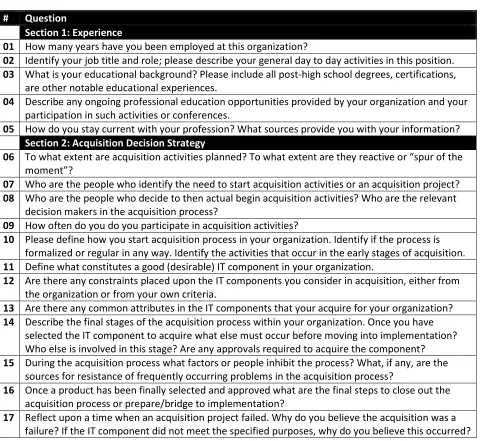
Table 1 provides a listing of the relevant questions asked during this interview and provides an
[image:24.612.69.553.216.657.2]identifying number which will be used throughout the remainder of this thesis report. A more in-depth explanation of each question is available in Appendix 10.3. Questions are organized by their primary section, however, please note some questions may have implications in other sections of the interview - please consult the appendix for further explanation. Also note that simpler language was used for each question during the course of the actual interview, but that the questions here are presented in a more formal matter to ensure clarity for the reader.
TABLE 1: INTERVIEW QUESTIONS
# Question
Section 1: Experience
01 How many years have you been employed at this organization?
02 Identify your job title and role; please describe your general day to day activities in this position.
03 What is your educational background? Please include all post-high school degrees, certifications, are other notable educational experiences.
04 Describe any ongoing professional education opportunities provided by your organization and your participation in such activities or conferences.
05 How do you stay current with your profession? What sources provide you with your information?
Section 2: Acquisition Decision Strategy
06 To what extent are acquisition activities planned? To what extent are they reactive or “spur of the moment”?
07 Who are the people who identify the need to start acquisition activities or an acquisition project?
08 Who are the people who decide to then actual begin acquisition activities? Who are the relevant decision makers in the acquisition process?
09 How often do you do you participate in acquisition activities?
10 Please define how you start acquisition process in your organization. Identify if the process is formalized or regular in any way. Identify the activities that occur in the early stages of acquisition.
11 Define what constitutes a good (desirable) IT component in your organization.
12 Are there any constraints placed upon the IT components you consider in acquisition, either from the organization or from your own criteria.
13 Are there any common attributes in the IT components that your acquire for your organization?
14 Describe the final stages of the acquisition process within your organization. Once you have selected the IT component to acquire what else must occur before moving into implementation? Who else is involved in this stage? Are any approvals required to acquire the component?
15 During the acquisition process what factors or people inhibit the process? What, if any, are the sources for resistance of frequently occurring problems in the acquisition process?
16 Once a product has been finally selected and approved what are the final steps to close out the acquisition process or prepare/bridge to implementation?
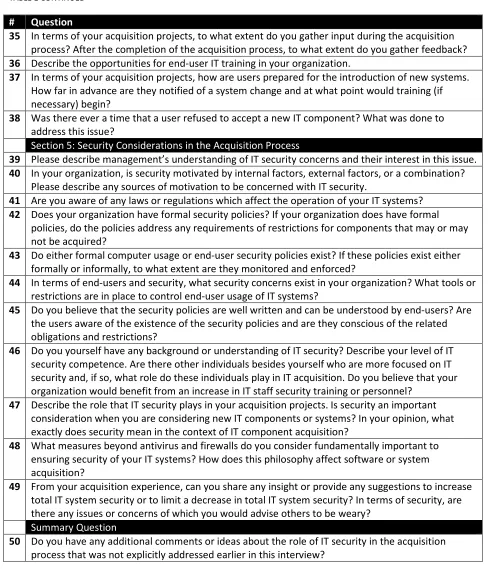
TABLE 1 CONTINUED
# Question
18 Reflecting upon the previous acquisition failure, please explain what was done to address the situation.
19 How have (or will you) address your acquisition process in order to limit or prevent a reoccurrence of a similar incident?
20 Who, including yourself, would decide that the acquisition process failed or that an acquired IT component was not meeting its intended purpose after implementation?
Section 3: Management Style and Organizational Factors
21 Is your organization best described as hierarchically organized or are the boundaries more blurred in your organization?
22 How strong is ownership of (information) assets in your organization? Do you believe that appropriate information generally flows easily across organizational borders?
23 Describe the quality of communication between upper management and the rest of the company.
24 Describe the quality and style of communication between yourself and upper management and/or your direct superiors.
25 Describe the quality of communication between upper level decision makers and the IT department as a whole. Expand on the general interaction with upper management and their general interest in IT matters.
26 In terms of management, who are the relevant decision makers in the IT acquisition process? What is their level of interaction with the acquisition activities?
27 In your own opinion, would you say IT is important to the core operation of your organization? Do you believe that the organization’s success is directly related to the quality of the IT systems and components?
28 Does upper management understand the impact and value of IT? To what extent is upper management involved or concerned about IT?
29 Do you believe that the selection of one IT component over another has any appreciable impact on the organization if they all options meet the core needs?
Section 4: User Interaction
30 Describe the range of end-user computer literacy within your organization (where do most users rank on a continuum from novice to expert).
31 If among the end-user population, there are IT experts power-users do they attempt to provide input into the acquisition process? Do you appreciate this input and do you ever seek input specifically from this portion of the end-user population?
32 In terms of the acquisition process, what considerations are made regarding end-users and how do you determine these considerations? What methods do you use in order to evaluate
user-acceptance of IT components?
33 In terms of technical support, do you find that users are willing to ask for help? Do end-users regularly communicate system issues to the IT staff?
TABLE 1 CONTINUED
# Question
35 In terms of your acquisition projects, to what extent do you gather input during the acquisition process? After the completion of the acquisition process, to what extent do you gather feedback?
36 Describe the opportunities for end-user IT training in your organization.
37 In terms of your acquisition projects, how are users prepared for the introduction of new systems. How far in advance are they notified of a system change and at what point would training (if necessary) begin?
38 Was there ever a time that a user refused to accept a new IT component? What was done to address this issue?
Section 5: Security Considerations in the Acquisition Process
39 Please describe management’s understanding of IT security concerns and their interest in this issue.
40 In your organization, is security motivated by internal factors, external factors, or a combination? Please describe any sources of motivation to be concerned with IT security.
41 Are you aware of any laws or regulations which affect the operation of your IT systems?
42 Does your organization have formal security policies? If your organization does have formal policies, do the policies address any requirements of restrictions for components that may or may not be acquired?
43 Do either formal computer usage or end-user security policies exist? If these policies exist either formally or informally, to what extent are they monitored and enforced?
44 In terms of end-users and security, what security concerns exist in your organization? What tools or restrictions are in place to control end-user usage of IT systems?
45 Do you believe that the security policies are well written and can be understood by end-users? Are the users aware of the existence of the security policies and are they conscious of the related obligations and restrictions?
46 Do you yourself have any background or understanding of IT security? Describe your level of IT security competence. Are there other individuals besides yourself who are more focused on IT security and, if so, what role do these individuals play in IT acquisition. Do you believe that your organization would benefit from an increase in IT staff security training or personnel?
47 Describe the role that IT security plays in your acquisition projects. Is security an important consideration when you are considering new IT components or systems? In your opinion, what exactly does security mean in the context of IT component acquisition?
48 What measures beyond antivirus and firewalls do you consider fundamentally important to ensuring security of your IT systems? How does this philosophy affect software or system acquisition?
49 From your acquisition experience, can you share any insight or provide any suggestions to increase total IT system security or to limit a decrease in total IT system security? In terms of security, are there any issues or concerns of which you would advise others to be weary?
Summary Question
6
Results
6.1
Scoring Criteria
In this interview study, two types of questions were asked, scored and informational. Some questions, or groups of questions taken together, are assigned an ordinal score out of a possible score on that question or question group of questions, with 0 being the lowest possible value and being the highest value. The possible scores are based upon predefined criteria that vary depending on each question or question group. For a full explanation of the scoring criteria for each question, please see Appendix 10.3.
6.2
Participant Scores
TABLE 2: PARTICIPANT SCORES ON INTERVIEW QUESTIONS Participant Id 2 2 3 7 9 5 3 3 1 0 3 1 4 1 3 2 3 5 6 7 9 3 5 2 4 0 7 5 5 2 5 4 4 5 0 5 3 5 0 5 8 2 5 5 6 6 1 6 6 5 7 5 8 4 3 0 5 8 9 0 9 6 8 6 5 2 7 4 8 6 7 0 0 8 1 4 6 8 4 8 6 5 3 2 9 3 1 5 3 1 4 9 8 9 2 1 0 5 9 9 8 8 2 3 7 Possible Score
Q01 3 1 1 3 3 3 2 3 3 3 3 3 1 3 1 3
Q02 3 1 3 2 3 3 3 2 2 3 2 2 2 2 3 3
Q03 3 2 3 2 3 1 3 3 3 3 3 2 2 3 2 3
Q04 3 3 2 3 2 3 2 3 3 3 3 2 3 2 2 3
Q05 3 1 2 2 2 3 3 2 2 2 3 3 1 2 2 2
Q06 3 NA 1 2 1 2 3 3 2 3 3 2 2 2 3 3
Q07 3 3 3 3 3 3 3 3 3 3 3 3 3 2 3 2
Q08 2 2 3 2 2 2 2 2 2 2 1 1 2 2 2 2
Q10 3 3 1 3 3 3 3 3 3 2 3 3 3 3 3 1
Q11
2 2 0 2 2 2 2 2 2 2 2 1 1 1 2 0
Q12 Q13 Q17
3 3 3 3 3 1 3 3 3 3 2 2 3 3 NA 3
Q18 Q19
Q22 2 2 2 2 2 2 0 2 1 0 1 2 2 1 1 2
Q23 2 1 2 2 1 2 1 NA 2 2 2 2 2 2 2 2
Q24 3 2 NA 2 NA NA 1 1 3 NA 3 1 3 3 3 2 Q25 3 0 NA 2 NA NA 0 1 3 NA 2 2 3 3 2 1
Q26 3 1 2 3 2 3 1 1 2 3 1 3 2 2 3 2
Q28 2 2 2 2 1 2 0 2 2 2 2 2 2 2 2 2
Q29 2 1 2 1 1 2 1 2 2 1 2 1 1 2 0 2
Q31 2 0 2 2 2 1 2 2 2 2 2 0 2 2 2 2
Q33 2 2 1 2 2 NA 2 2 2 2 2 2 2 2 2 2
Q34 2 2 1 2 2 2 0 2 1 2 1 2 1 0 0 1
Q35 2 1 1 2 2 2 2 2 2 2 1 0 2 1 2 0
Q39 2 1 1 2 2 2 2 2 0 2 1 2 1 2 2 2
Q42 3 1 0 3 1 1 3 3 1 2 1 1 0 2 3 2
Q43 3 3 1 3 3 2 3 2 1 3 2 1 0 3 3 2
Q45 3 3 0 3 3 3 3 2 3 3 1 1 0 3 3 2
6.3
Answer Summaries by Participant
6.4
Security Scoring Analysis
The following simple statistics summarize the sample population's scores on the security related
questions. These tables are used in later analysis for characterizing the sample and for drawing trends. A basic explanation for each statistic will be explained at face value, more in-depth analysis follows in later sections where appropriate.
6.4.1 Scoring on All Questions in the Security Section of the Interview
TABLE 3: AVERAGES AND STANDARD DEVIATION FOR ALL QUESTIONS IN THE SECURITY SECTION
Mean Score 0.6769
Median Score 0.6923
Standard Deviation 0.2761
Table 3 shows simple statistics for the security related questions of the interview. The mean average score is 0.68/1.00, which is relatively low and indicates that the organizations in the sample on average have mediocre security practices and attitudes. The median approximates the mean indicating that the scores are roughly divided around the mean. The large standard deviation indicates that there was a wide range of scores for this section of the interview.
6.4.2 Scoring on Security Questions Directly Addressing Security during Acquisition
TABLE 4: AVERAGE AND STANDARD DEVIATION ADDRESSING ROLE OF SECURITY IN ACQUISTION
Mean Score 0.5733
Median Score 0.6000
Standard Deviation 0.3011
6.5
Correlations Analysis
[image:31.612.79.526.153.317.2]6.5.1 Correlations between various sections addressed in the Interview
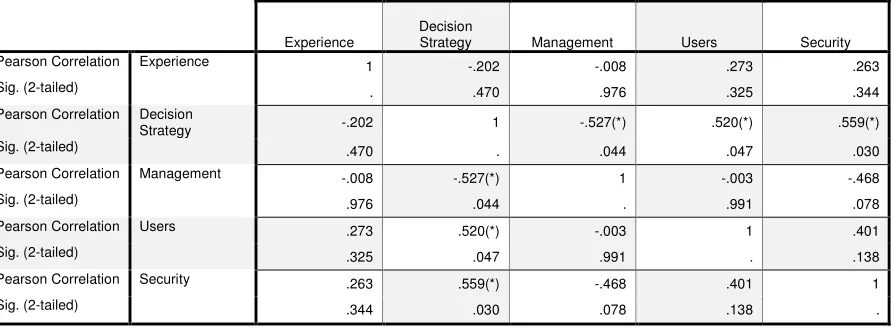
TABLE 5: CORRELATION STATISTICS COMPARING THE VARIOUS SECTIONS OF THE INTERVIEW
Experience
Decision
Strategy Management Users Security
Pearson Correlation Experience 1 -.202 -.008 .273 .263
Sig. (2-tailed) . .470 .976 .325 .344
Pearson Correlation Decision
Strategy -.202 1 -.527(*) .520(*) .559(*)
Sig. (2-tailed) .470 . .044 .047 .030
Pearson Correlation Management -.008 -.527(*) 1 -.003 -.468
Sig. (2-tailed) .976 .044 . .991 .078
Pearson Correlation Users .273 .520(*) -.003 1 .401
Sig. (2-tailed) .325 .047 .991 . .138
Pearson Correlation Security .263 .559(*) -.468 .401 1
Sig. (2-tailed) .344 .030 .078 .138 .
N (Sample Size) = 15
* Correlation is significant at the 0.05 level (2-tailed).
6.5.2 Regression Results: Decision Strategy on Security
TABLE 6: REGRESSION MODEL FOR THE EFFECT OF DECISION STRATEGY ON SECURITY (SUMMARY)
R R Square
Adjusted R
Square Sig.
.559(a) .313 .260 .030(a)
(a) Predictors: (Constant), Decision Strategy
Table 6 provides a summary of the statistics related to the regression calculation. Since there is only one independent variable being considered the r-Value and significance are the same as in the above
correlation calculations. The relationship is significant at the .05 level. 31% of the variance in scores in the security section of the interview can be explained by the participant scores in the decision
[image:32.612.72.267.306.353.2]strategy section.
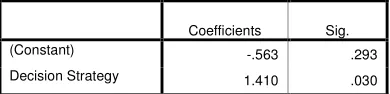
TABLE 7: REGRESSION MODEL FOR THE EFFECT OF DECISION STRATEGY ON SECURITY (EQUATION)
Coefficients Sig.
(Constant) -.563 .293
Decision Strategy 1.410 .030
(a) Dependent Variable: Security
Table 7 provides the coefficient used to create the regression model equation and each coefficient's significance. For this relationship, the following model can be used to predict a participant's score on the security section of the interview based on the corresponding participant score on the decision strategy questions:
6.5.3 Regression Results: {User Interaction and Involvement, Management Attitudes, and Experience of Decision Maker and Organization} on Decision Making
TABLE 8: REGRESSION MODEL FOR THE EFFECT OF PREDICOTORS ON DECISION STRATEGY (SUMMARY)
R R Square
Adjusted R
Square Sig.
.822(a) .676 .588 .005(a)
(a) Predictors: (Constant), Users, Management, Experience
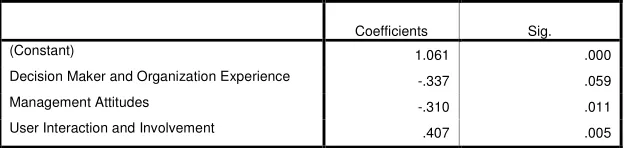
[image:33.612.72.384.345.419.2]Table 8 provides a summary of the statistics related to the regression calculation. The independent variables (predictors) are the participant's scores in the user interaction and involvement, management attitudes, and experience sections of the interview. The relationship is significant at the .05 level. 68% of the variance in scores in the decision strategy section of the interview can be explained by considering the impact of user interaction, management attitudes, and experience.
TABLE 9: REGRESSION MODEL FOR THE EFFECT OF PREDICOTORS ON DECISION STRATEGY (EQUATION)
Coefficients Sig.
(Constant) 1.061 .000
Decision Maker and Organization Experience -.337 .059
Management Attitudes -.310 .011
User Interaction and Involvement .407 .005
(a) Dependent Variable: Decision Strategy
Table 9 provides the coefficient used to create the regression model equation and each coefficient's significance. The reader should note that management attitudes and user interaction are significant at the .05 level, while experience is trending towards significant. For this relationship, the following model can be used to predict a participant's score on the security section of the interview based on the corresponding participant score on the decision strategy questions:
7
Interpretations & Analysis
7.1
Research Question Q1
7.1.1 Question Statement
To what extent, if any, is security considered during the acquisition process?
7.1.2 Interpretations and Analysis
In this study, the fifth section of interview questions addressed security factors. Interview questions 42 and 47 specifically address the participant's attitudes and consideration of security during the
acquisition phase of the system development lifecycle (SDLC). The participants' scores on the individual questions can be found in Section 6.2 and a statistical analysis of these questions can be found in Section 6.4.2.
Overall, security consideration was not high with a mean score of 0.57/1.00. Close to half of the
participants (7/15) had a score below the average, while three participants scored 1.00/1.00. The lowest two scoring participants were #3103141 and #7008146; these participants also scored within the
bottom quartile for all questions in the security consideration category and they scored in the bottom quartile when all question scores in the study were summed together. Only one-third of the
participants' scores were above 0.80/1.00.
In general, even when participants mentioned that management was aware of security concerns or that they were concerned about security issues, there was no immediate concern for defining security requirements or considering security issues during the acquisition process. There is a significant correlation (r=0.70, p=0.004) between participants' scores on the questions about security during acquisition and the scores on the other questions in the security section which address security more broadly, suggesting that those who are more aware of security needs during acquisition will show more concern for security throughout the SDLC.
Three participants (#3235679, #5350582, #5566166) scored 1.00/1.00 on these questions. Participant #3235679 is the IT decision maker for a financial services organization which is subject to very strict compliance requirements, and thus he identified security and compliance as a major part of his
position's daily requirements. Participant #5350582 does not work in a highly regulated industry, but in a previous role he was a security auditor. This participant also noted that a large percentage of his time is devoted to acquisition activities. Participant #5566166's organization was also subject to compliance, and noteworthy from other participants, this participant was highly aware of the many laws and regulations which impact security requirements for his organization.
The two lowest scoring participants (#3103141 and #7008146) generally did not believe they were at risk and did not see the value in analyzing security concerns. For interview question 47, participant #3103141 commented that security is not often talked about or addressed. The participant also noted that he believes consultants only talk about security as a fear-based motivation to buy a product.
acquisitions would not likely have any significant security repercussions. He further described his organization's security policies as weak and useless.
Within the general sample population over half (8/15) of the participants scored 0/3 or 1/3 on interview question 42, which indicates that they either have no security policies, the security policies are weak, or the policies, if they exist, have no impact on security and/or would not be actively considered during the acquisition process. Less than on third (4/15) had security policies or rules which influence and affect whether a component could or could not be acquired. The remainder of the participants in the sample did not have an explicit relationship between security policy and acquisition;