RESEARCH ARTICLE
Collaborative modeling of an
implementation strategy: a case study
to integrate health promotion in primary
and community care
Gonzalo Grandes
1*, Alvaro Sanchez
1, Josep M. Cortada
2, Haizea Pombo
1, Catalina Martinez
1, Laura Balagué
3,
Mary Helen Corrales
4, Enrique de la Peña
5, Justo Mugica
6, Esther Gorostiza
7and on behalf of the PVS group
Abstract
Background: Evidence-based interventions are more likely to be adopted if practitioners collaborate with
research-ers to develop an implementation strategy. This paper describes the steps to plan and execute a strategy, including the development of structure and supports needed for implementing proven health promotion interventions in primary and community care.
Results: Between 10 and 13 discussion and consensus sessions were performed in four highly-motivated primary
health care centers involving 80% of the primary care staff and 21 community-based organizations. All four centers chose to address physical activity, diet, and smoking. They selected the 5 A’s evidence-based clinical intervention to be adapted to the context of the health centers. The planned implementation strategy worked at multiple levels: bottom-up primary care organizational change, top-down support from managers, community involvement, and the development of innovative e-health information and communication tools. Shared decision making and practice facilitation were perceived as the most positive aspects of the collaborative modeling process, which took more time than expected, especially the development of the new e-health tools integrated into electronic health records.
Conclusions: Collaborative modeling of an implementation strategy for the integration of health promotion in
primary and community care was feasible in motivated centers. However, it was difficult, being hindered by the heavy workload in primary care and generating uncertainty inherent to a bottom-up decision making processes. Lessons from this experience could be useful in diverse settings and for other clinical interventions. Two companion papers report the evaluation of its feasibility and assess quantitatively and qualitatively the implementation process.
Keywords: Primary health care, Health promotion, Health education, Preventive care, Implementation strategies,
Implementation research, Community of practice, Participatory action research, Learning community, Health information technologies
© The Author(s) 2017. This article is distributed under the terms of the Creative Commons Attribution 4.0 International License (http://creativecommons.org/licenses/by/4.0/), which permits unrestricted use, distribution, and reproduction in any medium, provided you give appropriate credit to the original author(s) and the source, provide a link to the Creative Commons license, and indicate if changes were made. The Creative Commons Public Domain Dedication waiver (http://creativecommons.org/ publicdomain/zero/1.0/) applies to the data made available in this article, unless otherwise stated.
Background
Evidence-based interventions are more likely to be taken up if users of these interventions collaborate with researchers in the development of an effective and
research-informed implementation strategy, including structure and supports that help these users to change their practice and organization to perform the proven
intervention [1–5]. This type of collaborative bottom-up
approach is especially necessary when implementation strategies are conceptualized not only as complex proce-dures but also as social processes, in which professionals take up a specific intervention or innovation if they chose to do so and creatively apply it in their setting, solving
Open Access
*Correspondence: [email protected] 1 Primary Care Research Unit of Bizkaia, Basque Healthcare
Service-Osakidetza, BioCruces Health Research Institute, Luis Power 18, 48014 Bilbao, Spain
competing interests and reaching group consensus on
re-design of their care delivery system [5–9]. While few
studies appropriately report the details of their
imple-mentation strategies [10], there are even fewer describing
the process through which these strategies were designed
and tailored [11]. The report of the carrying out of this
kind of collaborative experience is essential to learn from the process and to inform future refinement and replication.
Our target for improvement was the integration of healthy lifestyle promotion within primary and commu-nity healthcare. Health promotion is an excellent exam-ple of the need for imexam-plementation strategies because of the huge gap between evidence and practice in this area. Despite the sound epidemiological evidence for the impact of individual behavior on population health
[12–18], we are failing to progress in the adoption of a
healthy lifestyle: less than 10% of the population in devel-oped countries do regular physical activity, follow a bal-anced diet, do not smoke and do not drink to excess, and the great majority have multiple behavioral risk factors
[19, 20]. In addition, the current economic crisis
under-lines the critical role of the prevention of chronic diseases associated with these behaviors in the sustainability of
healthcare systems [21] and primary care practitioners
are in the best position within these systems to promote healthy behaviors among the population due to their
accessibility and role in providing continuity of care [22].
Nevertheless, despite the availability of effective evi-dence-based interventions, healthy lifestyle promotion is far from being integrated into routine clinical practice in
primary care [23–25]. For example, during the last
dec-ade our own research group has contributed with evi-dence-based clinical interventions for health promotion
in routine primary care based on clinical trials [26–28].
Nevertheless, we have to recognize that after these trials finished participating clinicians stopped delivering the
interventions [29]. The main reasons which explain this
lack of sustainable integration are the inherent difficulties and complexities of changing, on the one hand, people’s
lifestyles [23, 24, 30, 31], and on the other, clinical
prac-tices and the organization of primary care services [2, 23,
32, 33]. As a consequence, as in many other examples,
valuable innovative initiatives fail due to implementation
weaknesses [34, 35].
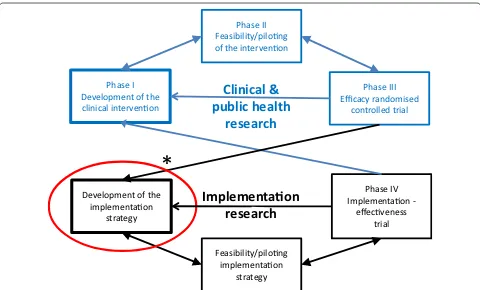
In accordance with the complexity of developing a tar-geted implementation strategy, we worked step-by-step following the UK Medical Research Council guidance for the development and evaluation of complex interventions
[36]. In this paper, we describe the first step of this
pro-cess, which is better visualized in relation to the exten-sion of this guidance proposed by Pinnock et al. for phase
IV implementation studies [37] (see Fig. 1). As previous
preparatory work, an expert panel analyzed the causes of the implementation gap and identified roadblocks to
change [23, 29]. In brief, they recommended a process of
mutual adaptation of evidence-based interventions to the specific context of the primary health care (PHC) cent-ers and, in turn, redesigning the practices and organiza-tion of these centers with the active participaorganiza-tion of the healthcare practitioners and managers of these services, researchers and community members. They also recom-mended adopting the Chronic Care Model as a validated general framework to guide the redesign of primary care delivery necessary to integrate health promotion into
routine practice [38–40]. Therefore, possible actions to
be included in the strategy were considered at different levels: self-management support, delivery system rede-sign, decision support, e-health tools integrated into the clinical information systems, community resources, and health system organization.
This paper describes the process of how to engage pri-mary care staff and members of the community to reor-ganize primary care delivery system to optimize physical activity, healthy diet and smoking cessation interventions in primary and community healthcare. This is the com-panion article of two recently published in a series docu-menting the development and subsequent piloting of the Prescribe Healthy Life implementation strategy (PVS—
from the Spanish ‘Prescribe Vida Saludable’-) (Fig. 1) [41,
42].
Methods
Action research principles were used to collaboratively model a multi-component implementation strategy for
health promotion interventions [1–4]. This was a
bot-tom-up process of dialogue, discussion and consensus among a multi-professional primary care team and com-munity members for shared decision making on actions to be included in the implementation strategy. The study
protocol has been published previously [43]. Briefly, we
refer to this method as collaborative modeling, defining this as the process of redesigning the primary healthcare delivery system with a dual purpose: on the one hand, adapting available evidence-based health promotion interventions to the context of each of the collaborat-ing PHC centers, and on the other, reachcollaborat-ing a consen-sus among professionals and community members on reorganizing the practice delivery system, creating a multi-professional workforce, defining new professional roles, and redistributing tasks and workflows. Interven-tion mapping was used as a guide to schedule structured discussion/consensus meetings and the Institute of Med-icine Plan-Do-Study-Act improvement cycles were
car-ried out [44, 45]. The study protocol was approved by the
Service and by the Basque Country Clinical Research Ethics Committee (Ref: 06/2009).
Setting and participants
Four public community PHC centers were selected for convenience by managers of the district primary care organizations on the basis of their especial
motiva-tion favorable to health promomotiva-tion [42]. For a candidate
center to be included, individual written commitment to the project was required by a majority of the staff within each of the professional categories (administrative and clerical staff, nurses, family physicians, pediatricians, and others), after an informative session in the center explaining the objectives of the project and the work plan. Primary care professionals of these centers, manag-ers of the Basque Health Service, community partnmanag-ers, and researchers were engaged to model the implementa-tion strategy. A local champion was identified in each of the collaborating centers and on-site supportive practice facilitation was provided by the research team.
The Basque Health Service (Osakidetza) provides universal coverage free at the point of delivery funded through regional general taxation. In Spain, primary care services are almost exclusively delivered in publically-owned centers. Each citizen is registered on the list of
one family physician or pediatrician, and these clinicians work in PHC teams including nurses and administra-tive personnel. They provide comprehensive primary care with easy accessibility for residents in a defined geographical area (70% of the population visiting their family physician at least once a year). Healthcare staff have a civil-servant like employment status and they are paid a fixed salary with small capitation payments for physicians.
Modeling the implementation strategy
Table 1 summarizes the stages, planning and quality
improvement techniques used for modeling the imple-mentation strategy. This process was organized through discussion and consensus meetings to assess needs, pri-oritize areas for improvement and select common goals; provide education on evidence-based health promotion interventions and selection by PHC center staff and com-munity members of the most appropriate clinical inter-ventions to be implemented; make consensus on how to redesign workflows and redistribute tasks; and then brief piloting; followed by training, auditing and feedback (see
Table 1). The research team acted as practice facilitators
for this modeling process, including organizing and sum-marizing meetings, providing selected documentation
Phase I Development of the clinical intervenon
Phase II Feasibility/pilong of the intervenon
Phase III Efficacy randomised
controlled trial
Development of the implementaon
strategy
Feasibility/pilong implementaon
strategy
Phase IV Implementaon
-effecveness trial
Clinical &
public health
research
Implementaon
research
*
[image:3.595.58.538.86.376.2]Table 1 S teps in the collabor ativ e modeling of the P V S implemen ta tion str at egy under a par ticipa tor y ac tion resear ch fr ame w ork in volving primar y car e staff and c ommunit
y members suppor
ted b y ex ternal facilita tion pr ovided b y the r esear ch t eam Implemen ta tion goals C on ten ts and ac tivities Techniques of c onsensus , planning , qualit y impr ov emen t and ev alua tion 1st — descr iptiv
e stage (thr
ee or f
our 90–120
min sessions)
T
o obtain the
commitment
of the major
ity of the pr
of
essionals
to a common health pr
omotion goal , af ter pr ior itizing which beha
viors and g
roups t
o tar
get
Pr
esentation of P
VS objec
tiv
es and plan
A
ssessment of attitudes
, per
ceiv
ed prac
tice and or
ganizational
climat
e in the pr
imar
y health car
e cent
er
G
ather
ing of inf
or
mation on general and local epidemiology of
unhealth y beha viors Strat eg ic e
valuation of health
y lif est yle pr omotion prac tice (audit and f eedback)
Individual identification of ar
eas f
or impr
ov
ement (gaps and
needs assessment)
Pr
ior
itization and consensus (nominal g
roup)
2nd—
cr
eativ
e stage (thr
ee 90–120 min sessions) T o acquir e competenc e
in planning the pr
eliminar y int er vention pr og
ram: specify objec
tiv
es and ac
tions
, and identify agents
and r
esour
ces in
volv
ed
Analysis of det
er
minants of beha
vior
Re
vie
w of e
vidence
-based int
er
ventions
Tailor
ing of int
er
ventions t
o the ac
tual cont
ex
t of the cent
er
Redesig
n of w
or
kflo
ws and staff r
oles
Educational sessions on theor
etical models and health pr
omotion int er ventions Gr oup discussion—
consensus and planning
Specific objec tiv es (beha vior det er minants) M
apping of ac
tions and int
er
ventions
Redistr
ibution of tasks and r
esponsibilities: what, who
, ho w , when and wher e 3r
d—piloting stage (f
our t
o six 90–120
min sessions) T o achie ve ac tiv e cooper ation
among the multidisciplinar
y
team within the cent
er and with communit
y agents
, opti
-mization of int
er
vention components and their sustainable
int eg ration Prac tical ex er
cise of implementing int
er
vention ac
tions in r
eal-w
or
ld conditions
, f
or the identification of f
easible strat eg ies M onit or
ing of per
for
mance measur
es
Standar
dization of pr
eliminar
y pr
og
ram on the basis of f
easibilit y Br ief P lan-D o-Study-A ct c ycles f or piloting A
udit and f
eedback in g
roup sessions
Lear
ning sessions t
o identify r
eadjustments
Strat
eg
ic e
valuation of the cent
er ’s capabilit y t o addr ess the planned pr og
rams and a
vailabilit
y of r
esour
ces necessar
y f
or
their implementation (SW
O
T matr
[image:4.595.171.429.85.723.2]and periodical activity reports. A local coordinator was selected at each center that was the liaison with the research team and leaded the process at the local level.
The main contribution at the management level was to ensure the availability of new information and commu-nication technology tools, intervention materials, and other resources necessary to facilitate the organizational change at the level of the primary care system. Further, management were required to set aside time 1 day a week for the local champion of the program in each center to support and supervise implementation at local level, and on average 2 h a month for the discussion and consen-sus meetings within working hours, to allow participa-tion of the entire primary care team, covering clinical and administrative tasks with additional staff. District primary care authorities also lent institutional support to the project, which helped to initiate coordination with community organizations.
At the community level, PHC center staff were asked to identify potential partners and resources in their pri-mary care catchment area. The research team contacted these community agents by letter, informed them of the objectives of the project, and invited them to collaborate in the subsequent sessions of the collaborative modeling. Public health practitioners from the Basque Department of Health and Consumer Affairs contributed to link com-munity organizations and the PHC centers.
Data and analyses
First, we describe actual engagement of professionals and community in the process of modeling the implementa-tion strategy. To this end, we documented their participa-tion in each of the steps of the implementaparticipa-tion strategy by asking participants to sign a register at each event, keeping signed registers of attendance at meetings, and writing summary reports of each of the meeting listed
in Table 1. Second, based on the abovementioned
docu-mentation, we outline the final implementation strategy designed in terms of clinical actions to be performed, dis-tribution of tasks between participants, definition of new roles assigned to each participant, and the new organi-zation of the health promotion delivery system. Third, we describe the experience of professionals involved. At the end of all the collaborative modeling sessions listed
in Table 1, a final meeting was organized for qualitative
evaluation. The nominal group technique was used to explore the opinions of primary care professionals about their experience in the process of collaborative
mod-eling of the PVS program [46]. As a preparatory part of
the nominal group technique participants were surveyed about the positive and negative aspects of the collabora-tive process, the implementation climate, facilitators and barriers related to the feasibility of the implementation
strategy designed, and the relationship between research-ers and PHC center staff. The results of the survey were summarized and reported back to the group followed by a 90-min open-group discussion session to prioritize the most relevant aspects of the process of modeling the PVS implementation strategy.
Results
The same sequence of meetings was performed at each PHC center for collaborative modeling of the PVS imple-mentation strategy. It required different numbers and lengths of discussion and consensus meetings at each center, ranging from 10 to 13 structured sessions last-ing between 90 and 120 min. Active engagement of 71 (80%) of the 89 staff working in the four PHC centers was achieved. The highest proportion of participation was
observed among family physicians (n = 24, 92% of the 26
working in the four PHC centers), followed by reception
staff (n = 18, 86%), nurses (n = 23, 74%), pediatricians
(n = 3, 50%), and midwives (n = 2, 50%), while the only
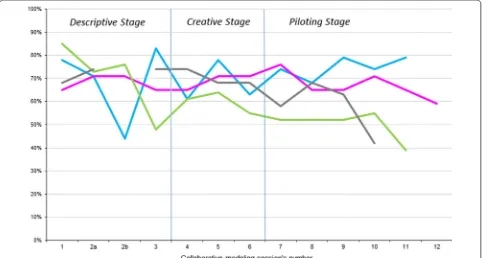
dentist also participated. The staff participation remained above 50% in all of the discussion and consensus sessions in one center, in all but one session in two other centers,
and in all but two sessions in the fourth center (Fig. 2).
During the creative phase (Table 1), participants
selected four theoretical models of behavior change as a basis for their programs, among the models most
fre-quently used for health promotion [47]: the health belief
model, the theory of planned behavior, the transtheo-retical model and the social-cognitive model. The 5 A’s (Assess, Advise, Agree, Assist, and Arrange follow-up) behavioral counseling intervention was identified in all four PHC centers as the most effective and feasible evidence-based clinical intervention for the objectives
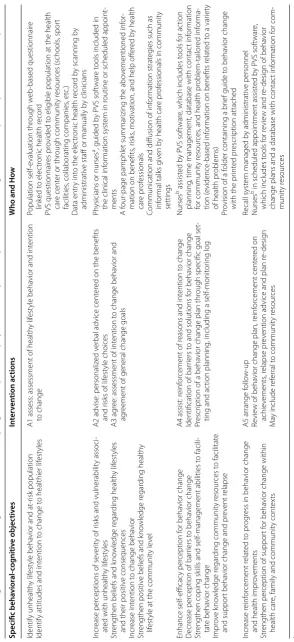
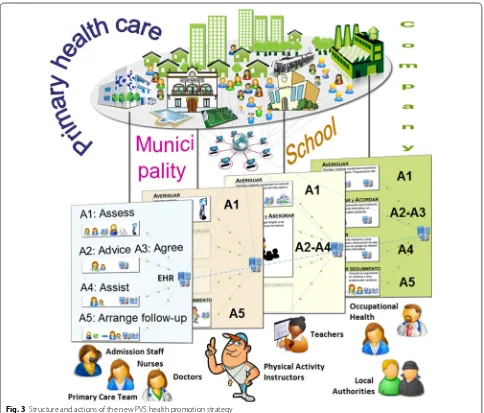
set [48]. Specific tasks, goals and actions were
distrib-uted among the primary care staff as shown in Table 2
and Fig. 3. Some examples of the planned distribution of
clinical intervention tasks between participants are the following. The “Assess” step was performed by recep-tionists before patients were seen by physicians, outside the center by school teachers, by company occupational health departments, or by individuals themselves through the Internet. The “Advice” and “Agree” steps were mainly delivered by family physicians or company doctors. The “Assist” step was mainly performed by nurses. All partici-pants inside and outside the centers were involved in the follow-up process with particular involvement of
recep-tionists and nurses (Table 2).
management of healthy lifestyles (regular physical
activ-ity, adequate diet and abstinence from smoking) [41].
At the community level, 30 organizations or institu-tions were contacted and 21 (70%) agreed to participate in the collaborative modeling process and were actively involved in the identification and prioritization of the health promotion goals of the programs. They also par-ticipated in the design of the interventions, as well as in piloting the programs. Of the 21 community participants, nine were local authority departments, six were schools, four were sports facilities and two were manufacturing companies. The community participants mostly con-tributed to healthy lifestyle assessment (e.g., question-naires administered in schools), some also participated in the advice and support steps (e.g., physicians and nurses of the occupational health departments of the collaborating companies) and in arranging follow-up actions (e.g., referral to sports facilities). In three of the four neighborhoods, local PVS health promotion coun-cils have been set under the local authority to foster and strengthen linkages between clinical practices and com-munity organizations. The main objectives of these coun-cils are to identify and make information available about resources and facilities for health promotion in the com-munity, to increase communication between organiza-tions, and to identify referral mechanisms between them.
The experiences of participants were mixed, with both positive and negative feelings. Among the positive aspects, PHC center staff agreed that the modeling pro-cess enhanced the importance of healthy lifestyle promo-tion in primary care. They highlighted the engagement of the entire primary care team, including reception staff and community members, in shared decision making and cooperation in a community-based program. In addition, the availability of technological tools integrated in the EHR for supporting the clinical interventions was rated posi-tively. Lastly, they also valued the fact that the discussion and consensus meetings were held within working hours.
As for the negative aspects of the process, the PHC center staff emphasized the heavy workload associated with the new health promotion activities compounded the problem of lack of time in the routine context of pri-mary care. They noted the “awkward” language used in the theoretical educational sessions, and, above all, the feeling of uncertainty inherent in the innovation pro-cess: “not knowing where the process will end”. Some of the participants felt that there was a hidden agenda man-aged by the research team to lead them to some prede-termined outcome. Additionally, participants pointed out the inherent difficulty of changing behaviors, the com-plexity of health promotion interventions, and the diffi-culty to achieve short-term results.
[image:6.595.58.540.89.347.2]Table 2 T ar gets , ac tions and agen ts of the ne w P V S pr ogr ams t o pr omot e ph ysic al ac tivit y, health
y diet and
smok ing c essa tion in primar y and c ommunit y c ar e
a I
n pr
imar
y health car
e c
en
ter
, although in some cases c
ollabor
ating c
ompanies ma
y also do this
b M
ainly nurses in the pr
imar
y health car
e c
en
ter and/or a
t c
ollabor
ating c
ompanies
, in some cases family ph
ysicians ma
y also do this
Specific beha vior al-cog nitiv e objec tiv es In ter ven tion ac tions W ho and Ho w Identify unhealth y lif est yle beha
vior and at
-r
isk population
Identify attitudes and int
ention t
o change t
o healthier lif
est
yles
A1 assess: assessment of health
y lif
est
yle beha
vior and int
ention to change Population self-evaluation thr ough w eb -based questionnair e link ed t o elec tr
onic health r
ecor d PV S questionnair es pr ovided t o elig
ible population at the health
car
e cent
er or thr
ough communit y r esour ces (schools , spor t facilities
, collaborating companies
, et
c.)
Data entr
y int
o the elec
tr
onic health r
ecor
d b
y scanning b
y
administrativ
e staff or manually b
y clinicians
Incr
ease per
ceptions of se
ver
ity of r
isks and vulnerabilit
y associ
-at
ed with unhealth
y lif
est
yles
Str
engthen belief
s and k
no wledge r egar ding health y lif est yles
and their positiv
e consequences
Incr
ease int
ention t
o change beha
vior
Str
engthen positiv
e belief
s and k
no wledge r egar ding health y lif est
yle at the communit
y le
vel
A2 advise: personaliz
ed v
er
bal advice cent
er
ed on the benefits
and r
isks of lif
est
yle choices
A3 ag
ree: assessment of int
ention t
o change beha
vior and
ag
reement of general change goals
Ph
ysicians or
nurses
a, guided b
y P
VS sof
twar
e t
ools included in
the clinical inf
or
mation syst
em in r
outine or scheduled appoint
-ments
A f
our
-page pamphlet summar
izing the abo
vementioned inf
or
-mation on benefits
, r
isks
, motivation, and help off
er ed b y health car e pr of essionals
Communication and diffusion of inf
or
mation strat
eg
ies such as
inf
or
mal talks g
iv
en b
y health car
e pr
of
essionals in communit
y settings Enhance self-efficac y per ception f or beha vior change D ecr ease per
ception of bar
riers t
o beha
vior change
Str
engthen coping sk
ills and self-management abilities t
o facili -tat e beha vior change Impr ov e k no wledge r egar ding communit y r esour ces t o facilitat e and suppor t beha
vior change and pr
ev
ent r
elapse
A4 assist: r
einf
or
cement of r
easons and int
ention t
o change
Identification of bar
riers t
o and solutions f
or beha
vior change
Pr
escr
iption of a beha
vior change plan thr
ough specific goal set
-ting and ac
tion planning
, including a self-monit
or
ing log
Nurses
b assist
ed b
y P
VS sof
twar
e, which includes t
ools f
or ac
tion
planning
, time management, database with contac
t inf or mation for communit y r esour ces
, and health pr
oblem-tailor ed inf or ma -tion ( evidence -based inf or
mation on benefits r
elat
ed t
o a var
iet
y
of health pr
oblems)
Pr
ovision of a f
older containing a br
ief guide t
o beha
vior change
with the pr
int ed pr escr iption attached Incr ease r einf or cement r elat ed t o pr og
ress in beha
vior change
and health impr
ov
ements
Str
engthen per
ception of suppor
t f
or beha
vior change within
health car
e, family and communit
y cont ex ts A5 ar range f ollo w-up Re vie
w of beha
vior change plan, r
einf or cement cent er ed on achie vements , r elapse pr ev
ention advice and plan r
e-desig
n
M
ay include r
ef er ral t o communit y r esour ces Recall syst
em managed b
y administrativ
e personnel
Nurses
b in scheduled appointment assist
ed b
y P
VS sof
twar
e,
which includes t
ools f
or r
evie
w and r
e-desig
n of beha
vior
change plans and a database with contac
[image:7.595.146.441.84.728.2]Participants highlighted the following critical areas for optimization to enhance the feasibility and sustainabil-ity of the modeled implementation strategies for future application: (a) at the PHC center level, first of all reor-ganization of on-demand care to minimize work over-load, to improve the coordinated flow of care to avoid extra visits by patients, with coordinated working at all professional levels, to foster communication between different tiers of professionals and to provide sufficient staff resources; (b) concerning the information system, improvement of efficiency and reliability of the informa-tion and communicainforma-tion tools and databases integrated into the EHR; (c) at the patient level, innovative ways of motivating patients not ready to change and ensur-ing continuity of care for those with intention to change behavior to minimize false expectations; and (d) at the
community level, improvement of coordination with community resources to align forces and avoid duplica-tion of efforts.
Discussion
This paper illustrates a real world example of developing an implementation strategy through a collaborative bot-tom-up process engaging PHC staff, community agents and researchers. The three steps followed in this process
(Table 1: descriptive, creative, and piloting stages) pursue
three Implementation goals needed to introduce change into an organization: first, commitment to a shared common goal; second, planning competence to tailor evidence-based interventions to the different context of each center; and third, real cooperation among the entire
group of participants [49].
[image:8.595.57.541.86.499.2]All the centers chose the 5 A’s clinical intervention and this is probably due to its simplicity, meaning that less time and training are required than for other interven-tions, and because of the strong scientific evidence
avail-able of its effectiveness in the general population [46]. We
used the Chronic Care Model as a framework to guide this effort to redesign a healthcare delivery system with the goal of improving health promotion in primary and
community care [38–40]. Our approach to changing and
reorganizing clinical practice is consistent with newer frameworks such as the Consolidated Framework for Implementation Research, which considers five major domains that may influence successful implementation of healthcare interventions: intervention characteristics, outer setting, inner setting, characteristics of the
indi-viduals involved, and the process of implementation [50].
Such frameworks provide no specific blueprints on how they should be operationalized in practice and research-ers trying to design implementation strategies for health promotion interventions need detailed examples such as
that provided herein on how they should be used [51].
Cooperation among all the PHC center staff and linkage with community agents are extremely challenging and
complex social processes [5–9, 52–54]. Consequently,
small steps that make progress in this direction should be considered very important. In our experience, these pro-cesses present considerable challenges. Firstly, it is not easy to sustain the commitment of staff to the common goal of integrating health promotion into routine prac-tice, over the course of the long process of modeling and implementation. Secondly, the development of useful and efficient information and communication support tools for addressing healthy lifestyle promotion in routine pri-mary care practice should be accelerated. Thirdly, there is resistance to organizational changes, which are essen-tial for successful cooperation among professionals in the implementation of intervention programs. Fourthly, it would be desirable to prioritize health promotion objec-tives, to avoid conflicts with multiple other activities in daily practice.
All these difficulties are consistent with findings in pre-vious initiatives for integration of health promotion in
primary care [55, 56]. Institutional support from
man-agers of healthcare services, to facilitate and ensure the organization and execution of group dynamics in each center, is essential to address these difficulties. In par-ticular, setting aside time in the agenda of practitioners and provision of substitutes to cover regular duties of all staff to free them to attend are necessary requirements to ensure participation of PHC center staff in discussion/ consensus meetings.
Prescribe Healthy Life strategy (from the Spanish ‘Pre-scribe Vida Saludable’) was greatly influenced by previous
programs such as Prescription for Health or STEP-UP, carried out in primary care practice-based research
net-works in the USA [55, 56]. In turn, factors associated
with the successful implementation of PVS are similar to those that arose in those programs, i.e., selection of the 5 A’s intervention strategy, active participation of pri-mary care professionals in the decision making process to adapt the intervention to a specific context, the devel-opment of innovative information and communication technologies, and linkage with community resources. The PVS project may serve as an example for other primary care services of how to do this.
The main limitation of this study is the selection of centers by convenience. It would have been desirable to measure the readiness for change of the PHC centers, a necessary condition for quality improvement, and use this information in the selection of participating centers. However, measuring organizational readiness for change
is not an easy task [57]. Past performance of the
organi-zation, the main selection criteria used in this study, is probably the best predictor of successful improvements
[58], along with leadership and coaching by facilitators [2,
34, 59]. The two companion papers by Sánchez et al. and
Martinez et al. [submitted] evaluate quantitatively and qualitatively the feasibility/piloting of the
implementa-tion strategy (see Fig. 1). In brief, they identify a set of key
factors that facilitate or hinder the PVS program imple-mentation, show that it is feasible to improve its uptake in routine clinical practice and that contextual factors
conditioned each center’s performance [41, 42].
Conclusions
This detailed description of the design of the PVS imple-mentation strategy can be used by impleimple-mentation researchers for planning their implementation research projects and will help readers to understand the two companion papers, which describe quantitative indica-tors of adoption and implementation, as well as PHC center staff’s qualitative perception of the performance of the described strategy. The development of the strategy has been difficult and complex. Lessons learned will be used to improve the implementation strategy and test it in a future experimental implementation trial we are cur-rently planning.
Abbreviations
5 A’s: Assess, Advise, Agree, Assist, and Arrange follow-up; PVS: Prescribe Healthy Life strategy (from the Spanish ‘Prescribe Vida Saludable’); PHC: pri-mary health care; EHR: electronic health record.
Authors’ contributions
cess. MHC, EP, JM, and EG were local champions at the primary care centers and contributed to implementation and interpretation of the process. LB and CM were responsible for the analysis of results of the nominal groups. All contributors have critically reviewed the manuscript and approved this version submitted for publication to BMC Reseach Notes. All authors read and approved the final manuscript.
Author details
1 Primary Care Research Unit of Bizkaia, Basque Healthcare Service-Osak-idetza, BioCruces Health Research Institute, Luis Power 18, 48014 Bilbao, Spain. 2 Deusto Primary Health Care Center, Bilbao-Basurto Integrated Care Organization-Osakidetza, BioCruces Health Research Institute, Luis Power 18, 48014 Bilbao, Spain. 3 Iztieta Primary Care Center, Donostialdea Integrated Care Organization-Osakidetza, Avenida de Lezo, s/n, 20100 Renteria, Spain. 4 La Merced Primary Health Care Center, Bilbao-Basurto Integrated Care Organization-Osakidetza, Luis Iraurrizaga 1, 48003 Bilbao, Spain. 5 Sondika Primary Health Care Center, Uribe Integrated Care Organization-Osakidetza, Lehendakari Agirre 41, 48160 Sondika, Spain. 6 Beasain Primary Health Care Center, Goieri-Alto Urola Integrated Care Organization-Osakidetza, Bernedo s/n, 20200 Beasain, Spain. 7 Matiena Primary Health Care Center, Barru-alde-Galdakao Integrated Care Organization-Osakidetza, BioCruces Health Research Institute, Trañabarren 13-Bajo, 48220 Abadiño, Spain.
Acknowledgements
We acknowledge the large group of members of the PSV group who made the collective contribution of this action research project:
Research Team: Primary Care Research Unit of Bizkaia, Basque Health Service– Osakidetza. Principal investigator: Gonzalo Grandes; co-investigators: Álvaro Sánchez, Haizea Pombo, Josep M Cortada, Catalina Martínez, Paola Bully, and Aitor Sanz-Guinea.
Basque Health Service–Osakidetza: Carlos Sola, Deputy Director of Healthcare Services; Martín Begoña, Susana Iglesias, Maite Cuadrado, and Nuria González, from the Department of Information Technology; Teresa Garmendia, Mª Luz Jáuregui, and Amaia Hernando, from the Management Team of Goierri-Alto Urola District; Jesús Larrañaga, Maribel Romo, and Pilar Isla, from the Manage-ment Team of Bilbao District; Enrique Maíz, Cristina Domingo, and Carmen Esparta, from the Management Team of Interior District; Mª Luz Marqués, Encarnación San Emeterio, and Antón Elorriaga, from the Management of Uribe District.
Beasain Health Center (Coordinator: Justo Múgica; María Pilar Alberdi, Mª Ángeles Arrondo, Amaia Azkoitia, Xabier Epaizabal, Mª Aranzazu Echeverria, Mª Esperanza García, Mª Ángeles García, María Erkuden Imaz, Mª Antonia Ipar-raguirre, Mª Isabel Irizar, Mª Rosario Larrea, Mª Dolores López, Petra Pacheco, María Yolanda Porres, Begoña San Juan, Mª Aranzazu Suquia, Mª Teresa Arro-spide, Carolina Díez, Miren Arantxa Igartua, Oihana Jauregui, Alazne Saizar, Mª Jose Tilves, Mª Lourdes Etxeberria, María Aurora Valdivielso, Xabier Mugica, Mª Mercedes Lasagar, Coro Zabaleta),
La Merced Health Center (Coordinator: Mª Isabel Urcelay, Mary Helen Cor-rales; Mª Ángeles Crespo, Javier José María Jesús de Ordozgoiti, María Iciar Elguezabal, Susana Esteban, Catalina Frau, Laura Gallo, Inés Yolanda Martín, Nerea Ordorika, José Ramón Pérez, Mª Begoña Relloso, María Soledad San-groniz, María Iluminada Santos, Patxi Xabier Iturbe).
Matiena Health Center (Coordinator: Esther Gorostiza; Mª Esther Azpitarte, Bixente Barrutia, Amaia Bengoa, Francisco José Miguel, Ana Isabel Etxebar-ria, Mª Belén García, Mª Jose Ibars, Mª Jose Lasa, Mª Carmen Martínez, Maura Pernudo, Lourdes Oribe, Mª Dolores Ustarroz, Valentina Camino, Leire Corpión, Leire Ortuondo, Mª Carmen López, Rosana Abraldes, Eneko Ibarruri, Javi Alonso).
Sondika Health Center (Coordinator: Enrique de la Peña; Mª Carmen Artola, Teresa Casado, Jesús García, Mª Paz Sánchez, Luisa Santos, María Lanzarote).
Department of Health of the Basque Government: Concha Castells, Francisco Cirarda, Henar Ortuondo, Pilar Manrique, Ines Urieta, and Amaia Ajuria.
Physical activity clinical committe: Ricardo Ortega, Jesús Torcal, Mª Sol Ariestaleanizbeaskoa, Verónica Arce, Álvaro Sánchez, and Gonzalo Grandes.
Healthy diet clinical committe: Bittor Rodríguez, Pilar Amiano, Esther Gorostiza, Enrique de la Peña, Álvaro Sánchez, and Gonzalo Grandes.
Josep Cortada, Álvaro Sánchez, and Gonzalo Grandes.
Beasain community: Arcelormittal company (Juan Manuel Elosegui), CAF company (Iñaki Korta, Ainhoa Irastorza, Leire Makibar), Antzizar sports center (Jon Alkaiaga, Karmele Alkaiaga).
La Merced community (Bilbao): Community Health of Bilbao´s Council (Iñaki Aldamiz), School Health of Bilbao´s Council (Virginia Zelaia), Miribilla Primary Education Center (Adela Etxeberria, Itziar Basurto), Bilbao sports center (Gon-zalo Casado, Maite Martínez, Alberto Díez), Municipal Office of Bilbao La Vieja, San Francisco y Zabala (Javier Rojo), “Bakuba” Community association (Sara Gar-teiz), “Etorkinekin Bat” Community association (Aitziber Artabe, Ainhoa Parra), “Iniciativa gitana” Community association (Marcelo Borja, Mª Carmen Jiménez). Sondika community: Sondika Council (Gorka Carro, Bernardo Valdivielso), Commonwealth municipality of Sondika (Janire Kasuso, Esther Martin), Gorondagane Primary Education Center (Paulino Parra), Txorierri Secondary Education Institute (Loinaz Albizu), Txorierri polytechnic (Marivi Cuartango), Sondika sports center (Unai Atxa), Olarra company (Jesús Miguel Enríquez), Sondika Pharmacy (Rosario Acebal, Javier Ancel).
Matiena community: Matiena Council (José Luis Navarro, Inmaculada Zapardiez), Commonwealth municipality of Abadiño (Nerea Lejarzaburu), Traña Matiena Primary Education Center (Edurne Madariaga), Abadiño Sec-ondary Education Institute (Eugenia Peral), Abadiño sports center (Pablo Mas)
Mutualia company (Juan Mayor), FREMAP company (Joseph Reverte), Estampaciones Metálicas company (Bernard Mandaluniz).
Others: Basque Institute for Healthcare Innovation: O + berri (Roberto
Nuño), Osarean (Josu Llano), Osatek SA (Enrique Gutiérrez), University of Colo-rado, School of Medicine, Department of Family Medicine (Maribel Cifuentes), University of Massachusetts Boston, College of Education and Human Devel-opment (Gonzalo Bacigalupe), Laval University, Faculty of Nursing Sciences (Marie-Pierre Gagnon).
Competing interests
The authors declare that they have no competing interests.
Availability of data and materials
Data sharing not applicable to this article as no datasets were generated or analyzed.
Consent for publication Not applicable.
Ethics approval and consent to participate
The study protocol was approved by the Primary Care Research Committee of the Basque Health Service, Osakidetza, and by the Basque Country Clinical Research Ethics Committee (Ref: 6/2009). Health care professionals that com-mitted to participate also gave written consent for the anonymous manage-ment and publication of data pertaining both to patients assigned to their practices and indicators related to their health care delivery activity.
Funding
The PVS project was funded by the Carlos III Health Institute of the Spanish Ministry of Economy and Competitiveness, co-financed by the European Regional Development Fund (PS09/01461, PI12/02113), the Health Depart-ment of the Basque GovernDepart-ment (2009111072, 2011111145), the Basque Foundation for Social and Health Care Innovation (Grant CA-2012-086), the Basque Research Center in Chronicity-Kronikgune (Grant 11/056), and the Spanish Primary Care Research Network for Prevention and Health Promotion (redIAPP RD12/0005/0010).
Publisher’s Note
Springer Nature remains neutral with regard to jurisdictional claims in pub-lished maps and institutional affiliations.
References
1. Waterman H, Tillen D, Dickson R, de Koming K. Action research: a systematic review and guidance for assessment. Health Technol Assess. 2001;5(23):III.
2. Grol R, Grimshaw J. From best evidence to best practice: effective imple-mentation of change in patients’ care. Lancet. 2003;362:1225–30. 3. Kottke TE, Solberg LI. Optimizing practice through research: a preventive
services case study. Am J Prev Med. 2007;33:505–6.
4. Leykum LK, Pugh JA, Lanham HJ, Harmon J, McDaniel RR Jr. Implemen-tation research design: integrating participatory action research into randomized controlled trials. Implement Sci. 2009;4:69.
5. Øvretveit J. Evaluating improvement and implementation for health. Maidenhead: Open University Press, McGraw-Hill Education; 2014. 6. Greenhalgh T, Robert G, Macfarlane F, Bate P, Kyriakidou O. Diffusion of
innovations in service organizations: systematic review and recommen-dations. Milbank Q. 2004;82:581–629.
7. Grol R. Has guideline development gone astray? Yes. BMJ. 2010;340:c306. 8. Dixon-Woods M, Bosk CL, Aveling EL, Goeschel CA, Pronovost PJ. Explain-ing Michigan: developExplain-ing an ex post theory of a quality improvement program. Milbank Q. 2011;89:167–205.
9. Mittman BS. Implementation science in health care. In: Brownson RC, Colditz GA, Proctor EK, editors. Dissemination and implementation research in health: translating science to practice. New York: Oxford University Press; 2012. p. 400–18.
10. Proctor EK, Powell BJ, McMillen JC. Implementation strategies: recom-mendations for specifying and reporting. Implement Sci. 2013;8:139. 11. Powell BJ, Beidas RS, Lewis CC, Aarons GA, Aarons JC, Proctor EK, Mandell
DS. Methods to improve the selection and tailoring of implementation strategies. J Behav Health Serv Res. 2017;44:177.
12. GBD 2013 Risk Factors Collaborators, Forouzanfar MH, Alexander L, Ander-son HR, Bachman VF, Biryukov S, Brauer M, et al. Global, regional, and national comparative risk assessment of 79 behavioral, environmental and occupational, and metabolic risks or clusters of risks in 188 countries, 1990–2013: a systematic analysis for the Global Burden of Disease Study 2013. Lancet. 2015;386:2287.
13. Ford ES, Bergmann MM, Kröger J, Schienkiewitz A, Weikert C, Boeing H. Healthy living is the best revenge: findings from the European Prospec-tive Investigation Into Cancer and Nutrition-Potsdam study. Arch Intern Med. 2009;169:1355–62.
14. Ford ES, Zhao G, Tsai J, Li C. Low-risk lifestyle behaviors and all-cause mortality: findings from the National Health and Nutrition Examination Survey III Mortality Study. Am J Public Health. 2011;101:1922–9. 15. Kvaavik E, Batty GD, Ursin G, Huxley R, Gale CR. Influence of individual and
combined health behaviors on total and cause-specific mortality in men and women: the United Kingdom health and lifestyle survey. Arch Intern Med. 2010;170:711–8.
16. Khaw KT, Wareham N, Bingham S, Welch A, Luben R, Day N. Combined impact of health behaviours and mortality in men and women: the EPIC-Norfolk prospective population study. PLoS Med. 2008;5(1):e12. 17. van Dam RM, Li T, Spiegelman D, Franco OH, Hu FB. Combined impact of
lifestyle factors on mortality: prospective cohort study in US women. BMJ. 2008;337:a1440.
18. Knoops KT, de Groot LC, Kromhout D, et al. Mediterranean diet, lifestyle factors, and 10-year mortality in elderly European men and women: the HALE project. JAMA. 2004;292:1433–9.
19. Galán I, Rodríguez-Artalejo F, Díez-Gañán L, Tobías A, Zorrilla B, Gandaril-las A. Clustering of behavioural risk factors and compliance with clinical preventive recommendations in Spain. Prev Med. 2006;42:343–7. 20. Fine LJ, Philogene GS, Gramling R, Coups EJ, Sinha S. Prevalence of
mul-tiple chronic disease risk factors. 2001 National Health Interview Survey. Am J Prev Med. 2004;27(Suppl):18–24.
21. Maruthappu M, Sood HS, Keogh SB. The NHS five year forward view: transforming care. Br J Gen Pract. 2014;64:635.
22. Starfield B, Shi L, Macinko J. Contribution of primary care to health sys-tems and health. Milbank Q. 2005;83:457–502.
23. Grandes G, Sanchez A, Cortada JM, et al. Is integration of healthy lifestyle promotion into primary care feasible? Discussion and consensus sessions between clinicians and researchers. BMC Health Serv Res. 2008;8:213. 24. Glasgow RE, Lictenstein E, Marcus AC. Why don’t we see more translation
of health promotion research to practice? Rethinking the efficacy-to-effectiveness transition. Am J Public Health. 2003;93:1261–7.
25. McGlynn EA, Asch SM, Adams J, et al. The quality of health care delivered to adults in the United States. N Engl J Med. 2003;348:2635–45. 26. Grandes G, Sánchez A, Montoya I, Ortega Sánchez-Pinilla R, Torcal J,
PEPAF Group. Two-year longitudinal analysis of a cluster randomized trial of physical activity promotion by general practitioners. PLoS ONE. 2011;6(3):e18363.
27. Grandes G, Sánchez A, Ortega R, Torcal J, Montoya I, Lizarraga K, Serra J, PEPAF Group. Effectiveness of physical activity advice and prescription by physicians in routine primary care: a cluster randomised randomized trial. Arch Intern Med. 2009;169:694–701.
28. Grandes G, Cortada J, Arrazola A, Laka JP. Predictors of long-term out-come of a smoking cessation programme in primary care. Br J Gen Pract. 2003;53:101–7.
29. Grandes G, Sanchez A, Cortada JM, Calderon C, Balague L, Millan E et al. Useful strategies for healthy lifestyle promotion in primary health care (Report in Spanish). Commissioned Research. Vitoria-Gasteiz: Departa-mento de Sanidad, Gobierno Vasco, Informe nº Osteba D-08-07; 2008. 30. Whitlock EP, Orleans CT, Pender N, Allan J. Evaluating primary care
behav-ioural counselling interventions: an evidence based approach. Am J Prev Med. 2002;22:267–84.
31. Moreno-Peral P, Conejo-Cerón S, Fernández A, Berenguera A, Martínez-Andrés M, Pons-Vigués M, Motrico E, Rodríguez-Martín B, Bellón JA, Rubio-Valera M. Primary care patients’ perspectives of barriers and enablers of primary prevention and health promotion—a meta-ethno-graphic synthesis. PLoS ONE. 2015;10:e0125004.
32. Eccles M, Grimshaw J, Walker A, Johnston M, Pitts N. Changing the behav-ior of healthcare professionals: the use of theory in promoting the uptake of research findings. J Clin Epidemiol. 2005;58:107–12.
33. Rubio-Valera M, Pons-Vigués M, Martínez-Andrés M, Moreno-Peral P, Berenguera A, Fernández A. Barriers and facilitators for the implementa-tion of primary prevenimplementa-tion and health promoimplementa-tion activities in primary care: a synthesis through meta-ethnography. PLoS ONE. 2014;9:e89554. 34. Grol R, Wensing M, Eccles M, Davis D. Improving patient care: the imple-mentation of change in health care. 2nd ed. Chichester: Wiley Blackwell/ BMJ; 2013.
35. Foy R, Eccles M, Grimshaw J. Why does primary care need more imple-mentation research? Fam Pract. 2001;18:353–5.
36. Medical Research Council. Developing and evaluating complex interven-tions: new guidance. London: Med Res Counc; 2008.
37. Pinnock H, Epiphaniou E, Taylor SJ. Phase IV implementation studies. The forgotten finale to the complex intervention methodology framework. Ann Am Thorac Soc. 2014;11(Suppl 2):118–22.
38. Wagner EH, Austin BT, Von Korff M. Improving outcomes in chronic ill-ness. Manag Care Q. 1996;4:12–25.
39. Glasgow RE, Orleans CT, Wagner EH, Curry SJ, Solerg LI. Does the chronic care model serve also as a template for improving prevention? Milbank Q. 2001;79:579–612.
40. Davy C, Bleasel J, Liu H, Tchan M, Ponniah S, Brown A. Factors influenc-ing the implementation of chronic care models: a systematic literature review. BMC Fam Pract. 2015;16:102.
41. Sanchez A, Grandes G, Cortada JM, Pombo H, Martinez C, Corrales MH, de la Peña E, Mugica J, Gorostiza E, PVS group. Feasibility of an implementa-tion strategy for the integraimplementa-tion of health promoimplementa-tion in routine primary care: a quantitative process evaluation. BMC Fam Pract. 2017;18(1):24. 42. Martinez C, Bacigalupe G, Cortada JM, Grandes G, Sanchez A, Pombo H,
Bully P, PVS group. The implementation of health promotion in primary and community care: a qualitative analysis of the ‘Prescribe Vida Salud-able’ strategy. BMC Fam Pract. 2017;18(1):23.
43. Sanchez A, Grandes G, Cortada JM, Pombo H, Balagué L, Calderon C. Modelling innovative interventions for optimizing healthy lifestyle pro-motion in primary health care: ‘Prescribe Vida Saludable’ phase I research protocol. BMC Health Serv Res. 2009;9:103.
44. Bartholomew LK, Parcel GS, Kok G. Intervention mapping: a process for developing theory- and evidence-based health education programs. Health Educ Behav. 1998;25:545–63.
45. Institute for Healthcare Improvement (IHI). The Breakthrough Series: IHI’s Collaborative model for achieving breakthrough improvement. IHI inno-vation series white paper. Boston: Institute for Healthcare Improvement; 2003. (http://www.IHI.org). Accessed 16 Oct 2015.
• We accept pre-submission inquiries
• Our selector tool helps you to find the most relevant journal
• We provide round the clock customer support
• Convenient online submission
• Thorough peer review
• Inclusion in PubMed and all major indexing services
• Maximum visibility for your research
Submit your manuscript at www.biomedcentral.com/submit
Submit your next manuscript to BioMed Central
and we will help you at every step:
tice. 2nd edn. National Institutes of Health, National Cancer Institute, NIH Publication No. 05-3896, Washington, DC: NIH; 2005.
48. Glasgow RE, Goldstein MG, Ockene JK, Pronk NP. Translating what we have learned into practice. Principles and hypotheses for interven-tions addressing multiple behaviors in primary care. Am J Prev Med. 2004;27(Suppl 2):88–101.
49. Beer M, Eisenstat RA. Spector: why change programs don’t produce change. Harv Bus Rev. 1990;68:158–66.
50. Damschroder LJ, Aron DC, Keith RE, et al. Fostering implementation of health services research findings into practice: a consolidated framework for advancing implementation science. Implement Sci. 2009;4:50. 51. Kadu MK, Stolee P. Facilitators and barriers of implementing the chronic
care model in primary care: a systematic review. BMC Fam Pract. 2015;16:12.
52. Porterfield D, Hinnant L, Kane H, Horne J, McAleer K, Roussel A. Linkages between clinical practices and community organizations for prevention. RTI Project Number 0210088.006 for the Agency for Healthcare Research and Quality. Research Triangle Institute, NC; 2010.
53. Woolf SH, Glasgow RE, Krist A, Bartz C, Flocke SA, Holtrop JS, Rothemich SF, Wald ER. Putting it together: finding success in behavior change through integration of services. Ann Fam Med. 2005;3(Suppl 2):S20–7.
nities to promote healthy behaviors. Am J Prev Med. 2008;35(5S):S390–7. 55. Cifuentes M, Fernald DH, Green LA, Niebauer LJ, Crabtree BF, Hassmiller
SB. Prescription for health: changing primary care practice to foster healthy behaviors. Ann Fam Med. 2005;3(Suppl):S4–12.
56. Ruhe MC, Weyer SM, Zronek S, Wilkinson A, Wilkinson PS, Stange KC. Facilitating practice change: lessons from the STEP-UP clinical trial. Prev Med. 2005;40:729–34.
57. Attieh R, Gagnon MP, Estabrooks CA, Légaré F, Ouimet M, Roch G, el Ghandour K, Grimshaw J. Organizational readiness for knowledge transla-tion in chronic care: a review of theoretical components. Implement Sci. 2013;28(8):138.
58. Gustafson DH, Quanbeck AR, Robinson JM, Ford II JH, Pulvermacher A, French MT, McConnell KJ, Batalden PB, Hoffman KA, McCarty D. Which elements of improvement collaboratives are most effective? A cluster-randomized trial. Addiction. 2013;2013(108):1145–57.