Open Access
Short Report
Interpreting missense mutations in Human TRIM5alpha by
computational methods
Philip A Chan
Address: Department of Internal Medicine, Rhode Island Hospital, Providence, RI 02903, USA Email: Philip A Chan - [email protected]
Abstract
Background: The human restriction factor TRIM5α may play an important role in regulation of the human immunodeficiency virus (HIV). It is unclear whether non-synonymous single nucleotide polymorphisms (nsSNP) in TRIM5α affect the clinical course of HIV infection.
Findings: We surveyed the literature for TRIM5α nsSNPs and used comparative sequence analysis to predict the effect of each polymorphism on protein function. Twenty-eight nsSNPs were identified with available functional data, clinical data, or both. The four comparative method programs assessed included SIFT, PolyPhen, A-GVGD, and average BLOSUM62 pairwise score. Two common polymorphisms, H43Y and R136Q, were predicted to be benign based on comparative sequence analysis. The nsSNPs P323R, K324N, I328M, G330Q, R332P, I348V, and T369S were all predicted to affect protein function.
Conclusion: Comparative sequence analysis offers a functional tool to analyze unknown nsSNPs in TRIM5α.
Background
Human immunodeficiency virus type 1 (HIV-1) infection depends on both viral and human genetic factors [1]. Sin-gle nucleotide polymorphisms (SNP) in different immune-modulation genes have been shown to affect susceptibility and progression of disease. Of these, the restriction factors APOBEC3F [2], APOBEC3G [3], and TRIM5α [4] are innate immune proteins that affect postentry steps in HIV-1 replication and confer resistance to retroviruses in other species.
The tripartite motif restriction factor TRIM5α is a cytoplas-mic and nucleolic protein that restricts viral infection by interfering with the capsid protein, promoting premature disassembly [5]. TRIM5α has been studied in primates where it has been shown to be extremely effective at
inhib-iting HIV-1 and other lentiviruses [6,7]. The restriction factor is composed of several regions: the RING domain, B-boxes, a coiled-coil domain, and a carboxy-terminal SPRY (B30.2) domain [8]. The SPRY domain defines antiretroviral activity of TRIM5α and amino acids in this region show a high degree of positive selection based on sequence comparison in primates [9,10]. The variation in the SPRY domain is responsible for the specificity of TRIM5α in primates, but not humans, to effectively restrict HIV-1. The RING domain contributes to the anti-viral activity, but the exact function remains unknown [8,10,11]. Different studies have analyzed TRIM5α nsS-NPs in both HIV-1 infected and non-infected populations [12-16]. The affect of TRIM5α polymorphisms on protein function and clinical course of HIV-1 remains controver-sial. Studies have revealed conflicting results secondary to
Published: 24 November 2008
BMC Research Notes 2008, 1:116 doi:10.1186/1756-0500-1-116
Received: 3 July 2008 Accepted: 24 November 2008
This article is available from: http://www.biomedcentral.com/1756-0500/1/116
© 2008 Chan et al; licensee BioMed Central Ltd.
variations in functional assays, lack of power in clinical cohorts, and possible linkage disequilibrium between alleles.
Comparative sequence analysis is a powerful technique that can predict whether an nsSNP is likely to affect pro-tein function. These methods rely on the fact that critical residues for function are conserved across different genomes and should not vary [17-19]. These amino acids may directly participate in enzymatic reaction or have an important role in secondary or tertiary structure. Likewise, residues that are not vital would be subject to increased variation with little to no affect on protein function. Recently, we studied the accuracy of four methods using comparative sequence analysis to predict the affect of nsS-NPs on protein function [20]: (1) SIFT (Sorting Intolerant from Tolerant, http://blocks.fhcrc.org/sift/SIFT.html) [21]; (2) PolyPhen (Polymorphism Phenotyping, http:// genetics.bwh.harvard.edu/pph) [22]; (3) A-GVGD (Grantham Variance-Grantham Difference, http:// agvgd.iarc.fr) [19]; (4) Average BLOSUM62 pairwise score [20].
The accuracy of any one method for predicting a non-syn-onymous SNP as either deleterious (affecting protein function) or tolerant (benign) is approximately 80%. When all four methods agree, the predictive value is greater than 90% [20]. The goals of this study are to: (1) Predict the affect of TRIM5α nsSNPs using comparative sequence analysis and compare our results to known in-vitro and clinical data; (2) Identify mutations that are likely to affect TRIM5α protein function and may warrant further investigation in clinical cohorts and functional assays.
Methods
Creation of multiple sequence alignments
Amino acid sequence alignments were constructed using the standard program ClustalW as previously described [18]. Homologs of genes of interest were retrieved from GenBank after BLAST searches using the human sequence as the query. Alignments are available as supplemental material.
The TRIM5α sequence alignment consisted of 40 sequences: Homo sapiens (gi 48994821), Pan paniscus (gi 122145800), Pan troglodytes (gi 60593103), Gorilla gorilla (gi 56480705), Pongo pygmaeus (gi 122143969), Pongo abelii (gi 75060761), Symphalangus syndactylus (gi 122143726), Nomascus leucogenys (gi 156079722), Hylo-bates lar (gi 122143029), Colobus guereza (gi 75060798), Macaca mulatto (gi 62548080), Bunopithecus hoolock (gi 122144995), Pygathrix nemaeus (gi 75060797), Cercocebus torquatus (gi 118772044), Macaca fascicularis (gi 75060455), Papio anubis (gi 162951988), Macaca
assa-mensis (gi 122144997), Macaca nemestrina (gi 122146076), Erythrocebus patas (gi 75060791), Chloroce-bus aethiops (gi 48994825), Cercopithecus tantalus (gi 47559193), Chlorocebus pygerythrus (gi 75060767), Eryth-rocebus patas (gi 58379053), Callithrix jacchus (gi 167427342), Callithrix pygmaea (gi 75060793), Pithecia pithecia (gi 75060790), Saguinus oedipus (gi 122145799), Saguinus labiatus (gi 75060764), Callicebus donacophilus (gi 75060786), Saimiri boliviensis (gi 58379043), Saimiri sciu-reus (gi 75060788), Ateles geoffroyi (gi 75060789), Lagothrix lagotricha (gi 75060785), Aotus trivirgatus (gi 51317461), Alouatta sara (gi 75060794), Equus caballus (gi 149719383), Bos taurus (gi 77736574), Mus musculus (gi 31982207), Rattus norvegicus (gi 109459178), and Gallus gallus (gi 150247142).
TRIM5α nsSNPs were evaluated by four publicly available methods as previously described [20]: 1) Average BLOSUM62 pairwise; 2) SIFT; 3) PolyPhen; 4) A-GVGD. These computational methods were applied to known clinical and functional data. Literature containing TRIM5α nsSNPs was identified by searching PubMed [12,13,15,16,23]. The agreement of the four methods was assessed for overall consistency using Fleiss' kappa [24,25].
Results and discussion
Comparative sequence analysis is a powerful tool for the analysis of nsSNPs in the human genome. A large variety of organisms selected for sequence analysis means fewer sequences will be needed to make inferences secondary to long divergence times and increased number of mutations [20,26]. Too little variation can cause residues to be overly conserved with 'false positive' results, i.e. a residue may seem to be critical for protein function when it is not. In our study population, organisms were not highly diversi-fied, but there was sufficient variation for comparative analysis [18,26]. With proper alignment, comparative sequence alignment programs have been shown to be accurate over 90% of the time [20]. The TRIM5α sequence alignment was based on available BLAST data of 40 spe-cies with 2550 variants. This met the previous threshold for statistical significance [18,26]. All sequences were eukaryotes and included primates, mouse, rat, and cow [27].
com-mon nsSNPs included V112F (1 to 11%), G249D (6 to 27%), and H419Y (1 to 8%).
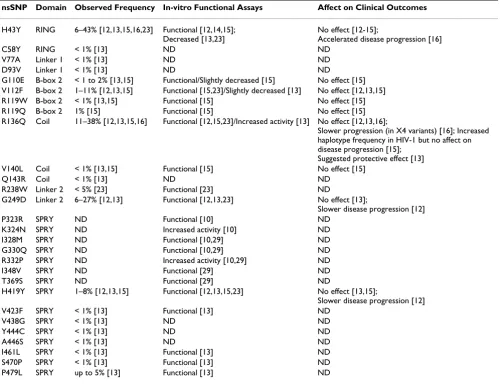
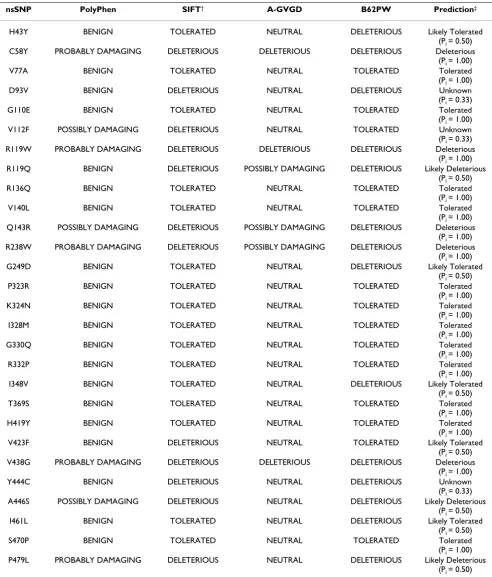
The nsSNP H43Y of the RING region may be important in protein function, specifically E3 ligase activity [13,16,23]. Up to 43% of certain populations carry this polymor-phism [23]. Functional data have shown that H43Y retains restriction activity [12,14,15], whereas other results show decreased activity [13,23]. Individuals homozygous for the H43Y mutation may develop X4-trophic virus more rapidly than those who are not and progress to AIDS at a faster rate [16]. To further investigate the affect of H43Y and other polymorphisms on protein function, the twenty-eight TRIM5α mutations were ana-lyzed using SIFT, PolyPhen, A-GVGD, and average BLOSUM62 pairwise score (Table 2). Three of the four computational methods (SIFT, PolyPhen, A-GVGD) sug-gested that H43Y is a tolerated mutation and does not affect protein function. Although PolyPhen and SIFT do
not require aligned sequences, we have previously shown that using a sequence alignment of curated data is supe-rior to a single query sequence alone [20]. In this case, regardless of the sequence(s) entered, SIFT classifies the mutation as tolerant. The BLOSUM62 pairwise program predicted H43Y as deleterious, but does not distinguish specific mutations at a given codon and instead makes general predictions based on overall conservation at a given position. This may be a less specific algorithm for detecting individual mutations, but is still as accurate as the other methods. For H43Y, the agreement between pro-grams suggests a greater than 70% accuracy of a 'tolerant' prediction [20]. This supports the evidence that H43Y does not affect TRIM5α function and is likely a benign mutation.
Similar to H43Y, data regarding R136Q has shown con-flicting results (Table 1). This amino-acid resides in the coiled coil domain and may participate in TRIM5α oli-Table 1: Observed TRIM5α mutations
nsSNP Domain Observed Frequency In-vitro Functional Assays Affect on Clinical Outcomes
H43Y RING 6–43% [12,13,15,16,23] Functional [12,14,15]; Decreased [13,23]
No effect [12-15];
Accelerated disease progression [16]
C58Y RING < 1% [13] ND ND
V77A Linker 1 < 1% [13] ND ND D93V Linker 1 < 1% [13] ND ND
G110E B-box 2 < 1 to 2% [13,15] Functional/Slightly decreased [15] No effect [15] V112F B-box 2 1–11% [12,13,15] Functional [15,23]/Slightly decreased [13] No effect [12,13,15] R119W B-box 2 < 1% [13,15] Functional [15] No effect [15] R119Q B-box 2 1% [15] Functional [15] No effect [15] R136Q Coil 11–38% [12,13,15,16] Functional [12,15,23]/Increased activity [13] No effect [12,13,16];
Slower progression (in X4 variants) [16]; Increased haplotype frequency in HIV-1 but no affect on disease progression [15];
Suggested protective effect [13] V140L Coil < 1% [13,15] Functional [15] No effect [15]
Q143R Coil < 1% [13] ND ND
R238W Linker 2 < 5% [23] Functional [23] ND
G249D Linker 2 6–27% [12,13] Functional [12,13,23] No effect [13];
Slower disease progression [12] P323R SPRY ND Functional [10] ND
K324N SPRY ND Increased activity [10] ND I328M SPRY ND Functional [10,29] ND G330Q SPRY ND Functional [10,29] ND R332P SPRY ND Increased activity [10,29] ND I348V SPRY ND Functional [29] ND T369S SPRY ND Functional [29] ND
H419Y SPRY 1–8% [12,13,15] Functional [12,13,15,23] No effect [13,15];
Slower disease progression [12] V423F SPRY < 1% [13] Functional [13] ND
V438G SPRY < 1% [13] ND ND
Y444C SPRY < 1% [13] ND ND
A446S SPRY < 1% [13] ND ND
I461L SPRY < 1% [13] Functional [13] ND S470P SPRY < 1% [13] Functional [13] ND P479L SPRY up to 5% [13] Functional [13] ND
[image:3.612.57.558.101.485.2]Table 2: TRIM5α mutations and predicted affect on protein function
nsSNP PolyPhen SIFT† A-GVGD B62PW Prediction‡ H43Y BENIGN TOLERATED NEUTRAL DELETERIOUS Likely Tolerated
(Pi = 0.50) C58Y PROBABLY DAMAGING DELETERIOUS DELETERIOUS DELETERIOUS Deleterious
(Pi = 1.00) V77A BENIGN TOLERATED NEUTRAL TOLERATED Tolerated (Pi = 1.00) D93V BENIGN DELETERIOUS NEUTRAL DELETERIOUS Unknown (Pi = 0.33) G110E BENIGN TOLERATED NEUTRAL TOLERATED Tolerated (Pi = 1.00) V112F POSSIBLY DAMAGING DELETERIOUS NEUTRAL TOLERATED Unknown (Pi = 0.33) R119W PROBABLY DAMAGING DELETERIOUS DELETERIOUS DELETERIOUS Deleterious
(Pi = 1.00) R119Q BENIGN DELETERIOUS POSSIBLY DAMAGING DELETERIOUS Likely Deleterious
(Pi = 0.50) R136Q BENIGN TOLERATED NEUTRAL TOLERATED Tolerated (Pi = 1.00) V140L BENIGN TOLERATED NEUTRAL TOLERATED Tolerated (Pi = 1.00) Q143R POSSIBLY DAMAGING DELETERIOUS POSSIBLY DAMAGING DELETERIOUS Deleterious
(Pi = 1.00) R238W PROBABLY DAMAGING DELETERIOUS POSSIBLY DAMAGING DELETERIOUS Deleterious
(Pi = 1.00) G249D BENIGN TOLERATED NEUTRAL DELETERIOUS Likely Tolerated
(Pi = 0.50) P323R BENIGN TOLERATED NEUTRAL TOLERATED Tolerated (Pi = 1.00) K324N BENIGN TOLERATED NEUTRAL TOLERATED Tolerated (Pi = 1.00) I328M BENIGN TOLERATED NEUTRAL TOLERATED Tolerated (Pi = 1.00) G330Q BENIGN TOLERATED NEUTRAL TOLERATED Tolerated (Pi = 1.00) R332P BENIGN TOLERATED NEUTRAL TOLERATED Tolerated (Pi = 1.00) I348V BENIGN TOLERATED NEUTRAL DELETERIOUS Likely Tolerated
(Pi = 0.50) T369S BENIGN TOLERATED NEUTRAL TOLERATED Tolerated (Pi = 1.00) H419Y BENIGN TOLERATED NEUTRAL TOLERATED Tolerated (Pi = 1.00) V423F BENIGN DELETERIOUS NEUTRAL TOLERATED Likely Tolerated
(Pi = 0.50) V438G PROBABLY DAMAGING DELETERIOUS DELETERIOUS DELETERIOUS Deleterious
(Pi = 1.00) Y444C BENIGN DELETERIOUS NEUTRAL DELETERIOUS Unknown (Pi = 0.33) A446S POSSIBLY DAMAGING DELETERIOUS NEUTRAL DELETERIOUS Likely Deleterious
(Pi = 0.50) I461L BENIGN TOLERATED NEUTRAL DELETERIOUS Likely Tolerated
(Pi = 0.50) S470P BENIGN TOLERATED NEUTRAL TOLERATED Tolerated (Pi = 1.00) P479L PROBABLY DAMAGING DELETERIOUS NEUTRAL DELETERIOUS Likely Deleterious
(Pi = 0.50)
†SIFT output is based on manually aligned sequences. Query only sequence data is not shown. ‡Predictions are based on P
gomerization [8,13]. Clinical studies have shown that this mutation is increased in HIV-infected patients versus non-infected (OR = 5.49, 95% CI 1.83–16.45, p = 0.002) [15], but in-vitro data shows R136Q retains functional activity [15,23]. Furthermore, other clinical studies have shown that R136Q may have a protective affect against HIV-1 [13]. One reason for the conflicting results may be that this mutation is in linkage disequilibrium with other alle-les that do play a role in HIV progression or susceptibility [15,16]. A questionable protective effect of R136Q has also been observed in people with X4-trophic virus [16]. Comparative sequence analysis shows that all four meth-ods agree R136Q would be tolerant with an accuracy of greater than 90% [20].
Two other nsSNPs, G249D and H419Y, have also shown ambiguous data with either no effect on clinical outcomes [13,15] or a slower progression of disease [12]. Functional data show that both of these nsSNPs have no affect on TRIM5α function [12,13,15,23]. Three of four methods using comparative sequence analysis suggest G249D is a benign polymorphism, and all four agree that H419 is benign (Table 2).
Several other TRIM5α nsSNPs of interest were also identi-fied. The polymorphisms C58Y, R119W, Q143R, R238W, and V438G are all observed in different human popula-tions and are all predicted deleterious by the four compar-ative sequence methods (Table 2). Only R119W has been evaluated in clinical studies and has no effect on HIV out-comes [15]. Both R119W and R238W are functional based on in-vitro studies [15,23]. Given the conflicting data, these nsSNPs along with C58Y, Q143R, and V438G should be further studied to assess affect on protein func-tion and associafunc-tion with clinical HIV disease.
The SPRY region of TRIM5α is a critical region involved in species-specific restriction of HIV-1 [8,10,28] and con-tains codons under high degrees of positive selection [9,28]. A number of TRIM5α mutations have been studied in the SPRY region of the protein (Table 1). Of interest, amino acid residues 325 to 344 are in a segment of this domain which differs from primates [8]. This 'hypervaria-ble' region has been shown to be responsible, at least in part, for the ability to specifically target HIV-1 [10]. Although no nsSNPs have yet been observed in this region in the human population, mutations at this site may con-fer a protective benefit against HIV-1 infection. In-vitro studies have demonstrated that single amino acid changes in this region, specifically R332P and to a lesser extent K324N, may be able to effectively restrict HIV-1 [10,29]. All methods for these mutations with the exception of I348V were predicted tolerant mutations in agreement with the functional data. For I348V, three methods
pre-dicted the mutation as tolerant while only the average BLOSUM62 pairwise predicted it as deleterious.
Overall, the four computational methods agreed the majority of the time (κ = 0.53, moderate agreement [25]). Clinical studies on TRIM5α nsSNPs have shown conflict-ing results [12,13,15,16], but in-vitro assays clearly dem-onstrate activity at inhibiting HIV-1. More studies are needed to define the interaction of TRIM5α with immune regulatory genes and DNA sequences that may be in link-age disequilibrium. Focus should be taken to explore the possibility that TRIM5α may affect certain populations differently, specifically people with X4-dominant HIV infection or other ethnic groups.
Two limitations to this study are the paucity of TRIM5α gene sequences available and the lack of structural data available on TRIM5α. Although the number of sequences is sufficient as discussed above, a greater variety of species would allow better alignments based on sensitivity and specificity plots [20]. Furthermore, programs such as PolyPhen rely on structural databases of which there is none presently for TRIM5α.
Conclusion
Comparative sequence analysis suggests that neither H43Y nor R136Q affect TRIM5α protein function. We identified other nsSNPs that may affect TRIM5α activity and should be analyzed in further clinical and laboratory studies.
Competing interests
The author declares that they have no competing interests.
Authors' contributions
PC was the sole contributor to the contents of this article.
Acknowledgements
I would like to thank Rami Kantor and Marc Greenblatt for critical reading of the manuscript.
References
1. Lama J, Planelles V: Host factors influencing susceptibility to
HIV infection and AIDS progression. Retrovirology 2007, 4:52.
2. Zheng YH, Irwin D, Kurosu T, Tokunaga K, Sata T, Peterlin BM:
Human APOBEC3F is another host factor that blocks human immunodeficiency virus type 1 replication. J Virol
2004, 78(11):6073-6076.
3. Sheehy AM, Gaddis NC, Choi JD, Malim MH: Isolation of a human
gene that inhibits HIV-1 infection and is suppressed by the viral Vif protein. Nature 2002, 418(6898):646-650.
4. Nisole S, Stoye JP, Saib A: TRIM family proteins: retroviral
restriction and antiviral defence. Nat Rev Microbiol 2005,
3(10):799-808.
5. Stremlau M, Perron M, Lee M, Li Y, Song B, Javanbakht H,
Diaz-Griffero F, Anderson DJ, Sundquist WI, Sodroski J: Specific
recog-nition and accelerated uncoating of retroviral capsids by the TRIM5alpha restriction factor. Proc Natl Acad Sci USA 2006,
Publish with BioMed Central and every scientist can read your work free of charge
"BioMed Central will be the most significant development for disseminating the results of biomedical researc h in our lifetime."
Sir Paul Nurse, Cancer Research UK
Your research papers will be:
available free of charge to the entire biomedical community
peer reviewed and published immediately upon acceptance
cited in PubMed and archived on PubMed Central
yours — you keep the copyright
Submit your manuscript here:
http://www.biomedcentral.com/info/publishing_adv.asp
BioMedcentral
6. Yap MW, Nisole S, Lynch C, Stoye JP: Trim5alpha protein
restricts both HIV-1 and murine leukemia virus. Proc Natl Acad Sci USA 2004, 101(29):10786-10791.
7. Hatziioannou T, Perez-Caballero D, Yang A, Cowan S, Bieniasz PD:
Retrovirus resistance factors Ref1 and Lv1 are species-spe-cific variants of TRIM5alpha. Proc Natl Acad Sci USA 2004,
101(29):10774-10779.
8. Perez-Caballero D, Hatziioannou T, Yang A, Cowan S, Bieniasz PD:
Human tripartite motif 5alpha domains responsible for ret-rovirus restriction activity and specificity. J Virol 2005,
79(14):8969-8978.
9. Ortiz M, Bleiber G, Martinez R, Kaessmann H, Telenti A: Patterns
of evolution of host proteins involved in retroviral pathogen-esis. Retrovirology 2006, 3:11.
10. Stremlau M, Perron M, Welikala S, Sodroski J: Species-specific
var-iation in the B30.2(SPRY) domain of TRIM5alpha deter-mines the potency of human immunodeficiency virus restriction. J Virol 2005, 79(5):3139-3145.
11. Javanbakht H, Diaz-Griffero F, Stremlau M, Si Z, Sodroski J: The
con-tribution of RING and B-box 2 domains to retroviral restric-tion mediated by monkey TRIM5alpha. J Biol Chem 2005,
280(29):26933-26940.
12. Goldschmidt V, Bleiber G, May M, Martinez R, Ortiz M, Telenti A:
Role of common human TRIM5alpha variants in HIV-1 dis-ease progression. Retrovirology 2006, 3:54.
13. Javanbakht H, An P, Gold B, Petersen DC, O'Huigin C, Nelson GW,
O'Brien SJ, Kirk GD, Detels R, Buchbinder S, Donfield S, Shulenin S, Song B, Perron MJ, Stremlau M, Sodroski J, Dean M, Winkler C:
Effects of human TRIM5alpha polymorphisms on antiretro-viral function and susceptibility to human immunodeficiency virus infection. Virology 2006, 354(1):15-27.
14. Nakayama EE, Carpentier W, Costagliola D, Shioda T, Iwamoto A,
Debre P, Yoshimura K, Autran B, Matsushita S, Theodorou I: Wild
type and H43Y variant of human TRIM5alpha show similar anti-human immunodeficiency virus type 1 activity both in vivo and in vitro. Immunogenetics 2007, 59(6):511-515.
15. Speelmon EC, Livingston-Rosanoff D, Li SS, Vu Q, Bui J, Geraghty DE,
Zhao LP, McElrath MJ: Genetic association of the antiviral
restriction factor TRIM5alpha with human immunodefi-ciency virus type 1 infection. J Virol 2006, 80(5):2463-2471.
16. van Manen D, Rits MA, Beugeling C, van Dort K, Schuitemaker H,
Kootstra NA: The Effect of Trim5 Polymorphisms on the
Clin-ical Course of HIV-1 Infection. PLoS Pathog 2008, 4(2):e18.
17. Bao L, Cui Y: Prediction of the phenotypic effects of
non-syn-onymous single nucleotide polymorphisms using structural and evolutionary information. Bioinformatics 2005,
21(10):2185-2190.
18. Greenblatt MS, Beaudet JG, Gump JR, Godin KS, Trombley L, Koh J,
Bond JP: Detailed computational study of p53 and p16: using
evolutionary sequence analysis and disease-associated muta-tions to predict the functional consequences of allelic vari-ants. Oncogene 2003, 22(8):1150-1163.
19. Tavtigian SV, Deffenbaugh AM, Yin L, Judkins T, Scholl T, Samollow
PB, de Silva D, Zharkikh A, Thomas A: Comprehensive statistical
study of 452 BRCA1 missense substitutions with classifica-tion of eight recurrent substituclassifica-tions as neutral. J Med Genet
2006, 43(4):295-305.
20. Chan PA, Duraisamy S, Miller PJ, Newell JA, McBride C, Bond JP,
Rae-vaara T, Ollila S, Nystrom M, Grimm AJ, Christodoulou J, Oetting
WS, Greenblatt MS: Interpreting missense variants: comparing
computational methods in human disease genes CDKN2A, MLH1, MSH2, MECP2, and tyrosinase (TYR). Hum Mutat
2007, 28(7):683-693.
21. Ng PC, Henikoff S: SIFT: Predicting amino acid changes that
affect protein function. Nucleic Acids Res 2003, 31(13):3812-3814.
22. Ramensky V, Bork P, Sunyaev S: Human non-synonymous SNPs:
server and survey. Nucleic Acids Res 2002, 30(17):3894-3900.
23. Sawyer SL, Wu LI, Akey JM, Emerman M, Malik HS: High-frequency
persistence of an impaired allele of the retroviral defense gene TRIM5alpha in humans. Curr Biol 2006, 16(1):95-100.
24. Fleiss JL: Measuring nominal scale agreement among many
raters. Psychological Bulletin 1971, 76(5):378-382.
25. Landis JR, Koch GG: The measurement of observer agreement
for categorical data. Biometrics 1977, 33(1):159-174.
26. Cooper GM, Brudno M, Green ED, Batzoglou S, Sidow A:
Quantita-tive estimates of sequence divergence for comparaQuantita-tive anal-yses of mammalian genomes. Genome Res 2003, 13(5):813-820.
27. Si Z, Vandegraaff N, O'Huigin C, Song B, Yuan W, Xu C, Perron M, Li
X, Marasco WA, Engelman A, Dean M, Sodroski J: Evolution of a
cytoplasmic tripartite motif (TRIM) protein in cows that restricts retroviral infection. Proc Natl Acad Sci USA 2006,
103(19):7454-7459.
28. Sawyer SL, Wu LI, Emerman M, Malik HS: Positive selection of
pri-mate TRIM5alpha identifies a critical species-specific retro-viral restriction domain. Proc Natl Acad Sci USA 2005,
102(8):2832-2837.
29. Yap MW, Nisole S, Stoye JP: A single amino acid change in the