Management Working Papers
School of Management
Forecasting the weekly time-varying beta of UK firms:
comparison between GARCH models vs Kalman filter
method
Taufiq Choudhry
University of Southampton
And
Hao Wu
University of Southampton
Number M-07-09
2007
FORECASTING THE WEEKLY TIME-VARYING BETA OF UK FIRMS: COMPARISON BETWEEN GARCH MODELS VS KALMAN FILTER METHOD
By
TAUFIQ CHOUDHRY School of Management University of Southampton
Highfield
Southampton SO17 1BJ UK
Phone: (44) 2380-599286 Fax: (44) 2380-593844 Email: [email protected]
HAO WU School of Management University of Southampton
Highfield
Southampton SO17 1BJ UK
Phone:
Fax: (44) 2380-593844 Email: [email protected]
Abstract
This paper investigates the forecasting ability of four different GARCH models and the Kalman filter method. The four GARCH models applied are the bivariate GARCH, BEKK GARCH, GARCH-GJR and the GARCH-X model. The paper also compares the forecasting ability of the non-GARCH model the Kalman method. Forecast errors based on twenty UK company weekly stock return (based on time-vary beta) forecasts are employed to evaluate out-of-sample forecasting ability of both GARCH models and Kalman method. Measures of forecast errors overwhelmingly support the Kalman filter approach. Among the GARCH models both GJR and GARCH-X models appear to provide somewhat more accurate forecasts than the bivariate GARCH model.
Jel Classification: G1, G15
1. Introduction
The standard empirical testing of the Capital Asset Pricing Model (CAPM) assumes that the beta of a
risky asset or portfolio is constant (Bos and Newbold, 1984). Fabozzi and Francis (1978) suggest that stock’s beta coefficient may move randomly through time rather than remain constant.1 Fabozzi and Francis (1978) and Bollerslev et al. (1988) provide tests of the CAPM that imply time-varying betas.
As indicated by Brooks et al. (1998), several different econometrical methods have been applied to estimate time-varying betas of different countries and firms. Two of the well known methods are the different versions of the GARCH models and the Kalman filter approach. The GARCH models apply
the conditional variance information to construct the conditional beta series. The Kalman approach recursively estimates the beta series from an initial set of priors, generating a series of conditional alphas and betas in the market model. Brooks et al. (1998) provide several citations of papers that apply these
different methods to estimate the time-varying beta.
Given that the beta is time-varying, empirical forecasting of the beta has become important.
Forecasting time-varying beta is important for several reasons. Since the beta (systematic risk) is the only risk that investors should be concerned about, prediction of the beta value helps investors to make their investment decisions easier. The value of beta can also be used by market participants to measure
the performance of fund managers through Treynor ratio. For corporate financial managers, forecasts of the conditional beta not only benefit them in the capital structure decision but also in investment
appraisal.
This paper empirically estimates, and attempts to forecast by means of four GARCH models and the Kalman filter technique, the weekly stock returns based on time-varying beta of twenty UK firms. This
paper thus empirically investigates the forecasting ability of four different GARCH models: standard bivariate GARCH, bivariate BEKK, bivariate GARCH-GJR and the bivariate GARCH-X. The paper
also studies the forecasting ability of the non-GARCH Kalman filter approach. A variety of GARCH
1
models have been employed to forecast time-varying betas for different stock markets (see Bollerslev et al. (1988), Engle and Rodrigues (1989), Ng (1991), Bodurtha and Mark (1991), Koutmos et al. (1994), Giannopoulos (1995), Braun et al. (1995), Gonzalez-Rivera (1996), Brooks et al. (1998) and Yun (2002)). Similarly, the Kalman filter technique has also been used by some studies to forecast the time-varying beta (see Black et al., 1992; Well, 1994).
Given the different methods available the empirical question to answer is which econometrical method provides the best forecast. Although a large literature exists on time-varying beta forecasting
models, no single model however is superior. Akgiray (1989) finds the GARCH(1,1) model specification exhibits superior forecasting ability to traditional ARCH, exponentially weighted moving average and historical mean models, using monthly US stock index returns. The apparent superiority of
GARCH is also observed by West and Cho (1995) in forecasting exchange rate volatility for one week horizon, although for a longer horizon none of the models exhibits forecast efficiency. In contrast,
Dimson and Marsh (1990), in an examination of the UK equity market, conclude that the simple models provide more accurate forecasts than GARCH models.
More recently, empirical studies have more emphasised the comparison between GARCH models
and relatively sophisticated non-linear and non-parametric models. Pagan and Schwert (1990) compare GARCH, EGARCH, Markov switching regime, and three non-parametric models for forecasting US
stock return volatility. While all non-GARCH models produce very poor predictions, the EGARCH, followed by the GARCH models, perform moderately. As a representative applied to exchange rate data, Meade (2002) examines forecasting accuracy of linear AR-GARCH model versus four non-linear
methods using five data frequencies, and finds that the linear model is not outperformed by the non-linear models. Despite the debate and inconsistent evidence, as Brooks (2002, p. 493) says, it appears
that conditional heteroscedasticity models are among the best that are currently available.
European stock market indices. Their results indicate that non-linear GARCH models can not beat the original model. In particular, the GJR model is not recommended for forecasting. In contrast to their
result, Brailsford and Faff (1996) find the evidence favours the GARCH-GJR model for predicting monthly Australian stock volatility, compared with the standard GARCH model. However, Day and Lewis (1992) find limited evidence that, in certain instances, GARCH models provide better forecasts
than EGARCH models by out of sample forecast comparison.
Few papers have compared the forecasting ability of the Kalman filter method with the GARCH
models. The Brooks et al. (1998) paper investigates three techniques for the estimation of time-varying betas: GARCH, a time-varying beta market model approach suggested by Schwert and Seguin (1990), and Kalman filter. According to in-sample and out-of-sample return forecasts based on beta estimates,
Kalman filter is superior to others. Faff et al. (2000) finds all three techniques are successful in characterising time-varying beta. Comparison based on forecast errors support that time-varying betas
estimated by Kalman filter are more efficient than other models. One of the main objectives of this paper is to compare the forecasting ability of the GARCH models against the Kalman method.
2. The (conditional) CAPM and the Time-Varying Beta
One of the assumptions of the capital asset pricing model (CAPM) is that all investors have the same subjective expectations on the means, variances and covariances of returns.2 According to Bollerslev et al. (1988), economic agents may have common expectations on the moments of future returns, but these
are conditional expectations and therefore random variables rather than constant.3 The CAPM that takes conditional expectations into consideration is sometimes known as conditional CAPM. The conditional
CAPM provides a convenient way to incorporate the time-varying conditional variances and covariances
2
See Markowitz (1952), Sharpe (1964) and Lintner (1965) for details of the CAPM.
3
(Bodurtha and Mark, 1991).4 An asset’s beta in the conditional CAPM can be expressed as the ratio of the conditional covariance between the forecast error in the asset’s return, and the forecast’s error of the
market return and the conditional variance of the forecast error of the market return.
The following analysis relies heavily on Bodurtha and Mark (1991). Let Ri,t be the nominal return on
asset i (i= 1, 2, ..., n) and Rm,t the nominal return on the market portfolio m. The excess (real) return of
asset i and market portfolio over the risk-free asset return is presented by ri,t and rm,t, respectively. The
conditional CAPM in excess returns may be given as
E(ri,t|It-1) = βiIt-1 E(rm,t|It-1) (1)
where,
βiIt-1 = cov(Ri,t, Rm,t|It-1)/var(Rm,t|It-1) = cov(ri,t, rm,t|It-1)/var(rm,t|It-1) (2)
and E(|It-1) is the mathematical expectation conditional on the information set available to the economic
agents last period (t-1), It-1. Expectations are rational based on Muth (1961)’s definition of rational
expectation where the mathematical expected values are interpreted as the agent’s subjective expectations. According to Bodurtha and Mark (1991), asset I’s risk premium varies over time due to three time-varying factors: the market’s conditional variance, the conditional covariance between asset’s
return, and the market’s return and/or the market’s risk premium. If the covariance between asset i and the market portfolio m is not constant, then the equilibrium returns Ri,t will not be constant. If the
variance and the covariance are stationary and predictable, then the equilibrium returns will be predictable.
3. Bivariate GARCH, BEKK GARCH, GARCH-X and BEKK GARCH-X Models
3.1 Bivariate GARCH
As shown by Baillie and Myers (1991) and Bollerslev et al. (1992), weak dependence of successive
asset price changes may be modelled by means of the GARCH model. The multivariate GARCH
4
model uses information from more than one market’s history. According to Engle and Kroner (1995), multivariate GARCH models are useful in multivariate finance and economic models, which require the
modelling of both variance and covariance. Multivariate GARCH models allow the variance and covariance to depend on the information set in a vector ARMA manner (Engle and Kroner, 1995). This, in turn, leads to the unbiased and more precise estimate of the parameters (Wahab, 1995).
The following bivariate GARCH(p,q) model may be used to represent the log difference of the company stock index and the market stock index:
yt = µ + εt (3)
εt/Ωt-1 ~ N(0, Ht) (4)
vech(Ht) = C +
∑
= p
j 1
Ajvech(εt-j)2 +
∑
= q
j 1
Bjvech(Ht-j) (5)
where yt =(rt c, rt f) is a (2x1) vector containing the log difference of the firm (rtc) stock index and market
(rtf) index, Ht is a (2x2) conditional covariance matrix, C is a (3x1) parameter vector (constant), Aj and
Bj are (3x3) parameter matrice, and vech is the column stacking operator that stacks the lower triangular
portion of a symmetric matrix. We apply the GARCH model with diagonal restriction.
Given the bivariate GARCH model of the log difference of the firm and the market indices presented above, the time-varying beta can be expressed as:
βt = Ĥ12,t/ Ĥ22,t (6)
where Ĥ12,t is the estimated conditional variance between the log difference of the firm index and market
bivariate GARCH model. Given that conditional covariance is dependent, the beta will be time-dependent.
3.2 Bivariate BEKK GARCH
Lately, a more stable GARCH presentation has been put forward. This presentation is termed by
Engle and Kroner (1995) the BEKK model; the conditional covariance matrix is parameterized as
vech(Ht) = C’C +
∑
K
1 =
K
∑
q
1 = i
A’Kiεt-iε’t-i Aki +
∑
K
1 =
K
∑
p
1 = i
B’Kj H t-jBkj (7)
Equations 3 and 4 also apply to the BEKK model and are defined as before. In equation 7, Aki, i =1,…,
q, k =1,… K, and Bkj j =1, … p, k = 1,…, K are all N x N matrices. This formulation has the advantage
over the general specification of the multivariate GARCH that conditional variance (Ht) is guaranteed to
be positive for all t (Bollerslev et al., 1994). The BEKK GARCH model is sufficiently general that it includes all positive definite diagonal representation, and nearly all positive definite vector
representation. The following presents the BEKK bivariate GARCH(1,1), with K=1.
Ht = C’C + A’εt-1ε’ t-1A + B’Ht-1B (7a)
where C is a 2x2 lower triangular matrix with intercept parameters, and A and B are 2x2 square matrices of parameters. The bivariate BEKK GARCH(1,1) parameterization requires estimation of only 11
parameters in the conditional variance-covariance structure, and guarantees Ht positive definite.
BEKK GARCH model is also expressed as equation 6. Once again, we apply the BEKK GARCH model with diagonal restriction.
3.3 GARCH-GJR
Along with the leptokurtic distribution of stock returns data, negative correlation between current returns and future volatility have been shown by empirical research (Black, 1976; Christie, 1982). This
negative effect of current returns on future variance is sometimes called the leverage effect (Bollerslev et al. 1992). The leverage effect is due to the reduction in the equity value which would raise the
debt-to-equity ratio, hence raising the riskiness of the firm as a result of an increase in future volatility. Thus, according to the leverage effect stock returns, volatility tends to be higher after negative shocks than after positive shocks of a similar size. Glosten et al. (1993) provide an alternative explanation for the
negative effect; if most of the fluctuations in stock prices are caused by fluctuations in expected future cash flows, and the riskiness of future cash flows does not change proportionally when investors revise
their expectations, the unanticipated changes in stock prices and returns will be negatively related to unanticipated changes in future volatility.
In the linear (symmetric) GARCH model, the conditional variance is only linked to past conditional
variances and squared innovations (εt-1), and hence the sign of return plays no role in affecting
volatilities (Bollerslev et al. 1992). Glosten et al. (1993) provide a modification to the GARCH model
that allows positive and negative innovations to returns to have different impact on conditional variance.5 This modification involves adding a dummy variable (It-1) on the innovations in the
conditional variance equation. The dummy (It-1) takes the value one when innovations (εt-1) to returns
are negative, and zero otherwise. If the coefficient of the dummy is positive and significant, this indicates that negative innovations have a larger effect on returns than positive ones. A significant
effect of the dummy implies nonlinear dependencies in the returns volatility.
5
Glostern et al. (1993) suggest that the asymmetry effect can also be captured simply by incorporating a dummy variable in the original GARCH.
2 1 1
2 1 2
1 0
2
− −
−
− + +
+
= t t t t
t α αu γu I βσ
σ (8)
where It−1 =1 if ut−1 >0; otherwise It−1 =0. Thus, the ARCH coefficient in a GARCH-GJR model
switches between α+γ and
α
, depending on whether the lagged error term is positive or negative.Similarly, this version of GARCH model can be applied to two variables to capture the conditional
variance and covariance. The time-varying beta based on the GARCH-GJR model is also expressed as equation 6.
3.3 Bivariate GARCH-X
Lee (1994) provides an extension of the standard GARCH model linked to an error-correction model of cointegrated series on the second moment of the bivariate distributions of the variables. This model is
known as the GARCH-X model. According to Lee (1994), if short-run deviations affect the conditional mean, they may also affect conditional variance, and a significant positive effect may imply that the further the series deviate from each other in the short run, the harder they are to predict. If the error
correction term (short-run deviations) from the cointegrated relationship between company index and market index affects the conditional variance (and conditional covariance), then conditional
heteroscedasticity may be modelled with a function of the lagged error correction term. If shocks to the system that propagate on the first and the second moments change the volatility, then it is reasonable to study the behaviour of conditional variance as a function of short-run deviations (Lee, 1994). Given that
short-run deviations from the long-run relationship between the company and market stock indices may affect the conditional variance and conditional covariance, then they will also influence the time-varying
The following bivariate GARCH(p,q)-X model may be used to represent the log difference of the company and the market indices:
vech(Ht) = C +
∑
= p
j 1
Ajvech(εt-j)2 +
∑
= q
j 1
Bjvech(Ht-j) +
∑
= k
j 1
Djvech(zt-1)2 (9)
Once again, equations 3 and 4 (defined as before) also apply to the GARCH-X model. The squared
error term (zt-1) in the conditional variance and covariance equation (equation 9) measures the influences
of the short-run deviations on conditional variance and covariance. The cointegration test between the log of the company stock index and the market index is conducted by means of the Engle-Granger
(1987) test. 6
As advocated by Lee (1994, p. 337), the square of the error-correction term (z) lagged once should
be applied in the GARCH(1,1)-X model. The parameters D11 and D33 indicate the effects of the
short-run deviations between the company stock index and the market stock index from a long-short-run cointegrated relationship on the conditional variance of the residuals of the log difference of the
company and market indices, respectively. The parameter D22 shows the effect of the short-run
deviations on the conditional covariance between the two variables. Significant parameters indicate that
these terms have potential predictive power in modelling the conditional variance-covariance matrix of the returns. Therefore, last period’s equilibrium error has significant impact on the adjustment process of the subsequent returns. If D33 and D22 are significant, then H12 (conditional covariance) and H22
(conditional variance of futures returns) are going to differ from the standard GARCH model H12 and
6
The following cointegration relationship is investigated by means of the Engle and Granger (1987) method:
St = η + γFt + zt
where St and Ft are log of firm stock index and market price index, respectively. The residuals zt are tested for unit root(s) to
check for cointegration between St and Ft. The error correction term, which represents the short-run deviations from the
H22. For example, if D22 and D33 are positive, an increase in short-run deviations will increase H12 and
H22. In such a case, the GARCH-X varying beta will be different from the standard GARCH
time-varying beta.
The methodology used to obtain the optimal forecast of the conditional variance of a time series from a GARCH model is the same as that used to obtain the optimal forecast of the conditional mean
(Harris and Sollis 2003, p. 246)7. The basic univariate GARCH(p, q) is utilised to illustrate the forecast function for the conditional variance of the GARCH process due to its simplicity.
∑
∑
= − = − + + = p j j t j q i i t i t u 1 2 1 2 02
α
α
β
σ
σ
(10)Providing that all parameters are known and the sample size is T, taking conditional expectation, the
forecast function for the optimal h-step-ahead forecast of the conditional variance can be written:
∑
∑
= = − + − ++ Ω = + Ω + Ω
q i p j T i h T j T i h T i T h T u E 1 1 2 2 0 2 ) ( ) ( )
(
σ
α
α
β
σ
(11)where ΩT is the relevant information set. For i≤0,
2 2
) (uT i T uT i
E + Ω = + and E(σT2+iΩT)=σT2+i; for i>0,
) (
)
( 2 2
T i T T i T E u
E + Ω = σ + Ω ; and for i>1, E(σT2+iΩT) is obtained recursively. Consequently, the
one-step-ahead forecast of the conditional variance is given by:
2 1 2 1 0 2 1 )
( T T uT T
E σ + Ω =α +α +βσ (12)
Although many GARCH specifications forecast the conditional variance in a similar way, the forecast
function for some extensions of GARCH will be more difficult to derive. For instance, extra forecasts of
the dummy variable I are necessary in the GARCH-GJR model. However, following the same framework, it is straightforward to generate forecasts of the conditional variance and covariance using
bivariate GARCH models, and thus the conditional beta. 4. Kalman Filter Method
In the engineering literature of the 1960s, an important notion called ‘state space’ was developed by
control engineers to describe systems that vary through time. The general form of a state space model defines an observation (or measurement) equation and a transition (or state) equation, which together
express the structure and dynamics of a system.
In a state space model, observation at time t is a linear combination of a set of variables, known as state variables, which compose the state vector at time t. Denote the number of state variables by m and
the (m×1) vector by
θ
t, the observation equation can be written ast t t
t z u
y = '
θ
+(13)
where ztis assumed to be a known the (m×1) vector, and ut is the observation error. The disturbance
t
u is generally assumed to follow the normal distribution with zero mean, ut ~N(0,
σ
u2). The set ofstate variables may be defined as the minimum set of information from present and past data such that
the future value of time series is completely determined by the present values of the state variables. This important property of the state vector is called the Markov property, which implies that the latest value
of variables is sufficient to make predictions.
from an initial set of priors, generating a series of conditional intercepts and beta coefficients for the CAPM.
The Kalman filter method estimates the conditional beta, using the following regression,
t Mt it t
it R
R =
α
+β
+ε
(14)where Rit and RMt are the excess return on the individual share and the market portfolio at time t, and
ε
tis the disturbance term. Equation (14) represents the observation equation of the state space model,
which is similar to the CAPM model. However, the form of the transition equation depends on the form of stochastic process that betas are assumed to follow. In other words, the transition equation can be flexible, such as using AR(1) or random walk process. According to Faff et al. (2000), the random walk
gives the best characterisation of the time-varying beta, while AR(1) and random coefficient forms of transition equation encounter the difficulty of convergence for some return series. Failure of
convergence is indicative of a misspecification in the transition equation. Therefore, this paper considers the form of random walk, and thus the corresponding transition equation is
t it
it
β
η
β
= −1+ (15)Equation (14) and (15) constitute a state space model. In addition, prior conditionals are necessary for using the Kalman filter to forecast the future value, which can be expressed by
) , (
~ 0 0
0 N
β
Pβ
(16)The first two observations can be used to establish the prior condition. Based on the prior condition, the
5. Data and Forecasting time-varying beta series
The data applied is weekly, ranging from January 1989 to December 2003. Twenty UK firms are
selected based on size (market capitalisation), industry and the product/service provided by the firm. Table 1 provides the details on the firms under study. The stock returns are created by taking the first difference of the log of the stock indices. The excess stock returns are created by subtracting the return
on a risk-free asset from the stock returns. The risk-free asset applied is the UK Treasury Bill Discount 3 Month. The proxy for market return is the return on index of FTSE all share.
To avoid the sample effect and overlapping issue, three forecast horizons are considered, including two one-year forecast horizons (2001 and 2003) and one two-year forecast horizon (2002 to 2003). All models are estimated for the periods 1989-2000, 1989-2001 and 1989-2002, and the estimated
parameters are applied for forecasting over the forecast samples 2001, 2002-2003 and 2003.
It is important to point out that the lack of benchmark is an inevitable weak point of studies on
time-varying beta forecasts, since the beta value is unobservable in the real world. Although the point estimation of beta generated by the market model is a moderate proxy for the actual beta value, it is not an appropriate scale to measure a beta series forecasted with time variation. As a result, evaluation of
forecast accuracy based on comparing conditional betas estimated and forecasted by the same approach cannot provide compelling evidence of the worth of the approach. To assess predictive performance, a
logical extension is to examine returns out-of-sample. Recall the conditional CAPM equation
) (
)
(ri,t It-1 = it−1E rm,t It−1
E
β
(17)With the out-of-sample forecasts of conditional betas, the out-of-sample forecasts of returns can be easily calculated by equation (17), in which the market return and the risk-free rate of return are actual
returns observed. The relative accuracy of conditional beta forecasts then can be assessed by comparing the return forecasts with the actual returns. In this way, the issue of missing benchmark can be settled.8
8
The methodology of forecasting time-varying betas will be carried out in several steps. In the first step, the actual beta series will be constructed by GARCH models and the Kalman filter approach, from
1989 to 2003. In the second step, the forecasting models will be used to forecast returns based on the estimated time-varying betas and be compared in terms of forecasting accuracy. In the third and last step, the empirical results of performance of various models will be produced on the basis of hypothesis
tests whether the estimate is significantly different from the real value, which will provide evidence for comparative analysis of merits of different forecasting models.
6. Measures of Forecast Accuracy
A group of measures derived from the forecast error are designed to evaluate ex post forecasts. This family of measures of forecast accuracy includes mean squared error (MSE), root mean squared error
(RMSE), mean error (ME), mean absolute error (MAE), mean squared percent error (MSPE), root mean squared error (RMSPE), and some other standard measures. Among them, the most common overall
accuracy measures are MSE and MSPE (Diebold 2004, p. 298):
∑
=
=
n
t t
e n MSE
1 2 1
(18)
∑
=
=
n
t t
p n MSPE
1 2 1
(19)
where e is the forecast error defined as the difference between the actual value and the forecasted value,
and p is the percentage form of the forecast error. Very often, the square root of these measures is used to preserve units, as it is in the same units as the measured variable. In this way, the RMSE is sometimes a better descriptive statistic. However, since the beta is a value without unit, MSE can be competent
measure in this research.
The lower the forecast error measure, the better the forecasting performance. However, it does not necessarily mean that a lower MSE completely testifies superior forecasting ability, since the difference
between the MSEs may be not significantly different from zero. Therefore, it is important to check whether any reductions in MSEs are statistically significant, rather than just compare the MSE of different forecasting models (Harris and Sollis 2003, p. 250).
Diebold and Mariano (1995) develop a test of equal forecast accuracy to test whether two sets of
forecast errors, say e1tand e2t, have equal mean value. Using MSE as the measure, the null hypothesis
of equal forecast accuracy can be represented asE[dt]=0, wheredt =e12t −e22t. Supposed n,
h-step-ahead forecasts have been generated, Diebold and Mariano (1995) suggest the mean of the difference
between MSEs
∑
= = n t t d n d 1 1
has an approximate asymptotic variance of
+ ≈
∑
− = 1 1 0 2 1 ) ( h k k n dVar
γ
γ
(20)where
γ
kis the kth autocovariance of dt, which can be estimated as:∑
+ = − − − = n k t k t tk d d d d
n 1( )( )
1 ˆ
γ (21)
Therefore, the corresponding statistic for testing the equal forecast accuracy hypothesis
isS=d / Var(d), which has an asymptotic standard normal distribution. According to Diebold and
However, this test is found to be over-sized for small numbers of forecast observations and forecasts of two-steps ahead or greater.
Harvey et al. (1997) further develop the test for equal forecast accuracy by modifying Diebold and Mariano’s (1995) approach. Since the estimator used by Diebold and Mariano (1995) is consistent but biased, Harvey et al. (1997) improve the finite sample performance of the Diebold and Mariano (1995)
test by using an approximately unbiased estimator of the variance ofd . The modified test statistic is given by
S n
h h n h n
S
2 / 1 1
) 1 ( 2
1
*
+ − + −
=
−
(22)
Through Monte Carlo simulation experiments, this modified statistic is found to perform much better
than the original Diebold and Mariano at all forecast horizons and when the forecast errors are autocorrelated or have non-normal distribution. In this paper, we apply both the Diebold and Mariano
test, and the modified Diebold and Mariano test but only the results from the second test are presented. Results from the standard Diebold and Mariano tests are available on request.
7. GARCH and Kalman Method Results
The GARCH model results obtained for all periods are quite standard for equity market data. Given their bulkiness, these results are not provided in order to save space but are available on request. The
GARCH-X model is estimated only for five companies: BT Group, Legal and General, British Vita, Alvis and Care UK. This is because cointegration between the log of the company stock index and the log of the market stock index is found only for these five companies. The cointegration results are
available on request. For the GARCH models, except the BEKK, the BHHH algorithm is used as the optimisation method to estimate the time-varying beta series. For the BEKK GARCH, the BFGS
The Kalman filter approach is the non-GARCH models applied in competition with GARCH for predicting the conditional beta. Once again, the BHHH algorithm is used as the optimisation method to
estimate the twenty time-varying beta series. Although the random walk gives the best characterisation of the conditional beta with highest convergence rates and shortest time to converge (see Faff et al., 2000), four firms (Signet Group, Caldwell Investment, Alvis and Tottenham Hotspur) fail to converge to
a unique solution when the random walk is chosen as the form of transition equation. This is indicative of a misspecification in the transition equation. In order to obtain the unique solution, AR(1), constant
mean (plus noise), and random walk with drift are considered as alternative forms of transition equation for these companies. However, no convergence can be achieved, implying that alternative transition equations are no better than the random walk. The Kalman filter results are also available on request.
The basic statistics indicate that the time-varying conditional betas estimated by means of the different GARCH models have positive and significant mean values. Most beta series show significant
excess kurtosis. Hence, most conditional betas are leptokurtic. All beta series are rejected for normality with the Jarque-Bera statistics, usually at the 1% level. Compared to the results of GARCH models, betas generated by the Kalman filter approach show some different features. First, not all conditional
betas can be calculated by means of the Kalman filter approach. Second, conditional betas have a wider range than those constructed by GARCH models. Third, skewness, kurtosis and Jarque-Bera statistics
are more diversified. There are very few cases of symmetric distribution, mesokurtic, and a single case of normal distribution. These basic statistics of the estimated beta series are available on request.9
8. Forecast Errors Based on Return Forecasts
As stated earlier, to avoid the sample effect and overlapping issue, three forecast horizons are considered, including two one-year (2001 and 2003) and one two-year on (2002 to 2003). Also stated
earlier, MAE, MSE and ME are the criteria applied to evaluate return forecasting performance. Given
9
the bulkiness of these results only a summary is provided. Tables of actual results are available on request. In summary, the Kalman filter approach is the best model, when forecasted returns are
compared to real values. It dominates GARCH models in most cases for different forecast samples. A similar conclusion is also reached by Brooks et al. (1998) and Faff et al. (2000). All GARCH-based models produce comparably accurate return forecasts. Interestingly, BEKK is acceptable in terms of
return forecasts, although it performs poorly when evaluated in terms of beta forecasts.
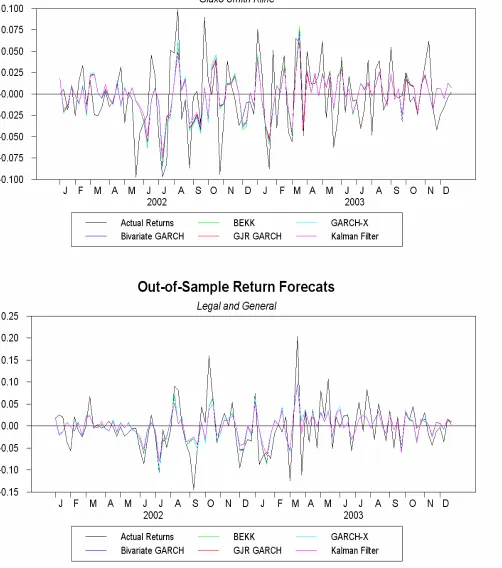
Figure 1 shows the return forecasted by the different methods and the actual return over the longer
period (2002-2003) for two firms. All estimates seem to move together with the actual return, but the Kalman filter forecast shows the closest correlation. Figures for other firms are available on request.
9. Modified Diebold and Mariano Tests
As stated earlier, Harvey et al. (1997) propose a modified version that corrects for the tendency of the Diebold-Mariano statistic to be biased in small samples. Out-of-sample forecasts on the weekly
basis are fairly finite, with 52 observations in the one-year forecast horizon. In this case, the modified Diebold-Mariano statistics are more reliable and apposite for ranking the various forecasting models candidates than the original Diebold-Mariano statistics. Two criteria, including MSE and MAE derived
from return forecasts, are employed to implement the modified Diebold-Mariano tests. Each time, the tests are conducted to detect superiority between two forecasting models, and thus there are ten groups
of tests for five models. For each group, there are a number of modified Diebold-Mariano tests for both MSE and MAE from return forecasts, between all applicable firms, and through three forecast samples. Each modified Diebold-Mariano test generates two statistics, S1 and S2, based on two hypotheses:
1. H10: there is no statistical difference between two sets of forecast errors. 1
1
H : the first set of forecasting errors is significantly smaller than the second. 2. H02: there is no statistical difference between two sets of forecast errors.
2 1
It is clear that the sum of the P values of the two statistics (S1 and S2) is equal to unity. If we define the
significance of the modified Diebold-Mariano statistics as at least 10% significance level of t distribution, adjusted statistics provide three possible answers to superiority between two rival models: 1. If S1is significant, then the first forecasting model outperforms the second.
2. If S2 is significant, then the second forecasting model outperforms the first.
3. If neither of S1and S2is significant, then the two models produce equally accurate forecasts.
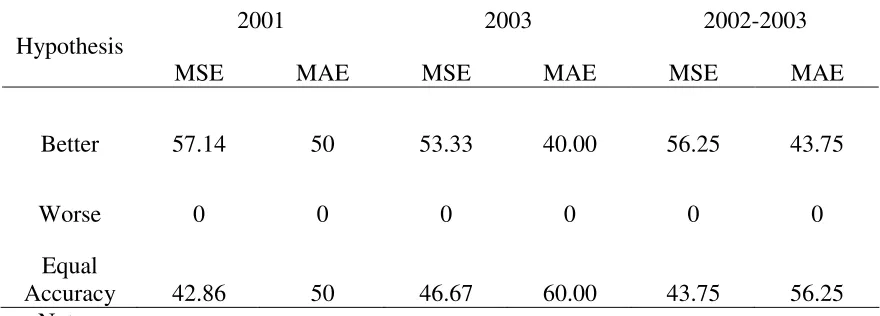
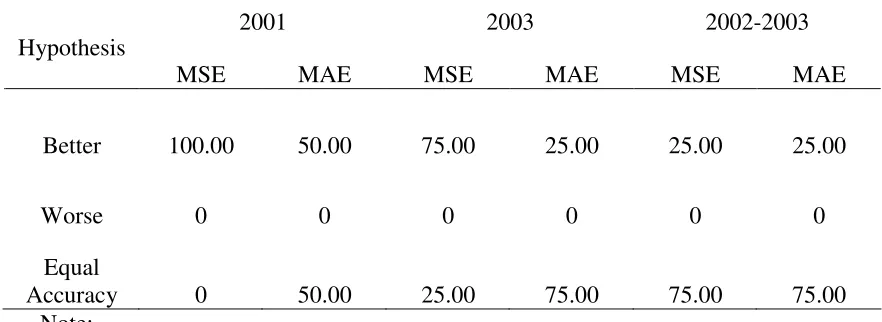
Tables 2 to 11 present the results of ten groups of modified Diebold-Mariano tests. Tables 2 to 5 provide a comparison between the Kalman filter approach and the four GARCH models. Kalman filter
is found to significantly outperform bivariate GARCH, BEKK GRACH and GJR GARCH models based on both the MSE and MAE (Tables 2 to 4). The hypothesis that these GARCH models significantly outperforms the Kalman filter method is not accepted for any firms. In about half of the cases, the two
forecasting models are found to produce equally accurate forecasts.
Since neither GARCH-X nor Kalman filter can be applied to all firms, the modified
Diebold-Mariano tests are valid in a smaller group of forecast errors. Test results presented in Table 5 show that Kalman filter overwhelmingly dominates GARCH-X in one-year forecast samples. In particular, the modified statistics based on MSE in 2001 find evidence in all firms that Kalman filter outperforms
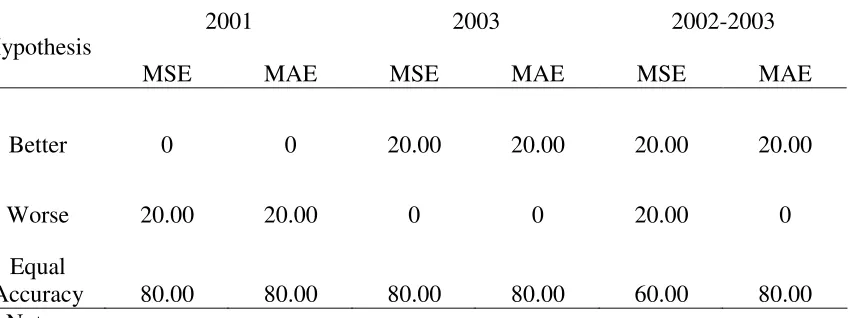
GARCH-X. For the two-year forecast horizon, although more forecast errors are found to have no significant difference between each other, Kalman filter still exhibit superiority in some cases. No
modified Diebold-Mariano statistics provide evidence for dominance of GARCH-X over Kalman filter. Modified Diebold-Mariano tests are also applied among GARCH models. Table 6 reports the results of tests between bivariate GARCH and BEKK. According to the modified Diebold-Mariano statistics,
the standard GARCH model has more accurate forecasts than BEKK in 2003, no matter which error criterion is used. In the forecast sample of 2001 and 2002-2003, the test statistics based on MSE
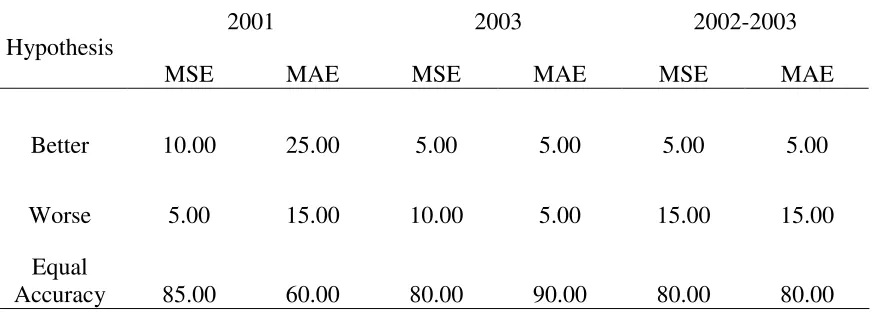
Table 7 reports the results of modified Diebold-Mariano tests between the standard GARCH and GJR specifications. The modified test statistics provide conflicting evidence on the dominance of
alternative models. In 2001, bivariate GARCH outperforms GJR by having a higher percentage of dominance, in terms of both MSE and MAE. In 2003 and 2002-2003, opposite evidence is found that GJR GARCH is better than bivariate GARCH in a few cases. However in all forecast samples, most
firms show that forecast errors are not statistically different. Thus, bivariate GARCH and GJR have similar forecasting performance in most cases.
Modified Diebold-Mariano tests are applied to a smaller group of forecast errors to detect the superiority between bivariate GARCH and GARCH-X. According to the results reported in Table 8, GARCH-X is found to be superior to bivariate GARCH in one-year forecasts. In two-year forecast
samples, evidence is found that bivariate GARCH outperforms GARCH-X. However, most firms accept the hypothesis that the competing models have similarly accurate forecast errors over different samples.
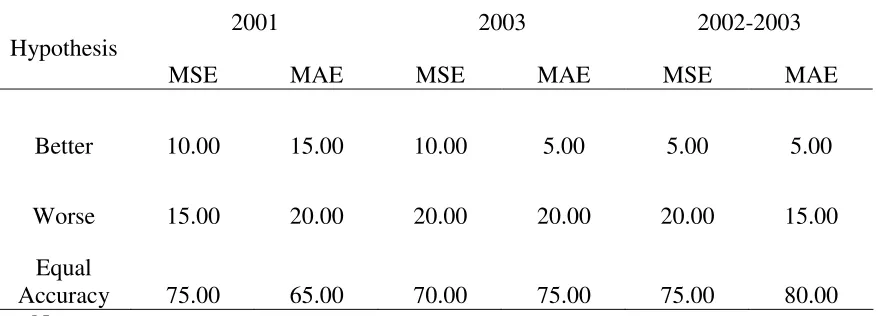
The results of modified Diebold-Mariano tests between BEKK GARCH and GJR GARCH are reported in Table 9. In all forecast horizons, the proportion of firms accepting the superiority of GJR is higher than firms supporting BEKK. Thus, GJR is favoured by more firms in terms of forecast accuracy.
However, more than half of the firms provide evidence of equal accuracy between the two GARCH models.
According to the modified Diebold-Mariano test results in Table 10, GARCH-X outperforms BEKK model through different samples in terms of MSE. MAE in 2001 also provides evidence for the dominance of GARCH-X, while in 2003 and 2002-2003, test statistics show that both models have
similar levels of MAEs. A high proportion of firms support that both forecasting models produce equally accurate forecasts, especially in 2003 and 2002-2003.
shows dominance over GJR in a few cases, while GJR is found to be better in 2003. In forecast period 2002-2003, no significant dominance is found in terms of MSE, while GJR is favoured by MAE.
Based on the ten groups of modified Diebold-Mariano comparison tests, Kalman filter is the preeminent forecasting model, as it overwhelmingly dominates all GARCH models with significantly smaller forecast errors in most cases. In contrast, none of the firms shows that GARCH type models can
outperform Kalman filter. Among the GARCH models, forecast performance is generally similar, as many firms accept the hypothesis of equal accuracy. In cases of firms that do not accept the hypothesis
of equal accuracy, the GJR is the best GARCH specification in terms of return forecasts, followed by bivariate GARCH that also produces accurate out-of-sample forecasts. BEKK shows as a little inferior to bivariate GARCH. GARCH-X is found to have similar forecasting performance to GJR; however, it
can only be applied to the firms with cointegrated relationship with the market.
10. Conclusion
This paper empirically estimates the weekly time-varying beta and attempts to forecast the returns
based on the estimated betas of twenty UK firms. Since the beta (systematic risk) is the only risk that investors should be concerned about, prediction of the beta value helps investors by making their
investment decisions easier. The value of beta can also be used by market participants to measure the performance of fund managers through the Treynor ratio. For corporate financial managers, forecasts of the conditional beta benefit them not only in the capital structure decision but also in investment
appraisal. This paper also empirically investigates the forecasting ability of four different GARCH models: standard bivariate GARCH, bivariate BEKK, bivariate GARCH-GJR, and the bivariate
beta series. The Kalman approach recursively estimates the beta series from an initial set of priors, generating a series of conditional alphas and betas in the market model.
The tests are carried out in two steps. In the first step, the actual beta series are constructed by GARCH models and the Kalman filter approach from 1989 to 2003. In the second step, the forecasting models are used to forecast returns based on the estimated time-varying betas and be compared in terms
of forecasting accuracy. To avoid the sample effect, three forecast horizons are considered, including two one-year forecasts, 2002 and 2003, and one two-year horizon from 2002 to 2003. Two sets of
forecasts are made and the different methods applied are compared.
In the third and last step, the empirical results of performance of various models are produced on the basis of hypothesis tests whether the estimate is significantly different from the real value, which will
provide evidence for comparative analysis of merits of different forecasting models. Various measures of forecast errors are calculated on the basis of beta forecasts to assess the relative superiority of alternative models. In order to evaluate the level of forecast errors between conditional beta forecasts
and actual values, mean absolute errors (MAE), mean squared errors (MSE), and mean errors (ME). Forecast errors based on return forecasts are employed to evaluate out-of-sample forecasting ability
of both GARCH and non-GARCH models. Measures of forecast errors overwhelmingly support the Kalman filter approach. The last comparison technique used is modified Diebold-Mariano test. This test is conducted to detect superiority between two forecasting models at a time. The results again find
evidence in favour of the Kalman filter approach, relative to GARCH models. Both GJR and GARCH-X models appear to have somewhat more accurate forecasts than the bivariate GARCH model. The BEKK
Reference
Akgiray, V. (1989). Conditional Heteroscedasticity in Time Series of Stock Returns: Evidence and Forecast, Journal of Business, Vol. 62, pp. 55-80.
Alexander, C. (2001). Market Models: A Guide to Financial Data Analysis, Chichester: Wiley.
Baillie, R. T. and Myers, R. J. (1991). Bivariate GARCH Estimation of the Optimal Commodity Future Hedge, Journal of Applied Econometrics, Vol. 6, pp. 109-124.
Black, F. (1976). Studies of Stock Market Volatility Changes, Proceedings of the American Statistical Association, Business and Economics Statistics Section, pp. 177-181.
Black, A., Fraser, P. and Power, D. (1992). UK Unit Trust Performance 1980-1989: A Passive Time-varying Approach, Journal of Banking and Finance, Vol. 16, pp. 1015-1033.
Berndt, E., Hall B., Hall R. and Hausman J. (1974). Estimation and Inference in Nonlinear Structural Models, Annals of Economic and Social Measurement, Vol. 3, pp. 653-665.
Bodurtha, J. and Mark, N. (1991). Testing the CAPM with Time-Varying Risk and Returns, Journal of Finance, Vol. 46, pp. 1485-1505.
Bollerslev, T. (1988). On the Correlation Structure for the Generalized Autoregressive Conditional Heteroscedastic Process, Journal of Time Series Analysis, Vol. 9, pp. 121-131.
Bollerslev, T., Chou, R. and Kroner, K. (1992). ARCH Modeling in Finance, Journal of Econometrics, Vol. 52, pp. 5-59.
Bollerslev, T., Engle, R. and Nelson, D. (1994). ARCH Models, In Engle, R. and McFadden, D. (Eds.), Handbook of Econometrics, vol. 4, Elsevier Science, New York, pp. 2960-3038.
Bollerslev, T., Engle, R. F. and Wooldridge, J. M. (1988). A Capital Asset Pricing Model with Time-Varying Covariances, The Journal of Political Economy, Vol. 96, pp. 116-131.
Bos, T. and Newbold, P. (1984). An Empirical Investigation of the Possibility of Stochastic Systematic Risk in the Market Model, Journal of Business, Vol. 57, pp. 35-41.
Brailsford, T. J. and Faff, R. W. (1996). An Evaluation of Volatility Forecasting Techniques, Journal of Banking and Finance, Vol. 20, pp. 419-438.
Braun, P. A., Nelson, D. B. and Sunier, A. M. (1995). Good News, Bad News, Volatility, and Betas, Journal of Finance, Vol. 50, pp. 1575-1603.
Brooks, C. (2002). Introductory Econometrics for Finance, Cambridge: Cambridge University Press.
Brooks, R. D., Faff, R.W. and McKenzie, M. D. (1998). Time-Varying Beta Risk of Australian Industry Portfolios: A Comparison of Modelling Techniques, Australian Journal of Management, Vol. 23, pp. 1-22.
Christie, A. (1982). The Stochastic Behavior of Common Stock Variances: Value, Leverage and Interest Rate Effects, Journal of Financial Economics, Vol. 10, pp. 407-432.
Day, T. E. and Lewis, C. M. (1992). Stock Market Volatility and the Information Content of Stock Index Options, Journal of Econometrics, Vol. 52, pp. 267-287.
Diebold, F. X. and Mariano, R. S. (1995). Comparing Predictive Accuracy, Journal of Business and Economic Statistics, Vol., pp. 253-263.
Dimson, E. and Marsh, P. (1990). Volatility Forecasting without Data-Snooping, Journal of Banking and Finance, Vol. 44, pp. 399-421.
Engle, C. and Rodrigues A. (1989). Tests of International CAPM with Time-Varying Covariances, Journal of Applied Econometrics, Vol. 4, pp. 119-138.
Engle, R. and Ng, V. (1993). Measuring and Testing the Impact of News on Volatility, Journal of Finance, Vol. 48, pp. 1749-1778.
Engle. R. and Granger, C. (1987). Cointegration and Error Correction: Representation, Estimation and Testing, Econometrica, Vol. 55, pp. 251-276.
Engle, R. F. and Kroner, K. F. (1995). Multivariate Simultaneous GARCH, Econometric Theory, Vol. 11, pp. 122-150.
Fabozzi, F. and Francis, J. (1978). Beta as a Random Coefficient, Journal of Financial and Quantitative Analysis, Vol. 13, pp. 101-116.
Faff, R. W., Hillier, D. and Hillier, J. (2000). Time Varying Beta Risk: An Analysis of Alternative Modelling Techniques, Journal of Business Finance and Accounting, Vol. 27, pp. 523-554.
Fletcher, R. and Powell, M. J. D. (1963). A Rapidly Convergent Descent Method for Minimisation, Computer Journal, Vol. 6, pp. 163-68.
Fornari, F. and Mele, A. (1996). Modeling the Changing Asymmetry of Conditional Variances, Economics Letters, Vol. 50, pp. 197-203.
Franses, P. H. and Van Dijk, D. (1996). Forecasting Stock Market Volatility Using Non-Linear GARCH Models, Journal of Forecasting, Vol. 15, pp.229-235.
Giannopoulos, K. (1995). Estimating the Time-Varying Components of International Stock Markets Risk, European Journal of Finance, Vol. 1, pp. 129– 164.
Glosten, L., Jagannathan, R. and Runkle, D. (1993). On the Relation between the Expected Value and the Volatility of the Nominal Excess Return on Stocks, Journal of Finance, Vol. 48, pp. 1779-1801. Gonzales-Rivera G. (1996). Time-Varying Risk The Case of American Computer Industry, Journal of Empirical Finance, Vol. 2, pp. 333-342.
Harris, R. and Sollis, R. (2003). Applied Time Series Modelling and Forecasting, New York: John Wiley.
Harvey, D., Leybourne, S. J. and Newbold, P. (1997). Testing the Equality of Prediction Mean Squared Errors, International Journal of Forecasting, Vol. 13, pp. 281–291.
Hentschel, L. (1995). All in the Family: Nesting Symmetric and Asymmetric GARCH Models, Journal of Financial Economics, Vol. 39, pp. 71-104.
Klemkosky, R. and Martin, J. (1975). The Adjustment of Beta Forecasts, Journal of Finance, Vol. 30, pp. 1123-1128.
Koutmos, G., Lee, U. and Theodossiou, P. (1994). Time-Varying Betas and Volatility Persistence in International Stock Markets, Journal of Economics and Business, Vol. 46, pp. 101-112.
Lee, T. H. (1994). Spread and Volatility in Spot and Forward Exchange Rates, Journal of International Money and Finance, Vol. 13, pp. 375-383.
Lintner, J. (1965). The Valuation of Risk Assets and the Selection of Risky Investments in Stock Portfolios and Capital Budgets, Review of Economics and Statistics, Vol. 47, pp. 13-37.
Markowitz, H. (1952). Portfolio Selection, Journal of Finance, Vol. 7, pp. 77-91.
Meade, N. (2002). A Comparison of the Accuracy of Short Term Foreign Exchange Forecasting Methods, International Journal of Forecasting, Vol.18, pp. 67-83.
Muth, J. (1961). Rational Expectation and the Theory of Price Movements, Econometrica, Vol. 29, pp. 1-23.
Ng, L. (1991). Tests of the CAPM with Time-Varying Covariances: A Multivariate GARCH Approach, Journal of Finance, Vol. 46, pp. 1507-1521.
Pagan, A. and Schwert, G. W. (1990). Alternative Models for Conditional Stock Volatilities, Journal of Econometrics, Vol. 46, pp. 267-290.
Rosenberg, B. and Guy, J. (1976a). Prediction of the Beta from Investment Fundamentals. Part 1, Financial Analysts Journal, Vol. 32, pp. 60-72.
Rosenberg, B. and Guy, J. (1976b). Prediction of the Beta from Investment Fundamentals. Part 2, Financial Analysts Journal, Vol. 32, pp.62-70.
Schwert, G. W. and Seguin, P. J. (1990). Heteroscedasticity in Stock Returns, Journal of Finance, vol. 4, pp. 1129–55.
Sharpe, W. F. (1964). Capital Asset Price: A Theory of Market Equilibrium under Conditions of Risk, Journal of Finance, Vol. 19, pp. 425–442.
Wahab, M. (1995). Conditional Dynamics and Optimal Spreading in the Precious Metals Futures Markets, Journal of Futures Markets, Vol. 15, pp. 131-166.
Well, C. (1994). Variable Betas on the Stockholm Exchange 1971-1989, Applied Economics, Vol. 4, pp. 75-92.
West, K. D. and Cho, D. (1995). The Predictive Ability of Several Models of Exchange Rate Volatility, Journal of Econometrics, Vol. 69, pp. 367-391.
Table 1
Company Profile Table
Name Products Industry
Market Capitalisation
(m£)
British Airways Airline services Transportation 2517.50
TESCO
Mass market
distribution Retailer 18875.26
British American
Tobacco Cigars and Cigarettes Tobacco 15991.70
BT Group Telecommunications Utilities 16269.67
Legal and General Insurance Financial 6520.12
Glaxo Smith Kline Medicines Pharmaceutical 76153.00
Edinburgh Oil and
Gas Oil and gas Energy Producer 48.07
Boots Group
Health and beauty
products Retailer 5416.64
Barclays Banking Financial 32698.64
Scottish and
Newcastle Beer Beverage 3380.12
Signet Group Jewellery and watches Retailer 1770.29
Goodwin Mental products Metal Producer 17.64
British Vita
Polymers, foams and
fibers Chemical 466.62
Caldwell Investments Ninaclip products Wholesaler 3.08
Alvis Military vehicles Automotive 189.68
Tottenham Hotspur Football club Recreation 28.57
Care UK Health and social care Service organization 146.84
Daily Mail and Gen
Trust Media products
Printing and
Publishing 237.84
Cable and Wireless Telecommunications Utilities 3185.61
Table 2
Percentage of Dominance of Kalman Filter over Bivariate GARCH
2001 2003 2002-2003
Hypothesis
MSE MAE MSE MAE MSE MAE
Better 57.14 57.14 53.33 33.33 56.25 50.00
Worse 0 0 0 0 0 0
Equal
Accuracy 42.86 42.86 46.67 66.67 43.75 50.00
Note:
This table presents the proportion of firms that accept the three hypotheses. The statistic is the modified Diebold-Mariano test statistic, using MSE and MAE as the error criterion. Better means the former model dominate the later; while worse means the later model significantly outperform the former. Equal accuracy indicates no significant difference between forecast errors. The significance is defined as at least 10% significance level of t distribution.
Table 3
Percentage of Dominance of Kalman Filter over BEKK GARCH
2001 2003 2002-2003
Hypothesis
MSE MAE MSE MAE MSE MAE
Better 57.14 50 53.33 40.00 56.25 43.75
Worse 0 0 0 0 0 0
Equal
Accuracy 42.86 50 46.67 60.00 43.75 56.25
Note:
[image:30.595.26.466.472.630.2]Table 4
Percentage of Dominance of Kalman Filter over GJR GARCH
2001 2003 2002-2003
Hypothesis
MSE MAE MSE MAE MSE MAE
Better 50.00 57.14 66.67 46.67 62.50 37.50
Worse 0 0 0 0 0 0
Equal
Accuracy 50.00 42.86 33.33 53.33 37.50 62.50
Note:
This table presents the proportion of firms that accept the three hypotheses. The statistic is the modified Diebold-Mariano test statistic, using MSE and MAE as the error criterion. Better means the former model dominate the later; while worse means the later model significantly outperform the former. Equal accuracy indicates no significant different between forecast errors. The significance is defined as at least 10% significance level of t distribution.
Table 5
Percentage of Dominance of Kalman Filter over GARCH-X
2001 2003 2002-2003
Hypothesis
MSE MAE MSE MAE MSE MAE
Better 100.00 50.00 75.00 25.00 25.00 25.00
Worse 0 0 0 0 0 0
Equal
Accuracy 0 50.00 25.00 75.00 75.00 75.00
Note:
[image:31.595.25.466.473.634.2]Table 6
Percentage of Dominance of Bivariate GARCH over BEKK GARCH
2001 2003 2002-2003
Hypothesis
MSE MAE MSE MAE MSE MAE
Better 0 5.00 15.00 25.00 15.00 5.00
Worse 5.00 5.00 0 5.00 10.00 5.00
Equal
Accuracy 95.00 90.00 85.00 70.00 75.00 90.00
Note:
This table presents the proportion of firms that accept the three hypotheses. The statistic is the modified Diebold-Mariano test statistic, using MSE and MAE as the error criterion. Better means the former model dominate the later; while worse means the later model significantly outperform the former. Equal accuracy indicates no significant different between forecast errors. The significance is defined as at least 10% significance level of t distribution.
Table 7
Percentage of Dominance of Bivariate GARCH over GJR GARCH
2001 2003 2002-2003
Hypothesis
MSE MAE MSE MAE MSE MAE
Better 10.00 25.00 5.00 5.00 5.00 5.00
Worse 5.00 15.00 10.00 5.00 15.00 15.00
Equal
Accuracy 85.00 60.00 80.00 90.00 80.00 80.00
Note:
[image:32.595.31.469.487.643.2]Table 8
Percentage of Dominance of Bivariate GARCH over GARCH-X
2001 2003 2002-2003
Hypothesis
MSE MAE MSE MAE MSE MAE
Better 0 0 0 0 20.00 20.00
Worse 20.00 40.00 20.00 0 0 0
Equal
Accuracy 80.00 60.00 80.00 100.00 80.00 80.00 Note:
This table presents the proportion of firms that accept the three hypotheses. The statistic is the modified Diebold-Mariano test statistic, using MSE and MAE as the error criterion. Better means the former model dominate the later; while worse means the later model significantly outperform the former. Equal accuracy indicates no significant different between forecast errors. The significance is defined as at least 10% significance level of t distribution.
Table 9
Percentage of Dominance of BEKK GARCH over GJR GARCH
2001 2003 2002-2003
Hypothesis
MSE MAE MSE MAE MSE MAE
Better 10.00 15.00 10.00 5.00 5.00 5.00
Worse 15.00 20.00 20.00 20.00 20.00 15.00
Equal
Accuracy 75.00 65.00 70.00 75.00 75.00 80.00
Note:
[image:33.595.29.470.471.629.2]Table 10
Percentage of Dominance of BEKK GARCH over GARCH-X
2001 2003 2002-2003
Hypothesis
MSE MAE MSE MAE MSE MAE
Better 0 0 0 0 0 0
Worse 20.00 40.00 20.00 0 20.00 0
Equal
Accuracy 80.00 60.00 80.00 100.00 80.00 100.00 Note:
This table presents the proportion of firms that accept the three hypotheses. The statistic is the modified Diebold-Mariano test statistic, using MSE and MAE as the error criterion. Better means the former model dominate the later; while worse means the later model significantly outperform the former. Equal accuracy indicates no significant different between forecast errors. The significance is defined as at least 10% significance level of t distribution.
Table 11
Percentage of Dominance of GJR GARCH over GARCH-X
2001 2003 2002-2003
Hypothesis
MSE MAE MSE MAE MSE MAE
Better 0 0 20.00 20.00 20.00 20.00
Worse 20.00 20.00 0 0 20.00 0
Equal
Accuracy 80.00 80.00 80.00 80.00 60.00 80.00
Note:
[image:34.595.42.467.501.660.2]University of Southampton Discussion Papers in the School of Management
Centre for Risk Research series
CRR-05-01 Private information, excessive volatility and intraday empirical regularities in the
spot foreign exchange market, by McGroarty, F., ap Gwilym, O. and Thomas, S.
March 2005.
CRR-05-06 Dividend resumptions, future probability and stock returns, by ap Gwilyn, O., Seaton, J. and Thomas, S.
September 2005.
CRR-05-07 The Relative Importance of Information, Inventory and Price Clustering for STIR
Futures Pre- and Post-EMU, by McGroarty, F. November 2005
CRR-06-01 Short Selling: Discussion of Short Sales Constraints and Momentum in Stock
Returns, by Thomas, S. March 2006
CRR-06-02 Valuation Rations, Stock Returns and Relative Asset Volatilities: An International
Puzzle, by ap Gwilym, O., Seaton, J., Thomas, S. and Werner, R. August 2006
CRR-07-02 Home Asset Bias and Investment Performance in a Market for State-Contingent
Claims, by Johnson, J.E.V., Bruce, A.C. and Yu, J. August 2007
CRR-07-03 A New Method for Predicting the Outcome of Speculative Events, by Johnson, J.E.V., Lessman, S. and Sung, M-C. August 2007
Management series
M-06-03 Revisiting the ‘paperless office’: A case of values, power and (in)action, Harwood, I. September 2006
M-07-08 Short-run deviations and time-varying hedge ratios: evidence from agricultural
University of Southampton
Discussion Papers in the School of Management
Centre for Research in Accounting, Accountability and Governance series
CRAAG-05-08 Costing Information in the UK NHS: The (Non-) Use of Cost Information in the UK
NHS Trust Hospitals, Agrizzi, D. December 2005
CRAAG-05-09 The State of UK Professional Accountancy Education: Professionalising Claims, Agrizzi, D. December 2005
CRAAG-06-04 Rating System in Healthcare: Contradictions and Conflicts in an English Hospital, Agrizzi, D. November 2006
CRAAG-07-04 Costing for (non) control: A case of a particular English hospital, Agrizzi, D. November 2007
CRAAG-07-05 Assessing English Hospitals: Contradiction and Conflict, Agrizzi, D. November 2007
Centre for Operational Research, Management Science and Information Systems series
CORMSIS-05-02 Modelling the purchase dynamics of insurance customers using Markov chains,
Bozzetto, J-F., Tang, L., Thomas, L.C. and Thomas, S. June 2005
CORMSIS-05-03 Managing inventory and production capacity in start-up firms, Archibald, T.W., Possani, E. and Thomas, L.C. June 2005.
CORMSIS-05-04 It’s the Economy Stupid: Comparison of Proportional Hazards Models with Economic and Socio-demographic Variables for Estimating the Purchase of
Financial Products, Tang, L., Thomas, L.C., Thomas, S.H. and Bozzetto, J-F. June
2005
CORMSIS-05-05 A comprehensive and robust procedure for obtaining the nofit polygon using
Minkowski sums, Bennell, J.A. and Song, X. June 2005
CORMSIS-07-01 A Beam Search Implementation for the Irregular Shape Packing Problem, Bennell, J.A. Song, S. March 2007
CORMSIS-07-06 Optimizing credit limit policies to maximise customer lifetime value, So, M and Thomas, L. November 2007
© Author(s): All rights reserved.
Copies of discussion papers can be obtained by contacting the address below: School of Management
University of Southampton Southampton SO17 1BJ Telephone +44 (0)23 8059 7787