A “BOTTOM UP” GOVERNANCE FRAMEWORK FOR DEVELOPING
AUSTRALIA’S MARINE SPATIAL DATA INFRASTRUCTURE (SDI)
K. T. Finney
Australian Antarctic Division, Department of Environment & Heritage, Channel Hwy, Kingston, 7050, Australia Email: [email protected];
University of Tasmania, Sandy Bay, Australia Email: [email protected]
ABSTRACT
Spatial Data Infrastructures (SDIs) have been developing in some countries for over 10 years but still suffer from having a relatively small installed base. Most SDIs will soon converge around a service-oriented-architecture (SOA) using IT standards promulgated primarily by the Open Geospatial Consortium (OGC) and ISO Technical Committee 211. There are very few examples of these types of architected SDIs in action, and as a result little detailed information exists on suitable governance models. This paper discusses the governance issues that are posed by SOA-based SDIs, particularly those issues surrounding standards and services management, with reference to an Australian marine case study and the general literature. A generalised governance framework is then postulated using an idealised use case model which is applicable for “bottom-up,” community-based initiatives. This model incorporates guiding principles and motivational and self-regulation instruments that are characteristically found in successful open source development activities. It is argued that harnessing an open development model, using a voluntary workforce, could rapidly increase the size of the SDI installed base and importantly defray infrastructure build costs.
Keywords: Marine, SDI, Governance, SOA, Web services, Registry
1
INTRODUCTION
The notion that considerable benefits accrue to a society by “freeing up” access to spatially referenced data has provided impetus for the construction of local, national, and global spatial data infrastructures [SDIs] (Rajabifard, Chan, & Williamson, 1999; Rhind, 2001). SDIs, no matter what their scale, theoretically comprise networked, spatially-enabled databases or datasets that are accessible for downloading or manipulation using contemporary technologies, usually according to explicit institutional arrangements and are supported by policies, standards, and human capital (Rajabifard & Williamson, 2001; Nebert, 2004). They are a type of information infrastructure, which Hanseth & Lyytinen (2006) characterise as something that has a shared, evolving, heterogeneous, and open system of IT capabilities, whose evolution is enabled and constrained by the installed base and the nature and content of its components and connections. Even the more strongly supported and mature SDIs, however, still have relatively poor public penetration and insufficient robustly implemented technology standards and continue to succumb to policy and technology related data integration obstacles (Nedovic-Budic, Feeney, Rajabifard, & Williamson, 2004; Masser, 2006a; Ramsey, 2006a). While there is recent acknowledgement that governance plays an important role in developing and sustaining SDIs (ANZLIC, 2003a; Masser, 2006b), little detail has been presented in the literature on how formal governance models are being applied in this field. This is a significant gap if governance does have an appreciable effect on how SDIs develop. It is suggested here that appropriately geared governance models could assist SDI development in a number of ways: by stimulating more rapid evolution of SDIs; by addressing current deficiencies in the application of standards; and by helping to achieve an increase in public penetration of SDI related technology and services through more tightly integrating a user-perspective in both SDI design and operational management.
for example in the case of the US SDI (FGDC, 2005). These descriptions may include details of specific over-arching national SDI-related policy, legislation, or standards promulgation activities. Collectively, these types of governance structures and processes have been termed by some SDI commentators as “top-down” approaches (Groot & Georgiadou, 2001), presumably because they refer in the main to government initiated activities. They contrast with “bottom-up” approaches, which occur predominantly at the local level and which guide the development of application-specific and enterprise-wide activity. At this level, the hard fabric of the infrastructure is actually being built by a networked community through the incremental development of services, by deployment of applications, and importantly through the adoption and development of standards. While the expression of these bottom-up activities is necessarily diverse, common elements of the infrastructure building process, including human motivational factors and recent convergence around a single IT architectural model, provide the scope for exploring a generic governance framework for stimulating and coordinating bottom-up approaches.
Most SDI-related development communities have already adopted, or will soon do so, the services-oriented-architecture (SOA) paradigm through subscription to the Open GIS Consortium’s (OGC) geospatial service architecture standard (OGC, 2002). But despite the pervasive promotion of this and other OGC standards in top down governance approaches, there is still a lack of comprehensive implementation experience with the SOA paradigm in SDI communities. This has lead to a paucity of information specifically addressing SOA governance requirements within SDI developments at any level (local, national, or global). A better appreciation for what needs to be governed in developing SOA-based SDIs and the processes available for executing these requirements could help realise more robust solutions in extending existing SDIs. Any forthcoming governance models could also serve as best practice for adoption by new SDI entrants.
Based on Australia’s experience in building the foundations of a marine spatial data infrastructure and an extensive literature review, a generic, idealised Governance Framework is postulated in this paper to support a bottom-up, SOA-based, SDI development. This Framework addresses how to incentivise, control, monitor, and supervise the building of an SDI using governance principles and motivational models inherently found in successful open source development projects. The Framework is under-pinned by assumptions consistent with observed mainstream information infrastructure design principles (Hanseth & Lyytinen, 2006). Developed with hindsight, the Framework draws on the author’s practical experience over the last three years, playing a number of roles within the Australian marine SDI community, including marine SDI project sponsor, project manager, community developer, data contributor and end-user. Many conclusions are made through observing approaches which did not work successfully during implementation, as much as they are based on observations of successful actions or governance.
This paper is organised as follows. Section 2 presents the basic tenets of the SOA paradigm and the types of technology standards involved, as they are applied to SDIs and which are exemplified by reference to building Australia’s marine spatial data infrastructure. Section 3 outlines complex governance issues that arise from the SOA paradigm, primarily those surrounding service: design; integration; standards compliance; typing; versioning; quality and performance monitoring. These rather abstract issues are explored by using the Australian case study to provide concrete examples with which the reader can identify. This section also examines how open source communities could be productively used to increase the installed base in SOA-based developments and how a volunteer community can defray costs associated with SDI development. This open approach is then suggested as a potential model for motivating and governing a distributed, community-based SDI work-force.
2
PRINCIPLES OF THE SOA PARADIGM AS APPLIED IN BUILDING
AUSTRALIA’S MARINE SDI
There is little difference between the general processes involved in developing an information infrastructure (i.e. a collection of interoperating systems) and building one that is spatially focused (De Man, 2006). The design principles identified by Hanseth & Lyytinen (2006), which apply in building main-stream information infrastructures, should therefore also equally apply to developing SDIs. These principles, covering issues such as initially designing for direct usefulness and kick-starting the process, building on existing installed bases, and acquiring users to grow the infrastructure, designing for simplicity and modularity, will be discussed in context throughout this paper. They have been used as key inputs in shaping the postulated SDI Governance Framework, described later in section 4. But whether we are dealing with a general information infrastructure or an SDI, the involvement of potentially large numbers of distributed users and designers and the heterogeneity of the infrastructure components mandates that standards must be used to describe the foundations of the infrastructure. These standards typically are deliberately designed but sometimes simply emerge. Either way, understanding how to manage the definition, implementation, and use of standards and their interaction and interdependencies is fundamental to managing and growing any infrastructure (Hanseth, Monteiro, & Hatling, 1996).
In addition, because information system environments are constantly evolving, as are standards, designing and developing for flexibility is a basic requirement in building any infrastructure (Hanseth et al, 1996). Requirements change as systems and users mature. To avoid lock-ins, where sub-infrastructures diverge and become incompatible because of competing standards or where infrastructure technologies can no longer meet new requirements, modularisation and encapsulation should be used to maximise flexibility, portability, and simplicity. All of this suggests that the collection of systems making up an infrastructure needs to be designed based on a shared architectural view (Hanseth & Lyytinen 2006).
Service-oriented-architectures provide, in concept at least, an appropriate technology paradigm for developing infrastructures in the new ICT landscape, a landscape in which the Internet and advanced telecommunications readily support geographically distributed access to data and systems. SOAs are a main-stream Information Technology (IT) paradigm and theoretically allow development communities to establish a shared architectural view, while still permitting considerable flexibility, a component approach, and diversity in terms of any devised solutions. An SOA is not, however, an IT solution that can be bought off-the-shelf. It is a conceptual approach to building infrastructure to meet business needs, centred on the philosophy of re-usable, component-based “services”. These services, acting independently or in tandem, are developed to address specific business functions and should be readily deployable in a heterogeneous, networked IT environment.
The SOA concept has proved attractive to main-stream business because it promises a path for better systems and business process integration, a more agile development environment, and ultimately better returns on IT investment. From an SDI perspective, it represents a very tangible way of connecting many disparate, unconnected agency-based IT systems via the Internet, without requiring that each agency dismantles its existing legacy systems. Agencies can mask what is behind their firewalls as long as they present services that conform to the standards stipulated for the SDI. The prospect that creative service consumers might take SDI services and find new and innovative ways to re-use or re-factor them to the benefit of the whole community is particularly attractive. However, fitting all the pieces together and making sense of the technologies, standards, and people issues involved in rolling out SOA-based SDIs is still in its infancy. Mature national SDIs were not originally based on this paradigm and are either in the process of transitioning to it, for example, Canada (GeoConnections, 2005), USA, and Australia, or are planning to do so. Some new SDIs such as INSPIRE, the European regional SDI initiative (Smits, 2002), and Australia’s marine thematic SDI have begun using this architecture from their inception. There are currently no successful and mature SOA-based SDI implementations from which to extract wisdom concerning the role that governance can play in building these infrastructures.
similar issues, is actually fundamental to managing the standards components and operational aspects of community-based, SOA SDI projects.
First we require a general description of an SOA and how this architecture is being applied in the geospatial realm, with particular reference to the Australian marine case study.
2.1
Geo-spatial service-oriented architectures
There are four entities that make up a Service-Oriented-Architecture (SOA). The first three are architectural elements, i.e. a service provider, a service registry, and a service consumer (or service requestor). The fourth is the contract that binds the consumer and provider (see Figure 1). This contract (or service definition) contains a description of the functionality that the service provider offers, along with other technical information required for the services to be used by any potential consumer. A service provider publishes this contract in a services registry in order to make requestors aware that the service is available. Service consumers access a registry to find a particular service that meets their requirements and then implement the elements from the contract that are necessary to invoke the service. The only agreement between the service provider and service consumer is expressed through the contract itself. It is important to recognise that these relationships and communications are all machine-mediated transactions, i.e. once defined they are intended to occur without the need for human intervention. These transactions typically occur through the utilisation of a range of standard, mainstream IT protocols and languages such as the:
• Universal Discovery, Description and Integration (UDDI) protocol for composing registries (Clement, Hately, von Riegan, & Rogers, 2004),
• Simple Object Access Protocol (SOAP) defining how to format a message to communicate between
applications (W3C, 2003),
• Web Services Description Language (WSDL), describing services and how to access them (Christensen, Curbera, Meredith, & Weerawarana, 2001),
• Hyper Text Transfer Protocol (HTTP), defining how messages are formatted and transmitted
(http://www.w3.org/Protocols),
• Extensible Mark-up Language (XML), using tag-based language to describe data elements and for
electronic data interchange (http://www.w3.org/XML/).
In the past few years, the geospatial community, mainly lead by the OGC and the ISO Technical Committee 211 for Geographic Information/Geomatics, has embraced the SOA model but developed alternate standards that are designed specifically to deliver or discover geospatial data payloads (see http://www.opengeospatial.org/standards
and http://www.isotc211.org/ ). For example, instead of UDDI and WSDL, the OGC has developed a registry
interface standard, the OpenGIS Catalogue Service (CS-W) and three types of web services with their own messaging formats, the Web Maps Service (WMS - http://www.opengeospatial.org/standards/wms), Web Feature Service (WFS - http://www.opengeospatial.org/standards/wfs) and Web Coverage Service (WCS). These web services and other spatially-based standards are expressed in GML (Lake, Burggraf, Trinic, & Rae, 2004), an XML-based language tuned for representing spatial objects. While the OGC and its ISO counterpart are currently in the process of harmonising these standards with mainstream IT protocols (OGC, 2005), a degree of specialisation is currently still required until mainstream IT interface standards efficiently cater for the discovery, transfer, and manipulation of data with a spatial component.
2.2
Observations from Australia’s marine SDI activities
In Australia the entity notionally overseeing the development of the national SDI is the Australia, New Zealand Land Information Council (ANZLIC). Like many other countries, Australia has been explicitly building a national spatial data infrastructure (NSDI) for at least 10 years (Williams, Chan, & Effenberg, 1998), but it was only in 2003 that ANZLIC published its SDI Distribution Network roadmap (ANZLIC, 2003b) in which a SOA was nominated to underpin SDI development. Since the publication of this roadmap, several initiatives have emerged from the bottom-up which embrace the SOA concept, significant amongst these is the Australian marine community’s effort to build a marine-themed SDI, which began in 2004 led by the Australian Ocean Data Centre Joint Facility (AODC JF). This community fully adopted the OGC open web service standards and augmented these with other internationally recognised standards where deficiencies were apparent [e.g. the ebXML RIM (OASIS, 2002) standard was used to define the information model necessary to support the marine SOA registry service].
The AODC JF comprises Australian federal government agencies (Australian Institute of Marine Science, CSIRO, Geosciences Australia, Australian Antarctic Division, Bureau of Meteorology, National Oceans Office, Royal Australian Navy) that have an interest in the marine domain. These partners formed an alliance using a non-legally binding Heads of Agreement which provided for the instantiation of a governing Board and a Technical Committee to manage day-to-day facility operational activities. The aim of this consortium is to establish an infrastructure with re-usable patterns for publishing marine related data from multiple agencies and to keep the SDI essentially technology neutral. An underlying premise is that any service provider or vendor should be capable of implementing or updating their SDI components without reference to the technology platforms of other components. The partners selected a consultant, Social Change Online (SCO), to assist with infrastructure development.
In building this thematic SDI, the Australian consortium quickly discovered that the existence of SOA supporting standards did not guarantee a smooth technical implementation path. Many pieces of the geo-spatial SOA standards jigsaw have been created as paper-based exercises, so harnessing these and fitting them together in a real world situation to achieve interoperability between actual systems is still very much a novel activity. The fact that the international development of geographic standards is a consensus based activity that can begin (and end) with an “absence of any real theory or conceptual basis,” often resulting in a standard with “little or no technical sustainability or long-term viability” (Tom, 2003), can present implementation difficulties for those at the cutting edge of development.
In the Australian case study, the OGC/TC 211 implementation specifications were found to have deficiencies, particularly in relation to manipulating marine data types which typically have 3 or 4 dimensional components (e.g. latitude, longitude, depth, and/or time). For instance, the AODC JF partners found that it was difficult to deal with the time dimension in OGC Web Map services. Woolf et al. (2005) also encountered this problem and reported other difficulties including the lack of appropriate support for using a range of vertical coordinate systems in the WMS specification, a specification that was essentially designed for 2-dimesional mapping.
shortcomings often become apparent only after design decisions have already been taken and development effort has begun. This highlighted to the AODC JF partners the need for efficient feedback mechanisms between community-based developers and international standards bodies in such circumstances, even if only to communicate what deficiencies have been found, pending a longer-term process to gain a consensus solution. Nebert, Reed, & Wagner (2006) have drawn the same conclusions and believe that specifying a versioned, international SDI Standards Suite with good governance processes for managing the SDI Standards Suite life-cycle is required for creating interoperating SDIs at all levels.
Ensuring interoperability within and between SDIs requires agreement on metadata schemas and formats, data models and encodings, and service interfaces for accessing both data and discovery metadata (Nebert, 2004). The ISO TC 211 standards do provide a framework for conceptual information and service modelling. However, there is no guidance on how to determine which semantic features make up a particular domain of discourse, what level of granularity should be applied, or how to govern the domain modelling process.
At the time that the AODC JF infrastructure was being designed, there was also no recommended OGC standard for the registry information model nor any standards for constructing workflows to chain services together. Subsequent to the commencement of the Australian SDI activity, the OGC has embraced the ebRIM metamodel for future application profiles of the OpenGIS CS-W specification (OGC, 2007) and in 2005 began interoperability testbed activities to develop service chaining and workflow orchestration specifications
(http://www.opengeospatial.org/projects/initiatives/ows-4/#gpw). However, given the vacuum at the time and the
size of the task required to explore all of these interoperability issues, the AODC JF partners chose to focus the most attention on examining the types of reusable information models that are necessary to support coherent, scalable discovery and exploitation of conforming data services in an SOA environment and in particular the role that a registry plays in this system.
To create a platform for exploration, the Australian marine partners established several SDI components to work together under the SOA model:
• a demonstration Portal (Figure 2) hosted by the Department of Environment and Heritage’s National Oceans Office,
• a marine catalogue (services registry) hosted by CSIRO’s Marine & Atmosphere Division, and
• a variety of distributed content & service providers (mostly State and Federal government contributors).
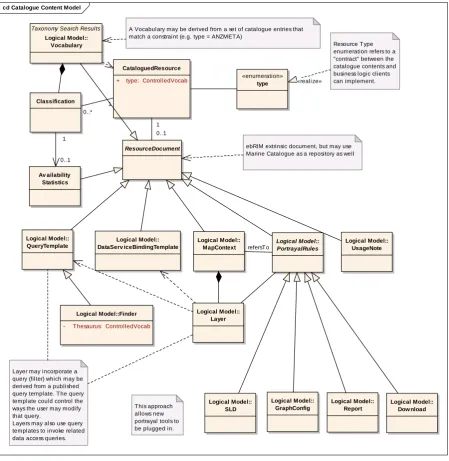
Supported by various project working groups, SCO assessed the types of service metadata required to discover and permit subsequent binding to different types of services and then abstracted the results of this exercise to develop a scalable information architecture for the infrastructure. Using the ebRIM metamodel, SCO then created a flexible registry content model (Figure 3), which is capable of managing standardised vocabularies, classification schemes, data portrayal rules, service usage information, and templates (or Data Access Query Models) for finding and binding to service types and their data (feature) payloads. These registry artefacts and the relationships between them facilitate meaningful queries against the registry not only for service discovery purposes but also to provide a querying client with information about what can be done with the service and its payload once retrieved (SCO, 2006a). This Australian registry content model can be considered a pre-cursor to a more robust and comprehensive registry content standard, which will be required in the future if independently developed SDIs wish to easily federate their registry services.
In developing the SDI information architecture, some initial attention had to be paid to service modelling, although the limited variety of services deployed by contributors did not offer the resources necessary to design abstract patterns that would be useful candidates to enhance current, basic OGC web service standards. Instead, the AODC JF partners implemented several simple derivative profiles of the OGC Web Map (WMS) and Web Feature Services (WFS) specifications that suited their immediate requirement to serve up specific types of publicly available data. In OGC terms, “profiles” are community or domain-specific implementations of standards, where non-mandatory elements have been exercised or the standard has been extended. The profiles developed for data deployment in the Australian case study include those listed below. They are accessible from http://www.bluenet.org.au/:
• a basic OGC WMS
• a species-enabled WMS that can be queried by a species code, species taxonomy and a time aggregation unit,
• a sea_surface_temperature-enabled WMS that can be queried by product type, and a time aggregation unit, and
• a basic OGC WFS.
.
Each contributed data service that conforms to one of these profiles is accessible via the portal interface and has been registered with the marine (catalogue) registry using various types of discovery and service metadata, including thematic or “topic” keywords. These topic keywords are a sub-set of those used by NASAs Global Change Master Directory (GCMD), a multi-disciplinary, metadata clearinghouse (http://gcmd.nasa.gov/) with a large international user-base. By re-using these terms, the Australian marine community hopes to remain consistent with what is emerging as an international de-facto standard for scientific “topic” categories. Synchronising the Australian community’s usage of these terms with the GCMD is an aspect of the system that will require ongoing governance.
In addition to topic keywords, the user is also able to select from a hierarchical list of marine taxa through a “Species Finder”. This list and its categories were developed under the guidance of CSIRO for use within the Oceans Portal. Under pinning these marine taxonomic categories is an Australian marine species register
(http://www.cmar.csiro.au/caab/), which contains Linean-based, taxonomic information with a focus on the
Australian region of interest. When Australian species data are eventually included in international taxonomic registers that are now being developed to represent global biological diversity (e.g. ITIS - http://www.itis.gov/ & Species 2000 - http://www.sp2000.org/ ) and are accessible as services, the Australian register will be de-coupled and substituted with a global taxonomy. Once again, suitable ongoing governance processes are required to manage this facet of the system not only from a technology viewpoint but also in terms of providing the necessary communication channels between the Australian marine community species experts and overseas domain experts working to create globally relevant species naming services.
There are other examples that can be drawn from developing the marine information architecture where it became evident that well-defined governance processes are needed in order to manage vocabulary dependent aspects of the infrastructure, particularly if we want to link thematic and jurisdictional SDIs. For example, it was necessary to augment significantly the International Hydrographic Organisation (IHO) Marine Gazetteer Standard
(http://www.ngdc.noaa.gov/mgg/gebco/underseafeatures.html ) that the AODC JF consortium is using for spatial
Figure 2. Oceans Portal Conceptual Model (SCO, 2006a)
S ite H o m e p a g e
C o n ta c t in fo
S ta tic c o n te n t U R L
lin k s N e w s fe e d s
M a rin e C a ta lo g u e
D is c o v e ra b le c o n te n t (F IN D ) Q u e ry c a ta lo g u e to c re a te lis t o f re le v a n t
ite m s
L a u n c h O c e a n s P o rta l
D isco ve ry p a n e l M a p p a n el O c e a n s P o rta l
M a p p a n e l D is co v ery p a n el
D a ta a c c e s s s e rv ic e s re g is te re d in c a ta lo g u e
(W M S , W F S , W C S ) D a ta c o n trib u to r
M a p p a b le c o n te n t (B IN D ) D is c o v e ra b le
c o n te n t (P U B L IS H )
P o rta l D a ta A c c e s s T o o ls (B IN D ) In v o k e
s e rv ic e s
In v o k e a d d itio n a l s e rv ic e s (B IN D )
(P u b lis h in g m e ta d a ta fo r d a ta a c c e s s s e rv ic e s a n d o th e r a g re e d
c o n te n t)
C o n c e p tu a l M o d e l o f O c e a n s P o rta l
A P I
- L a u n c h v ie w in g /m a n ip u la tio n to o l (e .g . 3 -d d a ta v is u a liz a tio n to o l)
- L a u n c h d a ta c o n v e rs io n s e rv ic e (e .g . G M L to s h a p e file )
- D o w n lo a d x m l/g m l d a ta to d e s k to p G IS - s e t-u p c o n n e c tio n to c o n te n t fro m G IS - lin k to a re m o te W e b a p p lic a tio n
E x te rn a l D a ta V is u a lis a tio n T o o ls
Figure 3. AODC JF Marine Catalogue Content Model (SCO, 2006b)
The AODC JF partners, via the Australian Antarctic Division (AAD) and a dedicated working group, have also had to establish a symbology catalogue to register symbols which can be used to portray the feature payloads of contributed services. While many of the symbols required are domain specific, a large number of symbols, particularly those necessary for visualising contextual information (e.g. coastal and seafloor topography, navigation features, legislative zones, protected areas) are useful across multiple domains and jurisdictions and therefore should be developed and managed using more inclusive mechanisms. The Intergovernmental Committee on Surveying and Mapping (ICSM: http://www.icsm.gov.au/) is potentially a prime candidate for driving such an initiative within Australia and perhaps could be encouraged to take on this remit, but until then the AAD will need to drive this activity.
cd Catalogue Content Model
CataloguedResource
+ type: ControlledVocab
ResourceDocument
Logical Model:: UsageNote Logical Model::
DataServ iceBindingTemplate
ebRIM extrinsic document, but may use Marine Catalogue as a repository as well
Logical Model:: MapContext «enumeration» type Logical Model:: QueryTemplate Logical Model:: Layer Logical Model:: PortrayalRules Logical Model:: SLD Logical Model:: GraphConfig This approach allows new portrayal tools to be plugged in.
Logical Model:: Report Classification
Taxonomy Search Results
Logical Model::
Vocabulary Resource Type
enumeration refers to a "contract" between the catalogue contents and business logic clients can implement. A Vocabulary may be derived from a set of catalogue entries that
match a constraint (e.g. type = ANZMETA)
Layer may incorporate a query (filter) which may be derived from a published query template. The query template could control the ways the user may modify that query.
Layers may also use query templates to invoke related data access queries.
Logical Model:: Dow nload Logical Model::Finder
Australia’s experience in implementing some foundation components of a marine themed, SOA-based SDI has emphasised to the AODC JF partners the critical nature of the standards governance processes that need to operate within a community-of-interest, and also between communities-of-interest, in order to establish machine-level, interoperating systems. In building these processes, communities need to determine when it is more appropriate to collaborate outside of their domain in developing an abstract standard, which they can later individualise for their domain through the creation of profiles. To make this choice, however, it needs to be much easier than it currently is for cross-domain collaboration to occur, and this is where adopting a generic governance framework, for bottom-up SDI development initiatives, could assist. As will be discussed later, by making community-based standards management intrinsic to any bottom-up development effort and then linking this activity to a national standards co-ordinating body, a standards network could be realised that provides for collaboration and which can exercise standards with credible reference implementations.
It should be noted that the AODC JF partners deliberately side-stepped the complex array of technical and governance issues surrounding SOA authentication and authorization of services. The consortium decided that these fundamental generic services would ultimately be provided by the mainstream IT community as a plug-in layer within the infrastructure and could then be adopted at some point in the future. The partners therefore elected to publish only those services requiring no authentication and authorisation. This decision, although practically motivated, is consistent with the recommendation of Hanseth and Lyytinen (2006) who caution that building one’s own, complex and pervasive service infrastructures (such as those for authentication services) should only be considered once significant momentum has been acquired because the overhead of doing so is very (resource) expensive.
In summary, the Australian marine SDI initiative exposed a range of governance matters that are not considered to be specific to the Australian case study but rather are related to SOA-based SDI development more generally. SDI builders, regardless of theme or jurisdiction, will need to address:
• How to communicate effectively with existing standards bodies on standards deficiencies and have mechanisms in place to proffer standards enhancements, cognisant that many standards are un-tested, tested in constrained circumstances, or only theoretically based,
• How to work with domain communities and domain experts to determine content and service standards that will permit semantic interoperability amongst services (including those for alignment of data features, vocabularies, code lists, symbolisation, data portrayal rules, ontologies, content/service discovery, and querying),
• The scope of the role that the service registry will play in brokering transactions between service providers and consumers and the impact that this scope has on the design of the service profiles and the domain registry information model (i.e., the design and ongoing maintenance of the registry data model must be strongly coupled with the overall infrastructure information architecture development process).
3
TEASING OUT GOVERNANCE ISSUES ARISING FROM
COMMUNITY-BASED SOA SYSTEMS DEVELOPMENT
Recognising that the governance issues raised above and others not yet discussed would have an impact on the consortium’s ability to grow the marine infrastructure installed base and that these issues have ramifications for managing the various infrastructure components, the AODC JF Board established an AODC JF Governance Working Group (GWG). Its mandate during the course of the project was to identify the main governance issues that an SOA-based SDI development posed and to find solutions to some of these issues where practical. Marks & Bell (2006) have usefully defined SOA governance as encompassing the various governance processes, organisational roles and responsibilities, standards, and policies that must be adhered to in a conceptual SOA. They posit that governance provides for architectural oversight; establishes SOA policies; identifies appropriate funding models; implements SOA policies & processes; and drives service definition, creation, and publishing, as well as addresses quality of service management. This definition essentially provided the scope of the GWG task.
(Brauer & Kline, 2005; Mitra, 2005; Marks & Bell, 2006) assume closed, enterprise environments with strong command and control structures. In a “community of practise,” the challenge is to develop technical and governance roadmaps that can meet the requirements of a diverse range of players, all with competing interests, disjoint business functions, different business imperatives, and varying models for determining return on investment. How to provide incentives for members of the community to adhere to these roadmaps is also more difficult than would be the case than within an enterprise environment. Furthermore in an enterprise, the enterprise boundaries are known, even if they can occasionally expand or contract in a planned manner. In a “community of practice,” the boundaries of the community are fluid.
Cognisant of these difficulties, the Australian marine GWG decided at the outset to tackle the detail of the problem space by partitioning the more technically-based governance issues into those that needed to be addressed in relation to provided services, the marine catalogue, and the portal application. While in each category there were a myriad of matters requiring attention, depending on the depth to which each issue was examined, there was consensus at a gross level on what required immediate attention given the early stage of SDI evolution. Subsequent to the GWG deliberations, the author also identified work-force motivation and productivity as an important governance issue, particularly the question of how to govern to best foster a rapid increase in the installed base.
The main governance issues distilled through development of Australia’s marine-themed SDI are outlined below under the headings of Service, Catalogue and Portal, and Work-force Governance. In section 4 an idealised governance framework is suggested to address many of the issues raised.
3.1 Service
governance
In theory, central to any SOA initiative is the concept that services will be business aligned, re-usable, durable, discoverable, interoperable, composable (i.e. designed such that one service can be incorporated readily into another or be part of a service chain), loosely-coupled, and relatively coarse-grained (Marks & Bell, 2006). In practice the design of these services with such characteristics is a very subjective activity, mostly coloured by the particular skills of the designers, the technologies, and the development methodologies with which they are familiar. The stated service characteristics themselves are also subject to significant ambiguity and interpretation within the global IT fraternity. However, accepting these traits in general terms as desirable end goals, the GWG focused on the following service-centric issues in developing its Governance Framework:
• Service design, integration and standards compliance
• Service typing
• Service versioning
• Service quality and monitoring
3.1.1 Service design, integration and standards compliance
The services launched by current providers in the Australian marine SDI were based on specifications promulgated by the OGC and are considered implementation profiles of these standards. The community has not designed services from scratch because the consortium wishes to remain conformant at a core level with other spatial data providers for the purposes of interoperability. The main areas where the community was able to influence the character of these implementation profiles included:
• the interfaces provided by the services;
• the kinds of information handled by the services;
• constraints on the use and interpretation of that information; and
• conformance testing.
further described the types of queries (filters) that could be used to: extract data from the service; identify the types of real-world features that the services can provide and the styling rules for portraying these features. Conformance rules associated with these profiles have also been made explicit, but ideally, software-based test suites should now be developed to allow providers to automatically check their service for compliance.
While the community has started with a handful of well-specified services, it is anticipated that new service profiles will need to be added when providers wish to launch new data types that demand different service templates. Any devised Governance Framework must therefore promote compliance with existing standards as well as provide for the creation of new implementation profiles for alternate data delivery services, preferably ones that fit an over-arching community-agreed design pattern. In keeping with the principle that services should be “coarse-grained,” community developers are being discouraged from publishing new service types that are only minor variants on existing service profiles and instead are being urged to develop future service types that are more abstracted and generalised. The simple service pattern currently adopted already relies on the existence of community-agreed vocabularies and classification schemes and assumes the availability of other resources such as symbology and feature catalogues. Creating community fora where developers and data scientists in niche sub-domains can converse and collaborate to introduce new services and other artefacts that these services will rely upon is a process that needs to be given a high priority in a Governance Framework.
The agreed methods by which supporting specifications are developed and published and the processes by which the community adopts or moderates these profiles as standards must also be articulated. How these standards are then marketed to broader domains to further increase interoperability also requires consideration. Once new service specifications are accepted and in operation, does the community have a role in policing service conformance and if so, by what mechanism? An infrastructure populated with large numbers of non-conformant services could prove extremely frustrating for human service consumers when services fail to perform as specified. Non conformant services may also degrade network performance if machine-mediated transactions cannot occur as envisaged.
3.1.2 Service typing
Service types in the Australian marine SDI are currently synonymous with the existing AODC JF service profiles (see section 2.2) because of the existing paucity of service variety. It is envisioned, however, that once the infrastructure becomes populated with a larger core of services that there will be value in establishing a community-sanctioned classification of service types. More sophisticated niche applications (or composite services) could be built that are tailored to operate with specific service types – because services of a particular type would exhibit certain common characteristics. The GWG suggested that a service type classification might be defined using two or more categorical axes, for example by service protocol with optional specialisation (for instance, a WMS enabled with time) and by the type of query model used on the service. There are many other ways to classify services, and the classification may be dependent on intended service use. From a governance perspective, however, there should be some mechanism to agree on the classification schemes and a method to promote service design patterns that are required to expand and populate these schemes.
3.1.3 Service versioning
As consumers, both human and machine, become more reliant on gaining access to services of the Marine Catalogue, or any other registry, the issue of service versioning will become a significant governance issue. Some consumers may suffer negative business impact if a particular service is no longer available. Other consumers may have made business decisions using data available via a given service, and if this service disappears, or changes, the business no longer has reference to the underlying data on which their decisions were based.
• how a provider can differentiate between versions of the same service and advertise these versions in ways that are meaningful to the consumer,
• the responsibilities of the provider to notify those consumers potentially or actually impacted by changes to services and the requirements to preserve or make available different data service versions,
• the approvals process that may need to exist at the provider or community (registry) level to make changes to existing services and retire older, superceded services.
3.1.4 Service quality and monitoring
In a business context, Service Level Agreements (SLAs) are often used to establish a contract between a service provider and a service consumer. An SLA generally outlines the types of services that will be provided, the quality of those services, and agreed performance criteria for enabling the evaluation of compliance with the agreement. It is questionable if a SLA is an appropriate instrument for encouraging a high quality of service provision in a networked community. This type of contract typically works well when a consumer is paying for a service. In these cases, if the standard of quality is not reached or not consistently maintained, the service provider can incur a financial penalty and over time, with continued breaches, may lose the contract.
In a networked community, an SLA is likely to be far less effective in encouraging a high quality of service (although may still provide a way of unambiguously articulating service obligations). Financial penalties are not able to be implemented, service providers may not all belong to a uniform business entity or even to an identifiable consortium of agencies, and they are generally volunteers. The motivation for providers in the networked community will not generally be financial. Provider self-interest will predominate in terms of the value that they perceive they can derive from a well-functioning network, coupled with their desire to innovate. This will always be weighed against the personal overhead of making a contribution. Consequently an important governance consideration is how to encourage these types of providers to adhere to the standards of best practice that are required to implement a useable and effective distributed infrastructure (assuming the infrastructure does not contain any e-commerce components). Monitoring contributor efforts and reporting back to the community will need to be a fundamental part of the governance strategy.
The quality of individual services offered in the infrastructure, even when they are conformant with community- agreed governance protocols and standards, will always vary. There is potentially a key role here for consumers to play in providing feedback on the quality of available services. The provider needs to furnish descriptive metadata associated with a service (e.g. via a profile of the ISO metadata standard 19115 such as that developed by the Australian marine community – see http://www.aodc.gov.au/index.php?id=37 ) to enable a basic assessment of content quality, but consumers may use data services in ways not envisaged by the service provider and therefore have some unique insights into the quality of the service with respect to a particular application. Amazon.com employs a consumer rating system on its products, particularly books. In a distributed network, such as an SDI, it might be useful to have a similar vehicle for consumers to comment on service quality issues. This type of commentary does not have to be restricted to aspects of service payload quality but could include how the service conforms and performs more broadly.
3.2 Marine catalogue and portal governance
For the Australian marine community, the Marine Catalogue is perhaps the core component of the marine SDI and therefore needs to exhibit a very high degree of software and hardware reliability and availability. It is the mechanism by which services are located and information is stored on how to use and access them. The Catalogue also acts as the primary repository, or access point, for service-related artefacts that are required by the marine community (e.g. published standards, protocols, specifications, ontologies, data models, controlled vocabularies, and policies). The capture of metrics on many aspects of SDI performance – particularly those relating to service availability and consumption should also be a function of the Catalogue. It is not only a key technical component in the infrastructure, but it also should be an indispensable tool in a Governance Framework.
issues surrounding the development and funding of new Catalogue capabilities, software upgrades, and hardware migration cycles. The AODC JF is still working through these matters and determining to what extent the community will drive these activities, balanced against the business imperatives of the host agency and how the community will organise itself to provide such influence and funding.
Governance issues surrounding the Portal Application (built using SCO’s WebMap Composer software) to some extent mirror those for the Marine Catalogue in that the Portal is considered a shared resource but hosted by a single community member. A difference, however, arises in that this application, which is currently the primary means for human consumers to discover and manipulate provided services and community-centric information, could easily be replaced with one or more new Portals. While this application is the portal of choice, however, the ability to re-configure the Portal Application dynamically to accommodate an ever-expanding stream of new content (static and service-based), is critical. Under these circumstances, the AODC JF is having to negotiate the types of community access that will be provided to the application source code and the governance protocols that need to surround such access.
3.3 Work-force governance
One of the problems identified earlier in this paper was that SDIs still have little public penetration, which equates to a lack of installed base. This in part is probably due to the supply-side driven data and technology approach that has traditionally been used in developing SDIs and which has not been particularly user or service focused. Bernard & Craglia (2005) suggest service and market (user) driven infrastructures will be the next wave of SDIs. Additionally, building SDIs has often progressed as a series of closed, often silo-like system developments, using proprietary products, funded by government often through a central agency, using non-recurrent funding. These types of approaches are not likely to cultivate a healthy, sustainable infrastructure and an alternative, more iterative, and robust development model should be explored.
It must also be acknowledged that building an information infrastructure is a significantly resource-intensive business and requires the participation of several generic actors working in tandem: designers (both of components and standards); product manufacturers (implementing products that follow infrastructure standards); service providers; regulators; and users (an important and often under-valued part of the installed base that can influence the design by sheer force of numbers through their infrastructure component usage choices). All of these actors play a role, but no single type of actor can control the direction of the infrastructure, only shape parts of it (Hanseth & Lyytinen, 2006).
3.3.1 An “open” approach to software development
Traditional software business development models are predicated on privately held intellectual property rights, where software is produced by company employees and distributed to clients in binary form for deployment on their computers, under some type of restrictive license (Haddad, 2007). A new business model, which emerged as a viable alternative in the early 1990s, was “open source” development. The most successful and widely known product resulting from this new development paradigm is the Linux operating system (http://www.linux.org/), but there are many others, for example Apache (http://www.apache.org/), Openoffice (http://www.openoffice.org/), and Eclipse (http://www.eclipse.org/) to name but a few. In this “open” model, motivated individuals come together, usually over the internet, to collaboratively build software, which is distributed to users with the source code at no cost. Although licensing is still part of the model, open licenses encourage code distribution, re-use, and sharing
(www.opensource.org/licenses).
3.3.2 Governance implications of an open approach for SDI development
The open source model, where a distributed community of individuals cooperates voluntarily to develop software that can be shared, re-used, and extended without any of the individuals having exclusive property rights to the product, offers a new paradigm for financing and implementing SDIs. In this type of development model, components can be built by people who have the interest, requisite skills, and time to invest in the endeavour. Individual organisations do not have to risk funding infrastructure development in isolation, and they can tailor their contribution to satisfy their immediate needs and most importantly leverage the input of others (Holmes, Doyle, & Wilson, 2005). SOA-based developments, because of their componentised design, should be well-suited to this type of approach, providing that the stringent requirement for coding to design standards and the need for semantic conformance can be accommodated within the relatively loose collaboration that exists within an open source community.
An open development model could provide significant productivity advantages over more traditional development methods, but traditional enterprise-based governance approaches are not applicable in such environments. Enterprise governance processes rely heavily on hierarchical command and control regimes and are coupled with monetary incentivisation. Open source communities by contrast are characterised by a large voluntary work-force (although not all contributors will go unpaid), and this voluntary effort is motivated by a sense of self-determination, the opportunity to enhance ones reputation, altruism, and for many contributors, the pure pleasure of doing the tasks (Lattermann & Stieglitz, 2005). Successful open source developments are not unmanaged activities; governance is still required to control, monitor and supervise people’s activities, in order to achieve a shared goal. The instruments that can be used to avoid conflicts, motivate, and guide the workforce effort are, however, different than those used in conventional enterprise situations. Many of the instruments that work in community collaborations are social control mechanisms, for example structures built around trust and a sense of belonging, establishing community norms and a common language for information exchange, creating shared beliefs, identifying tacit rules for behaviour, developing shared expectations, fostering opportunities to enhance reputation or status, and peer review processes (Sagers, Wasko & Dickey, 2004). How some of these instruments, and others of relevance in the context of SOA-based development, can be harnessed to build SDIs from the bottom up will now be discussed.
4
GOVERNANCE FRAMEWORK & APPROACHES FOR DOMAIN-SPECIFIC,
COMMUNITY DRIVEN SOA-BASED SYSTEMS
The preceding section has outlined the types of issues that need to be addressed in building SOA-based systems using a distributed development model by communities-of-interest. A Governance Framework is now postulated to address these issues and the following concepts and propositions are assumed:
• The OGC, who are the prime standards setting body in the geospatial realm, would continue to promote an SOA-based model for SDI development for the foreseeable future and continue to play a lead international role in geospatial standards management. However, the OGC does not currently involve itself in domain-specific standards development or management. Many of these types of standards are information-centric, i.e., they pertain to the semantics of the data exchanged over the infrastructure and the nature of the discovery metadata and its relationship to the discovery paradigms used by a particular community. Other domain standards may relate to how communities traditionally visualise, symbolise, or process data, and these are also unlikely to attract significant attention from the OGC now or in the future, except from an abstract perspective.
• A case has already been established in section 3 for using open development methodologies once the foundation of an infrastructure has been instantiated to speed up infrastructure growth and uptake and to defray the financial burden of infrastructure development.
• It was also argued in section 3 that robustness of an infrastructure developed under an SOA model requires some form of quality of service management and service consumers (infrastructure users) can play an invaluable role in shaping infrastructure directions and the services that are ultimately available within it.
prescription to continue to allow for interoperability. The main components in the proposed Framework that seek to achieve this goal are: a community-based standards management system that would link to national and international standards efforts; a system for managing the operation of the infrastructure; and methodologies, instruments and processes that would create a motivated, open, collaborative development environment.
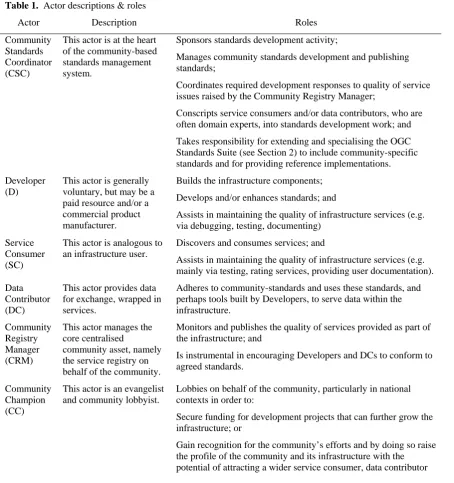
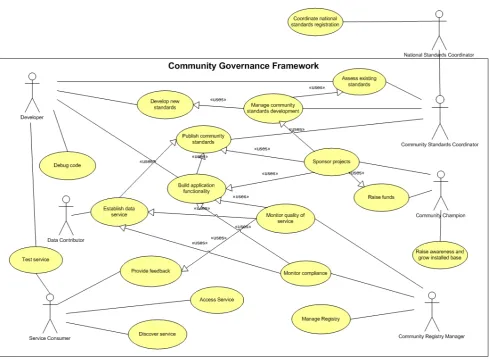
[image:16.595.65.520.252.736.2]The idealised use case model, presented in Figure 4, depicts the high level relationships and interdependencies that would exist among the main actors in a fictitious bottom-up SDI development initiative and their activities in relation to the suggested Framework components. Seven types of actors have been identified to play key roles. Six of them would operate within the bottom-up activity, and the National Standards Coordinator is identified as a necessary link between domain-specific standards coordination and international standards management, this latter role being considered part of a “top-down” process. A description of the seven actors and their potential roles appears in Table 1. Note that each actor can be an individual but is highly likely to be a group of individuals.
Table 1. Actor descriptions & roles
Actor Description Roles
Community Standards Coordinator (CSC)
This actor is at the heart of the community-based standards management system.
Sponsors standards development activity;
Manages community standards development and publishing standards;
Coordinates required development responses to quality of service issues raised by the Community Registry Manager;
Conscripts service consumers and/or data contributors, who are often domain experts, into standards development work; and
Takes responsibility for extending and specialising the OGC Standards Suite (see Section 2) to include community-specific standards and for providing reference implementations.
Developer (D)
This actor is generally voluntary, but may be a paid resource and/or a commercial product manufacturer.
Builds the infrastructure components;
Develops and/or enhances standards; and
Assists in maintaining the quality of infrastructure services (e.g. via debugging, testing, documenting)
Service Consumer (SC)
This actor is analogous to an infrastructure user.
Discovers and consumes services; and
Assists in maintaining the quality of infrastructure services (e.g. mainly via testing, rating services, providing user documentation).
Data Contributor (DC)
This actor provides data for exchange, wrapped in services.
Adheres to community-standards and uses these standards, and perhaps tools built by Developers, to serve data within the infrastructure.
Community Registry Manager (CRM)
This actor manages the core centralised
community asset, namely the service registry on behalf of the community.
Monitors and publishes the quality of services provided as part of the infrastructure; and
Is instrumental in encouraging Developers and DCs to conform to agreed standards.
Community Champion (CC)
This actor is an evangelist and community lobbyist.
Lobbies on behalf of the community, particularly in national contexts in order to:
Secure funding for development projects that can further grow the infrastructure; or
or developer base.
National Standards Coordinator (NSC)
This actor has a national standards coordination function.
[image:17.595.71.561.183.542.2]Operates outside of the community but is an important link between the community and national/international standards activities that may affect development of the infrastructure.
Figure 4. High level Governance Framework use case for bottom-up, SOA-based SDI developments.
It is argued that each of these actors is necessary for the growth and maintenance of an SOA-based, infrastructure because of the distributed nature of the development, the requirement for interoperability among separately developed and deployed services, and the need to grow the installed base as rapidly as possible and to maintain robustness in infrastructure functioning. Governance instruments or approaches that can incentivise actor participation (particularly that of developers, data contributors and service consumers), as well as steer and monitor their contribution in building the network, will now be presented.
Senyard & Michlmayr (2004) reported that in open source software projects that they had investigated, all projects originally commenced through the work of a core group of committed individuals in essentially closed environments until they were ready for release as open developments. This finding accords well with one of Hanseth & Lyytinen’s (2006) postulated infrastructure cultivation principles that all infrastructures benefit from starting life through a “kick-starting” process. These observations are important because it might be incorrectly assumed that an open source project, by definition, starts life as an open development. In fact, Senyard & Michlmayr claim that the chaotic nature of open development environments would not be conducive to producing a successful early product – one which would be able to get sufficient traction and attract appreciable numbers of interested developers or users. Raymond (1998) believes that you must start community-building by presenting a “plausible promise” even if the code you release does not work particularly well. He also considers that it would be almost impossible to originate a project in an open environment.
At some point, though, a decision is made to go “open” and a transition phase ensues. The original core individuals must then adapt to working in a new environment, one in which decision making is often more participatory and control over project directions is harder to exert. Therefore, when projects move from a closed to an open state, successful open source developments set a clear vision for what should be achieved and start to set community norms. These actions help coalesce a loose collaborating community around a shared set of goals and encourage conformance by guidance and encouragement, in lieu of hierarchical command and control techniques that are used in closed developments.
In the idealised Governance Framework mooted in this paper, it is suggested that the role played by the Community Standards Coordinator functions as the key governing body for an infrastructure after it transitions from a closed development. It is envisaged that some of the core individuals associated with driving the initial closed infrastructure development participate as part of CSC entity, at least in the early stages of infrastructure growth, to carry forward the original vision and goals. However, given the breadth of tasks that the CSC has to undertake, additional expertise may be brought in to supplement skills, particularly as new requirements herald the need for different perspectives and knowledge. The operating principles and decision-making processes of this group need to be transparent, though not necessarily democratic. For example, Linus Torvalds is the undisputed leader of the Linux project and originally acted as the final arbiter on which code was added to the Linux kernel. More recently, the magnitude of this open community development has seen Linus delegate this role to trusted lieutenants or “area owners.” However, there is no official organisation that institutionalises Torvalds role, and it is speculated that this is because he has attained a “charismatic leader” status. In the absence of such charismatic leadership, open source governance tends to be more coalitional and meritocratic (Kogut & Metiu, 2001).
The Community Standards Coordinator must maintain a big picture view and make sure that the standards that are set continue to encourage modularity of design and functionality to ensure infrastructure flexibility. In an SOA-based infrastructure, one way of providing diversity of functionality is through the development of specialised portals that serve particular niche domains, types of users, or themes. If developers can be encouraged to use portable modular software in instantiating these specialised portals, functionality from one portal can be readily harnessed and re-used in another (Anthony & Nebert, 2006). This type of portlet portability requires the promulgation of guidance on matters such as software design patterns and interface protocols.
The Community Champion actor is another entity that may draw its initial membership from the ranks of the core infrastructure developers. The Community Champion is an evangelical entity that can have a significant impact on the rate at which the infrastructure develops. In the early phases on infrastructure growth, the IT capability derives value through its user base size and not from its superior functionality (Hanseth & Lyytinen, 2006). Acquiring users is therefore paramount. Schweik and Semenov (2002) reported that of the open source projects that they surveyed, the successful open developments were actually supported by dedicated personnel as well as a voluntary workforce. Therefore the more successful the Community Champion is in attracting funds that can secure dedicated personnel, the faster the infrastructure can be built and the easier it will be to maintain or improve quality of services. The Community Champion can also increase the user-base by securing funding to catalyse specific projects that make the infrastructure useful to a particular stream of users.
the Community Champion needs to negotiate with the Community Standards Coordinator to make sure that any projects dedicated to leveraging and growing the infrastructure are done so in accordance with community norms and standards.
Importantly, the governance mechanisms directed at guiding an open source project and the collaboration among various actors should reflect that there is a cyclical pattern to these types of developments. Projects usually have an initiation phase followed by growth, maturity, and then decline, or possibly revival (Schweik & Semenov, 2002; Lattermann & Stieglitz, 2005). The growth phase will be characterised by increasing numbers of project participants and a higher degree of software specialisation requiring formalised communication rules and more coordination. Project founders will take on more management tasks, which will probably mean a move for these individuals away from software development to governance activities. The maturity phase is where the project has become very modularised, with numerous cooperating programs of activity. The need for transparency is paramount in all aspects of the project administration to retain the sense of community. Project momentum can go into decline if the governance becomes overbearing or too rigid, if self-determination is constrained by too many rules, or if management decisions are no longer understood and important founders leave the project (Lattermann & Stieglitz, 2005).
4.2 Creating incentives for participation
Under the proposed Framework, an open development environment is assumed. Because most SDI developments start as closed projects, moving from the closed to open state is therefore a critical step, but one that has been little studied. Schweik & Semenov (2002) suggest that going open too early, when the software is not yet stable or does not have sufficient functionality to attract users or developers, can cause projects to fail at the outset. As a result the transition to an open development never really occurs. Conversely a robust, finely tuned product with lots of rich features can also be a disincentive because developers feel that they are unable to make a credible new contribution.
Assuming an appropriate transition point has been determined, the next task is to grow the installed base as rapidly as possible. To build an open SDI using the idealised Framework, a priority should be given to adequately resourcing the Community Standards Coordinator and the Community Registry Manager actors to ensure continuity of personnel and performance in these key areas. Early on, after the transition from a closed development, seeding the Developer effort with funded personnel will also assist in presenting the impression that the infrastructure is growing and the development community is active. The aim, however, should be to use this funded effort to attract a pool of committed volunteers willing to contribute so that the funded activity eventually becomes a minor component of a much broader voluntary work-force. Studies by Shah (2006) have shown that voluntary developers may only contribute their services for up to one year. So a high turn-over in the development community should be anticipated. This potentially high turn-over rate implies that the systems implemented by the community to support infrastructure development activity should be easy for Developers to access, well documented, and record the history of interactions, decisions, and activities over time so that new entrants can quickly become familiar with issues and in turn create their own audit trails. Successful open developments make substantive use of mailing lists as a fast and effective medium for communication and coordination. Dedicated mailing lists with Frequently Asked Questions (FAQs) for different topics and well organised archives lower the barrier for new participants and may provide an alternative to creating extensive developer documentation (Michlmayr, 2005).
Developers are not the only actors in the proposed Framework that participate in building the physical fabric of the infrastructure. Service Consumers can play a pivotal role in testing new infrastructure components, help document parts of the infrastructure, and identify functionality wish-lists (Senyard & Michlmayr, 2004; Hanseth & Lyytinen, 2006). For Service Consumers to have an influence on development directions, the Framework must encompass communication methods that promote distributed interaction among Consumers and Developers, in addition to supporting communication between individual Developers. Community Newsletters as well as online discussion groups would support such interaction.
4.2.1 Motivation and roles