City, University of London Institutional Repository
Citation
:
Beccaria, M., De Angelis, G. F. & Forini, V. (2007). The scaling function at strong coupling from the quantum string Bethe equations. Journal of High Energy Physics, 2007, 066.. doi: 10.1088/1126-6708/2007/04/066This is the accepted version of the paper.
This version of the publication may differ from the final published
version.
Permanent repository link:
http://openaccess.city.ac.uk/19736/Link to published version
:
http://dx.doi.org/10.1088/1126-6708/2007/04/066Copyright and reuse:
City Research Online aims to make research
outputs of City, University of London available to a wider audience.
Copyright and Moral Rights remain with the author(s) and/or copyright
holders. URLs from City Research Online may be freely distributed and
linked to.
City Research Online: http://openaccess.city.ac.uk/ [email protected]
arXiv:hep-th/0703131v1 14 Mar 2007
Preprint typeset in JHEP style - HYPER VERSION HU-EP-07/06
The scaling function at strong coupling
from the quantum string Bethe equations
Matteo Beccaria
Dipartimento di Fisica, Universita’ del Salento, Via Arnesano, I-73100 Lecce INFN, Sezione di Lecce
E-mail:[email protected]
Gian Fabrizio De Angelis
Dipartimento di Fisica, Universita’ del Salento, Via Arnesano, I-73100 Lecce INFN, Sezione di Lecce
E-mail:[email protected]
Valentina Forini
Dipartimento di Fisica, Universita’ di Perugia, Via A. Pascoli, I-06123 Perugia INFN, Sezione di Perugia
and
Humboldt-Universit¨at zu Berlin, Institut f ¨ur Physik, Newtonstraße 15, D-12489 Berlin E-mail:[email protected],[email protected]
ABSTRACT: We study at strong coupling the scaling function describing the large spin anomalous dimension of twist two operators in N = 4super Yang-Mills theory. In the spirit of AdS/CFT duality, it is possible to extract it from the string Bethe Ansatz equa-tions in thesl(2)sector of theAdS
5 S
5
superstring. To this aim, we present a detailed analysis of the Bethe equations by numerical and analytical methods. We recover several short string semiclassical results as a check. In the more difficult case of the long string limit providing the scaling function, we analyze the strong coupling version of the Eden-Staudacher equation, including the Arutyunov-Frolov-Eden-Staudacher phase. We prove that it admits a unique solution, at least in perturbation theory, leading to the correct prediction consistent with semiclassical string calculations.
Contents
1. Introduction 1
2. Gauge Bethe Ansatz predictions for the scaling function without dressing 3
2.1 Input from string theory: Dressing corrections 4
3. Strong coupling regime and the string Bethe equations 5
3.1 The String Bethe equations and their numerical solution 7
3.2 Short string in the GKP limit 8
3.3 Short string in the BMN limit 9
3.4 Long string limit and the scaling function 9
4. The strong coupling ES equation 10
4.1 Leading order at strong coupling 11
4.2 NLO order at strong coupling 13
4.3 NNLO order at strong coupling 14
4.4 Numerical integration of the strong coupling ES equation 15
5. Conclusions 16
1. Introduction
Then-gluon maximally helicity violating (MHV) amplitudes in planarN =4SYM obey very remarkable iterative relations [1, 2, 3] suggesting solvability or even integrability of the maximally supersymmetric gauge theory. The main ingredient of the construction is the so-calledscaling functiondefined in terms of the large spin anomalous dimension of leading twist operators in the gauge theory [4]. The scaling function can be obtained by considering operators in thesl(2)sector of the form
Tr n
D S
Z L
+permutations o
: (1.1)
The classical dimension isS+L, soLis the twist, with minimal valueL=2. The minimal anomalous dimension in this sector is predicted to scale at large spinSas
S=f(g) logS+O(S 0
); (1.2)
where the planar ’t Hooft coupling is defined as usual by
g 2
= 16
2
; =Ng
2 YM
The one and two loops explicit perturbative calculation off(g) is described in [5, 6, 7] and [8, 9]. Based on the QCD calculation [10], the three-loop O(g
6
) calculation is per-formed in [11, 12] by exploiting the so-called trascendentality principle (KLOV).
In principle, one would like to evaluate the scaling function, possibly at all loop order by Bethe Ansatz methods exploiting the conjectured integrability of SYM. This strategy has been started in [13]. In that paper, an integral equation providingf(g) is proposed by taking the large spin limit of the Bethe equations [14]. Its weak coupling expansion disagrees with the four loop contribution. The reason of this discrepancy is well under-stood. The Bethe Ansatz equations contain a scalar phase, the dressing factor, which is not constrained by the superconformal symmetry of the model. Its effects at weak-coupling show up precisely at the fourth loop order.
A major advance was done by Beisert, Eden and Staudacher (BES) in [15]. In the spirit of AdS/CFT duality, they considered the dressing factor at strong coupling. In that regime, it has been conjectured a complete asymptotic series for the dressing phase [16]. This has been achieved by combining the tight constrains from integrability, explicit 1-loop-model calculations [17, 18, 19, 20] and crossing symmetry [21]. By an impressive insight, BES proposed a weak-coupling all-order continuation of the dressing. Including it in the ES integral equation they obtained a new (BES) equation with a rather complicated kernel. The predicted analytic four-loop result agrees with the KLOV principle. Very re-markably, an explicit and independent perturbative 4-loop calculation of the scaling func-tion appeared in [22]. In the final stage, the 4-loop contribufunc-tion is evaluated numerically with full agreement with the BES prediction.
This important result is one of the main checks of AdS/CFT duality. Indeed, a non trivial perturbative quantity is evaluated in the gauge theory by using in an essential way input data taken from the string side.
As a further check, one would like to recover at strong coupling the asymptotic behav-ior of the scaling function, as predicted by the usual semiclassical expansions of spinning string solutions [23, 24, 25]. Actually, the BES equation passes this check, partly numer-ically [26] and partly by analytical means [27]. One could say that this is a check that nothing goes wrong if one performs the analytic continuation of the dressing phase from strong to weak coupling.
From a different perspective, one would like to close this logical circle and check that the same result is obtained in the framework of the quantum string Bethe equations pro-posed originally in [17]. Indeed, it would be very nice to show that these equations repro-duce the scaling function in the suitable long string limit. Also, one expects to find some simplifications due to the fact that only the first terms in the strong coupling expression of the dressing must be dealt with. On the other side, the BES equation certainly requires all the weak-coupling terms if it has to be extrapolated at large coupling.
equation has been first derived by Eden and Staudacher in [13] as a minor result. Indeed, it has been left over because the main interest was focusing on matching the weak-coupling 4-loop prediction. However, we believe that it is a quite comfortable tool if the purpose is that of reproducing the strong coupling behavior of the scaling function. We indeed prove that the solution described in [27] is the unique solution of the strong coupling ES equation.
The plan of the paper is the following. In Sec. (2) we recall the Bethe Ansatz equations valid in thesl(2)sector ofN =4SYM without and with dressing corrections. In Sec. (3) we present various limits obtained in the semiclassical treatment of theAdS
5 S
5
superstring. We present our results for short and long string configurations. In Sec. (4) we analyze the strong coupling ES equation building explicitly its solution and checking that it agrees with the result of [27]. We also investigate numerically the equation without making any strong coupling expansion to show that the equation is well-defined. Sec. (5) is devoted to a summary of the presented results.
2. Gauge Bethe Ansatz predictions for the scaling function without dressing
In the seminal paper [13], Eden and Staudacher (ES) proposed to study the scaling func-tion in the framework of the Bethe Ansatz for thesl(2)sector ofN =4SYM. The states to be considered in this rank-1 perturbatively closed sector take the general form
Trf (D s
1
Z) (D s
L
Z)g; s 1
++s L
=S: (2.1)
They are associated to the states of an integrable spin chain. The anomalous dimension is related to the chain energies by
=L+S+E L;S
(g): (2.2)
The all-loop conjectured Bethe Ansatz equations valid forE
L;S up to wrapping terms are fully described in [28, 14]. Some explicit tests are can be found in [29, 30]. The Bethe Ansatz equations for the rootsfu
k g
1k Sare
x + k x
k !
L =
S Y
j6=k x
k x
+ j x
+ k
x j
1 g
2
x + k
x j
1 g
2
x k
x + j
; x
k
=x
u k
i 2
; (2.3)
where we have defined the maps
x(u)= u 2
0
1+
s
1 4g
2
u 2
1
A
; u(x)=x+ g
2
x
: (2.4)
The solutions of Eq. (2.3) must obey the following constraint to properly represent single trace operators
S Y
k =1 x
+ k x
k
The quantum part of the anomalous dimension,i.e.the chain spectrum, is obtained from
E L;S
(g)=2g 2 S X s=1 i x + k i x k ! : (2.6)
Taking the largeS limit of the Bethe Ansatz equations, ES obtain the following represen-tation of the scaling function
f(g)=8g 2 64g 4 Z 1 0 dt(t) J 1 (2gt) 2gt
; (2.7)
whereis the solution of the integral equation
(t)= t e t 1 J 1 (2gt) 2gt
4g 2 Z 1 0 dt 0 K m
(2gt;2gt 0 )(t 0 ) ; (2.8)
with the (so-calledmain) kernel
K m (t;t 0 )= J 1 (t)J 0 (t 0 ) J 0 (t)J 1 (t 0 ) t t 0 : (2.9)
Notice that given(t)we can simply write f(g) = 16g 2
(0)[31]. These equations are independent on the twist which drops in the large S limit. This is important since the scaling function is expected to be universal [32, 13] and therefore can be computed at large twist.
Unfortunately, the perturbative expansion off(g) disagrees at 4 loops with the ex-plicit calculation in the gauge theory. This is well known to be due to the missing contri-bution of the dressing phase.
2.1 Input from string theory: Dressing corrections
The effect of dressing is discussed in [15] to which we defer the reader for general dis-cussions about its origin and necessity. The Bethe equations are corrected by a universal dressing phase according to
x + k x k ! L = S Y j6=k x k x + j x + k x j 1 g 2 x + k x j 1 g 2 x k x + j e 2i kj : (2.10)
The general perturbative expansion of the dressing phase is [17, 33]1
k j = X r2 X 0 X g 2 r++ (r++) r;r+1+2 [q r (p k )q r+1+2 (p j
) (k$j)℄; (2.11)
where the higher order chargesq r
(p)are [34]
q r (p)= 2sin r 1 2 p r 1 0 q
1+16g 2 sin 2 p 2 1 4g 2 sin p 2 1 A r 1 : (2.12)
The first non trivial constant is (3) 2;3
6= 0. Indeed, (2) 2;3
= 0consistently with the 3-loops agreement with explicit perturbation theory.
The proposed coefficients for the all-order weak-coupling expansion of the dressing phase [16] are given in [15] (see also [38] and [39]). They read
(r++) r;r+1+2
=2( 1) r++1
(r 1)(r+2) 2+1
2+1
r +1
! 2+1
!
(2+1) (2.13)
and zero if r +1<0. This proposal is completely equivalent to a precise modifi-cation of the kernel of the integral equation. It amounts to the replacement
K m
(t;t 0
)!K m
(t;t 0
)+2K
(t;t 0
); (2.14)
where the dressing kernel can be written
K
(t;t 0
)=4g 2 Z 1 0 dt 00 K 1 (t;2gt
00 ) t 00 e t 00 1 K 0
(2gt 00 ;t 0 ); (2.15) with K 0 (t;t 0 ) = tJ 1 (t)J 0 (t 0 ) t 0 J 1 (t 0 )J 0 (t) t 2 (t 0 ) 2 ; (2.16) K 1 (t;t 0 ) = t 0 J 1 (t)J 0 (t 0 ) tJ
1 (t 0 )J 0 (t) t 2 (t 0 ) 2 : (2.17)
The modified integral equation can be exploited to compute the perturbative expansion of f(g). Now, there is agreement with the 4 loop explicit calculation. As we stressed in the Introduction, it is very remarkable that this weak coupling agreement is found with various inputs from string theory. In this sense, this is a powerful check of AdS/CFT duality.
3. Strong coupling regime and the string Bethe equations
As we explained, the BES equation is obtained by including in the ES equation an all-order weak-coupling expansion of the dressing phase. This expansion comes from a clever combination of string theory inputs and constraints from integrability. In our opinion, this is the essence of the integrability approach to AdS/CFT duality. As a consistency check, one would like to recover from the BES equation the known semiclassical predictions valid in theAdS
5 S
5
superstring at large coupling.
There are indeed several limits that can be computed. The semiclassical limit is eval-uated in terms of the BMN-like [40] scaled variables which are kept fixed as!1
E p ; J p ; S p ; (3.1)
whereE;J;S are the semiclassical energy of a string rotating inS 5
with angular momen-tumJ and spinning inAdS
5 with spin
The simplest limits that can be considered are those describing short strings that do not probeAdSregions with large curvature. We call them
short-GKP;
J p
1;
S p
1; : E=
q J
2 +2S
p
; (3.2)
short-BMN;
J p
fixed; S p
1; : E=J +S s
1+ J
2
: (3.3)
The scaling function is instead reproduced in the simplest long string limit which reads
long string;
J p
1;
S p
1; :E =S+f() logS: (3.4)
In this limit, one can read the strong coupling behavior of the scaling function which is
f string
(g)=4g 3
log2+ : (3.5)
A first attempt to solve numerically the integral equation is described in [26]. The BES equation is solved in a discrete series of Bessel modes and the result is a numerical profile of the scaling function shown in Fig. (1) of that paper. The lower curve is the scaling function taking into account the conjectured dressing and well reproduces the string prediction.
Recently, the leading term off(g)has been obtained analytically in [27], including the analytic expression of the Bethe roots densities in the strong coupling limit.
An intriguing feature of Fig. (1) in [26] is that the strong coupling behavior starts very early, namely atg ' 1. The long string behavior should be visible atS=
p
1which at g = 1 meansS 13. One can ask if it is possible to explore numerically the Bethe equations in the gauge theory up tog ' 1 and with S = O(100) to extract the scaling function. Actually, this is a hard task. At g ' 1 the regime is not perturbative. The complete dressing should be resummed and it is not easy to do that, although some very interesting results have been presented in [15].
An alternativehybrid approach would be that of taking the string Bethe equations with leading dressing. This should be enough to study the leading terms off(g)at strong coupling. Of course, the problem is now thatgmust be large and thenS must be unre-alistically large to deal with the numerical solution. However, not much is known about the properties of the strong coupling dressing expansion. It is divergent, but possibly asymptotic. Therefore, it would be difficult to estimate its accuracy atg'1.
3.1 The String Bethe equations and their numerical solution
For the subsequent analysis it is convenient to pass to thepvariables defining
p(u) = ilog x + (u) x (u) ; (3.6) x (p) = e ip 2 4sin p 2 1+ r
1+16g 2 sin 2 p 2 ; (3.7) u(p) = 1 2 ot p 2 r
1+16g 2 sin 2 p 2 : (3.8)
The loop corrections to the energy are now
E L;S (g)= S X k =1 r
1+16g 2 sin 2 p k 2 1 ; (3.9) wherefp k
gare obtained by solving the Bethe equations with dressing Eq. (2.10). At strong coupling, we use the leading dressing phase and write the string Bethe equations in loga-rithmic form as
iLp k = X j6=k 8 > > > > < > > > > : log 0 B B B B x k x + j x + k x j 1 g 2 x k x + j 1 g 2 x + k x j 1 C C C C A + (3.10)
+2i(u k u j )log 0 B B B B 1 g 2 x k x + j 1 g 2 x + k x + j 1 g 2 x + k x j 1 g 2 x k x j 1 C C C C A 9 > > > > = > > > > ;
+2i"(p k
) (3.11)
where "(x) = x=jxjand we have utilized thep ! p symmetry of the solution for the ground state as well as its known mode numbers [13].
The numerical solution of the String Bethe equations is perfectly feasible. The tech-niques have already been illustrated in the two compact rank-1 subsectors su(2) and su(1j1)as discussed in [41, 42].
First, we solve the equations at=0. This is the one-loop contribution. It is known exactly at L = 2. The Bethe roots are obtained, for an even spin S, as the roots of the resolvent polynomial [43, 13]
Y s (u u s ) 3 F 2
S;S+1; 1 2
iu;1;1;1
: (3.12)
The 1-loop energy can also be computed in closed form with the result
E 2;S
=8g 2
( (S) (1))8g 2
log S+ ! f(g)=8g 2
+: (3.13)
AtL > 2, we use the solution at L = 2 as the starting point for the numerical root finder. Then, we increaseg. At each step, we use a linear extrapolation of the previous solutions to improve the guess of the new solution. This procedure is quite stable and allows to explore a wide range ofL;S;gvalues. Notice that changing the twistLis trivial since the complexity of the equations does not change.
3.2 Short string in the GKP limit
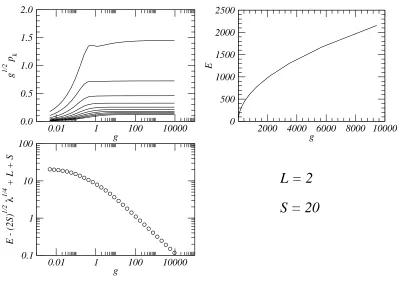
As a first numerical experiment we fixLandSand increasegup to large values where the equations are reliable. This is the short string limit where theAdS geometry is approx-imately flat. One expects to recover the Gubser-Klebanov-Polyakov law g
1=2 [44]. Solving the equations, we indeed verify that the Bethe momenta have the asymptotic scalingp
k g
1=2
. This is clearly illustrated in Fig. (1).
Despite the non trivial distribution of the Bethe roots, it is straightforward to compute the anomalous dimension at largeg. To do that, we first write the Bethe equations in the form
iLp k
=2i"(p k )+ X j6=k S k j : (3.14)
At largegwe can write
p k = k g 1=2 + 0 k g
+: (3.15)
The Bethe momenta can be divided into a setP with k
>0and a symmetric set obtained by flippingp! p. The expansion of the energy is
E = X k 2g 1=2 j k
j+2"( k ) 0 k 1
+= (3.16)
=4g 1=2 X k 2P k +4 X k 2P 0 k S: (3.17)
From the Bethe equations we have
iL X
k 2P p
k
=iS+ X k 2P X j62P S k j : (3.18)
where we exploitedS ij
= S
ji. Each Bethe momentum p
j with
j 62P can be written as p
j 0 with
j 0
2P. Hence we can write
iL X
k 2P p
k
=iS+ X j;k 2P S(p k ; p j ): (3.19)
At largeg
S(p k
; p j
)= 2i k j + 1 g 1=2 ( 0 k j + k 0 j )
+ (3.20)
The leading order Bethe equations give
iS 2i X k ;j2P k j
=0 !
The next-to-leading terms are
iL X
k 2P
k
= 2i X
j;k 2P (
0 k
j
+
k
0 j
)= 4i X
k 2P
k X
j2P
0 j
; (3.22)
! X
k 2P
0 k
= L 4
: (3.23)
In conclusion, by plugging these results in the expression for, Eq. (2.2), we find
=
p 2S
1=4
+O( 1=4
): (3.24)
The subleading term cancels the classical contribution leaving a pure 1=4
behavior. This can be compared with the flat limit in the semiclassical approximation that reads forJ=
p , S=
p
1
E string
= q
J 2
+2S p
(3.25)
with full agreement.
3.3 Short string in the BMN limit
If we keep S fixed and increase with =L 2
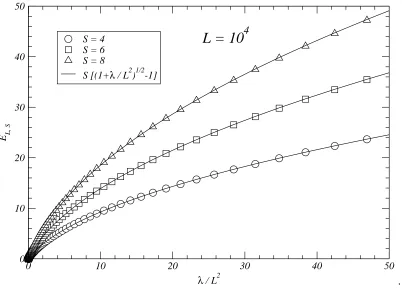
fixed, we can reach the BMN limit [40]. This is numerically very easy becauseLenters trivially the equations. Fig. (2) shows the convergence to the BMN limit whenLis increased from 10 to 100 andSis fixed atS=4. The various curves clearly approach a limiting one. This is very nice since it is an explicit show of how the BMN regimes sets up. Fig. (3) shows the limiting curves forS = 4;6;8 at very largeL=10
4
. The three curves are perfectly fit by the expected law
E =L+S s
1+ L
2
: (3.26)
3.4 Long string limit and the scaling function
The previous pair of tests in the (easy) short string limits is a clear illustration that the numerical solution of the Bethe equations is reliable.
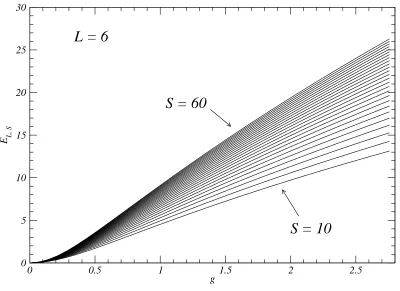
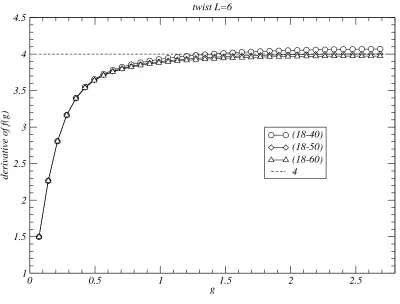
The slow string limit is much more difficult. We begin with a plot of the energy at fixed twistL = 6and increasing spin from 10 to 60. It is shown in Fig. (4). Each curve bends downward asgincreases, since it ultimately must obey theg
1=2
law. However, at fixedg, whenSincreases the energy increases slowly eventually following thelogS law. We attempted an extrapolation atS ! 1at eachg. In Fig. (5) we show our estimate for the derivative of the scaling function, by fitting the data(S
1 S
2
)withS 1
indeed to the spinS. In practice, as it stands, the numerical investigation could hardly be significantly improved.
For all these reasons, in the final part of this paper we explore an equation analogous to the BES equation, but derived for the string Bethe equation, at least with the leading order dressing phase.
4. The strong coupling ES equation
The inclusion of the AFS phase [17] in the ES equation
(t)= t e t 1 J 1 (2gt) 2gt
4g 2 Z 1 0 dt 0
K(2gt;2gt 0 )(t 0 ) ; (4.1) K(t;t 0
) K m (t;t 0 )= J 1 (t)J 0 (t 0 ) J 1 (t 0 )J 0 (t) t t 0 ; (4.2)
is straightforward and has been described in full details in [13]. The resulting equation reads (t) = t e t 1 J 1 (2gt) 2gt
+2g J
2 (2gt) 2gt
4g 2 Z 1 0 dt 0 e
K(2gt;2gt 0 )(t 0 ) ; (4.3) e K(t;t 0
) = K(t;t 0
)+2gK AFS
(t;t 0
); (4.4)
where the AFS kernel is
K AFS (t;t 0 )= t(J 2 (t)J 0 (t 0 ) J 2 (t 0 )J 0 (t)) t 2 (t 0 ) 2 : (4.5)
It is important to remark that both the main and AFS kernels admit a simple expansion as series of products of two Bessel functions. For the main kernel, it is well known that
K(t;t 0 )= 2 tt 0 X n1 nJ n (t)J n (t 0 ): (4.6)
For the AFS kernel we have2
J 2 (t)J 0 (t 0 ) J 2 (t 0 )J 0 (t) t 2 (t 0 ) 2 = 8 t 2 (t 0 ) 2 X n1 nJ 2n (t)J 2n (t 0 ): (4.8)
We change variables to put the equation in a somewhat simpler form and define
s(t)= e
t 1 t
(t); h()=s
2g
: (4.9)
2This expansion can be proved by starting from the identity
J 2 (t)J 0 (t 0 ) J 2 (t 0 )J 0 (t)= 2 tt 0 t 0 J 1 (t)J 0 (t 0 ) tJ
0 (t)J 1 (t 0 ) : (4.7)
The strong coupling ES equation forhis then
h()= J
1 ()
+2g J 2 () Z 1 0 d 0 e K(; 0 ) 0 e 0 =(2g) 1 h( 0 ): (4.10)
This equation is expected to be reliable at strong coupling. It should reproduce the leading term in the scaling functionf(g)=8g
2
h(0). With the conventions adopted in this part of the paper, this meansh(0)=1=(2g)+subleading.
4.1 Leading order at strong coupling
We are interested in the large g limit with fixed. The leading terms are obtained by expanding
h() = 1 g
v()+O 1 g 2 ; (4.11) e =(2g) 1
= 2g+O( 1): (4.12)
Taking the terms with the leading power ofg we find thatv() satisfies the remarkably simple equation Z 1 0 d 0 K AFS (; 0 )v( 0 )= J 2 () 2 : (4.13)
Taking into account the expansion of the AFS kernel, the equation can be written in the equivalent form Z 1 0 d J 2n
()v() 2 = 1 16 Æ n;1 : (4.14)
Following the approach of [26, 27] we expand the solution in a Neumann series of Bessel functions v()= X k 1 k J k () ; (4.15)
and now the equation reads
X k 1 H nk k = 1 16 Æ n;1 ; H nk = Z 1 0 J 2n (x)J k (x) x 3 dx: (4.16)
Now, the following question arises: Is this equation a constraint or does it determine a unique solutionv()? As a first step, we prove that the solution of [27] is indeed a solution to the above equation. This solution reads
2n
=( 1) n+1
(n+1=2) (n) (1=2)
;
2n+1
=( 1) n
(n+3=2) (n+1) (1=2)
: (4.17)
Now, the detailed values of the matrix elementsH nkare
keven: H n;k = 8 > > > > > > > > > < > > > > > > > > > : 1
32n(n+1)(2n+1)
; k=2n+2;
1
8n(2n+1)(2n 1)
; k=2n;
1
32(2n 1)n(n 1)
; k=2n 2;
0; otherwise:
and
k=1+2p; : H n;1+2p = 16 ( 1) n+p (4n 2
(2p+3) 2
)(4n 2
(2p+1) 2 )(4n 2 (2p 1) 2 ) (4.19)
The linear equations Eq. (4.16) are then (Estands foreven Bessel)
E n
=0; n1; (4.20)
where
E n
=(1 Æ n;1
)
2n 2 32(2n 1)n(n 1)
+
2n
8n(2n+1)(2n 1) +
2n+2 32n(n+1)(2n+1)
+ (4.21) + X p0 2p+1 H n;1+2p 1 16 Æ n;1 :
These equations are indeed satisfied by the solution defined through Eq. (4.17). This can be checked by evaluating the infinite sum in closed form by the Sommerfeld-Watson trans-formation methods. For instance the five terms in Eq. (4.21) read atn=1;2;3
E 1
= 0+ 1 48 1 256 + 35 768 1 16
=0; (4.22)
E 2 = 1 384 1 320 + 1 1024 7 15360
0=0; (4.23)
E 3 = 1 1280 + 1 896 5 12288 + 311 430080
0=0: (4.24)
However, this is not the unique solution of Eq. (4.13). As is quite usual, the straightfor-ward strong coupling limit of Bethe equations does not determine completely the solution which is fixed by the tower of subleading corrections. A similar difficulty is explained in details in [27].
For instance, a second solution of Eq. (4.16) is
2k
=2k( 1) k +1
;
2k +1
=0: (4.25)
Indeed, this produces the remarkably simple solution
v()= X
k 1
2k( 1) k +1 J 2k () 1 2 J 1
(): (4.26)
Notice that, before summing the series, this second solution is precisely of the general class Eq. (4.15). As a check, we have indeed
Z 1 0 d J 2n ()J 1 () 2 2 = 1 8 sin n n 2 (n 2 1) = 1 16 Æ n;1 for
n=1;2;::: (4.27)
In practice, we still need the equal-weight condition on the even/odd Bessel functions contained in the solution [27].
To find a unique solution, we must examine the next orders in the strong coupling expansion. Indeed, the next orders provide both equations for the various subleading corrections to the solutionv()andconstraints on the previous contributions. This is due to the fact that the AFS kernelK
AFS (;
0
4.2 NLO order at strong coupling
Let us work out the constraints from the subleading correction. If we take into account the next terms in the expansion and write
h() = 1 g v (0) ()+ 1 g 2 v (1)
()+; (4.28)
e
=(2g) 1
= 2g 2
+ (4.29)
we find the following equation forv (1) Z 1 0 d 0 K AFS (; 0 )v (1) ( 0
)= (4.30)
= Z 1 0 d 0 1 4 K AFS (; 0 ) 0 1 2 K(; 0 ) v (0) ( 0 )+ J 1 () 4 : (4.31)
To simplify, we exploit
1 4 K AFS (; 0 ) 0 1 2 K(; 0
)= (4.32)
= 2 0 X n1 nJ 2n ()J 2n ( 0 ) 1 0 X n1 nJ n ()J
n (
0
)= (4.33)
= 1 0 X n0
(2n+1)J 2n+1 ()J 2n+1 ( 0 ): (4.34)
Hence, the equation can be written
Z 1 0 d 0 K AFS (; 0 )v (1) ( 0 )= J 1 () 4 + X n0
(2n+1) n J 2n+1 () (4.35)
where, explicitly, the constants
nare given by
n = X k 1 k G nk ; (4.36) G nk = Z 1 0 J 2n+1 (x)J k (x) x 2 dx: (4.37)
The relevant integrals are
Z 1 0 J 2n+1 (x)J 2k (x) x 2 dx= 8 > > > > < > > > > : 1 8n(2n+1)
; k=n;
1
8(n+1)(2n+1)
; k=n+1;
0; otherwise:
(4.38) and F nk = Z 1 0 J 2n+1 (x)J
2k 1 (x) x
2
dx=
=
4( 1) n+k
1 (4k
2
(2n+1) 2
)(2k+2n 1)(2k 2n 3)
Equating to zero the coefficients of the odd Bessel functionsJ 2n+1
() we obtain the con-straint onv
(0)
O n
=0; n0; (4.40)
where
O n
=(1 Æ n;0
)
2n 8n(2n+1)
+
2n+2 8(n+1)(2n+1)
+ X k 1 F nk
2k 1 1 4 Æ
n;0
: (4.41)
These conditions are linear combinations of the previous equations. Indeed, one can check that E n = 1 4n (O n +O n 1 ): (4.42)
So this constraint adds nothing new and, in particular, is satisfied by the Alday’s solu-tion [27]. Looking at the even Bessel funcsolu-tions, we obtain the homogeneous equasolu-tion
Z 1
0 J
2n ()v
(1) ()
2
d =0: (4.43)
which admits the consistent solutionv (1)
=0.
4.3 NNLO order at strong coupling
The next order in the1=g expansion is what we need to fix uniquelyv (0)
. Expanding as before and writing now
h() = 1 g v (0) ()+ 1 g 2 v (1) ()+ 1 g 3 v (2)
+; (4.44)
e
=(2g) 1
= 2g 2 + 2 24g
+ (4.45)
we find the following equation forv (2) 4 Z 1 0 K AFS (; 0 )v (2) ( 0 )d 0 = (4.46) = Z 1 0 1 2 0 K(; 0 ) 1 12 ( 0 ) 2 K AFS (; 0 ) v (0) ( 0 )d 0 v (0) ():
The odd Bessel functions give a constraint independent onv (2)
. To compute it, we need the integrals (in our relevant range of values forn;k)
Z 1 0 J 2k +1 (x)J 2n (x) x dx= 2 ( 1) n k
(1+2k) 2 4n 2 (4.47) and Z 1 0 J 2k +1 (x)J 2n+1 (x) x dx= 1 2(1+2k)
Æ n;k
: (4.48)
One obtains immediately the crucial relation
2k +1 2k+1
= 4 X n1 2n ( 1) n k
(1+2k) 2
4n 2
This relation permits to write all odd coefficients
2k +1in terms of the even ones. Substi-tuting this relation in the truncated versions of the basic conditions
E n
=0; (4.50)
one obtains a well-posed problem converging rapidly to the solution [27] without anya
prioricondition on the solution. For instance, by truncating the problem dropping all
2n withn>N, we find the table Tab. (1) of values for
2. A simple polynomial extrapolation toN !1provides the correct limit
1 =
2
=0:5000(1).
Hence, the strong coupling expansion is well defined and the leading solution is unique. Of course, it is the one described in [27].
N 10 20 30 40 50 60 70 80
[image:17.612.87.512.479.606.2]
2 0.5665 0.5386 0.5273 0.5211 0.5173 0.5146 0.5127 0.5112
Table 1:Coefficient
2from the truncated full rank linear problem.
4.4 Numerical integration of the strong coupling ES equation
To summarize, we have shown that the strong coupling ES equation is consistent with the results of [27]. In that paper, it was crucial to fix the relative weights of the even/odd Bessel functions appearing in the general solution. These weights were shown to be more than an Ansatz. They are encoded in the full equation before expanding at strong cou-pling. Alternatively, they can be derived by analyzing the next-to-leading and next2
-to-leading corrections.
As a final calculation and check, we provide the results from a numerical investigation without any strong coupling expansion to see how the correct strong coupling solution arises. This can be done along the lines illustrated in [26, 27]. We start again from the Neumann expansion
h()= X
k 1
k J
k ()
; (4.51)
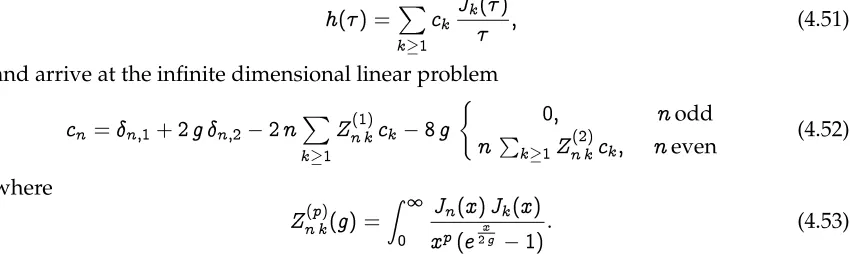
and arrive at the infinite dimensional linear problem
n
=Æ n;1
+2gÆ n;2
2n X
k 1 Z
(1) nk
k 8g
(
0; nodd
n P
k 1 Z
(2) nk
k
; neven
(4.52)
where
Z (p) nk
(g)= Z
1
0 J
n (x)J
k (x)
x p
(e x 2g
1)
: (4.53)
As in [26, 27] we can truncate this equation setting k
=0fork>N. The solution should be reliable forg .N. We considered2 <g <30andN =50. The best fit to the leading term inf(g)gives
f(g) =g+subleading; (4.54)
=4:000(1): (4.55)
5. Conclusions
In this paper, we have considered several properties of the quantum string Bethe equa-tions in thesl(2)sector with the leading strong coupling dressing,i.e. the AFS phase. We have performed a numerical investigation of the equations showing that their analysis is quite feasible. As an interesting result, we have repeated the calculation of the GKP limit of the anomalous dimensions as for the highest excited states in the compact rank-1 subsectorssu(2)andsu(1j1). Also, we have been able to observe the setting of the BMN scaling regime by reproducing the plane wave energy formula at fixed spin and large twist. In the case of the long string regime, we have been able to provide numerical ev-idences for a scaling function exhibiting an early strong coupling behavior as expected from the numerical solution of the BES equation.
Motivated by these results, we have analyzed analytically and perturbatively at strong coupling an almost trivially modified version of the BES equation with the very simple strong coupling dressing [17]. In particular, we have proved that this equation admits, as it should, a unique solution for the asymptotic Bethe root (Fourier transformed) density in full agreement with existing results.
While this work was under completion, the paper [45] presented an analysis partially overlapping with our results. That paper derives an integral equation for the Bethe root density taking into account the dressing at strong coupling and is based on a novel integral representation of the dressing kernel. We hope that the two alternative approaches will turn out to be useful in computing the one-loop string correction to the large g scaling function. Indeed, this interesting contribution has been checked numerically in [26] but it still evades an analytical confirmation.
Hopefully, these various efforts might give insight on the general structure of the dressing phase as well as on the role of the asymptotic Bethe equations in an exact de-scription of the planar spectrum [46]. Significative studies about finite size effects [47] and corrections that arise in a finite volume to the magnon dispersion relation at strong coupling [48], see also [49], as well as the recent observation [50] that the dressing phase could originate from the elimination of ”novel” Bethe roots, strongly demand a deeper understanding.
Acknowledgments
We thank D. Serban and M. Staudacher for very useful discussions and comments. M. B. also thanks G. Marchesini for conversations about the properties of twist-2 anomalous dimensions at finite spinS. The work of V. F. is supported in part by the PRIN project 2005-24045 ”Symmetries of the Universe and of the Fundamental Interactions” and by DFG Sonderforschungsbereich 647 ”Raum-Zeit-Materie”.
References
[2] Z. Bern, L. J. Dixon and V. A. Smirnov,Iteration of planar amplitudes in maximally
supersymmetric Yang-Mills theory at three loops and beyond, Phys. Rev. D72, 085001 (2005) [arXiv:hep-th/0505205].
[3] Z. Bern, J. S. Rozowsky and B. Yan,Two-loop four-gluon amplitudes in N = 4 super-Yang-Mills, Phys. Lett. B401, 273 (1997) [arXiv:hep-ph/9702424].
[4] G. Sterman and M. E. Tejeda-Yeomans,Multi-loop amplitudes and resummation, Phys. Lett. B 552, 48 (2003) [arXiv:hep-ph/0210130].
[5] D. J. Gross and F. Wilczek,Asymptotically Free Gauge Theories. 1Phys. Rev. D8(1973) 3633;
[6] H. Georgi and H. D. Politzer,Electroproduction Scaling In An Asymptotically Free Theory Of Strong Interactions, Phys. Rev. D9(1974) 416.
[7] F. A. Dolan and H. Osborn,Conformal four point functions and the operator product expansion, Nucl. Phys. B599(2001) 459, [arXiv:hep-th/0011040].
[8] A. V. Kotikov and L. N. Lipatov,DGLAP and BFKL equations in the N = 4 supersymmetric gauge theory, Nucl. Phys. B661(2003) 19; Erratum-ibid. B685(2004) 405,
[arXiv:hep-ph/0208220].
[9] A. V. Kotikov, L. N. Lipatov and V. N. Velizhanin,Anomalous dimensions of Wilson operators in N = 4 SYM theory, Phs. Lett. B557(2003) 114, [arXiv:hep-ph/0301021].
[10] S. Moch, J. A. M. Vermaseren and A. Vogt,The three-loop splitting functions in QCD: The non-singlet case, Nucl. Phys. B688(2004) 101, [arXiv:hep-ph/0403192].
[11] A. V. Kotikov, L. N. Lipatov, A. I. Onishchenko and V. N. Velizhanin,Three-loop universal anomalous dimension of the Wilson operators in N = 4 SUSY Yang-Mills model, Phys. Lett. B595 (2004) 521, [arXiv:hep-th/0404092].
[12] A. V. Kotikov, L. N. Lipatov, A. I. Onishchenko and V. N. Velizhanin,Three-loop universal anomalous dimension of the Wilson operators in N = 4 supersymmetric Yang-Mills theory, [arXiv:hep-th/0502015].
[13] B. Eden and M. Staudacher,Integrability and transcendentality, J. Stat. Mech.0611, P014 (2006) [arXiv:hep-th/0603157].
[14] N. Beisert and M. Staudacher,Long-range PSU(2,2—4) Bethe ansaetze for gauge theory and strings, Nucl. Phys. B727, 1 (2005) [arXiv:hep-th/0504190].
[15] N. Beisert, B. Eden and M. Staudacher,Transcendentality and crossing, J. Stat. Mech.0701, P021 (2007) [arXiv:hep-th/0610251].
[16] N. Beisert, R. Hernandez and E. Lopez,A crossing-symmetric phase for AdS(5) x S**5 strings, JHEP0611, 070 (2006) [arXiv:hep-th/0609044].
[17] G. Arutyunov, S. Frolov and M. Staudacher,Bethe ansatz for quantum strings, JHEP0410, 016 (2004) [arXiv:hep-th/0406256].
[18] N. Beisert and A. A. Tseytlin,On quantum corrections to spinning strings and Bethe equations, Phys. Lett. B629, 102 (2005) [arXiv:hep-th/0509084].
[19] R. Hernandez and E. Lopez,Quantum corrections to the string Bethe ansatz, JHEP0607, 004 (2006) [arXiv:hep-th/0603204].
[21] R. A. Janik,TheAdS 5
S 5
superstring worldsheet S-matrix and crossing symmetry, Phys. Rev. D73, 086006 (2006) [arXiv:hep-th/0603038].
[22] Z. Bern, M. Czakon, L. J. Dixon, D. A. Kosower and V. A. Smirnov,The four-loop planar amplitude and cusp anomalous dimension in maximally supersymmetric Yang-Mills theory, arXiv:hep-th/0610248.
[23] S. S. Gubser, I. R. Klebanov and A. M. Polyakov,A semi-classical limit of the gauge/string correspondence, Nucl. Phys. B636(2002) 99, [arXiv:hep-th/0204051].
[24] S. Frolov and A. A. Tseytlin,Semiclassical quantization of rotating superstring in AdS(5) x S(5) JHEP0206(2002) 007, [arXiv:hep-th/0204226].
[25] S. Frolov, A. Tirziu and A. A. Tseytlin,Logarithmic corrections to higher twist scaling at strong coupling from AdS/CFT, [arXiv:hep-th/0611269].
[26] M. K. Benna, S. Benvenuti, I. R. Klebanov and A. Scardicchio,A test of the AdS/CFT correspondence using high-spin operators, [arXiv:hep-th/0611135].
[27] L. F. Alday, G. Arutyunov, M. K. Benna, B. Eden and I. R. Klebanov,On the strong coupling scaling dimension of high spin operators, [arXiv:hep-th/0702028].
[28] M. Staudacher,The factorized S-matrix of CFT/AdS, JHEP0505, 054 (2005) [arXiv:hep-th/0412188].
[29] B. Eden,A two-loop test for the factorised S-matrix of planar N = 4, Nucl. Phys. B738, 409 (2006) [arXiv:hep-th/0501234].
[30] B. I. Zwiebel,N = 4 SYM to two loops: Compact expressions for the non-compact symmetry algebra of the su(1,1—2) sector, JHEP0602, 055 (2006) [arXiv:hep-th/0511109].
[31] L. N. Lipatov,Transcendentality and Eden-Staudacher equation, Talk at Workshop on Integrability in Gauge and String Theory, AEI, Potsdam, Germany, July 24-28, 2006,
http://int06.aei.mpg.de/presentations/lipatov.pdf.
[32] A. V. Belitsky, A. S. Gorsky and G. P. Korchemsky,Logarithmic scaling in gauge / string correspondence, Nucl. Phys. B748, 24 (2006) [arXiv:hep-th/0601112].
[33] N. Beisert and T. Klose,Long-range gl(n) integrable spin chains and plane-wave matrix theory, J. Stat. Mech.0607, P006 (2006) [arXiv:hep-th/0510124].
[34] N. Beisert, V. Dippel and M. Staudacher,A novel long range spin chain and planar N = 4 super Yang-Mills, JHEP0407, 075 (2004) [arXiv:hep-th/0405001].
[35] S. A. Frolov, R. Roiban and A. A. Tseytlin, “Gauge - string duality for superconformal deformations of N = 4 super Yang-Mills theory,” JHEP0507, 045 (2005)
[arXiv:hep-th/0503192].
[36] N. Beisert and R. Roiban, “The Bethe ansatz for Z(S) orbifolds of N = 4 super Yang-Mills theory,” JHEP0511, 037 (2005) [arXiv:hep-th/0510209].
[37] D. Astolfi, V. Forini, G. Grignani and G. W. Semenoff, “Finite size corrections and integrability of N = 2 SYM and DLCQ strings on a pp-wave,” JHEP0609, 056 (2006) [arXiv:hep-th/0606193].
[39] A. V. Kotikov and L. N. Lipatov,On the highest transcendentality in N = 4 SUSY, [arXiv:hep-th/0611204].
[40] D. Berenstein, J. M. Maldacena and H. Nastase,Strings in flat space and pp waves from N = 4 super Yang Mills, JHEP0204, 013 (2002) [arXiv:hep-th/0202021].
[41] M. Beccaria and L. Del Debbio,Bethe Ansatz solutions for highest states in N = 4 SYM and AdS/CFT duality, JHEP0609, 025 (2006) [arXiv:hep-th/0607236].
[42] M. Beccaria, G. F. De Angelis, L. Del Debbio and M. Picariello,Highest states in light-cone AdS(5) x S**5 superstring, arXiv:hep-th/0701167.
[43]
[43] G. P. Korchemsky,Quasiclassical QCD pomeron, Nucl. Phys. B462, 333 (1996) [arXiv:hep-th/9508025].
[44] S. S. Gubser, I. R. Klebanov and A. M. Polyakov,Gauge theory correlators from non-critical string theory, Phys. Lett. B428, 105 (1998) [arXiv:hep-th/9802109].
[45] I. Kostov, D. Serban and D. Volin,Strong coupling limit of Bethe Ansatz equations, arXiv:hep-th/0703031.
[46] S. Schafer-Nameki, M. Zamaklar and K. Zarembo, “How accurate is the quantum string Bethe ansatz?,” JHEP0612, 020 (2006) [arXiv:hep-th/0610250].
[47] J. Ambjorn, R. A. Janik and C. Kristjansen, “Wrapping interactions and a new source of corrections to the spin-chain / string duality,” Nucl. Phys. B736, 288 (2006)
[arXiv:hep-th/0510171].
[48] G. Arutyunov, S. Frolov and M. Zamaklar, “Finite-size effects from giant magnons,” arXiv:hep-th/0606126.
[49] D. Astolfi, V. Forini, G. Grignani and G. W. Semenoff, “Gauge invariant finite size spectrum of the giant magnon,” arXiv:hep-th/0702043.
0.01 1 100 10000 g
0.0 0.5 1.0 1.5 2.0
g
1/2
p k
2000 4000 6000 8000 10000 g
0 500 1000 1500 2000 2500
E
0.01 1 100 10000 g
0.1 1 10 100
E - (2S)
1/2
λ
1/4
+ L + S
L = 2
[image:22.612.95.494.79.365.2]S = 20
Figure 1:Numerical solution in the short-GKP limit,i.e. atL;S fixed and increasingg. We show
theg 1=2
behaviour of the Bethe momenta, the computed energy with itsg 1=2
0 10 20 30 40 50
λ / L2 0
5 10 15 20 25
E L, S
S = 4
[image:23.612.98.494.80.383.2]L = 10
L = 100
Figure 2:Short-BMN limit. Convergence to the BMN limit atL;!1with=L
0 10 20 30 40 50
λ / L2 0
10 20 30 40 50
E L, S
S = 4 S = 6 S = 8
S [(1+λ / L2)1/2-1]
L = 10
4 [image:24.612.96.498.82.373.2].
Figure 3:Short-BMN limit. Check of the semiclassical string predictionE
string
=L+S p
1+=L 2
. We plot the quantum partE
0 0.5 1 1.5 2 2.5 g
0 5 10 15 20 25 30
E L, S
L = 6
S = 60
[image:25.612.97.497.81.372.2]S = 10
Figure 4:Long string limit. Logarithmic spin-dependence of the energy at fixedgand increasing
0 0.5 1 1.5 2 2.5 g
1 1.5 2 2.5 3 3.5 4 4.5
derivative of f(g)
[image:26.612.97.497.82.386.2](18-40) (18-50) (18-60) 4 twist L=6