
The application of the product development process in the development of architectural products : a thesis presented in partial fulfillment of the requirements of the degree of Master of Technology in Product Development at Massey University
114
0
0
Full text
(2) The Application of the Product Development Process in the Development of Architectural Products. MASSEV UNIVERSITY. A thesis presented in partial fulfillment of the requirements of the Degree of Master of Technology in Product Development at Massey University. Natasha Perkins 1997.
(3) The Application of the Product Development Process in the Development of Architectural Products. Abstract. Historically, methodologies in architecture and product development have differed with one based in art, the other in industry but their similarities are bringing them together. This research compares the Product Design, Product Development Process and Architectural Design Methodologies, showing the differences between them and how they are developing to common structures. Architectural design in the 1990s is presented as a multi-disciplinary solution for complex building systems, including purpose built products, and examples of European architectural firms who develop products with manufacturers are presented.. Opportunity exists in New Zealand for product development to be utilised in architectural projects. A project investigated the design, development and production of an architectural product in New Zealand, where a combined Product Design and Development Process was integrated with Architectural Design. This was the design and development of a trolley system for the new Palmerston North Library.. The Product Development and Architectural Processes need to be interrelated for a total design approach in development projects to produce and market products. This requires a greater emphasis on the inclusion of end user involvement in the building up of ideas and evaluation procedures throughout the development process. Also needed. is a better. understanding of manufacturing processes. and. product. development. This integration of the Product Development Process including final marketing with architectural design can be achieved by forming multi-disciplinary teams or networking with other professionals for example manufacturing engineers and consumer researchers. This integration should produce marketable products. The research concludes that Product Development is an effective method for designing architectural products in New Zealand for the local market and for export..
(4) ii. Acknowledgements. Thanks must be given to all those people involved in the practical section of this study. These include the Head Librarian and librarians at the Palmerston North Public Library, the Athfield Architects team, and the manufacturers of the prototypes.. Funding for the research was met by the Department of Consumer Technology,. Massey. University. and. Athfield. Architects. Limited,. Wellington.. I should like to thank Professor Peter Robertson of the Consumer Technology. Department for the invaluable guidance. he. provided. throughout this study.. A special mention and thanks goes out to Professor Mary D. Earle for her knowledge of Product Development and academic support.. Similarly, Erik Greenslade and Helen Rayner also provided much guidance, listening power and constructive criticism in the development of the thesis. Thank you Helen - the best study partner, librarian and fellow Taurian.. Special mention goes to Clare and Ian Athfield, Carolyn Stevens and Allan Brown, for their commitment to design and development, and who know what it is all about in the real world.. A big shout out to all my other friends for your discussion and support Cheers. Finally, I would like to give thanks to my parents, my partner Banse, Hamish and Michelle for their support and encouragement throughout my academic endeavours..
(5) iii. Table of Contents Abstract Acknowledgements. ii. Table of Contents. iii. List of Figures. vi. List of Tables. vi. Introduction Chapter One The Development Of Architectural Design And. 6. Product Development Processes . How to design for a changing world. 6. Design and Design Methodology Definitions. 7. Growth , Development and Application of Design Methods. 8. Systematic methods. 8. Des igner Behaviour. I0. Heuristic Methods. 12. Reflective Practitioner. 14. Other Design Methods. IS. Architectural Plan of Work. 17. Product Design. 18. Management of the Design Process. 19. The Product Development Process. 20. Comparison of Architectural Design, Product Design and the Product. 22. Development Process Analysis and Critique. 25. Chapter Two Product Development In Architectural Design. 27. Towards Industrialised Building Methods. 27. Foster and Rogers Development of Products in Architecture. 30. Philosophy and Working Methods. 31. Design of Furniture in a Building System. 34. - Use of Manufacturing Methods. 34. Evolutionary Development of Furniture. 36.
(6) iv - Design for Manufacture. 38. Integrated Teams. 42. Total Design Approach. Chapter Three Product Development In A New Zealand. 43. 47. Architectural Project Introduction. 47. Aim and Objectives. 48. The Product Development Process. 49 50. . Planning. 50. Research Standard Book Trolley. 50. - Technical Information. 51. - User Feedback. 52. New Trolley System. 53. - Technical Information/Requirements. 53. - User Investigation. 54. Market information. 55. Design Specification. 55. Design Investigation. 57. Design Philosophy. 57. Initial sketch discussions. 58. Feedback on Concept Sketches. 58. Design Development. 59. Mock-ups. 59. Testing. 60. - The Testing of Prototypes with Users. 60. - Evaluation with specific users. 61. - Technical Evaluation. 61. - Testing of the Trolley with the Public. 62. - Public feedback results. 62. Production Development. 63. Evaluation of the Project. 64. Project Costs. 64. Timeline of Project. 65. - Relationship to original time frame. 66. Final Design. 66.
(7) v. Future Work and Promotion. 67. Conclusions. 68. Chapter Four Discussion And Conclusions. 69. Discussion. 69. People Involved in the Design and Buying Process. 70. Budget and time constraints. 72. Process for Product Design in the Architectural Environment. 73. Inclusion of the Product Development Process into a Building. 75. Program Problems and Barriers to the Product Development Process in. 77. the Architectural Environment. Future Production and Promotion. 78. - Marketing. 78. - Ownership. 79. New Zealand Context. 80. Conclusions. 81. Recommendation Section. 82. References Bibliography Appendices A. Design Brief. B. Gantt Chart. C. Technical User Feedback on Standard Book Trolley. D. Technical User Feedback on Concepts: Trolleys - Designs and Suggested Numbers. E. Technical Evaluation Memorandum from P.N.C.C. Library. F. Feedback Form.
(8) vi. List of Figures. figure I. An iconic model of a design process.. 9. figure 2. Archer's design process ( 1963).. 10. figure 3. The Markus/Maver design process incorporating decision sequence.. 12. figure 4. Schon's reflection-in-action summary of paradigms.. 14. figure 5. Royal Institute of British Architects Plan of Work ( 1966). 17. figure 6. Idealized Product Evolution - British Standard 7000.. 19. figure 7. Cooper's ( 1983) seven stage new product process.. 21. figure 8. The Walking City in New York, by Ron Herron ( 1964). 28. figure 9. Model development for casting. Richard Rogers + Partners.. 32. figure 10 Interior view showing various chairs and the signage system. 35. figure 11 Seating for Centre Pompidou.. 36. figure 12 Nomos evolution Stage I. drawing board design for the Foster office.. 37. figure 13 Nomos evolution Stage 2. the Renault Building reception desk.. 38. figure 14 Nomos furniture . Casting system for leg detail.. 39. figure I 5 Nomos desk - initial sketch and finished product. 39. figure 16 Nomos furniture - mock-up and ergonomic development.. 40. figure 17 Nomos furniture - Development of the foot detail.. 41. figure 18 Nomos furniture - Factory mock-up testing of designs for storage.. 41. figure 19 Evolutionary development of a library trolley system .. 47. figure 20 Standard book trolley design project for the Wellington Public Library. SI. figure 21. 58. Conceptual discussion sketches for trolleys. figure 22 Concept presentation sketches of the technical and display trolleys.. 59. figure 23 Mock-up sketches of the display trolley for communication with. 60. manufacturer. figure 24 Drawing with recorded changes from technical evaluation.. 61. figure 25 Mock-up positioned in existing library for evaluation.. 62. figure 26 Standard book and display trolleys.. 66. figure 27 A member of the public working at the technical trolley in the new library. 67 figure 28 Co-ordination and relationships between parties.. 71. figure 29 Architectural product development process.. 74. figure 30 Inclusion of a product development project into a building. program.. 76.
(9) vii. List of Tables table I. Similarities and differences in the Architectural and Product Design, and. 24. the Product Development Processes. table 2. The product development process for the new trolley system for the. 49. P.N.C.C. library. table 3. Timeline of project and construction of library.. 65.
(10) Introduction. In a society changing continually with technology as an active ingredient, environments are required to be flexible and interactive. The main drive for this has been the transfer from an industrial age through an electronic revolution to what is termed the 'Second Machine Age' (also known as the Information Age). Just as the robot has revolutionised the processes of production, the computer has altered the way most of the western world operates. The First Machine Age meant struggling to reconcile the art and craft of architecture with the new machinery of industrial production. Most early Modernists were concerned mainly with the new style rather than understanding industrialised production methods.. The Second Machine Age can be associated with the introduction of the television, but more so of the computer. The microprocessor has allowed modern industry to provide benefits for the masses especially in the areas of consumer goods, automobiles, and communications, by flexible mass-production lines. Buildings of the Second Machine Age are complex systems that contain complex subsystems made of many mass produced products such as ducting, electrical, heating and computer controlled lighting systems. These truly 'smart buildings' are technology based and require a multi-disciplinary approach in their creation.. The methodologies of architecture and product development have differed, but despite this, architectural practices often design products for their buildings. Some of the reasons for this include: a complete design service to the client; control of service and design; the.
(11) 2. unavailability of the required goods; local production quota restrictions; budget; lead times; and monetary gains.. In public and commercial spaces, products such as lighting, furniture, shelving and carpets have substantial budgets and involve a large proportion of the research and development in their production, but are typically designed on a job-by-job basis. In this situation, many practices fail to realise the potential in design for sustainable manufacture, and produce 'one off designs that ideally should be, or could be mass produced. However, there are several architectural firms that design and produce one-offs for a particular job that then become mainstream products. They achieve this through the use of multi-disciplinary teams , and a structured research and. development. programme. with. a. manufacturer.. This thesis investigates why and how the Product Development process could be utilised in the development of architectural products. Chapter One studies the historical development of product development and architectural and product design.. Product Development is part of a company's business strategy to launch new. and. improved. products. onto. the. market.. The. Product. Development Process is a multi-disciplined co-ordinated project that is undertaken to meet the company's strategic goals including marketing, business and technology plans. Product Design forms part of this project and consists of the product design specification (or 'product concept') development through to the.
(12) 3. testing of the final. prototype. Professionals,. namely product and. industrial designers, model-makers, technologists and engineers are closely involved in the total project and consider the consumer as well as the manufacturing requirements in the Design Process.. Architectural Product Design encompasses the design and development of products for architectural environments. These products may be developments in building materials and finishes, or any item in an interior. In this context architectural products offer a large area of potential for product and industrial designers to exploit,. using a. structured development process. This is especially the case in New Zealand where:. overseas lead times can be extremely long;. quotas 1. exist for public and government interiors; architects specify overseas products because they regard New Zealand made products substandard. This country has the primary resources and skill base to produce value added architectural products.. There is a need to compare Product Design and Architectural Methods to see if they can be integrated for use in an architectural context for a total design approach . Cooper( 1983) reviewed the uptake of the Product Development Process and its success within the manufacturing sector, but within architecture there has been little research to date. Abel( 1986) in Ditching the dinosaur sanctuary suggested architects become more aware of industrial design practices and manufacturing processes.. 1. A quota of 70% New Zealand content exists for publicly funded projects. This is to limit. import of product and give local firms an opportunity..
(13) 4. Within the Architectural industry there are very few examples of firms who have Research and Development programmes in place as part of their strategic goals. The architectural practices of Norman Foster and Associates, and Richard Rogers + Partners are the major exceptions. They employ industrial and product designers, other specialists when required, and work closely with engineers and manufacturers to develop products. Examples of their product work is presented and discussed in Chapter Two.. The design and development of a library trolley system was selected as a project to validate Architectural projects using product development methods in practice within New Zealand. This project was undertaken by the researcher,. in. conjunction. with,. Athfield. Architects. of. Wellington, for the Palmerston North City Council library, and was completed in May I 996.. The objectives for this thesis were: • To compare Architectural, Product Design and Product Development Methodologies. • To investigate the historical development and compare the differences between the Product Development Process and Architectural Design Methodologies. • To study architectural firms that have integrated development methods within their Architectural methodology and design philosophy. • To undertake an integrated method of product development for an architectural product within an architectural environment in New Zealand by:.
(14) 5. -Recording the actual process used in the development process and; -Recording the decision making process and ascertain how it affects the development process. •To investigate and confirm that a systematic and structured process can be overlaid on the architectural design process with a user focus.. It must be noted that the aim was not to come up with a new methodology: but to prove that an understanding of the processes and their manipulation, can lead to more efficient building projects, as well as successful commercial products. No attempt is made in this paper to define "good design" as the work presented is concerned with the theory of navigating towards a final product rather than with the merit of that product, although it should be stated that an efficient process should lead to a better end product. The mere fact that the firms presented in Chapter Two have produced key buildings in Europe and have won countless awards for their work, perhaps is an indication that their process and philosophies are on the road to providing society with more efficient and customer orientated environments and the building industry with a progressive project method..
(15) 6. Chapter One. The Development of Architectural Product Design and Product Development Processes This chapter introduces an overview of the historical development of design methods as a discipline. The central issues in this research focused on design in architecture, engineering, and product development. Design management is also broadly discussed.. How to Design for a Changing World Design research literature began seriously in the late nineteen fifties and sixties as designers and educationalists started to inquire more into the process of design itself rather, than the end product. Design methods theory draws from many diverse schools of thought such as: architecture, engineering, mathematics, operations research, philosophy, management science, behaviorism, psychology, sociology, and personal beliefs.. Jones ( 1970) outlined that the appearance in the sixties of the 'design methods movement' sought to systemize the current subjective methods into a more objective and open design process. It was a reaction to the craft-based approach to design, namely the trial-and-error and the evolution methods, then the design-by-drawing method which allowed for the division of labour in the production of products. This design-bydrawing method was viewed by design theorists to be too simple for the growing complexity of the man-made world. Society had the right to expect designer's to be "accountable" and responsible for the process they used because of the wide ranging effects of their end products in a technological society (Lawson, 1991 ). Therefore the subjective process became objective and systematic as designing become more difficult in a rapidly changing technological world. The number of new materials, variation in manufacturing methods, performance of the finished article,.
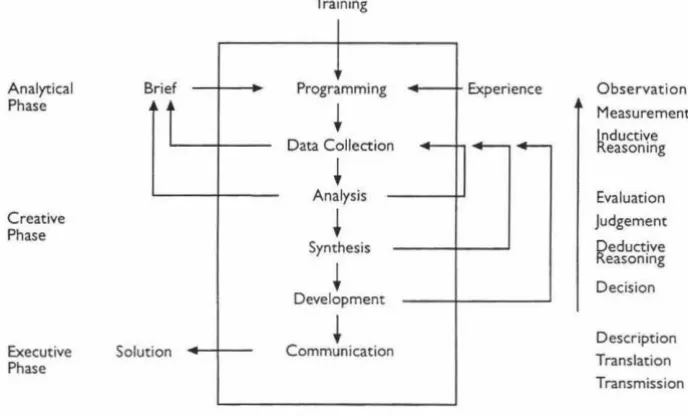
(16) 7. high costs of design errors, and product liability have all combined to increase the complexity of the designer's role.. Grant ( 1986, p.390), suggested another ingredient for the move to systematic methods was the long list of scientific breakthroughs such as DNA and nuclear fission occurring at the time. These changed the whole situation in which we lived, and "the fashion in modes of thought". Grant also cited the emerging use of the computer for manipulation of quantifiable data as a factor in the systematic movement.. The common aim of the methods at this time was that all the methods are attempts to make public the hitherto private thinking of designers; to externalize the design process and to provide a more manageable process, particularly at the systems level. An advantage of this is that other people, such. as users,. can understand. and participate. by. contributing "information and insights that are outside the designer's knowledge and experience" Uones, 1970, p.45).. Design and Design Methodology Definitions Cross ( 1984), broadly described Design Methodology as the principles, practices and procedures of design. The definition of designing varies among writers, depending on their background, but a common thread is the "creation of something new that did not exist previously" (Roy 1972, p.5). Luckman ( 1984, p.84) insisted that some creativity or originality must enter into the process for it to be called design. If the alternative solutions can be written down by strict calculation, then the process that has taken place is not design. Roy ( 1972), also suggested the word design means "purpose or plan" as does the Oxford English Dictionary.. Perhaps the most apt definition was delivered by Jones ( 1970) after studying a variety of definitions by Alexander ( 1963), Archer ( 1965), and others in the field between 1962 and 1968, he concluded that the effect of.
(17) 8. designing is to "initiate change in man-made things" Oones, 1970, p.4). Thus it includes not only the actions of design professionals (architects, engineers, industrial designer) but also town planners, legislators, applied researchers, managers, politicians, and pressure groups in their attempts to change cities, laws, public services, buildings, opinions, products, markets, and so on.. Cross concluded that design methodology as a discipline includes the study of how designers work and think; the establishment of an appropriate structure for the design process; the development and application of new design methods, techniques, and procedures; and reflection of the nature and extent of design knowledge and its application to design problems (Cross, 1984, p.vii).. Growth, Development and Application of Design Methods This section outlines the development of design methods from the early 1960s of the systematic and rational (I st. generation) procedures to designer behaviour, then the heuristic movement also termed holistic design or second generation. The reflective practitioner era which consisted of a reflection-in-action approach is investigated, and finally a summery of other design methods such as systems approaches, statistical models and computer-aided design are discussed.. Systematic Methods Cross ( 1984) outlined in the introduction to Developments in Design. Methodology, that in the early 1960s, theorists were primarily concerned with the development of systematic procedures: in which attempts were made to restructure the design process based on the new methods of problem solving, management, and operational research, which had been developed in World War II and the 1950s. Design in these 'first generation' methods as they were also termed, was viewed as a rational.
(18) 9. process. Of this era the best known examples according to Broadbent ( 1979) are Asimow. ( 1962), Jones. ( 1963), Archer. ( 1963/4). and. Alexander' ( 1964). Figure I shows an Iconic Model of a design process as presented in Rowe ( 1987) - proposed by Mesarovic 1964 and Watts 1966, that is congruent with the Asimow model ( 1962).. ~. A. .---. C ommunicat ion. E. --... ......... s. Concrete. :.->. E. Abstract. (Host Enviroment}. A nalysis -. figure I.. Synthesis -. Evaluation -. C ommunication. An iconic model of a design process.. The horizontal sequence is represented as a cycle that begins with analysis, proceeds through synthesis and evaluation to communication. Asimow viewed the cycle as an iterative cycle between and within the various phases of activity. Analysis is defined as the ordering and structuring of a problem and involves: the exploration of relationships; forming patterns in the information available; and the classification of objectives. Synthesis is the generating of solutions; an attempt to create a response to the problem.. 1. Alexander's seminal book Notes on the Synthesis of Form appeared in 1964..
(19) 10. Evaluation involves critical analysis of suggested solutions against the objective formulated. in the analysis. phase. Lawson. ( 1991 ). The. disbursement of information so that tasks can be undertaken is the communication component.. Archer's ( 1963/64) design process model is schematically represented in figure 2 as shown in Rowe. Th ree interrelated realms for the process: ex ternal representation; process of activities; and the problem so lver, along with more pronounced feedback loops distinguish it from previous models, although it is from the behavioural realm (Rowe 1987). Training. Analytical Phase. Brief. Programming. +. Data Collection. +. Creat ive Phase. l nducti'~e. Reason mg Evaluation. +. Judgement. +. Decision. Synthesis. Solution. Obser vation Measurement. Analysis. Development. Executive Phase. Experience. +. Communication. Deductive Reasoning. Description Translation Transmission. figure 2 Archer's design process ( 1963). Designer Behaviour It was then realized that design problems could not be totally solved through systematization and therefore attention turned to the illstructured nature of design problems, this occurred from the period 1966-73. This period tried to understand and describe the complexity of problems, and centered around the investigation of designer behaviour through controlled laboratory ex periments to open-ended interviews. The aim was to develop a greater understanding of how designers resolve.
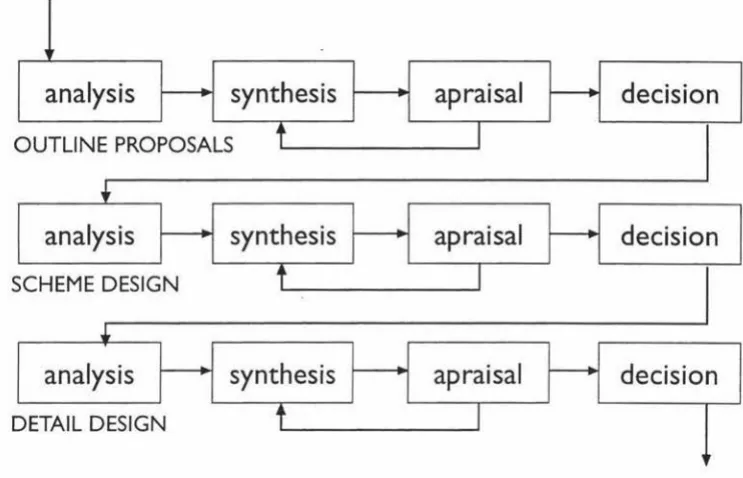
(20) 11. complex problems. Simon ( 1969) introduced problem solving theories that provided a framework for this type of study within the paradigm of technical rationality.. Heath ( 1984) pointed out this was an active period for design research in terms of conferences and publications. The Birmingham symposium, subsequently published as The Design Method (Gregory, 1966) occurred in 1965. in 1968 the Portsmouth conference in England addressed design methods in Architecture (Broadbent and Ward, 1969), and also the American Design Methods Group held its first international conference at Cambridge, Massachusetts (Moore, 1970).. Christopher Jones produced a critical review of all research activity up to 1970 in his Design Methods - Seeds of Human Futures Oones, 1970), and Broadbent ( 1973) produced a similar review for architecture in his Design. in Architecture. Markus ( 1969) and Maver ( 1970) developed maps of designing based on the RIBA 2 plan of work of the design process which consisted of four phases: assimilation; general study; development; communication: with feed-back loops between the first three elements. In the model shown in figure 3 where they insisted that a complete representation of design requires decision sequence as well as a design process. They suggested the need to progress through the decision sequence of analysis, synthesis, appraisal, and decision at increasing levels of the detail in the design process.. 2. R.1.8.A - Royal Institute of British Architects..
(21) 12. ,, analysis r----- synthesis OUTLINE PROPOSALS. r--. t. apraisal. I. -. decision. ~. decision. -. decision. . analysis. r----- synthesis. t. sCHEME DESIGN. . analysis. -. ~. synthesis. DETAIL DESIGN. t. apraisal. I. -. apraisal. I. figure 3. The Markus/Maver design process incorporating decision sequence.. From 1972 onwards a more fundamental and philosophical approach emerged which drew upon the knowledge and lessons learned in the first decade of design methodology.. Heuristic Methods In 1972 Rittel, Protzen, and Grant presented what they considered a new direction or "second generation" in design methods. The intention was to extend the scope of method to ill-constrained or what Rittel coined "wicked" problems. Second-generation methods are heuristic 3 search processes, which make use of hypotheses and the information that the testing of each successive hypothesis generates to limit the subsequent field of search (Heath, 1984, p.128). Rittel ( 1972) and Broadbent ( 1979) observed that successful design methodologies must be more open,. 3. Perkins defines a heuristic as "a rule of thumb that often helps in solving a certain class of. problems" (Perkins 1981, p 192)..
(22) 13. flexible, and iterative than the rigid first generation systematic methods allow.. Rittel's methods include argument and debate, since they admit that part of the problem in design lies in deciding what ought to be done. Other characteristics which distinguish them from those of the first generation are:. augmented. problem. space,. where. designs. are. subsets. or. consequences of broader issues; "symmetry of ignorance" where both sides have essential knowledge, a logical argument for using participatory methods;. transparency of decision making and arguments used, which. equates with Jones ( 1970) "glass box" methods; objectification in that the process is. recorded; delegation of judgment to the designer. be. understood and agreed; and the "conspiracy model, of planning" where designers and users bring about first agreement and then action. All these characteristics evoke an interactive rather than a reactive model of the design process (Heath, 1984).. How Designers Think (Lawson, 1991) presented the empirical and protocol experiments of Drake ( 1978) and Lawson ( 1972, 1979) and later Rowe ( 1987) that explored the subtleties about design as it is actually practiced. These protocols show how designers explored the problem through a series of attempts to create solutions. As Rowe ( 1987) reported " ... several distinct lines of reasoning can be identified, often involving the a. priori use of an organizing principle or model to direct the decision making process". The results showed also that there is a very close or inseparable relation between analysis and synthesis as opposed to earlier step by step methods such as the RIBA Plan of Work (1966). (Lawson 1991, p.33) states Akin ( 1986) found that "designers were constantly both generating new goals and redefining constraints"..
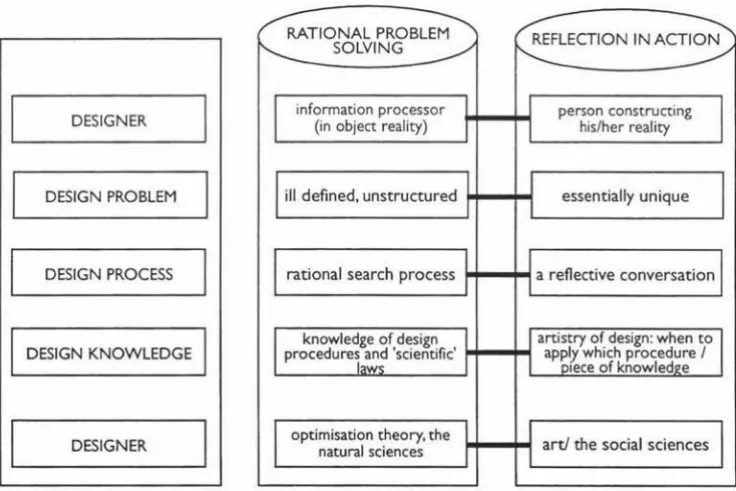
(23) 14. Reflective Practitioner. Dorst and Dijkhuis ( 1995) outlined how Schon ( 1983) reacted to the rational problem solving approach which had been the dominant doctrine in. prescriptive. and descriptive. design. methodologies. since. their. conception. Schon proposed "a new theory of design" by describing design as a process of "reflection-in-action" which addresses some of the shortcomings he perceived in mainstream methodology, namely in the training of practitioners. This includes generalities about design problems and design processes without a concrete linkage between the two. He stated a core skill of designers lies in determining how every problem should be tackled which has always been left to the "professional knowledge" of experienced designers. Schon refers to this as "the artistry" of design practice. Thus these problems cannot be described in the prevalent analytical approaches, and their solving cannot be taught.. DESIGNER. RATIONAL PROBLEM SOLVING. REFLECTION IN ACTION. information processor (in object reality). person constructing his/her reality. essentially unique. DESIGN PROBLEM. DESIGN PROCESS. DESIGN KNOWLEDGE. DESIGNER. knowledge of design artistry of design: when to procedures and 'scientific' io+-...,.""4 apply which procedure I 1ece of knowled e. optimisation theory, the natural sciences. art/ the social sciences. figure 4. Schon's reflection-in-action summary of paradigms..
(24) 15. Schon's alternative was based on human. perception and thought. processes where he viewed design as a "reflective conversation with the situation". Problems are actively "framed" by designers, who make "moves", and evaluate these, improving the perceived current situation. Dorst and Dijkhuis ( 1995) presented a summary of the rational problem solving, and Schon's reflection-in-action paradigms, as can be seen in figure 4.. Other Design Methods It can be seen from the literature presented that the "science" of design is primarily based on models derived from theories from the logicalempirical sciences where methodologies are based on problem solving, analysis, synthesis, and evaluation, and models viewed as a mathematical problem that can be solved by prescribed logical steps. Other approaches or models in the areas of "design science" worth mentioning are: systems approaches to urban planning, design-related issues in manenvironment studies. relying. on. statistical. models. based. around. behavioural science. Computer-aided design (CAD) research responds to models derived from mathematics, logic, language theory and cognitive science.. The extension of these, particularly language theory and. cognitive science is artificial intelligence. Which enters the realms of expert systems, rule based systems, prototypes and machine learning. (Snodgrass and Coyne, 1992).. Snodgrass and Coyne ( 1992) presented the case that "models are metaphors." Therefore the "semantic" and "disclosive" functions are not founded on their logical structures but convey their meaning via metaphors by way of a hermeneutical 4 understanding. By contrast to scientific models, models based on hermeneutical understanding are capable of providing "felicitous translations of designing as they are 4. The science of interpretation - including the paradox described by Hirsch (1967, p.259) as "that we cannot perceive the meaning of a part until we have grasped the meaning of a whole" and vice versa..
(25) 16. directly experienced by designers" Snodgrass and Coyne ( 1992 p.56 ). Hermeneutical understanding in architecture, "requires intelligibility on the part of the overall organisation and composition of the work and on the part of its surfaces, framing devices, material, and decoration." Rowe ( 1987, p.195).. Cross ( 1984, p.ix) concluded "that the movement has progressed through four stages: prescription of an ideal design process; description of the intrinsic nature of design problems, observation of the reality of design activity and reflection on the fundamental concepts of design".. In. summary, Systematic or first generation methods leaned towards a industrial design orientation whereas heuristic or second generation methods tried to address the complex issues of town planning and architecture. There is a void between theory and practice with many problems relating to the use of systematic methods and reactions from other theorists,. designers,. and end. users.. The. key factors. for. professionals not taking on board the methods include: the methods are hard to use and absorb into practice; the knowledge required is too specific; and terminology used differs from theorist to theorist. It should be mentioned here that computers are still only used as tools to aid drawing and documentation although research is progressing in the area of artificial intelligence. The study of practitioners, as well as method, is advocated by many to understand and aid designers, rather than straight jacketing them with methods they do not use.. It can be seen from the review that the theory of processes cross over from one discipline to another and causes some confusion with the terminology used. Although the processes seem abstract and therefore quite generic, the professionals who work in each field have different specialist skills and knowledge to carry out their respective jobs such as: engineers designing bridges or a plastic injection tool; architects designing buildings and/or houses; and an industrial designer designing furniture or mobile phones. The specific processes for different disciplines including:.
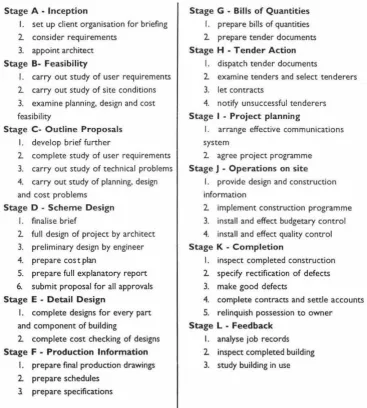
(26) 17. The RIBA Plan of Work (1966); the British Standard 7000 - a guide to managing product design ( 1989); and Cooper's Product Development Process ( 1983), are presented and compared in the following section. The processes have been chosen for acceptance into their aligning professions.. Architectural plan of work Taking the model Plan. of Work. published by the Royal Institute of British. Architects ( 1966) as a basis, the normative process that architects follow in the program for a building is shown in figure 5.. Stage A • Inception. Stage G - Bills of Quantities. I. set up client organisation for briefing. I. prepare bills of quantities. 2. 2. consider requirements. 3. appoint architect. Stage B- Feasibility I. carry out study of user requirements 2. carry out study of s ite conditions. 3. examine planning, design and cost feasibility. Stage C- Outline Proposals. prepare tender documents. Stage H • Tender Action I. dispatch tender documents 2. examine tenders and select tenderers. 3. let contracts 4. notify unsuccessful tenderers. Stage I • Project planning I.. arrange effective communications. I. develop brief further. system. 2. 2. complete study of user requirements. 3. carry out study of technical problems 4. carry out study of planning, design and cost problems. Stage D - Scheme Design I. finalise brief 2. full design of project by architect. 3. preliminary design by engineer. agree project programme. Stage J • Operations on site I. provide design and construction information 2. implement construction programme. 3. install and effect budgetary control 4. install and effect quality control. Stage K - Completion. 4. prepare cost plan. I. inspect completed construction. 5. prepare full explanatory report. 2. 6.. 3. make good defects. submit proposal for all approvals. Stage E - Detail Design I. complete designs for every part and component of building 2. complete cost checking of designs. Stage F - Production Information I. prepare final production drawings 2. prepare schedules. 3. prepare specifications. specify rectification of defects. 4. complete contracts and settle accounts 5. relinquish possession to owner. Stage L - Feedback I. analyse job records 2. inspect completed building. 3. study building in use. figure S. Royal Institute of British Architects Plan of Work ( 1966)..
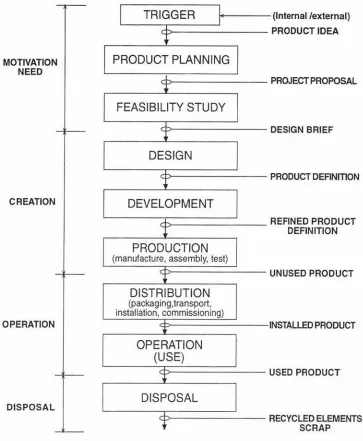
(27) 18. Product Design Product design is a creative and complex process which involves the integration of specialist skills and knowledge bases, including such as the skill base of industrial designers and engineers. Slappendel ( 1996) stated that Flurscheim when explaining that the industrial design specialism generally embraces aesthetics, ergonomics, graphic techniques. and. provides tools that can assist in the specification of what is needed by the market, and in the design of the human/machine interface. Slappendel adds that Moody ( 1984) stated that with the integration of the Industrial Design techniques, some of the omissions of engineering design can be rectified. Efficient product design and manufacture requires the integration of components so as to meet the highest possible performance specification for. the. whole.. In. reference. to. conceptual. engineering. design,. methodological approaches look at the enhancement of the creative process with the aim to active intervention in the unfolding of the process as opposed to environmental approaches which establish an environment in which creativity is more likely to occur. The British Standard 7000 outlines the management of product design. The flow diagram in figure 6 is the idealized product evolution as presented in BS 7000..
(28) 19. TRIGGER. (Internal /external) PRODUCT IDEA. MOTIVATION NEED. PRODUCT PLANNING PROJECT PROPOSAL. FEASIBILITY STUDY DESIGN BRIEF. DESIGN PRODUCT DEFINmON CREATION. DEVELOPMENT REFINED PRODUCT DEFINITION. PRODUCTION (manufacture, assembly, test) UNUSED PRODUCT. DISTRIBUTION (packaging,transport, installation, commissioning) OPERATION. INSTALLED PRODUCT. OPERATION (USE) USED PRODUCT. DISPOSAL DISPOSAL RECYCLED ELEMENTS SCRAP. figure 6. Idealized Product Evolution - British Standard 7000.. Management of The Design Process This area has gained recognition and impetus in the last twenty years, as a way of controlling the process to meet a company's strategic objectives and investment returns. Another important area of management is the culture and environment of companies where products are developed. The British Standards 7000 ( 1989) and BS5750 are an indication of the acceptance of methods and procedures being integrated into practice. The 7000 standard suggests a matrix management for multi-disciplinary groups that develop products and offers a typical evolution of a products.
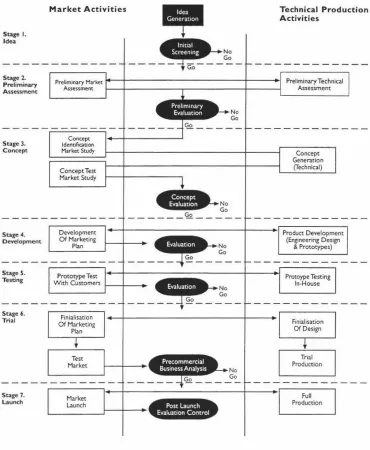
(29) 20. development as figure 6 shows. The BS5750 standard, originally written in the 1970s for manufacturing companies, is now promoted as a Quality Assurance standard for service industries. With the certification, which is similar to the International Standards Organisation (ISO) 9000 series predominantly used in New Zealand, companies can confirm that they offer a professional service.. The Product Development Process The. Product Development. Process. is. essentially. the conception,. development, testing, and commercializing of products. The use of a development process that is systematic allows for a product to be developed completely, ensuring all details are not overlooked. Therefore the aim of the Product Development Process "is to co-ordinate development activities, optimize the product's market potential, and reduce the inherent risk of developing new products" Kerr ( 1995, p. I).. Product Development research appeared in the late 1960s when BoozAllen and Hamilton ( 1968) investigated what actually occurred in the development of new products and how it was managed. Findings showed that there was a process, although quite primitive, that gave management a 'game plan' that assisted in the development and planning of new products. A characteristic flow diagram for the development of consumer goods, as presented by Cooper ( 1984) is shown in figure 7..
(30) 21. Marke t Activities. Technical Production Activities. Stage I. I d~. Stage 2. Preliminary. Assessment. Preliminary Technical Preliminary Market Assessment Assessment f--+--------.--------+----~. No. Go. Stage 3. Conce pt. Concept. Identification Market Study. Concept Generation (Technical). Concept Test Market Study. •Mm• ~ No Go. ------ ~----Stage•· Development. Development. Gia.No. Of Marketing Plan. ---~-~0-Stage 5. Testing. Prototype Test With Customers !---+---+-. Gia.No. Product Development (Engineering Design & Prototypes). Protoype Testing In-House. ----~--Go-Stage 6. Trial. Finialisation. Finialisation Of Design. Of Marketing Plan. Trial Production. Test Market. . , .• • No. - - - - - ~---~~ Stage 7. Launch. Market. _...;-+---411Ni'.9. Full. Production. .___u_ u_nc_h. figure 7. Cooper's ( 1983) seven stage new product process..
(31) 22. Comparison of Architectural Design, Product Design and the Product Development Processes Having shown that architecture and product development and product design share common goals and methods on a abstract and theory level, the processes are shown in table I to compare their differences and similarities. The emphasis of each process can be expressed in the following terms:. The Product Development Process has an emphasis on consumer and market research , testing and evaluation especially at the early concept stages. The plan addresses both market and technical activities while the architectural. and product design. orientation.. However the. lean. more. towards. product development. a technical. process. includes. technical specialists early in the process where the other two bring in specialists at the development stage. All three processes have some form of planning and feasibility stages which also include some form business analysis on a strategic level. The Product Development Process is usually instigated in-house by a manufacturing company and therefore very rarely has a client, consumers in this process are what the architectural industry would term the public or end user.. The Product Design Process is similar to product development in terms of the number of stages involved, but product design has less initial idea screening and testing in the market. Like the Architectural Process there is a close relationship with a client. The process places an emphasis on models to develop and communicate ideas with the client. Both the Product Design and Product Development processes have procedures for the evaluation of ideas and concepts. The Product Design Process has a.
(32) 23. disposal and recycle cycle at the end, while the Architectural and Product Development processes have feedback and post launch evaluation.. The Architectural Plan has a loose concept up until the scheme design and as Rowe suggested, it is a valid form of progression through idea formulation (Heuristic methods) and the idea is formulated closely with the client at these early stages. The evaluation of stages seems to be controlled by cost and payment progression. There is some identification with users in stage C - Outline Proposals but no mention of testing procedures with users, and there is no trial period at the end of the production phase. The stages of the Architectural process A and B, can be considered equivalent to Product Planning and Preliminary Assessment stages of the other two processes. Stage C is the Concept Stage, D is the Design, E for development and stages F through to. J are. the production. phase if you were to look at a building as a large product. Table I expresses the equivalent stages for each process..
(33) 24. Table I. Similarities and differences the Architectural and Product Design, and the Product Development Processes. '"'". ,.. '~. Arch. Desi_gn A Inception. Product Desi2n Trigger. P.D.Process I Idea. B Feasibility. Product Planning. 2 Preliminary. Similarities. Differences. Need or motivation initiates project. Consumers used early in PDP to formulate ideas. Assessment of cost & user requirements Definition of project aims & constraints. PD does not emphasize consumers as much as PDP. PDP idea tested with market. AD brief is lose up unti l this stage. Emphasis on models to develop concepts in PD AD finalizes brief. Assessment. C Outline Proposals. Feasibility Design Brief. D Scheme Design. Design. 3 Concept. Concept testing & evaluation, assessment of technical issues.. E Detail Design. Development. 4 Development. Refined product definition in PD&PDP Major developmental part of all processes. 5 Testing. User & technical testing in PD&PDP. Production -manufacture, assembly, test. 6 Trial. Final design specifications.. Distribution -packaging, transport. installation, commissioning Operation (Use). 7 Launch. F Production Information. G Bills of Quantities. H Tender Action I Project PlanninS? Completion. J. K Feedback. AD completing designs & costing. PDP trial production & test market, development of marketing plan. PD emphasis on refining production . Because PD&PDP in full of tender AD starts production, launching to work with distribution, & unknowns marketing of product. Disposal 11 stages. 9 stages. 7 stages. In conclusion it can be observed that on a general level the processes presented are similar and in some cases equal, but as they break down into component level they change. Even at component level, different jobs.
(34) 25. within the same profession process will have different tasks performed in different ways and times, depending on the type of job. This can be attributed to client interaction, time scales, environment, contractors, budget and designer personality. This is not within the scope of this paper, but it must be recognized as a contributing factor in the success of the final product.. In short every job is different but, experience and. review of previous jobs, and an awareness. and understanding of the. methodology used and the ability to manipulate them, coupled with genuine control of creativity, will produce satisfying results.. Analysis and Critique Showing the process development over the decades gives a indication of how ideas about what happens in the design process are wide ranging and varied. The variety of methods to chose from is vast. Theory has not translated into practice as the methodologists would have hoped for due to the problems mentioned earlier. The only transition is the BS7000 which represents legislation of the process, however this has been initiated by management sectors. Technology involvement, and the resulting social concerns of complex systems and sub systems has influenced and initiated the management system w ithin design. to. accommodate and deal with complex problems.. Communication between disciplines is a key factor in success and methods are now coming back to generic process to allow different disciplines to work together in a flexible and manageable process. This is shown in Jones ( 1984, p.225) roughness theory which involves letting and including non trained people interacting in the process, and relaxing the constraints early on, thus, 'if we had known then what we know now' therefore creating a learn as you go collaboration before concept-fixing..
(35) 26. This paper does not look at or judge the design quality of buildings or products produced as this area is outside the scope of this research. Although it must be stated that the whole reason for the methods research was to improve the outcome and reduce the chance of failures . Understanding of process leads to continual improvement of the processes and hopefully the · end results, and it could be argued better design aesthetically, although no study has been carried out to prove this. Study of understanding method produces good solid design that has method checks in place. Investigation of successful practices at work, where we can gain insight into their methods for success will give an appreciation of the practical application of methods. Discussion will show, by way of examples how the integration of the Product Development. Process into architecture improves the total end result. This is the theme of the next section..
(36) 27. Chapter Two. Product Development in Architectural Design The architectural industry has always been multi-disciplined, but it has been concerned primarily with erecting a building. There are few architects who understand the wider ranging skills available to them to create total environments, such as employing industrial designers who understand manufacturing processes, and consumer researchers who understand public needs and attitudes.. This section presents buildings as complex system environments that ·include mass produced products to meet the demands in a technological age. Inclusion in architectural design of the Product Development Process for mass-produced products is presented in examples of the practices of Norman Foster and Associates and Richard Rogers + Partners. The theme of the hypothesis for this research is focused primarily on the development process of furniture for architectural environments.. Towards Industrialized Building Methods Since the nineteenth century, when mechanization began to impact on the building industry, architects have been distanced from the production processes by which parts of buildings are made. The teaching at the Bauhaus School reconciled the early craft orientation methods to an emphasis on Industrial Design to try and align the Art and Craft of architecture with the new machinery of industrial production. (Banham 1960, cited in Abel 1988)..
(37) 28. Other philosophical influences included Buckminster Fuller's lightweight, all-purpose geodesic domes, Mies van der Rohe's steel structures and Le Corbusier's "machines for living in". Jean Prouve was one of the four early architects to take Industrial Design seriously by maximizing the performance of building products by careful product design (Abel, 1988, p 17).. Another influential group named Archigram, assembled in 1961 and put on seminal architectural exhibitions such as the Plug-in City by Peter Cook ( 1964) and The Walking City in New York, by Ron Herron ( 1964) - shown below in figure 8. Archigram's philosophy was formed around the idea of metamorphosis, the continually changing but always existing environment. The group questioned the need for buildings at all, and suggested that in order to survive "we must invent new artifacts, new situations, and regard shelter or urbanism merely as a term of reference that does not demand a 'house' or 'city'.". figure 8. The Walking City in New York, by Ron Herron ( 1964).. Another major influence had grown from the 1960 "systems approach" and relates to the industrial building methods of the prefabricated kit buildings. A major change in thinking in architecture occurred with the.
(38) 29. factory-made Southern Californian Schools Development project, or SCSD by Ezra Ehrenkrantz in the 1960s. Ehrenkrantz had no skill in factory production methods, so the factory designers developed the system for production (Abel, 1989).. Sudjic ( 1986) pointed out that Rogers, Foster and Stirling, have in different ways, continued to work in what can only be called a "modernist mode", albeit one that has radically widened its concerns from the pioneering days of the 1920s. The potential of the modernist is also exhibited by present architects such as Mario Botta in Switzerland, Arata lsozaki in Japan, Hans Hollein in Austria and many others.. Norman Foster and Richard Rogers met in 1961 while studying for their Master degrees in Architecture at Yale, where they were taught by Serge Chermayeff, who helped pioneer modernism in Britain. At Yale they were exposed to the work of Serge Chermayeff and Christopher Alexander described in Toward a New Architecture of Humanism, which propounded an "ecological approach" to architecture and urban form , and had a similar rationale to the "interdisciplinary system" approach. The work of Chermayeff and Alexander differed from the purely technological orientation by emphasizing the aspect of " human ecology". This was also the philosophy of Buckminster Fuller (Abel 1988, p 13). Foster and Rogers joined to become "Team 4" with two other partners from 1963-67, and designed mainly houses. The work of Foster and Rogers are presented as examples of architects who create and produce total environments of the Second Machine Age. These two well respected firms are presented below because they are the forefront in their field, of course there are others such as Grimshaw + Edwards, who have equally integrated.
(39) 30. working methods, but tend to a lesser extent get involved with 'spin-off' commercial products.. Foster and Rogers Development of Products in Architecture The involvement of product development in Foster and Rogers methods is in fact part of their philosophy and approach to building. Sudjic ( 1986, p43) explained that Foster Associates has been concerned since its conception by projecting the image of the "architect as the omnipotent scientist, committed to team work and efficiency, and adopting the most technocratic of working methods". To realize truly integrated design solutions there is a need to broaden the range of skills and to emphasize team work.. Today factories manufacture practically all components of a building by common production methods, but with little or no involvement from architects. It is in this situation where Foster and Rogers excel while others remain detached from common place production processes and methods. By realizing that items are produced when ordered, these architects have learned to work with manufacturers to modify their product to suit a particular job. This also creates a situation were by understanding the processes, they are able to develop and produce spinoff products which increase the range. of products available for. specification by others. Both Foster and Rogers have, through the use of development programs, pushed technology and manufacturers to the maximum, as is the case with the Hong Kong and Shanghai Bank (Foster).
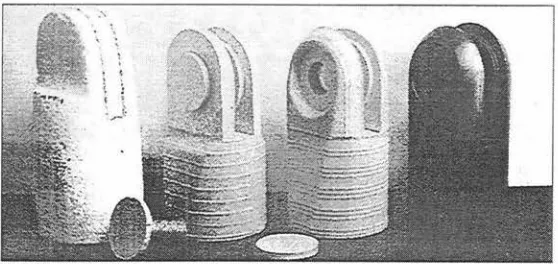
(40) 31. and the famous Centre Beaubourg, or Pompidou Centre, in Paris (Rogers with Renzo Piano and Sir Ove Arup and Partners).. Philosophy and Working Methods. Both Rogers and Foster developed early in their careers an aversion to conventional building processes, which they considered to be muddy, inefficient, inexact and for the builders themselves a cold, wet and unpleasant task. A fundamental aspect of Foster's philosophy is that with the advent of the Second Machine Age, specialist components and one-off designs are able to be manufactured at minimal cost. Foster places high priority on cost control and program disciplines as a framework to control quality and to attempt innovation.. The extent to which Rogers and Foster are prepared to go in the process of invention is an integral part of their methods of design. Their approach is underpinned by a willingness and ability to extract from manufacturers, performance that is often beyond the limit of what is normally considered possible, by becoming involved in the factory manufacturing process (Sudji, 1986, p75).. Both firms maintain a permanent staff of model-makers that produce mock-ups and prototypes for study and evaluation within the office, developing form simple hand cut polystyrene shapes to a metal casting as shown in figure 9. This has the added benefit of giving the firm the ability to be able to talk to manufacturers on equal terms in regard to methods of production. Foster demonstrated that by working with people in industry and studying the essentials of production technology, it was possible to design components for relatively small production runs.
(41) 32. suitable even for. single. building. projects.. Foster. often. designs. components with the possibility of wider use in the building industry in mind, even though they have to be justified within the constraints of a single project (Abel, 1988). Foster designs out the surprises, the same way a car manufacturer constructs a maquette of a new car before committing to full production.. figure 9. Model development for casting. Richard Rogers + Partners.. For both Rogers and Foster, the initial design of a building tends to be a diagram, almost an agenda for discussion, rather than a final design, even though that is often how it is presented. Thereafter teams within each office are detailed to investigate all the technical options available for realizing particular areas of the building. Specialists also have to be involved right from the start. Without them the high level of technical sophistication that Rogers and Foster both aspire to would be impossible to achieve (Sudjic, 1986, p74).. Both Architectural teams use the services of the engineers Ove Arup and Partners and other specialists when working on a design and build program of work. This approach to work also means the firms get.
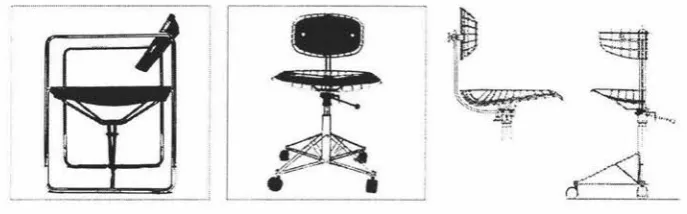
(42) 33. involved in wide ranging work including materials research with large manufacturing companies such as Pilkington Glass. In the design for the Hong Kong and Shanghai Bank the Foster team used a new approach to the design and development process. What distinguishes the new approach , which Foster refers to as "design development'', is its similarity to industrial design rather than to conventional architectural practice. Almost all of the components used in the bank building were designed. by the. Foster. team. in. close. collaboration. with. the. manufacturers' own design and shop floor people, an exhaustive process which included the making and testing of full prototypes. (Davies, 1986, cited by Able, 1988).. Foster and Rogers are both considered to be or are labeled 'high-tech' architects. However they have proven that they can work with low tech regional materials such as the case with Foster's housing project for the Televisa Headquarters Building in Mexico City by building w ithin t he limits of local construction techniques and materials. This stresses Foster's interest in "appropriate technology". Perhaps a more apt description is that they strive to explore and use materials and processes to create effective projects. They ask the questions 'what if and 'why not' to expand and develop what they view as an archaic industry by using combination of methods, research and professionals to achieve good design. They are architects who understand the overall picture which includes not only the spatial and construction qualities of buildings but also the importance of details such as lighting and furniture which are indeed part of the overall picture..
(43) 34. Design of Furniture in a Building System. This section outlines the design of furniture for a large public building where constraints meant that there were no existing commercially available designs to fulfill requirements, thus a product development program was initiated.. Use of Manufacturing Methods.. The Furniture for the Centre. Pompidou Paris, France 1974-76, for the client - Ministere des Affaires , Culturelles/Ministere de !'Education Nationale. The development team included the Architects Piano + Rogers, with the internal systems group of the Etablissement Publique du Center Pompidou.. A special edition of Architeaural Monographs dedicated to Richard Rogers + Partners reports that this project was initiated because of the quantity of material required , and the absence of any available system on the market capable of satisfying the diverse range of user needs. This led to an early decision to develop an integrated range specifically for the Centre Pompidou. The aim of the project was to develop a coordinated kit of parts that would be easily adaptable to all the internal needs of the building, and be capable of producing a consistent vocabulary of furniture that also fitted the construction vocabulary of the building, as shown in figure I 0..
(44) 35. fig. I 0 Interior view showing various chairs and the signage system. The kit of parts had to respond to the changing needs of the building and users, and it was essential that the parts could be easily assembled and taken apart without resorting to specialist assistance.. The kit of parts. consisted of: a table and work station system; a chair system; and a suspension frame system for display. Single components, capable of being assembled to produce different items of furniture were developed wherever possible to minimize the range of components and offer economy of production. The ability to knock-down all components in the kit to component level was important and meant a reserve would always be held in stock.. French fire codes ruled out timber and any form of plastics except for small parts, so this led the system of construction to metal, and in response to the low overall budget, steel was chosen compared with aluminum. Time and cost constraints dictated the use of simple production techniques to supply the large quantities of components.
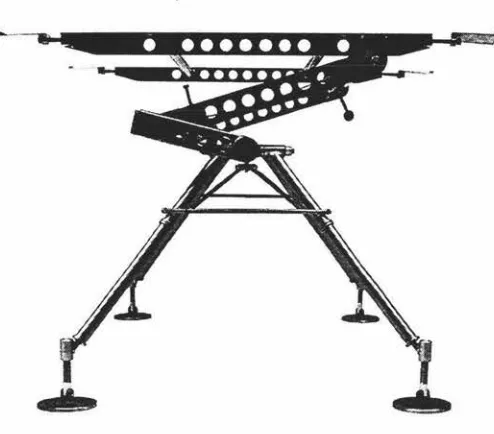
(45) 36. required. Therefore processes such as brake pressing, stamping, spotwelding and weld-mesh influenced the design process, as shown in figure 11 for the seating.. ~ ii. I\,,~ ,~~,~ . . .. !! .. .. 'r.1. ··-;,. ~ ). figure I I. Seating for Centre Pompidou.. Evolutionary Development of Furniture. The Nomos Furniture System by Foster Associates for T echno, Italy is an example of a product that has undergone evolutionary development through three projects. It is an example of a mass produced main-stream product system developed between an architect and manufacturer.. Sparke ( 1989) outlined the development that led up to the Nomos range of furniture by Foster Associates. The final Nomos range evolved through two projects, the first was drawing desks designed and manufactured for the Foster studio in Great Portland Street in 1981. The impetus for the development of the desk was the problems the firm found in the available off-the-shelf models including they were too heavy, expensive, inflexible or had a long delivery time.. A brief for a design to counter these. problems produced the use of a tubular-steel sub-frame and a special mechanism that allowed the desk to perform multiple functions - see figure 12. The brief also anticipated that variations on the desk might include a storage facility. The real key to the desk was the invention of a.
(46) 37. honeycomb-cored table top which drew inspiration from aerospace technology. The development work was undertaken through a process of sketching, working on full-size mock-ups and providing a prototype which was presented to the manufacturer. These desks were essentially 'batch production' objects manufactured in small numbers with hand processes such as welding.. figure 12. Nomos evolution Stage I. drawing board design for the Foster office.. This basic design was then extended and developed into a range of simple office furniture that would visually and conceptually blend with the Renault Building, an architectural project undertaken by the office in 1983. The design of the desks was changed to suit the manufacturing processes for a job this size by including a simple casting, although the main manufacturing process was still welding as in the initial design. The Renault furniture included a desking system, glass-topped dining tables and extra adapted pieces such as the reception desk shown in figure 13..
(47) 38. After the office desk and Renault building furniture were completed, Foster decided the furniture should become main-stream furniture . Foster chose an Italian furniture manufacturer called T echno to work with in developing the Nomos range. Once formal contracts had been drawn up, development work progressed rapidly and the prototypes of the new system were on show at the Milan Furniture Fair of 1986.. figure 13. Nomos evolution Stage 2. the Renault Building reception desk.. Design for Manufacture. The Nomos system required involvement from both the Foster and Techno design teams in the development stage for production and included issues such as: production feasibility, ergonomic and mock-up testing; and the development of design details . For mass production, the problem of reducing the welding involved in the earlier designs was solved by creating a number of cast-aluminum pieces which act as joints linking one piece of steel to another. This in turn meant that only the steel tubes needed to be cut to the various lengths which increased the flexibility of the system. These castings were vital to the production feasibility of the system, and much work was undertaken to perfect them as shown in figure 14 - a, the initial sketch, b, a two point.
(48) 39. fixing method, c, an aluminum prototype of four point fixing, and d, the final solution shown with half of the production mould.. '. I. 11. ' ,._f. a.. b. I. •". c.. figure 14. Nomos furniture. Casting system for leg detail.. Although radical changes were made to Foster's designs, they did not damage the original 'feel' of the early concept as figure 15 shows.. figure I 5. Nomos desk - initial sketch and finished product..
(49) 40. Ergonomic testing was an important factor in the development process see. figure. I 6c.. Mockups. were. used. extensively. throughout. the. development process. Two possible support structures in figure I 6a & b were explored and developed concurrently for some time before a decision was made to go with option a.. ;·. figure 16. Nomos furniture - mock-up and ergonomic development.. Development of configurations were explored including the provision for wheels and leveling adjustment. The final foot detail incorporating these features is shown in figure 17. Mock-up testing was also carried out during the detail production stage at Techno as figure 18 shows, for fine tuning before committing to production..
(50) 41. figure 17. Nomos furniture - Development of the foot detail.. figure 18. Nomos furniture - Factory mockup testing of designs for storage.. The. highly organized, flexible. manufacturing system. that T echno. developed has proved ideal for the production of Nomos, as it depends upon a variety of standardized and individual components which can be put.
(51) 42. together in a number of different ways. T echno's role did not end with production - its in-house design team was responsible not only for some of the development work for the system but also for its packaging and publicity material. An innovating package was devised where by the steel spine provides support, thus making the package light and compact. T echno, in keeping with the kind of work it has undertaken in the past also offered a service to customers for the design of office layouts, and offers them a book of configurations of possible layouts which brought the project to a logical end.. Integrated T earns In 1975 Roger's PATScentre was founded and includes a multi-disciplinary team of engineers, architects and scientists. It was formed with the aim of extending the team's understanding and expertise to effectively integrate the potential of the Second Machine Age to shape an environment which offers to the user the full advantage of these new technological forces {Architectural. Monographs,. environmental. systems. 1985. p 138).. PATScentre. research. includes. research such as: acoustics, lighting.. space. servicing and materials research, prototypes, mockups and performance testing.. Both Sir Norman Foster and Sir Richard Rogers are much respected for what they achieve, and are very much figureheads and spokesmen of British Architecture. One important issue often overlooked by reporters on these two truly multi-disciplined top international firms is that they do still work closely with manufactures at home that are producing products that could become export earners for Britain..
(52) 43. Total Design Approach In order to produce environments that are successful, there must be a total. design. approach.. The. total. design. approach. emphasis. an. understanding of the methodology utilized, and the manipulation of that process; an understanding and inclusion of the different discipline skills involved; and knowledge of production methods.. Abel ( 1986) suggested that the potential of new building technology cannot be fulfilled unless changes are undertaken in architectural practice and education more along the lines of industrial design practices. This may be a worthwhile advance but the gestation period could be as much as 20 years by the time the students of this era are in a position to implement their altered practice methods due to the conservative nature of architecture. Perhaps a more responsive approach would be to utilize the industrial designers presently available, but also educate/promote product development. as. a. multi-disciplinary. approach:. working. with. manufacturers to achieve results that incorporate and maximize craft and industrialized production methods for the building industry to progress.. Communication and teamwork are obviously two of the key ingredients to the success of these projects. Other factors include the innovative personality of the team leader. An understanding of process and production methods is necessary so that research and development teams understand were they fit into the process and feel comfortable to push manufacturing processes. The processes and practices used have been developed to optimize to reduce the development risk of products within the architectural industry. This approach is changing the industry expectations to bring it up to speed in the Second Machine Age, and in.
(53) 44. line with Le Corbusier's 'Machine for living' philosophy. The examples above of leaders for what should be a more widespread industry standard, although it should be stated that not every architectural firm will have the necessary expertise to get involved in this type of work. However the firms already working in this area should understand the product development process, the commitment involved and be prepared to take the risk associated to the larger projects.. In New Zealand there are examples of architects who develop products with manufacturers for a total design approach. One such example is a stadium seat which was developed and produced though a strategic alliance between Metallion Ltd. - an architectural product accessory manufacturer, and Reese Plastics. The project was initiated by the manufacturer while the stadium was in its initial development. The architects were involved in feedback and evaluation sessions throughout the development of the seat. The design was accepted for tender in its final model stage. The development team was made up of industrial and product designers, a model-maker, and the two manufacturers. Brown ( 1996, p35) from Metallion Ltd, the project manager of the development project said "The key to successful team development is encouraging creativity, while still maintaining focus on the commercial goals. At times, these can seem contradictory". To this end Metallion put together a development path model which was applied to the new stadium chair project. The model breaks the various stages of development into two types of tasks - creative and analytical so team members can understand the nature of the tasks and work in the appropriate thinking style..
(54) 45. New Zealand shelving manufacturer Hydestor won the tender for the development, production and installation at Wellington Public Library in 1991 of a new shelving design, designed by the architects. The library shelving project was initiated when the architects were despondent with the four available existing systems on the New Zealand market, the design of which was 30 years old and did not meet the requirements for storage, wiring, lighting, and signage. Hydestor's Royale library system has a display function and was especially designed to carry internal wiring and the cable management facilities necessary to service communication technology. The design also included a combination of possible storage systems for books, CD, magazines, music cassettes and posters. The development took place over one year and cut $250,000 off the original budget due to the improvements made. Other total development work by architects include t he New Zealand Rail long distance train upgrade and the National Bank of New Zealand, work that was undertaken by Custance Associates. The examples of projects above have been initiated in several ways including: the lack of commercially available products; the present products do not fulfill the specifier's requirements; a tender situation has created a new design. Another possible initiation is by an architect or manufacturer with knowledge of up-coming project..
(55) 46. A NEW ZEALAND CASE STUDY.
(56) 47. Chapter Three. Product Development in a New Zealand Architectural Project This case study presents the design, development and decision process of a development project within an architectural environment. The project, the design and development of a library trolley system for the new Palmerston North City Council (P.N.C.C) Library completed in 1996, was in conjunction with Athfield Architects of Wellington.. Introduction The trolley system comprised four trolleys: standard, technical, display, and book return, and was based on an existing standard book trolley, produced by a Wellington Manufacturer for the Wellington New Public Library in 199 I.. Wellington City Council New Public Library 1991. Palmerston North City Council Public Library 1995. ~ Promotion & Marketing Architects 1997. Standard BookTrollev Proiect Initiation and development project including special art trolleys LibraryTrolley System Continuation and extension of initial project to produce a total trolley range Marketing Engagement of promotional p erson to investi gate and promote to other markets. figure 19. Evolutionary development of a library trolley system. An overview of the Palmerston North project is shown using stage, decision, and feedback models imposed over each other. The procedure is outlined, and a background to the project is given. The background section overviews information from the initiation of the first trolley.
Figure
+7

Related documents
повышается также скорость входа протонов в матрикс (рис.. Влияние МрТр на трансмембранный обмен ионов в митохондриях. Открывание МРТР, как уже было показано нами
When tested with simulated data, the ROC curves and true positive comparison indicate that a kernel size of roughly 0.20 should show an improvement over CCA (Figure 4), but
Methods: A follow-up study 5.5 years after the explosion, 330 persons aged 18 – 67 years, compared lung function, lung function decline and airway symptoms among exposed
It was decided that with the presence of such significant red flag signs that she should undergo advanced imaging, in this case an MRI, that revealed an underlying malignancy, which
19% serve a county. Fourteen per cent of the centers provide service for adjoining states in addition to the states in which they are located; usually these adjoining states have
Assessing the Impact of Biodiversity Conservation in the Management of Maize Stalk Borer (Busseola f
Field experiments were conducted at Ebonyi State University Research Farm during 2009 and 2010 farming seasons to evaluate the effect of intercropping maize with
The cholesterol lowering drugs include statins, fibrates, bile acid sequestrants, inhibitors of intestinal sterol absorption, nicotinic acid derivatives and others
