A PRE
±
EXPERIMENTAL STUDY TO ASSESS THE
EFFECTIVENESS OF STRETCHING EXERCISES ON
JOINT PAIN AMONG OBESE WOMEN IN SELECTED
AREA AT VELLORE
BY
POORNIMA. I
A Dissertation submitted to
THE TAMILNADU DR.M.G.R MEDICAL UNIVERSITY,
CHENNAI - 32In partial fulfillment of the requirement for the Degree of
MASTER OF SCIENCE IN NURSING
CERTIFICATE
Certified that this is a Bonafide work of
POORNIMA. I
Arun college of nursing, Vellore.
Submitted in partial fulfillment of the requirement for the degree of
Master of Science In Nursing
THE TAMILNADU DR. M.G.R MEDICAL UNIVERSITY, CHENNAI - 600032.
COLLEGE SEAL
Signature ---
PROF.Mrs.J.SUNITHA PRIYADARSHINI, M.Sc (Nursing ), M.Sc (Psy)., P.hD., Principal, Arun college of Nursing,
BY
POORNIMA. I
M.Sc., (Nursing Degree Examination,
Branch
±
I, Medical Surgical Nursing,
Arun College of Nursing,
Vellore -632 001.
A Dissertation submitted to
THE TAMILNADU DR.M.G.R MEDICAL UNIVERSITY,
CHENNAI - 32
In partial fulfillment of the requirement for the Degree of
MASTER OF SCIENCE IN NURSING
APRIL - 2016A PRE
±
EXPERIMENTAL STUDY TO ASSESS
THE EFFECTIVENESS OF STRETCHING
EXERCISES ON JOINT PAIN AMONG
OBESE WOMEN IN SELECTED AREA
A PRE ± EXPERIMENTAL STUDY TO ASSESS THE EFFECTIVENESS OF STRETCHING EXERCISES ON JOINT PAIN AMONG OBESE WOMEN IN
SELECTED AREA AT VELLORE.
Approved by Dissertation Committee
Research Guide
Prof.Mrs.J. Sunitha Priyadarshini, M.Sc(N),M.Sc(psy)., P.hD --- Principal, Arun college of Nursing ,
NO, 15, Thiyagarajapuram ,Vellore - 632 001 .
Clinical Speciality Guide
Mrs. Gomathy. V. M.Sc (Nursing) , --- Associate Professor ,
HOD, Department of Medical Surgical Nursing , Arun College of Nursing, Vellore ± 632001.
Clinical specialty Co- Guide
Mrs. Rajeshwari, M.Sc (N), Lecturer --- Medical Surgical Nursing
Arun College of Nursing, Vellore ± 632001
Medical Guide
Mr. Dr.Manogaran ---
MBBS, D.C.A.A.M.A Chief Medical Officer,
Arun Multispecialty Hospital, Vellore- 632 001
A Dissertation submitted to
THE TAMILNADU DR .M.G .R MEDICAL UNIVERSITY
CHENNAI - 32
In partial fulfillment of the requirement for the degree of
MASTER OF SCIENCE IN NURSING
A PRE- EXPERIMENTAL STUDY TO ASSESS THE
EFFECTIVENESS OF STRETCHING EXERCISES ON JOINT
PAIN AMONG OBESE WOMEN IN SELECTED AREA AT
VELLORE.
BY
POORNIMA.I
M.SC.(Nursing) Degree Examination Branch-I, Medical Surgical Nursing, Sub- Specialty- Orthopedic Nursing,
Arun College of Nursing, Vellore- 632001.
A Dissertation submitted to
THE TAMILNADU Dr.M.G.R MEDICAL
UNIVERSITY, CHENNAI
. In partial fulfillment of the requirement for the
degree of MASTER OF SCIENCE IN NURSING, APRIL
±
2016
--- ---
INTERNAL EXAMINER EXTERNAL EXAMINER
DECLARATION
I hereby declare that the present dissertation entitled ³A PRE ±
EXPERIMENTAL STUDY TO ASSESS THE EFFECTIVENESS OF
STRETCHING EXERCISES ON JOINT PAIN AMONG OBESE WOMEN IN
SELECTED AREA AT VELLORE´ is the outcome of the original research
work undertaken and carried out by me ,under the guidance of Prof . Mrs J . Sunitha Priyadarshini ,MSC (N), Msc (Psy), PhD., Principal and
Department of Nursing Research, Arun college of Nursing and, Mrs. Gomathy.V. M.Sc (N) Associate professor HOD of Medical Surgical Nursing,
Arun college of Nursing Vellore, and Mrs. Rajeshwari Lecturer in Medical Surgical Nursing Arun college of Nursing.
I also declare that the material of this has not been found in any way, the basis for the reward of any degree or diploma in this university or any other universities.
POORNIMA.I
ACKNOWLEDGEMENT
I acknowledge my love and gratitude to all those loving hearts who has
KHOSHGPHWKURXJKRXWP\(QGHDYRXU¶V
I express my deep sense of gratitude to God Almighty for his abiding grace, love, compassion and blessing which gave me the strength and courage for success of this project.
The writing of this dissertation has been one of the most significant academic challenges and I have ever had to face without the support, patience and guidance of the following people, This study would not be completed. I am thankful for their aspiring guidance, invaluably constructive criticism and friendly advice during the project work. I am sincerely grateful to them for sharing their truthful and illuminating views on a number of issues related to the project. It is to them that I owe my deepest gratitude.
I extend my sincere thanks to Mr. Adhimoolam, Managing Director Arun Educational trust for his encouragement which helped me to complete my project.
I express my sincere thanks to Prof. Mrs.V.Praba,M.sc (N), Phd ,Vice - Principal Arun College of Nursing for her encouragement which helped me to complete my project.
7KHSUHVHQWVWXG\KDVEHHQFRPSOHWHGXQGHUWKHH[SHUW¶VJXLGDQFHVXSSRUW
and suggestions and supervision of Mrs. Gomathy .V. M.sc (N) Associate professor HOD in Medical Surgical Nursing, Arun college of Nursing Vellore. For their esteemed guidance, interest sustained patience, critical comments and continuous inspiration and support right from the planning phase till the completion of the project .
I extend my sincere thanks to Mrs.Rajeshwari M.sc (N) Lecturer Medical Surgical Nursing Arun college of Nursing and Ms .Gayathri M.sc (N) Lecturer Medical Surgical Nursing Arun college of Nursing in Medical Surgical Nursing, Arun college of Nursing for continuous inspiration and support till the completion of the project .
I extend my warmest thanks to Mr. Murgan President and Mrs. Mangaikarsi Medical officer for helping me for conducting my study in Poigai, Vellore
I thank all Head of the Department and other faculties of Arun college of Nursing for their guidance and support. And I thank the Librarian of Arun college of Nursing & The Tamil nadu Dr MGR Medical University for their valuable assistance, essential in carrying out of the review of literature and providing library throughout the study.
I would like to express my deepest thanks towards my beloved parents Mr. T. Inbasagaram , Mrs. A Bhavani and Mr. I. Janarthanan my brother and Friends for their kind Co - Operation and encouragement in completion of this project.
ABSTRACT
A pre - experimental study to assess the effectiveness of stretching exercises on joint pain among obese women in selected area at Vellore.
The objectives of the study were,
1. To assess the pre test and post test level of joint pain among obese women,
2. To evaluate the effectiveness of stretching exercise on joint pain among obese women.
3. To find the association between the pre test and post test level of joint pain among obese women in selected demographic variables.
4. To find the association between the pre test and post test level of joint pain among obese women in selected clinical variables.
The research approach was evaluative and Research deaign used was pre - experimental involving only one group pre test and posttest design.Purposive sampling technique was adopted to choose. Joint pain was assessed by Lysholm Knee Scoring scale. Stretching exercise was done daily 8 minutes.
Major findings of the study are
participated in the study were married. More than half 17 (56.7%) obese women were implemented family planning method.
Clinical variables showed the majority 12 (40%) whose BMI is 30.0-39.9 waist circumstances is extremely high 10 (33%) of obese women. All obese women do not have maximum resistance 8(27%). Majority of obese women were partly depended 11(37%). Majority of obese women have duration of joint pain less than 1 to 5 years 14 (47%). Majority of obese women are using comfort devices as pillows 26 (90%) and some are using back rest 3(7%) and sand bag 1 (3%).
Before stretching exercises out of 30 obese student none of them had mild joint pain. 7% had moderate joint pain 93% had sever joint pain. But after stretching exercises 10% have moderate pain and none of them had sever joint pain. The comparison using paired t-test is 25.90*** which proved highly significant of p<001.Hence H01 stated earlier there is significant difference between the level of Joint pain among obese ZRPHQEHIRUHDQGDIWHUVWUHWFKLQJH[HUFLVHV³LVDFFHSWHG´
The study revealed that there is significant association between the selected demographic variable and their post test level of joint pain among elderly. Statistical significance was calculated using chi square test hence H02 stated HDUOLHUµ¶WKHUHLVno significant association between the post test level of joint pain
among elderly and selectHGGHPRJUDSKLFV¶¶LVDFFHSWHG
square test. Hence H03 is stateGHDUOLHUµ¶7KHUHLVno significant association between the post test level of joint pain among obese women and selected clinical variable µ¶LVDFFHSWHG
RECOMMENDATIONS
¾ Similar kind of study can be conducted to a large group to generalize the findings.
¾ The same study can be repeated by using the true experimental design.
LIST OF CONTENTS
CHAPTER CONTENTS PAGE NO
I
INTRODUCTION 1
Background of the study 8
Need for the study 11
Statement of the problem 11
Objectives of the study 11
Null Hypothesis 11
Operational definition 12
Assumption 12
Delimitation 13
Conceptual frame work 13
II
REVIEW OF LITERATURE 17
Literature related to incidence and prevalence of
joint pain among obese women 18
Literature related to joint pain among obese women 20 Literature related to effectiveness of stretching
exercise on joint pain among obese women 23 Literature related to effect of stretching exercise
among alternative therapies in reducing joint pain among obese women.
CHAPTER CONTENTS PAGE NO
III
RESEARCH METHODOLOGY 28
Research Approach 28
Research Design 28
Variation of the study 29
Settings of the study 31
Population 31 Sample 31
Sampling Technique 32
Criteria for Sample Selection 32
Selection and Development of study Instrument 33
Pilot Study 34
Data Collection Procedure 35
Plan for Data Analysis 35
1V Analysis and interpretation 36
V Discussion 59
VI Summary Conclusion, Implications and
Recommendations
65
References
LIST OF TABLES
TABLE NO DESCRIPTION PAGE NO
1
Frequency and percentage Distribution of Demographic variables among Obese women with Joint pain
37
2
Frequency and percentage Distribution of Clinical variables of Obese women with Joint pain
45
3
Frequency and percentage Distribution level of Joint pain before and after doing Stretching Exercise
52
4
Comparison of mean and standard deviation of pre test and post test level of Joint pain among Obese
54
5
Association between the post test level of Joint pain among Obese with selected demographic variable
55
6
Association between the post test level of Joint pain among Obese with selected clinical variable
LIST OF FIGURES
S .NO FIGURE NAME Page No
1 Conceptual framework 16
2 Schematic Representation of Research Design 30
3 Percentage distribution of demographic age in years of obese women with Joint pain
40
4 Percentage distribution of demographic variable of religion of obese women with Joint pain
41
5 Percentage distribution of demographic variable of educational status of obese women with Joint pain
42
6 Percentage distribution of demographic variable of occupation distribution of obese women with Joint pain
43
7 Percentage distribution of demographic variable of Family planning among obese women with Joint pain
44
8 Percentage distribution of clinical variable of BMI among obese women with Joint pain
47
9 Percentage distribution of clinical variable of waist circumference among obese women with Joint pain
48
10 Percentage distribution of clinical variable of among obese women
49
11 Percentage distribution of clinical variable of duration of Joint pain among obese women with Joint pain
50
12 Percentage distribution of clinical variables of swelling among obese women with Joint pain.
51
13 comparison of pre test and post of joint pain in the selected samples
LIST OF ANNEXURE
S .No Content
I Letter seeking permission to conduct the study II Request for content validity
III Content validity certificate IV List of experts
V Certificate for Tamil editing VI Consent form
VII Demographic variables VIII Clinical variables
IX Lysholm Knee Scoring Scale X Coding sheet
KEY WORDS
Demographic VariablesAge - Age
Religion - Rl Educational status - Es Occupation - Oc Family Planning - Fp Calcium intake - Ct Marital Status - Ms Family planning - Fp Menopause - Mp Child bearing - Cb Number of children - Nc
Clinical Variables
Body mass index - BMI
Waist circumference - WC
Mobility status - MS
Duration of Joint pain - DJ
Swelling - SW
Comfort devices - CD
Joint affected - JA
Type of pain - TP
Walk with support - WS
&+$37(5,
,QWURGXFWLRQ
&+$37(5,,
5HYLHZRI/LWHUDWXUH
&+$37(5
²
,,,
5HVHDUFK0HWKRGRORJ\
&+$37(5,9
$QDO\VLV
,QWHUSUHWDWLRQ
&+$37(5
²
9
'LVFXVVLRQ
&+$37(59,
6XPPDU\&RQFOXVLRQ,PSOLFDWLRQV
1
CHAPTER
±
I
INTRODUCTION
Background of the study
Pain is an unpleasant sensory and emotional experience associated with actual or potential tissue damage or described in terms of such damage. Pain is an abstract concept which refers to a personal, private, and sensation of hurt, a harmful stimulus with signal current or pattern of responses which operate to protect the organism from harm.
-RLQW SDLQ LV D FRPPRQ PXVFXORVNHOHWDO FRPSODLQW QRZ D GD\¶s people are suffering. It includes injuries and acute or chronic inflammation of the joint, tendons, and surrounding ligaments. Everyone has experienced some type or degree of pain.
A person in pain feels distress or suffering and seeks relief. Pain is much more than a physical sensation caused by specific stimulus. The pain experience is complex, involving physical, emotional and cognitive components. Pain is subjective and highly individualized. Pain cannot be objectively measured, only the client knows whether pain is present.
2
Alih. Mokdad 2013, measured the prevalence of obesity is increasing in the united states. To estimate the prevalence of obesity among adult peoples in 2011. Random digit telephone survey of 1,95.000 sample was collected in the states participating in the risk factors surveillance system. BMI ,based on self reported weight and height was taken. In 2011 the prevalence of obesity BMI > 30 was 20 .9% ,19 .8% in 2010 and it increases up to 5 .6% in 2012. Increased cholesterol level 2.72% ,high blood pressure 1.88% and joint pain people around 4 .19% people are affected. Since the percentage is 45 to 58 % and 2010 over weight is 65.9% men and 49 .9% women.
Pain can be described in terms of duration (acute pain, chronic pain) origin (cutaneous, deep, somatic, visceral) and location (radiating, referred pain, intractable pain, neuropathic pain). Acute pain is a short term feeling of pain felt in response to an easily identifiable cause. It might be caused by surgery, some kind of trauma or an acute illness. Chronic pain lasts for a prolonged time period, and its cause is not amenable to specific treatment. It is associated with prolonged tissue pathology or pain that persists beyond the normal healing period for an acute injury or disease.
3
The total annual incremental cost of health care due to joint pain ranges from 560 billion to 635 billion in the United States, which combines the medical cost of pain care and the economic cost related to disability days and productivity. More than half of all patient experienced pain in the last days and although therapies are, present to alleviate most pain, research shows that 50 -75% of die in moderate to severe pain.
In 2013 study was conducted by nearly 51.5% of the respondent reported some form of pain. The prevalence sites of pain includes knee pain 12.6%, Low back pain 8.9%,general body pain 7.8%, multiple joint pain 14.2% and pain in legs 2.7%. Musculoskeletal pain in men and women were 32.7%
PHQ¶VDUHDIIHFWHGDQGRIZRPHQ¶VDUHDIIHFWHGIURPPXVFXORVNHOHWDO
pain.
Joint pain is the sensation of discomfort, inflammation, soreness ,stiffness in a joint or joints. Joint pain is a symptom of a wide variety of mild to serious disease. Joint pain can result from infection, trauma, malignancy ,autoimmune disease and other abnormal processes.
Joint pain indicate a relatively benign condition such as mild sprain. Joint pain can result of a moderate disorder such as bursitis, ankylosing spondylitis, a moderate ligament sprain or a dislocation. Joint pain can also accompany serious condition that can even be life threatening. These include rheumatoid arthritis, leukemia or bone cancer.
4
Related Diagnosis could be offered while degenerative disorder (29%) and soft tissue rheumatism (20%)were commonly seen. Inflammatory arthritis (11%) and Rheumatoid arthritis (4%) in particular ,was seen in significant & unexpected proportion. Adults who are overweight or obese should try to lose 5% to 10% of their current weight over 6 months. Arthritis affecting approximately 27 million of people in India.
According to Rochester Mink every pound of excess weight exerts about 4 pounds of extra pressure on knees. so a person who is 10 pounds overweight has 40 pounds of extra pressure on his knees, if a person is 100 pounds overweight, that is 400 pounds of extra pressure on his knees.
Over all 22 .7% (52.5 million) of adults reported doctor diagnosed arthritis, with significantly higher age adjusted prevalence in women (23.9%) than men (18.6%).Arthritis prevalence increase with age and was higher among women than men in every age group. Between 2010 and 2012 around 52.5 million people are not affected. The age adjusted prevalence of arthritis increases as BMI 16 .3% among normal/underweight adults of 28.9% among obese people.
According to Indian Rheumatology Association statistics 2011, 49.8% of the total population is over the age of 60 years suffering from severe joint pain, among these 15% of the population have some degree of limitation of movement and 6% cannot perform daily activities.
5
health, maintain fitness and is important as mean of physical rehabilitation. It plays a major role in healing of disease. Therapeutic exercise program are developed to improve joint range of motion and muscle strength. Before beginning the exercise programs the client must be aware of limiting factors such as pain and the inability to relax. Immobility disrupts normal metabolic functioning, decreasing the metabolic rate.
Stretching exercise if people are doing properly it increases flexibility. According to M.Alter, benefits of stretching mainly includes enhanced physical fitness to improve skilled movement, reduced risk of injury to joints, muscle fitness, reduced risk of injury to joints, muscles and tendons. Common mistakes made when stretching are inadequate rest between workouts, overstretching and performing the wrong exercise.
Several studies state that long period of bed rest have psychological effect on both clients and family members. At least 2 -3 immediate family members, have to go through emotional, physical and psychological training. Comprehensive educational program for client and family of caregivers should begin throughout care. Educating the researcher regarding various aspects of health care management helps them improving recovery and they can prevent the complications.
The nurse has an important role in multidisciplinary pain management. The
QXUVH¶V UHVSRQVLELOLW\ LQFOXGH SDLQ DVVHVVPHQW DGPLQLVWHULQJ WKHUDSLHV
6
There are number of home remedies non ± pharmacological intervention therapy that pain reduces the pain and that can be used in combination with pharmacological measures. Nurses are ethically and legally responsible for managing pain and reliving suffering. Effective pain management not only reduce physical discomfort but also improves quality of life and promotes earlier movement.
Stretching is useful for both injury prevention and injury treatment. If done properly, stretching increases flexibility and this directly translates into reduced risk of injury. The reason is that muscle tendon group with a greater range of motion passively will be less likely to experience tears will used actively. It is very important to relax during the stretching routine .It should not be a rushed event.
Although physical activity and exercise have been shown to benefit people with arthritis by improving pain, function and mental health, many people with arthritis report no leisure time physical activity 24% of adults with diagnoses arthritis report no leisure time physical activity, a considerable higher proportion compared with adults without arthritis (18 .6%).
7
It has been suggested that performing a warm up and cool down before and after sporting activity can help reduce the incidence of injury and promote recovery following training. Central to these practices is improving flexibility through stretching. Here we guide you through the science of stretching, explain the various techniques for the level of stretching appropriate to requirement, and provide a comprehensive program me of stretches.
Lack of flexibility is one of the most frequent causes of poor performance and inefficient technique. By increasing flexibility in the upper and lower body the climber will reduce the risk of injury increases recovery.
$OWKRXJKHYHQ LQGLYLGXDO¶VIOH[LELOLW\ LVVRPHZKDWJHQHWLFLWLV SRVVLEOHIRU
everyone to make scientific gains in their flexibility .
Stretching and flexibility exercises should be performed for a minimum of 8 minutes before aerobic exercise. The main purpose is to keeping muscles supple increasing range of motion of joints, enhancing flexibility, improving co
±ordination, increasing blood flow to muscles and preventing injuries. Recent center for disease control and prevention of health statistics data suggest the pain of cause and most people for United States b adults report. Low back pain is around 28% and knee pain 19 .5%, finger pain 7 .6% and shoulder pain 9.0%.
8
Need for the study
Ann Inter med (2008) a study shows that 47.5 million United States adults (21,8%)reported a with joint pain and we identified through incident report and find out. Among adults reporting a disability, the most commonly identified limitations were difficulty climbing a flight of stairs (21 .7 million ,10.0%) and walking 3 city blocks (22.5 million, 10.3%). That means that 1 in 10 adults have trouble while walking a distance equal to walking from the parking lot of back of a store or through mall.
The total annual incremental cost of health care due to joint pain ranges from 560 billion to 635 billion in the United States, which combines the medical cost of pain care and the economic cost related to disability days and productivity. More than half of all patient experienced pain in the last days and although therapies are, present to alleviate most pain, research shows that 50 -75% of die in moderate to severe pain.
An estimated 20% of American adults (42 million people)report that pain or physical discomfort disrupts their sleep a few night a week or more. Among the major adjustment of chronic joint pain suffers have made are such serious steps as taking disability leave from work (20%)changing jobs altogether (17%)getting help with activities of daily living (13%)and moving to a home that is easier to manage (13%) of cases.
9
older will have diagnosed as arthritis. Compared with the 52 .5 million adults in 2010 -2012. Also by 2030 an estimated 25 million adults(37% of adults with arthritis or 9.3% of all cases) will report arthritis activity limitations.
The age adjusted prevalence of arthritis increases as body mass index increases from 16.3% among normal /underweight older to 28.9% among obese people. Excess weight also contributes to activity limitation. Among normal, underweight adult with arthritis, 38.2% report arthritis attributable activity limitation compared to 44.8% among obese adults with arthritis. Losing even modest amount of weight can reduce your risk of getting arthritis, and improve arthritis pain ,function and quality of life if you are living with arthritis.
Although physical activity and exercise have been shown to benefit people with arthritis by improving pain, function and mental health, many people with arthritis report no leisure time physical activity 24% of people have diagnosed. Higher proportion compared with adults without arthritis (18.6%). Low level of physical activity place individual with arthritis at further risk of inactivity associated condition such as diabetes obesity and functional limitation .
10
that 80% of them are unemployed and 67 .3% were found to be dependent on their family members . Among these , most of them (65 .5%) were found to be suffering from joint pains.
In a conference held on behalf of world arthritis Day confesses that in 1 in every 10 patient department all over Tamilnadu among adult population aged 40 years and older reports of one or other symptoms of joint pain cases and there was a raising incidence of arthritis in younger aged and even lesser ones ( Karthikeyan, 2010) .
The world wide statistics in 2008 shows that, among total population, 40% of people at age above 50 years, suffer from severe joint pain, 70% of the population have some degree of limitation s of movement and 25% cannot perform daily activities.
Joint pain is estimated that upto 1 in 20 people in UK may be affected and at some point of life .Most people got joint pain in the age group of 50 and above. This condition more common in women than men The annual incidence rate in general population is 3 - 5 % and upto 20% of people are affected. ( Henricus , 2006)
11
joint pain had many side effects which disable a patient chronically. This along with the use of wide range of pharmacological and non pharmacological therapies prompted the researcher to evaluate the effectiveness of stretching exercise reducing joint pain among obese women.
STATEMENT OF THE PROBLEM
A pre ±experimental study to assess the effectiveness of stretching
exercises RQMRLQWSDLQDPRQJREHVHZRPHQLQVHOHFWHGDUHDDW9HOORUH
OBJECTIVES
1. To assess the pre test and post test level of joint pain among obese women.
2. To evaluate the effectiveness of stretching exercise to reduce joint pain among obese women.
3. To find the association between pre test and post test level of joint pain among obese women with selected demographic variables.
4. To find the association between the pre test and post test level of joint pain among obese women with selected clinical variables.
NULL HYPOTHESIS (H0)
1. There will be no significant difference between pretest and post test level of joint pain after doing stretching exercise.
2. There will be no significant association between pre test and post test level of pain with selected demographic variables.
12
OPERATIONAL DEFINITION
Effectiveness
It refers to the extent to which the stretching exercise are effective which is assessed and measured by Lysholm Knee Scoring.
Stretching Exercise
In this study stretching exercise are exercise that strengthen the Joint muscle which improves physical activity which decreases Joint pain and provide comfortable muscle tone. Stretching exercise are hamstring stretches, quadriceps stretches calf stretches.
Joint pain
Joint pain refers to the pain felt the knee joint which grading less 64 using Lysholm knee scoring scale
Obese Women
All female genders whose BMI 25.0 to 40 and above.
ASSUMPTIONS
1) Obese women experience joint pain.
2) After performing stretching exercise, the joint pain reduced.
DELIMITATION
The study was limited to,
x Obese women with joint pain in selected area Vellore.
13
CONCEPTUAL FRAMEWORK
The conceptual framework for research study presents the measure on which the purpose of the study is based. The framework provides the perspective from which the researcher views the problem. It helps to express abstract ideas in more readily understandable on precise from than the original conceptualization.
This study is based on the concept that the effectiveness of stretching exercise will reduce the level of joint pain and thus enhance individual
ZHOOEHLQJ 7KH UHVHDUFKHU DGRSWHG WKH PRGLILHG (UQHVWLQH :LHGHQEDFK¶V
helping ard clinical nursing theory in 1964 for nursing, which desired situation and a way to attain it .It directs action towards the explicit goal.
This theory has three factors, 1) Central purpose 2) Prescription 3) Reality.
CENTRAL PUROPSE
It referred to accomplish the overall goal towards which a nurse strives, it transcends the immediate indent of the assignment or task by specifically directing activities towards the patient good . In my study the central purpose is to reduce Joint pain .
PRESCRIPTIONS
14
realities identified by Widen Bach are agent, recipient, goal, means activities and framework.
Agentis the practicing nurse or a design who has personal attributes, capacities, capabilities, commitment and competence to providing nursing care. In this study the researcher is the agent.
Recipient is the patient who has personal attributes, problems, aspirations, Capabilities, and ability to cope. The recipient is the one who receives a
QXUVH¶V DFWLRQ ,Q WKLV VWXG\ JRDO LV UHGXFWLRQ RI MRLQW SDLQ DPRQJ REHVH
women .
Goal LVWKHQXUVH¶VGHVLUHGRXWFRPHWKURXJKDFWLRQ7KHVHGLUHFWDFWLRQDQG
suggest the reason for taking those actions. In this study, goal is reduction of joint pain among obese women.
Mean are the activities and devices used by the nurses to achieve the goal. In this study stretching exercise is done to the obese women with an advantage of reducing joint pain.
Framework refers to the facilities in which nursing is practiced. This study frame work referred to the poigaie.
The conceptualization of nursing according to this theory consists of three following steps.
15
Step 1 : Identification of the need for help Step 2 : Ministration the need for help Step 3 : Validation that the need was met
IDENTIFICATION OF THE NEED FOR HELP
This step determine a patient need for help based on the existence of need, whether the patient realize the need, which prevents the patient from meeting the need and whether the patient cannot meet the need alone. In selective study joint pain patients who are suffering from pain in one or the joint and those who have physical limitation as a result of pain in their activity of daily living are not possible to get adequate pain relief and comfort in their living. Joint pain patients are identified based on inclusive criteria and exclusive criteria. Purposive sampling technique was used to assign patients into the experimental group. General information of obese women with joint pain was collected and pre assessment on level of pain is assessed.
MINISTERING THE NEED FOR HELP
Refers to provision of needed help My study after the pre assessment of the level of joint pain, stretching exercise was done to 40 year elderly with joint pain in the experimental group.
VALIDATING THAT THE NEED FOR HELP WAS MET
6WXG\UHIHUVWRDFROOHFWLRQRIHYLGHQFHWKDWVKRZVDSDWLHQW¶VQHHGV
have met and his functional ability has been restored as a direct result of the
17
CHAPTER
±
II
REVIEW OF LITERATURE
This chapter deals with an extensive review of literature to gain deeper insight into the problem as well as to collect maximum relevant information for building up of the study. The literature review is an extensive, systematic and critical review of the most important published scholarly on a particular topic.
This literature directs the researcher to design the study and interpreting the outcomes. The primary purpose is to gain broad background or understanding of the information that is available related to the problem. The review helps investigator in developing a deeper insight into the concept of effectiveness of stretching exercise and in gaining information on trends in various related studies in this area. The most common usage of the term review of literature is to refer to that section of research study in which the researcher describes the link between previously existing knowledge in current study.
The literature reviews obtained in the study were organized and presented in the following sections.
1) Literature related to incidence and prevalence of joint pain among obese women.
2) Literature related to joint pain among obese women.
3) Literature related to effectiveness of stretching exercise on joint pain among obese women.
18
LITERATURE RELATED TO INCIDENCE AND PREVALENCE OF
JOINT PAIN AMONG OBESE WOMEN
This chapter provides some finding from the literature on the prevalence of joint pain seen in clinical practice that may affect general population. The findings include a literature based discussion on risk factors associated with the onset of joint pain including personal, occupational and psychosocial working factors.
Prevalence of joint pain in the general population
Chronic joint pain has large health care costs and the major health of affected individuals, including absence from work and disability. Joint pain complaints may have an unfavorable outcome, with only about 60% of all new episodes of joint pain complaints presenting in medical practice showing a complete recovery within few months. After 1 month these proportion increases to 72%. Most of the joint pain prevalence is derived from population -based research. The easiest method for obtaining information about musculoskeletal pain the use of specially designed self - administered questionnaires that seek specific information from the responding participants was conducted by Havsold et al 2007, the sample size was 29,026 and prevalence of joint pain was estimated to be 15.4% in men and 29.9% in women who reported weekly episodes of pain.
19
method and timing of intervention varied widely, there was poor mention of parameters used in stretches and absence of physical examination.
Pope et al 2009
,
performed a study with total level of people suffering in community from joint pain to be as greater as 30% of the population. Pope et al further suggest that most of these will not seek help for their condition so it is important to determine joint pain prevalence in order to impact on the population. The patient was randomly selected between 30 to 70 years. This participation was asked to fill out a questionnaire. The initial response was 66% and the post test survey respond was around 80% underwent an interview. The current study findings support the fact that Joint pain continues to be an important clinical, social and economic burden and public health problems affecting the population of the entire world.20
Parsons et al 2007 , measured a random sample of 6000 persons aged 25 years chose by the authors , with the survey achieving a response rate of 46 .8%. The findings from the study found that almost of the Netherland population aged 30 years and over reported musculoskeletal pain during the past 12 months. 66.8% reported musculoskeletal pain during the survey and 44 .6% reported musculoskeletal pain lasting longer than three months. The joint pain is one of the most common problem among people. The prevalence of chronic joint pain was determined to be 24 .2% are get affected.
LITRETURE RELATED TO JOINT PAIN AMONG OBESE WOMEN
Alih .Mokdad 2013, measured the prevalence of obesity is increasing in the United States .To estimate the prevalence of obesity among adult peoples in 2011. Random digit telephone survey of 1,95.000 sample was collected in the states participating in the risk factors surveillance system. BMI ,based on self reported weight and height was taken. In 2011 the prevalence of obesity BMI > 30 was 20 .9%, 19 .8% in 2010 and it increases b up to 5 .6% in 2012. Increased cholesterol level 2.72%, high blood pressure 1.88% and joint pain people around 4 .19% people are affected. Since the percentage (%) around is 45 to 58 % and 2010 over weight is 65.9% men and 49 .9% women.
21
are unexplained death and functional limitation activities of living. Recent epidemiological data on extreme obesity and data of cardiac dysfunction show impaired quality of life in young morbidly obese patient.
AmayJankle Andrea T Kozak 2009,conducted a study on both pain and overweight, obesity are critical issues. Research reviewed in this article suggest that half of the patient who seen obesity treatment report moderate to severe pain. Cross sectional studies show support for a relationship between obesity and severe pain condition low back pain 19 ± 23% over and joint pain 43 -47% and some evidence shows that a dose response relationship between BMI and pain. Finally, on observation from a few studies have demonstrated that treatment for obesity reduce pain secondary to weight loss around 76 -87 % of people.
LijingLayan, Martha L Daviglus 2009 study to assess the relationship of BMI with health related quality of life among adults. The study was conducted in Chicago Association Detection Project in Industry study (1998 to 2005). The response rate was 60% and the sample included 3981 male and 3099 female responded. Over weight was associated with impaired physical wellbeing among men only. Scores for women were underweight 50.8%, 62 .7% ( normal weight), 60 .5% (over weight) and 52% are (obese) respectively.
22
controlled trial groups of weight loss that show a reduction of joint pain in treatment compared with control group. S o samples collected in that 19 samples found, that obese women reduced weight up to 5 kg in 4 months duration of time. Combined diet and exercise will be helpful to reduce weight and improvement in joint pain and disability.
Oliver, Susan A : Felson, David T 2008, study was conducted on evaluating the hand, knee joints and weight, however it was assessed through X ray or been cross sectional, or both of the result has been inconsistent. We assessed the association between BMI , and incidence rate 134 matches case - control pairs of women, who were part of study. We identified incident rate cases of hands, knee joint in women age group 30 ± 89 years After controlling of cholesterol content food, smoking status and lack of exercise obesity rate is decreased. Odds ratio ranged from 3 .0 to 10 .5 % is reduced at all joint studies.
Peter F .M Verhaaak, Jan J Kerssens, Jorst Dekker 2007, studies concerning chronic pain among adults are discussed . To this end, studies focusing on chronic pain, reporting prevalence at a population or primary health care level including subjects aged between 18 to 75 years have been collected and analyzed. Focus of analysis was on research method. Prevalence varied between 2% to 20% of the population. Non Randomized Method used for telephone survey and postal survey (> 1 month > 3 month > 6 month) clearly explained the difference in prevalence in various studies.
23
40 years around total 260 women were interviewed out of which 123 ( 47 .3%) women were found to be suffering from joint pain. Prevalence of joint pain found to be increased with age. The study involved 389 subjects with BMI of 28 or above with self reported with knee joint pain. At the end of the study the trial was a significant reduction of joint pain. After doing exercise pain is reduced to people.
A. M Glenny, so Meara, A ± Meara2003, the study was conducted with 97 papers were identified as meeting inclusion criteria. The quality of the randomized controlled trials identified was not always of a high standards. The expectation of community based interventions, the sample size for the studies include were in general small . Droup out 97% of the included studies. The results are reported for each intervention type and the overall implications and then discussed as a whole. At the end of the study regular exercise and diet will help the person to reduce obesity.
LITERATURE RELATED TO EFFECTIVNESS of STRETCHING EXERCISE
IN REDUCING JOINT PAIN AMONG OBESE WOMEN
Decoster 2012 , reviewed the literature to assess the effects of different hamstring stretches on flexibility. They found 28, studies incorporating 1, 338 healthy subjects. Although they noted a relatively poor over all subject quality, they concluded that hamstring stretches does increases joint ROM range of motion in a variety of stretching techniques, position and duration.
24
joints. They found 13 studies of which 4 were rated as per quality. The reviews found that the overall results of the moderate quality studies that regular stretching can increase joint stiffness. Joint range of motion (ROM) by a mean 8 degrees for >1 \ day after stopping stretching.
Len. Kravitzphd 2008 , shown the minor difference in joint structure and connective tissue anatomy, women have slightly greater range of motion than men for most joint motions. With a sample of 190 male and female subjects ranging from 18 to 88 years. Bell and Hoshizaki 1999 measured 17
joint action in 8 specific joint . In assessment of the upper body joints ( shoulder, elbow . wrist , trunk and neck) of group of 41 subjects aged 25 to
35 years. Doriot and Wang 2006 also found females to have significantly greater range of motion in several joint action.
Radford 2007, performed a systematic review of randomized trials that randomized trials that investigated the effects of static calf stretches compared with no stretching . They found 5 trials for their meta analysis, which showed that calf muscle stretching increases ankle dorsa flexion particularly when performed for > 30 minutes total stretching exercise.
25
These evaluation were performed before they received by the manual and 3 months later. Patients were seen monthly regarding improvement in their exercising abilities.
Rubini, costa, Gomes 2004, was performed although stretching are recommended as part of any comprehensive training program, better ways to include them in a training session. while viewing the acute effects of stretching before strength training the research indicates the stretching decrease the maximal strength from 4 .5 to 28% group with total stretching from 120 to 3600 seconds, and for optimal flexibility increases 4 stretches 30 seconds totally .There is no significant consensuses in the research for underlying mechanism explaining force production loss of muscle after stretching .
26
LITERATURE RELATED TO ALTERNATE THERAPIES IN REDUCING
JOINT PAIN AMONG OBESE WOMEN
M .Barnes. MA, Eve Powell Griner, PhD, Kim Mc pan 2008, the report present the selected estimates of complementary and alternative medicines among US adults .Data for the US civilian non - Institutionalized population were collected using computer assisted personal interviews. Sixty - two percent of adults used during the past 12 months the definition , 36% of adults used sample therapies during the past 12 months were use of ( 43 . 0%) , natural products ( 18 .9%) , breathing exercise ( 11.6%) , medication ( 7.6%) yoga (5 .1%), massage ( 5 .0%) and diet based on therapies ( 3 .5%). After doing alternative therapies patient can able to work comfortably .The most ofter used to treat back pain . joint pain and shoulder pain.
Barbar Bloom 2004 , performed a study this reports presents selected estimates of Complementary and Alternative Medicine (CAM) use among U . S adults and children, using data from 2004. In 2004 almost 4 out of 10 adults used complementary and alternative medicine in the past 12 months, with the most commonly used therapies being nonvitamin, nonmineral , natural products (17 .7%) and deep breathing exercise (12 . 7%). American Indian or Alaska native adult ( 50 .3%) and while adult (43 .1%) were more likely to use complementary and alternative medicine.
27
deep breathing exercise, massage therapy, medication, naturopathy and yoga. Complementary and alternative medicine used for joint pain. Shoulder joint and knee pain. From 2002 to 2005 ( 9 .5% to 2 .0%) pain was reduced to people .
Sheikh ZA Karachi 2003, an experimental study was conducted to evaluate the effectiveness of stretching exercise in reducing joint pain among patient suffering from several years conducted in US ( 2002). The sampling technique used was purposive sampling. The study consists of a sample size 41 women with an average of 41 years of age. They were subjected to do stretching exercise twice daily for 5 days. The tool used was Visual Analogue Scale & questionnaire. The results of 5 days showed that significant of pain ( 80%) reduction of pain in experimental group.
28
CHAPTER -III
RESEARCH METHODOLOGY
Methodology of research indicates the general pattern for organizing the procedure for empirical study together with the method of obtaining valid and reliable data for problem under investigation.
The present study is designed to evaluate the effectiveness of stretching exercise of obese women with joint pain. This chapter deals with description of the research approach, research design. Criteria for sample selection, variables of the study, pilot study main study and techniques of data collection procedure and summary.
RESEARCH APPROACH
Research approach tells the researcher from when the data is to be collected, how to collect and how to analyse them. It also suggest the possible conclusion and help the researcher in answering specialist questions in the most accurate and efficient way. (Rossgrippa and Gorneylucero). Evaluative researcher approach was used for this study.
RESEARCH DESIGN
Research design is the plan, structure and strategy of investigation of answering question is the overall plan or blue ± print the researcher to select to carry out their study (BT Basvanthappa).
Study subject Pre test Intervention Post test
29
01 - Pre assessment of joint pain among obese women. X - Stretching exercise on joint pain among obese women. 02 - Post assessment of joint pain among obese women.
VARIABLES
Variables are defined as the characteristics, properties, traits or attributed of a person or thing observed in a study (Polit and Hungler).
Independent variables
Independent variable is the variable stands alone and doesnot depend on any other. It influence the dependent variable
(
Polit and Hungler)
.Independent variable was the stretching exercise among obese women.Dependent variables
D
ependent variable is the variable that the researcher is interested in understanding or predicting (Polit and Hungler). In this study dependent variable was Joint pain among obese women.Research Setting
30
SCHEMATIC DIAGRAM
FIG
±
2: Schematic presentation of the Research Design
Research design
Pre experimental study
TARGET POPULATION
Obese women with joint pain
ACCESSIBLE POPTLATION
Obese women in selected area at Vellore
Sample size 30
Pre test
Assessment of joint pain among obese women
Stretching exercise for 5 to 10 mins twice a day for 15 days
Post test
Assessment of Joint pain among obese
Analysis and interpretation of descriptive and interferential
d
Effectiveness of stretching exercise on joint
Joint Pain Lyshlom scale
[image:55.612.129.543.106.683.2]31
Population
Population refers to a total category of persons or objects that meets the criteria for study established by the researcher, any sets of persons, objects or measurements having observable characteristics in common. (BT Basvanthappa)
Target population
The target population refers to the population that the researchers wishes to study the population about which researcher wishes to make a generalization.
The group of population that the researcher aims to study and to whom the study findings will be generalized. In this study target population comprised of obese women above 40 years who are suffering from joint pain .
Accessible population
The accessible population refers to the aggregate of cases which conform to the designated criteria and which to accessible the researchers as a pool of subjects for the study. Accessible population in this study was obese women with joint pain who are residing at Vellore.
Sample & sample size
32
Sampling technique
Sampling technique refers to process of selection of portion to the population to represent the entire population non probality purposive sampling technique was used for this study.
Non probality sampling are those in which the sample elements are arbitrary selected by the samples because in his judgment the element thus chosen will most effectively represent the population (BT Basvanthappa).
SAMPLE SELECTION CRITERIA
Inclusive criteria
¾ Obese women who were willing to participate in the study .
¾ Obese women who were having joint pain.
¾ Obese women whose age group >30 years.
Exclusive criteria
¾ Obese women who have mental and physical illness during data collection .
¾ Obese women with fracture and recently undergone for surgery.
SELECTION AND DEVELOPMENT OF STUDY INSTRUMENT
33
Demographic Variable Performa for obese women include age, religion, marital status, education, source of income, food habits child bearing age, menopause attained, type of family planning method used.
Clinical Variable Performa consisted of anthropometric, which include height, weight, and body mass index. Whether maintaining normal body mechanism, mobility status, duration joint of pain and swelling, use of comfort devices, which joint is affected, swelling, type of pain, do you walk with support, how many stairs can you climb .
TEGNER LYSHOLM KNEE SCORING SCALE
Knee joint pain scale was developed by Lysholm in 1982 It is used to evaluate outcomes of knee pain. The present scale includes 8 items limp, support, instability, pain, swelling, stair climbing, squatting. Maximum score and each response to the 8 items, of a possible score of 100. A score of 100 means no symptoms of disability.
Excellent 95 ± 100, Good 84 - 94, Fair 65 - 83, Poor less than 64. The Lysholm knee pain scale takes 5 to 10 minutes for a patient to complete and is the only reliable and valid region - specific measure for the joint pain .
Validity of study instrument
34
Reliability
Reliability is the extent to which instrument yields the same results on repeated measures (BT Basvanthappa).
The method adopted for testing reliability of was inter rater method and reliable
W
=0.83 reliability and practicability of was the tested through pilot study and used for main study. The study was proved to be reality.Pilot study
(
Polit & Beck 2004) said that pilot study is a miniature of some parts of actual study, in which the instrument is administered to the subject drawn from the actual population.Pilot study, is a small scale preliminary study conducted in order to evaluate feasibility, time, cost, adverse events and affect size in an attempt to predict an appropriate to predict an appropriate sample size and improve upon the study design prior to performance of a full scale research project .
35
DATA COLLECTION PROCEDURE
A formal permission was obtained from the principal and research committee of Arun college of nursing to conduct study in Poigai at Vellore District. The data was collected in the month of July 2015. The permission was obtained from the Primary Health center and panchyatthalivar to conduct my research study. The main aim of the study was to assess the effectiveness of stretching exercise on joint pain among obese women. The participants were selected by using non ±probability purposive sampling ,and the obese women were selected on the basis on inclusive criteria, The purpose of procedure was explained properly in their own language ,consent were taken from obese women with joint pain, the confidentiality assurance was given .The researcher used demographical variables data to collect baseline data of each obese women with joint pain , and the pre ±assessment level of pain was measured by using clinical variables , to assess the joint pain among obese women Lysholm Knee Scoring Scale was used. The procedure was scheduled in twice a day with the duration of 10 - 15 minutes for fifteen days . Post test assessment was done on sixteen day by using Lyshlom knee scoring scale and throughout the procedure participants maintained good communication & very co ±operative .
PLAN FOR DATA ANALYSIS
36
CHAPTER
±
IV
ANALYSIS AND INTERPRETATION
This chapter deals with analysis and interpretation of the data collected. The analysis is defined as the methods of organizing data in such way that the research question can be answered .
Interpretation is the process of making sense of result and examining in simplification of the findings with in a broader context .
This chapter includes both descriptive and inferential statistics .Statistics is a field of study concerned with technique or method of collection of data , classification summarizing , interpretation , drawing inferences , testing of hypothesis
ORGANIZATION OF FINDINGS
The findings of the study were organized and presented under the following headings.
¾ Frequency and percentage distribution of demographic variables under obese women with joint pain.
¾ .Frequency and percentage distribution of clinical variables among obese women with joint pain .
¾ Frequency and percentage distribution of level of joint pain before and after stretching exercise among obese women with joint pain .
37
¾ Association between selected demographic variables and post test level of joint pain among obese women .
38
Table 1 Frequency and percentage distribution of Demographic Variables
of Obese Women with Joint Pain( age, religion, educational status,
occupation, marital status, food habits, calcium intake, family planning)
(N= 30) S.N
O
Demographic variables Frequency (n) Percentage (%)
1 Age
40-49 years 50-59 Years Above 59 years
9 10 11 30.0 33.3 36.7
2 Religion
Hindu Christian Muslim Others 16 3 8 3 53.3 10.0 26.7 10.0
3 Education
Illiterate Secondary Higher secondary Degree 13 10 4 3 43.3 33.3 13.3 10.0
4 Occupation
Unemployment Coolie Business Professional 14 12 4 0 46.7 40.0 13.3 0.0
5 Food habits
Vegetarian Non vegetarian 10 20 33.3 66.7
6 Calcium take Diet Tablets
21 9
70,0 30.0
7 Marital status
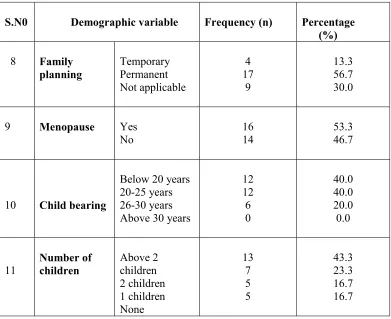
39
S.N0 Demographic variable Frequency (n) Percentage (%)
8 Family planning Temporary Permanent Not applicable 4 17 9 13.3 56.7 30.0
9 Menopause Yes
No
16 14
53.3 46.7
10 Child bearing
Below 20 years 20-25 years 26-30 years Above 30 years
[image:64.612.123.514.66.385.2]12 12 6 0 40.0 40.0 20.0 0.0 11 Number of children Above 2 children 2 children 1 children None 13 7 5 5 43.3 23.3 16.7 16.7
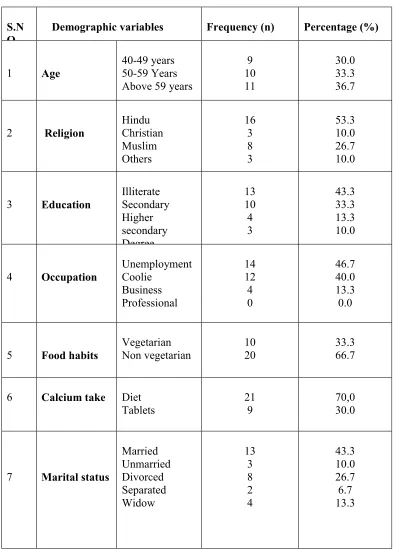
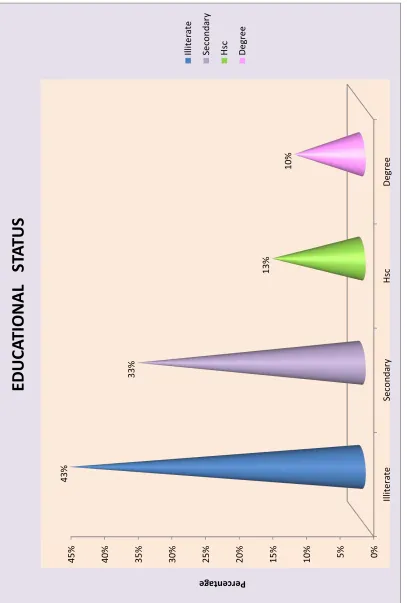
Table 1-.Revealed that in Figure 3 represent the percentage distribution of obese women with Joint pain in relation to age. Majority 11(36.7%) Figure 4observed the percentage distribution of obese women with Joint pain in relation to religion. Majority Hindus 16(53.3%) Figure 5 Shows the percentage distribution of obese women with Joint pain in relation to educational status degree 3 (10.0%) . Figure 6 depicts the percentage distribution of obese women with Joint pain in relation to occupation 14 (46.7%) Figure 7showed the percentage distribution of obese women with Joint pain in relation to family planning 17 (56.7%).
40
[image:65.612.73.482.78.705.2]
Fig 3: Percentage
Dist
ribution of
De
m
ographic Age
In Ye
a
r
s
of
Obese Wo
m
e
n With Joint Pain
0% 5% 10 % 15 % 20 % 25 % 30 % 35 % 40 % 40 -49 Y e ars 5 0 -59 Y e ars A bove 59 Y e ars 30.00 % 33.30 % 36.70 % Percentage
A
GE DIS
T
RIBUTION
40 -49 Y e ars 50 -59 Y e arsAbove 59 Y
e
41
Fig 4: Percentage
Dist
ribution
o
f De
m
o
g
r
aphic Variable of
Re
ligi
on of
O
b
ese Women With Joint Pain
53%
10%
27%
10%
RELIGION
Hindu Chris
tian
Mus
clim
42
Fig 5: Percentage
Dist
ribution
o
f De
m
o
g
r
aphic Variable of
Ed
ucational Stat
us
of
Obese Women With Joint Pain
0% 5% 10 % 15 % 20 % 25 % 30 % 35 % 40 % 45 % Illite rate S econda ry Hsc D egre e 43% 33% 13% 10% Percentage
EDUCA
TIONAL ST
43
[image:68.612.72.478.69.684.2]
Fig 6: Percentage
Dist
ribution
o
f De
m
ographic Variable of
Occ
upation Distr
ibution
o
f O
b
ese Wo
m
e
n With
Joint Pain
44 0% 10% 20% 30% 40% 50% 60% T e m p orary Perm anent N ot ap plicab le 13% 57% 10%
Percentage
P
e
rc
ent
a
g
e
dis
tribution
of
demogr
aphic
v
a
riable
-F
amily
Planning
Tempora ry Perman e nt Not a p p licab leFig 7: Percentage
Dist
ribution
o
f De
m
ogr
aphic Variable of
Fam
ily
Planning
Am
ong Obes
e
Wo
m
e
n With Joint
45
Table 2 Frequency and percentage of clinical variables of obese women with
Joint pain( BMI, waist circumference, muscle strength, mobility status, duration
of Joint pain, swelling, use of comfort devices) (N=30)
S.No Clinical Variables Frequency(n) Percentage (%)
1 Body Mass Index a)25.0 ± 29.9 Overweight b)30.0 ± 39.9 obese
c)40 and aboveMorbid obese
8 12 10 27 40 30
2 Waist Circumference
a)High b)Very High c)Extremely High
7 13 10 23 43 33
3 Muscle Strength
a)Maximal Resistance b)Against Gravity c)No Contraction
8 11 11 27 37 37
4 Mobility Status
46
47
Fig 8: Percentage
Dist
ribution
o
f Clinical V
a
riable