Int. J. Electrochem. Sci., 14 (2019) 1751 – 1762, doi: 10.20964/2019.02.34
International Journal of
ELECTROCHEMICAL
SCIENCE
www.electrochemsci.org
A Novel Sensor Based on Ag Nanoparticles Functionalized with
Poly-Acid Chrome Blue K and Graphene for the Sensitive
Determination of Diclofenac Sodium
Qing Huang1, Xiaokun Li1,*, Suxiang Feng1, Wenfeng Zhuge1, Jinyun Peng2, Xiaoting Li2
1 School of Pharmacy, Henan University of Traditional Chinese Medicine, Zhengzhou 450046, China 2 College of Chemistry and Chemical Engineering, Guangxi Normal University for Nationalities,
Chongzuo 532200, China
*E-mail: [email protected]
Received: 10 May 2018 / Accepted: 20 June 2018 / Published: 5 January 2019
Ag nanoparticles functionalized with poly-acid chrome blue K and graphene (Ag-poly-ACBK@Gr) were successfully fabricated on the surface of a glassy carbon electrode using layer-by-layer electropolymerization. The surface structure of the synthesized modified glassy carbon electrode was characterized by scanning electron microscopy. The electrochemical behaviours of diclofenac sodium (DS) at the Ag-poly-ACBK@Gr-modified electrode were investigated by cyclic voltammetry and differential pulse voltammetry. It was found that the prepared sensor exhibited a cathodic peak at 0.78 V with higher peak current response compared to the related modified electrodes. Under optimal conditions, the sensor for the determination of DS exhibits a good linear relationship between the peak current and DS concentration in the range from 0.1 to 40 μM, and the equation is Ip(μA) = 7.23 × 10³c(μM) + 3.46 × 10⁻² (R = 0.9955) with the estimated limit of detection of 34.2 nM (S/N = 3). The
Ag-poly-ACBK@Gr-modified glassy carbon electrode with high sensitivity and excellent stability and selectivity was successfully applied to detect DS in real drugs and human urine at the recoveries ranging from 99.60 to 101.84%.
Keywords: Ag-poly-ACBK@Gr; Diclofenac sodium; Electrochemistry
1. INTRODUCTION
DS in pharmaceutical preparations. In recent years, common techniques such as the UV spectrophotometric method [7], high-performance liquid chromatography [8], fluorometry [9] and electrochemistry [10] have been applied to the quality monitoring of DS. It is worth noting that electrochemistry was applied to trace detection with some advantages of high sensitivity, low limit of detection, fast testing speed and simple equipment and low cost [11-14]. The current study presents a novel sensor based on a strategy to achieve ultra-sensitive DS determination.
Chemically modified electrodes refer to the molecular design on the surface of the electrode. This approach fixes the molecules, ions or polymers with excellent chemical properties on the surface of the electrodes in the form of a chemical film, conferring some specific chemical and electrochemical properties on the electrodes [15-16]. Electroactive polymer-modified electrodes have attracted wide attention due to their high sensitivity and excellent adsorption capacity [17]. In addition, electrical polymerization techniques not are only simple and easy to carry out but also can be used for the control of the film thickness [18]. Therefore, this approach has been widely used in biology, environment analysis, chemical analysis, medicine and other fields [15].
Acidic chrome blue K (ACBK), a kind of dyestuff with electrochemical catalytic activity, usually plays the role of the redox indicator in chemistry titration [19]. Meanwhile, it is also an organic conjugate compound with special structure [20]. ACBK was fixed on the electrode surface using electropolymerization, and then, a polymer film, such as poly(methylene blue) [21], polyazulene [22], and poly(glycine) [23], was obtained. Graphene (Gr) is a thin carbon material with excellent conductivity and mechanical properties [24]. It is now used in biology, medicine and electricity analysis owing to its large specific surface area and biocompatibility [25-26]. Therefore, the composite of ACBK and Gr is used as an electrochemical polymerization modified glassy carbon electrode (poly-ACBK@Gr/GCE) to obtain larger active surface, better conductivity, and higher stability [27]. Ag nanoparticles have high medical value owing to their good fungal resistance [28-29]. Moreover, Ag nanoparticles are extremely popular with researchers because of their advantages of large surface areas, special binding sites, nontoxicity, and strong conductivity [30].
In the work, based on the poly-ACBK@Gr/GCE platform, Ag nanoparticles were uniformly fixed on the surface of poly-ACBK@Gr using a layer-by-layer of electropolymerization to obtain the composite film, namely, Ag nanoparticles functionalized with poly-ACBK@Gr (Ag-poly-ACBK@Gr). The thickness of the composite film could be controlled, and the overall electro-catalytic performance was improved. The Ag-poly-ACBK@Gr-modified GCE was applied for the determination of DS by differential pulse voltammetry (DPV) with excellent response. There are no previous reports on the direct electrochemical measurement of DS based on Ag-poly-ACBK@Gr. Therefore, this strategy should be considered.
2. EXPERIMENTAL SECTION
2.1. Reagents and instruments
respectively. ACBK was purchased from the Guangzhou chemical reagent factory in China. Other reagents were obtained from Aladdin industrial corporation (Shanghai, China) and were of analytical grade. Phosphate buffer solution (PBS) was used as the electrolyte and was prepared using 0.2 M Na2HPO4 and 0.2 M KH2PO4 solution containing 0.1 M NaCl.
The surface morphologies of poly-ACBK@Gr and Ag-poly-ACBK@Gr were examined by scanning electron microscopy (SEM, ZEISS EVO18, Germany). The electrochemical experiments were performed using a CHI660D electrochemical workstation (ChenHua Instruments Co., Shanghai, China) with a three-electrode system: a GCE with the diameter of 3 mm was used as the working electrode, a calcium electrode was used as the indicator electrode, and a calomel electrode was used as the reference electrode.
2.2. Fabrication of Ag-poly-ACBK@Gr/GCE
Graphene oxide (GO) was obtained by the Hummers method [31]. One hundred milligrams of synthesized GO was dispersed into 50 mL deionized water by ultrasonication to obtain a suspension which was reduced in 80 °C for 2 h after the addition of 1 g of NaBH4. The product was cleaned with
deionized water, and Gr was obtained via vacuum drying at 45 °C for 12 h [32]; 0.5 mg of obtained Gr was dispersed in 1 mL of 1 mM ACBK solution to prepare the ACBK@Gr suspension. The glassy carbon electrode (GCE) was polished to a mirror-like finish with 1.0, 0.3 and 0.05 μm alumina polishing solutions, respectively, and then rinsed with deionized water and dried by high-purity nitrogen. The procedure for the fabrication Ag-poly-ACBK@Gr-modified GCE was as follows: in the first step, the bare GCE was immersed into the ACBK@Gr suspension and the potential range from -1.4 V to 0.2 V was swept in 40 segments at the scan rate 50 mV s-1, and a poly-ACBK@Gr film on the surface of GCE was obtained. Second, the poly-ACBK@Gr modified GCE continued to be immersed into 1 mM AgNO3 containing 0.1 M KNO3 solution, and the potential range from -1.5 V to 2.1 V was
swept for 20 segments at the scan rate 100 mV s-1, and Ag functionalized with poly-ACBK@Gr
modified GCE was prepared successfully, and then the Ag-poly-ACBK@Gr/GCE was rinsed with deionized water for further expansion. For comparison, Gr/GCE, ACBK@/GCE and poly-ACBK@Gr/GCE were fabricated using similar procedures.
2.3. Procedure for real samples
3. RESULTS AND DISCUSSION
3.1. Characterization of modified GCE
Figure 1. CVs of functionalization of Ag nanoparticles on the surface of poly-ACBK@Gr/GCE in 1 mM AgNO3 containing 0.1 M KNO3 solution. The cycling number is 28. Inset: enlarged image.
[image:4.596.164.432.129.326.2] [image:4.596.69.535.377.746.2]
The poly-ACBK@Gr/GCE was swept continuously at the potential range from -1.5 V to 2.1 V for 28 cycles at the scan rate 100 mV s-1 in 1 mM AgNO3 containing 0.1 M KNO3 to obtain a film of
Ag-poly-ACBK@Gr on the surface of GCE. The cyclic voltammetry curves (CVs) are shown in Fig. 1, and an anodic peak current at about -0.35 V increasing with the cycling number is observed and tends to be stable after 16 segments. It was indicated that Ag nanoparticles were modified successfully on the surface of poly-ACBK@Gr/GCE.
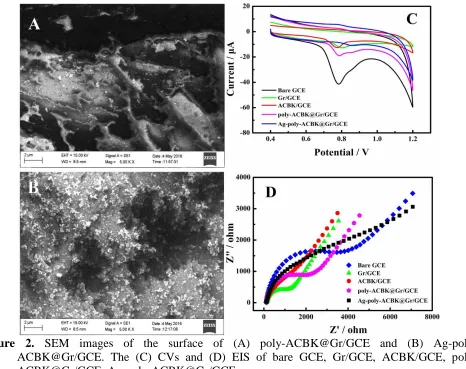
The surface morphologies of poly-ACBK@Gr/GCE and Ag-poly-ACBK@Gr/GCE were characterized by SEM (Figs. 2A and B). A thin film with pleated construction on the GCE can be clearly seen in Fig. 2A, indicating that Gr can become a modified GCE through electro-deposition [21]. Furthermore, the composite of ACBK and Gr shows enhanced surface area to provide more opportunity for further functionalization. An examination of Fig. 2B shows that many Ag nanoparticles were immobilized on the rough surface of poly-ACBK@Gr/GCE, and the sizes of the Ag nanoparticles are in the range from 20 to 30 nm. The morphology is in agreement with the results of the previous work [21]. The addition of Ag nanoparticles enables the whole material to obtain a larger surface area which directly contributes to the enhancement of adsorption behaviour.
The cyclic voltammetry curves (CVs) for bare GCE, Gr/GCE, ACBK/GCE, poly-ACBK@Gr/GCE, Ag-poly-ACBK@Gr/GCE in 0.2 M PBS (pH 2.5) buffer containing 20 μM DS at the scan rate of 0.1 V s-1 are shown in Fig. 2C. A cathodic peak potential (Ep) on Ag-poly-ACBK@Gr/GCE was found at 0.78 V, and the corresponding peak current (I, 29.01 μA), by contrast, was 17 times that of bare GCE (1.68 μA). It was demonstrated that the catalytic efficacy to DS at Ag-poly-ACBK@Gr/GCE was substantially improved, and the method was expected to be applicable for further quantitative determination. Electrochemical impedance spectroscopy (EIS) of different modified electrodes was carried out in 5 mM [Fe(CN)6]3−/4− solution containing 0.1 M KCl with the
same parameters. As displayed in Fig. 2D, in the low-frequency region, the diameters of Gr/GCE and ACBK/GCE were smaller than those for the bare GCEs, indicating that Gr and ACBK showed a low charge transfer resistance. However, the diameter of Ag-poly-ACBK@Gr/GCE is greater than that of the poly-ACBK@Gr/GCEs. According to Fuchs' theory [33], the phenomenon of decrease in the conductivity is attributed to the additional scattering at the surface of poly-ACBK@Gr/GCE when the electron mean free path becomes comparable to the thickness of the metal film. The results demonstrated that silver ions in silver nitrate had been transformed into Ag nanomaterials through electrochemical deposition, and the Ag nanomaterials had successfully modified the film of poly-ACBK@Gr.
3.2. Effect of pH
of linear regression is Ep(V) = – 0.035pH + 0.90, R=0.9960. According to the theoretical equation [34] Ep = – 0.059(m/n)pH + Eθ, it is demonstrated that the numbers of proton transferred (m) were not equal to electron transferred (n) in the electrochemical reaction of DS, and the ratio (m/n) was calculated to be 0.59. The results may be ascribed to the formation of the ACBK@Gr polymer corresponding to unequal proton/electron reaction on the nanoparticles film [35]. The variation of the ratio was also discussed in nanohybrid film/microperoxidase [36].
Figure 3. Influence of (A) pH in PBS solution containing 20 μM DS. (B) Corresponding data.
3.3. Effect of san rates
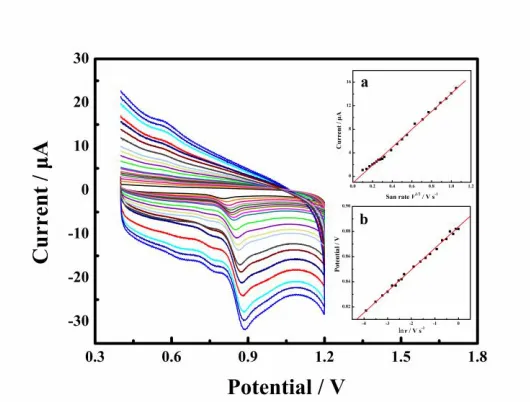
Figure 4. CVs of DS in pH 2.5 PBS buffer at different san rates in the range from 0.01 to 0.12 V s-1. Inset a: linear relationship of peak current (Ip) and the square root of san rate (v1/2). Inset b: the linear relationship of peak potential (Ep) and logarithm of scan rates (lnv).
[image:6.596.75.519.175.343.2] [image:6.596.166.431.424.625.2]
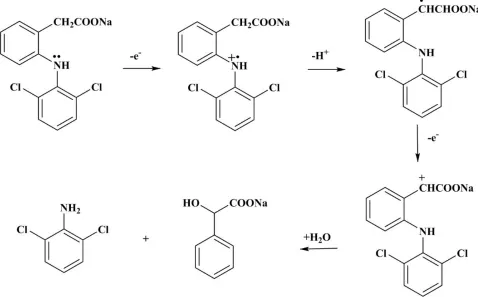
was essentially controlled by diffusion. The peak potential shows a positive drift with linearity and the equation is Ep = 0.0176lnv + 0.8843, R = 0.9968. The irreversible reduction in DS with the scan rate increases by 10 times, and Ep shifts positively by 1.15 RT/αF units [R is the gas constant, 8.314J (mol·K)-1; T is thermodynamic temperature, 298.15 K; F is the Faraday constant, 96,485 C mol-1; α is the electron transfer coefficient]. According Laviron's equation [37], α and n were calculated to be 0.62 and 2.30 (approximately equal to 2), respectively. The results showed that the electrochemical behaviours of DS are reduction reactions with two-electron transfer and one-proton transfer. The mechanism of the reaction on the Ag-poly-ACBK@Gr/GCE is presented in Scheme 1.
Scheme 1. Electrochemical mechanism of DS detection at the Ag-poly-ACBK@Gr/GCE.
3.4. Chronocoulometry studies
[image:7.596.58.536.227.524.2]The effective surface area was investigated for different modified electrodes in 1 mM [Fe(CN)6]3−/4− solution containing 0.1 M KCl by the chronocoulometry (CC) technique. As shown in
been improved after GEC was fabricated by layer-by-layer electropolymerization. Specifically, the addition of Ag nanoparticles enabled a great improvement in the effective surface area of the electrode.
Figure 5. Plot of (A) Q~t and Q~t1/2 curve of bare/GCE, Gr/GCE, ACBK/GCE, poly-ACBK@Gr/GCE, Ag-poly-ACBK@Gr/GCE.
3.5. DS determination
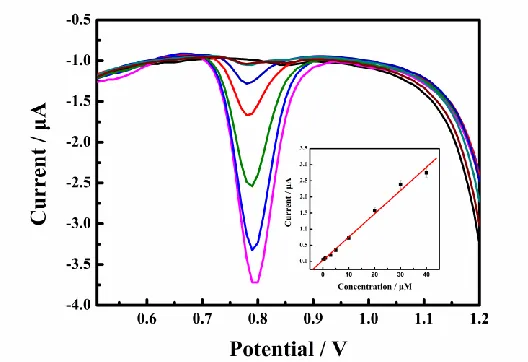
Fig. 6 shows the differential pulse voltammetry curves (DPVs) of Ag-poly-ACBK@Gr/GCE for a series of DS concentrations under optimal conditions. As seen, the cathodic peak current increases with DS concentration increasing and presents a good linear relationship at the DS concentration range from 0.1 to 40 μM.
Figure 6. DPVs of Ag-poly-ACBK@Gr/GCE in different DS concentrations in the range from 0.1 to 40 μM.
[image:8.596.57.543.124.314.2] [image:8.596.166.430.496.677.2][image:9.596.72.524.253.462.2]
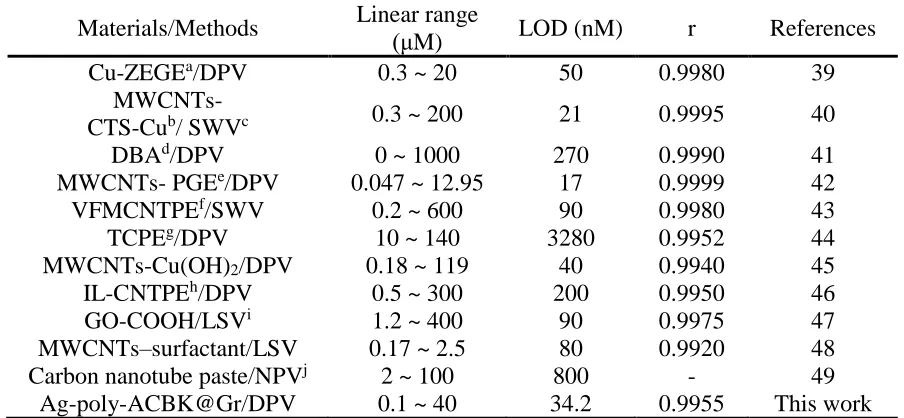
active surface area and excellent electrocatalytic activity of Ag-poly-ACBK@Gr, DS concentration in the surface layer of Ag-poly-ACBK@Gr/GCE effectively increases its peak current. The comparison of Ag-poly-ACBK@Gr/GCE with other recent studies for DS detection is presented in Table. 1. The initial concentration of the linear range of the prepared sensor was lower than those for other electrochemical sensors, and the limit of detection was superior to most sensors. These results indicated that the Ag-poly-ACBK@Gr can be applied for the monitoring of DS with excellent linear concentration range, considerable sensitivity and a low limit of detection.
Table 1. Comparison of Ag-poly-ACBK@Gr/GCE to other recent DS detection studies.
Materials/Methods Linear range
(μM) LOD (nM) r References
Cu-ZEGEa/DPV 0.3 ~ 20 50 0.9980 39
MWCNTs-
CTS-Cub/ SWVc 0.3 ~ 200 21 0.9995 40
DBAd/DPV 0 ~ 1000 270 0.9990 41
MWCNTs- PGEe/DPV 0.047 ~ 12.95 17 0.9999 42
VFMCNTPEf/SWV 0.2 ~ 600 90 0.9980 43
TCPEg/DPV 10 ~ 140 3280 0.9952 44
MWCNTs-Cu(OH)2/DPV 0.18 ~ 119 40 0.9940 45
IL-CNTPEh/DPV 0.5 ~ 300 200 0.9950 46
GO-COOH/LSVi 1.2 ~ 400 90 0.9975 47
MWCNTs–surfactant/LSV 0.17 ~ 2.5 80 0.9920 48
Carbon nanotube paste/NPVj 2 ~ 100 800 - 49
Ag-poly-ACBK@Gr/DPV 0.1 ~ 40 34.2 0.9955 This work
a Cu-doped zeolite-modified expanded graphite-epoxy composite. b Copper ions on
MWCNTS-Chitosan thin film. c Square wave voltammetry. d Amino-functionalized diclofenac binding aptamer. e Multiwalled carbon nanotubes modified pencil graphite electrode. f Vinylferrocene modified multiwall carbon nanotubes paste electrode g Tyrosine-modified carbon paste electrode h Ionic liquid-modified carbon nanotubes paste electrode. i Linear sweep voltammetric. j Normal pulse voltammetry.
3.5. Reproducibility, stability and selectivity
Five electrodes were modified in the same manner for the detection of 20 μM DS under the same conditions, and the obtained peak currents were 1.70 μA, 1.66 μA, 1.63 μA, 1.67 μA and 1.64 μA. The calculated relative standard deviation (RSD) of the Ag-poly-ACBK@Gr/GCE was 1.65%, indicating that the sensor had an excellent reproducibility. Furthermore, the stability of the sensor was investigated. The Ag-poly-ACBK@Gr/GCE was stored in a refrigerator at 4 °C for 7 days; 95.33% of its initial peak current was obtained for DS detection, indicating that the sensor shows strong stability.
including glucose, lactose, sucrose, soluble starch, dextrin, uric acid and urea, did not interfere with the detection of DS. The 1 μM DS solution contained 100 μM interference. This outcome demonstrated that the designed sensor has an excellent selectivity.
3.6. Real samples analysis
Table 2. Results of DS detection for sustained release tablets, capsules and human urine samples.
Sample
Initial DS in the sample
(μM)
Added DS concentration
(μM)
The detection concentration
(μM)
Recovery ± RSD (%, n=5)
Tablets 22.4 6.07 28.5 101.13 ± 1.12
Capsules 24.6 3.06 27.7 101.84 ± 1.81
Urine 0 10.00 9.96 99.60 ± 0.40
To verify the feasibility of the use of Ag-poly-ACBK@Gr/GCE for DS detection in real samples, diclofenac sodium-sustained release tablets, capsules and human urine were studied by using the standard addition method. The results are shown in Table. 2, and it can be seen that RSD was no greater than 2% and that the standard recovery rate was in the range from 99.60 to 101.84%. It was demonstrated that the Ag-poly-ACBK@Gr/GCE could be applied for the determination of human urine and different doses of real DS samples.
4. CONCLUSION
In this work, we have prepared a novel sensor based on Ag-poly-ACBK@Gr electro-chemical material-modified glassy carbon electrodes by using layer-by-layer electropolymerization, with larger working surface area and special structures. The prepared sensor shows excellent electrocatalytic efficiency towards DS, with the advantages of high sensitivity, stability and selectivity. Meanwhile, it exhibits a low detection limit of 34.2 nM and linear range from 0.1 to 40 μM for DS. Furthermore, it could be applied to the detection of DS in human urine and related drugs.
ACKNOWLEDGEMENTS
The authors wish to thank the National Natural Science Foundation of China (Grant No. 21465004) for fellowships and financial support.
References
1. M. Shalauddin, S. Akhter, S. Bagheri, M.S. Abd Karim, N. Adib Kadri, W.J. Basirun, Int. J. Hydrogen Energy, 42(31) (2017) 19951-19960.
3. Q. Huang, S. Deng, D. Shan, Y. Wang, B. Wang, J. Huang, G. Yu, J. Colloid Interface Sci., 488 (2017) 142-148.
4. A. Afkhami, A. Bahiraei, T. Madrakian, Mater Sci Eng C Mater Biol Appl, 59 (2016) 168-176. 5. M. Schriks, M.B. Heringa, M.M. van der Kooi, P. de Voogt, A.P. van Wezel, Water Res., 44(2)
(2010) 461-76.
6. B.N. Bhadra, P.W. Seo, S.H. Jhung, Chem. Eng. J., 301 (2016) 27-34.
7. S. Savale, H. Mahajan, Asian Journal of Biomaterial Research, 3(2) (2017) 40-43 8. S.D. Labhade, S.R Chaudhari, R.B. Saudagar, IJSRST, 2(4) (2018) 1413-1417
9. A.A. Gouda, M.I. Kotb El-Sayed, A.S. Amin, R. El Sheikh, Arabian J. Chem., 6(2) (2013) 145-163.
10.L. Kashefi-Kheyrabadi, M.A. Mehrgardi, Biosens. Bioelectron., 33(1) (2012) 184-9.
11.S. Gandhi, A. Talan, A. Mishra, S.A. Eremin, J. Narang, A. Kumar, Biosens. Bioelectron., 105 (2018) 14-21.
12.M.M. Musameh, C.J. Dunn, M.H. Uddin, T.D. Sutherland, T.D. Rapson, Biosens. Bioelectron., 103 (2018) 26-31.
13.A. Kaushik, S. Tiwari, R.D. Jayant, A. Vashist, R. Nikkhah-Moshaie, N. El-Hage, M. Nair, Trends Biotechnol., 35(4) (2017) 308-317.
14.S. Tanaka, Y.V. Kaneti, R. Bhattacharjee, M.N. Islam, R. Nakahata, N. Abdullah, S.I. Yusa, N.T. Nguyen, M.J.A. Shiddiky, M.S.A. Hossain, Y. Yamauchi, ACS Appl. Mater. Interfaces, 10(1) (2018) 1039.
15.M. Sajid, M.K. Nazal, M. Mansha, A. Alsharaa, S.M.S. Jillani, C. Basheer, TrAC, Trends Anal. Chem., 76 (2016) 15-29.
16.F. Pepi, A. Tata, S. Garzoli, P. Giacomello, R. Ragno, A. Patsilinakos, M.D. Fusco, A.
D’Annibale, S. Cannistraro, C. Baldacchini, G. Favero, M. Frasconi, F. Mazzei, J. Phys. Chem. C, 115(11) (2011) 4863-4871.
17.G. Pankratova, K. Hasan, D. Leech, L. Hederstedt, L. Gorton, Electrochem. Commun., 75 (2017) 56-59.
18.M.-T. Hsieh, T.-J. Whang, Appl. Surf. Sci., 396 (2017) 1589-1595. 19.W. Sun, J. Han, K. Jiao, L. Lu, Bioelectrochemistry, 68(1) (2006) 60-66.
20.R. Zhang, G.-D. Jin, D. Chen, X.-Y. Hu, Sens. Actuators, B, 138(1) (2009) 174-181.
21.S. Yang, G. Li, J. Zhao, H. Zhu, L. Qu, J. Electroanalytical Chem., 717-718 (2014) 225-230. 22.N. He, R.E. Gyurcsanyi, T. Lindfors, Analyst., 141(10) (2016) 2990-7.
23.P.V. Narayana, T.M. Reddy, P. Gopal, G.R. Naidu, Anal. Methods, 6(23) (2014) 9459-9468. 24.E.B. Bahadır, M.K. Sezgintürk, TrAC, Trends Anal. Chem., 76 (2016) 1-14.
25.C. Gardin, A. Piattelli, B. Zavan, Trends Biotechnol., 34(6) (2016) 435-437.
26.N. Dubey, K. Ellepola, F.E.D. Decroix, J.L.P. Morin, A.H. Castro Neto, C.J. Seneviratne, V. Rosa, Nanotoxicology, 12(4) (2018) 274-289.
27.X. Lin, Y. Ni, S. Kokot, J. Hazard. Mater., 260 (2013) 508-17.
28.F. Furno, K.S. Morley, B. Wong, B.L. Sharp, P.L. Arnold, S.M. Howdle, R. Bayston, P.D. Brown, P.D. Winship, H.J. Reid, J. Antimicrob. Chemother., 54(6) (2004) 1019-1024.
29.V. Marassi, L.D. Cristo, S.G.J. Smith, S. Ortelli, M. Blosi, A.L. Costa, P. Reschiglian, Y. Volkov, A. Prinamello, Royal Society Open Science, 5(1) (2018) 171113.
30.X. Liu, X. Liu, H. Wei, G. Song, H. Guo, X. Lu, Sens. Actuators, B, 252 (2017) 503-510. 31.F. Li, X. Jiang, J. Zhao, S. Zhang, Nano Energy, 16 (2015) 488-515.
32.Y. Song, J. Yang, K. Wang, S. Haller, Y. Wang, C. Wang, Y. Xia, Carbon, 96 (2016) 955-964. 33.K. Fuchs, Proc. Camb. Phil. Soc. 11 (1938), 100-108.
34.T. Zhana, Z. Tana, X. Wanga, W. Houb, Sens. Actuators, B, 255 (2018) 149–158. 35.L.Shen, N. Hu, Biochimica et Biophysica Acta 1608 (2004) 23-33.
38.D. Jia, L. Wang, Y. Gao, L. Zou, B. Ye, J. Electroanal. Chem., 764 (2016) 56-63.
39.F. Manea, M. Ihos, A. Remes, G. Burtica, J. Schoonman, Electroanalysis, 22(17-18) (2010) 2058-2063.
40.M. Shalauddin, S. Akhter, S. Bagheri, M.S. Abd Karim, N. Adib Kadri, W.J. Basirun, Int. J. Hydrogen Energy, 42(31) (2017) 19951-19960.
41.L. Kashefi-Kheyrabadi, M.A. Mehrgardi, Biosens. Bioelectron., 33(1) (2012) 184-9. 42.G.P. Fard, E. Alipour, R.E. Ali Sabzi, Anal. Methods, 8(19) (2016) 3966-3974.
43.A. Mokhtari, H. Karimi-Maleh, A.A. Ensafi, H. Beitollahi, Sensors and Actuators B: Chemical, 169 (2012) 96-105.
44.B.K. Chethana, S. Basavanna, Y. Arthoba Naik, Ind. Eng. Chem. Res., 51(31) (2012) 10287-10295. 45.M. Arvand, T. M. Gholizadeh, M. A. Zanjanchi, Materials Science and Engineering C, 32 (2012)
1682–1689.
46.A. A. Ensafi & M. Izadi & H. Karimi-Maleh, Ionics, (2013) 19:137–144.
47.C. Karuppiah, S. Cheemalapati, S.M. Chen, S. Palanisamy, Ionics, 21 (2014) 231. 48.Y. XF, W. SH, Mater Sci Eng C, (2010) 28:188.
49.A. Ambrosi, R. Antiochia, L. Campanella, R. Dragone, I. Lavagnini, J Hazard Mater, (2005) 122:219.