A THESIS SUBMITTED FOR THE DEGREE OF DOCTOR OF PHILOSOPHY
OF THE
AUSTRALIAN NATIONAL UNIVERSITY
University.
for their considerable support and interest throughout this study. Dr Cook provided many thoughtful discussions and careful consideration of draft manuscripts. Dr Danta contributed his substantial clinical expertise both to the study and the manuscript and provided much of the practical support without which this project would never have been completed. I must offer a special thanks to Dr Bill Burch for his generous contribution of time and energy to the design of the micro-computer based test equipment.
Other contributors and advisors to the project included Ms Lynne Geary, Sister Ruth Kidd, Ms Debbie Lopert, Dr Felicia Huppert and Professor Noel Butlin.
in epileptics. This study examined the effects of three major anticonvulsants, phenytoin, carbamazepine and sodium valproate, on the memory function of epileptic patients.
Studies of the effects of anticonvulsants on memory function have been fraught with methodological problems. The results from studies of non-epileptics have limited applicability to the use of these drugs in clinical practice. Studies of epileptics, on the other hand, are often difficult to interpret because of methodological weaknesses largely inherent in examining clinical populations. In spite of these methodological difficulties, the effects of the drugs are of considerable interest. Anticonvulsants are used over very long periods, sometimes a whole life-time and on a significant proportion of the general population. There is a significant possibility that the side-effects of treatment may be worse than the benefits for some patients.
This study examined epileptic patients in a clinical setting but attempted to improve on the research methodology that has generally been the case in the past. Experiment 1 examined previously untreated epileptics before and three months after monotherapy with phenytoin, carbamazepine or sodium valproate and compared these with untreated non-epileptic controls. Experiment 2 compared the memory performance of patients treated with phenytoin and then either remaining on phenytoin or switched to carbamazepine. Experiment 3 compared the memory performance of epileptics treated with carbamazepine and then either remaining on carbamazepine or switched to sodium valproate. Experiment 4 examined the relationships between dose and blood level of phenytoin, carbamazepine or sodium valproate and folate with memory function.
1.1 THE PROBLEM 2 1.2 EFFECTS OF ANTICONVULSANT DRUGS ON 5
COGNITION
1.3 EFFECTS OF ANTICONVULSANT DRUGS ON MEMORY 1.3.1 The Effect of Phenobarbitone on Memory
1.3.2 The Effect of Phenytoin on Memory
1.3.3 The Effect of Carbamazepine on Memory 12 1.3.4 The Effect of Sodium Valproate on Memory 15 1.3.5 Summary of the Effects of Drugs on Memory 17 1.4 POSSIBLE PHYSIOLOGICAL MECHANISMS UNDERLYING 17
MEMORY IMPAIRMENT
1.4.1 Folic Acid, Anticonvulsants and Cognition 18 1.4.2 Summary of the Effects of Folate on Memory 19
1.5 CONCLUSION 20
1.6 SUMMARY OF MAIN POINTS 21
CHAPTER 2 METHODOLOGICAL PROBLEMS IN THE 22
STUDY OF THE EFFECTS OF ANTICONVULSANTS ON MEMORY
2.1 THE EFFECT OF EXPERIMENTAL DESIGN ON 23 CONCLUSIONS
2.2 THE EFFECT OF SUBJECT SELECTION ON . 27 EXPERIMENTAL RESULTS
2.3 THE EFFECT OF EPILEPTIC STATUS AT THE TIME OF 31 TESTING
2.4 THE EFFECT OF MOOD AT THE TIME OF TESTING 32 2.5 THE EFFECT OF INTER-ICTAL BEHAVIOUR CHANGES ON 35
EXPERIMENTAL RESULTS
2.6 THE EFFECT OF DRUG LEVELS ON EXPERIMENTAL 36 RESULTS
C
D
C
D
O
2.8 THE MEASUREMENT OF FOLATE LEVELS 39
2.9 THE EFFECT OF PSYCHOLOGICAL MEASURES ON 40
CONCLUSIONS
2.10 SUMMARY 42
CHAPTER 3 GENERAL INTRODUCTION TO THE 43
METHODOLOGY OF THE STUDY
3.1 INTRODUCTION 44
3.2 SUMMARY OF THE STUDY 45
3.2.1 Experiment One 48
3.2.2 Experiment Two 48
3.2.3 Experiment Three 48
3.2.4 Experiment Four 48
3.3 THE MEMORY TESTS 49
3.3.1 The Order of Administration of Parallel Forms 49 of the Test Battery
3.3.2 Changes to the Test Battery 50
3.3.3 The Nature of the Memory Battery 50
3.3.4 The Tests Used in the Memory Battery 53 3.4 THE SELECTION OF DRUGS FOR INVESTIGATION 63
3.5 SUMMARY 67
CHAPTER 4 SHORT-TERM EFFECTS OF 68
ANTICONVULSANTS ON THE MEMORY PERFORMANCE OF PREVIOUSLY
UNTREATED EPILEPTICS (EXPERIMENT 1)
4.1 INTRODUCTION 69
4.2 METHOD 69
4.2.1 Procedure 69
4.2.2 Subjects 70
4.2.3 Analysis 71
4.4.3 Comparisons with the Results of Other Research 81
4.5 CONCLUSIONS 83
CHAPTER 5 THE EFFECTS OF CHANGING 84
MEDICATION (EXPERIMENT 2 & 3)
5.1 INTRODUCTION 85
5.2 METHOD-EXPERIMENT 2 87
5.2.1 Procedure 87
5.2.2 Subjects 87
5.3 RESULTS-EXPERIMENT 2 88
5.4 METHOD-EXPERIMENTS 90
5.4.1 Procedure 90
5.4.2 Subjects 90
5.5 RESULTS - EXPERIMENT 3 91
5.6 DISCUSSION 93
5.7 CONCLUSIONS 96
CHAPTER 6 THE RELATIONSHIP BETWEEN BLOOD 98
LEVEL OF ANTICONVULSANT, RED CELL FOLATE AND MEMORY PERFORMANCE IN CHRONICALLY MEDICATED EPILEPTICS (EXPERIMENT 4)
6.1 INTRODUCTION 99
6.2 METHOD 100
6.2.1 Procedure 100
6.2.2 Subjects 100
6.2.3 Test Material 101
6.2.4 Analysis 101
6.3 RESULTS AND DISCUSSION 102
6.3.5 Correlations Between Folate and Memory Test 112 Performance Partialling Out Age, IQ and
Blood Level of Drug
6.3.6 Correlations Between Blood Level of Drug and 114 Memory Test Performance Partialling Out
Age, IQ and Folate
6.3.7 Comparisons Between Group Performances 114 Adjusted for Age, IQ and Folate (MANCOVA)
6.3.8 Summary of Results 115
6.3.9 Possible Effects of Folate on Memory 116 6.3.10 The Possible Role of Other Metabolic Factors 119
in the Production of Memory Impairment
6.3.11 The Effect of Confounding Variables on the Results 120
6.4 CONCLUSION 122
CHAPTER 7 GENERAL DISCUSSION 123
7.1 SUMMARY OF THE STUDY 124
7.2 PROBLEMS IN INTERPRETATION OF THE RESULTS 126 7.2.1 The Influence of EEG Activity on the Results 126 7.2.2 The Influence of Seizure Frequency on the Results 128 7.2.3 The Influence of Social and Emotional Factors 129
on the Results
7.2.4 The Influence of Parallel Test Administration 130 on the Results
7.2.5 The Influence of the Memory Tests on the Results 132 7.2.6 The Influence of Blood Levels of the Drugs on the Results 133
7.3 IMPLICATIONS FOR EPILEPSY 134
7.3.1 Comparison of Carbamazepine with Phenytoin 136 7.3.2 Benefits of Monotherapy and Therapeutic Ranges 137 7.3.3 Benefits of Routine Assessments in Clinical Practice 137
7.4 FUTURE RESEARCH 138
7.4.1 Effects of Folate Supplements on Cognition 138 7.4.2 Relationship of Folate Level to Normal Memory 139
of the memory battery
3.2 Summary of tests used but not analysed 159
3.3 Form A of the memory battery 162
APPENDICES TO CHAPTER 4 172
4.1 Data for Experiment 1 172
4.2 Analysis of Faces(2) test on Experiment 1 181
APPENDICES TO CHAPTER 5 182
5.1 Data for Experiment 2 182
5.2 Data for Experiment 3 187
5.3 Analysis of Faces(2) test on Experiment 2 192
APPENDICES TO CHAPTER 6 193
6.1 Data for Experiment 4 193
6.2 Full correlation coefficients matrix between 203 all variables
6.3 Correlation coefficients for epileptics 205
treated by monotherapy with phenytoin, carbamazepine and sodium valproate and summary of MANOVA and MANCOVA.
6.4 Pilot experiment on the effects of folate 218 supplements on phenytoin treated epileptics
epilepsy/drug effects
2.2 Theoretical relationship between dose and serum 37 anticonvulsant level for several individuals
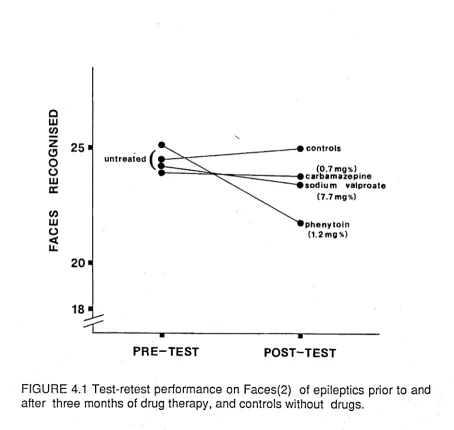
3.1 Layout of information processing task stimulus screen 60 3.2 Effects of anticonvulsants on seizures 66 4.1 Test-retest performance on Faces(2) of epileptics 72
prior to and after three months of drug therapy, and controls without drugs
5.1 Test-retest performance on Faces(2) for epileptics on 88 phenytoin or switched to carbamazepine from phenytoin
(Experiment 2)
2.1 Studies of the effects of anticonvulsants on memory function 25 classified on the basis of either an independent groups
design or a mixed repeated-measures design
2.2 Classification of epileptic seizures 29
2.3 Non-brain related factors associated with 33 psychopathology in epilepsy
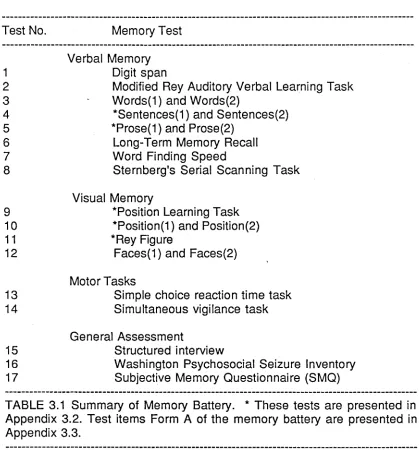
3.1 Summary of the memory battery 53
3.2 Available anticonvulsant drugs 63
3.3 Total number of prescriptions for anticonvulsants in the years 64 1980 and 1981 obtained through retail chemists, doctors and
approved private hospitals and excluding those obtained at public hospitals, private presciptions and repatriation scheme prescriptions in Australia.
3.4 Short-list of drugs for different types of epilepsy 65 4.1 Characteristics of the sample obtained for Experiment 1 71 4.2 Performance scores of epileptics prior to and after three 73
months of drug therapy epilepsy, and controls without drugs
5.1 Sample characteristics for epileptics remaining on 87 phenytoin (control) and those switching from phenytoin to
carbamazepine (switching)
5.2 Performance scores of epileptics treated with phenytoin 89 and then either remaining on phenytoin (contol) or switched to
carbamazepine and then tested three months later (switching)
5.3 Sample characteristics for epileptics remaining on 90 carbamazepine (control) and those switching from
carbamazepine to sodium valproate (switching)
5.4 Performance scores of epileptics treated with carbamazepine 92 and then either remaining on carbamazepine or switched to
sodium valproate and then tested three months later
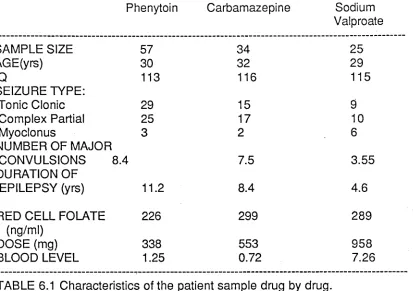
6.3 Mean performance scores of epileptics treated by mono therapy of phenytoin, carbamazepine or sodium valproate 6.4 Correlations between dose of anticonvulsant and memory
test performance scores
6.5 Correlations between serum level of anticonvulsant and memory test performance scores
6.6 Correlations between red cell folate level and memory test performance scores
6.7 Correlations with serum anticonvulsant levels and memory test performance scores after the effects of age and IQ were partialled out
6.8 Correlations between red cell folate levels and memory test performance scores after the effects of age and IQ were partialled out
6.9 Partial correlations between red cell folate levels and memory test performance scores after partialling out the effects of age, IQ and dose and blood level of antionvulsant 7.1 Average blood levels of the drugs for each of the experiments
106
109
110
110
111
112
113
1.1 THE PROBLEM
Epilepsy is generally treated with drugs. Table 1.1 shows the main anticonvulsant drugs in use today. Some of these have been used for more than forty years and yet we have a poor understanding of their mechanisms of action and their effects on even fundamental aspects of cognition such as memory. C linical experience and some experim ental evidence has raised the suspicion that these drugs may have adverse effects on memory. This study examines possible adverse effects of anticonvulsants on the memory function of epileptic patients.
ANTICONVULSANT DRUG YEAR OF INTRODUCTION
Phenobarbitone 1912
Phenytoin 1938
Primidone 1954
Ethosuximide 1960
Carbamazepine 1969
Sodium valproate 1973
Clonazepam 1975
TABLE 1.1 The year of introduction of the major anticonvulsant drugs. Adapted from Eadie and Tyrer (1980).
How is it that our understanding of the undesirable side -effe cts of anticonvulsant drugs has been so poor? Since epilepsy has a prevalence of between 0.5% and 1.0% of the general population (Beran, 1981) one might expect that prolonged treatment of large numbers of patients would have lead to a more presice understanding the side-effects of the anticonvulsants than is the case.
As you see, he is broken down in appearance, has large abscesses in his neck, and is altogether in a bad condition. But this is better than to have epilepsy.
However, surprisingly little is known about the psychological effects of the drugs. It is becoming increasingly clear that a better understanding of the psychological effects of the anticonvulsant drugs is important. Few people today would agree with Hammond's rather extreme therapeutic enthusiasm even when dealing with more modern drugs. The skilful use of drugs entails a careful balance between the potential benefits and hazards of long-term drug therapy. As Webster (1981) stated:
Nowhere is the 'total person' approach more important than in the management of epilepsy ... There has until recently been a lack of awareness by the practising doctor in recognising the side-effects and the potential hazards of long-term therapy with the common anti-epileptic drugs. It is slowly beginning to be appreciated that many patients have suffered as much, if not more, from the treatment than the disorder.
Although anticonvulsant drugs may affect cognition, other factors may also play a part. Structural abnormalities in the brain and seizure type and frequency are undoubtedly important factors associated with the occurrence of impaired cognition. Trimble and Thompson (1981) reviewing the relationships between memory, drugs and seizures, concluded that although the drugs may impair cognition, brain lesions in epileptics have been associated with specific cognitive deficits and that long-term memory appears to be affected by seizures.
estimated that the drugs were responsible for intellectual deterioration in about 15% of his cases. Although in subsequent work Lennox lowered this estimate to 5% (Lennox and Lennox, 1960) surveys of serum anticonvulsant levels in epileptics have indeed demonstrated that many are subjected to excessive levels of the medication which produced "apathy, somnolence and mental slowing" (Vadja, Walsh and Bladin, 1978).
Before serum anticonvulsant levels were available, doses of the drugs were gradually increased until seizures were controlled or frank toxic signs appeared. The dose was then reduced slightly (Trimble, 1981). Drugs were administered in this way, because it was found that variable doses were required for adequate seizure control (Pippenger, 1980).
An important advance in reducing adverse side-effects of anticonvulsants was made when Buchtal and Svensmark (1959/1960) introduced the concept of a therapeutic range of plasma drug levels. The upper bound of the therapeutic range represented the level of the drug at which the incidence of overt symptoms of intellectual or physical deterioration was low. The lower bound of the range represented a level of the drug below which seizure control was unsatisfactory. Subsequent studies (for example, Loeser, 1961; Kutt, Winters, Kokenge and McDowell, 1964; Wallis, Kutt and McDowell 1968; Kutt, 1971) demonstrated the clinical utility of plasma level assays for phenytoin. Further extensions of this work have led to the definition of therapeutic ranges for most of the anticonvulsants (Richens, 1976).
measured and with little regard to a variety of other confounding variables. While symptoms of "mental slowing, apathy and somnolence" (Vajda, et al, 1978) may be readily apparent above the therapeutic ranges, these and other side-effects may be present to a less overt degree at levels of the drugs that are within or below the therapeutic ranges.
The difficulty in determining whether anticonvulsants impair cognition stems from the difficulties of separating the effect of epilepsy and the anticonvulsants on cognition. As noted above, epilepsy is associated with cognitive impairments. Systematic studies including groups of untreated epileptics are frought with ethical considerations (this point will be considered further below). Under this constraint, research in this area has tended to confound the two.
1.2 EFFECTS OF ANTICONVULSANT DRUGS ON COGNITION
Trimble and Reynolds (1976) reviewing the evidence for an effect of anticonvulsant drugs on mental symptoms, commented that there were few well-controlled studies which included sufficient numbers of patients studied over reasonable periods using a broad spectrum of psychological measures and reporting blood levels of the drugs. Nonetheless, they concluded that:
Some evidence suggests that subtle mental changes may occur even with blood levels of the drug that are within or below the currently accepted therapeutic ranges....
Subsequent studies (e.g. Marchesi, Ladavas, Sei Pesce, Fua and Guilliani, 1981; Thompson, Huppert and Trimble 1980a, 1980b, 1981; Thompson and Trimble, 1981, 1983; Trimble and Thompson, 1981, 1983) tended to confirm this view.
attention and a number of important studies by Thompson (1981) indicate that phenytoin, carbamazepine and sodium valproate may have an adverse effect on memory. However, her studies using epileptic subjects have proved difficult to interpret. The purpose of this study is to examine the effects of the anticonvulsants, as used in clinical practice, on memory in epileptics.
1.3 EFFECTS OF ANTICONVULSANT DRUGS ON MEMORY
Some studies of the effects of the most commonly used anti-epileptic drugs - phenobarbitone, phenytoin, carbamazepine and sodium valproate - on memory in adults have been carried out. These will now be reviewed.
1.3.1 The Effect of Phenobarbitone on Memory
Phenobarbitone was first introduced in 1912 and rapidly replaced the use of bromides as the predominant treatment for epilepsy (Eadie and Tyrer, 1980). Although phenobarbitone enjoys less popularity today, it is still used extensively, especially in France (Reynolds and Shorvon, 1981).
Wapner, Thurston and Holowach (1962) studied the effect of phenobarbitone on epileptic children who were having at least three seizures a day. They used a six-week pre-test post-test design including non-epileptic controls matched for age, sex, IQ and race. Two forms of the Stanford-Binet Intelligence Scale were administered and a picture vocabulary test and a multiple T stylus maze (Deutsch, 1953) were used as measures of learning. There were no significant differences in the pre- and post-test performances of the epileptic children. However, since the children had significantly fewer seizures, the effects of reduced seizures were confounded with the effects of the introduction of phenobarbitone.
(WAIS), Rey's Profile of Memory Test Performance and Rey's Test of Entangled Lines (a measure of perceptuo-motor abilities) to examine the relationship between phenobarbitone and psychometric test performance in 20 epileptics. Only the correlation between dose of the drug and performance on Object Assembly subtest of the WAIS was significant. However, seizure fequency and possible underlying brain damage were not controlled in this small sample.
Kalska (1976) examined the effects of phenobarbitone used in polytherapy with a cross-sectional design on a sample of 100 epileptics. High blood levels of the drug were associated with poorer scores on the Wechsler Memory Scale (WMS) and the Benton Visual Retention Test (BVRT). A similar result was not observed for phenytoin or carbamazepine.
MacLeod, Dekaban and Hunt (1978) also examined the effects of phenobarbitone, both alone and in combination with other drugs. They compared performance at high therapeutic levels of the drug with performance at low therapeutic levels of the drug. Nineteen epileptics were tested at low therapeutic levels and then retested one week later after increasing the dose. These workers found that access speed to short-term memory, as measured by the Sternberg serial scanning task (Sternberg, 1966) was significantly reduced at higher therapeutic levels than lower therapeutic levels. However, access speed to items in long-term memory, as measured by the Posner letter matching task, was not affected. They concluded that phenobarbitone had a deleterious effect on short-term memory but not long-term memory. Nevertheless, since the retest period was only one week, the effects observed may have been due to transient changes in performance, which may not have been aparent over longer periods of study.
performance of an epileptic control group in which no change was made to their medication. They found that performance on the WMS improved after reducing the dose of phenobarbitone, in spite of an increase in fit frequency, but that the level of the drug did not correlate significantly with performance. The retest interval in this case was six months.
Camfield, Chaplin, Doyle, Shapiro, Cummings and Camfield (1979) studied a group of infants who had had a single febrile convulsion, using a double-blind placebo controlled procedure. A significant negative correlation with performance on some subtests of the Stanford-Binet Intelligence Scale was reported. Although the actual scales were not identified in the report, the authors labelled the scales as assessing memory and concentration. A trend towards greater impairment with longer exposure to the drug was also noted.
Marchesi et al (1981) studied the effects of phenobarbitone, phenytoin and carbamazepine on performance by 26 previously untreated epileptics on a specially designed memory battery. The epileptics were untreated on the first test and then retested 'at least' one month later. They found significant impairment of memory performance in patients receiving phenobarbitone on a variety of different memory tests.
to the timing of the testing.
A majority of papers report that phenobarbitone has a deleterious effect on memory, even on relatively insensitive clinical tests of memory (Tchicaloff and Gaillard, 1970; Kalska, 1976; MacLeod et al, 1978; Oxley et al, 1979; Camfield et al, 1979; Marchesi et al, 1981; Salzman and Shader, 1973). Although the precise nature of the effect of phenobarbitone on memory function in epileptic patients remains unclear, some better controlled studies (MacLeod et al, 1978; Marchesi et al, 1981) suggest that phenobarbitone exerts a deleterious effect on short-term memory performance.
1.3.2 The Effect of Phenytoin on Memory
The use of phenytoin, introduced in 1938 (Eadie and Tyrer, 1980) was initially associated with many case reports of improvement in cognitive functioning in epileptics (Trimble and Reynolds, 1976). However, this improvement in functioning may have been due to the withdrawal or reduction of phenobarbitone as much as the introduction of phenytoin. Nonetheless, phenytoin has proved to be an extremely effective anti epileptic agent (Shorvon, Chadwick, Galbraith and Reynolds, 1978) and is now one of the most commonly used medications in the world today. In Australia in 1981, phenytoin accounted for 42% of all prescriptions for anticonvulsants filled under the National Health Scheme (but excluding those provided from hospital pharmacies).
properly controlled.
Rosen (1968) reported a study of 20 patients who were tested before and after being switched to either phenobarbitone or mysoline after treatment with phenytoin. He stated that:
Comparison of detailed psychological test batteries revealed a remarkable improvement in test results on the Wechsler Adult Intelligence Scale, Bender-Gestalt and other tests of intellectual and perceptual performance.
However, the precise extent of the this "remarkable improvement" was not documented in the report.
Tchicaloff and Gaillard (1970) reported a significant inverse relationship between dose of phenytoin and performance on the Arithmetic and Digit Span subtests of the WAIS. The authors suggested that the drug impaired performance by affecting attention and concentration. This result contradicts earlier-reports of patients becoming noticeably brighter and more alert following the introduction of phenytoin therapy, (e.g. Kimball and Horan, 1939; McCarton and Carson, 1939; Haward, 1968, 1970,
1973).
Dodrill (1975a) compared the performance of epileptics with low and high therapeutic levels of phenytoin on performance on the WAIS and the Halstead-Reitan Neuropsychological Battery. He found that high levels of the drug were associated with a greater degree of impairment on a majority of measures. However, performance on the Tactual Performance Test (TPT) was not impaired.
study. They found that performance on carbamazepine was superior on some measures but that there was no difference on the TPT.
Nolte, Wetzel, Bregman and Brintzenger (1980) studied eight epileptic children before and six months after treatment was initiated. A further eight children were tested prior to ceasing treatment and six months after treatment had ceased. Although the results were not significant, possibly due to the small sample sizes, Nolte et al (1980) did find that performance on the HAWIK Intelligence Test and measures of concentration, memory and perceptuo-motor skills were impaired after six months of treatment with phenytoin and that performance was improved after withdrawal of the drug.
Marches'! et al (1981) studied the effects of phenytoin on the performance of epileptic patients on a specially designed memory battery. The epileptics were untreated on the first test occasion and then followed up at least one month later. They reported significant impairment of memory performance in patients receiving phenytoin on a variety of different memory tests.
Thompson et al (1981) studied non-epileptic volunteers using a double-blind cross-over trials placebo controlled procedure. Subjects were assessed before and following two treatment periods of two weeks. A variety of tests using verbal and non-verbal material were used. These workers found highly significant impairment by phenytoin of memory function for both verbal and non-verbal material as well as adverse effects on mood, concentration and psychomotor performance.
However, the results were interpreted using an unprotected t test.
The better controlled of the studies reviewed above indicate that phenytoin has a deleterious effect on memory performance in epileptic patients (Marchesi et al, 1981; Thompson et al, 1981; Trimble and Thompson, 1983). Nonetheless, a significant proportion of papers report little or no effect or even an improvement in memory (Millichamp et al, 1969; Rosen 1968; Dodrill 1975a; Dodrill and Troupin 1977; Nolte et al, 1980). The possibility must be considered that some of the inconsistencies in the results reported may reflect the beneficial effect of withdrawal of other medication or a dose-dependent relationship between memory performance and blood level of phenytoin. Nonetheless, Trimble (1981) summarising a review of the effects of anticonvulsant drugs on cognitive abilities and behaviour concluded that:
...some drugs - particularly phenytoin - are
associated with a progressive decline in intellectual abilities which is often insidious and unrecognised.
1.3.3 The Effect of Carbamazepine on Memory
Although only available for the last fifteen years, carbamazepine has proved to be an extremely effective anticonvulsant, comparable in efficacy with phenytoin (Bird, Griffin, Mikalaszewska and Galbraith, 1966; Simonsen, Olesen, Kupl, Lund and Wendelobe, 1975). In addition, carbamazepine is believed to have a number of beneficial psychotropic effects. Dalby (1975) reviewing the literature, concluded that carbamazepine improved attention, concentration and perseverence. However, it is unclear whether this was a consequence of improved seizure control, effects of the drug on mood, withdrawal of other medication, placebo effects, or a genuine effect of the drug on cognition.
six months before the addition of carbamazepine to their drug regimens and for a further six months. They found that 34.4% of the children improved overall on tests of cognitive function, including memory, visuo-spatial and motor abilities, whereas 13.3% were more impaired and the remaining 52.3% showed no change.The authors concluded that carbamazepine had a beneficial effect. However, no control was made for practice or placebo effects nor was the possibility of drug interactions taken into account.
Leder (1970) using a double-blind procedure, studied the effect of adding carbamazepine or placebo to the drug regimens of 50 epileptics. Patients were assessed after three months of placebo or carbamazepine using tests of memory, concentration and psychomotor ability. Patients also completed rating scales for mood. There was a general trend towards improvement on carbamazepine for scores on the test of attention. Improvements in mood were also noted. The authors described their patients as becoming 'more adapatable and quicker in their actions, thought and speech' on the drug.
Dodrill and Troupin (1977) used double-blind cross-over trials to compare the effect of monotherapy of phenytoin with the effect of monotherapy of carbamazepine on performance on the WAIS and the Halstead-Reitan Neuropsychological Test battery. No effects were found on the TPT but performance changes were observed on the Stroop Color-Word Test, the Wonderlich Personel Battery and tests of apraxia and aphasia. Overall performance on carbamazepine was superior to performance on phenytoin and the authors felt that the former drug had a 'specific action on the intellectual and attentional elements of the tests'.
test as well as a mood rating scale. In spite of improved seizure control, no change in cognitive performance or mood was observed after three months of treatment with carbamazepine.
Marchesi et al (1981) compared the performance of 26 previously untreated epileptics who were treated with monotherapy of either carbamazepine, phenytoin or phenobarbitone. Patients were re-assessed after at least one month of drug taking. The tests were designed to assess vigilance, attention, psychomotor performance, and short- and long-term memory for verbal and non-verbal material. Carbamazepine was found to have no effect on vigilance, attention, sensory performances or memory function although some motor and adaptive performances appeared to improve. However, only six patients were assessed on carbamazepine and the results must be interpreted carefully.
Thompson et al (1980b) examined the effect of switching epileptic patients on polytherapy to carbamazepine, either alone or in combination with other drugs. These patients were compared with patients in which the number of drugs was reduced, or in which no change was made to their polytherapeutic treatment. Patients who were switched to carbamazepine, or who had the number of drugs reduced, showed a significant improvement in performance on a variety of different memory tasks. The results of this experiment are difficult to interpret because it is unclear whether the change in performance was brought about by the introduction of carbamazepine or the withdrawal of other medication.
Trimble and Thompson (1983) also studied a group of eight epileptics treated with carbamazepine alone. Their subjects were tested on both high and low levels of the drug. For several measures, performance was better at the lower level although these effects were not significant.
demonstrate clearly an effect of carbamazepine on memory, or cognitive function in general. However, some studies of the effects of the drug on non-epileptic populations have also been carried out. While studies of non-epileptic populations avoid some of the methodological problems caused by changes in seizure frequency and interactions with other drugs, almost all of these studies have used clinical populations, most often 'minimally brain damaged' children or children with behavioral problems (Thompson, 1981). Consequently, these studies are difficult to interpret, and will not be discussed further.
Little work has been carried out on non-clinicial populations. Thompson et al (1980a) studied the effect of carbamazepine and phenytoin using a double-blind cross-over trials procedure with placebo control on normal healthy volunteers. Subjects were tested before and after each of two treatment periods of two weeks each. They found that carbamazepine,
unlike phenytoin, did not affect memory performance.
Although the reports on the effects of carbamazepine are difficult to interpret for methodological reasons, there is a remarkable lack of any evidence that carbamazepine has a deleterious effect on memory at normal therapeutic levels (Martin et al 1965; Leder 1968; Dodrill and Troupin, 1977; Siirtola and Siirtola, 1979; Marchesi et al, 1981; Thompson et al, 1980a; Thompson and Trimble, 1982; Trimble and Thompson, 1983). It is equally true that the evidence for an improvement in performance attributable to carbamazepine is, at best, slender.
1.3.4 The Effect of Sodium Valproate on Memory
cognition (Volzke and Doose, 1973; Jeavons and Clark, 1974; Harding, Herrick and Jeavons, 1978). However, there have been no properly controlled studies of the effect of sodium valproate on memory function in epileptic patients.
Thompson and Trimble (1981) studied the effect of sodium valproate on performance on a specially designed memory battery using a double-blind, cross-over trials, placebo-controlled procedure on non-epileptic volunteers. Assessments were carried out before and following two treatment periods of two weeks each. This study was carried out in a parallel manner to the procedure used to study the effects of phenytoin and carbamazepine on normal volunteers. No significant differences were found on any of the measures of memory although subjects took longer on a decision-making task when receiving the active drug.
Trimble and Thompson (1983) also studied a group of seven epileptics treated with sodium valproate alone. Subjects were tested at a three month interval at either high or low levels of the drugs. They found impairments at high levels of the drug on measures of concentration, decision-making speed and retention of new information. However, the results were interpreted using an unprotected t test.
1.3.5 Summary of the Effects of Drugs on Memory
The evidence for an effect of these four anticonvulsants on memory function in epileptic patients, when the drugs are used within the therapeutic range, is generally methodologically poor. In spite of over seventy years since the introduction of phenobarbitone, little is known about its effect on memory (except that it probably has an adverse effect). Almost nothing is known about the specific nature of its effect on memory. Phenytoin also appears to have a deleterious effect on memory, but, again, the nature of the deficit remains uncertain, in spite of its extensive use. There are some grounds for cautious optimism that carbamazepine does not have an adverse effect on memory. Sodium valproate is clearly too new a drug to have been properly evaluated.
The evidence for an effect of the common anti-epileptic drugs on memory function is, at best, difficult to interpret owing to methodological problems. Untreated epileptics with similar clinical histories should be matched to treated epileptics, but this has not been done for practical and ethical reasons. Non-epileptic controls cannot be treated for prolonged periods to allow reasonable comparison with long-term therapy in epilepsy. Many studies have failed to report blood levels of the drugs. Early studies have failed to classify different types of epilepsy and classification schemes have changed. In addition, some studies have confounded the cognitive effects of the drugs with the effects of polytherapy or changes in seizure frequency. These methodological problems and others will be discussed in greater detail in the next chapter.
1.4 POSSIBLE PHYSIOLOGICAL MECHANISMS UNDERLYING MEMORY IMPAIRMENT
mechanisms which could be responsible for these effects. Several established or suspected neurotransmitters, such as acetylcholine, dopamine, noradreline, seretonin, gama-amino-butyric acid (GABA) and folic acid, are known to be affected by the use of anticonvulsants (Tyrer and Eadie, 1980). Most work has been carried out on the role of folic acid metabolism, seretonin and GABA. All theories of the physiological mechanisms underlying the impairment of memory by the drugs are speculative. Because the evidence for the effect of folic acid is most substantial, and because it is relevant to the findings of this study, only the effects of folate will be reviewed here.
1.4.1 Folic Acid, Anticonvulsants and Cognition
Folic acid is a vitamin which is distributed throughout the brain and is believed to have an important role in neuronal metabolism (Botez and Reynolds, 1979). Flerbert (1962) described a folate deficient diet as causing increasing 'forgetfulness' which became apparent during the fourth month. Many studies have shown that the administration of anticonvulsants can lead to a reduction of folate in the serum and the CSF (Reynolds, Gallagher, Mattson, Bowes and Johnson, 1972). Reynolds (1976) reported that treatment of epileptics with phenytoin, phenobarbitone or primidone resulted in reductions in serum, red blood cell and CSF folate levels in 27-91% of cases. Chanarin (1979) reviewing the effects of the anticonvulsants on cognition, concluded that phenobarbitone and phenytoin were the two common epileptic drugs most often linked with reductions in folate levels in epileptic patients. Such observations have led several investigators to link cognitive impairments attributed to anticonvulsants with folate depletion by those same drugs (Reynolds, 1979; Trimble, 1979).
folate, comments that the anticonvulsants may reduce folate level through direct action on folate co-enzymes, through indirect action or by acting on pathways unrelated to folate. Some evidence suggests that phenytoin inhibits the uptake of dietary folates (Hoffbrand and Nichelles, 1968; Rosenberg, Streif, Godwin and Castle, 1968) but Fehling, Jagerstad, Lindstrand and Westesson (1973) comparing normal people with those on anticonvulsant therapy, found that at least two polyglutamic acids were equally well absorbed in the two groups. Other evidence suggests that hepatic enzyme induction by anticonvulsants may cause a reduction in serum folate level (Maxwell et al, 1972). Chanarin (1979) also suggests that anticonvulsants may interfere at a stage beyond the action of folates - the incorporation of thymidone into DNA.
Reports on the cognitive performance of folate deficient patients have been conflicting. Some studies have reported a greater incidence of cognitive impairments amongst such patients (Reynolds, Preece and Chanarin, 1969; Snaith, Mehta and Raby, 1970; Trimble, Corbett and Donaldson, 1980). Other, better controlled studies have failed to confirm this finding (Bowe, Cornish and Dawson, 1971; Gibberd, Nicholls and Wright, 1981; Grant and Stores, 1970).
1.4.2 Summary of the Effects of Folate on Memory
1.5 C O N C L U S IO N
Epilepsy is a disorder with a prevalence of between 0.5% and 1% of the general population (Beran, 1981). The treatment is almost exclusively by drug therapy and involves drug taking for many years, sometimes even a whole lifetime. It is possible that a proportion of the epileptic population may be suffering from cognitive disabilities produced by the medication for the treatment of their epilepsy. The implications for children and those
individuals relying on their intellect for employment are not difficult to appreciate.
Over forty years ago, Lennox (1942) remarked that:
...the careful study of [anticonvulsant] effect on intellectual processes of normal and epileptic persons is long overdue.
It was still possible to comment in 1981 that:
The paucity of research is regrettable considering the potential reversibility of drug induced impairments of functioning in contrast with some of the more intractable causes... (Thompson 1981).
1.6 SUMMARY OF MAIN POINTS
(1) There are only a few satisfactory studies of the effects of anticonvulsant drugs on the memory of epileptics. That is few studies have:
(i) used sufficient subjects;
(ii) reported blood levels of the drugs;
(iii) studied the drugs when prescribed in monotherapy; (iv) compared a variety of different drugs; and
(v) used specially designed memory test batteries.
(2) Nonetheless, there is some evidence to suggest that memory function is impaired at blood levels of the drugs that are within or below the currently accepted therapeutic ranges.
2.1 T H E E F F E C T OF E X P E R I M E N T A L D E S I G N ON C O N C L U S I O N S
In order to study the effects of the drugs on memory function, the epilepsy and drug factors must be manipulated independently. The influence of each must be studied in isolation, as well as in combination, before their independent effects, as well as their interactions, can be determined.
The drug and epilepsy 'factors' are complex sets of variables. Drug-related variables include: type of drug; dose of medication (including no medication); frequency of dose; and drug interactions if used polytherapeutically. The epilepsy-related variables include: seizure type; seizure frequency (including no seizures); age at onset; and duration of illness.
While recognising their complexity, it is useful to consider drug-epilepsy studies in terms of a simple schematic form, presented in Figure 2.1. Epileptics both on and off drugs are compared to non-epileptics both on and off drugs. A study, including these groups, could be executed using either an independent groups design (in which different subjects fill each of the cells) or a mixed repeated-measures design (in which a group of epileptics is studied on and off the drug and a group of non-epileptics is studied on and off the drug).
Drug
No Drug
Epilepsy No Epilepsy
A
B
C
D
[image:35.546.67.514.552.811.2]No study of the effects of anticonvulsants on memory function has obtained subjects for all four groups. Indeed, there are fundamental methodological problems with this type of applied research which strongly make it unlikely that such a study will ever be executed. It is extremely difficult to obtain suitable subjects for Groups B and C. In the case of Group B, very few epileptics remain untreated and those who are have few seizures or refuse drug treatment. It is difficult to match these epileptics with treated epileptics. In order to obtain untreated epileptics with similar clinical histories to treated epileptics, medication would need to be withdrawn. Such an experiment has never been executed because the withdrawal of drug treatment is likely to have a profound effect on seizure frequency.
Non-epileptic subjects cannot be given drugs for prolonged periods. Anticonvulsant therapy for epilepsy is normally continued for a period of years. The effects of the drugs after prolonged use may well be quite different from short-term effects. However, non-epileptic subjects administered anticonvulsants have usually only been studied over periods of a few weeks (e.g. Thompson et al, 1981). Therefore, Group C has been inadequately studied.
likely to be statistically significant, particularly if the effects are relatively subtle.
INDEPENDENT GROUPS DESIGNS GROUPS DRUGS STUDIED Tchicaloff and Gaillard (1970) A,D phenobarbitone
phenytoin
Dodrill (1975a) A phenytoin
Kalska (1976) A phenobarbitone
Kornetsky (1958) C phenobarbitone
MIXED REPEATED-MEASURES DESIGNS
GROUPS DRUGS STUDIED
Wapner et al, (1962) A,D phenobarbitone
MacLeod et al, (1978) A phenobarbitone
Oxley et al, (1979) A phenobarbitone
Camfield et al, (1979) A,B phenobarbitone
Marches'! et al, (1981) A,B phenobarbiotne
phenytoin carbamazepine
Salzman and Shader (1973) C,D phenobarbitone
Millichamp et al, (1969) C,D phenytoin
Rosen (1968) A phenytoin
mysoline
phenobarbitone
Dodrill and Troupin (1977) A phenytoin
carbamazepine
Nolte et al, (1980) A,B phenytoin
Thompson et al, (1981) C,D phenytoin
Thompson et al, (1983) A phenytoin
Martin et al, (1965) A carbamazepine
Leder (1970) A carbamazepine
Siirtola and Siirtola (1979) A,B carbamazepine
Thompson and Trimble (1982) A carbamazepine
Trimble and Thompson (1983) A carbamazepine
Thompson et al (1980a) C,D phenytoin
carbamazepine Thompson and Trimble (1981) C,D sod. valproate Trimble and Thompson (1983) A sod. valproate
TABLE 2.1 Studies of the effects of anticonvulsants on memory function classified on the basis of either an independent
repeated-measures design.
In addition to comparisons between drug and no drug groups, independent groups designs also offer the option of correlation analysis relating medication level to performance as a means of studying drug effects. This correlational approach can potentially provide a wealth of information, not only about simple effects, but also about dose dependent relationships, without requiring large numbers of control groups. In such studies, where performance levels at zero dose levels may be absent, they can, nevertheless, be estimated, in principle, from the obtained dose-performance curve. However, the validity of such extrapolation may be questionable as experimental levels tend to lie within the therapeutic ranges and there is a paucity of data at sub-therapeutic levels. In addition, correlational designs require even larger sample sizes than designs involving comparisons between groups. In particular, effects which may be present at particular stages of treatment can be distorted by correlation analysis unless the sample is sufficiently large to be able to study the effect of the length of treatment and various other disease related factors as independent variables.
The mixed repeated-measures design, in which subjects are studied over a few weeks (for example, studies by Thompson et al 1981) to many months (for example, six months in the case of Oxley, 1979) and which uses subjects as their own controls, has also been used when studying the effects of the anticonvulsants on memory (see Table 2.1). This design is more sensitive than the independent group design. It can be used to study changes in performance overtime and compare performance when treated with pre-test performance not on treatment. However, such subjects cannot be studied for long without confounding the effects of the drugs with the ongoing effects of epilepsy. In spite of these drawbacks, the majority of studies in this field have employed this design (see Table 2.1).
employed a double blind, placebo-controlled cross-over trials procedure on non-epileptic volunteers while Dodrill and Troupin (1977) examined the effect of changing medication in a non-placebo-controlled cross-over trials design on epileptic volunteers. This method provides important comparative information about the drugs and avoids many methodological difficulties by studying the effects of switching drugs in medicated epileptics. (Conceptually, this may be seen as a variant on the scheme presented in Figure 2.1, in that in groups switched between Drug 1 and Drug 2, the Drug 2 condition is a "non-Drug 1" condition and vice versa). The primary disadvantage is that if there are no effects of the drug changes, it is unclear whether the drugs are having an equal effect or no effect at all.
One important mixed repeated-measures design is the study of newly diagnosed epileptics before and after the initiation of drug therapy. This approach has the advantage of attempting to assess the effects of epilepsy in the absence of drugs. Provided the test-retest period is not long, the effects of seizures are likely to be negligable. The principal disadvantage with this approach is that shortening the length of the test retest interval prevents the study of long-term drug effects.
In practice, it is difficult to experimentally manipulate the drug and epilepsy factors independently. Cross-sectional group designs, longitudinal designs and correlational designs each have their own advantages and disadvantages. Since no single approach is flawless, studies should seek to employ multiple research methodologies in attempting to disassociate the effects of anticonvulsants from the effects of epilepsy.
2.2 T H E E F F E C T OF S U B J E C T S E L E C T I O N ON TH E E X P E R IM E N T A L RE SULTS
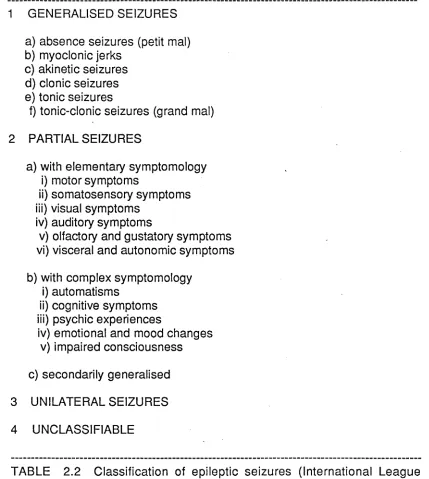
was when it was made. The extent of the region of disorderly discharge, the frequency of occurrence of the discharge and the location or focus of the discharge within the brain, are entirely variable. Epileptic neural discharges may be generalised or focal or begin focally and become generalised. They may be very frequent, occuring almost continously, or every few years, or only at certain times in the life of an individual. Focal epileptic activity may arise almost anywhere in the brain, although the temporal lobes appear to be most susceptible. Epilepsy may vary widely in its severity (usually measured by seizure frequency but also to some degree by the nature of the seizure), its nature (that is the type of seizures and their cognitive effects) and the course of the epilepsy. What all of these variations have in common is this "excessive, disorderly discharge of neurones" even though the actual behavioural manifestations of the seizure may be quite different in degree, nature (see Table 2.2) and course from one individual to another.
Although the evidence is not altogether consistent, there is general agreement that certain types of epilepsy are frequently associated with more or less specific cognitive dysfunction. Deficits have been reported in memory, attention, perceptuo-motor abilities and cognitive speed. These will now be commented on briefly.
There is good evidence associating memory deficits with temporal lobe epilepsy. Most reports have been concerned with patients with intractable seizures requiring surgical intervention and these have been reviewed by Milner (1974) and Iverson (1977). However, similar results have been found with children and adults not requiring surgical intervention (e.g. Glowinski, 1973; Fedio and Mirsky, 1969; Quadfasel and Pruyser
(Glowinski, 1973; Remschmidt, 1973) found no such association. Perceptuo-motor disturbances (including mental slowing) have been frequently observed (e.g. Gastaut, 1964; McKinley, 1980). Morgan and Groh (1980) reported that visual impairments, at least, may occur more frequently in children with partial seizures.
The relationship between severity of epilepsy and intellectual deterioration is not perfectly understood. There have been a number of longitudinal studies conducted which have all produced dissimilar results (Reviewed by Thompson, 1981). Nonetheless, it is possible to conclude that although progressive intellectual deterioration is severe for some epileptics, it may not occur at all for the vast majority of epileptics. In a recent review of the relationship between seizures and cognitive dysfunction byt Trimble and Thompson (1981) it is suggested that generalised seizures may produce impairments of long term memory. Further unpublished evidence from Dodrill (1981, pers. comm.) indicates that the experience of 50 or more generalised seizures and/or status epilepticus correlates with a significantly reduced IQ. Presumably repeated or prolonged experience of hypoxia during the seizure (which does not occur in all seizure types) may eventually lead to a measureable deterioration of intellectual function.
1 GENERALISED SEIZURES a) absence seizures (petit mal) b) myoclonic jerks
c) akinetic seizures d) clonic seizures e) tonic seizures
f) tonic-clonic seizures (grand mal) 2 PARTIAL SEIZURES
a) with elementary symptomology i) motor symptoms
ii) somatosensory symptoms iii) visual symptoms
iv) auditory symptoms
v) olfactory and gustatory symptoms vi) visceral and autonomic symptoms b) with complex symptomology
i) automatisms
ii) cognitive symptoms iii) psychic experiences
iv) emotional and mood changes v) impaired consciousness c) secondarily generalised 3 UNILATERAL SEIZURES 4 UNCLASSIFIABLE
TABLE 2.2 Classification of epileptic seizures (International League Against Epilepsy, 1969).
[image:42.546.62.491.78.557.2]The populations examined in studies of the effects of the anticonvulsants on cognitive function have varied widely and have been of three general types: epileptic; non-epileptic-but-clinical; and non-epileptic-and-non- clinical. Epileptic populations, although clearly the most directly relevant, have not always been well described in papers examining the effects of the drugs on memory. Classification schemes have changed. Severity of epilepsy (that is, seizure frequency and type) is commonly inadequately reported even though it is well established that seizures, particularly grand mal seizures, may impair cognitive performance. Non-epileptic-but-clinical populations have included children with behavioural and learning problems and elderly patients (Salzman and Shader, 1973) - highly heterogenous samples likely to reduce the sensitivity of the experiment to drug effects. Non-clinical populations have included such groups as medical students (e.g. Thompson et al, 1981). The use of such diverse populations may at least partially be responsible for the wide variation in the results obtained.
2.3 THE EFFECT OF EPILEPSY AT THE TIME OF TESTING
There is a growing awareness of the significance of sub-convulsive se iz u re s (these are sm all d isch a rg e s w ith o u t o ve rt b e h a vio u ra l consequences) which may, nonetheless, have a significant effect on behaviour. The manner in which psychological function may be affected by sub-clinical discharges is not clear. Some studies have found an association between im pairm ent on various cognitive tasks and the occurrences of discharges (Wilkus and Dodrill, 1976). Such discharges are believed to have an effect on attention (M irsky, Primac, Marsan, Rosvold and Stevens, 1960), tim ed peform ance (Parsons and Kemp, 1960), and memory (Glowinski, 1973). There may even be effects on em otional behaviour as well, particularly in tem poral lobe epileptics (Herman and Whitman, 1984).
O stensibly EEG recordings during psychological assessm ents could measure the confounding effects of sub-clinical epileptic activity on cognitive perform ance. However, there are a num ber of practical problems. Firstly, interpretation of records is made difficult by the fact that, when a discharge is recorded during testing, it cannot be known whether this occurred spontaneously or as a consequence of the mental activity demanded by this test. (Although many discharges appear to be recorded at random in the substantially inactive patient, occasional cases present in which discharges result from specific mental activity such as arithmetic (Wiebers, W estm oreland and Klass, 1979) or reading (Hammond, Danta and Dowling, 1978).)
Two procedural recommendations can be followed. Firstly, avoid severe cases of epilepsy with poor seizure control (which have generally been studied because they have been easily accessible). Avoiding such subjects would not only yield a sample more representative of the general population of epileptics, but would also reduce the strength of possible effects of the disease on memory test performance. Secondly, EEG recordings could be made either immediately before or after (rather than during) a psychological testing session in order to examine the frequency of spontaneous subclinical discharges. While this would not guarantee that the frequency of discharge was not different during testing, it would permit exclusion from the analysis of patients with exessive frequency of neural disturbance (at the possible cost of impairing applicability of the results to more severe cases).
2.4 THE EFFECT OF MOOD AT THE TIME OF TESTING ON THE EXPERIMENTAL RESULTS
There is little direct evidence of an influence of mood on test performance amongst epileptics. However, in an extensive review by Herman and Whitman (1984) many factors associated with the development of psychopathology have been suggested. These are summarised below.
results in social exclusion and ostracism (Bagley, 1972; Schneider and Conrad, 1980) and existence of social discrimination in the granting of drivers’ licences or gaining access to educational and employment opportunities.
NON-BRAIN RELATED FACTORS OBSERVATIONS Chronic illness
variables
Presence of a chronic disorder; economic stress;
limitations of activites; limitations of aspirations; other
Epilepsy variables Nature of epilepsy; medical ignorance; fear of seizures;
stigma (real and perceived); social consequences;
discrimination Developmental/epilepsy
variables
Familial considerations; effects of epilepsy on family; altered expectations of child; general adjustment of parents; familial psychiatric history; age at onset;
early experiences Demographic/subject
variables
Socioeconomic status; age;
sex;
premorbid personality; psychological status;
other (e.g. employment status)
TABLE 2.3 Non-brain related factors associated with psychopathology in epilepsy adapted from Herman and Whitman (1984).
test-performance variability. Higher levels of variability will reduce statistical power and can consequently obscure small effects. This may affect the interpretation of results, particularly when comparisons are to be made between epileptic and non-epileptic groups, or where the design involves re-examination of subjects. Relatively few studies of the effects of the drugs on cognition have attempted to examine the effect of mood on their results. (The studies by Thompson (1981) which employed the Mood Adjective Check List are an important exception to this.)
Since most of these psychosocial factors are difficult to control experimentally, the only practical strategy is to measure them and take them into consideration when interpreting the results. Such assessments have usually been done subjectively. The objective measurement device most commonly used has been the MMPI, but this assessment has been critisised on the grounds that it has been developed and standardised on non-epileptic patients and may confuse psychopathology with the effects of seizure disorders (Dodrill et al, 1980). Dodrill has instead chosen to develop a specially designed inventory for the assessment of psychosocial problems amongst epileptics - the Washington Psychosocial Seizure Inventory (WPSI). The WPSI will be considered in more detail in the next chapter.
2.5 TH E EF F EC T OF IN T E R -I C T A L B E H A V IO U R C H A N G E S ON THE EXPERIMENTAL RESULTS
While the concept of an epileptic personality has generally fallen from favour (Hermann and Whitman, 1984) there is some evidence to suggest that there are some specific behavioural changes which are associated with complex partial seizures or temporal lobe epilepsy (TLE). Waxman and Geschwind (1975) proposed that patients with TLE exhibit hypergraphia, hyposexuality and increased religiosity. Subsequently, Bear (1979) identified 18 separate personality traits associated with TLE. He proposed that TLE patients undergo a process of "sensory-limbic hyperconnection" in which new associations are formed between the neocortex and the limbic structures. Unfortunately, well controlled studies of personality differences between TLE and matched non-TLE groups (e.g. Hermann and Riel, 1981; Bear et al, 1982) failed to identify consistent personality discriminators. Clearly, further work is required to clarify the influence of personality changes due to the onset of epilepsy.
The possibility exists that some epileptics may undergo personality or behavioural changes as a result of the onset of epilepsy which is independent of psychopathology. Such changes could influence the results of studies of the effects of drugs using certain research designs. In particular, these changes would be confounded with comparisons between epileptic and non-epileptic groups and comparisons of repeated tests in epileptics.
groups of epileptics may be reduced by the measurement of such effects and careful subject matching.
2.6 THE EFFECT OF DRUG LEVELS ON THE EXPERIMENTAL RESULTS
In studies of the effects of the drugs on cognitive function it is essential to control the level of the drug in the brain. However, relatively few assessments of anticonvulsant effects on memory function have been carried out with concurrent serum blood level assessments (Trimble and Reynolds, 1976). The need for such assessments has only become apparent in the last 10 to 15 years with the recognition of therapeutic ranges for most anticonvulsants. Before this, anticonvulsants were administered in increasing doses until fitting ceased or side-effects became apparent. With the introduction of serum level testing it became evident that a substantial proportion of patients were either over-treated or under-treated (Vajda et al, 1978).
FIGURE 2.2 Theoretical relationship between dose and serum anti convulsant level for several individuals.
Bearing in mind that many of the studies referred to in Table 2.1 do not cite serum anticonvulsant levels, it is possible that some of the inconsistencies between their results are due to variations in drug levels. Indeed comparative studies of toxic and non-toxic populations of epileptics have shown precisely these kinds of differences. Matthews and Harley (1975) examined the performance of epileptics with toxic and non-toxic levels of phenytoin, phenobarbitone and primidone. They found that the toxic group consistently performed at a lower level than the non-toxic group on measures of attention, concentration, motor co-ordination and static tremor although no differences were observed on the Knox Cube Imitiation Test. In addition, some patients may have had levels of the drugs which would now be regarded as too low for therapeutic effect. The use of serum assays reduced the numbers of such patients who are inadequately medicated and presumably not experiencing the putative adverse effects of the drugs on cognition to the same degree. The inclusion of such subjects within the anaysis of previous studies would tend to bias the results towards concluding that the drugs had no effect on cognition.
subjects with levels of the drugs outside the accepted therapeutic ranges so that the effects of the drugs within these limits can be studied.
2.7 THE EFFECT OF D IFF EREN T DRUG REGIM ENS ON THE E X P E R IM E N T A L RESULTS
Drug administration protocols are another potentially important variable which might influence the cognitive effects of the anticonvulsants. Studies have generally fallen into one of three categories : single dose; short-term treatment (a few weeks to a few months); or long-term treatment (a few years to decades).
Studies of the long-term effects of the drugs are most relevant to the epileptic population. Nevertheless, side-effects may be observed during short-term administration which may disappear after habituation. Thus, short-term studies may provide important information about effects which are significant at the time but unimportant during long-term treatment. The value of single dose studies is questionable. The time between ingestion and assessment has a critical effect on the results obtained because of the gradual change in the blood level as the drug is metabolised. Whether or not adverse effects are observed in the very short-term cannot imply that such effects do or do not exist in the long-term. Ideally, studies should be carried out over a long period of time.