SMALL SCALE ENERGY STORAGE IN A DISTRIBUTED
FUTURE
Nick Kelly BEng, MSc, PhD, Scottish Energy Environment Foundation
SYNOPSIS
With increasing interest in the co-location of energy supply and demand through distributed generation will there be any need for large-scale energy storage schemes in the future provision of energy? Indeed, if the future of energy supply is small-scale why should this not also apply to energy storage? This paper will examine the current drive towards localised heat and power production and available options for storage of energy at the point of demand. The economics, practicality and impact of localised storage will be analysed along with the potential for energy efficiency measures and load management to reduce energy storage requirements at the small scale.
Keywords: distributed resources, renewables, storage, demand supply matching.
1. INTRODUCTION
Current policy in the UK is aimed at radically reducing CO2 emissions to 60% below 1990 levels
by 2050 (DTI, 2003). There are several means envisaged by which this target can be met. Under the banner “creating a low carbon economy” the government aspires to a major increase in electricity supply from renewables, with sources such as wind, wave and tidal stream eventually producing around 30-40% of the total supply. This increase in the use of renewables will be augmented with improvements in energy efficiency and moves towards low carbon transport technologies. Specific targets for 2010 include 10% renewable electricity generation and increasing the deployment of combined heat and power (CHP) to 10GW.
The proposed changes in the existing electricity generation mix in the UK will result in an increasing contribution from intermittent renewable sources of energy accompanied by a reduction in capacity of technologies such as conventional thermal plant that can respond to changes in demand.
Therefore this paper looks ahead to 2050 to an energy supply that would be very different from that of today, containing a significant proportion of renewable and local energy production. Such an energy supply is likely to demonstrate a greater variability of output with less controllability (with supply varying in magnitude over different time scales from sub hourly to seasonal variations). This poses severe technical challenges for the maintenance of a reliable energy supply whilst minimising emissions. The greatest challenge is reconciling the intermittency and unpredictability of renewable energy supplies with continued expectations of instantly available heat and power. One means of meeting these expectations is to use conventional fossil fuel based heat and power sources as backup to meet any shortfall between renewable supplies and demand. However, used in this way, backup plant is likely to operate inefficiently and uneconomically at less than optimum load, producing CO2 and other emissions. If large numbers of renewables are to be deployed then
limited to pumped storage hydro schemes and it is unlikely in the current political climate that large quantities of new pumped storage hydro will become available. So what are the alternatives? Could a large number of smaller distributed energy sources and stores (commonly termed “distributed resources”) be an alternative to, or at least compliment centralised energy storage?
This paper focuses on the potential for the deployment of distributed resources in the built environment: an area that is largely overlooked in the Government’s Energy White Paper, despite the fact the built environment accounts for the majority of primary energy use (DTI, 2002a). Energy supply and storage options at the small scale are reviewed and the potential impacts and benefits of widespread deployment of distributed resources to meet the proposed CO2 reduction
targets are discussed. The potential for interaction between a large population of distributed resources, the larger energy supply system and the impact on the requirement for large-scale energy storage is also examined.
2. DISTRIBUTED GENERATION AND RESOURCES
The term “distributed generation” (DG) is usually thought of in terms of the local production of electricity by renewable or energy efficient technologies. However, it should not be forgotten that the majority of the energy used in the built environment is required for space and water heating (DTI, 2002b). One of the main advantages of localised power production is the possibility of utilising the waste heat thus improving the overall efficiency of the energy conversion process. In this paper the term “distributed generation” will be expanded to encompass the local production of heat. The concept of distributed generation is one which has emerged (or re-emerged) in the last couple of decades and encompasses a wide range of clean and energy efficient technologies including small scale CHP (combustion engines, micro turbines and Stirling engines), building-integrated wind turbines, PV and fuel cells. These will be discussed in more detail later. Distributed generation combined with local energy storage is often termed “distributed resources”.
As distributed generation systems provide both heat and power to buildings it would be prudent to consider that there could be a requirement for the storage of both of these energy forms. The requirement for electrical energy storage in distributed generation is very much dependent upon the type of power source employed (e.g. renewable or CHP) and the desirability (or necessity) of autonomous operation. Currently most DG systems in the UK are grid connected and so there is no requirement for electrical storage; systems are usually sized to meet only a fraction of the total electrical load with any shortfall being taken from the grid.
Combined heat and power is currently the most established and practical means of supplying heat and power to buildings. However the use of CHP only reduces CO2 emissions by around 30%
compared to conventional supply sources, so to meet a stringent 60% target it is likely that future distributed generation systems will need to supply a significant quantity of their energy from renewables. Moreover in the future, local generation systems may be required to operate autonomously more often if those stringent reductions in CO2 emissions are to be achieved. The
ability to operate autonomously could be a distinct advantage with respect to large-scale matching of renewable supply with demand.
Autonomous operation will require the provision of both local backup and storage for heat and power in order to match instantaneous demands and maintain electrical power quality. The use of electrical and thermal storage can also bring the following benefits:
if heat or power produced by a renewable source cannot be immediately used then the surplus
the combination of distributed generation plus storage reduces the required installed capacity of
the distributed generation: storage can be utilised to meet peak demands.
2.1 Distributed or Centralised?
The early electricity systems were essentially distributed generation systems, with many small electricity generators supplying power to local consumers. However these small systems were superseded by the larger, centralised system used today.
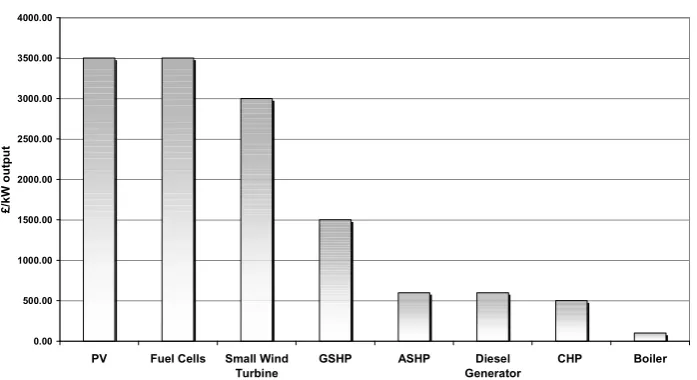
The advent of a national grid and large power stations was driven by a desire for economies of scale, improvements in the efficiency of electrical power production and increased reliability. However the major drawbacks with centralisation are that heat rejected from the power production cycle is wasted (so overall efficiency is poor (~30%)) and power has to be transmitted over long distances, with the loss of considerable quantities of energy (up to 10%). Additionally, the construction of centralised generation plant (including large renewable schemes and centralised pumped storage) suffers from problems relating to high capital costs and long lead-times in a rapidly changing market. Distributed generation systems do not suffer from all of these disadvantages: waste heat from the power production processes can be utilised locally, transmission distances are minimal and lead times for the installation of distributed plant are short. However, distributed generation tends to suffer the disadvantage of higher (sometimes significantly higher) capital costs (£/kW), leading to more expensive electricity (£/kWh) compared to conventional plant (see figure 1). This is a significant barrier to the uptake of distributed generation in areas when there is a well-established, centralised mechanism for the distribution of power, as exists in the UK. However in developing countries these cost disadvantages disappear, as the option of centralised power generation simply does not exist due to a complete lack of infrastructure. In these cases the future of heat and power production will be distributed given the enormous capital costs associated with developing a large scale distribution system: examples of this evolving process can be seen in developing countries such as Brazil (de Hollanda, 2000). In these areas distributed generation is seen as the answer to meeting rapidly expanding energy requirements.
Capital Costs of Local Heat and Power Production Technologies
0.00 500.00 1000.00 1500.00 2000.00 2500.00 3000.00 3500.00 4000.00
PV Fuel Cells Small Wind
Turbine
GSHP ASHP Diesel
Generator
CHP Boiler
£
/k
W
o
u
tp
u
[image:3.595.126.475.509.699.2]t
It should also be noted that the large-scale and small-scale energy supply options are not mutually exclusive, especially when considering renewables. Indeed distributed resources have the ability to improve overall grid stability and security of supply (Energy Storage Council, 2002).
2.2 Distributed Generation Technologies
Distributed generation spans a wide range of technologies ranging from well-established sources such as combined heat and power (CHP) to up and coming technologies such as fuel cells. The main contenders for energy supply in buildings and communities are outlined below.
Combined Heat and Power (CHP)
The use of CHP powered using an internal combustion engine running on natural gas in place of grid electricity and conventional boilers can reduce CO2 emissions by around 30% (CHPA, 2003).
Current installed capacity in the UK is some 5GW, the majority of which is associated with large-scale applications such as industrial processes. However, there are around 500 CHP units with output of less than 100kW. CHP forms a central plank of future government energy policy, with a target to double CHP capacity in the UK by 2010. Much of this increase on capacity is anticipated to be through the deployment of large numbers of micro-CHP systems supplying individual buildings.
In addition to internal combustion engines several other CHP technologies are emerging. Small Stirling engines are already on the market as a direct replacement for domestic boilers and small micro turbines derived from aircraft onboard power sources are also available. However both of these sources are considerably more expensive than conventional CHP units.
Since 2001 and the implementation of the new electricity trading arrangements (NETA) the outlook for small scale CHP in the UK has worsened dramatically (CHPA, 2003) with a 95% downturn in new capacity coming on-line. The main reason for this that NETA brought about a reduction in the wholesale cost of electricity from centralised supplied. Until electricity and gas costs begin to rise it will difficult for CHP to compete in markets other than in niche applications.
Building Integrated Photovoltaics (BIPV)
Photovoltaics have been installed on many demonstration buildings in the UK and the currently installed capacity is some 4MWp (Gunning, 2002). The main advantage of installing PV on buildings is that displaced material costs can help offset the extremely high costs of PV (£~3500/kWp). There is also the potential for heat recovery with hybrid PV systems, though if this is recovered as warm air the utilisation has been shown to be limited (Wouters et al., 1998). The main disadvantages of PV are that it has a low conversion efficiency (around 12% for crystalline silicon in realistic operating conditions (Clarke et al. 2001) leading to an extremely low energy supply density. For example mono crystalline silicon solar cells can produce around 90 kWh/m2 annually in a UK climate for a south facing vertical wall. Additionally building surfaces are often not optimised for installation of PV and shading from other buildings will further reduce energy availability.
Ducted Wind Turbines
potential power output from a DWT installation is low. Several manufacturers in the UK and US are readying various designs of DWTs for niche applications.
Fuel Cells
Fuel cells are in use in many co-generation demonstration projects, however only one is operational in the UK (Jones, 2003). Fuel cells offer a means of producing controllable heat and power for buildings with no production of CO2 if hydrogen is used as the fuel source. Solid oxide fuel cells
are emerging as the most promising fuel cell technology for combined heat and power applications due to their high temperature of operation (~1000oC). The major barriers to the widespread use of fuel cells for stationary power are high costs and technological challenges associated with producing, distributing and storing hydrogen safely and efficiently. Fuel cells can run on other hydrogen rich fuels such as natural gas but there are associated CO2 emissions and conventional
CHP units running on the same fuel are considerably less expensive.
Solar Water Heating
Solar water heating has been an established technology in the UK for many years, however uptake has been low due to long payback times. Around 50,000 systems (around 300,000m2 of collector in total) have been installed in the UK (ETSU, 2001) though this is small compared to other markets in Europe. Around 50% of the UK housing stock is thought to be suitable for the installation of solar water heating. Contrary to popular opinion there is considerable potential for solar water heating systems to reduce fossil fuel emissions in the UK: 4m2 of solar can produce around 40% of the hot water requirements for a typical family of 4.
2.3 Distributed Generation and Emissions Targets
Technologies such as solar water heating and CHP are a practical and viable means of supplying heat and power to the built environment. However the penetration of these technologies into the UK market has been relatively small. The major reason for this is the continuing low cost of heat (gas) and power, which makes alternative sources financially unattractive. With energy costs forecast to rise (electricity 15% and gas 30%) by 2010 (BBC, 2003) this situation may change and
must change if there is any hope of attaining the ambitious target for emissions set out in the Energy White Paper.
A means of increasing the penetration of distributed resources in the built environment is to toughen energy efficiency legislation and require new build to include renewable or energy efficient supply systems. While DG systems have a high capital cost, this is small compared to the overall cost of the building, and energy savings accrued over the lifetime of the building are more favourable than the alternative of centralised supply.
If DG systems with a high renewable content are to provide an adequate energy supply to buildings then two major challenges must be addressed: the low energy density and intermittency of renewable energy sources. The low energy supply density means that energy demands must be minimised (this is dealt with later) and the problem of intermittency will require the utilisation of a combination of storage technologies and backup to overcome fluctuating supply and to maintain power quality.
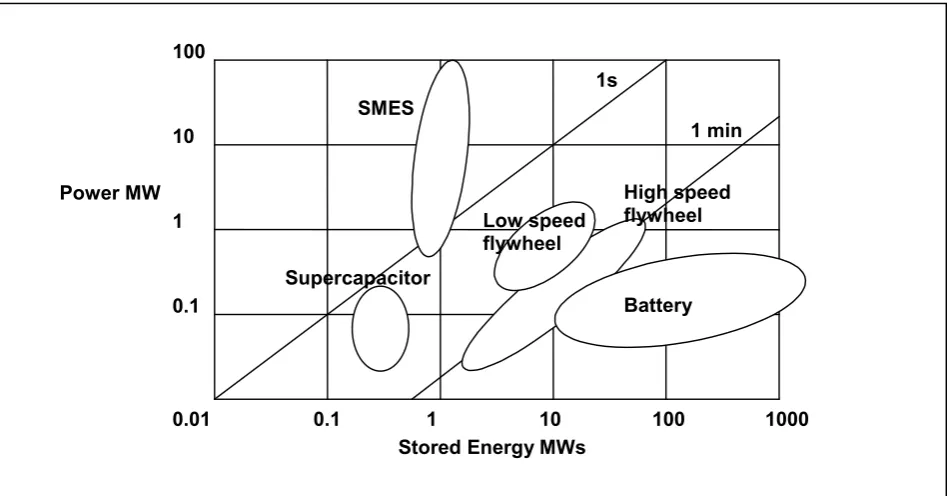
Figure 2 Rated power versus energy for various energy storage systems (Sels et al. 2001).
2.4 Small Scale Energy Storage Options
Batteries
Lead acid batteries are by far the most common and lowest cost means of electrical energy storage in use with distributed generation systems, particularly those off-grid systems employing renewables. However batteries are a far from perfect storage media: the efficiency of battery storage is in the region of 50-75% (Dell and Rand, 2001), while their life span can be as low as 3 years, depending on the frequency of the charge/discharge cycles. Batteries also carry a significant environmental penalty. However at present they are the only viable means of storing and recovering electrical energy over extended periods of time.
Flywheels
Flywheel energy storage systems usually consist of a massive rotating cylinder, supported on a stator by magnetically levitated bearings. The flywheel system operates in a slight vacuum to reduce losses due to drag. The flywheels themselves are usually constructed from a strong composite material as very high speeds are required to store a reasonable amount of energy. Flywheels can store energy over short periods of time (typically a few hours). The quantity of energy stored is in the region of 0.3 MJ (Dell and Rand, 2001). Actual delivered energy depends on the speed range of the flywheel as it cannot deliver its rated power at very low speeds. For example, over 3:1 speed range, a flywheel will deliver ~90% of its stored energy to the electric load.
Super Capacitors and Superconducting Magnetic Energy Storage (SMES)
Super capacitors, like flywheels are a short-term energy store used for improving the power quality and reliability of DG systems. The storage capacity of supercapacitors is relatively small, around 3 orders of magnitude less than a battery. However the energy storage density is much higher with most current systems having a capacity in the region of 20-70 MJ/m3 (Sels et al.). SMES systems
Power MW
Stored Energy MWs 1s
1 min
Supercapacitor
High speed flywheel
Battery Low speed
flywheel 10
1
0.1
0.01 100
0.1 1 10 100 1000
store energy in the magnetic field of a superconducting coil. Power output ranges from 0.3 to 3MW and capacity ranges from 0.3 to 180MJ. SMES systems can maintain their output from 1 to 60s.
Hydrogen
The use of hydrogen as an energy store, coupled with fuel cells is often viewed as the solution to renewable energy intermittency. Hydrogen has the highest energy density per unit mass of any fuel, however its volumetric energy density is low, 0.01MJ/l. To be a practical fuel source (particularly for transport) hydrogen must be stored and transported at high pressure (200-700 bar) or in liquefied form. The energy density of hydrogen increases to 3MJ/l when compressed (at 5000Psi or 340 bar) and to 8MJ/l when liquefied. For comparison purposes the energy density of a fossil fuel such as gasoline is 32MJ/l (Harris, 2003). Considerable technical obstacles must be overcome in relation to storage and the distribution of hydrogen in compressed or liquid from. Liquefied hydrogen incurs a significant energy penalty (40%) while the tank to fuel weight ratio of compressed hydrogen storage tanks remains a problem. The US Department of Energy has set a target of 9% hydrogen stored to tank weight (11 MJ/kg) by 2015, however current systems can only achieve around 5 MJ/kg. A promising storage technology may be the storage of hydrogen in solid form using metal hydrides, with energy densities of 1-1.5 MJ/kg being achieved though considerable technical challenges remain to improve the energy/weight ratio (particularly for transportation) and reduce costs.
There is much debate as to the optimal hydrogen production route and source. Viewed from the perspective of small scale DG on-site production, using electrolysis is by far the most practical means as transportation of hydrogen over distance either by road or pipeline is costly and impractical. Additionally on-site production can acts as a linkage mechanism between the small and the large scale as both locally produced and large-scale renewable electricity can be used to produce the hydrogen.
Ground Source Heat Pump (GSHP)
These are commonly used as a heating mechanism for buildings in both the US and Scandinavian countries. A GSHP combined with solar collectors or CHP offers one of the few functional means of storing surplus heat energy over long periods of time. Surplus energy in summer can be stored in the earth surrounding the condenser/evaporator of the heat pump (which takes the form of buried pipes) and retrieved for heating during winter. However as with solar water heating, high installation costs and low heating energy costs from conventional sources are a major barrier to the introduction of GSHP as a storage system.
Water Heating and Capacitive Loads
A from of short-term heat energy storage are those non-essential loads in the building that have an intrinsic thermal capacitance. Prime examples are hot water heating, storage heating and refrigeration. The capacitance of these loads means that they can effectively be used as energy “dumps” able to take energy from renewable sources when required. The ability to schedule the charging of these loads could be a useful mechanism for controlling demand such that it better fits the available energy supply.
accommodated. However, the technical challenges arise with the longer-term storage mechanisms for electrical power.
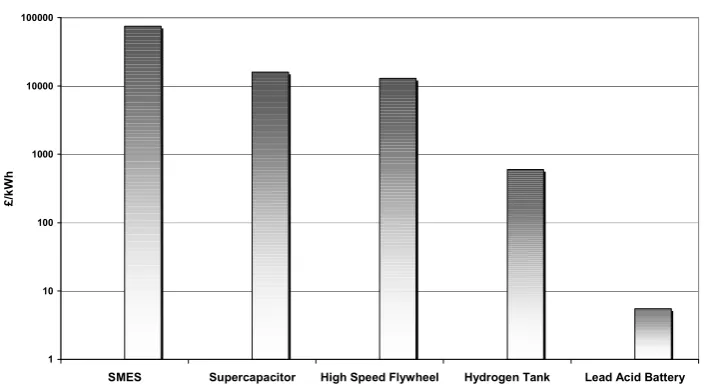
The prime candidate for longer-term storage is hydrogen. However hydrogen storage suffers from low overall efficiencies, unsolved technical problems and high costs (figure 3).
The lack of mechanisms to store both heat and power over the long term has important implications for a largely renewable energy supply. Without long-term storage capability it is unlikely that a renewable energy supply will be able to cope with demands for some periods of the year, particularly in winter. Moreover storage on its own does not address the major problem associated with local renewable energy sources: the fundamental mismatch between the magnitude of demand and available energy supply (the energy “gap”). This means that even with local energy storage a distributed generation system using only renewables cannot hope to meet the total annual energy demands of the load it supplies. It therefore is almost impossible to conceive (in the industrialised world) of an economic, renewable DG system without some form of controllable backup to meet shortfalls in demand. In the medium term suitable backup would be CHP, which at least makes effective use of fossil fuels (efficiency 80-90%). In the long term, if the technical difficulties can be overcome, then controllable backup may be in the form of a fuel cell with local hydrogen store. However the provision of storage and backup adds considerable expense to the capital cost of small-scale energy systems and also adds complexity to their design, installation and control. Additionally the ability to reduce CO2 emissions is lessened the larger the quantity of fossil
fuel-based backup required.
For renewables-based distributed generation to be a viable proposition in the future there is a requirement to address the twin issues of the energy gap and temporal mismatches between supply and demand.
Capital Costs of Storage Technologies
1 10 100 1000 10000 100000
SMES Supercapacitor High Speed Flywheel Hydrogen Tank Lead Acid Battery
£
/k
W
[image:8.595.123.476.468.662.2]h
Figure 3 capital costs of some storage technologies.
3. DEMAND REDUCTION
with a photovoltaic façade providing electrical power. The average annual electrical energy yield from such a façade in a UK climate is around 90kWh per m2 of façade, while a typical electrical energy usage in a UK office building ranges from 85-360kWh per m2 of floor area. This would mean that to meet all the electrical loads of the typical office (neglecting for the moment the intermittency of supply and the need to meet peak demand) the PV façade would need to be a minimum area of between 1 and 4 times the total building floor area.
Significant reductions in electricity usage are achievable through the implementation of such energy saving measures as daylight and occupancy responsive controls for lighting, the use of energy efficient appliances and switching components off rather than using standby. According to one source (Oliver, 2001), savings of up to 80% should be achievable (while heating of buildings would be unnecessary if suitably insulated). An 80% reduction in energy consumption may seem optimistic but it should be kept in mind that the scope for demand reduction in the built environment is large, mainly due the poor energy performance of most buildings. The built environment accounts for around 50% of total energy consumption in most industrialised countries. Research in the US has indicated that in buildings over 10 years old around 40% of the energy consumed is wasted due to poor quality and maintenance of the building fabric and systems (Johnston, 1993). In the UK buildings over 10 years old comprise 90% of the building stock (Utley, 2001). Various reports indicate that the potential for energy savings in the built environment ranges from 40 to 80%. It is also worth keeping in mind that new buildings in the UK have poorer levels of insulation than Scandinavian buildings constructed before the Second World War.
An 80% reduction in power consumption brings the load in the example above down to 17-71kWh per m2. These demands are in the same order of magnitude as the available supply. Note however that in the absence of long term storage of electrical power the façade would not be able to meet all electrical demands over the course of the year as solar energy availability in winter is around 6-10% of that available in summer in the UK. In reality a mixture of renewable sources and some form of additional energy supply would always be required. However, demand reduction allows renewable sources to meet a far higher percentage of the demand and it is by far the most cost-effective means of reducing emissions.
While the example above is somewhat extreme it does illustrate the gulf between current demand levels and the available supply from renewable-only resources. However, even in a building supplied by a more conventional DG source such as CHP, demand reduction and the better matching of supply with demand brings the advantages of reduced energy costs, reduced local emissions, reduced system size and reduced storage requirements (and hence reduced capital costs).
Finally, it should be noted that reducing energy demand is not just important in the case of distributed generation systems. Consider the current situation in the UK, where overall energy consumption has been increasing by around 1% per year since 1990 (DTI, 2002b), while electricity consumption has been increasing by around 2% per year over the same period (DTI 2002b). If UK electricity demand grows at this rate then by 2010 demand will have increased by around 30TWh. Renewable output could be expected to grow by around 30TWh over the same period. Any benefit from an increase in renewable generation will therefore be negated. Clearly if renewable resources and associated energy storage mechanisms are to have any impact on reducing CO2 emissions then
serious reductions in consumption will need to be achieved.
magnitude) is not controllable. Hence to minimise storage requirements it is necessary to shape demand profiles to better match supply. Two techniques in particular are available to facilitate this:
load shedding – closing down non-critical loads at times of peak demand;
load-shifting – supplying energy to loads with capacitance at times of high energy availability.
In addition to the manipulation of loads to match supply and demand it is also worth considering the selection of energy supply technologies for a building. There are numerous options for the supply of renewable energy, all of which may have complimentary or perhaps conflicting temporal characteristics. Particular combinations of renewables selected to meet a specific load will give different levels of temporal “fit” to a specific demand. Clearly, the better the fit between supply and demand then the less the requirement for energy storage, thus reducing the capital cost of the DG system. Specific tools to allow designers to analyse the match between supply and demand are beginning to appear, e.g. MERIT (Born et al., 2001).
4. IMPACT OF DISTRIBUTED RESOURCES AT THE LARGE SCALE
The widespread implementation of CHP (and eventually fuel cells), building integrated renewables and local energy storage, would have a dramatic impact at the large scale, as they could reduce or even eliminate the need for large, centralised energy storage. Large numbers of DR in the built environment offers the possibility of controlling overall energy demand through the ability to mask load from the grid, significantly altering the short term demand characteristics and engineering a better instantaneous fit between a varying renewable supply and demand. The mechanisms by which this can be achieved are discussed below.
Distributed resources fundamentally change the nature of a load “seen” by the grid, if operating autonomously then a building meeting all of its electricity demands by local means ceases to be a load. The length of time during which a system can usefully operate in this fashion will be largely determined by the available storage and energy supply system. The use of DR to drop load at short notice is a valuable control technique available to a future energy system, particularly if the supply is subject to variability due to a high renewables content. DR may also be used as a source of additional power backup by supplying power to local networks. Again this would be seen as a drop in load by the larger grid. If the heat produced from the backup in distributed systems can be stored and used then local power backup would be a more efficient alternative to centralised systems. Moreover, the response time of small generators from cold is far quicker than could be achieved with equivalent centralised power generation so large numbers of small generators could be used as an alternative to centralised backup.
Distributed resources could also be used as a means soak up surplus renewable power. In this case the interchangeability between local power and heat demands could be an advantage: while a distributed supply may not be able to charge electrical storage, it may be able to utilise surplus electrical power for water heating or use power for a low priority, non time critical load. This type of flexibility and load switching would not be available at the large scale.
5. CHALLENGES FOR DISTRIBUTED RESOURCES
The cost of distributed generation technologies, particularly PV and fuel cells, is significantly higher than conventional equivalents such as boilers and diesel generators. As mentioned previously, even less expensive technologies such as CHP, solar water heating and air source heat pumps are failing to achieve the desired market penetration (CHPA, 2003) due to the current low cost of energy in the UK. A rise in energy prices or supportive legislation will be required to seriously increase the penetration of distributed generation into the UK energy supply market.
Excluding battery technologies, the cost of energy storage is even more prohibitive than distributed generation. For example, the US Department of Energy has set a target of $200-500/kg-H2 for
high-pressure storage tanks by 2005. Current costs are three orders of magnitude higher than this. Additionally the infrastructure to handle high pressure or liquefied hydrogen for static and automotive applications does not exist. Most predictions for the widespread use of hydrogen are in the region of 30-50 years. It is likely that the deployment of large numbers of small storage devices is a more distant prospect than widespread distributed generation.
If CO2 emissions are to be radically reduced then hydrogen, produced using renewable energy is
likely to be a very important energy vector. However, should production be done locally, close to the point of demand or large-scale production close to a central energy source. Production close to the point of demand would be the most appropriate match for distributed generation. However, as mentioned, serious technical hurdles need to be overcome at both the small and large scale in terms of the storage, distribution and the overall conversion efficiency. At the moment this can be as low as 4% with photovoltaics as the energy source (Trainer, 1995) and 11% with wind turbines.
Finally, if distributed resources are to be used in large numbers to aid in high level demand-supply matching (as outlined in previously) then suitable control mechanisms must be developed. Particular issues that need to be addressed include the synchronised control of very large numbers of small generators and reconciling different control priorities. For example, the need for high-level demand supply matching against potentially conflicting local control constraints.
The Internet is emerging as a mechanism for both the collection of dispersed energy usage information and as a means of controlling large numbers of internet connected loads. Both of these tasks can be undertaken using “e-box” type technology (Ericsson, 1999). In addition to controlling loads this technology could be extended to control localised generation. Tasks that could be undertaken include polling for surplus capacity in both generation and storage and activation and de-activation of controllable generation. In a distributed future it is likely that the internet will be a vital means of controlling both energy supply and demand.
6. CONCLUSIONS
This paper has looked at the prospects for distributed generation and storage (distributed resources) in the context of the challenging emissions targets set out in the recent UK Energy White Paper.
To meet stringent CO2 targets, significant quantities of renewable heat and power will need to
be deployed, radically changing the characteristics of energy supply with possible increases in supply variability and unpredictability.
To overcome this variability energy storage and backup heat and power sources will be required
Distributed generation technologies will increase their penetration in the UK only if energy
prices increase and legislative and fiscal measures are put in place to encourage their use. Otherwise their costs are too high in comparison to conventional technologies.
Storage of both heat and electrical power over the long term remains a problem. One potential
technology solution could be the widespread use of hydrogen as an energy vector. However significant technical hurdles must be overcome in both the storage and distribution of liquid and high-pressure hydrogen.
For renewables to have a meaningful impact on CO2 emissions in the industrialised world, then
significant improvements must be made in energy efficiency to halt the current increase in energy consumption and eventually radically reduce energy demands.
Energy efficiency and demand management will impact upon distributed generation and storage
in several respects: the size of systems required to meet energy demands is reduced and the requirement for storage is reduced through an improved match in supply demand magnitudes.
At the larger scale, energy efficiency will increase the autonomy of local energy systems
reducing requirements to source energy from the grid at periods of peak demands.
Large numbers of distributed resources could also offer the potential for some degree of control
REFERENCES
Bennet J, 2003, The Gas-and-Go Puzzle: Tanks Slow Advance of Hydrogen Cars, Article in Auto News March 6
BBC News Online, 2003, UK Unveils Greener Energy Plans, www.bbc.co.uk/news
Born F J, Clarke J A, Johnstone C M and Smith N A V 2001, Merit - An Evaluation Tool for 100% Renewable Energy Provision, Proc. Renewable Energies for Islands, Chania, Crete.
Clarke J A, Hand J W, Johnstone C, Kelly N, Strachan P A, 1996, The Characterisation of Photovoltaic-Integrated Building Facades Under Realistic Operating Conditions, Proc. 4th European Conference on Solar Energy in Architecture and Urban Planning Berlin.
Clarke J A, Hensen J L M, Johnstone C M, Macdonald I, 2001, On the use of Simulation in the Design of Embedded Energy Systems, Proc Building Simulation, Rio de Janeiro, International Building Performance Simulation Association.
CHPA, 2003, Combined Heat and Power Association, Website Article, www.chpa.org.uk
DTI 2003, Our Energy Future, Energy White Paper, HMSO, 2003.
DTI, 2002a, Digest of UK Energy Statistics, HMSO
DTI, 2002b, Energy Consumption in the UK, HMSO
Energy Storage Council, 2002, Energy Storage The Missing Link in the Electricity Value Chain, White Paper, Electricity Storage Council.
Ericsson, 2001, Ericsson Review No. 1, www.ericsson.com
ETSU, 1995, Survey of Active Solar Heating Systems in the UK, ETSU S/P3/00238/REP
ETSU, 1999, New and Renewable Energy: Prospects in the UK for the 21st Century, Supporting Analysis, Report for the DTi.
Grant A D, Kelly N J, 2003, A Ducted Wind Turbine Model for Building Simulation, Paper to be published in Building Services Engineering Research and Technology.
Gunning R, 2003, National Survey Report of PV Power Applications in the United Kingdom , Report to the IEA PVPS Co-operative Programme on PV Power Systems.
Hollanda J, Fyodorova M, 2000, Cogeneration for Brazil, Cogeneration and On-Site Power Production, Volume 1 number 2 March-April, James & James
Harris R, Hydrogen Storage: A Critical Technology for the Future, 2003 Presentation to How Far to the Hydrogen Economy? Workshop, St. Andrews University.
Jones J, 2003, Woking: Local Sustainable Community Energy, Proc. Conference C80 of the Solar Energy Society:Towards Zero Carbon – Renewables, Fuel Cells and Embedded Generation, London.
Olivier D, 2001, Building in Ignorance: Demolishing Complacency: Improving the Energy Performance of 21st Century Homes, report published by the Association for the Conservation of Energy.
Sels, T., Dragu, C., Van Craenboeck, Th. and Belmans, R., 2001, Electrical energy storage systems: Existing systems versus newest systems - an overview, International Conference Power Generation and Sustainable Development (AIM), Liège, Belgium, pp. 215-220.