© 2018 IJSRST | Volume 4 | Issue 2 | Print ISSN: 2395-6011 | Online ISSN: 2395-602X Themed Section: Science and Technology
An Implementation of Identity Based Encryption in Revocable
Cloud Storage
Gagandeep Kaur Bhatti1, Insiya Wakeel1, Niranjan Sadhu1, Vinay Dighade1, Nishad Hatwar1,
Prof. Shradhha Karale2
1BE Scholars, Department of Computer Science and Engineering, Rajiv Gandhi College of Engineering and Research, Nagpur, Maharashtra, India
2Assistant Professor, Department of Computer Science and Engineering, Rajiv Gandhi College of Engineering and Research, Nagpur, Maharashtra, India
ABSTRACT
As for securing information, scattered limit is quickly changing into the procedure for decision. Dispersed limit is rapidly changing into the framework for choice. Securing data remotely as opposed to locally boasts a collection of inclinations for both home and ace customers. Appropriated limit indicates "the utmost of information online in the cloud", regardless, the passed on amassing isn't totally trusted. Regardless of whether the informational collection up away on cloud are or not changes into a huge worry of the customers moreover get the chance to control changes into a troublesome business, especially when we share information on cloud servers. To manage this issue outsourcing Revocable IBE gets ready for skilled key period and key fortifying technique is accessible. Besides to update the ability of cloud server to as far as possible new secure information self-destructing framework in scattered figuring is utilized. In this framework, each figure contains (encoded report) is named with a period interim. On the off chance that the qualities related with the figure content fulfill the keys get the chance to structure and both the time minute is in the permitted time between times then the figure substance is decoded. After a client showed end time the information at cloud server will be safely self-destructed.
Keywords: Cloud Computing, Self-Destruction, Identity Based Encryption (IBE), Revocation, Outsourcing.
I.
INTRODUCTION
Distributed preparing proposes the use of enrolling assets, those being re-trying or gear that pester a re-bit machine and are passed on to the end customer as an association over a structure, with the most extensively saw case being the web. Scattered limit is getting praise and centrality quickly. To share information safely the Identity-based encryption system or utilization of mix of Identity's is utilized [2]. The identity based encryption (IBE) is a basic crude of ID-based cryptography. Considering everything it is a sort of open key encryption in which people when all is said in done key of a client is two or three
key essentially indistinguishable to the identity ID by join the master open key with the character respect given the expert open key. To get a sorting out private key, the party embraced to utilize the character ID relates the PKG, which utilizes the master private key to make the private key for identity ID. Precisely when a client leaves the get-together or bear on genuinely, this client must be denied from the party for security reasons. In this way, this denied client ought to never again can get to and change shared information. For this revocable Identity Based Encryption strategy is imparted by A. Boldyreva, V. Goyal, and V. Kumar [3], yet it as a disadvantage of estimation overhead at single point i.e. executive or essential individual from the relationship, to beat the weight an outsourcing considering along with IBE disavowal is shown. Structure propose a course of action to offload all the key time related structures amidst key-issuing and key-restore, leaving just an unfaltering number of direct operations for PKG and qualified clients for perform locally. Besides another game-plan safe key issuing procedure is proposed which uses a mutt private key for every client, in which an AND door is fused into key period prepare, to be specific the identity part and the time section.
In like way to enhance the passed on storage room a guaranteed information self-destructing framework in appropriated preparing is proposed. In this structure, while private key is connected with a period minute each ciphertext is named with a period between values. In the event that both the time minute is in the permitted time interim and the characters related with the ciphertext fulfill the keys find the opportunity to structure then the ciphertext can be unscrambled. All around, the proprietor has the advantage to affirm that specific touchy data is true blue for a constrained time traverse i.e. self-destructed after total of time break set by the proprietor, or ought not to be unconfined before an asking for time.
II.
RELATED WORK
In this paper [4] the maker proposes a totally utilitarian character based encryption plot (IBE). Expecting a variety of the computational Diffie Hellman issue the structure has picked ciphertext security in the subjective prophet illustrate. The structure relies upon bilinear maps between social occasions. The Weil mixing on elliptic twists is an instance of such a guide.
In this paper [3] the Identity-based encryption is proposed, as IBE murders the prerequisite for a Public Key Infrastructure (PKI), it is an empowering differentiating alternative to open key encryption. Any setting, PKI-or identity based, must give an approach to deny customers from the system. Competent renouncement is an overall considered inconvenience in the standard PKI setting.
However in the setting of IBE, there has been little work on focus the denial parts. While scrambling, the most even minded course of action require the senders to in like manner use periods and by achieving the trusted master each one of the beneficiaries to revive their private keys reliably. Regardless, this course of action does not scale well the work on key updates transforms into a bottleneck, as the amount of client's augmentations. We propose an IBE plot that clearly progresses key-invigorate sufficiency for the place stock in social occasion, while staying skilled for the customers.
characters ! What‟s more, 0 are each different as estimated by the "set cover" parcel metric. A Fuzzy IBE plan can be related with draw in encryption utilizing biometric commitments as characters; the botch protection property of a Fuzzy IBE design is precisely what takes into cooling check the utilization of biometric personalities, which unavoidably will have some aggravation each time they are explored. Moreover, we display that Fuzzy-IBE can be utilized for a sort of use that we term "quality based encryption".
In this paper [6] the maker tends to the issue of utilizing untrusted (possibly pernicious) cryptographic associates. A formal security definition to safely outsourcing figurings from a computationally obliged contraption to an untrusted accessory is proposed. In this model, the will organized condition frames the thing for the associate, however then does not have facilitate correspondence with it once the contraption begins depending upon it. Not with standing security, it in like way gives a structure to estimating the sufficiency also; check limit of an outsourcing usage. It moreover display two reasonable outsource secure game plans. In particular, it show to safely outsource
estimated exponentiation, which shows the
computational bottleneck in most open key cryptography on computationally restricted gadgets. Without outsourcing, a contraption would require O (n) particular expansions to complete particular exponentiation shape bit sorts. The heap declines to O (log2 n) for any exponentiation-based course of action where the true blue gadget may utilize two untrusted exponentiation programs; they feature the Cramer-Shoup cryptosystem and Schnor stamps as tests. With an agreeable thought about security, we satisfy a comparative weight diminishment for another CCA2-secure encryption organize utilizing rise untrusted Cramer-Shoup encryption program.
In this paper [7] the maker showed that the Trait based encryption (ABE) is a promising cryptographic
contraption for ne-grained get the opportunity to control. By the by, the computational taken at online encryption generally makes with them any-sided nature of get the opportunity to strategy in existing ABE organizes, which changes into a bottleneck convincing its application. In this paper, a novel point of view of outsourcing encryption of ABE to cloud association supplier to calm neighborhood calculation bother is proposed. It utilizes an enhanced progression with MapReduce cloud which is secure under the uncertainty that the ace focus point and moreover no less than one of the slave focuses is immediate. In the wake of outsourcing, the computational dispensed critical harm at client side amidst encryption is reduced to obscure four exponentiations, which is persevering. Another motivation behind slant of the proposed progression is that the client can designate encryption for any game-plan.
In this paper [8] the maker proposed ABE plan, the Attribute based encryption (ABE) is a promising cryptographic crude, which has been for the most part associated with design fine-grained get the opportunity to control structure starting late. In any case, ABE is being censured for its high arrangement over-head as the computational cost creates with the multifaceted nature of the get to formula. Since they have obliged preparing resources this obstacle ends up being more honest to goodness for adaptable de-obscenities.
In this paper [9] the maker proposed the virtuoso to sort of forward security for Cryptographic estimations was exhibited. Puzzle keys are revived at typical time spans; contact of the secret key organizing to a given time does not allow a challenger to "break" the arrangement for any previous day and age in a forward-secure arrangement. Different improvements of forward-secure propelled stamp designs, key-exchange traditions, and symmetric-key designs are known. The essential building accomplishes security near picked plaintext strikes under the decisional bilinear Diffie-Hellman supposition in the standard model. This system is helpful, and with the total number of times all parameters create at for the most part logarithmically.
III.
PROPOSED SYSTEM
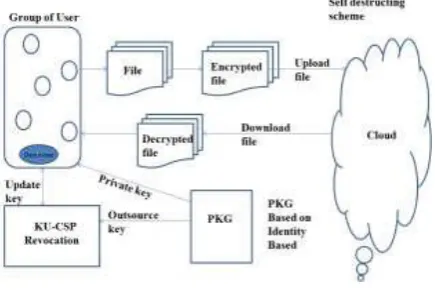
The following Figure shows the proposed system architecture.
Figure 1. System Architecture
A. System Overview
1) The client registers himself at server and after that login with true blue username and secret word into framework. After login, client ask for keys to KU-CSP [1]. The client/proprietor scramble the records utilizing the keys and traded these reports at cloud server for particular time interim and wind up being free from the weight. Precisely when any client leave the social event ,the rundown of outstanding client is send to KU-CSP, where the KU-CSP make the new key or resuscitate the keys to keep up the security of
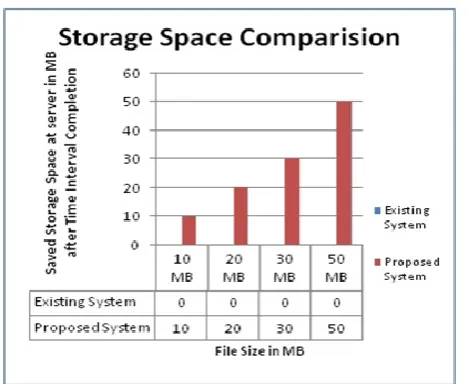
the structure and send the new keys to the key asked for client. At cloud server if the predefined time for the file is end then the record is destructed/erase from the server and it is never again open for clients. This develops the storage space at cloud server. In past work the structure stores the information at cloud server and the client itself has kill the informational index away at cloud in the event that he never again required the information, it fabricates overhead of client and additionally utilizes more space at cloud server, to beat the downside of past framework, the structure virtuoso positions information self-hurting game plan, In this client trade the information at cloud server for particular time length (for
example,(15/1/2018-2/2/2018,).at cloud server
information is honest to goodness for just a lone year i.e. from begin date to end date controlled by client after satisfaction of day and age information is self-destructed from the cloud and it liberates the space at cloud server.
B. Self-Destructing Scheme
slip by of the ensured key. Thusly, secure data self-decimation with fine-grained get the opportunity to control is accomplished. Remembering the true objective to unscramble the ciphertext sufficiently, the honest to goodness attributes should fulfill the get the opportunity to tree where the time snapshot of each leaf in the customers key should have a place with the in the planning trademark in the ciphertext.
C. Algorithm
1) Setup ( ): PKG run the setup algorithm. It picks a random generator g 2R G as well as a random integer x 2R Zq and sets g1 = gx. Then, A random Element PKG picked by g2 2R G and two hash functions H1; H2: f0; 1g! GT. Finally, output the public key PK= (g; g1; g2; H1; H2) and the master key MK = x.
2) KeyGen (MK, ID, RL, TL, and PK): PKG firstly checks whether there quest identity ID exists in RL, for each user's private key request on identity ID, if so the key generation algorithm is terminated. Next, PKG randomly selects X1 2R Zq and sets x2 = x x1. It randomly selects, and computes. Then, PKG reads the current time period Ti from TL. Accordingly, it randomly selects Ti 2R Zq and computes, where and finally, output SKID = (IK [ID]; TK [ID] Ti) and OKId = x2.
3) Encrypt (M, ID, Ti+, and PK): Assume a user needs to encrypt a message M under identity ID and time Ti period. He/She chooses a random value s 2R Zq and computes, C0 = Me (g1; g2) s; C1 = gs; EID = (H1 (ID)) s and Finally, publish the ciphertext as CT = (C0; C1; EID; ETi).
4) Decrypt (CT; SKID; PK): Assume that the
ciphertext CT is encrypted under ID and Ti, and the user has a private key SKID = (IK[ID]; TK[ID]Ti), where IK[ID] = (d0; d1) and TK[ID]Ti = (dTi0; dTi1). 5) Revoke(RL; TL; {IDi1; Idi2; ::::Idik}) : If users with identities in the set {IDi1; Idi2; ::::Idik} are to be revoked at time period Ti, PKG updates the revocation list as RL0 = RL{IDi1; Idi2; ::::Idik} as well as the time list. Through connecting the recently created time period Ti+1 onto original list TL. Finally send a copy
for the updated revocation list as well as the new time period Ti+1 to KUCSP.
6) Key Update (RL; ID; Ti+1; OKID): Upon receiving a key update request on ID , KU-CSP firstly checks whether ID exists in the revocation list RL , if so KU-CSP returns and key-update is terminated. Other-wise, KU-CSP gets the corresponding entry (ID; OKID = x2) in the user list UL. Then, it randomly selects Ti+1 2R Zq.
Data self-destruction after end: Previously the current time instant tx lags behind after the threshold value (expiration time) of the valid time interval tR; x, the user cannot obtain the true private key SK. Therefore, the ciphertext CT is not capable to be decrypted in polynomial time, ease the self-destructions of the shared data after end.
IV.
EXPERIMENTAL SETUP
The framework utilized Netbeans (version 8.1) instrument for advancement and Java structure (version JDK 1.8) on Windows stage as a front end. Any standard machine is equipped for running the application. The framework needn't bother with a particular equipment to run.
V.
EXPERIMENTAL RESULT
Figure 2. Storage Space Comparison Graph
VI.
CONCLUSIONS
Different current inconveniences have showed up with the expedient change of adaptable cloud associations. A champion among the most titanic issues is the best way to deal with safely erase the outsourced informational index away in the cloud disengages. So as to deal with the issues by executing flexible fine-grained find the opportunity to control amidst the underwriting time traverse and time-controllable self-pummeling after close to the normal and outsourced information in flowed preparing, this paper proposed an information self-destructing structure which can achieve the time chose ciphertext. Also a revocable outsourcing considering along with IBE knows about beat issue of character revocation. There is No guaranteed channel or client check is required amidst key-resuscitate among client and KU-CSP, in addition with the assistance of KU-KU-CSP, the structure has portions, for example, ardent plausibility for the two tallies at PKG and private key size at client.
VII.
REFERENCES
[1]. Jin Li, Jingwei Li, Xiaofeng Chen, Chunfu Jia, and Wenjing Lou, "Identity-Based Encryption
with Outsourced Revocation in Cloud
Computing", in IEEE transactions on computers, vol. 64, no. 2, february 2015.
[2]. W. Aiello, S. Lodha, and R. Ostrovsky, "Fast digital identity revocation," In Advances in Cryptology CRYPTO98). New York, NY, USA:Springer, 1998, pp. 137-152.
[3]. A. Boldyreva, V. Goyal, and V. Kumar,
"Identity-based encryption with efficient revocation," in Proc. 15thACMConf. Comput. Commun.Security (CCS08), 2008, pp. 417-426. [4]. D. Boneh and M. Franklin, "Identity-based
encryp-tion from the Weilpairing," in Advances in Cryptology CRYPTO „01), J. Kilian, Ed.Berlin, Germany: Springer, 2001, vol. 2139, pp. 213-229.
[5]. A. Sahai and B. Waters, "Fuzzy identity-based encryption,"in Advances in Cryptology (EUROCRYPT‟05), R. Cramer, Ed. Berlin, Germany: Springer, 2005, vol. 3494, pp. 557-557.
[6]. J. Li, C. Jia, J. Li, and X. Chen, "Outsourcing encryp-tion of attribute based encryption with
mapreduce," in Information and
Communications Security. Berlin, Heidel-berg:Springer, 2012, vol. 7618, pp. 191-201. [7]. B. Zhang, J. Wang, K. Ren, and C. Wang,
"Privacy-assured Trans. Emerging Topics Comput., vol. 1, no. 1, p. 166-177, Jul. Dec. 2013 outsourcing of image reconstruction service in cloud," IEEE.
[8]. J. Li, X. Chen, J. Li, C. Jia, J. Ma, and W. Lou, "Fine-grained access control system based on outsourced attribute-based encryption," in Proc. 18th Eur. Symp. Res. Comput. Secu-rity (ESORICS), 2013,pp. 592-609.
[9]. R. Canetti, S. Halevi, and J. Katz, "A forward-secure publickey Encryption scheme," in Advances in Cryptology (EUROCRYPT'03), E. Biham, Ed. Berlin, Germany: Springer, 2003, vol. 2656,pp. 646-646.
[11]. C. Wang, K. Ren, and J. Wang, "Secure and practical outsourcing of linear programming in cloud computing," in Proc. IEEE Int. Conf. Comput. Commun. (INFOCOM), 2011, pp. 820– 828.
[12]. M. Green, S. Hohenberger, and B. Waters,
"Outsourcing the decryption of ABE
ciphertexts," in Proc. 20th USENIX Conf. Security (SEC‟11), 2011, pp. 34–34.
[13]. B. Waters, "Efficient identity-based encryption without random oracles," in Advances in Cryptology (EUROCRYPT‟05), R. Cramer, Ed. Berlin, Germany: Springer, 2005, vol. 3494, pp. 114–127.
[14]. C. Gentry, "Practical identity-based encryption without random oracles," in Advances in Cryptology (EUROCRYPT‟06), S. Vaudenay, Ed. Berlin, Germany: Springer, 2006, vol. 4004, pp. 445–464.
[15]. C. Gentry, C. Peikert, and V. Vaikuntanathan, "Trapdoors for hard lattices and new cryptographic constructions," in Proc. 40th
Annu. ACM Symp. Theory Comput. (STOC‟08),
2008, pp. 197–206.
[16]. S. Agrawal, D. Boneh, and X. Boyen, "Efficient lattice (h)ibe in the standard model," in Advances in Cryptology (EUROCRYPT‟10), H. Gilbert, Ed. Berlin, Germany: Springer, 2010, vol. 6110, pp. 553–572.
[17]. D. Cash, D. Hofheinz, E. Kiltz, and C. Peikert, "Bonsai trees, or how to delegate a lattice basis," in Advances in Cryptology (EUROCRYPT‟10), H. Gilbert, Ed. Berlin, Germany: Springer, 2010,vol. 6110, pp. 523–552
[18]. Y. Hanaoka, G. Hanaoka, J. Shikata, and H. Imai, "Identity-based hierarchical strongly key-insulated encryption and its application," in Advances in Cryptology (ASIACRYPT‟05), B. Roy, Ed. Berlin, Germany: Springer, 2005, vol. 3788, pp. 495–514.
[19]. D. Boneh, X. Ding, G. Tsudik, and C. Wong, "A method for fast revocation of public key
certificates and security capabilities," in Proc. 10th USENIX Security Symp., 2001, pp. 297– 308.
[20]. B. Libert and J.-J. Quisquater, "Efficient
revocation and threshold pairing based
cryptosystems," in Proc. 22nd Annu. Symp. Principles Distrib. Comput., 2003, pp. 163–171. [21]. H. Lin, Z. Cao, Y. Fang, M. Zhou, and H. Zhu,
"How to design space efficient revocable IBE from nonmonotonic ABE," in Proc. 6th ACM
Symp. Inf. Comput. Commun. Security