City, University of London Institutional Repository
Citation
: Pantelous, A., Karcanias, N. & Halikias, G. (2012). Approximating distributional
behaviour of LTI differential systems using Gaussian function and its derivatives.International Journal of Control, 85(7), pp. 830-841. doi: 10.1080/00207179.2012.667881
This is the accepted version of the paper.
This version of the publication may differ from the final published
version.
Permanent repository link:
http://openaccess.city.ac.uk/7295/Link to published version
: http://dx.doi.org/10.1080/00207179.2012.667881
Copyright and reuse:
City Research Online aims to make research
outputs of City, University of London available to a wider audience.
Copyright and Moral Rights remain with the author(s) and/or copyright
holders. URLs from City Research Online may be freely distributed and
linked to.
1
Approximating distributional behaviour of LTI differential
systems using Gaussian function and its derivatives
Athanasios A. Pantelous1*, Nicos Karcanias2and George Halikias2
1
Department of Mathematical Sciences, University of Liverpool, UK
2
School of Engineering and Mathematical Sciences, City University, UK
Abstract
The paper is concerned with the approximation of the destributional behaviour of linear,
time-invariant (LTI) systems. First, we review the different types of approximations of
distributions by smooth functions and explain their significance in characterizing
sys-tem properties. Secondly, for controllable LTI differential syssys-tems, we establish an
inte-resting relation between the time and volatility parameters of the Gaussian function and
its derivatives in the approximation of distributional solutions. An algorithm is then
proposed for calculating the distributional input and its smooth approximation which
minimizes the distance to an arbitrary target state. The optimal choice of the volatility
parameter for the state transition is also derived. Finally, some complementary distance
problems are also considered. The main results of the paper are illustrated by numerous
examples.
AMS (Classification): 93C05, 34K45, 34A37
Keywords: Linear Systems; Approximating Distributional Behaviour; Gaussian Func-tion and its Derivatives
*Corresponding Author: Dr Athanasios Pantelous, Department of Mathematical Sciences, University of
2
1. Introduction
The use of distributions in the study of LTI differential system problems is a
well-established subject going back to [3, 4-6, 8, 10, 12, 14-21] and references therein. The
work so far has dealt with the characterisation of basic system properties such as infinite
poles and zeros [17, 18] for regular and singular (implicit) systems, as well as the study
of fundamental control problems where the solution is expressed in terms of
distribu-tions. Typical problems are those dealing with the notions of almost
A B,
-invariance and almost controllability subspaces [12], [20].Indeed, the study of distributional solutions plays a key role in many areas in
sys-tems and control such as:
(i) Controllability, Observability.
(ii) Infinite zero characteristic behaviour.
(iii) Almost invariant subspaces, almost controllability spaces.
(iv) Dynamics of singular systems etc.
The distributional characterization is also linked to the solution of a number of
con-trol problems. The solution of these problems has only theoretical significance, given
that distributions cannot be constructed and only smooth functions can be implemented.
The idea of approximating distributional inputs with smooth functions that achieve a
similar control objective was first introduced by Gupta and Hasdorff [10] (see also
[11]).
In the present paper, which actually extends and provides a rigorous reformulation
of the early ideas presented in [10], we consider the problem of approximating Dirac
distributions with smooth functions of infinite support, and more specifically using the
Gaussian distribution and its derivatives. Analytically, in Section 2 we present the
prob-lem formulation for a LTI differential system. In Section 3 we provide a brief review of
the different types of approximations of distributions by smooth functions and explain
3 system is controllable, and under this assumption we establish an interesting connection
between a time-parameter t and a volatility parameter of the Gaussian density func-tion used in the approximafunc-tion. It turns out that the fracfunc-tion t/ can be fixed (to a suf-ficiently large value) and in this case parameter t (or ) controls the state-transition time and the accuracy of the approximation (which can be interpreted probabilistically).
A new algorithm is proposed for calculating the smooth input signal that approximates
the distributional input which transfers the origin of the state-space to an arbitrary target
point (subject to a controllability assumption) and the distance (Euclidean norm)
be-tween the actual terminal state and the target state; this distance is subsequently
mini-mized subject to magnitude constraints imposed on the coefficients of the control signal.
Finally, in Section 5 we define the distance from the origin using the Euclidean norm.
Moreover, we consider the problem of maximising the distance from the origin with
constrained input. Section 6 concludes the paper.
2. Problem Definition
We consider the linear time invariant (LTI) system
o
x t Ax t bu t , (2.1)
where x t
,
n1;
(smooth function over the field or , whose elements belong to the algebra
n1;
), and u to
n1 (where n1 is the spaceof Dirac distribution having derivatives up to an order n1) are the state vector, and the impulsive input, respectively andA
n n R ;
, b
n1;R
. Following also [10], we assume that A is simple and expressed as
1, 2,..., n
Adiag , (2.2)
where i j 0 for every in
(n:
1, 2,,n
). This assumption can be relaxed, see4 It is assumed that the input to the LTI is a linear combination of Dirac -function
and its first n1 derivatives, i.e.
1 0
n k
o k
k
u t a t
, (2.3)where k or
k k
d dt
is the kth derivative of the Dirac -function, and ak for ino
(no: {0,1, n1}
) are the magnitudes of the delta function and its derivatives. We
shall denote the initial state of the system at time t0 as x
0 and the final state de-fined at time t0 as x
0 . It is assumed that x
0
0 0 0
T and x
0
1 2
T n
x x x . Furthermore, it is assumed that the system is controllable and thus any x(0 ) n can be achieved. In general, the existence of an input that transfers the state of the system (2.1) from x
0 0 to x
0 requires that the vector x
0 be-longs to the controllable subspace of the pair ( , )A b , i.e. x
0
A b|
. In this case, the necessary and sufficient condition for transferring the state of the system (1) from
0 0x to x
0 by the action of the control input defined in (2.3) is that
1 0
n
k k k
x t t
where the coefficients k, kno , are the components of x
0
along the directions { ,b Ab A b, 2 ,,A bn1 }, respectively, defined according to some projections law.
In the next section, some background results as a brief review on the approximation
of Dirac delta function are presented.
3. Approximations of Dirac Delta Function
The approximation of distributions by smooth functions is a problem which has
been considered in the literature. In this section, we review the main results in this area
5 their derivatives. If the standard approximating technique of the Dirac -function is
followed, (see e.g. [7-8, 11-13, 22]), the change of the state in some minimum practical
time depends mainly on the accuracy of the approximations that have been generated.
The relation between the type of approximation used and the duration of the resulting
state-transition is one of the important issues considered in this section.
The Dirac -function can be viewed as the limit of a sequence of functions
0
lim a
a
t t
, (3.1)
where a
t is referred to as a nascent delta function. The limit is in the sense that
0
lim a 0
a t f t dt f
. (3.2)These properties can be approximately enforced by using a smooth, finite
approxi-mation of the Dirac distribution. Such approxiapproxi-mations have additional advantages.
Ap-proximating the Dirac distribution by a smooth function may actually be a better
repre-sentation of the solution sought in a particular problem, especially if the effective width
of the approximation function can be coupled to the physics of the problem. Following
Cohen and Kirschner [7], a suitable approximating function, which is convenient for
computations, should satisfy the following properties everywhere on the domain under
consideration:
1. Its limit with some defining parameter is the Dirac distribution (see eq. (3.1)).
2. It is positive, decreases monotonically from a finite maximum at a source point (for instance 0), and tends to zero at the domain’s extremes.
3. Its derivative exists and is a continuous function.
4. It is symmetric about the source point, for instance 0 (see eq. (3.1) and (3.2)).
6 Next, we discuss the approximation of the Dirac delta function by functions having
infinite support.
3.1. Infinite Time-support approximations
The choice of the “best” nascent delta function depends on the particular
applica-tion. Choices which have proved useful in applications are listed below and include the
Gaussian and Cauchy distributions, the rectangular function, the derivative of the
sig-moid (or Fermi-Dirac) function, the Airy function, etc, see for instance [8, 11, 13, 22];
for approximations based on finite difference methods see [2]:
● The Cauchy distribution:
2 21 1 ikt ak
a
a
t e dk
a t
,● The rectangular function:
/
1 sin2 2
ikt a
rect t a ak
t c e dk
a
,where
1, 1 1.0, 1
t rect t
t
● The partial derivative of the sigmoid (or Fermi-Dirac) function,
/ /1 1
1 1
a t t t a t t a
e e
,
● The Airy function
1a i
t
t A
a a
7 The finite difference formulae may be easily converted into sequences that
ap-proximate the derivatives of the Dirac delta function in one dimension [2]. Recall the
definition of the rectangular function
1 , 2 2 0, 2 a a a t a t a t , (3.3)
which approaches
t as a0. An expression for the derivatives of
t is given by
0 0 0 1 lim , k k kj a j
k a
j h
d
x a x b h
dx h
(3.4)where xtot, the aj are appropriate constants defining the finite differences [2], and
|
1
|o
k k
k
t t x
k k
d d
u u
du du .
Expression (3.4) is exactly what we would obtain by making the substitution
a
f t t in the following finite difference approximation for the kth derivative of
a smooth test function f evaluated at to :
0 1 | o k k kt t j o j
k
j d
f t a f t b h dt h
. (3.5)Note that aj and bj are suitably chosen constants and (3.5) becomes exact in the limit h0. Note also that
0
0 1 | lim o k k k
t t j o j
k h
j
d
f t a t t b h f t dt
dt h
. (3.6)
8 In our case the Gaussian distribution may be considered as a good approximation of
the Dirac distribution on an infinite domain.
3.2 Input signal structure
Since our time-domain is infinite, the Gaussian distribution, i.e.
2/2 20 0
1 1
lim lim
2
t t
t e
where
2
/ 2
1 :
2
x
x e
(3.8)
is considered. Hence, the approximate expression for the input signal (2.3) is given by
1
1 0
1
,
n
k k k k
t u t a
(3.9)where
( / )
i i
i
t d t
d t
.
The impulsive response of the system is recovered in the limit:
0
lim
o
u t u t
. (3.10)
A natural question arising in the context of the zero-time state-transition problem
considered in this work is why attention is restricted to impulsive control signals
ex-pressed as a sum of Dirac delta functions (and its derivatives). The answer to this
ques-tion involves the idea of single-layer distributions [8, 13, 22] which is briefly
intro-duced in the next few paragraphs:
Lemma 3.1 [22] If is a bounded closed set in and is a neighbourhood of , then there exists a function such that n1 on , n0 outside , and 0 n 1 over
9
Definition 3.1 Let be a piecewise regular curve in and is a locally integrable function defined on . The linear continuous functional S on the space of infi-nitely differentiable complex-valued functions on with compact support is defined as
, ,
S
S S
and is called single (or simple) layer on with density .
Note that S
S
x x S
.Definition 3.2 Let be a piecewise regular curve in and S. The linear continu-ous functional d dt/
S
on the space of infinitely differentiable complex-valuedfunctions on with bounded support is defined as
/ S ,
S
d x
d dt S
dt
. It can be shown that every distribution S
x that has compact support is of finite order, see [8, 22]. Thus, every distribution S
x whose support is the point x hasthe form
kn10ck k
t
, i.e. it can be expressed as a linear combination of the Dirac -function and its first n1 derivatives.
Thus, the zero-time state transfer problem considered on this work, involving the
state transfer of system (2.1) from x
0 to x
0 , corresponds to a single support point 0 and hence (2.3) is appropriate.4. Design of Approximate Input Signal
In this section, we attempt to answer the following question: “What are the
coeffi-cients a , kk n
10
signal defined in equation (2.3) transfers the state from x
0 to x
0 ?” In attempt-ing to answer this question the followattempt-ing standard result is significant.Lemma 4.1 [11] The solution of system (2.1) is given by
,t
At A
o
x t e e bu d
(4.1)where uo
is defined in equations (3.9) and (3.10). Remark 4.1 Recall that for simplicity it is assumed that matrix A is diagonal with dis-tinct eigenvalues. This reduces the complexity of various mathematical expressions
and the number of technicalities involved, without introducing any real loss of
general-ity. The general case can be tackled by defining a n n non-singular similarity
trans-formation Q
v v1, 2,,vn
n n ;
that takes A into the Jordan canonical form.The solution of system (2.1) to the input defined in equations (3.9) and (3.10) is
0
lim ,
t
At A
x t e e bu d
or equivalently
1
1 0
0
1
lim .
t n
k
At A
k k k
x t e e b a d
(4.2)
As 0, the energy of the input signal “concentrates” around 0. Hence the
zero-time state-transition problem involves setting t0 and selecting the coefficients
k
a so that (an arbitrary) x(0 ) n is reached (recall that controllability of the pair ( , )A b is assumed).
11
2
1 2
1
/ ,
2
t t e
and its derivatives tend to zero very strongly with t/ . Define t/ K t
,
and assume that t is fixed to a positive value, so that K t
,
as 0. Then,
/
,
, 0,K t t K t
and its derivatives
/
,
, 0K t
k k
t K t
, kno
.
where 0
t/
t/
.A suitable choice of K t
,
depends on the choice of the transition time-variablet and the volatility-parameter . In practice, t can be fixed, since we can pre-define the duration of the (almost zero) transition between the initial and final (target) state of
the system when solving the (almost) zero-time state transition problem (e.g., we can
select t to be of the order of t106seconds, say). This is the approximate version of the exact problem and can be formulated as follows:
For a fixed value of the time parameter tt* and a fixed 0 determine
* * *
ˆ
sup R : x t x t ,
(4.3)
where
*x t is the target state and ˆ
*x t is the actual terminal state resulting from the approximation of the input signal, see equation (4.1).
This is in the form of a distance-approximation problem. Roughly, for a fixed
state-transition time-duration, we seek the “smoothest” input signal for which the error
toler-ance of the disttoler-ance between the target and actual terminal state is kept within a
pre-defined level . Note, that since this distance tends to zero as 0 and the only
deriva-12 tives, an alternative equivalent formulation of the problem is to determine (for a fixed
value tt*),
* *
sup R : k K t , k,k no ,
where the k are suitable positive constants.
The following lemma is required for subsequent developments. The objective is to
develop approximation bounds for the terminal state when the impulsive inputs in
equa-tion (4.1) are substituted by their smooth approximaequa-tions.
Lemma 4.2Consider u t( ) defined in equations (3.9). Then
2 2 1 1 1 1 2 1 0 1 , i it n k m k
k m
t i k
k k m i i
k m
t t
e u d a e e
(4.4)where (0)
x
x , ( 1)
x x
y dy 2 erf1
2x 1
, x
0,1 .
Proof Substituting expression (3.9) into the integral i
t
e u d
, we obtain
1 1 1 1 0 0 / / . i i kt n n t
k k k k k k k a
e d a e d
Consider first the term corresponding to k 0,
1 2 2 1 2 1 2 21 2 2 2 / 1 . 2 i i t t i t
e d e e d e
Consider next the term corresponding to k1. Integration by parts and using theequa-tion above gives
2
/ 1 /
/
i i i
t t
t i
e d e e d
13
2 2 1 1 2 1it / .
i i
t e t e
Similarly,
2 23 2 2
1
2 2 1 2
/ 1 /
/
1 1
/ / .
i i i
i
t t
t i
t
i i i
e d e e d
t
e t t e
A recursive application of this procedure gives
2 21
1 2 1
1 1 1 / 1 , i i k t k k m
t m k k
i i i
k k m
m
t t
e d e e
from which the result follows.
Choose 0 / K
0 ,
sufficiently large so that k
0 /
k
K
0 ,
0
, kno
. Then the following approximation is valid
2 2 0 1 1 2 1 /0 , .
i
k
k
i i
k
e d e K
Combining expressions (4.2) and (4.4) then gives
0 , 1 2 2
11 2
0
0 , i i 0 , ,
n K
k
i i i k i
k x K b e K a
(4.5)for i1, 2,,n. The approximate almost zero-time state-transfer problem can now be
defined as follows: Suppose that parameters (0 , )
have been chosen so that
0 / 0 , 0
k k
K
, kno
. Then, given
0n x
determine real
sca-lars ak, kno
such that (4.5) are satisfied with equality for all i{1, 2,, }n . Note that
14 above equation becomes exact; in this case we also have that xi(0 ) xˆi(0 )
,
1
0 , i 1
K
, and
0 10
ˆ 0 i , 1, 2, ,
n k
i i k i
k
x b e a i n
so that
2 2
1
1
2 ˆ
0 i 0 , 0 , 1, 2, , .
i i i
x e K x i n
The following Theorem now follows.
Theorem 4.1 Let Adiag
1, 2,n
with i j for i j, b
b1 b2 bn
Tand assume that the pair ( , )A b is controllable. Let also Bˆdiag
1/ ,1/b1 b2,,1/bn
and denote by V V
1, 2,...,n
the Vandermonde matrix
2 1
1 1 1
2 1
2 2 2
1 2 2 1 1 1 , ,..., . 1 n n n n
n n n
V V
Then the coefficient vector a
ao a1 an1
T of the input signal defined in (3.9) which solves the almost zero-time state-transfer problem is given by
1 A0 ˆ ˆ 01
aV e B x , (4.6)
where
2 2 1 1 2 0 , ˆ 0 0 , i i i i x K xe K
, in.
(4.7)
15
2 2
1 0
/ 2 1 0
(0 ) ˆ (0 )
(0 )
i
i n
k i
i i k
k i
x
x b e a
e
for in.
Thus we can write ˆ 0
ˆ A0x Be Va or equivalently (4.6). Note that the indicated
in-verses V1 and Bˆ1 exist due the assumption that the eigenvalues of A are distinct, and the assumed controllability of ( , )A b , respectively.
Ideally the parameters t* 0 and should be chosen so that the distance
*
*
21 2
ˆ , ˆ ,
n
i i
i
x t x t
x K t x K t is “small”. Clearly the distance is zero provided that K t
,
is selected so that
2 21
1 2
, i i 0
K t e
(4.8)
for all i which requires 0, in which case (4.8) implies that
,
1
0 0
lim K t, 1 lim K t x dx 1 K t( , ) .
(4.9)
In probability theory and statistics, the normal or Gaussian distribution
x is widely used. The graph of
x is bell-shaped and is known as the Gaussian function or bell curve. Actually, in this case we are interested in
,
K t
x dx
,which is the cumulative distribution function (cdf) of a random variable X ~N(0,1)
evaluated at the upper limit of the integral K t
,
, denoting the probability that
,
X K t . In practice, if | i |1 for all i, we can assume that equation (4.8) is
ap-proximately satisfied if K0 K t
,
3.9 (in which case 1
K0
1 104). Thus, a reasonable choice for the volatility parameter is * K t01 * 0.256t*
16 The results of the section are summarised in the following algorithm.
Algorithm TIAZT (Transfer In Almost Zero Time)
1st Step: Define the terminal (target) state of the transitionx
0 .2nd Step: Using the required transition time t*
0
define the optimal volatility parameter* 0.256t*.3rd Step: Finally, the coefficients if the input signal a
ao a1 an1
T de-fined in equation (3.9) are obtained by (4.6), i.e. aV e1 A0B xˆ ˆ 01
where all variables are defined in Theorem 4.1.Remark 4.4 From the control viewpoint it is important to choose an appropriate time duration for the state transition. This ultimately depends on the type of application, e.g.
due to control signal magnitude or “slew-rate” limitations. It is clear from the imposed
proportionality *K t01 * that increasing the duration of the state-transition results is “smoother” input signals, which is often desirable. For example, if the system operates
in a feedback loop (in which case the input signal is generated by a feedback controller),
highly discontinuous signals typically correspond to system overdesign (e.g. excessive
closed-loop bandwidth) and may have detrimental effects on the stability and
perform-ance characteristics, e.g. in terms of reduced robust stability margins and sensor noise
amplification.
Example 4.1 (See Gupta, 1966) Consider the system
1 1
2 2
2 0 1
0 3 2 o
x t x t
u t
x t x t
where x t
and u to
are the state and the input signals, respectively. Suppose we wishto transfer the state of the system from x
0 0 0
T to x
0
3 4
T at time0 1s
17
1st Step: Here the desired state is x
0
3 4
T.2nd Step: The transition duration has been pre-determined as 0 106s, so the opti-mal volatility parameter is * 2.56 10 7 (takingK0 3.9).
3rd Step: Here,xˆ 101
6
x1
106
3 and xˆ 102
6
x2
106
4. The inverse of the Vandermonde matrix is:
1
1 1 1 2 3 2
2, 3 .
1 3 1 1
V V
Thus, the coefficient vector a
a0 a1
T is calculated as:1 -6
-6 1
3 -2 exp(2 10 ) 0 1 0 3 5
1 -1 0 exp(3 10 ) 0 2 4 1
o
a a
a
.
5. Distance Problems
5.1. Distance from the origin in state-space
In this section, we define the distance from the origin corresponding to a state
tran-sition of the system (2.1) from the zero (or ground) state, x
0
0 0 0
T.Us-ing the Euclidean norm this is defined as
2
2 2
1
0 0 T 0 0 n i 0
i
r x x x x x
, (5.1)
(see Fig 1). The time interval of the transition has been defined in previous sections as
18 However, if the Dirac delta function and its derivatives are replaced by smooth
sig-nals (Gaussian distribution function and its derivatives), this target state will not be
reached exactly, in general. The distance in terms of the target state xˆ 0
is defined as
2 2 2 2 2 2 1 1 1 0 ,ˆ ˆ 0 ,
0 , i i n n i i i i x K r x
e K
where (4.7) has been used. Note that fixing K t
,
and taking 0, we get rˆr.Example 5.1 Consider the system:
1 1 2 22 0 1
,
0 3 2 o
x t x t
u t
x t x t
where x t
R,
2 1; R
and u to
are the state vector and the input,respec-tively. Let x
0 0 and x
0
3 4
T. Then
2 2 2 22 2 2
1 1 2 1 0 , 1 2
0 , 9 16
ˆ ˆ 0 0 .
0 , i i i i i K i x K
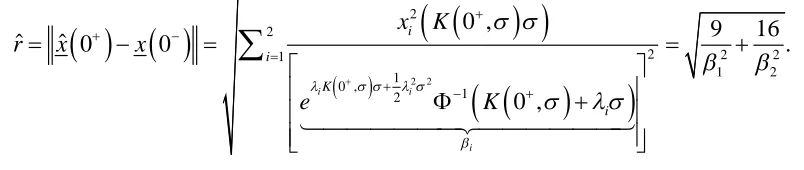
r x x
e K
[image:19.595.97.499.571.656.2]As 1, 21, rˆr 5.
Fig. 1: 2-ball with centre x
0 and radius rˆ
0 x S
r
19
5.2 Maximum distance from the origin with constrained input
Here we assume that the system (2.1) starts from the zero state at time t 0 and consider the problem of maximising the distance to the terminal state in an (almost)
zero-time state transition. This problem of course makes sense if the input signal is
con-strained in some sense. Here we impose constraints on the coefficient vector of the input
signal a
a0 a1 an1
Tin terms of the Euclidian and the infinity norms.Lemma 5.1 Let i 0, i1, 2,,n. Then
1 1
1 max , 1
p n
n n
i i
i n i
for all1, 2, ,
p n.
Proof Define function 1
1
( ) n i x
i
f x
which can be written as ( 1)1
( ) n m xi
i
f x
e bysetting mi lni . Since ( ) n1 2 m xi( 1) 0
i i
f x
m e for all x, function is convex for all x and specifically in the interval 1xn. Thus f x( ) attains its maximum at an edge of the interval 1xn, i.e.
1 1
1
1 max ( ) max (1), ( ) max , 1 ,
p n
n n
i x n i
i f x f f n n i
for every p1, 2,,n as required.
Theorem 5.1 Let Adiag
1, 2,n
, b
b1 b2 bn
T and assume that the pair( , )A b is controllable. Define Bˆ diag
1/ ,1/b1 b2,,1/bn
and denote by V
1, 2,..., n
V the Vandermonde matrix
2 1
1 1 1
2 1
2 2 2
1 2
2 1
1 1
, ,..., .
1
n n n
n
n n n
V V
20
Let a
ao a1 an1
T be the coefficient vector of the input signal u to( )
1 0
n i
i i a t
defined in (3.9). Then, if xˆ 0
denotes the terminal state of the zero-time state-transition problem with xˆ 0
0,
1
0
1 1
( ) ˆ
max ( ) max , ,
min | |
n n A
i
a i
i n i t A n
x t Be V n
b
(5.2)where the indicated matrix norm denotes the largest singular value (spectral norm) and
( )A
denotes the spectral radius of A.
Proof In the notation of Theorem 4.1 the terminal state of the transition is
ˆ 0ˆ 0 A
x Be Va. Thus
01 ˆ ˆ
max 0 A
a x Be V
, while the maximizing coefficient
vector a is the (normalised) singular vector of ˆ A0
Be V corresponding to the largest singular value. (If the largest singular value is repeated we can choose any linear
com-bination of unit length of the singular vectors corresponding to the repeated largest
sin-gular value). Note also that
* *
0 0 max | ( ) | ( )
ˆ ˆ .
min | | min | |
A A i n i
i n i i n i
t A t A
Be V B e V V V
b b
(5.3)
Now,
1 1
1,2, ,
1 max 1 max , 1 ,
p n
n n
T
p n i i i i
V n V n V n n n
(5.4)see Lemma 5.1 and [9], where 1 and
denote the induced 1 and -matrix norms,
respectively. Equation (5.2) follows by combining (5.3) and (5.4).
Remark 5.1 Consider the almost zero-time state transition problem in which
,
/K t t
has been fixed and has been chosen sufficiently small so that
1
i
for all i and approximation [9] is valid. Then we have x
0 BeA0Va,where
2 2 1
(0 , ) / 2
i i
diag K
21 It follows that in this case
0
0 2 1
1
max (0 ) A ( ) max e i (0 , ) ,
i n i i i
a x Be V n b K
where
2 1
1
( ) max , ,
2
n n
i i
n
n n
while the maximizing coefficient vectora is the (normalised) singular vector of A0 Be V
corresponding to the largest singular value.
Next, we impose magnitude constraints on the coefficients defining the
distribu-tional input signal. Again we assume that xˆ 0
x(0 ) 0 and seek to maximize
ˆ 0x using the impulsive input u t0( ) in equation (3.10) (or x
0
using its smooth
approximation u t( ) in (3.9)) subject to the constraint:
i i
a c , ci 0, for i n
(5.5)
(see also [9]). Geometrically, we seek constants ai for i n
in the ranges defined by
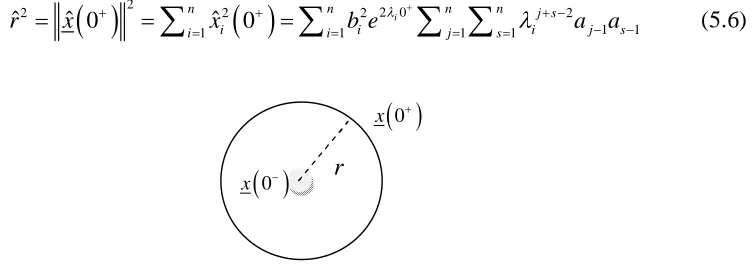
(5.5) such as the radius ˆr depicted in fig. 2 is maximised, (starting from xˆ 0
0)where
2
2 02 2 2 2
1 1
1 1 1 1
ˆ ˆ 0 n ˆ 0 n i n n j s
i i i j s
i i j s
r x x b e a a
[image:22.595.137.513.556.689.2]
(5.6)Fig. 2: n-ball with centre x
0 and radius r
0 x S
r
22 Again, if the smooth approximation signal u t( ) is applied, equation (4.6) should
be used; substitution into equation (5.6) shows that in this case we seek to maximise:
2 2
2 1
2 2 2 2 1
1 0 1ˆ 0 0 , .
i
n n
i i i
i i
r x x e K
Next note that equation (4.5) gives:
0 11 1
ˆ 0 i n j
i i j i j
x b e a
,and hence
2 02 2 2
1 1 1 1
ˆ 0 i n n j s
i i j s i j s
x b e a a
, i n (5.7)
Substituting, (5.7) into (5.6), gives
2 2
2 1
2 0
2 2 1 2
1 1
1 1 1
0 n i i i 0 , i n n ij s j s .
i j s
r x b e K a a
(5.8)Define the symmetric matrix
2 2
1 0
2 2 1
( ) T ( ) , i i i 0 , i .
Q V D V D diag b e K
Note that due to the assumed controllability of ( , )A b (which implies that bi 0,
in
) and the assumption that the eigenvalues of A are distinct (which implies that
det( )V 0), we have that ( )Q QT( ) 0. The two distance maximisation problems
now have the form
22
max r x 0 a QT ( ) a s t. . ci ai ci, i n
and
22
ˆ ˆ
max r x 0 a QT (0)a s t. . ci ai ci, in,
23 which are Quadratic Programming optimization problems with “box” constraints. Since
the cost function ( ( )f a a QT ( ) a ) which is maximized is convex, the constrained
maximum is achieved in a vertex of a hyper-cube ai c ii, n.
Thus, we obtain
2
1 1
sgn sgn 0
j s
i aj as
for all j and k.
This can be easily derived if we assume that
11
sgnaj 1 j and
1 1
sgnas 1 s ,
so we obtain
1 1
21 1
sgnaj sgnas 1 j 1 s 1 j s .
So, the maximum distance is given by
2 2 2
1 0 ,
2 2 1
1 1
1 1 1 0 , .
iK i
n n n j s
i j s i
i j s
r c c e K
(5.9)
Finally, again if we assume that *
* *
*, 0
t K t , and
* *
,
K t to beequal or greater to 3.90, we obtain
*
2 21 1
1 1 1
0 n n n i j s j s .
i j s
r x t x c c
(5.10)
The following numerical example illustrates some of the results of this section.
Example 5.2 Consider the (almost) zero state transition problem for the system defined in example 5.1 with x
0 0. Suppose that the following constraints are imposed onthe coefficients of the input signal
0 0 1
24 Subject to these constraints, the maximum distance from the zero state is:
2 2 2 2 1 1 1 2 2 2 1 2 1 0 ,2 2 2 2 2 1
1 1
1 1 1
2 1
0 ,
2 2 2 1
2
1 1 1 1
1 1
2 2
0 0 0
0 , .
0 , i i i i K j s
i j s i
i j s
K j s
j s
j s
j s
x x x
c c e K
c c e K
c
2 2 2 2 2 2 1 0 ,2 2 1
2
1 1 2
1 1
2 1 2 2 2 2 1 2 2 2
1 0 1 1 1 1 1 1 2 0 1 2 2 1 1 2
1 1 1 1
2 2
2 2 2 2 2 2
1 2 0 0 1 1 2 2 0 1 1 1 2 1 1 1
0 , .
2 2
K j s
j s
s s s s
s s s s
s s s s
c e K
c c c c c c c c
c c c c c c
In this example, c0 1, c12 and 1 2, 2 3. So, the maximum radius is given by
2 2
2 2
2 2
2 21 2 1 2 1 1 1 2
0 0 4 4 2 3 2 4 9 20 34
r x x
.
Now, for the case that t*K t
*,*
* 0, we have 12,22 1 and
*
0 4 4 2 3 2 4 9 54 7.35.
r x t x
6. Conclusions
In this paper, a novel methodology has been proposed for approximating the
distri-butional trajectory that transfers the state of a LTI differential system in (almost) zero
time by using an impulsive input. It has been shown that no loss of generality is
intro-duced if the impulsive input signal is chosen as a linear combination of the Dirac
func-25 tion, and the resulting response of the system was analysed. The work has addressed the
following three distinct problems:
(i) We have determined the (unique) impulsive input signal (and its smooth
approxima-tion) which transfers the state of the system from the origin to an arbitrary point in state
space in zero (almost-zero) time, subject to appropriate controllability assumptions. To
simplify our presentation, the simplest set of assumptions has been selected (full system
controllability, single control input, distinct set of eigenvalues in the system matrix);
however, extension to the general case is straightforward at the expense of possible loss
of uniqueness and considerable additional complexity in the resulting mathematical
ex-pressions.
(ii) A Euclidean metric has been defined to quantify the approximation error in the
state-trajectories of the system resulting from substituting impulsive input signals by
smooth signals. The optimal choice of two parameters (time and volatility)
characteris-ing the family of all smooth approximatcharacteris-ing functions has been obtained, along with an
interesting probabilistic interpretation.
(iii) The solution of two state-space maximum-distance problems in the context of
(al-most) zero-time state-transition has been presented. These correspond to two different
types of constraints on the coefficients of the impulsive input signal and its smooth
ap-proximation, involving the Euclidian and infinity norms of the vector of coefficients.
Both problems are tractable and can be solved via an SVD and the solution of a
quad-ratic programming problem with box constraints, respectively.
Future work will attempt to: (i) extend the results of this paper to more general classes
of systems (e.g. descriptor, singular), (ii) investigate the numerical properties of
simu-lating impulsive trajectories and their smooth approximation, and (iii) develop
alterna-tive energy-based approximation techniques of impulsive behaviour especially in the
context of large-scale systems and model reduction.
Acknowledgment: Part of the present version of the paper has been presented in the 4th
26 2010, Ancona, Italy and in the Workshop “Advances in Mathematical Control Theory
and Applications", 19-20th of May 2011, Liverpool, UK. We are very grateful to Prof. Michael Malabre, Prof. Malcolm Smith, Prof. Jean-Jacques Loiseau, and Dr Efstathios
Antoniou for their helpful comments and remarks.
References
[1]. Bowen, J.M. (1994) Delta function terms arising from classical point source fields,
American Journal of Physics Vol. 62, pp. 511-515.
[2]. Boykin, T.B. (2003) Derivatives of the Dirac delta function by explicit construction
of sequences, American Journal of Physics Vol. 72, pp. 462-468.
[3]. Campbell, S.L. (1980) Singular systems of differential equations. I. Research Notes
in Mathematics 40. Pitman, Boston.
[4]. Campbell, S.L. (1982) Singular systems of differential equations. II. Research
Notes in Mathematics 61. Pitman, Boston.
[5]. Cobb, J.D. (1982) On the Solutions of Linear Differential Equations with Singular
Coefficients, Journal of Differential Equations Vol. 46, No. 3, pp. 310-323.
[6]. Cobb, J.D. (1983) Descriptor Variable Systems and Optimal State Regulation,
IEEE Transactions on Automatic Control Vol. 28, No. 5, pp. 601-611.
[7]. Cohen and Kirchner (1991), Approximating the Dirac distribution for Fourier
analysis, Journal of Computational Physic Vol. 93, pp. 312-324.
[8]. Estrada, R. and Kanwal, R.P. (2000) Singular integral equations, Birkhauser,
Bos-ton.
[9]. Gautshi, W. (1975), Optimally conditioned Vandermode matrices, Numerische