1
Revisiting the Relationship between Justice and
Extra-Role Behavior: The Role of State Ownership
Xi Chen
1,2 11New York University, USA, and 2University of Nottingham Ningbo, China
2
ABSTRACT State ownership is an important phenomenon in the world economy, especially 3
in transition economies. Previous research has focused on how state ownership influences 4
organizational performance, but few studies have been conducted on how state ownership 5
influences employees. I propose that different ownership structures trigger different 6
relational models among employees, who pay attention to organizational justice consistent 7
with their model to guide their extra-role behavior. Specifically, state-owned organizations 8
reinforce employees’ relational concern and direct employees’ attention to procedural 9
justice, whereas privatized organizations highlight employees’ instrumental concern and 10
direct their attention to distributive justice. I leverage a sample of organizations in China 11
to explore how different ownership structures activate different relational models among 12
employees and alter the relationship between organizational justice and employees’ 13
extra-role behaviors. I find that state ownership attenuates and even reverses the positive 14
relationship between distributive justice and extra-role behaviors. Conversely, state 15
ownership exaggerates the positive relationship between a critical procedural justice 16
dimension (participation in decision making) and employee extra-role behaviors. 17
Implications for the micro-foundations of corporate governance and institutional change, 18
organizational justice literature, and cross-cultural research are developed. This study also 19
generates new insights for transition economies such as China. 20
KEYWORDS distributive justice, extra-role behavior, procedural justice, relational model, 21
state ownership 22
INTRODUCTION 23
Ownership structure is a key characteristic of corporate governance and holds 24
important implications for organizational strategy and productivity (Hill & Snell, 25 1989). State ownership – the degree to which an organization’s property interest 26
is vested in the state or a public body representing the state – is still an important 27
phenomenon in the world economy (La Porta, Lopez-De-Silanes, & Shleifer, 1999). 28
State-Owned Enterprises (SOEs) contribute approximately 10% of the worlds’ 29
GDP (Bruton, Peng, Ahlstrom, Stan, & Xu, 2015) and still exist in countries 30
2
33 Norway, the Philippines, Malaysia, Singapore, Egypt, Serbia, Turkey, Bhutan,
34 Chile, Ghana, Kenya, India, Pakistan, Peru, South Africa, Zambia, Korea, and 35 many other countries (World Bank, 2014). Therefore, Peng, Bruton, Stan, and 36 Huang (2016) suggest that state ownership is one of the mainstream organizational
37 forms and holds important implications for organizational theories. Existing
38 research on state ownership has focused on its implications for organizational 39 performance (Le & O’Brien, 2010; Ramaswamy, 2001) and found that state
40 ownership is on average associated with decreased labor productivity and 41 corporate performance (Chen, 2001; Xu & Wang, 1999). However, privatization
42 reform, which aims to reduce state ownership, has only achieved mixed results 43 (Dharwadkar, George, & Brandes, 2000). Because employees are an important 44 stakeholder of organizations and driver of organizational performance (Aguilera & 45 Jackson, 2010), how state ownership and its reduction influence employee behavior
46 may provide a clue about the transition effect. However, very few studies have 47 paid attention to their experiences under state ownership (Fiss, 2008). Therefore,
48 more research is needed on the micro foundation of ownership reform (Cuervo 49 & Villalonga, 2000; Parker, 1995). A few micro studies found that employees in 50 SOEs prefer egalitarian distribution (He, Chen, & Zhang, 2004) and perform 51 extra-role behaviors that align with SOEs’ goals (Farh, Zhong, & Organ, 2004).
52 However, it is unclear what motives drive SOE employees to engage in
extra-53 role behaviors. To fill this gap, this study focuses on how organizations with
54 different ownership structure motivate employee behavior that is important for
55 organizational performance – extra-role behavior.
56 In this study, I propose that SOEs rely on a distinctive mechanism to
57 motivate employees’ extra-role behavior. SOEs foster a strong collective identity 58 among employees and encourage them to treat their enterprises as families.
59 This objective is achieved through widespread participation in organizational
60 governance. As the reform emphasizing market efficiency and organizational
61 productivity proceeds, privatized companies reinforce employees’ concern about
62 their individual outcomes and utilize equitable allocation of outcomes to motivate
63 employees. Thus, employees in SOEs and privatized companies will hold
64 different relational models about their relationships with their organizations and
65 pay attention to organizational practice that is consistent with their relational
66 model. In particular, I suggest that the communitarian and egalitarian relational
67 model in SOEs accentuates positive reactions to procedural justice, whereas
68 the market and exchange relational model in privatized companies accentuates
69 positive reactions to distributive justice. To test this argument, the present
70 research draws upon the variability in ownership structure of organizations
71 during China’s transition to explore how ownership structure moderates the 72 effects of distributive justice and procedural justice on employees’ extra-role 73 behavior.
74 The current work contributes to existing theory and research in a number
3 reform (Naughton, 1996; Ramamurti, 2000), developing a theory regarding 76
how ownership structure influences employee relational model and reactions to 77
organizational practices. This is key to understanding the micro-foundations of 78
institutional reform. I suggest that ownership structure is not associated with 79
different levels of employee motivation (Burawoy & Lukacs, 1985), but rather 80
associated with different predictors of employee motivation. Thus, whether these 81
differences are acknowledged and addressed properly during the transition may 82
help explain the mixed results of transition effects in macro research. 83
Second, by exploring how ownership structure serves as a key contextual 84
factor altering the well-known relationship between organizational justice 85
and extra-role behavior, I offer new insights into the boundary conditions 86
of justice effects. Because different ownership structures rely on different 87
approaches to motivate employees, it will shape which mechanism of justice is 88
operative – social exchange or social identity. Specifically, distributive justice, by 89
emphasizing equitable allocation of outcomes, is especially important in soliciting 90
employee extra-role behavior in privatized organizations. Procedural justice, by 91
verifying individuals’ collective identity, plays an important role in state-owned 92
organizations. Thus, I show how different justice dimensions matter in different 93
contexts. 94
Finally, this study holds important implications for designing reform measures 95
in transition economies. Previous reform efforts are based on the assumption 96
that SOE managers and employees lack incentives and motivation, and the 97
main reform measure is to privatize SOEs. This study uncovers an unrecognized 98
predictor of employee extra-role behavior in SOEs. I suggest that SOEs do not 99
simply lack motivation but motivate employees in different ways than privatized 100
organizations. Recognizing this new motive can generate more creative ways to 101
reform and manage SOEs, given the increasing presence of state ownership around 102
the globe (The Economist, 2012). 103
THEORETICAL BACKGROUND AND HYPOTHESES 104
In this article, I propose that ownership structure is associated with the relational 105
model that individuals hold regarding their relationships with their organizations 106
and their primary concerns in organizations. Ownership structure and the role 107
of labor are two important dimensions in corporate governance (Aguilera & 108
Jackson, 2010). Because ownership structure defines the social relations among 109
organizational actors (Fiss, 2008), it will influence how employees construe their 110
relationships with their organizations. In addition, ownership structure shapes 111
organizational goals (Fiss, 2008), which will influence the primary concerns among 112
employees. For instance, a state owner focuses more on organizational solidarity 113
and treats workers as ‘master of enterprises’ (Chiu, 2006), whereas private owners 114
may focus more on organizational productivity and treat labor as a means to 115
achieve organizational productivity. Thus, their relative weights in the ownership 116
4 117 structure of organizations will influence how employees construe their relationships
118 with their organizations – as enterprise master or exchange partners – and
119 whether they are primarily concerned with social identity or exchange outcomes.
120 The relational schemas that employees hold and their primary concerns will
121 direct their attention to different organizational practices (Thornton, Ocasio, & 122 Lounsbury, 2012), with implications for which form of justice is important for
123 guiding employee extra-role behavior. I selected China as the empirical setting 124 to examine this proposal because its transition from planned economy to market
125 economy generates great diversity in the ownership structure of organizations. 126 In the context of China, I suggest that state ownership and privatization reform
127 activate different relational models people apply to their organizations. These
128 relational models are the cognitive schemas that people use to process complex
129 information and guide their actions. These cognitive schemas are constructed in a 130 specific institutional environment and mediate the impact of institutions on human 131 behaviors (Seo & Creed, 2002). Therefore, only one or a few relational models
132 are salient in a specific context, and economic development generally moves the 133 relational model from communal sharing to market pricing (Fiske, 1992). Eco- 134 nomic development generally moves the relational schema from communal sharing 135 to market pricing (Fiske, 1992). Applying this theory to employee-organization
136 relationships in China, I argue that the communal sharing model is dominant in
137 SOEs, and the market pricing model is dominant in privatized companies. The
138 following sections will develop these arguments based on previous research.
139 State Ownership in China
140 State ownership is an important characteristic of China’s pre-reform socialist 141 economy. China adopted the Soviet model shortly after its revolution (Jackson,
142 1992),leading SOEs to play a central role in the composition of its planned 143 economy (Groves, Yongmiao, McMillan, & Naughton, 1994). State ownership
144 is associated with obligations and privileges that have evolved historically. In
145 particular, SOEs have alternative goals beyond financial performance, such
146 as maintaining political stability, increasing employment, and providing public 147 facilities (Walder, 1989; Zif, 1981). In conjunction with these obligations, they
148 have greater access to government loans and purchases and face softer budget 149 constraints (Bai & Wang, 1998; Dong & Putterman, 2003). The incentive system
150 of SOEs has been historically characterized by high social benefits and low cash 151 wages (Walder, 1983), both of which are allocated equally within classes of workers 152 (Giacobbe-Miller, Miller, & Zhang, 1997). SOEs also provide employment security
153 and used to grant all employees lifelong employment until retirement (Naughton, 154 1996). SOE employees have more secure employment than employees of non-state- 155 owned organizations (Gong & Chang, 2008).
156 SOEs’ equal treatment of workers in their need satisfaction foster a communal
5 and taken care of by the group. Based on interviews with 30 employees and a 158
survey of 500 employees of two SOEs in northeast China, Liu (2003) found that 159
SOEs emphasize group solidarity and treat employees as families. This family 160
culture is further intensified by the socialist ideology, which regards workers as 161
the ‘leading class’ and ‘master of socialist society’ (Wang & Greenwood, 2015). 162
This ideology cultivated a collective identity of SOE employees as the ‘master of 163
enterprises’ (zhurenweng) (Chiu, 2006). This identity is manifested in their reactions 164
to unemployment. Due to their sense of class status and entitlement, laid-off 165
workers prevalently experienced loss of face and a sense of betrayal (Mok, Wong, 166
& Lee, 2002; Wang & Greenwood, 2015), and state workers resorted to this 167
identity to defend their rights and resist SOEs’ downsizing effort, as illustrated 168
in interviews with eight steel SOEs throughout China in 1997 (Hassard, Morris, 169
Sheehan, & Yuxin, 2006). SOEs’ family culture and collective identity have 170
been acknowledged by private companies during their acquisition of SOEs, as 171
documented in a case study (Xing & Liu, 2016). The above studies unanimously 172
show that SOEs activate a communal sharing relational model among SOE 173
employees, as reflected in their culture and collective identity as ‘master of 174
enterprises’. 175
A very important institutional embodiment of that identity is the widespread 176
participation opportunities of SOE employees in the governance of SOEs. 177
SOEs institutionalize widespread employee participation in organizational affairs 178
through daily production meetings, yearly workers’ congress, various management 179
committees, and incentive-suggestion systems (Tang, 1993; Walder, 1981). 180
Although these participation opportunities are limited by central planning and 181
party control over leadership selection (Walder, 1981), they still have a symbolic 182
function of enhancing the communal sharing model in SOEs. Based on case 183
studies of six enterprises in Shanghai from 1997 to 1998, Benson and Zhu (1999) 184
found that SOEs are characterized by traditional management systems including 185
teamwork, information sharing, and harmonious work conditions. In these 186
organizations, unions and work congress participate in important organizational 187
decision making, including redundancy decisions, organizational restructuring, 188
developing training, and welfare and housing. In addition, employee creativity 189
is recognized as an asset during ownership transformation, and employees can 190
receive shares or form new companies based on their adopted ideas (Benson & 191
Zhu, 1999). Participation opportunity has become so deeply grounded in SOE 192
employees’ model that they rely on it to evaluate new management practices. 193
For instance, a study of 194 employees from four SOEs in northeast China 194
in 2008 showed that procedural justice, especially being able to participate in 195
the performance appraisal process, is very important for employees’ perception 196
of the system (Tsai & Wang, 2013). Therefore, procedural justice, especially 197
the opportunity to participate in organizational decision making, plays an 198
important role in upholding SOE employees’ collective identity and sustaining 199
their motivation. 200
6
201 Gradualist Reform in China
202 China’s economy has experienced an unprecedented change as it transitions from 203 a centrally-planned socialist economy to a market-oriented capitalist economy 204 (Guthrie, 1999). However, the capitalist economy in China is centrally-managed
205 capitalism, where the state plays an important role in many aspects of the 206 economy (Lin, 2011). Under this background, ownership reform in China adopts a 207 gradualist approach, with SOEs coexisting with organizations of hybrid ownership 208 (Nee, 1992). For example, SOEs are partially privatized via public listing on
209 stock exchanges, building joint ventures with local or foreign private firms, or 210 transferring property rights to private holders (Walder, 1995). Analogous to other
211 gradual reforms in China, this privatization reform is only a partial one in
212 the sense that the state remains as a dominant shareholder in many privatized 213 firms. Typically, public listing of SOEs allows the state to retain between 40%
214 and 50% of the company’s shares. Between 20% and 30% of the shares are 215 designated for institutional shares, and the remaining 30% are designated for 216 public consumption as free-floating shares (Guthrie, 1999; Xu & Wang, 1999).
In
217 joint ventures, foreign parent companies often control half or more of the shares
218 of joint ventures, and state-owned parent companies hold the other half or less 219 (Guthrie, 1999). These privatized companies constitute an important sector in 220 China’s economy (Walder, 2011). The privatization reform abolished privileges
221 provided by the government, tightened budget constraints, and increased market 222 pressure in privatized companies (Zahra, Ireland, Gutierrez, & Hitt, 2000). As a 223 result, privatized companies place a higher priority on efficiency and productivity 224 as organizational goals than SOEs do (He et al., 2004).
225 Along with change in ownership structure, management practices of privatized
226 companies are different from SOEs as well. The capitalist market exchanges
227 human activities based on prices generated from market competition (Friedland 228 & Alford, 1991). Under this logic, privatized companies allocate rewards based 229 on individual performance and contribution to the organization (Giacobbe-Miller, 230 Miller, Zhang, & Victorov, 2003), provide opportunities for career advancement 231 to motivate their employees (Gong & Chang, 2008), and use meritocracy as 232 the basis for promotion (Zhao & Zhou, 2004). That is, the incentive system of 233 privatized organizations follows the rule of equity (Chen, Meindl, & Hui, 1998).
234 Although SOEs are also increasingly adopting these labor practices, such as 235 bonus payment and piece-rate wages (Groves et al., 1994; Keister, 2002), their
236 movement towards a modern human resource management system is constrained 237 by government involvement and union strength (Benson & Zhu, 1999). According
238 to a survey of 600 Chinese companies in 2003, SOEs adopt less strategic human
239 resource management practices than foreign-invested enterprises and private-240 owned enterprises (Ngo, Lau, & Foley, 2008).
241 With the change in ownership structure and management practices of privatized
7 well. As privatized companies reward individuals according to their contribution, 243
employees will adopt the market pricing model – in which they view their 244
relationship with organizations as exchanges and pay attention to the ratio 245
between their output and input (Guthrie, 2002). Accordingly, they will expect 246
that every effort that they contribute to the organization is fairly rewarded. 247
Indeed, compared to SOE employees, employees of public firms and joint 248
ventures have a stronger preference for equitable allocation based on individual 249
contribution and a lower preference for equal allocation of outcomes (Choi & 250
Chen, 2007; He et al., 2004). At the same time, the introduction of private 251
owners and multinational companies downplays the status of workers in corporate 252
governance (Hassard, Morris, & Sheehan, 2002). Indeed, the majority of workers 253
perceive stricter management control after the reform (Chiu, 2006), and privatized 254
organizations, such as private enterprises and joint ventures, have lower employee 255
participation than SOEs (Chiu, 2002). As a result, employees of privatized 256
companies may be less likely to regard themselves as ‘master’ of their organizations 257
than SOE employees. The different relational models in SOEs and privatized 258
companies can also be evidenced by employees’ organizational commitment. 259
SOE employees had higher continuance commitment than employees of private 260
enterprise (Chiu, 2002) and foreign-invested enterprises (Wang, 2004). In contrast, 261
employees of foreign-invested enterprises perceive higher value congruence with 262
organizations than SOE employees, due to their common interest in the exchange 263
relationship. 264
Overall, previous research has found a significant difference between SOEs 265
and privatized companies in organizational practices and employee models. SOEs 266
create a family culture and activate a communal sharing model among employees. 267
Accordingly, SOE employees participate widely in organizational activities and 268
develop the collective identity as ‘master of enterprises’. In contrast, privatized 269
companies emphasize productivity and foster a market pricing schema. As a 270
result, employees regard themselves as exchange partners of their organizations 271
and expect fair treatment for their contribution. In the following sections, I 272
explicate that the different relational models in SOEs and privatized companies 273
will influence how employees react to organizational justice. 274
Organizational Justice and Extra-Role Behavior 275
An important indicator of employees’ contribution to their organizations is extra- 276
role behavior (Van Dyne, Cummings, & Parks, 1995). Extra-role behaviors are 277
those that lie outside of formal role requirements, are directed toward benefitting 278
the organization, and are not explicitly rewarded (Van Dyne et al., 1995),[1] Extra- 279
role behaviors reflect employees’ engagement with the organization and have been 280
associated with important organizational outcomes, such as sales, efficiency, quality, 281
and customer satisfaction (Organ, Podsakoff, & MacKenzie, 2006; Podsakoff, 282
8 284 partly justify the existence of organizations within markets by lowering transaction 285 costs and increasing coordination at little tangible cost to the firm (Coase, 1937; 286 Williamson, 1981). Previous research has found that the ownership structure of
287 organizations is related to different forms of extra-role behaviors that individuals 288 perform (Farh et al., 2004). For instance, because SOEs incorporate social welfare
289 as an indicator of organizational performance, SOE employees engage more in 290 behaviors that are community-oriented, such as participating in social welfare, than 291 non-SOE employees. On the other hand, because SOEs place a lower emphasis on
292 organizational efficiency than non-SOEs, SOE employees engage less in extra-role
293 behaviors that enhance organizational efficiency – such as taking initiatives and
294 saving and protecting organizational resources – than non-SOE employees. In the
295 current study, I take a different perspective and focus on extra-role behaviors that
296 have been widely regarded as important to all kinds of organizations. I examine
297 how ownership structure influences predictors of these extra-role behaviors that
298 are essential for organizational effectiveness.
299 I argue that ownership reform changes people’s models of their relationships 300 with organizations, and the different relational models of employees in SOEs and
301 privatized companies will lead them to pay attention to different organizational
302 practices. Perceived justice is an important way through which organizational
303 practices increase employees’ extra-role behaviors. Organizational justice includes
304 distributive justice – the allocation of outcomes according to individuals’
305 performance and contribution – and procedural justice – the fair process
306 of organizational decision making, such as allowing individuals to participate 307 (Colquitt, 2001). Both distributive justice and procedural justice robustly predict 308 employees’ motivation and extra-role behaviors (Cohen-Charash & Spector, 2001). 309 However, individuals don’t take all forms of justice into consideration when making 310 a decision about their extra-role behaviors (Lind, 2001). Instead, they rely on the
311 most salient form of justice in their environment to make an overall evaluation of
312 their organization and rely on that evaluation to guide their extra-role behaviors
313 (Lind, Kray, & Thompson, 2001). Based on relational models theory (Fiske, 1992),
314 I propose that which form of justice becomes salient in a context will depend on
315 the relational model in that context because relational model guides individuals’ 316 information processing. Information that is consistent with the model is attended
317 to and becomes salient, whereas information that is inconsistent with the model 318 is ignored or downplayed (Fiske, 1992; Sanchez-Burks, Nisbett, & Ybarra, 2000).
319 As a result, the salience of distributive justice and procedural justice in a specific
320 context depends on the dominant relational model in that context.
321 Based on cross-cultural research, I suggest that distributive justice is especially
322 salient under the market pricing model, whereas procedural justice is especially 323 salient under the communal sharing model. When people hold the market pricing
324 model, they are primarily concerned with the ratio of their output to their input, 325 which is exactly the definition of distributive justice (Adams, 1965). Social exchange
9 in social exchanges, and distributive justice makes sure that individuals’ inputs 327
into social exchange are fairly rewarded (Colquitt et al., 2013; Organ, 1990). 328
Because distributive justice is fair distribution of outcomes, people pay attention 329
to distributive justice when their instrumental concern is highlighted. For instance, 330
distributive justice is especially important for countries high in materialism, such 331
as China and Korea (Kim & Leung, 2007), or when the productivity goal is high- 332
lighted (Chen et al., 1998). In contrast, when the relational concern is highlighted, 333
people attend to procedural justice to make sense of their relational status. Because 334
procedural justice, such as whether people can participate in the decision making 335
process, carries expressive value of how people are treated in their groups and 336
helps individuals address their relational concern (Tyler, 1989, 1994). According 337
to the relational model of justice, procedural justice signals to individuals that they 338
are valued members of their groups and plays an important role in enhancing em- 339
ployee cooperation in organizations (Tyler & Blader, 2000). Procedural justice leads 340
individuals to interpret their interactions with organizations as social relationships, 341
rather than economic transactions (Tyler, Degoey, & Smith, 1996; Tyler & Lind, 342 1992),and such interpretation reinforces the communal sharing model. Empirical 343
research also shows that procedural justice is especially important when people care 344
about their relationships (Kwong & Leung, 2002). For instance, procedural justice is 345
especially important for people with interdependent self-construal, i.e., those who 346
define themselves according to their relationships (Brockner, De Cremer, van den 347
Bos, & Chen, 2005). When their highlighted relational concerns are addressed 348
by procedural justice, they don’t pay attention to distributive justice any more 349
(Brockner, Chen, Mannix, Leung, & Skarlicki, 2000; Kwong & Leung, 2002). All 350
of these studies suggest that procedural justice is especially salient when people are 351
primarily concerned with relationships, whereas distributive justice plays a large 352
role when people are primarily concerned with outcomes. 353
The Moderation Effect of Ownership Structure 354
In this section, I argue that the effects of organizational justice will depend on the 355
ownership structure of organizations. As stated above, the ownership structure of 356
organizations is associated with the dominant relational models employees hold, 357
and the relational models will direct people’s attention to the justice practice that 358
is consistent with the dominant model. Specifically, the communal sharing model 359
in SOEs lead SOE employees to pay attention to procedural justice to address 360
their relational concern, whereas the market pricing model in privatized companies 361
will lead employees to resort to distributive justice to address their instrumental 362
concern. Thus, the ownership structure of organizations will moderate the impact 363
of organizational justice on individual behaviors. 364
I propose that the communal sharing model in SOEs reinforces the importance 365
of procedural justice in verifying employees’ collective identity. Scholars have 366
10 368 extra-role behaviors – described in the group engagement model (Tyler & Blader, 369 2003). This model suggests that organization members have a need to belong to the 370 organization and therefore identify with it (Lind & Tyler, 1988; Tyler, 1989), and 371 procedural justice satisfies that need because it enhances members’ sense of pride 372 and respect (Tyler & Blader, 2000). I argue that this identity mechanism of justice 373 is especially salient in highly state-owned organizations, where employees hold the
374 communal sharing model and value their organizational membership. Because
375 procedural justice enhances their pride about their organizational membership
376 and makes them feel respected and honored in SOEs, it leads them to invest
377 their social identities in their organizations and engage in extra-role behaviors to 378 express that identity. Thus, employees in state-owned organizations will display a 379 stronger positive reaction to procedural justice via extra-role behaviors than those
380 in organizations with lower levels of state-ownership.
381 Hypothesis 1: State-ownership will moderate the positive relationship between procedural justice
382 and employee extra-role behaviors, such that the relationship will be stronger for employees of
383 organizations with higher levels of state ownership.
384 In privatized companies, where employees are more concerned about their
385 economic outcomes, I propose that distributive justice will be a more important
386 driver of individual extra-role behaviors than in SOEs. According to social
387 exchange theory, both justice and extra-role behavior are social resources used in
388 the exchange between organizations and employees, and their exchange follows 389 the rule of reciprocity (Colquitt et al., 2013). This is consistent with the market 390 pricing model, which matches input to output proportionally (Fiske, 1992). As 391 employees of privatized organizations view their relationship with organizations as
392 exchanges, they will match their extra-role behaviors to the outcomes received from
393 their organizations. When these employees perceive the outcomes they receive
394 from organizations to be fair, they will reciprocate by engaging in extra-role 395 behavior. In addition, distributive justice may lead employees to increase extra-role
396 behavior to exchange for outcomes they value. Although extra-role behaviors are 397 not prescribed in role-definitions, employees deem these behaviors instrumental to
398 increase their performance evaluation and promotion opportunities (Hui, Lam, 399 & Law, 2000; MacKenzie, Podsakoff, & Fetter, 1991). When people perceive
400 their companies to be fair and believe these behaviors are reciprocated by their
401 organizations, they are more likely to engage in extra-role behaviors (Podsakoff, 402 MacKenzie, Paine, & Bachrach, 2000). Taken together, employees of privatized
403 organizations will pay more attention to distributive justice to make a decision
404 about whether to engage in extra-role behaviors than SOE employees. Therefore,
405 I hypothesize that:
406 Hypothesis 2: State-ownership will moderate the positive relationship between distributive
407 justice and employee extra-role behaviors, such that the relationship will be stronger for employees
408 of organizations with lower levels of state ownership.
11 behaviors varies with the ownership structure of organizations. SOEs activate 410
the communal sharing model and relational concern among employees, who 411
pay attention to procedural justice to determine whether to engage in extra-role 412
behaviors. In contrast, privatized organizations reinforce the market pricing model 413
and instrumental concern among employees, who resort to distributive justice to 414
determine whether to engage in extra-role behavior. To examine these hypotheses, 415
I first conducted a qualitative study to examine the relational models dominant 416
in different kinds of organizations. After that, I conducted a field survey with 417
employees from organizations with different degrees of state ownership to directly 418
test my hypotheses. 419
QUALITATIVE STUDY 420
Sample and Procedure 421
Because Fiske (1992)’s relational models are targeted to interpersonal relationships, 422
existing measures of relational modles – such as Haslam and Fiske (1999) – 423
are not suitable to characterize employee-organization relationships in this study. 424
Therefore, I conducted a qualitative study to investigate the different relational 425
models under different ownership structures. This is consistent with the qualitative 426
methodology employed in research of relational models (Fiske, 1991). In order to 427
understand employees’ relational models in organizations with different ownership 428
structures, I selected four firms under the same group company, including one 429
state-owned firm (Case 1), two public firms (Case 2 and 3), and one joint venture 430
(Case 4). I interviewed six human resource managers from these four firms. 431
The interviews were conducted at the managers’ offices. The interviews were 432
designed in a semi-structured approach. First, I asked about the history of 433
the firm and the career history and responsibilities of the manager. Second, I 434
asked about ownership structure, organizational goals, and requested a chart of 435
organizational structure. Third, I asked how they carry out the functions of human 436
resource management, including recruiting, training, performance evaluation, 437
compensation, and career management. Finally, I asked how employees construe 438
their relationships with their company. I took notes of all interviews and recorded 439
and transcribed the interviews for which approval was granted. The duration of 440
interviews varied between one to two hours. 441
Results 442
The management practices of the four cases are summarized in Table 1. Because 443
Case 2 and Case 3 were both public firms, and their practices were very similar, 444
I combined them into one category. As shown in Table 1, the cases represented 445
12
Table 1. Organizational information of state-owned enterprises, public firms, and joint ventures. Summary of case organizational information
Case Number 1 2, 3 4
State Ownership 100%. 47%, 45% 30%
Organizational type SOE Public Firm Joint Venture
Organizational goals Fealty to state, Board evaluation, Brand recognition, Contribution to Continuous profit, Product quality, Market
economy, Harmony Functional share, Personnel
of top management coordination, development team, Employee Industry reputation
satisfaction
Board composition Party secretary, Top Party secretary, Top Delegates of parent
management team management companies
team,Independent board members, Union representative
Organizational Simple Complex Simple
structure Three functional Multiple functional Multiple functional
departments departments departments
Performance No evaluation Key-Performance Goal achievement
evaluation Indicators Self-evaluation
Balanced Score Card Supervisor evaluation
Compensation Fixed wages External Job requirements
No evaluation-based competitiveness Individual performance
bonus Internal fairness Market competitiveness
Training Basic position training Monthly safety Externally required/
training madatory training
Continued education Individual skill training EMBA for top Education sponsorship
managers policy
Participation Worker congress Worker congress Informal
meeting meeting communication
Incentive-suggestion Incentive-suggestion Incentive-suggestion
system system system
447 goals, employee satisfaction was one of organizational goals in SOEs, but not in
448 public firms or joint ventures, indicating the special employee status in SOEs. 449 According to company law in China, limited companies with two or more
state-450 owned investors need to have a union representative on the board to represent the
451 interest of workers, as reflected in Cases 2 and 3. These characteristics indicate
452 that in SOEs and public firms, employee satisfaction is an ends rather than a 453 means to achieve organizational profit. This is different from the schema in highly
454 privatized organizations, such as the joint venture. Their organizational goals
13 achieving organizational goals. Therefore, different organizational goals regarding 456
employees reflect different relational models. 457
In SOEs, employees rely on their organizations to satisfy their needs, reflecting 458
the communal sharing schema (Fiske, 1992). An SOE manager commented about 459
SOE employees’ loyalty (Case 1): 460
The workers of SOEs are very loyal. They think that they belong to the firm even after death, 461
and the firm will send them a wreath (hua quan). Our employees have a very high happiness 462
index, and this index is even higher after they retire. If employees are hospitalized, the firm will 463
visit them. I buy employees casualty insurance. If they get cancer, I give them 100,000 Yuan. 464
I visit them during holidays. If an employee dies, I cover a series of services. Overall, employee 465
loyalty is highest in SOEs, less in public firms, and even less in joint ventures. 466
Another SOE manager commented about the organizational culture of the 467
SOE and how it compares with the market pricing schema in joint ventures 468
(Case 1): 469
With the development of the times, employees of SOEs are not as committed as in the past. 470
If the firm is performing well, people have hope. SOEs value people and give employees many 471
opportunities, such as rotation. Although the foreign companies pay well, people have to work 472
very hard. My friends working there admire my job. 473
SOEs and public firms hold annual worker congress meetings, which 474
institutionalize employees’ participation in organizational decision making. During 475
these meetings, top managers debrief employee representatives, who evaluate 476
managers’ performance, express the concerns of employees, and vote on important 477
organizational policies. A public firm manager described the procedures for 478
employee participation (Case 2): 479
I have a series of democratic management procedures, including employee representative meetings, 480
evaluation of top management teams, publicity of party and administrative policies and affairs. 481
If employees have some big problems, they may even go to the top managers. 482
The public firms and the joint venture inherited the incentive-suggestion system 483
(helihua jianyi) from former SOEs, in which employees provide suggestions for 484
improving the work process and receive recognition or bonuses (in case 4) for 485
their valuable suggestions. Yet in the joint venture, employees’ suggestions become 486
a resource of exchange, because the division of labor is clear – managers are 487
responsible for making decisions, and employees are to execute decisions. Their 488
communication is mostly carried out in the informal way, in which employees 489
directly express their concerns to their supervisors. 490
The incentive systems are different between the three kinds of organizations 491
I studied, reflecting different underlying relational models. In the SOE, factory 492
managers are evaluated via financial indicators, but there is no formal performance 493
evaluation or performance-based bonus for employees. The equality in outcomes 494
is aligned with the solidarity goal and communal sharing schema in SOEs (Chen 495
14 496 et al., 1998). The joint venture evaluates and rewards individual performance
497 consistent with the market pricing model. Their incentive system emphasizes not 498 only internal equity but also external competitiveness, i.e., it ensures that employees
499 are compensated for the value they create for their organizations. A joint venture 500 manager, who was dispatched to the joint venture from an SOE in 2009, described
501 the incentive system of joint ventures this way (Case 4):
502 Our system is objective, scientific, and based on data and evidence. It’s not like SOE, where
503 bonuses often come as surprises. The incentive system gave priority to performance in evaluation,
504 reward, and promotion. The organization and managers and employees at each level set goals
505 at the beginning of every year. With reference to the goals, the evaluation of employees is carried
506 out every year, combining self-evaluation and supervisor evaluation. The compensation is based
507 on the result of evaluation, adjusting up to 20% above or below the salary band for each level.
508 The salary levels are adjusted annually for market competitiveness by comparing with market
509 salary data.
510 The public firms were experimenting with different evaluation and incentive
511 systems, such as Key-Performance Indicators (KPI) and balanced score card and 512 experiencing some tension during the transition. A public firm manager described
513 the challenges that she encountered in enforcing the new incentive systems (Case 514 3). Because the firm used to be SOE, employees still held the communal sharing
515 model and react negatively to the management practices that contradict this
516 model.
517 I have established all the institutions relying on economic measures. However, when the (firm)
518 performance is not good, I can’t enforce these institutions, because I don’t have so much money.
519 SOE employees are not as qualified (su zhi) as joint venture employees, and their attitudes are
520 not good. When you evaluate their performance, they think that you are going to deduct their
521 wages. Therefore, I can’t do performance evaluation right now. The rules can’t rule the mass
522 (fa bu ze zhong). I will hold KPI trainings this year.
523 The interviews and case studies corroborated my argument that highly state-524 owned organizations activate a communal sharing model whereas highly privatized
525 organizations reinforce a market pricing model. The evidence provided support 526 for my theoretical argument that different relational models underlie different 527 ownership structures. The following quantitative study further tests my hypotheses
528 regarding how ownership structure moderates employees’ reactions to different 529 justice practices.
530 QUANTITATIVE STUDY
531 Utilizing the ownership diversity of organizations in China, this study examines the
532 moderating effect of state ownership on individual behaviors in a variety of firms
15 2009 to 2010. In 2008, Shanghai SASAC supervised 40 group companies, which 535
were composed of 3923 enterprises; the total revenue of these enterprises was 536
equivalent to 101.49 billion US dollars, and their total profit was 1.66 billion 537
dollars. Among the organizations under the supervision of SASAC, I selected 538
three types of organizations with different degrees of state ownership: (1) entirely 539
state owned, which have the most state ownership, (2) publicly-traded, which 540
typically have a middle-level of state ownership, and (3) international joint ventures, 541
which typically have the lowest level of state ownership. This unique design has 542
three advantages. First, examining and comparing organizations under the same 543
city’s governance reduces the potential influence from other contextual factors 544
because the same state office standardizes the governance of local enterprises 545
under its supervision (Naughton, 2005). Second, because all these firms used to 546
be SOEs before the reform, the cross-sectional sample can provide a clue about 547
the transition effect. Third, because the state directs and controls the transition 548
process, the mobility and transfer of personnel between organizations is kept at a 549
minimum. Thus, the observed relationships are more likely to be driven by change 550
in ownership structure than personal selection. 551
Sample and Procedure 552
Among the 40 group companies supervised by Shanghai SASAC, four agreed 553
to participate in my survey study. These companies covered a wide range 554
of industries, including food, commercial, chemical, and automobile. I varied 555
ownership structure within each industry and selected 12 firms, including four 556
state-owned firms, three public firms, and five joint ventures. I requested 50 to 557
100 respondents from each firm, summing up to 800 respondents from the 12 558
firms altogether. In order to create a random sample of each firm, I requested 559
that managers of each firm select respondents from employee rosters randomly 560
based on the sample size that they agreed on. Finally, 721 participants returned 561
the questionnaires, resulting in a response rate of 90%. The distribution of the 562
sample among the three types of organizations was 282 from SOEs, 230 from 563
public firms, and 209 from joint ventures. The hierarchical composition of the 564
sample was 42% general employees, 28% supervisors, 21% middle managers, 565
and 9% top managers. The respondents had an average age of 39 years and an 566
average tenure of 13 years. In addition, 39% were females, 56% were Chinese 567
Communist Party members, and 78.2% of the respondents had college or higher 568
education. 569
The questionnaire was translated from English to Chinese by the author 570
and back translated to English by a research assistant, following the procedure 571
suggested by Brislin (1980). In addition, the wording of the questions was discussed 572
with a local manager to ensure that employees can understand it. Questionnaires 573
enclosed in envelopes were distributed to employees at their workplaces, and they 574
were informed that the survey was only for research purposes and assured of 575
16
Figure 1. (Color online) Histogram of state ownership in 12 organizations.
576 the anonymity of their responses. They were required to seal the envelopes after 577 completing the survey and drop the envelopes at a central location. After the survey,
578 the companies returned the envelopes to the author.
579 Measures
580 Independent variables. I obtained the annual statistics of all the firms from the 581 government office and calculated the degree of state ownership by the proportion of
582 state-owned equity in the total equity of each organization, following the example 583 of previous research (Le & Buck, 2009; Le & O’Brien, 2010). The information of 584 state-owned equity was readily available in the government report (SASAC, 2008), 585 and the total equity was calculated by subtracting total liabilities from total assets. 586 The distribution of state ownership in the sample is presented in Figure 1. 587 Following the example of previous literature (Colquitt, 2001), distributive justice
588 was measured by the extent to which the outcomes are allocated based on 589 individual contribution. I selected a scale widely used in previous studies (Blader & 590 Tyler, 2009; Tyler & Blader, 2000, 2003). This scale contained five items, including
[image:16.486.71.426.49.338.2]17 resources are fairly allocated among employees at my organization’ (α= 0.91). 592
Responses were made with a five-point scale (1-highly disagree, 5-highly agree). 593
One of the most important manifestations of procedural justice is organizational 594
members’ participation in organizational decision making (Bies & Shapiro, 1988), 595
and the function of participation in conveying the relational value of procedural 596
justice has been found to be cross-cultural (Lind, Tyler, & Huo, 1997). Therefore, 597
I measured procedural justice with a scale asking about employees’ participation 598
in organizational decision making (Hage & Aiken, 1969). The scale has four 599
questions, such as ‘How frequently can you participate in the decision on the 600
adoption of new programs?’ and ‘How frequently can you participate in decisions 601
on the adoption of new policies?’ (1-never to 5-always, α= 0.90). 602
Dependent variable. Since my objective is to examine extra-role behavior that is 603
important for all types of organizations, I adopted the widely-used measure of extra- 604
role behavior that represents individuals’ engagement with organizations (Blader & 605
Tyler, 2009; Tyler & Blader, 2000, 2003). With a five-point scale ranging from 1- 606
‘never’ to 5-‘always’, respondents rated the frequency of how often they engage in 607
six behaviors, such as volunteering to do things that are not required in order to 608
help the organization; putting extra effort into doing their jobs well, beyond what 609
is normally expected; working extra hours even when they would not receive credit 610
for doing so; and helping others with work related problems (α= 0.91). 611
Control variables. I controlled for demographic variables including gender, education, 612
tenure (how many years they had worked in the organization), and position in the 613
hierarchy, which have been found to be related to extra-role behaviors in previous 614
research (Morrison, 1994; Podsakoff et al., 2000). Gender was a dummy variable 615
(1= Female, 0 = male), whereas the other variables were treated as continous 616
variables. Previous research suggests that another dimention of organizational 617
justice – the treatment individuals receive from their leaders, i.e., interactional 618
justice – also influences their extra role behavior (Colquitt, 2001). Therefore, this 619
study controlled for interactional justice, which was measured with a four-item scale 620
used in previous research (Blader & Tyler, 2003a, 2003b). Respondents indicated 621
to what extent their supervisors consider their views, respect their rights, care 622
about employees’ well-being, and give them an explanation for the decisions made 623
when there is a disagreement (1-highly disagree, 5-highly agree; α= 0.92). In 624
order to rule out the alternative argument that the effect of state ownership 625
is due to individual differences on value of groups and relationships, I also 626
included psychological collectivism and interdependent self-construal, which have 627
been found to either enhance extra-role behaviors (Moorman & Blakely, 1995) 628
or moderate the effect of procedural justice (Brockner et al., 2005). Psychological 629
collectivism is individuals’ value of groups and was measured by selecting five items 630
with the highest loadings on each dimension of the psychological collectivism scale 631
18 633 preferred to work in groups rather than working alone’; ‘I felt comfortable trusting
634 group members to handle their tasks’; ‘I followed the norms of groups’; ‘I was 635 concerned about the needs of groups’; and ‘Group goals were more important 636 to me than my personal goals’ (1-highly disagree, 5-highly agree; α= 0.85). I 637 measured interdependent self-construal with four items with the highest loadings in 638 the relational-interdependent self-construal scale (Cross, Bacon, & Morris, 2000): 639 ‘my close relationships are an important reflection of who I am’; ‘when I feel very
640 close to someone, it often feels to me like that person is an important part of who
641 I am’; ‘I think one of the most important parts of who I am can be captured by
642 looking at my close friends and understanding who they are’; and ‘when I think of
643 myself, I often think of my close friends or family also’ (1-highly disagree, 5-highly
644 agree; α= 0.71).
645 Results
646 Firstly, I tested whether missing data was a serious problem in the sample.
647 Missing value analysis showed that the majority of missing values occurred in
648 the demographic variables (the number of observations for other variables ranged
649 from 716 to 721). I divided the sample into two subsamples: one without any
650 missing values of gender, tenure, education, and position (N = 464), and the other with at
651 least one missing value (N = 255). The two subsamples did not have a significant
652 difference on extra-role behaviors (t (458) = 1.63, p = 0.10). Therefore, missing
653 data did not cause a serious concern. After that, I also examined whether SOEs 654 and privatized organizations differ in age or tenure because of the different histories
655 of these organizations. ANOVA results showed that SOEs, public firms, and joint
656 ventures did not have a significant difference on employee age (F (2, 646) = 1.00,
657 p = 0.37) or tenure (F (2, 596) = 2.65, p = 0.07).
658 Secondly, I conducted confirmatory factor analysis to examine whether the
659 measurement of variables was valid. The confirmatory factor analysis showed
660 that the six-factor model, using all the items of the measured variables without
661 parceling, fit very well with the data (χ2 (390) = 1579.68, p < 0.001, CFI =
662 0.92, TLI = 0.91, RMSEA = 0.06). In order to examine whether a substantial 663 common method variance was present, I conducted the one-factor test as suggested 664 in previous studies (Podsakoff, MacKenzie, Jeong-Yeon, & Podsakoff, 2003). The
665 model that loaded all the items on a common method factor did not fit the
666 data well (χ2 (405) = 7234.70, p < 0.001, CFI = 0.52, TLI = 0.48, RMSEA
667 = 0.15), which suggested that the common method cannot account for the
668 relationship between variables. I also compared the measurement model with 669 several alternative models. For instance, the six-factor model fit better than a five-
670 factor model that combined distributive justice and procedural justice ( χ2 (5) =
671 1207.72, p < 0.001) and a four-factor model that combined distributive justice,
672 procedural justice, and leader treatment ( χ2 (9) = 2172.27, p < 0.001). These
19 justice measured in this study represent distinctive aspects of organizational justice. 674
I also compared the measurement model with a five-factor model that combined 675
psychological collectivism and interdependent self-construal, and the latter fit the 676
data significantly worse ( χ2 (5) = 219.49, p < 0.001), indicating that collectivism 677
and interdependent self-construal represent distinctive aspects of cultural values. 678
The means, standard deviations, and correlations among all the variables are 679
presented in Table 2. 680
Thirdly, I used the software HLM7 to test my hypotheses. Considering the 681
nested nature of my data, I constructed a three-level hierarchical linear model to 682
control for industry and firm effects. The results are presented in Table 3. In the 683
intercept-only model, both firm effects and industry effects were significant, which 684
indicated the necessity of controlling for these effects. In Model 1, I entered the 685
demographic variables into the model. Both position and tenure had significant 686
and positive effects on extra-role behaviors. To test my hypotheses that state 687
ownership accentuates the effect of procedural justice (H1) and attenuates the effect 688
of distributive justice (H2) on extra role behavior, I centered procedural justice and 689
distributive justice around their group means and centered state-ownership around 690
its grand mean, following the suggestion of previous research (Aguinis, Gottfredson, 691
& Culpepper, 2013).[2] In Model 2, I entered state ownership, distributive justice, 692
and procedural justice into the model. Consistent with previous research, both 693
distributive justice and procedural justice had significant and positive effects on 694
extra-role behaviors. To test the moderation effect of state ownership, I entered 695
these interaction terms in Model 3. The interaction effects significantly improved 696
model fit (χ2 (2) = 11.74, p = 0.003) and explained 3% of individual-level variance 697
and 5% of industry-level variance according to the procedure suggested by Hox 698
(2010). According to Cohen’s standard, the effect sizes were above the low level 699
(0.02) and under the medium level (0.15). Besides the variances explained which 700
indicate explanatory power, Aguinis et al. (2013) also recommended reporting 701
predictive power as indicated by the coefficients of moderation effect. The 702
interaction effect between state ownership and procedural justice (γ = 0.30) was 703
significant and positive, which supported H1. This effect has achieved the medium 704
standard of effect size (Cohen, 1988). I did a simple slope analysis at one standard 705
deviation above, at, and below the mean level of state ownership (Preacher, Curran, 706
& Bauer, 2006) and plotted the simple slopes in Figure 2. Simple slope analysis 707
showed that the effect of procedural justice on extra-role behaviors was positive 708
at high (simple slope = 0.21 s.e. = 0.05, t= 4.19, p< 0.001) and medium levels 709
(simple slope = 0.14, s.e.= 0.04, t= 3.94, p= 0.001) of state ownership, but the 710
effect became non-significant at low level of state ownership (simple slope = 0.07, 711
s.e.=0.05, t =1.58, p =0.115). 712
In Model 3 of Table 3, the interaction effect between state ownership and 713
distributive justice was significant and negative; supporting H2 that state ownership 714
attenuates the positive effect of distributive justice on extra-role behaviors. The 715
20
Table 2. Correlations and descriptive statisticsa
Variables Mean SD 1 2 3 4 5 6 7 8 9 10
1.State ownership 0.64 0.25
− 0.03
2.Procedural Justice (Participation) 2.51 1.06 0.90
3.Distributive Justice 3.51 0.71 − 0.09 0.52 0.91
0.91
4.Extra-role behavior 3.66 0.70 − 0.16 0.43 0.35
.
X
5.Interactional justice 3.70 0.67 − 0.13 0.41 0.67 0.42 0.92
0.85
6.Psychological collectivism 3.97 0.52 − 0.12 0.31 0.42 0.56 0.49
C
h
e
n
8. Female 0.39 0.49 − 0.04 0.24 0.13 0.13 0.10 0.02 0.03
7.Interdependent self-construal 3.58 0.55 0.04 − 0.23 − 0.32 − 0.35 − 0.30 − 0.46 − 0.71
9.Education 3.31 1.12 − 0.08 0.19 − 0.01 0.16 0.11 0.08 0.07 − 0.01
10. Position 1.96 1.00 − 0.04 0.46 0.18 0.27 0.18 0.16 0.14 − 0.12 0.36
11. Tenure 13.29 9.75 0.00 0.04 0.11 0.04 0.17 0.06 0.01 0.08 0.320.11
− − − − − −
Notes: aEntries on the diagonal are Cronbach’s alphas. Significance levels are based on two-tailed tests. For position, 1=Employee, 2=Supervisor, 3=Middle manager, 4=Top manager.
21 © 2 0 1 8 T h e In te rn at io n al A ss o ci at io n f o r C h in ese M an ag eme n t R ese ar ch
Table 3. Hierarchical linear models of extra-role behavior
Intercept-only model Model 1 Model 2 Model 3 Model 4
DV: Extra-role behaviorb s.e p b s.e p b s.e p b s.e p b s.e p
Intercept 3.63 0.12 <0.001 3.18 0.15 <0.001 3.23 0.14 <0.001 3.19 0.14 <0.001 3.26 0.12 <0.001 State ownership
− 0.08
− 0.36 0.22 0.138 − 0.36 0.22 0.137 − 0.39 0.17 0.058
Female 0.06 0.15 − 0.03 0.06 0.58 − 0.04 0.06 0.533 − 0.06 0.05 0.279
Education 0.04 0.03 0.22 0.06 0.03 0.048 0.07 0.03 0.016 0.07 0.03 0.015
Position 0.15 0.03 <0.001 0.07 0.03 0.038 0.07 0.03 0.041 0.05 0.03 0.094
Tenure 0.01 0.00 0.04 0.01 0.00 0.01 0.01 0.00 0.01 0.01 0.00 0.003
PJ 0.13 0.04 <0.001 0.14 0.04 <0.001 0.13 0.03 <0.001
PJ state ownership 0.30 0.14 0.038 0.32 0.13 0.013
DJ 0.14 0.05 0.003 0.13 0.05 0.005 − 0.08 0.05 0.12
DJ state ownership
− 0.69 0.20 <0.001 − 0.79 0.19 <0.001
Interactional justice 0.12 0.06 0.027
Collectivism 0.46 0.06 <0.001
ISC 0.10 0.05 0.04
Collectivism DJ − 0.07 0.08 0.382
Collectivism PJ 0.07 0.06 0.231
−
ISC DJ 0.14 0.08 0.082
ISC PJ − 0.02 0.06 0.704
Random part Var p
Var p Var p
Var p
Var p
σ 2 individual 0.43 0.36 0.33 0.32 0.26
σ 2firm 0.03 <0.001 0.02 <0.001 0.02 <0.001 0.02 <0.001 0.01 0.004
σ 2 industry 0.04 0.002 0.02 0.011 0.01 0.013 0.01 0.016 0.00 0.086
R2 individual 0.17 0.09 0.03 0.19
R2 firm 0.43 0.15 0 0.42
R2 industry 0.57 0.16 0.05 0.69
Deviance 1460.35(4) 858.98(8) 811.70(11) 799.96(13) 699.79(20)
Notes: ISC=Interdependent Self-Construal. DJ=Distributive justice. PJ=Procedural justice (participation). For position, 1=Employee, 2=Supervisor, 3=Middle manager, 4=Top
manager. For education, 1 = Middle school, 2 = High school, 3 = College, 4 = Bachelor, 5 = Master or higher.
R evi si ting the Re la tio nsh ip bet w ee n Jus tice and Ex tr a -R ol e Beh avi o
r 2
22
Figure 2. The interaction effect of procedural justice and state ownership on extra-role behavior.
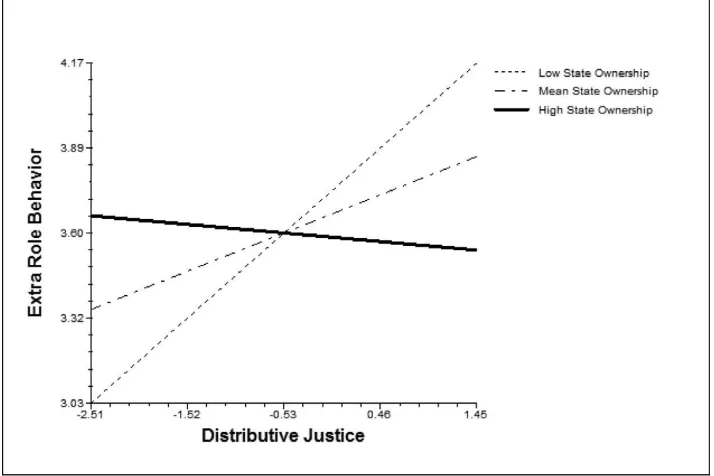
717 (above 0.50) (Cohen, 1988). The results of simple slope analysis are presented in
718 Figure 3.Distributive justice had a positive effect on extra-role behaviors among 719 organizations with medium (simple slope = 0.13, s.e. = 0.05, t = 2.83, p = 0.005) or
720 low levels (simple slope = 0.29, s.e. = 0.06, t = 4.54, p < 0.001) of state ownership. 721 At high level of state ownership, distributive justice did not have a significant effect
722 on extra-role behaviors (simple slope = -0.03, s.e. = 0.07, t= -0.43, p= 0.66). 723 Finally, I conducted robustness checks to test whether the moderation effects
724 of state ownership are driven by individual differences on collectivism and
725 interdependent self-construal. To achieve that objective, I first tested whether 726 state ownership was associated with cultural values. I regressed cultural values on
727 state ownership in hierarchical linear models. After controlling for demographic
728 variables, state ownership did not have a significant effect on psychological
729 collectivism (b= -0.05, s.e.= 0.16, p = 0.76) or interdependent self-construal (b
730 = 0.00,s.e. = 0.11,p = 0.99). Therefore, state ownership was not systematically 731 related with individual difference in cultural values. Next, I entered cultural values
732 and their interaction effects with distributive justice and procedural justice in the 733 model. In Model 4 of Table 3, both psychological collectivism and interdependent
734 self-construal had a significant and positive effect on extra role behavior.
735 Controlling for these effects and their moderating effects, the hypothesized
736 interaction effects remained significant. It indicates that the moderation effects
23
Figure 3. The interaction effect of distributive justice and state ownership on extra-role behavior.
whether the hypothesized interaction effects were robust after controlling for the 739
effect of interactional justice. Interactional justice had a positive effect on extra- 740
role behavior, and this effect was not moderated by state ownership (b= -0.35, 741
s.e. =0.23, p=0.12). After controlling for the main effect of interactional justice, 742
the hypothesized moderation effects remained significant.[3] Therefore, the results 743
were robust to individual difference in cultural values and interactional justice 744
individuals receive. 745
DISCUSSION 746
Drawing on the institutional diversity in the reform context of China, this study 747
demonstrates that ownership structure moderates the effects of justice on extra- 748
role behavior. Specifically, distributive justice is positively associated with extra 749
role behavior in privatized organizations but has no effect (or even negative 750
effect after controlling for individual values and interactional justice) in highly 751
state-owned organizations. In contrast, participation in decision making – a key 752
component of procedural justice – is positively associated with extra-role behavior 753
in organizations with high and medium levels of state ownership, but its effect 754
became non-significant in highly privatized companies. The moderation effect 755
of state ownership is not reducible to individual difference in cultural values. 756
Therefore, the findings support my proposal that employees pay attention to the 757
form of justice that is consistent with their relational schema to guide their extra 758
role behavior. 759
24
760 The findings also indicate that the effect of state ownership on employee
761 behavior depends on perceived justice. Specifically, employees of privatized
762 organizations demonstrate less extra-role behavior than SOE employees when
763 distributive justice is low, whereas SOE employees engage in less extra-role
764 behavior than employees of privatized organizations when they perceive low
765 procedural justice or high distributive justice. In other words, people react
766 negatively when their dominant relational schema is not verified, but people in
767 different organizations react differently to practices that are inconsistent with their
768 schemas, depending on whether such practice is irrelevant or contradictory to
769 their schemas. Since participation is irrelevant to privatized companies’ market 770 pricing schema, it is ignored by their employees, and their extra-role behavior is
771 not reduced. In contrast, distributive justice is not only inconsistent with SOEs’ 772 communal sharing schema, it contradicts that schema by undermining the equal
773 status of employees. As a result, employees of SOEs engage in less extra-role
774 behavior than privatized companies when distributive justice is high.
775 Theoretical Contributions
776 This study makes important theoretical contributions to multiple literatures.
777 First, this study contributes to research on the micro-foundations of corporate
778 governance. Research on corporate governance has called for more attention to
779 the role of labor and research on the transition economies (Aguilera & Jackson,
780 2010; Fiss, 2008). Many countries’ SOEs have employee representatives on board 781 (World Bank, 2014), and even more organizations have various forms of worker 782 participation, such as employee stock ownership plans (Doucouliagos, 1995).
783 This study suggests that these organizations should pay attention to the unique
784 relational schema triggered by these institutions. Increasing labor representation
785 in corporate governance can change the nature of how employees relate to their
786 organizations. Employees will regard themselves as owners of organizations and
787 attend to participation opportunities to verify their owner identity. Meanwhile, 788 they will be less sensitive to the outcomes they receive. Therefore, even minor and
789 symbolic change in corporate governance can have far-reaching implications for
790 employee motivation.
791 In addition, I offer a theory of the micro foundations of institutional
792 transition. I find that the relationship between perceived justice and individual
793 behavior depends upon ownership structure and, likewise, the relationship
794 between ownership structure and individual behavior depends upon justice
795 perceptions. Thus, the favored variables of micro and macro scholars do
796 not work independently – they combine interactively to influence individual
797 behaviors. I found that ownership structure is not associated with different 798 levels of employee motivation (Burawoy & Lukacs, 1985), but rather associated
799 with different predictors of employee motivation. This finding helps explain