Generic MMSE Decision Directed Channel
Estimation for OFDM and MC-CDMA
J. Akhtman and L. Hanzo
School of ECS., Univ. of Southampton, SO17 1BJ, UK.
Tel: +44-23-80-593 125, Fax: +44-23-80-593 045
Email: [email protected], http://www-mobile.ecs.soton.ac.uk
Abstract— In this letter we propose a Minimum Mean Square
Error (MMSE) Channel Impulse Response (CIR) estimator-aided Decision Directed Channel Estimation (DDCE) method, which is suitable for employment in both OFDM and MC-CDMA systems. Firstly, we outline the difficulty associated with the employment of the Least Squares (LS) approach to the problem of a posteriori Frequency Domain Channel Transfer Function (FDCTF) estimation in the context of a MC-CDMA system and derive a suitable MMSE-based CIR estimator, which circumvents the LS method’s deficiencies. Secondly, we demonstrate that the computational complexity associated with the conventional MMSE estimation method is relatively high compared to that of the LS method. Thus a reduced-complexity version of the MMSE estimator is proposed, which has a complexity similar to that exhibited by the LS-aided estimator. The MC-CDMA system using the reduced-complexity MMSE estimator proposed is shown to outperform the corresponding OFDM-based scheme.
I. INTRODUCTION
The family of well-documented decision directed chan-nel estimation (DDCE) methods [1]–[4] provides a suitable solution for the problem of channel estimation in OFDM-based systems. The major benefit of the DDCE scheme is that in contrast to purely pilot assisted channel estimation methods [5]–[8] both the pilot symbols as well as all the information symbols are utilised for channel estimation [4]. The simple philosophy of this method is that in the absence of transmission errors we can benefit from the availability of 100% pilot information by using the detected subcarrier symbols as an a posteriori reference signal. The employment of this method allows us to reduce the number of pilot symbols required.
A basic component of the DDCE schemes proposed in the literature is an a posteriori Least Squares (LS) temporal estimator of the OFDM-subcarrier-related Frequency-Domain Channel Transfer Function (FD-CTF) coefficients [1], [3], [4]. The accuracy of the resultant temporal estimates is typically enhanced using either one- or two-dimensional interpolation exploiting both the time- and the frequency-domain correlation between the adjacent FD-CTF coefficients. The LS-based tem-poral FD-CTF estimator was shown to be suitable for QPSK-modulated OFDM systems [3], [4], where the energy of the transmitted subcarrier-related symbols is constant. However, as
Acknowledgements: The financial support of the mobile VCE and of the EU under the auspices of the Newcom and Phoenix projects is gratefully acknowledged.
it will be pointed out in Section III-B.1, the LS method cannot be employed in MC-CDMA systems, where – in contrast to OFDM systems – the energy of the transmitted subcarrier-related symbols fluctuates as a function of both the modulated sequence and that of the choice of the potentially non-constant-modulus modulation scheme itself. Thus the novel contribution of this letter is that we propose a Minimum Mean Square Error (MMSE) Channel Impulse Response (CIR) estimator-aided DDCE method, which constitutes an appropriate solution for both OFDM and MC-CDMA systems. Furhermore, we demonstrate that the proposed MMSE technique has a reduced complexity, which is similar to that of the LS-based DDCE technique.
The rest of this paper is structured as follows. The system model and the channel model considered are described in Section II. The difficulty of employing the Least Squares (LS) approach to the problem of estimating the OFDM-subcarrier-related FD-CTF coefficients is described in Section III-B.1. The alternative MMSE FD-CTF estimator circumventing the problem outlined in Section III-B.1 is analyzed in Section III-B.2. Our discourse evolves further by proposing a MMSE CIR estimator exploiting the frequency-domain correlation of the FD-CTF coefficients in Section III-C.1 and a reduced-complexity version of the CIR MMSE estimator considered is proposed in Section III-C.2. Finally, the achievable per-formance of the estimation methods proposed is studied in Section IV.
II. SYSTEMMODEL
The discrete baseband model of the OFDM/MC-CDMA system can be described as in [9]
y[n, k] =H[n, k]x[n, k] +w[n, k], (1)
for k = 0, . . . , K −1 and all n, where y[n, k], x[n, k] and
w[n, k] are the received symbol, the transmitted symbol and the Gaussian noise sample respectively, corresponding to the
kth subcarrier of thenth OFDM symbol. Furthermore,H[n, k]
is the complex channel transfer function (CTF) coefficient associated with kth subcarrier and time instant n. Note that in the case of anM-QAM modulated OFDM system,x[n, k]
corresponds to theM-QAM symbol accommodated by thekth subcarrier, while in a MC-CDMA system, such as a Walsh-Hadamard Transform (WHT) assisted OFDM scheme using
Gusers [4] we have
x[n, k] =
G−1 X
p=0
c[k, p]s[n, p], (2)
wherec[k, p]is thekth chip of thepth spreading code, while
s[n, p]is theM-QAM symbol spread by thepthG-chip code. Each of theGspreading codes is constituted byGchips.
As it was pointed out in [3], in OFDM/MC-CDMA systems using a sufficiently long cyclic prefix and adequate synchro-nisation, the discrete CTF can be expressed as
H[n, k] =H(nT, k∆f) =
K0−1 X
l=0
Wkl
Kh[n, l], (3)
for k = 0,1,· · ·, K −1, where h[n, l] = h(nT, lT /K)
is the sample-spaced CIR (SS-CIR) having significant non-zero tap values only at sample-spaced raster positions and
WK = exp(−2π/K). Note that in realistic channel
condi-tions associated with non-sample-spaced path-delays the re-ceiver will encounter dispersed received signal components in several neighbouring samples owing to the convolution of the transmitted signal with the system’s impulse response, which we refer to as “leakage” [4]. This phenomenon is usually unavoidable and therefore the resultant SS-CIRh[n, l]will be constituted of numerous correlated non-zero taps. Although the results of this contribution are applicable also in the context of estimating the fractionally-spaced CIR, we opted for concentrating our attention on the case of SS-CIRs for the sake of notational simplicity. Therefore, we assume hereafter a SS-CIR constituted ofK0 uncorrelated tapsh[n, l].
III. CHANNELESTIMATION
A. Decision Directed Channel Estimator
Decoder Detector
Remodulator Feedback
CIR Predictor Robust a priori FFT
-
-?
6
CIR estimator a posteriori
IFFT
ˆ x[n]
ˆ h[n] y[n]
y[n]
ˇ h[n+1] ˇ
[image:2.595.42.295.464.588.2]H[n+1]
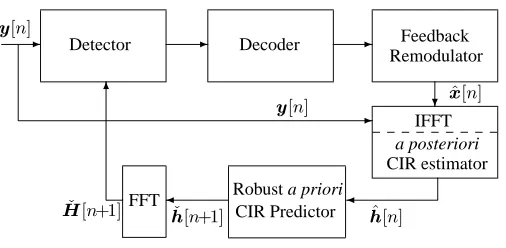
Fig. 1. Schematic of the channel estimator constituted by an a
posteri-ori decision-directed CIR estimator, based on frequency-domain modulated
symbol estimates, followed by an a priori CIR predictor.
The schematic of the channel estimation method considered is depicted in Figure 1. Our channel estimator is constituted by what we refer to as an a posteriori decision-directed CIR estimator, followed by an a priori CIR predictor [4]. As seen in Figure 1, the a posteriori SS-CIR estimator inputs are the frequency-domain signaly[n] and the decision-based transmitted symbol estimate xˆ[n]. The transformation from the frequency to time domain is performed within the CIR estimator of Figure 1 and its output is an a posteriori estimate
ˆ
x[n, k]of the SS-CIR taps of Equation (3), which is fed into the low-rank time-domain SS-CIR tap predictor of Figure 1 for the sake of producing an a priori estimateˇh[n+ 1, l], l= 0,1,· · ·, K0−1 of the next SS-CIR on a SS-CIR tap-by-tap basis [4]. Finally, the predicted SS-CIR is converted to the FD-CTF with the aid of the FFT block of Figure 1. The resultant FD-CTF is employed by the receiver for the sake of detecting and decoding the next OFDM symbol.
B. A Posteriori FD-CTF Estimation
In order to emphasize the major difference between the OFDM and MC-CDMA systems in the context of the associ-ated channel estimation scheme, first we analyze the perfor-mance of the temporal estimator of the subcarrier-related FD-CTF coefficients H[n, k] based on the a posteriori decision-aided estimates of the transmitted subcarrier-related samples
x[n, k]of Equation (1).
1) Least Squares CTF estimator: Following Equation (1), the Least Squares (LS) approach [10] to the problem of estimating the discrete FD-CTF coefficientsH[n, k], based on the knowledge of the decision-aided estimates x[n, k]ˆ of the transmitted frequency-domain samplesx[n, k]of Equation (1) can be expressed as
˜
H[n, k] = y[n, k] ˆ
x[n, k] =H[n, k]· x[n, k] ˆ x[n, k]+
w[n, k] ˆ
x[n, k], (4)
where H[n, k] represents the Rayleigh-distributed FD-CTF coefficients having a variance of σ2
H, while x[n, k] denotes
the transmitted subcarrier-related samples having zero mean and a variance of σ2
x. The distribution of the samplesx[n, k]
is dependent on the particular modulation scheme employed by the system. For instance, in a MC-CDMA system using an arbitrary modulation scheme, the samplesx[n, k]are complex-Gaussian distributed, having a Rayleigh-distributed magnitude |x[n, k]|2and uniformly-distributed phaseθ[n, k]. By contrast, in an M-PSK-modulated OFDM system the samples x[n, k]
are uniformly distributed within the set of M-PSK symbols having a constant amplitude |x[n, k]| = σx and a
discrete-uniform distributed phaseθ[n, k] = 2πm
M, m= 0,1,· · ·, M−
1. Finally, the noise samples w[n, k] are independent identi-cally distributed (i.i.d.) complex-Gaussian variables having a zero mean and a variance of σ2
w.
Under the assumption of carrying out error-free decisions we have ˆx[n, k] = x[n, k] and thus the Normalized Mean Square Error (NMSE) associated with the LS FD-CTF esti-mator of (4) is given by
NMSELS= 1
σ2
H
E
w[n, k] x[n, k]
2
. (5)
The AWGN samplesw[n, k] are known to be i.i.d. complex-Gaussian and hence the NMSE of Equation (5) is determined by the statistical distribution of the transmitted subcarrier-related samples x[n, k]. The NMSE encountered assumes its minimum value, when |x[n, k]|2 =σ2
x is constant, as in the
case of an M-PSK-modulated OFDM system. Thus, we have
NMSELS,min= 1
σ2
Hσ2x
E{w[n, k]}= σ
2
w
σ2
Hσ2x
where γ = σ2Hσ 2 x
σ2
w is the average SNR level. On the other hand, the NMSE value will increase substantially, if the energy of the transmitted samples x[n, k] varies as in the case of
M-ary Quadrature Amplitude Modulation (M-QAM)-based OFDM or MC-CDMA. In fact, in the case of strictly Gaussian-distributed samplesx[n, k], which corresponds to encountering a MC-CDMA system having a sufficiently long spreading code, the NMSE value of Equation (5) does not exist, since the variance of the resultant Cauchy distributed variable associated with the ratio of two Gaussian-distributed variablesx[n, k]and
w[n, k] of Equation (5) cannot be defined [11]. The NMSE of the LS estimator of Equation (4) derived for QPSK, 16-, 64- and 256-QAM-modulated OFDM16-, as well as QPSK-modulated MC-CDMA is depicted in Figure 2(a). The solid line in Figure 2(a) corresponds to the lower NMSE bound described by Equation (6).
Consequently, the performance degradation of the LS esti-mator of Equation (4) is a result of the energy-fluctuations as-sociated with the near-Gaussian distributed subcarrier-related samples x[n, k], which renders the LS estimator inapplicable for employment in MC-CDMA systems. Consequently, for the sake of mitigating the resultant performance degradation we would like to turn our attention to the MMSE estimation approach.
2) MMSE CTF Estimator: Following the Bayesian theory of [10], the MMSE estimator of the FD-CTF coefficients
H[n, k]of the linear scalar model described by Equation (1), where the parameters H[n, k] are assumed to be complex-Gaussian distributed with a zero mean and a variance ofσ2
H,
is given by [10]
˜
HMMSE[n, k] =
x∗[n, k]y[n, k] |x[n, k]|2+σ2 w
σ2 H
. (7)
The corresponding NMSE can be expressed as [10]
NMSEMMSE = σ
2
w
σ2
H|x[n, k]|2+σ2w
. (8)
As we have seen previously in the context of Equation (8), the NMSE is determined by the statistical distribution of the transmitted subcarrier-related samplesx[n, k]and assumes its minimum value, when the energy of these samples|x[n, k]|2=
σ2
x is constant. On the other hand, in contrast to the NMSE of
the LS estimator of Equation (4), the NMSE of the MMSE es-timator of Equation (7) is upper-bounded, which is evidenced by Figure 2(b). The NMSE assumes its maximum value, when the samples x[n, k] are complex-Gaussian distributed, as in the case of a MC-CDMA system having a sufficiently high spreading factor. Explicitly, the maximum NMSE may be expressed as follows:
NMSEH,max(γ) = E
x∈N(0,σ2 x)
{NMSE(γ, x)}
=
Z ∞
0
1 γr+ 1 e
−rdr = 1
γ e 1 γEi
1
γ
, (9)
where we define the exponential integral function asEi(x) =
R∞
x
e−t
t dt.
In the following section we employ the following vectorial notationv[n] = (v[n,1],· · ·, v[n, K])T.
C. A Posteriori SS-CIR Estimator
1) MMSE SS-CIR Estimator: We would like to commence our portrayal of the proposed channel estimation philosophy by briefly recalling the DDCE-aided OFDM scheme advocated in [4, Chapter 15], [3].
By substituting the FD-CTF of Equation (3) into (1) we arrive at
y[n, k] =
K0−1 X
l=0
Wkl
Kh[n, l]x[n, k] +w[n, k]. (10)
The SS-CIR tapsh[l]are assumed to be uncorrelated complex-Gaussian distributed variables having a zero mean and a covariance matrix Ch= diag σ2l
. The MMSE estimator of the SS-CIR taps h[n, l] of the linear vector model described by Equation (10) is given by [10]
ˆ
h = σ2wI+ diag σ
2
l
WHdiag |x[k]ˆ |2W−1 × diag σ2l
WHdiag (ˆx∗
[k])y, (11)
where we omit the time-domain OFDM-symbol-related index
n for the sake of notational simplicity.
2) Reduced-Complexity SS-CIR Estimator: As it is seen from Equation (11), the direct MMSE approach to the problem of estimating the SS-CIR taps h[n, l] involves an inversion of a time-variant matrix, which imposes a relatively high computational complexity [4]. In order to reduce the associated computational complexity, we introduce a two-step reduced-complexity SS-CIR estimator invoking a method, which by-passes the computationally intensive matrix inversion opera-tion encountered in Equaopera-tion (11).
Following the Bayesian theory of [10], the MMSE CTF estimates H˜MMSE[n, k] of Equation (7) may be modelled as complex Gaussian-distributed variables having a mean identi-cal to that ofH[n, k], which represents the actual FD-CTF co-efficients encountered and a variance ofσ2
v=σH2NMSEmax,
whereσ2
H is the average channel output power andNMSEmax is the average NMSE quantified in Equation (9). Thus we can write
˜
HMMSE[n, k] =H[n, k] +v[n, k], (12)
where v[n, k] represents the i.i.d. complex-Gaussian noise samples having a zero mean and a variance ofσ2
v. Furthemore,
by substituting (3) into (12) we arrive at
˜
HMMSE[n, k] =
K0−1 X
l=0
WKklh[n, k] +v[n, k], (13)
where WK =e−2π
1
K. Furthermore, the MMSE estimator of the SS-CIR taps h[n, l] of the linear vector model described by Equation (13) is given by [10]
ˆ
h= (C−1
h +WHC
−1
v W)
−1
WHC−1
v H˜MMSE, (14) where we defineChandCvas the covariance matrices of the
SS-CIR vector h and the scalar-MMSE FD-CTF estimator’s noise vectorv, respectively. The elements of the noise vector
v are assumed to be complex-Gaussian i.i.d. samples and therefore we have Cv =σ2vI. On the other hand, as follows
-20 -15 -10 -5 0 5 10
0 5 10 15 20
NMSE [dB]
SNR [dB] MC-CDMA M-PSK 16-QAM 64-QAM 256-QAM
(a)
-20 -15 -10 -5 0 5 10
0 5 10 15 20
NMSE [dB]
SNR [dB] MC-CDMA M-PSK 16-QAM 64-QAM 256-QAM
(b)
Fig. 2. NMSE associated with (a) Least Squares (LS) and (b) Minimum Mean Square Error (MMSE) estimators of the uncorrelated Rayleigh-distributed subcarrier-related CTF coefficientsH[n, k]of Equation (1) corresponding to the various statistical distributions of the transmitted subcarrier-related samples x[n, k]. The markers on the plot correspond to the simulated cases ofM-PSK, 16-, 64- and 256-QAM modulated OFDM as well asM-QAM modulated MC-CDMA, while the lines correspond to the analytically calculated performance recorded for the cases ofM-PSK OFDM (solid) and MC-CDMA (dashed), which represent the lower and the upper NMSE bounds, respectively. Note that the upper bound for the LS estimator in conjunction with MC-CDMA does not exist.
SS-CIR taps’ covariance matrix is a diagonal matrix Ch =
diag σ2
l
, where σ2
l = E
|h[n, l]|2 . Substituting C
h and
Cv into Equation (14) yields
ˆ
h=
diag
1
σ2
l
+ 1 σ2
v
WHW
−1
WH 1 σ2
v
˜
HMMSE
=diag
σ2
l
σ2
v+Kσl2
WHH˜
MMSE, (15)
where we have exploited the fact that [WHW]l,l′ = PK−1
k=0 e
−2πk(l−l′)
K =Kδ[l−l′]and therefore WHW =KI, whereI is a(K0×K0)-dimensional identity matrix.
Finally, upon substituting Equation (7) into Equation (15) we arrive at a scalar expression for the Reduced-Complexity (RC) a posteriori MMSE SS-CIR estimator in the form of
ˆ
h[n, l] = σ
2
l
σ2
v+Kσ2l K−1
X
k=0
Wkl K
ˆ
x∗[n, k]y[n, k] |x[n, k]ˆ |2+σw2
σ2 H
. (16)
Observe that the RC-MMSE estimator of Equation (16) does not require any matrix inversion and therefore the associated complexity is similar to that exhibited by the conventional LS estimator.
In order to complete the DDCE scheme of Figure 1 we employ the a priori CIR predictor as derived in [4]. For the sake of brevity we leave the description of the a priori CIR predictor employed out of the scope of this contribution and the interested reader may refer to [4] for further details.
IV. SIMULATIONRESULTS
Our simulations were performed in the base-band frequency domain and the system configuration characterised in Table I is
TABLE I SYSTEM PARAMETERS.
Parameter OFDM MC-CDMA
Channel bandwidth 800 kHz Number of carriersK 128 Symbol durationT 160µs Max. delay spreadτmax 40µs
No. of CIR taps 3
Channel interleaver WCDMA [12] – 248 bit
Modulation QPSK
Spreading scheme – WH
FEC Turbo code [13] , rate 1/2 component codes RSC, K=3(7,5) code interleaver WCDMA (124 bit)
reminiscent to that used in [3]. In the OFDM mode, the system utilizes 128 QPSK-modulated orthogonal subcarriers. In the MC-CDMA mode we employ a full set of 128-chip Walsh-Hadamard (WH) codes for frequency-domain spreading of the QPSK-modulated bits over the 128 orthogonal subcarriers. All the 128 WH spreading codes are assigned to a single user and hence the data-rate is similar in both the OFDM and the MC-CDMA modes. For forward error correction (FEC) we use 12-rate turbo coding [13] employing two constraint-length
K= 3Recursive Systematic Convolutional (RSC) component codes and a 124-bit WCDMA code interleaver [12]. The octally represented generator polynomials of (7,5) were used. We employed the seven-path Rayleigh-fading COST-207 Bad Urban (BU) channel model characterised in [14], using the delay spread of τmax = 8µs and the normalized Doppler
[image:4.595.67.512.41.288.2]-30 -25 -20 -15
0 5 10 15 20
NMSE [dB]
SNR [dB]
OFDM MC-CDMA MMSE RC-MMSE
(a)
10-6 10-5 10-4 10-3 10-2 10-1
0 5 10 15 20
BER
SNR [dB]
OFDM MC-CDMA MMSE RC-MMSE
[image:5.595.65.512.40.288.2](b)
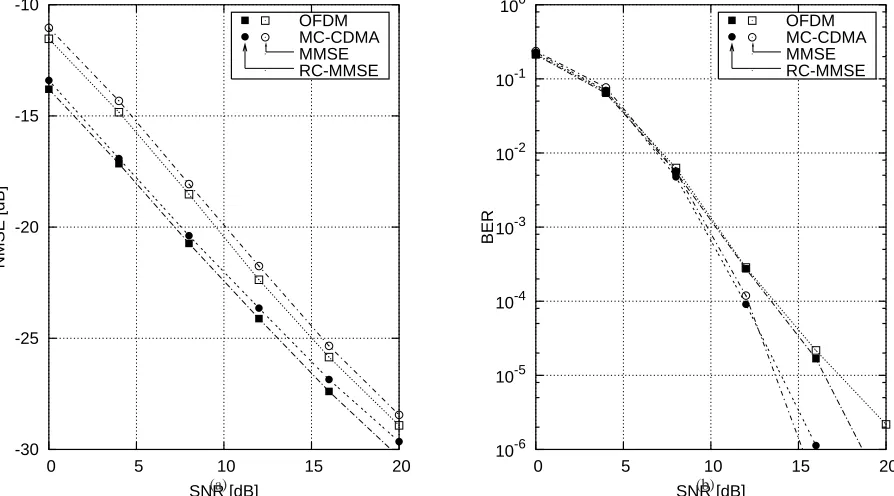
Fig. 3. (a) Normalised Mean Square Error (NMSE) and (b) Bit Error Rate (BER) exhibited by the channel estimator which follows the philosophy of Figure 1 and employs the Minimum Mean Square Error (MMSE) and the Reduced-Complexity MMSE a posteriori SS-CIR estimators of Equations (11) and (14), respectively. The a priori prediction is performed using the robust SS-CIR predictor [4] assuming matching propagation conditions described by the COST-207 BU channel model having a normalised Doppler frequency offD= 0.01. The turbo-coded QPSK-modulated OFDM and MC-CDMA modes are identified using the and◦markers, respectively.
Figure 3 demonstrates (a) the Normalized Mean Square Error (NMSE) performance and (b) the achievable turbo-coded Bit Error Rate (BER) of the DDCE scheme of Figure 1 using both the full-complexity MMSE and the RC-MMSE SS-CIR estimators described in Sections III-C.1 and III-C.2, respec-tively, in the context of both the above-mentioned OFDM and MC-CDMA systems. The simulations were carried out over the period of 10,000 QPSK-modulated K = 128-subcarrier OFDM/MC-CDMA symbols. It can be seen in Figure 3(a), that the RC-MMSE method performs at least as well as its MMSE counterpart in the context of both the OFDM and MC-CDMA systems considered. Moreover, as it becomes evident from Figure 3(b), the MMSE/RC-MMSE SS-CIR operating in the context of the MC-CDMA system outperforms its OFDM counterpart.
V. CONCLUSIONS
In this paper we have proposed a reduced-complexity MMSE SS-CIR estimator, which is suitable for employment in both DDCE-aided OFDM and MC-CDMA systems. As it was shown in Section IV, the performance of the reduced-complexity MMSE method proposed is at least as good as that of its high complexity counterpart, while its complexity does not exceed that of the conventional LS-based estimator. Furthermore, it was shown that the turbo-coded MC-CDMA system using the proposed MMSE DDCE method outperforms the corresponding OFDM-based system.
REFERENCES
[1] J.-J. van de Beek, O. Edfords, M. Sandell, S. K. Wilson, and P. O. B¨orjesson, “On channel estimation in OFDM systems,” in IEEE
Vehic-ular Technology Conference, Chicago, IL, July 1995, pp. 815–819.
[2] O. Edfords, M. Sandell, J.-J. van de Beek, S. K. Wilson, and P. O. B¨orjesson, “OFDM channel estimation by singular value decomposi-tion,” IEEE Transactions on Communications, vol. 46, pp. 931–939, July 1998.
[3] Y. Li, L. Cimini, and N. Sollenberger, “Robust channel estimation for OFDM systems with rapid dispersive fading channels,” IEEE
Transac-tions on CommunicaTransac-tions, vol. 46, no. 7, pp. 902–915, April 1998.
[4] L. Hanzo, M¨unster, B. Choi, and T. Keller, OFDM and MC-CDMA
for Broadband Multi-user Communications, WLANs and Broadcasting.
John Wiley – IEEE Press, 2003, 992 pages.
[5] P. H ¨oher, S. Kaiser, and P. Robertson, “Pilot-symbol-aided channel estimation in time and frequency,” in IEEE Global Telecommunications
Conference: The Mini-Conference, Phoenix, AZ, November 1997, pp.
90–96.
[6] Y. Li, “Pilot-symbol-aided channel estimation for OFDM in wireless systems,” IEEE Transactions on Vehicular Technology, vol. 49, pp. 1207–1215, July 2000.
[7] F. Sanzi and J. Speidel, “An adaptive two-dimensional channel esti-mation for wireless OFDM with application to mobile DVB-T,” IEEE
Transactions on Broadcasting, vol. 46, no. 2, pp. 128–133, June 2000.
[8] M.-X. Chang and Y. Su, “Model-based channel estimation for OFDM signals in Rayleigh fading,” IEEE Transactions on Communications, vol. 50, pp. 540–544, April 2002.
[9] Y. Li, “Simplified channel estimation for OFDM systems with multiple transmit antennas,” IEEE Transactions on Wireless Communications, vol. 1, no. 1, pp. 67–75, January 2002.
[10] S. M. Kay, Fundamentals of Statistical Signal Processing. Englewood Cliffs, NJ, USA: Prentice-Hall, 1998.
[11] A. Papoulis, Probability, Random Variables, and Stochastic Processes, 2nd ed. New York, USA: McGraw-Hill, 1984.
[12] H. Holma and A. Toskala, Eds., WCDMA for UMTS : Radio Access for
Third Generation Mobile Communications. John Wiley and Sons, Ltd.,
2000.
[13] L. Hanzo, T. H. Liew, and B. L. Yeap, Turbo Coding, Turbo Equalisation
and Space-Time Coding. Chichester, UK; Piscataway, NJ, USA: John Wiley, IEEE Press, 2002, 766 pages. (For detailed contents, please refer to http://www-mobile.ecs.soton.ac.uk.).
![Fig. 2.NMSEx associated with (a) Least Squares (LS) and (b) Minimum Mean Square Error (MMSE) estimators of the uncorrelated Rayleigh-distributedsubcarrier-related CTF coefficients H[n, k] of Equation (1) corresponding to the various statistical distribution](https://thumb-us.123doks.com/thumbv2/123dok_us/8515350.351408/4.595.67.512.41.288/associated-estimators-uncorrelated-distributedsubcarrier-coefcients-corresponding-statistical-distribution.webp)