A DIGITAL TECHNIQUE FOR ONLINE IDENTIFICATION AND TRACKING
OF POWER SYSTEM HARMONICS BASED ON REAL CODED GENETIC
ALGORITHM
Naser Zamanan Jan Sykulski A. K. Al-Othman
School of Electronics & Computer
Science School of Electronics & Computer Science Dept. Electrical Engineering University of Southampton University of Southampton College of Technological Studies
U.K. U.K. Kuwait [email protected] [email protected] [email protected]
ABSTRACT
Current and voltage waveforms of a distribution or a transmission system are not pure sinusoids. There are distortions in these waveforms that consist of a combination of the fundamental frequency, harmonics and high frequency transients. This paper presents an enhanced measurement scheme for identification and tracking of harmonics in power system. The proposed technique is not limited to stationary waveforms, but can also estimate harmonics in waveforms with time-varying amplitudes. This paper presents a new method based on Real Coded Genetic Algorithm, which is a technique for optimization inspired by genetics and natural evolution. The algorithm was tested using simulated data, and effects of sampling rate studied. Results are reported and discussed.
KEY WORDS
Real coded Genetic Algorithm, Estimation, Power system harmonics analysis
1. Introduction
Voltage and current waveforms of a distribution or a transmission system are distorted and consist of a combination of the fundamental frequency, harmonics and high frequency transients. In an ideal electrical power system, energy is supplied at a constant frequency with specified voltage levels. However, none of these conditions are fulfilled in practice because voltage and current waveforms are rarely pure sinusoids. Distortions can be associated, for instance, with the operation of nonlinear loads such as inverters, rectifiers, AC/DC converters and a countless number of power electronic devices that can add harmonics to the sinusoidal signal. Nowadays, it is well known that harmonics have adverse effects on the whole power system [1, 2].
Various digital signal processing techniques based on static and dynamic estimation have been suggested to evaluate power system harmonics. Some examples of static estimation are the Least-Squared Method (LSM)
and it is one of the oldest techniques used to fine tune state variables. It is based on the minimization of the mean square error between the estimated and the measured values for the voltage and current amplitudes and phase angles. For a nonlinear power system model, this technique results in reasonable parameter estimation [3]. In the Least Absolute Value estimation (LAV) technique the error to be minimized is the absolute error. Discrete Fourier Transform (DFT) is based on orthogonal functions. According to DFT, the waveform consists of a fundamental component increased by an infinite number of harmonics. The computational cost of this algorithm is low, but its performance can be badly affected by the DC component present in the signal [4]. The Fast Fourier Transform (FFT) algorithm is a speed-optimized DFT version. However, the application of the FFT may lead to imprecise results especially due to pitfalls such as aliasing, leakage and picked fence effect [5, 6]. On the other hand, the Kalman Filter is an example of a dynamic estimation, it is based on a dynamic estimation of the signal and it has the ability to identify, analyze and locate the harmonic content in a non-stationary three phase signal. Despite presenting accurate results, previous statistical analysis of the signal is necessary.
Artificial Intelligence (AI) has also been applied to power system harmonic evaluation. Artificial Neural Networks (ANNs) have been used as an online digital system to read and update harmonic parameters of electrical signals [7]. The algorithm proposed has fast convergence and it precisely evaluates even noisy distorted waveforms.
3. Genetic Algorithms
2. Harmonic model
A signal can be defined as a function that carries information, usually about a state or a procedure of a physical system. However, signals can be represented in several ways. Mathematically, a periodic and distorted signal can be suitably represented in terms of its fundamental frequency and harmonic components, expressed as a sum of sinusoidal waveforms referred to as the Fourier series. Each frequency is an integer multiple of the fundamental system frequency. In order to obtain an approximation of such waves, mathematical models are employed.
Genetic Algorithms are adaptive search procedures for optimization and learning. The concepts of the algorithms are based on natural selection and natural population genetics. They involve survival of the fittest among string structures. In every generation, a new set of strings are generated using bits and pieces of the fittest previous strings. They efficiently exploit historical information to speculate on new search points with expected improved performance [10]. GAs are different than other conventional optimization techniques in many ways. They use the objective function itself and not the gradient, they search from a population of strings and not single point and they work with a coding of the parameter set, not with the parameter themselves. Because of these reasons, and others, GAs are considered as an attractive alternative optimization technique.
Consider a voltage waveform with harmonic components, written as Equation (1)[8, 9]
)
cos( ) ( 1 ' 1 ()sin( ) 2
)
( N t i t
i Vi N
i Vi t i t
V t
v ο ω ∑ ω
= + ∑ = + =
(1) generation of a population. A population consists of a set GA is a simple algorithm, starts with random of strings. Usually, the string size ranges between 50-1000. The population may be of any size according to the accuracy required. The population size remains constant throughout the whole process. Each string in GAs may be divided into a number of strings. The number of sub-strings, usually, equals to the number of the problem variables. The problem variables are coded using suitable coding system. In this study real coding system is used. In addition to coding and fitness evaluation, the simple GA is composed of another three basic operations, Reproduction, Crossover and Mutation. Each string of the old population goes through these three steps before a new population is generated.
Where Vi (t) and V’í (t) are the amplitudes of ith harmonic at time t, w is the fundamental frequency and N is the number of harmonics present in the voltage waveform. Assuming that the voltage waveform is sampled at a predefined sampling rate at equal time intervals ∆t, one will have a set of m samples, v (t1), v (t2), … v (tm), obtained for t1, t2, … tm, where t1 is an arbitrary time
reference. One can write the following discrete system of equations in the state space form, as shown in Equation (2)
+ + + + = + + + + = ) sin( ) ( ... ) cos( ) ( ' ) sin( ) ( 2 ) ( . ... ... ... ... ... ... ... ... ... ... . ... ... ... ... ... ... ... ... ... ... ) sin( ) ( ... ) cos( ) ( ' ) sin( ) ( 2 ) ( 1 1 1 1 1 1 1 1 1 1 1 m m N m m m m m N t N t V t t V t t V V t v t N t V t t V t t V V t v ω ω ω ο ω ω ω ο3.1 Characteristics of genetic algorithm
A formal structure of a GA has three components, the environment and its elements (search space), a selection based on a measurement of performance (fitness of the solution) and an adaptive plan (evolutionary operators). An initial population (possible solutions) of random individuals is usually generated. In the course of the evolutionary process, this population is evaluated: each individual is given a score, reflecting its ability to adapt to a particular environment. In each generation, an evolutionary behaviour is observed through two basic characteristics: competition and cooperation, where the principles of selection and reproduction are applied. (2)
In the matrix form, Equation (2) can be rewritten as:
e x f
V = ( )+ (3)
where:
• V is the voltage sample vector m x 1;
• f (x) is the ideal connection vector m x 1;
• x is the state vector to be estimated, i. e. the 3.2 Fitness Function
voltage amplitudes;
The Fitness Function (FF) is one of the key elements of GAs as it determines whether a given potential solution will contribute its elements to future generation through the reproduction process. The FF should be able to provide a good measure of the quality of the solution and should differentiate between the performances of different strings. In this study the fitness function is set to minimize
the maximum individual error. The evaluation function is the function responsible for the determination of the fitness of each individual. Its objective is to evaluate the estimation error (e). The coded parameters are substituted at the right of Equation (2) and they are compared to the measured value in each time step V(t) to calculate the average error (e). We use the evaluation function as the function of the sum of quadratic errors. Equation (3) can be written in the form of:
ei x F
Vi− i( )= For i=1,2,...m (4)
The quadratic error is calculated according to (5)
m m i e Fsum
i
∑ = = 1
2
(5)
3.3 Selection
The selection, or competition, is a stochastic process in which the chance of an individual surviving is proportional to its adaptation level. The adaptation is measured by the phenotype evolution, that is, the characteristics presented by an individual in the problem environment. The GA, through selection, determines which individuals will go to the reproduction phase. In the literature, there are several selection methods, where the fittest individuals from each generation are preferentially chosen for reproduction [10]. The mechanisms that give an adaptive behavior to the GAs are the selective pressure and genetic inheritance. The selection imposes pressure on the population; promoting the best individuals’ survival that, subsequently, produce the potential best offspring, converging to an optimal or approximately optimal solution. This evolution occurs by means of the reproduction and manipulation of the initial population, observing equilibrium between stability and adaptability, social organization and between cooperation and competition. The selection process causes an increase in the adaptation of the population of chromosomes, so only the individuals with the best fitness values will be selected. This will guide the search for the chromosomes using fitness value above the average. The members maintained by selection can go through changes in their fundamental characteristics through the genetic operators of mutation and crossover, generating. offspring for the next generation. This process is known as reproduction, and is repeated until a satisfactory solution set is found.
3.4 Crossover
Crossover is a genetic step in which the members of the population obtained after reproduction process are randomly mated according to pre-specified probability. Each pair mutually interchanges a portion of bits. The position at which the interchange starts is selected
randomly. In this way, new strings are generated to form the new population. Crossover can occur at a single position or at a number of different positions [10].
3.5 Mutation
After crossover, the population passes through another genetic process called mutation. In this process randomly selected bits of randomly selected strings are changed from 0 to 1 and vice versa. This process occurs according to pre-specified probability; usually less than 5% of bits are changed in this process. Mutation process is used to escape from probable local optimum [10].
4. Real coded Genetic Algorithms
GAs are inspired by the study of genetics [10-12]. They are conceptually based on natural evolution mechanisms working on populations of solutions. An interesting feature of GAs is that they do not require any prior knowledge of the solution and they tend to exhibit reliable performance on the majority of the problems [12].
Initially, GAs were designed to operate using binary representations of the problem parameters (or unknowns). In recent studies, however the superiority of higher cardinality alphabet GAs (floating point or integer) has been demonstrated with respect to their applications to various problems. A brief description of a real-coded GA developed for the solution of the load-flow problem is given next.
In a real-coded genetic algorithm (RCGA), all decision variables (unknowns) are expressed as real numbers. Explicit conversion to binary does not take place. A reduction of computational effort is an obvious advantage of a real-coded GA. Another advantage is that an absolute precision is now attainable by making it possible to overcome the crucial decision of how many bits are needed to represent potential solutions.
As in a conventional GA, an initial population of chromosomes (potential solutions) is randomly created. The best size of this population is subject to experimentation with the problem at hand. Having created a population of chromosomes, it is possible to assess the performance, or fitness, of individual members of a population. This is done through an objective function (equation 5) that characterizes an individual’s performance in the problem domain. Then a method known as ranking [13], is used to rank individuals according to their objective values. Based on that ranking (i.e. fitness) of each chromosome in the initial population, a selection scheme is carried out to pick the best individuals as members of the new generation.
between 0 and that sum. Therefore, only one random number is generated, all the others used being equally spaced from that point. The index of the chromosome selected is determined by comparing the generated numbers with the cumulative sum. The probability of an individual being selected is then given by
1
( ) ( )
( )
=
= ∑ind
i
i N
i i
f x F x
f x
(6)
where (f xi) is the fitness of individual
x
i and (F xi) is the probability of that individual being selected.A discrete recombination method (equivalent to crossover) is employed for mating individuals and breeding of offsprings. Discrete recombination exchanges variable values between the individuals. A method known as simple crossover [12, 15] is implemented. To be specific, let’s assume that
(
1 1)
1= 1... n
C c c and C2 =
(
c12...cn2)
are two chromosomes that are being subjected to crossover. A position(
1,2,3,...,)
∈
i n−1 is randomly assigned. The two new chromosomes are made as follows:
(
1 1 1 2 2)
1,new = 1, ,..., ,2 i i+1,... n
C c c c c c (7)
(
2 2 2 1 1)
2,new = 1, ,..., ,2 i i+1,... n
C c c c c c (8)
Mutation of real-valued population is accomplished with the breeder genetic algorithm in [16]. Each variable is mutated with a probability by addition of small random values (size of the mutation step). The mutation step can be reduced as the algorithm evolves.
The proposed algorithm uses a generation gap and fitness-based reinsertion to implement an elitist strategy whereby the most fit individuals always propagate through to successive generations. For example, if G-gap = 90%, then population_size ×G-gap new individuals are produced at each generation. And then population_size ×(G-gap -1) best chromosomes are copied intact from the parent generation to the new generation to complete the population size (i.e. fill the gap). According to [10], a better average fitness is attained with the adoption of elitist strategy.
5. Testing and analysis of the algorithm
Equations 9 and 10 represent a transmission line fault situation as seen in [17]. A single phase to ground fault is used since it is the most common type and the fault is applied at a voltage peak since this is the worst condition concerning transients. With a pre-selected sampling rate and specified window size, the actual analogue signal is converted to discrete digital samples. A/D converters are used to generate the measurement vector [V]. The fitness
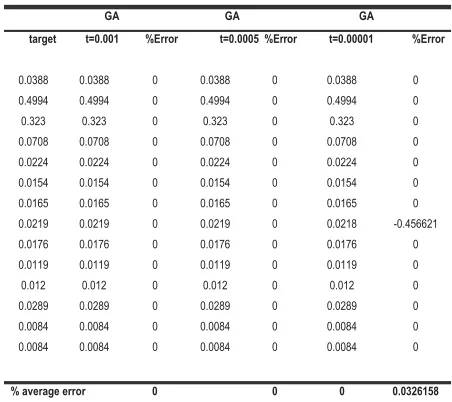
function proposed earlier is used to evaluate the RCGA solution. A data window size of one cycle is used with different sampling frequency. Tables 1 and 2 show the results obtained using the fitness function with different sampling frequency. It is very clear from the results that the estimated results for both voltage and current are very accurate.
V(t) =0.0388exp(0.4t)+0.4994cos(wt)+0.3230sin(wt) +0.0708cos(2wt)+0.0224sin(2wt)+0.0154cos(3wt) + 0.0165cos(4wt)+0.0219sin(4wt)+0.0176cos(5wt) +0.0119sin(5wt)+0.0120cos(6wt)+0.0289sin(6wt)
+0.0084cos(7wt)+0.0084sin(7wt) (9)
I(t) =0.0454exp(0.4t)+0.4662cos(wt)+0.0817sin(wt) +0.0519cos(2wt)+0.0543sin(2wt)+0.0305cos(3wt) +0.0218cos(4wt)+0.0313sin(4wt)+0.0178cos(5wt) +0.0244sin(5wt)+0.0159cos(6wt)+0.0196sin(6wt)
+0.0157cos(7wt)+0.0168sin(7wt) (10)
TABLE 1. ESTIMATED HARMONIC MANGNITUEDES FOR V(T) USING GA WITH DIFFERENT SAMPLING TIME
GA GA GA
target t=0.001 %Error t=0.0005 %Error t=0.00001 %Error
0.0388 0.0388 0 0.0388 0 0.0388 0
0.4994 0.4994 0 0.4994 0 0.4994 0
0.323 0.323 0 0.323 0 0.323 0
0.0708 0.0708 0 0.0708 0 0.0708 0
0.0224 0.0224 0 0.0224 0 0.0224 0
0.0154 0.0154 0 0.0154 0 0.0154 0
0.0165 0.0165 0 0.0165 0 0.0165 0
0.0219 0.0219 0 0.0219 0 0.0218 -0.456621
0.0176 0.0176 0 0.0176 0 0.0176 0
0.0119 0.0119 0 0.0119 0 0.0119 0
0.012 0.012 0 0.012 0 0.012 0
0.0289 0.0289 0 0.0289 0 0.0289 0
0.0084 0.0084 0 0.0084 0 0.0084 0
0.0084 0.0084 0 0.0084 0 0.0084 0
[image:4.612.322.548.305.506.2]% average error 0 0 0 0.0326158
TABLE 2.ESTIMATED HARMONIC MANGNITUEDES FOR I(T)
USING GA WITH DIFFERENT SAMPLING TIME
GA GA GA target t=0.001 %Error t=0.0005 %Error t=0.00001 %Error
0.0454 0.0454 0 0.0454 0 0.0454 0 0.4662 0.4662 0 0.4662 0 0.4663 0.02145 0.0817 0.0817 0 0.0817 0 0.0816 -0.122399 0.0519 0.0519 0 0.0519 0 0.0519 0 0.0543 0.0543 0 0.0543 0 0.0543 0 0.0305 0.0305 0 0.0305 0 0.0305 0 0.0218 0.0217 -0.45872 0.0219 0.458716 0.0218 0 0.0313 0.0313 0 0.0313 0 0.0313 0 0.0178 0.0178 0 0.0178 0 0.0178 0 0.0244 0.0244 0 0.0243 -0.40984 0.0244 0 0.0159 0.0159 0 0.0159 0 0.0159 0 0.0196 0.0197 0.510204 0.0196 0 0.0196 0 0.0157 0.0157 0 0.0157 0 0.0157 0 0.0168 0.0168 0 0.0168 0 0.0168 0
6. Conclusion
A new method for on-line tracking of power system harmonics was proposed. The problem is addressed as an estimation problem. Real Coded genetic (RCGA) are used to solve this formulated optimization problem. This method based on Real Coded genetic algorithm was successfully tested using window size of one cycle of voltage and current waveform with different sampling frequency. The very accurate results obtained show that the proposed method can be used as a very reliable on line harmonic estimator especially for signals with time varying magnitudes.
References
[1] D. A. B. J. Arrillaga and P. S. Bondger, Power Systems Harmonics. New York: John Wiley & Sons, 1985.
[2] S. B. D. a. A. Straughen, Power Semiconductor Circuits. New York: John Wiley & Sons, 1985. [3] I. Kamwa and R. Grondin, "Fast adaptive
schemes for tracking voltage phasor and local frequency in power transmission and distribution systems," IEEE Transactions on Power Delivery, vol. 7, pp. 789-95, 1992.
[4] A. A. Girgis, W. B. Chang, and E. B. Makram, "A digital recursive measurement scheme for on-line tracking of power system harmonics," IEEE Transactions on Power Delivery, vol. 6, pp. 1153-1160, 1991.
[5] A. A. Girgis and F. M. Ham, "A quantitative study of pitfalls in the FFT," IEEE Transactions on Aerospace and Electronic Systems, vol. AES-16, pp. 434-9, 1980.
[6] F. Zhang, Z. Geng, and W. Yuan, "The algorithm of interpolating windowed FFT for harmonic analysis of electric power system," IEEE Transactions on Power Delivery, vol. 16, pp. 160-164, 2001.
[7] P. K. Dash, S. K. Panda, A. C. Liew, B. Mishra, and R. K. Jena, "A new approach to monitoring electric power quality," Electric Power Systems Research, vol. 46, pp. 11-20, 1998.
[8] W. M. Al-Hasawi, H. K. M. Youssef, and K. M. El-Naggar, "A genetic algorithm for on-line identification and tracking of power system harmonics," presented at Proceedings of 2000 Conference on Power and Energy Systems (PES 2000), 19-22 Sept. 2000, Marabella, Spain, pp. 535-9, 2000.
[9] M. F. M. R. C. Dugan, H. W. Beaty, Electrical Power Systems Quality. United States: McGraw Hill, 1996.
[10] D. E. Goldberg, Genetic Algorithms in Search Optimization and Machine Learning. Reading, Ma: Addison Wesely, 1989.
[11] E. Falkenauer, Genetic algorithms and grouping problems. New York: Wiley, 1997.
[12] Z. Michalewicz, Genetic algorithms + data structures = evolution programs, 3rd rev. and extended ed. Berlin; New York: Springer-Verlag, 1996.
[13] D. Whitley, "The GENITOR Algorithm and Selection Pressure: Why Rank-Based Allocation of Reproductive Trials is Best," presented at Proc. ICGA 3, pp. 116-121, 1989.
[14] J. E. Baker, "Reducing bias and inefficiency in the selection algorithm," presented at ICGA, pp. 14-21, 1987.
[15] A. H. Wright, "Genetic algorithms for real parameter optimization," presented at Foundations of Genetic Algorithms,(edited by Gregory J. E. Rawlins), Morgan Kaufman, pp. 205-218, 1991.
[16] H. Mühlenbein and D. Schlierkamp-Voosen, "Predictive Models for the Breeder Genetic Algorithm: I. Continuous Parameter Optimization," Evolutionary Computation, vol. 1, pp. 25-49, 1993.