nutrients
ISSN 2072-6643 www.mdpi.com/journal/nutrientsArticle
A Community-Based Study of Enduring Eating Features in
Young Women
Phillipa J. Hay 1,2,*, Petra Buettner 3, Jonathan Mond 4,5, Susan J. Paxton 6, Frances Quirk 2 and Bryan Rodgers 7
1 School of Medicine, University of Western Sydney, Locked Bag 1797, Penrith NSW 2751, Australia 2 School of Medicine and Dentistry, James Cook University, Townsville QLD 4811, Australia;
E-Mail: [email protected]
3 School of Public Health, James Cook University, Townsville QLD 4811, Australia;
E-Mail: [email protected]
4 School of Sociology, The Australian National University, Canberra ACT 0200, Australia;
E-Mail: [email protected]
5 Centre for Rural and Remote Mental Health, School of Medicine and Public Health, University of
Newcastle, Orange NSW 2800, Australia
6 School of Psychological Sciences, La Trobe University, Melbourne VIC 3086, Australia;
E-Mail: [email protected]
7 Australian Demographic and Social Research Institute, The Australian National University,
Canberra ACT 0200, Australia; E-Mail: [email protected]
* Author to whom correspondence should be addressed; E-Mail: [email protected]; Tel.: +61-2-46203668; Fax: +61-2-46203891.
Received: 2 February 2012; in revised form: 5 April 2012 / Accepted: 18 May 2012 / Published: 24 May 2012
follow-up. In both groups, there was early improvement in ED symptoms which plateaued after the first year, and participants retained high EDE-Q scores at 5 years. BMI increased as expected. Mental health related quality of life scores did not change but there were small improvements in psychological distress scores. The findings suggest little likelihood of spontaneous remission of ED problems in community women.
Keywords: binge-eating; help-seeking; treatment barriers; bulimia nervosa
1. Introduction
Eating disorders are a common mental health problem [1] and a growing problem worldwide in developed and developing countries such as Australia [2] and India [3]. In addition, disordered eating associated with overweight and obesity is increasing concomitantly [4]. As well as being common, eating disorders are serious mental health problems with important medical co-morbidities. Features include behaviours, such as restrictive dieting, vomiting and compulsive exercise, that aim to address extreme concerns about body shape and weight. Such body image concerns dominate the person’s self-view and are a core preoccupation. People with an eating disorder often have irregular eating patterns, fluctuating between severe food restriction and overeating that becomes out of control (binge eating). Current diagnostic schemes define three Eating Disorders: anorexia nervosa, bulimia nervosa [5,6] and Eating Disorders not Otherwise Specified (EDNOS) [5] or atypical anorexia nervosa or bulimia nervosa [6]. The former are well-defined Eating Disorders, but are much less prevalent than EDNOS in the community or primary care settings [1,7]. In revisions to diagnostic schemes, binge eating disorder (BED), a subset of EDNOS, is likely to become a full disorder [8]. The remainder of EDNOS mostly comprises people whose (i) symptom severity excludes them from a diagnosis of bulimia nervosa or anorexia nervosa, for example they fail to meet the frequency requirement for binge eating episodes, or their binging episodes are not unusually large (subjective binge eating), or (ii) a range of disorders characterised by extreme weight control methods [4,5]. Research has also confirmed that BED and other EDNOS are associated with poor quality of life and impairments in home, work, personal, and social life [9]. Such disorders are the focus of the present paper.
longitudinal naturalistic 4-year outcome study of BED [17] indicated only a small proportion of BED recover spontaneously. A recent general population study of adolescents followed into their third decade with disordered eating indicated more persistence of disordered eating particularly when associated with purging [18]. This study did not however examine time trends in psychopathology such as body image or weight and shape concerns.
In this context, the present study was planned to investigate the course of two community cohorts of young women with disordered eating and associated eating disorder psychopathology. The first was recruited from the general population, and the second was a convenience sample recruited from colleges of higher education. Both cohorts were participants in two similar randomised controlled trials (RCTs) aimed to prompt evidence based treatment seeking. In these RCTs at the start of the first year (baseline) the participants were randomised to receive either an eating disorder mental health literacy (ED-MHL) [19] intervention or information about their symptom scores and local mental health services only, with the comparison group (as required by ethical consideration) receiving the intervention at the end of the first year. The intervention comprised a single posted package of information about treatment of BN and related disorders, purchasing information on the book “Binge Eating and Bulimia Nervosa: A Guide to Recovery” (Cooper, 1995 [20]) that included a detailed psycho-educational section and a self-directed cognitive-behaviour therapy, recommended websites for further information on treatments, lists and contact details of local eating disorder specialist treatment facilities, and contact details for the (local) eating disorders support group and consumer organisation. At baseline the control participants received information about local mental health services only.
Early outcomes in these participants were mixed. Although there was improvement in both cohorts it was unclear how much could be ascribed to the ED-MHL intervention [21,22]. At two years eating disorder psychopathology remained high in the first cohort [23]. Despite this, and the known social and personal costs of eating disorders, at four years the majority of participants had not sought or been referred for effective or evidence based therapy [24]. The present paper reports the longer-term, outcomes over the 5-year of both cohorts. Our specific aims were to investigate the persistence or otherwise of eating disorder symptoms, both behaviours and psychopathology, throughout the five years in these participants.
2. Method
2.1. Participants
2.1.1. Cohort 1
total of 324 women met screening criteria and were then interviewed to determine ED diagnoses using the Eating Disorder Examination (EDE) [26]. Of these women, 185 were identified with ED symptoms of clinical severity, and 122 consented to participate in a follow-up study, of whom 78 (64%) completed follow-up at the fifth year and 48 (40%) completed assessment at each of the 5 years. Clinical severity was denoted by the presence of current extreme weight/shape concerns and/or current regular (e.g., occurring weekly over the past three months) binge eating and/or any extreme weight control behaviours such as self-induced vomiting and/or laxative/diuretic use and/or fasting or severe food restriction and/or “driven” exercise as determined on the EDE. For example, the EDE defines extreme weight or shape concerns as a level of ≥4 (maximum 6) on the relevant questions.
2.1.2. Cohort 2
This sample was derived from a parallel longitudinal survey of women with disordered eating recruited through advertisements in four universities and colleges of higher education in two Australian States (Queensland and Victoria). Details of the total sample at baseline have been reported in Mond et al. [27]. Recruitment strategies varied and included approach via central University email/web mail, printed advertisements in student bulletins and halls of residence and direct approach to students in University common areas. For individuals approached via email, participants were given the option of completing an on-line questionnaire. For other participants, questionnaires were provided in hard copy with reply-paid envelopes. The questionnaire included measures of eating disorder psychopathology and health-related quality of life (as completed by the first sample, see below). The present study cohort of 221 symptomatic women (217, 98% of whom participated in the first year RCT) were selected from the 794 respondents if they had had current extreme weight/shape concerns and/or current regular (e.g., occurring weekly over the past three months) binge eating and/or any extreme weight control behaviours such as self-induced vomiting and/or laxative/diuretic use and/or fasting or severe food restriction and/or “driven” exercise and/or who self-identified on the ED-MHL survey as currently having a problem like that of a fictional women with bulimia nervosa. One hundred and fifteen (52%) completed the fifth year of assessment, and 67 (30.3%) completed assessments are each of the five years.
2.2. Measures
The questionnaire package mailed out to participants each year included demographic information including marital status, employment status, educational level obtained, and self-reported height and weight. At years 1, 2 and 4 the questionnaire also included questions regarding whether participants had sought help during the previous 12 months for any emotional or mental health problem, or for a problem specifically related to eating, and in year 4 a detailed interview regarding help-seeking was conducted [24]. The same measures of eating disorder and psychological variables as used at Time 1 were also included. These were as follows.
four sub-scales (i.e., shape, weight and eating concern and dietary restraint) can be derived and it assesses frequency of specific diagnostic behaviours such as binge eating and driven exercise. Driven exercise is defined as having “exercised hard as a means of controlling your shape or weight”.
Mond et al. have reported Australian norms [30]. The four subscales have been found to have good reliability (alpha and test-retest reliability coefficients ≥0.8) and moderate predictive validity in identifying probable cases of the more commonly occurring eating disorders (Se = 0.8, Sp = 0.8, PPV = 0.5) [31]. Cronbach alpha in the present study was 0.77.
Physical and Mental health: The well-validated 12-item SF-12 [31] measures dimensions of health and role limitations due to physical and mental ill-health, for which component Physical and Mental Health Component summary scales (PCS and MCS respectively) can be derived. Cronbach’s alpha in the present study was 0.82.
Psychiatric symptoms: General psychiatric symptoms were assessed with the Kessler-10 item distress scale (K-10) [32]. The K-10 has high internal consistency and test-retest reliability. It is designed to detect cases of anxiety and affective disorders in the general population [33]. A score of 16–29 indicates medium risk of the presence of an anxiety or depressive disorder, and 30–50 high risk [34]. Cronbach’s alpha in the present study was 0.91.
2.3. Data Analysis
Numerical data were inspected for normality. Repeated measurement ANOVA was applied to test for differences in eating disorder and other clinical features over the 5 year study period. Mauchly’s test statistic was used to determine whether sphericity could be assumed or was violated. Wilks’ lambda was used in situations where sphericity was assumed; Greenhouse-Geisser test and tests for linearity were used in situations where sphericity was violated. Frequency of binge eating (objective and/or subjective bulimic episodes in past month) and driven exercise were skewed and subjected to logarithmic transformation. Post-hoc differences within repetitions were adjusted for multiple testing by Bonferroni (t-tests were accepted as being significant if p < 0.0083, α = 0.05/6 = 0.083). Participants who completed all five follow-up assessments (n = 48 for Cohort 1 and n = 67 for Cohort 2) were compared with people who did not using t-tests and the Independent Samples median test. Because of the low prevalence of purging behaviours and little variance (all median and IQ range scores were 0 at all time points in Cohort 2 and all but two time points in Cohort 1) and risk of Type 2 error this behaviour was not reported beyond the baseline and not examined statistically.
2.4. Ethics
3. Results and Discussion
3.1. The Two Cohorts at Baseline
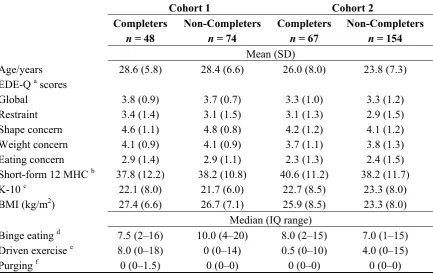
[image:6.595.84.518.341.615.2]Both cohorts were predominately EDNOS type with regular binge eating (89 and 79% respectively) but low (less than 10 and 15% respectively) rates of regular purging behaviours. As shown in Table 1, within each cohort when participants at baseline were compared with those who completed all 5-year follow up contacts and those who did not differences were small and not significant for demographic characteristics including age, marital status, dependent children at home, level of education, Australian birth (over 90 and 80% respectively), English as first language, as well as baseline values of outcome measures (the latter shown with age in Table 1, all p > 0.05). As expected, each cohort had moderate to high levels of eating disorder symptoms (comparable to those found in clinical samples [25]), psychological distress and impaired mental health related quality of life.
Table 1. Comparative baseline features (mean (SD) or median (IQR)) of those who completed each of the 5 years of follow-up and those who did not.
Cohort 1 Cohort 2
Completers Non-Completers Completers Non-Completers
n = 48 n = 74 n = 67 n = 154
Mean (SD)
Age/years 28.6 (5.8) 28.4 (6.6) 26.0 (8.0) 23.8 (7.3) EDE-Q a scores
Global 3.8 (0.9) 3.7 (0.7) 3.3 (1.0) 3.3 (1.2) Restraint 3.4 (1.4) 3.1 (1.5) 3.1 (1.3) 2.9 (1.5) Shape concern 4.6 (1.1) 4.8 (0.8) 4.2 (1.2) 4.1 (1.2) Weight concern 4.1 (0.9) 4.1 (0.9) 3.7 (1.1) 3.8 (1.3) Eating concern 2.9 (1.4) 2.9 (1.1) 2.3 (1.3) 2.4 (1.5) Short-form 12 MHC b 37.8 (12.2) 38.2 (10.8) 40.6 (11.2) 38.2 (11.7) K-10 c 22.1 (8.0) 21.7 (6.0) 22.7 (8.5) 23.3 (8.0) BMI (kg/m2) 27.4 (6.6) 26.7 (7.1) 25.9 (8.5) 23.3 (8.0)
Median (IQ range)
Binge eating d 7.5 (2–16) 10.0 (4–20) 8.0 (2–15) 7.0 (1–15) Driven exercise e 8.0 (0–18) 0 (0–14) 0.5 (0–10) 4.0 (0–15) Purging f 0 (0–1.5) 0 (0–0) 0 (0–0) 0 (0–0)
a Eating Disorder Examination Questionnaire, Global and subscale scores [28], for comparison community
normative values for these in young adult women are respectively Global 1.52 (1.25), Restraint 1.30 (1.40), Eating concern 0.76 (1.06), Weight concern 1.70 (1.51) and Shape concern 2.23 (1.65) [30]; b mental health
component score of the Short form 12 health related quality of life measure [32]; c Kessler 10 item measure of
psychological distress [35]; d Monthly frequency of objectively large binge eating episodes as defined in the
DSM-IV [5] and/or subjective binge eating episodes as defined in the Eating Disorder Examination [26];
e defined as number of times in the past month the person exercised hard as a means of controlling her shape
3.2. Changes Each Year in Eating Disorder and Other Features over the 5 Years of Follow-Up
3.2.1. Cohort 1 (See Table 2 below)
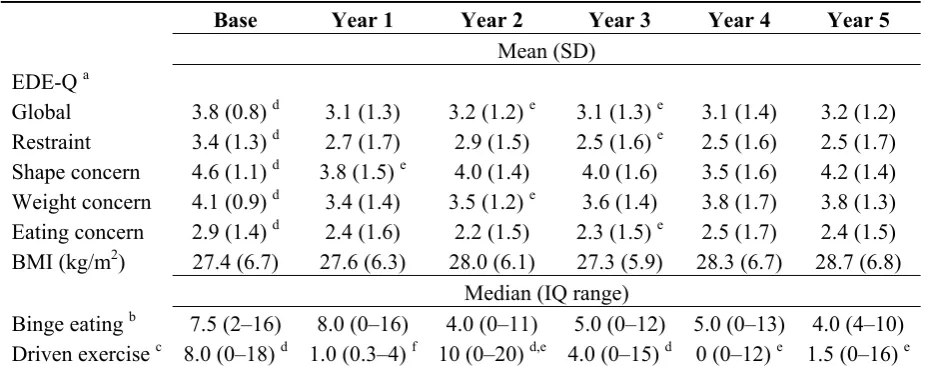
Means over the 5-year were compared with one-way repeated measures ANOVA. All were significantly different, p < 0.05. Polynomial contrasts indicated significant linear (p = 0.011) and quadratic (p < 0.005) trends in mean EDE-Q global scores. Polynomial contrasts indicated a significant quadratic trend in terms of EDE-Q shape concern scores (p = 0.001). The mean EDE-Q restraint scores showed a significant linear as well as quadratic trend (p = 0.001 and p = 0.037, respectively). Polynomial contrasts indicated a significant quadratic trend in terms of EDE-Q eating concern scores (p = 0.005). Binge eating (subject to logarithmic transformation) and BMI followed a linear trend over the years, (p = 0.001). Driven exercise fluctuated over the five years and did not follow a linear or quadratic trend. At four and five years frequency of driven exercise was lower than at baseline but greater than year 1.
[image:7.595.67.530.388.571.2]Differences in Mental Component Summary Scores (MCS) were not significant (mean 37.8, SD 12.3 at 5 years). Mean K-10 scores were significantly improved with differences significant between baseline and each other year (mean 21.9, SD 7.7 at 5 years, p = 0.021).
Table 2. Comparative eating disorder features over each of the 5-years for Cohort 1 (n = 48).
Base Year 1 Year 2 Year 3 Year 4 Year 5
Mean (SD)
EDE-Q a
Global 3.8 (0.8) d 3.1 (1.3) 3.2 (1.2) e 3.1 (1.3) e 3.1 (1.4) 3.2 (1.2) Restraint 3.4 (1.3) d 2.7 (1.7) 2.9 (1.5) 2.5 (1.6) e 2.5 (1.6) 2.5 (1.7) Shape concern 4.6 (1.1) d 3.8 (1.5) e 4.0 (1.4) 4.0 (1.6) 3.5 (1.6) 4.2 (1.4) Weight concern 4.1 (0.9) d 3.4 (1.4) 3.5 (1.2) e 3.6 (1.4) 3.8 (1.7) 3.8 (1.3) Eating concern 2.9 (1.4) d 2.4 (1.6) 2.2 (1.5) 2.3 (1.5) e 2.5 (1.7) 2.4 (1.5) BMI (kg/m2) 27.4 (6.7) 27.6 (6.3) 28.0 (6.1) 27.3 (5.9) 28.3 (6.7) 28.7 (6.8)
Median (IQ range)
Binge eating b 7.5 (2–16) 8.0 (0–16) 4.0 (0–11) 5.0 (0–12) 5.0 (0–13) 4.0 (4–10) Driven exercise c 8.0 (0–18) d 1.0 (0.3–4) f 10 (0–20) d,e 4.0 (0–15) d 0 (0–12) e 1.5 (0–16) e
a Eating Disorder Examination Questionnaire, Global and subscale scores [28]; b Monthly frequency of
objectively large binge eating episodes as defined in the DSM-IV [5] and/or subjective binge eating episodes as defined in the Eating Disorder Examination [26]; c monthly frequency; d,e,f superscripts indicate a
significant difference between means.
3.2.2. Cohort 2 (See Table 3 below)
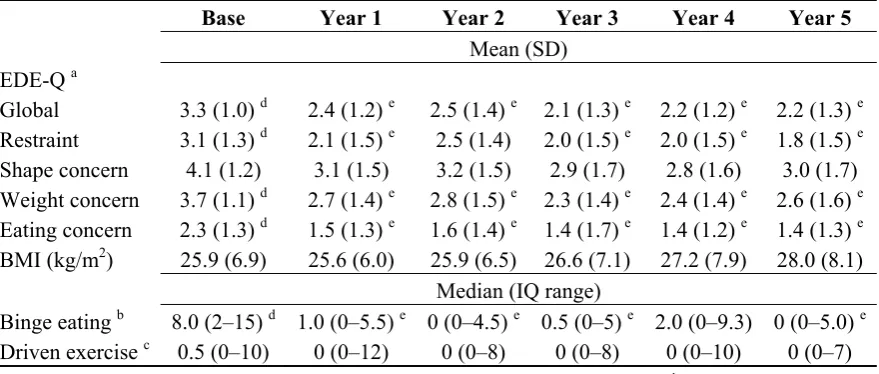
linear and quadratic significant trends. Polynomial contrasts indicated a significant linear (p = 0.001) and quadratic (p = 0.025) trend in mean BMI. There were no significant differences over the 5-year for frequency of driven exercise and no linear or quadratic trends.
[image:8.595.81.521.231.418.2]Differences in the mean SF12 MCS scores were not significant over the years (mean at five years 45.4, SD 10.8). Polynomial contrasts indicated a linear trend. The mean K10 scores were significantly improved over the years with differences between baseline and each other year, between year 1 and years 3 and 5, and between year 2 and 3 (mean at five years 17.9, SD 6.7, p < 0.005).
Table 3. Comparative eating disorder features over each of the 5-years for Cohort 2 (n = 67).
Base Year 1 Year 2 Year 3 Year 4 Year 5
Mean (SD)
EDE-Q a
Global 3.3 (1.0) d 2.4 (1.2) e 2.5 (1.4) e 2.1 (1.3) e 2.2 (1.2) e 2.2 (1.3) e Restraint 3.1 (1.3) d 2.1 (1.5) e 2.5 (1.4) 2.0 (1.5) e 2.0 (1.5) e 1.8 (1.5) e Shape concern 4.1 (1.2) 3.1 (1.5) 3.2 (1.5) 2.9 (1.7) 2.8 (1.6) 3.0 (1.7) Weight concern 3.7 (1.1) d 2.7 (1.4) e 2.8 (1.5) e 2.3 (1.4) e 2.4 (1.4) e 2.6 (1.6) e Eating concern 2.3 (1.3) d 1.5 (1.3) e 1.6 (1.4) e 1.4 (1.7) e 1.4 (1.2) e 1.4 (1.3) e BMI (kg/m2) 25.9 (6.9) 25.6 (6.0) 25.9 (6.5) 26.6 (7.1) 27.2 (7.9) 28.0 (8.1)
Median (IQ range)
Binge eating b 8.0 (2–15) d 1.0 (0–5.5) e 0 (0–4.5) e 0.5 (0–5) e 2.0 (0–9.3) 0 (0–5.0) e Driven exercise c 0.5 (0–10) 0 (0–12) 0 (0–8) 0 (0–8) 0 (0–10) 0 (0–7)
a Eating Disorder Examination Questionnaire, Global and subscale scores [28]; b Monthly frequency of
objectively large binge eating episodes as defined in the DSM-IV [5] and/or subjective binge eating episodes as defined in the Eating Disorder Examination [26]; c monthly frequency, d,e superscripts indicate a
significant difference between means. 3.3. Discussion
The present study followed two cohorts of women with disordered eating over five years. The participants in the present study predominately had a problem with recurrent episodes of binge eating, either subjectively or objectively large, where they described their eating as beyond their control with or without dietary restriction. Disordered eating was associated with psychological distress, extreme concerns about weight, shape and eating and impaired mental health related quality of life. This was despite both groups receiving an intervention to prompt help-seeking either at the beginning or the end of the first year. However, help-seeking of any type for a problem related to eating disorder symptoms was not common in either cohort, ranging between 22 and 40% in any one year, and detailed interviews of Cohort 1 in the fifth year of the study indicated that few had accessed effective or evidence based therapy during the five years and if they did so it was mainly for weight loss and not for disordered eating [24]. Although there were high levels of dietary restraint and weight concern, BMI did not reduce over time.
was no significant change in frequency found in Cohort 2.) It was unclear how much the initial general improvement may have been due to the intervention or effects of study participation irrespective of the group. At the end of the first year all participants had received the intervention and the findings for the RCTs were modest and mixed [21,22]. Improvement in general psychological distress did occur but was very small. Why time trends for frequency of driven exercise differed between cohorts and had the most fluctuating course of any behavior in the first cohort is unclear. However, the assessment of exercise by self-report is problematic and unlike other eating disorder behaviours, exercise has positive health attributes and social regard.
The findings differ from others, e.g., [15,16] which have suggested EDNOS and similar eating disorders may follow a benign course and/or high degree of symptom fluctuation over time [35]. These differences may be due in part to the nature of the sample recruitment (clinic vs. community) and selection (response to advertisement versus generally population survey) and the present study findings cannot be generalised to samples with clinically diagnosed eating disorder. Rather, possibly because this is a young adult community based sample the findings are more like the McKnight longitudinal naturalistic study and Abebe et al., which found persistence of symptoms over time [17,18]. These findings highlight the importance of increasing access to and participation in effective treatments. Further research is needed to investigate the factors predictive of outcome, including treatment effects and the nature of psychopathology.
The strengths of the study are that participants in the first cohort were recruited directly from the community and whilst the second was a convenience sample, the two cohorts did not differ on key demographic or clinical features. The main limitation was the low rate of continuous participation at each year of follow-up. This is in spite of the 5-year retention rate of 64% in Cohort 1 and 52% in Cohort 2. We did consider data imputation but elected to present the data without imputation as the two cohorts had very similar findings and thus we present a study and replication study within the one research paper. It is possible that those who did not attend at each year would have differed in pattern of symptom severity, for example showing more fluctuation, more, or less improvement. However, there was no indication from baseline comparisons that their outcomes would differ in any predictable way. The low prevalence of purging type weight control behaviours in the present samples also precluded investigation of the persistence (or otherwise) of this eating disorder feature. Further limitations are the assessment of disordered eating by self-report (which may bias toward over-reporting binge eating [25] and limits generalisability to those with clinic diagnosed eating disorders) and the assessment of women only when men are also likely to suffer problems with recurrent binge eating and EDNOS [1,2].
4. Conclusions
Implications
More research is needed on how to assist people avail themselves of evidence based treatments such as cognitive behavior therapy. Without effective intervention disordered eating continues to be problematic.
Acknowledgments
This research was supported by a mental health project grant from the Australian Rotary Health Research Fund. We thank Amber Sajjid who assisted with data collation and analyses.
Conflict of Interest
The authors declare no conflicts of interest.
References
1. Hudson, J.I.; Hiripi, E.; Pope, H.G.; Kessler, R.C. The prevalence and correlates of eating disorders in the national comorbidity survey replication. Biol. Psychiatry 2007, 61, 348–358. 2. Hay, P.; Mond, J.; Buttner, P.; Darby, A. Eating disorder behaviors are increasing: Findings from
two sequential community surveys in South Australia. PLoS One 2008, 3, doi:10.1371/ journal.pone.0001541.
3. Mishra, S.K.; Mukhopadhyay, S. Eating and weight concerns among Sikkimese adolescent girls and their biocultural correlates: An exploratory study. Public Health Nutr.2011, 14, 853–859. 4. Darby, A.; Hay, P.; Mond, J.; Quirk, F.; Buettner, P.; Kennedy, L. The rising prevalence of
co-morbid obesity and eating disorder behaviours from 1995 to 2005. Int. J. Eat. Disord. 2009,
42, 104–108.
5. American Psychiatric Association. Diagnostic and Statistical Manual of Mental Disorders, DSM-IV-TR; American Psychiatric Publishing: Arlington, VA, USA, 2000.
6. World Health Organization. The ICD-10 Classification of Mental and Behavior Disorders; World Health Organization: Geneva, Switzerland, 1992.
7. Hay, P.J.; Marley, J.; Lemar, S. Covert eating disorders: The prevalence, characteristics and help-seeking of those with bulimic eating disorders in general practice. Prim. Care Psychiatry 1998, 4, 95–99.
8. Keel, P.K.; Brown, T.A.; Holm-Denoma, J.; Bodell, L.P. Comparison of DSM-IV versus
proposed DSM-5 diagnostic criteria for eating disorders: Reduction of eating disorder not otherwise specified and validity. Int. J. Eat. Disord.2011, 44, 553–560.
9. Jenkins, P.E.; Hoste, R.R.; Meyer, C.; Blissett, J.M. Eating disorders and quality of life: A review of the literature. Clin. Psychol. Rev.2011, 31, 113–121.
10. Steinhausen, H.C.; Weber, S. The outcome of bulimia nervosa: Findings from one-quarter century of research. Am. J. Psychiatry2009,166, 1331–1341.
11. Steinhausen, H.C. Outcome of eating disorders. Child Adolesc. Psychiatr. Clin. North Am. 2009,
12. Keski-Rahkonen, A.; Hoek, H.W.; Linna, M.S.; Raevuori, A.; Sihvola, E.; Bulik, C.M.; Rissanen, A.; Kaprio, J. Incidence and outcomes of bulimia nervosa: A nationwide population-based study.
Psychol. Med.2009, 39, 823–831.
13. Hart, L.M.; Granillo, M.T.; Jorm, A.F.; Paxton, S.J. Treatment seeking in eating disorders: A systematic review of the proportion of community cases seeking treatment for an eating disorder.
Clin. Psychol. Rev.2011, 31, 727–735.
14. Patton, G.C.; Coffey, C.; Carlin, J.B.; Sanci, L.; Sawyer, S. Prognosis of adolescent partial syndromes of eating disorder. Br. J. Psychiatry2008, 192,294–299.
15. Fairburn, C.G.; Cooper, Z.; Doll, H.A.; Norman, P.; O’Connor, M. The natural course of bulimia nervosa and binge eating disorder in young women. Arch. Gen. Psychiatry2000, 57,659–665. 16. Fairburn, C.G.; Stice, E.; Cooper, Z.; Doll, H.A.; Norman, P.; O’Connor, M. Understanding
persistence in bulimia nervosa: A 5-year naturalistic study. J. Consult. Clin. Psychol. 2003, 71, 103–109.
17. Agras, W.S.; Crow, S.; Mitchell, J.E.; Halmi, K.A.; Bryson, S. A 4-year prospective study of Eating Disorder NOS compared to full eating disorder syndromes. Int. J. Eat. Disord. 2009, 42, 565–570.
18. Abebe, D.S.; Lien, L.; Torgersen, L.; van Soest, T. Binge eating, purging and non-purging compensatory behaviours decrease from adolescence to adulthood: A population-based, longitudinal study. BMC Public Health2012, 12, doi:10.1186/1471-2458-12-32.
19. Jorm, A.F. Mental health literacy: Public knowledge and beliefs about mental disorders. Br. J. Psychiatry2000, 177, 396–401.
20. Cooper, P. Bulimia Nervosa and Binge Eating: A Guide to Recovery; Robinson Press: London, UK, 1995.
21. Hay, P.J.; Mond, J.M.; Darby, A.; Rodgers, B.; Owen, C. What are the effects of providing evidence-based information on eating disorders and their treatments? A randomised controlled trial in a symptomatic community sample. Early Interv. Psychiatry 2007, 1, 316–324.
22. Hay, P.; Mond, J.; Buttner, P.; Paxton, S.; Bryan, B.; Quirk, F.; Kancijanic, D. Targeted prevention in bulimic eating disorders: randomized controlled trials of a mental health literacy and self-help intervention. In New Insights into the Prevention and Treatment of Bulimia Nervosa; InTech: Rijeka, Croatia, 2011; pp. 69–84.
23. Hay, P.; Buttner, P.; Mond, J.; Paxton, S.J.; Rodgers, B.; Quirk, F.; Darby, A. Quality of life, course and predictors of outcomes in community women with EDNOS and common eating disorders. Eur. Eat. Disord. Rev. 2010, 18, 281–295.
24. Evans, E.J.; Hay, P.J.; Mond, J.; Paxton, S.J.; Quirk, F.; Rodgers, B.; Jhajj, A.K.; Sawoniewska, M.A. Barriers to help-seeking in young women with eating disorders: A qualitative exploration in a longitudinal community survey. Eat. Disord.2011, 19, 270–285.
25. Mond, J.M.; Hay, P.J.; Rodgers, B.; Owen, C.; Beumont, P.J.V. Validity of the Eating Disorder Examination Questionnaire (EDE-Q) in screening for eating disorders in community samples.
Behav. Res. Ther. 2004, 42, 551–567.
26. Fairburn, C.G.; Cooper, Z. The Eating Disorders Examination. In Binge Eating: Nature,
27. Mond, J.M.; Hay, P.J.; Paxton, S.J.; Rodgers, B.; Darby, A.; Nillson, J.; Quirk, F.; Owen, C. Eating disorders “mental health literacy” in low risk, high risk and symptomatic women: Implications for health promotion programs. Eat. Disord.2010, 18, 267–285.
28. Beglin, S.J.; Fairburn, C.G. Evaluation of a new instrument for the detection of eating disorders in community samples. Psychiatry Res. 1992, 44,191–201.
29. Fairburn, C.G.; Beglin, S. The Eating Disorders Examination—Questionnaire (EDE-Q 6.0). In
Cognitive Behaviour Therapy and Eating Disorders; Fairburn, C.G., Ed.; Guilford Press: New York, NY, USA, 2008; pp. 309–313.
30. Mond, J.M.; Hay, P.J.; Rodgers, B.; Owen, C. Eating Disorder Examination Questionnaire (EDE-Q): Norms for young adult women. Behav. Res. Ther. 2006, 44, 53–62.
31. Ware, J.E.; Kosinski, M.; Keller, S.D. A 12-item short-form health survey: Construction of scales and preliminary tests of reliability and validity. Med. Care1996, 34, 220–233.
32. Kessler, R.C.; Andrews, G.; Colpe, L.J.; Hiripi, E.; Mroczek, D.K.; Normand, S.L.T.; Walters, E.E.; Zaslavsky, L.M. Short screening scales to monitor population prevalences and trends in non-specific psychological distress. Psychol. Med.2002, 32, 959–976.
33. Andrews, G.; Slade, T. Interpreting scores on the Kessler Psychological Distress Scale (K10).
Aust. N. Z. J. Public Health2001, 25, 494–497.
34. Department of Health. The Kessler Psychological Distress Scale (K10). Available online: http://health.adelaide.edu.au/pros/docs/reports/br200214_k10.pdf (accessed on 29 February 2012). 35. Lavender, J.M.; de Young, K.P.; Franko, D.L.; Eddy, K.T.; Kass, A.E.; Sears, M.S.; Herzog, D.B.
An investigation of the joint longitudinal trajectories of low body weight, binge eating, and purging in women with Anorexia Nervosa and Bulimia Nervosa. Int. J. Eat. Disord. 2011, 6, 679–686.