UNIVERSITI TEKNIKAL MALAYSIA MELAKA
ANALYSIS ON THE EFFECT OF INTER-CELL INTEREFENCE
IN LTE BY USING MATLAB
This report is submitted in accordance with the requirement of the Universiti Teknikal Malaysia Melaka (UTeM) for the Bachelor of Electronic Engineering
Technology (Telecommunication) with Honours.
by
NURUL ATIQAH BINTI RAFI’I B071410414
950405086228
UNIVERSITI TEKNIKAL MALAYSIA MELAKA
BORANG PENGESAHAN STATUS LAPORAN PROJEK SARJANA MUDA
TAJUK: Analysis of the effect of inter cell interference in LTE by using Matlab
SESI PENGAJIAN: 2017/18 Semester 2
Saya NURUL ATIQAH BINTI RAFI’I
mengaku membenarkan Laporan PSM ini disimpan di Perpustakaan Universiti Teknikal Malaysia Melaka (UTeM) dengan syarat-syarat kegunaan seperti berikut: 1. Laporan PSM adalah hak milik Universiti Teknikal Malaysia Melaka dan penulis. 2. Perpustakaan Universiti Teknikal Malaysia Melaka dibenarkan membuat salinan
untuk tujuan pengajian sahaja dengan izin penulis.
3. Perpustakaan dibenarkan membuat salinan laporan PSM ini sebagai bahan pertukaran antara institusi pengajian tinggi.
4. **Sila tandakan ( )
SULIT
TERHAD
TIDAK TERHAD
(Mengandungi maklumat yang berdarjah keselamatan atau kepentingan Malaysia sebagaimana yang termaktub dalam AKTA RAHSIA RASMI 1972)
(Mengandungi maklumat TERHAD yang telah ditentukan oleh organisasi/badan di mana penyelidikan dijalankan)
Alamat Tetap:
Tarikh: ________________________
Disahkan oleh:
Cop Rasmi:
FAKULTI TEKNOLOGI KEJURUTERAAN
DECLARATION
I hereby, declared this report entitled “The Effect of Inter-cell Interference in LTE by using Matlab” is the results of my own research except as cited in references.
Signature :
APPROVAL
This report is submitted to the Faculty of Engineering Technology of UTeM as a partial fulfillment of the requirements for the degree of Bachelor of Electronic Engineering Technology (Telecommunication) with Honours. The member of the supervisory is as follow:
i
ABSTRAK
ii
ABSTRACT
Inter-cell interference (ICI) occurs when users in different adjacent cells attempt to use the same frequency at the same time. ICI may cause severe degradation in terms of the bit error rate (BER) which in turn reduces the overall network performance. This project aims to investigate the effect of modulation techniques, number of transmitted frames and dominant interferer proportion (DIP) on the network throughput in the presence of ICI. The results show that QPSK outperforms QAM by at least 12% in terms of the network throughput. In addition, it is shown that when the number of frames increases, the network throughput decreases. Meanwhile, the DIP parameter is found to have less influence on the network throughput. Therefore, we concluded that the choice of technique of modulation is very crucial to guarantee the quality of service especially in the presence of ICI.
iii
DEDICATION
To my family..
To my Supervisor..
iv
ACKNOWLEDGEMENT
I would like to thank ….
I must first and foremost thank my thesis advisor, Madam Zahariah Binti Manap, who was most responsible for helping me make this work a success. Her encouragement and guidance combined with a superior, in depth knowledge of the mobile field have enabled me to complete this thesis. Her positive influence on my remaining education was more than she will ever know.
v
TABLE OF CONTENT
Abstrak i
Abstract ii
Dedication iii
Acknowledgement iv
Table of Content v
List of Tables vii
List of Figures ix
List Abbreviations, Symbols and Nomenclatures x
CHAPTER 1: INTRODUCTION
1.0 Introduction 1
1.1 Project background 1
1.2 Problem Statement 3
1.3 Project Objective 4
1.4 Work Scope 4
1.5 Organization of the Report 4
CHAPTER 2: LITERATURE REVIEW
2.0 Introduction 6
2.1 LTE Background 6
2.2 Evolution of Cellular Network 7
2.3 Long Term Evolution(LTE) Overview 8
2.4 LTE Physical Layer 10
vi
2.4.1.1 Downlink 10
2.4.1.2 Downlink Physical Layer 12 2.4.1.3 Function of Downlink Channel 14 2.5 Key Enable Technologies and Features of LTE
2.5.1 Orthogonal Frequency Division Multiplexing (OFDM) 15
2.5.2 SC-FDE and SC-FDMA 17
2.5.3 Flexibility Spectrum 17
2.5.4 Multi- Antenna Method 17
2.5.5 Multi Input Multi Output (MIMO) 18 2.5.6 Downlink Power Control 19
2.6 Transport Control 20
2.6.1 Single Carrier Frequency Demultiplexing (SCFDM ) 21
2.6.1.1 SCFDMA Spreader 21
2.7 Quality Of Service (QoS) 21
2.8 Modulation Techniques 22
2.8.1 Quadrature Phase Shift Keying (QPSK) 22 2.8.2 Quadrature Amplitude Modulation 24
2.9 Interference in LTE Network 25
CHAPTER 3: METHODOLOGY 28
3.1 Simulation Set up 28
vii
3.1.5 Generate Downlink Waveform 32
CHAPTER 4: RESULT 33
4.0 Introduction 33
4.1 The Effect of Number of Frames 34
4.2 The Effect on DIP2 and DIP3 37
4.3 The Effect of Modulation Techniques 38
CHAPTER 5 : CONCLUSION & FUTURE WORK 5.0 Introduction 41
5.1 Conclusion 41
5.2 Achievement of Project Objectives 41
5.3 Future Work 42
viii
LIST OF TABLES
2.1 Technical specification published by 3GPP standards 10 3.1 Parameter for reference channel for R.46 and R.65 30 3.2 Parameters for propagation condition EVA 70 31 3.3 Matlab functions used for downlink waveform generation 32 4.1 The Parameter is set based on the conditions specified in TS 36.101,Section
ix
LIST OF FIGURES
2.1 Evolution of wireless standards in the last two decades 7
2.2 Frame Structure 11
2.3 The LTE downlink physical layer 13
2.4 Multi-layer transmission 18
2.5 Network Topology 27
3.1 Flow Chart of Research 29
4.1 Graph for simulating 10 frames 34
4.2 Graph for simulating 100 frames 34
x
LIST OF ABBREVIATIONS, SYMBOLS AND
NOMENCLATURE
3GPP - Third Generation Partnership Project
3GPP2 - Third Generation Partnership Project 2Million 4G - Fourth Generation of Cellular Technology AWGN - Additive White Gaussian Noise
BCH - Broadcast Channel CDD - Cyclic Delay Diversity
CDMA - Code Division Multiple Access CP - Cyclic Prefix
CRC - Cyclic Redundancy Check DCI - Downlink Control Information DFT - Discrete Fourier Transform DL - Downlink
DL-SCH - Downlink Shared Channel U ENodeB - Enhance Base Station
E-UTRAN - Universal Terrestrial Radio Access Network EVA - Extended Vehicle A
FDD - Frequency Division Duplexing HARQ - Hybrid automatic repeat request HSPA - High Speed Packet Access IBI - Inner Block Interface ICI - Inter-Cell Interference
IETF - Internet Engineering Task Force ISI - Intersymbol Interference
xi MIMO - Multiple Input Multiple Output
OFDM - Orthogonal Frequency Division Multiplexing OFDMA - Orthogonal frequency division multiple access PAPR - Peak to Average Power Ratio
PCH - Paging Channel
PDCCH - Physical Downlink Control Channel PDSCH - Physical Downlink Shared Channel QAM - Quadrature Amplitude Modulation QCI - Quality of Service Class Identifier QoS - Quality of Service
QPP - Quadratic Permutation Polynomial QPSK - Quadrature Phase Shift Keying RE - Resource Elements
RSC - Recursive Systematic
SC-FDMA - Single Carrier Frequency Division Multiple Access SINR - Signal to Interference plus Noise Ratio
TDD - Time Division Duplexing TFP - Traffic Forwarding Policy UE - User Equipment
UL - Uplink
UL-SCH - Up link shared channel
1
CHAPTER 1
INTRODUCTION
1.0 Introduction
In this chapter, the overview of LTE and ICI, aims and objectives, problem statement and scope research for this project and its outline are discussed.
1.1 Project Background
2 Aggressive utilization of the spectrum turns to be an enhancement of Inter-Cell Interference (ICI) in the LTE network infrastructure creates congested. Sharing out the frequency in the adjacent cell declines the performance of ICI. Therefore, this issue needs analyze to solve so that the network performance can increase for real time application.
Orthogonal frequency division multiple access (OFDMA) has been recently implemented as the multiple access scheme for the LTE. One of the advantage of OFDMA is elegant solution to multipath interference (Arunabha G., 2010).The critical challenge to high bit rate transmission in a wireless channel is ICI caused by users in different neighbor cells attempt to use the same resource at the same time.
The orthogonal criteria among the subcarriers per cell, makes the intra-cell interference almost negligible. However, with universal frequency reuse among cells and assume all cells use the same set of subcarriers, the ICI at each subcarrier may cause severe degradation in the network performance.
3 cannot be quantified at a given instant due to the highly varying locations of the interfering mobile transmitters.
Conditioned on the location of the desired mobile receiver within a cell, the exact distance of the interfering eNodeB can be calculated in the typical grid based downlink network models. However, knowing the location of the ENodeB receiver in the uplink does not help in determining the exact location of the interfering mobile users. In the uplink, cell edge and cell center mobile users are subject to the same amount of interference on a given subcarrier, which is the interference received at the ENodeB whereas the same is not true for the downlink in which cell edge users experience higher interference coming from the nearby ENodeB. Based on the above mentioned studies, there are limited studies, in particular, on how ICI impacts on the throughput. Therefore, in this project, a comparative study has been done on the effect of performance throughput in ICI.
1.2 Problem statement
4
1.3 Project Objective
The main focus in this project is to measure the effects of ICI based on average throughput percentage. This include in analyzing the throughput vs simulated subframe based on the Extended Vehicle A (EVA) delay profile and several reference channels and using the properties of Matlab.
The objective of the project:-
i. To simulate the inter-cell interference in vehicular propagation environment by using Matlab.
ii. To analyze the effect of the inter-cell interference on the throughput performance in selected LTE propagation channel of LTE.
1.4 Work scope
The scope of project is very important in order to support in the build and development process of this project. The main focus in this project is to measure the performance of throughput in detailed. This include in analyzing the Throughput vs simulated subframe based on the Extended Vehicle A (EVA) delay profile and several channel references.
1.5 Organization of the Report
6
CHAPTER 2
LITERATURE REVIEW
2.0 Introduction
This chapter provides an overview of the basic concepts of an LTE network then, a synopsis of interference related aspects, including a brief state of the art, and a study of services and applications, and their related traffic models, are provided.
2.1 LTE Background
7
2.2 Evolution of Cellular Network
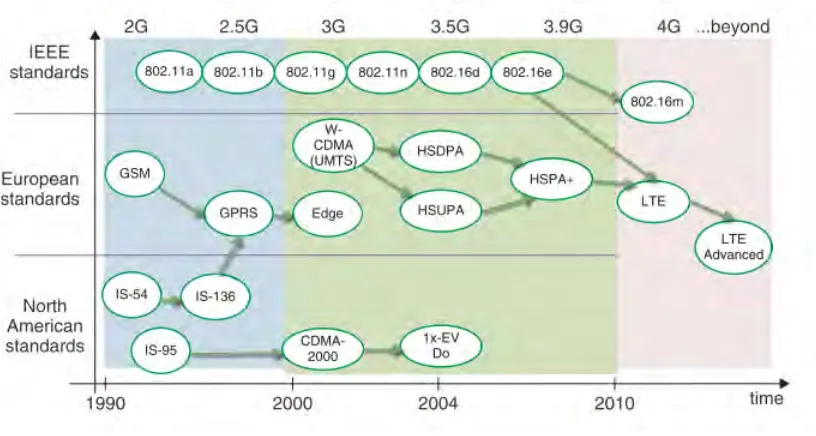
[image:23.595.149.557.311.529.2]In the previous two decades we have seen the presentation of different mobile standards, from 2G to 3G to the present 4G, and we anticipate that the pattern will proceed with (see Figure 2.1). The essential man date of the 2G guidelines was the help of mobile communication and voice applications. The 3G principles denoted the start of the parcel based information upset and the help of Internet Third Generation Partnership Project 2 (3GPP2) was the institutionalization body that built up specialized particulars and measures for 3G mobile system in light of the development of Code Division Multiple Access (CDMA) innovation.
8
2.3 Long Term Evolution (LTE) Overview
The 3GPP introduces LTE represents a major advance in cellular technology. LTE is designed to meet carrier needs include improves system capacity and coverage, high-speed data and media transport as well as high-capacity voice support well into the next decade, reduce operating cost, multi-antenna support, flexible bandwidth operations and seamless integration with existing system. It also encompasses high-speed data, multimedia unicast and multimedia broadcast services. Although technical specifications are not yet finalized, significant details are emerging.
In table 2.1, 3GPP developed the widely used Universal Mobile Telecommunication Service (UMTS), Wideband Code Division Multiple Access (WCDMA), High Speed Packet Access (HSPA) 3G standards, also developed LTE. Release 8 was completed in 2010, followed by release 9. Available now, release 10 defines LTE-Advanced (LTE-A).
Multiple cell-phone technologies designated by generations have led to LTE-A. The first generation was analogue technology, which is no longer available. The second generation (2G) brought digital technology with its benefits to the industry. Multiple incompatible 2G standards were developed. Only two, GSM and Code Division Multiple Access (CDMA), have survived.
LTE was created as an upgrade to the 3G standards. The cellular industry recognized its major benefits, and virtually every mobile carrier has embraced it as the next generation. All cellular operators are now on the path to implementing LTE. While 3GPP still defines LTE as a 3.9G technology, all of the current LTE networks are marketed at 4G. The real 4G as designated by 3GPP is LTE-A.