OPTIMUM SOCIO-ENVIRONMENTAL FLOWS APPROACH FOR
RESERVOIR OPERATION STRATEGY USING MANY-OBJECTIVES
EVOLUTIONARY OPTIMIZATION ALGORITHM
Jafar Y. Al-Jawad
a*, Hassan M. Alsaffar
b, Douglas Bertram
c, Robert
M. Kalin
da,c,dDepartment of Civil and Environmental Engineering, University of Strathclyde Glasgow
75 Montrose St, Glasgow G1 1XJ
bNationalCenter for Water Resources Management, Ministry of Water Resources, Baghdad,
Iraq
a [email protected]; b [email protected]; c [email protected]; d [email protected]
* corresponding author
alternative e-mail: [email protected]
Abstract
Water resource system complexity, high-dimension modelling difficulty and
computational efficiency challenges often limit decision makers’ strategies to combine
environmental flow objectives (e.g. water quality, ecosystem) with social flow objectives (e.g.
hydropower, water supply and agriculture). Hence, a novel Optimum Social-Environmental
Flows (OSEF) with Auto-Adaptive Constraints (AAC) approach introduced as a river basin
management decision support tool. The OSEF-AAC approach integrates Socio-Environmental
(SE) objectives with convergence booster support to soften any computational challenges. Nine
SE objectives and 396 decision variables modelled for Iraq’s Diyala river basin. The
approach’s effectiveness evaluated using two non-environmental models and two inflows’
scenarios. The advantage of OSEF-AAC approved, and other decision support alternatives
highlighted that could enhance river basin SE sectors’ revenues, as river basin economic
benefits will improve as well. However, advanced land use and water exploitation policy would
2
Keywords: Environmental flows regime, Water resources management, Borg MOEA,
-DSEA, auto-adaptive constraints, Diyala River basin
1 INTRODUCTION
The limits of water resources often lead to building dams in arid-environments to fulfil
social and environmental demands such as flood wave absorption, water supply, agriculture
projects, producing hydropower, tourist attraction, and other recreational purposes. These
structures and their catchments need a robust management plan to handle their complexity in
terms of: non-linearity, dynamic characteristics, conflicting objectives, multimodal, etc.
(Haimes and Hall, 1977 in Reed et al., 2013).
In the last few decades optimization algorithms developed and carried out in different
scientific and engineering fields to solve complex problems (Coello et al., 2007); these
problems include water resources management (Maier et al., 2014). Multiple optimization
methods used in reservoir system operation including linear and non-linear programing,
dynamic programing and evolutionary algorithms (Ahmad et al., 2014; Rani and Moreira,
2010). Evolutionary algorithms (EA) widely employed to tackle the intricacies of reservoir
systems, inspired from evolution of genes (Nicklow et al., 2010; Back et al., 2000). Studies
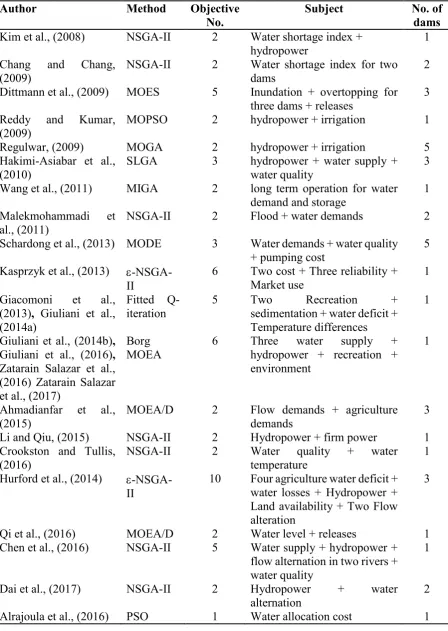
involving multi-objective reservoir operation optimization using evolutionary algorithm
summarized in Table 1. Only three of the twenty-two studies consider more than five
objectives in reservoir operation strategy (multiple publications used in the same case study
considered as one study). Besides, some studies merge objectives to simplify the multiple dam
system problems, and hydropower generation and water supply (for domestic and irrigation)
3
Environmental objectives seldom adopted in reservoir management, in a recent review
of studies between 1980 and 2015 by Horne et al., (2016) found only 42 studies adopt
environmental releases in reservoir management as decision variables.
Recently Horne et al., (2017) presented conditional probability networks (CPNs)
approaches combined with Mixed Integer Programing (MIP) optimizer for environmental flow
regimes. Poff et al., (2016) propose a framework approach for eco-engineering decision scaling
using performance indices, and Acreman et al., (2014) show that environmental flows need a
“designer” approach for considering ecosystem objectives in water control infrastructure,
rather than a “natural” approach.
Older studies do consider social objectives (hydropower, water supply, and flood
protection) in their optimization models for reservoir operation strategy, and more recent
studies consider environmental flow regimes. We propose to adopt a more holistic approach,
where environmental flows from reservoir combined with the social water needs to improve
economic revenues reliant on the river basin system.
Water resources management models provide information to the decision makers,
rather than the decision itself (Loucks, 2012). There are pre and post-optimization
implementation approaches for incorporating decision maker criteria within a multi-aspects
problems (Maier et al., 2014; Coello et al., 2007). One of the pre-criteria approach drawbacks
is the dissatisfaction (or lack of trust) of decision makers toward model results that emerged
depending on their criteria set, and they may change these criteria to produce new results
(Loucks, 2012). Hence the model needs to be re-executed until they get satisfaction. The second
approach is computationally challenging and has potential difficulties to find the Pareto-front
for optimum solutions set, which recently tackles by using multi-objective (or many-objective
4
These holistic challenges motivate development of a novel approach to produce
optimum river basin management strategies that combines both social and environmental
objectives. Many-objective evolutionary optimization algorithm adopted to conceptualise and
analyse the multi-sector problem. Also, an auto-adaptive constraints approach used to
overcome system complexity and boost algorithm convergence. The approach effectiveness
evaluated using challenging water resources problem in a semi-arid region in Middle East. The
approach achievement and robustness supported by two evolutionary algorithms (Maier et al.,
2014): the state-of-the-art Borg MOEA (Hadka and Reed, 2013) and the new -DSEA
(Al-Jawad et al., 2018b). The findings expected to improve the river basin system potential social
and environmental sectors economic revenues. Also, the optimum water management strategy
“trade-off” will provide the decision makers with a flexible flow regime management
consistent with different time-scales for real-world IWRM.
2 METHODS AND TOOLS
2.1 Identification of OSEF-AAC Approach
This study presents the Optimum Socio-Environmental Flows (OSEF) approach which
combines all social and environmental sectors (or objectives) together in one model using a
many-objectives optimization algorithm approach.
Many-objectives model can solve more than three objectives problems (Maier et al.,
2014; Li et al., 2015); however, the complexity increases exponentially when involving more
objectives, which leads to challenges in computational efficiency (Lokman and Köksalan,
2013; Maier et al., 2014). Nevertheless, involving more objectives has minor or similar impact
on the computational complexity of MOEAs’ algorithms, since it’s a function of; population
size, number of objectives and number of generations (Curry and Dagli, 2014). The later study
5
computational complexity impact. This based on comparing two versions of MOEAs for multi
and many-objectives optimization algorithms; NSGA-II (Deb et al., 2002) and NSGA-III (Deb
and Jain, 2013); SPEA (Zitzler et al., 2002) and FD-SPEA2 (He et al., 2014). Also, they refer
to the length of chromosome (number of decision variables) as a key-factor affecting on the
computational complexity. Maier et al., (2014) explore computational efficiency challenges in
water resources management models and the available methods to handle them, over the use
of surrogate model (SM) or parallel computing. The SM approaches used to reduce the
difficulties (or the dimensions) and the authors reviewed several studies carrying out the SM
model, noting “SMs are only an approximation and therefore subject to errors” (Maier et al.,
2014). While the parallel computing is not commonly available and highly expensive, another
challenging are the barriers (or constraints) that real-world water resources management
problems have which limit the model feasible solutions region. For examples dam releases
restricted to the spillway gates’ maximum discharge capacity, and power generation limited to
the maximum power plant turbine flows. Hence, constraints should assign for unconstrained
optimization algorithms like evolutionary algorithms (Deb, 2001; Abraham et al., 2005).
Developing a penalty function formula is a type of constraints approach paradigm
(Coello Coello, 2002; Simon, 2013) to represent decision makers policy or criteria (Maier et
al., 2014) and to exaggerate the unfeasible solution to guide algorithm exploration towards
feasible solutions. However these functions should carefully develop and test for each problem
to avoid premature or delay of algorithm convergence towards optimum solutions (Deb and
Datta, 2013). Hence, the new Auto-Adaptive Constraints (AAC) method developed to
overcome such challenges. The AAC developed after intensive practical diagnosis and
assessment of evolutionary algorithm behaviour on real-world many-objectives problem with
large number of decision variables. The initial decision variables population random seeding
6
candidates subjected to mutation and crossover evolution to produce new generations until
evaluation ends (Deb, 2001; Abraham et al., 2005), which is sensitive to objective achievement
to produce non-dominated solutions. Therefore, the initial evaluation stages produce large
penalized values due to numerous decision variables’ violations which restrains the
convergence or may cause stagnation in local optima (Deb and Datta, 2013). To overcome this
problem, the AAC approach release the chain of constraints at large values of violation
gradually, then re-enforce it at small violations, as decision variables approach feasible region.
The method based on a dynamic like combining the penalty formula with model violations.
Figure 1 shows the diagram of OSEF-AAC and AAC details approaches.
2.2 Identification of Many-Objectives Optimization Algorithms
Hadka and Reed (2013) present the state-of-the-art Borg MOEA for many-objectives
optimization problem with auto-adaptive six recombination operators, -box techniques for
dominance sorting, injection technique (Kollat and Reed, 2006) to avoid stagnation, and an
archive for dominance solutions sorting. Comparative assessment studies of Borg MOEA
achieved by Hadka and Reed (2012), Hadka et al. (2012), Reed et al., (2013), Woodruff et al.
(2015), Zatarain Salazar et al., (2016), and (Yan et al., 2017) on various problems with
competitive evolutionary algorithms (like NSGA-II, AMALGAM, -MOEA, SPEA2, .. etc.)
shows outperformance of Borg MOEA. Recently, Al-jawad and Tanyimboh (2017) assessed
Borg MOEA to solve real-world reservoir operation; results show that Borg MOEA improves
the solution significantly.
New methods proposed by in developing -DSEA to increase the diversity and improve
model convergence. -DSEA has self-adaptive operators’ parameters control technique for
auto-parameter-tuning and random parameters resetting to avoid stagnation. The -DSEA
real-7
world reservoir operation problem, and a real-world groundwater long-term management
(Al-Jawad and Tanyimboh, 2018; Al-(Al-Jawad et al., 2018). The results showed that -DSEA
outperformed Borg MOEA in almost all adopted cases.
3 CASE STUDY DESCRIPTION 3.1 Regional Identification
The Himren dam system in Iraq selected as a challenging water resources problem,
located in the semi-arid region in the Middle East, which has many social and environmental
management problems. It is a rock fill multi-purpose dam located in the Diyala governorate of
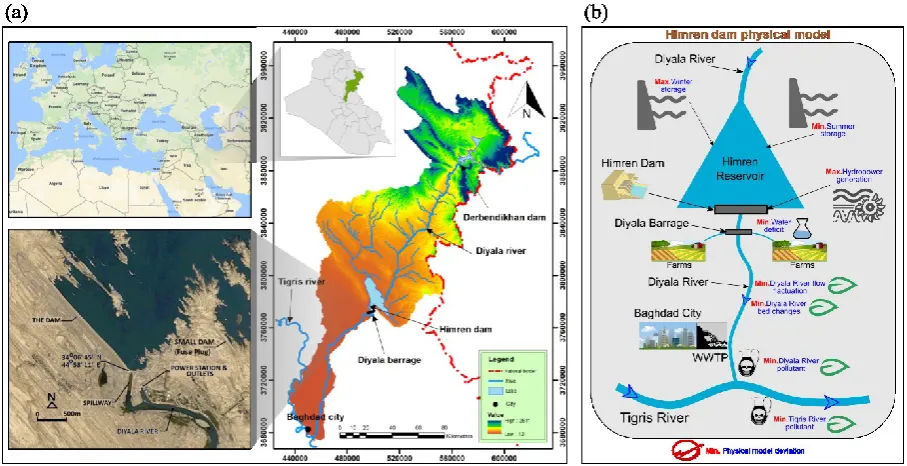
Iraq at 34o 06’ 45” N – 44o 58’ 11” E, 120 km in the north-east from Baghdad city (Figure 2a).
The dam built for hydropower production, flood control, agriculture and reregulate river
flows for downstream water exploitation. Table A2 and A3 in the supplementary data presents
Himren dam characteristics details, and the average monthly meteorological data, precipitation,
evaporation, river losses, and irrigation projects demands for the dam system, respectively. The
Diyala river basin is facing crisis and deterioration in the sustainability of its water resources
and environments. Details identification of the problem illustrate in section 2 in the
supplementary data.
3.2 Identification of Reservoir Management Objectives (OSEF-AAC approach)
In general, each river basin has its own operation objectives and constraints, hence
mathematical models developed for the adopted case study for OSEF-AAC approach
implementation. Water resources management decisions may relate to a range of spatial and
temporal scales, from sub-daily to multi-year and a single location to the river basin,
respectively. However monthly rather weekly values considered in the model as the focus of
8
operational control (Horne et al., 2016). Figure 2b shows the proposed nine objectives of
Himren dam physical model. The river basin management system is classified into two main
groups, social and environmental.
3.2.1 Social Sector Objectives
This sector includes objectives addressing water demands, storage support, flood risk
management, and power generation. To fulfil downstream water demands for domestic,
industrial, and irrigation projects at time t (𝐷𝐷𝑡𝐻), the relevant reservoir releases (𝑅𝑡𝐻) should
manage to follow these demands over the time operation T, which can formulate as:
𝑚𝑖𝑛 𝑓𝑑𝑒𝑚𝑎𝑛𝑑𝑠𝐻 = ∑ (
𝑅𝑡𝐻− 𝐷𝐷𝑡𝐻 𝐷𝐷𝑚𝑎𝑥𝐻
)
2 𝑇
𝑡=1
+ 𝐶𝑃 , t =1, 2,..T
(1)
where 𝐷𝐷𝑚𝑎𝑥𝐻 is the maximum water demands, and CP is the penalty value includes all the
violations of the model, which could express as:
𝐶𝑃 = ∑ 𝐶𝑖𝑒 𝑃𝑁
𝑖=1
, i =1, 2,..PN (2)
where PN is the number of penalty functions, Ci is the penalty value for the (ith) penalty
function, and e is any positive integer number. More details of Ci presents in equations 19 and
20 below.
In arid environments one of the main reasons for a dam is to support reservoir storage
during rainy seasons (TW), usually in winter, to fulfil water demands in hotter / dryer seasons.
Hence the reservoir storage at time t (𝑆𝑡𝐻) should increase to the maximum reservoir storage
(𝑆𝑚𝑎𝑥𝐻 ). Therefore, the second social objective can express as:
𝑚𝑖𝑛 𝑓𝑤𝑖𝑛𝑡𝑒𝑟𝐻 = ∑ (𝑆𝑚𝑎𝑥
𝐻 − 𝑆 𝑡𝐻
𝑆𝑚𝑎𝑥𝐻
)
2
𝑇𝑤
𝑡=1
9
The reservoir water storage budget is affected by the quantity of reservoir inflows (𝐼𝑡𝐻),
the reservoir releases (𝑅𝑡𝐻), reservoir lake evaporation (𝐸𝑡𝐻), direct rainfall (𝑃𝑡𝐻), reservoir
seepage losses (𝑆𝐸𝑡𝐻), and reservoir groundwater recharge (𝐺𝑅 𝑡
𝐻). Hence, reservoir storage at
time t+1 (𝑆𝑡+1𝐻 ) could express as:
𝑆𝑡+1𝐻 = 𝑆𝑡𝐻+ 𝐼𝑡𝐻− 𝑅𝑡𝐻− 𝐸𝑡𝐻+ 𝑃𝑡𝐻− 𝑆𝐸𝑡𝐻+ 𝐺𝑅𝑡𝐻 , t =1, 2,.. T (4)
Reservoir area-storage and head-storage relation presented in the section 3 in the
supplementary data. Flood risk management strategy should consider in the operation policy
to reduce inundation hazards, and can manage by reducing reservoir storage during the summer
season (TS) before the next rainy season. However, the minimum producing power (𝑆𝑚𝑖𝑛𝑝𝐻 )
need to preserve during this period. Hence the third social objective can formulate as:
𝑚𝑖𝑛 𝑓𝑠𝑢𝑚𝑚𝑒𝑟𝐻= ∑ (
𝑆𝑡𝐻− 𝑆𝑚𝑖𝑛𝑝𝐻 𝑆𝑚𝑎𝑥𝐻
)
2
+ 𝐶𝑃 𝑇𝑠
𝑡=1
, t =1, 2, .. TS (5)
Producing power is one of the main economic purposes considered in dam operational
design. Therefore, the fourth social objective is to maximize the power generation at time t
(𝑃𝑤𝑡𝐻) towards the maximum power plant capacity (𝑃𝑤
𝑚𝑎𝑥𝐻 ) over the operation time T to
improve project revenues using the following formula:
𝑚𝑖𝑛 𝑓𝑝𝑜𝑤𝑒𝑟𝐻= ∑ (𝑃𝑤𝑚𝑎𝑥
𝐻 − 𝑃𝑤 𝑡𝐻
𝑃𝑤𝑚𝑎𝑥𝐻 )
2 𝑇
𝑡=1
+ 𝐶𝑃 , t =1, 2,..T (6)
The general hydropower generation formula is as follows:
𝑃𝑤𝑡𝐻= 𝜂𝑒𝐻. 𝛾𝑤. 𝑄𝑡𝑡𝑢𝐻. 𝐻𝑡𝑛𝐻 (7)
where 𝜂𝑒𝐻 is power plant efficiency, 𝛾
𝑤 is water specific weight, 𝑄𝑡𝑡𝑢𝐻 is the turbine discharge,
and 𝐻𝑡𝑛𝐻 is the net head in the reservoir measured between reservoir water surface level and
10 3.2.2 Environmental Sector Objectives
The objectives of this sector can express as: controlling river discharges, river water
quality, downstream water quality, and river morphology. The harmony in river flows is
important for controlling river morphology, navigation and tourism in the region. Since the
Diyala barrage on dam downstream controls reservoir releases, extra control should consider
within the management model. A new Barrage operation policy proposed to improve river
environment, which its details are in section 4 in the supplementary data. Hence the second
environmental objective is to minimize the river discharge differences at time t (𝑄𝑡𝑟) and t+1
(𝑄𝑡+1𝑟 ) with respect to the maximum river discharge (𝑄
𝑚𝑎𝑥𝑟 ) for the entire periods time T. The
following formula proposed:
𝑚𝑖𝑛 𝑓𝑟𝑖𝑣𝑒𝑟𝐵 = ∑ (𝑄𝑡
𝑟− 𝑄 𝑡+1𝑟
𝑄𝑚𝑎𝑥𝑟 ) 2 𝑇
𝑡=1
+ 𝐶𝑃 , t =1, 2,..T (8)
The river water quality is important for ecosystem and anthropogenic needs; therefore,
reservoir releases management should consider this issue. Where a pollutant source discharges
to the river, the final concentration of total dissolved solids after the source point at time t
(𝑇𝐷𝑆𝑡𝑟2) depend on the mixed concentrations of pollutant source and the river (𝑇𝐷𝑆
𝑡𝑃𝑆, 𝑇𝐷𝑆𝑡𝑟1)
coupled with their discharges (𝑄𝑡𝑃𝑆, 𝑄
𝑡𝑟1), respectively. Hence, the final concentration can
calculate using mass solute balance equation:
𝑇𝐷𝑆𝑡𝑟2 =
𝑇𝐷𝑆𝑡𝑟1× 𝑄𝑡𝑟1+ 𝑇𝐷𝑆𝑡𝑃𝑆× 𝑄𝑡𝑃𝑆
𝑄𝑡𝑟1+ 𝑄𝑡𝑃𝑆 , t =1, 2,..T (9)
Thus, the second environmental objective is to minimize river pollutant after the pollutant
source over the operation time T, which can express as:
𝑚𝑖𝑛 𝑓𝑇𝐷𝑆−𝐷𝑌= ∑ (𝑇𝐷𝑆𝑡
𝑟2
𝑇𝐷𝑆𝑡𝑃𝑆)
2 𝑇
𝑡=1
11
Consistency, since the Diyala River is merging with Tigris River downstream, the
mixing water should also monitor. So, the mix concentration after the confluence (𝑇𝐷𝑆𝑡𝑅)
depends on both rivers quality and quantity 𝑇𝐷𝑆𝑡𝑟2, 𝑄
𝑡𝑟2, 𝑇𝐷𝑆𝑡𝑟3, 𝑄𝑡𝑟3, respectively, which could
express as:
𝑇𝐷𝑆𝑡𝑅 =𝑇𝐷𝑆𝑡 𝑟2× 𝑄
𝑡𝑟2+ 𝑇𝐷𝑆𝑡𝑟3× 𝑄𝑡𝑟3
𝑄𝑡𝑟2+ 𝑄 𝑡𝑟3
, t =1, 2,..T (11)
The third environmental objective is to minimize the final mixed concentration in Tigris river
after the confluence with Diyala river about the maximum allowable concentration of
(𝑇𝐷𝑆𝑚𝑎𝑥) over the operation period T, which can formulate as:
𝑚𝑖𝑛 𝑓𝑇𝐷𝑆−𝑇𝑅 = ∑ (
𝑇𝐷𝑆𝑡𝑅 𝑇𝐷𝑆𝑚𝑎𝑥
)
2 𝑇
𝑡=1
+ 𝐶𝑃 , t =1, 2,..T (12)
River morphology is another environmental aspect considered through degradation and
aggregation in the riverbed at section i and time t according to the Schoklisch formula (1934)
(Yang 1996 in Ali 2016) and it depends on river discharge per unit width (𝑞𝑖,𝑡𝑟 ), critical
discharge per unit width (𝑞𝑖,𝑡𝑐 ), energy gradient of water (𝐻𝐺
𝑖,𝑡), and soil particle diameter (𝑑𝑠).
Hence, the riverbed sediment loads discharge (𝐵𝐷𝑖,𝑡) per unit width is:
𝐵𝐷𝑖,𝑡 =7000 𝐻𝐺𝑖,𝑡
3 2⁄
√𝑑𝑠
. (𝑞𝑖,𝑡𝑟 − 𝑞𝑖,𝑡𝑐 ) , t =1, 2,..T, i = 1, 2, .. NS (13)
where NS is the number of considered sections along the river
𝑞𝑖,𝑡𝑐 =1.944 × 10
−5. 𝑑 𝑠
𝐻𝐺𝑖,𝑡4 3⁄ (14)
The energy gradient at section i and time t could be calculated using Manning’s
formula, which depends on Manning’s roughness coefficient (n), river discharge (𝑄𝑡𝑟), effective
12 𝐻𝐺𝑖,𝑡 =
𝑛2(𝑄 𝑡𝑟)2
𝐴𝑖,𝑡2 𝐻𝑅𝑖,𝑡4 3⁄ , t =1, 2,..T, i = 1, 2, .. NS (15)
Carriaga and Mays (1995) and Nicklow and Mays (2001) proposed sediment routing
formula in the river to calculate the bed level change at section i and time t (𝐵𝐿𝑖,𝑡), and time
t+1 (𝐵𝐿𝑖,𝑡+1), respectively. Their formula depends on the difference between bed load
discharge at section i-1 and i+1 (𝐵𝐷𝑖−1,𝑡, 𝐵𝐷𝑖+1,𝑡), specific density of water-soil mixture (𝛾𝑚),
river bed width (𝑊𝑖), and the length between the considered section and the upstream section
(𝐿𝑢,𝑡) and downstream section (𝐿𝑑,𝑡). Hence, the aggregation and degradation at i section in
any time difference ∆𝑇 along riverbed could be calculated as follows:
𝐵𝐿𝑖,𝑡+1= 𝐵𝐿𝑖,𝑡− ∆𝑇𝑡 0.5𝛾𝑚𝑊𝑖
(𝐵𝐷𝑖−1,𝑡− 𝐵𝐷𝑖+1,𝑡)
(𝐿𝑢,𝑡+ 𝐿𝑑,𝑡) , t =1, 2,..T, i = 1, 2, .. NS (16)
In order to minimize the changes in river bed levels over the operation time T, the following
formula proposed:
𝑚𝑖𝑛 𝑓𝐷𝑌−𝐵𝐶𝐻 = ∑ (𝐵𝐿𝑖,𝑡=0− 𝐵𝐿𝑖,𝑡=𝑇
∆𝐵𝐿𝑚𝑎𝑥 )
2 𝑁𝑆
𝑖=1
+ 𝐶𝑃 , t =1, 2,..T (17)
where ∆𝐵𝐿𝑚𝑎𝑥 is the maximum allowable river bed level changes
3.2.3 Model Violation Objective
The final objective function is to minimize the penalty function value (𝐶𝑃) to force the
optimization algorithm to search in the feasible space of the problem, as follows:
𝑚𝑖𝑛 𝑓𝑀𝐷 = 𝐶𝑃 (18)
When model system boundaries violated over the evaluation, the following formula
13 𝐶𝑖 = 𝐴𝑖. ∑ 𝑔𝑗
𝑇
𝑗=1
; 𝐴𝑖 ≥ 1 (19)
where, (𝑔𝑗) is the penalty function of (jth) constraint. Details of the constraints formulas
(𝑔𝑗) for the reservoir operation management are as follows:
- Equations 20 to 23 are for reservoir minimum, maximum, sustainable storage control
- Equations 24 to 26 are for hydropower generation and penstock discharge limits
- Equations 27 and 28 are for controlling reservoir releases
- Equations 29 and 30 are for minimum and maximum river discharge
- Equations 31 and 32 are for river water quality control
- Equations 33 to 35 are for controlling riverbed changes, respectively
𝑔1 = ∑ 𝑀𝑎𝑥[0, (𝑆𝑡− 𝑆𝑚𝑖𝑛)]
𝑇
𝑡=1
(20)
𝑔2 = ∑ 𝑀𝑎𝑥[0, (𝑆𝑚𝑎𝑥− 𝑆𝑡)] 𝑇
𝑡=1
(21)
𝑔3 = ∑ 𝑀𝑎𝑥[0, 𝜇1(𝑆𝑡)]
𝑇
𝑡=1
(22)
𝜇1(𝑆𝑡) = {
0
0.5 × (1 − 𝑐𝑜𝑠 ((0.9 × 𝑆(𝑆𝑡− 𝑆𝑚𝑖𝑛𝑝)
𝑇+1− 𝑆𝑚𝑖𝑛𝑝))
1.0
|
𝑆𝑡 ≥ 0.9 × 𝑆𝑇+1 𝑆𝑚𝑖𝑛𝑝 < 𝑆𝑡< 0.9 × 𝑆𝑇+1
𝑆𝑡< 𝑆𝑚𝑖𝑛𝑝
} (23)
𝑔4 = ∑ {𝑀𝑎𝑥[0, 1]|𝑃𝑤𝑡 < 𝑃𝑤𝑚𝑖𝑛 𝑃𝑤𝑡 > 𝑃𝑤𝑚𝑎𝑥}
𝑇
𝑡=1
(24)
𝑔5 = ∑ 𝑀𝑎𝑥[0, (𝑄𝑡𝑡𝑢− 𝑄𝑚𝑖𝑛𝑡𝑢 )]
𝑇
𝑡=1
(25)
𝑔6 = ∑ 𝑀𝑎𝑥[0, (𝑄𝑚𝑎𝑥𝑡𝑢 − 𝑄 𝑡𝑡𝑢)] 𝑇
𝑡=1
14 𝑔7 = ∑ 𝑀𝑎𝑥[0, (𝑅𝑡− 𝑅𝑚𝑖𝑛)]
𝑇
𝑡=1
(27)
𝑔8 = ∑ 𝑀𝑎𝑥[0, (𝑅𝑚𝑎𝑥− 𝑅𝑡)] 𝑇
𝑡=1
(28)
𝑔9 = ∑ 𝑀𝑎𝑥[0, (𝑄𝑡𝑟− 𝑄 𝑚𝑖𝑛𝑟 )] 𝑇
𝑡=1
(29)
𝑔10 = ∑ 𝑀𝑎𝑥[0, (𝑄𝑚𝑎𝑥𝑟 − 𝑄 𝑡𝑟)] 𝑇
𝑡=1
(30)
𝑔11 = ∑ 𝑀𝑎𝑥[0, 𝜇2(𝑇𝐷𝑆𝑡𝑅)] 𝑇
𝑡=1
(31)
𝜇2(𝑇𝐷𝑆𝑡𝑅) = {
0
0.5 × (1 − 𝑐𝑜𝑠 ( (𝑇𝐷𝑆𝑡
𝑟3− 𝑇𝐷𝑆𝑚𝑎𝑥1) (𝑇𝐷𝑆𝑚𝑎𝑥2− 𝑇𝐷𝑆𝑚𝑎𝑥1))
1.0
|
𝑇𝐷𝑆𝑡𝑅≤ 𝑇𝐷𝑆𝑚𝑎𝑥1 𝑇𝐷𝑆𝑚𝑎𝑥1< 𝑇𝐷𝑆𝑡𝑅< 𝑇𝐷𝑆𝑚𝑎𝑥2
𝑇𝐷𝑆𝑡𝑅≥ 𝑇𝐷𝑆𝑚𝑎𝑥2
} (32)
𝑔12 = ∑ 𝑀𝑎𝑥[0, 𝜇3(∆𝐵𝐿𝑖)]
𝑇
𝑡=1
(33)
𝜇3(∆𝐵𝐿𝑖) = {
0
0.5 × (1 − 𝑐𝑜𝑠 ((𝐵𝐿(∆𝐵𝐿𝑖 − 𝐵𝐿𝑚𝑎𝑥1)
𝑚𝑎𝑥2− 𝐵𝐿𝑚𝑎𝑥1))
1.0
|
∆𝐵𝐿𝑖 ≤ 𝐵𝐿𝑚𝑎𝑥1 𝐵𝐿𝑚𝑎𝑥1 < ∆𝐵𝐿𝑖 < 𝐵𝐿𝑚𝑎𝑥2
∆𝐵𝐿𝑖 ≥ 𝐵𝐿𝑚𝑎𝑥2
} (34)
∆𝐵𝐿𝑖 = |𝐵𝐿𝑖,𝑡=1− 𝐵𝐿𝑖,𝑡=𝑇| (35)
In this research, the AAC approach adopted for the factor (Ai) for the environmental constraints.
In reservoir releases management, these constraints relevant with ecosystem requirement such
as river flow, river water quality, sediment transport, navigation …etc. The factor (Ai) first set
for an initial value, then these values dynamically adapted with the corresponding penalty
15 𝐴𝑖 = {𝐴𝑖 − (
1
√𝐶𝑖
) 𝑖𝑓 𝐶𝑖 ≥ 1.0
𝐴𝑖+ 1.0 𝑜𝑡ℎ𝑒𝑟𝑤𝑖𝑠𝑒
} , 𝐴𝑖 ≥ 1.0 (20)
Two scenarios adopted using a historical data from 1981 to 2012. Scenario-1 projects of
the historical data for the next future inflows. Scenario-2 reflects the predicted climate changes
impacts on reservoir inflows for the next thirty-three years. Details of proposed scenarios
presented in section 5 in the supplementary data.
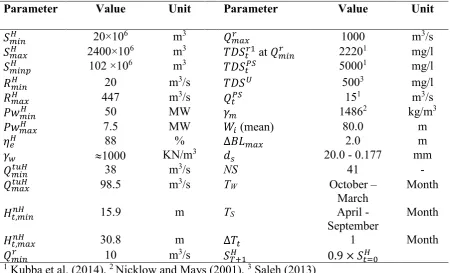
Table 2 shows operation and environment parameters of reservoir system. The
operational parameters include the physical limits of reservoir storage, releases, turbine and
river discharges, while the environmental parameters include water quality limits, river
morphology, and storage sustainability.
3.3 Computational Model Implementation
Using in the programming language C, a model developed to conceptualize all the
objective functions and the related constraints. For completeness, both the Borg MOEA and
the -DSEA algorithms replicated 20 times for each scenario, with the number of function
evaluations equal to 500,000 and epsilon () ( is the resolution of the objective search space)
equal to 0.5 for the nine objectives for both scenarios. The number of decision variables, 396,
equals the number of monthly releases over the thirty-three years’ data period. Also, other
reservoir parameters system including storage, surface area, water level, and power producing
calculated by the model; hence the model solved 3564 variables in each run. The overall
function evaluation total is 40 million, with total processing time about 80 hours CPU time.
The optimization running made using PC desktop (Core i7-6700 CPU @ 3.4 GHz, 16 GB
RAM) with Ubuntu 16.04 OS. The parameters used for both algorithms shown in Table A3 in
16
In the current study, a value of A = 104 selected for the dam physical model’s constraints
to exploit all feasible solutions and avoid rendering infeasible solutions at the constraints
threshold, especially those with small violation values. While Ai = 102 (Al-Jawad and
Tanyimboh, 2017) selected as starting value for the environmental constraints, as described in
section 3.2.3.
4 RESULTS
4.1 Optimum Trade-off Achievement
The MOEAs’ effectiveness commonly measured using metrics like the hypervolume
metric (Zitzler, 1999) which evaluate the non-dominated solutions’ hypervolume, and
generational distance metric (Van Veldhuizen and Lamont, 1998) which measure the average
distance between the dominance solutions and the closer Pareto-front set. However, these
metrics (and others) may provide misguiding results and most of their design principles
depends on the true Pareto-front, which is unknown in real-world water resources management
problems (Maier et al., 2014). Accordingly, qualitative and quantitative parameters adopted for
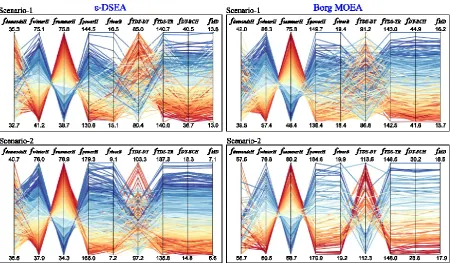
achievement assessment. The optimization results shown in Figure 3, here the -DSEA
outperforms Borg MOEA in both scenarios for the near median Pareto-front values achieved
from the 20 runs for each scenario, since the range of objectives functions values achieved by
-DSEA are lower than those in Borg MOEA.
The mean numbers of dominance solutions achieved by -DSEA and Borg MOEA in
both scenarios were about 721, 406; 771, 368; and the median were 372, 286; 815, 273,
respectively. While, the gross number of dominance solutions achieved by both algorithms for
the adopted scenarios were 14410, 8118; 15415, 7363, respectively, hence the -DSEA has
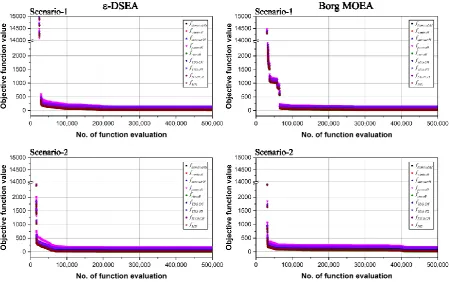
advance diversity than Borg MOEA. Convergence speed is another parameter chosen for
17
convergence development of model objectives functions over the evaluation process for both
algorithms and scenarios. It is clearly that -DSEA converge faster than Borg MOEA in both
scenarios. Hence the -DSEA’s solutions adopted for interpretation of the reservoir operation
management. Detail competitive analysis results for both algorithms presented in section 8 in
the supplementary data.
Figure 3 also shows that the total model violation function is greater than one (𝑓𝑀𝐷 >
1.0) in all cases, which refers to unfeasible solutions achievement in the objective search space.
However, these solutions located in both the feasible and unfeasible regions in the decision
variables search space. Table 3 illustrates the summary of Himren dam system parameters
achieved by -DSEA for both scenarios. The reservoir releases, storage, water level, surface
area and hydropower generation did not violate its barriers; hence their objectives attainment
emerged from feasible decision variables. Also, the Diyala River discharges preserved below
river’s maximum capacity, as they controlled by Himren dam and Diyala Barrage. However,
Diyala River morphology and Tigris River water quality had violated slightly about their
preferable limits (riverbed changes 2.0, TDS 600 mg/l) specified by NCWRM (the decision
makers). This refers to the reservoir releases inertia to satisfy these limits over the operation
periods, hence some decision variables located in the unfeasible region of the decision variables
space.
4.2 Auto-Adaptive Constraints’ Approach Achievement
The new AAC approach succeeds to guide the optimization algorithm towards possible
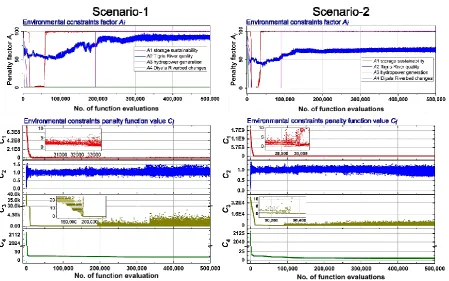
optimum solutions. Figure 5 shows the values of penalty factors (Ai) with the corresponding
penalty function value (Ci) over the evaluation process for both scenarios.
This Figure illustrates how Ai’s values dynamically changed with the corresponding
18
remains at minimum value (A4= 1.0) in both scenarios, since its penalty value C4 is greater
than one over the entire evaluation process. The riverbed changes including aggregation and
degradation, mainly affected by water flow velocity and riverbed sediment grain size. The flow
velocity is directly proportion with reservoir releases; hence inconsistent releases may cause
changes in riverbed morphology, depending on bed sediment grain sizes. Here, because of lack
data, the adopted mathematical model of riverbed changes simplified using averaging riverbed
width, and assuming water energy gradient equal to the riverbed slop. Therefore, detail
cross-sections, bed sediment grain size, and other parameters needed to improve the control of river
morphology changes.
4.3 Sensitivity of Computational Parameters
Based on the use of a feedback loop from the dominance archive, pre-execution tuning
(or setting) of the operators’ parameters is not required in -DSEA. The novel self-tuning
technique is sensitive to the problem environment over the different stages of optimization
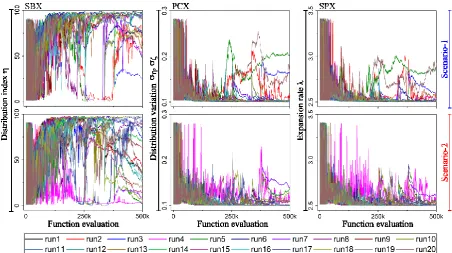
progress. The parameters’ sensitivity of operators SBX, PCX, and SPX during problem
evaluation of 20 runs for both scenarios are shown in Figure 6. Obviously, at each random
seeding repetition and at each scenario, the operators’ parameters varied during problem
evaluation progress phase, based on operators’ efficiency to produce dominance solutions. The
SBX distribution index () often adopted values larger than 50 in scenario-1 after 25×104 of
function evaluation. In scenario-2, the parameter adopted different values within the specified
domain (0 to 100) over optimization progress. The PCX distribution variation parameters
(𝜎𝜂, 𝜎𝜁) ranged between 0.1 and 0.2 in scenario-1. In scenario-2, they changed from 0.1 to 0.25
in the first quarter stage of evaluation, then from 0.1 to 0.15. The expansion rate parameter ()
19
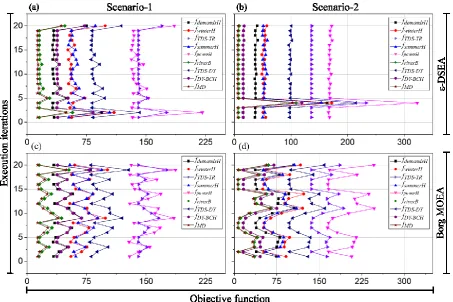
The sensitivity of parameters’ self-tuning to optimization results showed in Figure 7.
Clearly, -DSEA preserve consistent optimum results in all execution repetitions especially in
scenario-2, except few runs. Conversely, Borg MOEA shows unreliable achievement in both
scenarios, especially in scenario-2, by producing inconsistent results over the considered
repetitions, based on its parameters’ default values. Thus, -DSEA is more reliable than Borg
MOEA.
4.4 Reservoir Operation Strategy
Although the decision of adopting any optimum solution depends on the decision makers’
decision, we will propose a solution emerged from the best achievement of each objective,
which could be beneficial for the decision makers to consider. The corresponding reservoir
releases for optimum solutions are presented in Figure 8, (a) and (b) for both scenarios
respectively. It clearly that these results are consistent, hence an average values for reservoir
releases was generated, as shown in Figure 8 (c) and (d) for both scenarios, respectively. The
details of other corresponding variables of the system like: reservoir storage, surface area,
hydropower generation, etc., for both scenarios are presented in section 7 in the supplementary
data.
The summary of the outcomes is illustrated in Table 4; from this data there emerges an
optimum socio-environmental flows regime for long-term reservoir system management
strategy that could be adopted by the decision makers. Furthermore, improvements were
achieved in different sectors in the river basin (e.g. hydropower generation, crop production,
water industry, etc.). The mean hydropower generated in scenario-1 was about 26 MW over
three decades with standard deviation about 14 MW, while in scenario-2, is about 21 MW and
12 MW, respectively. The mean agriculture water delivery for both scenarios were maintained
20
water delivery when compared with the actual design demands. Hence, the government should
adopt future policy to assess other alternatives to reduce the water deficit, such as reducing
crop patterns, changing crops types, using groundwater, changing irrigation method (e.g.
sprinkles, drips), developing water conveyance infrastructure, etc.
Furthermore, the reservoir storage was also maintained with its limits with a mean value
about 1.3×10⁹ m3/month for both scenarios. This provides suitable space when compared with
the normal storage of 2.4×10⁹ m3/month, to absorb flood waves and reduce the possible flood
risk impact on the community downstream the river. However, future government led policies
should also consider flood alarm systems for advance flood control. Additionally, reservoir
seepage losess and advanced data collection systems should be included in their policy for
comprehensive water resources management.
With consistency, the proposed operation policy for the Diyala barrage maintains a
minimum discharge about 30.8 MCM in both scenarios, which is equivalent to about 12 m3/s;
this is more than the minimum river discharge of 10 m3/s. Also, the model predicts maintenance
of the mean and median changes in river morphology less than one meter in both scenarios
over the entire period, which mitigates the impact of load sediment transport on downstream
projects. Sediment movement impacts navigation, water supply projects, and for river
hydraulic infrastructures in the downstream, which raise maintenance costs to overcome these
problems.
The impact of Diyala river environment improvement was also observed by
maintaining Tigris water quality (TDS) less than 613 mg/l in both scenarios over the entire
periods, predicted management would have a positive economic impact on the water supply
projects, farming, and the industry in downstream cities and villages. However, river quality
should be monitored in case of shortage in Tigris water resources to avoid any deterioration
21
However, the current model’s temporal (regional extension) and special scale (No. of
decision variables) is relevant to the adopted case study, which can be extended for other
problems for future works.
4.5 Effectiveness of OSEF-AAC approach
Two extra optimization management models (M2, M3) proposed to identify the
effectiveness of the current model (M1) using scenario-1. Model M2 employs Equations 1, 6,
and 18 of objective functions, and M3 Equations 1, 3, 5, 6, 8, and 18. The M1 achievement
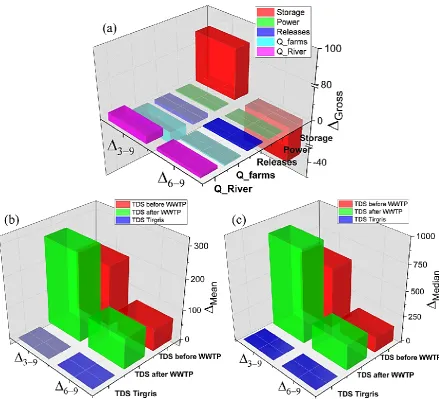
considered as a datum, thus the differences of M2-M1 (∆3−9), and M3-M1 (∆6−9) were
developed, as shown in Figure 9. The total gross differences (∆𝐺𝑟𝑜𝑠𝑠) of; reservoir storage,
power generation, releases; farms’ delivered water farms; and river discharge showed by Figure
9a. Extra reservoir storage and river discharge achieved via M2 model (89.6×10⁹ m3, 4.7×10⁹
m3), however releases, hydropower and farms’ delivery water were less (-2.35×10⁹ m3, -0.76
GW, -7.1×10⁹ m3), in comparison with M1. For ∆
6−9, the storage, power generation, and farms’
water delivery were less (-35.3×10⁹ m3, -0.25 GW, -0.85×10⁹ m3), while slightly higher values
achieved for releases and River discharge by M3.
Figures 9b and 9c show the contrast of the mean and median TDS concentration of Diyala
and Tigris Rivers achieved by the M2 and M3 models, with M1 model as a datum. Clearly, M2
achieved higher TDS concentration than M3 before and after WWTP at Diyala River for both
mean and median values. For M2, the ∆𝑀𝑒𝑎𝑛 and ∆𝑀𝑒𝑑𝑖𝑎𝑛 were 202, 286 mg/l; 600, 905 mg/l
at before and after WWTP, and for M3 were 72, 100 mg/l; 151, 251 mg/l, respectively.
Notably, the proposed model (M1) with nine objective functions achieved better
socio-environmental flow regime than M2 and M3 models with three and six objective functions,
22
5 DISCUSSION
In this research, a reservoir operation strategy produced using novel
socio-environmental flow regime approach. Nine objective functions, twelve constraints, and two
inflows’ scenarios employed relevant to Himren dam system in Iraq. Conflicts between model
objectives are obvious in both scenarios (Figure 3), except for 𝑓𝑇𝐷𝑆−𝑇𝑅 and 𝑓𝐷𝑌−𝐵𝐶𝐻 which
have soft conflicts, since their relations are indirect. At Tigris and Diyala Rivers’ junction, the
quality of mixed water is sensitive to their relevant quality and quantity. While Diyala River
morphology directly affected by the relevant discharge. The degree of mutual influence
between power generation objective (𝑓𝑝𝑜𝑤𝑒𝑟) and flow control objective (𝑓𝑟𝑖𝑣𝑒𝑟𝐵) is medium
since most of reservoir releases diverted to the agriculture projects by Diyala Barrage. Handling
multiple conflicts objectives simultaneously produces a set of optimum solutions (Deb, 2001)
(trade-off) adaptive with decision makers’ criterion.
The novel penalized feedback formula succeeded to soften the computational
complexity of many-objectives problem. The early convergence from infeasible to feasible
region (Figure 4) supports improving search space’s exploration and exploitation. The current
formula may justify for other case studies.
The -DSEA robustness and reliability are obvious (Figures 3, 4, and 7) based on
twenty executions, in comparison with Borg MOEA. The -DSEA self-tuning technique limits
time-wasting of pre-execution tuning of crossover operators’ parameters (Figure 6). In classical
hybrid algorithms like Borg MOEA and AMALGAM (Vrugt and Robinson, 2007) that employ
multiple crossover operators, the possible tuning combination trials are directly proportion with
the number of operators’ parameters. For example, Borg MOEA has six operators with nine
parameters, thus 9! (362,880) tuning trials needed to explore their sensitivity of the results’
23
algorithms. But, this may leads a drawback in algorithm’s optimality merit when solving
problems that have different environments (Maier et al. 2014; Karafotias et al. 2015).
Usually the operation management priorities based on the stakeholders’ demands. Here
domestic demands are a key priority, and other objectives have secondary priorities. A
maximum TDS of 600 mg/l (Alsaffar, 2017) recommended at the river, while a top of 620 mg/l
preserved after Rivers’ junctions over the considered period and scenarios, in contrast with
recently recorded range of 600 to 1200 mg/l. Thus, the government needs to adopt advance
treatment policy of Al-Rustumiya plant’s discharges to improve downstream environments.
The previous argument shows the importance of understanding reservoir management
priorities in developing system objectives functions and constraints to represent these priorities.
Further, partial violated solutions in secondary priorities could adopt for reservoir operation
strategy. The model results’ reliability supported by Alsaffar, 2017, based on current operating
management strategy, especially the median reservoir releases in scenario-2. Hence, the
method of scenario-2 could adopt to represent climate change impact in other part of this
region.
The prediction picture delivered to the decision makers displays the valuable of
considering social and environmental objectives in the river basin over different scenarios.
However, alternatives (scenarios), like out boarder upstream development projects impacts on
downstream river basin system, could carry out for further insight approach assessment.
Combining environmental objectives succeed to improve water quality in downstream
of Diyala River. Masking environmental objectives in models M2 and M3 produce higher
pollutant’s concentration at the river. However, including more objectives in M3 improve the
mean and median water quality about 9%, and 26%, respectively. Notably, M2 and M3 models
24
model produces better operation strategy (or flow regime) than other models, since
environmental aspects involved as objective functions.
The study results also show how the system is sensitive to the reservoir inflows, which
affected by the releases from the upstream reservoir (Derbindikhan dam reservoir),
out-of-border tributaries and upstream direct runoff and water exploitation. Hence, the Iraqi
government should consider future policies to restrict unauthorized water use in upstream
region. Also they should consider developing water sharing agreement with Iran to avoid future
water crisis in the basin. Therefore, the river basin needs further future management
development to involve the previous features (and others) for fully river basin management,
which known as integrated water resources management (IWRM). Finally, this study’s novel
approach shows how environmental features could improve when they considered in the
reservoir operation management, and how they will promote the potential economic benefits
for the entire system.
The current approach could perform at any reservoir operation problem (i.e. combining
social with environmental objectives using many-objective optimization algorithm). The
proposed mathematical optimization model is relevant to the current case study and/or similar
problems, and can adjust for other region to adapt with the physical models’ operation
objectives and constraints.
6 CONCLUSIONS
In this research a novel Optimum Social-Environmental Flows approach with
Auto-Adaptive Constraints (OSEF-AAC) was developed to improve the river basin management
strategy which combines all social and environmental objectives in the river basin. The
research used a many-objectives evolutionary optimization algorithm to generate a trade-off to
25
flow regimes in the reservoir operation strategy (Horne et al., 2016; Horne et al., 2017), and to
overcome the complexity and computational challenges of such models (Maier et al., 2014).
The OSEF-AAC was evaluated and assessed using a challenging case study in the
Middle East. The Himren dam at Diyala river basin was modelled using nine social and
environmental objectives with 396 decision variables. The state-of-the-art Borg MOEA and
the new -DSEA optimizers, two predicted inflows’ scenarios, and two comparative
non-environmental models were employed. The algorithms’ computational analysis results show
the -DSEA outperformed the Borg MOEA in almost all cases. The AAC approach succeed to
overcome the complexity of the problem, boosting algorithm convergence toward possible
optimum solutions and avoiding algorithm stagnation in local optima. The reliability of
-DSEA techniques were also endorsed, hence its results were adopted. The OSEF-AAC
effectiveness was evident, based on comparison with other proposed models.
The reservoir releases optimum trade-off emerged from the OSEF-AAC approach
integrate all adopted social and environmental sectors in the river basin including hydropower
generation, flood risk management, river quality, river sediment transport, reservoir storage
control, agriculture water delivery, discharge regulation, and downstream water quality. More
objectives could be embedded to the approach for comprehensive flows regime (e.g. fisheries,
navigation and tourism). The decision makers can adjust the trade-offs and adopt those that fit
their criteria.
However, to fully develop the potential achievement of the OSEF-AAC approach, an
average optimum solution was generated using optimum solution achieved by each objective.
The results show improvement in reservoir system environments in all sectors, as follows:
Environmental Sectors: The Diyala river water quality (TDS) was improved after a pollutant
source from about 2600 mg/l to about 2400 mg/l, which leads to improve the downstream
26
will decrease water remediation cost in downstream region. Additionally, the mean and
median river morphology changes were maintained within one meters for both scenarios
over the considered period. Hence, positive impacts on the maintenance cost for water
supply and hydraulic structures in the river were achieved.
Social Sector: The power revenues were improved over continues hydropower generating
for the next three decades under two scenarios. Future investment opportunities plans could
be set from the mean values 26 MW and 21 MW obtained for both scenarios, respectively.
Moreover, the storage control objectives were succeeded to preserve free mean reservoir
storage about 1.0×10⁹ m3 for flood wave absorption, which mitigate the possible flood risk
and reduce the cost of inundated indemnity for lands and properties. For crop production,
the mean and median agriculture water deficit for both scenarios were maintained within
the range of 18-28% and 30-35%, respectively, which robust crop investment revenues.
The adopted mathematical optimization model for the current case study considers only
the common management objectives based on the available database. However, other issues
like; water influent and affluent of Reservoir Lake, ecosystem and navigation objectives, etc.
could be implemented for future works.
Finally, the OSEF-AAC approach can be adopted to solve any river basin management
problems to generate optimum socio-environmental flows regime. These provide decision
makers a trade-off for developing robust management strategy towards achieving better
economic revenues for the water-energy-food nexus objectives of a river basin.
Recommendations for the decision makers to improve the lower Diyala river basin
environment are presented in section 8 in the supplementary data.
27
This research is funded in part by the Government of Iraq Ministry of Higher Education
and Scientific Research (MHESR)/University of Baghdad under scheme of Iraqi National PhD
Scholarship Programme for the first author and this is gratefully acknowledged. The Iraqi
Ministry of Water Resources has also acknowledged providing the data. The authors thank
28
REFERENCES
Abraham, A., Jain, L., Robert, G. (Eds), 2005. Evolutionary Multiobjective Optimization,
Evolutionary Multiobjective Optimization. https://doi.org/10.1007/1-84628-137-7
Acreman, M., Arthington, A.H., Colloff, M.J., Couch, C., Crossman, N.D., Dyer, F., Overton,
I., Pollino, C.A., Stewardson, M.J., Young, W., 2014. Environmental flows for natural,
hybrid, and novel riverine ecosystems in a changing world. Front. Ecol. Environ. 12, 466–
473. https://doi.org/10.1890/130134
Ahmad, A., El-Shafie, A., Razali, S.F.M., Mohamad, Z.S., 2014. Reservoir Optimization in
Water Resources: a Review. Water Resour. Manag. 28, 3391–3405.
https://doi.org/10.1007/s11269-014-0700-5
Ahmadianfar, I., Adib, A., Taghian, M., Faculty, E., Resources, N., 2015. a Multi-Objective
Evolutionary Algorithm Using Decomposition (Moea/D) and Its Application in
Multipurpose Multi-Reservoir Operations. Int. J. Optim. Civ. Eng. 5, 167–187.
Al-Jawad, J.Y., Al-Jawad, S.B., Tanyimboh, T.T., Kalin, R.M., 2018a. Comprehensive
Evolutionary Algorithms Performance Assessment Using a Multi-Objectives Water
Resources Management Problem. Water Resour. Manag. In review.
Al-Jawad, J.Y., Tanyimboh, T.T., 2017. Reservoir operation using a robust evolutionary
optimization algorithm. J. Environ. Manage. 197, 275–286.
https://doi.org/10.1016/j.jenvman.2017.03.081
Al-Jawad, J.Y., Tanyimboh, T.T., Kalin, R.M., 2018b. ε-DSEA: A Multi and Many-Objective
Evolutionary Optimization Algorithm Based on Novel Self-Adaptive Technique. Appl.
Soft Comput. Under revi.
29 Thesis, Luleå University of Technology, Sweden.
Alrajoula, M.T., Al Zayed, I.S., Elagib, N.A., Hamdi, M.R., 2016. Hydrological,
socio-economic and reservoir alterations of Er Roseires Dam in Sudan. Sci. Total Environ. 566–
567, 938–948. https://doi.org/10.1016/j.scitotenv.2016.05.029
Alsaffar, H.M., 2017. Personal communication. , 15 July.
Amirkhani, M., Bozorg-Haddad, O., Fallah-Mehdipour, E., Loáiciga, H.A., 2016.
Multiobjective Reservoir Operation for Water Quality Optimization. J. Irrig. Drain. Eng.
142. https://doi.org/10.1061/(ASCE)IR.1943-4774
Back, T., Fogel, D.B., Michalewicz, Z. (Eds.), 2000. Handbook of Evolutionary Computation.
IOP Publishing Ltd., Bristol, UK, UK.
Carriaga, C.C., Mays, L.W., 1995. Optimization Modeling For Sedimentation In Alluvial
Rivers. J. WATER Resour. Plan. Manag. 121, 251–259.
Chang, L.C., Chang, F.J., 2009. Multi-objective evolutionary algorithm for operating parallel
reservoir system. J. Hydrol. 377, 12–20. https://doi.org/10.1016/j.jhydrol.2009.07.061
Chang, L.C., Chang, F.J., Wang, K.W., Dai, S.Y., 2010. Constrained genetic algorithms for
optimizing multi-use reservoir operation. J. Hydrol. 390, 66–74.
https://doi.org/10.1016/j.jhydrol.2010.06.031
Chen, D., Chen, Q., Leon, A.S., Li, R., 2016. A Genetic Algorithm Parallel Strategy for
Optimizing the Operation of Reservoir with Multiple Eco-environmental Objectives.
Water Resour. Manag. 30, 2127–2142. https://doi.org/10.1007/s11269-016-1274-1
Coello, C.A.C., Lamont, G.L., van Veldhuizen, D.A., 2007. Evolutionary Algorithms for
30
Springer, Berlin, Heidelberg. https://doi.org/10.1007/978-0-387-36797-2
Coello Coello, C.A., 2002. Theoretical and numerical constraint-handling techniques used with
evolutionary algorithms: a survey of the state of the art. Comput. Methods Appl. Mech.
Eng. 191, 1245–1287. https://doi.org/http://dx.doi.org/10.1016/S0045-7825(01)00323-1
Curry, D.M., Dagli, C.H., 2014. Computational complexity measures for many-objective
optimization problems. Procedia Comput. Sci. 36, 185–191.
https://doi.org/10.1016/j.procs.2014.09.077
Dai, L., Zhang, P., Wang, Y., Jiang, D., Dai, H., Mao, J., Wang, M., 2017. Multi-objective
optimization of cascade reservoirs using NSGA-II: A case study of the Three
Gorges-Gezhouba cascade reservoirs in the middle Yangtze River, China. Hum. Ecol. Risk
Assess. 23, 814–835. https://doi.org/10.1080/10807039.2017.1285692
Deb, K., 2001. Multi-Objective Optimization using Evolutionary Algorithms, 1st ed,
Wiley-Interscience Series in Systems and Optimization. John Wiley & Sons, Chichester.
Deb, K., Datta, R., 2013. A bi-objective constrained optimization algorithm using a hybrid
evolutionary and penalty function approach. Eng. Optim. 45, 503–527.
https://doi.org/10.1080/0305215X.2012.685074
Deb, K., Jain, H., 2013. An Evolutionary Many-Objective Optimization Algorithm Using
Reference-point Based Non-dominated Sorting Approach, Part I: Solving Problems with
Box Constraints. Ieeexplore.Ieee.Org 18, 1–1.
https://doi.org/10.1109/TEVC.2013.2281534
Deb, K., Pratap, A., Agarwal, S., Meyarivan, T., 2002. A fast and elitist multiobjective genetic
algorithm: NSGA-II. IEEE Trans. Evol. Comput. 6, 182–197.
31
Dittmann, R., Froehlich, F., Pohl, R., Ostrowski, M., 2009. Optimum multi-objective reservoir
operation with emphasis on flood control and ecology. Nat. Hazards Earth Syst. Sci. 9,
1973–1980. https://doi.org/10.5194/nhess-9-1973-2009
Giacomoni, M.H., Kanta, L., Zechman, E.M., 2013. Complex Adaptive Systems Apporach to
Simulate the Sustainability of Water Resources and Urbanization. J. Water Resour. Plan.
Manag. 139, 554–564. https://doi.org/10.1061/(ASCE)WR.1943-5452
Giuliani, M., Castelletti, A., Pianosi, F., Mason, E., Reed, P.M., 2016. Curses, Tradeoffs, and
Scalable Management: Advancing Evolutionary Multiobjective Direct Policy Search to
Improve Water Reservoir Operations. J. Water Resour. Plan. Manag. 142, 04015050.
https://doi.org/10.1061/(ASCE)WR.1943-5452.0000570
Giuliani, M., Galelli, S., Soncini-Sessa, R., 2014a. A dimensionality reduction approach for
many-objective Markov Decision Processes: Application to a water reservoir operation
problem. Environ. Model. Softw. 57, 101–114.
https://doi.org/10.1016/j.envsoft.2014.02.011
Giuliani, M., Herman, J.D., Castelletti, A., Reed, P., 2014b. Many-objective reservoir policy
identification and refinement to reduce policy inertia and myopia in water management.
Water Resour. Res. 50, 3355–3377. https://doi.org/10.1002/2013WR014700
Hadka, D., Reed, P., 2013. Borg: An Auto-Adaptive Many-Objective Evolutionary Computing
Framework. Evol. Comput. 21, 1–30. https://doi.org/10.1162/EVCO_a_00075
Hadka, D., Reed, P., 2012. Diagnostic Assessment of Search Controls and Failure Modes in
Many-Objective Evolutionary Optimization. Evol. Comput. 20, 423–452.
https://doi.org/10.1162/EVCO_a_00053
32
many-objective product family design problems, in: 2012 IEEE Congress on Evolutionary
Computation, CEC 2012. pp. 10–15. https://doi.org/10.1109/CEC.2012.6256466
Haimes, Y.Y., Hall, W.A., 1977. Sensitivity, responsivity, stability and irreversibility as
multiple objectives in civil systems. Adv. Water Resour. 1, 71–81.
https://doi.org/10.1016/0309-1708(77)90025-2
Hakimi-Asiabar, M., Ghodsypour, S.H., Kerachian, R., 2010. Deriving operating policies for
multi-objective reservoir systems: Application of Self-Learning Genetic Algorithm. Appl.
Soft Comput. J. 10, 1151–1163. https://doi.org/10.1016/j.asoc.2009.08.016
He, Z., Yen, G.G., Zhang, J., 2014. Fuzzy-based pareto optimality for many-objective
evolutionary algorithms. IEEE Trans. Evol. Comput. 18, 269–285.
https://doi.org/10.1109/TEVC.2013.2258025
Horne, A., Kaur, S., Szemis, J., Costa, A., Webb, J.A., Nathan, R., Stewardson, M., Lowe, L.,
Boland, N., 2017. Using optimization to develop a “designer” environmental flow regime.
Environ. Model. Softw. 88, 188–199. https://doi.org/10.1016/j.envsoft.2016.11.020
Horne, A., Szemis, J.M., Kaur, S., Webb, J.A., Stewardson, M.J., Costa, A., Boland, N., 2016.
Optimization tools for environmental water decisions: A review of strengths, weaknesses,
and opportunities to improve adoption. Environ. Model. Softw. 84, 326–338.
https://doi.org/10.1016/j.envsoft.2016.06.028
Hurford, A.P., Huskova, I., Harou, J.J., 2014. Using many-objective trade-off analysis to help
dams promote economic development, protect the poor and enhance ecological health.
Environ. Sci. Policy 38, 72–86. https://doi.org/10.1016/j.envsci.2013.10.003
Jazmin, Z.S., Reed, P.M., Quinn, J.D., Giuliani, M., Castelletti, A., 2017. Balancing
33
optimization. Adv. Water Resour. 109, 196–210.
https://doi.org/10.1016/j.advwatres.2017.09.014
Karafotias, G., Hoogendoorn, M., Eiben, A.E., 2015. Parameter Control in Evolutionary
Algorithms: Trends and Challenges. IEEE Trans. Evol. Comput. 19, 167–187.
https://doi.org/10.1109/TEVC.2014.2308294
Kasprzyk, J.R., Nataraj, S., Reed, P.M., Lempert, R.J., 2013. Many objective robust decision
making for complex environmental systems undergoing change. Environ. Model. Softw.
42, 55–71. https://doi.org/10.1016/j.envsoft.2012.12.007
Kim, T., Heo, J.-H., Bae, D.-H., Kim, J.-H., 2008. Single-reservoir operating rules for a year
using multiobjective genetic algorithm. J. Hydroinformatics 10, 163.
https://doi.org/10.2166/hydro.2008.019
Kollat, J.B., Reed, P.M., 2006. Comparing state-of-the-art evolutionary multi-objective
algorithms for long-term groundwater monitoring design. Adv. Water Resour. 29, 792–
807. https://doi.org/10.1016/j.advwatres.2005.07.010
Li, B., Li, J., Tang, K., Yao, X., 2015. Many-objective evolutionary algorithms: A survey.
ACM Comput. Surv. 48, 35. https://doi.org/10.1145/2792984
Li, F.F., Qiu, J., 2015. Multi-objective reservoir optimization balancing energy generation and
firm power. Energies 8, 6962–6976. https://doi.org/10.3390/en8076962
Li, Y., Cui, Q., Li, C., Wang, X., Cai, Y., Cui, G., Yang, Z., 2017. An improved multi-objective
optimization model for supporting reservoir operation of China’s South-to-North Water
Diversion Project. Sci. Total Environ. 575, 970–981.
34
Lokman, B., Köksalan, M., 2013. Finding all nondominated points of multi-objective integer
programs. J. Glob. Optim. 57, 347–365. https://doi.org/10.1007/s10898-012-9955-7
Loucks, D.P., 2012. Water Resource Management Modeling in 2050. Towar. a Sustain. Water
Futur. 341–349.
Maier, H.R., Kapelan, Z., Kasprzyk, J., Kollat, J., Matott, L.S., Cunha, M.C., Dandy, G.C.,
Gibbs, M.S., Keedwell, E., Marchi, A., Ostfeld, A., Savic, D., Solomatine, D.P., Vrugt,
J.A., Zecchin, A.C., Minsker, B.S., Barbour, E.J., Kuczera, G., Pasha, F., Castelletti, A.,
Giuliani, M., Reed, P.M., 2014. Evolutionary algorithms and other metaheuristics in water
resources: Current status, research challenges and future directions. Environ. Model.
Softw. 62, 271–299. https://doi.org/10.1016/j.envsoft.2014.09.013
Malekmohammadi, B., Zahraie, B., Kerachian, R., 2011. Ranking solutions of multi-objective
reservoir operation optimization models using multi-criteria decision analysis. Expert
Syst. Appl. 38, 7851–7863. https://doi.org/10.1016/j.eswa.2010.12.119
Nicklow, J., Reed, P., Savic, D., Dessalegne, T., Harrell, L., Chan-Hilton, A., Karamouz, M.,
Minsker, B., Ostfeld, A., Singh, A., Zechman, E., 2010. State of the art for genetic
algorithms and beyond in water resources planning and management. J. Water Resour.
Plann. Manag. 136, 412–432.
Nicklow, J.W., Mays, L.W., 2001. Optimal control of reservoir releases to minimize
sedimentation in rivers and reservoirs. J. Am. Water Resour. Assoc. 37, 197–211.
https://doi.org/DOI 10.1111/j.1752-1688.2001.tb05486.x
Poff, N.L., Brown, C.M., Grantham, T.E., Matthews, J.H., Palmer, M.A., Spence, C.M., Wilby,
R.L., Haasnoot, M., Mendoza, G.F., Dominique, K.C., Baeza, A., 2016. Sustainable water
35
Chang. 6, 25–34. https://doi.org/10.1038/nclimate2765
Qi, Y., Bao, L., Ma, X., Miao, Q., Li, X., 2016. Self-adaptive multi-objective evolutionary
algorithm based on decomposition for large-scale problems: A case study on reservoir
flood control operation. Inf. Sci. (Ny). 367–368, 529–549.
https://doi.org/10.1016/j.ins.2016.06.005
Rani, D., Moreira, M.M., 2010. Simulation-optimization modeling: A survey and potential
application in reservoir systems operation. Water Resour. Manag. 24, 1107–1138.
https://doi.org/10.1007/s11269-009-9488-0
Reddy, M.J., Kumar, D.N., 2009. Performance evaluation of elitist-mutated multi-objective
particle swarm optimization for integrated water resources management. J.
Hydroinformatics 11, 79–88. https://doi.org/10.2166/hydro.2009.042
Reed, P.M., Hadka, D., Herman, J.D., Kasprzyk, J.R., Kollat, J.B., 2013. Evolutionary
multiobjective optimization in water resources: The past, present, and future. Adv. Water
Resour. 51, 438–456. https://doi.org/10.1016/j.advwatres.2012.01.005
Regulwar, D.G., 2009. Multi Objective Multireservoir Optimization in Fuzzy Environment for
River Sub Basin Development and Management. J. Water Resour. Prot. 01, 271–280.
https://doi.org/10.4236/jwarp.2009.14033
Salazar, J.Z., Reed, P.M., Herman, J.D., Giuliani, M., Castelletti, A., 2016. A diagnostic
assessment of evolutionary algorithms for multi-objective surface water reservoir control.
Adv. Water Resour. 92, 172–185. https://doi.org/10.1016/j.advwatres.2016.04.006
Schardong, A., Ph, D., Simonovic, S.P., Asce, F., Vasan, A., 2013. Multiobjective
Evolutionary Approach to Optimal Reservoir Operation. J. Comput. Civ. Eng. 27, 139–