Factors Affecting Success In
International Collaborative Forestry
Research Projects
Anthony Grey BARTLETT
Submitted in fulfilment of the requirements for the degree of
Doctor of Philosophy
of the Australian National University
September 2018
The Fenner School of Environment and Society
Factors Affecting Success In
International Collaborative Forestry
Research Projects
Anthony Grey BARTLETT
Submitted in fulfilment of the requirements for the degree of
Doctor of Philosophy
of the Australian National University
September 2018
The Fenner School of Environment and Society
Candidate's Declaration
Statement of originality
This thesis is presented as a collection of linked chapters, with the six substantive chapters having
been published in various peer-reviewed, international journals. The research aims to make academic
contributions to both evaluation practice and the understanding of factors that influence success in
collaborative international forestry research projects.
Of the six journal articles, five are authored by me and one is co-authored with the three members
of my academic panel: Assoc. Prof. Lorrae van Kerkhoff, Prof. Peter Kanowski and Dr. Neil Byron.
Throughout this research, I instigated, planned and conducted the research, undertook the data analysis
and was the primary author of all chapters. My panel provided academic guidance and assistance with
editing and revisions, particularly for the most significant aspects of the peer review comments.
At the time of submission of the final thesis, six articles are now published. The attribution
statement for each publication is presented below:
Chapter
Attribution Statement
1
Introduction (unpublished)
I wrote this chapter with academic review from my panel.
2
Bartlett, A.G. (2016) The evolution and impacts of ACIAR’s forestry research
program over three decades.
Australian Forestry
, 79 (3), 171-188.
I instigated the work, undertook the research and analysis and wrote the article, with
review from my panel.
© 2016 The Author(s). Published by Informa UK Limited, trading as Taylor & Francis
Group.
3
Bartlett, A.G. (2016) Evaluating relative success of donor-funded
collaborative research projects.
Research Evaluation
25(4): 405-415.
I instigated the work, undertook the research, developed the methodology, undertook
the analysis and wrote the article, with academic guidance and review from my panel.
© The Author 2016. Published by Oxford University Press.
4
Bartlett, A. G., Kanowski, P. J., van Kerkhoff, L. and Byron, R. N. (2017)
Identifying factors that influence the success of forestry research projects
implemented in developing countries: case study results from Vietnam.
Forestry
90(3): 413-425.
I instigated the work, undertook the research and analysis and drafted the manuscript.
The co-authors provided academic guidance on the structure, content and presentation
of data and further academic input to revisions following external review.
© Institute of Chartered Foresters, 2017.
Research in Indonesia.
The European Journal of Development Research
.
https://doi.org/10.1057/s41287-018-0138-3
I instigated the work, undertook the research and analysis and drafted the manuscript,
with academic guidance and review from my panel. Prof. Kanowski provided extensive
constructive input to various drafts.
Ó
2018 The Author(s) 0957-8811
6
Bartlett, A. G. (2018) Factors affecting the success of collaborative forestry
research projects in Papua New Guinea.
Australian Forestry
81(2): 116-128.
I instigated the work, undertook the research and analysis and drafted the manuscript,
with academic guidance and review from my panel.
Ó
2018 The Author(s)
7
Bartlett, A. G. (2018) Understanding and evaluating success in international
forestry research projects.
International Forest Review
20 (3) 274-295
I instigated the work, undertook the research and analysis and drafted the manuscript,
with academic guidance and review from my panel.
8
Conclusions (unpublished)
I wrote this chapter, with academic review from my panel.
Declaration
I declare that this thesis is my own original work and that it contains no material which has been
accepted for the award of any other degree or diploma in any university. To the best of my knowledge,
it contains no material previously published or written by another person, except where due reference
is made in the text.
Anthony Grey BARTLETT
6 September 2018
Acknowledgements
I am indebted to the three members of my academic panel, Assoc. Prof. Lorrae van Kerkhoff and
Prof. Peter Kanowski, from the Australian National University, and Dr. Neil Byron from the University
of Canberra, for their ongoing support and guidance over the past six years on both research design and
documentation of the findings. I acknowledge their constructive reviews of the many drafts and
revisions of journal manuscripts and thesis chapters. I am particularly grateful for their advice when
dealing with some rather critical and challenging comments from journal referees, about aspects of the
evaluation methodology and its application.
In 2011, Peter Kanowski provided encouragement when I first considered undertaking a PhD and
he explained the ‘Thesis by Compilation’ option, which I found very appealing. He also identified
Lorrae van Kerkhoff as an appropriate primary supervisor and Neil Byron as the third member of the
panel. Lorrae van Kerkhoff was a wonderful supervisor, she guided me into the literature for qualitative
and case study research, regularly reviewed my progress and offered wise counsel when I was faced
with various challenges along the way. Peter Kanowski was extremely supportive of my research every
step of the way and we would often meet for a discussion. He had endless energy to provide detailed
and constructive comments on my written work, and he provided me with additional literature to
consider. Neil Byron, who was strongly interested in my research from the start, complemented the
other panel members by asking lots of challenging questions. These questions always made me think
carefully about how I was approaching an issue, or how others might view, or misinterpret, the way I
was expressing a finding.
Undertaking a PhD while working full time is very challenging. This substantial endeavour would
not have been possible without the strong support of my employer, the Australian Centre for
International Agricultural Research (ACIAR), and in particular the support of ACIAR’s previous Chief
Executive Officer, Dr. Nick Austin, and the current CEO, Prof. Andrew Campbell. When I first
discussed the idea with Dr. Austin, he highlighted the relevance of the topic to ACIAR, as well as his
concern about how I would find time to do the necessary study, because of the demands of my ACIAR
work. When I commenced the research, he provided me with some assistance to build a database of
relevant project records to use in the subsequent research. He then granted me 20 days study leave per
year, which was enormously helpful, as it gave me the dedicated blocks of time that I needed to analyse
data and write. He allowed me to access and use all the ACIAR project records for the research, and
allowed me to conduct the interviews in Vietnam, Indonesia and Papua New Guinea while travelling
for work purposes. He encouraged me to present my early findings to the ACIAR Commission
(governing body), and also at the 2014 IUFRO World Congress in the USA.
When Prof. Campbell was appointed as ACIAR CEO in 2016, he was equally supportive of my
research. He allowed me to continue the study support arrangements agreed to by Dr Austin, and
international conferences. Both of the CEOs offered comments on various chapters in the thesis, which
I really appreciated, and attended my review seminars at ANU.
The identification of the project success factors would not have been possible without the
generosity and support of the 90 international and Australian forestry scientists who participated in the
interview process. The duration of these interviews ranged from 30 minutes to over three hours, and I
was continually amazed at, and grateful for, their willingness to provide detailed comments on the
research projects used in the case study. Their insights helped me enormously, not only to answer the
research question related to success factors, but also to appreciate the subtleties of what makes some
projects very successful and other less so.
Throughout my research, I got good feedback and support from many of my colleagues at ACIAR
and from some ACIAR project leaders and other international forestry researchers. They were
particularly encouraging about the value of the research, the utility of the methodology for evaluating
relative success of projects, and for the identification of the success factors. This helped me appreciate
that my research would be relevant to other practitioners in the research for development domain. I also
appreciated the encouragement to do this postgraduate study that I got from some long-term forestry
friends, particularly Dr. Don Gilmour and Mr Gary Morgan, as well as that of some very good friends
from my leadership network.
Liz Clarke, then a fellow PhD scholar at the Fenner School of Environment and Society, suggested
that I should consider using HyperRESEARCH software to assist with the management and analysis of
my interview data. This was helpful advice, as the software was easy to use and quite applicable to the
analysis that I needed to do. I am also very grateful for the support that I received from Clive Hilliker,
from the Fenner School of Environment and Society, to improve the presentation of some of the figures
and tables that were used in the journal articles. I also thank Suzie Gaynor, from ACIAR, who helped
me with the task of compiling the thesis from many individual documents.
Finally, I am very grateful for the strong support that I got from my family, Anni, Michael and
Roxane, and Ian, over the past six years. Billi, our budgie, would often land on my shoulder, while I sat
at the dining table writing, and cheerfully tell me “I’ve got a PhD”. Most importantly, I acknowledge
the enormous support that I got from my wife, Anni Bartlett. I thank her for her tolerance and patience
during the long hours that I was otherwise engaged on my postgraduate study, and therefore not
focussed on domestic matters. She also helped me sort out various challenges that I experienced in using
Excel and with preparing graphs and diagrams for use in the thesis. Sadly, neither of my parents, Bruce
and Marjorie, nor my sister, Kyra, lived to see this achievement, but I know that all three of them would
be very proud of me.
Preface
When I graduated from the University of Melbourne in early 1979, undertaking a PhD was the last
thing on my mind and I had virtually no understanding of forestry beyond Australia. In August 1983,
while attending the 10
thTriennial Conference of the Institute of Foresters of Australia in Melbourne, I
was inspired by the keynote address from Jack Westoby. He spoke of the challenges for people and
forestry in developing countries, the role that foresters needed to play in addressing these challenges
and the need for foresters to take greater account of community views about how forests should be
managed. Then in 1984, I was fortunate to be awarded a Russell Grimwade Fellowship, which enabled
me to go to Oxford to undertake a Master of Science in Forestry and its Relationship to Land
Management. It was during my period of study at the Oxford Forestry Institute, that I began to
appreciate the importance of forests globally, the variety of uses of forests in different countries and the
significant challenges to be faced. When I returned to Victoria in late 1985, I knew that I wanted to find
an opportunity to do some forestry work in developing countries.
In 1989, David Griffin, then the Professor of Forestry at the Australian National University and
the Project Director for the Nepal-Australia Forestry Project (NAFP), selected me for a role on the
project in Nepal and presented me with a copy of his book “Innocents Abroad in the Forests of Nepal”.
That was the opportunity I had been looking for, and my entrée to the domain of development forestry.
I consider myself very fortunate to have had the opportunity to live in Nepal and contribute to such a
globally significant forestry aid project. For two years, as part of the NAFP project team - much of it
under the mentorship of Dr. Don Gilmour, I learned about and contributed to the development of
community forestry approaches in the Middle Hills of Nepal. I learned a lot from the Australians
working on the project, Don Gilmour and Michael Nurse, as well as from the visiting anthropologist,
Dr. Bob Fisher. Importantly, I learned how to learn from the locals - the wonderful Nepali project staff,
the government forestry officers and rangers, and particularly from the many villagers with whom we
collaborated. There was no doubt that those two years were a ‘life changing’ experience for me and my
family.
In 1985 another opportunity came up to work in development forestry, this time in the Pacific
Island nation of Vanuatu. For two years I was employed by the Government of Vanuatu as the Principal
Forest Utilisation Officer, an in-line position in the Department of Forestry. I worked closely with the
ni-Vanuatu Director of Forests, Mr. Aru Mathias, and two other Australian foresters, Mr. David Wood
and Mr Ross Andrewartha, who were working on the AusAID funded Vanuatu Sustainable Forest
Management Project. Collectively we set about building the local capacity to better manage Vanuatu’s
tropical forests, all of which were under customary land ownership. This was another wonderful
learning opportunity for me, and it particularly focussed my mind on the challenges of implementing
country that had limited technical capacity and poor infrastructure.
From 1997 to 2008, while working in various forestry roles for the Victorian, ACT and
Commonwealth governments, I had the privilege of participating in the various United Nations forest
policy dialogue processes, including the development of the 2007 UN Non-Legally Binding Instrument
on all types of forests. Through these processes, I learned a lot about effective inter-governmental
negotiations and the power that comes from collaborative efforts to improve the management of forests
and trees in developing countries.
In 2010, I was recruited to the position of Forestry Research Program Manager with the Australian
Centre for International Agricultural Research (ACIAR), being only the fourth person in that role since
ACIAR commenced in 1982. After I had been at ACIAR for about a year, I asked some of my colleagues
whether ACIAR had any guidance documents on how best to ensure that new projects had a good
chance of being successful. I was surprised with the response that “you learn this as you go along”.
Given there were substantial records from about 30 years of completed ACIAR projects, it seemed like
a golden opportunity for someone to explore this issue more systematically, to develop a better
understanding of what makes some projects more successful than others, and how this might vary across
the countries that ACIAR worked in. This then was the genesis of my interest in conducting
postgraduate study on the topic “Factors affecting success in international collaborative forestry
research projects”. Hopefully, the knowledge that I have gained and documented through this
postgraduate research will leave a legacy that will benefit both those involved in funding and managing
research for development projects, and those people in developing countries for which the findings of
such research is intended to benefit.
Abstract
Collaborative research projects are an important component of research for development programs
globally, but there is little consensus regarding what constitutes project ‘success’, and little
understanding of factors that contribute to or constrain success. This thesis explores the principle
research question:
What constitutes success, and what factors influence it, in forestry research for
development projects?
In doing so, it presents a new approach for evaluating the relative success of
projects, and applies it to case studies of forestry research for development projects implemented by
the Australian Centre for International Agricultural Research (ACIAR) in Vietnam, Indonesia and
Papua New Guinea (PNG).
While ACIAR evaluates individual projects regularly, it has no methodology to compare levels of
success across large numbers of projects. The first part of the thesis reviews ACIAR’s forestry
program and evaluation methodologies, and presents a new methodology for evaluating the relative
success of research projects using existing project records. It places projects into four categories of
success based on scores for achievements and impacts, which aids understanding of differential
success between projects.
In the second part of the thesis, this methodology is applied to country-based case studies in Vietnam,
Indonesia and PNG. Ten completed ACIAR forestry projects were evaluated in each country to
identify relative success. There was considerable variation in the relative success of the projects, in
terms of both achievements and impacts. Interviews with Australian and partner country project
participants were then used to investigate the factors that affected project success. The number of
project success factors identified varied, with 22, 30, and 37 factors identified in Vietnam, Indonesia
and PNG respectively. In each country the frequency of identification of these factors and their
apparent relationships with the relative success evaluation scores of selected projects was
investigated.
The third part of the thesis synthesised results from the three country case studies, and considered how
this knowledge could be used by ACIAR and other international development agencies. Overall,
ACIAR’s forestry programs in Vietnam and Indonesia have been more successful than its program in
PNG. Project success had little relation to research theme, and successor projects were not necessarily
more successful than their precursors. Of the 37 success factors identified, seven were considered to
be beyond the control of a project, and a further 15 factors would only apply in some situations. The
remaining 15 factors, which relate to aspects of project design and implementation, and for which
there appear to be relationships with the evaluated level of project success, are therefore considered
to be ‘key success factors’.
development projects. The first is a low-cost method for evaluating relative success between projects.
The second is the identification of 15 widely applicable success factors that are subject to decisions
made by research program managers and project teams. These insights will help inform research for
development funders and managers about factors influencing, and strategies for enhancing, project
success.
Candidate's Declaration ... i
Acknowledgements ... iii
Preface ... v
Abstract ... vii
Table of Contents ... ix
List of Figures ... x
List of Tables ...
.
x
Chapter 1: Introduction ... 1
1.1 Research need, opportunity and focus ... 3
1.2 Research aims and questions ... 5
1.3 Research approach ...
7
1.4 Research methods ... 1
2
1.5 Structure of the thesis ... 1
4
1.6 References (for Chapter 1 only) ... 1
8
Chapter 2: The evolution and impacts of ACIAR’s forestry research program over three
decades ...
23
Chapter 3: Evaluating relative success of donor-funded collaborative research projects ...
43
Chapter 4: Identifying factors that influence the success of forestry research projects
implemented in developing countries: case study results from Vietnam. ... 5
7
Chapter 5: Factors affecting the success of collaborative forestry research in Indonesia. ... 7
5
Chapter 6: Factors affecting the success of collaborative forestry research projects: experience
from ACIAR projects in Vietnam, Indonesia and Papua New Guinea. ... 99
Chapter 7: Understanding and evaluating success in international forestry research projects.1
15
Chapter 8: Conclusions ... 1
39
8.1 Research findings and contributions ... 1
4
2
8.2 Opportunities to improve success in research for development ... 1
5
4
8.3 Potential for application of the approach I contexts beyond ACIAR ... 159
8.4 Further research needs ... 1
6
1
8.5 Reflections ... 1
6
2
8.6 References (for Chapter 8 only) ... 1
6
4
References
...
1
6
7
Appendix 1: Interview protocols
...
...
19
3
Figure 1.1: Influence and responsibilities in the R4D project impact pathway ...
...9
Figure 1.2. The four categories of relative success in R4D projects ...
...14
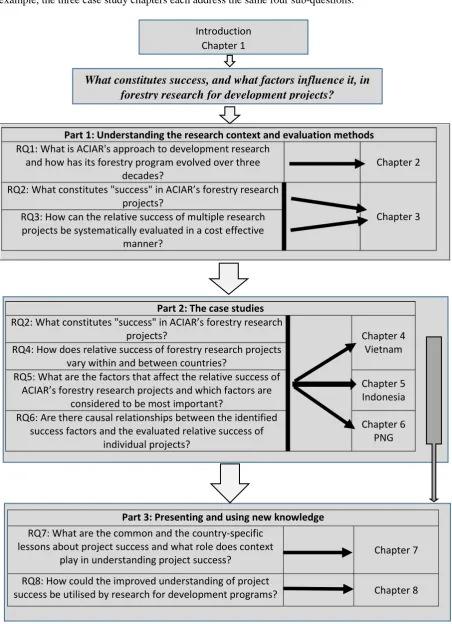
Figure 1.3. Thesis logic diagram ...
...16
Figure 8.1. Results from evaluations of relative success from groups of projects from three
different countries ...
....146
Figure 8.2. Results from evaluations of the relative success of forestry research projects
implemented in Vietnam, Indonesia and PNG. ...
....147
Figure 8.3. The fifteen key success factors by frequency of identification ...
....151
List of Tables
Table 1.1. Definitions of key evaluation terms used in ACIAR reports ...
...11
Table 1.2. Structure of thesis chapters and journal publication status ...
...15
Table 8.1. The 37 identified project success factors, classified by categories of potential influence
and whether they are ‘key’ or ‘other’ success factors ...
...150
1. Introduction
This chapter introduces the rationale and focus of this research, including outlining its aims and the
chosen research questions. While providing a brief review of some of the relevant literature, it does
not include a comprehensive literature review, as that is undertaken in Chapter 2, for the ACIAR
forestry literature, and in Chapter 3, for the international development evaluation literature. It briefly
describes the focus of the research within the broader domain of understanding what contributes to
success in projects, as well as summarising the overarching approach and the methods used to conduct
the research. Finally, it presents the connecting logic and the structure of the thesis.
1.1.
Research need, opportunity and focus
Following the development of the United Nations Charter in 1945, the global community began to
implement measures, including Official Development Assistance (ODA) programs, to support
development in underdeveloped countries (Koehler, 2015). There has long been a recognised need for
effective research in the agriculture, fisheries and forestry sectors (Zethner, 1973; Westoby, 1987),
and for adequate resourcing of such research (Sachs, 1999), to address agricultural and environmental
development-related challenges in developing countries (Ryan, 1987; Tribe, 1994). Over the past six
decades, much of this research has been funded under ODA programs and it forms part of what has
become known as research for development (R4D) (senso lato Høgh-Jensen
et al.
, 2010).
The context for R4D projects has some differences to that of other development projects. The two
major differences are that R4D projects are conducting research, rather than development, activities
which involve many unknowns; and they typically focus on developing ‘proof of concept’ innovations
and systems rather than their wide-scale adoption. The nature of the research varies considerably, but
can include fundamental research - for which the outcome is unknown; applied research - where
existing knowledge is applied and adapted; and systems or social research - including understandings
that facilitate or constrain adoption of research innovations. In addition, very often a single R4D
project will not be sufficient to resolve the underlying research question, and consequently successive
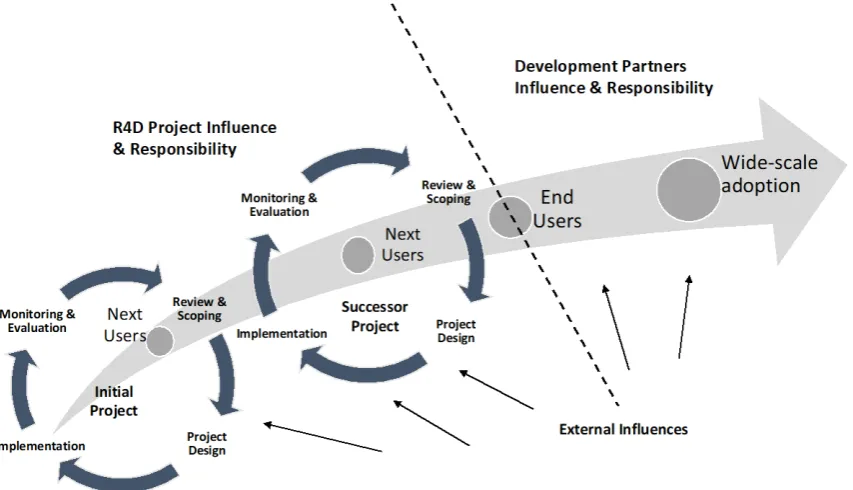
related projects will form a longer-term program (see Figure 1.1). Because of these differences, the
nature, extent and timing of impacts from R4D projects will generally be quite different to those from
development projects.
International agricultural and forestry research programs facilitate the generation of knowledge and
technologies to address national and global development goals related to increasing food security,
reducing poverty and ensuring sustainable management of natural resources (CGIAR, 2005). Such
international research programs have been shown to increase crop yields and lower food prices
(Evenson and Gollin, 2003), and to generate impressive economic benefits collectively but not always
individually (Raitzer, 2003; Lindner
et al.
, 2013; Maredia and Raitzer, 2012). The poor performance
and mixed success of many individual ODA and R4D projects has also long been a concern
(Yalegama
et al.
, 2016; Ika
et al.
, 2012; CGIAR Standing Panel on Impact Assessment, 2006; Raitzer
and Lindner, 2005).
Evaluation of ODA-funded programs, including R4D projects, provides information on development
policy and implementation to facilitate learning, increase accountability and ultimately to enhance the
effectiveness of development cooperation (Liverani and Lundgren, 2007). The literature on various
approaches used to evaluate ODA programs and projects is reviewed in detail in Chapter 3. Despite
projects, it is difficult to compare the results from large numbers of projects, and there are very
significant gaps in our understanding of what approaches work or don’t work, and where and why this
is the case. Very few studies have attempted to identify conceptual sets of (critical) success factors in
international development (Diallo and Thuillier, 2004; Yalegama
et al.
, 2016), and even fewer have
attempted to explore the relationships between success factors and project success (Ika
et al.
, 2012).
Furthermore, the ability to improve project success is constrained by an inadequate understanding of
why development projects will achieve success in one setting yet not in others (Ika and Donnelly,
2017).
There are few studies that report project-level factors contributing to the success of ODA-funded
projects, particularly those that relate to agriculture, fisheries or forestry research. There is a wealth of
literature related to organisational management and behaviour, leadership, and effective teamwork:
see (Schein, 2004; Koontz
et al.
, 1984; Yang
et al.
, 2011) as examples. Likewise, there is
considerable literature on factors affecting effective research collaboration (Ulnicane, 2015), as well
as on inter- and trans-disciplinary research (Buizer
et al.
, 2015; Woolley
et al.
, 2015) and team
science Bozeman and Youtie (2017). However, much of this literature focusses on the developed
world, and generally does not explore the specific research operating environments of ODA-funded
agricultural or forestry research projects. There are some exceptions, which are reviewed in Chapter
4: in 2010, the Australian Centre for International Agricultural Research (ACIAR) surveyed 30 of its
project leaders, research program managers and country managers, to investigate factors supporting
success in its agricultural, fisheries and forestry research projects, to identify 14 factors that
contributed to successful project outcomes (Pearce, 2010). Earlier, Miles (1998) identified four factors
that contributed to success of ODA-funded construction projects in seven countries.
Given the length of time that collaborative agricultural and forestry R4D projects have now been
supported by ODA funding and the apparent variability in success, there is an important need to
improve the understanding of which factors affect R4D project success in different contexts. While
most ODA and international organisations conduct evaluations of their projects, much of this
important material exists as grey literature, for example (Global Environment Facility, 2018), and the
methodologies used are often organisation-specific, making it difficult to systematically compare the
results from different evaluations. This research therefore seeks to enhance the understanding both of
how the success of forestry research projects differs in different developing country contexts, and
what factors contribute towards greater or lesser success in such projects. Given the apparent
knowledge gaps about these factors, this research will focus primarily on identifying factors that
might be influenced by those responsible for designing and implementing collaborative agricultural
and forestry research projects that are implemented in developing countries.
research through the Australian Centre for International Agricultural Research (ACIAR). ACIAR
commissions collaborative R4D projects, involving Australian and international scientists working
together with scientists and other stakeholders from partner countries, to address a priority research
need identified by the partner country. ACIAR’s work not only supports research collaboration but
emphasizes human capital building and private sector-led development, targeted at improved
livelihoods in the agriculture, forestry and fisheries sectors. It is also a learning organisation, with a
strong commitment to distil, learn and share the lessons from its research portfolio (ACIAR, 2017).
ACIAR’s activities are organised into disciplinary research programs, of which forestry is one.
In 2012, when this research commenced, ACIAR’s forestry program had been implementing forestry
projects for about 30 years, and had completed about 100 projects. In recent years, the program has
involved 20 to 25 active projects, representing an annual investment of about $10 million. ACIAR
monitors the performance of its research investments by conducting adoption and impact assessment
studies (ACIAR, 2017). Its impact assessment studies demonstrate substantial economic benefits
arising from some of the completed forestry projects, but limited impact from other projects (Lindner,
2011; Fisher, 2011). The commitment from governments of developed and developing countries to
increase aid effectiveness (OECD, 2005), together with ACIAR’s lesson-learning culture and its
commissioning of new projects annually, provide a justification for more research on ways to improve
the effectiveness of these projects.
Throughout the period of this research, which was undertaken on a part-time basis, I was also
managing ACIAR’s forestry program and had access to ACIAR’s internal records of the completed
projects. The extent, variability and ongoing level of investment in the ACIAR forestry program,
together with the availability of extensive data on completed projects, provided a good basis for
conducting detailed research to improve understanding of what factors had affected their variable
success. After discussions with ACIAR’s chief executive and several scientists who were involved in
ACIAR forestry projects, I identified an opportunity to undertake postgraduate research on this topic.
I was particularly interested to understand what could be learned from the completed projects that
could help those responsible for designing and implementing projects to improve their success.
1.2.
Research aims and questions
This postgraduate research had three aims, all related to improving the understanding of success of
R4D programs and projects. They were:
1. improving the understanding of what factors contribute to success in collaborative research
projects that are implemented in developing countries;
2. developing an evaluation method to enable the relative success of large numbers of R4D
projects to be systematically evaluated in a cost-effective manner; and
for funding and managing research programs, or for implementing projects under these
programs, to collectively achieve better results from these investments.
When I commenced the research, I had only identified the first and third of these aims. I added the
second aim, when it became apparent that, to achieve the other two aims, I needed to address a gap in
evaluation methods which constrained evaluations of the relative success of large numbers of R4D
projects in a cost-effective manner. For organisations like ACIAR that fund a lot of R4D projects,
addressing different research priorities and implemented in different locations, systematic
comparisons of the achievements and impacts of large numbers of the projects are rarely, if ever,
undertaken. Research program managers and project scientists, who have been involved in multiple
projects, often have subjective impressions about the differential success of projects, but these
comparisons are limited to the projects that they know well and they cannot be quantified in any way.
This limits the ability of research mangers to systematically identify lessons related to project success,
or to compare the effectiveness of different research project investments over time. Having a simple,
cost-effective, but consistent methodology for evaluating the relative success of multiple projects
would help overcome these limitations.
The research therefore seeks to make academic contributions to both evaluation methodologies R4D
projects and the understanding of factors that influence project success; as well as practical
contributions that could assist development agencies, such as ACIAR and its R4D counterparts
worldwide, to improve the design and implementation of their research project investments.
The thesis explores the principal research question: What constitutes success, and what factors
influence it, in forestry research for development projects? This is addressed through application of
case study research involving ACIAR’s forestry program. The research activities examined eight
research sub-questions, grouped into four themes of research:
Research context
1. What is ACIAR's approach to development research and how has its forestry program
evolved over three decades?
2. What constitutes "success" in ACIAR’s forestry research projects?
Independent evaluation of relative success
3. How can the relative success of multiple research projects be systematically evaluated in a
cost effective manner?
4. How does relative success of forestry research projects vary within and between countries?
Consultative identification of project success factors
5. What are the factors that affect the relative success of ACIAR’s forestry research projects and
which factors are considered to be most important?
success of individual projects?
Synthesizing the lessons
7. What are the common and the country-specific lessons about project success and what role
does context play in understanding project success?
8. How could the improved understanding of project success be utilised by research for
development programs?
1.3.
Research approach
The approach I took, which evolved as the research progressed, was through conducting
empirically-based, practically oriented research, drawing on elements of approaches used in action research,
formative research and case study research, and applying them to development evaluation. This mixed
methods design used both quantitative and qualitative methods. A significant proportion of the
research was done in a qualitative manner, by engaging 90 scientists who had worked on ACIAR
forestry projects.
From the beginning of this research, I was inspired by the writings of Michael Quinn Patton, an
American specialist in the art and science of utilisation-focused evaluation (Patton, 1996) and
developmental evaluation (Patton, 1994), particularly his evaluation books (Patton, 2011; Patton,
2014; Patton, 2012a). Patton’s insightful writings were very useful for a forestry practitioner like
myself who was entering the evaluation domain in the latter part of my career. These writings
improved my understanding of the differences between summative and formative approaches to
evaluation and helped me realise that there was some ‘middle ground’ that developmental evaluation
occupies. Developmental evaluation, in which evaluators are involved in program development,
centres on situational sensitivity, responsiveness, and adaptation, and is an approach to evaluation
especially appropriate for situations of high complexity and uncertainty where what may and does
emerge is relatively unpredictable and uncontrollable (Patton, 2011). With this new knowledge, I was
able to find the space where I wanted to operate when evaluating projects for this research.
An important element of the research approach was to try to ensure that the methods and findings are
practical and relevant to those responsible for designing and implementing research for development
projects. While I was familiar with the way that ACIAR operated I also researched evaluation and
learning approaches used by other similar organisations, especially those of Canada’s International
I may not have gone where I intended to go, but I think I ended up where
I intended to be.
Douglas Adams – The Long Dark Tea-Time of the Soul (1988)
Earl, 2007) and the importance of thinking about how a project contributes to the system or society as
a whole (Carden, 2013). Throughout the research, I made regular efforts to discuss the research with
my ACIAR colleagues and to share the preliminary findings widely, as they emerged, including
through presentations at national and international conferences. This facilitated very helpful two-way
exchanges on how the research could be approached, what the findings meant, and how they might be
applied practically in R4D organisations. Early on, I decided to progressively publish the research
findings in order to make early contributions to the somewhat limited body of literature, and to
achieve appropriate peer review of the methods and findings.
The research commenced with a review of literature, focussing on exploring the literature on
evaluation of ODA-funded programs and projects and of project management in general, including
methodologies, identification of project success factors and studies that contributed to improved
understanding of project success. A summary of the various evaluation methodologies and some
issues relevant to their application in this research is included in Chapter 3. This review provided me
with a good understanding of the domain of evaluation, particularly its application within
international development. While the evaluation literature is very extensive, only a small proportion
of it relates to R4D projects or to forestry development projects. Significantly, no published journal
articles were found that explained what ACIAR does or its approach to designing and implementing
its projects, and only one published report (Pearce, 2010) was found that identified factors
contributing to success in R4D projects.
At the end of the literature review, the three key knowledge gaps relevant to the principal research
question were identified:
1. No existing cost-effective evaluation methodology for comparing the success of large
numbers of projects;
2. Very limited literature on factors that influence success in R4D projects; and
3. Limited understanding of how and why success of development projects varies between
countries.
In parallel to the literature review, I undertook a review of ACIAR’s internal records from the forestry
program to understand the nature of the projects that had been implemented over the previous 30
years. A journal manuscript was prepared from this review, which is presented here as Chapter 2.
During this process, I also gained insights into what existing information existed in the ACIAR
records that might be useful for the planned research.
While developing the research proposal, I established that the research methods needed to do the
following:
be evaluated;
•
Identify which projects could be considered to be more successful or less successful;
•
Understand the view of scientists who had worked on ACIAR projects on what factors they
considered had enhanced or diminished project success; and
[image:23.595.83.510.225.470.2]•
Establish whether there is any evidence of causal relationships between the identified success
factors and the evaluated level of relative success of a project.
Figure 1.1: Influence and responsibilities in the R4D project impact pathway
During the literature review, I found that defining what is meant by success in R4D projects was quite
challenging. Within the general project management literature, there is no consensus on a definition of
project success or a means of assessing it (Ika, 2009) and as a result it is often contested and
controversial (McLeod
et al.
, 2012). Within the domain of R4D programs, there is very limited
literature and no consensus on how research quality and impact should be considered in defining
success. Likewise, there is considerable variation in the literature on how both outcomes and impacts
of development interventions are defined (Belcher and Palenberg, 2018). Furthermore, the nature and
extent of impacts generated by individual R4D projects partly depend on the nature of the project and
also on where it is situated within the research to development continuum (see Figure 1.1). This is
further complicated by the long and complex causal chains that link research activities and outputs to
development results for the intended beneficiaries (Mayne and Stern, 2013) and the challenges of
attributing observed impacts to the research intervention alone (Alston and Pardey, 2001).
assessment studies. In this research, the concept of success of a forestry research project follows the
logic articulated by Pearce (2010), with two primary dimensions: the extent to which planned research
outputs are achieved and adopted (“achievements”); and the extent of the impacts resulting from
wider adoption, typically outside of the project and beyond its life (“impacts”). As success can mean
different things to different people and wanting to test the validity of the ACIAR approach, I asked all
the researchers that I interviewed during this research to describe what success, in an ACIAR forestry
project, meant to them. While the central purpose of the research was to identify ‘success factors’ –
the factors that contribute to enhanced or diminished success in R4D projects – I did not specify a
priori how I defined ‘success factors’ when conducting interviews. My aim was to explore the
breadth of opinion amongst the researchers about what they thought constituted ‘success’, and what
factors they thought affected project success. This approach enabled me to reflect the variety of ideas
when I distilled the inputs into lists of project ‘success factors’. However, it also means that, amongst
the large number of identified ‘success factors’, there may be considerable variation in the
significance of each for a project’s success.
The development evaluation domain is plagued by terminological inconsistency, with definitions of
key concepts, such as outputs, outcomes and impacts, constantly changing as thinking and practice
evolve (Mayne and Stern, 2013; Befani and Mayne, 2014). While the Organization for Economic
Co-operation and Development (OECD) has a glossary of relevant evaluation terms (OECD, 2002) these
have not been used in the ACIAR literature, which draws principally on the definitions presented in
two ACIAR Impact Assessment Series reports (Davis
et al.
, 2008; Mayne and Stern, 2013). Pearce
(Pearce, 2010) uses these three terms, without further discussion of them, when describing what
constitutes success in an ACIAR project. In this research, recognising that the evaluation component
relied primarily on existing grey and published literature from ACIAR forestry projects over some 20
years, the approach I took was to use the terminology used in this literature rather than attempting to
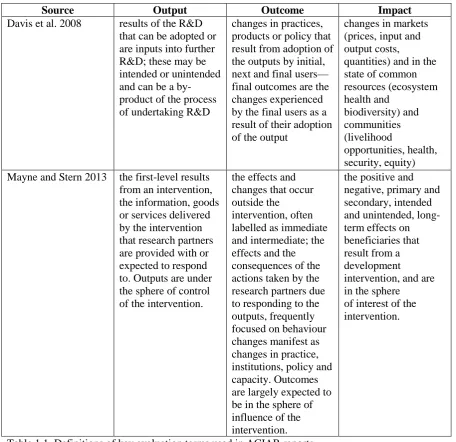
retrofit the findings to consistent definitions. The definitions of the terms output, outcome and impact,
as used in the ACIAR Impact Assessment Series reports are shown in Table 1.1.
Davis et al. 2008
results of the R&D
that can be adopted or
are inputs into further
R&D; these may be
intended or unintended
and can be a
by-product of the process
of undertaking R&D
changes in practices,
products or policy that
result from adoption of
the outputs by initial,
next and final users—
final outcomes are the
changes experienced
by the final users as a
result of their adoption
of the output
changes in markets
(prices, input and
output costs,
quantities) and in the
state of common
resources (ecosystem
health and
biodiversity) and
communities
(livelihood
opportunities, health,
security, equity)
Mayne and Stern 2013 the first-level results
from an intervention,
the information, goods
or services delivered
by the intervention
that research partners
are provided with or
expected to respond
to. Outputs are under
the sphere of control
of the intervention.
the effects and
changes that occur
outside the
intervention, often
labelled as immediate
and intermediate; the
effects and the
consequences of the
actions taken by the
research partners due
to responding to the
outputs, frequently
focused on behaviour
changes manifest as
changes in practice,
institutions, policy and
capacity. Outcomes
are largely expected to
be in the sphere of
influence of the
intervention.
the positive and
negative, primary and
secondary, intended
and unintended,
long-term effects on
beneficiaries that
result from a
development
intervention, and are
in the sphere
[image:25.595.65.522.69.511.2]of interest of the
intervention.
Table 1.1. Definitions of key evaluation terms used in ACIAR reports
The final aspect of the research approach involved determining the appropriate evaluation
methodology to use in the research. In order to understand what factors have enhanced or diminished
project success, it is necessary to have a method that enables the assessor to objectively determine
which projects had good success and which ones had poor success. For this type of research, such a
methodology needed to be equally applicable to projects that concluded recently or that concluded
many years ago. The methodology needed to be cheap to implement, if large numbers of projects
were to be evaluated, and practical for me to implement alone, as a postgraduate research-scale task.
At the beginning of this research, I had intended to either utilise an existing evaluation methodology,
or to adapt one to suit the needs of this research. Unfortunately, despite extensive searches of the
literature, no existing methodology suitable for this research could be found. Therefore, I had to
develop a new methodology for use in evaluations of the relative success of multiple research
projects.
Development of a methodology for the independent evaluation of relative success
The new methodology for evaluating relative success is described in Chapter 3. In developing the
methodology, I gained some inspiration from a recently published score-card methodology used to
evaluate international public health projects (Guinea
et al.
, 2015). I also drew on my experience as the
ACIAR forestry program manager, including knowledge of data available in the ACIAR project
records that could inform evaluations of relative success. The methodology incorporates consideration
of two dimensions that reflect ‘success’ in the terms described previously: achievement of the
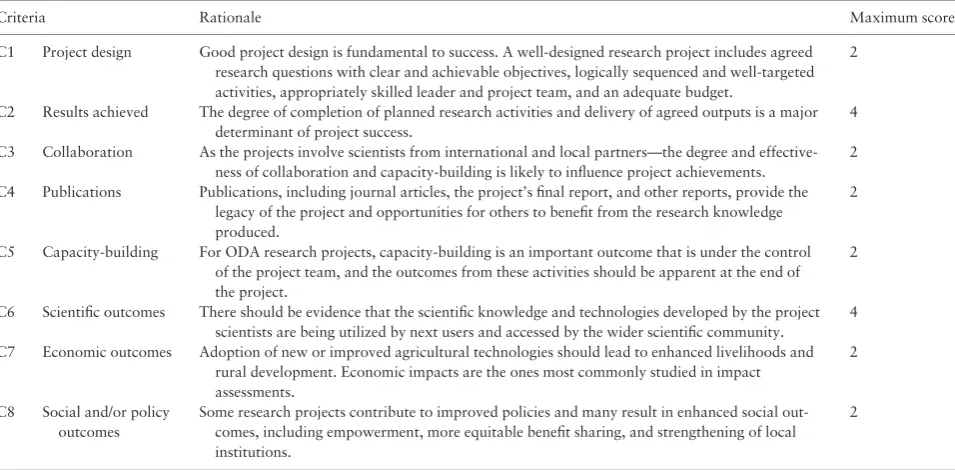
intended research activities, and evidence of the apparent impacts. It utilises eight criteria, four for
each of the two dimensions, and involves the evaluator(s) assessing project records to assign scores
for each criterion. Further information on the rationale for these eight criteria and the scoring system
are presented in Table 1 of Chapter 3.
I tested the new methodology on ten completed ACIAR forestry research projects from Vietnam,
finding that it was practical to apply and able to identify differential success of projects. A manuscript
on this component of the research, presented here as Chapter 3, was published in the journal
“Research Evaluation”, following substantial revision to address the extensive and critical reviewer
comments. The editor noted that it addressed an important gap in existing evaluation methods.
Case study research
Case study methods (Yin, 2009) are particularly appropriate for social research, including evaluations
of complex initiatives such as international development projects (Yin and Davis, 2007), and have the
ability to address the complexity and contextual conditions of different projects (Stufflebeam and
Shinkfield, 2007). From the review of the ACIAR forestry program, I identified that the greatest
number of completed projects were in Indonesia, Vietnam and Papua New Guinea, so I selected them
as the case study countries. In each case study, ten completed projects, representing about half of the
forestry projects that ACIAR had completed in each country between 1987 and 2016 were studied.
In conducting the three case studies, I used a mix of qualitative and quantitative methods, involving
three phases: identification of success factors; evaluation of relative success of projects; and
exploration of relationships between the identified success factors and the evaluated relative success
of projects. Chapter 4, which was accepted for publication in the international journal “Forestry”,
describes the methods used and presents the logic and flow of tasks within the three phases as Figure
1.1. The research protocol covering the case studies was approved by the Australian National
University Human Ethics Committee (Protocol No. 2014/051).
To identify the project success factors, I conducted interviews with Australian, partner country and
international scientists who had participated in projects from each case study. The interviews were
undertaken sequentially by case study, with interviews conducted in the three countries and in
Australia between 2014 and 2017. For the Vietnam study, 24 researchers were interviewed, and for
each of the Indonesia and PNG studies, 33 researchers were interviewed. When researchers had
participated in multiple projects, there were asked the same interview questions for each of these
projects. Chapter 4 includes the standard questions used in each interview as supplementary
information. The full set of interview protocols are provided in Appendix 1.
In each case study, I conducted thematic analyses of the interview data, using HyperRESEARCH1
qualitative data analysis software, and prepared two lists of the factors: factors that enhanced success;
and factors that diminished success. During the first case study, I found that most often the
researchers identified that the one factors could either enhance or diminish project success depending
on how it had been addressed. Therefore, I identified the complementary expressions of the same
factor from the two lists, and prepared concisely-worded statements that best represented researchers’
perspectives on what these success factors were. I also recorded data on the frequency with which
each success factor had been identified. In each case study I analysed the frequency data to determine
the most important success factors, which I considered to be the most frequently identified factors
whose combined identification frequencies represented 75% of the data.
Independent evaluations of relative success:
I conducted evaluations of relative success of the projects in each case study using the new evaluation
methodology (as presented in Chapter 3), drawing in information from internal ACIAR project
records. The evaluation questions and evidence guidance that I used when conducing these
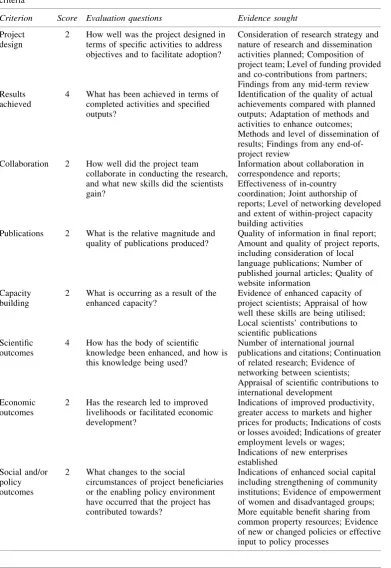
evaluations are detailed in Table 2 of Chapter 3. When conducting these evaluations, a degree of data
source triangulation occurred through reviewing a range of reports and other records, which
collectively presented information and the perspectives of research program managers, project
participants, and those of external reviewers of projects.
During the conduct of the first case study, I thought about how best to portray the results of the two
evaluation scores to provide a useful way to compare project success. Given the variable nature of the
individual research projects, both in research theme and their position in the research for development
continuum, I considered it inappropriate to aggregate the scores for research achievements and
research impacts. Hence, I developed a classification approach with four potential categories of
project success which are represented diagrammatically in Figure 1.2.
1 Researchware, Inc. – [http://www.researchware.com/ accessed 13/06/2014]