An Examination of Deferred
Reference Counting and Cycle
Detection
Luke Nathan Quinane
A subthesis submitted in partial fulfillment of the degree of
Bachelor of Software Engineering (Research Project)
at
The Department of Computer Science
Australian National University
Except where otherwise indicated, this thesis is my own original work.
Acknowledgements
Firstly I would like to thank my supervisor Steve Blackburn. You have helped through-out my project in many ways. You offered much assistance and guidance and your energy and enthusiasm for this area of research is contagious. I would also like to thank you for the usage of two machines, ‘chipmunk’ and ‘raccoon’ on which many of my results were produced.
Thanks also to Daniel Frampton for his help during the many late nights and white board sessions. Daniel was also kind enough to provide usage of ‘toki’ on which the remainder of my results were produced.
Thanks to Ian, Robin, Fahad and Andrew for listening and brain-storming during our weekly meetings.
Thanks to John Zigman for raising the humour level at our meetings and for re-minding me that my problems were always small in comparison (. . . and only running on one computer).
I would also like to thank Daniel B. I couldn’t have done the robotics lab and assignment without your help.
Thanks to Stephen Milnes from the Academic Skills and Learning Centre for read-ing over my drafts.
Thanks to my girlfriend Mira for working late and generally putting up with all my grumpiness.
Finally I would like to thank my parents and step-parents. They have provided me with support, understanding and caring.
Abstract
Object-oriented programing languages are becoming increasingly important as are managed runtime-systems. An area of importance in such systems is dynamic auto-matic memory management. A key function of dynamic autoauto-matic memory manage-ment is detecting and reclaiming discarded memory regions; this is also referred to as garbage collection.
A significant proportion of research has been conducted in the field of memory management, and more specifically garbage collection techniques. In the past, ade-quate comparisons against a range of competing algorithms and implementations has often been overlooked. JMTk is a flexible memory management toolkit, written in Java, which attempts to provide a testbed for such comparisons.
This thesis aims to examine the implementation of one algorithm currently avail-able in JMTk: the deferred reference counter. Other research has shown that the refer-ence counter in JMTk performs poorly both in throughput and responsiveness. Sev-eral aspects of the reference counter are tested, including the write barrier, allocation cost,increment and decrement processingandcycle-detection.
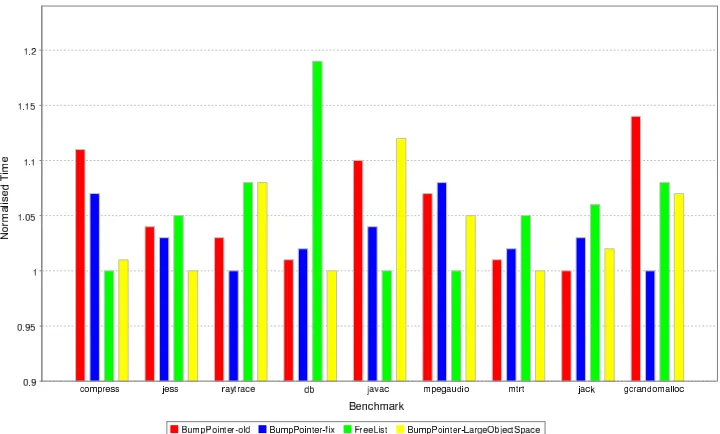
The results of these examinations found thebump-pointerto be 8% faster than the free-listin raw allocation. The cost of the reference counting write barrier was deter-mined to be 10% on the PPC architecture and 20% on the i686 architecture. Processing increments in the write barrier was found to be up to 13% faster than buffering them until collection time on a uni-processor platform. Cycle detection was identified as a key area of cost in reference counting.
In order to improve the performance of the deferred reference counter and to con-tribute to the JMTk testbed, a new algorithm for detecting cyclic garbage was de-scribed. This algorithm is based on a mark scan approach to cycle detection. Using this algorithm, two new cycle detectors were implemented and compared to the orig-inal trial deletion cycle detector.
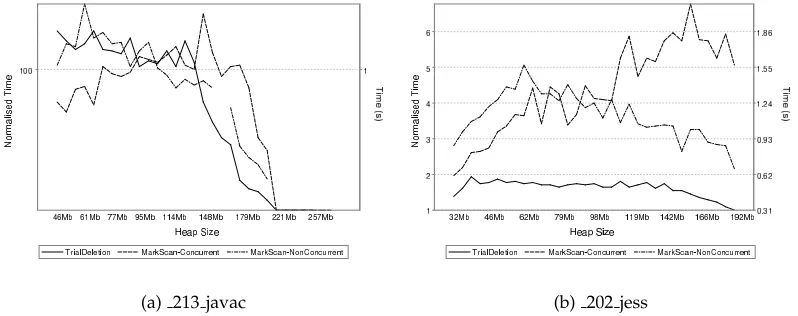
The semi-concurrent cycle detector had the best throughput, outperforming trial deletion by more than 25% on thejavacbenchmark. The non-concurrent cycle detector had poor throughput attributed to poor triggering heuristics. Both new cycle detec-tors had poor pause times. Even so, the semi-concurrent cycle detector had the lowest pause times on thejavacbenchmark.
The work presented in this thesis contributes to an evaluation of components of the reference counter and a comparsion between approaches to reference counting implementation. Previous to this work, the cost of the reference counter’s components had not been quantified. Additionally, past work presented different approaches to reference counting implementation as a whole, instead of individual components.
Contents
Acknowledgements vii
Abstract ix
1 Introduction 1
1.1 Motivation . . . 1
1.2 Approach . . . 1
1.3 Contribution . . . 2
1.4 Organisation . . . 2
2 Background 3 2.1 Traditional Dynamic Memory Management . . . 3
2.2 Automatic Dynamic Memory Management . . . 3
2.2.1 Collector Evaluation . . . 4
2.2.2 Allocation . . . 4
2.2.3 Copying Vs. Non-Copying Collectors . . . 5
2.2.4 Tracing Vs. Reference Counting Collectors . . . 6
2.2.5 Write Barriers . . . 6
2.2.6 Object Life-Cycles . . . 6
2.2.7 Locality of Reference . . . 7
2.3 Mark-Sweep Collection . . . 7
2.3.1 Marking Strategies . . . 7
2.3.2 Sweeping Strategies . . . 8
2.4 Reference Counting . . . 8
2.4.1 Deferred Reference Counting . . . 9
2.4.2 Coalescing Reference Counting . . . 9
2.4.3 Retain Events . . . 10
2.4.4 Cyclic Garbage . . . 10
2.4.4.1 Trial Deletion . . . 10
2.4.4.2 Mark-Scan . . . 12
2.5 Summary . . . 12
3 Jikes RVM, JMTk and the Reference Counter 13 3.1 Jikes RVM . . . 13
3.1.1 Boot Image . . . 13
3.1.2 Threading and Scheduling . . . 14
3.1.3 Synchronisation and Locking . . . 14
3.1.4 Compilers . . . 14
3.1.4.1 Baseline Compiler . . . 14
3.1.4.2 Dynamic Optimising Compiler . . . 15
3.1.4.3 Adaptive Optimisation System . . . 15
3.1.5 Object Model . . . 15
3.1.6 Object Headers . . . 16
3.1.7 Memory Management . . . 16
3.2 JMTk . . . 16
3.2.1 Plans . . . 17
3.2.2 Allocation Spaces . . . 17
3.2.3 Allocation Locals . . . 17
3.2.4 Double Ended Queues (Deques) . . . 17
3.2.5 Approach to Marking . . . 18
3.2.6 Acyclic Objects . . . 18
3.3 The Reference Counter . . . 18
3.3.1 Write Barrier . . . 18
3.3.2 Roots . . . 18
3.3.3 Increments and Decrements . . . 19
3.3.4 Reference Counting Header . . . 19
3.3.5 Allocation Strategy . . . 19
3.3.6 Cycle Detection . . . 19
3.4 Summary . . . 19
4 Costs involved in Deferred Reference Counting 21 4.1 Measuring Allocation Cost . . . 21
4.1.1 Approach . . . 21
4.1.2 Bump-Pointer . . . 22
4.1.3 Segregated Free-list . . . 22
4.1.4 Bump-Pointer With Large Object Allocator . . . 22
4.1.5 Allocation Benchmark . . . 22
4.1.6 Compiler Settings . . . 22
4.2 Approaches for Processing Increments . . . 23
4.2.1 Buffering the Increments . . . 23
4.2.2 Incrementing in the Write Barrier . . . 23
4.2.3 The Write Barrier . . . 24
4.2.4 Approach . . . 24
4.3 Write Barrier Cost . . . 24
4.3.1 Approach . . . 24
4.3.2 Meta-Data . . . 25
4.3.3 Inlining the Write Barrier . . . 25
4.4 Processing Decrements, Roots and Cycle Detection . . . 25
Contents xiii
5 Mark-Scan Cycle Detection 27
5.1 Properties of the Cycle Detector . . . 27
5.1.1 Safety . . . 27
5.1.2 Completeness . . . 28
5.1.3 Correctness . . . 29
5.2 Non-concurrent Cycle Detector . . . 29
5.2.1 Allocation . . . 30
5.2.2 Filtering Possible Cycle Roots . . . 31
5.2.3 Reclaiming Garbage Cycles . . . 31
5.2.4 Acyclic Objects . . . 32
5.2.5 Properties . . . 33
5.3 Parallel Non-concurrent Cycle Detector . . . 33
5.4 Concurrent Cycle Detector . . . 33
5.4.1 Mutation During Marking . . . 34
5.4.2 Mutation After Marking . . . 34
5.4.3 Roots . . . 35
5.4.4 Allocation . . . 35
5.4.5 Detecting Cycles . . . 35
5.4.6 Filtering Possible Cycle Roots . . . 35
5.4.7 Acyclic Objects . . . 35
5.4.8 Reclaiming Garbage Cycles . . . 35
5.5 Comparison to Trial Deletion . . . 36
5.6 Summary . . . 37
6 Results 39 6.1 Approach to Benchmarking . . . 39
6.2 Reference Counting Costs . . . 40
6.2.1 Allocation . . . 40
6.2.2 Processing Increments . . . 40
6.2.3 Write Barrier . . . 42
6.2.4 Roots, Decrement Buffers and Cycle Detection . . . 43
6.3 Cycle Detectors . . . 44
6.4 Summary . . . 45
7 Discussion 47 7.1 Allocation . . . 47
7.1.1 Locality . . . 47
7.1.2 Bump-Pointer Fix . . . 47
7.1.3 Summary of Allocation Findings . . . 48
7.2 Processing Increments . . . 48
7.2.1 Pause Times . . . 49
7.2.2 Summary of Processing Increments Findings . . . 49
7.3 Write Barrier Cost . . . 49
7.4 Processing Decrements, Roots and Cycle Detection . . . 50
7.4.1 Summary of Roots, Decrements and Cycle Detection Findings . . 50
7.5 Cycle Detection . . . 51
7.5.1 Incremental Scanning . . . 51
7.5.2 Summary of Cycle Detection Findings . . . 51
7.6 Summary . . . 52
8 Conclusion 53 8.1 Summary . . . 53
8.2 Future Work . . . 53
8.3 Conclusion . . . 54
A Conventions 55 B Complete Results 57 B.1 Allocation Costs . . . 57
B.2 Processing Increments . . . 58
B.3 Semi-Space with Write Barrier . . . 63
B.3.1 Intel i686 Architecture . . . 63
B.3.2 Motorala PPC Architecture . . . 66
B.4 Roots, Decrements and Cycle Detection . . . 69
B.5 Cycle Detection . . . 70
Glossary 75
List of Figures
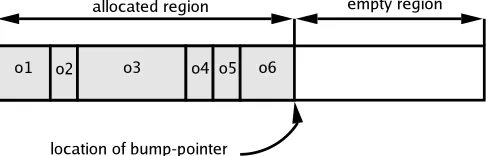
2.1 An example bump-pointer allocator. . . 5
2.2 An example free-list allocator. . . 5
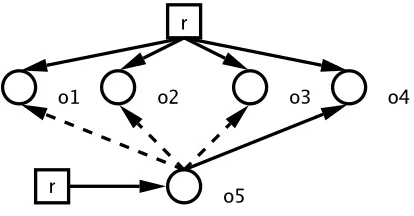
2.3 An example of several reference mutations. . . 10
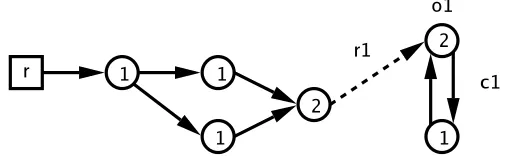
2.4 A cycle of garbage in a reference counted heap. . . 11
2.5 A garbage cycle. . . 11
2.6 A non-garbage cycle. . . 11
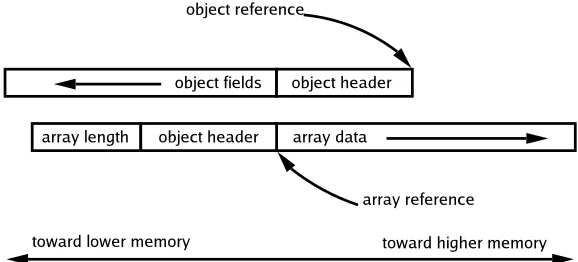
3.1 THe object model for Jikes RVM. . . 15
5.1 Example of a safe and an unsafe object reference. . . 28
5.2 Examples of marked and unmarked cycles. . . 30
5.3 A cycle that is created disconnected from the graph of live objects. . . 32
5.4 Possible problem during cycle collection. . . 32
5.5 Situation where reference counts need to be updated. . . 32
5.6 A possible problem caused by an acyclic object. . . 33
5.7 Example of how the mutator can cause problems when marking. . . 34
5.8 Potentially unsafe pointer access. . . 35
5.9 A cycle that must be retained till the next epoch. . . 36
5.10 Another cycle that must be retained till the next epoch. . . 36
6.1 Allocation performance across benchmarks. . . 40
6.2 Total running time for different increment processing approaches. . . 41
6.3 Mutator time for different increment processing approaches. . . 41
6.4 GC count for different increment processing approaches. . . 42
6.5 Pause times for different increment processing approaches. . . 42
6.6 Total running time for 209 db. . . 43
6.7 Mutator running time for 209 db. . . 43
6.8 Total running time for 202 jess. . . 44
6.9 Breakdown of reference counter time costs. . . 44
6.10 Total times for cycle detectors. . . 45
6.11 Average pause times for cycle detectors. . . 45
7.1 Bump-pointer behaviour during allocation. . . 48
A.1 A legend for figures in this document. . . 55
B.1 Allocation performance across benchmarks. . . 57
B.2 Increments - total time . . . 58
B.3 Increments - mutator time . . . 59
B.4 Increments - collection count . . . 60
B.5 Increments - average pause times . . . 61
B.6 Increments - maximum pause times . . . 62
B.7 i686 write barrier test - total time. . . 63
B.8 i686 write barrier test - mutator time. . . 64
B.9 i686 write barrier test - collection count. . . 65
B.10 PPC write barrier test - total time. . . 66
B.11 PPC write barrier test - mutator time. . . 67
B.12 PPC write barrier test - collection count. . . 68
B.13 Breakdown of reference counter time costs. . . 69
B.14 Cycle detection - total time. . . 70
B.15 Cycle detection - mutator time. . . 71
B.16 Cycle detection - collection count. . . 72
B.17 Cycle detection - average pause times. . . 73
List of Algorithms
5.1 Top level view of the mark scan cycle detection algorithm. . . 28
5.2 Mark the graph of live objects. . . 29
5.3 Process purple objects. . . 30
5.4 Process the scan queue. . . 31
Chapter 1
Introduction
1.1 Motivation
With industry leaders such as Sun, IBM and Microsoft pushing managed run-times such as Java and .NET, automatic dynamic memory management is becoming in-creasingly important. This is especially highlighted by papers which suggest that a program could spend up to a third of its running time performinggarbage collection [Levanoni and Petrank 2001].
Study in the field of automatic dynamic memory management dates back to 1960 and much research has been conducted. While there are many papers and reports available on the performance of memory management algorithms and implemen-tations, they are often implemented in different environments. Unfortunately this makes it difficult to compare different collection algorithms as other elements from the underlying runtime affect the comparison.
Reference countingis one approach to automatic memory management that has not had its differing implementations thoroughly compared and examined. For example, themark-scanandtrial-deletionapproaches tocycle detectionhave been described and implemented but not compared with each other. Instead, implementations of refer-ence counters and their components are presented as a whole when they are really several orthogonal components [Bacon et al. 2001; Levanoni and Petrank 2001].
The reference counter is also considered to perform poorly in throughput when compared to other collection algorithms [Blackburn and McKinley 2003; Blackburn et al. 2003]. However the reasons for this poor performance have not been examined. The cost of maintaining reference counts for each object is also thought to be high [Wilson 1992; Jones 1996], but again the costs have not been quantified.
This thesis aims to dissect the costs involved in the components of the one refer-ence counter implementation and, where possible, offer improvements.
1.2 Approach
The costs involved in allocation, the write barrier, processing increments, processing decrements, processing roots and cycle detection will be examined and their costs quantified.
Using these results and the knowledge of the algorithm, improvements to the cur-rent implementation will be proposed and tested.
All work will be done in JMTk, a flexible memory management toolkit written in Java [Blackburn et al. 2003]. This will allow any improvements to be compared against other collectors in the same platform.
1.3 Contribution
The main costs involved in reference counting are dissected. Allocation cost, the cost of the write barrier, different approaches for handling increments and the costs of processing decrements, roots and cycle detection are quantified.
A new algorithm for collecting cyclic garbage is described and discussed. Using this new approach to cycle detection, two new cycle detector implementations are provided to JMTk.
The new cycle detectors are compared to the original cycle detector. One of the cycle detector implementations performed well in throughput. However, both per-formed poorly in responsiveness.
1.4 Organisation
Chapter 2 gives an overview of the garbage collection problem domain. Some ap-proaches to garbage collection are discussed, particularly those relating to reference counting.
Chapter 3 describes the environment in which the reference counter is currently im-plemented.
Chapter 4 examines the various costs involved in deferred reference counting garbage collection. Preliminary results indicate that cycle detection is a major cost in the refer-ence counter.
Chapter 5 describes a new algorithm for collecting cyclic garbage. Based on this algo-rithm, two alternate cycle detectors are implemented. These implementations aim to improve the performance of the reference counter.
Chapter 6 presents results from the cost analysis and an evaluation of the new cycle detectors.
Chapter 7 critically examines the result obtain in Chapter 6.
Chapter 2
Background
This chapter aims to provide background information on the general problem of mem-ory management. The differences between traditional methods for memmem-ory manage-ment and automatic dynamic memory managemanage-ment are examined. Alternative ap-proaches for memory allocation and reclamation are described with respect to garbage collection in object-oriented systems. Approaches to mark-sweep and reference count-ing collection are described in more detail.
2.1 Traditional Dynamic Memory Management
Traditional memory management places the onus of memory management on the pro-grammer. The programmer must explicitly instruct the program when to allocate and release regions of memory as well as indicate the quantity of memory required by the program. The programmer must also ensure that any pointers in the program are valid. During the program execution and in a concurrent setting, the programmer must also ensure that the order in which the memory is accessed is legal and resulting data is consistent. If any of these components of the program’s memory management is defective, undesirable and unpredictable behaviour can result [Jones 1996].
Special care must be taken when sharing data between modules [DeTreville 1990; Wilson 1992]. It must be checked that one module does not free the allocated memory while another module is using it. It must also be checked that the allocated memory is eventually freed when all modules have finished using it.
In addition, pointer arithmetic and pointers to arbitrary memory regions are al-lowed. Thus the programmer must check that memory locations reference by these pointers are only accessed when the pointers are referencing valid locations.
2.2 Automatic Dynamic Memory Management
Automatic dynamic memory management is a high level facility provided to the pro-grammer that removes the need for explicit memory management. It allows memory regions to be allocated automatically as they are required and collected automatically as they become discarded [Wilson 1992].
Many object-oriented languages have automatic dynamic memory management as part of their specification. These languages include C# [ECMA 2002], Java [Joy et al. 2000] and Smalltalk [Committee 1997]. When referred to in this context, auto-matic dynamic memory management is calledgarbage collection. These languages also ensure that all references are either valid or null, thus removing another burden from the programmer.
Meyer considers that automatic dynamic memory management is an important part of a good object-oriented language. Further, he states that leaving developers responsible for memory management complicates the software being developed and compromises its safety [Meyer 1988].
It is possible to implement automatic dynamic memory management for most lan-guages, even those that do not include garbage collection in their specification. This is the case for two popular languages, C and C++ [Jones 1996]. However, these im-plementations may need to operate without communication from the compiler. Addi-tionally, these languages usually have very different allocation and collection patterns to languages commonly associated with garbage collection [Jones 1996].
2.2.1 Collector Evaluation
When evaluating the performance of garbage collection algorithms several qualities must be taken into consideration. These include the throughput and pause-times of the collector and the required meta-data.
The throughput of the collector indicates the speed at which the collector is able to reclaim garbage. The higher a collector’s throughput the more efficient it will be able to complete processing its workload. High throughput is important for systems that generate large quantities of garbage. Throughput provides an indication of the overhead the collector places on total system running time [Jones 1996].
The collector’s times indicate how long a collection cycle takes. Low pause-times are important for interactive and hard real-time systems. In most cases there is a trade-off between short pause-times and high throughput [Blackburn and McKinley 2003].
Some collectors, such as reference counting collectors, require meta-data in order to operate. This data can be stored both in the object header or associated with the collector. Some meta-data may be required throughout the execution of the program while other meta-data is only required at collection time. The quantity of meta-data required by the collection algorithm is an important consideration for systems with limited memory [Jones 1996].
2.2.2 Allocation
Bump-§2.2 Automatic Dynamic Memory Management 5
[image:23.595.198.441.198.276.2]pointers provide fast allocation routines as only one field needs to be read and up-dated. The drawback to using bump-pointers is that they are only able to allocate into an empty memory region. This means that the region of memory allocated by a bump-pointer must be freed completely before it can be reused.
Figure 2.1: An example bump-pointer allocator.
The other approach is to allocate objects using a “free-list”. A free-list indicates regions of memory not containing live objects, see figure 2.2. When the collector finds a garbage object, the object’s space is recorded in the free-list. Free-lists are more com-plex than bump-pointers and are slower as a result. However, free-lists can allocate into a previously allocated space, making them essential in non-copying collectors.
Figure 2.2: An example free-list allocator.
2.2.3 Copying Vs. Non-Copying Collectors
Garbage collection algorithms can either move objects found to be live or leave live objects fixed and maintain a free-list for the heap.
Copying collectors are able to utilise the fast allocation associated with a bump-pointer, as they are always allocating into unused space. However, they must pay the overhead of copying all live objects from the space being collected. In the worst case, all objects in the collected region will remain live and the collector must have enough free space to copy these objects [Blackburn et al. 2002]. In the most inefficient implementation, a copying collector will only be able to allocate half of the memory region it is managing.
[image:23.595.191.444.424.483.2]2.2.4 Tracing Vs. Reference Counting Collectors
Garbage collection algorithms use two approaches to determine if an object is live. The first method is to trace through the graph of live objects. Any object reached in this traversal must be live due to the nature of garbage objects [McCarthy 1960]. The other approach is to record the number of references to an object [Collins 1960]. When an object has a reference count of zero it is garbage, as no live objects are referencing it.
One advantage of tracing algorithms is that unlike reference counting, no special action is required to reclaim cyclic garbage [Schorr and Waite 1967]. Since a garbage cycle only contains internal references, a trace of live objects will never reach the garbage cycle indicating that is not live. Reference counting algorithms must therefore employ additional approaches to detect garbage cycles.
Non-incremental, non-concurrent tracing collectors also avoid the overhead of a write barrier, which is required by reference counting algorithms [Jones 1996].
2.2.5 Write Barriers
A write barrier is a piece of code that is executed every time a reference mutation oc-curs. The write barrier can either be conditional or fixed. Conditional write barriers can either execute a “fast-path” or a “slow-path”. The fast-path checks if the refer-ence mutation should be recorded, while the slow-path actually records the mutation. Fixed write barriers have no fast-path and execute the slow-path for every mutation.
Conditional write barriers are used in generational collectors, collectors that per-form incremental collection and also other styles of collectors [Jones 1996]. Reference counting collectors can be implemented with a fixed write barrier, however coalesc-ing and generational reference countcoalesc-ing still use a conditional write barrier [Levanoni and Petrank 2001; Blackburn and McKinley 2003].
2.2.6 Object Life-Cycles
In order to improve the performance of garbage collection algorithms, research has been conducted to identify trends in object life cycles. One trend discovered is that most objects die young. To take advantage of this behaviour, some collectors take a generational approach to garbage collection [Lieberman and Hewitt 1983; Ungar 1984]. A nursery is employed into which all new objects are allocated. Objects in the nursery remain there until the next nursery collection. At this point they are copied over into the mature object space. The premise is that because the nursery will have a high mortality rate, only a minimal subset of the nursery object will need to be copied into the mature space.
§2.3 Mark-Sweep Collection 7
In modern languages the exception to this rule is finalisation. Afinaliseris a piece of code that is executed after the object dies but before the object is collected. It is possible for this code to “resurrect” the object by restoring a reference to itself.
2.2.7 Locality of Reference
Locality of reference is the degree to which subsequent memory accesses are close to each other both temporally and spatially. In both cases, closer references have better locality. Memory accesses that are close temporally have better locality if a last re-cently used (LRU) policy is used for the cache or paging system [Tanenbaum 1999]. This is because they are less likely to be bumped out of the cache or have their page unloaded. Memory accesses which are spatially close will have better locality since they are more likely to be on the same page, reducing the number of page faults.
A program with good locality will frequently take advantage of objects in the cache and any cache pre-fetching mechanisms. Programs with good locality will also have a concentrated working set. As indicated above, a concentrated working set helps to reduce page faults since most required data is on a small subset of all pages.
Since the allocation strategy and garbage collection policy are both responsible for the placement of objects, they can both aid or hinder benefits gained from locality. For example, segregated free-lists group similar sized objects together and copying collectors compact objects into the “copy-to” space. Thus locality is an important consideration when dealing with memory management.
2.3 Mark-Sweep Collection
The mark-sweep garbage collection algorithm operates by tracing through all live ob-jects in the heap and then sweeping the heap for any unmarked obob-jects. Obob-jects that are unmarked after a traversal of the heap have no live objects referencing them and are therefore garbage.
To prevent objects from being reclaimed incorrectly the algorithm must retain garbage until a complete scan of the heap is complete. In contrast, reference counting algorithms are able to collect garbage objects immediately.1
In basic implementation of the mark-sweep algorithm pause times are large when compared with some other algorithms, for example reference counting [Blackburn and McKinley 2003]. The algorithm’s high pause times can be attributed to its need to traverse large portions of the heap at collection time. In the marking phase, all live objects in the heap must be traversed. In the sweeping phase, the heap is traversed again updating the free-lists.
To help minimise the length of the pause times and maximise throughput, various strategies are attempted in both the marking and sweeping phases of the algorithm.
2.3.1 Marking Strategies
The goal of the marking phase is to detect all live objects in the heap and to flag them as live. The live objects are detected by tracing the graph of live objects from the roots. A sub-graph is only traced if the root of the sub-graph had not been previously marked. This prevents unneeded tracing and handles cyclic data structures.
The mark state is typically stored in two locations: in the header of the object or in a separate bitmap. Storing the mark state with the object is cheaper to access than storing it in a bitmap but this is not always possible, for example in C collectors [Jones 1996].
The space required to store the bitmap is small when compared to the entire heap. This means that there is a possibility that the bitmap will remain in the cache or at least that reading and writing mark bits should not cause as many page faults. The addi-tional advantage is that large portions of the heap are not written to while marking occurs. This helps to avoid marking many pages as dirty, thus reducing the number of page writes the operating system must perform. The downside is that writing to the mark bit is more expensive [Zorn 1989].
The marking process is recursive in nature, however the marking program can-not use recursive calls to perform the mark because a stack overflow can result. To overcome this problem two approaches can be used: storing objects that need to be traversed in a marking queue or traversing the graph using pointer reversals.
Using a marking queue avoids the need to call the marking function recursively, however it requires additional space to store the queue. Research has been under-taken to approximate the space needed, and it was found that real applications tend to produce marking stacks that are shallow in proportion to the heap size [Jones 1996]. Even so, some collectors will push large objects onto the marking queue incrementally to save space[Jones 1996].
Using the pointer reversal technique does not require any additional space to per-form the mark however it is suggested to be 50% slower than using a marking queue [Schorr and Waite 1967]. Thus it is only recommended for use when marking with a mark queue fills the heap.
2.3.2 Sweeping Strategies
The most basic sweeping strategy is to traverse the entire heap in a linear fashion and push unmarked objects back onto the free-list. The heap is scanned in a linear fashion to take advantage of any page pre-fetching mechanism in the hardware or operating system [Jones 1996].
§2.4 Reference Counting 9
2.4 Reference Counting
Reference counting garbage collection records the number of references to live ob-jects. When a reference to an object is created, the reference count of that object is incremented. When a reference to an object is removed, the reference count of the ob-ject is decremented. Obob-jects with a reference count of zero are not linked to any live object and are therefore garbage. When an object’s reference count drops to zero, the reference counts of child objects are decremented before the object is reclaimed. This ensures that all objects will have a correct reference count during the execution of the program.
To update the reference counts of objects when references are altered, a write bar-rier is used. The write barbar-rier increments the object receiving the reference and decre-ments the object losing the reference. Since garbage objects can be detected as soon as their reference counts drop to zero, the collection work is more evenly spread than a traditional tracing collector. This spread of the workload enables reference counting to achieve consistently small pause times.
As mentioned above, reference counting is notcomplete. It requires the assistance of acycle detectorto collect all garbage on the heap. It is possible to avoid the need for cycle detection by using weak pointer implementations, however this is suggested to be highly costly [Jones 1996].
2.4.1 Deferred Reference Counting
It is costly for the run-time to execute the write barrier for every reference mutation. To reduce this cost a reference counting algorithm can choose to ignore some sets of frequently mutated references [Deutsch and Bobrow 1976]. References from hardware registers or the stack are examples of frequently mutated references. To prevent incor-rect collection of live objects, all objects must be checked for references residing in the stack and registers before they are reclaimed.
Deferred reference counting typically defers adjusting the reference counts in the write barrier. Instead increments and decrements are placed into a buffer and pro-cessed together. This approach requires more meta-data space since buffers for the increments and decrements are required. It also produces longer pause times but gains significant increases in throughput [Ungar 1984].
2.4.2 Coalescing Reference Counting
collection takes place the reference fromo5changes to referenceo2, theno3and finally o4. The coalescing collector only need remember the initial reference too1 and the final destination,o4. The objects in between each would receive an increment and a decrement resulting in no net change.
Figure 2.3: An example of several reference mutations.
2.4.3 Retain Events
To prevent deferred reference counting algorithms from collecting objects referenced from the stack or from hardware registers,retain eventsare used. There are three ways to implement retain events: using a zero count table, using temporary increments and using a flag in the object’s header.
The zero count table method places all objects with a zero reference count into a table [Deutsch and Bobrow 1976]. Before the objects are reclaimed each object is checked for references in the stack and hardware registers. If such a reference exists the object is left in the zero count table until the next collection, otherwise the object is reclaimed. If the object’s reference count increases again between collections it is removed from the zero count table.
The other two methods gather all roots from the stack and the hardware registers and indicate to the reference counter that these objects should be retained [Bacon et al. 2001; Blackburn and McKinley 2003]. This is achieved either by incrementing the reference count and decrementing it in the next collection or by setting a flag in the object’s header.
2.4.4 Cyclic Garbage
§2.4 Reference Counting 11
[image:29.595.191.445.174.255.2]must also be used. The two basic cycle detection algorithms are trial deletion and mark-scan.
Figure 2.4: A cycle of garbage in a reference counted heap.
2.4.4.1 Trial Deletion
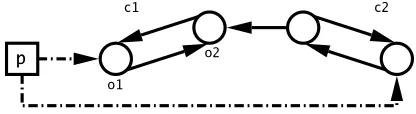
The trial deletion cycle detector operates by considering possible cycle roots. For each possible cycle root, it pretends that the object is dead and then decrements the refer-ence counts of all child objects [Lins 1992; Bacon et al. 2001]. If the object is the root of a cycle of garbage, then this process will kill the child objects which will in turn decrement the parent and kill it. Consider the cyclec1 in figure 2.5. If the possible cycle rooto1 were to decrement all its child objects, in this case justo2, the child ob-ject would have a reference count of zero. The child obob-jecto2would be marked as a possible member of a garbage cycle and its child nodes would be decremented, in this case justo1. This decrement would leave both objects with a reference count of zero indicating the two objects were members of a garbage cycle.
Figure 2.5: A garbage cycle.
Figure 2.6: A non-garbage cycle.
2.4.4.2 Mark-Scan
An alternative approach to detect cycles is to perform an occasional mark sweep of the entire heap [DeTreville 1990; Levanoni and Petrank 2001]. Any garbage cycles uncollected from reference counting would not be reached in the mark phase and thus could be collected in the sweep phase.
In implementations where a limited number of bits are used to store the reference count, the mark sweep is also used to resetstuckreference counts back to their correct values [Jones 1996].
2.5 Summary
Chapter 3
Jikes RVM, JMTk and the
Reference Counter
The previous chapter looked at the general problem of memory management and garbage collection. Possible approaches to reference counting were also described.
In this chapter, the software used as a platform for research, the Jikes Research Virtual Machine is described. The Java Memory management Toolkit (JMTk) is also described along with details of its reference counter implementation. Important prop-erties of the platform, such as the approach to compilation and the self-hosting nature of Jikes, are discussed.
3.1 Jikes RVM
The Jikes Research Virtual Machine (RVM) is an open source research Java Virtual Machine (JVM) written in Java [Alpern et al. 1999a; Alpern et al. 1999b; Alpern et al. 2000]. It is designed to be a high performance JVM and is intended to run on high end server machines. To support these goals it incorporates a high performance compiler system and a family of memory managers.
An interesting property of the RVM is that it is self hosting. This means that the RVM not only runs the application program it is executing, but also its own internal components. For example, the RVM’s compiler system can recompile code that the RVM is itself using. This approach to design opens up many opportunities for optimi-sation unavailable in other JVMs. For example the RVM has the ability to inline parts of the supporting Java libraries and the runtime itself, such as the write-barrier and allocation fast-path, into the application code being executed.
While there are other virtual machines which run in the language they were pro-grammed in [Ingalls et al. 1997; Taivalsaari 1998], Jikes RVM is the only such imple-mentation that is both self hosting and aiming to be a high performance VM.
3.1.1 Boot Image
Since the RVM is self hosting, it requires a boot image to commence execution. This boot image is generated by running the RVM on another JVM. The RVM then uses a
special boot writer class to write an image of the running RVM into a boot image. This boot image is then reloaded using limited quantities of C and assembly code.
When generated, the classes in the boot image can either be compiled by the base-line compiler or by the optimising compiler. A basebase-line compiled boot image is faster to generate but runs slower than a boot image generated from the optimising com-piler.
3.1.2 Threading and Scheduling
When the RVM loads its boot image, it creates a native process for each processor available in the system. Using these native processes, Java threads are multiplexed using quasi-preemptive scheduling [Alpern et al. 2000].
Again since the RVM is self hosting threads for compilation, garbage collection and other services are scheduled using the same scheduling system that runs the ap-plications threads.
3.1.3 Synchronisation and Locking
The RVM uses a locking mechanism based on thin locks to support Java synchronisa-tion [Alpern et al. 2000]. Each object has informasynchronisa-tion in its header detailing its current locking state. When there is no contention for the lock a thin lock is used. When con-tention occurs the thin lock is promoted into a thick lock. This approach avoids the need for the heavier thick locks in cases where there is no contention for the object in question.
The RVM also includes other lower level locking mechanisms only available inside the RVM [IBM Research 2003].
3.1.4 Compilers
Unlike other JVMs, Jikes RVM does not use an interpreter loop to run its applications. Instead the RVM takes a compile only approach to bytecode execution. Initially it compiles every executed method with a very fast “baseline” compiler. Later “hot” methods are re-compiled using a more aggressive optimising compiler.
The RVM also takes a lazy approach to compilation; when a class is loaded all methods are left uncompiled until they are called. This approach helps to reduce the initial time cost of compiling all bytecode.
3.1.4.1 Baseline Compiler
§3.1 Jikes RVM 15
3.1.4.2 Dynamic Optimising Compiler
The optimising compiler is more aggressive but also more expensive than the baseline compiler. It aims to generate the best possible code while at the same time remember-ing that compilation time is an important factor. The optimisremember-ing compiler is able to produce code that performs at a speed comparable to production JIT compilers [Burke et al. 1999].
Code within the RVM is able to use a compiler pragma to instruct the optimising compiler how certain portions of code should be handled. For example, it is possible to instruct the optimising compiler to always inline a specific method [Blackburn et al. 2003].
3.1.4.3 Adaptive Optimisation System
The adaptive optimisation system controls the two compilers and attempts to make a good cost/performance trade-off. It uses metrics gathered at runtime to recompile “hot” methods using the optimising compiler. It can also recompile optimised meth-ods using difference optimisations to achieve even greater performance [Arnold et al. 2000].
The behaviour of the adaptive optimisation system is non-deterministic which can affect benchmarking [Blackburn et al. 2003].
3.1.5 Object Model
[image:33.595.173.462.526.657.2]Jikes RVM is implemented with an unusual object model that is inherited from early versions of the Jalape˜no JVM. Object fields are laid out backwards in decreasing mem-ory from the object reference. Additionally, the length of arrays are stored before the array reference and the array data starts at the array reference, see figure 3.1.
Figure 3.1: The layout of the object model implemented in Jikes RVM and used by JMTk.
checks by protecting high memory to trigger a hardware exception. When the pro-gram attempts to access any field of a null object (object reference at 0x0), the field would be high memory (below 0xFFFFFFFF), triggering the exception. This approach makes the assumption that the field in the object being referenced will be in a pro-tected region of memory, that is:
fieldoffset>−(protectedpages)×(page size)
Another consequence is that the RVM cannot safely be loaded into high memory as the page protection system would not work in this case.
The Java language specification ensures that all array accesses are bounds checked, which implies that the array length needs to be read before an access is attempted. Again with the length laid out before the array reference, accessing a null array would trigger an exception.
The other advantage of this object layout is efficient array access. Theith element in the array isitimes the element size from the object header reference. This allows fast and cheap access to array elements.
3.1.6 Object Headers
In the RVM all objects and arrays are stored with a header. This header contains information about the type and status of the object or array. The reference counting header also contains an additional word to store the reference count and data used for cycle detection.
3.1.7 Memory Management
The RVM supports a family of memory managers. This includes collectors from the original Jalape˜no VM.1 More importantly the RVM includes the versatile Java Mem-ory management Toolkit (JMTk).
3.2 JMTk
JMTk is a memory management toolkit written in Java. Since Jikes RVM was designed to run on server machines that possibly have more than one CPU, JMTk is designed with concurrent operation in mind. Since Jikes RVM is also designed to be high a performance VM, JMTk is intended to contain high performance algorithms for both collection and allocation [Blackburn et al. 2003].
JMTk provides a testbed where different memory management strategies can be examined and compared. It improves upon previous memory management toolkits by providing both free-list and bump-pointer allocators [Blackburn et al. 2003]. It supports a range of collection algorithms including copying collectors, mark-sweep and reference counting. It also has support for generational collectors.
§3.2 JMTk 17
3.2.1 Plans
JMTk contains a set of “plans” for its range of collectors. Each plan specifies how a certain memory management approach will allocate and collect objects. The plan also specifies if a write barrier is required by the collector.
3.2.2 Allocation Spaces
JMTk provides the VM with several different spaces to allocate objects. These spaces allow collectors and allocators to take different action for objects residing in different spaces.
Since Jikes RVM is self-running and requires a boot-image to start running some objects are allocated into the boot space. Objects in the boot space are never allocated at runtime, they are allocated at build time when the boot image is made.
JMTk also provides an immortal space. JMTk will allocate objects that never need to be collected into the immortal space, this removes some load off the collector. These objects are typically internal RVM data structures.
Most JMTk collectors also have a large object space (LOS). The large object space provides a space to deal with objects so large that they would otherwise hinder the normal memory management process. Consider a copying collector; during a collec-tion it would be quite expensive to copy a large object into a new memory region. The LOS allows the collector to avoid this problem. Segregating large objects into a separate space may also help collectors by providing better object locality.
JMTk collectors also have a default space used by which ever collection algorithm is being used. For example the default space for a reference counting collector is the “RefCount” space.
3.2.3 Allocation Locals
For each space in the system, each processor can have a “local”. Each processor allo-cates into and collects its own locals. Locals get their memory from their associated space in large chunks. This prevents the need for fine grain synchronisation during al-location and collection. Instead only coarse gain synchronisation is needed for access among processors.
3.2.4 Double Ended Queues (Deques)
JMTk provides a set of general purpose queues for storing data. These queues, as the name suggests, allow values to be inserted at either end.
3.2.5 Approach to Marking
Marking can be done by changing a bit in the object’s header. In the first mark of the graph, an object is marked by setting the mark bit in the object’s header. Then instead of unmarking all objects after a mark and sweep, the meaning of the mark bit is flipped. Thus, in the next mark phase an object will be marked by clearing the mark bit.
3.2.6 Acyclic Objects
The compiler assists the reference counter by identifying some acyclic objects. Only classes that only reference scalars and final acyclic classes can be safely treated as acyclic. This is because a subclass of an acyclic object could be cyclic, causing the original analysis to be incorrect. Thus the compiler can only perform limited analysis of which objects are acyclic.
Even with these restrictions Bacon et al. [2001] found that some benchmarks from the SPECJVM98 suite contained high proportions of acyclic objects. In the two ray-tracing benchmarks, ray-trace and mtrt, 90% of objects allocated were acyclic.
The trial deletion cycle detector in JMTk never traverses acyclic objects. This is because an acyclic object cannot be part of a cycle.
3.3 The Reference Counter
The reference counter currently implemented in JMTk is a deferred reference counter.2 This means that all reference mutations to registers and stack variables are ignored. All other mutations are handled by a write barrier.
3.3.1 Write Barrier
The write barrier in the reference counter handles all non-deferred reference muta-tions. For each such mutation the corresponding increment and decrement are placed into increment and decrement buffers. These buffered increments and decrements grow in size until a collection is needed either due to object allocation or excessive reference mutation.
3.3.2 Roots
At collection time all roots of the object graph from the previous collection are decre-mented. All new roots are located and their reference counts incredecre-mented. The incre-mented roots are also placed into a buffer to be decreincre-mented in the next collection. This approach avoids the need for a zero count table (ZCT).
2Ian Warrington, Honours student at Australian National University, has also implemented a
§3.4 Summary 19
3.3.3 Increments and Decrements
Increments are processed before decrements. Increments need to be processed first to avoid an object’s reference count incorrectly dropping to zero or lower. Any object whose reference count drops (is decremented) to a non-zero value is coloured purple and placed into a buffer. These purple objects are considered possible roots of cyclic garbage and need to be handled by the cycle detector. Any object whose reference count drops to zero is considered garbage and is collected. This involves decrement-ing all reference objects which may in turn be killed.
3.3.4 Reference Counting Header
The reference counter uses an extra word on top of the standard header. This extra space is used to store cycle detection state and the reference count. Having this much space for the header removes the need to “un-stick” reference counts that have over-flowed.
3.3.5 Allocation Strategy
The reference counter allocates objects using a segregated free-list and a large object allocator. The large object allocator rounds the object’s size up to the nearest page.
3.3.6 Cycle Detection
The reference counter uses the trial deletion algorithm described by Bacon et al. [2001]. The cycle detector is called at each collection. Instead of performing cycle detection every time it is called, the implementation occasionally filters out any objects in the purple buffer that have either been incremented and are now black or have been decremented to zero. It also filters live purple objects into a “mature” purple buffer to help reduce the load on the cycle detection. The implementation uses time caps at each stage of the algorithm to help prevent large pause times.
3.4 Summary
Chapter 4
Costs involved in Deferred
Reference Counting
The previous chapters have described the issues surrounding reference counting. Chap-ter 2 has described some approaches to the components of the reference counChap-ter. The current implementation of the reference counter has been described in chapter 3.
This chapter aims to describe tests to dissect the costs in the current reference counter. Justifications for these tests are provided along with expected results.
4.1 Measuring Allocation Cost
As mentioned in chapter 2, the bump-pointer is considered to be the cheapest method of allocation. However, in JMTk it is unclear how the free-list allocator compares from a cost perspective. Measuring and comparing the cost of allocation for the different allocation approaches aims to determine whether the free-list is significantly slower than the bump-pointer.
While it is not possible to replace the free-list in the reference counter with a bump-pointer, if the difference in cost is significant future work could try to improve the free-list performance.
It is expected that free-list allocation will be more costly than allocation using the bump-pointer. There is no expectation of the degree of difference.
4.1.1 Approach
All automatic memory management systems need an allocator. This requirement makes determining the cost of the allocator a difficult task. While it is not possible to run the system without the allocator and determine the system speed-up, it is pos-sible to change the allocation process and measure any performance improvement or degradation.
An allocation only plan1was used to measure the performance difference between the various allocator strategies available in JMTk. This plan was chosen to remove the
1The “NoGC” plan.
cost of collection from the total cost. While using the same collector for different allo-cators is possible, there is no collector that is designed to perform this task. Removing the collector from the costs removes the possibility of the collector’s design favouring one allocator over another.
4.1.2 Bump-Pointer
The allocation only plan traditionally uses a bump-pointer to allocate objects. To mea-sure the difference between allocators, this bump-pointer will be replaced by the other allocators and differences measured. During testing, a defect was uncovered in the bump-pointer implementation, thus the optimised version of the bump-pointer was also compared.
4.1.3 Segregated Free-list
The bump-pointer in the plan was replaced by the segregated free-list allocator used in the reference counter. This allocator does not handle allocation of large objects2so the reference counter’s large object allocator was added.
4.1.4 Bump-Pointer With Large Object Allocator
The bump-pointer was also tested with the large object allocator from the reference counter and the allocation only free-list plan. This aims to uncover the benefits of adding the large object allocator.
4.1.5 Allocation Benchmark
While all benchmarks need to allocate objects to function, many are not aimed at test-ing allocation alone. Instead the benchmarks allocate some data and then perform a task involving the data. The execution of the task causes other factors, such as locality, to affect overall performance. To help remove factors like locality from affecting the results, an additional custom benchmark,gc random alloc, is used.
Thegc random allocbenchmark initially allocates a set of data to fill part of the heap, then allocates sets of garbage objects. The objects allocated are all arrays of random length.3 This approach is aimed at testing the various size buckets in the free-list as well as any boundary issues in the bump-pointer. Issues like locality are avoided since the benchmark does not actually operate on the objects it allocates. Any locality issues that arise are purely allocation related.
4.1.6 Compiler Settings
When factoring out the cost of the allocator the behaviour of the adaptive optimising system (AOS) and the optimising (OPT) compiler will have a large impact on the
2Objects greater than 8Kb.
§4.2 Approaches for Processing Increments 23
final results. The runtime must be allowed to perform some optimisations, such as inlining allocation fast-paths. However, running the system in without a collector also prevents the possibility of running without the AOS enabled. This is because OPT compiling every method uses too much memory.
4.2 Approaches for Processing Increments
The reference counter must increment an object’s reference count for every new ence that the object receives. The reference counter records these changes to a refer-ence by using a write barrier.
Increments must be processed before decrements to avoid incorrectly lowering an objects reference count to zero. Aside from this constraint the increments can be pro-cessed at any point before the decrements. This includes the possibility of processing the increments directly in the write barrier.
Processing the increments in the write barrier should move some of the collector’s work load out of collection time and into mutator time. This should cause shorter pause times, a decrease in collection time, and an increase in mutator time.
This test aims to quantify the difference between processing the increments in the write barrier and buffering increments to be processed later.
4.2.1 Buffering the Increments
As mentioned in chapter 3, the current reference counter implementation buffers in-crements in the write barrier to be processed at collection time. This approach is thought to take advantage of locality benefits. It is hoped that mutations will mostly be to the working set, and that this set is concentrated in one region.
This method requires more meta-data to store the increments until collection time. This extra meta-data would cause collections to occur more frequently. Storing the increments in a buffer also incurs the cost of the push and pop associated with the buffer.
4.2.2 Incrementing in the Write Barrier
It is possible to avoid the cost of managing the increment buffer by processing the increments directly in the write barrier.
It also aims to achieve a locality gain as it is expected that in many cases an incre-mented object will belong to the mutator’s workset helping avoid causing excessive page faults.
4.2.3 The Write Barrier
The write barrier for the reference counter is already quite large. Processing the incre-ments in the write barrier has the potential to increase its size and as such affect code size and total running time. However, by selectively inlining only parts of the write barrier the impact of its size is reduced. This results in less load being placed on the compiler and code generated is smaller [Blackburn and McKinley 2002].
4.2.4 Approach
The benefit of both approaches will be compared by considering total system running time using the two configurations. Mutator time will be compared to see if some of the workload is displaced. The number of collections will be compared to highlight the meta-data impact of buffering all increments. Average and maximum pause times will also be considered to see if processing increments in the write barrier cause workload to become more distributed.
4.3 Write Barrier Cost
The cost of using a write barrier is traditionally thought to be non-trivial [Wilson 1992; Jones 1996]. This is because the write barrier for reference counting is quite large and must be executed for every non-deferred pointer mutation. Also, the write barrier in the reference counter isfixed(non conditional) and thus always executes an expensive slow path.
While there has been work done to examine the cost of conditional write barriers [Zorn 1990; Blackburn and McKinley 2002], those used in incremental and genera-tional collectors, little research indicates the overhead of a reference counting write barrier.
This test seeks to determine the overhead of the reference counting write barrier used in JMTk. It also aims to determine how dependant the write barrier cost is on the system architecture.
4.3.1 Approach
The main problem with factoring out the write barrier is that it is an integral part of the reference counter and the reference counter will not operate with it removed. Also, the write barrier is executed at many points throughout the running of the VM and the program being executed. Unlike other components of the reference counter it is not possible to measure start and end times for each execution of the write barrier since it is executed too frequently and the timing operation may be more expensive than the write barrier. Thus to determine the cost of the write barrier it will be placed into a collector that does not use a write barrier and the overhead will be measured. A semi-space collector is used for this test since it is simple4 and does not require a
§4.4 Processing Decrements, Roots and Cycle Detection 25
write barrier.
4.3.2 Meta-Data
The write barrier used in the reference counter catches all non-deferred pointer muta-tions and places a reference to the involved objects into the increment and decrement buffers. When this meta-data grows too large, the reference counter processes these buffers.
To fully simulate the cost of the write barrier, the writes to the buffers must be made as they may cause new pages to be allocated as meta-data (a non-trivial cost if frequent enough). When placed into a semi-space collector this will uncover a new problem. Without processing, the meta-data will grow until there is no free space on the heap.
There are several solutions to this problem. The increment and decrement buffers can be periodically emptied, however this will incur additional costs. The increment and decrement buffers could be left unprocessed and the collector run in a large heap. Due to memory constraints this approach is not possible. Finally, the buffers can be modified to overwrite the same entry every time a push occurs, however this avoids the need to fetch extra meta-data pages. The last method will be used in testing since it avoids extra processing and is able to run within the memory constraints of the testing system.
4.3.3 Inlining the Write Barrier
As mentioned above, the amount of the write barrier that is inlined can affect the cost of both running time and compilation. Thus the write barrier will be tested completely out-of-line and with set portions inlined.
4.4 Processing Decrements, Roots and Cycle Detection
The reference counter must process decrements and perform cycle detection to reclaim garbage. Since the reference counter in JMTk uses temporary increments to ensure ob-jects referenced from outside the heap are not collected, roots must also be processed at each collection.
Processing decrements and roots and collecting cycles happens once each collec-tion at most. This property makes these components of the reference counter easy to measure using standard timers. Thus the costs of each item of work will be measured using the reference counter’s built in statistics.
The number of mutations is fixed across heap sizes, thus it is expected that cycle detection and processing the roots will contribute to a larger percentage of the cost in smaller heap sizes.
4.5 Summary
Chapter 5
Mark-Scan Cycle Detection
The previous chapter looked at the cost of the reference counter’s components. Initial results indicated that cycle detection was a major cost in the reference counter. Cur-rently, the only cycle detection algorithm implemented in JMTk is trial deletion. This means there is no alternate cycle detector implementation against which to compare the performance of trial deletion.
This chapter describes the algorithm for an alternative approach to cycle detection. Two possible variants are described.
5.1 Properties of the Cycle Detector
The cycle detector must obey certain properties to function properly. These are de-scribed below.
5.1.1 Safety
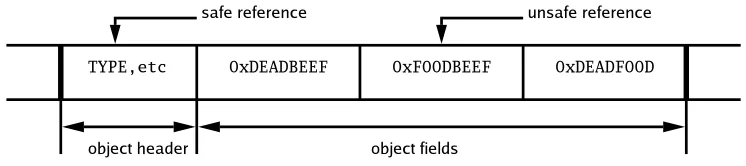
During the cycle detection process, it is important that the cycle detector only refer-ences areas of memory that contain object headers for live or unclaimed objects. This property will be referred to as thesafetyproperty.
The safety property implies that the cycle detector will not end up accessing ran-dom memory regions when it attempts to traverse the object graph. If the cycle de-tector did not have this property, the virtual machine (VM) would enter an undefined state.1
For example, if the VM obtained a reference to the fields of an object, instead of an object header, an incorrect object type could be looked up, see figure 5.1. The VM would be tricked into thinking it was dealing with a different object and values on the heap would be treated as references to objects. When traversal of these references was attempted, access to “random” memory regions would result.
It is acceptable for the cycle detector to access a reference to a dead object provided it has not been collected and its space re-allocated or cleared. This is because the object header (and thus the object type) along with any references will remain on the heap
1Under Linux, most likely a segmentation fault would be generated, crashing the VM.
COLLECT-CYCLES()
1 // Check if cycle detection is required
2 ifshouldCollectCycles()
3 then
4 mark()
5 processPurples()
6 scan()
7 processKillQueue()
8
9 else ifshouldFilterPurple()
10 then
11 f ilterPurple()
[image:46.595.90.463.361.444.2]Algorithm 5.1: Top level view of the mark scan cycle detection algorithm.
Figure 5.1: Example of a safe and an unsafe object reference.
until reallocation. To help ensure dead objects are not reallocated while the cycle detector is using them, flags are set in the object header indicating the the object is “in use”. Since the normal collection process will retain flagged objects, it is up to the cycle detector to cleanup any objects that become (or already are2) garbage.
5.1.2 Completeness
The cycle detector must ensure that all cycles are eventually detected and reclaimed, this property will be referred to ascompleteness. If the cycle detector did not satisfy this property, the VM would leak memory and would eventually run out of memory. Further, it implies that every possible cycle root considered is correctly identified the first time. This condition arises because a cycle with no remaining references will not receive any further pointer mutations due to the nature of garbage objects.
§5.2 Non-concurrent Cycle Detector 29
MARK()
1 // Add all roots into the marking queue
2 markQueue←roots
3
4 while¬markQueue.isEmpty() 5 do
6 ob ject←markQueue.pop() 7
8 // Only traverse unmarked subgraphs
9 ifob ject.testAndMark()
10 then
11 forchildinob ject.children()
12 do
13 markQueue.push(child)
Algorithm 5.2: Mark the graph of live objects.
5.1.3 Correctness
The cycle detector must only collect objects that are actually garbage; this property is thecorrectness property. If the cycle detector was not correct and reclaimed arbitrary objects from the program running on the VM, spurious NullPointerException
orClassCastExceptions could be thrown inside the program. Since the VM also
performs garbage collection on its own data structures, core components of the VM such as compiled methods, could be reclaimed therefore causing the VM to crash.
5.2 Non-concurrent Cycle Detector
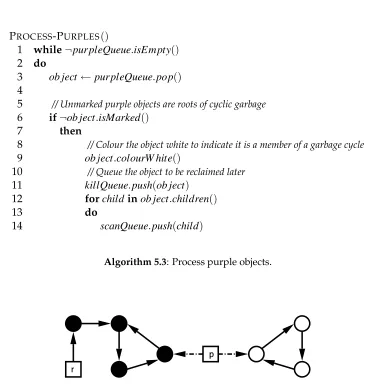
In the non-concurrent case the cycle detector runs in a stop-the-world setting. A top level overview is described in algorithm 5.1. The cycle detector performs a mark of all live objects in the heap starting from the roots, see algorithm 5.2. Since the garbage collector has stopped all other threads from running, no special precautions need to be taken during marking. It then examines all possible roots of cyclic garbage obtained after the previous collection, see algorithm 5.3. If any of these objects are unmarked it cannot be attached to the graph of live objects and is therefore a root of a garbage cycle, see figure 5.2.
PROCESS-PURPLES()
1 while¬purpleQueue.isEmpty() 2 do
3 ob ject←purpleQueue.pop() 4
5 // Unmarked purple objects are roots of cyclic garbage
6 if¬ob ject.isMarked()
7 then
8 // Colour the object white to indicate it is a member of a garbage cycle
9 ob ject.colourW hite()
10 // Queue the object to be reclaimed later
11 killQueue.push(ob ject) 12 forchild inob ject.children()
13 do
14 scanQueue.push(child)
[image:48.595.89.479.94.478.2]Algorithm 5.3: Process purple objects.
Figure 5.2: Example of a marked live cycle (left) and unmarked dead cycle of garbage (right).
5.2.1 Allocation
It is possible for a program to allocate a cycle that is never connected to the graph of live objects,3consider figure 5.3. In the depicted example it is possible for the created cycle to be considered live by the cycle detector if the objects allocated have the op-posite mark state to the graph of live objects. In this case, the cycle detector would consider the cycle to be live after the next mark and leave it uncollected. To avoid this possibility, all objects must be marked with the current mark state after allocation. Then when the next mark occurs, any garbage cycle will always be coloured opposite to the graph of live objects.
§5.2 Non-concurrent Cycle Detector 31
SCAN()
1 while¬scanQueue.isEmpty() 2 do
3 ob ject←scanQueue.pop() 4
5 // Unmarked purple are roots of cyclic garbage
6 ifob ject.isMarked()
7 then
8 // Decrement the object’s reference count (a reference from cyclic garbage).
9 decrementQueue.push(ob ject) 10
11 else if¬ob ject.isW hite()
12 then
13 // Colour the object as member of a garbage cycle
14 ob ject.colourW hite()
15 // Queue the object to be reclaimed later
16 killQueue.push(ob ject) 17 forchildinob ject.children()
18 do
19 scanQueue.push(child)
Algorithm 5.4: Process the scan queue.
5.2.2 Filtering Possible Cycle Roots
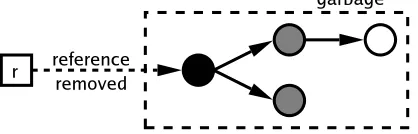
It is possible that an object becomes a candidate cycle root, but before cycle detection can run it becomes garbage. To help reduce the load on the cycle detector, the buffer containing the possible cycle roots is filtered. The filtering process removes any dead objects from the buffer and places them onto a kill queue. If the size of this buffer is small enough after the filtering (if enough memory has been reclaimed), a full mark and scan of the heap can be postponed until a later collection.
5.2.3 Reclaiming Garbage Cycles
After a root of a garbage cycle has been identified, the algorithm traverses the garbage cycle and flags any unmarked objects as cyclic garbage, see algorithm 5.4. Flagging objects as cyclic garbage prevents them being traversed more than once (as will oth-erwise happen with cyclic garbage). The flagged objects are also added to a kill buffer to be reclaimed at the end of cycle detection.