ll
EUR-JET-R7
THE JET PROJECT
JOINT
Acknowledgements
The JET Design Team is especially indebted to the members of the Associated Laboratories for their valuable work and interest in the project, and especially for their contribution to the JET Workshops. This co-operation between the Design Team and the Associated Laboratories is essential to ensure that JET develops as a true Community project.
The team w1shes to acknowledge the collaboration and encouragement of the Directorates of the Associations and of the Commission. The Design Team is grateful for help and advice from the members of the Supervisory Board, and the Scientific and Technical Committee.
The JET Design Team finally takes pleasure in thanking Dr. R. S. Pease and all the members of the Culham Laboratory for their warm welcome and effective help during the design phase of the project.
P. H. Rebut
This document has been compiled and edited by Dr. M. Bauer IPP), Mr. J. Maple UKAEA) and Dr. J. Sheffield (EUR-UKAEA). The introduction was contributed by Dr. D. Palumbo (C.E.C.).
The preparation for publication has been undertaken by Mr J. L. Hall, Mr. P. J. Oliver and the Documentation Service, UKAEA, Culham.
The help of the illustrators is particularly appreciated.
The technical sections of EUR-JET-R7 are based upon the detailed design proposal EUR-JET-R5 and on the summary of JET Workshops given in EUR-JET-R6 Enquiries about these documents should be sent to the address below.
© Commission of the European Communities 1975
Enquines about copynght and reproduction should be addressed to
COr.!liTSSION OF TEE EUROPEAN COZ.l:MUNITIES Directorate General XII
Fusion Programme Rue de la Loi, 200
THE JET PROJECJ"
Introduction
EUR-JET-R7 August 1975
In recent years there have been many significant advances in the research program for the utilization of fusion energy which encourage the belief that this important program will have a successful conclusion.
These advances are the reason for the proposed expansion of the fusion research program, both in staff numbers and especially in the scale of the experiments.
There will certainly be an increasingly wide public involvement and interest in this rapidly developing field. It therefore seems appropriate at this time, when the Commission has proposed to the Council the adoption of the Fourth European Fusion Program, in which the Joint European Torus (JET) constitutes a principal part, to prepare this description of JET which is intended for the non-specialist and for industry. To industry, because in the long term, when the current research is successful, industry will have the responsibility for the construction of the fusion reactors; and because in the short term industry will provide the laboratories with many of the large and complicated components of the experiments.
In appreciation of the differing needs of the potential readers we have included both a short section introducing the fusion field and also a more technical section describing the JET apparatus.
The reader may be surprised at the scale of the proposed JET experiment, hundreds of tons of copper and steel and a cost of more than 100 MUC. This is, however, a consequence of the laws of nature which make it impossible in practice to produce and magnetically confine, for an appreciable time, a toroidal thermonuclear plasma having a volume less than many cubic metres. The advances made in fusion research with smaller apparatus are such that the stage has now been reached where a definitive experiment is required with dimensions large enough to permit extrapolation of the results to future reactor designs.
This increase in scale is not peculiar to JET but covers the entire fusion field, and is in evidence throughout the world program. In fact in the U.S.A., U.S.S.R. and JAPAN, machines comparable to the European
Communities JET machine, have been proposed as part of expanded fusion programs.
The dimensions of such an expanded program certainly require, in the European framework, that the member nations should pool their resources. This has been a major aim of the Commission in this field, and the successful initiation of the JET project is evidence of the good progress in this direction. In a relatively short time it was possible to assemble at Culham personnel, from the associated laboratories, represent-ing all the areas of expertise involved in this field. As a result of the effective management of this team, working in close collaboration with the Associated Laboratories, the design has been rapidly and successfully completed.
D. Palumbo
THE JET DESIGN TEAM (May 1975)
!lead of Project
P H Rebut (C.EA)
Mr:> A Lvraud (CE-\)
PhysiCS, Add Heatmg,
Vacuum and TorOJdal Fteld Cod Polmdal J<teld Tormdal F1eld Diagnostics, D1vertor,
Actlvatwn and Mechamcal Sy<>tem Po\\ier O..,upphes Plannmg, Sttt Cost Scalmg Structure
A Gtbson ( UKAEA) D Eckhartt (IPP) M Huguet (CEA) D L Smart (UKAEA) E Bertohm \C'NFN l J P Puffe (EURJ
Admmistratlon
M Hauer ( IPP J W Core (UKAEA) M Bernardm1 (CNEN) T Arthur (UKAEA) P Dokopoulos (KFA) V Coccorese (CNEN l G Audmn (CE.A) Mrs J Clark (UKAF AJ B Green (IPP) H Clerc (CEA)• * I Batley (UKAEA) H Goss (IPP) R llibberd (UKAEA.) G Mannhardt (!pp) Mrs K h.ot7lowski (!PP) D Marty (CEA) C Froger (CEA) J Booth ( UKAEA) P IldhngmJ.n (FOMl J ll!ck~ (UKAEAl Mrs W Pnll WK.\EA)*
P Noli (KFA) D Grey (UKAEA) M Duqueno> (CEA) J La1ot (UKAEAl Mrs D Newton (l'K<\EA)* H Vcrbeek (£LJH) H Oosterom (FOM) K Jensen (AEK) Mrs C Ludescher (IPP) C Raymond (UKAEA) K ~elm (AFR)
C Pellegnm (CNEN) J Keen (UKAEA) C Lyraud (CEA) R Schole~ (UKAEA )* * J Sheffield (UKAEA) H Kotzlowsk1 (IPP) I Marren (UKAEA) P T1gwell (UI\.-\EA) Mrs J Woodage (UKAEA) G Rappe (UKAEA) R Pohlchen (!PP) A van Wees (FOM)
M Snykers (EB) T Ra1mundJ (CNEN) Mrs J Wood WK•\EAJ G Venus (I PP) L ~onnerup (AFR)
half-t1me
Table of Contents
Page
1. What is JET? 1
2. What is Fusion? 2
3. Why Fusion? 5
4. Conditions for Fusion 6
5. Confinement of a Plasma 7
6. Heating of a Plasma 10
7. The Tokamak Confinement System 12
8. The World Tokamak Program 14
9. Objectives of JET 17
10. Main Parameters of JET 18
11. Description of the JET Apparatus 20
11.1 Vacuum System 22
11.2 Magnetic Field System 24
11.3 Power Supplies 28
11.4 Additional Heating 30
11.5 Diagnostics and Controls 32
12. JET Construction. Phase 34
13. JET Experimental Program 37
14. European Collaboration in Fusion Research 40
14.1 In JET Design 43
14.2 In JET Construction 46
15. Involvement of Industry 49
Symbols 50
Surface of the sun
I
What
lS
•JET?
JET (JOINT EUROPEAN TORUS) is an experiment in a program which has the ultimate aim of utilising a new source of energy.
This is the energy released by the fusion of the nuclei of light atoms, the energy source of the SUN.
New sources of energy are required to meet the increasing world energy demands. The increased supply is needed not only because of the increase in world population and in the rapid growth of modern industrialised society, but also because of the need to raise the living standards of the developing countries.
Present day energy production is based mainly on the fossil fuels, oil, coal and natural gas. These fuels cannot supply the needs of the world indefinitely and in any case have such a value as chemicals that as they become depleted they will be too precious to burn simply for the purpose of producing electricity.
It is desirable to develop for the future as many alternative sources as possible. New sources of energy include nuclear, solar, geothermal, tidal and wind power. Nuclear power in the form of nuclear fission power stations has already made an impact on electricity production in a number of countries. There are however, two possible sources of nuclear energy:
FISSION and FUSION
2
What
is Fusion?
All matter whether it is a solid, a liquid or a gas is made up of millions of tiny particles called atoms. The heart of every atom, called the nucleus, consists of a mixture of two elementary particles called protons (p) and neutrons (n). Orbiting around the nucleus is a swarm of electrons, in number as many as the protons in the nucleus, making the atom look like a very small solar system. The weight of the atom is mainly in the nucleus and corresponds to the number of protons and neutrons. Thus the 'lightest' atom Hydrogen (H) has 1 proton and 1 electron, a heavy hydrogen atom Deuterium (D) has 1 proton, 1 neutron, and 1 electron, while an even heavier hydrogen atom Tritium (T) has 1 proton, 2 neutrons and 1 electron. An example of a very heavy atom is Uranium (2 3 5 U) which has 92 protons, 92 electrons and 14 3 neutrons.
H D
Experiments have shown that the forces (binding ener-gy) \1\hich hold the nucleus together vary from one type of atom to another. The re-arrangement of the protons and neutrons in certain nuclei into other groupings can lead to the release of large amounts of surplus binding energy (or 'nuclear glue'). This is illustra-ted in exaggeraillustra-ted form op-posite.
T
Energy
Released in Fusion
Atomic Mass
u
D Deuterium
3He Helium 3
T Tritium
Li Lithium
4
He Helium4
•
• In the nuclear FISSION process, large nuclei of, for example, uranium and plutonium are split into smaller nuclei by the impact of neutrons. This releases vast amounts of binding energy which can be harnessed and converted into electricity. All present day nuclear reactors work on this principle, for example:
0
---•
n + U Ba + Kr + neutrons + Energy
• The nuclear FUSION process, however, relies on releasing the binding energy by fusing or joining together lighter nuclei to make a heavier one, for example:
D
-\.
'
--~
\
+ T 4He + n + Energy
Table 1 Fusion Reactions
D + D ~ 3He + n + 5.2 X 10- 13 Joules
D + D ~ T + p + 6.4 X 10⁻¹³ Joules
D + T ~ 4He + n + 28.2 X 10⁻¹³ Joules
D + 3He ~ 4He + p + 29.4 X 10⁻¹³ Joules
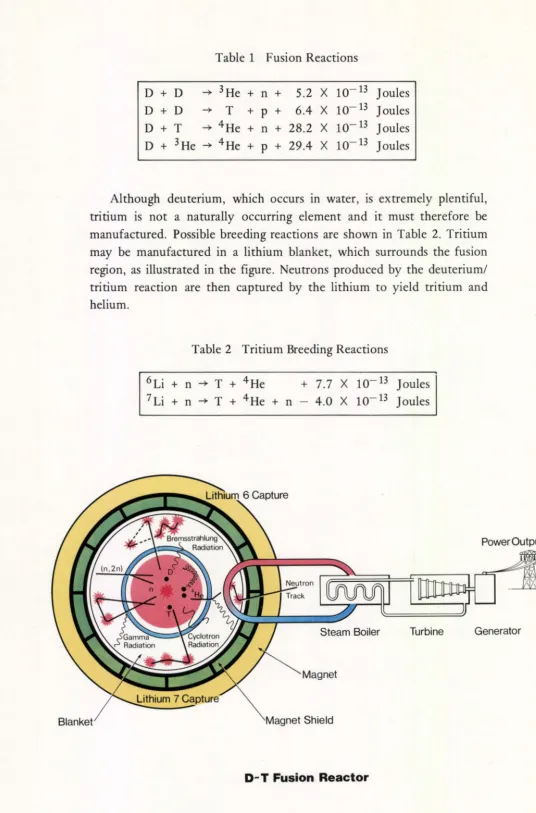
Although deuterium, which occurs in water, is extremely plentiful, tritium is not a naturally occurring element and it must therefore be
manufactured. Possible breeding reactions are shown in Table 2. Tritium may be manufactured in a lithium blanket, which surrounds the fusion region, as illustrated in the figure. Neutrons produced by the deuterium/ tritium reaction are then captured by the lithium to yield tritium and helium.
Table 2 Tritium Breeding Reactions
6Li + n ~ T + 4He + 7.7 X 10- 13 Joules 7Li + n ~ T + 4He + n 4.0 X 10- 13 Joules
Power Output
Steam Boiler Turbine Generator
Blanket Magnet Shield
[image:10.588.16.552.14.826.2]3
Why
Fusion?
The energy needs of the world in the future are so great that all sources of energy should be seriously studied. The present understanding is, however, that only nuclear energy - FISSION and FUSION - can meet the long term needs of Europe. Thus the advantages of fusion are seen mainly in a comparison with fission. It must be emphasised that, given the magnitude of the energy problem, one should think of the systems as complementary rather than as alternatives. Research on fission reactors points to the likelihood of breeder reactors being successful as the basis of generating stations. Fusion is at present at a much earlier stage but offers the possibility of several long-term advantages.
( 1) Fusion is intrinsically cleaner because the ultimate fusion products (mainly helium) are non-radioactive and harmless. The radioactivity produced by neutron irradiation in the structural materials of the fusion reactor may at worst, depending on the structural materials used, be comparable with that in a fission reactor.
(2) The amount of fuel in the reactor zone is expected to be so small that there is no prospect of a dangerous nuclear runaway. The nuclear heat produced after a shutdown does not present a serious problem. Safeguarding against the misuse of the system is easy. The tritium processing may be undertaken on site; this eliminates the dangers associated with the offsite transportation of radioactive fuel. The time to replace the tritium fuel, by breeding in the blanket, is small.
4
Conditions for Fusion
Fusion reactions are difficult to achieve because the deuterium and tritium nuclei each have a positive electric charge and therefore strongly repel one another. Fusion will only occur if the nuclei approach each other at very high velocities, sufficient to overcome their mutual electrostatic repulsion.
HEATING
Abundant fusion reactions can be obtained by HEATING the gaseous deuterium-tritium fuel to a temperature of 100 million degrees or above. Already at considerably lower temperatures than this the gas becomes IONIZED - that is, the electrons are dislodged from the atoms. In this state the separate electrons and nuclei move freely.
The physical properties of such an assembly of particles are so different from those of a normal gas that it is given a special name PLASMA. It is often referred to as the 4th State of Matter, solid, liquid and gas being the other three. In nature plasma occurs in the sun, stars, aurora and in the tails of comets. Plasma is the glowing material in fluorescent lights, circuit breakers, etc.
CONFINEMENT
Gas
Plasma
In order to obtain more energy out than is put in 1t 1s necessary to CONFINE the plasma for long enough so that sufficient fusion reactions can take place. The required CONFINEMENT TIME ( r) for a 100 million degree plasma depends upon the DENSITY (n). The requirement, known as the LA WSON CRITERION, is that the product nr is greater than about 1014cm- 3 s, thus at a density of 1014 particles per cubic centimetre (1014cm-3) the particles must be confined on average for about 1
second. At lower densities the confinement time would have to be longer.
Summary of Conditions for Fusion TEMPERATURE ,...., 100 000 000 degrees
5
Confinement of a Plasllla
High temperature plasmas have a natural tendency to expand unless restrained in some way, since the individual particles, electrons and nuclei which constitute the plasma are moving at very high speeds (typically a few million kilometres per hour). Fusion plasmas in the Universe - the sun and the stars - are held together by large gravitational forces. Gravitational forces, however, are too small for apparatus of a terrestrial
scale.
On earth we must find some way to confine hot plasma, but in a more convenient sized module.
The plasma must be confined in a non-material container, smce no matter can withstand the high temperatures without vaporising and cooling the plasma by contamination. This in turn must be contained within some material container, a high vacuum vessel, so that the composition of the plasma can be controlled.
Without Magnetic Field Charges in a Magnetic Field
MAGNETIC CONFINEMENT
Plasma in a Magnetic Field
Plasma is a very good conductor of electricity and it can be influenced by magnetic fields. Magnetic confinement has been under investigation for over 25 years, and is the approach to be used in the JET experiment. The charged particles which constitute the plasma follow helical paths around the magnetic field lines, and may therefore be isolated from the material walls. They are contained in the magnetic bottle while they are heated and
react.
A number of comments can be made about magnetic confinement.
• Some arrangements of plasma and magnetic field are UNSTABLE, that is the plasma can escape from the magnetic bottle much more rapidly than by simple diffusion.
• The simplest arrangement is straight and OPEN ENDED. By increasing the fields at the ends we can reflect some particles back and forth (MIRROR) but the end losses appear at present to pose severe difficulties for a fusion reactor.
• To eliminate the ends the field lines are bent to close on themselves within the vacuum container. This is known as a TOROIDAL MAGNETIC FIELD (BTOR). Unfortunately, the plasma drifts side-ways to the wall in this field system. The drift can be overcome by the addition of a second field around the minor diameter - POLOIDAL MAGNETIC FIELD (BPOL) - which gives the resultant field a twist and provides compensating drifts.
• A promising magnetic confinement system of this type is the TOKAMAK in which the poloidal magnetic field is produced by a current lP flowing through the plasma itself. The plasma is the secondary winding of a transformer. JET is a TOKAMAK.
• Other systems use external coils to produce the extra field (Stellara-tor), or have different ratios of the two fields (Pinch Devices).
• Due to collisions particles can transfer from one field line to a neighbouring one and cross the field. This process is called DIFFU-SION.
• An important feature of the diffusion process is the rapid increase in confinement time obtained with increase in the scale of the system.
INERTIAL CONFINEMENT
MIRROR MAGNETIC FIELD
TOROIDAL MAGNETIC FIELD
TOKAMAK
Losses
,Coils
I
Magnetic Field
Bpol
~.····
Btor r~· .-'-!...!' .... ,,A~~;;
Particles Contained
Plasma
Losses
Particles Drift Out
Pnmary Winding
J+,-...,.:...a..._~ - - - Plasma
Iron Transformer Core
6
Heating of a Plasma
In a reactor the a-particles (the nuclei of helium 4 He produced by the fusion of deuterium and tritium) will provide the heat to sustain the plasma temperature. The a-particles will be trapped by the confining magnetic fields and will slow down by collisions with the plasma particles, heating them. In present experiments, which work at temperatures too low for significant fusion heating, other methods must be used. This will also be the case during the start-up of a reactor when the temperature has to be raised to the fusion level.
OHMIC HEATING
The main heating method in Tokamaks and in many other magnetic confinement devices is the Ohmic or Resistive heating due to currents flowing in the plasma. This heating is similar to that in an electric heater element or in a light bulb.
A problem with the application to plasmas, when the currents are steady, is the decrease in plasma resistance as the temperature rises. The losses on the other hand, for example by radiation, generally increase with temperature. The temperature reached when the losses balance the heating is therefore limited.
Additional heating methods are therefore needed. Among those which have been used are
NEUTRAL INJECTION
Hydrogen atoms are injected with very high speed. They are electrically neutral and cross the magnetic field, where they are ionized by the plasma and are then trapped by the magnetic field. They may then be confined by the field, and slow down transferring their (kinetic) energy to the plasma by collisions, thus heating it.
RADIO FREQUENCY HEATING
ADIABATIC COMPRESSION
The magnetic field is raised rapidly; as a consequence the plasma is compressed and heated. This may be achieved by moving the plasma to a region of stronger magnetic field.
Oscillator
I
RADIO FREQUENCY HEATINGOHMIC HEATING
Current
Atoms Ionised and Trapped
Cross Section showing Alternative Plasma Arrangement for ADIABATIC COMPRESSION
Energetic Hydrogen Atoms
NEUTRAL INJECTION HEATING
lonDump7
Neutraliser
In present Tokamaks temperatures of more than 10 million degrees have been reached with ohmic heating. Neutral injection and radio frequency heating have been successfully applied; in both cases with power levels of about 100 kilowatts the temperature rise was about 2 million degrees. Temperatures have been more than doubled by adiabatic corn presswn.
7
The Tokamak
Confinement System
This type of confinement system was first developed in the U.S.S.R., and has the general form shown in the figure opposite. This figure reflects the choice of design options made for the JET Tokamak.
The main components of the Tokamak and their respective functions are listed below.
• The plasma is contained in a ring-shaped vacuum vessel - TORUS. The vacuum is maintained by external pumps. The plasma is created by letting in a small puff of gas, inducing some ionization and then driving a current in it to ionize it completely and heat it.
• The plasma is confined by a MAGNETIC FIELD. This field is the combination of the TOROIDAL FIELD produced by a set of TOROIDAL FIELD COILS which link the torus, and the weaker POLOIDAL FIELD produced by the current flowing in the plasma (see section 5).
• The PLASMA CURRENT is induced by a transformer, of which the plasma is the Secondary Winding. The Primary Winding of the transformer and the subsidiary Equilibrium coils, which give the fine control of the position and shape the plasma, are called POLOIDAL FIELD COILS.
• Large POWER SUPPLIES are used to generate the strong magnetic fields (up to 100 kilogauss) and large plasma currents (up to 400 000 amperes in present Tokamaks).
• Powerful ADDITIONAL HEATING systems are used to augment the heating of the plasma current (see section 6).
• The coil and plasma currents and plasma content and density are in general pre-set by the CONTROL SYSTEM. Fine adjustments may however be made by using FEEDBACK SYSTEMS which are controlled by measurements on both the apparatus and the plasma i.e. DIAGNOSTICS.
Power Supplies
-fr==i-- ---:
/ \ 1 Static Rotating
High Voltage Line
!
systeml
r
system 1I I
Toroidal Field
Equilibrium Id
Adjust operating conditions
: Rectifiers :
I I
I I
L - - - _ _j
Poloidal Field
Auxiliaries Additional (Water cooling, Pumps) Heating
(Neutral injection, Magnetising
Coil
Iron Transformer R. F. etc.) Core
Data acquisition monitoring control system
Data analysis
~
andinterpretation
Device T-3 T-4 ORMAK ST ATCt 11--'E' PL'L'>\lllR ALCATOR
8
The World Tokatnak
Program
Tokamak research, initiated in the U.S.S.R., is now a major part of the world fusion effort.
The Tokamak is a relatively simple device for the production and confinement of large volumes of high temperature plasma at a density level relevant to reactors. It is therefore of interest not only as the basis of a fusion reactor, but also as a workhorse for the investigation of areas of general importance to the fusion program.
Thus there are Tokamaks which are designed to extend the scaling of the plasma confinement parameter (nr) and temperature (T) towards the reactor regime and there are others which will investigate specific problems such as heating, plasma shaping and plasma cleanliness.
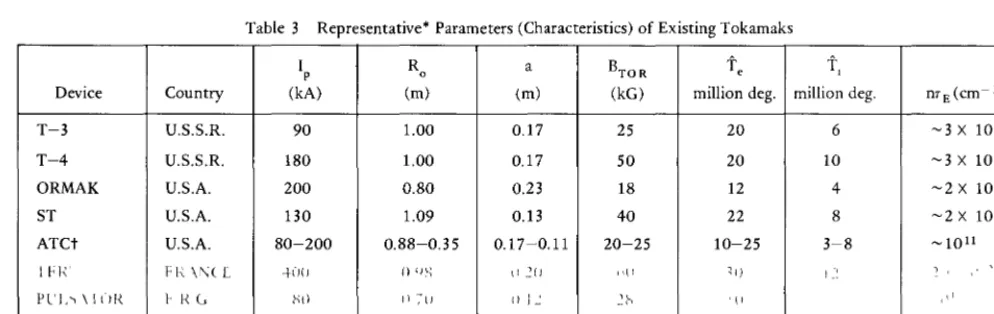
These roles are represented in the wide range of machines, existing and under construction, of which some examples are given in Tables 3 and
4.t
Table 3 Representative* Parameters (Characteristics) of Existing Tokamaks
I p R 0 a BTOR Te t,
Country (kA) (m) (m) (kG) million deg. million deg.
U.S.S.R. 90 1.00 0.17 25 20 6
U.S.S.R. 180 1.00 0.17 50 20 10
U.S.A. 200 0.80 0.23 18 12 4
U.S.A. 130 1.09 0.13 40 22 8
U.S.A. 80-200 0.88-0.35 0.17-0.11 20-25 10-25 3-8
FJ;: \1\( [ +OIJ () () ~~ () ~0 !I( I ::1) i_-:
J~ R (, -~t) tl ~(I \) J -~ 2h (I
U.S.A. 160 0.54 0.095 60 18 6
•
t
These numbers represent normal operatwn rather than maximum capability The two values refer to initial and compressed states
nrE (cm-3 s)
-3 X 10¹¹
-3X 10¹¹
-2 X 10¹¹
-2 X 10¹¹ -1011
) '
[image:20.582.41.538.475.632.2]Table 4 Principal Tokamaks under Construction
Device Country lP (MA) R0 (m) a(m) BTO R (kG)
DITE0
U.K. 0.28 1.12 0.23 28
PLT U.S.A. 1.4 1.30 0.45 46
FT0
ITALY 1.0 0.83 0.21 100
T- 10 U.S.S.R. 0.8 1.50 0.35 50
PDX U.S.A. 0.50 1.40 0.45 50
ASDEX0
F.R.G. 0.50 1.54 0.40 30
DOUBLET 3 U.S.A. 2.5- 5.0 1.40 0.45 ; 1.50 26(42)
(a ; b)
:j:A glossary of symbols and units is given at the end of this document.
b
_l
At the present time the highest values of m and T in the world have been achieved in the laboratories associated with Euratom. JET is a logical extension of this work as a part of the continuing European Tokamak program. It should not only raise m
and T well towards the reactor regime but also contribute significantly in such areas as plasma-wall interaction and plasma heating. It will be joined by other large T okamaks which are proposed by the other countries with large fusion programs, TFTR (U.S.A.) and JT- 60 (Japan). In the U.S.S.R. an even bigger machine,
T- 20, is proposed. This is expected to
go into operation after JET and the others. The machine parameters are shown in Table 5.
Table 5 Proposed Large Tokamaks
Device Country lP (MA) R0(m) a( m) b(m) BTo R (kG)
JET0
E.E.C. 2.6(4.8) 2.96 1.25 2.10 27.7(34.5)
TFTR U.S.A. 2.5 2.48 0.85 0.85 52
]T- 60 JAPAN 3.0 3.0 1.0 1.0 50
105.----,---~
~
lE u -~ c Gl~
10
4..
cGl
E
Gl
c
·-...
c0 u ~ c ftl :» ~ Ill
c 13
Gl 10
~
...
0
..
u:2 ~ 0 ~ a. I ~ Gl
..
GlE
ftl
~
ftl 12
C.10
..
cGl
E
Gl
c
...
c0
u
Region of JET operation The wide range of the parameters reflects the uncertainty in
- the extrapolations and the range of poss modes of operation
Expected region of
Reactor Domain
experiments under construction
Present experiments
1d1~----~--~-L~~~LL~----~--~~~~-L~~----~---L~--L-~~~
1 10 100 1000
...
Peak temperature in million degrees Ti
9 Objectives of
JET
Detailed studies in the present, relatively small Tokamaks have produced a consistent pattern of encouraging results. Plasmas with increasingly high temperatures have been isolated and controlled for progressively longer times. The knowledge gained from small scale apparatus shows that higher temperatures and longer confinement times can only be achieved in large machines with large plasma current.
The essential objective of JET is to obtain and study a plasma in conditions and dimensions approaching those needed in a thermonuclear reactor.
These studies will be aimed at defining the parameters, the size and the working conditions of a Tokamak reactor. The range of values of (nr) and (T) expected in JET are indicated opposite.
Under these conditions the following studies will be made:
(1) The study of plasma processes and scaling laws into regions close to those needed in a thermonuclear reactor.
(2) The study of the behaviour of energetic a-particles (the nuclei of helium 4He) produced by the fusion of deuterium and tritium. In a reactor, the a-particle energy will sustain the plasma temperature.
( 3) The study of methods of heating the plasma to temperatures at which in a reactor the energy released in fusion reactions would sustain the plasma.
( 4) The study of the interaction of the plasma with the torus walls. This is important because the effects of impurities (driven from the walls) on the plasma and the lifetime of the walls in a reactor are still unknown factors.
ro
Main Parameters of JET
The Tokamak design described here is the culmination of studies initiated by the Joint European Torus Working Group in 1972, and undertaken by the JET Design Team (October 197 3-197 5) working in close collaboration with the Associations.
The design philosophy has been to achieve the JET objectives with a machine based as far as possible on well-established engineering tech-niques. Within this frame-work, great attention has been paid to achieving the most cost-effective design.
• The main parameter is the plasma current which not only heats the plasma but also provides the poloidal magnetic field. Experimental and theoretical investigations have confirmed that both T and m
increase with this current. A plasma current of 3 million amperes, in basic operation, has been chosen. This level will permit a significant scaling from earlier Tokamaks and should provide good containment of the energetic fusion a-particles.
• The level of current permitted by stability considerations depends upon the aspect ratio (R
0/a) of the torus, the strength of the toroidal
magnetic field, and the size of the plasma. The most cost-effective design to meet the JET objective is found to be a fat torus with an aspect ratio of about 2.4 with a major radius of about 3 metres.
• The maximum toroidal magnetic field at the centre of the plasma which may be achieved at this aspect ratio, with low technological risk, is about 30 kilogauss.
• The toroidal field coils which have the lowest mechanical stress are D-shaped in profile and this shape has been chosen for JET. In addition this shape is a desirable feature because of the interest in investigating non-circular cross section plasmas.
Main Parameters of JET
Plasma minor radius
(horizontal) a 1.25 m
Plasma minor radius
(vertical) b 2.10m
Plasma major radius Ro 2.96 m
Plasma aspect ratio R
0/a 2.37
Plasma elongation ratio b/a 1.68
Flat top pulse length 20 s
Weight of the vacuum vessel 80 t
Weight of all the toroidal
field coils 380 t
Weight of the iron core 1500 t
Basic Extended* Toroidal field coil power
(peak on 13 s rise) 245MW 380MW
Total magnetic field
at plasma centre 27.7 kG 34.5 kG
Plasma current:
- circular plasma 2.6 MA 3.1 MA
- D-shape plasma 3.9MA 4.8MA
V oh-seconds available to
drive plasma current 25 Vs 34 Vs
Additional heating power 4-10MW "'25 MW
n
Description of the
JET Apparatus
The general form of a Tokamak is discussed in section 7. Some general information on the components of JET i"s presented below.
• The vacuum vessel - TORUS - is made of eight stainless steel sections, which are welded together. The total weight is 80 tonnes -see section 11.1.
• There are 32 TOROIDAL FIELD COILS made of water-cooled copper conductors, total weight 380 tonnes -see section 11.2.
• The POLOIDAL FIELD COILS are also constructed of water-cooled copper, total weight 80 tonnes. The transformer efficiency is improved by an eight-limbed IRON CORE, weight 1500 tonnes - see section 11.2.
• The POWER SUPPLIES are a combination of power from the network and motor generator flywheel sets. The initial capacity will be an average power 180 MW energy dissipated per pulse (20 s), 3600 megaj oules - see section 11.3.
• ADDITIONAL HEATING will be provided by Neutral Injection, Radio Frequency Heating and Adiabatic Compression. Initially at a level of 4 MW - see section 11.4.
• The CONTROL CIRCUIT and DIAGNOSTICS will be linked by computers which will provide fast feedback control of the plasma and apparatus and will assist in analysis of the measurements between pulses - see section 11.5.
With apparatus the size of JET, changing a part or repairing a failure is a time-consuming process. Consequently special provision must be made to permit efficient assembly and dismantling and components must be reliable, thus
• The design of the apparatus is modular
• Large single units are made from sets of identical smaller components, suited to serial production.
• The poloidal field coils are outside the toroidal field coils eliminating undesirable topological links.
...
The JET Apparatus- Elevation
500 1!00
H)oo 2000
millimetres
The JET Apparatus- Plan
4 tor.Hdoln.tdColl•
...
I l'oloidellrlltldtoilt.(lat.<flall
1 PoloOdalrloldtoils(C...Irol) I tAWnal ...,_le Circuit llblkiiV_,_, IO'M1ic1111VIewl'ort(Large) 11 'NrlkaiV ... I'ort(S...OII) 12 Coollr>g P!pn
13Ctyo~
Vacuum Chamber Limiter 3 Bellows Shield
1o Toroidat Field Coils Structure
Potoido:l Field Coils (External) Poloidal Field Coils (Central) Eaternal Magnetic Circuit
9 Radial Vft Port tO Vertical Vi- Port (Large) 11 Vertical View Port (Small)
12 Cooling Pipes
ll Cryo Pumps
11.1 VACUUM SYSTEM
In order to minimize the plasma loss arising from interactions with background gas particles, the plasma is contained in an ultra-high vacuum system.
The JET vacuum chamber is composed of a series of box sections joined together with thin flexible bellows, the whole made of high nickel content stainless steel. This structure is able to withstand the forces of atmospheric pressure, 20 tonnes on each of the 3 2 rigid sectors, and those associated with the currents induced during the rise of the toroidal magnetic field, an additional 10 tonnes per sector.
The inner walls of the vacuum chamber must be extremely clean (a base pressure of 1
o-
1 0 torr is specified) to minimise the level of impurities released from it. This is obtained by using a completely welded structure, which may be baked to 500°C to remove gas from the walls. Discharge cleaning by bombardment with low energy plasma particles will also be used.The chamber is in eight sections, and the welds between sections are designed to be easily opened to facilitate remote handling.
From an electrical viewpoint, the vacuum vessel must not short-circuit the plasma. The bellows sections are included in order to increase the electrical resistance to a level high compared to the resistance of the plasma.
A series of protective shields prevents the plasma from touching the bellows. In addition, a series of plates a few centimetres inside the plasma wall defines the plasma boundary: these are known as LIMITERS. Various materials, with good thermal properties, ranging from tungsten and molybdenum to ceramic compounds of boron and carbon are being investigated for use as limiters.
Access to the plasma for additional heating and diagnostics is provided by large radial and vertical ports in the same radial plane.
PLASMA
I
l
1710
MODULE RIGID SECTOR
OCTANT JOINT
2500
PORT RIGID SEC "TOR
120
llloodulor
Restraint Rin9s
Support
Module Jont
Limiter Support
PLASMA
DETAIL OF INNER WALL
11.2 MAGNETIC FIELD SYSTEM
TOROIDAL FIELD SYSTEM
The toroidal magnetic field is produced by 3 2 D-shaped coils which
link the torus. These water-cooled copper coils produce a toroidal
magnetic field of about 30 kilogauss at the plasma centre. The field will be maintained for about 20 seconds, in each pulsed operation of the machine.
The shape of the coil is one which minimises the mechanical stresses.
A mechanical structure supports these coils against the forces arising from the interaction of the poloidal and toroidal field systems. The centering force of 1800 tonnes per coil is supported by the central column.
S«tion A-A
-d- •
j-: -: -1 -: i + l-H· H T \ l--: +I-: r--: :· l· i +ft (G:
I I ! l 1 I t ! I I !
·t ·; T ; T r 1 -r r -i T
l·+ i -l 1· t· 1
t+:
+-f-PARAMETERS OF ONE TOROIDAL FIELD COIL
Overall height Overall width Weight
Copper cross-section per turn: (average) inner part of coil
outer part of coil
Insulation thickness between turns Insulation thickness between pancakes Ground insulation thickness
5.68 m 3.86 m 12 t
2700 mm2
3900 mm2
2mm 8mm 6mm
·l
PARAMETERS OF THE TOROIDAL FIELD SYSTEM
Total resistance before a pulse (25°C) 61 mn
Total resistance after a pulse 67 mn
Total inductance 0.66 H
Inductance of one coil alone 4.4 mH
Basic Extended
performance performance
Total Ampere turns (MA) 41 51
Magnetic field at R
0
=
2. 96 m (kG) 27.7 34.5Nominal current (kA) 53.4 66.4
Peakvoltage (for adiabatic compression)
between turns (V) 12 12
between pancakes (V) 288 288
versus ground (kV) ±4.6 ±4.6
Resistive power (MW) 175 270
Equivalent square wave pulse duration (s) 30 20
Energy dissipated per pulse (GJ) 5.3 5.4
Magnetic energy stored (GJ) 0.94 1.45
late plate
+
POLOIDAL FIELD SYSTEM
The poloidal field coils mounted outside the toroidal field coils, have two main functions:
(a) To act as the primary windings for the transformer, of which the plasma is the secondary winding. This is the primary function of the coils wound around the iron core.
(b) To shape, position or compress the plasma. These are the pnmary functions of the coils wound around the outer part of the system.
A secondary function of these coils is to act like a copper shell and through induced eddy currents to suppress rapid motion of the plasma.
The addition of the massive iron core, with its eight return limbs, improves the efficiency of the transformer coupling and keeps to a minimum the power supplies required for establishing and maintaining the plasma current. In addition the return limbs give a significant reduction in the magnetic field outside the apparatus (stray field). This latter function is extremely important for the neutral injection and diagnostic systems.
Poloidal Field Coils - Physical Parameters and Performance Data
C01l Type No. 1 2 3 4
Designation Inner Inner Outer Outer
Conductor cross section (C.S) mmXmm 44 X 44 44X 44 29 X 29 29 X 52 Cooling hole diameter mm 15 15 12 12 X 22 Mean diameter of coil m 1.81 4.3 7.88 10 49 Total C.S. area including
insulation mZ 0.157 0.161 0.174 0.227
Total C.S. area of copper m2 0.111 0.093 0.087 0.122 Weight of copper/coil t 5 7 10 20.2 35 9 Weight of msulation/coil t 0.4 1.2 2.8 4.2
Number of coils reqUired 10 2 2 2
Max. current density in copper MA/m2 19.3 19.3 1.62 10.2 Max. current/conductor kA 34 34 11.8 13
Effective pulse length s 20 20 20 20
Adiabatic temperature rise oc 40 40 31 12 Total water flow lis (all cods) 24.5 5.6 55.2 90.2 Max. voltage between terminab
of each c01l kV 8 7 20 20
Max. voltage to earth kV 20 20 20 20
Max. hoop stress in copper kg/mm 2 5.9 - 0.67 2.0
r....-~r..._...,;...;....a.I'!::=~Ft~F===:ftt::1:f=-Pos it ions of coils 3 and 4 tor replacing
Maximum plasma volume
I
*
_ _j
I
...__..._
_
j
machine octant
11.3. POWER SUPPLIES
JET will operate in a pulsed mode, with a pulse length of up to 20 seconds, every 5 to 15 minutes. During this short pulse, very large peak electrical powers are required. It is proposed that the multi-megawatt pulses should be provided by a combination of power from the local network (static system) and from motor generator flywheel sets. The precise distribution between these alternative sources depends upon the site chosen for JET. An indication of the general form of the supplies is given in the figure below.
The toroidal field system is supplied through a combined scheme made up of a static unit which supplies up to 80% of the energy and a motor generator set which supplies up to 60% of the power. The energy stored in the coils will be 940 to 1450 megajoules* and the energy dissipated during the constant field period (20 seconds) 3600 to 5600 mega-joules*. The average power applied will be 180 to 280 megawatts*.
The poloidal field system is supplied by a motor generator set which provides a high voltage at the pulse start (zero current) and a high current at lower voltage subsequently. The amount of energy per pulse is about 1/5 of that in the toroidal system. The maximum power will be 160 to 230 megawatts*, to be applied in slightly less than one second. An indication of the time variation of currents is given in the schematic diagram opposite.
'\'
Pol01dal F1•ld Ampl1f1•rs
Addil1onal H•almg Pow•r Supply Sysl•m
"-..:
01od• Thyr~stors
1 - - - - " ' - .
Sl•p down
Transformer
20 - 33 kV
Load Toro1dal
F1•ld Coils
5 5 - 11 k V
Rectrfrer
"-..;;---l
010d• Rocllflor
Load Pololdal F1•ld Coils
Jet Main Power Supply Scheme
50
MA
turns
0
Total toro1dal coil current
~Pla~a
MA 3 - '""'"' 10 I 10Total pnmory
+15 current
MA turns 0 10 -15 20
T1me (s) 30
l
I I\
20 30
Time variation of representative plasma and coil currents
40 I 40 40
* *
_,.,0,$
Pow•r Suppl1•s
for AUXI[IQfi<ZS
11.4 ADDITIONAL HEATING SYSTEMS
The initial heating in JET is provided by the ohmic heating of the toroidal current. This should raise the temperature to the region of 10 million degrees. A problem with this method of heating is the way in which the plasma resistance decreases as the temperature rises, while the losses, owing for example to radiation, increase.
To achieve the objectives of JET and make full use of the great flexibility of the apparatus, the ohmic heating will be supplemented by additional heating.
The methods used will be those discussed in section 6.
• NEUTRAL INJECTION. Hydrogen nuclei will be accelerated up to 80 000 volts and then converted back to atoms in a neutraliser. These atoms cross the confining magnetic field and transfer their energy to the plasma. Deuterium atoms at energies up to 160 000 volts will also be used.
• RADIO FREQUENCY HEATING. Use will be made of the resonances at the 'Lower Hybrid Frequency' (about 1000 MHz) and the region of oscillatory frequency of the ions in the magnetic field 'Cyclotron Frequency' (about 5 to 50 MHz).
• ADIABATIC COMPRESSION. The plasma will be started in the outer region of the torus, and will be preheated by injection or radio frequency heating. It will then be moved rapidly to the inner part of the torus where the toroidal field is stronger. The resultant compres-sion will heat the plasma.
On present experiments significant temperature rises, more than 2 million degrees, have been obtained with these methods using about 100 kilowatts of power.
• The power supplies, initially with 25 megawatts capacity (finally about 50 megawatts) will be constructed of a number of units, each of about 60 000 volts. These units will be stacked to provide the range of voltages, up to about 200 000 volts required by the various heating methods.
SECTIONAL SIDE VIEW
SECTIONAL PLAN 0
RECOVERY GRIDS
2 3
ACCELERATOR GRIDS
4m
11.5. DIAGNOSTICS and CONTROLS
The main control of the apparatus will be on a preset basis, with some measure of self-adjustment in the circuits. However, the fine control and operation in the event of a fault will be directed from the analysis of measurements made on the apparatus and plasma.
On the apparatus, voltages and currents, the hydrogen gas pressure, stresses and temperatures in the coils and vacuum vessel, and the cooling water flow will be measured.
On the plasma, the current, voltage around the plasma, the plasma position and shape, density, temperature, radiation and impurity level will be measured. Material diagnostic probes may not be used because the hot plasma will damage them and they in turn will contaminate the plasma. Consequently the measurements depend upon detecting the external effects of the plasma.
Passive diagnostics involve:
Radiation. X-rays, ultra-violet, visible, infra-red and microwave radia-tion emitted by the plasma will be analysed.
Particles. Charge-exchanged atoms and neutrons released by fusion will be studied.
Fields. The changes in electric and magnetic fields will be analysed.
Active diagnostics include the study of laser beam light scattered by the plasma and the study of beams of atoms fired into the plasma.
Neutron Counters (Fusion, Ion Temperature)
Laser Interferometer (Mean Electron Density)
Charge Exchange Detector (Ion Temperature,
\.
o
\
Distribution Functions)0
\
Vertical Laser Light Photon Scattering (Electron
Temperature,
Electron Density)
All this information will be handled by data processmg units (including computers). This will be done on-a fast enough time scale, that action can be taken to prevent damage (as for example if a coil overheats), or to adjust the plasma position to reduce the heat loading on the limiters. On a slightly slower time scale, the data from a pulse will be analysed so that there is time to consider the implications for subsequent pulses.
In addition, this data will be introduced into computer programs that simulate the plasma (make a mathematical model of the plasma.) This allows values to be inferred for parameters that are not measured and checks the self-consistency of the data.
MAIN CONTROL
/
/
L
SIMULATION CODES
---,
II
+
I
I I
I
I
I I
I
I I
I
+
II I
I
12
JET Construction Phase
• The Construction Phase of JET should start in 1976 and will continue for a period of about five years. Some design work will of course continue during this phase and some aspects (modification, prepara-tion for the operation with tritium) will extend into the Experimental
Phase. The time scales involved for the various components are shown in the time bar chart.
• The Experimental Phase will start in 1980 provided that decisions concerning the site and the build-up of the Construction Team can be taken before the end of 1975.
Vacuum
[
Toroidal Field Mech. Structure
Poloidal Field
Power Supplies
Control, Data handling Jan
0<1
m
~1.3 > ( ) ( )..--.
;IJ >
"
., c:OO" Ill
Ill !!.
l
a
[!~
0 Ill.o· 3 0.. 1'1
:> -< 3
I
~
~
l
j
~~
Q. • 30 a.~g. I-<" r:rJ:
3 :; &r=> 0
Ill
74 Jan 75 Jan 76 Jan 77 Jan 78 Jan 79 Jan 80
-Design Phase
--~~-~~
----~;~===1===~=~~----
...
..
----1---:--~
-
~
;:1=
::::::::::::r-
_ _ _I
:==:J·
-
---·
--- --- ---
======
I
J
_
.
_
...
___
:!\ .,
Ill
....
[
Diagnostics.
Additional Heating
========
=========
1
=-
F--
~-
-
~...J-[
Machine Assembly Commission
fBuildings, Shielding
LArea Preparation
Engineering Studies, Design, Feasibility.
Scale Models, Purchase of Long Del. Items. Development
- Construction, Manufacture. Installation.
- Sub. Assembly. Test, Connections.
System, Test.
Prototype.
• An overall view of a possible site layout is shown below. More detailed drawings of the Experimental Buildings are shown overleaf.
A Assembly Hall s Storage Hall Ad Administration Support Se Support Cell
L Laboratories T Torus Hall
0 Operations Wing Tr Tritium Room
P Power House w Workshop
LONGITUDINAL SECTION THROUGH
EXPERIMENTAL BUILDING
PLAN AT FLOOR LEVEL tOOO
s jeld1ng
d pr ciRsed
dump ptt
dump
pit
under
loo tJ
r
M f)IOD n R 11 ~lamSCALE
Possible Experimental Building Section and Plan
ASSEMBLY HALL
+---13
JET Experimental
Program
A significant feature of the JET design is the flexibility, which permits the use of a wide range of plasma configurations and modes of operation, with large current (greater than 1 million amperes) and large radius (greater than 0. 5 metres). This will play an important role in the making of the studies described in section 9. There are two basic modes, one involving a fixed plasma shape, the other involving the major radius compression of a reduced size plasma. In both modes a wide range of configurations, involving circular or elliptical (D-shaped) cross section plasmas, are possible as illustrated.
As a general strategy it 1s intended to realise the objectives by a program of phased exploitation. This is described below and summarised in the table.
Outline of Experimental Program
1980 1981 1982 1983
I t
t E;1
1984
Phase l: Exploratory Studies
I
Phase 11: Improvement of Plasma Phase lii: Fusion StudiesI
PerformanceI
(some of the following will beI
attempted)• establish a range of opera ring
I
• extend power supplies • attempt fusion experimentsconditions
• examine heating methods using (a) non-Maxwellian
beam-• scaling studies
I
internal structures plasma methods, maybe • work up to maximum plasmaI
• increase heating power with compressioncurrent for installed power
I
• fit divertor if necessary (b) self-heating ifsupplies including use of possible
0-shaped cross-section
I
• try new limiter or wall materials• examine additional heating
I
• investigate impurity effects
I
• establish limits of operation
I
• decide on future power supplies
Phase I Exploratory Studies.
This phase will begin in the final stages of the machine commissioning to establish operating regimes at low plasma currents. Over a period of months the plasma current will be raised to the 3 million amperes level and non-circular plasmas will be studied. A decision will then be taken as to whether to order further power supplies for later phases of operation.
• The experimental results will be compared with the predictions of plasma simulation computer codes, which in turn should indicate optimum regimes of operation.
• A range of heating methods including neutral injection, radio frequency heating and adiabatic compression will be assessed.
By the end of the phase the possible range of parameters - density, temperature, containment time, etc., for the available power supplies and heating methods, will have been established.
Phase II Improvement of Plasma Performance.
The program for this phase will depend on the outcome of Phase I. At one extreme, if very favourable plasma parameters are obtained it will be possible to go directly to Phase Ill; at the other extreme, Phase 11 will contribute the bulk of the experimental program and will involve the exploration of heating and impurity control for future experiments.
It may be necessary to enhance the power supplies or to install a modified vacuum vessel for impurity control. For example, a special wall might be introduced or an additional field system (divertor) to divert impurities away from the plasma might be added.
Phase Ill Fusion Studies.
The object of experiments m this phase will be to establish the behaviour of plasmas which include a significant level of 'fast' particles produced by fusion reactions in the plasma. The heating, diffusion and pressure of the fast fusion particles will modify the plasma equilibrium.
particles, by neutral injection, into a lower temperature plasma, e.g. by the injection of energetic deuterons (160 000 volts) into a tritium plasma, or into a plasma of 3 He.
Except in the case of deuteron injection into a 3 He plasma there will be a large release of neutrons and the consequent activation problems will severely restrict access to the machine and may well limit operation to only a small number of discharges. Consequently the experimental program for this phase will have to be very carefully planned so that the maximum information is obtained from each discharge.
Method of Working.
JET is planned to be the principal Tokamak in the Euratom Fusion Program from 1980 onwards. Clearly the success of the experiment will depend on the active support of scientists in the Associations. It is foreseen that the JET experiment, carried out as a joint venture of the Associations, will benefit from many individual investigations carried out by teams of scientists visiting the JET site for periods of several months, using equipment developed in their own laboratories. Such work has already begun in the field of plasma heating. During the operating phase it is foreseen that the JET project will involve the following:
• A European Program Committee to determine the general line of experiments and the relative priorities.
• A resident European JET Team; (1) to run the experiment, (2) ensure program continuity, (3) collect, interpret and distribute the data obtained on JET, and (4) take responsibility for maintenance, safety · and to undertake modifications to the apparatus.
• A formal body to certify the acceptability and safety of equipment proposed for use on JET.
• A number of Visiting Teams of Specialists from the Associations to develop and use specialist dignostic techniques.
14
European Collaboration
in Fusion Research
Fusion research started around 1950 in a number of European countries. Cooperation between these countries was initiated first through exchanges of information. As the work progressed, the true European dimensions of the program were appreciated and the advantages to be gained from sharing the effort became apparent, a closer collaboration was sought.
The first European 5-year program for Plasma Physics and Fusion Research was a part of the initial program, when in 1958 the European Atomic Energy Community (EURATOM) was established. This has since been followed by a number of pluriannual programs, adopted by the COUNCIL of the European Communities on the proposal of the COMMISSION of the European Communities.
'
According to the EURATOM Treaty the Commission is responsible for the implementation of the program. The Commission decided that, given the existence of the national programs, the goal of a united European Fusion Program could most readily be achieved through CONTRACTS OF ASSOCIATION with the laboratories already existing or being built up.
Up to now, the Commission has concluded such contracts with:
AEK -The Atomenergiekommissionen Denmark (Laboratory at
Ris~).
CEA -The Commissariat
a
l'Energie Atomique (Laboratories at Fontenay-aux-Roses, Saclay and Grenoble).CNEN -The Comitato Nazionale per l'Energia Nucleare (Laboratory at Frascati).
CNR -The Consiglio Nazionale delle Richerche (Laboratories at Milan and Padua).
EB -The Etat Belge (Laboratories of the Ecole Royale Militaire and the University of Brussels).
FOM - The Stichting voor Fundamental Onderzoek der Materie (Laboratories at Jutphaas, Amsterdam and Eindhoven). IPP -The Max-Planck-Institut fur Plasrnaphysik (Laboratory at
Garching).
KFA -The Kernforschungsanlage Jiilich GmbH (Laboratory at Jiilich).
UKAEA -The United Kingdom Atomic Energy Authority (Laboratory at Culham).
The subject matter of each individual Contract of Association, a pluriannual program, is agreed after discussion in the COMMITTEE OF DIRECTORS and a recommendation of the LIAISON GROUP to the Contracting Parties. These programs form part of a Community-wide long term collaboration with the aim of the joint construction of large experimental facilities.
The execution of these programs is supervised by the STEERING COMMITTEE. of the individual Association.
In the framework of these contracts the Commission contributes to the expenditure of the Association by about 24% (or about 44% for certain experiments of priority interest), participates through representa-tives in the different management boards in the preparation and execution of the programs and seconds scientists to the laboratories for collabora-tion with the nacollabora-tional staff.
A contract concerning the important exchange of personnel (MOBILITY CONTRACT) allows national laboratories to second their staff to other national laboratories, the costs of these secondments being reimbursed by the Commission.
14.1. EUROPEAN COLLABORATION IN THE JET DESIGN
HISTORY
Encouraging results with various relatively small Tokamaks have led to proposals for large Tokamak facilities, to extend the parameter range close to the conditions needed in a thermonuclear reactor. It soon became clear that the realisation of such a machine would involve large personnel and financial requirements, and would best be achieved by a joint effort of the Partners.
After preliminary discussions in the T okamak Advisory Group in 1971 the Liaison Group set up a JOINT EUROPEAN TORUS WORKING GROUP to prepare various design concepts and compare them from the point of view of technology, cost and construction time. On the basis of this work the Liaison Group in 1973 recommended the setting up of a Team to design a 3 MA Tokamak.
LEGAL BASIS
The basis for the realisation of the JET Design was a PROGRAM DECISION of the Council of the European Communities in 1973, incorporating the JET Design Project into the presently running 5-year-program.
In implementation of this decision a JET DESIGN AGREEMENT covering the Design Phase from October 1973 to December 1975 was concluded between the PARTNERS, that is between the contracting parties of the Association Contracts.
The MOBILITY CONTRACT was amended in order to take into account the specific requirements of the JET Design Phase.
ORGANISATION
The Board is assisted by a Committee for Scientific and Technical matters as well as a Committee for Administrative matters, both of which advise the Board.
The execution of the program agreed upon in the Design agreement was assigned by the Partners to a JET DESIGN TEAM, which was set up in October 197 3 and centred at the UKAEA Culham Laboratory acting as host laboratory.
The Team is directed by a HEAD OF PROJECT who is responsible to the Supervisory Board for the execution of the work and who has power of decision for any operation required for the implementation of the work except where the Design Agreement specifies otherwise.
The implementation of the successive stages of the work as well as contracts up to 50,000 U.C. are approved by a PROJECT BOARD, composed of the Head of Project and five Group Leaders.
EURATOM INSTITUTIONS LIAISON GROUP NATIONAL INSTITUTIONS
Y
AdvisoryI
t- AEK Groups ' - - - ' - - - ' COMMITTEE OF DIRECTORS STEERING COMMITTEES J.E.T. SUPERVISORY BOARDI
Scientific Committee AdministratiVe CommitteeJET DESIGN TEAM HEAD of PROJECT PROJECT BOARD
- CEA
t- CNEN CNR
t- EB t - FOM
t-1- !PP
f-- KFA
THE FUNDS FOR DESIGN
The following funds necessary for the implementation of the JET Design Project are provided by the JET Design Agreement and the Mobility Contract as upper limits:
Total
Commission Association
TYPE OF EXPENDITURE Ceiling Share Share
(MUC*)
NATIONAL STAFF: SALARIES 1.2 0.3 0.9
EXPATRIATION ALLOWANCES, etc.,
travel of JET team members 1.25 1.25
-EURATOM STAFF 0.3 0.3
-CONTRACTS WITH ASSOCIATIONS
to execute specified work required for JET 3 1.32 1.68 CONTRACTS WITH THIRD PARTIES
(Industry, etc.) to execute specified work 3 3 -or to supply certain long delivery items
HOST LABORATORY EXPENSES 0.45 0.34 0.11 9.2 6.51 2.69
*
MUC=
Million Units of Account.1 Unit of Account equals 50 Belgian Francs.
THE WORK OF THE DESIGN TEAM
The Design Team, internationally composed and supported by Host Laboratory staff, is organised in 7 groups as shown in the introduction.
In November 1973 the Team issued an outline design and first set of dimensions in the Report 'Preliminary Description' (EUR-JET-R1), followed in April 1974 by the Report 'First Project Proposal' (EUR-JET-R2) and in July 1974 by a first cost estimate for the project (EUR-JET-R4).
On the basis of a positive response from the JET Supervisory Board and after discussion in the Committee of Directors and the Liaison Group the Partners accepted the JET parameters outlined in EUR-JET-R2 and the cost estimates contained in EUR-JET-R4 as a basis for continuing design.
14.2. EUROPEAN COLLABORATION IN ]ET CONSTRUCTION
Upon a recommendation of the Partners on the basis of this report, the Commission may propose to the Council the construction of the JET facility within the next pluriannual research and training program of the Community in the field of Nuclear Fusion and Plasma Physics.
THE FUNDS FOR CONSTRUCTION
The proposal of the Commission to the Council includes funds for JET during the 5 years from 197 6 to 1980 of 13 5 million Units of Account (MUC; 1 UC
=
50 Belgian Francs) at March 1975 prices for the following items:TYPE OF EXPENDITURE Amount
(MUC)
THE JET DEVICE 29.1
(comprisi~g Mechanical structure, Toroidal field magnet, Core
and outer coil support structure, Poloidal field windings, Vacuum vessel, Limiter, Miscellaneous, Spares, Transport).
AUXILIARY SYSTEMS 9.0
(comprising Pumping and Cooling systems, Assembly and Maintenance systems, Additional Heating systems)
POWER SUPPLIES 22.5
(for Toroidal and Poloidal field systems; Auxiliary power supplies)
CONTROL, MONITORING, DATA ACQUISITION 3.5
(comprising Computers and peripherals, Control station and connections)
DIAGNOSTICS 3.5
OPERATING BUDGET 8.9
(Preparation of the operation phase, Test and commissioning of the device, Provision for modifications)
BUILDINGS 15.3
(Assembly hall and Torus hall, Power supplies areas, Cooling tower, Rental auxiliary buildings)
MANPOWER 31.9
(Team for construction phase and preparation of operation phase, Overheads, Travel)
RESERVE 11.3
135
THE MANPOWER