l
Introduction
The idea behind this book has been to assemble information on the
various elements of Turkey·EC relations in a single, convenient
volume. This idea grew out of the number of requests which have been
received for information. These have come from researchers, Embassies,
the Press etc. It also grew out of a realisation that existing sources
were very scattered and difficult to use.
This book recently appeared in Turkish under the title " Ttirkiye-A.E.T.
1li§kileri"(l). The text which follows has been revised to take account
of developments up to March 1977.
The book has been produced under the auspices of the European Community
Commission Office in Ankara.
This views expressed here1however, should not necessarily be considered
as those of the Commission. Rather they represent the views of various
experts from Turkey and the Nine, who have worked together to produce
a convenient handbook on the subject.
We hope this volume will be of use to researchers and others interested
in Turkey and its relations with the Community. We trust also that it
will contribute to the ongoing dialogue concerning the development of
co-operation between Turkey and the Community.
March 1977
Gian Paolo Papa
Head of the Ankara Office
Commission of European Communities
(1) The Turkish edition includes also some extra annexes, notably the text of the Association Agreement and the Additional Protocol; a chronology
of Turkey-EC relations; statements from Government Programmes and leading
L I ST 0 F C 0 N T E N T S
SECTION I The Foundations of the Association Agreement
Chapter 1: The Ankara Agreement. Its objectives : a step
towards the integration of Turkey into Europe
Chapter 2: Stocktaking of the Preparatory Stage : the
progressive implementation of the provisions
of the Association
Chapter 3: The Passage to the Transitional Stage :
Negotiation of the Additional and Supplementary
Protocols
A. The Decision to move from the Preparatory Stage to the Transitional Stage
B. The Debate in Turkey about the Additional Protocol
C. The Cour~ of the Negotiations
D. The Extension of the Association to the
three new Member States by the Supplementary
Protocol
SECTION II :The Agreement in Operation
Chapter 4
Chapter 5
Chapter 6
The Organs 9f the Association
Economic Relations
I. The Existing Pattern of Trade
II. The Goal of the Association : Customs Union
III. Trade in Industrial Products
IV. Trade in Agricultural Products
V. The Freedom of Establishment, the
Freedom to provide services and the Free Movement of Capital
Social Questions : Migrant Workers and the
European Community
page 1
page 8
page 11
11 15 17 page page page 25 36 36 41 45 64 77
Chapter 7
Chapter 8
Annexes
Co-operation
A. Financial Assistance
B. Food and Emergency Aid
C. The Fight against Foot and Mouth
The effects of certain Foreign Policy
Questions
I Statistical Annex
Disease
II Community Statement on the development of the Association
page 93
93
115
116
page117
page 127
SECT10N I
THE FOUNDATIONS OF THE ASSOCIATION
CHAPTER I
The Ankara Agreement. Its objectives : a step towards the integration of Turkey into Europe
The Agreement creating an association between the European Economic Community and Turkey was signed in Ankara on September 12th 1963 by the delegates of the
.
.
.
.
Commun~ty and of the S~x member states on the one s~de and by those of Turkey on the other. Thus Turkey becamethe second country of Europe ( after Greece on July 9th 1961) to associatie itself to the E.E.C.
Turkey had requested the conclusion of an association agreement with the Community on July 31st, 1959. Greece had made her request to the Community on June 8th.
After examining the Turkish request the Council of the Community decided on September 11th, 1959 to give the Commission of the EEC a mandate to undectake negotiations with Turkey, These negotiations lasted our years. It was on the 25th of June, 1963 that the representatives of the Commission and of the Turkish Government initialed the Association Agreement in Brussels. The agreement was signed at Ankara on the 12th September, 1963; and entered into force on the 1st December 1964.
During the four years of negotiations there were ten negotiating sessions between the Community and Turkey. Without going into technical details on~ could divide the negotiations into three distinctive phases in order to indicate the differences of view which become apparent as to the object and the form of the Association.
The first phase covered the first three negotiations and extended from September 28th 1959 to October 21st 1960. During this pha~e the Parties were agreed on the goal of the Association which was the progressive establishment of a customs union. However, there were some differences of opinion over the details of the transitional stage. Turkey was asking for a preparatory stage of 10 years and then a second, transitional stage of 15 years. On the other hand she did not want to assume more than the minimum of ob~igations during the first phase. By contrast the Community held out for a single transitional stage of 22 years, during which Turkey would already assume some . obligations.
-2-The second stage corresponds to the fourth negotiating session which took place from the lOth to the 22nd of April 1961.
This stage represented a turning point in the progress of the negotiations. In effect the Community took up a completely different position. She maintained that a customs union was not the only possible form for the association; and that the essential point was to find the formula which was most appropriate to the economic situation of the future associate state. Thus she proposed a simple aid and co-operation agreement aimed at preparing Turkey for association. By contrast Turkey did not want
the agreement to have co-operation as its only goal, The Turkish delelation insisted on an association agreement which
provided for the progressive establishment of a customs union.
The third and final stage covers the last five negotiating sessions. These began on June 18th 1962 and were concluded on June 25th 1963 with the initialing of the accord. The dominant theme of this stage was the agreement of the
Member States of the Community to include in the text of the accord the principle of a customs union, albeit at a future date.
Turkish association has two principle objectives. In the short term i t aims to reduce the gap between the economy of Turkey and those of the member States of the Community. Although this objective represented a future commitment of a political nature, we could nevertheless say that economic concerns were dominant. In the long term the accord envisages Turkey's accession to the Community. This clearly represents a political objective. Moreover,
the first of these objectives is justified by the second. For all the economic provisions of the Association Agree-ment are directed to ease the ultimate accession of Turkey.
The Economic objective to which the parties put their signatures is the first point stressed in the preamble to the agreement.
The second paragraph of the Preamble states that the contracting parties are resolved " to ensure a continuous improvement in living conditions in Turkey and in the European Economic Community through accelerated economic progress and Lhe harmonious expansion of trade and to reduce the disparity between the Turkish economy and the econonies of the Member States of the Community". The P.arties equally expressed their determination to take into consideration both " the special problems presented by the development of theTurkish economy and of the need to grant economic aid to Turkey during a given period" (1)
-3-Also in the PreaEble the link existing between the economic and the political objectives is ~£firmed by the Contracting Part i e s as f o 11 o w s : " Re cog n i z L ; that t h ,' support given by the European Economic Community to the efforts of the Turkish people to improve their standard of 1iving will facilitate the accession of Turkey to the Community at a later date" (paragraph 4 of the Preamble).
As regards the political aspect of the Associat·on, this is developed in the first and last paragraphs of the Preamble, " to establish ever closer bonds between the Turkish people and the peoples brought t~gether in the European Economic
Community"; they are also " resolved to preserve and strengthen peace and liberty by joint pursuit of the ideals underlying the Treaty establishing the European Economic Com1 ·nity". Turkey's Association thus involves a participation in the final objective of the EEC, the objective of an eventual political integration of the Member countries.
In signing the agreement, Turkey thus made a political choice.
The two objectives enumerated above come together in the gradual extension to the relation between the EEC and Turkey of the provisions of the Treaty of Rome relative to a Customs Union (subject to the necessary adaptations). The first paragraph of article 2 states the object of the agreement
as being : "to promote the continous and balanced strengthening of trade and economic relations between the Parties, while taking full account of the. need to ensure an accelerated development of the Turkish economy and to improve the level of employment a11d the living conditions of the Turkish people". Paragraph 2 of article 2 of the agreement provides for the progressive establishment of a Customs Union between Turkey and the Community . In order to achieve ~his principle of progressivity, the agreement provided for three~successive
stages. The stages of the Association are independent one of another; or, in other words, there is no automatic passage from one to the other. But throughout all these stages, the realisation of the objectives set out above always remains tied to the principle of the progressive establishment of a customs union. It is possible to summarise the esential content of the agreement in three points :
- First, Institutions, set up on a basis of parity, were charged with the task of taking steps for the establishment of a
customs union.
- The main lines an~ principles of the customs union were fixed in the Association Agreement.
-4-This legal formula of an association contains some features which are new and original from the point of view of inter-national commitments. This chapter will be devoted to the examination of the legal aspects of the Association created between Turkey and the EEC.
The general nature of the Association as provided for by article 238 of the Treaty of Rome.
The Association established between the EEC and Turkey-as that with Greece- was concluded under the terms of article 238 of
the Treaty of Rome. This article sets out the rules governLns association and also lays down the procedure for concluding association agreements.
The Treaty establishing the European Economic Community did not create a closed system. To be sure, the opening of the Community towards the outside world does not have a universal a pp 1 i cat )_ on • Above a 11 i t con c e r n s a " E u r o p ea n" C o mm u n it y • The Preamble of the Treaty of Rome underlines the determination of the Contracting Parties" to lay the foundations of an ever closer union among the peoples of Europe".
It sets out also their resolution" to call upon the other peoples of Europe who share their ideal to join in their effort~! It
is in this context that article 237 of the Treaty of Rome provides the opportunity for any European State to become a member of the Community. The method of accession to the Community is defined in article 237 as follows :''Any European State may apply to
become a member of the Community. It shall address its application to the Council, which shall act unanimously after obtaining the opinion of the Commissiod~
"The conditions of admission and the adjustments to this
Treaty necessitated thereby shall be the subject of an agreement between the Member States and the applicant State. This
agreement shall be submitted for ratification by all the Contracting States in accordance with their respective constitutional requirements".
Thus accession to the Community is reserved in principle to European States. For a non-European State to be able to
become a member of the Community, i t would be necessary first to revise the Treaty of Rome.
However, as we have seen above, as well as Accession the Treaty of Rome laid down another formula designed to
establish a permanent link between the Community and a third international entity- association. This concerns an opening of wider application. Thus article 238 of the Treaty of Rome
stipulates that"the Community may conclude with a third State, a union of States or an international organisation agreements establishing an association". In contrast to accession i t follows from this article that, any State, be i t European or non-European, may become associated.
-5-We leave aside here the Association of African States provided for in articles 131 to 136 of the Treaty of Rome. The achievement of independence by the majority of the countries and territories inquestion resulted in the
opening of new negotiations to establish a new convention. The Yaounde convention between the EEC and eighteen African and i~alagasy States was initialled on December20th,l969. It was replaced by " the Convention of Lome between the EEC and the ACP", (46 African,Caribbean and Pacific States) signed on 28th February 1975.
This convention was also concluded from the Community side on the basis of art. 238 of t~e Treaty of Rome; but the ACP states preferred not actually to use the term "Association". The co-operation agreements between the Community and Morocco, Algeria and Tunisia concluded in 1976 were similarly-concluded from the Community point of view- under art. 238 but without the use of the term "association". The Association of Turkey was effected on the basis of article 238.
In examining art. 238 we see that Association is not reserved exclusively for States. The Community may establish an asso-ciation link with international bodies other than states, that 1s to say with groups of States or international organisations(!).
In the case of Turkey, as for Greece, the Association formula of art. 238 was used as a fdrm of 11
pre-accession". Article
28 of Turkey's Association Agreement provides that the Contracting Parties will examine the possibility of Turkey's accession to the Community . Or to put it differently, association is considered as a preliminary to an eventual accession. This is explained by the fact that the two European countries, which have associated themselves to the Communities, cannot , by reason of their lower level of economic development vis-a-vis the member states, assume the obligations flowing from the
Treaty of Rome without endangering their economic and commercial position. Therefore by the nature of things the accession
laid down in article 237 of the Treaty of Rome is reserved for industrialised European States of a level of economic development comparable to that of the original member states.
It is useful to examine now in legal terms the pr~ncipal
themes of the Association.
Article 238 of the Treaty of Rome gives a concise definition of Association. It speeks of an association 11
involving reciprocal rights and obligations, common action and special procedures".
-6-It is recognised in general that association under art. 238 is distinct from international commitments providing for the exchange of mutual benefits.In effect the common action spoken of by the Treaty implies something more than a simple exchange of mutual benefits. It supposes a sharing by the associated state in the objectives of the Community. This Association has been defined as " a permanent,general
and institutionalised bond for co-operation representing a participation by the third country in the objectives of the Communities ". We are thus brought to consider another aspect of Association which differentiates it from other contractual relations.The Greek and Turkish associations have their own organisations: Council of Association: the Association Committee: the Joint Parliamentary Committee
(see below).
Apart from its objective and its institutional character, the association laid down by article 238 has t~o other important characteristics.
The first is its bilateral and equal nature. The relation between the Community and th~ associated State does not contain the objective of integration. The associated State does not cede ~ny of its sovereignty. The relations estab-lished between the Community and the associated State are bilateral relations between equal partners. In the
insti-tutions of the association and their functioning legal parity is strictly observed. This principle is guaranteed in the decision-making procedure which is based on unanimous voting Both Turkey and the Community possess one vote.
We must therefore un0erline the progressive character of the Association. This characteristic is one of the principle themes of the rules of the European Economic Community itself. Article 8 of the Treaty of Rome stipulates that, " Tha co·mmon Market shall be progressively established during a transitional period of twelvQ years. This transitional stage shall be divided
into three stages of four years each . . . " This principle of progressivity is adopted equally inthe Association Agreements with Greece and Turkey. The reason for this is cle~rly the level of economic development of these two countries. The Association with Greece contains a transitional period ~f
twelve, and in certain cases, twenty-two years. As for Association with Turkey, it lays down three successive stages.
The Progressive character of the Association
The Ankara Agreement lays down the progressive establishment of a customs union between the EEC and Turkey. The agreement
-7-contains the main points about the content of this union; the principles which will guide it; and the objectives which it should attain. This Agreement is unlike that
concluded with Greece, which lays down the progressive establishment of a customs union beginning with its entry into force. For it did not ipso facto provide for the
launching of a customs union. The current economic situation of Turkey was not judged by the Contracting Parties to be such as to allow the immediate establishment of a customs union, even if it was to be re~lised gradually. Indeed the Agreement stipulated that the association would comprise
three stages; preparatory, transitional and final (article 2/3). The effect of the Association was to vary according to the stages. The customs union between the Community and Turkey was not to begin to be established until the second stage (1e. the transitional stage) and then only gradually. Moreover, the passage from the preparatory stage to the transitional stage was not to take place automatically. At the end of the preparatory stage the parties were: free to decide whether or not they wanted to establish a customs union amongst themselves. In other words the extent of Ankara's commitment is relative as regards the establishment of a customs union. The Conttacting Parties only signed
CHAPTER 2
S~ktaking of the Preparatory Stage the progressive implementation of the provisions of the Association
a) The legal basis of the Association Agreement
As we have seen the goal of t~e Association Agreement was defined as being : " To promote the continuous and balanced strengthening of trade and economic relations between the Parties, while taking full account of the need to ensure an accelerated development of the Turkish economy and to improve the level of employment and the living conditions of the Turkish people ."Accordingly the Community undertook to aid Turkey to strengthen her economy during the Preparatory stage without expecting any reciprocal concessions. This aid took the form of financial aid ( see chapter 7) and unilateral commercial concessions.
b) The development of Commercial concessions during the Preparatory Stage
With effect from theentry into force of the Association Agreement in December, 19~4, the Community introduced
tariff quotas (1) for four of Turkey's largest traditional agricultural exports. These were respectively for 12 500 tons of tobacco; 30 000 tons of raisins; 17 000 tons of hazelnuts; and 13 000 tons of dried figs.
Article 4 of the Provisional Protocol annexed to the Association Agreement provided that the volume of these quotas could be extended from the second year following the entry into force of the Agreement. The quotas were therefore increased for 1966 to 13 615 tons for tobacco; 33 000 tons for raisins; and 14 300 tons for dried figs. The following year they were further increased to 17 615 tons for tobacco; 38 570 tons for raisins; 18 700 tons for hazelnuts; and 18 900 tons for dried figs.
Article 6 of the Provisional Protocol also laid down fuat from the end of the third year after the entry into
force of this Agreement the Council could take measures to help sales of other Turkish products on E.C. markets.
-9-Therefore tariff concessions were made on hand-made carpets, fresh grapes, lemons, oranges and "small fruits" ( tariff position 08.02 B of the BTN) with effect from December 1st 1967. Tariff quotas were also introduced for certain other categories of textiles; certain fish, crustaceans and molluscs ( of Chapter 3 of the B.T.N.); and certain wines.
The tariff rates payable within the original quotas at first varied between Member States as the Six were themselves s t i l l working towards customs union. However, the achievement of customs union meant that the Six began to employ the Common Custom Tariff on imports
from third countries; and within these quotas from 1968, Turkish lobacco and raisins were allowed into the Community dutyfree, whilst the preferential rate was 2.5% for
hazelnuts and 4.7% for figs.
On the expiry of the Preparatory Stage at the end of November 1969 the Community maintained the commercial concessions listed above in Turkey's favour pending the entry into force of the commercial provisions of the Additional Protocol.
c) Utilisation of quotas
Table I below shows thedevelopment of Turkish exports of hazelnuts, tobacco, raisins and dried figs to the Six between 1963 and 1970. Actual exports are compared with
the tariff quotas opened in Turkey's favour by the Community. This comparison shows that Turkish exports of hazelnuts
to the Community have consistently exceeded the tariff quota; whereas for tobacco, raisins and dried figs in most years Turkey did not f i l l these quotas.
Table I
EXPORT
TOBACCO
-
10-Turkish exports to the Six of four of her major agricultural exports and the quotas opened for them 1963-1970
metric tons
X
1963 1964 1965 1966 1967 1968
Quota 5735 12500 13615 17615 17615
Actual Exports 5359 8353 8773 15488 11533 16334
1969 1970
17615 17615
15153 23745
Quota 15250 30000 33000 38570 38570 38570 38570
RAISINS
Actual Exports 2~90 19752 29715 28659 29942 31308 31740 34148
Quota 10815 17000 17000 18700 18700 18700 18700
HAZELNUTS
Actual Exports 23051 28022 41263 29099 47001 40713 58195 42845
Quota 7585 13000 14300 18900 18900 18900 18900
DRIED FIGS
Actual Exports
13891 13353 15736 16394 17076 18005 15311 15518
For export x Quota opened for the month
of December on the entry into force of the Agreement
figures Source: Ministry of Trade - Ankara
d) Development of Trade
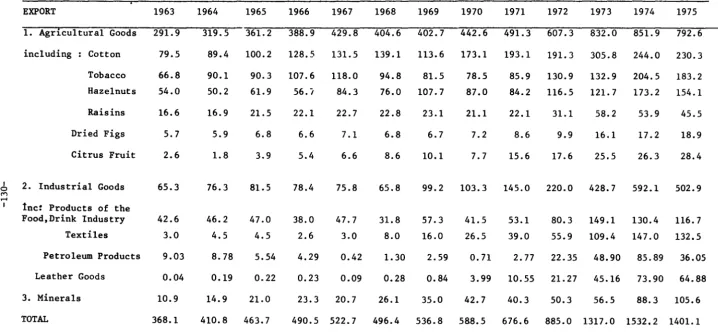
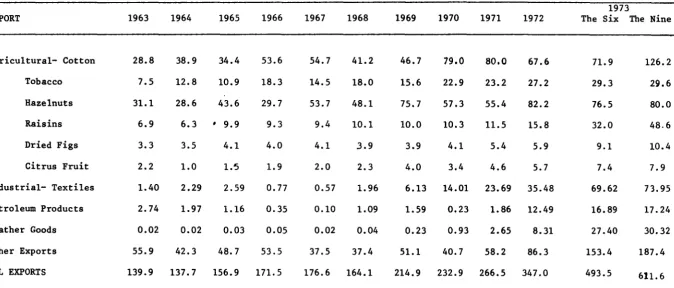
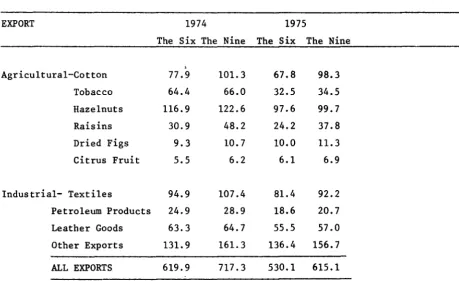
Nevertheless, as we see in Table 3 b of the Statistical Annex, exports of hazelnuts, raisins, tobacco, dried figs and textiles to the E.E.C. all registered a rising trend between 1963 ( the year before preferences took effect) and 1970 ( the year before the commercial provisions of the Additional Protocol entered into force). Exports of these five products to the Community rose respectively 84%, 49%, 205%, 12% and 900% between these years. Exports of the same products to the Rest of the World rose respec-tively by 30%, 11%, -6%, 45%, 680%. Thus the proportions of Turkish exports of tobacco, hazelnuts, raisins and
textiles, whic~ were directed to the Six, all rose over these years. This would suggest tuat the preferen~es given by
the E.E.C. did contribute to the development of Turkish exports during the Preparatory Stage.
[image:15.547.32.507.66.396.2]CHAPTER 3
The Passage to the Transitional Stage : Negotiation of the Additional and Supplementary Protocols
A. The Decision to move from the Preparatory stage to the Transitional Stage
According to the provisions of the Ankara Agreement the passage to the transitional stage was not automatic. Rather " Four years after theentry into force of this Agreement, the Council of Association shall consider whether, taking into account the economic situation of Turkey, it is able to lay down, in the form of an additional Protocol, the provisions relating to the
conditions, detailed rules and timetables for implementing the transitional stage" (Article 1, Provisional Protocol). When the Council of Association decided to start
nego-tiations for the passage to the transitional stage on December 9th 1968, it acted at the earliest time provided for in the agreement.
In taking this important decision the Council of Association stated that " it had considered not only progress achieved in the Turkish economy following the entry into force of the Agreement; but also projections about the future, whether these would permit Turkey to sustain the burdens she would face in the Transitional Stage.
"On this point it is possible to observe firstly that
important results have been achieved in the first five-year Plan period and to expect the same progress to continue during the period of the second Plan.
"Furthermore the operation of the Ankara Agreement during the first four year of the Preparatory phase was considered a success both from the point of view of the operation of the commercial and financial provisions; and from the point of view of the mutual co-operation and understanding shown by both sides.
"Moreover the passage to the Transitional Stage would provide the Turkish economy with a new framework which would stimulate
economic activity during this period ".
B. The Debate in Turkey about the Additional Protocol
-~-Although divided on their value, public opinion did accept that some immediate benefit would accrue to
Turkey through the agricultural concessions offered under the Protocol. Similarly it was hoped that in the social field the Protocol would protect the rights of Turkish workers already in the Community and open the way
for more to join them. This possibility held the prospect of relief to domestic-unemployment and to Balance of
Payments difficulties with increases in remittances. Furthermore, although Turkey would have preferred a larger figure, the financial aid contained in the Second Financial Protocol ( which was negotiated in parallel with the Additional Protocol) was favourabl~
received.
Turkish concern centred mainly on the prospects for Turkish industry following the introduction of a
Customs Union with the E.E.C. For the gradual removal of all barriers on industrial imports from the Six and the application of the Community's Common Customs Tariff on imports from third countries would expose Turkish industry to a degree of competition hitherto unknown. Opinions varied as to how Turkish industry would cope. Some were most pessimistic. The Society of Mechanical Engineers forecast that the final terms of the Additional Protocol would mean the speedy collapse of Turkey's
existing industry and would prevent the establishment ~t
new industries (1).
Concern was expressed also about some of the other commercial provisions of the Additional Protocol. Thus Prof. Dr. Zaim (2), for example, argued that, when Turkey agreed to adopt the
CCT by the end of the Transitional Stage, she was making an umefined commitment. For the Community was free to change the CCT in the meanwhile without c~ulting Turkey. Similarly he argued that the ?rotocol reduced furkey's freedom to foster economic relations with third countries. For, whilst the
EEC was at liberty to negotiate preferential agreements at will, Turkey was obliged to apply themost·favoured-nation
clause in favour of the Six (Art. 14) (3).
(1) "Ortak Pazar ve TUrkiye1' Makina MUhendisleri Odas1 1970 p.251
(2) Ozel Galatasaray YUksek !ktisat ve Ticaret Okulu 1970, p.3 (3) In practice this has not been the case. When Turkey
signed the Protocol for tariff rPrluctions negotiated by 16 developing countries undP.r GATT auspices in 1971, the Community agreed to her derogating from the most favoured nation clause ( see Association Council Decision 1/72). Thus the Community accepted that imports of the industrial prod~cts
-13-Others were much more positive about the Additional Protocol.
Thus the Ankara, Istanbul and Aegean Chambers of Industry
stated that i t would give the Turkish economy in general
and Turkish industry in particular a great opportunity for
development. One of their expectations was that the Protocol
would facilitate the development of Turkish exports. A
study commissioned by the Economic Development Foundation
(I.K.V.) (1) isolated some of the better prospects for
Turkish exports. We quote some of the conclusions about
the textile and leather industries by way of example.
(Compare actual trade figures in Table 3b of the Statistical
annex).
" In the context therefore of roughly static demand for
cotton in the EEC, the pressure of competition in the
EEC is likely to increase as more developing countries
endeavour to sell part of the output of their new textile
industries to the affluent markets of Western Europe. In
this situation, the provisions of the Annex Protocol should
be of considerable help to Turkish textile exporters. Out
of the 32 textile positions in the foreign trade statistics,
29 are immediately exempted from EEC customs duty. Amongst
the articles which have duty-free access are fabrics or
blends of man-made and natural fibre, and ready-to-wear
garments . . . •
These provisions of the Annex Protocol offer Turkish textile
manufacturers the greatest comparative advantages in just
those sectors of the textile industry where the greatest
growth in import demand is likely to occur, namely blended
fabrics and ready-to-wear garments.
-14-" In our view the leather industry is an attractive one to
develop from the point of view of using scarce resources ,
because it requires comparatively little imported machinery.
It uses Turkish natural resources in the form of hides and
skins, and the labour needed to process them into finished
or semi-fin1shed articles. Moreover the industry is
labour-intensive and the lower wage rates in Turkey should enable
the industry to be highly competitive in the EEC in view of
the preferential access under the Annex Protocoi~
I.K.V. also gave another viewpoint on protection (1) 'If our industry cannot become competitive within the 22- year
transitional stage, the most beneficial solution from the
national point of view is rationalisation beginning at once.
Sooner or later the- consumer will rise up against an industry
that lives behind tariff barriers. Even if we don't enter
the Common Market, there remains the question of the efforts
of international organisations like GATT, Kennedy Round and
UNCTAD to increase world trade by removing tariffs and other
barriers to it. As is realised in the West, uncompetitive
industry is nothing other than a burden on the nation.
" In our industrialisation from every point of view it is
necessary that we abandon the policy of supporting industries
which are shielded behind tariff walls and are confined to
the boundaries of the domestic market.
" There is a point of view put forward by industry that if
we become full members it will be impossible to establish
profitable industries which require protection at the beginning.
" When we do not know what future technical developments will
be, this anxiety is out of place. Rather if a new industry
is to be set up and is profitable, it will be more succesful
i t there is a wide market. Its capacity, and hence its costs,
depend on the market.
(1) " Avrupa Toplulu~u- Tiirkiye Ortakl1~1 " IKV Istanbul 1969
-15-" If we become full members we should not forget the
healthy air which competition will bring. Under today's
protection, industry is growing lazy."
In spite of such divergences of opinion there was general
agreement at least as to the need to spread the reduction
of tariffs and quantitative barriers over a substantial
transitional period to facilitate the adjustments which
Turkish industry would have to make.
This overriding concern for industry was expressed by the
Turkish side at the beginning of the negotiations. The
Community side accepted the Turkish view; and joined in
issuing a statement that the Transitional stage should not
expose the Turkish Economy to harm by any sudden opening to
competition with the Six. Nevertheless adequate protection
of her industry remained a prime concern of the Turkish
side throughout the negotiations.
Thus attention in Turkey during the negotiations was centred
on economic questions; and relatively little was said about
the broader political question of Turkey's future role
vis-a-vis the creation of Europe.
C) The Course of the Negotiations
Following the decision in December 1968 to begin negotiations,
extensive talks were conducted throughout 1969, centring on
three meetings of the Council of Association. At the third of
these, held in Brussels on December 9th 1969, the Community side
made a global offer aimed at achieving a final compromise. The
Turkish side was not able to pronounce on the new offer
-16-" Turkey gave her reply on May 13th 1970 and requested an
improvement in the Community propositions on certain points.
The unresolved questions were settled during the meetings of
the Council of Association of July 22nd and November 19th 1970;
and the signature of the Additional Protocol took place on
November 23rd 1970. On. the same date two other documents
were also signed : the second Financial Protocol concerning
the loans to be accorded by the Community for a further period;
and an Agreement on preducts within the province of the European
Coal and Steel Community intended to permit in due course the
definition of a preferential regime for those products which are
not covered by the Association Agreement.
The Additional Protocol was intended to regulate the conditions,
detailed rules and timetables for implementing the transitional
stage. Thus following the principles set out in the Ankara
Agreement, i t fixed the rules for the establishment of a
customs union and of closer economic cooperation between
Turkey and the EEC (1) over a transitional period of 22 years
prior to the final period which should witness the accession
of Turkey with the status of a full member.
To become effective the protocol had to be ratified by
Turkey and the member states of the Community. Taki~ account
of the delays caused by ratification procedures, the Turkish
government expressed the wish to conclude an interim Agreement
with the Community to allow the commercial provisions of the
Additional Protocol to be implemented in advance. This
agree-ment was signed on July 27th 1971 and entered into force on
September 1st of the same year. From that date the tariff
and quota provisions of the Additional Protocol began to be
applied. However, the calendars laid down for the subsequent
progressive realisation of a customs union were not effected
by i t .
The Additional Protocol fully entered into force on January
-17-D. The Extension of the Association to the three new Member
States by the Supplementary Protocol
At the beginning on 1971 upon a request from Turkey the two
parties agreed to analyse the consequences for the association
of the enlargement of the Community. At the end of the same
year the Six instructed the Commission to start negotiations
with Turkey for the conclusion of a supplementary protocol.
This was to constitute ~he legal instrument necessary to allow the association with Turkey to be extended to the new
member states when the enlargement of the Community took
place.
Whilst the Community wanted to deal only with the technical and
legal aspects of the problem , Turkey from the beginning of
the negotiations asked to follow a more global approach which
would take account of the general econom1c consequences for
her of the enlargement of the Community.
Apart from the unfavourable impact which a new opening to
the outside world was likely to produce on
her/~~fof~~ustrialese,
Turkeymintained that the equilibrium of the agreement couldbe upset for the following reasons :
- The extension to new states of the advantages granted to
the Community by Turkey could constitute too heavy a burden
for her, particularly in the realm of liberalisation.
- Turkish agricultural products enjoyed more favourable
conditions of access to the markets of the new member States
than under the preferential regime accorded by the Community
Therefore the simple application of the Community regime to
these markets would entail the risk of considerable losses
for Turkey in this sector.
- The general structure of Turkish trade with the new member
states ~s different from that of its exchanges with the Six. The Turkish Balance of Tradewas in larger deficit vis-a-vis
-18-reason to fear that after the enlargement the trade deficit
with the enlarged Community would increase considerably.
Three negotiating sessions took place during 1972. The two
problems which were most strongly debated were the following:
the flexibility measures demanded by Turkey in the industrial
field and the question of the adaptation of the basis of
calculation of the consolidated liberalisation list to the
new conditions created by the enlargement. Finally two other
negotiating sessions were required in the spring of 1973 before
the negotiators were able to record their agreement on the
content of the Supplementary Protocol.
The signature of this Supplementary Protocol,jtBfitproducts within
the province of the ECSC, as well as that of the Interim
Agreement allowing the application in advance of the commercial
provisions of the Supplementary Protocol took place in Ankara
on June 30th 1973.
The Content of the Supplementary Protocol
The provisions of the Supplementary Protocol, which is intended
to extent the EEC-Turkey Association to the three new member
States, are essentially of three types : transitional measures,
adaptation measures and flexibility measures introduced in
favour of Turkey.
a) The Transitional Measures are those which will apply only
temporarily and will ~isappear by 1 July 1977 at the latest. These include in particular the provisions governing the
mecha-nisms whereby the new Member States of the Community on the
one hand, and Turkey on the other, will gradually bring their
respective import arrangements into line with the preferential
arrangements of the Association.
The three new Member States agreed upon the entry into force
of the Supplementary Protocol to grant total exemption from
-19-For its part Turkey was to redu~e in favour of the new
Member States the difference between the customs duties
and taxes of equivalent effect which she applies towards
third countries and those which-in virtue of the Association
Agreement- she applies towards the Community as originally
constituted, in steps of 20% according to the following
timetable :
- The first step was to be effected when the Interim Agreement
entered into force.
- The following steps were then to be effected on January
1st 1974, January 1st 1975, January 1st 1976 and January 1st 1977.
Originally the Community proposed that the three new Member
States should reduce their customs duties over five years,
following a timetable which was inspired by that of the
treaties of accession. However, Turkey opposed this formula
stating that i t would result in a discrimination against
Turkish products on the market of the Three compared with
the products of countries benefitting from generalised
preferences.
b) The adaptation measures are those measures of a permanent
nature designed to make adaptations to the existing agreements
necessitated by the fact that the Association henceforth includes
nine instead six Member States on th~ Community side.
The tariff quotas opened by the Commu~ity in favour of Turkey under the Additional Protocol have thus been increased from
200.000 to 340.000 metric tons for petroleum products, from
300 to 390 metric tons for cotton yarn and from 1,000 to
1,390 metric tons for other woven fabrics of cotton. Similarly,
the additional contributions from the new Member States make
it possible to increase the financial aid granted to Turkey
under Article 3 (2) of the second Financial Protocol from
-20-c) Flexibility Measures During the course of the negotiations
of the Supplementary Protocol Turkey had expressed deep concern
as to the new burdens which could result for her from the
extension of the Association Agreement to the three new
Member States, particularly in the realm of liberalisation.
It was for this reason,with the aim of not imperilling her
industrialisation goals, that she made certain demands
designed to give flexibility to her obligations in this realm.
The overall compromise reached at the end of the negotiations
(see Article 4 of the Supplementary Protocol) provided that
the consolidated lib~ralization list deposited in 1970 (equi-valent to 35% of Turkish imports on private account from the
Six in 1967) shouH first be extended as it stands to the
three new Member States. How~ver, at the time of the first increase in this list, (1 January 1976) the liberalization
rate which was then;'l?ise to 40%'\llOuld be calculated on the basis of Turkey's imports from the Nine during the reference
year of 1967.
Also another important measure of flexibility was introduced
in favour of Turkey. This consisted of authorizing her to
modify - subject to certain restrictions- the composition
of this list, i.e. to deconsolidate some products.
The relevant conditions which are laid down in art 4 paragraph
2 of the Supplemen~ary Protocol are as follows
- These modifications should not effect more than 10% of the
value of imports from the Community in 1967.
- The total value of imports from the Community of all the
products on the Consolidated Liberalisation List should not
-21-For the products taken off this list, quotas must be opened.
In each case the quota must equal at least 60% of the imports
of the product in question from the Community during the
pre-vious year. This, however, does not prejudice Turkey's right
to apply to thes~ products the provisions of Art. 22 para 5 of the Additional Protocol. (i.e. The right to introduce
quantitative restrictions on the importation of
liberalised-but not consolidated- products on condition that quotas are
opened in favour of the Community equal to at least 75% of
the average imports from the EEC during the course of the
last three years before this reintroduction).
Morover, Article 3 of the Supplementary Protocol introduced
another important flexibility measure in favour of Turkey. By
virtue of Article 12 paragraph 3 of the Additional Protocol,
Turkey may reintroduce, increase or introduce customs duties
on imports of products subject to the 12 year tariff-reduction
timetable, in order to protect the development of a processing
industry which does not exist in Turkey or to ensure the
expansion in accordance with her development plan of an
existing processing industry. This is subject to a ceiling
of 10% of imports from the Community in 1967. To this existing
authorization the Supplementary Protocol adds the possibility
of introducing quantitative restrictions for the same products.
In this case Turkey was to open a quota equal to at least 60%
of the imports of this product from the Community during the
year preceding the introduction of these measures. These
quantitative restrictions should not effect more than 5% of
imports from the Community ( as originally comprised) in 1967.
If the Council of Association has not taken any decision under
the preceding provisions within six months of her lodging
the request, Turkey may, after informing the Council of
Asso-ciation and not earlier than one year after the lodging of
-22-Turkey can use this facility until the end of the period for
which the 40% level of liberalisation is applicable, that is
to say until January 1st 1981, or possibly until January 1st 1983.
Moreover, it is specified that Turkey should simultaneously add
new products to the consolidated liberalisation list in order
that the total value of.imports from the Community of all the
products on the list should not fall.
Finally, in a desire to express their mutual concern for the
industrialisation of Turkey, the Contracting Parties annexed
to the Supplementary Protocol a declaration in which they
stated that they were resolved to devise and take measures which,
within the framework of the Association Agreement and the
Addi-tional Protocol, would seem to be the ones most likely to
promote the industrialisation of Turkey under its Development
Plan.
In agriculture, the Supplementary Protocol (see Article 6 and
the Joint Declaration on that Article) provides that additional
concessions requested by Turkey in order to compensate for its
expected losses,when the three new Member States adopt Community
arrangements for agricultural import~ will be adopted on the occasion of the first agricultural review provided for in
Article 35(3) of the Additional Protocol; it was agreed that
this first review- which should normally have taken place on
1 January 1974- would be brought forward and would begin as
soon as the Supplementary Protocol had been signed and would
therefore cover the Community concessions consequent upon
enlargement.
As agreed, this review bagan on June 30th 1973 during the
session of the Concil of Association which took place in
Ankara. In this context the Community accorded Turkey new
concessions covering some twenty tariff positions. These
concessions took effect under the Interim Agreement on
January 1st 1974 (1).
-23-For the Supplementary Protocol to enter into force i t is
necessary for it to be approved by the Turkish Grand National
Parliament and the Parliaments of the Nine. On the Turkish
side the Protocol has not yet been ratified. However, an
Interim Agreement, which implements the commercial provisions
of the Protocol in advance, entered into force on Jan. 1st 1974.
As, however, the "flexibility measures" contained in Art 3 and 4
(paragraph 2 ) of the Supplementary Protocol contain revisions
of the Additional Protocol, they could not be implemented in
advance under the Interim Agreement. For they require the
ratification of the Parliaments of Turkey and the Nine.
Similarly the increase in the funds made available under the
second Financial Protocol requires Parliamentary ratification.
The fact that the Turkisl. ~rliament has not yet ratified the Supplementary Protocol means that Turkey has not as yet
S E C T I 0 N
II
C H A P T E R 4
THE ORGANS OF THE ASSOCIATION
A. THE STRUCTURE AND LEGAL CHARACTERISTICS OF Th~ INSTITUTIONS
In studying the general nature of Association, we indicated
that this
~~~~~u~~1a
the extension-albeit partial- of the institutional methods applicable within the Community to therelationship between it and the associated country. Although
we are concerned here with the Association of Greece or of
Turkey, all the associations established to date possess their
own institutions.
The whole thrust of the Treaty of Rome was precisely to break
with the traditional character of a multilateral treaty. For
the performance of multilateral treaties usually suffer from
a lack of executive or judicial machinery.
Because the associated State is not a member of the Community,
it cannot participate in the running of the latter's institutions.
Consequently i t is necessary to create for the Association
institutions separate from those of the Community.
The Association Agreement with Turkey provided primarily for
an executive body charged with ensuring the application and
progressive development of the rules of the Association. This
is the Council of Association. The Agreement with Greece
pro-vided for an abritration body as well as an ~xecutive body. The primary function of the Council of Association is the
implementation of the Agreement. However, as the Ankara
Agree-ment did not set up a separate judicial or arbitration body to
remedy the absence of judicial machinery. the Council of
Association wasentrusted with certain functions in settling
disputes between the Parties to the Agreement. Moreover, as
regards the settlemeoc of disputes the Agreement provided
-26
already in existence. Thus we are concerned here to study
the Council of Association and the machinery for settling
disputes. Also we must mention two bodies set up subsequently:
the Committee of Association and the Joint Parliamentary
Committee.
a. The Council of Association
The Agreement provided for the following institutions
1. A Council of Association (articles 6,22,23 and 24)
2. A procedure for settling disputes
3. A co-operation between the European Parliament and latter
the Economic and Social Committee on the one hand and the
Turkish Parliament and the corresponding organs in Turkey
on the other. (Article 27).
In contrast tc the classical techniques for international
engagements, the Parties to the Ankara Agreement established
a permament contact in order to ensure the concerted application
of the objectives of their contractual connection. The Council
of Association is the most important institution of the
Association. It is responsible for ensuring the application
and progressive development of the Association (article 6).
The composition of the Council of Association reflects the
bilateral and equal nature of the Association.
As with the corresponding organs of the Association with Greece
and the ACP states, the Council of Association is composed of
members of the Governments of the Member States and of members
of the Council and Commission of the EEC on the one hand and
of members of the Government of the Associated State on the
other ( a r t . 23 para. 1). Thus in conformity with the
bilateral conception of the Community, it concerns two
parties: The Community and Turkey. However, on the Community
side we find simultaneously members of the Governments of
-
27-The participation of the Member States jointly with the
Community in the Council of Association is explained
(from the Community's point of view) by the status of the
Association, status which is neither fully subject to
govern-mental nor to Community jurisdiction. The participation in
the Association's organ takes place both at the Government
and the Community level.
The meetings of the Council of Association are thus normally
held at Ministerial level; but there is provision for member~
to arrange to be represented ( art. 23/2). The internal rules
of the Council of Association provided a priori that the
Council should meet at ministerial level at least once every
six months unless there was a decision to the contrary; but
that apart from these cases the Council would meet at the
level of Representatives.
The Representatives mentioned above have the same powers as
the accredited members. This representation is necessary in
our age in view of of the very busy timetable of Ministers.
The office of President of the Council of Association is held
in turn for terms of six months by the Community and by Turkey
(art. 24/1).
The Council of ·Association has the following powers
The competence of the Council of Association is defined by
article 6 of the agreement. By reason of its composition
and its method of taking decisions the Council of Association
is a select international conference which allows the States
involved to confer together and arrive at agreement.
28
-- those of a conciliation body
- the power to recommend
- the power of decision
The Council of Association, like the Council of Ministers of
the EEC, has important powers of decision, notably that
of taking decisions suitable to attain one of the objectives
of the agreement when the agreement did not provide the
necessary powers (articles 22 and 30).
The Council of Association has two other roles : it 1s a
review body which periodically undertakes to review the
results of the Association arrangements. Each year it prepares
an annual report ( a r t . 22/2).
By the Agreement the Council of Association is also constituted
as one of the means for the settlement of disputes (Art.25).
In the Council UNANIMITY is required ( a r t . 23/3). To arrive
at common positions amongst themselves, the Nine concluded
an 'internal agreement' which lays down two cases :
1) For questions which concern commercial policy, the common
position is obtained by the application of the rules of the
Treaty of Rome, that is to say in general by decision of the
Concil upon propositions from the Commission ( art. 149 of
the Treaty of Rome).
2) On other questions, the position is adopted
unanimously-after consulting the Commission- by the Council or by the
representatives of the Governments of the Member States
meeting within the Council. ( Turkey, Internal accord, Official
Journal of the European Communities, Dec. 29th 1964).
Turkey makes her decision independently and possesses one vote,
the same as the Community. The Council of Association makes its
decisions unanimously. These decisions principally concern the
-
29-- customs arrangements ( for goods imported from third
countries- art. 2/3 of the Additional Protocol; to determine
methods of administrative co-operation- art.4 : authorization
to introduce new customs duties on exports- Art. 7;
authori-zation to retain customs duties of a fiscal nature - art. 16/4;
the postponement of time limits for the suppression of quota
restrictions- art. 22/3 : etc.)
- agriculture ( information to be provided- art. 33/4;
measures concerning the free movement of agricultural products
between the Community and Turkey- art. 34-35 )
- social questions ( the free movement of workers-art. 36;
social security- art. 39).
- the question of the freedom of establishment ( art 41)
- transport ( extension to Turkey of the Community's policies
relative to transport- art. 42)
- the alignment of economic policy ( the application of
Community rules on competition between 1973 and 1979- art.43:
where necessary recommending appropriate measures for the
co-ordination of Turkish and Community economic
policies-art. 49) . . .
Moreover, the Council of Association is the forum. which is
notified of all the important unilateral decisions which may
effect the functioning of the Association Agreement: and
the forum within which Turkey and the Community consult over
all the sectors which may interest the Association.
. . . .
1to .
The Counc1l of Assoc1at1on also has the power make recommendat1om
-
30-At first sight i t seems that the Council of Association only
disposes of explicit powers, i.e. powers expressly conferred
by the \ssociation Agreement. Indeed article 6 of the Agreement
provides for " a Council of Association which shall act
within the powers conferred upon it by this Agreement".
However, as we saw above,article 22/3 permits the Council
as from the Transitional Stage to enjoy implicit powers. The
Council will be able to take appropriete decisions in cases
where. in the course of the implementation of the Association
arrangements, common action by the Parties seems necessary
to attain one of the objectives of the Agreement but the
requisite powers are not granted in the Agreement.
The role of the Council of Association therefore becomes more
important. It is the centre of all the activities which
concern the Association.
To conclude our consideration of the Council of Association
we must also explain the acts or legal standards of the
Council of Association.
The Council of Association may make decisions or recommendations
(art.22). The decisions of the Council of Association are
binding. " Each of the Parties shall take the measures necessary
to ~mplement the decisions taken" (art 22/1). An important question concerns the direct application of these decisions.
Unlike certain acts of the Institutions of the Community (art.l89
of the Treaty of Rome), the decisions of the Council of
Association cannot be·applied directly to nationals of the
Contracting Po~ties. In other words, the organ of the Association does not enjoy supranational powers. The
Association set up a bilateral and equal link between the
Contracting Parties; and the decisions of the Council have
the effect only of creating external commitments for the
Parties. Each of them takes the measures necessary to
include the decisions of the Council in their domestic legal
-
31-The recommendations of the Council, whilst constituting an
important means of exerting pressure, do not possess a binding
legal character.
It is necessary finally to stress again that the Council of
Association takes its decisions by unanimity. The unanimity
rule flows from the bilateral and equal character of the
Association.As an Associate, Turkey does not yield any of
its sovereignty to the Community.
Thus we can conclude from this that the Council of Association
constitutes a body for negotiation and for the implementation
of the principal decisions to be taken for the development of
the Association. Its character as an effective decision- making
body has been accentuated by the practice, for which the
Turkish partner has particularly press~d, of not letting "the Council meet for nothing", or in the words of Mr. Gaglayangil
(July 14th 1976) of not letting the Council meet only '' to
make declarations of good will, promises of a general nature,
and minor adaptations which only serve to maintain appearances".
The Council is the place where agreement between the Community
and its associate are arrived at. Therefore each meeting of
the Council must lead to a strengthening of EEC-Turkey relations
in corformity with the objectives of the Association.
The Council of Association has met 22 times since its creation
(as of October 1976).
It publishes each year a report on the evolution of the
Association. The main statistics relating to the Association and
the legal texts imvlementing the decisions of the Council of
the EEC in Community law are generally annexed to this report.
b) Bodies related to the Council of Association
1. According to article 24 of the Agreement, a body could be set
up by the Couucil to ensure the continuing co-operation