Regularizing Text Categorization with Clusters of Words
Konstantinos Skianis François Rousseau
LIX, École Polytechnique, France
Michalis Vazirgiannis
Abstract
Regularization is a critical step in supervised learning to not only address overfitting, but also to take into account any prior knowledge we may have on the features and their de-pendence. In this paper, we explore state-of-the-art structured regularizers and we pro-pose novel ones based on clusters of words from LSI topics, word2vec embeddings and graph-of-words document representation. We show that our proposed regularizers are faster than the state-of-the-art ones and still improve text classification accuracy. Code and data are available online1.
1 Introduction
Harnessing the full potential in text data has always been a key task for the NLP and ML communities. The properties hidden under the inherent high di-mensionality of text are of major importance in tasks such as text categorization and opinion mining.
Although simple models like bag-of-words man-age to perform well, the problem of overfitting still remains. Regularization as proven in Chen and Rosenfeld (2000) is of paramount importance in Natural Language Processing and more specifically language modeling, structured prediction, and clas-sification. In this paper we build upon the work of Yogatama and Smith (2014b) who introduce prior knowledge of data as a regularization term. One of the most popular structured regularizers, the group lasso (Yuan and Lin, 2006), was proposed to avoid large L2 norms for groups of weights.
1https://goo.gl/mKqvro
In this paper, we propose novel linguistic struc-tured regularizers that capitalize on the clusters learned from texts using the word2vec and graph-of-words document representation, which can be seen as group lasso variants. The extensive experiments we conducted demonstrate these regularizers can boost standard bag-of-words models on most cases tested in the task of text categorization, by imposing additional unused information as bias.
2 Background & Notation
We place ourselves in the scenario where we con-sider a prediction problem, in our case text catego-rization, as a loss minimization problem, i. e. we define a loss functionL(x,θ, y)that quantifies the
loss between the prediction hθ,b(x) of a classifier parametrized by a vector of feature weightsθand a biasb, and the true class labely∈Yassociated with the examplex∈X. Given a training set ofN data points{(xi, yi)}i=1...N, we want to find the optimal set of feature weightsθ∗such that:
θ∗= argmin θ
N X
i=1
L(xi,θ, yi)
| {z }
empirical risk
(1)
In the case of logistic regression with binary predic-tions (Y = {−1,+1}), hθ,b(x) = θ>x+b and L(x,θ, y) =e−yhθ,b(x)(log loss).
2.1 Regularization
Only minimizing the empirical risk can lead to over-fitting, that is, the model no longer learns the un-derlying pattern we are trying to capture but fits the
noise contained in the training data and thus results in poorer generalization (e. g., lower performances on the test set). For instance, along with some fea-ture space transformations to obtain non-linear de-cision boundaries in the original feature space, one could imagine a decision boundary that follows ev-ery quirk of the training data. Additionally, if two hypothesis lead to similar low empirical risks, one should select the “simpler” model for better general-ization power, simplicity assessed using some mea-sure of model complexity.
Loss+Penalty Regularization takes the form of additional constraints to the minimization problem, i. e. a budget on the feature weights, which are of-ten relaxed into a penalty termΩ(θ) controlled via a Lagrange multiplier λ. We refer to the book of Boyd and Vandenberghe (2004) for the theory be-hind convex optimization. Therefore, the overall expected risk (Vapnik, 1991) is the weighted sum of two components: the empirical risk and a reg-ularization penalty term, expression referred to as “Loss+Penalty" by Hastie et al. (2009). Given a training set of N data points {(xi, yi)}i=1...N, we
now want to find the optimal set of feature weights θ∗such that:
θ∗ = argmin θ
N X
i=1
L(xi,θ, yi)
| {z }
empirical risk
+ λΩ(θ)
| {z }
penalty term
| {z }
expected risk
(2)
L1 and L2 regularization The two most used penalty terms are known as L1regularization, a. k. a. lasso (Tibshirani, 1996), and L2 regularization, a. k. a.ridge(Hoerl and Kennard, 1970) as they cor-respond to penalizing the model with respectively the L1 and L2 norm of the feature weight vectorθ:
θ∗= argmin θ
N
X
i=1
L(xi,θ, yi) +λ p
X
j=1
|θj| (3)
θ∗= argmin θ
N
X
i=1
L(xi,θ, yi) +λ p
X
j=1
θj2 (4)
Prior on the feature weights L1 (resp. L2) reg-ularization can be interpreted as adding a Laplacian (resp. Gaussian) prior on the feature weight vector. Indeed, given the training set, we want to find the
most likely hypothesish∗ ∈ H, i. e. the one with
maximum a posterioriprobability:
h∗= argmax
h∈H P(h|{(x
i, yi)}i=1...N)
= argmax h∈H
P(
{yi}
i|{xi}i, h)P(h|{xi}i)
P({yi}i|{xi}i)
= argmax h∈H P
({yi}i|{xi}i, h)P(h|{xi}i) = argmax
h∈H P
({yi}i|{xi}i, h)P(h) (5)
= argmax h∈H
N
Y
i=1
P(yi|xi, h)P(h)
!
(6)
= argmax h∈H
N
X
i=1
logP(yi|xi, h)+ logP(h)
!
= argmin h∈H
N X i=1
−logP(yi|xi, h)
| {z }
empirical risk
−logP(h)
| {z }
penalty term
For the derivation, we assumed that the hypothesis h does not depend on the examples alone (Eq. 5) and that theN training labeled examples are drawn from an i.i.d. sample (Eq. 6). In that last form, we see that the loss function can be interpreted as a neg-ative log-likelihood and the regularization penalty term as a negative log-prior over the hypothesis. Therefore, if we assume a multivariate Gaussian prior on the feature weight vector of mean vector0
and covariance matrixΣ = σ2I (i. e. independent features of same prior standard deviationσ), we do obtain the L2 regularization:
P(h) = p 1 (2π)p|Σ|e
−1
2θ>Σ−1θ (7)
⇒ −logP(h) = 1
2σ2θ>Iθ+ p
2log(2πσ) argmax
= λkθk22, λ= 1
2σ2 (8)
And similarly, if we assume a multivariate Lapla-cian prior on the feature weight vector (i. e. θi ∼ Laplace(0,λ1)), we obtain L1-regularization. In practice, in both cases, the priors basically mean that we expect weights around0on average. The main
difference between L1 and L2 regularization is that the Laplacian prior will result in explicitly setting some feature weights to 0 (feature sparsity) while
2.2 Structured regularization
In L1and L2 regularizations, features are considered as independent, which makes sense without any ad-ditional prior knowledge. However, similar features have similar weights in the case of linear classifiers – equal weights for redundant features in the ex-treme case – and therefore, if we have some prior knowledge on the relationships between features, we should include that information for better general-ization, i. e. include it in the regularization penalty term. Depending on how the similarity between fea-tures is encoded, e. g., through sets, trees (Kim and Xing, 2010; Liu and Ye, 2010; Mairal et al., 2010) or graphs (Jenatton et al., 2010), the penalization term varies but in any case, we take into account the struc-ture between feastruc-tures, hence the “strucstruc-tured regular-ization” terminology. It should not be confused with “structured prediction” where this time the outcome is a structured object as opposed to a scalar (e. g., a class label) classically.
Group lasso Bakin (1999) and later Yuan and Lin (2006) proposed an extension of L1 regularization to encourage groups of features to either go to zero (as a group) or not (as a group), introducinggroup
sparsity in the model. To do so, they proposed to regularize with the L1,2 norm of the feature weight vector:
Ω(θ) =λX g
λgkθgk2 (9)
whereθg is the subset of feature weights restricted to groupg. Note that the groups can be overlapping (Jacob et al., 2009; Schmidt and Murphy, 2010; Je-natton et al., 2011; Yuan et al., 2011) even though it makes the optimization harder.
2.3 Learning
In our case we use a logistic regression loss function in order to integrate our regularization terms easily.
L(x,θ, y) = log(1 + exp(−yθTx)) (10)
It is obvious that the framework can be extended to other loss functions (e. g., hinge loss).
For the case of structured regularizers, there exist a plethora of optimization methods such group lasso. Since our tasks involves overlapping groups, we se-lect the method of Yogatama and Smith (2014b).
Algorithm 1ADMM for overlapping group-lasso Require: augmented Lagrangian variableρ,
regulariza-tion strengthsλglasandλlas
1: whileupdate in weights not smalldo 2: θ = argmin
θ
Ωlas(θ) +L(θ) +ρ2 V P i=1
Ni(θi−µi)2
3: forg= 1toGdo 4: vg=proxΩ
glas,λgρ
(zg)
5: end for
6: u=u+ρ(v−Mθ) 7: end while
Their method uses the alternating directions method of multipliers (Hestenes, 1969; Powell, 1969).
Now given the lasso penalty for each feature and the group lasso regularizer, the problem becomes:
min
θ,v Ωlas(θ) + Ωglas(v) +
D X
d=1
L(xd,θ, yd) (11)
so thatv=Mθ, wherevis a copy-vector ofθ. The copy-vectorvis needed because the group-lasso reg-ularizer contains overlaps between the used groups. M is an indicator matrix of sizeL×V, whereLis the sum of the total sizes of all groups, and its ones show the link between the actual weightsθand their copiesv. Following Yogatama and Smith (2014b) a constrained optimization problem is formed, that can be transformed to an augmented Lagrangian problem:
Ωlas(θ) + Ωglas(v) +L(θ) +u>(v−Mθ)
+ρ
2kv−Mθk 2 2
(12)
Essentially, the problem becomes the iterative up-date ofθ, v and u:
min
θ Ωlas(θ)+L(θ)+u
>Mθ+ρ
2kv−Mθk 2 2 (13)
min
v Ωglas(v) +u
>v+ρ
2kv−Mθk 2
2 (14)
u=u+ρ(v−Mθ) (15)
3 Structured Regularization in NLP
In recent efforts there are results to identify useful structures in text that can be used to enhance the ef-fectiveness of the text categorization in a NLP con-text. Since the main regularization approach we are going to use are variants of the group lasso, we are interested on prior knowledge in terms of groups/clusters that can be found in the training text data. These groups could capture either semantic, or syntactic structures that affiliate words to communi-ties. In our work, we study both semantic and syn-tactic properties of text data, and incorporate them in structured regularizer. The grouping of terms is pro-duced by either LSI or clustering in the word2vec or graph-of-words space.
3.1 Statistical regularizers
In this section, we present statistical regularizers, i. e. with groups of words based on co-occurrences, as opposed tosyntacticones (Mitra et al., 1997). Network of features Sandler et al. (2009) intro-duced regularized learning with networks of fea-tures. They define a graphGwhose edges are non-negative with larger weights indicating greater sim-ilarity. Conversely, a weight of zero means that two features are not believed a priori to be similar. Pre-vious work (Ando and Zhang, 2005; Raina et al., 2006; Krupka and Tishby, 2007) shows such sim-ilarities can be inferred from prior domain knowl-edge and statistics computed on unlabeled data.
The weights of G are mapped in a matrix P, wherePij ≥0gives the weight of the directed edge from vertex i to vertex j. The out-degree of each vertex is constrained to sum to one,PjPij = 1, so that no feature “dominates" the graph.
Ωnetwork(θ) =λnet X
θk>Mθk (16)
whereM =α(I−P)>(I−P) +βI. The matrix M is symmetric positive definite, and therefore it pos-sesses a Bayesian interpretation in which the weight vectorθ, isa priorinormally distributed with mean zero and covariance matrix 2M−1. However, pre-liminary results show poorer performance compared to structured regularizers in larger datasets.
Sentence regularizer Yogatama and Smith (2014b) proposed to define groups as the sentences
in the training dataset. The main idea is to define a group dd,s for every sentencesin every training document d so that each group holds weights for occurring words in its sentence. Thus a word can be a member of one group for every distinct (training) sentence it occurs in. The regularizer is:
Ωsen(θ) = D X
d=1 Sd
X
s=1
λd,skθd,sk2 (17)
whereSdis the number of sentences in documentd. Since modern text datasets typically contain thou-sands of sentences and many words appear in more than one sentence, the sentence regularizer could potentially lead to thousands heavily overlapping groups. As stated in the work of Yogatama and Smith (2014b), a rather important fact is that the reg-ularizer will force all the weights of a sentence, if it is recognized as irrelevant. Respectively, it will keep all the weights of a relevant sentence, even though the group contains unimportant words. Fortunately, the problem can be resolved by adding a lasso regu-larization (Friedman et al., 2010).
3.2 Semantic regularizers
In this section, we present semantic regularizers that define groups based on how semantically close words are.
LDA regularizer Yogatama and Smith (2014a) considered topics as another type of structure. It is obvious that textual data can contain a huge num-ber of topics and especially topics that overlap each other. Again the main idea is to penalize weights for words that co-occur in the same topic, instead of treating the weight of each word separately.
Having a training corpus, topics can be easily ex-tracted with the help of the latent Dirichlet allocation (LDA) model (Blei et al., 2003). In our experiments, we form a group by extracting thenmost probable words in a topic. We note that the extracted topics can vary depending the text preprocessing methods we apply on the data.
2 2
2 1 2 2 2
2 2
2
2 2
2 2
2 1
1 1
1 1
1
1 1
1 2
1 1 1
1
● ● ● ●
●
●
●
● ●
●
● ● ●
method solut system linear
algebra
equat
m−dimension
lambda
matric
propos
numer special kind
[image:5.612.85.302.62.251.2]A method for solution of systems of linear algebraic equations with m-dimensional lambda matrices. A system of linear algebraic equations with m-dimensional lambda matrices is considered.The proposed method of searching for the solution of this system lies in reducing it to a numerical system of a special kind.
Figure 1:A Graph-of-words example.
identify latent variables that link co-occurring terms with documents. The main basis behind LSI is that words being used in the same contexts (i. e. the doc-uments) tend to have similar meanings. We used LSI as a baseline and compare it with other stan-dard baselines as well as other proposed structured regularizers. In our work we keep the top 10 words which contribute the most in a topic.
The regularizer for both LDA and LSI is:
ΩLDA,LSI(θ) = K X
k=1
λkθkk2 (18)
whereKis the number of topics. 3.3 Graphical regularizers
In this section we present our proposed regularizers based on graph-of-words and word2vec. Essentially the word2vec space can be seen as a large graph where nodes represent terms and edges similarities between them.
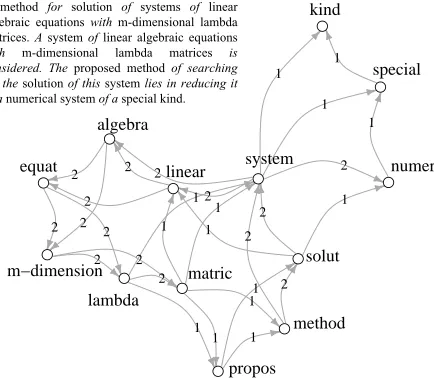
Graph-of-words regularizer Following the idea of the network of features, we introduce a simpler and faster technique to identify relationships be-tween features. We create a big collection graph from the training documents, where the nodes cor-respond to terms and edges corcor-respond to co-occurrence of terms in a sliding window. We present a toy example of a graph-of-words in Figure 1.
A critical advantage of graph-of-words is that it easily encodes term dependency and term order (via
edge direction). The strength of the dependence be-tween two words can also be captured by assigning a weight to the edge that links them.
Graph-of-words was originally an idea of Mihal-cea and Tarau (2004) and Erkan and Radev (2004) who applied it to the tasks of unsupervised keyword extraction and extractive single document summa-rization. Rousseau and Vazirgiannis (2013) and Malliaros and Skianis (2015) showed it performs well in the tasks of information retrieval and text cat-egorization. Notably, the former effort ranked nodes based on a modified version of the PageRank algo-rithm.
Community detection on graph-of-words Our goal is to identify groups or communities of words. Having constructed the collection-level graph-of-words, we can now apply community detection al-gorithms (Fortunato, 2010).
In our case we use the Louvain method, a commu-nity detection algorithm for non-overlapping groups described in the work of Blondel et al. (2008). Es-sentially it is a fast modularity maximization ap-proach, which iteratively optimizes local communi-ties until we reach optimal global modularity given some perturbations to the current community state. The regularizer becomes:
Ωgow(θ) = C X
c=1
λkθck2 (19)
where c ranges over the C communities. Thus θc corresponds to the sub-vector ofθsuch that the cor-responding features are present in the communityc. Note that in this case we do not have overlapping groups, since we use a non-overlapping version of the algorithm.
applying vector operations on them. We introduce another novel regularizer method, by applying un-supervised clustering algorithms on the word2vec space.
Clustering on word2vec Word2vec contains mil-lions of words represented as vectors. Since word2vec succeeds in capturing semantic similarity between words, semantically related words tend to group together and create large clusters that can be interpreted as “topics".
In order to extract these groups, we use a fast clustering algorithm such as K-Means (Macqueen, 1967) and especially Minibatch K-means. The reg-ularizer is:
Ωword2vec(θ) = K X
k=1
λkθkk2 (20)
whereKis the number of clusters we extracted from the word2vec space.
Clustering these semantic vectors is a very inter-esting area to study and could be a research topic by itself. The actual clustering output could vary as we change the number of clusters we are trying to iden-tify. In this paper we do not focus on optimizing the clustering process.
4 Experiments
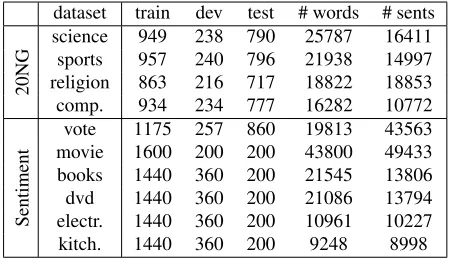
We evaluated our structured regularizers on several well-known datasets for the text categorization task. Table 1 summarizes statistics about the ten datasets we used in our experiments.
4.1 Datasets
Topic categorization. From the 20 Newsgroups2
dataset, we examine four binary classification tasks. We end up with binary classification problems, where we classify a document according to two related categories: comp.sys: ibm.pc.hardware vs. mac.hardware; rec.sport: baseball vs. hockey; sci: med vs. space and alt.atheism vs. soc.religion.christian. We use the 20NG dataset from Python.
Sentiment analysis. The sentiment analysis datasets we examined include movie reviews
2http://qwone.com/~jason/20Newsgroups/
dataset train dev test # words # sents
20NG
science 949 238 790 25787 16411 sports 957 240 796 21938 14997 religion 863 216 717 18822 18853 comp. 934 234 777 16282 10772
Sentiment
[image:6.612.314.540.57.186.2]vote 1175 257 860 19813 43563 movie 1600 200 200 43800 49433 books 1440 360 200 21545 13806 dvd 1440 360 200 21086 13794 electr. 1440 360 200 10961 10227 kitch. 1440 360 200 9248 8998
Table 1:Descriptive statistics of the datasets
(Pang and Lee, 2004; Zaidan and Eisner, 2008)3,
floor speeches by U.S. Congressmen deciding “yea"/“nay" votes on the bill under discussion (Thomas et al., 2006)3 and product reviews from
Amazon (Blitzer et al., 2007)4.
4.2 Experimental setup
As features we use unigram frequency concatenated with an additional unregularized bias term. We re-produce standard regularizers like lasso, ridge, elas-tic and state-of-the-art structured regularizers like sentence, LDA as baselines and compare them with our proposed methods.
For LSI, LDA and word2vec we use the gensim package ( ˇReh˚uˇrek and Sojka, 2010) in Python. For the learning part we used Matlab and specifically code by Schmidt et al. (2007).
We split the training set in a stratified manner to retain the percentage of classes. We use 80% of the data for training and 20% for validation.
All the hyperparameters are tuned on the develop-ment dataset, using accuracy as the evaluation crite-rion. For lasso and ridge regularization, we choose λfrom {10−2, 10−1, 1, 10, 102}. For elastic net, we perform grid search on the same set of values as ridge and lasso experiments for λrid and λlas. For the LDA, LSI, sentence, graph-of-words (GoW), word2vec regularizers, we perform grid search on the same set of values as ridge and lasso experi-ments for theρ,λglas,λlasparameters. In the case we get the same accuracy on the development data, the model with the highest sparsity is selected. For 3http://www.cs.cornell.edu/~ainur/data. html
dataset no reg. lasso ridge elastic LDA LSI sentencegroup lassoGoW word2vec
20NG
science 0.946 0.916 0.954 0.954 0.968 0.968* 0.942 0.967* 0.968*
sports 0.908 0.907 0.925 0.920 0.959 0.964* 0.966 0.959* 0.946* religion 0.894 0.876 0.895 0.890 0.918 0.907* 0.934 0.911* 0.916* computer 0.846 0.843 0.869 0.856 0.891 0.885* 0.904 0.885* 0.911*
Sentiment
vote 0.606 0.643 0.616 0.622 0.658 0.653 0.656 0.640 0.651
movie 0.865 0.860 0.870 0.875 0.900 0.895 0.895 0.895 0.890
books 0.750 0.770 0.760 0.780 0.790 0.795 0.785 0.790 0.800
dvd 0.765 0.735 0.770 0.760 0.800 0.805* 0.785 0.795* 0.795* electr. 0.790 0.800 0.800 0.825 0.800 0.815 0.805 0.820 0.815
[image:7.612.73.538.55.225.2]kitch. 0.760 0.800 0.775 0.800 0.845 0.860* 0.855 0.840 0.855*
Table 2:Accuracy results on the test sets. Bold font marks the best performance for a dataset.*indicates statistical significance of improvement over lasso atp <0.05using micro sign test for one of our models LSI, GoW and word2vec (underlined).
dataset no reg. lasso ridge elastic LDA LSI sentence GoW word2vecgroup lasso
20NG
science 100 1 100 63 19 20 86 19 21
sports 100 1 100 5 60 11 6.4 55 44
religion 100 1 100 3 94 31 99 10 85
computer 100 2 100 7 40 35 77 38 18
Sentiment
vote 100 1 100 8 15 16 13 97 13
movie 100 1 100 59 72 81 55 90 62
books 100 3 100 14 41 74 72 90 99
dvd 100 2 100 28 64 8 8 58 64
electr. 100 4 100 6 10 8 43 8 9
kitch. 100 5 100 79 73 44 27 75 46
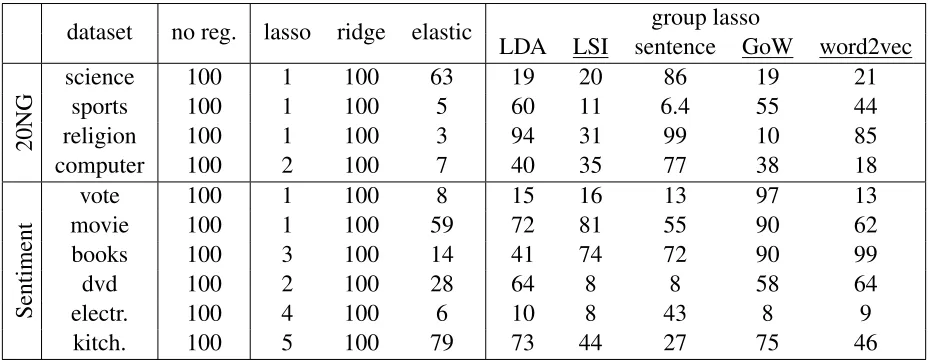
Table 3:Fraction (in %) of non-zero feature weights in each model for each dataset: the smaller, the more compact the model.
LDA we set the number of topics to 1000 and we keep the 10 most probable words of each topic as a group. For LSI we keep 1000 latent dimensions and we select the 10 most significant words per topic. For the clustering process on word2vec we ran Minibatch-Kmeans for max 2000 clusters. For each word belonging to a cluster, we also keep the top 5 or 10 nearest words so that we introduce overlapping groups. The intuition behind this is that words can be part of multiple “concepts" or topics, thus they can belong to many clusters.
4.3 Results
In Table 2 we report the results of our experiments on the aforementioned datasets, and we distinguish our proposed regularizers LSI, GoW, word2vec with underlining. Our results are inline and confirm that
of (Yogatama and Smith, 2014a) showing the advan-tages of using structured regularizers in the text cat-egorization task. The group based regularizers per-form systematically better than the baseline ones.
We observe that the word2vec clustering based regularizers performs very well - achieving best per-formance for three out of the ten data sets while it is quite fast with regards to execution time as it appears in Table 3 (i. e. it is four to ten times faster than the sentence based one).
[image:7.612.74.538.264.444.2]dataset GoW word2vec
20NG
[image:8.612.81.541.57.123.2]science 79 691 sports 137 630 religion 35 639 computer 95 594
Table 4:Number of groups.
dataset lasso ridge elastic LDA LSI sentence GoW word2vecgroup lasso
20NG
science 10 1.6 1.6 15 11 76 12 19
sports 12 3 3 7 20 67 5 9
religion 12 3 7 10 4 248 6 20
computer 7 1.4 0.8 8 6 43 5 10
Table 5:Time (in seconds) for learning with best hyperparameters.
= 0
piscataway combination [email protected] jamie reading/seeing chambliss left-handedness abilities lubin
acad sci obesity page erythromycin bottom
6
= 0
andspace the launchhealth for use that medicalyou
spacecancer andnasa
hiv healthshuttlefortobaccothat cancer that researchcenter space
hivaids areusetheory
keyboarddata telescopeavailablearefrom
systeminformationspace ftp Table 6:Examples with LSI regularizer.
= 0
village town
edc fashionable trendy trendy fashionable points guard guarding
crown title champion champions
6
= 0
numbness tingling dizziness fevers laryngitis bronchitis undergo undergoing
undergoes undergone healed
mankind humanity civilizationplanet
nasakunin lang tao kay kong
Table 7:Examples with word2vec regularizer.
examples in Table 6, 7, 8. This method proves as well very fast as it appears in Table 5 (i.e. it is three to sixty times faster than the sentence based one).
The GoW based regularization although very fast, did not outperform the other methods (while it has a very good performance in general). It remains to be seen whether a more thorough parameter tuning and community detection algorithm selection would improve further the accuracy of the method.
In Table 3 we present the feature space sizes re-tained by each of the regularizers for each dataset. As expected the lasso regularizer sets the vast major-ity of the features’ weights to zero, and thus a very sparse feature space is generated. This fact has as a consequence the significant decrease in accuracy performance. Our proposed structured regularizers
= 0
islands inta spain galapagos canary originated anodise advertises jewelry mercedes benzes
diamond trendy octave chanute lillienthal
6
= 0
vibrationalbroiledrelievingsuccumb
spacewalksdnanf-psychiatry itself commentedusenetgoldedinsects alternate
[image:8.612.74.299.93.461.2]self-consistentretrospect
Table 8:Examples with graph-of-words regularizer.
managed to perform better in most of the cases, in-troducing more sparse models compared to the state-of-the-art regularizers.
4.4 Time complexity
Although certain types of structured regularizers improve significantly the accuracy and address the problem of overfitting, they require a notable amount of time in the learning process.
As seen in Yogatama and Smith (2014b), a con-siderable disadvantage is the need of search for the optimal hyperparameters: λglas, λlasso , andρ, whereas standard baselines like lasso and ridge only have one hyperparameter and elastic net has two.
Parallel grid search can be critical for finding the optimal set of hyperparameters, since there is no de-pendency on each other, but again the process can be very expensive. Especially for the case of the sentence regularizer, the process can be extremely slow due to two factors. First, the high number of sentences in text data. Second, sentences consist of heavily overlapping groups, that include words reap-pearing in one or more sentences. On the contrary, as it appears on Table 4, the number of clusters in the clustering based regularizers is significantly smaller than that of the sentences - and definitely controlled by the designer - thus resulting in much faster com-putation. The update ofvstill remains time consum-ing for small datasets, even with parallelization.
[image:8.612.310.539.149.255.2]of-fer a smaller number of groups with less overlapping between words. For example, on the computer sub-set of the 20NG datasub-set, learning models with the best hyperparameter value(s) for lasso, ridge, and elastic net took 7, 1.4, and 0.8 seconds, respectively, on an Intel Xeon CPU E5-1607 3.00 GHz machine with 4 cores and 128GB RAM. Given the best hyper-parameter values the LSI regularizer takes 6 seconds to converge, the word2vec regularizer takes 10 sec-onds to reach convergence, the graph-of-words takes 4 seconds while the sentence regularizer requires 43 seconds. Table 5 summarizes required learning time on 20NG datasets.
We also need to consider the time needed to ex-tract the groups. For word2vec, Minibatch K-means requires 15 minutes to cluster the pre-trained vectors by Google. The clustering is executed only once. Getting the clusters of words that belong to the vo-cabulary of each dataset requires 20 minutes, but can be further optimized. Finding also the communities in the graph-of-words approach with the Louvain al-gorithm, is very fast and requires a few minutes de-pending on the size and structure of the graph.
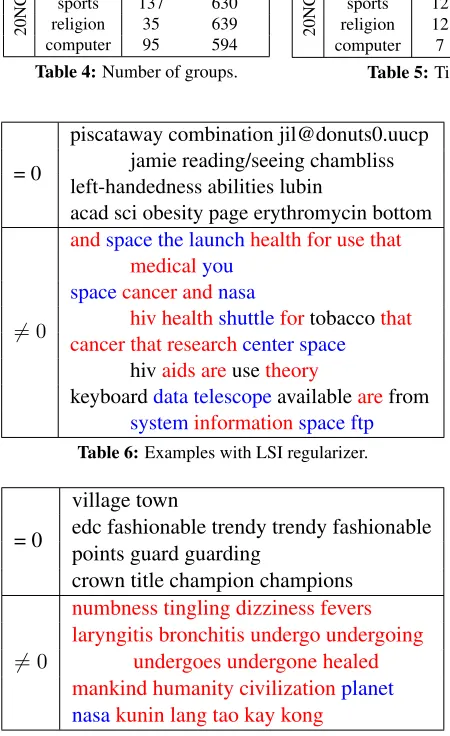
In Tables 6, 7, 8 we show examples of our pro-posed regularizers-removed and -selected groups (in v) in the science subset of the 20NG dataset. Words with weights (in w) of magnitude greater than10−3
are highlighted inred(sci.med) andblue(sci.space).
5 Conclusion & Future Work
This paper proposes new types of structured regular-izers to improve not only the accuracy but also the efficiency of the text categorization task. We mainly focused on how to find and extract semantic and syn-tactic structures that lead to sparser feature spaces and therefore to faster learning times. Overall, our results demonstrate that linguistic prior knowledge in the data can be used to improve categorization performance for baseline bag-of-words models, by mining inherent structures. We only considered lo-gistic regression because of its interpretation for L2 regularizers as Gaussian prior on the feature weights and following Sandler et al. (2009), we considered a non-diagonal covariance matrix for L2 based on word similarity before moving to group lasso as pre-sented in the paper. We are not expecting a signif-icant change in results with different loss functions
as the proposed regularizers are not log loss specific. Future work could involve a more thorough in-vestigation on how to create and cluster graphs, i. e. covering weighted and/or signed cases. Finding bet-ter clusbet-ters in the word2vec space is also a criti-cal part. This is not only restricted in finding the best number of clusters but what type of clusters we are trying to extract. Gaussian Mixture Models (McLachlan and Basford, 1988) could be applied in order to capture overlapping groups at the cost of high complexity. Furthermore, topical word embed-dings (Liu et al., 2015) can be considered for ularization. This approach could enhance the reg-ularization on topic specific datasets. Additionally, we plan on exploring alternative regularization algo-rithms diverging from the group-lasso method.
References
Rie Kubota Ando and Tong Zhang. 2005. A framework for learning predictive structures from multiple tasks and unlabeled data. Journal of Machine Learning Re-search, 6:1817–1853.
Sergey Bakin. 1999. Adaptive regression and model selection in data mining problems. Ph.D., The Aus-tralian National University, Canberra, Australia, May. David M. Blei, Andrew Y. Ng, and Michael I. Jordan.
2003. Latent Dirichlet Allocation. Journal of Ma-chine Learning Research, 3:993–1022.
John Blitzer, Mark Dredze, and Fernando Pereira. 2007. Biographies, bollywood, boomboxes and blenders: Domain adaptation for sentiment classification. In
Proceedings of the 45th Annual Meeting of the Asso-ciation of Computational Linguistics, ACL ’07, pages 440–447. ACL.
Vincent D Blondel, Jean-Loup Guillaume, Renaud Lam-biotte, and Etienne Lefebvre. 2008. Fast un-folding of communities in large networks. Jour-nal of Statistical Mechanics: Theory and Experiment, 2008(10):P10008.
Stephen Boyd and Lieven Vandenberghe. 2004. Convex Optimization. Cambridge University Press, New York, NY, USA.
Stanley F. Chen and Ronald Rosenfeld. 2000. A survey of smoothing techniques for ME models.IEEE Trans-actions on Speech and Audio Processing, 8(1):37–50. Scott Deerwester, Susan T. Dumais, George W. Furnas,
Günes Erkan and Dragomir R. Radev. 2004. LexRank: graph-based lexical centrality as salience in text sum-marization. Journal of Artificial Intelligence Re-search, 22(1):457–479.
Santo Fortunato. 2010. Community detection in graphs.
Physics reports, 486(3):75–174.
Jerome H. Friedman, Trevor Hastie, and Robert Tibshi-rani. 2010. A note on the group lasso and a sparse group lasso. Technical report, Department of Statis-tics, Stanford University.
Trevor Hastie, Robert Tibshirani, and Jerome H. Fried-man. 2009. The elements of statistical learning, vol-ume 2. Springer.
Magnus R. Hestenes. 1969. Multiplier and gradient methods. Journal of Optimization Theory and Appli-cations, 4:303—-320.
Arthur E. Hoerl and Robert W. Kennard. 1970. Ridge regression: Biased estimation for nonorthogonal prob-lems. Technometrics, 12(1):55–67.
Laurent Jacob, Guillaume Obozinski, and Jean-Philippe Vert. 2009. Group Lasso with Overlap and Graph Lasso. InProceedings of the 26th International Con-ference on Machine Learning, ICML ’09, pages 433– 440.
Rodolphe Jenatton, Julien Mairal, Francis Bach, and Guillaume Obozinski. 2010. Proximal methods for sparse hierarchical dictionary learning. In Proceed-ings of the 27th International Conference on Machine Learning, ICML ’10, pages 487–494.
Rodolphe Jenatton, Jean-Yves Audibert, and Francis Bach. 2011. Structured variable selection with sparsity-inducing norms. Journal of Machine Learn-ing Research, 12:2777–2824.
Seyoung Kim and Eric P. Xing. 2010. Tree-guided group lasso for multi-task regression with structured sparsity. In Proceedings of the 27th International Conference on Machine Learning, ICML ’10, pages 543–550. Eyal Krupka and Naftali Tishby. 2007. Incorporating
Prior Knowledge on Features into Learning. In Pro-ceedings of the 11th International Conference on Arti-ficial Intelligence and Statistics, volume 2 ofAISTATS ’07, pages 227–234.
Jun Liu and Jieping Ye. 2010. Moreau-Yosida Regular-ization for Grouped Tree Structure Learning. In Ad-vances in Neural Information Processing Systems 23, NIPS ’10, pages 1459–1467.
Yang Liu, Zhiyuan Liu, Tat-Seng Chua, and Maosong Sun. 2015. Topical word embeddings. In Proceed-ings of the 29th national conference on Artificial intel-ligence, pages 2418–2424.
J. Macqueen. 1967. Some methods for classification and analysis of multivariate observations. InIn 5-th Berke-ley Symposium on Mathematical Statistics and Proba-bility, pages 281–297.
Julien Mairal, Rodolphe Jenatton, Francis Bach, and Guillaume Obozinski. 2010. Network flow algorithms for structured sparsity. InAdvances in Neural Infor-mation Processing Systems 23, NIPS ’10, pages 1558– 1566.
Fragkiskos D. Malliaros and Konstantinos Skianis. 2015. Graph-based term weighting for text categorization. In Proceedings of the 2015 IEEE/ACM International Conference on Advances in Social Networks Analysis and Mining 2015, pages 1473–1479.
G.J. McLachlan and K.E. Basford. 1988. Mixture Mod-els: Inference and Applications to Clustering. Marcel Dekker, New York.
Rada Mihalcea and Paul Tarau. 2004. Textrank: Bring-ing order into texts. InProceedings of the 2004 Con-ference on Empirical Methods in Natural Language Processing, EMNLP ’04, pages 404–411.
Tomas Mikolov, Kai Chen, Greg S. Corrado, and Jeffrey Dean. 2013. Efficient estimation of word represen-tations in vector space. InProceedings of Workshop at International Conference on Learning Representa-tions, ICLR ’13.
Mandar Mitra, Chris Buckley, Amit Singhal, and Claire Cardie. 1997. An Analysis of Statistical and Syntactic Phrases. InProceedings of the 5th International Con-ference on Computer-Assisted Information Retrieval, volume 97 ofRIAO ’97, pages 200–214.
Bo Pang and Lilian Lee. 2004. A sentimental educa-tion: sentiment analysis using subjectivity summariza-tion based on minimum cuts. InProceedings of the 42nd Annual Meeting on Association for Computa-tional Linguistics, ACL ’04, pages 271–278.
M. J. D. Powell. 1969. A method for nonlinear con-straints in minimization problems. R. Fletcher editor, Optimization, pages 283—-298.
Rajat Raina, Andrew Y. Ng, and Daphne Koller. 2006. Constructing Informative Priors Using Transfer Learn-ing. In Proceedings of the 23rd International Con-ference on Machine Learning, ICML ’06, pages 713– 720.
Radim ˇReh˚uˇrek and Petr Sojka. 2010. Software Frame-work for Topic Modelling with Large Corpora. In Pro-ceedings of the LREC 2010 Workshop on New Chal-lenges for NLP Frameworks, pages 45–50.
François Rousseau and Michalis Vazirgiannis. 2013. Graph-of-word and tw-idf: New approach to ad hoc ir. InProceedings of the 22nd ACM international con-ference on Information and knowledge management, CIKM ’13, pages 59–68.
Mark W. Schmidt and Kevin Murphy. 2010. Convex structure learning in log-linear models: Beyond pair-wise potentials. InProceedings of the 13th Interna-tional Conference on Artificial Intelligence and Statis-tics, AISTATS ’10, pages 709–716. JMLR Workshop and Conference Proceedings.
Mark W. Schmidt, Glenn Fung, and Rómer Rosales. 2007. Fast optimization methods for L1 regulariza-tion: A comparative study and two new approaches. In Proceedings of the 18th European Conference on Machine Learning, ECML ’07, pages 286–297. Matt Thomas, Bo Pang, and Lillian Lee. 2006. Get
out the vote: Determining support or opposition from Congressional floor-debate transcripts. In Proceed-ings of the 2006 Conference on Empirical Methods in Natural Language Processing, EMNLP ’06, pages 327–335.
Robert Tibshirani. 1996. Regression shrinkage and se-lection via the lasso. Journal of the Royal Statistical Society. Series B (Methodological), pages 267–288. Vladimir Naumovich Vapnik. 1991. Principles of Risk
Minimization for Learning Theory. In Advances in Neural Information Processing Systems 4, NIPS ’91, pages 831–838.
Jierui Xie, Stephen Kelley, and Boleslaw K. Szyman-ski. 2013. Overlapping community detection in
net-works: The state-of-the-art and comparative study.
ACM Computing Surveys, 45(4):43:1–43:35.
Dani. Yogatama and Noah A. Smith. 2014a. Linguistic structured sparsity in text categorization. In Proceed-ings of the 52nd Annual Meeting of the Association for Computational Linguistics, ACL ’14, pages 786–796. Dani Yogatama and Noah A. Smith. 2014b. Making the
most of bag of words: Sentence regularization with al-ternating direction method of multipliers. In Proceed-ings of the 31st International Conference on Machine Learning, volume 32 ofICML ’14, pages 656–664. Ming Yuan and Yi Lin. 2006. Model selection and
es-timation in regression with grouped variables. Jour-nal of the Royal Statistical Society. Series B (Statistical Methodology), 68(1):49–67.
Lei Yuan, Jun Liu, and Jieping Ye. 2011. Efficient methods for overlapping group lasso. InAdvances in Neural Information Processing Systems 24, NIPS ’11, pages 352–360.