Compositionality
∗
with an appendix by B. Partee
Theo M.V. Janssen
Dept. of Math. and Comp. Sc., Univerity of Amsterdam
Plantage Muidergracht 24, 1018TV Amsterdam
[email protected]
Abstract
The first topic of the paper is to provide a formalization of the principle of compositionality of meaning. A mathematical model (based upon universal algebra) is presented, and its properties are investigated. The second topic is to discuss arguments from the literature against compositionality (of Hintikka, Higginbotham, Pelletier, Partee, Schiffer and others). Methods are presented that help to obtain compositionality. It is argued that the principle is should not be considered an empirical verifyable restriction, but a methodological principle that describes how a system for syntax and semantics should be designed. The paper has an appendix by B. Partee on the compositional treatment of genitives.
∗To appear in J.F.A.K. van Benthem & A. ter Meulen (eds.),Handbook of Logic and Linguistics,
1
The principle of compositionality of meaning
1.1
The principle
The principle of compositionality reads, in its best known formulation:
The meaning of a compound expression is a function of the meanings of its parts
The principle of compositionality of meaning has immediate appeal, but at the same time it arouses many emotions. Does the principle hold for natural languages? This question cannot be answered directly, because the formulation of the principle is sufficiently vague, that anyone can put his own interpretation on the principle. One topic of investigation in this chapter is providing a more precise interpretation of the principle, and developing a mathematical model for the principle. The second topic of investigation is to discuss challenges to the principle in the literature. It will be argued that the principle should not be considered an empirically verifiable restriction, but a methodological principle that describes how a system for syntax and semantics should be designed.
1.2
Occurrences of the principle
Compositionality of meaning is a standard principle in logic. It is hardly ever discussed there, and almost always adhered to. Propositional logic clearly satisfies the principle: the meaning of a formula is its truth value and the meaning of a compound formula is indeed a function of the truth values of its parts. The case of predicate logic will be discussed in more detail in section 2.
The principle of compositionality is a well-known issue in philosophy of language, in particular it is the fundamental principle of Montague Grammar. The discussions in philosophy of language will be reviewed in several sections of this chapter. In linguistics the principle was put forward by Katz and Fodor (Katz 1966, p.152), (Katz & Fodor 1963, p.503). They use it to design a finite system with infinite output: meanings for all sentences. There is also a psychological motivation in their argument, as, in their view, the principle can explain how a human being can understand sentences never heard before, an argument proposed by Frege much earlier (see section 1.3); see also the discussion in section 7.5.
The principle is also adhered to in computer science. Programming languages are not only used to instruct computers to perform certain tasks, but they are also used among scientists for the communication of algorithms. So they are languages with an (intended) meaning. To prove properties of programs, for example that the execution of the program terminates at some point, a formal semantics is required. A prominent school in this area , Denotational Semantics follows the methods of logic, and espouses therefore compositionality as a fundamental principle, see sec-tions 4.2 and 10.1.
Another argument for working compositionally that is often put forward in com-puter science, is of a practical nature. A compositional approach enables the pro-gram designer to think of his system as a composite set of behaviors, which means that he can factorize his design problem into smaller problems which he can then handle one by one.
1.3
On the history of the principle
Many authors who mention compositionality call it Frege’s Principle. Some assert that it originates with Frege (e.g. Dummett (1973, p.152)), others inform their readers that it cannot be found in explicit form in his writings (Popper 1976, p. 198). Below we will consider the situation in more detail.
In the introduction toGrundlagen der Mathematik (Frege 1884, p. xxii), Frege presents a few principles he promises to follow, one being:
One should ask for the meaning of a word only in the context of a sentence, and not in isolation’
Later this principle acquired the name of ’principle of contextuality’. Contextuality is repeated several times in his writings and ignoring this principle is, according to Frege, a source of many philosophical errors. The same opinion on these matters is held by Wittgenstein in his Tractatus (Wittgenstein 1921).
Compositionality requires that words in isolation have a meaning and that from these meanings the meaning of a compound can be built. The formulation of con-textuality given above disallows speaking about the meaning of words in isolation and is therefore incompatible with compositionality. This shows that Frege was (at the time he wrote these words) not an adherent of compositionality (for further arguments, see Janssen (1986a)). In Dummett (1973, p. 192-193) it is tried to reconcile contextuality with compositionality.
In Frege’s later writings one finds fragments that come close to what we call com-positionality of meaning. The most convincing passage, from ’Compound thoughts’ (Frege 1923), is quoted here as it provides a clear illustration of Frege’s attitude (in those days) with respect to compositionality. In the translation of Geach & Stoothoff:
’It is astonishing what language can do. With a few syllables it can express an incalculable number of thoughts, so that even a thought grasped by a terrestrial being for the very first time can be put into a form of words which will be understood by someone to whom the thought is entirely new. This would be impossible, were we not able to distinguish parts in the thoughts corresponding to the parts of a sentence, so that the structure of the sentence serves as the image of the structure of the thoughts.’
In this passage one could read the idea compositionality of meaning. Yet it is not the principle itself, as it is not presented as a principle but as an argument in a wider discussion. Furthermore, one notices that Frege does not require that the ultimate parts of the thought have an independently given meaning (which is an aspect of compositionality).
The conclusion is that Frege rejected the principle of compositionality in the period in which he wrote Grundlagen der Mathematik, but may have accepted the principle later on in his life. It seems that nowhere in his published works he mentions compositionality as a principle. It is, therefore, inaccurate to speak of ’Frege’s principle’. Compositionality is not Frege’s, but it it might be called ’Fregean’ because it is in the spirit of his later writings.
2
Illustrations of compositionality
2.1
Introduction
taken from natural language, programming language and logic. All cases concern a phenomenon that at a first sight might be considered as non-compositional. But it turns out that there is a perspective under which they are compositional.
2.2
Time dependence in natural language
The phrasethe queen of Holland can be used to denote some person. Who this is depends on the time one is speaking about. Usually the linguistic context (tense, time adverbials) give sufficient information about whom is meant, as in (1) or (2):
(1) The Queen of Holland is married to Prince Claus.
(2) In 1910 the Queen of Holland was married to Prince Hendrik.
In (1) the present tense indicates that the present queen is meant: Queen Beatrix. In (2) Queen Wilhelmina is meant, because she was queen in the year mentioned.
These examples might suggest that the meaning ofthe queen of Hollandvaries with the time about which one is speaking. This is, however, not in accordance with compositionality, which requires that the phrase, when considered in isolation, has a meaning from which the meaning of (1) and (2) can be build. The solution that leads to a single meaning for the phrase is to incorporate the source of variation into the notion of meaning. Accordingly, the meaning of the queen of Hollandis a function from moments of time to persons. For other expressions there may other factors of influence (speaker, possible world, . . . ). Such factors are called indices and a function with indices as domain is called an intension. So compositionality leads us to consider intensions as meanings of natural language expressions. For a discussion, see Lewis (1970).
2.3
Identifiers in programming languages
Expressions likex+ 1 are used in almost every programming language. The expres-sion denotes a number; which number this is, depends on the contents of a certain cell in the memory of the computer. For instance, if the value 7 is stored for xin the memory, then x+ 1 denotes the number 8. So one might say that the meaning ofx+ 1 varies, which is not in accordance with compositionality. As in the previous example, the source of variation can be incorporated in the notion of meaning, so that the meaning of an expression like x+ 1 is a function from memory states of the computer to numbers. The same notion of meaning is given in the algebraic approach to semantics of programming languages, initiated by Adj (1977).
Interesting in the light of the present approach is a discussion in Pratt (1979). He distinguishes two notions of meaning: a static meaning (an expression gets a meaning once and for all) and a dynamic notion (the meaning of an expression varies). He argues that a static meaning has no practical purpose, because we fre-quently use expressions that are associated with different elements in the course of time. Therefore he developed a special language for the treatment of semantics of programming languages: dynamic logic. Compositionality requires that an expres-sion has a meaning from which in all contexts the meaning of the compound can be built, hence a static notion of meaning. In this subsection we have seen that a dynamic aspect of meaning can be covered by a static logic by using a more abstract notion of meaning.
2.4
Tarski’s interpretation of predicate logic
for predicate logic. Pratt (1979) even says that ’there is no function such that the meaning of∀xφcan be specified with a constraint of the formM(∀xφ) =F(M(φ))’. In a compositional approach such a meaning assignment Mand an operatorF on meanings has to be provided.
Let us consider Tarski’s standard way of interpreting predicate logic in more detail. It roughly proceeds as follows. Let A be a model and g anA-assignment. The interpretation in A of a formula φ with respect to g, denoted φg, is defined recursively. One of these clauses is:
[φ∧ψ]g istrue iffφg istrue andψgistrue.
This suggests that the meaning ofφ∧ψis a truth value that is obtained from the truth values for φandψ. But another clause of the standard interpretation is not compatible with this idea:
[∃xφ]g istrue iff if there is a g0 ∼xg such that [φ(x)]g
0
istrue.
(Here g0 ∼
x g means that g0 is the same assignment as g except for the possible difference thatg0(x)6=g(x) ). Since it obviously is not always possible to calculate the truth value of ∃xφ (for a given g) from the truth value of φ(for the same g), a compositional approach to predicate logic requires a more sophisticated notion of meaning.
Note that there is no single truth value which corresponds withφ(x). It depends on the interpretation ofx, and in general on the interpretation of the free variables in φ, hence on g. In analogy with the previous example, we will incorporate the variable assignment into the notion of meaning. Then the meaning of a formula is a function from variable assignments to truth values, namely the function that yields true for an assignment in case the formula is true for that assignment. With this conception we can build the meaning of φ∧ψ from the meanings ofφandψ: it is the function that yields true for an assignment if and only if both meanings of φ
andψ yield true for that assignment.
The situation becomes more transparent if we use an another perspective: the meaning of a formula is the set of assignments for which the formula is true. Let M denote the function that assigns meanings to formulas. Then we have: M(φ∧ψ) =
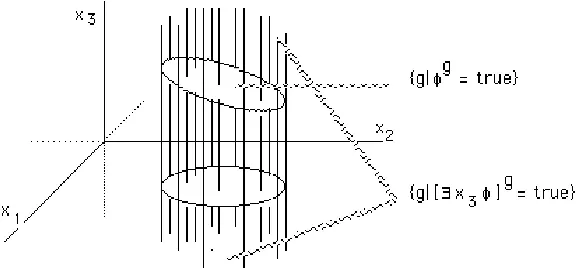
φ∩ψ. For the other connectives there are related operations on sets. For existential quantification the operation is: M(∃xφ) = {h| h∼x g and g ∈ M(φ)}. Let Cx denote the semantic operation described at the right hand side of the = sign, i.e.
Cx is the operation ’extend the set of assignments with all x variants’. Thus the requirement of compositionality is satisfied: the syntactic operation of writing ∃x
in front of a formula has a semantic interpretation: apply Cxto the meaning ofφ. This view on the meaning of predicate logic (sets of assignments) is explicit in some textbooks on logic (Monk (1976, p.196), Kreisel & Krivine (1976, p.17)).
Note that same strategy can be followed for other logics. For instance, a compo-sitional meaning assignment to propocompo-sitional modal logic is obtained by defining the meaning of a proposition to be the set of possible worlds in which the proposition holds.
Figure 1: The interpretation of∃xas a cylindrification operation
is called the x-th cylindrification operation (see figure 1). The algebraic structure obtained for predicate logic with cylindrifications as operators, is called a cylindric algebra. The original motivation for studying cylindric algebras was a technical one: to make the powerful tools from algebra available for studying logic (Henkin, Monk & Tarski 1971).
The discussion can be summarized as follows. The standard (Tarskian) interpre-tation of predicate logic is not a meaning assignment but a recursive, parameterized definition of truth for predicate logic. It can easily be turned into a compositional meaning assignment by incorporating the parameter (viz. the assignment to vari-ables) into the concept of meaning. Then meaning becomes a function with assign-ments as domain.
2.5
Situation semantics
Situation Semantics (Barwise & Perry 1983) presents an approach to meaning which differs from the traditional model-theoretic one. The basic new point is that a sentence conveys information (about the external world or about states of mind), formalized in their conception of meaning as a relation. The meaning of a declarative sentence is a relation between utterances of the sentence and the situation described by the utterance. More generally, the meaning of an expression is a relation between utterances and situations. The interpretation of an utterance at a specific occasion is the described situation.
To illustrate Situation Semantics, consider the following example (op. cit. p. 19):
(3) I am sitting.
The meaning of this sentence is a relation between utterance u and situation e
systematic way. Thus, Situation Semantics satisfies the principle of compositionality of meaning.
This was a simple example because the domain of interpretation does not change. More challenging is sentence (4) with antecedent relations as indicated in (5) (Bar-wise & Perry 1983, p. 136-137):
(4) Joe admires Sarah and she admires him.
(5) Joe1 admires Sarah2and she2 admires him1.
Sentence (4) has two parts (6) and (7):
(6) Joe admires Sarah
(7) She admires him.
Sentence (7), when considered in isolation, has two free pronouns for which suitable connections must be found. This is not the case for the whole sentence (4); so (7) has another domain for the interpretation of pronouns than (4). For this reason, the statement made with (4) cannot be considered as just a conjunction of two independent statements: somehow the meaning of the first part has to influence the meaning of the second part.
The solution is based on the meaning of names. Initially (op. cit. p. 131), the meaning of a name β was defined as a relation that holds between an utterance
u and an individual aσ (in a discourse situation d) if and only if the speakerc of the utterance refers by β to that individual. For sentences like (4), the meaning of names is augmented to make them suitable antecedents for co-indexed pronouns (op. cit. p. 137), evoking a connection with the coindexed pronouns. In symbols:
d, c[[βi]]aσ, eiffc(βi) =aσ, aσ is namedβ, and ifc(hei) =bthenb=aσ
With this extension the meaning of a sentence of the formφ and ψcan be obtained from the meanings ofφandψin the following way:
d, c[[φ and ψ]]eiff there is an extensionc’ ofcsuch thatd, c0[[φ]]eandd, c0[[ψ]]e
Let us summarize the solution. The meaning ofφ and ψ is a relation, and to find its value for the pair of coordinatesd, cthe value of the meanings ofφandψfor these coordinates is not sufficient. Other coordinatesc0have to be considered too, so the whole meaning relation has to be known. This illustrates that (op. cit. p. 32): ’a version of compositionality holds of meanings, but not of interpretations’ . This is in analogy of the situation in Montague grammar, where there is compositionality of meaning, but not of extension.
This example illustrates that the relational approach to meaning is not an obsta-cle to compositional semantics. The problem was that the initial meaning of names was too poor to deal with coindexed pronouns, and the solution was to augment the concept of meaning. Again, the strategy was followed that if a given conception of meaning is not suitable for a compositional semantics, a richer conception of meaning is defined.
2.6
Conclusion
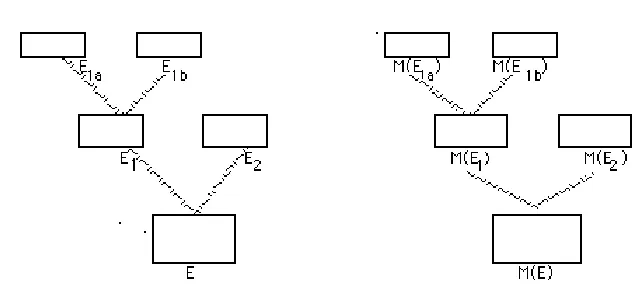
Figure 2: Compositionality: the compositional formation of expression E from its parts and the compositional formation of the meaning of E from the meanings its parts
.
3
Towards formalization
3.1
Introduction
The principle of compositionality of meaning is not a formal statement. It contains several vague words which have to be made precise in order to give formal content to the principle. In this section the first steps in this direction are made, giving us ways to distinguish compositional and non-compositional proposals (in section 4). In later sections (viz. 8, 9) mathematical formalizations are given, making it possible to prove certain consequences of the compositional approach.
Suppose that an expressionE is constituted by the partsE1andE2(according to some syntactic rule). Then compositionality says that the meaning M(E) of E
can be found by finding the meanings M(E1) and M(E2) of respectively E1 and
E2, and combining them (according to some semantic rule). Suppose moreover that E1 is constituted by E1a and E1b (according to some syntactic rule, maybe another that the one used for E). Then the meaning M(E1) is in turn obtained from the meaningsM(E1a) andM(E1b) (maybe according to another rule than the one combining M(E1) andM(E2)). This situation is presented in figure 2.
3.2
Assumptions
The interpretation in 3.1 is a rather straightforward explication of the principle, but there are several assumptions implicit in it. Most assumptions on composition-ality are widely accepted, some will return in later sections, when the principle is discussed further.
The assumptions are:
1. In a grammar the syntax and the semantics are distinguished components connected by the requirement of compositionality. This assumption excludes approaches, as in some variants of Transformational Grammar, with a series of intermediate levels between the syntax and the semantics.
3. The rules specify how to combine the parts, i.e. they are instructions for com-bining expressions. So this gives a different perspective from the traditional view of a grammar as a rewriting system.
4. The grammar determines what the parts of an expression are. It depends on the rules whetherMary does not cryhas two partsMaryanddoes not cry, or threeMary, does notandcry. This illustrates thatpartis a technical notion.
5. All expressions that arise as parts have meaning. This excludes systems in which only complete sentences can be assigned meaning (as in some variants of Transformational Grammar). Not only parts for which we have an intuitive meaning (as loves in John loves Mary), but also parts for which this is less intuitive (asonlyinOnly John loves Mary). The choice what the meaning of a part is might depend on what we consider a suitable ingredient for building the meaning of the whole expression.
6. The meaning of an expression is not only determined by the parts, but also by the rule which combines those parts. From the same collection of parts several sentences can be made with different meanings (e.g. John loves Mary
vs. Mary loves John). Several authors make this explicit in their formulation
of the principle, e.g. Partee, ter Meulen & Wall (1990, p.318):
The meaning of a compound expression is a function of the meanings of its parts and of the syntactic rule by which they are combined.
7. For each syntactic rule there is a semantic rule that describes its effect. In order to obtain this correspondence, the syntactic rules should be designed appropriately. For instance, semantic considerations may influence the design of syntactic rules. This correspondence leaves open the possibility that the semantic rule is a meaning-preserving rule (no change of meanings), or that different syntactic rules have the same meaning.
8. The meaning of an expression is determined by the way in which it is formed from its parts. The syntactic production process is, therefore, the only input to the process of determining its meaning. There is no other input, so no external factors can have an effect on the meaning of a sentence. If, for instance, discourse factors should contribute to meaning, the conception of meaning has to be enriched in order to capture this.
9. The production process is the input for the meaning assignment. Ambiguous expressions must have different derivations: i.e. a derivation with different rules, and/or with different basic expressions.
3.3
Options in syntax
In the above section it is not specified what the nature is of expressions and parts, i.e. what kind of objects are in the boxes in figure 2. Such a decision has to be based upon linguistic insights. Below some important options are mentioned.
Concatenation of words
Powerful operations on strings
In some theories the syntactic rules are more powerful than just concatenation. A small step is to allow a wrap-rule (a rule with two arguments, where the first argument is inserted in the second position of the second argument). In PTQ (Montague 1973) the syntactic rules are very powerful, for instance there is a rule that substitutes a string for a pronoun (e.g. the wide scope reading of Every man
loves a woman is obtained by substituting a woman for him in every man loves
him). In these cases the grammar generates strings, and the derivation does not assign a constituent structure to them (since the parts are not constituent parts).
Operations on structures
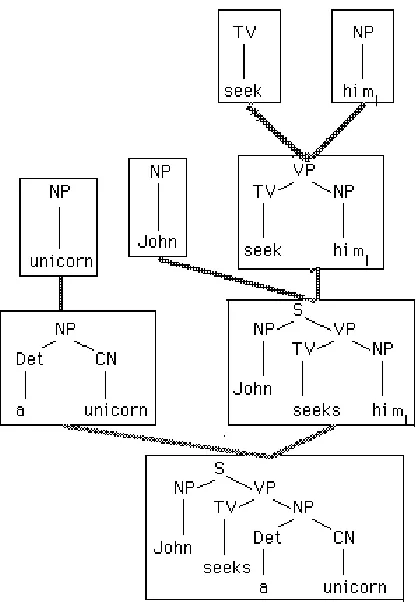
Most theories concern structures. Tree Adjoining Grammar, for instance, assumes as its basic elements (small) trees, and two kinds of rules: adjunction and sub-stitution. Another example are the M-grammars, introduced by Partee (1973), and used in the translation system Rosetta (Rosetta 1994). The boxes contain phrase-structure trees as in Transformational Grammar, and the rules are powerful operations on such trees. In this situation the tree that describes the derivation might differ considerably from the tree describing the structure of the string, as illustrated below.
Consider the following sentence:
(1) John seeks a unicorn.
There are semantic arguments for distinguishing two readings: the de re reading which implicates the existence of unicorns, and thede dictoreading which does not. But there are no syntactic arguments for distinguishing two different constituent structures. In an M-grammar this unique constituent structure can be derived in two ways, one for each meaning. In figure 3 the derivation of the de re reading of (1) is given, using a tree-substitution rule.
3.4
Conclusion
Above it is argued that there are several options in syntax. In the previous section it has been shown that there are choices in defining what meanings are. The discussion whether natural language is compositional has to do with these options. If one has a definite opinion on what parts, meanings and rules should be like, then it may be doubted whether compositionality holds. But if one leaves one or more of these choices open, then the issue becomes: in which way can compositionality be obtained? These two positions will return in several discussions concerning the principle of compositionality.
4
Examples of non-compositional semantics
4.1
Introduction
4.2
Arrays in programming languages
In programming languages one finds expressions consisting of an array identifier with subscript, e.g. a[7]. Hereais an array identifier, it refers to a series of memory cells in the computer. Between the [ -sign and ] -sign the subscript is mentioned. That subscript tells which of the cells is to be considered, so the expression a[7] refers to the contents of this cell (e.g. a number). The subscript can be a compound expression that denotes a number, e.g. x+ 1, hence the syntax of this construction says that there are two parts: an array identifier, and an arithmetical expression.
In the semantics of programming languages one often interprets programs in an abstract computer with abstract memory cells. Then expressions like a[7] and
a[x+ 1] have as interpretation the value stored in such a memory cell (or alterna-tively a function to such a value). The array identifier itself cannot be given an interpretation, since in the abstract computer model there is nothing but cells and their contents, and a does not correspond to anyone of them. As a consequence every time the array identifier arises, it has to be accompanied by a subscript. This leads to complicated proof rules (e.g. in de Bakker (1980))
This interpretation is not in accordance with compositionality which requires that all parts have a meaning; in particular the array identifier should have a mean-ing. Although in the given computer model an appropriate meaning is not available, it is easy to define one: a function from numbers to cells. Changing the model in this way, allows a simpler reformulation of the proof rules, because array identifiers without subscripts can be used (see e.g. Janssen & van Emde Boas (1977)).
4.3
Syntactic rules as conditions
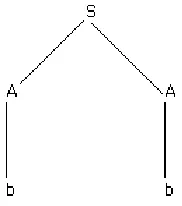
In several theories syntactic rules are formulated as conditions, or they are accom-panied by conditions. First we will consider a simple example. A context sensitive rule allows us to rewrite a symbol in a certain context. A context sensitive grammar is a grammar with such rules. An example is one with the rulesS→AA,Ab→bb,
bA → bb. This grammar does not produce any strings, because after application of the first rule, no further rules are applicable. MacCawley (1986) proposed to consider context sensitive rules as ’node-admissability conditions’. These specify which configurations in trees are allowed. For instance, the last rule says that an
b immediately dominated by an A is allowed, if there is an b immediately to the left of this b. With this interpretation, the tree in figure 4 is allowed by the given grammar. So the string bb belongs to the language of the grammar, although it cannot be generated in the classical way. In this conception of grammar there are no rules, only conditions. Hence there is no syntactic algebra with operations, and an admissible structure has no derivation. Consequently, a compositional meaning assignment (in the sense of the principle) is not possible.
A similar situation arises in the variant of Transformational Grammar known as ’Principles and Parameters’. Conditions form also the central part of the theory, but formally the situation is slightly different. One single transformation, called
move−α, can in principle move any constituent to any position controlled by various conditions on movement. So the interesting aspect of the theory does not lie in this transformation, but in the conditions. An algebraic formulation of this theory is possible, with one partial rule which takes one argument as input. Since this single rule has to account for all phenomena, there is no semantic counterpart for this rule. So ’Principles and Parameters’ is a theory where compositionality of meaning is impossible.
Figure 4: The context sensitive rules S → AA, Ab → bb, bA → bb used as node admissibility conditions
not disturb compositionality: a rule can be considered as an abbreviation for a collection of rules, each generating one of the admissible structures, and all rules from the collection have the same semantic interpretation (the one associated with the original rule).
4.4
Discourse representation theory
Pronominal references in discourses may depend on previous sentences, as illustrated by the following two discourses which have identical second sentences.
(1) A man walks in the park. He whistles.
(2) Not all men do not walk in the park. He whistles.
In (1), the pronounhein the second sentence is interpreted as anaphorically linked to the term a man in the first sentence. This is not possible in (2), where hehas to refer to a third party. The meanings of discourses (1) and (2) are, therefore, different.
Since their second sentences are identical, their first sentence (3) and (4) must contain the source of the meaning difference.
(3) A man walks in the park.
(4) Not all men do not walk in the park.
However, (3) and (4) have identical truth-conditions, hence the discourses (1) and (2) seem to provide an argument against compositionality.
is intended: the name of the theory states explicitly that it is about represen-tations, and claims psychological relevance of the representations. The solution DRT provides for the discourses we started with roughly is as follows. Different representations are assigned to (3) and (4), and the two negations in (4) cause a difference that triggers a difference in interpretation strategy, hence a difference in the pronominal reference.
However, a compositional treatment for this kind of discourse phenomena is quite feasible. In fact, the principle of compositionality itself points to a solution. Since (3) and (4) have identical truth-conditions, a richer notion of meaning is required if the principle of compositionality is to be saved for discourses. Truth-conditions of sentences (which involve possible worlds and assignments to free variables) are just one aspect of meaning. Another aspect is that the preceding discourse has a bearing on the interpretation of a sentence (and especially of the so called discourse pronouns). Moreover, the sentence itself extends this discourse and thus has a bearing on sentences that follow it. Hence a notion of meaning is required which takes the semantic contribution into account that a sentence makes to a discourse. Sentences (3) and (4) make different contributions to the meaning of the discourse, especially concerning the interpretation of later discourse pronouns. These ideas have led to Dynamic Predicate Logic (henceforth ’DPL’). It is a compositional theory that accounts not only for the phenomena that are treated in DRT, but for other phenomena as well, see Groenendijk & Stokhof (1991). Thus we see that the program to require compositionality has suggested a particular solution.
The difference in compositionality between in DRT and DPL was initially a cen-tral point in the discussion, see Groenendijk & Stokhof (1991). Later developments made the difference less crucial, because several reformulations of DRT were given that adhered to compositionality. Examples are Zeevat (1989) and Muskens (1993), and the chapter in this handbook on DRT. The concepts of meaning used in these proposals are illuminating. For instance, in Zeevat’s proposal the meanings are pairs consisting of sets of assignments (as in predicate logic), and a set of variables (discourse markers). So syntactic symbols act as component in the semantics, which reflects the special role of representations in DRT.
4.5
Substitutional interpretation of quantifiers
For the interpretation of∃xφan alternative to the Tarskian interpretation has been proposed that is not compositional. It is called the substitutional interpretation, and says: ∃xφ(x) is true if and only if there is some substitutiona forxsuch that
φ(a) is true. Of course, the substitutional interpretation is only equivalent to the standard interpretation if there is a name for every element in the domain. The substitutional interpretation can be found in two rather divergent branches of logic: philosophical logic and in proof theory, both considered below.
In philosophical logic the substitutional interpretation is advocated by Marcus (1962) with an ontological motivation. Consider
(5) Pegasus is a winged horse.
Marcus argues that one might believe (5) without believing
(6) There exists at least one thing which is a winged horse.
At the same time she accepts that (5) entails (7):
(7) ∃x(xis a winged horse)
The substitutional interpretation is discussed more formally by Kripke (1976). As a syntax for the logic he presents the traditional syntax: ∃xφ(x) is produced from φ(x) by placing the quantifier in front of it. According to that grammarφ(x) is a part of ∃xφ(x), and φ(a) is not a part of ∃xφ(x). Hence in this case the substitutional interpretation is not compositional: the meaning of ∃xφ(x) is not obtained from the meaning of its partφ(x).
In proof theory the substitutional interpretation is given by e.g. Sch¨utte (1977). According to his syntax ∀xφ(x) is formed from φ(a), wherea is arbitrary. So the formula∀xφ(x) is syntactically ambiguous: there are as many derivations as there are expression of the form φ(a). It is in general not possible, given one such a, to find the interpretation of ∀xφ(x) from the interpretation of that φ(a), because ∀xφ(x) can be false, whereas φ(a) is true for somea’s. Hence also in this case the substitutional interpretation does not satisfy the compositionality principle.
If one wishes to have the substitutional interpretation, and at the same time meet the principle of compositionality, then the syntax has to contain an infinitistic rule which says that all expressions of the formφ(a) are a part of∀xφ(x). But such an infinitistic rule has not been proposed.
4.6
Conclusion
The examples illustrate that compositionality is a real restriction in the sense that there are theories that are essentially non-compositional. Moreover, it illustrates that compositionality is crucial in evaluating theories: not in the sense that it discriminates good from bad (such arguments are not given above, but will be given in later sections), but in the sense that it exhibits a special aspect of those theories. The fact that there was no compositional treatment of arrays exhibits that the semantic model used was ontologically sparse (or too poor, if you prefer). It exhibits that the substitutional interpretation of quantifiers avoids assignments to variables with the price of introducing an infinitistic aspect in the syntax. In DRT the rules refer in several ways to the particular form of the partial discourse representations that occur as their inputs. The compositional reformulations exhibit in which respect this is essential. This brings us to the following advice: if you encounter a new proposal, and wish to find the innovative or deviant aspect, then look for the point where it departs from compositionality.
5
Logic as auxiliary language
5.1
Introduction
The principle of compositionality of meaning expresses that meanings of parts are combined into the meaning of a compound expression. Since meanings are gener-ally formalized as model-theoretic entities, such as truth values, sets of sets etc., functions have to be specified which operate on such meanings. An example of such an operation is (Montague (1970a); p.194 in Thomason (1974)):
(1) G3 is that functionf ∈((2I)A×A)A ω
such that, for allx ∈Aω, all u, t∈A and alli∈I:f(x)(t, u)(i) = 1 if and only if t=u
This example illustrates that such translations into logic are used for good reasons. In the present section the role of translations into a logical language is investigated.
5.2
Restriction on the use of logic
Working in accordance with compositionality of meaning puts a heavy restriction on the translations into logic, because the goal of the translations is to assign meanings. The logical representations are just a tool to reach this goal. The representations are not meanings themselves, and should not be confused with them. This means for instance, that two logically equivalent representations are equally good as rep-resentation of the associated meaning. A semantic theory cannot be based upon accidental properties of meaning representations, since it would then be a theory about representations, and not about the meanings themselves. Therefore the log-ical language should only be auxiliary tool and, in principle, be dispensable.
If one has a logic for representing meanings, this logic will probably not have all the operations on meanings one needs. For instance, logic usually has only one conjunction operator (between formulas of type t), whereas natural language requires several (not only between sentences, but also between verbs, nouns, etc.). So the logic has be extended with new operations. We will consider two methods.
A new semantic operation can be introduced by introducing a new basic operator symbol, together with a model theoretic interpretation for it. Such an interpretation can be given directly, speaking e.g. about functions from functions to functions. Another method is to denote the intended interpretation with a logical expression. Then one should not forget that this expression stands for its interpretation, see the example below (in section (5.3)).
Another method is to describe the effects of the new operation using already available ones. An example we have met above (in section 5.1) is ∧λtλu[t = u]. This is an example of the standard method (introduced by Montague (1970b)): using polynomials. Probably anyone has encountered polynomials in studying elementary mathematics; an example (with two variables) isx2
1+x1+ 3×x2. This polynomial defines a function on two arguments; the resulting value is obtained by substituting the arguments for the variables and evaluating the result. For the arguments 2 and 1 it yields 22+ 2 + 3×1, being 9. The method of polynomials can be used in logic as well. For instance, a polynomial over intensional logic with variablesX1 andX2 is:
(2) λy[X1(y)∧X2(y)]
Note that y is not a variable in the sense of the polynomial. Polynomial (2) is an operation which takes two predicates as inputs and yields a predicate as result. It can be used to describe, for instance, the semantic effect of verb phrase conjunction. Usually greek letters are used to indicate variables, in PTQ (Montague 1973) one finds for the above polynomial:
(3) λy[γ0(y)∧δ0(y)]
In section (5.4) more examples of polynomials and non-polynomials will be given.
5.3
A new operator: CAUSE
Dowty (1976) presents a treatment of the semantics of factive constructions like shake John awake. For this purpose intensional logic is extended with an operator CAUSE. In order to define its interpretation the semantic apparatus is extended with a function that assigns to each well-formed formula φand each possible world
most like iwith the possible exception that φis the case. Then the interpretation of CAUSE reads:
(4) If φ, ψ ∈M Et then (φ CAU SE ψ)A,i,j,g is 1 if and only if [φ∧ψ]A,i,j,g is 1 and [¬φ]A,f(¬ψ,i),j,g is 1.
The first argument of f is a formula, and not the interpretation of this formula. Hence CAUSE, which is based upon this function, is an operator on formulas, and not on the meanings they represent. This suggests that the logic is not dispensable, that it is an essential stage and that the proposed solution is not compositional. This is shown as follows. Let f be such thatf(¬[φ∧η], i)6=f(¬[η∧φ], i). Then it may be the case that [(φ∧η)CAU SE ψ]A,i,j,g holds whereas this does not hold for η∧φ. So the two equivalent formulas φ∧η and η∧φ cannot be substituted for each other without changing the resulting truth value; a consequence that was not intended. This illustrates that the introduction of a new operator in a way that violates compositionality bears the risk of being incorrect in the sense that the intended semantic operation is not defined.
The proposal can be corrected by definingf for themeaningof its first argument (i.e. its intension). Then the last clause of the definition becomes [¬φ]A,k,j,g is 1, where k=f([∧[¬η∧φ]]A,i,j,g, i).
5.4
An operation on logic: relative clause formation
The syntactic rule for restrictive relative clause formation in PTQ (Montague 1973) roughly is as follows:
(5) R3,n: Ifαis a CN andβ a sentence, thenαsuch thatβ? is a CN, whereβ?
comes fromβby replacing each occurrence ofhenby the appropriate pronoun.
The corresponding semantic rule reads (neglecting intensions and extensions):
(6) Ifα0 is the translation of the common nounα, andβ0 of the sentenceβ, then the translation of the CN with relative clause isλxn[α0(xn)∧β0].
The rule above forms frommanandhe2loves Mary the common noun phraseman such that he loves Mary. Suppose that the meanings of these parts are represented by man and love∗(x2, j). Then the meaning of the common noun phrase is given correctly by λx2[man(x2)∧love∗(x2, j)]. However, the translation rule yields in-correct results in case the translation of the common noun contains the occurrence of a variable that becomes bound by the λ-operator introduced in the translation rule. In order to avoid this, the editor of the collection of Montague’s work on phi-losophy of language, R.H. Thomason, gave in a footnote a correction (Thomason 1974, p.261):
(7) To avoid collision of variables, the translation must be λxm[man(xm)∧ψ)], where ψ is the result of replacing all occurrences ofxn in β0 by occurrences
ofxm, wheremis the least even number such thatxmhas no occurrences in
eitherα0 orβ0.
(8) λP[λxn[P(xn)∧β0]](α0)
This polynomial formulation avoids the binding of variables in α0 byλxn, so the complication of Montague’s rule does not arise. Furthermore, it is much simpler than Thomason’s correction of the rule.
5.5
Conclusion
These examples illustrate a method to find dangerous spots in a proposal: find the places where the translation into logic is not a polynomial. It is likely that compositionality is violated there. Either the proposal is incorrect in the sense that it makes unintended predictions, or it is correct, but can be improved (simplified) considerably by using a polynomial. The latter point, viz. that an operation on meanings can be expressed by means of a polynomial, (as illustrated in 5.3) can be given a mathematical basis (see section 8). These applications of compositionality exhibit the benefits of compositionality as a heuristic method.
6
Counterexamples to compositionality
6.1
Introduction
In the present section we consider some examples from natural language that are used in the literature as arguments against compositionality. Several other exam-ples could be given, see Partee (1984). The selection here suits to illustrate the methods available to obtain compositionality. The presentation of the examples follows closely the original argumentation; proposals for a compositional treatment are given afterwards. In the last section the methods to obtain compositional solu-tions are considered from a general perspective.
6.2
Counterexamples
6.2.1 Would
The need for the introduction of the NOW-operator was based upon the classical example (Kamp 1971):
(1) A child was born that will become ruler of the world.
The following more complex variants are discussed by Saarinen (1979), who argues for other new tense operators.
(2) A child was born who would become ruler of the world.
(3) Joseph said that a child had been born who would become ruler of the world.
(4) Balthazar mentioned that Joseph said that a child was born who would become ruler of the world.
6.2.2 Unless
Higginbotham (1986) presents arguments against compositionality; we discuss vari-ants of his examples (from Pelletier (1993a)). In (5) and (6)unlesshas the meaning of a (non-exclusive) disjunction.
(5) John will eat steak unless he eats lobster.
(6) Every person will eat steak unless he eats lobster.
However, in (7) the situation is different.
(7) No person will eat steak unless he eats lobster.
This sentence is to be represented as
(8) [ No: person ] (x eat steak ∧ ¬x eats lobster).
These examples show that the meaning of unless depends on the context of the sentence in which it occurs. Therefore compositionality does not hold.
6.2.3 Any
Hintikka (1983, pp. 266-267) presents several interesting sentences with any as challenges to compositionality. Consider
(9) Chris can win any match.
In this sentence it is expressed that for all matches it holds that Chris can win them, so any has the impact of a universal quantification. But in (10) it has the impact of an existential quantification.
(10) Jean doesn’t believe that Chris can win any match.
Analogously for the pair (11) and (12), and for the pair (13) and (14):
(11) Anyone can beat Chris.
(12) I’d be greatly surprised if anyone can beat Chris.
(13) Chris will beat any opponent
(14) Chris will not beat any opponent.
All these examples show that the meaning of the English determiner any depends on its environment.
The most exciting example is the one given below. As preparation, recall that Tarski required a theory of truth to result in T-schemes for all sentences:
(15) ’φ’ is true if and only ifφis the case.
A classical example of this scheme is:
(16) Snow is whiteis true if and only if snow is white
The next sentence is a counterexample against one half of the Tarskian T-scheme.
(17) Anybody can become a millionaireis true if anybody can become a millionaire.
6.3
Compositional solutions
6.3.1 Would
A compositional analysis of (18) is indeed problematic if we assume that it has to be based on (19), because (18) is ambiguous and (19) is not.
(18) Joseph said that a child had been born who would become ruler of the world.
(19) A child was born who would become ruler of the world.
However, another approach is possible: there may be two derivations for (18). In the reading that ’becoming ruler’ lies in the future of Joseph’s saying it may have (20) as part.
(20) say that a child was born that will become ruler of the world
The rule assigning past tense to the main clause should then deal with the ’sequence of tense’ in the embedded clause, transformingwillintowould. The reading in which the time of becoming ruler lies in the future of the birth could then be obtained by building (18) from:
(21) say that a child was born who would become ruler of the world.
The strategy to obtain compositionality will now be clear: account for the ambi-guities by using different derivations. In this way the parts of (18) are not necessarily identical to substrings of the sentences under consideration (the involved tenses may be different). Such an approach is followed for other scope phenomena with tenses in Janssen (1983).
6.3.2 Unless
Pelletier (1993a) discusses the arguments of Higginbotham (1986) concerningunless, and presents two proposals for a compositional solution.
The first solution is to consider the meaning ofunlessto be one out of a set of two meanings. If it is combined with a positive subject (as in every person will eat steak unless he eats lobster) then the meaning ’disjunction’ is selected, and when combined with negative subject (as in no person eats steak unless he eats lobster) the other meaning is selected. For details of the solution, see Pelletier (1993a).
So unless is considered as a single word, with a single meaning, offering a choice
between two alternatives. In the same way as in section 2 this can be defined by a function from contexts to values.
The second solution is to considerunlessa homonym. So there are two words written asunless. The first one isunless[−neg], occurring only with subjects which bear (as is the case for every person) the syntactic feature [-neg], and having ’dis-junction’ as meaning. The second one isunless[+neg], which has the other meaning.
Nowunless is considered to be two words, each with its own meaning. The syntax
determines which combinations are possible.
6.3.3 Any
Hintikka (1983, p.280) is explicit about the fact that his arguments concerning the non-compositionality ofany-sentences are based upon specific ideas about their syntactic structure. In particular it is assumed that (22) is a ’component part’ of (23)
(22) Anyone can beat Chris
He claims that this analysis is in accordance with common sense, and in agreement with the best syntactic analysis. But, as he admits, other analyses cannot be excluded a priori; for instance that (24) is a component of (23).
(24) I’ll be greatly surprised if — can beat Chris.
One might even be more radical in the syntax than Hintikka suggests, and introduce a rule that produces (23) from
(25) Someone can beat Chris.
Partee (1984) discusses the challenges of any. She shows that the situation is more complicated than suggested by the examples of Hintikka. Sentence (27) has two readings, only one of which can come from (26).
(26) Anyone can solve that problem.
(27) If anyone can solve that problem, I suppose John can.
Partee discusses the literature concerning the context-sensitivity of any, and con-cludes that here are strong arguments for two ’distinct’any’s: anaffective anyand
a free-choice any. The two impose distinct (though overlapping) constraints on
the contexts in which their semantic contributions ’make sense’. The constraints on affective any can be described in model-theoretic terms, whereas those of the free-choice any are less well understood. For references concerning this discussion see Partee (1984).
We conclude that theany-examples can be dealt with in a compositional way by distinguishing ambiguous any, with one or both readings eliminated when in-compatible with the surrounding context.
6.4
General methods for compositionality
In this section we have encountered three methods to obtain compositionality:
1. New meanings.
These are formed by the introduction of a new parameter, or alternatively, a function from such a parameter to old meanings. This was the first solution
forunless
2. New basic parts
Duplicate basic expressions, together with different meanings for the new ex-pressions, or even new categories. This was the solution for any, and the second solution forunless.
3. New constructions
Use unorthodox parts, together with new syntactic rules forming those parts and rules operating on those parts. This approach may result in abstract parts, new categories, and new methods to form compound expressions. This was the solution for thewouldsentences.
may then be produced in new ways, and new ambiguities may arise. So adopting compositionality raises fundamental questions about what meanings are, what the basic building blocks are and what ways of construction are.
The real question is not whether a certain phenomenon can be analyzed com-positionally, as enough methods are available, but what makes the overall theory (un)attractive or (un)acceptable. A case study which follows this line of argument is presented in appendix B: a study by Partee concerning genitives.
7
Fundamental arguments against
compositional-ity
7.1
Introduction
In the present section we discuss some arguments against compositionality which are not based upon the challenge of finding a compositional solution for certain phenomena, but arguments which concern issues of a more fundamental nature. The examples present the original arguments, immediately followed by discussion.
7.2
Ambiguity
Pelletier presents arguments against compositionality based upon its consequences for the analysis of ambiguities (Pelletier (1993b),Pelletier (1994)). Some examples are:
(1) Every linguist knows two languages.
(2) John wondered when Alice said she would leave.
(3) The philosophers lifted the piano.
Sentence (1) is ambiguous regarding the total number of languages involved. In (2) the point is whetherwhenasks for the time of departure, or the time of Alice’s saying this, and in (3) the interpretation differs in whether they did it together or individually.
The above sentences contain no lexical ambiguity, and there are no syntactic arguments to assign them more than one constituent structure. Pelletier (1993b) says: ’In order to maintain the Compositionality Principle, theorists have resorted to a number of devices which are all more or less unmotivated (except to maintain the Principle): Montagovian ”quantifying-in” rules, ”traces”, ”gaps”, ”Quantifier Raising”,. . .features, and many more.’
The issue raised by Pelletier with respect to (1) is a old one, and arises as well for the classicalde dicto - de reambiguity of :
(4) John seeks a unicorn
Other approaches try to eliminate the ambiguity. Linguists have argued that the scope order is the surface order. This is known as ’Jackendoff’s principle’ (Jack-endoff 1972). It has been said by semanticists that (1) has only one reading, viz. its weakest reading (everywide scope), and that the stronger reading is inferred, when additional information is available. Analogously for (4). These two approaches work well for simple sentences, but they are challenged by more complicated sentences in which the surface order is not a possible reading, or where the different scope readings are logically independent. The latest proposal for dealing with scope am-biguities is by means of ’lifting rules’. The meaning of a noun-phrase can, by means of rules, be ’lifted’ to a more abstract level, and different levels yield different scope readings (Hendriks 1993, chapter 1).
No matter which approach is taken to quantifier scope, the situation remains the same with respect to other examples (as (2) and (3)). They are semantically ambiguous, eventhough there are no arguments for more than one derivational struc-ture.
The crucial assumption in Pelletier’s arguments is that the derivation of a sen-tence describes its syntactic structure. But, as is explained in section 3, this is not correct. The derivation tree specifies which rules are combined in what order and this derivation tree constitutes the input to the meaning assignment function. One should not call something ’syntactic structure’ which is not intended as such and then refute it, because the notion so defined does not have the desired properties. The syntactic structure (constituent structure) is determined by the output of the syntactic rules. Different derivational processes may generate one and the same constituent structure, and in this way account for semantic ambiguities.
The distinction between derivation and resulting constitutent structure is made in various grammatical theories. In section (3) is illustrated how the quantifying-in rules quantifying-in Montague grammar derive the de re version of (4) and how the rules produce a syntactic structure that differs formally from the derivation tree. In Tree Adjoining Grammars (TAG’s) the different scope readings of (1) differ in the order in which the noun-phrases are substituted in the basic tree for know. In transformational grammar the two readings of (2) differ in their derivation: in the reading where whenasks for the time of leaving, is formed from
(5) John wondered Alice said she would leavewhen.
Another classical example is:
(6) The shooting of the hunters was bloody.
For this sentence transformational grammar derives the two readings from two dif-ferent sources: one in which the hunters is in subject position and one in which it is in object position.
7.3
Ontology
In Hintikka (1983, chapter 10), an extended version of (Hintikka 1981), the issue of compositionality is discussed. Besides counterexamples to compositionality (most have been considered in section 6), he presents objections of a fundamental nature. To illustrate Hintikka’s arguments we consider an example involving branching quantifiers.
(7) Every villager has a friend and every townsman has a cousin who are members of the same party.
(8) ∀x∃y
\
/M(x, y, z, u)
∀z∃u
The representation indicates the dependency of the quantifiers: the choice of y
depends only x, and of u only on z. Formula (8) is an example from a formal language that does not adhere to compositionality. The information about the dependencies of the quantifiers would be lost in a first-order representation.
As Hintikka says, it is easy to provide a linear representation with compositional interpretation when Skolem functions are used:
(9) ∃f∃g∀x∀zM(x, f(x), z, g(z))
The connection with Hintikka’s own (game-theoretical) treatment for (7) is that (9) can be interpreted as saying that Skolem functions exist which codify (partially) the winning strategy in the correlated game (op. cit. p.281). See chapter 6 of this Handbook, for more information on game theoretical semantics.
So compositionality can be maintained by replacing the first-order quantifiers by higher-order ones. About this, Hintikka (1983, p.20.) says ’It seems to me that this is the strategy employed by Montague Grammarians, who are in fact strongly committed to compositionality. However, the only way they can hope to abide by it is to make use of higher order conceptualizations. There is a price to be paid however. The higher order entities evoked in this ”type theoretical ascent” are much less realistic philosophically and psycholinguistically than our original individuals. Hence the ascent is bound to detract from the psycholinguistic and methodological realism of one theory’. Furthermore (op. cit. p.283): ’On a more technical level, the unnaturalness of this procedure is illustrated by the uncertainties that are attached to the interpretation of such higher order variables [..]’. Finally, (op. cit. 285): ’Moreover, the first order formulations have other advantages over higher order ones. In first-order languages we can achieve an axiomatization of logical truths and of valid inferences’.
Hintikka is completely right in his description of the attitudes of Montague Grammarians: they use higher-order objects without hesitation if this turns out to be useful. His objection against compositionality is in a nutshell objecting to the higher-order ontology required by compositionality.
Some comments here are in order (the first two originate from Groenendijk & Stokhof, pers. comm.).
1. If first-order analysis is so natural and psychologically realistic, it would be extremely interesting to have an explanation why it took more than two thou-sand years since Aristotle before the notion ’first order’ was introduced by Frege. And it was presented in a notation that differs considerably from our current notation, as it was not linear.
2. It is difficult to see why the first-order notation matters. If there are onto-logical commitments, then the notions used in the interpretation of the logic, in the metatheory, are crucial, and not the notation itself. It is, for instance difficult to understand why a winning strategy for a game is more natural than a function from objects to objects (cf. Hintikka’s comment on (9)).
7.4
Synonymy
Pelletier discusses problems raised by the substitution of synonyms in belief-contexts ((Pelletier 1993b, Pelletier 1994)). Consider:
(10) Dentists usually need to hire an attorney.
(11) Tooth doctors commonly require the professional services of a lawyer.
Suppose that these two sentences are synonymous. If we assume that (12) and (13) are formed from respectively (10) and (11) by the same rules, then compositionality implies that (12) and (13) are synonymous.
(12) Kim believes that dentists usually need to hire an attorney.
(13) Kim believes that tooth doctors commonly require the professional services of a lawyer.
However, it easy to make up some story in which Kim believes the embedded sen-tence in (12), but not the one in (13). Pelletier formulates the following dilemma: either one has to state that (10) and(11) are not synonymous, and conclude that there are no synonymous sentences at all in natural language, or one has to give up compositionality.
Let us consider the situation in more detail. The standard model theoretic semantics says that the extension of dentistis a set of individuals; dependent on possible world and the time under consideration. So the meaning of dentist is a function from possible worlds and times. For most speakers the meaning of tooth
doctor is the same function as for dentist. The source of the problem raised by
Pelletier is that for Kim these meaning functions fordentistandtooth doctormight differ. This shows that the standard meaning notion is an abstraction that does not take into account that for someone the generally accepted synonymy might not hold. In order to account for this, the meaning function can be given the involved individual an additional argument. Then (10) and (11) are no longer synonymous, nor are (12) and (13). Thus there is no problem for compositionality: we have just found an additional factor.
Are we now claiming that, upon closer inspection, there are no synonymous sentences? The synonymy of belief-sentences is an old issue, and there is a lot of literature about it; for references see Partee (1982) and Salmon & Soames (1988). It seems that Mates (1950) already showed that almost any difference in the em-bedded clauses makes belief-sentences non-synonymous. But there are several cases of constructional (non-lexical) synonymy. Examples are (14) and (15), and (from Partee (1982)) sentences (16) and (17).
(14) Kim believes that John gives Mary a book
(15) Kim believes that John gives a book to Mary.
(16) Mary believes that for John to leave now would be a mistake
(17) Mary believes that it would be a mistake for John to leave now.
7.5
Psychology
argues that compositionality is not needed in order to give an explanation for that power. On the other hand, he argues that such a compositional approach does not work. We will restrict our attention to this aspect of his book.
A compositional semantic analysis of
(18) Tanya believes that Gustav is a dog.
assumes that belief is a relation between Tanya and some kind of proposition. There are several variants of the propositional theory of belief, some more representational, others more semantic. For all variants of these theories, Schiffer argues that they meet serious problems when they have to explain how Tanya might correctly come to the belief expressed in (18). As examples, we will consider two cases of semantic theories in which the proposition says that Gustav has the property of doghood (Schiffer 1987, pp. 56-57). One approach is that doghood is defined by more or less observable properties. Then the problem arises that these properties are neither separately necessary, nor jointly sufficient, for being a dog. We might learn, for instance, that under illusive circumstances dogs do not have a doggy appearance. As Schiffer remarks, this theory was already demolished by Kripke (1972), and replaced by a theory which says that doghood means being an element of a natural kind. This kind most reasonably is the species ’Canis familiaris’. Membership of this kind is determined by some complex genetic property and it is not something we are directly acquainted with. Now suppose that we encounter a race of dogs we do not recognize as such, and decide that ’shmog’ stands for any creature of the same biological species as those creatures. Then (18) can be true, while (19) is false because Tanya may fail to believe that shmogs are dogs.
(19) Tanya believes that Gustav is a shmog
But in the explanation with natural kinds, the sentences have the same content. Since none of the theories offer a plausible account of the role that dog plays in (18), there is no plausible account of the proposition that is supposed to be the content of Tanya’s belief. Therefore there is nothing from which the meaning of (18) can be formed compositionally, so compositionality is not met.
Partee (1988) discusses Schiffer’s arguments against compositionality, and I fully agree with her opinion that Schiffer does not make a sufficient distinction between semantic facts and psychological facts. There is a fundamental difference between semantic facts concerning belief contexts (as implication and synonymy), and ques-tions that come closer to psychological processes (how can a person sincerely utter such a sentence). What Shiffer showed was that problems arise if one attempts to connect semantic theories with the relation between human beings and their language. Partee points out the analogy between these problems with belief and those with the semantics of proper names (how can one correctly use proper names without being acquainted with the referent). The latter is discussed and explained by Kripke (1972). Partee proposes to solve the problems of belief along the same lines. Her paper is followed by the reaction of Schiffer (Schiffer 1988). However, he does not react to this suggestion, nor to the main point: that a semantic theory is to be distinguished from a psychological theory.
7.6
Flexibility
model theoretic semantics become clear when the relation is considered between the semantic theory and all the factors that play a role in the interpretation of natural language. The following cases can be distinguished.
1. For some parts of language the meaning can correctly be described as rigidly as just characterized. Examples are words likeandandrectangle.
2. For other parts the semantics is jointly determined by the language users and the way the world is. The language users are only partially acquainted with the meanings. Examples are proper names and natural kinds.
3. There are parts of language where the speaker and hearer have to arrive at a mutually agreed interpretation. Examples are compounds like boat train and genitives likeJohn’s team, the resolution of demonstrative pronouns, and most lexical items.
4. For certain theory dependent terms, i.e. words like socialism or semantics, there is no expectation of the existence of a ’right’ or ’best’ interpretation. These terms constitute the main argument in Partee (1982).
Partee’s position is the following. Compositional model-theoretic semantics is possible and important, but one should understand the limits of what it can do. In a system of compositional semantics the flexibility of language is abstracted away. Therefore it is too rigid to describe the real life process of communication, and limits the description of language users to creatures or machines whose minds are much more narrowly and rigidly circumscribed than those of human beings. This underscores the argument (mentioned above in the section 7.5) that a theory of natural language semantics should be distinguished from a theory of natural language understanding.
The arguments of Partee describe limitations of the compositional possible world semantics. But most limitations are, in my opinion, just temporary, and not es-sential. There are several methods to deal compositionally with factors such as personal differences, linguistic context, situational context or vagueness. One may use additional parameters (as in section 7.2 on ambiguity), context constants or variables (see appendix B on genitives), the influence from discourse can be treated compositionally (see section 4.4 on DRT), and vagueness by fuzzy logic. And if for some technical terms speaker and hearer have to come to agreement, and practi-cally nothing can be said in general about their meaning, then we have not reached the limits of compositionality, but the limits of semantics (as is the title of Partee (1982)).
8
A mathematical model of compositionality
8.1
Introduction
In this section a mathematical model is developed that describes the essential as-pects of compositional meaning assignment. The assumptions leading to this model have been discussed in section 3. The model is closely related to the one presented in ’Universal Grammar’ (Montague 1970b). The mathematical tools used in this section are tools from Universal Algebra, a branch of mathematics that deals with general structures; a standard textbook is Graetzer (1979). For easy reference, the principle is repeated here: