A strategic perspective on IF games
∗
Merlijn Sevenster
†June 23, 2007
Abstract
Hintikka and Sandu’s Independence-friendly logic ([5] and [6]) has tradition-ally been associated with extensive games of imperfect information. In this paper we set up a strategic framework for the evaluation of IF logic la Hintikka and Sandu. We show that the traditional semantic interpretation of IF logic can be characterized in terms of Nash equilibria. We note that moving to the strategic framework we get rid of IF semantic games that violate the principle of perfect recall. We explore the strategic framework by replacing the notion of Nash equi-librium by other solution concepts, that are inspired by weakly dominant strategies and iterated removal thereof, charting the expressive power of IF logic under the resulting semantics.
1
Introduction
Game theory has proven to be a tool capable of covering the essentials of established subjects in research areas such as logic, mathematics, linguistics and computer sci-ence. Game-theoretic concepts have also been proposed in cases where traditional machinery broke down. In this paper we will study the game theory that functions as a verificational framework for independence-friendly (IF) first-order logic, which is a generalization of standard first-order logic (FOL).
As a semantics used for evaluating FOL, Tarski semantics is well-known and widely agreed upon. Yet this semantics cannot be used to evaluate Hintikka and Sandu’s IF first-order logic, see [1]. IF logic abstracts away from the Fregean assumption that syn-tactical scope and semantical dependence of quantifier-variable pairs coincides. That is, in an IF logical formula, if ‘∃x’ is in the syntactical scope of ‘∀y’, the variable x can be made semantically independent of y by means of the slash operator. To evaluate IF logical formulae, Hintikka and Sandu (in [5, 6]) introduce the notion of a semantic evaluation game. The independency of two variables expressible in IF logic is typically
∗This paper was presented at the Prague Colloquium on “Logic, Games and Philosophy: Foundational
Perspectives”, organized September 2004. It has been accepted for publication in the colloquium’s
proceed-ings.
†I gratefully acknowledge Peter van Emde Boas, Denis Bonnay, Sieuwert van Otterloo, Gabriel Sandu,
reflected by the corresponding semantic evaluation game being of imperfect informa-tion. This is in contrast to the evaluation games related to first-order formulae, they are of perfect information. Truth of an FOL or IF formula is defined in terms of its seman-tic evaluation game. This semanseman-tics was coined game-theoreseman-tic semanseman-tics (GTS) by Hintikka.
It has been noted in the literature ([12], [3]) that some IF evaluation games violate the game-theoretic principle of perfect recall. In game theory, games without perfect recall have not been studied extensively, one of the reasons being that it is hard to understand what real-life situations they capture — put loosely, they are not ‘playable’. Thereby also the playability of IF games is called into question.
In this paper, we set up a strategic game-theoretic framework in which IF games can be defined. We will see that truth of IF under GTS can be characterized in terms of Nash equilibria in the strategic framework. We observe that the playability issues, concerning perfect recall, evaporate in the strategic framework, yet we get so-called coordination problems in return.
We explore the strategic framework by replacing the notion of Nash equilibrium by other solution concepts. That is, we also define truth for IF logic in terms of weakly dominant strategies and iterated removal thereof. Naturally, changing semantics affects the truth conditions of IF formulae, a phenomenon we study in terms of the expressive power of IF logic w.r.t. the resulting semantics.
Section 2 recalls the basics of IF logic and GTS. In Section 3, we define the strategic framework and establish the connection between GTS and truth in terms of Nash equi-libria. Sections 4 and 5 explore the notions of truth that result after replacing the Nash equilibrium solution concept by different ones, that are inspired by the game-theoretic notions of weak dominance and iterated removal of strategies in strategic games.
The formal results are mostly given without proof. We hope to make an extended version of this paper, containing full proofs, available soon.
2
IF logic and game-theoretic semantics
The program of quantifier independence, as founded by [4] and later [5], is concerned with abstracting away from the Fregean assumption that the syntactical scope and bind-ing of quantifiers in first-order logic coincide. The syntax of independence-friendly first-order logic as proposed by [5] extends FOL, in the sense that, for example, if
∀x1∃x2. . .∀xn−1∃xnR(x1, . . . ,xn)
is a FOL sentence containing the n-ary predicate R, then
(∀x1/X1)(∃x2/X2). . .(∀xn−1/Xn−1)(∃xn/Xn) R(x1, . . . ,xn) (1)
is an IF sentence, provided that Xi⊆ {x1, . . . ,xi−1}. The variable xiis intuitively meant
to be independent of the variables in Xi, although it appears under their syntactical
scope.
Definition 1 In this paper FOL denotes the smallest set of first-order sentences, that
will assume them being of the form
Q1x1. . .QnxnR(x1, . . . ,xn), (2)
where Qi ∈ {∃,∀}. If no confusion arises we will abbreviate any string of variables
x1,x2, . . .using ¯x.
The reader has noted that the language we call FOL is really a simple version of first-order logic. This simplification streamlines notation considerably when we define
the IF language, without affecting the contention of this paper. Analogous to [5] we
define the syntax of IF logic in terms of FOL, as follows.
Definition 2 The language IF is obtained from FOL by repeating the following
proce-dure a finite number of times: ifφ∈FOL, then
If ‘Qixi ψ’ occurs inφ, then it may be replaced by ‘(Qixi/Xi)ψ’, where Qi ∈
{∃,∀}and Xi⊆ {x1, . . . ,xi−1}.
Since sentences in FOL are assumed to be as in (2), sentences of IF will be of the form
(Q1x1/X1). . .(Qnxn/Xn) R(x1, . . . ,xn), (3)
writing ‘Qixi’ instead of ‘(Qixi/∅)’.
Inφ∈FOL containing the strings ‘Qixi’ and ‘Qjxj’, variable xjdepends on xiiff
i < j. In IF this linear ordering of dependency is given up — the quantifiers of IF sentences are partially ordered. The first partially ordered quantifier, also known as Henkin quantifier, appeared in [4]. For later usage, we formalize variable dependence by means of a binary relation. To this end let the set Var(φ)={x1, . . . ,xn}denote the
variables for the IF formulaφas in (3). Then, Bφ⊆Var(φ)×Var(φ) isφ’s dependency
relation, such that for every xi,xj∈Var(φ)
(xi,xj)∈Bφ if i< j and xi<Xj.
Truth of an IF sentence is evaluated relative to a suitable model M=(D,I,p) in which we distinguish a domain D of objects; an interpretation function I, that determines the extension of relation symbols; and an assignment p that assigns an object from the
domain D to each variable. [6] associate with everyφ ∈ IF and suitable model M a
semantic evaluation game g(φ,M). The game is played by two players, called E and A, that control the existential and universal quantifiers inφ. In g(φ,M) the players and quantifiers are associated through the player function P, that is the function such that P(∃)=E and P(∀)=A. Intuitively, g(φ,M) proceeds as follows:
g((Qixi/Xi)ψ,M) triggers player P(Qi) choosing an object di ∈ D; the game
continues as g(ψ,M).
a b
E E
1 −1 −1 1
b b
[image:4.595.226.385.123.196.2]a a
Figure 1: The game tree of g(θ,({a,b},=)), containing seven histories. The top node corresponds to the empty history; the histories on the intermediate layer are denoted byhai,hbi; andha,ai,ha,bi,hb,ai,hb,biare the terminal nodes. The fact thathai,hbi sit in the same information set is reflected by the dashed line. The values 1 and−1 are payoffs for E.
The above rules regulate the behavior of the game g(φ,M). [6] do not provide
a rigorous game-theoretic model for these games. However, the formal treatments provided in the literature all take an extensive stance towards these games, viz. [12, 9, 3]
and [10] for a propositional variant. In this paper the game g(φ,M) — with a
lower-case ‘g’ — denotes a Hintikka-Sandu style, extensive semantic game. In these games independence is modeled by means of information sets imposed on the histories of the game tree. We omit rigorous definitions, but illustrate the idea by means of the game tree of an IF sentence that reappears in our discussion below
θ = ∃x1(∃x2/{x1}) [x1=x2], (4)
evaluated on the model ({a,b},=), depicted in Figure 1. From a game-theoretic perspec-tive, every node in a game tree corresponds to a history, and every leaf to a complete history. On every complete history the utility function of the players is defined.
To say that two histories are in the same information set means that the player owning the set at hand cannot distinguish between the two histories while at it. As a consequence any pure strategy for this player prescribes only one action for all the histories in the information set.
We say that E has a winning strategy in g(φ,M) if there exists a strategy that guar-antees an outcome of 1, against every strategy played by A; and a strategy is uniform with respect to the game’s information sets, if it assigns to every information set in which E is to move exactly one object from the domain. Note that here and henceforth we consequently mean ‘pure strategy’ when speaking of ‘strategy’. Truth under GTS is defined in terms of winning strategies.
Definition 3 Letφ∈ IF and let M be a suitable model. Then define truth under GTS as follows:
φis true under GTS on M, denoted by M|=GTSφ, if E has a winning strategy in
g(φ,M).
φis undetermined under GTS on M, if neither E nor A has a winning strategy in g(φ,M).
In the realm of IF semantic evaluation games, information sets only partition histo-ries of equal length, cf. [10]. Pure strategies in IF semantic games therefore coincide with tuples of Skolem functions, as we know them from logic. We introduce Skolem functions by illustrative means. Letφbe as in (1), then its Skolemization looks like
∃f2. . .∃fn∀x1. . .∀xn−1R( ¯x,f )¯,
where fiis a Skolem function, being a function of type D{x1,...,xi−1}\Xi →D.
[13] showed that the truth condition of every formula with partially ordered quan-tifiers can be expressed in theΣ11 fragment of second-order logic. Later, the result,
applied to IF, reappears in Sandu’s and Hintikka’s work (for references see [6]) hing-ing on the fact that forφas in (1)
M|=GTSφ iff M|=Tarski∃f2. . .∃fn∀x1. . .∀xn−1R( ¯x,f )¯,
since any tuple f2, . . . ,fnwitnessing the truth ofφ’s Skolemization is a winning strategy
for E in g(φ,M) and the other way around, assuming the Axiom of Choice. For [6] it
is the strategies that form the heart of the game-theoretic apparatus involved.
What is essential [about game-theoretic conceptualizations] is not the idea of competition, winning and losing. . . . What is essential is the notion of strategy. Game theory was born the moment John von Neumann formu-lated explicitly this notion.
Having read this, the thought occurs that defining IF evaluation games in a strategic way may be more in line with Sandu and Hintikka’s thinking. In this paper we will set up such a strategic framework; discuss the ‘playability’ of IF games in this context; and start exploring the framework.
The issue of playability of IF games, mentioned above, arises when we actually want to play games for IF sentencesφ. In a game forφ, the turn-taking is governed by
φ’s quantifier prefix and the epistemic qualities of the agents byφ’s slash sets. However, defining the IF language, we took no special care that our formulas would give rise to playable games. In fact, it has been observed that certain IF sentences yield games that require agents with odd epistemic features. That is, games that violate the game-theoretic principles of perfect memory and action memory. Roughly speaking a game of imperfect information has perfect memory if a player learning something (in our context: a previous move), implies it knowing this piece of information for the rest of the game; and, a game has action memory if every player recalls at least it’s own moves. We refer the reader to [11] for an elaborate treatment of perfect recall and IF games.
For the sake of illustration, consider the extensive game g(θ,({a,b},=)), withθas in (4).1It is the case that ({a,b},=)|=
GTSθ, since the tuple (play a, play a) is a winning
1The formulaθalso appears in [7], as an argument against Hintikka’s claim of IF logic modeling
quanti-fier independency. Janssen argues that, sinceθholds on the domain, it must be the case that x2depends on x1. However, inθthe choice for x2is independent of x1, since X2={x1}. For more on IF logic and intuitions
strategy. But also we have it that the historieshaiandhbiare in E’s information set indicating that these histories are indistinguishable for E. Thus, g(θ,({a,b},=)) lacks both perfect memory and action memory.
The issue of the playability of g(θ,({a,b},=)) evolves around the question how E can understand that (play a, play a) is a winning strategy for E, despite the fact that she is uninformed at the intermediate stage. That is, E seems to forget her own move right after playing it!
One explanation may be that E is allowed to decide beforehand on a strategy and consult it while playing the game, even if she is unsure about her own moves at the in-termediary stage. (This explanation appears in [12].) In particular, that (play a, play a) is a winning strategy can then be understood as follows: First E picks a, thereafter
she is uncertain about what history she is actually in: haiorhbi. By consulting here
winning strategy, however, she derives that she actually is inhaiand not inhbi. The
imperfect information evaporates!
This explanation requires more game-theoretic structure — i.e., consulting of one’s strategy — than present in its description and would imply a non-game-theoretic un-derstanding of having imperfect information during the game.
Another explanation may be that E is an existential team, hence associating with every existential variable a member of the team. This would make g(θ,({a,b},=)) a
two-player cooperative game. But then the very fact that θ holds on the model at
stake suggests to be interpreted in such a way that the x1-player and the x2-player are
allowed to settle on their strategies before the game. Again, no such event can be found in the definition of g(θ,({a,b},=)) and it seems such an event would violate the game-theoretic understanding of information sets. Because, for instance in g(θ,({a,b},=)) the second player in the E-team would really know the move of the first player.
Below we shall reduce the puzzle that arises withθto the question how Nash
equi-libria are supposed to arise in strategic games. First we set up a strategic framework, in which the notion of Nash equilibrium and other solution concepts can be meaningfully employed.
3
Strategic framework for IF games
In this section we define IF games as strategic games. We characterize truth of IF under GTS in terms of Nash equilibria.
Definition 4 Letφ ∈ IF and let M be a suitable model. Then, define the strategic
evaluation game ofφand M as
G(φ,M) = Nφ,(Si,φ)i∈Nφ,(ui,φ,M)i∈Nφ
.
Nφdenotes the set of players, Si,φthe set of strategies for player i, and ui,φ,Mis player
i’s utility function. We also call G(φ,M) an IF game.
below are restricted to this assumption, but can be generalized without much ado.
Players. The set Nφ={i|xi∈Var(φ)}contains the players. The set Nφconveys the
strong connection between variables inφand players in G(φ,M). In fact, if V ⊆Var(φ),
then we will use N(V)={i| xi ∈ V}to denote the set of players associated with the
variables in V. Let Eφ(Aφ) be the set of existentially (universally) quantified variables
inφ. We have adopted the multi-player view on IF games here, mainly because it is the
framework that is most open to generalizations with respect to, for instance, the utility functions. Moreover, it allows for smoother terminology.
Strategies. For xi∈Var(φ), define Ui,φ⊆Var(φ) to be the set of variables on which
xi depends inφ. That is, Ui,φ = {xj|(xj,xi) ∈ Bφ}. In the context of the game and
player i having control over xi, we often say that i sees Ui,φ. Si,φdenotes the set of all
player i’s strategies in G(φ,M), being (Skolem) functions of type si : DUi,φ → D. If
Ui,φis empty, Si,φonly contains atomic strategy.
Manipulating strategies. Define a profile s in G(φ,M) as an object in
i∈N′ Si,φ,
for some N′ ⊆ N
φ. We call s existential (universal), if N′ ⊆ Eφ(Aφ); otherwise we
call it mixed. We call s complete, if N′ = N
φ; otherwise we call it partial. If N′ =
N(Eφ) (N(Aφ)), we call the profile completely existential (universal). If no confusion
arises we will drop as many of the terms as possible.
If s ∈ i∈N′Si,φ for some N′ ⊆ Nφand{1, . . . ,j} ∈ N′, then s1,...,j denotes the strategy profile s containing only player 1 to j’s strategies. We will often discuss player j changing strategies with respect to a strategy profile s. We write (s−j,tj) to denote the
profile that is the result of replacing sjby tj. If s∈i∈N′Si,φand s′∈i∈N′′Si,φfor disjoint N′,N′′ ⊆Nφ, then ss′is the result of concatenating s and s′. If siis a strategy
of type D{y1,...,yk} →D and assignment p is defined over{y
1, . . . ,yk}, then we will write
si(p) instead of si(p(y1), . . . ,p(yk)).
Finally, every profile s∈ i∈{1,...,j}Si,φin G(φ,M) gives rise to an assignment [s]
that is defined over{x1, . . . ,xj}as below. Note that s1is an atomic strategy.
[s](x1) = s1
[s](xi) = si([s1,...,i−1]).
Utility functions. Let i∈ Nφ. Then, i’s utility function in G(φ,(D,I,p)) is defined
over complete profiles s as follows:
ui,φ,(D,I,p)(s) =
(
ci if [s]∈I(R)
−ci if [s]<I(R),
where ci = 1 if i ∈ N(Eφ), and ci = −1 if i ∈ N(Aφ). As all utility functions of the
players in N(Eφ) and N(Aφ), respectively, are equivalent and the models under
play a play b
play a 1 −1
[image:8.595.258.356.126.168.2]play b −1 1
Table 1: Every cell in the matrix corresponds to an assignment [s] over Var(θ). We
filled in the value uE([s]) reflecting payofffor the members of the existential team.
Now that we switched from extensive to strategic semantic games, observe that the notion of winning strategy in extensive games has a respectable strategic counter-part: Nash equilibrium. We say that the strategy profile ˆs is a Nash equilibrium in the strategic game G, if none of the players i gains from unilateral deviation (see also [8]):
ui(( ˆs−i,si))≤ui( ˆs),
where siis any other strategy for player i and uiis player i’s utility function in G. The
following lemma can also be understood as a proof of effective equivalence between
g(φ,M) and G(φ,M).
Lemma 5 Letφ∈IF and let M be a suitable model. Then, the following are equiva-lent:
• M|=GTSφ.
• There exists a Nash equilibrium s in G(φ,M), such that uE(s)=1.
Technically this lemma is not deep. Yet it shows us that strategic games can account for truth of IF logic. In the strategic framework the playability issues concerning per-fect recall, encountered in extensive IF games, evaporate simply because the strategic games ignore the inner structure of games defined by consecutive moves by the agents. By ignoring the inner structure of the game, also the epistemic states of the agents — i.e., their information sets — are ignored.
But the issue of playability pops up in the strategic framework under a different
guise. Revisit the game G(θ,({a,b},=)). As is common usage in strategic games we
draw its payoffmatrix, see Table 1. The puzzle induced by the truth ofθon ({a,b},=) in extensive contexts appears in the strategic context as a coordination problem. There are two equally profitable Nash equilibria, but which one to choose, without possibility to coordinate? How to understand Nash equilibria is a problem central in game theory, see [8].
In the upcoming two sections we explore semantic interpretations for IF logic that are motivated by solution concepts that are not subject to coordination problems.
4
Weak dominance semantics
Definition 6 Fix some IF game G(φ,M). Then, ˆsi is a weakly dominant strategy in
G(φ,M) for player i, if ˆsi ∈Si,φ and for every complete mixed profile s it is the case
that
uE((s−i,ˆsi))≥uE(s).
We call ˆsiweakly dominant, because possibly it is exactly as good as player i’s original
strategy in s. Dually, we define strategy ti ∈ Si,φ to be strictly dominated by ˆsi in
G(φ,M), if for every complete mixed profile s it is the case that
uE((s−i,ˆsi))≥uE((s−i,ti)) and uE((r−i,ˆsi))>uE((r−i,ti))
for at least one complete mixed profile r.
The notion of weak dominance we employ is weaker than the one usually adopted in game theory. For comparison we refer to [8]. We now come to our definition of truth in terms of weak dominance.
Definition 7 Letφ∈IF and let M be a suitable model. Then we define truth ofφon M under weak dominance semantics (WDS) as follows
M |=WDS φiffin G(φ,M) there exists a complete existential profile ˆs such that
ˆsiis a weakly dominant strategy for every i ∈ N(Eφ), and uE( ˆst) = 1, for any
complete universal profile t.
Falsity and undeterminedness under WDS are defined similarly.
The question remains, of course, what remains of IF logic evaluated under WDS. It becomes clear that GTS is less restrictive a semantics for IF logic than WDS, after
reformulating truth under GTS in multi-player terms, since we may simply omit ˆsi’s
constraint of being weakly dominant:
M |=GTS φiffin G(φ,M) there exists a complete existential profile s such that
uE(st)=1, for any complete universal profile t.
Formally, our claim boils down to the claim that
M |=WDSφ implies M|=GTSφ, (5)
but not the other way around. Since it is the case that ({a,b},=)|=GTSθ, butθdoes not
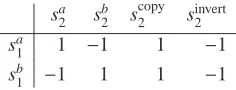
hold on this domain under WDS, see Table 1. As an example of WDS observe, that, surprisingly, for any model M with more than one object in its domain it is the case that forτ=∃x1∃x2[x1=x2]:
M 6|=WDSτ whereas M|=Tarskiτ.
Thatτis true under Tarski semantics is obvious. From Table 2 it becomes clear thatτ
is not true under WDS on the model with two objects{a,b}. Although player 2 has a
sa
2 s
b
2 s copy
2 s
invert 2
sa1 1 −1 1 −1
sb
[image:10.595.247.365.124.169.2]1 −1 1 1 −1
Table 2: sd
i is the atomic strategy for player i∈ {1,2}assigning object d ∈ {a,b}. s
copy 2
is player 2’s strategy such that scopy2 (d)=d, whereas sinvert
2 switches the object chosen
by player 1.
In the remainder of this section we will characterize the truth-conditions of IF under WDS and see that very little is left of IF’sΣ11-expressiveness it enjoyed under GTS. We
show in Theorem 10 that truth under WDS can be expressed in a fragment of FOL (evaluated under Tarski semantics). Before we come to a rigorous formulation, let us classify an IF sentenceφ’s variables and characterize one of the resulting classes.
Recall that we defined the dependency relation ofφ’s variables as a binary relation Bφ. The result of taking the transitive closure of Bφwe denote B∗φ. That is, (xi,xj)∈B∗φ
iffthere exists a chain z0, . . . ,zmof variables in Var(φ) such that z0 =xi, zm =xj, and
for every t∈ {0, . . . ,m−1}it is the case that (zt,zt+1)∈ Bφ. Such a chain of variables
z0, . . . ,zmwe will call a Bφ-chain. Note that B∗φis irreflexive.
For every variable xi∈Var(φ), partition Var(φ)\{xi}as follows:
Ui,φ = {xj|(xj,xi)∈Bφ} (6)
Wi,φ = {xj|(xi,xj)∈B∗φ} (7)
Vi,φ = Var(φ)\(Ui,φ∪ {xi} ∪Wi,φ). (8)
We encountered Ui,φbefore, as it contains all variables seen by player i. Wi,φ
con-tains the variables that can (in)directly see xi. Vi,φ is the set of all other variables inφ
not containing xi. What is meant by ‘seeing (in)directly’ is pinpointed by the following
lemma, that characterizes the variables in Wi,φ.
Lemma 8 Letφ∈IF be as in (3) and let M be a suitable model. Let Wi,φ be defined
as in (7) for some sentenceφand i ∈ Nφ. Then, xj ∈ Wi,φ iffi , j and in G(φ,M)
there exists a complete strategy profile s and a strategy ti ∈ Si such that [s](xj) ,
[(s−i,ti)](xj).
Intuitively, Wi,φ is the subset of Var(φ) consisting of variables that are sensitive to
xichanging assignments. The lemma, interpreted the other way around, teaches that, if
xjis not in Wi,φ, for every strategy profile, player i changing strategies does affect the
object assigned to xj.
Theorem 9 Letφ∈IF as in (3) and let M be a suitable model. The sets Ui,φ, Wi,φ, Vi,φ
are defined as in (6), (7) and (8), respectively. We also consider the set W′
i,φ ={x
′|x∈
Wi,φ}. The strings of variables in these respective sets will be referred to by means of
¯u,¯v,w¯,and ¯w′. Then, in G(φ,M) player i∈Nφhas a weakly dominant strategy iff
where
(i) = R( ¯u,xi,¯v,w)¯
(ii) = xi,x′i
(iii) = ^
j,i∈N
^
xk∈Uj,φ xk=x∗k
→ xj=x∗j
(iv) = R( ¯u,x′i,¯v,w¯′).
If Uj,φ is empty, interpret (Vxk∈Uj,φ xk = x ∗
k) as⊤. Note that Var((i)) = Var(φ) and
that Var((iv))=Ui,φ∪ {x′i} ∪Vi,φ∪Wi′,φ. Furthermore,·
∗is a mapping from Var((i)) to
Var((iv)), as follows
y∗= (
y if y∈Ui,φ∪Vi,φ
y′ if y∈ {x
i} ∪Wi,φ.
We will refer to the first-order formula in (9) asαi(φ).
Basically, αi(φ) states that if (i) there exists an assignment that satisfies R, (ii)
player i changes the object assigned to xi, but (iii) the other players j play according
to a Skolem function that is uniform with respect to what they can see (i.e., the objects assigned to the variables in Uj,φ), then (iv) there exists an object dito assign to x′i that
guarantees truth of R no matter what is played by the players that can (in)directly see to xi. The strategy such that ˆsi( ¯u) = di for all ¯u that satisfy (i) is a weakly dominant
strategy. It is a weakly dominant strategy in G(φ,M) for player i, because ˆsi∈Si,φ.
Theorem 9 characterizes the condition under which a player has a weakly dominant strategy. To be true under WDS, however, slightly more is required. The following theorem characterizes truth under WDS.
Theorem 10 Letφ ∈ IF be as in (3) and let M be a suitable model. Let Eφand Aφ
partition Var(φ) in such a way that Eφcontains the existentially quantified variables in
φ. We abbreviate the string of all variables in Eφand Aφusing ¯e and ¯a. Then,
M|=WDS φ iff M |=Tarskiα(φ)∧β(φ),
whereα(φ)=V
i∈N(Eφ)αi(φ) andβ(φ)=∀¯a∃¯e R(¯a,¯e).
Formulaα(φ) being true on M is equivalent to every existential player i having a weakly dominant strategy ˆsiin G(φ,M). Yet this does not guarantee that the
existen-tial players i playing according to ˆsiwill always get 1. For instance, in G(ψ,M) every
existential player has a weakly dominant strategy, ifψ’s relational symbol is false for every suitable tuple of objects from M’s domain. However, playing according to it will always yield an outcome of−1. Truth ofβ(φ) is a sufficient and necessary condition for avoiding the latter situations.
For future comparison we conclude this section with a meta-statement about IF logic interpreted under WDS, that follows straightforwardly from Theorem 10.
scopy2
sa1 1
sb
[image:12.595.282.328.124.169.2]1 1
Table 3: The payoffmatrix of G′(τ,({a,b},=))=({1,2},({sa
1,s
b
1},{s copy
2 }),{uE,uA}).
5
Beyond WDS
From Theorem 9 we learn that for a player to have a weakly dominant strategy it does not matter what is played by his team members. Even in the case all its team members
leave him and join the other team, this would not make a difference with respect to
him having a weakly dominant strategy. I.e., WDS ignores the opportunities that might come with the notion of a team. In this section we show by example that increasing the ‘powers’ of the involved players in IF games increases the expressive power of IF logic on the obtained semantics, Theorem 14 as opposed to Theorem 11.
Let us revisit the sentenceτ = ∃x1∃x2 [x1 = x2]. We observed thatτis not true
under WDS on any model M that has a domain with more than one object (see Table 2). On the assumption that player 1 knows 2 is rational, player 1 may infer that 2 plays scopy2 , because playing this strategy is better for it than any other strategy. That is, scopy2
is weakly dominant. After this inference, player 1 choosing a strategy in G(τ,M) then
effectively boils down to it choosing a strategy in the game
G′(τ,({a,b},=)) = {1,2},({s1a,sb1},{s2copy}),{uE,uA}
.
G′’s trivial payoffmatrix is depicted in Table 3.
In this spirit, the following definition hard-wires the procedure of players calculat-ing what other players will play. As such it bears strong similarity to the game-theoretic literature on iterated removal of dominated strategies, see [8].2 The result of this pro-cedurePas applied to some IF game will be the game that is effectively played.
Definition 12 Letφ∈IF as in (3) and let M be a suitable model. Then, define
Gn(φ,M) = G(φ,M) = (N,(S1, . . . ,Sn),{uE,uA})
Gi−1(φ,M) = N,(S1, . . . ,Si−1,SPi,S
P
i+1, . . . ,S P
n),{uE,uA}
where S1, . . . ,Si−1,SPi+1. . . ,SPn are copied from Gi(φ,M) and
SPi = {si∈Si|siweakly dominant in Gi(φ,M)}.
Finally, put the strategic evaluation game GP(φ,M)=G0(φ,M).
2It is tempting to clarify the inferences of the players by assuming common knowledge of rationality.
This vehicle we employ to define a semantics ‘on top’ of WDS.
Definition 13 Letφ∈IF and let M be a suitable model. Then we define truth ofφon M under weak dominance semantics plusPas follows:
M|=P
WDS φiffin G
P(φ,M) for every complete profile ˆs it is the case that u
E( ˆs)=
1.
We thus state the truth of an IF sentenceφon M in terms of the outcome of playing
the game GP(φ,M) by players that are empowered to reason according to the procedure
P. For instance, it is the case that ({a,b},=)|=P WDSτ.
First of all, note that, epistemically, player n needs to know nothing about the other players in order to pick a weakly dominated strategy, i.e., to act in accordance with P. Now, player n−1 needs to know that player n is indeed rational in order for it to
be rational to consider game Gn(φ,M). In general, to explain why the players would
executeP, one has to assume that every player i is rational and i knows that i+1 knows that. . .knows that n is rational. Now, this is quite strong an assumption to make. Much stronger in any case than WDS’ mere requirements that all the players are rational.
Secondly, we observe that forφ∈IF
M |=WDSφimplies M|=PWDSφ and M|=PWDS φimplies M|=GTSφ, (10)
but the converses do not hold, witnessingτandθon M=({a,b},=), respectively. Thirdly, in Theorem 14 we observe that the expressive power increases when switch-ing from|=WDSto|=PWDSwith respect to FOL. Also, we draw the conclusion from this
theorem that every FOL formula behaves under WDS plusPas it does under Tarski
semantics. What is the expressive power of IF logic under WDS plusPis left open.
Theorem 14 Letφ∈FOL and let M be a suitable model. Then,
M|=Tarskiφ iff M|=PWDSφ.
The procedurePturns out to be the strategic counterpart of the backwards induction algorithm as applied to the extensive game tree of an FOL game. The proof of Theorem 14 boils down to showing that a tuple of Skolem functions ¯f is a witness of M|=Tarskiφ
iffit is contained in SP1 ×. . .×SPn.
6
Conclusion
We used the strategic framework to define to semantic interpretations for IF logic inspired by solution concepts related to weakly dominant strategies:|=WDSand|=PWDS.
The former does not require any of the involved players to know anything about the
other players. We showed that under|=WDSthe expressive power of IF logic collapses
to that of a fragment of first-order logic (under Tarski semantics). The epistemic de-mands of|=P
WDSwere seen to be higher than that of|=WDS. We showed that the
expres-sive power of FOL (under Tarski semantics) is left intact when evaluated under|=PWDS.
Thus, all of IF logic (under|=P
WDS) has expressive power of at least FOL (under Tarski
semantics). Our findings can be summarized in the following table:
Solution conceptS Expressive power|=S
Nash equilibrium High (= Σ1
1)
WDS+P Medium-high (≥FOL)
WDS Low (<FOL)
Further research will have to flesh out this table and determine what are the de-pendencies between solution concepts and the expressive power of IF logic evaluated under the associated solution concept. This enterprise would explore correlations be-tween notions of agency and semantic interpretations of logical languages.
References
[1] P. J. Cameron and W. Hodges. Some combinatorics of imperfect information. Journal of Symbolic Logic, 66(2):673–684, 2001.
[2] Boudewijn de Bruin. Explaining Games, On the Logic of Game Theoretic Expla-nations. PhD thesis, ILLC, Universiteit van Amsterdam, 2004.
[3] Francien Dechesne. Game, Set, Maths: Formal investigations into logic with imperfect information. PhD thesis, SOBU, Tilburg university and Technische Universiteit Eindhoven, 2005.
[4] Leon Henkin. Some remarks on infinitely long formulas. Infinitistic Methods, pages 167–183, 1961.
[5] Jaakko Hintikka. Principles of mathematics revisited. Cambridge University Press, Cambridge, 1996.
[6] Jaakko Hintikka and Gabriel Sandu. Game-theoretical semantics. In Johan F. A. K. van Benthem and Alice ter Meulen, editors, Handbook of logic and lan-guage, pages 361–481. North Holland, Amsterdam, 1997.
[7] T. M. V. Janssen. Independent choices and the interpretation of IF logic. Journal of Logic, Language and Information, 11:367–387, 2002.
[9] A. Pietarinen and Tero Tulenheimo. An introduction to IF logic. Lecture notes for the 16th European Summerschool in Logic, Language and Information, 2004.
[10] Gabriel Sandu and A. Pietarinen. Informationally independent connectives. In G. Mints and R. Muskens, editors, Logic, Language and Computation, volume 9, pages 23–41. CSLI Publications, Stanford, 2003.
[11] Merlijn Sevenster. Branches of imperfect information: logic, games, and compu-tation. PhD thesis, ILLC, University of Amsterdam, 2006.
[12] J.F.A.K. van Benthem. Logic and games, lecture notes. Draft version, 2000.

![Table 1: Every cell in the matrix corresponds to an assignment [s] over Var(θ). Wefilled in the value uE([s]) reflecting payoff for the members of the existential team.](https://thumb-us.123doks.com/thumbv2/123dok_us/8386848.322189/8.595.258.356.126.168/table-corresponds-assignment-welled-reecting-payo-members-existential.webp)