JOURNAL OFVIROLOGY, June 1996, p. 4150–4156 Vol. 70, No. 6
0022-538X/96/$04.0010
Copyrightq1996, American Society for Microbiology
Evidence that Replication of Human Neurotropic JC Virus DNA
in Glial Cells Is Regulated by the Sequence-Specific
Single-Stranded DNA-Binding Protein Pur
a
CHUN-FAN CHANG,1GARY L. GALLIA,1VANDHANA MURALIDHARAN,1NANCIE N. CHEN,1
PHILIP ZOLTICK,1EDWARD JOHNSON,2ANDKAMEL KHALILI1*
Molecular Neurovirology Section, Jefferson Institute of Molecular Medicine, Department of Biochemistry and Molecular Biology, Thomas Jefferson University, Philadelphia, Pennsylvania 19107,1and Brookdale Center for
Molecular Biology, Mount Sinai Center for Molecular Biology, New York, New York 100292
Received 2 November 1995/Accepted 22 February 1996
Initiation of polyomavirus DNA replication in eukaryotic cells requires the participation of the viral early protein T antigen, cellular replication factors, and DNA polymerases. The human polyomavirus JC virus (JCV) is the etiologic agent of the fatal demyelinating disease progressive multifocal leukoencephalopathy in immu-nocompromised individuals. This virus exhibits a narrow host range and a tissue specificity that restricts its replication to glial cells of the central nervous system. Restriction of viral DNA replication due to species specificity of the DNA polymerase, coupled with glial cell-specific transcription of the viral early promoter, is thought to account for the brain-specific replication of JCV. In this report we demonstrate that overexpression of Pura, a protein which binds to single-stranded DNA in a sequence-specific manner, suppresses replication of JCV DNA in glial cells. Results from footprinting studies indicate that Puraand T antigen share a common binding region spanning the single-stranded ori sequence of JCV. Further, T antigen was capable of stimu-lating the association of Purawith the ori sequence in a band shift assay. Whereas no evidence for simul-taneous binding of Puraand T antigen to single-stranded DNA has been observed, results from coimmuno-precipitation and Western blot (immunoblot) analyses of proteins derived from cells producing JCV T antigen indicate a molecular association of JCV T antigen and Pura. The binding of Purato the single-stranded ori sequence and its association with T antigen suggest that Purainterferes with the activity of T antigen and/or other regulatory proteins to exert its negative effect on JCV DNA replication. The importance of these findings in the reactivation of JCV in the latently infected individual under immunosuppressed conditions is discussed.
Utilization of eukaryotic viruses, including polyomaviruses, in in vitro and in vivo systems has led to the identification of several key regulatory proteins which are involved in initiation and elongation processes of eukaryotic DNA replication (20, 36–39). Results from cell-free replication studies of simian virus 40 (SV40) have revealed that in addition to the viral early protein T antigen, a group of cellular proteins, including DNA polymerases, topoisomerases, a single-stranded DNA-binding protein (RPA), and other accessory proteins, are required for initiation of viral DNA replication (4, 8, 9, 15, 25, 34, 36). In addition, it is speculated that a negative regulatory mechanism may be involved in the replication process in order to modulate the rate of DNA replication during the course of viral infec-tion. Such a mechanism may utilize a protein(s) which exerts its activity by direct interaction with important cis-regulatory DNA sequences and/or indirect communication with positive regulatory proteins.
In support of this concept, earlier studies have indicated that some functional interaction between T antigen and DNA poly-merase a-primase may restrict replication of SV40 and JC virus (JCV) to certain species (11, 27–29). JCV is a human polyomavirus with a narrow host range and a tissue specificity which restricts its replication to oligodendrocytes (13, 24). Cy-tolytic infection of oligodendrocytes, the myelin-producing
cells in the central nervous system, with JCV results in devel-opment of the fatal neurodegenerative disease progressive multifocal leukoencephalopathy (35). Earlier studies with cell culture (11, 17, 18, 33) and transgenic mice (10, 30) have indicated that tissue-specific expression of the JCV genome is determined primarily at the level of viral gene transcription. In an attempt to understand the molecular mechanism that me-diates the host range and tissue specificity of JCV replication, we have employed deletion analysis and identified acis-acting transcription element encompassing a pentanucleotide repeat sequence, (penta) AGGGAAGGGA, with the ability to mod-ulate viral gene transcription and viral DNA replication (5, 21, 22, 31, 32). This motif is bound by a protein, Pura, which is produced in both glial and nonglial cells (6). Pur a is a se-quence-specific single-stranded-DNA-binding protein with a region of limited homology to several proteins involved in the initiation of replication (16), including SV40 large T antigen (16, 23). Purabinds in a sequence-specific manner to a closely spaced repeat of the triplet GGN (2, 3), a sequence which is included in the origin of JCV DNA replication (12). In this study, we demonstrate that expression of Pur a in glial cells suppresses replication of JCV DNA and that this inhibitory effect is independent from the interaction of Pura with the pentanucleotide repeat and may be mediated upon Pura in-teraction with the ori sequence. Results from DNA-binding studies indicated that Purahas no effect on the binding of T antigen to double-stranded JCV DNA. However, these two proteins share a common binding site on the single-stranded DNA encompassing the origin of DNA replication. Moreover, we demonstrate that the viral early protein T antigen is capable * Corresponding author. Mailing address: Molecular Neurovirology
Section, Jefferson Institute of Molecular Medicine, Department of Biochemistry and Molecular Biology, Thomas Jefferson University, 233 S. 10th St., Philadelphia, PA 19107. Phone: (215) 955-5534. Fax: (215) 923-5905.
4150
on November 9, 2019 by guest
http://jvi.asm.org/
of enhancing binding of Pur ato the single-stranded ori se-quence with no evidence for its association with the Pura-ori complex. Finally, results from coimmunoprecipitation studies suggest the direct interaction of Puraand T antigen in glial cells.
Effect of Puraon replication of JCV DNA.Our understand-ing of cis-acting elements which regulate replication of JCV DNA is mainly inferred from SV40 on the basis of the conser-vation in the primary structure of sequences surrounding the origin of DNA replication. The origin of JCV DNA replication consists of four central T-antigen binding sites, an imperfect palindrome to the early side, and an AT-rich region to the late side within the 98-bp enhancer repeat. JCV also contains a T-antigen binding site to the early side of the ori (site I) and a pentanucleotide repeat, AGGGAAGGGA, attached to a con-sensus NF-1 binding site on the late side of the ori. Earlier studies (5, 21, 22) have indicated that the pentanucleotide repeat plays an important role in the replication of viral DNA and has the ability to interact with the single-stranded-DNA-binding protein Pur a (6). Furthermore, from the primary structure of the JCV origin-containing GGCGGA motifs, it appears that Pur a could bind to this single-stranded viral sequence. These notions prompted us to examine the biolog-ical activity of Puraon replication of JCV DNA.
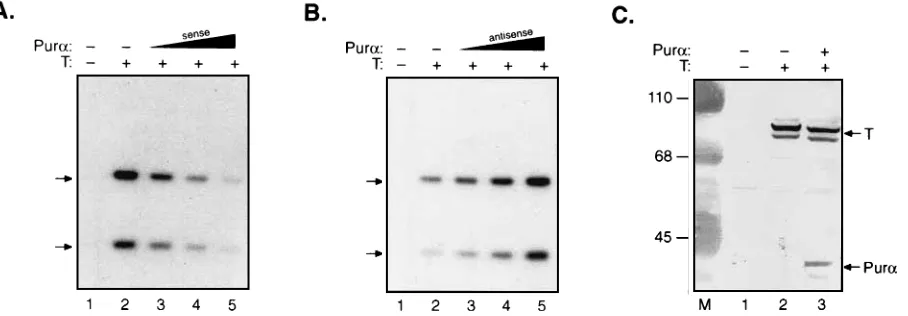
Toward this end, the human astrocytic glial cell line U-87MG was transfected with a plasmid containing the entire control region of JCV plus a recombinant expressing JCV T antigen and a cytomegalovirus expression vector containing the cDNA for Purain either the sense or antisense orienta-tion. As shown in Fig. 1A, results fromDpnI analysis of low-molecular-weight DNAs obtained from the transfectants indi-cated that increasing expression of PuracDNA in the sense orientation by pCMV-Puraresults in a dramatic decrease in the intensity of the bands corresponding to the newly amplified JCV DNA. Conversely, expression of Pur ain the antisense orientation caused an increase in the level of JCV DNA rep-lication (Fig. 1B). These results indicate that overexpression of Purain glial cells negatively affects T-antigen-induced repli-cation of JCV DNA and that the endogenous Pur a may modulate the level of replication in the cells. Similarly, we
observed that overexpression of Pur a decreased replication of JCV DNA induced by SV40 T antigen in glial cells (4a). As shown in Fig. 1C, results from Western blot (immuno-blot) analysis of proteins obtained from glial cells transfected with pJCV-T or pJCV-T plus pCMV-Pur a indicated that overproduction of Purain glial cells has no significant effect on the overall level of T antigen produced by pJCV-T in these cells.
[image:2.612.85.539.74.232.2]Interaction of Pur a and T antigen with JCV DNA. The origin of JCV DNA replication, which is enriched in GGAG GC nucleotides, and the pentanucleotide repeat AGGGAAG GGA within the 98-bp enhancer are potential targets, albeit in the single-stranded configuration, for binding to Pura(4a, 6). Also, it has been shown that JCV T antigen binds directly to the origin of JCV DNA replication. In the following studies, we carried out in vitro footprinting assays utilizing highly purified JCV or SV40 T antigen and recombinant maltose-binding pro-tein–human Purafusion to evaluate the interaction of Pura and T antigen in binding to the JCV sequence. As shown in Fig. 2A, binding of JCV T antigen to double-stranded DNA probe protects two distinct areas corresponding to the origin of DNA replication and a region corresponding to site I, which includes the NF-kB regulatory motif (Fig. 2A, compare lane 2 with lanes 3 and 4). Under similar conditions, SV40 T antigen showed a comparable binding pattern, although more protec-tion at the origin and the sequences near the NF-kB motif was observed (data not shown; however, see Fig. 2C). Inclusion of Purain the binding reaction showed no significant effect on the protected areas corresponding to the binding of T antigen to the duplex DNA and induced no changes in the overall T-antigen binding pattern, although we noticed that Pur a altered the pattern of DNase I protection at the region near the NF-kB motif. The single-stranded DNA probe represent-ing the late strand of JCV which encompasses the GGAGGC-rich (ori) and the AGGGA repeat (pentanucleotide repeat) motifs interacted weakly with T antigen at the origin and at the various regions near the NF-kB motif (Fig. 2B). Purashowed binding affinity to the pentanucleotide repeat, the origin, and the multiple GAGC regions scattered at the early side of the JCV genome (Fig. 2B and C). Addition of T antigen to the FIG. 1. Effect of Puraon replication of JCV DNA in glial cells. A replication-competent plasmid, pBL-CAT3(3mg), containing 400 nucleotides of the viral
regulatory sequence located between the early and late genes was introduced into the human glial cell line U-87MG in the absence or presence of pJCV-T (10mg) and increasing amounts (0.5, 2.5, and 10.0mg) of pCMV-Puraexpressing PuracDNA in sense (A) and antisense (B) orientations. Transfections were performed in 100-mm-diameter plates (1.53106cells per plate). The total amount of DNA in the transfection mixtures was kept constant by the addition of pCMV vector DNA.
Low-molecular-weight DNA was isolated 72 h posttransfection by the Hirt procedure (14), and the plasmids were treated withSacI and withDpnI prior to Southern blot analysis (1). The arrows indicate the position of the two bands corresponding to the newly replicatedDpnI-resistant JCV DNAs afterSacI digestion and Southern blot hybridization. Autoradiography was done for 72 h (A) and 24 h (B). (C) Western blot analysis of nuclear extracts from U-87MG (lane 1), U-87MG transfected with 10mg of pJCV-T (lane 2), and U-87MG transfected with 10mg of pJCV-T plus 10mg of pCMV-Pura(lane 3). The blot was reacted with a mixture of anti-SV40 T-antigen antibody (pAb 416) and anti-Puraantibody. The arrows indicate the positions of 89-kDa T antigen and 39-kDa Pura.
VOL. 70, 1996 NOTES 4151
on November 9, 2019 by guest
http://jvi.asm.org/
binding reaction mixtures containing Pur a and the single-stranded probe showed noticeable improvement in the quality of DNA protection, in particular in the region which corre-sponds to the origin, i.e., between the pentanucleotide repeat
[image:3.612.69.540.70.567.2]and origin domain (Fig. 2B, compare lanes 8 and 9; Fig. 2C). These observations suggest that T antigen and Puracointeract with the DNA probe and/or that one protein affects the asso-ciation of the other protein with the DNA molecule.
FIG. 2. Binding of T antigen and Purato the JCV regulatory sequence. (A) JCV T antigen (0.1 and 0.3 mg) produced in baculovirus (3a) was incubated in 40-ml bind-ing reaction mixtures (30 mMN-2-hydroxyethylpiperazine-N9-2-ethanesulfonic acid [HEPES; pH 7.5], 3 mM MgCl2, 1 mM dithiothreitol, 2.5% glycerol, 40 mM creatine
phophokinase, 4 mM ATP, and 0.5 mg of bovine serum albumin per ml) containing 30,000 cpm of the32P-labeled double-stranded 259-nucleotide JCV DNA probe
span-ning the origin and part of the 98-bp sequence in the absence (lanes 3 and 4) or presence of 0.25mg (lanes 6 and 7) and 0.75mg (lanes 9 and 10) of bacterially produced Pura. After 20 min of incubation at 48C, the reaction mixtures were treated with DNase I and the cleavage products were analyzed by denaturing by 4% PAGE and visualized by autoradiography. Lane 1 contains the control maltose-binding protein, whereas lanes 5 and 8 contain 0.25 and 0.75mg of Pura, respectively. The protected areas are shown by the brackets on the left side. (B) DNase I footprinting of the single-stranded JCV DNA corresponding to the late strand of JCV in the absence and pres-ence of T antigen from JCV and various amounts (0.25 and 0.75mg) of Pura. The areas which are affected by Puraand T antigen are shown by brackets and arrows. (C) Nucleotide composition of the probe and the regions which are affected by T antigen and Pura. The thick lines represent the areas of strong protection, and the thin lines indicate the sites which are weakly protected by T antigen. At the bottom of the sequence, the areas of the single-stranded DNAs which are affected by the proteins are depicted. The thick and thin lines illustrate the areas of strong and weak protection, respectively. The dotted lines show the regions which are enhanced.
4152 NOTES J. VIROL.
on November 9, 2019 by guest
http://jvi.asm.org/
Enhancement of Pura-ori complex formation by T antigen.
Utilizing highly purified Pur a and T antigen in band shift studies, we have demonstrated that T antigen exerts no signif-icant stimulatory action on the binding of Pura to the pen-tanucleotide repeat sequence (6). The above results from foot-printing corroborate those observations, as we observed no changes in the protection of the pentanucleotide sequence by Pur a upon the addition of T antigen. On the other hand, mutations within the pentanucleotide repeat which affect the binding of Purato the pentanucleotide repeat motif showed no effect on Pura-induced suppression of JCV DNA replica-tion (4a). These observareplica-tions support the noreplica-tion that Pur a may exert its suppressory action through the origin of DNA replication.
To further evaluate the possible influence of T antigen and Puraon each other’s binding to the origin of JCV, glial cells were transfected with pCMV-Purain the absence and pres-ence of pJCV-T. Nuclear extracts from the transfected cells were used in a band shift assay utilizing a single-stranded
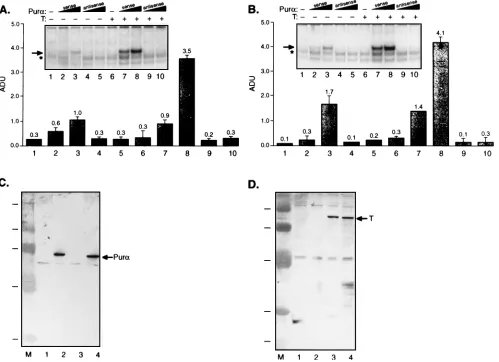
oligonucleotide representing the late strand of the JCV origin which contains three copies of GGC and two copies of GGA. As shown in Fig. 3A, overexpression of sense PuracDNA in glial cells results in the formation of a nucleoprotein complex, which is indicative of the interaction of Purawith the single-stranded probe (lanes 1 to 3). Under similar binding condi-tions, using extract from pJCV-T-transfected cells, we obtained no evidence for the association of T antigen with the single-stranded probe (Fig. 3A, compare lanes 1 and 6). However, the extract containing JCV T antigen showed two- to threefold enhancement in the intensity of the band corresponding to the Puracomplex with the probe (Fig. 3A, compare lanes 2 and 3 with lanes 7 and 8).
[image:4.612.60.559.73.435.2]In parallel and independent studies, we utilized a single-stranded probe containing four copies of GGA and four copies of GGC and obtained similar results, suggesting that JCV T antigen induces binding of Purato the DNA probe (Fig. 3B, compare lanes 2 and 3 with lanes 7 and 8). SV40 T antigen behaved similarly to JCV T antigen in stimulating binding of FIG. 3. Effect of T antigen on the binding of Purato its targets on the JCV origin. Nuclear extracts from glial cells transfected with PuracDNA in the sense or antisense orientation in the absence (lanes 2 to 5) and presence (lanes 7 to 10) of pJCV-T were prepared by standard methods (1). Ten micrograms of the proteins was used in binding reactions containing 20,000 to 30,000 cpm of the 59-end-labeled single-stranded JCV ori sequence (59-AGCTTGGAGGCGGAGGCGGCCTCG GCG-3) (A) or a single-stranded probe encompassing the Purabinding site (59-GGAGGCGGAGGCGGAGGCGGAGGC-39) (B) according to a previously described procedure (32). Nucleoprotein complexes were analyzed by native 9% PAGE. The intensity of the bands corresponding to the Pura-ori complex was determined by scanning densitometry of the corresponding band (shown by the arrow) and normalized with the intensity of the band depicted by the asterisk which is seen in the control (lanes 1) and the experimental (lanes 2 to 10) lanes. The values are presented in arbitrary units (ADU) from 1 to 5. (C and D) Western blot analysis of nuclear extracts from transfected glial cells utilizing anti-Puraantibody and anti-T-antigen antibody, respectively. Lanes 1, no transfection; lanes 2, transfection with pCMV-Pura; lanes 3, transfection with pJCV-T; lanes 4, transfection with pCMV-Puraand pJCV-T antigen. The arrows indicate the positions of the bands corresponding to Pura(C) and JCV T antigen (D).
VOL. 70, 1996 NOTES 4153
on November 9, 2019 by guest
http://jvi.asm.org/
Purato the ori sequence (data not shown). The increase in the intensity of the band corresponding to the Pura-ori complex in T-antigen-producing glial extract may not be attributed to the elevated level of Pura in the T-antigen-producing cells. As shown in Fig. 3C, the level of Pur a in the cells remained constant in the absence and the presence of T antigen (com-pare lanes 2 and 4). Also, Fig. 3D illustrates results from Western blot analysis of protein from the untransfected cells and cells transfected with pCMV-Pur a and pJCV-T which indicate a constant level of T antigen in cells overexpressing Pura.
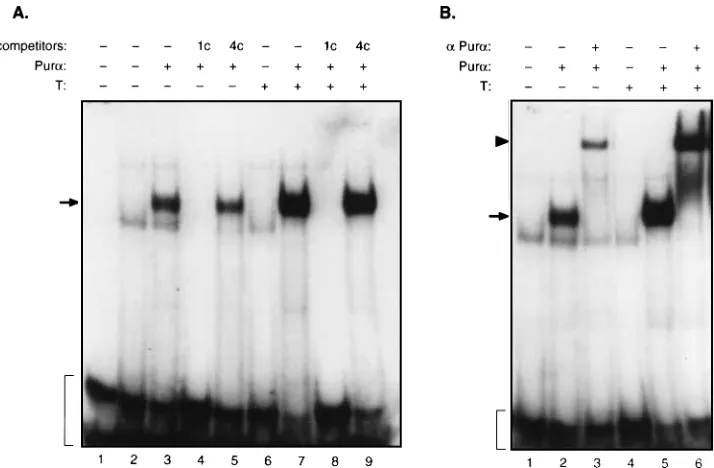
In order to demonstrate that the enhanced binding activity described above is due to binding of Pur aand not another DNA-binding protein which is induced by Pura, we performed competition and supershift assays. In competition studies, ex-tracts from the control and cells overexpressing Purain the absence or presence of T antigen were mixed with oligonucle-otide 1C, which contains the Purabinding site, and its mutant variant 4C. As shown in Fig. 4A, inclusion of 1C, but not 4C, in the binding reaction inhibited the appearance of the nucle-oprotein complex in the absence (lanes 2 to 5) and the pres-ence (lanes 6 to 9) of T antigen. Furthermore, addition of purified Pura monoclonal antibody to the reaction mixture supershifted the nucleoprotein complexes, indicating the pres-ence of Purain the enhanced band. Under similar experimen-tal conditions, anti-T-antigen antibody showed no effect on the migration of the observed duplex (4a). Altogether, these data describe an activity for T antigen which includes enhancement of binding of the cellular protein Purato its target within the JCV origin.
Interaction of JCV T antigen and Purain glial cells.The ability of T antigen to enhance the binding of Purato its target ori sequence with no evidence for its association with the Pur
a-ori complex suggests that these two proteins must directly or indirectly communicate with each other. Through such
tran-sient interaction, Pur a may gain a configuration which is optimum for its stable association with the single-stranded ori motif. In order to investigate the association of these two proteins with each other, pEBV T7 His-Puraexpression vec-tor producing a His-Purafusion protein was introduced into hamster glial cells continuously expressing JCV T antigen. After 36 h, nuclear extracts were prepared, and the level of Pur
a expression was determined by direct Western blot analysis using anti-T7 Tag antibody. The association of Pura and T antigen was evaluated by immunoprecipitation of the extracts with anti-T-antigen antibody followed by Western blotting uti-lizing anti-Puraantibody. As shown in Fig. 5A, the expression of PuracDNA in the transfected cells resulted in the appear-ance of three bands corresponding to the three isoforms of Pur
[image:5.612.132.489.70.304.2]a with molecular sizes of 47, 45, and 39 kDa. Of particular interest, a band corresponding to band 47 kDa was detected upon immunoprecipitation with anti-T-antigen antibody and Western blot with anti-T7 Tag antibody, suggesting an inter-action between Puraand T antigen in glial cells. This inter-action is specific, as the control His–b-galactosidase protein showed no binding activity to T antigen (Fig. 5A, lane 4). In a separate series of studies, we utilized an alternative protein binding assay to verify the interaction of JCV T antigen and Pura. In this study, cell extracts from HJC cells were mixed with glutathione-Sepharose beads containing glutathione S-transferase (GST), GST-Pur a fusion protein, and GST-p53 fusion protein. After incubation for 30 min at room tempera-ture, complexes were washed extensively and the bound pro-teins were analyzed by sodium dodecyl sulfate-polyacrylamide gel electrophoresis (SDS-PAGE) followed by Western blot-ting. As shown in Fig. 5B, T antigen bound to GST-Pura(lane 3) but not to GST alone (lane 2). T antigen also bound the control GST-p53 (lane 4). Of note, the amount of GST-p53 used in this assay was half of the amount of GST-Puraused. Altogether, these results strongly suggest that T antigen and FIG. 4. Competition and supershift analysis of the Puranucleoprotein complex. (A) Competition experiments were carried out in a binding reaction utilizing the 59-end-labeled single-stranded JCV origin sequence as described in the Fig. 3 legend in the absence and presence of a 250-fold excess amount of unlabeled competitor DNA encompassing Purabinding site 1C (59-AAGGGAAGGGATGGCTG-39) and its mutant variant 4C (59-AAGTGAAGCGAG-39). (B) Supershift experiments were performed using 1.8mg of highly purified monoclonal antibody against Purawhich was added to the reaction mixture containing nuclear extracts at 10 min prior to the addition of labeled probes. The arrow depicts the position of the Puranucleoprotein complex, and the arrowhead points to the position of the supershift bands.
4154 NOTES J. VIROL.
on November 9, 2019 by guest
http://jvi.asm.org/
Pur a could bind to each other. Whether T-antigen–Pur a interaction is direct or utilizes a bridge protein remains to be investigated.
Initiation of DNA replication in papovaviruses, e.g., SV40, is a complex process which requires the involvement of the viral early protein T antigen and multiple cellular proteins with the specific capacity for interaction with the DNA and/or each other. According to one model, after the association of two hexamers of T antigen with the duplex ori, T antigen exerts its unwinding activity on the DNA. This activity, which is a critical step in the initiation of DNA replication, requires the partic-ipation of the cellular single-stranded-DNA-binding protein RPA, a protein which binds to the unwound single-stranded DNA and interacts with T antigen (7, 9, 19, 26, 34, 36, 39, 40). Once the initial step is completed, T antigen utilizes its helicase activity to enlarge the loop and allow the association of DNA polymerase and other replication factors with the initiation complex.
In this article, we report the down-regulation of human neurotropic virus (JCV) DNA replication by Pur a in glial cells. Pur a is a single-stranded-DNA-binding protein with specific affinity for repeats of the sequence GGN (2, 3). This element is present in several eukaryotic origins of DNA rep-lication and regulatory regions. Our data indicate that, similar to RPA, Purahas the ability to bind to the ori sequence of JCV in the single-stranded configuration and independently interact with JCV T antigen. However, unlike RPA, Pur a
binds to the single-stranded DNA in a sequence-specific man-ner, as evidenced by its ability to recognize the GGAGGC content of the JCV ori located on the late strand of the viral genome. Thus, one could envision a simple model in which the binding of Purato its GGCGGA target interferes with RPA function. Our footprinting data suggest that Puraexhibits no significant effect on binding of T antigen to the double-stranded ori DNA; therefore, the initial step of the replication process, which includes the association of T antigen with du-plex DNA, may not be affected by Pura. It is likely that the association of Purawith T antigen increases local concentra-tions of Puraaround the origin and facilitates its association with the newly unwound DNA. The ability of T antigen to stabilize the Pura-ori interaction suggests that T antigen could indirectly moderate the rate of viral DNA replication. This modulation may become an important event during the lytic cycle as the virus attempts to synchronize a series of compli-cated processes, including transcription and translation, in or-der to complete a successful infection cycle. Whether Pura plays any role in host range specificity of JCV DNA replication remains to be seen.
We express our gratitude to R. Frisque for sharing his reagents, his insightful comments throughout the course of this work, and his help-ful comments on the manuscript. We thank the members of the Mo-lecular Neurovirology Section for sharing their ideas and reagents and for insightful discussions. We thank C. Schriver for preparation of the manuscript.
This work was made possible by grants awarded by the NIH to K.K.
REFERENCES
1. Ausubel, F., R. Brent, R. E. Kingston, D. D. Moar, J. G. Siedman, J. A.
Smith, and K. Struhl.1989. Current protocols in molecular biology. John Wiley & Sons, Inc., New York.
2. Bergemann, A. D., and E. M. Johnson.1992. The HeLa Pur factor binds single-stranded DNA at a specific element conserved in gene flanking re-gions and origins of DNA replication. Mol. Cell. Biol.12:1257–1265. 3. Bergemann, A. D., Z.-W. Ma, and E. M. Johnson.1992. Sequence of cDNA
comprising the humanpurgene and sequence-specific single-stranded-DNA-binding properties of the encoded protein. Mol. Cell. Biol.12:5673–5682. 3a.Bollag, B., et al.Submitted for publication.
4. Bullock, P. A., Y. S. Seo, and J. Hurwitz.1991. Initiation of simian virus 40 DNA synthesis in vitro. Mol. Cell. Biol.11:2350–2361.
4a.Chang, C.-F., et al.Unpublished observations.
5. Chang, C.-F., H. Tada, and K. Khalili.1995. The role of a pentanucleotide repeat sequence, AGGGAAGGGA, in the regulation of JC virus DNA replication. Gene148:309–314.
6. Chen, N. N., C.-F. Chang, G. L. Gallia, D. A. Kerr, E. M. Johnson, C. P. Krachmarov, S. M. Barr, R. J. Frisque, B. Bollag, and K. Khalili.1995. Cooperative action of cellular proteins YB-1 and Pura with the tumor antigen of the human JC polyomavirus determines their interaction with the viral lytic control element. Proc. Natl. Acad. Sci. USA92:1087–1091. 7. Dornreiter, I., L. F. Erdile, I. U. Gilbert, D. vonWinkler, T. J. Kelly, and E.
Fanning.1992. Interaction of DNA polymerase alpha-primase with cellular replication protein A and SV40 T-antigen. EMBO J.11:769–776. 8. Erdile, L. F., K. L. Collins, A. Russo, P. Simancek, D. Small, C. Umbricht,
D. Virshup, L. Cheng, S. Randall, D. Weinberg, I. Moarefi, E. Fanning, and T. J. Kelly.1991. Initiation of SV40 DNA replication: mechanism and con-trol. Cold Spring Harbor Symp. Quant. Biol.56:303–313.
9. Fairman, M. P., and B. Stillman.1988. Cellular factors required for multiple stages of SV40 DNA replication in vitro. EMBO J.7:1211–1218. 10. Feigenbaum, L., S. H. Hinrichs, and G. Jay.1992. JC virus and simian virus
40 enhancers and transforming proteins: role in determining tissue specificity and pathogenecity in transgenic mice. J. Virol.66:1176–1182.
11. Feigenbaum, L., K. Khalili, E. O. Major, and G. Khoury.1987. Regulation of the host range of human papovavirus JCV. Proc. Natl. Acad. Sci. USA 84:3695–3698.
12. Frisque, R., G. L. Bream, and M. T. Cannella.1984. Human polyomavirus JC virus genome. J. Virol.51:458–469.
13. Frisque, R. J., and F. A. White.1994. The molecular biology of JC virus, causative agent of progressive multifocal leukoencephalopathy, p. 25–158.In R. Roos (ed.), Molecular neurovirology. Humana Press, Clifton, N.J. 14. Hirt, B. J.1967. Selective extraction of polyoma DNA from infected mouse
[image:6.612.64.297.71.206.2]cell culture. J. Mol. Biol.26:365–369. FIG. 5. Association of Puraand T antigen in glial cells. (A) Hamster glial
cells (HJC) consistently expressing JCV T-antigen (41) were transfected with pEBV His expression vector (Invitrogen) producing Pura(lanes 1 and 3) or the controlb-galactosidase gene (lanes 2 and 4). After 36 h, nuclear extracts were prepared (1) and immunoprecipitated with anti-T7 Tag antibody (lanes 1 and 2) or with anti-SV40 T antigen (pAb 416) (lanes 3 and 4). The immunocomplexes were separated by SDS-PAGE and transferred to nitrocellulose. The immuno-blot was reacted with anti-T7 Tag antibody. The positions of the major bands corresponding to 47-, 45-, and 39-kDa Puraare shown on the right. Asterisks depict immunoglobulin G heavy and light chains from immunoprecipitation, and the arrowheads indicate bands corresponding to cellular proteins which cross-react with the T7 Tag antibody. (B) Extracts were made from 23106to 33106
HJC cells. Briefly, cells were washed with phosphate-buffered saline and incu-bated in lysis buffer containing 50 mM Tris-HCl (pH 7.4), 150 mM NaCl, 5 mM EDTA, 0.1% Nonidet P-40, 50 mM NaF, 1 mM phenylmethylsulfonyl fluoride, 1
mg of leupeptin per ml, and 1mg of aprotinin per ml for 20 min at 48C. Lysate was centrifuged at 48C at 14,000 rpm for 25 min. Equal amounts of extract were incubated with beads containing 1.5 to 3mg of GST or GST fusion proteins for 30 min at room temperature. Complexes were washed extensively in lysis buffer, boiled in SDS buffer, and subjected to electrophoresis in an SDS–10% polyacryl-amide gel. Gels were transferred to Optitran nitrocellulose (Schleicher & Schuell) and immunoblotted with an anti-SV40 T-antigen antibody (Ab-2; On-cogene Science). Following addition of an alkaline phosphatase-conjugated sec-ondary antibody, T antigen was detected with 5-bromo-4-chloro-3-indolyl phos-phate–nitroblue tetrazolium (Vector Laboratories). Lanes: M, protein high-molecular-weight marker (indicated in thousands); 1, 20mg of cell lysate from HJC cells; 2, 3, and 4, extract from HJC cells incubated with GST, GST-Pura, and GST-p53, respectively.
VOL. 70, 1996 NOTES 4155
on November 9, 2019 by guest
http://jvi.asm.org/
15.Ishimi, Y., A. Claude, P. Bullock, and J. Hurwitz.1988. Complete enzymatic synthesis of DNA containing the SV40 origin of replication. J. Biol. Chem. 263:19723–19733.
16.Johnson, E. M., P. L. Chen, C. P. Krachmarov, S. M. Barr, M. Kanovsky, Z.-W. Ma, and H. W. Lee.1995. Association of human Purawith the reti-noblastoma protein, Rb, regulates binding to the single-stranded DNA Pura
recognition element. J. Biol. Chem.270:24352–24360.
17.Kenney, S., V. Natarajan, V. Strika, G. Khoury, and N. P. Salzman.1984. JC virus enhancer-promoter active in human brain cells. Science226:1337–1339. 18.Lashgari, M., H. Tada, S. Amini, and K. Khalili.1989. Regulation of JCVL
promoter function. Transactivation of JCVLpromoter by JCV and SV40
early proteins. Virology170:292–295.
19.Lee, S.-H., T. Eki, and J. Hurwitz.1989. Synthesis of DNA containing the simian virus 40 origin of replication by the combined action of DNA poly-merases alpha and delta. Proc. Natl. Acad. Sci. USA86:7361–7365. 20.Li, J.-J., and T. J. Kelly.1984. Simian virus 40 DNA replication in vitro. Proc.
Natl. Acad. Sci. USA81:6973–6977.
21.Lynch, K. J., and R. J. Frisque.1990. Identification of critical elements within the JC virus DNA replication origin. J. Virol.64:5812–5822. 22.Lynch, K. J., and R. J. Frisque.1991. Factors contributing to the restricted
DNA replicating activity of JC virus. Virology180:306–317.
23.Ma, Z. W., A. D. Bergemann, and E. M. Johnson.1994. Conservation in human and mouse Puraof a motif common to several proteins involved in initiation of DNA replication. Gene149:311–314.
24.Major, E. O., K. Amemiya, C. Tornatore, S. A. Houff, and J. R. Berger.1992. Pathogenesis and molecular biology of progressive multifocal leukoenceph-alopathy, the JC virus-induced demyelinating disease of the human brain. Clin. Microbiol. Rev.5:49–73.
25.Matsumoto, T., T. Eki, and J. Hurwitz.1990. Studies on the initiation and elongation reactions in the simian virus 40 DNA replication. Proc. Natl. Acad. Sci. USA87:9712–9716.
26.Melendy, T., and B. Stillman.1993. An interaction between replication protein A and SV40 T-antigen appears essential for primosome assembly during SV40 DNA replication. J. Biol. Chem.268:3389–3395.
27.Murakami, Y., T. Eki, M. A. Yamada, C. Prives, and J. Hurwitz. 1986. Species-specific in vitro synthesis of DNA containing the polyoma virus origin of DNA replication. Proc. Natl. Acad. Sci. USA83:6347–6351. 28.Murakami, Y., C. R. Wobbe, L. Weissbach, F. B. Dean, and J. Hurwitz.1986.
Role of DNA polymerase alpha and DNA primase in simian virus 40 DNA replication in vitro. Proc. Natl. Acad. Sci. USA83:2869–2873.
29.Schneider, C., K. Weisshart, L. A. Guarino, I. Dornreiter, and E. Fanning. 1994. Species-specific functional interactions of DNA polymerasea-primase
with simian virus 40 (SV40) T antigen require SV40 origin DNA. Mol. Cell. Biol.14:3176–3185.
30. Small, J. A., G. Khoury, G. Jay, P. M. Howley, and G. A. Scangos.1986. Early regions of JC virus and BK virus induce distinct and tissue-specific tumors in transgenic mice. Proc. Natl. Acad. Sci. USA83:8288–8292.
31. Tada, H., and K. Khalili.1992. A novel sequence-specific DNA-binding protein, LCP-1, interacts with single-stranded DNA and differentially regu-lates early gene expression of the human neurotropic JC virus. J. Virol. 66:6885–6892.
32. Tada, H., M. Lashgari, and K. Khalili.1991. Regulation of JCVLpromoter
function: evidence that a pentanucleotide ‘silencer’ repeat sequence, AGG GAAGGGA, down-regulates transcription of the JC virus late promoter. Virology180:327–338.
33. Tada, H., M. Lashgari, J. Rappaport, and K. Khalili.1989. Cell type-specific expression of JC virus early promoter is determined by positive and negative regulation. J. Virol.63:463–466.
34. Tsurimoto, T., T. Melendy, and B. Stillman.1990. Sequential initiation of lagging and leading strand synthesis by two different polymerase complexes at the SV40 DNA replication origin. Nature (London)346:534–539. 35. Walker, D. L.1978. Progressive multifocal leukoencephalopathy: an
oppor-tunistic viral infection of the central nervous system. Handb. Clin. Neurol. 34:307–329.
36. Weinberg, D. H., K. L. Collins, P. Simancek, A. Russo, M. S. Wold, D. M. Virshup, and T. J. Kelly.1990. Reconstitution of simian virus 40 DNA replication with purified proteins. Proc. Natl. Acad. Sci. USA87:8692–8696. 37. Wobbe, C. R., F. B. Dean, Y. Murakami, J. A. Borowiec, P. Bullock, and J. Hurwitz.1987. In vitro replication of DNA containing either the SV40 or the polyoma origin. Philos. Trans. R. Soc. Lond. B Biol. Sci.317:439–453. 38. Wobbe, C. R., F. B. Dean, L. Weissbach, and J. Hurwitz.1985. In vitro
replication of duplex circular DNA containing the simian virus 40 DNA origin site. Proc. Natl. Acad. Sci. USA82:5710–5714.
39. Wobbe, C. R., L. Weissbach, J. A. Borowiec, F. B. Dean, Y. Murakami, P. Bullock, and J. Hurwitz.1987. Replication of SV40 origin-containing DNA with purified proteins. Proc. Natl. Acad. Sci. USA84:1834–1838. 40. Wold, M. S., and T. J. Kelly.1988. Purification and characterization of
replication protein A, a cellular protein required for in vitro replication of simian virus 40 DNA. Proc. Natl. Acad. Sci. USA85:2523–2527. 41. Wood, W. S. M., J. K. Green, J. D. Mackey, B. L. Padgett, and D. L. Walker.
1980. Integration pattern of human JC virus sequences in two clones of a cell line established from a JC virus-induced hamster brain tumor. J. Virol.33: 1225–1228.
4156 NOTES J. VIROL.