This is a repository copy of
Resound: open-source live sound spatialisation
.
White Rose Research Online URL for this paper:
http://eprints.whiterose.ac.uk/80584/
Version: Published Version
Proceedings Paper:
Mooney, JR and Moore, D (2008) Resound: open-source live sound spatialisation. In:
Proceedings of the International Computer Music Conference 2008. International
Computer Music Conference 2008, 01 Aug 2008, Belfast, UK. International Computer
Music Association .
[email protected] https://eprints.whiterose.ac.uk/
Reuse
Unless indicated otherwise, fulltext items are protected by copyright with all rights reserved. The copyright exception in section 29 of the Copyright, Designs and Patents Act 1988 allows the making of a single copy solely for the purpose of non-commercial research or private study within the limits of fair dealing. The publisher or other rights-holder may allow further reproduction and re-use of this version - refer to the White Rose Research Online record for this item. Where records identify the publisher as the copyright holder, users can verify any specific terms of use on the publisher’s website.
Takedown
If you consider content in White Rose Research Online to be in breach of UK law, please notify us by
RESOUND: OPEN-SOURCE LIVE SOUND SPATIALISATION
James Mooney
Newcastle University
Culture Lab
David Moore
University of Sheffield
Department of Music
ABSTRACT
Resound is an open source cross-platform software tool for real time multi-channel sound spatialisation. This pa-per gives a non-technical account of the key capabilities of the system, predominantly from the standpoint of live per-formance in electroacoustic music, with specific examples of how the various functionalities might be used.
1. BACKGROUND
The Resound system has its roots in electroacoustic music, where the expression ‘sound diffusion’ describes the prac-tice by which music from fixed media (CD etc.) is pre-sented to an audience via loudspeakers in a performance context.1 Typically the source is stereophonic but, be-cause performance venues are comparatively large, more than two loudspeakers are needed, requiring duplication of the audio signals. Thus arises the necessity of sound diffusion, and with it an entire aesthetic and performance practice [1] [3] [11] [12].
Traditionally sound diffusion has been carried out us-ing standard audio mixus-ing desks as both the means of duplicating signals and as the performance interface, the faders being used to distribute the source channels among multiple loudspeaker pairs. Although widely adopted this approach has its limitations, particularly in terms of in-terface ergonomics and flexibility of input-to-output map-ping. The M2 sound diffusion system [4] [7] [8] sought to address these issues by making more ergonomic use of the familiar fader interface via a dynamic matrix-based mix engine implemented in software. Four years of expe-rience with M2 have revealed new aspects of performance practice, as well as highlighting areas in which further im-provements and optimisations could be made.
2. SYSTEM DESCRIPTION
Resound comprises two software programs: a server ap-plication and a graphical user interface (GUI). The server deals with all signal processing, with live audio inputs and loudspeakers being connected to a multi-channel au-dio interface. Auau-dio playback directly from the server is
1The term ‘sound diffusion’ is used to connote the practice
specif-ically in the context of electroacoustic music. The more general term ‘sound spatialisation’ is used to imply that the practice might apply more widely; in theatre, installation, virtual reality or scientific experiment for example. See http://culturelab.ncl.ac.uk/auditoryenvironments.
also possible. The GUI allows the performer to interact with the system and control spatialisation using an OSC or MIDI controller device.2 The server and GUI applica-tions can both run on the same computer, or on separate machines with communication via Ethernet. The follow-ing sections summarise the functionality of the system.
3. ONE FADER TO ONE LOUDSPEAKER
Resound can be configured to emulate the operation of a mixing desk based system. Here, the routing of input channels to loudspeakers is fixed and each fader merely controls the output level of a single loudspeaker (hence ‘one fader to one loudspeaker’). This is useful as many practitioners are already familiar with this setup.
4. GROUPED LOUDSPEAKERS
A single fader can be used to simultaneously control the levels of a group of loudspeakers. In this way a stereo source could be diffused to a specific pair of loudspeak-ers, or to a group of four, or indeed to any combination of loudspeakers, without having to manipulate multiple faders.
5. PROPORTIONAL GROUPS
Faders controlling multiple output levels can be config-ured to do so in variable relative amplitudes. A single fader could control the diffusion of a stereo source to all the loudspeakers, as described previously, but with a bias in loudness towards, say, the front pair of loudspeakers.
6. DYNAMIC INPUT TO OUTPUT MAPPING
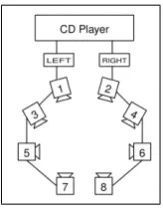
In Figure 1 the ‘left’ channel of a stereo source is mapped to loudspeakers 1, 3, 5 and 7, and the ’right’ to 2, 4, 6 and 8. It is common practice for the mapping of input channels to loudspeakers to be fixed in this way, and this is often ultimately due to hardware constraints. Although Resound can emulate this if required it is in fact possible to route any input channel to any loudspeaker. For exam-ple, one could define a routing in which the left channel of a stereo source is routed to loudspeaker 8 and the right
2For convenience we will refer to ‘faders’ as the control method
Figure 1. Fixed source channel mapping common in tra-ditional stereo diffusion systems.
channel to speaker 1, inverting the normal left-right axis. As with all of the previous examples, this mapping can be controlled with a single fader and implemented alongside other mappings.
7. ADDITIVE SPATIALISATION
As a simple scenario let’s say that faderacontrols the level of a stereo source mapped to the main pair of loudspeak-ers, while faderb controls the level of the same source mapped to all of the loudspeakers within the array. If we use both faders together, their effects will be mixed to-gether: faderb diffuses the stereo source ‘everywhere,’ and we can boost the level of the main pair of loudspeak-ers further by additionally raising fader a. This can be referred to as additive spatialisation.
8. SUBTRACTIVE SPATIALISATION
It is also possible for a fader to have a subtractive influ-ence, such that raising the fader will progressivelyreduce
the level of a given set of loudspeakers. If, for instance, fadercis configured to act subtractively on loudspeakers 3 through 8, then raising fader c will reduce the levels of these six loudspeakers without affecting the levels of loudspeakers 1 and 2. We might describe this particular subtractive routine as an ‘all to mains’ transition. It is the ability to perform manipulations additively and subtrac-tively that differentiates Resound from other matrix based systems such as the DM-8 [10].
9. SEMI-AUTOMATED SPATIALISATION BEHAVIOURS
In all of the examples so far there has been a simple pro-portionality - either direct (additive) or inverse (subtrac-tive) - between fader position and resulting output lev-els. Resound also provides a framework for defining semi-automated spatialisation ‘behaviours’ whereby the faders are used to control parameters other than loudness. Some examples are as follows.
9.1. Mexican Wave
The Mexican Wave behaviour cycles through a sequence of loudspeakers, or a sequence of groups of two or more loudspeakers. The user can control the rate at which the sequence is iterated (including the direction of iteration) and the overall amplitude level by assigning these param-eters to faders. The Mexican Wave behaviour can be used, for instance, to automate front-to-back or back-to-front movement within a venue; rotational movement is also a possibility.
9.2. Random
The Random behaviour also acts upon a group of loud-speakers, but iterates through the group in a random order as opposed to sequentially. Again, the user can control the rate at which loudspeakers are selected, and overall amplitude level of the behaviour. This behaviour can be particularly effective for the spatialisation of textural or granular material where an erratic spatial effect is sought.
9.3. Multi-point Crossfade
The Multi-point Crossfade behaviour is similar to the Mex-ican Wave, however in this case the behaviour does not iterate automatically through the sequence. Instead, the active loudspeaker(s) at any given time is governed by the position of a fader. This behaviour might be useful, for example, as a way of adjusting the width of stereo im-ages. Traditionally, this would be done by cross-fading the source between ‘main’ and ‘wide’ pairs of loudspeakers, necessitating the use of four faders. With the Multi-point Crossfade the same operation can be carried out with one fader.
10. PUT IT ALL TOGETHER...
All of the above techniques can be combined within a single performance. A thirty-two fader OSC controller might comprise, for instance, eight faders that operate on specific loudspeakers individually, eight that operate on groups of two, eight that operate on groups of four, and a further eight configured with semi-automated behaviours. Because all interactions within the Resound system can be applied additively or subtractively, there is no conflict between faders that act upon the same loudspeakers: the results are simply summed (positively or negatively). This is particularly useful in the context of semi-automated be-haviours, which can be used to dramatic effect on their own or subtly mixed in, as appropriate to the musical con-text.
11. COLLECTIVES
If you’ve got an eight-channel source, and ev-ery channel of the eight has a fader, how do you do crossfades? You haven’t got enough hands! [5]
The M2 system improved interface ergonomics by al-lowing multiple mappings to be grouped, but this intro-duced secondary problems in that such configurations take a long time to set up. Resound addresses this by introduc-ing the ‘collective’ [6] as new method of dealintroduc-ing with mul-tiple assignments, allowing these to be made more quickly and efficiently.
With collectives it is thus perfectly feasible to set up spatialisation routines that deal with 5.1, 8, orn channel images, presenting markedly different performance op-portunities from those afforded by stereo. Experiments whereby eight-channel images are spatialised among mul-tiple groups of eight loudspeakers have been carried out at BEAST.3 Resound is of course able to cater for this kind of configuration; however, because Resound deals with input-to-output mappings dynamically in real time, multi-channel images can also be inverted, translated, ro-tated, and so on. Furthermore, greater-than-stereo images usually have a front-to-back axis (as well as left-to-right) that can be manipulated in interesting ways. For example, the ‘front three’ and ‘rear two’ of a 5.1 image could be ‘Mexican Waved’ or ‘Multi-point Crossfaded’ indepen-dently between multiple groups of loudspeakers.
12. PRESETS
A preset is a snapshot of the complete state of the Resound system. Presets can be recalled instantaneously with a key press, and can be used to swap between input sources without the need for physical repatching, or in various cre-ative ways in performance. Saved banks of presets can be used as a means of sharing spatialisation techniques among practitioners.
13. SPATIALISATION OF MULTIPLE SOURCES
Consider the following scenario.
In my last piece [...] I used a six-channel hexagonal array as a ‘surround,’ and I had two solo speakers [...] for close-up stuff. What I would like to do [...] is be able to diffuse the ‘twos’ and the ‘sixes’ completely inde-pendently. [5]
Resound allows the performer to spatialise multiple in-put sources independently. To realise the scenario de-scribed by Harrison, we might assign one bank of faders to control only the six-channel image, and another bank to control only the stereo image. Of course both banks of faders could incorporate their own groups and behaviours. A similar scenario has proved effective in improvisation with multiple live electronic sources [2].
[image:4.595.365.487.52.118.2]3These experiments are described in Chapter 4 of [4]
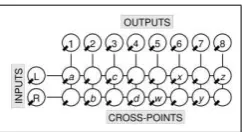
Figure 2. Graphical representation of a mix matrix archi-tecture. (The lettering of cross-point nodes refers to an example in the text.)
14. HOW DOES IT WORK?
In essence Resound allows each fader to control the levels of one or more input to output (source-channel to loud-speaker) mappings as defined by the user. This is achieved via the use of a matrix-based mix engine at the heart of the server application. Figure 2 describes a mix matrix architecture diagrammatically. In this case the matrix has two inputs and eight outputs, but in principle it can be any size. Audio inputs are shown on the left, audio outputs along the top. Every possible input to output mapping is referred to as a cross-point. Each node of the matrix has an attenuator that determines the amplitude of the signal allowed to pass through that node. In this way, any input can be mixed to any output in any proportion.
The GUI application acts as a remote control for the mix matrix, allowing the user to map multiple nodes on to faders. Mappings can be made directly; for example we might map matrix nodesa,b,canddto fader 1, meaning that fader 1 would simultaneously control the level of ‘L’ to outputs 1 and 3, and ‘R’ to 2 and 4. Alternatively we can map, say, nodesw,x,yandzto a Mexican Wave be-haviour, and then map the behaviour’s amplitude and rate parameters to faders 2 and 3, respectively. So, when we talk about faders and behaviours acting upon loudspeak-ers, this is not strictly accurate: in effectthey do, but in reality they act upon matrix nodes. The GUI application also allows matrix nodes to be locked to a given value. Locked parameters, once set, are not controlled by faders. A detailed technical and conceptual description of the system is given elsewhere [6] and source code is available online [9].
15. MATRIX MIXING TECHNIQUES
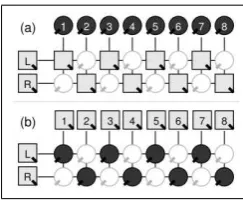
(b) is, however, more flexible. Because we are remotely controlling the cross-point nodes as opposed to outputs we have complete dynamic control over the mapping of source channels to loudspeakers.
Although relatively conservative examples have been given for ease of explanation, the same principles can be applied to achieve more unorthodox mappings across larger numbers of input and output channels. Through com-bining cross-point spatialisation with the ability to map multiple nodes simultaneously to faders, performers can circumnavigate the potentially cumbersome nature of the mix matrix architecture and exploit its latent flexibility.
16. FUTURE DIRECTIONS
An embedded scripting language for defining behaviours will increase accessibility and increase the creative poten-tial of the system. High level languages such as Python and Lua are being considered.
Augmenting the DSP functionality of each matrix node, perhaps by providing filtering and time-delay algorithms, is a relatively straightforward extension of the current ca-pabilities of the system.
Massively multi-channel systems (with two-hundred or more loudspeaker outputs) require exponentially increas-ing processor power and I/O capability. Systems such as Resound adopt a monolithic approach. A clustered com-puting solution would be more scalable and is currently being designed.
In the absence of permanent installations, rehearsal, software development and performance documentation is logistically difficult. Virtualisation of large arrays via Am-bisonic and binaural implementations is planned.
17. CONCLUSION
[image:5.595.363.485.52.152.2]Resound provides a simple but powerful user-configurable framework for multi-loudspeaker sound spatialisation and is particularly well suited to real-time interaction and im-provisation in a performance context. The ability to spec-ify and control mappings in groups, proportionally, addi-tively, subtractively and semi-automatically via behaviours allows performers to realise dynamic, flexible, and easy to control spatialisation routines that would be difficult or impossible to achieve in real time with analogue mixing hardware, particularly with multi-channel input sources. Because the system can operate additively and subtrac-tively, unorthodox or experimental methods can be used alongside more traditional fixed routings, allowing per-formers to adapt gradually, supplementing and extending their existing repertoire of spatialisation techniques. Ef-fectively, performers are at liberty to design their spatiali-sation instrument as appropriate to the music and accord-ing to their personal preference. Above all, however, Re-sound is a work in progress, and an open source project that actively encourages collective participation and on-going development.
Figure 3. Two ways of emulating fixed stereo routing. Locked nodes are square; nodes assigned to fader control are black circles.
18. REFERENCES
[1] Barri`ere, F. and Bennett, G. [eds]. Composi-tion / Diffusion in Electroacoustic Music, Edi-tions Mnemosyne, Bourges, 1998.
[2] Dead Dialogues: Sound Spatialisation in Free Improvisation. http://video.google.com/ videoplay?docid= 47006225079839391
[3] Harrison, J. “Sound, Space, Sculpture - Some Thoughts on the ’What,’ ’How’ and ’Why’ of Sound Diffusion,Organised Sound3(2), 1998.
[4] Mooney, J. Sound Diffusion Systems for the
Live Performance of Electroacoustic Music,
Ph.D. Thesis, University of Sheffield, 2005. http://www.james-mooney.co.uk/publications.
[5] Mooney, J. [ed]. “An Interview with Professor Jonty Harrison”, Appendix 2 in [4].
[6] Mooney, J. and Moore, D. “A Concept-Based Model for the Diffusion of Sound via Multi-ple Loudspeakers”,Proceedings of the Digital
Music Research Network Conference, Leeds,
UK, 2007.
[7] Moore, A., Moore, D. and Mooney, J. “M2 Diffusion: The Live Diffusion of Sound in Space”, Proceedings of the International
Computer Music Conference, Miami, 2004.
[8] Moore, D. Real-time Sound
Spatializa-tion, Software Design and Implementation,
Ph.D. Thesis, University of Sheffield, 2004. http://music.dept.shef.ac.uk/phd thesis/ rtss.pdf.
[9] Resound. http://resound.sourceforge.net.
[10] Rolfe, C. “A Practical Guide to Diffusion”,
EContact! 2(4), 1999. http://cec.concordia.
ca/econtact/Diffusion/pracdiff.htm.
[11] Smalley, D. “Space-form and the Acousmatic Image”,Organised Sound12(1), 2007.