65
Second-Order Science
of Interdisciplinary Research
A Polyocular Framework for Wicked Problems
Hugo F. Alrøe
• Aarhus University, Denmark • hugo.f.alroe/at/gmail.com
Egon Noe
• Aarhus University, Denmark • egon.noe/at/djf.au.dk
> Context • The problems that are most in need of interdisciplinary collaboration are “wicked problems,” such as food
crises, climate change mitigation, and sustainable development, with many relevant aspects, disagreement on what the problem is, and contradicting solutions. Such complex problems both require and challenge interdisciplinarity.> Problem
• The conventional methods of interdisciplinary research fall short in the case of wicked problems be-cause they remain first-order science. Our aim is to present workable methods and research designs for doing second-order science in domains where there are many different scientific knowledges on any complex problem.> Method
• We synthesize and elaborate a framework for second-order science in interdisciplinary research based on a number of earlier publications, experiences from large interdisciplinary research projects, and a perspectivist theory of science.> Results
• The second-order polyocular framework for interdisciplinary research is characterized by five prin-ciples. Second-order science of interdisciplinary research must: 1. draw on the observations of first-order perspectives, 2. address a shared dynamical object, 3. establish a shared problem, 4. rely on first-order perspectives to see themselves as perspectives, and 5. be based on other rules than first-order research.> Implications
• The perspectivist insights of second-order science provide a new way of understanding interdisciplinary research that leads to new polyocular methods and research designs. It also points to more reflexive ways of dealing with scientific expertise in democratic processes. The main challenge is that this is a paradigmatic shift, which demands that the involved disciplines, at least to some degree, subscribe to a perspectivist view.> Constructivist content
• Our perspectivist approach to science is based on the second-order cybernetics and systems theories of von Foerster, Maruyama, Maturana & Varela, and Luh-mann, coupled with embodied theories of cognition and semiotics as a general theory of meaning from von Uexküll and Peirce.> Key words
• Perspectivism, semiotics, complex phenomena, social systems theory, differentiation of sci-ence, perspectival knowledge asymmetries.“Perspective is one of the component parts of reality. Far from being a disturbance of its fabric, it is its organizing element.” (Ortega y Gasset 1961: 90)
“…a scientific perspectivism does not degenerate into a silly relativism.” (Giere 2006a: 13)
Introduction
« 1 » The science of sustainable agricul-ture is an example of a science that does not have its own scientific perspective. It de-pends on interdisciplinary collaboration be-tween many different specialized disciplines such as plant physiology, organic chemistry, soil physics, environmental science, ecology, engineering, statistics, business economics,
and sociology; and it must always be pre-pared to include new perspectives (recently, e.g., climate change, marketing, and social systems) due to the influence of a large va-riety of stakeholders and the structural and semantic developments within agriculture, food, the environment, and society at large.
« 2 » The problems that are most in need of interdisciplinary cooperation are “wicked problems” such as food crises, cli-mate change mitigation, and other resilience and sustainability problems (Klein 2004). Wicked problems are complex problems where there is disagreement on what the problem actually is, there are different inter-ests and different perspectives involved that frame the problem differently, and proposed solutions often contradict each other (Rittel & Webber 1973).
« 3 » Bryan Norton emphasizes that with respect to wicked problems we face an analytic void:
“
For those frustrated with the lack of progress in many areas of environmental protection, Rittel & Webber’s work suggested a powerful explanatory hypothesis: Complex environmental problems cannot be comprehended within any of the ac-cepted disciplinary models available in the acad-emy or in discourses on public interest and policy. This failure is not a matter of inadequate practice, but a matter of principle.”
(Norton 2012: 449)« 4 » This means that the wicked prob-lems of today both require and challenge interdisciplinarity. “The real-world research problems that scientists address rarely arise within orderly disciplinary categories, and
Authors’ Response:
Archived
at
Ph
Il
OSOP
hICA
l
CO
nC
eP
tS
In R
Ad
ICA
l C
On
St
Ru
Ct
Iv
ISM
66
vii). There is a need for unsimple truths (Mitchell 2009). But the conventional ideas and methods of interdisciplinary research fall short in the case of wicked problems. It is well-known that there are fundamental problems of communicating across disci-plines and carrying out cross-disciplinary1 research in practice (e.g., Miller et al. 2008; Bracken & oughton 2006; Harrison, Mas-sey & Richards 2008; Noe, alrøe & Langvad 2008; Pennington 2008). The more ambi-tious the collaboration is, in terms of using and integrating very different scientific per-spectives in solving real, complex problems, the more difficult the task.
« 5 » Interdisciplinary studies have gen-erally been developed as complementary to the development of specialized disciplines, based on the need to understand complex issues, answer complex questions and solve complex problems (e.g., Klein 1996, 2004; Moran 2010; Repko 2012). But the epis-temological aspects are rarely considered within the field where we might expect it, the philosophy of science, though philoso-phers of science have recently begun to fo-cus more on the interaction of epistemic and social practices (Krishnan 2009: 19).
« 6 » We argue that the existing ap-proaches to cross-disciplinary research are problematic because they remain first-order. This can be in the form of independent and uncoordinated research perspectives on a given problem, a patchwork of coordinated but still separate research perspectives, a synthesis through the lens of a hegemonic discipline (such as, often, economics), or a synthesis based on a new integrated disci-pline (such as first-order system theories). accordingly, we work to overcome the challenge to interdisciplinary science and the conundrum of doing cross-disciplinary research by way of a thorough perspectivist understanding of science that operates with
1 | We use “cross-disciplinary” as a generic term to encompass the various forms of multi-, inter- and transdisciplinary cooperation between scientific disciplines on a common issue. often “interdisciplinary” is used as the general term, but this can be confusing since interdisciplinary is also one of the different forms of interdisciplinar-ity (see Klein 2010 for a taxonomy of interdisci-plinarity).
tion. our aims in this paper are to present a second-order polyocular framework for doing interdisciplinary research on wicked problems, and to describe workable meth-ods and research designs for this second-order science.
« 7 » The proposed methodologies are empirically grounded in our participation in a range of large interdisciplinary research projects. The paper is based on fifteen years of research and a number of earlier publi-cations that propose perspectivist analyses and second-order research methodologies in the domain of agriculture, food and en-vironment.
« 8 » In the following, we first present the perspectivist view of science and lay out the principles of polyocular research. Then we illustrate and discuss the implications of the polyocular framework for cross-dis-ciplinary research, and for practice. Finally, we discuss future directions and sum up our conclusions.
the perspectivist view
of science
« 9 » Perspectivism has had a long but marginal presence in philosophy, with roots in Kant and Nietzsche (e.g., Palmquist 1993; anderson 1998; Hales & Welshon 2000). In a perspectivist view, science is observer-dependent to the core, and we see a growing recognition in science studies that all scien-tific knowledge is perspectival; i.e., that the context established by a scientific discipline is decisive for the kind of observations that can be made by that discipline. This devel-opment is connected to the develdevel-opment of radical constructivism, which suggests that we, including science, actively construct our world and that deeper insights in the knowl-edge constructions of science can be gained from cognitive sciences (Riegler 2001).
« 10 » The perspectivist view of science that we present here is a radicalization of the existing perspectivist, cognitive approach to science by way of a Luhmannian social sys-tems approach to science as a communica-tive system (alrøe 2000; alrøe & Noe 2011). « 11 » The cognitive understanding of science, where the focus is on scientific mod-els and representation rather than theories
ing in philosophy of science over the last few decades (e.g., Giere 1988; Cartwright 1999; Fraassen 2008), and it has recently been developed into an explicitly perspectival philosophy of science, labelled “scientific perspectivism,” by Ronald Giere (2006a). This implies that all scientific knowledge is perspectival, given that scientific knowledge is created in scientific perspectives, and that scientific representations and measurement outcomes are perspectival (Fraassen 2008: 8, 183). With regard to interdisciplinary sci-ence, the cognitive perspectivist approach has led to a pluralist view of science, a “per-spectival pluralism” (Giere 2006b), where different perspectives highlight different as-pects while ignoring others (Giere 1999: 28), and maintaining a plurality of perspectives promotes scientific progress (Longino 2006):
“
a thorough-going disciplinary pluralism […] suggests that sometimes the perspectives don’t fit nicely together on the same plane: they overlap or conflict or cannot both be held at the same time, and yet you need both of them.”
(Kellert 2006: 225)The perspectivist view of science implies that there are many scientific truths about any complex problem, and the question is not how to select the correct one, but how to appreciate and use the “nonunifiable plu-rality of partial knowledges” (Longino 2006: 127). But no real perspectivist methodol-ogy has so far been developed to handle the challenge of interdisciplinary science in this line of work.
communica-67
tion is only possible by co-creating a new, shared genre of discourse (Holbrook 2013). From this evolutionary, communicative view of science, the paradox of scientific expertise
becomes evident: that the growth of scientific knowledge leads to a fragmentation of scien-tific knowledge (alrøe & Noe 2011). The dif-ferentiation and specialization of science and expertise results in what we call perspectival knowledge asymmetries: different scientific perspectives see complex matters differently, and these differences cannot, and should not, be merged.
« 13 » The perspectivist view of science that we advocate sees different research ap-proaches (including disciplines, sub-disci-plines, and more specific research approach-es, as well as “schools of thought,” Kuhnian paradigms2, and Lakatosian research pro-grams3) as perspectives for observing the world (Giere 2006a; alrøe & Noe 2011). different scientific perspectives are charac-terized by different methods, instruments of observation and entire experimental ar-rangements, different concepts, categories, and theories, and different concerns and questions, as well as implicit values and tacit embodied knowledge and practices (cf. Col-lins 2010). all of this determines what a spe-cific scientific perspective can observe and what it cannot observe.
« 14 » Thomas Kuhn’s paradigms are examples of scientific perspectives in our understanding, according to his “Postscript 1969” to the highly influential “The struc-ture of scientific Revolutions,” where he suggests the term “disciplinary matrix” as a more precise term for “paradigm” (Kuhn 1996). But where Kuhn and the Kuhnian tradition generally have a historical, dia-chronic focus on how paradigms may shift within a single scientific field (scientific rev-olutions), we focus on the synchronic differ-ences across disciplines and perspectives in line with Magoroh Maruyama (1974).
« 15 » The concept of perspective, as we use it, originates from investigations of sci-ence as an observing system that is directed at learning (alrøe 2000; alrøe & Kristensen 2002; alrøe & Noe 2012). It draws on the one hand on an analogy with organisms, focus-ing on the characteristics of the sensory or
2 | see “Postscript 1969” in Kuhn (1996). 3 | see Lakatos (1978: 47ff).
observational apparatus, and the interactive aspect of observation, such as experiments. In this, we build on the autopoiesis of living systems (Maturana & varela 1980), the field of embodied cognition (e.g., varela, Thomp-son & Rosch 1991), and especially on Jakob von uexküll (1982), who investigated the different phenomenal worlds (umwelten) that animals have due to their different sen-sory and cognitive apparatuses, and the later development of biosemiotics, of which he is now considered the founding father (sebeok 2001). The connection to biosemiotics sug-gests a theoretical grounding of the perspec-tivist understanding of science in Peircean semiotics, which we will unfold in the next section.
« 16 » on the other hand, our concep-tion of perspective draws on an analogy with autopoietic social systems, such as organiza-tions and firms (Luhmann 1995, andersen 2003), who observe their environment and themselves, based on operational closure and blind spots. “The blind spot of tion exists because of the fact that observa-tion cannot see that it cannot see that which it cannot see” (andersen 2003: 65). Niklas Luhmann very clearly operates with a per-spectivist approach (though he does not call it that),4 laying out the premises of observa-tion of observaobserva-tion of social communica-tive systems, following Heinz von Foerster’s (1981, 2003) second-order cybernetics.
« 17 » In short, a perspective isthat which determines what an observer can observe and what it cannot observe. The perspectives that we are mainly concerned with in this article are scientific perspectives, and the observers we look at are social systems, the observing systems of science. observation is of course a key notion,5 and it is treated in more de-tail in the next section (see Figure 1). The term “polyocular” has been constructed in analogy with binocular and monocular (Maruyama 1974), and here “ocular” is used in nearly the same sense as perspective, but
4 | doubts have even been raised about whether Luhmann’s standpoint was properly con-structivist (Riegler & scholl 2012), but his critical arguments are also considered a help in clarifying radical constructivist epistemology (scholl 2012).
5 | alrøe & Noe (2012) investigate different constructivist conceptions of “observation” and the corresponding notion of “environment” or “world.”
with a built-in social systems theoretical meaning in the form of the “blind spot” of an eye (Latin: oculus).
« 18 » a scientific perspective is thus an autopoietic system that is reproduced and refined through internal processes (alrøe 2000), and which produces its own meth-ods, theories and instruments for observa-tion, and thereby also its own inputs (data).
« 19 » on the basis of this perspectiv-ist understanding of science, we describe a second-order, polyocular framework for interdisciplinary research. The key point is that interdisciplinary cooperation must be based on an awareness and recognition of the interacting disciplines first and foremost as perspectives – not as social groups, not as discourses, not as “sciences working on dif-ferent domains.”
Five principles for
polyocular research
« 20 » The second-order, polyocular framework for interdisciplinary research can be characterized by five interrelated but separate principles.
Principle 1 – Observing
observations
« 21 » The first principle is grounded in the perspectivist view of science, which sees different research approaches as perspec-tives for observing the world (Giere 2006a; alrøe & Noe 2011).
« 22 » science has no access to the world or “that which is observed,” except through observations (including interactions), as we shall explore in Principle 2.6 all scientific observations belong to a scientific perspec-tive, and the observations of a perspective include that perspective. The perspective is part of what an “observation” is. In his philosophy of quantum physics, Niels Bohr advocated that the very word phenomenon
be applied exclusively to refer to the ob-servations obtained under specific circum-stances, including an account of the whole experimental arrangement (Bohr 1985: 27).
Ph
Il
OSOP
hICA
l
CO
nC
eP
tS
In R
Ad
ICA
l C
On
St
Ru
Ct
Iv
ISM
68
Second-Order Science of Interdisciplinary Research hugo F. Alrøe & egon noe
Second-Order Science of Interdisciplinary Research hugo F. Alrøe & egon noe
We advocate taking this as a general princi-ple, based on the perspectivist view of sci-ence, and taking complex phenomenon to mean a phenomenon where multiple per-spectives are needed to give an unambigu-ous description (sensu Bohr, see Favrholdt 1999: xlix; alrøe & Kristensen 2002) of the phenomenon, and where the degree of com-plexity depends on the number and variety of perspectives needed. (This definition of complexity is very different from e.g., ideas about complexity building on statistical complexity, such as Ladyman, Lambert & Wiesner 2013).
« 23 » The only access for interdiscipli-nary science to studying a complex problem or complex phenomenon is through the (first-order) scientific perspectives that en-ter into the study. or in other words, there is no all-encompassing scientific perspective. aspirations in science to develop a deeper understanding of a complex problem can only be realized through specialization, which often involves a differentiation into separate specialized scientific perspectives, with their own semantics and means of observation. This differentiation of science has happened throughout the history of sci-ence (stichweh 1992; Weingart 2010). any attempt to reunite the fragmented sciences into a unitary science, such as the various systems sciences, either loses the powers of the specialized sciences or forms a new
spe-cialized perspective, or both.7 as autopoietic systems, scientific perspectives are closed to each other, they are each other’s environ-ment. second-order perspectives can only access the findings of first-order perspec-tives by observing them.
« 24 » It follows that the second-order science of interdisciplinary research must observe the observations of first-order per-spectives; not the social systems as in a soci-ology of science study, and not the “results” as they are often presented in a de-contextu-alized form, but the results in a form where it is clear how they are constructed from observations through the cognitive and analytical tools of the scientific perspective.
7 | This is not to say that integrating theories cannot be helpful and attractive, nor that integra-tion in science is not a continuous aim (e.g., in the “unity of science” movement), and a some-times very successful strategy (e.g., in molecular biology and nanoscience). But a recombination of relatively proximate fields will itself develop into another specialized field, such as molecular biology, and does not as such contradict the gen-eral process of differentiation in science; and the combinations of disciplines into applied research centers, such as nanoscience centers, with cor-responding journals and funding programs, are compatible with, and depend on, the continuous independent development of disciplines (Riegler 2005; Weingart 2010).
Perspectival knowledge must always be of the form “seen from this or that perspective, such and such is the case.” only in this rich form can the observations enter into a poly-ocular communication.
« 25 » In headline form, the first prin-ciple is: second-order science of interdisci-plinary research must draw on the observa-tions of first-order perspectives, because:
all observations include the observer,8 and only perspectives can offer observa-tions;
research approaches should be under-stood as perspectives, and scientific knowledge depends on the observing perspective;
there is no holistic scientific perspective;
first-order perspectives are the only ac-cess to observing complex problems.
Principle 2 – A shared dynamical
object
« 26 » What observers see depends on how they see it, and “the same thing” may therefore be seen in different ways. But how, then, can observers determine whether they are looking at the same thing? This seem-ingly simple question is in fact a deep philo-sophical question that requires a compre-hensive semiotic understanding that is able to address how observations relate to that which is observed.
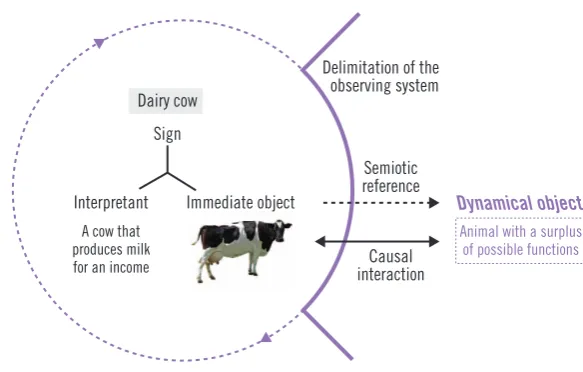
« 27 » Interdisciplinary research re-quires a shared research object; this is part of the very definition of what interdisciplinary research is. But different scientific perspec-tives have different names and specialized concepts for the objects they observe; this is part of what makes them a specialized per-spective. This means that we cannot be sure that we look at the same thing, even though we think we do. a farm from an economic perspective (a “farm enterprise”) is a quite different entity from a farm from a socio-logical or an environmental perspective. a cow from an accounting perspective is quite different from a cow from a veterinary or a landscape conservation perspective. In a per-spectivist, semiotic understanding, we can analyze this in the form of signs (Figure 1).
8 | By “all observations include the observer” we mean that every observation is made from somewhere, from a certain perspective (alrøe & Kristensen 2002).
Immediate object Interpretant
Sign Dairy cow
A cow that produces milk for an income
Dynamical object
Animal with a surplus of possible functions Delimitation of theobserving system
Causal interaction
[image:4.595.72.364.97.283.2]Semiotic reference
Figure 1 • The semiotic model of a scientific perspective, with three key conditions for observa-tion (Alrøe & Noe 2011: 157). The dotted circle with arrows symbolizes that the perspective is an
69
according to Peirce a sign, or representa-men, is something that stands to somebody for something in some respect or capacity.
“
a sign therefore has a triadic relation to its ob-ject and to its Interpretant. But it is necessary to distinguish the Immediate object, or the object as the sign represents it, from the dynamical ob-ject, or really efficient but not immediately pres-ent object.”
(Peirce 1998: 482, CP: 8.343)« 28 » Peirce’s distinction between the dynamical and the immediate object to some degree corresponds to Kant’s distinction be-tween phenomena, things-for-us, and nou-mena – things-in-themselves (alrøe & Noe 2011, 2012). some say they differ in that the Kantian ding an sich is unknowable as it is in itself, whereas the Peircean thing in itself, the dynamical object, is essentially repre-sentable and knowable as a limiting case,9 as truth is a limiting case for Peirce. But in order to approach the dynamical object, we have to acquire what Peirce calls collateral experience of the supposed same dynamical object (Hardwick & Cook 1977: 83).
« 29 » There is no position from where we can observe the dynamical object as it is in itself. (This is of course very different from a traditional realist conception, which takes the thing in itself as the immediately present object.)10 Every perspective adds to the number of immediate objects that refer to, point at, or hint at the dynamical object. The immediate objects all refer to a dynami-cal object, but none of them are the same as the dynamical object in itself. What rescues the prospects for interdisciplinary research is that dynamical objects “strike back” in our interaction with them, and that this causal interaction is part of what makes up the observations of scientific perspectives (Fig-ure 1). This relational nature of observation is also what enables scientific perspectives to make changes in the world that correspond
9 | see Joseph Ransdell’s “on the use and abuse of the immediate/dynamical object distinc-tion.” Retrieved from http://www.cspeirce.com/ menu/library/aboutcsp/ransdell/useabuse.htm on 5 May 2014.
10 | see also Winfried Nöth (2011) on the relation between the Peircean semiotic idea that representation is always incomplete and radical constructivism.
to their specialized observations. However, the existence of a shared dynamical object can never be presumed, but must be estab-lished and synchronized in each case.
« 30 » For cross-disciplinary research efforts, the questions of a shared dynamical research object and collateral experience are particularly difficult because they concern complex phenomena; that is, phenomena that can only be established by the collabor-ative effort of multiple specialized perspec-tives, and which refer to complex dynamical objects.
« 31 » In headline form, the second principle is: second-order science of inter-disciplinary research must address a shared dynamical object (sensu Peirce), because:
interdisciplinary research requires a shared research object;
there is no position from where we can observe the “thing-in-itself”;
each perspective has its own immediate object.
Principle 3 – A shared problem
« 32 » The second principle focused on the cognitive problem for interdisciplin-ary research to ensure that the involved perspectives observe the same thing. But why bother? Generally, scientific efforts are driven by either internal or external ques-tions, or some combination thereof. Inter-nal questions rarely motivate interdisciplin-ary cooperation; interdisciplininterdisciplin-ary research is mostly motivated by external questions, often formulated as “problems” for society or certain groups in society. Therefore it is a separate requirement for interdisciplin-ary research to establish a shared problem. Whereas having a shared dynamical object is the enabling factor for interdisciplinary research, having a shared problem is the motivating factor that calls for cooperative work (see also the section “Phases of poly-ocular research”).
« 33 » an important societal problem is an irritation, like an itch, a pain, or a gen-eral discomfort is an irritation for a person; this societal irritation we call a dynamical problem in analogy to the dynamical object and dynamical interpretant of Peirce. The problem is felt in different ways by different stakeholders, who occupy different perspec-tives, and is not necessarily perceived as one and the same problem. science is needed
to establish these perceived problems as a shared problem. on the other hand, shared problems need to be formulated in a shared language, which is connected to our daily relations with the world, in line with Bohr’s view that there is no alternative to ordinary language for unambiguous description (Fa-vrholdt 1999: xxxvii). The use of ordinary language is necessary for scientific com-munication to couple with the experiences, feelings, and motivations of stakeholders in relation to wicked problems.
« 34 » The perspectival nature of sci-entific disciplines leads to the problem of problem making. different disciplines nec-essarily see different types of immediate problems due to their different methods and instruments of observation, different concepts, categories and theories, and dif-ferent concerns, questions and values. Each research perspective forms its own version of what the problem is, and this is part of what makes the problem “wicked.” The par-adox that has to be resolved in the face of wicked problems is thus that it takes a con-certed effort to establish a shared problem, and it takes a shared problem to establish a concerted effort.
« 35 » Part of why having a shared problem is an essential motivation for in-terdisciplinary research is that faced with a shared problem there is a need for a shared solution. (This is science taken as the key to societal learning, complex problem solving, and creative transformation.) But as we said, different scientific perspectives see differ-ent immediate problems, and therefore they provide different solutions that often contra-dict each other.
« 36 » The shared problem of interdisci-plinary research is therefore only really pos-sible in a second-order framework. Wicked problems, such as the current sustainability crises, can only be adequately addressed in a second-order problem solving process, where the shared problem can be formu-lated in a polyocular way that is sufficiently flexible to incorporate the different versions of the problem that scientific perspectives offer, and that is thereby able to offer a com-mon or coordinated solution.
Ph
Il
OSOP
hICA
l
CO
nC
eP
tS
In R
Ad
ICA
l C
On
St
Ru
Ct
Iv
ISM
70
Second-Order Science of Interdisciplinary Research hugo F. Alrøe & egon noe
Second-Order Science of Interdisciplinary Research hugo F. Alrøe & egon noe
the shared problem is the driving force for doing interdisciplinary research;
each research perspective forms its own version of what the problem is (and this is part of what makes the problem “wicked”);
having a shared problem is a precondi-tion for being able to offer a common or coordinated solution.
Principle 4 – Perspectives must
see themselves as perspectives
« 38 » one of the typical problems of interdisciplinary research is a lack of re-spect for other disciplines. The reason can be a hegemonic feeling of being the better science; that other disciplines are generally less scientific and their results therefore less dependable; or that other disciplines are generally too restricted by their theoretical framework and their results therefore less useful. or the reason can be a more specific assessment that since the other disciplines come up with other explanations and other solutions in this case where we really know what we are doing, they must be wrong.
« 39 » The perspectivist view of science recognizes that (1) there are many different scientific perspectives on any complex is-sue, (2) these different perspectives can all contribute valuable observations, and (3) no single scientific discipline can provide adequate solutions to complex problems, and therefore it is a strong tool for founding mutual respect between even very different scientific perspectives.
« 40 » In fact, the second-order science of interdisciplinary research is dependent
on the ability of the scientific disciplines involved to see themselves as perspectives, through self-observation, and acknowledge that they are one among many different per-spectives. First, the very process of second-order observation requires that first-second-order observations are made available for observa-tion. The second-order science we describe is not just a science of sciences, such as so-ciology of science, but a polyocular frame-work based on scientific observations of scientific observations. and scientific obser-vations cannot be observed without the will-ing and skillful cooperation of the scientific perspective making those observations.
« 41 » second, establishing a shared dynamical object, which is required for
in-terdisciplinary research to qualify as inter-disciplinary research at all, depends on the involved first-order scientific perspectives being able to distinguish between their im-mediate objects and the dynamical objects that they refer to. There is no way in which an individual perspective can gain access to observe directly the difference between the immediate and the dynamical object. This distinction is only accessible as a theoretical construct that can be actualized in relation to other perspectives, through polyocular communication.
« 42 » Third, to help resolve a wicked problem in a constructive way, first-order perspectives must participate in the poly-ocular communication about how their dif-ferent immediate problems can contribute to the determination of a shared, polyocular problem. to do that, each scientific perspec-tive needs to recognize itself as a perspecperspec-tive on the world among other valid and valuable perspectives. This can be difficult because researchers are usually not trained to think of their approaches as perspectives. and the first-order perspectives need to enter into a form of partnership where they promise not certain observations, but certain promises of observations by way of their perspective (cf. andersen 2008: 4).
« 43 » In headline form, the fourth principle is: Second-order science of inter-disciplinary research must rely on first-order perspectives to see themselves as perspectives, because:
this is necessary to make first-order per-spectives volunteer their observations as objects for second-order observation;
this is necessary to determine the dy-namical object that is referred to by the immediate objects of the first-order per-spectives;
in order to observe wicked problems, the first-order perspectives must partic-ipate in the polyocular communication about the shared problem.
Principle 5 – different rules for
second-order science
« 44 » Polyocular cognition is the form of cognition needed to observe and un-derstand complex phenomena. There is no holistic first-order perspective; no all-encompassing perspective that can observe the whole of a complex phenomenon as a
re-placement for the many specialized perspec-tives, and there is no complete cognition ex-cept as an ideal limiting case (sensu Peirce).
« 45 » Polyocular cognition is based on observations of first-order observations, but it is not itself merely another first-order perspective. This does not mean that the polyocular second-order perspective is a privileged perspective; it is not a new gods-eye perspective. Perspectivism must also be applied to itself. The second-order scientific perspective is itself an autopoietic social sys-tem, it forms its own organization, and there can be different second-order perspectives on a complex phenomenon with different ideas about what the relevant first-order perspectives are and how the phenomenon is to be delimited.
« 46 » Polyocular cognition relies on collaboration with first-order perspectives, who must volunteer their observations for observation, as Principle 4 states, and of-fer self-descriptions. The first-order per-spectives can only make their observations available for (second-order) observation in form of communication, and polyocular cognition is therefore also dependent on polyocular communication. The polyocu-lar communication must be able to handle first-order observations in the context of their perspectives (as observer-dependent knowledge).
poly-71
ocular communication is about extending a multidimensional space of understanding of the dynamical object under study.
« 48 » The polyocular framework can reveal new observational dimensions that cannot be observed from any first-order perspective, like binocular vision can re-veal depth or distance. Gregory Bateson (1979: Chapter 3) described the elaborate anatomical structures behind binocular vi-sion, and how the difference between the information from the two eyes creates an extra dimension to seeing: information about depth, which is of a different logical type. Maruyama posed the more radical idea of polyocular vision, across cultures, professions, or disciplines, where the dif-ferent views are seen as complementary in a polyocular logics and “the differen-tials between the different views enable us to add new dimensions to our percep-tion” (Maruyama 1974: 187). He criticized previous interdisciplinary waves and sug-gested immersion in other disciplines as a way to enable polyocular vision and avoid “subunderstanding” due to the dimension reduction and blind spots of a single disci-pline (Maruyama 2004).
« 49 » Polyocular vision is therefore not merely a question of gathering collateral ex-perience. It is a way of approaching an in-depth multidimensional understanding of complex phenomena and wicked problems that requires synchronization and spatial coordination (in the timeframes and spaces employed) of the involved perspectives (this is developed more in the section “Phases of polyocular research”).
« 50 » In headline form, the fifth prin-ciple is: Second-order science of interdisci-plinary research must be based on other rules than first-order research, because:
polyocular cognition is based on obser-vations of first-order obserobser-vations, it is not merely another first-order perspec-tive;
perspectives can only make their ob-servations available for (second-order) observation in form of communication;
polyocular communication must be able to handle first-order observations in the context of their perspectives (as observ-er-dependent knowledge);
while disciplinary communication is about providing consistent, efficient,
and precise knowledge in the context of a sharply delimited research world, polyocular communication is about extending a multidimensional space of understanding that has its own require-ments for synchronization and spatial coordination.
Implications for research
« 51 » In this section we describe the im-plications of the polyocular framework for organizing and executing cross-disciplinary research. We present research methods and designs for doing second-order science in interdisciplinary research on the basis of the above principles as well as our experi-ences and experiments within a range of interdisciplinary agroecological research projects. as a simple example, we have em-ployed workshop setups where discussions have been carried out first in uniperspec-tival groups (participants having the same perspective) and then in multiperspectival groups where participant with different per-spectives are mixed.
« 52 » In a full-blown polyocular re-search project, there are three levels of ob-servation and three pivotal phases of carry-ing out research (Figure 2 and table 1). The middle level of observation is the familiar first-order observation in research execu-tion. The top level is second-order observa-tion; this is the observation of observations made from different scientific perspectives, including the self-observations of first-order perspectives (Luhmann 2000: 62f). First-order observation is necessarily unobserv-able to itself, and only becomes observunobserv-able in second-order observation, which can place first-order observations in the context of the perspective that has determined the observations. on the bottom level we have the dynamical objects that are presumed and hinted at in scientific observation, but which cannot directly enter into scientific communication. We characterize this as zeroth-order observation because, whereas second-order observation is the level of observation necessary for an observation to be seen as an observation, zeroth-order observation is the level of observation nec-essary for an observation to be considered
Polyocular communication
observations of observations made by the different perspectives
Dynamical object
Stakeh older perspe
ctive
Scientif
ic
perspec
tive
Scientific perspective
Scientific perspective
Stakeholder perspectiv
e Scientific
perspective
Second-order observation
First-order observation
[image:7.595.217.534.106.317.2]Zeroth-order observation
Figure 2 • The polyocular framework for cross-disciplinary research, indicating three levels of observation (modified from Alrøe & Noe 2008 and Noe, Alrøe & Langvad 2008). Scientific
perspectives are typically disciplines or subdisciplines; stakeholder perspectives can be key stakeholder associations, industries, governmental institutions, or NGOs. As in Figure 1, the dotted circles with arrows represent autopoietic social systems, and the eye symbol indicates
Ph
Il
OSOP
hICA
l
CO
nC
eP
tS
In R
Ad
ICA
l C
On
St
Ru
Ct
Iv
ISM
72
Second-Order Science of Interdisciplinary Research hugo F. Alrøe & egon noe
Second-Order Science of Interdisciplinary Research hugo F. Alrøe & egon noe
an observation, though it cannot be seen. If there is no reference, however feeble, to “the dynamical object, or really efficient but not immediately present object,” as Peirce puts it, there is no observation.
« 53 » We have previously suggested second-order polyocular understandings of multifunctional farming (Noe, alrøe & Langvad 2008), organic agriculture (alrøe & Noe 2008), sustainability (Noe & alrøe 2014a) and regulation (Noe & alrøe 2014b). The research project Multitrust11 was organ-ized as a multi-perspectival approach that worked explicitly with the different aspects of multicriteria assessment of food system sustainability exposed by the involved sci-entific perspectives in order to facilitate interdisciplinary research and enable the participation of a diverse range of organic actors and stakeholders in the project. at the onset of the project, all the involved partners produced self-descriptions of their own perspective on the problem of making, communicating, and implementing sustain-ability assessments. an example of polyocu-lar work in this project is a study on moti-vation in sustainability assessment based on three research perspectives – an economic, a psychosocial, and a semiotically-based relational perspective – resulting in a mul-tiperspectival research article (Læssøe et al. 2014). The polyocular work was difficult and unfamiliar for the researchers involved, but the experiment showed that such work can bring out a new level of understanding that could not be obtained otherwise. an added benefit was that this polyocular work encouraged mutual respect and insight be-tween the research groups. another example from this project on polyocular understand-ing is a scientific paper that investigates the role of values in different scientific perspec-tives on sustainability assessments, without presuming a unitary conclusion is possible (Thorsøe, alrøe & Noe 2014).
« 54 » The current Eu project Healthy-Growth12 is from start to finish organized around a polyocular framework: in-depth
11 | “Multicriteria assessment and commu-nication of effects of organic food systems,” 2011– 2014, funded by the danish Ministry of Food, see http://www.multitrust.org
12 | “Healthy growth: From niche to volume with integrity and trust,” 2013–2016, funded by
case studies of mid-scale organic values-based food chains are carried out in nine participating countries, followed by six com-parative analyses based on different research perspectives and a multi-perspectival (poly-ocular) meta-analysis. This is done to obtain a nuanced and coherent understanding of the underlying mechanisms and principles for a healthy growth of organic value chains. The project is still ongoing, but the prelimi-nary experiences with polyocular research processes are similar to that in Multitrust.
« 55 » Experiences from these research projects show that the main challenge in im-plementing the polyocular framework is that it involves a paradigmatic shift compared to conventional thinking about multi-, inter-, and transdisciplinary research. Multidisci-plinary research, which involves coordinat-ed but independent research perspectives on a given problem, does not ensure a shared dynamical object and therefore often fails to provide a shared solution. Interdisciplinary research, which involves a patchwork of co-operating but still separate research perspec-tives, is often synthesized through the lens of a dominating or hegemonic discipline (e.g., Noe, alrøe & Langvad 2008, Riegler 2005), and thus lacks the means to make fair use of the variety of first-order perspectives. trans-disciplinary research generally provides a synthesis based on the transformation of the involved disciplines into a new theoreti-cally integrated discipline or the formation of such a discipline in between the existing disciplines; this results in a new first-order perspective, which can be fine, but it is nei-ther possible nor desirable as a general ap-proach to cross-disciplinary research on wicked problems, which involves disciplines from across the human, social, and natural sciences.
« 56 » The polyocular framework in-volves a paradigmatic shift because all the conventional approaches to cross-disciplin-ary research remain first-order, whereas the perspectivist understanding of science leads to a second-order science of interdisciplin-ary research that is qualitatively different. This is a shift to what may be labelled as “post-disciplinary research” in the sense of Karl Müller (2014): research that operates
the European Commission’s 7th Framework Pro-gramme, see http://www.healthygrowth.eu
on two different levels – a normal science level and a meta-level – and which thereby transcends the conventional disciplinary framework of science.
« 57 » Figure 2 includes scientific per-spectives, with their special powers of obser-vation, as well as other stakeholder perspec-tives. Including stakeholder perspectives corresponds to moving from interdisciplin-ary research to transdisciplininterdisciplin-ary research13, where stakeholder participation is consid-ered a vital part of research. stakeholders, or actors, can have their own perspectives on a complex problem, which are important to include in cross-disciplinary research. stakeholder perspectives may be as mani-fest as scientific perspectives, if they reside in an organizational structure where their perspective on the world is produced and reproduced as an important part of the au-topoiesis of the organization (in accordance with social systems theory, see Luhmann 1995, andersen 2003), such as, e.g., many NGos. They may be closely connected to particular scientific perspectives or be very different and based on specific forms of practices. In any case, they differ from sci-entific perspectives in not necessarily being guided by the norms of scientific inquiry in their observations. But they may provide interactions through actor practices, which are very difficult to achieve in scientific ob-servation. and they may suggest perspec-tives that are not currently found in science.
three phases of polyocular
research
« 58 » Based on our experiences and ex-periments with polyocular research meth-ods, table 1 sums up three pivotal phases of polyocular research. They are modelled on the familiar pragmatic problem-solving model of science, but incorporate the five principles of second-order science of in-terdisciplinary research. In actual research there may well be iterations across these phases, such as going back to reassess the shared problem after some amount of
73
search studies, making a first attempt at a multidimensional understanding to help synchronize the different specialized re-search efforts, or instigating changes and go-ing back for a new round of observations to check the results. But this does not change the essential character of these three phas-es. In table 1, the three phases are boldly named “shared problem,” “shared research” and “shared solution,” but, as the observant reader will suspect, these titles must be tak-en with a grain of salt; taktak-en literally they suggest a naïve idea of the options for do-ing common research across different disci-plines, which we have argued against above.
Phase 1 – establishing a shared
problem
« 59 » The first phase of polyocular re-search addresses the problem of problem-making (e.g., when faced with a “wicked problem”). as a preparatory step for this and for the whole research endeavor, each perspective involved must make a self-de-scription. The description should include the key interests (concerns, problems, questions, goals, values) in relation to the suggested cross-disciplinary research ef-fort and the main ways of observing and tackling the suggested problem (practices, examples, and classifications, concepts and logic, theories and models, methods, and instruments). obviously, this phase runs into the paradox that it takes a concerted effort to establish a shared problem, and it takes a shared problem to establish a con-certed effort (see “Principle 3 – a shared problem”). There is probably a need for an iterative process of making perspectival descriptions of immediate problems to resolve this paradox and create a shared polyocular problem. an important aim of this first phase of polyocular research is to move towards determining a shared dy-namical object – a shared research object that can establish the collaborative research effort as interdisciplinary research proper.
Phase 2 – ensuring shared
research
« 60 » The second phase of polyocular research addresses the mosaic of phenom-ena offered by the involved perspectives as they carry out their research observations, which unfold dynamic objects by
con-structing and refining immediate objects (see Principle 2). Eventually, the studies are to contribute to a polyocular understand-ing of the shared research object. The chal-lenges and problems of cross-disciplinary research are deeply rooted in the differenti-ation of disciplines that operate in different codes, delimitations, timescales, and spatial scales (Noe, alrøe & Langvad 2008). Thefore there is a need to synchronize the re-search efforts of the perspectives involved, using, among other things, the perspectival self-descriptions from Phase 1, so that the findings can enter into a multidimensional polyocular understanding in an unambigu-ous way. But how to do this?
« 61 » The problem of communicating across disciplinary boundaries is recog-nized as a key problem in interdisciplinary research (Bracken & oughton 2006; Har-rison, Massey & Richards 2008; Riegler 2005), and the languages of science are continuously diverging into new special-ized languages (suppes 1978). No doubt “interactional expertise” in the sense of Harry Collins (2004), as the ability to com-municate in the language of another per-spective, plays some practical role in most interdisciplinary collaboration. and the amount of interactional expertise is prob-ably decisive for the degree of interdisci-plinary integration possible. But the notion of polyocular communication differs from ideas about interdisciplinary communica-tion such as interaccommunica-tional expertise and “trading zones” (Collins, Evans & Gorman 2007; Galison 1997: 803 ff). These focus exclusively on the possibility of commu-nication between first-order perspectives, whereas the polyocular approach
acknowl-edges that first-order communication is not adequate as a general methodological approach to interdisciplinary communica-tion (alrøe & Noe 2011).
« 62 » There is no common, first-order language that can be used in interdisciplin-ary research. using the semantics of e.g., economics or general systems theory as a common language leads to hegemony, and blinds the communication to the insights of other perspectives. The “shared research” can only be shared and synchronized in a very specific, but crucial sense: that of second-order polyocular communication, which is the only generally applicable form of common communication in interdisci-plinary research. Polyocular communica-tion builds on self-observacommunica-tion, perspectiv-al knowledges and grounding in a concrete wicked problem.
« 63 » First of all, the findings need to be communicated in a form that incor-porates a description of the observational conditions that enabled the findings, in line with Bohr’s definition of phenomena. as noted in Principle 5, the scientific hallmark for polyocular research is the inclusion of the cognitive context in scientific commu-nication. This perspectival communication is necessary for polyocular communication to avoid blind disagreement and miscom-munication and enable coherence where there seems to be insurmountable contra-diction between complementary perspec-tives (alrøe & Noe 2011).
« 64 » The task of producing perspec-tival knowledge relies on self-observation and the second-order observation of other perspectives to see how the perspectival context determines what the perspective is
Phases 1 – Shared problem 2 – Shared research 3 – Shared solution
2nd order Polyocular problem making (addressing the wicked problem)
Polyocular synchronization (addressing the mosaic of phenomena)
Polyocular understanding (addressing the plethora of solutions)
1st order Perspectival descriptions (self-descriptions, immediate problems)
Perspectival observations
(immediate objects) Perspectival implications (immediate solutions)
0th order Determining a shared dynamical research object Unfolding dynamical objects Instigating dynamical change and transition
Ph
Il
OSOP
hICA
l
CO
nC
eP
tS
In R
Ad
ICA
l C
On
St
Ru
Ct
Iv
ISM
74
Second-Order Science of Interdisciplinary Research hugo F. Alrøe & egon noe
Second-Order Science of Interdisciplinary Research hugo F. Alrøe & egon noe
able to observe and not able to observe. By contextualizing observations, specialized communication can enter into (second-order) cross-disciplinary communication without becoming ambiguous due to shift-ing contexts – it is transformed into gener-ally understandable, and commensurable, communication.
« 65 » Finally, polyocular communica-tion always takes place in relacommunica-tion to some-thing concrete, here the specific wicked problem. The reference to the shared prob-lem and a shared dynamical research object, which is made possible by contextualizing observations, enables the different scientific perspectives to synchronize their research efforts and communications.
Phase 3 – enabling a shared
solution
« 66 » The third phase of polyocular research addresses the plethora of solutions offered by the perspectives involved. Poly-ocular understanding – the multidimen-sional space of understanding that can be established through polyocular observation and communication of the perspectival ob-servations in Phase 2 – forms the basis for a shared or coordinated effort to instigating change and transformation. an important precondition is that, just as any observa-tion that is part of inquiry must be made through an established perspective, any deliberate approach to instigate change and transformation must take place through an established perspective. such perspectives can be very different, from practice-based stakeholder perspectives to high-tech scien-tific perspectives, but there is no way around perspectives to attempt changing dynamical objects intelligently.
« 67 » There are particular requirements for polyocular research projects to gain support in competition with conventional disciplinary or multidisciplinary research. Firstly, the second-order science framework needs to be recognized as scientifically valid and valuable. secondly, the procedures for project application and evaluation need to take into account the special features of second-order science, for instance that problem-making and synchronization of the scientific perspectives are part of the re-search project and not something that can be done in advance.
Stakeholder participation
« 68 » as noted earlier, the paradoxical challenge of solving (or alleviating) wicked problems is that they can only be observed and addressed through particular special-ized perspectives, but a common solution is needed. Polyocular research and polyocular understanding is a way to resolve this para-dox, but polyocular research also poses dis-tinct challenges with regard to stakeholder participation.
« 69 » When dealing with wicked prob-lems, participation of stakeholders is need-ed from Phase 1, since the establishment of a shared problem must also be based on how the problem is experienced outside of science. and stakeholder participation is equally needed in Phase 3, since a shared solution cannot be found and instigated based on scientific perspectives alone, but needs to involve the relevant practices in society. In general, stakeholder involvement in cross-disciplinary research is faced with the two-fold challenge of how the varied and fragmented knowledge of science is made accessible for stakeholders and how the many different interests and perspec-tives of stakeholders are made accessible for the scientific endeavors. The polyocu-lar framework outlined in Figure 2 treats scientific and stakeholder perspectives in parallel, allowing polyocular observation of all the perspectives. By being based on ordinary language and by contextualiz-ing specialized observations, polyocular communication can become accessible for stakeholders, political decision makers and scientific experts alike.
Implications for practice
« 70 » In the previous sections we have sketched the implications of the perspectiv-ist view for research, but what are the im-plications for practice? on the one hand the second-order science framework for interdisciplinary research is a way forward to address the wicked problems of society, remedying the shortcomings of the existing scientific approaches. on the other hand, polyocular answers may be seen as a new challenge for making decisions based on science. There is strong competition with
monocular answers, which offer an exten-sive reduction of complexity and simple truths. But of course this reduction comes at the expense of the big picture. However, the competition between basing decisions on few or many perspectives is nothing new; the news is that the polyocular frame-work provides a coordinated and intelli-gible perspectival understanding based on multiple perspectives.
« 71 » apart from the direct implica-tions for cross-disciplinary research proper, the perspectivist view of science also has implications for the use of science in soci-etal decisions on complex problems, such as reviews (assessment and synthesis) of disciplinary knowledges from a problem-oriented perspective in policy or practice, or the direct use of a range of specialized knowledges from across the sciences in such decision processes. space does not al-low us to develop these implications here, but we think the polyocular framework can in many ways be adopted to this broader use of science.
75
provide a very different scientific input to democratic debate and political decision making, and polyocular inquiry and learn-ing could help us resolve the paradox of scientific expertise by enabling us to better handle perspectival knowledge differences.
Future directions
« 73 » In the present paper we have described the polyocular methodological framework and introduced the theoretical background necessary to substantiate this approach. But the perspectivist approach to interdisciplinary science raises a range of other fundamental issues that would be interesting to pursue in the future. Here we will sketch three such issues: ontology, in-commensurability, and complementarity.
« 74 » The perspectivist approach to sci-ence has decisive implications for the discus-sions on realism, constructivism, and relativ-ism (Giere 2006a: 4–20; alrøe & Noe 2012), and Ronald Giere has given substantial argu-ments to show that “perspectival realism is as much realism as science can provide” (Giere 2006a: 20). In connection with this general discussion, there are also distinct
implica-tions for the concept of ontology. The per-spectivist approach starts with observation, and thereby primarily with an epistemologi-cal and constructivist understanding. This does not mean that there is no need for an ontological foundation. But this foundation must be in the form of a “working ontology,” in accordance with the fallibilist nature of science (Müller 2007; Noe & alrøe 2003). The foundational working ontologies of sci-entific perspectives are indispensable and must be discussed as intensely as realists dis-cuss “reality.” But it remains to be investigat-ed how the working ontologies of different scientific perspectives in interdisciplinary research can be processed in the framework of second-order science to form a multidi-mensional working ontology as the basis for polyocular understanding.
« 75 » Kuhn’s views on the incommen-surability between consecutive paradigms correspond to problems in integrating and communicating across perspectives in cross-disciplinary work (alrøe & Noe 2011). But where Kuhn’s approach was linguistic, talking of the untranslatability between dif-ferent paradigms (Kuhn 2000, Chen 1997), the perspectivist approach points out that the reason why it is difficult to communicate
across perspectives is because each observa-tional perspective has its own phenomenal world – its own representation of the world entailed in theories, models, concepts, clas-sifications, and examples. The perspectival understanding of incommensurability is a deeper reason than language, tied into the specific observational apparatus and the spe-cific forms of interaction provided by it. de-spite the common features, our synchronic and explicitly perspectivist approach leads to other questions and other answers than Kuhn’s diachronic and historical approach, and this can provide a new angle on the con-tested issue of incommensurability. The bar-riers of communication between scientific perspectives are not lifted, but transcended through a separate process of polyocular communication that includes observations on what the different perspectives can and cannot observe.
« 76 » as we have argued, polyocular communication can only happen with ref-erence to a shared dynamic object that is observed through different scientific per-spectives. We must expect this sometimes to bring forth mutually excluding representa-tions of the research object, that is, comple-mentary phenomena in Niels Bohr’s sense.
hugO F. AlRøe
is Associate Professor in philosophy of science and ethics at Aarhus University, Denmark. His research interests are in philosophy of science and ethics in relation to the sustainability of food, agriculture, and the environment, focusing on the philosophy and methods of cross-disciplinary research and the role of values in science. Recently, he has worked on the development of a perspectivist approach to cross-disciplinary research based on autopoietic systems theory and semiotics. Hugo Alrøe has been involved in a range of Danish and European research projects. He recently served as project leader of the interdisciplinary and participatory research project “Multicriteria assessment and communication of effects of organic food systems” (MultiTrust) funded by the Danish Ministry of Food. Homepage: http://hugo.alroe.dk
{
egOn nOe
is Associate Professor in rural sociology at Aarhus University. In recent years his research has been in the areas of rural entrepreneurship, organic marketing, and multifunctional farming, with special focus on the importance of networks and network building. He is strongly engaged in the methodological and philosophical development of approaches to organize multidisciplinary research. Egon Noe has been involved in a range of Danish and European research projects. At present, he is the coordinator of the transnational and cross-disciplinary project “Healthy growth: From niche to volume with integrity and trust” (HealthyGrowth), funded by the European Commission’s 7th Framework Programme.