Numeracy within reform-based
learning environments: A synthesis of
five dimensions of practice
Jane Skalicky, B. Ed. (Hons)
Submitted in fulfilment of the requirements for the Degree of
Doctor of Philosophy
University of Tasmania
Declaration
This thesis contains no material which has been accepted for a degree or diploma by the University or any other institution, except by way of background information and duly acknowledged in the thesis; to the best of my knowledge and belief the thesis contains no material previously published or written by another person except where due acknowledgement is made in the text of the thesis; nor does the thesis contain any material that infringes copyright.
js
'kaL'L
Signed: · -- -
-J
Authority of access
This thesis may be made available for loan and limited copying in accordance with the Copyright Act 1968.
Signed:
j
S{,,j,-dy
Acknowledgements
This thesis is dedicated to my family, Matthew, Emma, and Thomas, whose love has enabled me to pursue a goal I would never have dreamt of achieving. For the many camping trips you have taken to give me quiet space to continue writing until I finished. I am coming on the next one! Importantly to my parents, Robert
and Geraldine, who raised me to think of others and to believe in myself, thank you.
I would like to acknowledge and thank those who have provided support and assistance in the development of this thesis. First and foremost to Jane Watson,
thank you so much, you always made me feel as though my work was innovative and worthwhile. Your encouragement along the way to attend conferences, to publish, and to continue when it was very challenging, has enabled me to see myself as a researcher. To Natalie Brown, thank you for providing valuable feedback on my writing, and for being so flexible and encouraging. Special thanks also to Annaliese Caney, N oleine Fitzallen, and Andrea Adam, thank you for your support and friendship. The continual conversations we have about our work have been invaluable.
Abstract
Numeracy has become as essential as literacy for any individual who wishes to participate fully in democratic society. Alongside a growing awareness of the importance of developing school students' numeracy capabilities has been a curriculum reform movement that emphasises values-based, authentic experiences and transdisciplinary learning. This reform has translated into a focus on developing lasting conceptual understandings of a coherent set of the key ideas and skills that students need to become critical and productive members of society.
The aim of this thesis is to further understanding of numeracy from both a theoretical and a practical perspective in the context of schools undergoing curriculum reform. The study is concerned with the enactment of curriculum in the classroom, in which the roles and experiences of teachers and students are equally important. It considers the question, How are teachers positioning, and how are students experiencing, numeracy in reform-based learning environments?
A synthesised view of numeracy, underpinned by social constructivist theory, is presented in this thesis. It acknowledges the complexity involved in numeracy and argues that multiple aspects, beyond mathematical skill, are necessary for the development of competent and effective numeracy practice. A focus of the study is the development of a conceptual framework for numeracy incorporating five dimensions of practice: Mathematics, Reasoning, Attitude, Context, and Equity. These dimensions provide the lens through which the beliefs and practices of the teachers who participated in the study are considered and the learning exhibited by individual student participants is examined.
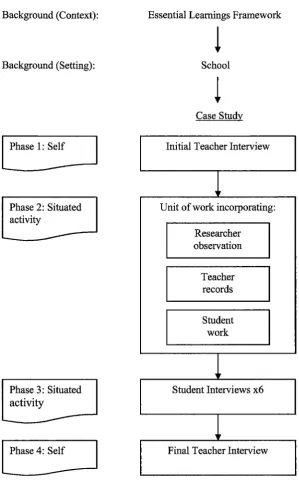
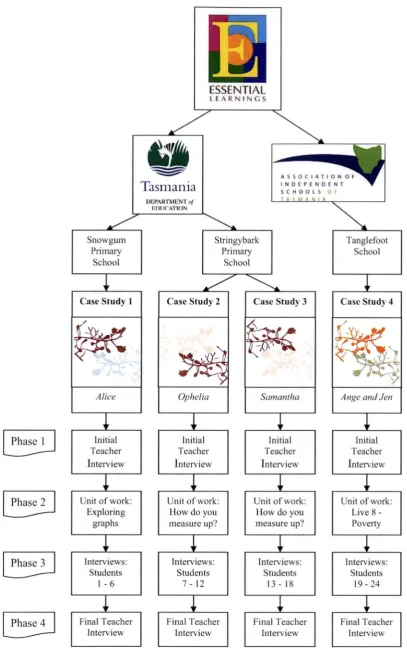
curriculum, the local curriculum framework at the time of the study. Phase 2 involved classroom observations of the units of work and incorporated researcher observations, teacher records, and student outcomes. During Phase 3, interviews were conducted with six students in each case study school. The final phase of the study was a reflective interview with each of the participant teachers. The results of the research are presented by case with data for teachers and their respective students reported together.
Table of Contents
Declaration ... i
Authority of access ... i
Acknowledgements ... ii
Abstract ... iii
Table of Contents ... v
Chapter One ... 1
Introduction ... 1
1.1 Numeracy: A golden anniversary ... 1
-1.2 Numeracy and its relationship to mathematics ... 2
1.3 The context of the study: Reform-based learning environments ... 4
1.3.1 Curriculum reform agendas ... 5
1.3.2 Mathematics education reforms ... 6
1.3.3 Middle years' reforms ... 7
1.4 Aim and objectives of the research ... 9
1.5 Thesis overview ... 11
Chapter Two ... 13
Literature Review ... 13
2.1 Introduction ... 13
2.2 Curriculum: A social construct ... 13
2.2.1 Curriculum in the classroom ... 15
2.2.2 Curriculum reform ... 17
2.2.3 Australia's curriculum landscape ... 19
2.2.4 Essential Learnings: A curriculum for Tasmania ... 22
2.3 Numeracy: An essential capability ... 24
2.3 .1 Conceptualising numeracy ... 25
2.3.2 Factors influencing numeracy learning ... 30
2.3.2.1 Curriculum influencing numeracy learning ... 30
2.3.2.2 Teaching influencing numeracy learning ... 32
2.3.2.3 Assessment influencing numeracy learning ... 34
2.3.2.4 Leaming environments influencing numeracy learning ... 36
2.3.3 Numeracy in practice: Examples ... 37
2.3.3.1 Numeracy as computation and mathematical skills ... 37
2.3.3.2 Numeracy as mathematics in context ... 39
2.3.3.3 Numeracy across the curriculum ... 40
2.4 Numeracy: Towards a synthesised view ... 43
2.5 Chapter summary and research questions ... 46
Chapter Three ... 49
Conceptual Framework ... 49
3.1 Introduction ... 49
3.2 Numeracy defined in this study ... 50
3.3 Mathematics dimension ... 57
3 .3 .1 Mathematics dimension - as it pertains to graphing and data analysis ... 57
3.3.2 Mathematics dimension - as it pertains to measurement.. ... 58
3.4 Reasoning dimension ... 61
3.5 Attitude dimension ... 63
3.6 Context dimension ... 65
3.8 Chapter summary ... 70
Chapter Four ... 73
Methodology ... 73
4.1 Introduction ... 73
4.2 Research perspective ... 73
4.2.1 Qualitative research ... 74
4.2.2 Social constructivism ... 75
4.2.3 Research-Practice link ... 76
4.3 Research framework ... 77
4.3.1 Theory building ... 77
4.3.2 Layder's conceptual map ... 78
4.4 Case study methodology ... 81
4.5 The study design ... 83
4.6 Case study participants: Sampling ... 85
4.6.1 Case selection ... 86
4.6.1.1 Selection of schools ... 86
4.6.1.2 Selection of teachers - Phases 1 to 4 ... 87
4.6.2 Selection within the case ... 90
4.6.2.1 Selection of students - Phase 2 ... 90
4.6.2.2 Selection of students - Phase 3 ... 91
4.6.3 Design summary as it applies to participants ... 91
4.7 The researcher's role ... 93
4.8 Data collection: Methods and techniques ... 95
4.8.1 Interview ... 96
4.8.1.1 Initial teacher interview - Phase 1 ... 97
4.8.1.2 Student interviews - Phase 3 ... 97
4.8.1.3 Final teacher interview - Phase 4 ... 97
4.8.2 Observation ... 98
4.8.3 Documents ... 102
4.8.4 Photographs ... 103
4.8.5 The motif ... 104
4.9 Procedures ... ;: ... 105
4.9.1 Phase 1 - Initial teacher interviews ... 106
4.9.2 Phase 2 -The unit of work ... 107
4.9.3 Phase 3 - Student interviews ... 109
4.9.4 Phase 4 - Final teacher interviews ... 109
4.10 Data Analysis and reporting ... 110
4.10.1 Data preparation ... 111
4.10.2 Teacher interviews-Phases 1 and4 ... 112
4.10.3 The unit of work-Phase 2 ... 112
4.10.4 Student interviews - Phase 3 ... 113
4.10.5 Presentation of results ... 114
4.11 Trustworthiness: Addressing adequacy and limitations of the study ... 115
4.11.1 Credibility ... 115
4.11.1.1 Triangulation ... 116
4.11.1.2 Rich, thick description ... 116
4.11.1.3 Clarifying researcher bias ... 116
4.11.1.4 Present negative information ... 116
4.11.1.5 Prolonged time in the field ... 117
4.11.1.6 Peerdebriefing ... 117
4.11.1.7 External audit ... 118
4.11.2 Dependability ... 118
4.11.3 Transferability ... 118
4.11.5 Communicability ... 119
4.12 Chapter summary ... 120
Chapter Five ... 121
Background: School Setting ... 121
5.1 Introduction ... 121
5.2 Snowgum Primary School. ... 122
5.2.1 Snowgum and curriculum ... 123
5.2.2 Numeracy at Snowgum ... 124
5.3 Stringybark Primary School ... 125
5.3.1 Stringybark and curriculum ... 126
5.3.2 Numeracy at Stringybark ... 127
5.4 Tanglefoot School ... 128
5.4.1 Tanglefoot and curriculum ... 130
5.4.2 Numeracy at Tanglefoot ... 131
5.5 Chapter summary ... 133
Chapter Six ... 135
Results: Snowgum Primary School - Alice ... 135
6.1 Introduction ... 135
6.2 Curriculum ... 136
6.2.1 Alice constructing curriculum ... 136
6.2.2 The unit of work: Exploring graphs ... 138
6.3 Numeracy ... 139
6.3 .1 Alice and her beliefs about numeracy ... 140
6.3.1.l Mathematics ... 141
6.3.1.2 Reasoning ... 142
6.3.1.3 Attitude ... 143
6.3.1.4 Context ... 143
6.3.1.5 Equity ... 144
6.3.2 Numeracy as enacted in the graphing unit of work ... 144
6.3 .2.1 Mathematics ... 145
6.3.2.2 Reasoning ... 150
6.3.2.3 Attitude ... 153
6.3.2.4 Context ... 155
6.3.2.5 Equity ... 157
6.3.3 Student learning ... 157
6.3.3.1 Mathematics ... 158
6.3.3.2 Reasoning ... 160
6.3.3.3 Attitude ... 162
6.3.3.4 Context ... 165
6.3.3.5 Equity ... 168
6.4 Chapter summary ... 170
Chapter Seven ... 173
Results: Stringy bark Primary School - Ophelia ... 173
7 .1 Introduction ... 173
7 .2 Curriculum ... 17 4 7 .2.1 Ophelia constructing curriculum ... 17 4 7.2.2 The unit of work: How do you measure up? ... 175
7.3 Numeracy ... 177
7 .3 .1 Ophelia and her beliefs about numeracy ... 177
7.3 .1.1 Mathematics ... 177
7.3.1.2 Reasoning ... 178
7.3.1.3 Attitude ... 179
7.3.1.5 Equity ... 179
7.3.2 Numeracy as enacted in the "How do you measure up?" unit ofwork.180 7.3.2.1 Mathematics ... 180
7.3.2.2 Reasoning ... 183
7.3.2.3 Attitude ... 187
7.3.2.4 Context ... 190
7.3.2.5 Equity ... 192
7.3.3 Student learning ... 193
7.3.3.1 Mathematics ... 193
7.3.3.2 Reasoning ... 196
7.3.3.3 Attitude ... 198
7 .3 .3 .4 Context ... 200
7.3.3.5 Equity ... 203
7 .4 Chapter summary ... 204
Chapter Eight ... 207
Results: Stringy bark Primary School - Samantha ... 207
8.1 Introduction ... 207
8.2 Curriculum ... 208
8.2.1 Samantha constructing curriculum ... 208
8.2.2 The unit of work: How do you measure up? ... 210
8.3 Numeracy ... 211
8.3.1 Samantha and her beliefs about numeracy ... 211
8.3.1.1 Mathematics ... : ... 212
8.3.1.2 Reasoning ... 213
8;3.1.3 Attitude ... 214
8.3.1.4 Context ... 214
8.3.1.5 Equity ... 215
8.3.2 Numeracy as enacted in the "How do you measure up?" unit of work. 215 8.3.2.1 Mathematics ... 215
8.3.2.2 Reasoning ... 220
8.3.2.3 Attitude ... 228
8.3.2.4 Context ... 232
8.3.2.5 Equity ... 237
8.3.3 Student learning ... 240
8.3.3.l Mathematics ... 240
8.3.3.2 Reasoning ... 243
8.3 .3 .3 Attitude ... 24 7 8.3.3.4 Context ... 250
8.3.3.5 Equity ... 254
8.4 Chapter summary ... 256
Chapter Nine ... 259
Results: Tanglefoot School -Ange and Jen ... 259
9.1 Introduction ... 259
9.2 Curriculum ... 260
9.2.1 Ange and Jen constructing curriculum ... 260
9.2.2 The unit of work: "Live 8" ... 262
9.3 Numeracy ... 263
9.3.1 Ange's and Jen's beliefs about numeracy ... 263
9.3.1.1 Mathematics ... 263
9 .3 .1.2 Reasoning ... 264
9.3.1.3 Attitude ... 264
9.3.1.4 Context ... 265
9.3.2 Numeracy as enacted in the "Live 8" unit of work ... 265
9.3.2.1 Mathematics ... 266
9.3.2.2 Reasoning ... 276
9.3.2.3 Attitude ... 280
9.3.2.4 Context ... 283
9.3.2.5 Equity ... 285
9.3.3 Student learning ... 288
9.3.3.1 Mathematics ... 289
9.3.3.2 Reasoning ... 291
9.3.3.3 Attitude ... 294
9.3.3.4 Context ... 297
9.3.3.5 Equity ... 299
9.4 Chapter summary ... 304
Chapter Ten ... 307
Discussion and Conclusion ... 307
10.1 Introduction ... 307
10.2 Teachers positioning numeracy ... 308
10.3 Students experiencing numeracy ... 311
10.4 Revisiting the framework ... 316
10.4.1 Mathematics ... 317
10.4.2 Reasoning ... 319
10.4.3 Attitude ... 320
10.4.4 Context ... 322
10.4.5 Equity ... 324
10.4.6 Relationships between and within the dimensions ... 326
10.4.6.1 Interconnections between the dimensions ... 327
10.4.6.2 The hierarchical nature of the five dimensions of practice ... 328
10.5 Relationship to and implications for curriculum design ... 329
10.6 Implications for professional learning ... 331
10.7 Limitations ... 333
10.8 Directions for further research ... 335
10.8.1 Numeracy at other levels of schooling and in different curricula, social, and cultural settings ... 335
10.8.2 Profiling teachers and students according to five dimensions of numeracy ... 336
10.8.3 Implications for assessment ... 338
10.9 Conclusion ... 339
References ... 343
Appendices ... 1
Appendix A-Queensland School Curriculum Council's Numeracy Framework .... 2
Appendix B - Semi-structured interview schedule: Phase 1 teacher interviews ... 3
Appendix C- Semi-structured interview schedule: Phase 3 student interviews ... 4
Appendix D - Semi-structured interview schedule: Phase 4 teacher interviews ... 8
Appendix E - Ethics approval letter from the University of Tasmania ... 11
Appendix F - Ethics approval letter from the Department a/Education, Tasmania 12 Appendix G - Data collection timeline for the research, including ethical requirements for each phase ... 13
Chap
ter One
Introduction
1.1
Numeracy: A
golden anniversary
Fifty years ago, in 1959 in the United Kingdom, The Crowther Report introduced the term numeracy as being the" ... mirror image of literacy ... [and recognised] the need in the modern world to think quantitatively" (quoted in Cockcroft, 1982, p. 11 ). Crowther's notion of numeracy was a sophisticated one, encompassing an
understanding of scientific method, thinking quantitatively, and avoiding statistical fallacies. Although the Crowther Report implied a broad concept of numeracy that incorporated higher level thinking processes, since that time numeracy has developed across the globe in many different forms, reflected by many different terms and definitions. In the United Kingdom itself, the term
numeracy moved away from the sophisticated conceptualisation of Crowther when, in a British government report on mathematics education (Cockcroft, 1982), numeracy was identified as an "at homeness" with numbers and an ability
to use mathematics in everyday life as well as an ability to understand and
interpret information presented in mathematical ways.
Australia essentially inherited the term numeracy from the United Kingdom.
Although sharing a predominantly functional view of numeracy that emphasises
the value of individuals having the mathematical skills necessary to cope with their everyday life experiences, Australia has moved away from the mostly
adopted (Doig, 2001). Numeracy, in Australia, is perhaps more aligned with the conceptions of "quantitative literacy" as proposed in the United States (e.g., Steen, 2001) and "mathematical literacy" as defined by the Organisation for Economic Co-operation and Development (OECD, 2006) in Europe. Within Australian education systems, across both public and private sectors, the most widely adopted definition is that articulated by the Australian Association of Mathematics Teachers (AAMT):
To be numerate is to use mathematics effectively to meet the general demands of life at home, in paid work, and for participation in community and civic life.
In school education, numeracy is a fundamental component of learning, discourse and critique across all areas of the curriculum. It involves the disposition to use, in context, a combination of:
• Underpinning mathematical concepts and skills from across the discipline (numerical, spatial, graphical, statistical and algebraic); • Mathematical thinking and strategies;
• General thinking skills; and
• Grounded appreciation of context. (AAMT, 1998, p. 2)
Although there are variations in how numeracy is conceptualised, it has forged an identity of its own having been previously overshadowed in education practice by literacy definitions and interventions (Luke et al., 2003). How numeracy is conceptualised affects not only the school mathematics curriculum but also the practice of teachers and ultimately the learning outcomes of students. Current conceptualisations of numeracy are considered in more depth in Chapter 2, both in relation to the context of this study and more broadly.
1.2
Numeracy and its relationship to mathematics
senior secondary school the distinctions between the two become more evident as increasingly complex and abstract mathematical content is introduced. In some cases the term numeracy is used to replace the term mathematics with the aim of inferring a more democratic and accessible mathematics curriculum available to all students. The AAMT (1997) described mathematics and numeracy as being "clearly interrelated" but not synonymous with each other.
All numeracy is underpinned by some mathematics; hence school mathematics has an important role in the development of young people's numeracy. The implemented mathematics curriculum (i.e. what happens in schools) has a responsibility for introducing and developing mathematics, which is able to underpin numeracy. However this 'underpinning of numeracy' is not all that school mathematics is about. Learning mathematics in school is also about learning in the discipline - its structure, beauty and importance in our culture. Further, while knowledge of mathematics is necessary for numeracy, having that knowledge is not in itself sufficient to ensure that learners become numerate. (p. 11-12)
However the relationship between mathematics and numeracy is viewed, there is little argument that numeracy is regarded as having the potential to provide a connection between mathematics and the real world if students are provided with opportunities to apply and use their mathematical knowledge and skills (Kemp &
Hogan, 2000; Morony & Brinkworth, 2003; Scott, 1999; Willis, 1998). In this respect, numeracy is also considered to have cross-curricular relevance in that an appropriate level of numeracy underpins learning and progress in other areas (AAMT, 1997; Steen, 2001). A cross-curricular view of numeracy has teaching implications, in that it implies that numeracy learning not only is the responsibility of the mathematics teacher but also requires a commitment and contribution by all teachers (Berlin, 2003; Frykholm, 2002; Hughes-Hallett, 2003; Price, 1997). In the primary school context, where the teacher usually has responsibility for teaching all or most subject areas, the implication is that the teacher needs to recognise opportunities to embed numeracy when appropriate across a range of areas. In secondary schooling this perspective necessarily involves teachers from discipline areas other than mathematics identifying and making explicit use of mathematics to support effective learning.
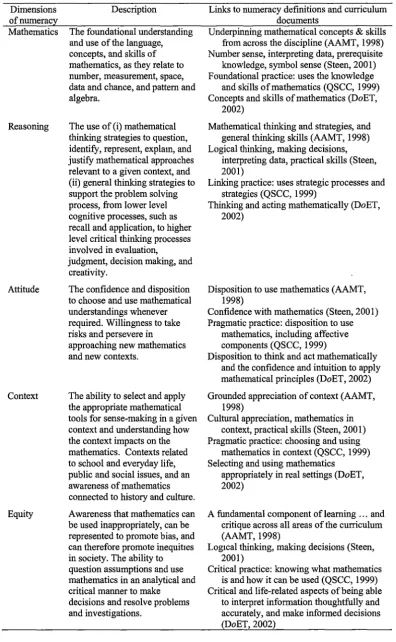
aspects, beyond mathematical skill, are necessary for the development of competent and effective numeracy practice. It also emphasises the place of numeracy across the curriculum, and aligns with the work of Steen (1997, 2001) who argued that numeracy is not the same as mathematics, but rather "an equal and supporting partner in helping students learn to cope with the quantitative demands of modem society." (Steen, 2001, p. 115). A conceptual framework for numeracy, describing five dimensions of practice, is developed in Chapter 3. The five dimensions of practice: Mathematics, Reasoning, Attitude, Context, and
Equity developed in this thesis provide the lens through which the beliefs and practices of the teachers who participated in the study are considered and the learning exhibited by individual student participants is examined.
1.3
The context of the study: Reform-based
learning environments
What competencies do citizens need in order to participate actively within democratic societies? This is a question that has driven educators to examine school curricula and address these needs with regard to the students of the 21 st
century. The Melbourne Declaration on Educational Goals for Young Australians
(Ministerial Council on Education, Employment, Training and Youth Affairs [MCEETYA], 2008a), which sets the direction for Australian schooling and followed the 1999 Adelaide Declaration (MCEETY A, 1999), places education as the driving force in equipping young people with the "knowledge, understanding, skills and values to take advantage of opportunity and to face the challenges of this era with confidence" (p. 4).
the enactment of curriculum, and more specifically the teaching and learning of numeracy, within the classroom learning environment, which is the focus of this study.
1.3.1
Curriculum reform agendas
Many Australian states have been reconceptualising curriculum in terms of a coherent set of the most important ideas and skills, sometimes referred to as "big ideas" or "key ideas," that will enable students to become productive and critical members of society. The curricula are values-based and call for the study of these "big ideas" across the traditional discipline boundaries. The development of students' capacities for thinking and building understandings is placed at the centre. Internationally, reconceptualisation of curricula is also occurring in response to changing views of knowledge and learning and consideration of the goals of education both for individual students and within the broader context of society. A curriculum of the future (Young, 1999) makes assumptions about key values and purposes held by society, about knowledge, and about learning. Curriculum, now, needs to provide "opportunities for participation in learning communities and strengthening the links between participation in school-based learning communities and in other contexts for learning... and must provide access to 'specialist knowledge communities"' (Young, 1999, p. 476).
Essential Learnings framework placed thinking skills and strategies at the centre of the curriculum and encouraged the connection of knowledge and concepts across the curriculum. It emphasised the importance of being numerate rather than purely knowing and doing mathematics. An ability to understand and apply mathematical concepts is valued alongside the development of students' abilities to problem solve, reason, communicate, and reflect upon their learning. Curriculum construction and the local reform environment are expounded in Chapter 2.
1.3.2
Mathematics education reforms
Over the past 20 years, reforms have also been occurring within mathematics curricula (National Council of Teachers of Mathematics [NCTM], 2000). These reforms have come about with a change in focus from mathematics content to how students can best learn mathematics (Van de Walle, 2004). They place importance on the connections among, and applications of, the domains within mathematics. Advocates of reform urged a move away from traditional teaching approaches that emphasise telling and practice of procedures (Olson & Barrett, 2004 ), to approaches that support a constructivist view of learning (Van de Walle, 2004), in helping students construct personally meaningful conceptions of mathematical topics (Fraivillig, Murphy, & Fuson, 1999). The United States NCTM Standards document (1989) that encapsulated much of the reform ideas, advocated that students should value mathematics, be confident in their ability to do mathematics, become mathematical problem solvers, learn to communicate mathematically, and learn to reason mathematically.
and resources that focus on conceptual understanding. Conceptual understanding refers to the development and deepening of connections among mathematical facts, procedures, and ideas (Hiebert & Carpenter, 1992).
The mathematics education reforms reported in the United States have largely been mirrored within the Australian context. A problem solving approach was launched in the 1980s and around the same time the AAMT focused its activities on developing communication and collaboration between mathematics teachers and educators from across the country (Ellerton & Clements, 2007). This resulted in the development of resources for teachers such as The Mathematics Curriculum and Teaching Program (MCTP) (Lovitt & Clarke, 1988; 1989). This national professional development program saw a focus on the reform goals of mathematical thinking, group work, problem solving, and context in order to support conceptual understanding. The program culminated in 114 lessons or investigations (Lovitt & Clarke, 1992) to encourage teachers to adopt student-centred approaches to teaching and learning. The program was a pre-cursor to the kinds of issues that teachers and researchers in Australia have been grappling with, in relation to numeracy, over the past ten years and these are discussed in the Literature Review (Chapter 2).
1.3.3
Middle years' reforms
Within the context of curriculum reform in Tasmania this study situates the investigation of the phenomenon of numeracy positioning within the middle years of schooling. The middle years is a time for fostering curiosity, problem solving, and critical thinking among adolescents; and for developing skills and habits of mind, in addition to knowledge, that is relevant to their concerns (Jackson &
Some school sites cater for all compulsory years of schooling including primary and secondary. Other schools offer a primary or secondary education only.
Educators are interested in this particular stage of schooling because of the "unique developmental and educational needs of young adolescent learners" (Barber, 1999). Reform agendas have been driven by those who believe students in these years require a stronger association between the particular developmental traits of adolescent learners and the way schooling is structured to meet these traits. Such reforms have led to the development of specific middle years' programs and in some cases dedicated middle school environments (Beane &
Brodhagen, 2001). In the report Beyond the Middle, Luke et, al. (2003) write, "middle years education has become a clear motivating force for reform and for the framing and focusing of teachers' and students' work in schools and classrooms" (p. 12).
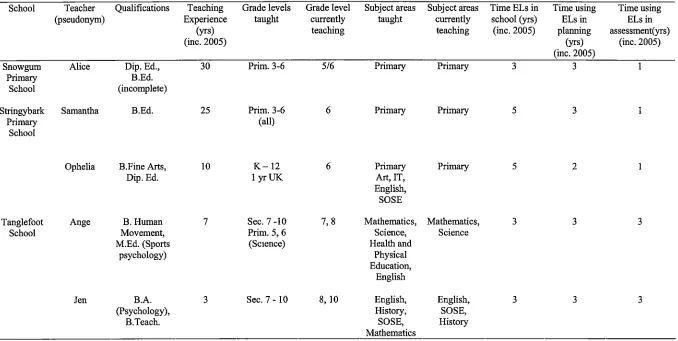
In this study, two of the schools were primary schools teaching grades from Kindergarten to Grade 6. These two schools did not incorporate specific middle years' programs, but did include young adolescent learners aged 10 - 12 years. The other school in this study catered for all the school grades from Kindergarten to Grade 12 and had a dedicated middle school for Grades 7 and 8, with a program specifically designed for these students based on the perceived needs of those learners.
J.4
Aim and objectives of the research
Innovative and reform curricula are filtered through teachers' beliefs and practices (Wilson & Lloyd, 2000). Although researchers are aware of the broader contexts and policy-driven environments that influence curriculum construction, it is the curriculum that is enacted in the classroom that is of interest in this study. Teachers add a pedagogical dimension to curriculum to create daily learning experiences for their students. It is that knowledge that equips teachers to "lift the curriculum away from texts and materials to give it an independent existence" (Doyle, 1992, p. 499). The role of the student in curriculum is also acknowledged. Students determine their own levels of engagement and interest in classroom activity and therefore exert some control over their learning and knowledge construction. Snyder, Acker-Hocevar, and Snyder (1994) suggest that "curriculum enactment" appropriately describes the process of implementation and educational experience that teachers and students jointly undertake as they negotiate and determine what the curriculum will be like in each classroom. With respect to the teaching of mathematics, teachers' knowledge, beliefs, and practices play a significant role in the learning of their students (Hill, Rowan, & Ball, 2005).
The aim of the study is to uncover the dynamics of numeracy positioning in the context of schools undergoing curriculum reform. It is a study investigating how classroom teachers are positioning numeracy in an emerging values-based curriculum setting and how their numeracy pedagogies affect students' experiences of numeracy in the classroom. The study is designed to investigate this central phenomenon where it is actually occurring and to understand what this reform means to those participating in it. Two objectives underpin the research:
• Second, a practical objective, to contribute to an understanding of the complex nature of the teaching and learning of numeracy. The study is concerned with the enactment of curriculum in the classroom, in which the roles and experiences of teachers and students are equally important.
The following research questions are posed:
1. How are teachers positioning numeracy in reform-based learning environments according to five dimensions of practice?
2. How are students experiencing numeracy in these reform-based learning environments according to five dimensions of practice?
3. How does a five-dimensional framework for numeracy, developed to align with a transdisciplinary curriculum context, contribute to an understanding of numeracy teaching and learning?
Research questions 1 and 2 are generated from a review of the literature (Chapter 2) and refined based upon the conceptual framework developed for the study (Chapter 3). An additional question (question 3) results from the development of the conceptual framework.
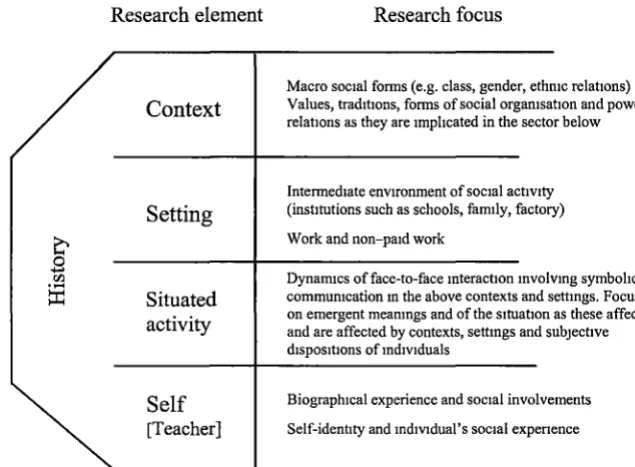
Figure 1.1. The motif.
1.5
Thesis overview
This chapter has provided an introduction to the major components of the thesis, numeracy and the reform agendas that form the context of the study. The principle aim and objectives of the research have also been described. Chapter 2 contains a review of the literature in the fields of curriculum and numeracy, drawing on the work ofrelated fields to support the aim and objectives of the research.
Chapter 3 expands upon the review of the literature by explaining the comprehensive view of numeracy adopted in the study and by presenting the development of a conceptual framework for numeracy, incorporating five dimensions of practice. The framework, developed by the author, is derived from a thorough review of the literature. It not only articulates clearly the conceptualisation of numeracy for the thesis and guides the data analysis of all phases of the study, but also provides a means with which to interpret numeracy in reform-based learning environments in a way that has not been previously considered.
[image:22.565.198.365.78.266.2]employed, role of the researcher and the participants, ethical considerations, data analysis procedures, and an evaluation of the study and its trustworthiness.
Chapter 5 presents the background to the results by discussing the distinctive characteristics of each of the schools that provided the setting for the case study research. The results of the study are then presented over four chapters, Chapters 6 to 9. The presentation of the results brings together the teachers and the students in each of the four case studies.
Chapter Two
Literature Review
2.1
Introduction
This chapter considers numeracy, the central phenomenon being studied, within the broader context of curriculum reform. The review of the literature spans three main areas. A discussion of curriculum begins the review by considering its role as a social construct and consequent influence on classroom teaching and learning. The reshaping of Australia's curricula and the motivation for the recent reforms is considered and the specific curriculum context of this study,
Tasmania's Essential Learnings, is described. The second section of the review examines how numeracy has been defined and conceptualised both nationally and internationally. Some of the key factors influencing student learning of numeracy are considered and ways that numeracy is interpreted in practice are also discussed. Finally, a synthesised view of numeracy is proposed that aligns with a cross-curricular view of numeracy and also its place within the local curriculum context, a values-focused transdisciplinary curriculum. The literature review closes with the aim of the current study and the objectives and research questions proposed for the study.
2.2
Curriculum:
A social
construct
recently as an outcome (Wiles, 2005). Schwab (1969) described four "commonplaces" of schooling the teacher, students, subject matter, and milieu -and definitions of curriculum tend to place more or less importance on one or more of Schwab's four aspects. How ever the curriculum is defined, be it what curriculum writers describe, what the teacher teaches, or what the student learns, it takes place in a broader context of the social, political, and economic structures of society. "The curriculum does not stand apart from society- it is firmly embedded in it" (Brady & Kennedy, 2003, p. 3).
Construction of curriculum is being increasingly influenced by those beyond the education community. Stakeholders, including government, business, parents, community groups, and students, all declare views about the purposes and outcomes of curriculum. Governments themselves view the school curriculum as an instrument of social and economic development (Lee, 2001). In Australia, this is evidenced in the Adelaide Declaration on National Goals for Schooling in the Twenty First Century:
Australia's future depends upon each citizen having the necessary knowledge, understanding, skills and values for a productive and rewarding life in an educated, just and open society. High quality schooling is essential to achieving this vision. This statement on the national goals for schooling provides broad directions to guide schools and education authorities in securing these outcomes for students.
(MCEETYA, 1999, para. 1)
This thesis acknowledges the highly complex and variable nature of curriculum in its role as a social construct, changing in response to and often as a reaction to societal changes, and representing each generation's view of what is deemed as worth knowing. A curriculum of the future (Young, 1999) makes assumptions about key values and purposes held by society, about knowledge, and about learning. The increased level of curriculum change in the later half of the twentieth century has mirrored an- acceleration of societal change. Grundy (2005) describes the many facets of these contextual factors in relation to the notion of position and opposition. The curriculum is positioned within a local context and a series of broader contexts including the global world in which Australia participates. Curriculum is enacted at the classroom level to support the local school and community context, at the same time as negotiating the broader social contexts of stakeholder interests and aiming to serve the needs of students living in an increasingly complex and global world environment. Where "globalisation appears to be breaking down national barriers related to cultures, social values and economies ... school curriculums remain firmly attached to the needs of individual nation states" (Kennedy, 2005, p. 1).
2.2.1
Curriculum in the classroom
Curriculum [is] a particular form of specification about the practices of teaching and not ... a package of materials of a syllabus or ground to be covered ... curriculum is a means of studying the problems and effects of implementing any defined line of teaching ... Curriculum research and development is based on the study of classrooms. It thus rests on the work ofteachers. (Stenhouse, 1975,p. 142)
Although being aware of the broader contexts and policy-driven environments that influence curriculum construction, it is the curriculum that is enacted in the classroom that is of interest in this research. Teachers are often at the end of a chain of curriculum development where they have had minimal input, making daily decisions regarding the implementation of system-approved frameworks. It
Teachers add a pedagogical dimension to curriculum to create daily learning experiences for their students (Doyle, 1992). Shulman (1987) describes such knowledge as "pedagogical content knowledge" and situates it within a broader model of teacher education with seven categories of important teacher knowledge: content knowledge; general pedagogical knowledge; curriculum knowledge; pedagogical content knowledge; knowledge of learners and their characteristics; knowledge of educational contexts; and knowledge of educational ends, purposes, and values. Shulman's model embeds curriculum as an important aspect of teaching and this thesis maintains the connectedness between the two, thus grounding the research in the classroom. Ben-Peretz (1990) encouraged teachers to see themselves as "informed and creative interpreters" of curriculum being able to reflect upon and reconstruct the curriculum to meet their learning objectives (p. xv).
2.2.2
Curriculum reform
Change is an inherent part of society and therefore of the construction of schooling and curriculum. Particularly in the last five decades change has been frequent and significant with respect to the aims and objectives of schooling, its content, assessment processes, teaching strategies, funding, and provisions (Marsh, 2004). Planned change is described by Fullan (1991) as being multi-dimensional - related to changes in goals, skills, beliefs, and behaviour - and ultimately concerned with change in practice. It may be focused on classroom or school level initiatives or on broader reforms and reconstructions of part or whole educational systems (Poppleton, 2000). This study is situated within the systemic reform of a state education system, with particular philosophical and pedagogical underpinnings. It is concerned with the impact of the reform at the classroom level with respect to the goals of the research: the positioning of numeracy within the reform-based environment. Reforms are usually directed at teachers and students in classrooms (Glatthorn & Jailall, 2000).
The central role that teachers play in the reform process is well recognised, not only in their roles as individuals but also as members of a team working collegially to introduce reform into the classroom (Fullan & Miles, 1992; Hargreaves, 1994; Little, 1999). In this sense it is collaboration that promotes professional growth and acknowledges individual capacity, organisational capacity, and the relationships between them (Knapp, 1997). Borko, Wolf, Simone, and Uchiyama (2003) advanced the work of Newmann, King, and Youngs (2000) and highlighted the complex nature of curriculum reform and the requirement for the coordination of all parts of the educational system to enable any likelihood of improved student learning. They identified six dimensions of school capacity: principal leadership; professional community; program coherence; technical resources; knowledge, skills, and dispositions of individual teachers; and learning opportunities for teachers (Borko et al., 2003).
embedded nature of curriculum reform within societal changes when considering the transition to a postmodern, post-industrial society in the late 1900s and into the twenty-first century: "at the heart of the transition is the globalisation of economic activity, political relations, information, communications and technology" (p. 47). The reform agendas in advanced industrialist societies have been driven by the increased economic competitiveness brought about by globalisation. The focus then for schooling has become the development of the skills and knowledge that can add value to the economy. This is predominantly discussed in terms of innovation, creativity, and entrepreneurship. Porter (1999) argued that these economic purposes are now dominating the political agenda to such an extent that other important functions of education, such as the social and the cultural, are being diminished. In this context, curriculum reform has risen to prominence in many countries. In the United States of America, and in the West in general, reforms are concerned with an interest in national standards and a core set of knowledge and skills for all students. In the United Kingdom, a National Curriculum was introduced in 1988, but more recent agendas focus on literacy and numeracy standards. In the non-industrialised regions of the Asia Pacific a very different set of issues is driving reform agendas. Access to schooling, health education, and vocational education are highly important in these contexts (Kennedy, 2003).
2.2.3
Australia's curriculum landscape
In Australia, the curriculum landscape in many ways mirrors changes occurring internationally with respect to the goals of a democratic nation positioning itself within a global marketplace. As in other industrialised countries, the over-riding goal is to equip students with the competencies that will enable them to live successfully as adults in this century, to contribute to the social needs of democratic society, and to gain the necessary attributes and skills to make a positive contribution to the nation's role in a global economy.
Wilson (2004) describes the dichotomy that represents Australia's curriculum development as involving two contrasting views of knowledge: "cultural transmission" and "higher-order capacities." "Cultural transmission" places value on specified areas of knowledge and skills that are clearly defined whereas "higher-order capacities" prioritises the development of higher-order thinking and generic skills such as communication, problem-solving, and decision-making over particular knowledge. Many Australian states have been re-conceptualising curricula in terms of the second view. They are focusing on a coherent set of the most important ideas and skills, sometimes referred to as "big ideas" or "key ideas," which will enable students to become productive and critical members of society. The curricula are values-based and call for the study of these "big ideas" across the traditional discipline boundaries. The development of students' capacities for thinking and building understandings is placed at the centre.
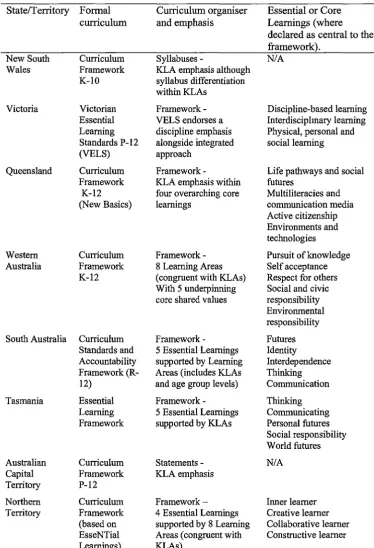
Table 2.1
Australian curriculum organisation (excerpts taken from Harris, 2005, p. 55 and www.curriculum.edu.au)
State/Territory Formal Curriculum organiser Essential or Core curriculum and emphasis Learnings (where
declared as central to the framework).
New South Curriculum Syllabuses - NIA
Wales Framework KLA emphasis although K-10 syllabus differentiation
withinKLAs
Victoria Victorian Framework- Discipline-based learning Essential VELS endorses a Interdisciplmary learning Learning discipline emphasis Physical, personal and Standards P-12 alongside integrated social learning (VELS) approach
Queensland Curriculum Framework- Life pathways and social Framework KLA emphasis within futures
K-12 four overarching core Multiliteracies and (New Basics) learnings communication media
Active citizenship Environments and technologies
Western Curriculum Framework- Pursuit of knowledge Australia Framework 8 Learning Areas Self acceptance
K-12 (congruent with KLAs) Respect for others With 5 underpinning Social and civic core shared values responsibility
Environmental responsibility
South Australia Curriculum Framework- Futures Standards and 5 Essential Learnings Identity Accountability supported by Learning Interdependence Framework (R- Areas (includes KLAs Thinking 12) and age group levels) Communication
Tasmania Essential Framework- Thinking
Learning 5 Essential Learnings Communicating Framework supported by KLAs Personal futures
Social responsibility World futures
Australian Curriculum Statements - NIA
Capital Framework KLA emphasis Territory P-12
Northern Curriculum Framework- Inner learner
[image:32.561.89.463.132.680.2]Juxtaposed with this curriculum reform at the state or territory level is concern at the Commonwealth level for high level quantitative, scientific, and technological literacy and for productive innovation to occur if Australia is to continue to grow as a knowledge-based economy and society.
Special emphasis is needed now on improving scientific and mathematical education and technological capability. (Committee for the Review of Teaching and Teacher Education [CRTTE], 2003b)
A fundamental question being asked as part of this process is how schools can best develop, in all students, a capacity to innovate, to be creative and to take great control of their lives ... (CRTTE, 2003a)
There is much debate amongst educators about the place of the disciplines in these new curricular frameworks. A values-focused curriculum is aimed at enabling legitimate connections between disciplines as well as engendering understanding through engagement. Likewise, people with singularly well-developed expertise are necessary to push the boundaries of innovation in Australian society. Are these two goals at odds? The needs for both numerate citizens and innovative and
creative scientists, mathematicians, and technologists, should not be mutually exclusive (Skalicky, 2006; Watson, Beswick, Brown, & Callingham, 2007). Curriculum, now, needs to provide "opportunities for participation in learning communities and strengthening the links between participation in school-based learning communities and in other contexts for learning... and must provide access to 'specialist knowledge communities"' (Young, 1999, p. 476). Hanlon (2004), Executive Director Curriculum Standards and Support, DoET, at the time of the study, acknowledged that there is a place for the disciplines within the broader goals of thinking and understanding that the Tasmanian curriculum reform was seeking to engender.
2.2.4
From a strong base of values and purpose determined through broad community consultation we are focusing on higher order thinking and understanding, and building a conceptual framework for curriculum that respects and encompasses discipline/subject knowledge and the forms of inquiry at the heart of the disciplines. (Hanlon, 2004, p. 55)
Essential Learnings: A curriculum for Tasmania
[SACSA], 2001). The setting for this study is the reform-based curriculum in Tasmania. The reform was initiated in 2000 in response to the DoET's Learning Together initiative (DoET, 2000). This initiative was established to complement a broader political initiative, Tasmania Together, a strategy of community consultation intended to help Tasmanians create a shared environmental, social, and economic vision for the next 20 years. Learning Together recognised the need for a curriculum that addresses the knowledge, skills, and confidence required of students in the context of the twenty-first century. It presented a plan for systemic reform of Tasmania's education system. A values and purposes statement was released and formed the basis of the development of Tasmania's Essential Learnings curriculum formally released with Essential Learnings Framework 1
(DoET, 2002).
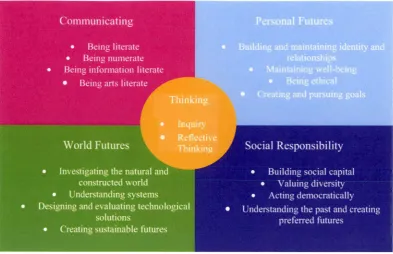
Figure 2.1. The Essential Learnings Framework.
(DoET, 2002, p. 7)
It is within the Tasmanian Essential Learnings reform curriculum setting that the major focus of this thesis, numeracy, is explored. How are teachers positioning numeracy in a values-focused curriculum and how do students experience numeracy m these classrooms? As Australia grapples with the
re-conceptualisation of curriculum, it is crucial that the place of numeracy is considered. "Critical and active engagement with democracy in the curriculum and wider society is the key" to preparing students for participation in a global world (Vidovich, 2005, p. 113). This thesis argues that numeracy has an important
part to play in supporting this critical engagement with democracy.
2.3
Numeracy: An essential capability
analyse information critically is required to make informed judgments. Politicians, media, and industry are talking regularly about many issues that impact on people's lives, such as interest rates, environmental issues, health policy, and national security. At an individual level people are dealing daily with work-related challenges and issues such as personal finance, health, shopping choices, and time management.
2.3.1
Conceptualising numeracy
The concepts and skills required to meet the numeracy demands of everyday life are defined and examined under various names, including "quantitative literacy" (Steen, 2001), "mathematical literacy" (OECD, 2003), "statistical literacy" (Watson, 2006), "critical numeracy" (Gal, 2002; Johnston, 1994; Lake, 2002), "critical mathematical literacy" (Frankenstein, 1998), "mathemacy" (Skovsmose, 2004), and "numeracy" (AAMT, 1997). Discussion amongst academics, mathematicians, and industry leaders, concerning numeracy, revolves around its increasing relevance for today's citizens. This conversation has extended to those involved in education at the school level and explores how to bring about learning that acknowledges the quantitative challenges of life in the twenty-first century. "In the twenty-first century, literacy and numeracy will become inseparable qualities of an educated person" (Steen, 2001, p. 9).
Although recognition of the importance of context is a feature of most definitions of numeracy, Doig (2001) notes that in the United Kingdom numeracy is a concept very much aligned with number. This sense that numeracy requires a lower level of mathematics than that implied by Crowther appeared in a British government report on mathematics education (Cockcroft, 1982). The Cockcroft Report identified two aspects of numeracy: an "at homeness" or being comfortable with numbers, and an ability to understand and interpret information presented in mathematical ways. Recent reforms in the United Kingdom have been initiated by a national literacy and numeracy strategy; however, the emphasis on number remains a focus for numeracy reforms with the other strands of mathematics, higher order thinking, and understanding of mathematical concepts all neglected (Fullan & Earl, 2002).
In Australia, the term "numeracy" is used to describe the quantitative capabilities of both students and adults. A view of numeracy has developed that more closely matches the term "mathematical literacy" used in Europe, and the term "quantitative literacy" as used in the United States of America. A view, beyond the ability to handle number concepts in context, is reflected by the AAMT definition:
To be numerate is to use mathematics effectively to meet the general demands of life at home, in paid work, and for participation in community and civic life.
In school education, numeracy is a fundamental component of learning, discourse and critique across all areas of the curriculum. It involves the disposition to use, in context, a combination of:
• Underpinning mathematical concepts and skills from across the discipline (numerical, spatial, graphical, statistical and algebraic); • Mathematical thinking and strategies;
• General thinking skills; and
• Grounded appreciation of context. (AAMT, 1998, p. 2)
The OECD Programme for International Student Assessment (PISA), a three-yearly survey of the knowledge and skills of 15-year-olds in the principal industrialised countries, defines "mathematical literacy" as:
individual's life as a constructive, concerned and reflective citizen. (OECD, 2006, p. 72)
The term "quantitative literacy" was used as early as 1974 when Professor Jerrold Zacharias of Massachusetts Institute of Technology identified "the varieties of competence that a citizen must possess in order to handle the matters and arguments that affect him and his country and his world" (p. 9). Public discourse surrounding quantitative literacy has grown significantly since that time, principally as a result of the writings and edited works of Lynn Arthur Steen, professor of mathematics at St. Olaf College in Minnesota, as documented in the publications, Why Numbers Count (Steen, 1997), Mathematics and Democracy
(Steen, 2001), and Quantitative Literacy: Why Numeracy Matters for Schools and Colleges (Madison & Steen, 2003). A comprehensive definition of "quantitative literacy" is detailed in Steen's case statement (2001), in which he describes ten elements of quantitative literacy.
Confidence with Mathematics. Being comfortable with quantitative ideas and at ease in applying quantitative methods. Individuals who are quantitatively confident routinely use mental estimates to quantify, interpret, and check other information. Confidence is the opposite of "math anxiety"; it makes numeracy as natural as ordinary language.
Cultural Appreciation. Understanding the nature and history of mathematics, its role in scientific inquiry and technological progress, and its importance for comprehending issues in the public realm.
Interpreting Data. Reasoning with data, reading graphs, drawing inferences, and recognizing sources of error. This perspective differs from traditional mathematics in that data (rather than formulas or relationships) are at the center.
Logical Thinking. Analyzing evidence, reasoning carefully, understanding arguments, questioning assumptions, detecting fallacies, and evaluating risks. Individuals with such habits of inquiry accept little at face value; they constantly look beneath the surface, demanding appropriate information to get at the essence of issues.
Making Decisions. Using mathematics to make decisions and solve problems in everyday life. For individuals who have acquired this habit, mathematics is not something done only in mathematics class but a powerful tool for living, as useful and ingrained as reading and speaking.
Mathematics in Context. Using mathematical tools in specific settings where the context provides meaning. Notation, problem-solving strategies, and performance standards all depend on the specific context.
Number Sense. Having accurate intuition about the meaning of numbers, confidence in estimation, and common sense in employing numbers as a measure of things.
skills are adept at using elementary mathematics in a wide variety of common situations.
Prerequisite Knowledge. Having the ability to use a wide range of
algebraic, geometric, and statistical tools that are required in many fields of postsecondary education.
Symbol Sense. Being comfortable using algebraic symbols and at ease in
reading and interpreting them, and exhibiting good sense about the syntax and grammar of mathematical symbols. (p. 8)
Such a broad view serves to move quantitative literacy away from being positioned as a subset of literacy, as reflected in the International Adult Literacy Survey (IALS) (OECD, 2000), where it was only concerned with the understanding and ability to manipulate numbers within text. This broader view is also evident in the redesigned 2003 International Adult Literacy and Lifeskills Survey in which numeracy "applies to the knowledge and skills required to manage mathematical demands of diverse situations" (National Center for Education Statistics, 2005, p. 1). It is seen as an important link between mathematics and the real world, and is concerned, not only with quantity and number, but also with other strands of mathematics: shape, patterns and relationships, chance and data, and change.
More specifically, the field of adult numeracy has contributed to the concept of critical numeracy when considering the relationship between mathematics and numeracy. Johnston (1994) argues:
Numeracy is a critical awareness which builds bridges between mathematics and the real world, with all its diversity .... In this sense ... there is no particular 'level' of mathematics associated with [numeracy]: it is as important for an engineer to be numerate as it is for a primary school child, a parent, a car driver or a gardener. The different contexts will require different mathematics to be activated and engaged in (p. 34).
Such a stance, acknowledging the social and cultural aspects brought to bear on the use of mathematics in context, is important when considering numeracy, not only for adults but also for students who need to develop these numeracy capabilities.
as Foucault (1989) and Freire (1970). Such approaches move beyond the recognition of social and cultural contexts to an awareness of the role of politics and power within those contexts, and the ability of critical numeracy capabilities to transform. Mathematics is seen as a tool to interpret and challenge inequities in society. Frankenstein (1990) argues that critical mathematical literacy involves "the ability to ask basic statistical questions in order to deepen one's appreciation of political issues . . . critical understanding of numerical data thus prompts individuals to question taken for granted assumptions" (p. 336).
Although closely related, the use of the term "critical" here is distinguished from higher order or metacognitive thinking capacities, included in many conceptions of numeracy as "critical thinking." Although critical thinking may at times include thoughtful consideration of political and social inequities presented in mathematical "texts," it is about the cognitive processes brought to bear on problems or investigations. Processes such as analysing, evaluating, and creating, as described by Anderson and Krathowl (2001), exemplify those that are used in critical thinking. Critical mathematical literacy, or critical literacy, however, refers more specifically to the attitude with which such knowledge or situations are approached. It is about looking for underlying explanations and questioning whose interests are being served. It is argued that a person can exhibit a high level of quantitative or mathematical literacy without necessarily acting for social justice (Gutstein, 2005). Critical thinking is a necessary component of critical
numeracy, whereas critical numeracy is not a prerequisite for critical thinking.
Media messages are presented from a diverse range of sources, such as journalists, political commentators, and advertisers, all of whom represent particular points of view and potential bias. The need for critical evaluation of quantitative messages is an important element of both literacy and numeracy. It is expressed in Steen's (2001) work within the element Logical Thinking.
important element of descriptions of numeracy and quantitative literacy (Gal, 1995; Steen, 2001). Watson and Callingham (2003) describe a six-level developmental model of statistical literacy requiring mathematical understanding, appreciation of context, and critical thinking capabilities. At the highest level students demonstrate quantitative reasoning capabilities that enable them to synthesise complex mathematical skills, such as proportional thinking and inference, together with "appreciation of subtleties of language and context" (Watson, 2006, p. 267) in considering and responding to tasks.
2.3.2
Factors influencing numeracy learning
Just as changing views of knowledge, learning, and broader goals of education impact upon re-conceptualisation of curricula and the conceptualisation of numeracy, so also do they impact upon the daily learning experiences and outcomes of students. As argued in Section 2.2.1 it is the enactment of curriculum within the classroom learning environment that is of interest in this study and more particularly the enactment of the teaching and learning of numeracy within the context of curriculum reform. In this section, some key factors that pose particular pedagogical challenges for teachers and influence students' numeracy learning are considered. In acknowledging the large research area that this entails, four areas are briefly discussed. They are those that have featured within mathematics education research in the past fifteen years and that intersect broadly with the aims and objectives of the study - curriculum, teaching, assessment, and learning environments. It is acknowledged that these are not discrete areas and overlap considerably, but they are addressed separately in order to emphasise key points of interest.
2.3.2.1 Curriculum influencing numeracy learning
In the field of mathematics education, there has been an explosion of curriculum materials in the last fifteen years influenced by the momentum of the mathematics education reforms of the 1980s (Van de Walle, 2004). These reforms had their beginnings in the 1960s when, in response to space exploration, countries across the world, including the United Kingdom, the United States, the Netherlands, and Australia, independently began reviewing what should be taught in school mathematics curricula (e.g. Blane, Maurer, & Stephens, 1984; Cockroft, 1982; De Corte & Verschaffel, 1986). These reforms saw a change of focus from mathematics content to how students can best learn mathematics. The NCTM Standards document in the United States (1989) encapsulated much of the reform ideas, urging for a move away from an emphasis on the practice of procedures (Olson & Barrett, 2004), to approaches that support a constructivist view of learning (Van de Walle, 2004). Some reform advocates also saw new curricula as having the potential to influence teachers and their instruction to move from a focus on basic skills to more conceptually-based problems that required reasoning, problem solving, and communicating (Senk & Thompson, 2003).
Studies have argued that students taught using standards-based curricula, as compared with students taught using conventional mathematics curricula, generally evidence greater conceptual understanding and higher levels of problem-solving (Briars, 1999; Thompson & Senk, 2001). Furthermore, students have also been found to perform equally well on traditional mathematical tests that assess predominantly skills and procedures (e.g., Thompson & Senk, 2001).
Future research needs to focus on creating measures that more precisely capture the essence of each component of quantitative literacy... In
addition, the effects of different curricula and instructional methods on the development of quantitative literacy should be examined. (Wilkins, 2000, p. 416)
As argued earlier in this chapter, the influence of curriculum on student learning cannot be understood without considering its interpretation by teachers and enactment within the classroom learning environment.
2.3.2.2 Teaching influencing numeracy learning
In keeping with the view of curriculum argued in Section 2.2, teaching in this thesis is about the interactions that occur between teachers and students with the aim of facilitating student understanding of planned for learning goals. This view aligns with that of Cohen, Raudenbush, and Ball (2003) who argue that "instruction consists of interactions among teachers and students around content" (p. 122) and also with Lampert (2001) who described the practice of teaching as involving "a teacher doing something with students around something to be learned" (p. 1 ).
Teaching is not deemed to be synonymous with teachers themselves, as there are broader factors beyond teachers' backgrounds, knowledge, beliefs, skills, and dispositions that can impact upon the learning interactions that occur within the classroom. Some of these factors might include the curriculum itself, professional learning and collaborative opportunities provided, and available resources. These factors are not dissimilar to those identified by Borko et al. (2003) as being dimensions that impact on school's capacities to implement reform agendas, and listed earlier in Section 2.2.2.