A Unified Exact BER Performance Analysis of Asynchronous
DS-CDMA Systems Using BPSK Modulation over Fading Channels
Xiang Liu and Lajos Hanzo
Abstract— An asynchronous binary DS-CDMA system using random spreading sequences is considered when communicating over various fading channels. New closed-form expressions are derived for the conditional Characteristic Function (CF) of the multiple access interference. A unified analysis is provided for calculating the exact average Bit Error Rate (BER) expressed in the form of a single numerical integration based on the CF approach. The numerical results obtained from our exact BER analysis are verified by our simulation results and are also compared to those obtained by the Standard Gaussian Approximation (SGA), confirming the accuracy of the SGA for most practical conditions, except for high Signal-to-Noise Ratios (SNR) and for a low number of interferers.
Index Terms— BER analysis, CDMA, fading, Rayleigh, Ricean, Hoyt, Nakagami-m, random spreading sequence.
I. INTRODUCTION
C
ODE Division Multiple Access (CDMA) has been one of the most successful radio access techniques since the 1990s and Direct Sequence (DS) CDMA has been integrated into the third generation mobile systems. The Bit Error Rate (BER) is one of the most important performance metrics in communication systems and hence it has been extensively studied in various DS-CDMA systems.For the sake of computational simplicity, the most widely used approach invoked for calculating the average BER of DS-CDMA systems is that of assuming that the Multiple Access Interference (MAI) is Gaussian distributed or condi-tional Gaussian distributed based on the Central Limit Theo-rem (CLT). Various Gaussian approximation techniques have been proposed, such as the Standard Gaussian Approxima-tion (SGA) [1]–[7], the Improved Gaussian ApproximaApproxima-tion (IGA) [3]–[5], [7], the Simplified IGA (SIGA) [4], [7], as well as the Improved Holtzman Gaussian Approximation (IHGA) [8]. However, Gaussian approximation techniques tend to become less accurate, when a low number of users is supported or when there is a dominant interferer [5].
Therefore the exact BER analysis dispensing with the previ-ous assumptions on the MAI distribution is desirable. Several exact BER evaluation techniques have been developed without assuming a Gaussian MAI distribution, such as the series expansion of [5], [9], or the employment of Moment Gen-erating Functions (MGF) [10] and Characteristic Functions (CF) [6], [7], [9]. These techniques typically achieve more Manuscript received February 20, 2006; revised May 24, 2006 and August 16, 2006; accepted August 17, 2006. The associate editor coordinating the review of this paper and approving it for publication was S. Kishore. The financial support of the EPSRC, UK and the EU in the framework of the NEWCOM, NEXWAY and PHOENIX projects is gratefully acknowledged.
The authors are with the School of Electronics and Computer Science, University of Southampton, UK (email: [email protected]).
Digital Object Identifier 10.1109/TWC.2007.060017.
accurate BER evaluation at the cost of a high computational complexity.
In the existing literature, most results are reported for the BERs of DS-CDMA systems communicating over Additive White Gaussian Noise (AWGN) channels [1]–[5], [9], and a few studies also considered both Rayleigh channels [5], [7] as well as Nakagami-m channels [6], [10]. Cheng and Beaulieu extended the CF based AWGN results of [9] to both Rayleigh [7] and Nakagami-m [6] channels. However, the results of [6] only apply to Nakagami-m fading associated with an integer fading parameterm.
The novel contribution of this paper is that we provide a unified exact BER performance analysis of asynchronous DS-CDMA systems using BPSK modulation for transmissions over Rayleigh, Ricean, Hoyt and Nakagami-m fading channels. This paper is organized as follows. In Section II the features of Rayleigh, Ricean, Hoyt and Nakagami-mfading channels are summarized. In Section III a general asynchronous DS-CDMA system using BPSK modulation and communicating over fading channels is presented. Then, in Section IV its exact BER performance using random spreading sequences is investigated based on the CF approach. Our numerical results are presented in Section V and finally our conclusions are provided in Section VI.
II. FADINGCHANNELS
We consider a range of different fading channels in our analysis, namely the Rayleigh, Ricean, Hoyt and Nakagami-m
channels. Note that a table of the corresponding fading PDFs and CFs has been given in [11]. We provide two new closed-form expressions in Table I for the CFs of the Ricean and Hoyt fading, respectively, rather than in the form of the sum of infinite series, as given by Table II of [11]. In Table I,Γ(x)
is the Gamma function [12],I0(x)is the zero-order modified Bessel function of the first kind [12], 1F1(α;β;x) is the confluent hypergeometric function [12],Ψ2(α;γ, γ;x, y)and
H7(α, γ, δ, x, y) are two of Horn’s confluent hypergeometric
functions of two variables [13], [14].
The fading is characterized by the complex-valued random variableh=hejϕ =h
r+jhi, wherehandϕare the fading
amplitude and phase, respectively, whilehrandhiare the real
and imaginary part, respectively.
The Rayleigh fading phase ϕis uniformly distributed over
[0,2π) and independent of the fading amplitudeh[15]. One of the important properties of the complex-valued Rayleigh variable is that its real and imaginary parts, i.e. hr and hi,
are mutually independent, zero-mean and real-valued Gaussian variables, both having a variance ofσ2 [15].
The Ricean distribution is also known as the Nakagami-n
TABLE I
PDFANDCFOF THE FADING AMPLITUDEhFOR A RANGE OF DIFFERENT FADING CHANNELS[11].
Rayleigh PDF: fh(x) = x
σ2exp −x 2
2σ2
, x≥0,
CF: Φh(ω) =1F1 1;1
2;− 1 2σ2ω2
+jσω
π
2exp − 1 2σ2ω2
, whereσ >0andΩ = 2σ2is the average fading power.
Ricean PDF: fh(x) = x
σ2exp −x 2+μ2
2σ2
I0
xμ σ2
, x≥0,
(Nakagami-n) CF: Φh(ω) = exp −μ
2
2σ2
Ψ2 1; 1,1
2;
μ2
2σ2,−
1 2σ2ω2
+j√2σωexp −μ2
2σ2
Ψ2 32; 1,32; μ 2
2σ2,−
1 2σ2ω2
, whereμ≥0andσ >0,Ω =μ2+ 2σ2 is the average fading power. Hoyt PDF: fh(x) =(1 +q
2)x
qΩ exp
−(1 +q2)x2
4q2Ω
I0
(1−q4)x2
4q2Ω
, x≥0,
(Nakagami-q) CF: Φh(ω) = 2q
1 +q2H7
1,1,1
2,
(1−q2)2
4(1 +q2)2,−
q2Ω
(1 +q2)2ω2
+jω2q2
√
πΩ (1 +q2)2H7
3 2,1,
3 2,
(1−q2)2
4(1 +q2)2,−
q2Ω
(1 +q2)2ω2
, whereΩ>0is the average power and0≤q≤1is the Hoyt fading parameter. Nakagami-m PDF: fh(x) = 2
Γ(m)
m
Ω
m
x2m−1exp
−m
Ωx2
, x≥0,
CF: Φh(ω) =1F1 m;1
2;− Ω 4mω2
+jωΓ(m+12)
Γ(m)
Ω
m1F1 m+
1 2;
3 2;−
Ω
mω2
, whereΩ>0is the average power andm≥12 is the Nakagami-mfading parameter.
consists of a direct LOS component having a power of μ2
and many weaker components having a total power of2σ2. The Ricean K-factor is defined as κ = μ
2
2σ2. The Ricean
phase ϕ is neither uniformly distributed nor independent of the fading amplitudeh[17]. One of the important properties of the complex-valued Ricean distribution is that its real and imaginary parts, i.e. hr and hi, are mutually independent
Gaussian variables [17]. The mean and variance of hr and
hi are {μr, σ2} and {μi, σ2}, respectively, where we have
μ2r+μ2i =μ2.
The Hoyt distribution is also known as the
Nakagami-q distribution [16], [18]. Similar to the Ricean fading, the Hoyt fading phase ϕ is neither uniformly distributed nor independent of the fading amplitude h [18]. One of the important properties of the complex-valued Hoyt distribution is that its real and imaginary parts, i.e.hrandhi, are mutually
independent zero-mean Gaussian variables having a variance ofσr2 andσi2, respectively [18], which satisfy Ω =σr2+σi2
andq= σi
σr
.
The distribution of the Nakagami-mfading phaseϕis still unknown at the time of writing, but typically it is assumed to be uniform over[0,2π)[16].
III. SYSTEMMODEL
We consider a general asynchronous BPSK modulated DS-CDMA system communicating over fading channels men-tioned in Section II. There areK simultaneously transmitting users in the system. Binary random spreading sequences having L chips and a rectangular chip waveform are em-ployed. Both the spreading sequence {ak,m}Lm−=01 and the
data sequence {bk,m}∞m=−∞ are mutually independent and
symmetrically Bernoulli distributed [15].
Without loss of generality, we assume that the 0th user’s signal is the desired one. The decision statisticZat the output of the coherent receiver is given by [7]:
Z=h0Lb0,0+ K−1
k=1
XkhkejΔk
+η, (1)
where{x} denotes the real part of the complex number x. The received complex equivalent signals{hk}Kk=0−1 are
mutu-ally independent and conform to one of the fading distributions mentioned in Section II and have an average fading power of {Ωk}Kk=0−1. The noise componentη is a zero-mean Gaussian
random variable having a variance of σ2η = NT0cL, where N0 is the double-sided power spectral density of the zero-mean Additive White Gaussian Noise (AWGN) and Tc is the chip
duration. The phase shift differenceΔk=−ωc(τk−τ0)+(θk−
θ0) between thekth and 0th user is uniformly distributed in
[0,2π), where τk and θk are the time delay and the carrier
phase of the kth user, respectively. The random variableXk
may be further expressed as [2], [7]:
Xk= L−2
m=0
Yk,m[(1−νk) +a0,ma0,m+1νk]
+Yk,L−1νk+Yk,L(1−νk), (2)
where the(L+ 1)random variables{Yk,m}Lm=0 are mutually
independent and symmetric Bernoulli distributed, conditioned on the 0th user’s spreading sequence {a0,m}Lm−=01.
Further-more, the relative chip shifts{νk}Kk=1−1between thekth and0th
user normalized by the chip duration are mutually independent and uniformly distributed in [0,1) [2], [7].
IV. BER ANALYSIS
spreading sequence, respectively, and define two sets A and Bas follows [2], [7]:
A={−A,−(A−2), ..., A−2, A},
B={−B,−(B−2), ..., B−2, B}. (3)
Then we haveA+B=L−1.
Upon defining the Co-Channel Interference (CCI), Ik =
XkhkejΔk
, incurred by thekth user, the CCIs imposed by different interferers are mutually independent conditioned on B [2], [7]. It may be readily shown that both the PDF,
fIk|B(x), and the CF,ΦIk|B(ω), of the CCI incurred by the
kth user are even functions for all fading channels presented in Section II.
Applying Parseval’s theorem [11], the0th user’s BERPe|B
conditioned onB may be shown to be:
Pe|B =1
2 − 1 π
∞
0 1
ωΦη(ω) {Φh0(ωL)}
K−1
k=1
ΦIk|B(ω)dω,
(4) where{Φh0(ω)} is the imaginary part of the CF of the0th
user’s fading amplitudeh0. When the Rayleigh or
Nakagami-m fading is considered, Equation 4 reduces to Equation 39 of [7] and to Equation 21 of [6], respectively.
Finally, the overall average BEP is obtained by averaging
Pe|B over all spreading sequences, yielding:
Pe= 2−(L−1) L−1
B=0
L−1
B Pe|B. (5)
For the sake of simplicity, we will only consider the CF range spanningω≥0in our later discussions in the context of Equation 4. Nevertheless, the CF defined for the rangeω <0
can be readily derived from that given for the rangeω≥0by exploiting the following property of the CF [15]:
Φ(−ω) = Φ∗(ω), (6) whereΦ∗(ω)denotes the complex conjugate ofΦ(ω).
The only task that remained unsolved so far is the determi-nation of the conditional CF,ΦIk|B(ω), of the CCI incurred by
thekth user. The CF ofIkconditioned onXk,ΦIk|Xk, may be derived by the specific properties outlined in Section II. Upon averaging ΦIk|Xk(ω) over {Yk,m}Lm=0 and νk, we arrive at
the CF ofIk conditioned onB in the following form:
ΦIk|B(ω) = 2−(L+1)
d1∈A
d2∈B
A
d1+A
2
B
d2+B
2
×
Yk,L−1,Yk,L∈{±1}
ΦIk|λ0,λ1(ω), (7)
where the coefficientsλ0 andλ1 are defined as:
λ0=d1+d2+Yk,L (8)
λ1=−2d2+Yk,L−1−Yk,L. (9)
The conditional CFs, ΦIk|Xk(ω) and ΦIk|λ0,λ1(ω), will be
provided for various fading scenarios in the following sub-sections.
A. Rayleigh
Upon exploiting the specific properties of the Rayleigh distribution which were outlined in Section II, it is readily shown that Ik conditioned on Xk and Δk is a zero-mean
Gaussian random variable having a variance ofXk2σ2k. Hence
we have the CF of Ik conditioned on Xk in the following
form:
ΦIk|Xk(ω) = ΦIk|Xk,Δk(ω) = exp
−1
2X 2
kσk2ω2 . (10)
Finally, the conditional CFΦIk|B(ω)is expressed as
Equa-tion 7 and the condiEqua-tional CFΦIk|λ0,λ1(ω)in Equation 7 may
be shown to be:
ΦIk|λ0,λ1(ω) = ⎧ ⎪ ⎪ ⎨ ⎪ ⎪ ⎩
1 λ1σkω
π 2erf
xσ√kω
2
λ0+λ1
λ0
, λ1= 0
exp
−1
2λ 2
0σ2kω2 , λ1= 0,
(11) whereerf(x)is the error function [12] andf(x)|xx21 =f(x2)− f(x1).
This result has been derived in [7] for the Rayleigh fading. However, we represent it here in a unified approach so that Equations 7 - 9 may be used for other fading channels in our later discussions.
B. Ricean (Nakagami-n)
Upon exploiting the properties of the Ricean distribution characterized in Section II or exploiting the results of [19], we have the CF of Ik conditioned on Xk in the following
form:
ΦIk|Xk(ω) = exp
−1
2X 2
kσ2kω2 J0(Xkμkω), (12)
where J0(x) is the zeroth-order Bessel function of the first kind [12]. Finally, the conditional CF ΦIk|B(ω) is also
ex-pressed as Equation 7 and the conditional CFΦIk|λ0,λ1(ω)in
Equation 7 may be shown to be:
Φ⎧Ik|λ0,λ1(ω) = ⎪
⎪ ⎨ ⎪ ⎪ ⎩
x λ1F
1:0;1 1:0;0
1
2:−;−; 3
2:−; 1 ;− 1 2σ
2
kω2x2,−
1 4μ
2
kω2x2 λ0+λ1
λ0 ,
λ1= 0, exp−12λ20σ2kω2
J0(λ0μkω), λ1= 0,
(13) whereFAC::BD;;BD
(a) : (b) ; (b) ;
(c) : (d) ; (d) ;x, y is the Kamp´e de F´eriet
function [14], [20].
C. Hoyt (Nakagami-q)
Upon exploiting the property of the Hoyt distribution in Section II, it can be readily shown thatIk conditioned onXk
and Δk is a zero-mean Gaussian random variable having a
variance ofσ2krcos2Δk+σki2 sin2Δk
Xk2. Hence we have
the CF ofIkconditioned onXkandΔkin the following form:
ΦIk|Xk,Δk(ω) = exp
−1
2
σkr2 cos2Δk+σki2 sin2Δk
Xk2ω2
.
0 2 4 6 8 10 12 14 16 18 20
Number of users, K
10-5
2 5
10-4 2 5
10-3
2 5
10-2
2 5
10-1
2 5
BER
Ricean (Nakagami-n) Fading
.
. .
. . . . .
. ..
.
. .
. . .
. . . ..
L=7 L=63
=0 exact =1 exact =9 exact =0 simulation
[image:4.567.52.235.63.221.2].
=1 simulation =9 simulationFig. 1. BER versus the number of usersKin an asynchronous DS-CDMA system exposed to Ricean fading using random spreading sequences and BPSK modulation. The length of the random spreading sequences isL= 7 and63. The RiceanK-factor isκ= 0(Rayleigh),1and9, which is common to all users. The average power of all users at the receiver is equal and the background noise is ignored, i.e. we haveγSNR=∞.
Applying the integral identity of Equation 3.339 in [12], we arrive at the CF of Ik conditioned on Xk by averaging
ΦIk|Xk,Δk(ω)over Δk ∈[0,2π)in the form of:
ΦIk|Xk(ω) = exp
−1
4
σkr2 +σki2
Xk2ω2
×I0
1 4
σkr2 −σki2
Xk2ω2
. (15) Finally, the conditional CF ΦIk|B(ω) is also expressed in
the form of Equation 7 and the conditional CF ΦIk|λ0,λ1(ω)
in Equation 7 may be shown to be in the form of Equation 16 seen at the top of the next page.
D. Nakagami-m
Upon exploiting the results of [10], [21], we have the CF ofIk conditioned onXk in the following form1:
ΦIk|Xk(ω) =1F1
m; 1;− Ω 4mX
2
kω2 . (17)
Finally, the conditional CF ΦIk|B(ω) is still expressed as
in Equation 7, while the conditional CF ΦIk|λ0,λ1(ω) in
Equation 7 may be shown to be:
Φ⎧Ik|λ0,λ1(ω) = ⎪
⎪ ⎨ ⎪ ⎪ ⎩
x λ12F2
m,1
2; 1, 3 2;−
Ω 4mx
2ω2 λ0+λ1
λ0
, λ1= 0,
1F1
m; 1;− Ω 4mλ
2
0ω2 , λ1= 0,
(18)
where pFq(α1, α2, ..., αp;β1, β2, ..., βq;x) is the generalized
hypergeometric function [12]. The MAI analysis of DS-CDMA systems communicating over Nakagami-m channels has been studied in [6], but the results of [6] only apply to the scenarios where the Nakagami-m fading parameterm is an integer. By contrast, Equation 18 applies to arbitrary values ofm.
1The authors would like to thank the anonymous reviewer for pointing out
that a similar result may also be found in Nakagami’s original paper [16], although the paper was not addressing the same problem.
0 2 4 6 8 10 12 14 16 18 20
Number of users, K
10-5
2 5
10-4 2 5
10-3
2 5
10-2
2 5
10-1
2 5
BER
Ricean (Nakagami-n) Fading
.
. .
. . . . .
. ..
.
. .
. . .
. . . ..
L=7 L=63
=0 SGA =1 SGA =9 SGA =0 simulation
[image:4.567.311.498.300.452.2].
=1 simulation =9 simulationFig. 2. BER versus the number of usersKin an asynchronous DS-CDMA system exposed to Ricean fading using random spreading sequences and BPSK modulation. The length of the random spreading sequences isL= 7 and63. The RiceanK-factor isκ= 0(Rayleigh),1and9, which is common to all users. The average power of all users at the receiver is equal and the background noise is ignored, i.e. we haveγSNR=∞.
0 2 4 6 8 10 12 14 16 18 20
Number of users, K
10-3 2 5
10-2
2 5
10-1
2 5
BER
Hoyt (Nakagami-q) Fading
.
.
. .
. . . . .
..
.
.
. .
. . .
. . ..
L=7
L=63 q = 0 exact q = 0.25 exact q = 1 exact q = 0 simulation
.
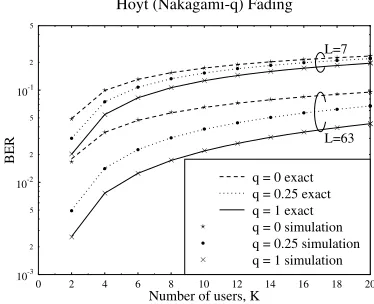
q = 0.25 simulation q = 1 simulationFig. 3. BER versus the number of users K in an asynchronous DS-CDMA system using random spreading sequences and BPSK modulation communicating over Hoyt channels. The length of the random spreading sequences is L = 7and63. The Hoyt fading parameter is q = 0 (one-sided Gauss), 0.25and 1 (Rayleigh), which is common to all users. The average power of all users at the receiver is equal and the background noise is ignored, i.e. we haveγSNR=∞.
V. NUMERICALRESULTS
Figures 1 and 2 illustrate the average BER performance versus the number of users in the context of Ricean fading channels, when the effects of background noise are ignored. Figure 1 compares the results obtained from our exact BER analysis to our simulation results and shows that they match very well both for various spreading sequence lengths and for various Ricean K-factors. On the other hand, Figure 2 compares the results obtained using the SGA to our simulation results and shows an interesting phenomenon. It is widely recognized that the SGA slightly over-estimates the average BER, when the Ricean K-factor isκ = 0, i.e. for Rayleigh fading. This has also been reported in [7]. By contrast, when
[image:4.567.43.280.573.642.2]ΦIk|λ0,λ1(ω) = ⎧ ⎪ ⎪ ⎨ ⎪ ⎪ ⎩
x λ1 F
1:0;0 1:0;1
(12) : 1,2:−; − ;
(32) : 1,2:−; [(1) : 1] ;− 1 4(σ
2
kx+σ2ky)ω2x2, 1
64(σ 2
kx−σ2ky)2ω4x4 λ0+λ1
λ0
, λ1= 0,
exp
−1
4
σ2kx+σ2ky
λ20ω2
I0
1 4
σ2kx−σ2ky
λ20ω2
, λ1= 0,
(16)
whereFCA::DB(1)(1);;......;;BD((nn)) (a) :θ
(1), ..., θ(n):(b(1)) :φ(1);...;(b(n)) :φ(n);
(c) :ψ(1), ..., ψ(n):(d(1)) :δ(1);...;(d(n)) :δ(n);x1, ..., xn is the generalized Lauricella
func-tion ofnvariables defined as Equations 21 - 23 of [14].
0 2 4 6 8 10 12 14 16 18 20
Number of users, K
10-3
2 5
10-2
2 5
10-1 2 5
BER
Hoyt (Nakagami-q) Fading
.
.
. .
. . . . .
..
.
.
. .
. . .
. . ..
L=7
L=63 q = 0 SGA q = 0.25 SGA q = 1 SGA q = 0 simulation
[image:5.567.47.237.164.325.2].
q = 0.25 simulation q = 1 simulationFig. 4. BER versus the number of users K in an asynchronous DS-CDMA system using random spreading sequences and BPSK modulation communicating over Hoyt channels. The length of the random spreading sequences isL= 7and63. The Hoyt fading parameter isq= 0(one-sided Gauss),0.25and1(Rayleigh). The average power of all users at the receiver is equal and the background noise is ignored, i.e. we haveγSNR=∞.
0 2 4 6 8 10 12 14 16 18 20
Number of users, K
10-4 2 5
10-3
2 5
10-2
2 5
10-1
2 5
BER
Nakagami-m Fading
.
. . .
. . . ..
.
. .
. . . .
..
L=7
L=63
m=0.5 exact m=1 exact m=2 exact
[image:5.567.314.504.173.324.2].
m=0.5 simulation m=1 simulation m=2 simulationFig. 5. BER versus the number of usersKin an asynchronous DS-CDMA system using random spreading sequences and BPSK modulation commu-nicating over Nakgami-m channels. The length of the random spreading sequences isL= 7and63. The Nakgami-mfading parameter ism= 0.5 (one-sided Gauss),1(Rayleigh) and2, which is common to all users. The average power of all users at the receiver is equal and the background noise is ignored, i.e. we haveγSNR=∞.
Figures 3 and 4 illustrate the average BER performance versus the number of users in the context of Hoyt fading channels, when the effects of background noise are ignored. Figure 3 compares the results obtained from our exact BER analysis to our simulation results and shows that they match very well both for different spreading sequence lengths and for various Hoyt fading parameters. On the other hand, Figure 4 compares the results obtained using the SGA to our simulation results and demonstrates that the SGA over-estimates the average BER, especially in the scenarios where either there
0 2 4 6 8 10 12 14 16 18 20
Number of users, K
10-4
2 5
10-3
2 5
10-2
2 5
10-1
2 5
BER
Nakagami-m Fading
.
. . .
. . . ..
.
. .
. . . .
..
L=7
L=63
m=0.5 SGA m=1 SGA m=2 SGA
[image:5.567.51.234.403.556.2].
m=0.5 simulation m=1 simulation m=2 simulationFig. 6. BER versus the number of usersKin an asynchronous DS-CDMA system using random spreading sequences and BPSK modulation commu-nicating over Nakagami-m channels. The length of the random spreading sequences isL= 7and63. The Nakagami-mfading parameter ism= 0.5 (one-sided Gauss), 1 (Rayleigh) and2. The average power of all users at the receiver is equal and the background noise is ignored, i.e. we have γSNR=∞.
is a limited number of interferers, or when the Hoyt fading parameter q is small or when short spreading sequences are used.
Figures 5 and 6 illustrate the achievable average BER performance versus the number of users in the context of Nakagami-mfading channels, when the effects of background noise are ignored. Figure 5 compares the results obtained from our exact BER analysis to our simulation results and shows that they match well both for various spreading sequence lengths and for various Nakagami-m fading parameters. On the other hand, Figure 6 compares the results obtained using the SGA to our simulation results and shows a similar phe-nomenon to that seen in Figure 2. The SGA slightly over-estimates the average BER when the Nakagami-m fading parameter is low, while it marginally under-estimates the average BER, when the Nakagami-mfading parameter is high.
VI. CONCLUSION
the spreading sequence length and the fading parameters. Fur-thermore, the SGA remains fairly accurate for most practical scenarios, although slightly over-estimates the average BER when the fading is severe, while it under-estimates the average BER, when the fading is benign, especially when either there is a low number of interferers, or the SNR is high and short spreading sequences are used.
REFERENCES
[1] M. B. Pursley, “Performance evaluation for phase-coded spread-spectrum multiple-access communication–part I: system analysis,”IEEE Trans. Commun., vol. 25, no. 8, pp. 795–799, Aug. 1977.
[2] J. S. Lehnert and M. B. Pursley, “Error probabilities for binary direct-sequence spread-spectrum communications with random signature se-quences,”IEEE Trans. Commun., vol. 35, no. 1, pp. 87–98, Jan. 1987. [3] J. R. K. Morrow and J. S. Lehnert, “Bit-to-bit error dependence in slotted DS/SSMA packet systems with random signature sequences,”
IEEE Trans. Commun., vol. 37, no. 10, pp. 1052–1061, Oct. 1989. [4] J. M. Holtzman, “A simple, accurate method to calculate
spread-spectrum multiple-access error probabilities,” IEEE Trans. Commun., vol. 40, no. 3, pp. 461–464, March 1992.
[5] M. O. Sunay and P. J. McLane, “Calculating error probabilities for DS-CDMA systems: when not to use the Gaussian approximation,” inProc. IEEE Global Telecommunications Conference, vol. 3, Nov. 1996, pp. 1744–1749.
[6] J. Cheng and N. Beaulieu, “Precise bit error rate calculation for asynchronous DS-CDMA in Nakagami fading,” inProc. IEEE Global Telecommunications Conference, vol. 2, Sept. 2000, pp. 980–984. [7] ——, “Accurate DS-CDMA bit-error probability calculation in Rayleigh
fading,”IEEE Trans. Wireless Commun., vol. 1, no. 1, pp. 3–15, Jan. 2002.
[8] J. H. Cho, Y. K. Jeong, and J. S. Lehnert, “Average bit-error-rate performance of band-limited DS/SSMA communications,”IEEE Trans. Commun., vol. 50, no. 7, pp. 1150–1159, July 2002.
[9] E. A. Geraniotis and M. B. Pursley, “Error probability for direct-sequence spread-spectrum multiple-access communications–part II: ap-proximations,”IEEE Trans. Commun., vol. 30, no. 5, pp. 985–995, May 1982.
[10] Q. Shi and M. Latva-Aho, “Accurate bit-error rate evaluation for syn-chronous MC-CDMA over Nakagami-m-fading channels using moment generating functions,”IEEE Trans. Wireless Commun., vol. 4, no. 2, pp. 422–433, March 2005.
[11] A. Annamalai, C. Tellambura, and V. K. Bhargava, “Equal-gain diversity receiver performance in wireless channels,” IEEE Trans. Commun., vol. 48, no. 10, pp. 1732–1745, Oct. 2000.
[12] I. S. Gradshteyn and I. M. Ryzhik, Table of Integrals, Series, and Products, 6th ed., A. Jeffrey and D. Zwillinger, eds. Academic Press, 2000.
[13] A. Erdelyi, W. Magnus, F. Oberhettinger, and F. G. Tricomi, eds.,Higher Transcendental Functions. New York, Toronto and London: McGraw-Hill Book Company, Inc., 1953, vol. 1.
[14] H. M. Srivastava and P. W. Karlsson,Multiple Gaussian Hypergeometric Series. Ellis Horwood, Ltd., 1985.
[15] A. Papoulis,Probability, Random Variables, and Stochastic Processes, 3rd ed. McGraw-Hill, Inc., 1991.
[16] M. Nakagami, “The m-distribution–a general formula of intensity distribution of rapid fading,” in Statistical Methods in Radio Wave Propagation, W. C. Hoffman, ed. London: Pergamon Press, 1960, pp. 3–36.
[17] S. O. Rice, “Statistical properties of a sine wave plus random noise,”
Bell Syst. Tech. J., vol. 27, pp. 109–157, Jan. 1948.
[18] R. S. Hoyt, “Probability functions for the modulus and angle of the normal complex variate,”Bell Syst. Tech. J., vol. 26, pp. 318–359, April 1947.
[19] Z. Du, J. Cheng, and N. C. Beaulieu, “BER analysis of BPSK signaling in ricean-faded cochannel interference,” inProc. IEEE Global Telecom-munications Conference, Nov. 2005, pp. 1211–1216.
[20] H. Exton,Handbook of Hypergeometric Integrals–Theory, Applications, Tables, Computer Programs. Chichester, New York, Brisbane, Toronto: Ellis Horwood Ltd., 1978.