BMC Health Services Research 2002,
2 x
Debate
Priority setting for new technologies in medicine:
A transdisciplinary study
Jennifer L Gibson*
1
, Douglas K Martin
2
and Peter A Singer
1,3
Address: 1University of Toronto Joint Centre for Bioethics, 88 College St, Toronto, Canada M5G-1L4, 2Collaborative Program in Bioethics, Department of Health Policy, Management and Evaluation, and Joint Centre for Bioethics, University of Toronto, 88 College St. Toronto, Canada M5G-1L4 and 3Department of Medicine, University of Toronto
E-mail: Jennifer L Gibson* - [email protected]; Douglas K Martin - [email protected]; Peter A Singer - [email protected]
*Corresponding author
Abstract
Background: Decision makers in health care organizations struggle with how to set priorities for new technologies in medicine. Traditional approaches to priority setting for new technologies in medicine are insufficient and there is no widely accepted model that can guide decision makers.
Discussion: Daniels and Sabin have developed an ethically based account about how priority setting decisions should be made. We have developed an empirically based account of how priority setting decisions are made. In this paper, we integrate these two accounts into a transdisciplinary model of priority setting for new technologies in medicine that is both ethically and empirically based.
Summary: We have developed a transdisciplinary model of priority setting that provides guidance to decision makers that they can operationalize to help address priority setting problems in their institution.
Background
Priority setting is a challenge for every health care system in the world because demand for health care outweighs the supply of resources allocated to finance it. Which pro-grams should a regional health authority fund? Which drugs should be placed on the drug benefit formulary? Which patients should be admitted to a hospital's critical care unit? Which priorities should a research granting body support?
There are no widely accepted models for legitimate and fair priority setting in health care to help address these questions. Traditionally, approaches from health eco-nomics are promoted as the solution to the problem of
priority setting. Health economics provides necessary but insufficient tools (e.g. cost-effectiveness analysis, program budgeting and marginal analysis [1]) to aid priority set-ting decision makers. Studies of actual priority setset-ting show that these tools have only limited influence on deci-sion making and the analyses are often unavailable when needed [2–4]. Priority setting for new technologies, for ex-ample, is frequently conducted under conditions of vary-ing degrees of evidence about the safety, effectiveness, and appropriateness of particular interventions [3]. Moreover, there is no consensus regarding the values these approach-es emphasize (i.e. efficiency) [5–9]. The Institute of Med-icine Panel on Cost-Effectiveness in Health and MedMed-icine argued that, "... CEA [should] be used as an aid to decision
Published: 18 July 2002
BMC Health Services Research 2002, 2:14
Received: 21 December 2001 Accepted: 18 July 2002
This article is available from: http://www.biomedcentral.com/1472-6963/2/14
makers who must weigh the information it provides in the context of ... other values [10]." Other values important to priority setting include equity, the health of individuals as against communities, the "rule of rescue," and democratic decision making [11]. Unpacking these values helps to clarify choices, but reasonable people, having diverse moral views, disagree about what constitutes a fair alloca-tion of resources to meet competing health care needs. In the absence of consensus on guiding principles, the prob-lem of priority setting becomes one of procedural justice – legitimate institutions using fair processes [12].
Discipline-specific ethical approaches to priority setting (e.g. from philosophy, law, political science, medicine, and health economics) are insufficient because they are not grounded in actual experiences of priority setting in health care institutions and because the values that they contribute to priority setting conflict. Empirical descrip-tions of priority setting that focus, for example, on consid-erations of safety, effectiveness, and appropriateness of particular preventive, diagnostic or therapeutic interven-tions are also insufficient. This is because, though ground-ed in actual experiences of priority setting, they cannot alone provide normative guidance about what should be done. What is needed, therefore, is a synthesis that incor-porates both ethical and empirical considerations. A transdisciplinary model, based in empirical realities of de-cision making and justified by ethical values, can provide such a synthesis.
In this paper, we develop a transdisciplinary model of health care priority setting. Transdisciplinary research – "re-searchers work [ing] jointly using shared conceptual framework drawing together disciplinary specific theories, concepts and approaches to address common problems" – can be contrasted with interdisciplinary research – "re-searchers work [ing] jointly but still from a disciplinary-specific basis on [a] common problem" – and multidisci-plinary research – "researchers work [ing] in parallel from their respective disciplinary bases to address a common problem" [13]. By integrating an ethically based account of health care priority setting (accountability for reasona-bleness) with an empirically based one (diamond model)
as described below, we have engaged in a transdiscipli-nary effort. The result is a model because it consists of plausible relationships proposed among concepts and sets of concepts [14]. However, the innovation here is not the resulting model, though the transdisciplinary model is an advance on its parent-models, but rather the transdis-ciplinary approach to the problem of priority setting.
Discussion
Accountability for reasonableness: an ethically-based ac-count of priority setting
Daniels and Sabin identify two key problems at the heart of health care priority setting: legitimacy and fairness [15]. The legitimacy problem poses the question: under what conditions should authority over priority setting decisions be placed in the hands of a particular organization, group or person? The fairness problem poses the question: when does a patient or clinician have sufficient reason to accept priority setting decisions as fair? An institution's priority setting decisions may be considered legitimate and fair if they satisfy four conditions of accountability for reasona-bleness: relevance, publicity, appeals, and enforcement (Table 1).
Although developed in the empirical context of US man-aged care organizations, the strength of accountability for reasonableness lies in its ethical roots found in theories of democratic deliberation, grounded in the disciplines of philosophical ethics and political philosophy. These roots connect the priority setting process in accountability for reasonableness with broader democratic processes.
The limitation of accountability for reasonableness is that it does not sufficiently explain how an institution might go about operationalizing the model. For example, how should institutional administrators go about putting the relevance condition into practice?
Diamond model of health care priority setting: An empiri-cally-based account
Our case study of priority setting for new technologies in medicine in two health care institutions provides a de-scriptive account of how priority setting decisions are
ac-Table 1: The four conditions of accountability for reasonableness [15]
Publicity Limit-setting decisions and their rationales must be publicly accessible.
Relevance These rationales must rest on information and principled arguments that fair-minded parties (people predisposed to working together under rules of mutual cooperation) can agree are relevant to deciding how to meet the diverse needs of a covered popula-tion under necessary resource constraints.
Appeals There is a mechanism for challenge and dispute resolution regarding limit-setting decisions, including the opportunity for revising decisions in light of further evidence or arguments.
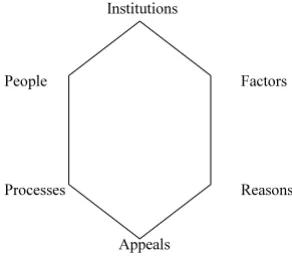
tually made [16,17]. In the case study, we analyzed documents, interviewed people and observed meetings of groups making priority setting decisions. Based on these data, we developed the diamond model of health care pri-ority setting (Figure 1).
The six elements are described briefly below:
• Institutions
Priority setting occurs in an institution with a mandate to set priorities; variations between institutional cultures af-fect priority setting.
• People
Groups of people contributing a spectrum of factors and arguments are involved in priority setting.
• Factors
Factors considered important by priority setting decision makers include benefit, evidence, cost, cost-effectiveness, and equity.
• Reasons
Priority-setting decisions involve clusters of factors that vary according to the decision. The previous conception of priority setting as trade-off (eg, equity vs efficiency) was too simplistic and abstract to describe actual priority set-ting reasoning. Reasons are assembled by combining these factor-clusters in support of a particular decision. Fi-nally, each decision and rationale is compared with previ-ous decisions and rationales in a casuistry or "case law" that helps to ensure consistency.
• Process
Priority setting includes certain procedural safeguards such as transparency, disclosure of conflicts of interest,
fair access to decision makers, and fair chairing and lead-ership of the priority setting group.
• Appeals
Decisions are open to review based on new information or arguments.
The diamond model reflects the fact that legitimacy and fairness are not all or none phenomena. Instead, they lie along a spectrum and priority setting can be more or less legitimate and fair. Much as a gem's flawlessness depends on the flawlessness of its facets, legitimate and fair priority setting depends on the legitimacy and fairness of each of six elements identified in our study.
The strength of the diamond model lies in its empirical roots, grounded in the discipline(s) of the social sciences. Because it reflects the realities of actual decision making, it can more easily be put into practice than an ethically based account.
The major limitation of the model is that simply because a group makes priority setting decisions in a particular way does not make these decisions "right". An ideal mod-el of health care priority setting will need to specify what should be done (i.e. justified ethically) and how it can be done (i.e. based in empirical reality).
A transdisciplinary model of priority setting in health care institutions
[image:3.612.106.252.96.226.2]By combining accountability for reasonableness with the diamond model, we developed a transdisciplinary model of priority setting that has a solid ethical justification and Figure 1
The diamond model of priority setting
Institutions
People Factors
Processes Reasons
Appeals
Figure 2
A model of accountability for priority setting in health care institutions
People Institutions
accountability
reasonableness
Rationales
transparency responsiveness
[image:3.612.315.526.512.661.2]deep empirical roots so it is more easily put into practice in a particular context (see Figure 2).
We integrated these two accounts as follows (Table 2). First, because reasons are central to priority setting, we col-lapsed together the elements of "reasons" and "factors" in our diamond model into the concept of "rationales" and positioned this as the central concept of the transdiscipli-nary model. Second, we arranged three elements of the diamond model – processes, people, and appeals – around the central concept of rationales (see Table 2, left hand column), because we discovered that conditions of ac-countability for reasonableness – relevance, publicity, and appeals (Table 2, middle column) – bound these ele-ments to rationales. Third, we replaced these conditions with operational goals: reasonableness, transparency, re-sponsiveness, and accountability (Table 2, right hand col-umn). Finally, we situated the model in the "institutions" element of the diamond model, which accords with the enforcement condition of accountability for reasonable-ness, and supports an operational goal of accountability.
This new model is a more practical and user-friendly ver-sion of accountability for reasonableness that can guide health care decision makers in actual priority setting. There would be constraints in each domain from account-ability for reasonableness. Institutions would have to be duly delegated to make these decisions; people would have to represent an appropriate array of perspectives; the people in the context would have to determine what fac-tors should be included in the rationales; the process would have to make reasons transparent not only to par-ticipants but to people affected by the decisions; and ap-peals would have to be responsive to the rationales.
Implications for decision makers
Imagine that a health care institution such as a hospital, managed care organization, or regional health authority is charged with priority setting for new technologies in med-icine. The following steps, based on the transdisciplinary model, offer guidance to the institution to ensure that their priority setting is legitimate and fair:
Step 1
Bring together a committee of fair-minded people to make priority setting decisions. The group should include a broad spectrum of individuals from within the organiza-tion, as well as patients and members of the public. They should focus on the reasonableness of the rationales for each decision.
Step 2
Put into place processes to ensure the transparency of the decision making activities (e.g. public notices and town hall meetings) and to ensure that the rationales are widely available.
Step 3
Design methods to hear appeals regarding the rationales for decisions and to respond to further evidence or argu-ments.
Step 4
Develop mechanisms of institutional accountability to en-sure that the first three steps are followed.
Comparison with current practice
Although studies of actual priority setting practices are rare, they often resemble aspects of the transdisciplinary model. In the US, accountability for reasonableness was itself developed in the context of private sector managed care institutions and is being applied to pharmaceutical benefit management [18,19]. In Canada, the diamond model was developed in the context of public sector insti-tutions making decisions about new technologies in can-cer and cardiac care. In the UK, Oxfordshire Health Authority has developed a "Priorities Forum" that illus-trates many aspects of the transdisciplinary model [20].
[image:4.612.58.553.110.195.2]There may be differences in how some public or private institutions might go about implementing the transdisci-plinary model. Many public institutions are already obli-gated by law to disclose their decision making practices and outcomes and to include a broad representation of public stakeholders. Adoption of the transdisciplinary
Table 2: Relationships among diamond model elements, accountability for reasonableness conditions, and transdisciplinary model op-erational goals
Diamond model elements Accountability for Reasonableness conditions Transdisciplinary model Operational goals
Rationales → People Relevance Reasonableness
Rationales → Process Publicity Transparency
Rationales → Appeals Appeals Responsiveness
Publish with BioMed Central and every scientist can read your work free of charge
"BioMedcentral will be the most significant development for disseminating the results of biomedical research in our lifetime."
Paul Nurse, Director-General, Imperial Cancer Research Fund
Publish with BMCand your research papers will be:
available free of charge to the entire biomedical community
peer reviewed and published immediately upon acceptance
cited in PubMed and archived on PubMed Central
yours - you keep the copyright
[email protected] Submit your manuscript here:
http://www.biomedcentral.com/manuscript/
BioMedcentral.com model would therefore entail a less radical transformation
of their institutional culture and practices than will be the case for many private institutions that have, up until this point, been under no such obligations [18].
Both accountability for reasonableness and the diamond model – and therefore the transdisciplinary model – were developed in the context of priority setting for new tech-nologies. It would be reasonable to expect that the transdisciplinary approach might be more broadly appli-cable, for example, to decision making about bed closures or space allocation or staffing, or around strategic, capital, and operational planning both at the hospital level and at the clinical level. If this exercise were repeated in different contexts, the resulting transdisciplinary models may very well look quite different. This transdisciplinary model may not be fully generalizable to all contexts, though we expect that it will offer some guidance to decision makers across many priority setting contexts.
Summary
Priority setting decision makers have had little guidance to help them develop their processes. Traditional disci-pline-specific approaches are insufficient because they cannot tell decision makers what to do in specific con-texts, and empirically derived models of actual decision making are insufficient because they cannot provide nor-mative guidance. We have developed a transdisciplinary model of priority setting that provides guidance to deci-sion makers that they can operationalize to help address priority setting problems in their institution.
Funding
The project was funded by a grant from the Medical Re-search Council of Canada/Canadian Institutes of Health Research and the Physicians Services Incorporated Foun-dation. Dr. Gibson is supported by a Canadian Health Services Research Foundation post-doctoral award. Dr. Singer is supported by a Canadian Institutes of Health Re-search Investigator award.
Competing interests
None declaredAcknowledgements
We are grateful to Solomon Benatar and Norman Daniels for comments, Marc Berger for helpful discussions, and Althea Blackburn-Evans for editing the manuscript.
References
1. Scott A, Currie N, Donaldson C: Evaluating innovation in gener-al practice: a pragmatic framework using programme budg-eting and marginal analysis.Family Practice 1998, 15:216-22 2. PausJenssen A, Singer PA, Detsky AS: How Ontario's Formulary
Committee Makes Recommendations. Pharmacoeconomics
2002
3. Martin DK, Pater JL, Singer PA: Priority-setting decisions for new cancer drugs: a qualitative case study.Lancet 2001, 358:1676-81
4. Ham C, Coulter A: Explicit and implicit rationing: taking re-sponsibility and avoiding blame for health care choices. Jour-nal of Health Services Research and Policy 2001, 6:163-9
5. Loughlin M: Rationing, barbarity, and the economist's per-spective.Health Care Analysis 1996, 4:146-156
6. van der Wilt GJ: Cost-effectiveness analysis of health care serv-ices, and concepts of distributive justice.Health Care Analysis
1994, 2:296-305
7. Williams A: Cost-effectiveness analysis: Is it ethical?Journal of Medical Ethics 1992, 18:7-11
8. Singer P, McKie J, Kuhse H, Richardson J: Double jeopardy and the use of QALYs in health care allocation.Journal of Medical Ethics
1995, 21:144-50
9. Drummond M, Torrance G, Mason J: Cost-effectiveness league tables: More harm than good?Social Science & Medicine 1993,
37:33-40
10. Russel LB, Gold MR, Siegel JE, Daniels N, Weinstein MC, for the Panel on Cost-Effectiveness in Health and Medicine: Journal of the American Medical Association 1996, 276:1172-7
11. Daniels N: Four unsolved rationing problems.Hastings Center Re-port 1994, 24:27-9
12. Daniels N, Sabin J: Limits to health care: Fair procedures, dem-ocratic deliberation, and the legitimacy problem for insur-ers.Philosophy and Public Affairs 1997, 26:303-50
13. Rosenfield PL: The potential of transdisciplinary research for sustaining and extending linkages between the health and so-cial sciences.Social Science & Medicine 1992, 35(11):1343-1357 14. Strauss A, Corbin J: Grounded Theory Methodology: An
Over-view.In Handbook of Qualitative Research. (Edited by: Denzin NK, Lin-coln YS) Thousand Oaks, CA: Sage Publications Inc. 1994, 278
15. Daniels N, Sabin JE: Limits to Health Care: Fair Procedures, Democratic Deliberation and the Legitimacy Problem for Insurers.Philosophy and Public Affairs 1997, 26(4):303-502 16. Singer PA, Martin DK, Giacomini M, Purdy L: Priority setting for
new technologies in medicine: A Qualitative Study. British Medical Journal 2000, 321:1316-8
17. Martin DK, Pater JL, Singer PA: Priority-setting decisions for new cancer drugs: a qualitative case study.Lancet 2001, 358:1676-81 18. Daniels N, Sabin JE: The ethics of accountability in managed
care reform.Health Affairs 1998, 17(5):50-64
19. Daniels N: Accountability for reasonableness in private and public health insurance.In The global challenge of health care ration-ing (Edited by: A. Coulter and C. Ham) Buckingham, UK: Open University Press 2000, 89-106
20. Hope T, Hicks N, Reynolds DJM, Crisp R, Griffiths S: Rationing and the health authority.British Medical Journal 1998, 317:1067-9
Pre-publication history
The pre-publication history for this paper can be accessed here: